

A halal wedding menu works best when you treat it as three separate jobs: deciding what “halal” means for your families, keeping those dishes physically apart from everything else in the kitchen and on the buffet, and proving both with paperwork and a simple temperature record, so every guest, whatever they eat, can trust what is on their plate.
Quick answer
Start by asking the couple’s families, and any guests who observe halal, what they expect: halal meat only, no pork and no alcohol, or a stricter standard that also covers sauces, desserts, and shared equipment. Then pick one of two paths. Either serve a fully halal wedding menu to everyone, which is the simplest kitchen to run, or run two clearly separated lanes with their own tools, labels, and serving staff. Get the meat source and certification in writing, ask about hidden ingredients such as gelatin and alcohol-based flavorings, keep food allergens and gluten on a separate list from faith rules, and have one person log hot and cold holding temperatures at every buffet or grazing table. This guide gives you the questions, a sorting method, and a monitoring record you can copy.
Before you can plan a halal wedding menu, you need a shared definition of the word. That sounds basic, but it is where most misunderstandings begin: a caterer may hear “halal” and think “no pork,” while a grandparent hears it and expects certified meat, no alcohol in any form, and separate cookware. None of these people is wrong to hold their view, and each is picturing a different halal wedding menu. The planning job is to find out which standard applies at your wedding and write it down.
This guide is general planning information. It is not a religious ruling, a food-safety certification, or legal or medical advice. For questions of religious practice, ask the people whose practice it is, such as your families or your imam, and for allergies, ask the guest and their clinician.
Halal is a dietary category with several layers
The Arabic word halal means permitted, and its counterpart, haram, means forbidden. In food, the category reaches past a single ingredient. It touches where meat comes from, how an animal was slaughtered, what else is in a processed product, and whether permitted food has touched anything forbidden on the way to the plate. Thinking in layers helps you ask better questions of a caterer.
Meat and slaughter
Sources that explain halal for general audiences describe pork and pork products, blood, and animals that were not slaughtered in the prescribed way as forbidden, and they describe prescribed slaughter as one done with minimal suffering and with God’s name pronounced. A Toronto Public Health fact sheet uses the term zabihah for that process and states that, under its guidance, all meat must be zabihah and that meat not certified halal is haram. A Pluralism Project overview adds that some Muslims hold a more flexible view, for example eating the slaughtered meat of Jews and Christians, citing a passage of the Qur’an, or choosing kosher food when halal is hard to find.
For a halal wedding menu, the practical point is simple. “Chicken” on a caterer’s proposal does not tell you whether that chicken is halal, and “halal chicken” does not tell you who certified it. Treat the meat as the first layer to confirm.
Ingredients that hide in sauces and desserts
The second layer is processed ingredients. The Halal Foundation’s guide to forbidden foods lists gelatin, alcohol-based flavorings, and enzymes of uncertain source among the items to check, and it states that any trace of alcohol makes a food impermissible under its standard. The Toronto fact sheet lists lard, tallow, broth, rennet, and gelatin from pork or non-zabihah animals, notes fish gelatin as an exception, and names pure vanilla extract as an item to avoid, while powdered vanilla is acceptable. It also says some ingredients depend on their source, such as certain flavorings, lipase, mono- and diglycerides, and whey made with rennet.
Notice the pattern: these are the ingredients that appear in sauces, glazes, cheeses, cakes, and frostings, the very items a caterer may buy pre-made. A person who has never had to read a label this way will not think to mention them, which is why the later sections give you a decoder table to hand to your caterer.
Why Muslim guests and families may differ
Planning gets easier when you stop looking for one correct halal standard and start asking who needs what. Muslims around the world follow a range of practices, and even within one family, an aunt and a cousin may draw lines in different places.
Minimal, strict, and extended approaches
The Pluralism Project describes three broad patterns among American Muslims. A minimal approach holds that avoiding pork, pork lard, and alcohol, and saying a blessing before eating, is enough. A strict approach insists on Islamically slaughtered meat and checks product labels for forbidden ingredients. An extended approach goes further and avoids certain non-food items as well. These are general descriptions from one educational source, not a ranking, and individuals may not fit neatly into any of them.
For you, the useful move is to ask guests which of these describes what they need, in plain words, without assuming. “Is halal meat enough, or do you also want separate cookware and no alcohol in sauces?” is a respectful question with a usable answer.
Ask the people who actually decide
If the wedding has two families with different practices, decide in advance who has the final say on the halal wedding menu standard. In many cases it will be the couple, guided by their parents. Settle that before you meet caterers, because a caterer will ask, and an uncertain answer leads to a vague contract.
If you are unsure what a family expects, ask a trusted elder or the family’s imam. A caterer cannot answer that question for you, and neither can this guide.
Halal, certified, and “halal-friendly” are not the same claim
When you read caterer websites, you will see several phrases that sound similar and mean different things. Learning to tell them apart will save you from the most common planning mistake: believing a claim that was never actually made.
There is no single federal definition
According to a September 2025 Food Safety News article, the USDA’s Food Safety and Inspection Service says it does not get involved in defining religious standards such as what is or is not halal, although a petitioner argues it still has a duty to make sure labels are not misleading. The same article describes a pending 2025 petition asking the agency to define “zabiha halal” or to require third-party certification for the term. We did not verify what has happened with that petition since the article ran, so treat it as background, not as current law.
What this means for you is practical. A restaurant or caterer that says “halal” is making a claim whose meaning may depend on that business, its supplier, and any certifier it uses. Ask what the claim rests on.
Put the claim and the evidence in writing
The Toronto fact sheet, written for Canadian consumers, advises that a package claiming to be halal should name the certifying organization, and that a symbol alone is not enough. US labels vary, so do not assume the same rule applies, but the habit is a good one: for each halal item, ask for the supplier’s name, the certifier’s name, and a copy of the certificate or invoice, and put “halal” and the standard you agreed on into the contract. A caterer who is confident in their supply chain will usually share this without fuss.
Never assume that “halal-friendly,” “no pork,” or “halal-style” means certified halal meat. If any of those phrases appears on a proposal, ask the caterer to say exactly what it covers.
A halal wedding menu built for a vague idea of your guests will fail the people who actually need it. A short, honest tally of who needs what does more for your catering plan than any list of dishes. It also tells you whether to serve one menu or two.
Collect dietary needs in a way that gets honest answers
Guests under-report when they feel they are being difficult, and they over-report when the question is too loose. A good question gives a few clear options and an open box for details, and it should fit the halal wedding menu you are actually planning. Our guide to wedding dietary restrictions covers the general approach, and the notes below add what is specific to a halal wedding menu.
Wording the RSVP question
Ask one question that separates a need from a preference, for example: “Please tell us about any food needs we should plan for, including halal, vegetarian, allergies, or other requirements.” Then give a free-text box and say that you will follow up by phone or message if you need details. If you need help with phrasing, our wedding RSVP wording guide has examples, and our guide to exporting RSVP data helps you turn the answers into a sortable list.
Asking about halal, pork, and certified-only separately
Do not treat “halal” as a single checkbox. A guest who ticks it may mean any of three things: they eat halal meat only, they avoid pork and alcohol, or they need certified halal and separate preparation. In a follow-up message, ask the three-part question in plain terms and record the answer in your list.
If a guest hesitates, do not push. Say that you want to make sure they have a full plate and that a short answer is fine.
Sort needs into three groups
Not every dietary need carries the same weight, and treating them all the same leads to bad decisions. Faith rules, medical needs, and preferences each call for a different kind of care from the kitchen.
Faith-based rules
Halal needs belong to the group where trust matters most, and they shape the halal wedding menu more than any other group. The guest is relying on the couple and the caterer to keep a standard that matters to them, and a mistake is a breach of that trust even if no one is harmed physically. For these guests, the evidence, the separation of equipment, and the honesty of the labels are the main tests.
Allergy and medical rules
Food allergies and celiac disease belong in a separate group because the consequence of an error is a health risk, not a matter of faith. The FDA lists nine major food allergens: milk, eggs, fish, crustacean shellfish, tree nuts, peanuts, wheat, soybeans, and sesame. Keep these on a different list from halal needs, even when one guest has both. A halal-certified dish can still contain nuts or milk, and a nut-free dish can still contain pork.
Count the overlap
Once you have the list, count how many guests fall into each group and how many fall into more than one. The overlap is what tells you which dishes in the halal wedding menu will do the most work, and it keeps you from designing a separate meal for every person.
A sample tally
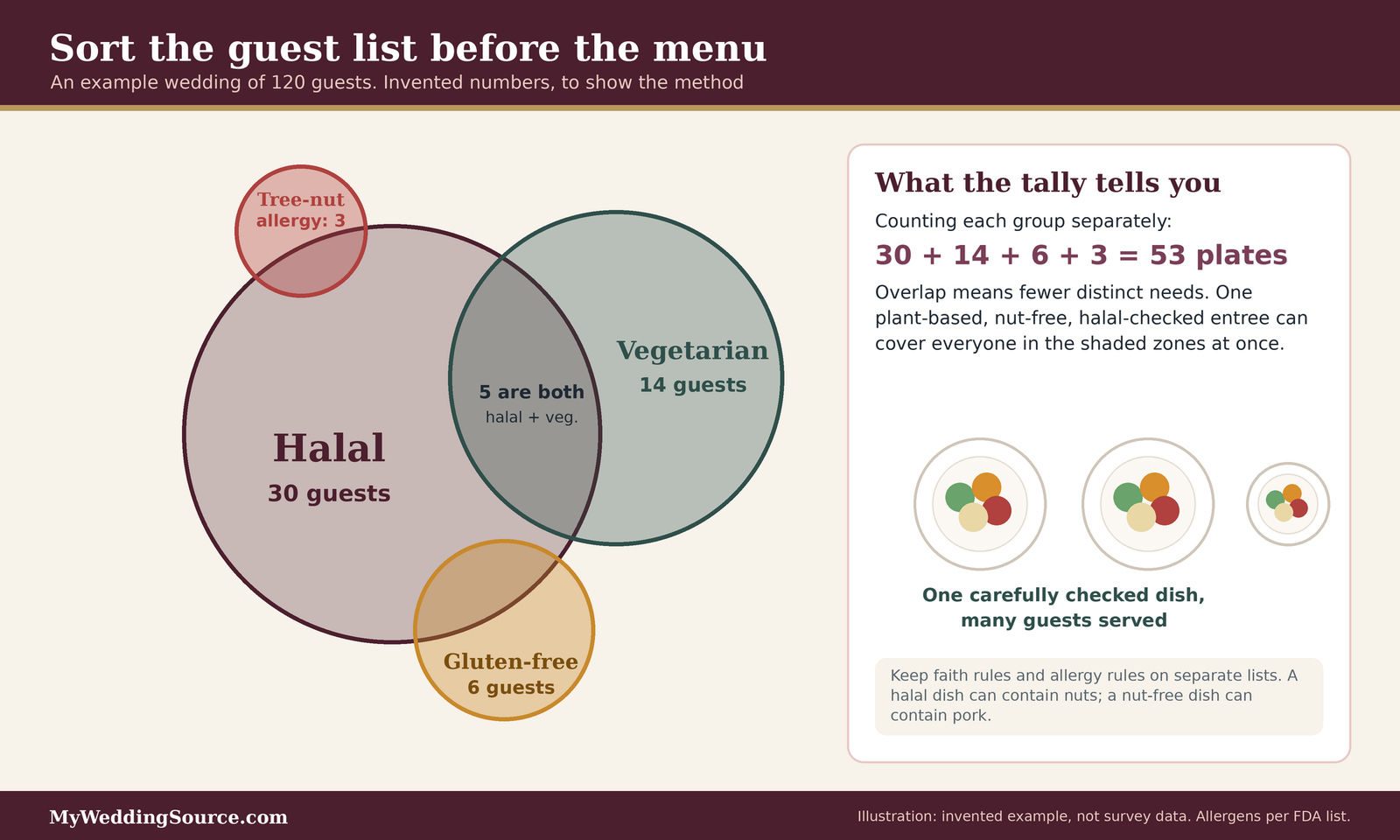
Here is a made-up example, to show the method and not a prediction: a wedding of 120 guests, where 30 observe halal, 14 are vegetarian, 6 need gluten-free meals, and 3 have a tree-nut allergy. Some of these overlap: for instance, 5 of the halal guests are also vegetarian, and one has a nut allergy. Counting only the groups, 53 plates seem to need special attention, but the overlap means the real number of distinct needs is lower, and a vegetarian, halal-safe, nut-free entree might serve 5 or more guests at once. This tally is our own illustrative arithmetic, not data from any source.
Using the tally to choose the service style
If a quarter of the room needs halal, you are closer to the decision point than if a single table does. The larger the share, the stronger the case for making the entire menu halal and avoiding a two-lane kitchen. If halal is a small share, a separate lane with separate tools may be more practical, though the halal wedding menu then needs closer supervision. The next section compares the options.
Choose a service style that keeps halal food protected
How food is served matters as much as what is served. A well-sourced halal wedding menu can still fail at the buffet if one spoon travels between a halal dish and a non-halal one. Food-safety and allergy sources agree on the mechanism: shared utensils, shared surfaces, and crowded service lines are where mixing happens.
Compare the common service styles
Our guides to wedding catering service planning and family-style service for long tables describe each style in general. The comparison below looks at each one through the lens of keeping a halal wedding menu intact.
Plated service gives you the most control
With plated meals in a halal wedding menu, each guest receives a plate prepared in the kitchen, so you can mark the halal plates, send them out first or by a separate server, and keep utensils from crossing. Plated service also lets guests choose a meal in advance on the RSVP, which gives the kitchen a count. The trade-off is that you must collect meal choices early and match every plate to a seat, so reliable place cards or table numbers become part of the plan.
Buffets and stations need extra rules
A buffet puts many foods close together and lets guests handle shared utensils. Food Allergy Research and Education, in its guide to dining out, calls buffets a high cross-contact risk for people with allergies, and the American Academy of Allergy, Asthma and Immunology advises against reusing utensils between dishes. Both warnings apply to halal as well, because a spoon that touched a forbidden ingredient carries it to the next dish. If you choose a buffet, use a separate line or a separate table for halal dishes, give each dish its own utensil, and have a staff member watch the line. Our dessert bar versus wedding cake guide has a similar caution for self-serve sweets.
One kitchen, one menu: the all-halal approach
The simplest way to protect a halal wedding menu is to make the whole menu halal, for every guest. This does not mean the food must be limited or plain. It means the caterer sources every ingredient to one standard, so there is nothing to separate.
Why it is the simplest path
With one standard in the kitchen, there is no lane to guard, no second set of tools, and no label to get wrong. Servers do not have to remember which dish is which, and guests who observe halal never have to ask. For couples in which a large share of guests or both families observe halal, a single halal wedding menu is usually the most relaxing way to host.
A fully halal wedding menu also removes the awkward moment when a guest has to point out that a dish is not suitable. The cost is that you must choose a caterer who can source and document the whole menu, and that you will give up a few dishes that rely on pork or alcohol, such as a wine reduction.
What it costs you
An all-halal menu changes the sourcing, not necessarily the size of the bill. We could not find reliable published price comparisons between halal-certified and conventional catering inputs, so we are not going to give you a number. Ask caterers to quote the same menu both ways and compare the lines. Our wedding catering cost guide explains how per-guest pricing works, and the cost per guest guide helps you test the totals.
Where the money moves
Ask each caterer for a written quote that shows the halal meat as its own line, the number of separate serving stations, and any extra staff for a second lane. Our own arithmetic, not a market price: if a second lane needs two extra servers for a four-hour reception, the cost is two people times four hours times the caterer’s hourly rate, plus any extra equipment. Compare that to the cost of making the whole menu halal and decide which is simpler to manage. We are not recommending any caterer, certifier, or product.
Two lanes in one room
Some weddings need a mixed menu, either because only a few guests observe halal or because the venue requires its own caterer. In that case, you are building a second kitchen workflow inside the first, and every point of contact must be controlled.
Separate preparation, tools, and cookware
A halal lane in a mixed halal wedding menu works only if the preparation is separate too. That means separate cutting boards, pans, and utensils, a clean workspace, and a cook who has been told what the standard is. The AAAAI guidance on event food, written for allergies, makes the same point in a different context: avoid sharing mixers, pans, and cutting surfaces between foods. Ask your caterer to describe the steps in their own words, and listen for specifics, such as a separate prep area, color-coded tools, or a separate oven rack.
Separate service, labels, and sequence
The second half of the job is service. Serve halal dishes first or from a separate line, use dedicated serving utensils, and label every dish with plain words, such as “Halal chicken, contains dairy and sesame.” The labels should do two things at once, naming the halal status and the allergens, because guests with both needs will look for both. Our wedding signage guide covers layout and legibility.

| Service style | Control over halal separation | Main risk | What to ask the caterer |
|---|---|---|---|
| Plated, pre-selected | High | Wrong plate at a seat | How are halal plates marked and delivered? |
| Plated, same entree for all | Highest, if the entree is halal | Hidden ingredients in sauces or sides | Can you show the supplier and certificate? |
| Family style | Medium | Shared platters and passing | Is there a separate halal platter and utensil? |
| Buffet | Lower | Shared spoons and crowded lines | Is there a separate line, and who monitors it? |
| Stations | Medium | Cross-contact at shared work surfaces | Is each station separate, with its own tools? |
| Grazing table | Lower | Shared boards, tongs, and items touching | Can a halal section be built apart, and logged? |
Reading the table
The table is a planning aid. A higher control level does not make a style better for every wedding, only easier to protect.
When the styles disagree with your budget
Plated service gives the most control over a halal wedding menu but may cost more in staffing. A buffet costs less in staff, but you pay for it in monitoring effort. If you must choose a buffet, put money into a separate halal line and a dedicated server instead of more dishes.
When the venue sets the style
Some venues only allow certain service styles. If yours does, work backward from the style: ask what separation the venue and caterer can really deliver, and decide whether the answer meets your standard. Our wedding venue questions guide lists what to ask before you sign.
With the standard and the service style chosen, you can design the food. The goal is a halal wedding menu where every guest has a full, interesting plate, and where the halal standard does not depend on someone remembering a rule at the last minute.
Choose proteins you can document
Meat is the layer of a halal wedding menu with the most evidence to collect, so decide it first. A halal wedding menu is easier to document when it has fewer proteins from fewer suppliers.
Name the supplier and the certifier
For each meat on the menu, ask for the supplier name, the certifier or the standard they follow, and the date of the most recent certificate or invoice. Ask whether the caterer buys the meat already halal or whether they rely on a separate halal supplier, and ask what happens if that supplier runs short close to the date. Write the answers into the contract. If the standard you agreed on is zabihah, say so in those words, since the Toronto guidance treats zabihah as the process that makes meat halal, and not all caterers use the term the same way.
Plan a vegetarian anchor
A vegetarian main course is useful in any halal wedding menu with mixed diets, because it serves vegetarian guests, many halal guests, and guests who skip meat for other reasons. The Toronto fact sheet notes that plant-based foods are generally halal, but the same sheet warns about hidden sources in processed ingredients, so a vegetarian dish is not automatically safe. Ask about the stock, the cheese, the sauce, and any alcohol used in cooking. If a dish contains cheese, ask whether the rennet is animal-derived, because that sheet lists whey made with rennet among the ingredients that depend on the source.
Check sauces, stocks, and flavorings
Most mistakes in a halal wedding menu do not come from the meat. They come from a spoonful of stock, a splash of wine, or a flavoring that the cook did not think of as an ingredient.
Stocks, wine reductions, and marinades
Ask the caterer to name every sauce and its base. Wine and spirits are the obvious items, and a menu can usually replace them with a stock, juice, or vinegar-based option. Stocks are less obvious, since a purchased stock base can contain pork or non-halal animal ingredients. The Halal Foundation’s guidance says any trace of alcohol makes food impermissible under its standard, while other families may hold a different view about alcohol cooked off in a sauce, so ask your family which standard applies.
Vanilla, extracts, and flavorings
Flavorings are easy to overlook. The Toronto fact sheet says pure or artificial vanilla extract is impermissible under its guidance, except powdered vanilla, and it lists certain flavorings among ingredients whose status depends on their source. Positions on extracts vary among families and scholars, so we are reporting one published view, not settling the question. The useful step is to ask your caterer’s pastry team what they use and to ask your family which standard to apply.
Desserts, cake, and gelatin
Sweets in a halal wedding menu deserve their own review, since they are often bought from a separate bakery with its own supply chain. FARE’s dining-out guide notes that desserts often come from specialty shops where full ingredient lists may be unavailable, a caution that applies to halal checking as much as to allergies.
Cake, frosting, and fillings
Ask the bakery for the full ingredient list of each tier, filling, and frosting, including the flavoring used. Mousses, fondants, and glazes may use gelatin, and some fillings use alcohol. The Toronto sheet treats gelatin from pork or non-zabihah animals as impermissible and fish gelatin as an exception, so ask what the gelatin is made from. If the bakery cannot answer, choose a different filling. Our guide to the wedding cake and wedding cake flavors can help you pick a simpler design.
Dessert tables and shared tongs
A dessert table has the same problem as a buffet, spread over many small items. Label each dessert, give each its own tongs or server, and keep any allergen-containing item, such as a nut tart, apart from the others. We are writing a separate guide on wedding dessert station allergens, which will go deeper on this.
Starters, sides, and fried food
Starters and sides are where a halal wedding menu can shine, because many traditional dishes are plant-based. They are also where shared equipment hides.
Shared fryers and griddles
FARE’s guide names the grill and frying oil as places where cross-contact is likely, and the AAAAI notes that heating oil does not destroy allergens. For halal, the principle is the same: if the fryer cooks both halal and non-halal items, the oil is shared. Ask whether the fryer is dedicated, and if it is not, remove fried items from the plan or cook them in a separate pan.
Rice, bread, and salads
Rice, flatbreads, and salads are easy to make halal, but ask about the fat in the rice, the glaze on the bread, and the dressing on the salad. Butter can be swapped for oil, and a dressing can be made without wine vinegar if your family prefers. A short, specific list of sides gives you fewer checks to make.
| Item | Why it may matter | Ask this | Evidence to request |
|---|---|---|---|
| Chicken, lamb, beef | Meat must meet the agreed standard | Who is the supplier and certifier? | Certificate or invoice |
| Cured meats, sausages | May contain pork or non-halal casings | Is each product halal-certified? | Product label or spec sheet |
| Stock and bouillon | May contain pork or non-halal animal ingredients | What is the base, and who makes it? | Ingredient label |
| Wine, spirits, beer | Alcohol is excluded under many standards | Is any used in cooking or glazes? | Written recipe list |
| Vanilla and flavorings | Some extracts contain alcohol | Which extract or flavoring is used? | Product label |
| Gelatin | May come from pork or non-halal animals | What is the source, or is it plant-based? | Supplier statement |
| Cheese | Rennet may be animal-derived | Is the rennet microbial or animal? | Product label or supplier |
| Mono- and diglycerides, lipase | Status depends on source | What is the source? | Supplier statement |
| Fryer oil | Shared oil carries cross-contact | Is the fryer dedicated? | Kitchen walk-through |
| Serving utensils | Shared tools carry cross-contact | Does each dish have its own? | Station plan |
Reading the decoder
This table is a prompt for questions about your halal wedding menu, not a verdict on any ingredient. Several of these items are ones that the Toronto fact sheet says depend on their source, and positions on some of them differ.
Use it as a conversation starter
Print the table and bring it to your caterer meeting. Ask the kitchen manager to walk through it and to mark anything they are unsure about. The goal is not to catch them out. It is to turn a vague promise into a list of checked items.
Keep a copy with the contract
If you agree on answers, attach the marked table to the contract or to an email that confirms the menu. That way, if the supplier changes, you have a record of what was agreed.
Layer in the other diets on your list
A halal wedding menu rarely stands alone. The same room usually holds vegetarian, gluten-free, allergic, and alcohol-free guests, and some guests belong to more than one group. The safest approach for a halal wedding menu with mixed diets is to treat each need as its own layer, with its own check, and to avoid assuming that satisfying one layer satisfies the others.
Vegetarian and vegan guests
Plant-based dishes are the natural bridge between diets, which is why the vegetarian anchor in the last section does so much work. They still need the same ingredient checks.
A vegetarian dish is not automatically halal
A vegetarian dish can contain wine, gelatin, animal-derived rennet, or a flavoring with alcohol, and those are the same items the decoder flags. Ask the same questions of the vegetarian entree that you ask of the meat dishes. A guest who is both vegetarian and observes halal will need the answers to both lists.
A halal dish is not automatically vegetarian
The reverse is true as well. Halal chicken is not suitable for a vegetarian, and a halal-certified stock may still be made from meat. If you want one dish to serve both groups, design it as plant-based from the start and confirm each component.
Gluten-free guests
Gluten-free and halal are separate questions on any halal wedding menu, and a caterer’s answer to one tells you nothing about the other.
What a gluten-free claim means
The FDA says foods labeled gluten-free, no gluten, free of gluten, or without gluten must contain less than 20 parts per million of gluten, the lowest level it says can be reliably detected with validated methods. The FDA’s page describes this as a definition for voluntary labeling of FDA-regulated foods and says restaurants’ claims should be consistent with it, while state and local governments oversee restaurants. The page is dated 2018, so check for newer guidance. For a wedding, that means a caterer’s gluten-free claim is something to ask about, not a regulated guarantee.
Ask how the kitchen prevents cross-contact
For a guest with celiac disease, the question is not only the ingredients but also the preparation. Ask whether gluten-free dishes are made first, on clean surfaces, with clean tools, and whether they are plated and carried separately. These are the same questions you ask for a halal lane, so you can ask them together.
Food allergies
Allergies carry a risk that faith rules do not, so the halal wedding menu needs a separate, clearly labeled system for them.
Know the major allergens and label them
The FDA lists nine major food allergens: milk, eggs, fish, crustacean shellfish, tree nuts, peanuts, wheat, soybeans, and sesame. The agency says sesame became the ninth under the FASTER Act and that packaged foods have had to label it since January 1, 2023. That labeling rule is for packaged foods, so it does not guarantee that a plated dish at a reception is labeled, and you will need to ask. The AAAAI says accurate labels require caterers to know their ingredients and how each dish was prepared, and it recommends asking guests about allergies early and repeating the concern at each planning step.
Remember what does not work
The AAAAI guidance lists two misconceptions that matter at a buffet: picking nuts off a salad does not make it safe, and the temperature of frying oil does not destroy allergens. If a guest has a serious allergy, offer a simply prepared meal that is made separately, and ask the guest or their family what they would like. Our guide to honeymoon travel with food allergies has a useful list of the questions allergic travelers ask, and several of them apply here.
Alcohol-free service
Many families who plan a halal wedding menu expect an alcohol-free event or an alcohol-free section, and this is a halal wedding menu decision as much as a bar decision.
Build a real non-alcoholic drink menu
If alcohol is served, a thoughtful non-alcoholic program tells guests they are as welcome as anyone. Our guides to wedding mocktails and nonalcoholic beer and wine cover options. Check the ingredients of non-alcoholic products too, since some contain trace alcohol or flavorings that matter under stricter standards.
Decide how alcohol and halal food share a room
If the couple chooses to serve alcohol, decide how that fits the family’s standard, and discuss it before invitations go out. Some couples serve no alcohol, some set up a separate bar area, and some keep halal tables apart. Our bar service planning and open bar wedding guides explain the logistics. This is a family decision and not something a caterer can make for you.
The grazing-table time and temperature monitoring record
Grazing tables, charcuterie boards, and buffet lines share one food-safety problem: food sits out for hours while many hands reach in. A halal wedding menu adds a second reason to be careful, since a shared board is also a shared surface. The record in this section is the working document for that table. It is our own template, built from the temperature and time limits in federal guidance, and it is meant to be filled in by one named person during the reception. Our guide to wedding grazing tables covers design and quantities, and this section covers the safety record.
The limits behind the record
Before you copy the form, you should know where its numbers come from, and where local rules might differ.
Hot and cold holding
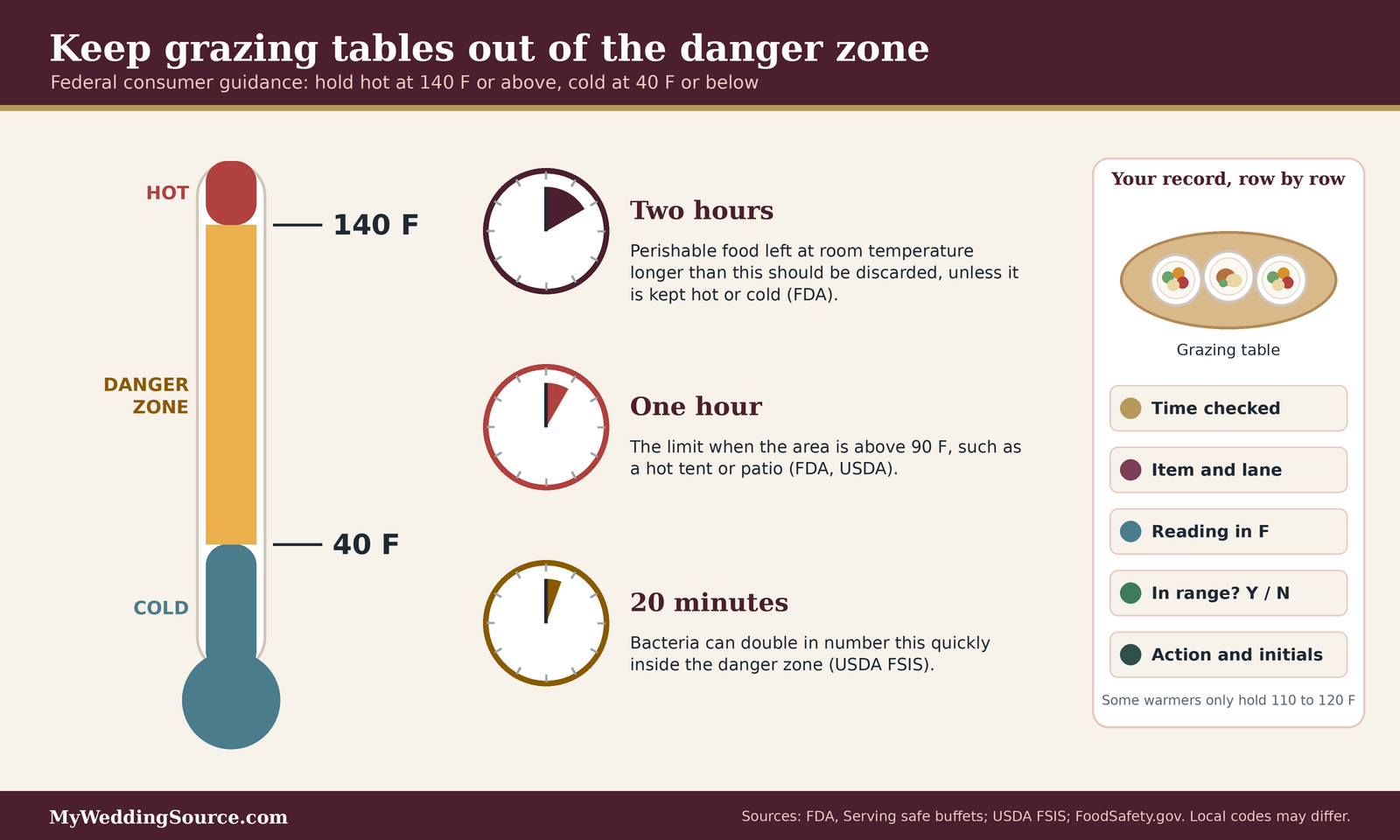
The FDA’s guidance on serving safe buffets says hot food should be kept at an internal temperature of 140 degrees Fahrenheit or warmer and cold food at 40 degrees Fahrenheit or colder, and that you should use a food thermometer to check. It also warns that some warmers hold food only at 110 to 120 degrees, so you should confirm the warmer’s label shows it can reach 140. It suggests keeping backup hot dishes in an oven set between 200 and 250 degrees until serving, and setting cold dishes on ice if they will sit out more than two hours. FoodSafety.gov describes using chafing dishes with a water pan, ice baths that are drained and refilled, and serving smaller portions of cold food at a time.
Time limits and hot rooms
The same FDA page says perishable food left at room temperature for more than two hours should be discarded unless it is kept hot or cold, and that the limit drops to one hour if the area is above 90 degrees. The USDA’s Food Safety and Inspection Service describes the range between 40 and 140 degrees as the danger zone and says bacteria can double in as little as 20 minutes in it. Local health departments set their own rules for caterers and venues, and they may use different numbers, so ask your caterer which rules they follow. We used the federal consumer guidance above because we could verify it, and we did not verify local codes. If you are planning a summer event, see our summer wedding heat plan.
The monitoring record
The record below has one row for each check. A check is a reading of one item at one time. The sample entries are made up to show how to fill it in and are not real readings.
The blank record to copy
Copy this table into a notes app or print several copies. Use one sheet per station, and write the station name at the top.
| Time checked | Station and item | Lane (halal, vegetarian, allergen-labeled, general) | Hold type (hot, cold, room temp) | Reading in F | In range? | Time first put out | Action taken | Initials |
|---|---|---|---|---|---|---|---|---|
How to read the “in range” column: hot items should read at or above 140, cold items at or below 40, per the federal guidance above. For items that are not temperature-controlled, such as bread and whole fruit, record the time first put out and discard or replace according to the time limits.
Sample entries
These entries are an example of how a filled-in sheet might look. They are invented for illustration.
| Time checked | Station and item | Lane | Hold type | Reading in F | In range? | Time first put out | Action taken | Initials |
|---|---|---|---|---|---|---|---|---|
| 5:00 PM | Grazing table, halal-certified turkey slices | Halal | Cold | 38 | Yes | 4:45 PM | None | AB |
| 5:00 PM | Grazing table, cheese board (microbial rennet, per supplier) | Vegetarian | Cold | 39 | Yes | 4:45 PM | None | AB |
| 5:30 PM | Chafing dish, halal chicken | Halal | Hot | 152 | Yes | 5:15 PM | None | AB |
| 6:00 PM | Chafing dish, halal chicken | Halal | Hot | 132 | No | 5:15 PM | Reheated from oven backup, rechecked at 6:10 | AB |
| 6:45 PM | Grazing table, hummus bowl | Allergen-labeled (sesame) | Cold | 41 | No | 4:45 PM | Replaced bowl with fresh one on ice | CD |
| 7:15 PM | Dessert table, cream tarts | General | Cold | 40 | Yes | 6:45 PM | None | CD |
Look at the fifth row. The bowl read one degree over the cold limit, and the action was to replace it with a fresh bowl on ice, which is consistent with the FDA’s advice to replace nearly empty or aging dishes with freshly filled ones instead of topping them off.
Who fills in the record
A record that no one owns is a record that does not get filled in. Decide who does it before the day.
Assign one person and one thermometer
Ask your caterer whether they keep their own log, and if so, ask to see it. If they do not, assign one person, such as a caterer’s lead, a planner, or a trusted family friend who is not a bridesmaid or a parent of the couple. Give that person a food thermometer, the printed sheets, and a pen. The FDA’s page notes that you should check temperatures with a thermometer, not by feel. Test the thermometer in ice water before the event, since cold ice water should read near 32 degrees, an easy check you can do yourself.
Decide what happens when a reading is out of range
Agree on the rule before the event. A simple one: if a hot item reads under 140 or a cold item over 40, correct it right away and recheck in ten minutes, and if it has been out of range for an unknown time or has been out more than two hours, discard it. The FDA page says to discard perishables left out for more than two hours, and one hour above 90 degrees. The ten-minute recheck interval is our own suggestion, not a regulatory number. When in doubt, throw it out and replace it with the backup.
Grazing tables and halal: special notes
A grazing table brings together cheese, cured meats, spreads, breads, and fruit, which makes it one of the harder items to keep halal and safe at once.
Build a separate halal section
If the grazing table includes cured meats, ask whether each is halal-certified, because many cured meats contain pork. A separate halal section with its own board, tongs, and label is easier to protect than a mixed board. Place it so guests reach it first, and ask a server to watch it. The AAAAI advice on not reusing utensils applies here: one pair of tongs per item.
Label for halal and allergens together
Each item on a grazing table needs a small card with its name, halal status, and major allergens. Because the table is open to everyone, labels do more work than at a plated dinner. Keep the language plain, and make sure the card matches the record’s wording so that your staff and your guests are reading the same thing.
Vendor and source questions
A halal wedding menu conversation is only as good as the questions you ask in it. The lists below are written so you can read them aloud or send them by email, and so that each answer can be put into the contract.
Questions to ask before you sign
- What standard of halal do you follow, and who certifies your meat?
- Who supplies each protein, and can you send a certificate or invoice?
- Which sauces, stocks, flavorings, and desserts contain alcohol, gelatin, or animal rennet?
- Do you have a separate prep area, tools, and cookware for halal food, and a dedicated fryer?
- How will halal dishes be served, labeled, and kept apart from other dishes?
- How do you handle allergens, gluten, and cross-contact, and how are they labeled?
- Who logs hot and cold temperatures at each station, and can we see your log?
- What happens if a supplier cannot deliver on the day?
Questions for the caterer
The caterer controls the kitchen, so most of your halal wedding menu questions go here. A good caterer will welcome them, since a clear standard reduces the chance of a mistake on the day. Our guides to wedding catering and vendor due diligence give a wider list.
Ask for a walk-through of the day
Ask the caterer to describe the day from delivery to cleanup: where halal food is prepped, how it travels, who carries it, and which tools touch it. Ask who is on site, and who will answer a guest’s question about an ingredient at the event. Vague answers are information too.
Ask for a tasting that tests the standard
At your tasting, ask to see the packaging or ingredient labels for the items you taste, and ask how each was prepared. A tasting that includes the halal dishes, the vegetarian entree, and a gluten-free plate gives you a chance to see how the kitchen handles each lane. Our upcoming guide to caterer tastings goes into more detail.
Questions for the halal supplier or certifier
If the caterer uses a separate halal supplier, you can ask that supplier directly, and doing so tends to reassure the guests who care most.
Ask what the claim covers
Ask the supplier whether the claim covers slaughter only or also processing, packaging, and handling. The Halal Foundation’s page says halal certification covers processing, packaging, and handling to prevent cross-contamination with forbidden substances, though that is one organization’s description, and practices vary. Ask what the certifier requires, how often it inspects, and whether it publishes its standard.
Ask how to verify
Ask for the certifier’s name, a copy of the current certificate, and the product or batch it covers. If you want to verify, contact the certifier directly using contact details you found yourself, not only those on the supplier’s document. We cannot vouch for any certifier, and we did not evaluate any.
Questions for the venue and the bar
Venues and bars affect the menu in ways that are easy to miss.
Venue kitchen and caterer rules
Ask whether the venue requires its own caterer or allows outside ones, whether an outside caterer may use the kitchen, and whether there are fees or insurance requirements. If an outside halal caterer is not allowed, ask whether the venue’s caterer will source halal meat from a supplier you name. Our wedding venue questions guide has more.
Bar and beverage service
If alcohol will be served, ask how the bar is set up and where it sits relative to the food. Ask whether non-alcoholic drinks are made with separate equipment, and whether juice, soda, and mocktails are included. Ask who handles the non-alcoholic menu and who answers questions about ingredients.
Edge cases that change the plan
Most weddings with a halal wedding menu hit at least one situation that the standard advice does not cover. The cases below are common enough to plan for, and each has a simple way to approach it.
The venue requires a caterer that cannot do halal
This is one of the most frequent snags, and it deserves an early conversation because it can affect your venue choice.
Ask what the venue will allow
Ask the venue manager three things in writing: whether an outside caterer can be approved for a fee, whether the in-house caterer will source halal meat from a supplier you choose, and whether the kitchen can be used by a separate vendor for part of the menu. Some venues say yes to one of these and no to the others. A written answer lets you compare venues fairly. If the answer is no to all three, you may need to choose between the venue and the menu standard.
Consider a hybrid arrangement
Some couples bring a halal caterer for the main course and let the venue handle the rest, or they serve a halal plated meal to those who need it and a standard meal to others. Hybrids work only if the separation is real, so ask both parties to confirm in writing who prepares, carries, and serves each plate. Our banquet hall versus hotel ballroom guide covers how in-house catering rules differ.
Families with different standards
When two families bring different expectations, the menu becomes a conversation as much as a document.
When kosher food is offered as a bridge
The Pluralism Project notes that when halal options are limited, some American Muslims eat kosher food marked with a K. That is one pattern among several, and it does not mean kosher and halal are the same. Do not offer kosher food as a substitute unless the guest has told you it works for them. If a kosher-style meal is part of your plan for other guests, our upcoming guide on a kosher-style menu without misleading guests covers the labeling issues.
When guests ask for more than you planned
A guest may ask for stricter handling than the couple planned. Decide in advance how you will answer: you can offer a specific alternative, such as a separately prepared plate, or explain what the menu does and does not cover. Answer kindly and truthfully, and do not promise anything you cannot document.
Multi-day events and vendor meals
A halal wedding menu often extends past the reception, and the same standard applies to the other meals of the weekend.
Rehearsal dinners, welcome parties, and late-night food
Each event is a separate menu with its own caterer and its own risks. Our guides to welcome drinks versus a full welcome dinner, the rehearsal dinner at a brewery, and the late-night coffee cart give general advice. For each event, repeat the standard, the evidence, and the labels.
Vendor meals
Your photographer, DJ, and coordinator may also observe halal or have other dietary needs. Ask each vendor on the contract and add the answers to the catering count. Our wedding vendor meals guide explains what to ask and how to count. A vendor who has to leave to find food is a vendor who is not working.
When something changes late
Last-minute changes are normal, and a plan that expects them is less stressful.
Late RSVPs and added guests
Ask the caterer for their cutoff for final counts and what happens after it. Plan a small buffer of extra halal portions if the caterer allows it, and ask how the extra will be priced. If a guest adds a dietary need late, tell the caterer at once and ask what is feasible.
Supplier shortages and substitutions
If a supplier runs short, the caterer may offer a substitute. Decide beforehand what you will accept: for example, a different halal-certified product from a named supplier, or a different dish entirely. Make the caterer agree in writing that they will call you, not substitute silently. A substitution that is announced is a manageable problem. One that is hidden can become a breach of trust.
Costs, timeline, and contract language
A halal wedding menu is easier to manage when decisions are made in a sensible order. This section gives you a timeline, a way to think about costs, and plain wording to ask for in the contract.
Where costs come from
We could not find reliable published prices for halal catering inputs, so we do not give price ranges. Instead, here is how to compare quotes.
Compare like with like
Ask each caterer to quote the same menu, for the same guest count, with halal sourcing itemized. Look at the per-guest price, the cost of any separate lane, the staffing, the equipment, and any service charge. A lower per-guest price may hide an extra fee for a second line. Our wedding budget guide helps you fit the numbers into the whole plan.
Estimate extra portions with simple arithmetic
If you want a small buffer, a simple estimate is the number of halal guests times a small percentage. For the sample wedding above with 30 halal guests, a buffer of ten percent is three extra portions. That is our own illustration, not an industry standard. Ask the caterer what they recommend.
A planning timeline
A timeline keeps the work spread out. The months below are suggestions, not rules, and a shorter engagement can compress them.
Early decisions
| When | What to do |
|---|---|
| Nine to twelve months | Agree on the standard with both families. Decide the venue and whether it allows an outside caterer. |
| Six to nine months | Collect quotes with halal sourcing itemized. Ask for certificates. Choose service style. |
| Four to six months | Book the caterer. Put the standard, the evidence, and the substitution rule in the contract. |
| Three to four months | Send RSVPs with a dietary question. Follow up on halal needs. |
| Two to three months | Hold the tasting. Finalize dishes and labels. |
| One month | Send final counts and dietary list. Confirm the monitoring plan and who holds the record. |
| One week | Confirm delivery, prep area, and supplier. Print labels and sheets. |
| Wedding day | Walk the stations before guests arrive. Start the record. |
Why the order matters
The standard comes first because everything else in the halal wedding menu depends on it. The caterer quote comes before the contract because the quote shows what is possible. The tasting comes late enough that the menu is nearly final but early enough to change a dish.
Contract language to ask for
We are not lawyers and this is not legal advice. The points below about a halal wedding menu are items to raise with your caterer and, if you wish, with a lawyer who can review the actual contract. Our vendor contract guide explains how to read one.
Define the standard and the evidence
Ask the contract to say what halal means for this event’s halal wedding menu, in the words you agreed, and to name the certifier or supplier for each meat. Ask for the right to receive the certificate or invoice before the event. If the contract only says “halal” with no definition, ask to add one.
State the substitution and labeling terms
Ask the contract to say that no substitution of a halal item will be made without your written approval, that dishes will be labeled for halal status and major allergens, and that the caterer will tell you of any change in the supply chain. Ask what remedy the caterer offers if a halal item is delivered that does not meet the standard.
Planning basics
What does halal mean for a wedding menu?
Halal means permitted under Islamic dietary rules. For a menu, it usually covers meat from animals slaughtered in the prescribed way, no pork, and no alcohol, with some families also checking sauces, desserts, and shared equipment. Standards vary among families, so ask the couple’s families which one applies before you talk to caterers.
Can I serve a halal menu and still offer other dishes?
Yes, but separation matters. Use separate preparation, tools, and serving lines for halal dishes, label every item, and put the arrangement in the contract. If most guests need halal, making the whole menu halal is usually simpler than running two lanes in one kitchen.
How do I ask guests about halal needs without being awkward?
Add a plain question to the RSVP listing halal, vegetarian, allergies, and other needs, with a free-text box. Follow up privately if a guest’s answer is unclear, and ask whether halal meat alone is enough or whether they also want separate preparation. A short, kind question usually gets an honest answer.
Safety and allergies
Is halal food automatically safe for guests with allergies?
No. Halal describes how food is sourced and handled under Islamic rules, not whether it contains milk, nuts, sesame, or other major allergens. Keep a separate allergen list, label every dish for both, and ask the caterer how they prevent cross-contact. Guests with serious allergies may need a separately prepared meal.
How long can food sit out at a buffet or grazing table?
The FDA’s buffet guidance says perishable food left out more than two hours should be discarded unless it is kept hot or cold, and the limit drops to one hour when the area is above 90 degrees. Keep hot food at 140 degrees or warmer and cold food at 40 degrees or colder.
Does gluten-free also mean halal, or the reverse?
No, they are separate questions. Gluten-free concerns wheat, rye, barley, and related ingredients, and the FDA defines a labeled gluten-free food as one with under 20 parts per million of gluten. Halal concerns the source and handling of ingredients under religious rules. A dish can meet one standard and fail the other.
Vendors and cost
How do I verify that a caterer’s meat is really halal?
Ask for the supplier’s name, the certifier’s name, and a copy of the certificate or invoice, and put the standard into the contract. You can also contact the certifier directly. Because there is no single federal definition of halal, the claim is only as strong as the evidence behind it.
Does a halal wedding menu cost more?
We found no reliable published price comparison, so we cannot say. Costs depend on the supplier, the menu, the guest count, and whether you run one lane or two. Ask caterers to quote the same menu with halal sourcing itemized, and compare the totals instead of relying on a general rule.
Your next steps
Settle the standard
Talk to both families first
Ask each family what a halal wedding menu means to them, who decides, and what they expect from sauces, desserts, and alcohol. Write down the answer in a sentence you can give to a caterer. Our wedding catering guide can help you frame the larger plan.
Collect guest needs
Send the RSVP question and follow up with each guest who marks halal or an allergy. Sort the answers into faith, medical, and preference groups and count the overlap. Our wedding planning checklist can help you place these tasks on a calendar.
Choose the vendors and the lane
Request quotes and evidence
Ask two or three caterers for the same menu with halal sourcing itemized, and ask for certificates before you decide. Use the question list in this guide. Compare answers, not only prices.
Put it in writing
Add the standard, the evidence, the labeling, and the substitution rule to the contract, and keep a copy of the decoder table with your answers. If you choose a grazing table or buffet, print the monitoring record and name the person who will fill it in.
Sources & methodology
How we built this guide
What we relied on
This guide combines U.S. federal consumer food-safety guidance on buffet holding temperatures and time limits, FDA material on major food allergens and gluten-free labeling, clinical guidance from allergy organizations on events and dining out, and published explanations of halal dietary rules from an educational center, a municipal public-health fact sheet, and a halal advocacy organization. Where a statement comes from one organization, we say so, because halal practice differs among Muslims and certifiers. The sample tally, the cost arithmetic, the ten-minute recheck, and the monitoring record are our own illustrations and estimates. We checked these sources on November 12, 2026, and pages may change after that date.
What we did not do
We did not issue any religious ruling, evaluate any caterer, supplier, or certifier, or test any food. We did not verify local health codes, which may use different temperatures and time limits, or the current status of the 2025 USDA petition mentioned above. We are not recommending any caterer, certifier, or product by name. This guide is not legal, medical, or religious advice. Ask your families, your imam, your caterer, your local health department, and, for allergies, your clinician.
Source list
Government and regulatory sources
- U.S. Food and Drug Administration, Serving safe buffets: https://www.fda.gov/food/buy-store-serve-safe-food/serving-safe-buffets
- U.S. Food and Drug Administration, FASTER Act: Sesame is the ninth major food allergen: https://www.fda.gov/food/food-allergies/faster-act-sesame-ninth-major-food-allergen
- U.S. Food and Drug Administration, Gluten and food labeling: https://www.fda.gov/food/allergens/gluten-and-food-labeling
- USDA Food Safety and Inspection Service, USDA urges consumers to keep clear of the danger zone this summer: https://www.fsis.usda.gov/news-events/news-press-releases/usda-urges-consumers-keep-clear-danger-zone-summer
- FoodSafety.gov, Keeping hot foods hot and cold foods cold: https://www.foodsafety.gov/blog/2018/12/keeping-hot-foods-hot-cold-foods-cold.html
Allergy, halal, and consumer sources
- American Academy of Allergy, Asthma and Immunology, Event planning and food allergy awareness: https://www.aaaai.org/tools-for-the-public/conditions-library/allergies/event-planning-and-food-allergy-awareness
- Food Allergy Research and Education, Dining out with food allergies: https://www.foodallergy.org/sites/default/files/2020-11/FARE_DiningOutWFA-110920.pdf
- Food Safety News, Should the USDA stand behind the zabiha halal label (September 2025): https://www.foodsafetynews.com/2025/09/should-the-usda-stand-behind-the-zabiha-halal-label/
- The Pluralism Project, Harvard University, Halal food: https://pluralism.org/halal-food
- Toronto Public Health, Halal fact sheet (written for Canadian consumers): https://www.toronto.ca/wp-content/uploads/2023/08/857f-HalalFactSheet20235.pdf
- Halal Foundation, What can Muslims not eat: https://halalfoundation.org/what-can-muslim-not-eat/