

A wedding end-of-night ride plan is the written answer to one question that is easy to skip until midnight: for every guest who walks into the reception, how do we know, by name, that they got a safe ride away and arrived where they were going?
Quick answer
A workable wedding end-of-night ride plan has four parts. First, a roster that lists every guest’s planned ride before the day starts. Second, a ride captain, who is not one of the couple, with authority to run the closing hour. Third, a runbook that marks each guest as planned, departed, and home, so nobody disappears between “left the party” and “arrived.” Fourth, a sweep of the venue and a back-up ride for anyone the roster missed. Plan the ride home before the first drink is poured, which is the same advice the National Highway Traffic Safety Administration gives anyone attending an event where alcohol is served. Any figure in this guide that is not attributed to a source is our own planning arithmetic, labeled as an estimate.
Most wedding days are planned toward the ceremony, the first dance, and the cake. The ride home gets one line on a timeline, if that. Yet the last hour is when the room is at its most tired, the lighting is at its lowest, the shuttle driver is at the end of a long shift, and the guests who most need a reliable ride, such as older relatives, people who traveled in, and anyone who has been drinking, are all trying to leave at the same moment. This guide treats the wedding end-of-night ride plan as an operations problem with a small, repeatable solution: a head count, a list, a few roles, and a closing routine you can rehearse on paper.
It is meant to sit beside our broader guides rather than repeat them. If you are still choosing vehicles and companies, start with wedding guest transportation planning and the overview of wedding transportation. If you are working out how many seats a shuttle needs across several departures, our walkthrough on shuttle capacity with staggered departures has the arithmetic. This article picks up at the point where the rides are booked and asks the question those guides leave open: how do you make sure everyone actually leaves, and how will you know? It is not legal, insurance, or safety advice, and it does not replace the instructions of your venue, your transportation company, or local law.
Why a wedding end-of-night ride plan is a head-count problem
A ride plan is easy to treat as a vehicle problem: how many vans, which company, what time. But vehicles are the easy part. The hard part is that a wedding is a crowd of people with different starting points, different destinations, different abilities, and different states of tiredness, and they all decide to leave in the same twenty minutes. A good wedding end-of-night ride plan starts by counting people, not by counting seats.
What goes wrong in the last hour
The same few things go wrong at weddings of every size, and almost none of them involves a vehicle breaking down. They are failures of information.
Everyone leaves at once
The last song ends, the lights come up, and the room empties toward one door. A shuttle that was comfortable at the planned pace is suddenly asked to carry everyone in one run. We cover the arithmetic in the capacity article, but the planning point here is simpler: a closing time announced to the whole room creates a wave, and the wave is the first thing a good wedding end-of-night ride plan breaks up.
Nobody owns the list
At most weddings, ride information lives in five places: the invitation website, a group chat, a few text threads, the shuttle company’s confirmation, and the couple’s memory. When something changes at ten o’clock, there is no single list to change. The guest who was told “the 11:30 van” meets a driver who was told “last run at 11:00,” and neither is wrong according to their own copy.
The couple leaves and the plan leaves with them
When the couple is the only owner of the wedding end-of-night ride plan, the plan ends when they take their send-off. A bride or groom who is still answering questions about the ride home at the exit is a sign that the wedding end-of-night ride plan was not handed to anyone. The first rule of the closing hour is that the couple is a guest of it, not its operator.
Nobody checks that people got home
Most plans end at departure. A guest steps into a van, and the plan counts them as done. Whether they reached the hotel, whether the hotel door was open, whether a rideshare driver found them at all: no one knows until the next morning, when one guest is not at breakfast. The difference between a plan that ends at departure and one that ends at arrival is the center of this guide. A wedding end-of-night ride plan should end at arrival.
Who is most likely to be stranded
Almost every guest will find a way home. The wedding end-of-night ride plan exists for the few who may not, and those guests tend to fall into recognizable groups. Naming them in advance means you can ask about them specifically instead of hoping they speak up.
Guests who do not use ride apps
Some guests do not carry a smartphone, do not have a ride app installed, or are not comfortable using one late at night in an unfamiliar place. They are the guests most likely to wait politely for a ride that is not coming. A roster entry with a named vehicle or a named person solves this; a general announcement that “rideshare is available” does not. Any wedding end-of-night ride plan has to work for these guests first.
Guests with limited mobility or specific vehicle needs
A guest who uses a wheelchair, a walker, or a service animal needs a specific kind of vehicle or a specific kind of help at the curb. An accessible ride that was not booked in advance is difficult to find at midnight, as we explain in our guide to wedding transportation for guests using wheelchairs. The roster is where those needs are written down early enough to act on.
Guests who have been drinking
The National Highway Traffic Safety Administration reports that 11,904 people died in drunk-driving crashes in 2024, and the agency’s advice to hosts is plain: if you host an event where alcohol is served, make sure every guest leaves with a sober driver. The Centers for Disease Control and Prevention adds that hosts can remind guests to arrange rides and that people should not let impaired friends drive. A wedding end-of-night ride plan is how that advice becomes specific. We discuss it further in a later section, and we link to our guide on running an open bar for the bar-side decisions.
Guests who drove themselves and cannot now
Local guests often arrive in their own cars and expect to drive home. Some will have decided at the reception that they should not. If the only options are “leave the car overnight” or “risk it,” the wedding end-of-night ride plan has failed them. A plan that includes a ride home and a clear way to collect the car the next day gives these guests an easy yes.
Wedding-party members and vendors
The wedding party stays late, helps with gifts, and leaves last. Photographers, DJs, bartenders, and planners finish after the guests and drive home tired. We are not covering vendor rides in depth, but the roster should include the wedding party, because they are the people most likely to be assumed to have a ride and least likely to have been asked.
What a ride plan promises and what it does not
A wedding end-of-night ride plan reduces the chance that someone is stranded. It does not eliminate that chance, and it does not transfer responsibility. Adults are responsible for their own decisions, and a guest who declines a ride has made a choice. The plan’s job is to make the safe choice the easy one, to make sure the offer was clear, and to give you a way to notice when someone has slipped through.
Offer, not obligation
You are offering a ride, not escorting guests. A calm record of the offer, such as the ride slip described below, is useful because it shows that the offer was clear and that the guest chose something else. We are not lawyers and this is not legal advice; for questions about hosting liability in your state, ask your venue, your insurance agent, or an attorney.
Plans that survive a bad night
A good plan assumes that something will change: a van is late, a guest forgets their coat, a storm slows traffic. We write the runbook around steps that still work when one piece fails. That is why the wedding end-of-night ride plan uses a roster and a sweep instead of a promise that “the shuttle will handle it.”
Build the roster before the night
The roster is the center of the wedding end-of-night ride plan. It is a single list of every guest and a single answer, for each, to the question “how are you getting home?” It does not need software. A shared spreadsheet or a printed sheet is fine, as long as one person owns it.
Sort guests by where they sleep and how they travel
Start with the guest list you already have for the invitation or the RSVP and add two columns: where the guest is staying, and how they expect to get there and back. Those two columns are the whole sort.
Four groups that cover almost everyone
Most guests fall into one of four groups. Hotel block guests sleep at one or two hotels and can share a vehicle. Local guests sleep at home, in a spread of directions, and travel in cars or by rideshare. Own-vehicle guests drive themselves and will need a sober driver or an alternative. Guests staying on site or very near need no ride but still belong on the roster so that you know where they are. A fifth, small group is guests who need something specific, and each person in it gets a line of their own.
A worked example with invented numbers
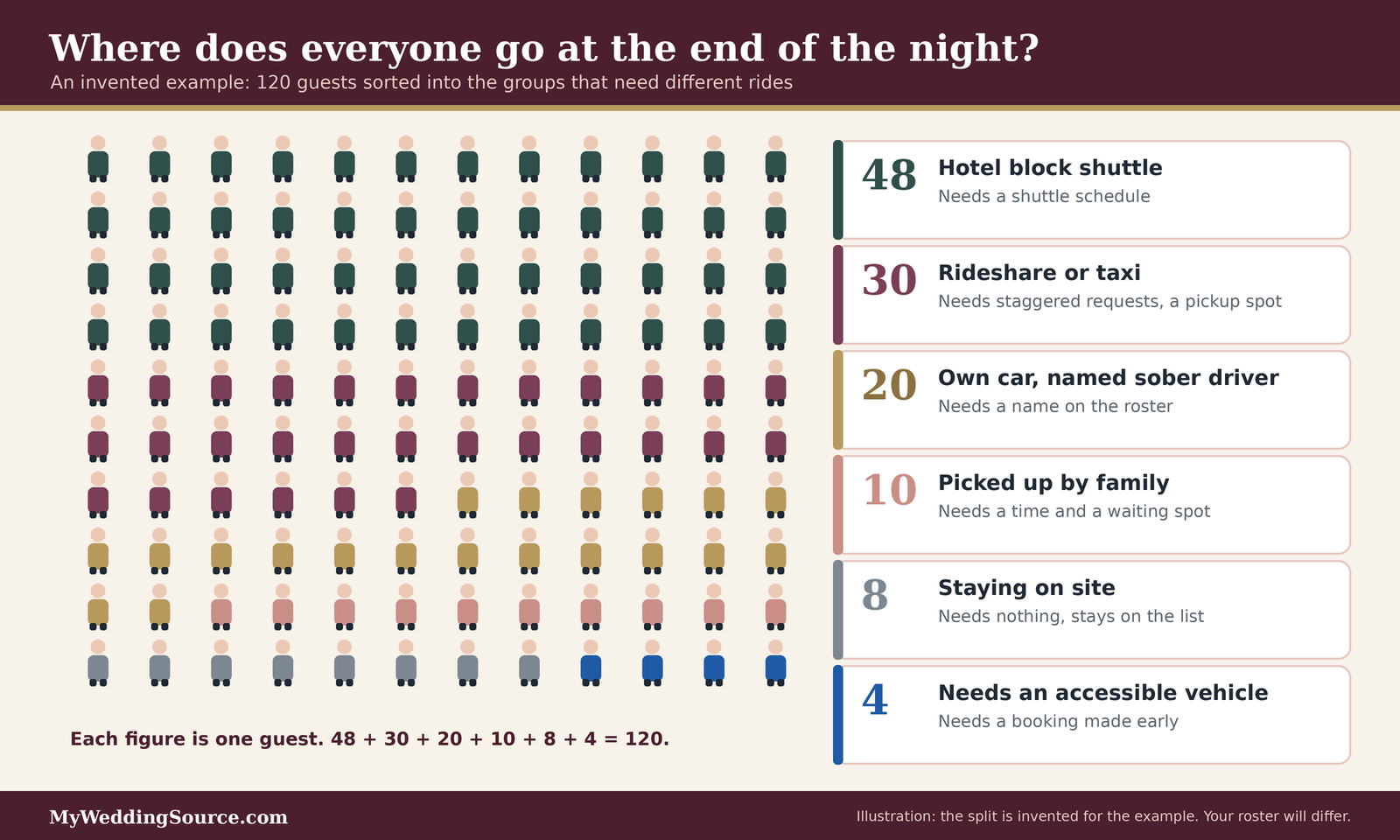
To make this concrete, here is an example with an assumed guest count of 120. The split below is invented for illustration. It is not a statistic and it will not match your wedding. Forty-eight guests are in a hotel block, thirty will use rideshare or taxis, twenty will drive with a named sober driver, ten will be picked up by family, eight are staying on site, and four need an accessible vehicle or specific help. That adds up to 120. Seeing the groups as pictures makes the point quickly: two of them need shared vehicles, one needs dozens of separate rides at once, and one needs special attention.
Why the groups change the plan
Each group asks for something different from the plan. The hotel block asks for a shuttle schedule. The rideshare group asks for a calm way to request many cars without everyone tapping the same screen at the same moment. The own-vehicle group asks for a named sober driver or a designated alternative. The accessible group asks for a specific booking made well in advance. A plan that treats everyone as “hotel shuttle guests” fails the other three. This is why a wedding end-of-night ride plan starts with groups, not vehicles.
Collect ride information in a way guests will answer
The roster is only as good as the answers in it, and guests answer what is easy. A long form about transportation will go unanswered; a single line on the RSVP or a small card at the table is far more likely to be filled in. A wedding end-of-night ride plan is only as good as its roster.
Add one question to the RSVP
If you are building a wedding website, add a single field to the RSVP: “How do you plan to get home?” with a short list of choices that match the four groups, plus “I need help with my ride.” Our guide to RSVP wording covers how to ask without sounding like a form. This gives you a draft roster weeks ahead, and it flags the guests who need help early, while an accessible vehicle can still be booked.
Put a ride slip at every place setting
Plans change between the RSVP and the reception, so we suggest a second, smaller check at the party itself: a ride slip. It is a small card at each place setting with four checkboxes: “I’m taking the hotel shuttle,” “I’ve arranged my own ride,” “I’m driving, and my sober driver is…,” and “Please help me find a ride.” Guests tick one and drop the card in a basket by the door or hand it to the ride captain. It takes a minute, it makes the question visible, and it gives the captain an updated roster in the hour before the room starts to empty. The design is our own idea, not an industry standard, and it works only if the slip is short.
Ask the people who can answer for others
Some guests cannot answer for themselves. Parents answer for children, and adult children answer for older parents. Ask the family contact to confirm the ride for anyone who may not answer a form, and note on the roster who made the call. A roster that says “Grandma Ruth: Dana confirmed, 11:00 shuttle” is more useful than one that says “Grandma Ruth: ?”.
Keep one list and one owner
The roster should have one owner and one version. When there are three copies, there are three truths.
Name the roster keeper
Choose a person who is organized, who will not be dancing at the end of the night, and who the guests will not hesitate to approach. A friend, a cousin, an attendant, or a planner can all fill the role. The roster keeper updates the master list when slips come in and when plans change. We describe the role in more detail in the runbook below.
Print it, and keep a digital copy
Phones die, venue Wi-Fi fails, and rural venues often have little signal. Print the roster on one page, sorted by ride group, and keep a second copy on a phone and with the ride captain. Our guide to guest pickup windows for rural wedding venues explains why a paper plan matters most where signal is weakest. A wedding end-of-night ride plan that depends on signal is a fragile one.
The end-of-night passenger reconciliation runbook
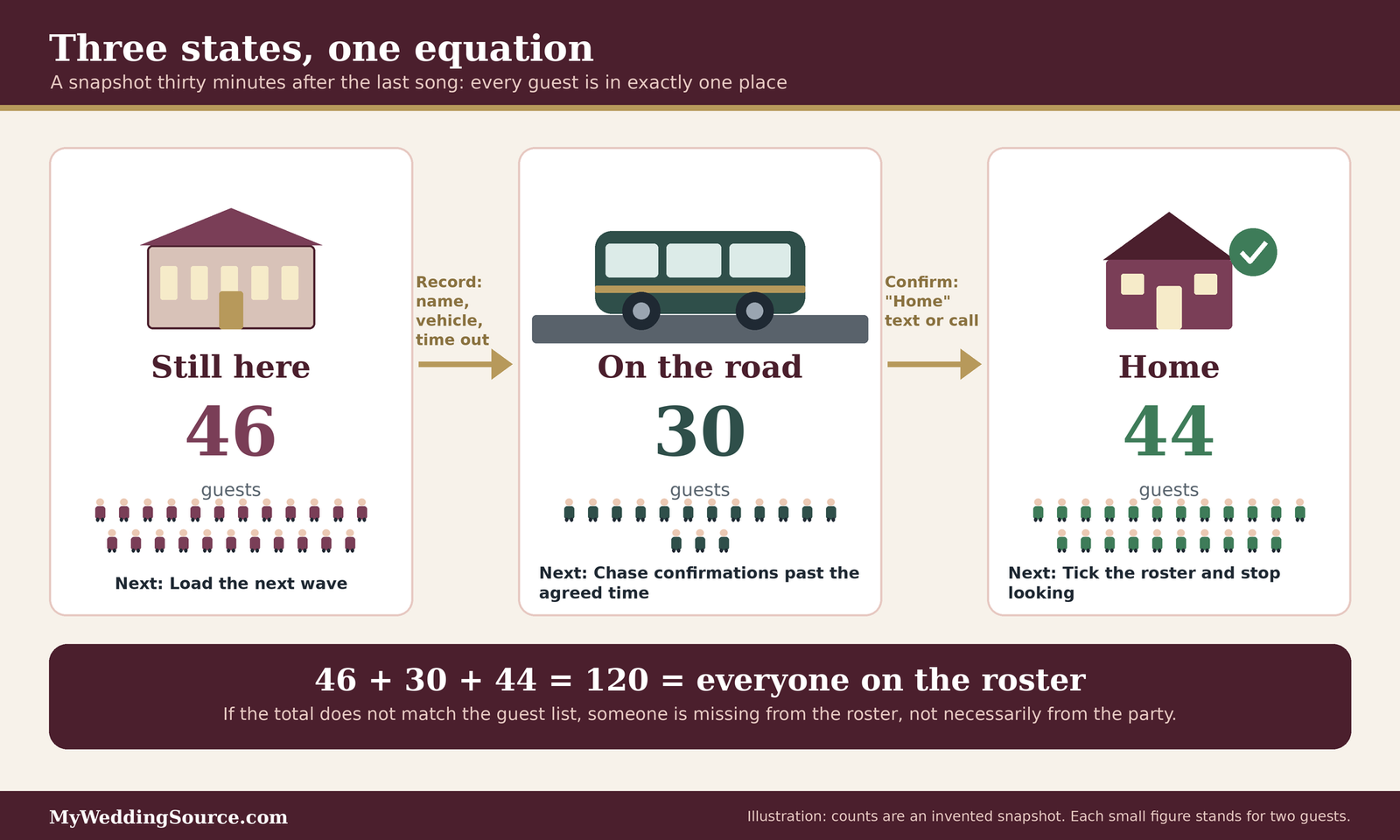
This is the core of the guide. A reconciliation runbook is a short, ordered set of steps that moves each guest through three states, from still here to on the road to home, and records each move. It is called reconciliation because, at the end, the list of guests who arrived and the list of guests who attended should match, and any difference is something you can see and act on. The runbook is our own synthesis of standard event-operations practice. It is not a regulatory requirement, and it is meant to be adapted to your venue and your guest count.
The three states every guest moves through
The simplest reliable runbook has only three states, and every guest is in exactly one of them at any moment. Keeping the states few makes the board easy to read at one o’clock in the morning. We use three because a wedding end-of-night ride plan is read at speed, by tired volunteers.
Still here
A guest is still here until you have seen them step into a vehicle or leave with a named person. Being on the roster with a plan is not enough. The label means that the guest is on the property and has not yet departed.
On the road
A guest is on the road from the moment their vehicle leaves until the moment you hear that they arrived. For a shuttle, the roster keeper records the vehicle and the departure time. For a rideshare, the guest or the captain records the car and the departure time. The goal is a record of who left, in what, and when.
Home
A guest is home only when someone confirms arrival. For a shuttle, the driver or hotel contact confirms that the vehicle unloaded. For a rideshare or private car, the guest sends a short “home” text to the captain or a group number. Anyone who is on the road and has not confirmed by the agreed time is the next call on the list.
The timeline, counted back from the last song
The runbook is built around a single time: the planned end of the reception. We call it L. Every other step is described as a number of minutes before or after L, so the wedding end-of-night ride plan survives a reception that runs long or short. The minute counts below are our own planning suggestions, not standards, and your venue’s rules and your vendors’ contracts come first.

Ninety minutes before L: confirm everything
Ninety minutes before the end, the ride captain checks in with each vehicle provider by phone or message, confirms the pickup time and location, and confirms that the roster keeper has the latest list. The captain also confirms the back-up plan: which rideshare account will be used for anyone the roster missed, and who holds it. This is the moment to collect the ride slips and update the roster. It is also a good time to confirm with the venue where vehicles will load and when the venue needs the property clear. Our venue questions guide lists what to ask about curfews and loading zones. This is the first checkpoint of the wedding end-of-night ride plan.
Sixty minutes before L: start the early departures
Sixty minutes before the end, offer the first rides to the guests who will want to leave early: older relatives, parents of young children, and anyone traveling the next morning. Staggering departures this way is the single most effective way to avoid a wave at the end. The captain makes a quiet announcement or has the table hosts mention it. Each early departure is recorded on the roster with the vehicle and time. It is the part of a wedding end-of-night ride plan that most couples skip.
Thirty minutes before L: check the board
Thirty minutes before the end, the roster keeper counts. How many guests are still here, how many are on the road, and how many are home? Is anyone still marked “needs help” with no ride arranged? This is the last point where a back-up car can be requested without a rush. Anyone who needs help should be matched with a ride now, not at the exit.
At L: announce the plan, not just the time
When the last song plays, the announcement should tell guests what to do, not only that the party is over. “The hotel shuttle is at the front entrance, leaving every fifteen minutes. If you have not arranged a ride, find Dana at the table by the door.” Lights come up gradually. The couple takes their exit, and the captain stays in charge. We cover the music side of the close in our guide to the last dance.
From L to forty-five minutes after: load in waves
For the next forty-five minutes, the curb marshal loads vehicles and the roster keeper records each departure: name, vehicle, time. Loading in small waves, not all at once, keeps the curb calm and the roster accurate. Signs make the loading point findable, and our guide to wedding transportation signage explains how to mark it.
Forty-five minutes after L: sweep and call
At this point, anyone not marked on the road or home gets a call. The captain, with the venue contact, sweeps the property: restrooms, coat check, the bar, the patio, the parking lot, the photo booth, and the gift table. The aim is to find the guest who is asleep in a lounge chair, the one who is waiting at the wrong door, and the one who has already left without telling anyone. The sweep is also when the roster keeper makes the first calls to anyone on the road who has not yet confirmed.
Until everyone is home: close the loop
The runbook ends when every name on the roster is home, or when an exception has been recorded and someone has accepted responsibility for following up. The captain sends a short message to the roster keeper, and then to the couple, saying “all accounted for” or naming who is outstanding. Only then does the captain stop. That is the finish line of the wedding end-of-night ride plan.
Six roles, and how to cover them with fewer people
The roles below are jobs, not people. At a small wedding, one person can hold several. At a larger one, each can be a different person. What matters is that every job has a name next to it before the day starts, and that nobody holds a job that conflicts with their evening. Every wedding end-of-night ride plan needs the same six jobs, however small the wedding.
Ride captain
The ride captain owns the whole plan. This is the person with the authority to say “the shuttle leaves now” and to call a vendor. Choose someone calm and trusted who is not in the wedding party’s formal duties at the end of the night and who plans to stay sober enough to make decisions. The couple should not be the captain. A professional planner or day-of coordinator is a natural choice, and if you hire one, put the wedding end-of-night ride plan in their scope in writing.
Roster keeper
The roster keeper maintains the master list, records departures, and chases confirmations. This job rewards patience more than energy. A printed sheet and a pen work well. The roster keeper also holds the guest phone numbers needed for the sweep calls.
Curb marshal
The curb marshal stands where vehicles load, directs guests to the right vehicle, and signals drivers. A reflective vest or a bright sash is helpful at night. This person keeps the loading point orderly, and should be able to spot a guest who needs help with steps or a mobility device.
Driver liaison
The driver liaison is the person each driver can reach. They hand over the driver sheet with the route, the stops, the contact number, and the last run time. They also receive the arrival confirmation from the hotel or last stop. At a small event, the ride captain does this.
Venue contact
The venue contact is the venue’s staff member who knows the closing time, the loading rules, and where the lights and gates are. Introduce the venue contact to the ride captain before the reception starts, and exchange phone numbers. The venue contact is also who unlocks the property for the sweep.
Back-up caller
The back-up caller holds the rideshare or taxi account that will be used for anyone the roster missed. This person also takes over if the captain is pulled away. The back-up should not be the same person as the captain, because the two jobs peak at the same time.
The roster at a glance
Keep the columns few
Below is the format we recommend for the printed roster. It is deliberately plain. The aim is a page a volunteer can read by phone light, with only the columns the closing hour needs.
| Guest or party | Group | Planned ride | Needs | Departed (vehicle, time) | Home (who confirmed, time) |
|---|---|---|---|---|---|
| Ruth and Alan (example) | Hotel block | Hotel shuttle, second run | Step-free boarding | ||
| Priya (example) | Local | Rideshare, requested by captain | None | ||
| Marcus and Elena (example) | Own vehicle | Elena driving, sober | None | ||
| Theo (example) | Needs help | Accessible van, booked | Wheelchair lift |
Questions that build it
These questions, asked in order, fill the roster and flag the guests who need attention.
Questions to ask: build the roster
- Who is staying where, and who has told us they need a ride?
- Who must be asked by a family member instead of directly?
- Which guests need an accessible vehicle, help at the curb, or a service animal accommodated?
- Which guests are driving, and who is their named sober driver?
- Who will hold the master roster, and where is the printed copy?
- What is the agreed time for “home” confirmations, and who receives them?
How to read the example
The last two columns stay empty until the night. The roster keeper fills in the departure when a guest leaves and the arrival when someone confirms, and a row with a departure and no arrival is the next call on the list. ## Match each ride type to the job it does well
A wedding end-of-night ride plan usually mixes several kinds of rides, because no single kind fits every guest. The goal is to give each group the option that suits it, and to know the limits of each option before the night, not at the curb.
Shuttles and charter vehicles
A hired shuttle, van, or motorcoach is the most controllable ride, because you choose the pickup time and the route and you can put a name on the roster against each seat. It is the usual choice for hotel block guests. In a wedding end-of-night ride plan it is the backbone for the hotel block.
What a shuttle does well
A shuttle moves many people on a known route with a driver who has been briefed. It lets you record who boarded and when it left, and it gives the roster keeper one confirmation to wait for instead of dozens. For a guest who does not use a ride app, it is the most dependable option. For capacity, loops, and how many vehicles you need when departures are staggered, use our guide to shuttle capacity with staggered departures.
Check the company before you book
The Federal Motor Carrier Safety Administration, part of the U.S. Department of Transportation, offers a passenger carrier safety data search and a Bus Safety Search tool, and its “Look Before You Book” page tells travelers to research a bus company’s safety record before booking, especially a charter company. The page also lists related guides, including tips for chartering a bus. The agency’s pages we read did not spell out which numbers or documents to request, so we suggest asking the company for its USDOT number and proof of insurance, then using the agency’s search to look up what the federal record shows. We did not verify any specific company, and nothing here is a safety rating.
Ask about the driver’s hours
A late-night run is often the last piece of a long day for the driver. The FMCSA’s summary of hours-of-service rules says passenger-carrying drivers may drive up to ten hours after eight consecutive hours off duty, may not drive after fifteen hours on duty counted from the end of that eight-hour rest, and need at least eight hours off before starting a shift. Whether those limits apply to your hired vehicle depends on the kind of carrier and the kind of trip, which we did not verify. The practical question is simple and fair to ask: “When does the driver’s shift start on our day, and does the last run fit inside it?” A morning airport run followed by an end-of-night run can add up.
Rideshare and taxis
Rideshare and taxis are the flexible option. They suit local guests who go in different directions, and guests who leave at different times. They fill the gaps in a wedding end-of-night ride plan that a shuttle cannot.
Scheduling ahead helps, but does not guarantee
Uber’s help page says riders can schedule a ride between thirty minutes and thirty days before pickup, and also says that scheduling does not guarantee a driver, that dynamic pricing may apply at pickup time, and that normal cancellation fees apply once a driver accepts. Lyft’s scheduled-ride page, which we read in its Canadian version, says scheduled rides can be booked up to ninety days ahead, that they are matched with drivers before other requests, and that a ride can be edited or canceled up to one hour before pickup, while noting that it does not guarantee a driver. Features, windows, and regions change, so check the current app for your area. The lesson for the wedding end-of-night ride plan is the same in both cases: a scheduled ride is a stronger bet than a late request, but it is not a promise.
Stagger the requests
Here is a simple piece of arithmetic, using invented numbers. Thirty guests leaving by rideshare, traveling in groups of about two and a half, means about twelve cars. If twelve cars are requested within the same few minutes at one pickup spot, the drivers arrive together, the curb jams, and some guests wait while others board. If the ride captain or the back-up caller spreads the requests over forty-five minutes, with a few cars every ten minutes, the curb stays calm. This is our own estimate, and the point is the pattern, not the exact figures.
Use a named pickup spot
Rideshare drivers find guests by a pin, and a pin on a large property is often wrong. Agree on one pickup spot, put it on the roster and in the guest message, and mark it. Our guide to wedding transportation signage covers how to mark it so guests can find it in the dark.
Hotel shuttles, designated drivers, and rides from family
Not every ride is hired. Some of the most reliable rides are the ones that already exist.
Hotel shuttles
Some hotels run a shuttle of their own. If the hotel block includes one, ask the hotel for its hours, its pickup location, and whether it can serve your venue. Our guide to wedding weekend event planning covers hotel blocks. Put the hotel shuttle’s last run on the roster and in the guest message, and do not assume it matches your reception end time. Existing rides can carry much of a wedding end-of-night ride plan at no extra cost.
Designated drivers
A designated driver is a named person who has agreed not to drink and to drive others home. NHTSA’s advice is to plan the ride home before drinking starts and to choose a non-drinking designated driver. The roster should show the name, not just “we have a DD.” A named person can be reminded earlier in the evening, and a guest who is not sober enough to drive can be matched with another ride.
Rides from family and friends
For guests who have arranged to be picked up by someone, record who and at what time. A parent who is collecting a teenager and a son who is collecting his mother belong on the roster as clearly as a van does. The pickup person may need to know where to wait, and the venue may need to know a car is coming.
Plan for guests who need a specific kind of ride
The people most at risk of being stranded are those for whom a generic ride does not work. Each of these needs is easier to meet when it is written down early. A wedding end-of-night ride plan should name them early.
Accessible vehicles and help at the curb
An accessible vehicle is not an upgrade; for some guests it is the only ride that works. We cover the planning side in wedding transportation for guests using wheelchairs and the broader guest experience in our guide to the accessible wedding guest experience. This section focuses on what the closing hour adds.
What the ADA National Network says about private transportation
The ADA National Network’s factsheet on ground transportation says that private entities providing transportation to the public, including airport shuttles, hotel shuttles, private buses, taxis, and motorcoach companies, are covered by accessibility requirements. It says demand-responsive motorcoach services, such as charter and tour buses, must provide an accessible bus when a passenger gives forty-eight hours of advance notice, and that a provider using inaccessible vehicles must offer equivalent service in the most integrated setting appropriate. It also says taxi providers may not refuse riders with disabilities who can use the taxi, may not refuse service animals or refuse help stowing mobility devices, and may not charge higher fares for riders with disabilities. The factsheet does not address app-based ride-hailing.
What that means for a wedding
Your wedding is a private event, and we are not giving legal advice about what any provider must do. The practical takeaway from the factsheet is the forty-eight-hour notice for charter service: if a guest needs an accessible bus, tell the company early and get the confirmation in writing. For taxis and rideshare, a Congressional Research Service legal analysis we read says courts have largely treated ride-hailing companies as covered by the ADA, that the companies have policies requiring drivers to accept service animals, and that wheelchair-accessible vehicle service is available only in limited areas. The summary also notes that the ADA does not require the companies to buy accessible vehicles. In plain terms, do not count on finding an accessible rideshare vehicle at midnight. Book it, or book a provider that confirms it.
Ask the guest, then confirm with the provider
The guest knows what they need. Ask about the vehicle, the boarding help, and any equipment, and then confirm each point with the provider in writing. If the guest uses a service animal, our guide on guests with service animals explains how to plan for it. Put a named person on the curb who knows to meet that guest at the vehicle.
Older guests and guests who tire early
Some guests are not disabled in any formal sense but are simply done at ten o’clock and will not ask for help.
Offer an early ride, and make it ordinary
A quiet early run, offered at the sixty-minutes-before step in the runbook, gives these guests a dignified way to leave. Presenting it as a regular departure, not a special service, matters. A table host saying “the first shuttle is leaving at ten, I’m taking it” does more than a sign.
Check the walk to the vehicle
A short walk can be a long one at the end of the day. Check the distance from the door to the loading spot, the lighting, the surface, and whether the curb is level. Our guide to seating for guests who cannot stand for long periods covers related comfort planning. If the loading point is far, ask the venue whether the vehicle can pull closer for these guests. Walking distance belongs in a wedding end-of-night ride plan too.
Children, teens, and the adults who bring them
A child is not on the ride plan alone; a child is on the ride plan with an adult, and the roster should say which.
Record who is responsible for each child
For each child, the roster should show the adult who is taking them home. This matters most for older children and teens who are attending without a parent, such as a cousin from out of town. Name the adult. Ask the parents, in advance, who is collecting the teenager.
Car seats are a family decision
A hired shuttle or a rideshare may not have a child car seat, and the rules differ by place and by vehicle. We did not research child-restraint rules, so ask the transportation company about its policy and ask the parents whether they plan to bring their own. Do not assume a seat will be available at midnight.
Plan for alcohol without making it awkward
Alcohol is the reason the wedding end-of-night ride plan matters most, and also the reason people hesitate to raise it. The aim is to make a safe ride the easiest choice, without lecturing anyone.
What the federal sources say
The numbers are sobering, and they come from federal agencies.
The statistics
NHTSA reports that 11,904 people died in drunk-driving crashes in 2024, about thirty-two a day, and that driving with a blood alcohol concentration of 0.08 or higher is illegal in all fifty states, the District of Columbia, and Puerto Rico, with Utah’s limit at 0.05. The CDC’s page, which uses 2022 data, reports 13,524 deaths in crashes involving alcohol-impaired drivers, about 32 percent of U.S. traffic deaths, and notes that impairment begins at lower levels than the legal limit. The two agencies use different years and counting methods, so we do not combine the figures.
The advice to hosts
NHTSA’s advice is to plan the ride home before drinking starts, to choose a non-drinking designated driver, to take the keys of anyone who has been drinking, and, for hosts, to make sure every guest leaves with a sober driver. The CDC lists drivers planning ahead and hosts reminding guests to arrange rides among its prevention strategies. A wedding end-of-night ride plan is the written, specific version of that advice. For the bar side of the decision, see our guides to open bar planning and wedding bar service planning.
Make the sober ride the easy ride
People accept a ride when it is available, free or clearly priced, and normal. They decline it when it feels like a judgment.
Offer rides to everyone
Announce the shuttle and the ride options to the whole room, not to anyone in particular. When the offer is general, a guest who needs it can take it without being singled out. A wedding end-of-night ride plan works best when the offer is for everyone.
Time the last call with the last ride
Align the bar’s last call with the ride schedule, so the final shuttle does not leave before guests have had time to settle up and collect their things. Our guide to wedding bar service planning covers service planning with the bar team, and the captain should know the last-call time. Coffee and food at the end of the night can slow the pace; see our guide to a late-night coffee cart. We do not claim that coffee makes anyone safe to drive.
Offer the car-collection option
For guests who drove in, say plainly that cars may stay overnight, and tell them how and when to collect them. The venue may have rules on overnight parking, so ask in advance. If you are using attendants for parking, our guide to parking attendants vs valet service explains what they can and cannot do with keys.
When a guest should not drive and says they will
This is the hardest moment in the plan, and it is worth deciding in advance who handles it.
Choose the person, not the policy
The ride captain, or a trusted friend or family member of the guest, is the right person to speak to someone who should not drive. A stranger or a vendor is not. Decide in advance who this will be for the guests you worry about.
Offer something specific
“I’ll drive you” or “I’ve got a car coming, let me walk you out” works better than “you shouldn’t drive.” Offer a ride, offer to hold the keys until morning, and offer to sort out the car. If a guest refuses and you believe they are about to drive impaired, do not argue at the curb; involve the venue’s staff and, where there is an immediate danger, local emergency services. We are not giving legal advice, and what hosts may or must do varies by place. Ask your insurance agent and review our guide to wedding insurance for what coverage may and may not address.
What a wedding end-of-night ride plan costs, and what to ask
Money matters here mostly in the form of surprise: minimum hours, overtime, wait time, and extra vehicles. We did not find verified average prices for these services, so we do not state any. Instead, here is a way to see your own numbers. A wedding end-of-night ride plan adds cost mainly through time, so ask about time.
What it costs
Use this pattern with the quotes you actually receive. Suppose a shuttle company quotes a rate of R per vehicle-hour with a minimum of M hours. Your cost is R times the larger of M and the hours you actually need. If your plan needs one extra vehicle for the last forty-five minutes, the added cost is R times whatever the company bills for that vehicle, which may be the minimum, not forty-five minutes. As an invented illustration only: at a placeholder rate of $100 per vehicle-hour with a three-hour minimum, a second vehicle costs $300 even if it runs for one hour. Rates, minimums, gratuities, and fuel or late-night charges vary by company, so ask for the full cost in writing. Our guide to vendor overtime rates explains how overtime is commonly structured and how to ask about it.
Questions for the transportation company
Put these questions to each company and keep the answers in writing, attached to the contract.
Questions about the service
- What are the last pickup time, the last drop-off time, and the cost of running later?
- Can the driver wait through a delayed ending, and for how long, before extra charges begin?
- What is your policy if a guest is not at the pickup point at the scheduled time?
- Will the driver carry the roster or the manifest, and can the driver confirm arrival to our captain?
- Who is the dispatcher on the night, and what is the number?
Questions about safety and paperwork
- What is your USDOT number, and what does the federal safety record show?
- Can you provide proof of insurance, and what does it cover for passengers?
- What are the driver’s hours on our day, and when does the shift start?
- How do you handle a passenger who becomes unwell or unruly?
- What is your policy on alcohol on board?
Questions about access
- Can you provide an accessible vehicle, and with how much notice?
- Do you accept service animals, and who helps with mobility devices?
- What is the boarding process for a guest who cannot manage steps?
- If your accessible vehicle is not available, what is the equivalent service, and who provides it?
Questions for the venue
The venue controls the property, the clock, and sometimes the road.
Questions about the property
- When must guests and vendors be off the property, and what happens if we run over?
- Where may vehicles load, and can large vehicles enter the site?
- Is the loading area lit, level, and close to the door?
- May guests leave cars overnight, and until when?
Questions about the night
- Who is our staff contact for the closing hour, and how do we reach them?
- Who unlocks areas for the sweep, and who is on site after guests leave?
- What is the plan if a storm or a power failure affects the lot?
- What is the venue’s policy on guests who should not drive?
Questions to put on the guest message
The guest message is where the wedding end-of-night ride plan reaches the people it is for. Keep it short, specific, and consistent.
What the message says
State the shuttle’s first and last run, the pickup spot, the rideshare option, the car-collection arrangement, and the name and number of the ride captain. Use the same words as your signs and your driver sheet. If the venue is remote, our guide to guest pickup windows for rural wedding venues explains how to set them. Guests should be able to read the whole wedding end-of-night ride plan in four lines.
When the message goes out
Send it with the final details a week or so before the day, and again as a short reminder the day before. Put a copy at the guest book or in the welcome bags, if you have them.
Edge cases that break a ride plan
A plan is tested by what goes wrong, not by what goes right. The cases below are the ones we think are most worth deciding in advance. They are scenarios we built from how the pieces of the wedding end-of-night ride plan fit together, not reports of particular weddings, and the responses are suggestions you can adapt.
The vehicle problem
Vehicles are late, full, lost, or absent. Each has a different fix, and the roster helps with all of them.
The shuttle is late or does not come
Call the dispatcher first, and note the time of the call. Tell guests on the curb what you know, which is better than leaving them to guess. Ask the back-up caller to request cars for the guests who most need to leave, in the order set by the roster: older guests, guests with children, guests with accessible needs. If you have a rideshare account ready, you can start requests at once. The captain should know in advance what delay triggers the back-up, and we suggest deciding that number before the night, not at the curb. A wedding end-of-night ride plan should say who makes this call.
The shuttle is full and people are left
A full vehicle leaves behind people who are standing in good clothes and tired. Because the roster shows who is in which group, the curb marshal can send the next vehicle’s first seats to those left behind and give them a time. An honest “the next one is in fifteen minutes” is easier to accept than silence. If the same thing keeps happening, the loops are too tight; see the capacity guide for the arithmetic of adding a vehicle or a run.
The driver cannot find the pickup spot
A driver who is a mile away and cannot find the spot is a communications problem. The driver liaison should have the driver’s phone number and the driver should have the liaison’s. A shared pin, a landmark in plain words, and a sign help. If the venue has a long drive or two gates, tell the driver which one to use, and tell the venue staff to open it.
A rideshare driver cancels
Cancellations happen, and the Uber help page itself says that normal cancellation fees apply once a driver accepts a request and that scheduled rides are not guaranteed. The back-up caller should be ready to request again at once, and to try a taxi company if the apps are slow. Keep one taxi company’s number on the roster sheet for this reason, and confirm in advance that the company operates in your area at that hour.
The people problem
People change their minds, lose their phones, fall asleep, and forget their plans.
A guest cannot be found at the sweep
At the sweep, a name that is neither on the road nor home is the next job. Check the roster for the guest’s ride and call them. Ask the people they were sitting with. Walk the property, including the places a person might rest: lounge areas, a car, the restroom, a quiet corner of the garden. Ask the venue whether anyone has seen them. Do this before you assume they left. If you cannot reach them and you have a real concern for their safety, involve the venue and, if appropriate, the family. We are not giving legal or medical advice, and an emergency is a matter for emergency services. The sweep is the safety net of the wedding end-of-night ride plan.
A guest changes their plan on the spot
A guest who was going to take the shuttle now wants to go to an after-party, or the reverse. This is normal, and it is one of the reasons the roster has a “departed” column. Ask the guest to tell the roster keeper or the captain, and record the change. A guest who leaves without telling anyone leaves a gap in the roster that will look like a missing person at the sweep.
A guest refuses help
A guest who declines a ride is an adult who made a choice. Record that they declined, offer again, and tell them how to reach the captain if they change their mind. If a guest appears impaired and plans to drive, follow the steps in the alcohol section above. Do not argue at the curb.
The couple’s own exit
The couple’s exit is often the moment when the plan loses its operator. The couple should hand the wedding end-of-night ride plan to the captain before the exit, not after it. If you are planning a decorated getaway car, a vintage car rental or an ordinary one, the driver and the route are part of the plan too: write down where the couple is going, who is driving, and where the car will be parked afterward.
The place problem
The venue, the weather, and the road each have their own ways of changing the evening.
Weather
Rain, wind, heat, or cold change how guests move and how long loading takes. A covered loading area, umbrellas, and a plan to hold guests inside until the vehicle arrives make a difference. If a storm slows traffic, the roster still tells you who is on the road and who is waiting. Our guides to a winter wedding weather plan and a summer wedding heat plan cover related planning.
Poor signal
At a remote venue, ride apps may not load, texts may not send, and a pin may be wrong. This is why the roster is printed and why the wedding end-of-night ride plan relies on pre-arranged vehicles. Ask the venue where signal is best and put the loading point there if you can. Agree in advance on a way to confirm arrival that does not need signal, such as the hotel desk or the driver confirming by phone call when the vehicle reaches town.
A venue curfew that arrives early
If the venue needs the property clear at a set time, work backward from that time to set the last run. A curfew is a fixed point, and a reception that runs late is an argument with the venue’s schedule. Ask the venue what happens at the curfew, and what the charges are if guests are still on the property. A curfew is the fixed point around which a wedding end-of-night ride plan is built.
Darkness at the loading point
A loading point that is dark, uneven, or unmarked is a hazard for tired guests in formal shoes. Ask the venue about lighting. If it is poor, bring battery lights and mark the path. Our signage guide discusses night legibility.
Worksheets and scripts you can copy
This section collects the paper that makes the plan work. Everything here is plain text and meant to be adapted, not a formal standard.
The driver sheet
Give each driver one page. Keep it to the facts the driver needs to complete the run and reach you.
What goes on it
The sheet should carry the ride captain’s name and number, the driver liaison’s name and number, the venue’s address and the exact loading spot, the hotel’s address and drop-off point, the planned run times, the last run, and the roster of passengers for that run if you have it. Add any guests who need specific help, by name. Add a line that says what to do if no one is at the pickup spot: wait how long, then call whom.
Why a paper copy
Drivers change, and the person who confirmed the booking is not always the person who arrives. A paper copy in the vehicle means that any driver who gets in has the plan.
Announcements and guest texts
Wording matters because tired guests need short, clear instructions. The examples below are ours and are meant to be adapted. Each message in a wedding end-of-night ride plan should be read in ten seconds.
The announcement at L
“Thank you for celebrating with us. The hotel shuttle is at the front entrance and runs every fifteen minutes until midnight. If you arranged your own ride, you can wait in the lobby, where it’s warm. If you haven’t arranged a ride, please find Dana at the table by the door, and she’ll get you home. Please don’t drive if you’ve been drinking; we’d love to get your car back to you tomorrow.”
The message before the day
“Getting home: the hotel shuttle runs from the venue’s front entrance, first run at 10:00 pm, last run at 12:15 am. Rideshare pickups use the gravel lot on the left, marked with a sign. If you’re driving, please tell us your sober driver on the RSVP, or find Dana, our ride captain, at the party and she will help you arrange a ride. Cars can stay overnight until 11 am. Questions: Dana, (000) 000-0000.” The times and names here are placeholders.
The “home” text
Ask guests to send one word to the captain’s number when they arrive: “Home.” Put the request on the ride slip, on a small sign at the exit, and in the announcement. A guest who forgets is easy to check on in the morning; a guest who never answers is the one to call that night. Some guests will not want to text, so tell them the roster keeper may call them, and say so in advance.
Rehearse the plan on paper
You do not need a full rehearsal to find the weak spots. A short walk-through of the runbook with the people who hold roles will do most of the work. A paper test is the cheapest way to check a wedding end-of-night ride plan.
A thirty-minute tabletop
Gather the captain, the roster keeper, the curb marshal, and the back-up caller, and walk through the timeline with the roster in front of you. Ask at each step: who does this, what do they need, and what if it fails? Then pick three of the edge cases above and ask what you would do. Write down the answers that were unclear and fix them.
Test the numbers
Check the arithmetic against your real roster. For the example in this guide, forty-eight hotel guests and a vehicle of twenty-four seats (an assumption) means two full loads. If the loop takes about twenty-five minutes round trip (also an assumption), a single vehicle needs about fifty minutes to move everyone, with every seat full both times. Two vehicles halve that, and a staggered start from sixty minutes before L means the last guests do not wait at all. Real loops depend on distance, traffic, and loading time, and your numbers will differ, which is why the roster comes first.
The morning after
The plan is not finished when the last guest leaves. A short close-out protects the next day too.
Close the roster
The captain checks that every row has an arrival or a recorded exception, and hands the roster to the couple or a trusted person. Only then is the wedding end-of-night ride plan complete.
Tell the people who are waiting
Tell the venue the property is clear, tell the transportation companies that the runs are complete, and tell any hotel desk that the last shuttle has arrived. A short message to each avoids a wait for a vehicle that is no longer needed, or a call at dawn.
Handle the leftover cars
Guests who left cars need a way to collect them. Share the plan by message the next morning: where the cars are, until when, and who to call. If a car cannot stay, the venue will have a rule about it, which is why you asked.
Review and pay
A short review leaves the next planner, or the next version of you, a better plan.
Check the invoices against the roster
Compare each company’s invoice with what actually ran. If a vehicle waited, ran late, or did not come, the roster and your notes are the evidence. Ask about any charge that does not match, and ask politely. Treat the invoices as the last test of your wedding end-of-night ride plan.
Thank the people who made it work
The ride captain, the roster keeper, and the curb marshal gave up part of the party. A note, a small gift, or a mention in your thank-you messages is fair. Our guide to wedding thank-you card wording can help.
Planning basics
What is a wedding end-of-night ride plan?
It is a written plan that records how every guest is getting home, who is in charge of the closing hour, and how you will confirm that people arrived. The core pieces are a roster, a ride captain, a timeline counted back from the last song, a sweep of the venue, and a back-up ride.
Who should be the ride captain?
Choose a calm, trusted person who is not the couple and who will stay clear-headed at the end of the night. A professional planner or day-of coordinator is a natural fit. If a friend takes the role, give them the roster, the vendor numbers, and the authority to make calls without checking with you first.
How early should we start moving guests?
We suggest offering the first rides about an hour before the planned end, to older guests, families with children, and anyone traveling the next morning. Spreading departures this way keeps the curb calm and the roster accurate. Treat the timing as a starting point and adjust it for your venue, your guests, and your vendors.
Rides, safety, and access
Is a scheduled rideshare ride guaranteed?
No. Uber’s help page says scheduling ahead does not guarantee a driver, and that dynamic pricing may apply at pickup. Lyft’s scheduled-ride page describes priority matching but does not promise a driver either. Treat a scheduled ride as a better bet than a late request, and keep a back-up, such as a taxi company’s number, ready.
What should we ask a charter or shuttle company?
Ask for the USDOT number and proof of insurance, then look up the company’s record with the Federal Motor Carrier Safety Administration’s search tools. Ask when the driver’s shift starts, what the last run time is, what extra time costs, and how the driver will confirm arrival. Get the answers in writing, attached to your contract.
What if a guest needs an accessible vehicle?
Ask early and book it, because an accessible vehicle may not be available at midnight. The ADA National Network says charter and tour bus services must provide an accessible bus when a passenger gives forty-eight hours’ notice. Confirm in writing with the provider and name a person to meet the guest at the curb.
Alcohol and responsibility
What if a guest who has been drinking insists on driving?
Offer something specific: a ride, a promise to hold the keys, or help with the car in the morning. Involve the venue’s staff, and call emergency services if there is immediate danger. NHTSA advises taking the keys of anyone who has been drinking. This is not legal advice, and what hosts may do varies by place.
Do we need to confirm that everyone got home?
It is wise to confirm for the guests most likely to be stranded, and easy to do for everyone if you ask for a one-word “home” text. Tell guests in advance that you will ask, and tell those who prefer a call. Treat the confirmation as a courtesy, not a requirement, and respect anyone who opts out.
Your next steps
Build the plan this month
Draft the roster
Add a transportation question to your RSVP and start the roster with what you already know. Mark anyone who needs an accessible vehicle or specific help, and book those rides first. If you are still choosing vehicles, our guides to wedding transportation and wedding guest transportation planning come before this one.
Name your roles
Write one name next to each of the six roles, and tell each person what you are asking. Confirm that the ride captain, the roster keeper, and the back-up caller are not three of the couple’s closest family. Put the wedding end-of-night ride plan on your wedding planning checklist so it does not slip.
Test and share it
Run the paper test
Hold the thirty-minute tabletop with the people who hold roles, fix what is unclear, and print the roster, the driver sheet, and the announcement. Keep a copy in your wedding emergency kit bag. Rehearse the wedding end-of-night ride plan on paper before you print anything.
Tell the guests and the vendors
Send the guest message a week ahead and again the day before, and give each vendor the same times. Add the closing plan to the vendor timeline so every vendor sees the same last-run time.
Sources & methodology
How we built this guide
What we relied on
This guide combines federal highway-safety and public-health pages on impaired driving, the Federal Motor Carrier Safety Administration’s passenger-carrier pages and hours-of-service summary, an ADA National Network factsheet on private ground transportation, a Congressional Research Service legal summary of how the ADA applies to ridesharing companies, and the help pages of two ride-hailing companies. Where a statement comes from a company, we say so, because a company describes its own product. The runbook, the roster, the ride slip, the minute counts, and every worked number are our own planning constructs and arithmetic, and they are estimates, not standards. We checked the sources listed below on November 12, 2026. Features, policies, and statistics change, so check the current page before you rely on a detail.
What we did not do
We did not test any vehicle, driver, or company, and we did not verify any provider’s licensing, insurance, or safety record. We did not research state or local law on host liability, child car seats, or overnight parking, and we found no verified price data for shuttles or rideshare, so we state none. The Lyft page we read was the Canadian version. Nothing here is legal, insurance, medical, or safety advice. Ask your insurer, an attorney, and your venue about the rules that apply to you.
Source list
Government and public-agency sources
- National Highway Traffic Safety Administration, Drunk driving: https://www.nhtsa.gov/risky-driving/drunk-driving
- Centers for Disease Control and Prevention, About impaired driving: https://www.cdc.gov/impaired-driving/about/index.html
- Federal Motor Carrier Safety Administration, Passenger carrier safety: https://www.fmcsa.dot.gov/safety/passenger-safety/passenger-carrier-safety
- Federal Motor Carrier Safety Administration, Look Before You Book: https://www.fmcsa.dot.gov/lookbeforeyoubook
- Federal Motor Carrier Safety Administration, Summary of hours of service regulations: https://www.fmcsa.dot.gov/regulations/hours-service/summary-hours-service-regulations
- U.S. Department of Transportation: https://www.transportation.gov/
- National Highway Traffic Safety Administration, Countermeasures That Work, alcohol-impaired driving: https://www.nhtsa.gov/book/countermeasures-that-work/alcohol-impaired-driving
Accessibility, legal, and company sources
- ADA National Network, The ADA and accessible ground transportation (factsheet): https://adata.org/factsheet/ground-transportation
- Congressional Research Service, Applying the Americans with Disabilities Act to ridesharing companies: https://www.everycrsreport.com/files/2026-04-10_LSB11417_56697c4c4fbb1aff1e972adc50c4ca7496f7b5fd.html
- Uber, Scheduling a ride in advance (help page): https://help.uber.com/h/63165ec1-0910-409e-972f-0b8d8df1a605
- Lyft, Scheduled rides (Canadian page): https://www.lyft.com/ride-with-lyft/ca/scheduledrides