

Outdoor wedding venues can be a lovely place to marry, but the deciding factor is rarely the view: it is whether the site has a tested weather plan, enough power and restrooms, accessible paths, the right permits, and a contract that says who pays when conditions go sideways.
You toured a garden at 4 p.m. on a mild Saturday, the light was gold, the ceremony lawn looked like a postcard, and the coordinator quoted a rental fee that was lower than the ballrooms on your list. Then the questions start to pile up in the car ride home. Where would 120 guests go if it rains at 3 p.m. on your wedding day, who pays for the tent, and is there a restroom within walking distance of an aunt who uses a cane? Outdoor sites are often priced like a blank canvas, which means the missing pieces become your line items, your vendors’ problems and sometimes your stress.
This guide is for couples comparing outdoor wedding venues who want to shop with open eyes rather than talk themselves out of a place they love. It covers the main site types, what the quote usually leaves out, how permits and zoning work on public land versus private property, how to judge a rain plan and a heat plan, and what to check for bugs, allergies, food safety and accessibility. It then turns to capacity and logistics, contract clauses and insurance, red flags and green flags, and the questions worth asking on a tour. Nothing here assumes a particular guest count, budget, religion or style: a 30-person ceremony in a county park and a 250-guest farm reception raise many of the same questions, just at different scales.
One honest limit before we start. Permit rules, fire codes, fees and insurance terms are set locally and change often, so the examples below show how real agencies handle these questions rather than what your county will require. Treat every number as a prompt to ask your own venue, fire marshal or insurance agent, and get the answer in writing.
Which Kinds of Outdoor Wedding Venues Exist, and Which One Fits You?
“Outdoor” covers a surprising range of places, from a municipal rose garden with a rental fee and a two-hour limit to a working farm with a barn, a lawn and a gravel parking field. Each type tends to come with its own trade-offs in service, rules and risk. This section sorts the main types and then helps you match one to your guest count, season and appetite for logistics.
What are the main types of outdoor wedding venues?
What should you know about gardens, arboretums and city parks?
Gardens and parks usually offer the most polished scenery for the least decor, which is why they book early in spring and fall. They also tend to be the most rule-heavy: many cap guest counts, limit the hours you can occupy a ceremony site, restrict amplified sound, and require approved caterers or insurance. The Knot’s venue roundup points out that some garden venues are small, with capacities in the range of 101 to 150 guests, so check whether the number you are quoted is for the ceremony lawn, the reception area or both. Public gardens sometimes stay open to visitors during your ceremony, which affects privacy and photography. The practical takeaway is to ask what the site does on a wedding morning when the public is already inside the gates.
What about farms, barns and ranches?
Farm and ranch venues often give you the most space and the longest rental window, along with a blank-canvas feel that suits couples who want to bring in their own caterer and rentals. The tradeoff is that infrastructure varies enormously: one property may have a finished barn, bridal suite and restroom building, while another has a field, a driveway and a long list of rental needs. Because these sites are often working agricultural land, zoning and event permissions are a separate question (covered later), and the Kentucky Department of Agriculture notes that many towns do not define events as agriculture. Gravel lots, uneven ground and livestock or standing water nearby also change the guest experience. Ask whether the barn is a true backup for your full guest count or only a place to stand during a shower.
How do vineyards and wineries differ?
Vineyards and wineries often package a polished setting, a tasting room that doubles as a rain backup and an in-house or preferred catering team. That can simplify planning, but it can also narrow your choices: required wine purchases, a mandatory vendor list and minimum spends are common in this category, so read the pricing structure closely. Harvest season, typically late summer into fall in many regions, can mean the most photogenic rows and the busiest operations, with equipment and staff working around your event. Alcohol rules also vary by state and by the venue’s own license, so ask whether you may bring your own beverages and what corkage or service fees apply. The question to bring to the tour is how the property handles a weekend when a harvest crew and a wedding share the same drive.
What changes on beaches, waterfronts and other public land?
Beaches, lakeshores and parks feel wonderfully open, but the land is usually managed by a city, county, state or federal agency, and the permit is the real venue. Rules cover things like guest caps, the number of hours including setup and breakdown, chairs and arches, vehicle access, drones and alcohol. Tides, wind and sun angle matter more on open sand than almost anywhere, and a reception usually needs a separate indoor or private site nearby. Many couples do the ceremony on public land and the reception elsewhere, which turns transportation and timing into planning items. If you fall in love with a public site, read the agency’s permit page before you do anything else, because the permit terms can change what you can bring.
Is a backyard or private property a realistic option?
A backyard, family farm or friend’s property can be the most personal and, in some situations, the least expensive way to host, but it moves nearly every venue job onto you. You become responsible for tents, restrooms, parking, power, trash, lighting, insurance questions and cleanup, and the coordination load is closer to running a small festival than renting a room. Neighborhood rules such as homeowners’ association covenants, noise limits and street parking restrictions apply even on land you own, and local governments may require permits for tents or large gatherings. A day-of coordinator or planner becomes less of a luxury and more of a structural need. If you are weighing this path, build a full cost list before you commit, because “free” land can still carry thousands of dollars in rentals and labor once every item on the list is priced.
How do you match a venue type to your wedding?
How does guest count narrow the field?
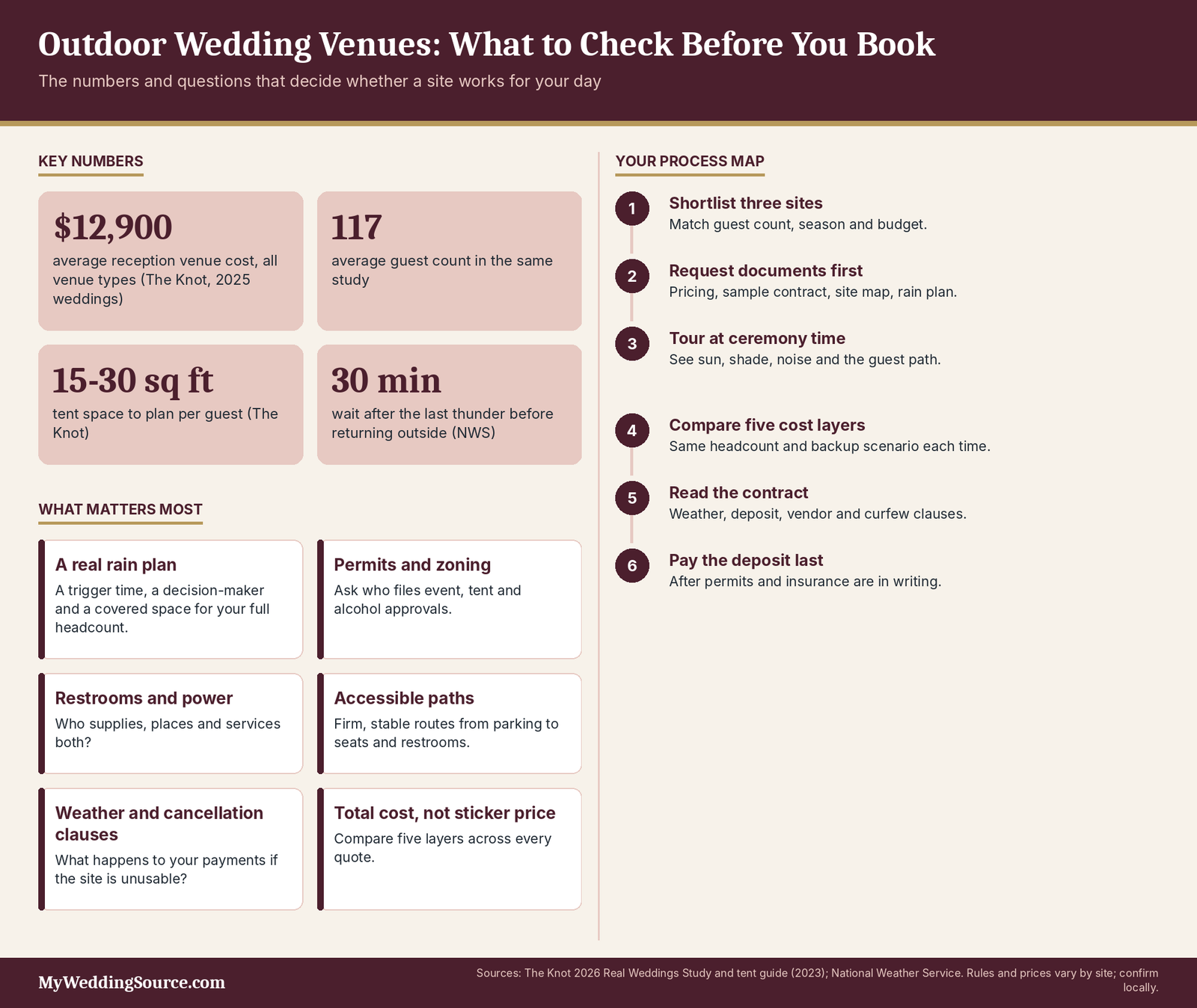
Guest count is the fastest filter, because outdoor capacity depends on land, parking, restrooms and fire-code limits as well as chair counts. The Knot’s 2026 study reports an average of 117 guests for 2025 weddings, but your list matters more than the average, and a site that is magic at 60 can feel stretched at 160. Ask for the maximum for each space in writing, including the backup space, and compare it to your list with a margin for guests who RSVP late. If your numbers fall between two sites’ capacities, ask what the cost increases are above a threshold, since many outdoor sites tier their fees by headcount. The takeaway is to give each venue the same guest-count scenario, not the aspirational one.
How should season and daylight shape the choice?
Season decides whether the same lawn feels charming or punishing. Summer weddings bring heat, storms and bugs, spring brings tree pollen and rain, and fall brings earlier sunsets, cooler evenings and ragweed. Daylight changes the timeline too: a 6 p.m. ceremony in June leaves hours of light, while the same time in late October may mean a dark reception and a lighting rental. The November wedding checklist is a useful reminder of what to confirm in the final month for cooler-weather dates. Ask each venue for sunset time on your date and how its program handles dusk.
Full-service site or blank canvas: which suits your planning style?
Some outdoor venues include tables, chairs, linens, a coordinator and a rain-ready indoor room, and others hand you the keys to a field. Full-service sites cost more up front but remove dozens of small decisions and vendor handoffs, while blank-canvas sites can lower the rental fee and raise your workload. Neither is the better value by default: the right test is the all-in cost and your tolerance for managing vendors. If you pick a blank canvas, plan on hiring someone to run the site on the day, and compare that fee honestly. The wedding planner questions guide can help you decide how much support to buy.
What Do Outdoor Wedding Venues Really Cost Once Everything Is Added?
Pricing for outdoor sites is complicated rather than shady: a field and a ballroom are sold as different products, so the first quote often covers different things. This section builds a cost stack so you can compare two quotes line by line, and it explains why a lower rental fee can end up as the more expensive day.
What does the sticker price on an outdoor venue quote usually include?
What is the national benchmark for venue spending?
The Knot’s 2026 Real Weddings Study, which surveyed 10,474 U.S. couples married in 2025, puts the average reception venue cost at $12,900, up from $12,200 in 2024 and $12,800 in 2023, with an overall average wedding cost of $34,200. The same data shows a wide spread by budget: the venue figure was $3,500 for the lower-budget group, $10,400 at the median and $24,800 for the upper group. Those numbers cover reception venues of every type, so they are a ballpark and not an outdoor-specific price or a quote for your city. A couple in a rural county and a couple in a coastal metro area can be looking at very different numbers for the same lawn. Use the benchmark to sanity-check a proposal, then replace it with real quotes.
What do venues typically bundle in the rental fee?
The Knot’s reception-venue data reports that 74% of venues included rentals, 41% included catering, 37% included alcohol and 7% were space-only. That tells you the packages vary, and an outdoor site is more likely than an indoor one to sit in the space-only group, since it may have no kitchen, tables or lighting. Ask for an itemized “included” list that names specific items, such as 120 chairs, 15 round tables, linens, a sound system, a bridal suite and a rain-date indoor room. An unnamed “tables and chairs” line leaves room for surprises when headcount grows. The consequence of a vague inclusion list is that you cannot compare it to another site’s line items.
How do venues structure their pricing?
Outdoor sites usually use one of four structures: a flat site fee for a set number of hours, a per-person price with food and drink included, a food-and-beverage minimum that you must spend on catering, or a full buyout of a property for the weekend. A flat fee looks simple but often excludes caterers, rentals and staffing, while a per-person price can hide service charges and gratuities that raise the real figure. A minimum spend is not a fee but a floor, and it can be a good deal if you were going to spend that much anyway. Each structure also changes your failure cost if the guest count shifts. Ask which structure applies, what is taxable, and whether the service charge is built in or added after.
What costs do outdoor sites add that a ballroom usually doesn’t?
How much can a tent, flooring and sidewalls add?
A weather structure is the biggest swing item. The Knot’s tent guide (updated in October 2023) says a tent wedding can run roughly $2,000 to $10,000 on average before labor and delivery, and notes that lighting, generators, flooring and restroom trailers can add thousands more. Pole tents are quicker to install and cheaper in labor than frame tents, and it advises planning about 15 to 30 square feet per guest for sizing. Prices have moved since 2023 and vary sharply by region, season and tent style, so use these as orientation and not as quotes. The takeaway is to ask whether the quote includes delivery, installation, flooring, sidewalls, lighting and teardown, because each is often a separate line.
What do power, lighting and a generator cost?
Evening receptions need lighting, and lawns and fields rarely have the amperage for a band, a caterer’s warming equipment and string lights at once. Venues may include basic outlets while expecting vendors to bring their own generators, which turns into a rental or a fuel fee. The Knot’s tent article lists lighting, generators and restroom trailers among line items that can add hundreds to thousands of dollars each, depending on the look and the scale. Ask who supplies power to each vendor and who pays if the system trips the breaker during dinner. A written power plan from the caterer, the DJ and the lighting vendor is a small request that prevents a dark dance floor.
What about restrooms, rentals, staffing and access fees?
Restrooms are a hidden cost at sites without permanent buildings, and portable units or a restroom trailer may be a separate rental. Other add-ons include delivery or load-in fees, early-access charges for setup, extra hours, overtime, a venue-required day-of manager or security, trash removal, parking attendants and shuttle service. If a site restricts outside vendors, the preferred vendors’ prices may also be higher than market. These items are individually modest, which is why they are easy to miss when comparing quotes. Collect them in a spreadsheet with the headings in the table below, and ask each venue to confirm which are mandatory.
How do taxes, service charges and failure costs change the total?
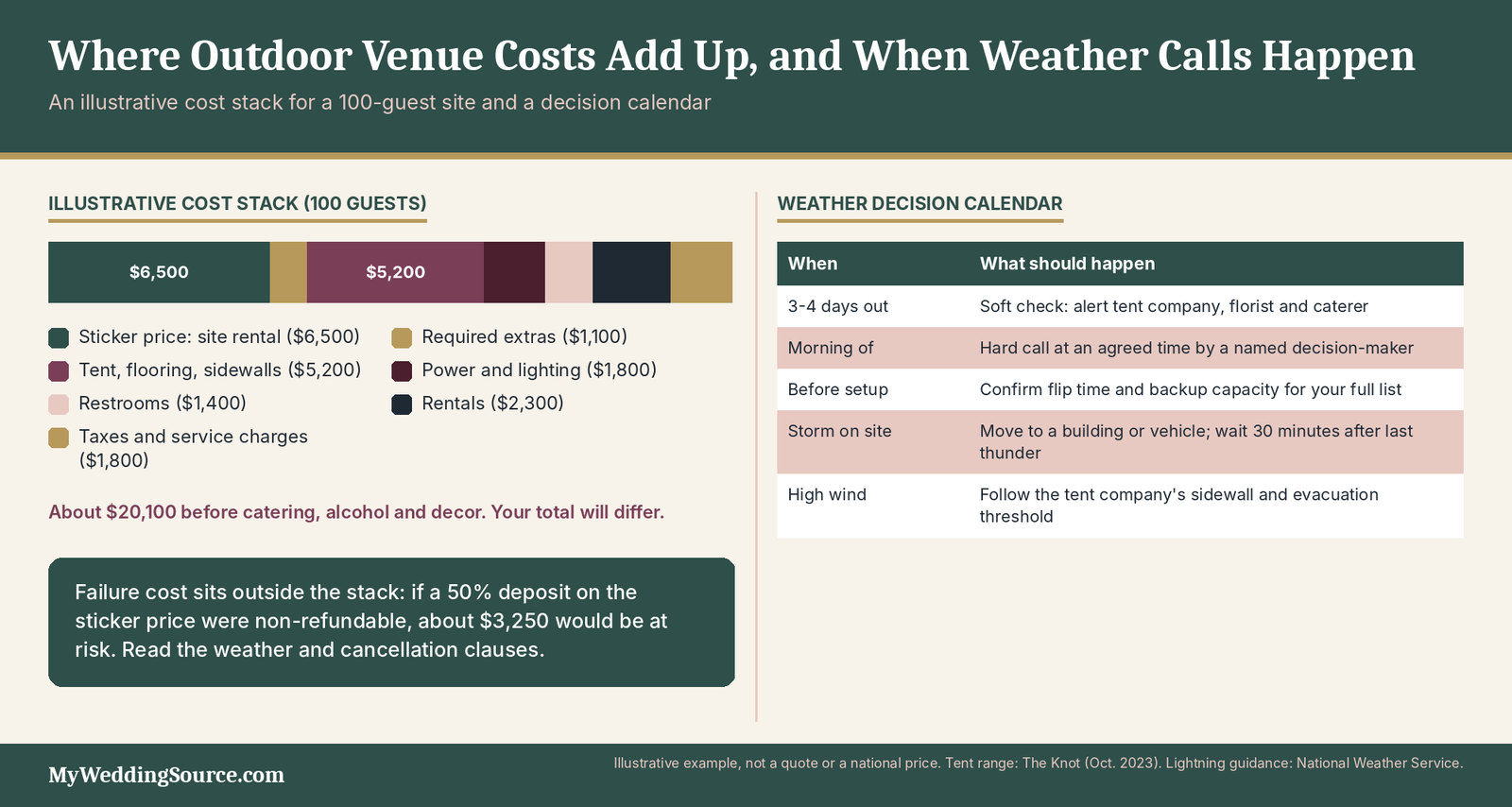
Sales tax and service charges vary by state and by what is being taxed, and a 20% service charge on a large food-and-beverage total is a meaningful number. Ask whether gratuity is included and whether the venue taxes the rental fee. Failure cost is the layer couples overlook: deposits may be non-refundable and payment schedules may be front-loaded, so a weather problem or a family emergency can cost thousands. Paying by credit card, where the venue accepts one, gives you some dispute options if a vendor fails to deliver, but it does not replace a clear refund clause. The point of the stack is to see the whole risk at once and choose where to be flexible.
| Cost layer | What it covers | Illustrative amount |
|---|---|---|
| Sticker price | Site rental fee for a set number of hours | $6,500 |
| Required extras | Venue-required cleaning, insurance and staff | $1,100 |
| Weather structure | Tent, flooring and sidewalls | $5,200 |
| Power and lighting | Generator, string lights, cabling | $1,800 |
| Restrooms | Portable units or a restroom trailer | $1,400 |
| Rentals | Chairs, tables and linens if not included | $2,300 |
| Taxes and service charges | Varies by state and contract | $1,800 |
| Illustrative total | Before catering, alcohol and décor | $20,100 |
Notice how the sticker price is only about a third of that total. This scenario is built to show how layers add up, not to say outdoor weddings cost a particular amount: a full-service site with tables, a restroom building and an indoor backup could land well below it, while a remote property could land above it. The failure-cost layer sits outside the table because it is exposure and not spending, and if the deposit in this example were 50% of the sticker price, about $3,250 could be at risk under a non-refundable contract. For a broader view of how contracts allocate that risk, see the wedding vendor contract red flags guide.
Which Permits, Zoning Rules and Local Approvals Apply to Outdoor Wedding Venues?
Indoor venues usually arrive with their permits and occupancy approvals already in place, which is why couples rarely ask about them. Outdoor sites are different: depending on the land, you may need a special-use permit, a tent permit, a fire inspection, a noise or alcohol approval, or none of these. The rules below come from real agencies, but they are examples of how the process works, not a map of your county.
What do public-land sites require?
What does a national park wedding permit look like?
Rocky Mountain National Park offers a useful picture of how tightly managed federal land can be. Its wedding page describes a $300 non-refundable administrative fee per application, applications accepted one year before the wedding month, and a maximum group of 30 that counts the couple, guests, infants, officiant and photographers. Ceremonies are limited to two hours including setup, pickup and photos, only designated sites can be used, tables, tents and decorations are restricted, and drones are prohibited. Sites also remain open to the public, so you cannot reserve a spot exclusively. If a park is your dream setting, treat it as a ceremony-only location and plan a reception somewhere else, and always read the specific park’s permit page, since each unit sets its own rules.
How do state parks and city beaches handle weddings?
State and local agencies set their own conditions, which is why a friend’s beach wedding in one town says little about yours. California State Parks’ guidance, for instance, notes that fees and requirements vary from location to location, and it lists guest limits that range from 75 at one historic park’s outdoor site to 300 at another. The City of Imperial Beach, California, lists a ceremony permit with an application fee of $316 for residents and $380 for non-residents, a beach venue fee of $750 or $900 for 50 guests or fewer and $900 or $1,080 above 50, a four-hour limit including setup and strike, and a certificate of insurance if you bring equipment such as arches, chairs or tables. It also asks applicants to apply at least 10 business days ahead and sets a refund cutoff of seven days. The lesson is that fees, caps and insurance rules are local, and the cost of a “free” public beach can still reach four figures.
What about city parks, pavilions and public gardens?
City and county parks often rent pavilions, gardens and lawns through a recreation department, with a reservation fee, a deposit and a list of rules. Common conditions include approved vendor lists, limits on amplified sound, bans on open flames, restrictions on alcohol, rules about how and when you may set up, and proof of liability insurance. Some sites also require you to keep the park open to the public or to hire a monitor, and a few do not allow tents or stakes in the ground at all. Ask for the facility rental agreement before you fall in love with the site, because the agreement, not the website photo, tells you what you may actually do. When two public sites are equal on beauty, the one with the clearer rulebook is usually the lower-risk choice.
What approvals apply on private land?
Does a farm, ranch or estate need special zoning for events?
Often yes, and the answer is local. The Kentucky Department of Agriculture’s guide to special events on the farm (revised June 2025) states that many towns do not include events in their definition of agriculture and that a farmer may need a conditional use permit; it also stresses that zoning is a local issue that can vary substantially by place. It points property owners to the county clerk, city clerk or planning and zoning office, to the local health department for food and sanitation rules, and to an insurance agent for coverage, and it recommends a walkthrough with fire and EMS personnel. As a couple, you do not have to be the zoning expert, but you do have the right to ask whether the property is legally permitted to host paid events and to see the permit or approval letter. A venue that cannot answer that question is carrying risk that could land on your date.
When does a tent need a permit or a fire inspection?
Many jurisdictions require a permit for larger temporary tents, and the size that triggers a permit varies by place. A Texas town’s permit application, for example, requires a permit for a tent, canopy or membrane structure over 400 square feet, a copy of the fire-retardant certificate, and bracing and anchoring against weather-related collapse, citing the 2015 International Fire Code. A fire district in Arizona publishes related guidance that open flame, heat-emitting devices and cooking equipment should not be within 20 feet of a tent open to the public, unless the fire code official approves it. Your jurisdiction may use a different edition or threshold, so ask the tent company, venue and local fire marshal who is responsible for permit, inspection and flame-resistance paperwork. The practical result is that a 100-guest reception tent will often fall into permit territory, so build the lead time into your tent contract.
What about noise limits, alcohol and parking?
Noise ordinances, alcohol licenses and parking rules are the three local rules most likely to reshape an evening. Many areas set quiet hours for amplified music, and a site with no neighbors in sight can still sit under a county ordinance that ends the band at a fixed time. Alcohol rules vary by state: some require a licensed caterer or bartender, others permit a venue to hold the license, and some venues restrict outside alcohol altogether. Parking on a grass lot, a county road shoulder or a shared driveway may need a plan, attendants and sometimes a shuttle. Ask the venue for the curfew in writing, who holds the alcohol license, and the maximum number of vehicles the property can handle on your date.
Who pulls the permits: you, the venue or a vendor?
Responsibility for approvals is the point where verbal assurances fail. A venue may say the property is “all set” for weddings and still expect you or the tent company to pull the tent permit, or it may handle the event permit and expect you to pay a surcharge. In a contract, look for language that names who applies, who pays and what happens if a permit is denied or delayed. The table below shows how responsibility often splits, though your site may differ.
| Approval | Who often decides | What to ask |
|---|---|---|
| Event or special-use permit | Park agency, city or county | Is it required, how early, and who applies? |
| Zoning for events on private land | Local planning office | Does the property have approval to host paid events? |
| Tent permit and fire inspection | Fire marshal or building office | Over what size, and who files paperwork? |
| Alcohol service | State and local alcohol authority | Who holds the license or permit? |
| Amplified sound and curfew | City or county ordinance | What is the cutoff time on my date? |
| Insurance certificate | Venue or park agency | What limits and additional-insured wording are required? |
How Should You Judge a Rain Plan, Heat Plan and Weather Risk?
Weather is the one variable no contract can remove, so the useful question is how the site and your team respond to it. A good plan names a trigger, a decision-maker, a covered space with enough capacity and a setup time. This section shows how to test those pieces, and it points to the live outdoor wedding rain plan guide for a deeper walkthrough of the backup itself.
What makes a rain plan real rather than hopeful?
What should a written rain plan include?
A real plan answers four questions in plain language: what is the trigger, who calls it, where do guests go, and how long does the flip take. The trigger is a clock time and a condition, such as “at 10 a.m. on the wedding day if the forecast shows a 40% or higher chance of rain at ceremony time,” and it should name who makes the decision, whether the venue manager, the planner or the couple. The backup space needs to hold your full guest count with chairs, not just fit people standing. Setup time matters because a ceremony room that takes 90 minutes to flip will eat into your photo and cocktail schedule. Ask the venue to put all four answers into the contract or an attached event order.
How big does the tent or indoor backup need to be?
Use the same guest-count scenario for both the weather structure and the indoor room. The Knot’s tent guide suggests planning about 15 to 30 square feet per guest, with sample minimums of a 30-by-50-foot tent for 100 guests, 40 by 60 for 150 and 40 by 80 for 200. The lower end is a tight fit for seated dinner with a dance floor, a bar, a band and a buffet, so ask the tent company to draw the layout and not just quote a size. If the indoor backup holds only 80 and you have 120 guests, you have not yet got a rain plan, you have a rain hope. Ask for the capacity in writing for dinner seating and for ceremony-style seating, since they differ.
When is a tent not enough?
Tents handle rain and sun but not every kind of weather. The National Weather Service states bluntly that “a tent offers NO protection from lightning,” and it says that the only completely safe action is to get inside a safe building or vehicle and to wait 30 minutes after the last thunder before resuming activity. Wind is a separate hazard: a fire district in Arizona recommends taking down small canopies when winds exceed 15 mph, and large tent companies set their own thresholds for sidewalls and evacuation. Ask the tent company what wind speed triggers sidewall removal or evacuation, and whether staff will be on site or on call. If a storm cell closes the site for 45 minutes, your plan should say where 120 guests will wait that is not under canvas.
Who decides, and by what time?
A plan with no decision-maker is just a preference. The decision-maker should be someone who is not emotionally invested in the lawn, such as the planner or venue manager, with the couple informed but not forced to make a call on their own wedding morning. Many teams use a two-step model: a “soft” check three or four days out to alert vendors, and a “hard” call at a fixed morning-of time. Tent companies, florists and caterers all need that signal, so ask the venue how it communicates the call and who has the group text. The result of a clear trigger is a calmer morning and fewer arguments over a radar app.
| Weather risk | Typical lead time | What the plan should say |
|---|---|---|
| Rain | Days out, then morning-of | Trigger time, decision-maker and covered space for your full headcount |
| Lightning | Minutes to hours | Evacuate to a building or vehicle and wait 30 minutes after the last thunder |
| Wind | Hours | Tent company’s threshold for sidewalls, anchoring and evacuation |
| Heat | Days out | Shade, water, cooling and timeline shifts |
| Cold evening | Days out | Sidewalls, heaters (with fire-code distances), blankets and an earlier end |
| Smoke | Day of | Air quality threshold and indoor option |
How do heat, cold, daylight and air quality change the plan?
How hot is too hot for an outdoor ceremony?
Heat risk is easy to underestimate when you are standing in a shaded tour. The National Weather Service explains that the heat index reflects humidity as well as temperature, and that exposure to full sunshine can raise heat index values by up to 15°F. The CDC lists adults 65 and older, infants and young children, pregnant people and people with chronic conditions among those at higher risk, and recommends shade, regular fluids and breaks. For a ceremony in July at 4 p.m., ask for shaded seating, a plan for chilled water at the entrance, fans or misters if available, and a shorter ceremony. A heat plan costs far less than treating a guest who has fainted on the lawn.
How do you keep guests warm after sunset?
Cool evenings catch fall and spring couples by surprise, especially when a daytime ceremony slides into a night reception. Tent sidewalls trap warmth but also change the look and may raise heating costs, and The Knot’s tent guide notes that heating and cooling systems and sidewalls are common add-ons. Space heaters bring a fire-code question, since the Arizona fire district’s guidance restricts heat-emitting devices within 20 feet of a tent unless the fire code official approves them. Blankets, a hot-drink station, an earlier cocktail hour and a planned shift indoors are simpler fixes than a mid-event scramble. Ask the venue and tent company what heating they can provide and what approvals it needs.
Where will the sun be during the ceremony?
Sun angle changes comfort, photographs and guest expressions, so it deserves a line in your timeline. A west-facing ceremony site at 5 p.m. can put the couple in glare and guests squinting, while the same lawn at 6:30 p.m. may be softer. Ask your photographer to walk the site at your planned time and recommend where to stand, and ask the venue for sunset time on your date and when light begins to fade. Photography schedules often depend on this: ask your photographer how they handle low light and golden hour. A 15-minute shift in ceremony time can be the cheapest improvement you make all year.
What if smoke or poor air quality is a risk?
In some regions, wildfire smoke can affect a late-summer or fall wedding even when the forecast is clear. AirNow’s Air Quality Index runs from Good (0 to 50) up to Hazardous (301 and higher), and readings of 101 to 150 are labeled unhealthy for sensitive groups, while 151 to 200 are labeled unhealthy for the general public. Ask the venue whether it has an air-quality plan, whether an indoor space is available and whether the contract treats smoke as a force majeure event. If you are marrying in a smoke-prone region and season, build a decision date for moving indoors and tell older guests and guests with asthma or heart conditions how you will communicate. This is general education, not medical advice, and anyone with a health condition should follow their clinician’s guidance.
What Should You Check for Bugs, Allergies, Food Safety and Accessibility?
A site can be beautiful and still wear guests out: tall grass full of ticks, a cooler of potato salad in the sun, a gravel path that stops a wheelchair, a restroom a quarter mile away. These are the details that decide whether guests remember the vows or the discomfort. They are also the areas where venues vary most, so it helps to ask about them on the tour and not on the wedding day.
What bugs, pollen and food-safety issues come with an outdoor setting?
How do you handle ticks and mosquitoes?
Ticks live in grassy, brushy and wooded areas, and the CDC says they are most active from April through September, so a farm or woodland venue in that window deserves a question. The CDC suggests using repellents registered with the EPA, walking in the center of trails, avoiding high grass and leaf litter, and showering within two hours of coming indoors, which has been shown to reduce Lyme disease risk. For mosquitoes, the CDC notes that they bite day and night and recommends emptying standing water weekly, so ask the venue whether it treats or mows the grounds before events and where standing water collects. Providing a basket of EPA-registered repellent at the ceremony entrance is a low-cost gesture that guests will actually use. Keep the aisle and cocktail areas mowed short and away from tall edges, and tell guests when the path crosses grass.
What should you know about pollen and stinging insects?
Pollen season depends on your region and month. The American College of Allergy, Asthma and Immunology notes that tree pollen comes first in spring, grass pollen follows later in spring and summer, and ragweed is the main fall trigger from August to November, with levels often highest in early to mid-September. Pollen counts for trees and grasses tend to peak in the evening, while ragweed peaks in the morning, which can matter if you are choosing between a morning and evening ceremony. Insect stings are also a spring and summer trigger, and guests with a known sting allergy will carry their own medication, so a reachable first-aid kit and a clear address for emergency responders are sensible additions. You cannot control pollen, but you can pick a ceremony time and tell sensitive guests what to expect so they can plan.
How do you keep food safe when it is warm outside?
Food safety is a weather problem when the buffet sits in the sun. The U.S. Department of Agriculture advises a two-hour rule for perishable food, or one hour when temperatures are above 90°F, and notes that bacteria multiply rapidly between 40°F and 140°F, so hot food should stay at or above 140°F and cold food at or below 40°F. Ask your caterer how they hold and serve cold items outdoors, what shade and power they need, and who monitors the clock. Cocktail-hour appetizers, charcuterie, seafood and cake with fresh filling are the items most likely to linger. The wedding caterer questions guide has more on food service, and you can ask the caterer for a written outdoor-service plan for your date.
How do you make an outdoor site accessible and comfortable for every guest?
Are the paths and surfaces usable for wheelchairs, walkers and heels?
Surfaces are the first accessibility test on any outdoor property. The U.S. Access Board says accessible ground surfaces must be stable, firm and slip resistant, and it notes that most loose materials, including gravel, will not meet that standard unless properly treated, with treatments that need repeated maintenance. Grass, soft sand and uneven lawn can be hard to cross with a wheelchair, a walker or a stroller, and they are slippery on dewy mornings. Ask the venue to describe the route from parking to the ceremony seats, to the restrooms and to the reception, and walk it yourself with a rolling suitcase to simulate wheels. Mats, a paved or compacted path, or a golf-cart shuttle may solve the problem, and they should be in the budget. The live guide on accessible wedding venue red flags goes deeper on what to look for.
How many restrooms do you need, and where should they be?
Restrooms are a common weak point at sites without permanent buildings. Industry guidance from a portable-restroom supplier suggests roughly one unit per 50 to 75 guests for events up to four hours, adding 15 to 30% for events longer than four hours and another 15 to 20% where alcohol is served. Applying that arithmetic to 100 guests over six hours with a bar suggests roughly 3 to 5 units, though that is the editorial calculation and not a legal standard, and local health or building codes may set different requirements. The City of Tampa’s April 2026 guidance for outdoor events says that accessible portable units should equal 5% of the units, with a minimum of one, on an accessible route, and the supplier’s guidance also suggests handwashing stations. Ask who supplies, services and positions the units, and whether a restroom trailer is an option for a long evening.
What about seating, dining tables and shade?
Accessibility does not stop at the path. The Tampa guidance for temporary events says that accessible seating and companion seating should be available, that tables should be a maximum of 34 inches high with at least 27 inches of knee clearance, and that each table should have at least one wheelchair-accessible space. The federal ADA treats businesses that serve the public as public accommodations and expects them to remove barriers where that is readily achievable, but how those rules apply to a particular venue or a temporary event is a legal question, so treat the list as a way to start the conversation and not as legal advice. Practical comforts are as important: shaded seating near the aisle, a quiet corner for guests who need a break, accessible parking close to the ceremony and clear signage. Ask the venue what it has done for other guests and what it can add for yours.
How Many Guests Will the Site Really Hold, and Who Handles Logistics?
Capacity is the number venues quote and the one couples most often misread. An outdoor site may have a ceremony capacity, a reception capacity, a tent capacity, an indoor backup capacity and a parking capacity, and the lowest of those is your real limit. The logistics that follow, from power to load-in, are where a smooth day or a chaotic one is decided.
How many guests can the site hold in each scenario?
Is the ceremony, reception or backup capacity the limit?
Ask for four numbers in writing: ceremony seating on the lawn, reception seating in the tent or barn, the capacity of the rain-plan space for the ceremony and for dinner, and the maximum number of vehicles the parking area can handle. A property that seats 200 for a ceremony may only seat 120 at round tables in its indoor backup, and a tent sized for 150 may hold fewer once a dance floor, bar and band are added. The Knot’s venue roundup shows how widely this varies, with listings from 0 to 50 guests up to more than 300. Make the venue state whether the stated capacity assumes round tables, long tables or theater-style seating. If your list is 140, confirm that the weather scenario holds 140 comfortably, not 140 shoulder to shoulder.
How should the layout work for vendors, bars and a dance floor?
A layout drawing is the cheapest way to prevent a problem. It should show the ceremony aisle, guest seating, tables, a dance floor, band or DJ, bars, buffet or kitchen areas, restrooms, vendor tents and the paths between them, with accessible routes marked. For a seated dinner with a dance floor, the higher end of the 15-to-30-square-feet-per-guest rule usually applies, and bars and food stations should be placed so lines do not block the path to restrooms. Ask the tent company, caterer and venue to review the same drawing so everyone is working from the same plan. The easiest fix at this stage is to move a bar; the hardest is to discover on the morning that the caterer’s trailer will not fit.
How will guests arrive, park and get home?
Parking and transportation are a capacity problem too. Fields and gravel lots may need attendants, drainage or ground mats after rain, and county roads may not allow roadside parking. If your venue is remote, a shuttle from a hotel can reduce vehicles and keep guests who drink from driving, and lodging blocks may be easier to arrange close by. Ask the venue about the rainy-day parking plan, the number of spaces and whether there is a safe place for rideshares to wait. An outdoor site 40 minutes from town that ends at 11 p.m. needs a plan for the drive home, and that plan belongs on the invitation or wedding website.
Who handles power, setup and the day-of schedule?
How do you plan for power and generators?
Power is a shared resource at an outdoor site, and a plan prevents the classic problem of a tripped breaker during dinner. List every item that needs power, including the band or DJ, caterer’s warming and cooling equipment, lighting, fans or heaters, and any coffee or dessert station, and ask each vendor for their load. If generators are needed, ask who supplies them and where they will sit. The U.S. Consumer Product Safety Commission’s household guidance is to never run a portable generator inside a home, garage or shed and to keep it at least 20 feet away from the house with the exhaust pointed away from buildings, which is a useful benchmark for a question about distance from a tent and guests. Request a written power plan that names who is responsible.
What are load-in, load-out and vendor access like?
Load-in is how vendors get gear to the site, and it can be harder outdoors than at a hotel. Ask about the route and surface for trucks, whether a tent company can drive onto wet grass, how early vendors can arrive, how far the catering truck is from the kitchen tent and what happens if the ground is soft. Rain can turn a farm lane into a rut and add hours to setup, which is why many venues require a certain buffer. Also ask about load-out: when must everything leave, who handles trash and rental pickup the next morning, and whether early access or late pickup costs extra. A one-page vendor access sheet from the venue is a good sign.
How should the day-of timeline account for light, weather and flips?
An outdoor timeline works backward from sunset, weather and the flip from ceremony to reception. Plan cocktail hour so the room can be flipped while guests are elsewhere, build a buffer for the weather call, and schedule portraits so the couple is not rushing against fading light. Put each of these tasks on the timeline with a named owner. Many outdoor venues have a hard end time because of noise or neighbors, so confirm whether the end time includes breakdown or music only. The result of a realistic timeline is that vendors can set up with fewer surprises and you can enjoy your own party.
| Responsibility | Venue often handles | You or vendors often handle | Confirm in writing |
|---|---|---|---|
| Tent and flooring | Sometimes includes it | Tent company installs | Who orders, permits and pays |
| Power and generators | Basic outlets | Vendors bring their own | Capacity, fuel and generator placement |
| Restrooms | Permanent or portable | Portable or trailer rental | Number, accessibility and servicing |
| Tables and chairs | Included or rented | Rental company | Counts and who sets up |
| Day-of manager | Venue coordinator | Planner or coordinator | Who controls the weather call |
| Trash and cleanup | Varies | Caterer and couple | Who removes it and when |
What Should an Outdoor Venue Contract Say About Weather, Cancellation and Insurance?
The contract is where a venue’s friendly promises become obligations, and outdoor sites need a few clauses that indoor venues rarely discuss. Terms and state laws vary, and this section is general education and not legal advice, so ask an attorney if a clause confuses you. The goal is to understand who carries each risk before you sign.
Which contract clauses matter most for an outdoor site?
What should the weather, rain-date and force-majeure language say?
Look for the clause that describes what happens if weather makes the site unsafe or unusable. Some contracts say the date proceeds regardless of weather and that you accept the risk, others move you to a named indoor space, and a few offer a rain date at no charge or at a fee. Force-majeure clauses typically list events outside anyone’s control and may or may not include severe weather, smoke or utility failure, and they often say what happens to your deposit. Ask the venue to describe the backup space by name, its capacity and any cost to use it. If the contract only says “weather permitting,” ask for a rewrite that states exactly what happens in a storm.
How do deposits, payment schedules and cancellation terms work?
Outdoor sites often collect a large deposit to hold a seasonal date, then stage later payments at 90, 60 and 30 days. Check whether the deposit is refundable, partly refundable or transferable to a new date, and what happens if you downsize your guest count. The wedding vendor contract red flags guide walks through cancellation and refund language in more detail. If the venue cancels, ask what you receive, because a refund of the deposit may not cover non-refundable payments you made to other vendors. Pay by credit card if the venue accepts one, keep every receipt, and get any promise made on the tour into the written agreement.
What do vendor rules, curfews and damage terms look like?
Many venues restrict who may work on the property. Look for required caterers, approved vendor lists, outside-alcohol fees, exclusivity for tents or rentals and proof of insurance from each vendor. Also check the curfew for music and the end of the event, overtime rates, restrictions on open flame, confetti and sparklers, drones, and any damage or cleaning deposit with its return conditions. Ask whether the grounds fee covers the repair of lawn damage caused by tent stakes or vehicles. The less specific the clause, the more it leaves to the venue’s judgment after the party.
What insurance matters, and what are the red and green flags?
What is the difference between cancellation, liability and liquor coverage?
These are different products. Zola’s wedding insurance guide describes cancellation or postponement coverage as repaying money you lose if you cancel or reschedule for a covered reason, liability coverage as covering injuries and third-party property damage, and liquor liability as covering damages from alcohol-related accidents involving guests. It also notes that most insurers do not consider rainy weather a reason to cancel or postpone, that a change of heart is not covered, and that some states require buying at least two weeks before the event for extreme-weather cancellations. Progressive’s event insurance explainer says a wedding liability policy can start around $101 as a single payment, though the price depends on coverage, headcount and length. Treat these as a starting point and get quotes for your own date and venue.
What insurance does the venue already carry, and what does it require from you?
Many venues require couples or vendors to carry liability coverage and to name the venue as additionally insured, and Zola recommends asking the venue for copies of its own event policies to see what it already covers. Public agencies do the same: the Imperial Beach beach-ceremony page asks for a certificate of insurance when equipment such as arches or chairs is used. Ask the venue for the exact limits and wording it requires, whether it sells a one-day policy, and whether vendors such as the tent company, caterer and DJ carry their own coverage. If you serve alcohol, ask who holds the liquor license and who carries liquor liability. Insurance is an area where an agent can give advice that matches your situation.
Which red flags should slow you down?
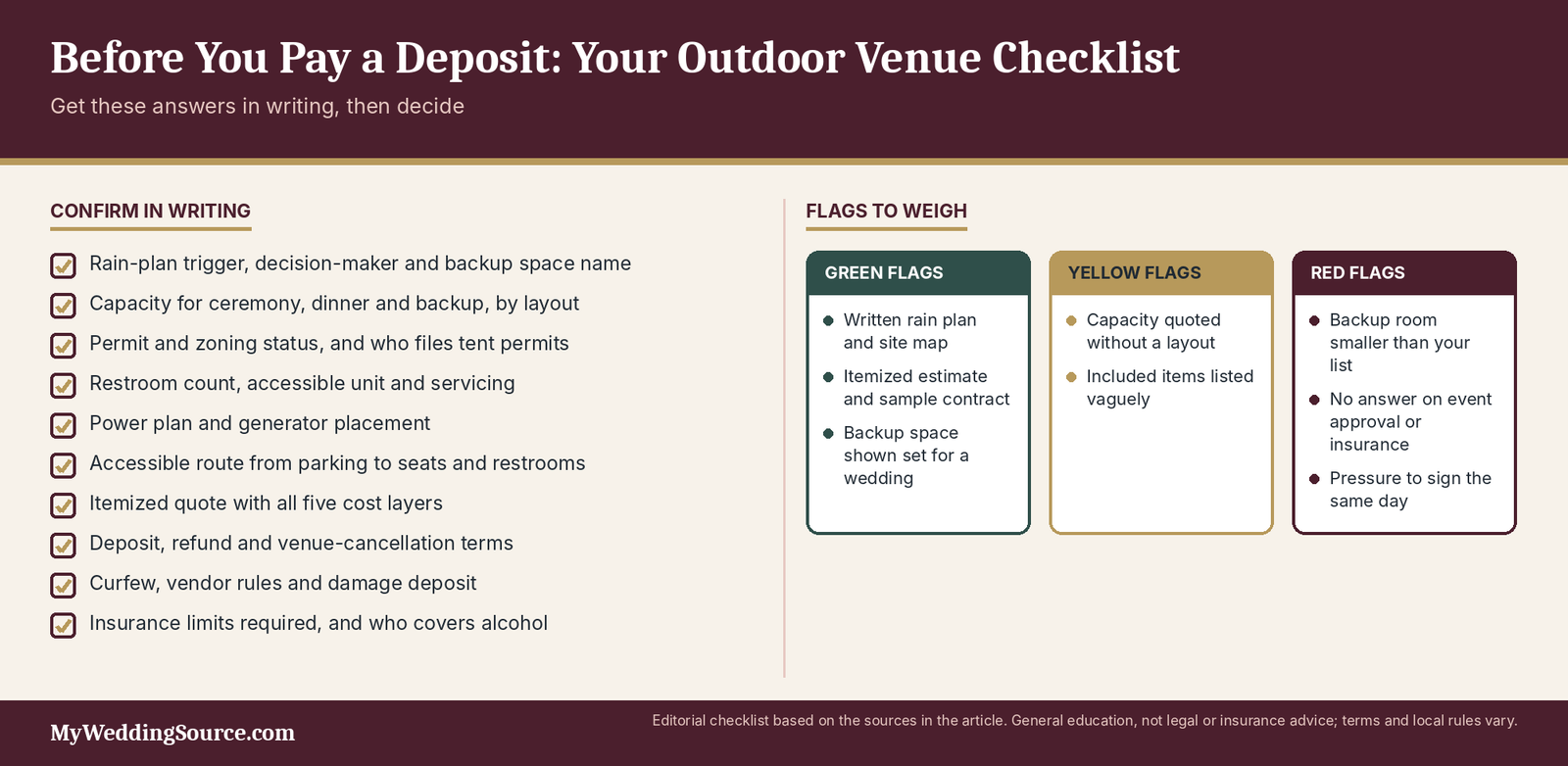
A red flag is not proof of bad intent, but it is a prompt to ask more. Common ones include a refusal to name the rain-plan space or its capacity, a “weather permitting” clause with no remedy, no written confirmation that the property may host events, vague inclusions, pressure to sign the same day, and a venue that will not let you speak with recent couples. Others include unclear restrooms, no power plan, an unwillingness to share its insurance certificate and no answer on who pulls the tent permit. One red flag may have a simple explanation, but several together suggest you should compare other sites. The table below pairs common flags with a follow-up question.
Which green flags suggest a venue is ready?
Green flags make planning feel easier. A venue that gives you a written rain plan, a site map with capacities, an itemized estimate with all five cost layers, a vendor access sheet, an accessible route, a sample contract before you pay and a coordinator who has run weddings in all kinds of weather is showing its work. It may also offer photos of the backup space set for a wedding, a clear permit and insurance list, and a willingness to walk the site with your planner. These signs do not guarantee a smooth wedding, but they show a team that has solved the common problems before.
| Red flag | Why it matters | Follow-up question |
|---|---|---|
| “We have never needed a rain plan” | Weather risk is unaddressed | Where did the last rained-on wedding go? |
| Backup room holds fewer guests than your list | Plan fails at your headcount | What is the capacity for dinner seating? |
| Event approval is unclear | Date could be at risk | Can I see the permit or zoning approval? |
| No restroom or power plan | Costs and discomfort land on you | Who supplies and services both? |
| Non-refundable deposit with weather risk on you | Failure cost is high | What happens to my payments if the site is unusable? |
| Reluctance to share insurance terms | Coverage gaps | What limits and additional-insured wording do you require? |
What Should You Ask on a Tour of Outdoor Wedding Venues?
A tour is your best chance to see how the site works, and an outdoor tour can be misleading if the day is mild and the lawn is empty. Plan visits so you see the place the way your guests and vendors will, and bring the same questions to every venue. This section gives you a preparation routine, an on-site list and a method for comparing quotes. For more on choosing a venue generally, see the wedding venues guide and the wedding venues hub.
How should you prepare before the visit?
What should you request before you arrive?
Ask the venue to send, before the tour, its pricing sheet, a sample contract, the list of what is included, the rain-plan description, a site map with capacities, vendor rules, insurance requirements and the typical timeline for a wedding. That saves tour time for questions you cannot answer on paper, and it shows how organized the venue is. Compare documents across venues so you notice who volunteers detail. If a venue says it only shares pricing after a call, that is a style difference and not necessarily a red flag, but it makes comparison slower. Keep each venue’s documents in one folder so you can check what you were promised.
When is the best time to tour an outdoor site?
The most useful tour happens at the time of day and the season that match your plan. Visit at the hour your ceremony would start so you can see sun angle, shade and noise, and if you can, go on a second visit at a different time or after rain to see drainage and mud. Ask to see photos from weddings held in rain, heat or cold. If you are touring in a different season than your wedding, ask what the site looks like then, including foliage, bugs and daylight. A single golden-hour visit is a good first impression, but it is not data about a wet Saturday in April.
Who should come with you?
Bring someone who will notice what you do not: a planner, a photographer, a parent who will use the restroom, or a friend who uses a wheelchair or a cane. If you have a planner, ask them to review the contract before you pay a deposit. A second set of eyes can spot a step, a gate or a slope you would miss, and it keeps the tour from becoming only about the view. Have one person take notes in a shared document while another walks the guest path.
What should you ask and compare once you are on site?
What should you ask about weather and the backup space?
Ask to see the backup space and ask how it is set for a wedding. Ask who decides to move, by what time, how long the flip takes, whether you can host the full guest list there and what it costs. Ask what the venue does for lightning, high wind, extreme heat and smoke, and how it has handled the worst weather in the past. A venue that answers with a specific story usually has a system, while one that says “it never rains here” probably does not. Write the answers down and ask for them in an email, so they can be attached to the contract.
What should you ask about people, services and the land?
Ask about staffing: who is on site during setup, the event and breakdown, and whether a coordinator is included. Ask about restrooms, power, water, trash, parking, accessible routes and cell service, since a site with no signal can complicate vendor coordination and payment processing. Ask about neighbors, curfews, livestock or wildlife, standing water, mowing and any pest control, as well as which vendors the property restricts. Walk the guest route from parking to the ceremony, the restrooms and the reception, noting every step, slope and surface change. These questions turn a pretty view into a working plan.
How do you compare two quotes fairly?
Put every proposal into the same five-layer table: sticker price, required extras, realistic extras, taxes and service charges, and failure cost. Use the same guest count, hours, season and backup scenario for each, and ask venues to fill gaps such as tents, power and restrooms with real quotes rather than guesses. A lower rental fee can come with higher extras, while a higher fee may include items you would otherwise rent. Include your own time as a cost if a blank-canvas site means coordinating ten extra vendors. After you complete the table, the right choice is usually the one where the total, the risk and the workload all fit your priorities.
| Topic | Ask the venue | A strong answer sounds like |
|---|---|---|
| Rain plan | Where do we go, who decides and when? | A named room, a clock time and a decision-maker |
| Capacity | What is the number for the ceremony, dinner and backup? | Written numbers by layout and space |
| Restrooms | How many, accessible and serviced by whom? | A count, a supplier and an accessible unit |
| Power | What is available, and who supplies the rest? | A written load plan and a generator location |
| Permits | Is the site approved for events, and who files tent permits? | A permit or approval letter and a named owner |
| Insurance | What do you carry, and what do you need from us? | Exact limits, wording and a sample certificate |
Frequently Asked Questions About Outdoor Wedding Venues
These are the questions couples ask most often once they have a shortlist. The answers are general guidance, so verify details with your venue, local officials and an insurance agent.
What do couples ask about cost and booking?
How far ahead should you book an outdoor wedding venue?
There is no universal rule, but The Knot advises that great venues book quickly, and public agencies show how far ahead demand can run: Rocky Mountain National Park accepts wedding applications one year before the wedding month. Popular spring and fall Saturdays at outdoor sites often fill many months ahead, which is an editorial observation and not a statistic. Start touring as soon as you have a rough date range and guest count, and ask whether the venue can hold a date while you review the contract. Weekday and off-peak dates can be easier to get and sometimes less expensive.
Are outdoor weddings cheaper than indoor weddings?
Sometimes the rental fee is lower, but the total depends on what the site includes. A space-only outdoor site may require a tent, power, restrooms, rentals and extra staff, while a full-service garden or vineyard may include many of those. The Knot reports that the average reception venue cost was $12,900 for 2025 weddings, but that figure is not specific to outdoor sites. The reliable way to compare is the five-layer table described above, using real quotes for the same guest count.
What do couples ask about weather and guests?
Do you still need a tent if the venue has an indoor backup?
Not always, but you should confirm that the backup truly holds your guest count for ceremony and dinner. If the indoor space is smaller, you may need a tent, or you may choose a smaller guest list or a different layout. Tents also help with sun and light rain, but they are not a lightning shelter, so you still need a building or vehicle plan. Ask the venue for the capacity of the backup space and what it costs to use it.
Does wedding insurance cover rain?
Usually not on its own. Zola reports that most insurers do not consider rainy weather a reason to cancel or postpone a wedding, while extreme weather that makes the event impossible may be covered under a cancellation policy, subject to its terms and exclusions. Read the policy for named exclusions and ask when coverage begins, since some states require buying a certain time before the event. Liability coverage is separate and protects against injury or property damage claims.
What if the forecast changes a few days before the wedding?
This is where a written trigger plan pays off. Tell your venue manager, planner and key vendors that you are watching the forecast, and use the soft check described earlier to alert the tent company, florist and caterer. Keep guests informed through your wedding website or a group message with clear advice about footwear, layers and arrival. The goal is to make the decision once, early enough for vendors to adjust, and then stop refreshing the radar.
Your Next Steps
You do not need to solve every question at once. The sequence below moves from shortlisting to the contract, so you spend your effort where the stakes are highest.
What should you do this week?
How do you build a shortlist you can compare?
Pick three outdoor sites that fit your guest count, season and budget, and ask each for the documents listed earlier: pricing, sample contract, inclusions, rain plan, site map, vendor rules and insurance requirements. Create a single table with the five cost layers and the capacity numbers, and fill in the sticker price first. Mark every blank as a question for the venue, and request a tour at the hour of your planned ceremony. Within a week you will know which sites answer clearly and which ones need follow-up.
Which five questions should you ask first?
Ask each venue where guests go if it rains and who decides when, what the capacity is for ceremony and dinner in both the outdoor and backup spaces, who supplies restrooms and power, which permits apply and who files them, and what happens to your payments if the site is unusable. These five cover most of the risk that can hurt your wedding. Send them by email so you have written answers. A venue that replies promptly with specifics is giving you useful information about how it will work with you later.
What should you check before you pay a deposit?
What should you confirm in the contract?
Read the weather, cancellation, deposit, vendor, curfew and damage clauses, and compare them with what the venue told you on the tour. Make sure the backup space is named, the capacities are written, the inclusions are itemized and the responsibility for permits is assigned. Use the contract red flags in the section above as a checklist. If anything is unclear, ask for a revision in writing before you sign.
What should you secure in writing before the money moves?
Ask for the venue’s insurance requirements and certificates, the permit and zoning status, the tent and power plan, the restroom plan, and a payment schedule that matches your comfort with risk. Consider whether cancellation insurance makes sense once you know what is refundable, and compare quotes from licensed insurers. Pay with a method that gives you records and some protection, and keep copies of everything. When these items are in writing, you can plan the rest of the wedding knowing the foundation is sound.
Sources & methodology
- The Knot: The Average Wedding Cost, According to The Knot Data — 2026 Real Weddings Study: 10,474 U.S. couples married in 2025, average cost $34,200, 117 guests and $12,900 reception venue.
- The Knot: Average Cost of a Reception Venue — venue cost by year and budget group, and what venues typically include.
- The Knot: Tent Weddings — tent cost range, add-ons and square-feet-per-guest sizing (updated October 2023).
- The Knot: Outdoor Wedding Venues — venue types and capacity examples.
- National Weather Service: Lightning Safety Outdoors — tents offer no lightning protection; wait 30 minutes after the last thunder.
- National Weather Service: Heat Index — full sun can raise heat index values by up to 15°F.
- CDC: Heat and Your Health — higher-risk groups, hydration and shade.
- CDC: Preventing Tick Bites — repellents, seasonal activity and post-event checks.
- CDC: Preventing Mosquito Bites — repellents and standing water.
- ACAAI: Seasonal Allergies — tree, grass and ragweed pollen seasons.
- AirNow: Air Quality Index basics — AQI categories and ranges.
- USDA: Food safety and the two-hour rule — two-hour rule, one hour above 90°F, and 40°F to 140°F danger zone.
- National Park Service: Rocky Mountain National Park weddings — example of a federal wedding permit, fees and limits.
- City of Imperial Beach: Beach Ceremonies — example of local beach ceremony fees, limits and insurance.
- California State Parks: Getting married in state parks — example of park-by-park rules and guest limits (undated PDF).
- Kentucky Department of Agriculture: Special Events on the Farm — local zoning, health department and insurance considerations (revised June 2025).
- Town of Prosper, Texas: Temporary Structure Permit Application — example tent permit threshold and flame-resistance paperwork.
- Sedona Fire District: Tent and Canopy Safety — example of distance rules for heat and cooking devices and canopy wind guidance.
- U.S. Access Board: Floor and Ground Surfaces — stable, firm and slip-resistant surfaces; loose gravel.
- ADA.gov: Title III primer — public accommodations and readily achievable barrier removal.
- City of Tampa: ADA compliance for outdoor events (April 2026) — example local guidance on portable toilets, seating and tables.
- Satellite Industries: Portable restroom to guest ratios — supplier guidance on restroom ratios (industry guidance, not a legal standard).
- U.S. CPSC: Portable generator safety — never indoors; at least 20 feet from the house.
- Zola: Wedding insurance guide — cancellation, liability and liquor coverage; rain exclusions.
- Progressive: Event insurance 101 — event liability and cancellation coverage; wedding policies starting around $101.
This article separates four kinds of information. The Knot figures are survey findings from its 2026 Real Weddings Study of couples married in 2025 and its tent guide updated in 2023; permit, fee and fire-code details are verified examples from the named agencies and are not a rule for your area; the $20,100 cost stack, the restroom calculation and the 40% rain-trigger example are illustrative or editorial arithmetic, not quotes or standards; and the advice on questions, red flags and comparisons is editorial judgment. Contracts, insurance and permits are general education, and terms and state laws vary, so confirm details with your venue, local officials, an insurance agent and, where needed, an attorney.
Freshness note: recheck The Knot cost data when its next Real Weddings Study publishes (about each February), recheck the tent cost guidance first because it dates from October 2023, and verify every permit fee, guest cap and fire-code threshold with the local agency for your date, since the examples above were read in October 2026 and change often.