

Wedding venue cost is almost never one number: it is a rental fee, a food-and-beverage minimum, a per-person rate, a service charge and a tax line, and the quote only becomes comparable once you ask every venue for the same all-in total.
You have toured three places and each sent a different kind of price. One lists a $5,500 site fee and nothing else, one wants a $14,000 food-and-beverage minimum plus a room fee, and one quotes $175 per person with two plus signs after it. Nobody is hiding anything, because each venue is describing its own business model, but you cannot pick between a flat fee, a spending floor and a per-head package until all three are converted into the same thing: what you will actually pay on the night, for your guest count, on your date. That conversion is the whole job of this article.
This guide is for couples at the quote-comparison stage who want a clear map of how venue pricing works before they negotiate or sign. It explains what the two big national studies measure (and why they disagree), how prices move by state, guest count and budget tier, what the four common pricing models really cover, and how service charges, taxes and the long tail of fees stack up.
It then shows how day of the week, season and guest count change the bill, walks through a quote-comparison worksheet with an illustrative three-venue example, and finishes with practical ways to lower the total. Contract clauses such as cancellation, force majeure and deposit refundability are covered separately in our guide to wedding venue contract hidden costs, and how to choose a venue by style and logistics sits in the wedding venues guide. Here the focus stays on the price itself.
Two honest limits before the numbers. National averages describe what other couples reported, not what a venue in your city will charge, and the published rate sheets quoted below are examples of structure, not offers. Where a figure comes from a venue’s own marketing page, an older page or a third-party estimate, the text says so.

What Is the Average Wedding Venue Cost, and Why Do Two National Studies Disagree?
Two respected datasets give two different headline numbers, and a couple who sees $12,900 in one place and $8,573 in another could reasonably conclude that one of them is wrong. Neither is, but they count different things from different groups of couples. Understanding that difference is the first step toward using any benchmark without being misled by it.
What do The Knot and Zola actually report?
What is The Knot’s average reception venue cost, and how has it changed?
The Knot’s 2026 Real Weddings Study surveyed 10,474 U.S. couples married between January 1 and December 31, 2025, recruited by email through Knot and WeddingWire membership, and reports an average reception venue cost of $12,900. The Knot’s venue-cost article (updated May 2026) shows the trend: about $9,000 in each of 2016, 2017 and 2018, $10,500 in 2019, $10,700 in 2021, $11,200 in 2022, $12,800 in 2023, $12,200 in 2024 and $12,900 in 2025. The same study reports 117 guests on average and $292 per guest, up from $284 the year before.
What does Zola count as a venue and site fee?
Zola’s Wedding Cost Index (last updated March 6, 2026 in the page we read) reports an average venue and site fee of $8,573, with a typical range of $6,900 to $10,300, alongside a separate catering average of $6,927 and a national total of $36,000. The index draws on Zola platform data, including budgets couples enter in the Zola Budget Tool and pricing reported by Zola vendors, while a separate Wedding Spend Survey of 720 couples (completed within 180 days after the wedding) supplements it.
The important design choice is that Zola breaks venue and catering into two lines, which makes its venue number a closer cousin of a flat site fee than The Knot’s all-in venue figure.
Why do the two numbers differ, and which should you use?
Three things explain most of the gap. First, The Knot asked couples what their reception venue cost them, and its article reports that couples said their venue price included rentals (74%), catering (41%), alcohol (37%) or only the space itself (7%), so a large share of the $12,900 contains services that Zola files under catering or rentals. Second, the two populations differ, because Knot and WeddingWire members are not the same couples as Zola registry and budget-tool users.
Our editorial judgment is to use The Knot’s figure when you are comparing all-in venue packages and Zola’s when you are comparing site fees, and to use both only as a sanity check on a quote, not as a target to hit.
| Benchmark | Headline figure | What is counted | Source year |
|---|---|---|---|
| The Knot, reception venue | $12,900 average | Venue as couples reported it; 74% say rentals, 41% catering, 37% alcohol included | 2025 weddings (published 2026) |
| Zola, venue and site fee | $8,573 average; $6,900 to $10,300 typical | Venue and site fees, with catering ($6,927 average) as a separate line | 2026 Wedding Cost Index |
| The Knot, whole wedding | $34,200 average; 117 guests | Ceremony and reception; engagement ring excluded from state and city data | 2025 weddings (published 2026) |
| Zola, whole wedding | $36,000 average | Budgets and vendor-reported pricing from Zola platform data | 2026 Wedding Cost Index |
How should you use a national average without being misled by it?
Is the national average a good budget target?
Not on its own, because an average blends a $3,000 community-hall reception with a $30,000 historic estate and describes neither. In The Knot’s venue data, couples in the lower tier reported venue spending around $3,500, the median was about $10,400, and the upper tier was about $24,800. The page does not define the tier cutoffs, so read those as illustrative bands. A better use of the average is as a plausibility check: if a quote for a mid-size reception is far below the Knot and Zola figures, ask what is missing (rentals, staffing, catering), and if it is far above, ask what is included that you would not otherwise buy.
What does a venue price usually include?
There is no standard. The Knot’s respondents said their venue price commonly included rentals, a meaningful minority said catering and alcohol came with it, and only 7% described a space-only price. That mix explains why two venues with the same headline number can deliver very different weddings: one hands you a ballroom with tables, linens and a bar team, while the other hands you keys and a list of rental companies. Before you compare a single price, write down for each venue whether it includes tables and chairs, linens, tableware, bar service, a coordinator, setup and breakdown, and cleanup, because every “no” becomes another line on someone else’s invoice.
Where is the average most likely to mislead you?
It misleads most when your situation sits far from the sample’s center. The Knot reports that couples spending under $12,000 averaged 92 guests and often used non-traditional venues such as parks or a family home, while couples spending over $41,000 averaged 141 guests and often chose full-service venues such as historic buildings and country clubs. If you are planning a 40-person dinner, an average built around 117 guests will overstate your venue cost, and if you are planning 200 guests in a major metro, it will understate it.
The same warning applies to dates, because a Saturday in October is priced differently from a Sunday in February, a gap we quantify with published rate sheets later in this guide.
How Does Wedding Venue Cost Change by State, Guest Count, and Budget Level?
Location is the largest single reason one couple’s venue bill looks nothing like another’s. The Knot publishes a state-by-state breakdown of reception venue spending, and the spread is wide enough to change which kinds of venues are realistic for you. Guest count adds a second layer, because a venue priced per person or with a minimum scales with the number of chairs you fill.
Which states price reception venues highest and lowest?
What do the highest-cost states look like?
In The Knot’s 2025 data, New Jersey leads at $27,710, followed by New York at $21,300, Rhode Island at $19,540, Massachusetts at $19,180 and Connecticut at $18,630. Pennsylvania ($15,020), California ($15,310) and Delaware ($15,890) sit in the next tier, and Illinois is at $14,060. If your wedding is in one of these markets, the Knot national average of $12,900 is probably a floor for a full-service reception, not a midpoint.
What do the lowest-cost states look like?
The lowest reported averages are Wyoming at $3,770, Idaho at $4,020, South Dakota at $4,740, Oklahoma at $5,000 and Mississippi at $5,100, with Kansas ($5,230), Arkansas ($5,370) and Iowa ($5,460) close behind. The gap between New Jersey and Wyoming is about 7.3 times, which is the clearest single reason not to apply a national number to a local budget. That range is the clearest argument for local quotes over national averages.
Does a state average predict what your own city will charge?
Only loosely. State averages hide big internal differences, and small-state samples can swing. A telling example: The Knot’s 2026 study puts Wyoming’s average total wedding cost at $17,000, while Zola’s 2026 state table lists a Wyoming range of $41,000 to $61,500, more than double, which suggests very small samples or very different couple populations. We found no free, national, city-level dataset for venue-only fees, because Knot’s metro averages (New York City $88,000, Chicago $54,000, San Francisco and Boston $51,000, Los Angeles $45,000) and Zola’s 150-guest city figures (Manhattan $99,452, Atlanta $48,555, Tulsa $33,891) describe total wedding costs.
Use state averages to set a range, then replace them with at least three local quotes as fast as you can.
| State group | State | Average venue cost |
|---|---|---|
| Highest | New Jersey | $27,710 |
| Highest | New York | $21,300 |
| Highest | Massachusetts | $19,180 |
| Mid-range | California | $15,310 |
| Mid-range | Florida | $12,510 |
| Mid-range | Texas | $9,520 |
| Lowest | Oklahoma | $5,000 |
| Lowest | Idaho | $4,020 |
| Lowest | Wyoming | $3,770 |
How much do guest count and budget tier change the venue bill?
What does venue cost look like by guest count?
The Knot’s venue article reports average reception venue cost of $6,500 for 1 to 50 guests, $10,400 for 51 to 100 guests and $16,000 for 101 or more guests. The same study’s whole-wedding averages scale similarly: $17,100, $27,200 and $43,300. The practical lesson is that the guest list is a venue decision, not just a family-diplomacy decision, and the most dependable way to lower a venue bill is often to host a smaller room, which we price in the section on guest-count math.
| Guest count | Average reception venue | Average whole wedding |
|---|---|---|
| 1 to 50 guests | $6,500 | $17,100 |
| 51 to 100 guests | $10,400 | $27,200 |
| Over 100 guests | $16,000 | $43,300 |
What changes when the site is not a traditional venue?
Public parks, gardens and community spaces price very differently from a banquet operation because they sell access, not service. Portland Parks and Recreation’s 2026 wedding reservation application, for example, lists site fees from about $224.50 for a gazebo or small garden to $826.25 for the Shakespeare Garden and $2,165.25 for the Washington Park amphitheater, plus an application fee of $133.50 to $266.75 depending on how far ahead you apply. The same form requires one portable restroom per 125 people, limits hosted alcohol to beer and wine with an insurance requirement, and restricts decorations at simple ceremony sites.
A site fee of a few hundred dollars is a genuine bargain, but it does not include a reception, so budget for catering, rentals, restrooms, sound and a rain plan as separate purchases.
Which Pricing Model Is Your Venue Using: Rental Fee, Minimum, Per-Person, or Package?
Venues sell the same evening in at least four different ways, and the model decides which costs are visible in the quote and which show up later. A flat rental fee is easy to read but leaves most of the event unpriced, a food-and-beverage minimum is a spending floor rather than a price, a per-person package multiplies with your guest count, and an all-inclusive bundle hides the arithmetic inside one rate. Each model is described below with what it leaves out.
What are the four main venue pricing models?
What is a flat rental fee, and what does it leave out?
A flat rental fee (also called a site fee, facility fee or room rental) buys access to the space for a fixed time window, and nothing else is implied. Gale Mansion in Minneapolis, for instance, publishes a 12-hour rental block at $5,700 for the mansion and ballroom in peak season, and Portland Parks sells garden and gazebo sites by the time slot. The cost is that you now own the missing pieces, and The Knot’s 2025 averages for event rentals ($2,000) and lighting and decor ($1,900) show how quickly those pieces add up when the venue provides none of them.
What is a food-and-beverage minimum, and do you owe it if guests eat less?
A food-and-beverage (F&B) minimum is the least the venue expects you to spend on catering and drinks, and it is often the number that actually sets your bill. Paperlust’s 2026 venue-budget article describes it as a floor usually stated before service charge and tax, and Fort Worth’s Ashton Depot publishes a 2026 Saturday minimum of $20,000 against a Friday minimum of $12,000 and a Sunday minimum of $7,000. If your menu and bar come in below the floor, the usual practice is that you still owe the difference, so a smaller guest list may save nothing until it falls well below the point where the minimum stops mattering.
What is per-person pricing, and what does it multiply?
Per-person pricing quotes a rate per guest, typically bundling a meal, sometimes a bar package, and occasionally rentals and staff. A Michigan hotel’s 2026 Friday and Sunday package, for example, starts at $109 per person plus a 25% taxable service fee and 6% sales tax, and Ashton Depot lists meal packages from $65 to $80 per guest and bar packages from $45 to $60 per guest. The trap is minimum guest counts and late-night add-ons, since Ashton’s late-night snack at $4 per guest must be ordered for 100% of the guest count, which makes it a fixed charge, not an optional extra.
What about restaurants, buyouts and all-inclusive packages?
Restaurants and bars often work as hybrids, charging a food-and-drink minimum for a private room or buyout with little or no separate room fee, and NerdWallet notes that restaurants typically do not charge a venue fee. All-inclusive venues fold the rental, catering, bar, rentals and coordination into one per-person rate, which is simple to compare but harder to audit; MayFair Farms’ 2026 blog puts all-inclusive upgrades at roughly $15 to $50 per guest, an estimate from a venue’s own marketing page.
How these packages differ in what they include is the subject of our guide to all-inclusive wedding venues, and the hotel version of the same model is covered in our hotel wedding venues guide.
| Model | What you pay | What is often missing | Ask before you sign |
|---|---|---|---|
| Flat rental fee | One fee for a time window | Catering, bar, rentals, staff, decor | Exactly which hours, rooms and furniture are included |
| F&B minimum | Room fee plus a spending floor | Service charge, tax, ceremony fee | What counts toward the minimum and what happens to a shortfall |
| Per-person package | Rate times guest count | Service charge, tax, upgrades, late-night food | Minimum guest count, tier differences, price after plus-plus |
| All-inclusive bundle | One rate covering most items | Premium bar, upgraded rentals, overtime | A written inclusion list and a sample invoice |
What do real published rate sheets look like?
What does a 2026 Fort Worth rate sheet show?
Ashton Depot’s 2026 Menus and Pricing page is a rare, fully published example of the minimum model. Evening facility fees are $5,000 on Friday, $6,000 on Saturday and $5,000 on Sunday, with food-and-beverage minimums of $12,000, $20,000 and $7,000, a 23% service charge and 8.25% sales tax on each. The ceremony is an extra $2,500, the facility fee includes three hours of setup, a four-hour reception and one hour of breakdown, and rentals such as tables, linens, Chiavari chairs, china and glassware are included. The page does not say which charges the service charge and tax apply to, or what overtime costs.
What does a Minneapolis rate sheet add?
Gale Mansion’s pricing page (last modified April 10, 2023, so treat it as a structure example and not a current price) shows how many separate rules can sit behind one site fee. The mansion and ballroom cost $5,700 in peak season (May through November) and $4,700 off-peak for a 12-hour block, and food-and-beverage minimums run from $3,500 off-peak to $4,700 on peak Fridays and Saturdays. A 23% service charge and 8.025% sales tax apply to all services except the house rental fee, liquor carries a separate 10.525% tax, and a 5% gratuity on food and beverage goes to service staff.
What does “plus-plus” mean on a per-person price?
When a venue writes “$109 per person ++”, the two plus signs mean that service charge and tax will be added on top, and the base figure understates what you will pay. In the Michigan hotel package quoted above, a 25% taxable service fee and 6% tax turn $109 into roughly $144 per person if the tax applies to both the food and the fee, which is about a 32% increase. A quote without those layers is a starting point, not a total.
What Fees Get Added After the Quoted Price: Service Charge, Tax, and the Rest
The rental fee or minimum is the headline, but a large part of the final invoice comes from the layers that follow it. Pricing here is genuinely complicated, and most venues are following established industry practice, so the useful posture is curiosity: ask how each layer is calculated and in what order. Each layer below is a question to ask in writing before you compare.
How do service charges, gratuity and sales tax stack up?
What is a service charge, and is it the same as a tip?
A service charge is a percentage the venue adds contractually to food and beverage, and it is not automatically a tip for the people who serve you. Paperlust describes it as separate from any gratuity, and MayFair Farms’ 2026 blog estimates service charges of 18% to 25% with a gratuity sometimes added separately at 18% to 22%, while the published sheets we read show 22% to 25%.
The IRS treated this distinction in Revenue Ruling 2012-18: a payment is a tip only if it is free from compulsion, the customer can set the amount, the amount is not dictated by the employer and the customer decides who receives it, and the ruling’s example is that an automatic 18% charge for large parties is a service charge. For you, the practical questions are what share of the charge goes to staff, what it covers (administration, kitchen, bar, management) and whether staff still expect a tip on top.
Why can sales tax apply to the service charge?
Many states tax a mandatory charge unless it meets strict conditions, so a 23% service charge often sits inside the taxable base. New York’s Department of Taxation says a mandatory gratuity is not taxable only if it is separately stated, identified as a gratuity and paid entirely to employees, and gives the example that a 23% banquet gratuity where the hotel keeps 5% is taxable in full.
Texas treats mandatory charges up to 20% as excludable only if they are separated, identified and paid to qualifying employees, and says a charge above 20% is entirely taxable, according to 34 Texas Administrative Code section 3.337. These rules vary by state and by invoice wording, and this is general education, not tax advice: the venue’s invoice and your state’s rules control.
How do the layers compound on a real invoice?
Percentages stack on percentages, so the all-in number is higher than a simple addition suggests. Take Ashton Depot’s published Saturday terms and a $20,000 food-and-beverage minimum: a 23% service charge adds $4,600, and if 8.25% tax applies to both food and service charge, tax adds about $2,030, for a total of roughly $26,630, or 33% above the minimum. If the tax applied only to the food and drink, the total would be about $26,250, a difference of around $380, which is small but shows why the tax base is worth confirming. Illustrative example, not a quote.
Does the FTC’s junk-fee rule protect wedding couples?
Probably not directly. The Federal Trade Commission’s Rule on Unfair or Deceptive Fees took effect on May 12, 2025, and requires all-in price display for live-event tickets and short-term lodging, according to coverage of the rule, and we found nothing extending it to wedding venues. Treat all-in pricing as something you request, not something the law hands you, and ask for the total in writing before you pay a deposit. Treat all-in pricing as something you request, not something the law hands you.
Which other line items appear on the final invoice?
What do time, setup and overtime cost?
Time is a price lever that many couples overlook. Ashton Depot’s fee includes three hours of setup, four hours of reception and one hour of breakdown, Gale Mansion’s rate covers a 12-hour block, and Rosecliff Mansion in Newport is described by a third-party pricing guide as charging about $3,000 for an additional hour (an older 2025 estimate, not an official rate). MayFair Farms estimates overtime at $250 to $1,000 per hour, with higher rates possible after midnight. Ask how many hours your price covers, when vendors can load in, whether setup and breakdown count against your time, and who must be present for the final hour.
What do rentals, furniture and decor cost?
If the venue does not provide tables, chairs, linens and tableware, someone else must, and it is usually you. The Knot’s 2025 averages put event rentals at $2,000 and lighting and decor at $1,900, and MayFair Farms estimates upgraded chairs and tables at $5 to $15 per guest, linens at $8 to $25 per table and upgraded glassware, china and silverware at $3 to $8 per guest. Setup and breakdown labor is estimated at $500 to $2,000 on the same page.
What about staffing, security, parking and restrooms?
These are small lines that make a real difference, and they vary by venue and local rules. Gale Mansion requires security past 5:00 p.m. at $55 per hour, Rosecliff’s pricing guide lists separate charges for house attendants, police detail and tent-related costs, and Portland Parks requires one portable restroom per 125 people. MayFair Farms estimates valet at $200 to $800, coat check at $150 to $300, restroom attendants at $150 to $250, post-event cleaning at $200 to $500 and a required day-of coordinator at $500 to $1,500.
What food-and-drink extras should you expect?
Beyond the main menu, venues charge for specific behaviors. MayFair Farms estimates cake-cutting fees of $2 to $8 per guest for an outside cake and corkage of $15 to $40 per bottle for outside alcohol, while vendor meals run $35 to $75 each and card processing 2% to 3% of the total bill. Our guide to wedding cake costs, minimums and service fees covers the cake-specific version of this.
| Fee layer | Range or example in sources | Evidence type |
|---|---|---|
| Service charge | 23% (Ashton Depot, Gale Mansion), 25% (a Michigan hotel); 18% to 25% (MayFair Farms) | Published rate sheets; one blog estimate |
| Separate gratuity | 5% (Gale Mansion); 18% to 22% (MayFair Farms) | Rate sheet; blog estimate |
| Sales tax | 6% (Michigan), 7% plus 1% meals (Rhode Island), 8.025% (Minneapolis), 8.25% (Fort Worth) | Rate sheets; third-party guide |
| Overtime | $250 to $1,000 per hour (estimate); about $3,000 per extra hour at one landmark mansion | Blog estimate; third-party guide |
| Rentals, lighting and decor | $2,000 and $1,900 averages | The Knot 2025 weddings |
| Security | $55 per hour after 5:00 p.m. (Gale Mansion) | Rate sheet (2023 page) |
| Coordinator, valet, cleaning | $500 to $1,500; $200 to $800; $200 to $500 | Blog estimates |

How Do Day of the Week, Season, and Guest Count Change Venue Pricing?
Once you know the pricing model, three variables do most of the work: which day you pick, which month you pick and how many chairs you fill. The published rate sheets below show how large those steps can be, though each venue sets its own scale, and a few of the examples are older or third-party, as noted. Together they decide how much of the quote is fixed and how much is flexible.
When do couples pay less for the same venue?
How much cheaper is Friday or Sunday than Saturday?
At venues that publish day-specific prices, the gap can be large. Ashton Depot’s 2026 evening rates put the facility fee plus food-and-beverage minimum at $26,000 on Saturday, $17,000 on Friday and $12,000 on Sunday, which makes Friday about 35% lower and Sunday about 54% lower before service charge and tax. NerdWallet’s wedding-savings guide says Saturday is generally the most expensive day to marry and that a Sunday or even a weeknight may lower the price, without giving a percentage, and The Knot confirms that Saturday is the most popular day.
The discount for leaving Saturday is real but varies by venue, and these figures are one Fort Worth venue’s rates, not a national rule.
| Day | Facility fee plus F&B minimum | Illustrative all-in with 23% service charge and 8.25% tax | Guests needed to reach the minimum |
|---|---|---|---|
| Friday | $17,000 | About $20,980 | About 86 to 109 |
| Saturday | $26,000 | About $32,630 | About 143 to 182 |
| Sunday | $12,000 | About $14,320 | About 50 to 64 |
The all-in column is our illustration: it assumes the service charge and tax apply to the food-and-beverage minimum only, with tax charged on the service charge too, because the sheet does not say what base applies. The guest column divides each minimum by $140 and $110 per person, the top and bottom of the venue’s combined meal-plus-bar package tiers ($65 to $80 plus $45 to $60), and assumes the bar counts toward the minimum. The rest of the table reflects the venue’s published numbers.
How much does the month or season change the quote?
Season can move prices as much as the day of the week does. Gale Mansion’s 2023 page lists $5,700 for peak season (May through November) against $4,700 off-peak, about 18% less, with food-and-beverage minimums falling from $4,700 to $3,500, about 26% less. A third-party estimate of 2026 rates at Rosecliff Mansion in Newport, which the Preservation Society does not publish officially, shows a far steeper curve for a landmark property: about $16,000 for January through March against $40,000 for a June through September weekend, which is 60% lower.
The Knot reports that fall has been the most popular season since 2015 and that October was the most popular month (17%) for 2024 weddings, which is one reason shoulder-season dates carry more room.
Do weekday and daytime events cost less?
Often, though the evidence is thinner and venue-specific. The Rosecliff estimate prices Monday through Thursday below Friday through Sunday in every period where it splits them, by about 20% in April and November through December, 25% in June through September and about 28% in May and October. Paperlust’s 2026 venue-budget article says Friday and Sunday dates are “nearly always” available at lower rates than Saturday evenings and that weekday weddings cost less still but may require guests to take time off work. Ashton Depot labels its sheet as evening rates, so ask whether daytime events are priced differently.
What is the catch with an off-peak date?
The savings are real but not free of trade-offs. Guests may have to travel on a Sunday or take time off for a weekday, and couples with out-of-town relatives can lose attendance they care about. Winter dates carry weather risk in colder regions, and The Knot notes that popular dates limit vendor availability while the average couple books 13 vendors, so a cheaper venue date still needs to work for your photographer, band or DJ and caterer.
How does guest count change the venue bill?
How much does each additional guest add?
Where the venue charges per head, each guest carries food, drink, service charge and tax. At Ashton Depot’s published tiers, a meal ($65 to $80) plus bar ($45 to $60) is $110 to $140 per guest, and with a 23% service charge and 8.25% tax on both that is roughly $146 to $186 per guest. Ten more or fewer guests therefore moves the bill by about $1,465 to $1,865, and twenty by about $2,930 to $3,730, which is consistent with NerdWallet’s note that trimming 10 to 20 guests can save thousands on food, alcohol and rentals.
Our guide to wedding cost per guest applies the same arithmetic across the whole budget, which is useful when the venue is one line among many.
When does the minimum make guest count irrelevant?
A food-and-beverage minimum creates a floor below which cutting guests saves nothing. With The Knot’s 117-guest average and Ashton’s highest package tier of $140 per person, the food and drink would come to $16,380, which is still below the $20,000 Saturday minimum, so the couple would pay the floor and the effective cost would be about $171 per guest for a menu priced at $110 to $140. Before you trim a guest list for budget reasons, find out whether you are above or below the minimum, because below it the list is not the lever you want.
How does room size affect price?
Venues price rooms by capacity and layout, so the wrong room can cost you twice. A room much larger than your list can carry a higher rental fee and feel empty, while a room that is too small may force you to rent a tent or a second space for cocktail hour. Ashton’s published ceremony fee ($2,500, with a coordinator and a one-hour rehearsal) and Gale Mansion’s separate ceremony fee ($600) show that holding the ceremony on site can be its own line item, which is worth comparing against a nearby church or park site that charges its own fee.
Ask for seated-dinner capacity with a dance floor, not standing capacity.
Should you change the day or cut the list first?
Run both numbers, because the answer depends on the pricing model. Under the illustrative Ashton figures above, moving from Saturday to Friday lowers the all-in estimate by about $11,650, while cutting 20 guests saves roughly $2,900 to $3,700 where the minimum is already met. For couples whose families can travel on a Friday, the day change can outweigh a painful list cut, but only the second option keeps everyone you invited.
How Do You Compare Wedding Venue Quotes Apples-to-Apples?
The goal of comparison is to replace three incompatible price formats with three comparable totals. That takes four steps, one worksheet and a willingness to ask each venue the same questions in the same order. Each step below is small, and the worksheet pays for itself on the first quote.
How do you build a venue comparison worksheet?
Step one: what inputs should every venue receive?
Give every venue the same brief: the date (or two candidate dates), the guest count, the event hours, whether the ceremony is on site, whether you need a bar and which services you expect. Write the brief once and paste it into each inquiry, with a line asking for an itemized quote that shows service charge and tax. If you are not sure about guest count, request two scenarios (for instance 90 and 120) so you can see how each model scales.
Step two: what should an itemized quote contain?
A usable quote lists the room or site fee, any food-and-beverage minimum, the per-person rates, the service charge percentage and what it applies to, the tax rate and its base, any separate gratuity, the overtime rate, the included rental list and the deposit schedule. If the venue uses a package, ask for the inclusion list in writing and for the price after plus-plus. If any of these answers is “it depends,” ask what it depends on, because that conditional is where surprises come from.
Step three: how do you fill in what the venue leaves out?
Venues that do not provide catering, rentals or staffing leave those costs to you, and the comparison is only fair if you price them. Use real local quotes where you can get them; as placeholders, The Knot’s 2025 averages give catering at $80 per person, alcohol at $2,800, event rentals at $2,000, lighting and decor at $1,900 and a planner at $2,100, and MayFair Farms estimates a required day-of coordinator at $500 to $1,500. For blank-slate venues, our wedding catering cost guide explains how to price the caterer’s side of the bill.
Step four: how do you turn the worksheet into two numbers?
Add up each column to total event cost, then divide by the guest count for cost per guest, and run the exercise at two guest counts and, if you are flexible, two dates. Two numbers are enough to decide: the total and the per-guest figure. If you want a structured place to enter these numbers, our wedding budget calculator can hold the venue and catering lines while you test scenarios.
What does a three-venue comparison look like in practice?
How do three differently priced quotes compare?
Consider three illustrative venues for a 100-guest Saturday reception. Venue A is a blank-slate estate with a $5,500 site fee and nothing else, Venue B is a ballroom with a $6,000 room fee and a $14,000 food-and-beverage minimum, and Venue C is an all-inclusive package at $175 per person plus plus. The inputs below are our assumptions, anchored to ranges named in this guide (Knot averages, rate-sheet percentages and blog estimates), and they are an illustration, not a quote or a prediction.
| Line | Venue A: flat fee, blank slate | Venue B: room fee plus minimum | Venue C: per-person package |
|---|---|---|---|
| What the quote says | $5,500 site fee | $6,000 fee plus $14,000 minimum | $175 per person ++ |
| Site or room fee | $5,500 | $6,000 | Included |
| Food and drink | $10,300 ($75 meal, $2,800 bar) | $14,000 (menu was $12,500) | $17,500 |
| Service charge | $2,060 (20%) | $3,220 (23%) | $3,850 (22%) |
| Sales tax | $865 (7%) | $1,378 (8%) | $1,495 (7%) |
| Rentals, staffing, other | $7,800 | $500 | $1,500 |
| Total | $26,525 | $25,098 | $24,345 |
| Per guest | About $265 | About $251 | About $243 |
Venue A’s “other” line includes $4,000 of rentals, $1,200 of lighting and power, a $1,200 required coordinator, $1,000 for restrooms and $400 of cleanup. Venue B’s $500 covers security, and its $14,000 is the minimum because the $12,500 menu fell short. Venue C’s $1,500 combines a $1,000 ceremony fee and $500 of upgraded chairs, and tax is charged on both food and service charge at each venue.
Which quote looks cheapest, and which one is cheapest?
On the first page, Venue A looks cheapest at $5,500, Venue B looks mid-range and Venue C looks expensive at $175 per person. In total, the order reverses: A is the highest at about $26,500, B is about $25,100 and C is lowest at about $24,300. The spread between the highest and lowest is about $2,180, or roughly 9%, which is small compared with the headline differences and shows why neither “cheapest sticker” nor “cheapest per person” is a safe shortcut. Real quotes will differ, and in some markets the blank-slate option wins, so the lesson is the method.
When is a higher or less predictable total worth paying?
Price is not the only value, and a worksheet can overweight it. A blank-slate venue gives control over cuisine, caterer, hours and decor, which matters if your menu needs a specific tradition or dietary approach, and it can be the most flexible path for a small guest list. A minimum-based ballroom gives predictability and in-house staff, while an all-inclusive package reduces the number of vendors you manage.
What if a venue will not itemize its price?
Ask for a sample invoice from a recent comparable event with names removed, or send your own assumptions in an email and ask the venue to confirm or correct them line by line. Most venue coordinators handle this request routinely, and a clear written reply is itself a good sign about how the venue communicates after you sign. If a venue declines to explain its charges at all, mark that quote as incomplete in your worksheet and compare the others first.
How Can You Lower Wedding Venue Cost Without Shrinking the Day?
The levers that move a venue bill most are date, headcount, inclusions and time, and they work differently depending on the pricing model. Some are free to pull (asking about a Friday), some trade money for convenience (a smaller list) and some are negotiations that depend on a venue’s calendar. Use the table below to see which levers fit your situation.
Which changes save the most money?
Which date changes are worth asking about?
Start with the day of the week, then the month, because they cost nothing to ask about and can change the quote more than any decorating decision. At the one venue where we could calculate it from a published 2026 sheet, a Friday cost about 36% less than a Saturday and a Sunday about 56% less under our all-in assumptions. The Knot notes that some venues and vendors offer lower pricing later in October, while NerdWallet suggests January or February for a possible discount, especially in milder climates.
How do you right-size the guest list and the room?
Fewer guests lower per-person costs at full price once you are above any minimum, and ten guests at roughly $146 to $186 each is about $1,465 to $1,865 in the Ashton Depot example. If you are near a food-and-beverage floor, a smaller list may save nothing, and a venue with a lower floor or a different date may be a better answer. Where you sit relative to a minimum determines whether the lever works.
Can a split ceremony and reception site save money?
Sometimes, depending on what the reception venue charges to hold a ceremony. Ashton Depot lists a $2,500 ceremony fee and Gale Mansion a $600 fee, while Portland Parks charges site fees from about $224.50 for a gazebo to $826.25 for the Shakespeare Garden, so a public garden or a house of worship for the ceremony may cost less than an on-site ceremony. The trade-off is logistics: guest travel time, a second rain plan, a second set of rules and possibly a second insurance requirement.
Rural and farm sites, which often price as shells, are covered in our guide to barn wedding venues, where the missing pieces can erase an apparent discount.
Which add-ons can you decline or downgrade?
Look for line items that scale with guests but may not change the experience. Bar tiers can be a big lever, since Ashton’s packages run $45 to $60 per guest and a beer-and-wine bar is the only option at Portland’s public sites, while MayFair Farms’ estimates suggest outside alcohol can add $15 to $40 per bottle in corkage. Upgraded linens, chairs and glassware ($5 to $15 per guest for chairs and tables, $3 to $8 per guest for tableware, in MayFair’s estimates) are worth a second look when the venue’s standard items are fine.
| Lever | Where the savings come from | Example size from our sources | Trade-off |
|---|---|---|---|
| Friday or Sunday date | Lower fee and lower minimum | Friday about 36% and Sunday about 56% below Saturday at one venue (illustrative all-in) | Guest travel and attendance |
| Off-peak month | Lower rental and minimum | About 18% lower rental and 26% lower minimum at one 2023 rate sheet | Weather and vendor availability |
| Smaller guest list | Fewer per-person charges | About $1,465 to $1,865 per 10 guests above the minimum | Hard conversations; no savings below a floor |
| Lighter bar or menu tier | Lower per-guest rate | $45 to $60 bar tiers and $65 to $80 meal tiers at one venue | Guest preferences and dietary needs |
| Included hours or rentals | Venue adds value instead of cutting price | An extra hour at roughly $250 to $1,000 (blog estimate) | Depends on the venue’s calendar |
| Separate ceremony site | Lower site fee than an on-site ceremony | $224.50 to $826.25 site fees in Portland versus a $2,500 venue ceremony fee | Transport, second rain plan |
What can you realistically negotiate?
What is usually negotiable, and what is not?
Sales tax is set by government and is not negotiable, as Paperlust notes, and everything else is a business decision that varies by venue. The room fee, included hours, rental upgrades, the ceremony rehearsal, tasting guests and payment schedule are the most common places a venue may be flexible, while published minimums and service charges are often fixed by policy. Practice varies, so ask politely rather than assuming a number is fixed or flexible.
Why ask for inclusions instead of a lower price?
Venues often protect their published rates because a discount for one couple becomes the price other couples quote back. An inclusion (an extra hour, a complimentary rehearsal, upgraded chairs, an extra tasting) lets the venue give value without changing its rate card, and it can be worth more to you than a small cut. If you are weighing two venues, ask both what they can add at the quoted price, and compare the answers as part of the worksheet.
When is the best time to ask for flexibility?
Leverage comes from the venue’s calendar, not from tactics. Paperlust notes that in peak season venues tend to have higher minimums, higher per-head rates and less room to negotiate, so the strongest moments are off-peak dates, dates close to the event that are still open and multi-date inquiries. Ask whether the venue is holding any open dates and whether it offers lower rates for off-peak or shorter events, and be ready to decide quickly if the answer is yes.
What should you never trim to save money?
Some line items protect your guests and your contract, and trimming them is false economy. Required insurance, licensed bar service, security where a venue requires it and adequate restrooms are not decorative. Portland’s form, for instance, ties insurance requirements to hosted alcohol and larger crowds and requires one portable restroom per 125 people, and MayFair Farms estimates required event insurance at $200 to $500. Spend your negotiating energy on decor, upgrades and hours, and leave safety and liability alone.
Where Does Venue Cost Fit in Your Total Wedding Budget?
The venue is usually the first big contract, and it quietly sets the guest count, the date, the style and the catering options for everything that follows. That is why the venue quote deserves a ceiling before you start touring, and why it is worth knowing how studies describe its share of a typical budget. The sections below put the venue quote in that context.
How big a share of the budget does the venue take?
What do The Knot and Zola imply about the venue share?
Neither source publishes the share as a headline, so these are our calculations from published averages. The Knot’s $12,900 reception venue against a $34,200 average total is about 38%, and Zola’s $8,573 venue and site fee plus $6,927 catering, $15,500 together, is about 43% of its $36,000 average. Those percentages mix different bases, so treat them as an order of magnitude, not a rule. Our wedding budget hidden costs guide shows how the other lines behave when the venue takes up a big share.
Why shouldn’t you add the venue and catering averages together?
Adding The Knot’s venue and catering figures looks tidy ($12,900 plus $80 per person for 117 guests is about $22,260, or 65% of $34,200), but it can double-count. The Knot’s own article says 41% of couples’ venue bills included catering, so a share of the $12,900 already contains food. Zola’s separation of venue and catering avoids that problem, which is one reason its combined 43% is the cleaner number.
What does this mean if your venue quote is above these shares?
It means you have a decision, not a failure. If a quote lands above the shares you planned, the three levers are date, headcount and inclusions, which this guide has priced, and the fourth is to move money from another line you care about less. Keep the conversation focused on the total event cost, not on the percentage.
When should you set a venue ceiling, and what should you reserve?
Why set a total-event ceiling before touring?
Because a tour is persuasive and a number is not. The Knot’s 2025 study release (about 2024 weddings) reported that nearly half of couples found their initial budget fell short of actual costs, and venues are the largest single driver of that surprise because their quotes grow with guests, hours and extras. Set a ceiling for venue, food and bar together, then tour only the places whose all-in estimate for your guest count fits it.
How much cushion should you hold back?
There is no sourced standard, so this is editorial judgment: keep a reserve for the venue invoice because percentage layers compound and small items accumulate. Our three-venue illustration had a 9% spread between the highest and lowest totals, and a single overtime hour at the blog-estimated $250 to $1,000 adds up quickly. A reserve of several percent of the venue-plus-food total is a reasonable starting point for most couples.
How should the venue and caterer be coordinated?
If the venue has an in-house or exclusive caterer, the venue quote and the catering quote are the same conversation. If the venue allows outside caterers, ask whether it charges a fee, requires an approved list, or needs the caterer’s insurance certificate, and compare the caterer’s own service charge and tax against the venue’s. The catering cost guide linked earlier goes deeper on the food side.
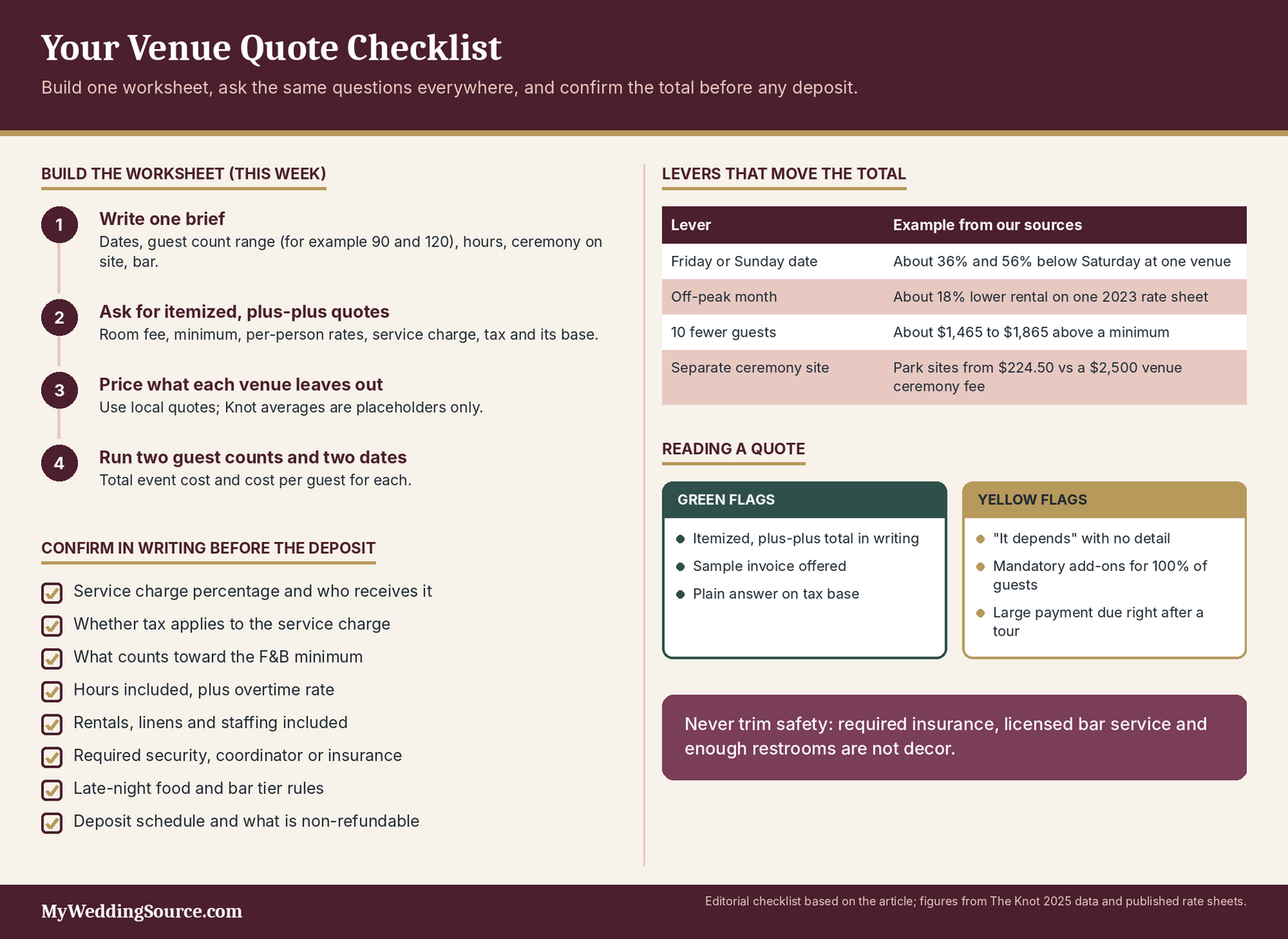
FAQ: Wedding Venue Cost Questions Couples Ask
The answers below are short on purpose and point back to the sections above for the numbers. Prices and rules vary by venue, state and date, so treat every figure as a prompt for your own written quote. Each answer links the main idea to a decision you can make this week.
Pricing and averages
How much does the average wedding venue cost?
The Knot’s 2026 Real Weddings Study reports an average reception venue cost of $12,900 for couples married in 2025, while Zola’s 2026 Wedding Cost Index reports an average venue and site fee of $8,573 with a typical range of $6,900 to $10,300. The gap comes mostly from definitions, because many Knot-reported venue bills include rentals, catering or alcohol. Use these as a range to question quotes with, then replace them with three local, itemized quotes as soon as you can.
What is the difference between a service charge and a gratuity?
A service charge is a percentage the venue adds under its contract, commonly 22% to 25% in the published sheets we read, while a gratuity is a tip that may or may not be included in that charge. Ask what share of the service charge reaches the staff who serve you, what it covers, and whether a separate gratuity is expected, as Gale Mansion’s published 5% staff gratuity shows some venues do. Also ask whether the tax is applied to it, because several states tax mandatory charges unless strict conditions are met.
Is a Friday or Sunday wedding actually cheaper?
Often, but by how much depends on the venue. One Fort Worth venue’s published 2026 rates put the facility fee plus minimum at $17,000 on Friday and $12,000 on Sunday against $26,000 on Saturday, which is about 35% and 54% lower before service charge and tax. NerdWallet and Paperlust both say Sunday or Friday dates are usually priced below Saturday evening without giving a percentage, and some venues price all weekend days alike. Ask for the quote for your exact date, and weigh the savings against guest travel and vendor availability.
Quotes and negotiation
What is a food-and-beverage minimum, and do I owe it if guests eat less?
A food-and-beverage minimum is the least a venue expects you to spend on food and drink, and it usually does not include the room fee, service charge or tax, as Paperlust describes it. If your menu and bar come in below it, the common practice is that you still owe the difference, although some venues let you use the shortfall for upgrades. Ask exactly what counts toward the minimum (alcohol, tax, service charge, ceremony fee) and what happens to a shortfall, and get the answer in writing.
Can you negotiate a wedding venue price?
Sometimes, and more often on inclusions than on the headline number. Sales tax is not negotiable, and published minimums and service charges are often policy, but room fees, extra hours, rentals, rehearsals and payment schedules may have room, especially on off-peak dates. Ask for what the venue can add at the quoted price, offer two or three dates and let the venue tell you which is lowest, and decide quickly if the answer is yes.
How do I compare a per-person venue with a flat-fee venue?
Convert both to total event cost and cost per guest for the same date, guest count and hours. For the flat-fee venue, add caterer, bar, rentals, staffing, restrooms, cleanup and a coordinator if required, then service charge and tax where they apply. In our illustrative three-venue example, the flat fee that looked cheapest on page one produced the highest total, while the per-person package that looked most expensive produced the lowest, a reminder to compare totals and not headlines.
Your Next Steps
You do not need to solve the whole venue question in one sitting. Two short tasks this week and a short list of confirmations before any deposit will put you ahead of most comparisons, and each takes less time than a venue tour. Neither takes more than an evening.
This week
Write your shared venue brief and open the worksheet
Write one brief that lists your candidate dates, a guest count range (for example 90 and 120), the hours you want, whether the ceremony is on site, and whether you need a bar. Send the same message to every venue on your shortlist and ask for an itemized quote that shows the room fee, any minimum, the per-person rates, the service charge percentage, the tax and what each applies to. Open a simple worksheet with one column per venue and the lines from the three-venue table, and mark every line that is still a placeholder.
Pick two or three dates and ask which is priced lowest
Choose a preferred Saturday, a Friday or Sunday alternative and one off-peak month, and ask each venue to price all of them. This single question is the cheapest way to learn how much flexibility is worth, and it shows how a venue treats its calendar. Note any date that works for your key guests and your must-keep vendors, since a cheaper venue date is only useful if the people and vendors you care about can come.
Before you pay a deposit
Get the all-in total in writing
Ask each finalist to confirm, in one email, the room fee, the minimum, the per-person rate, the service charge percentage and what it applies to, the tax and its base, any separate gratuity, the overtime rate, what rentals are included and the deposit schedule. Compare the replies against your worksheet, and ask about anything that does not match. If you are choosing between two venues that are close in total, the one that answers clearly and quickly is usually the better partner after the contract is signed. Keep the written answers with your contract.
Check what you would lose if plans change
Before the first payment, confirm which amounts are refundable, which are non-refundable and when each is due, because a deposit that equals the room fee, as on Gale Mansion’s published page, can be the largest sum at risk. Read the cancellation, rescheduling and force majeure language with a clear head, and ask for clarification in writing. Our contract guide walks through the clauses worth checking, and your own attorney can advise on terms and state law, since this article is general education and not legal advice.
Sources & methodology
- The Knot: Real Weddings Study (2026) — study description: U.S. couples married in 2025, fieldwork January to December 2025, page updated February 2026.
- The Knot: 2026 Real Weddings Study data read-out (PDF) — 10,474 couples; 117 guests; $292 per guest; spending-tier and venue-type notes; 89% hired a venue.
- The Knot: Average Cost of a Reception Venue — $12,900 average, venue cost by year, guest count and state, and what venue prices include (updated May 2026).
- The Knot: The Average Wedding Cost, According to The Knot Data — $34,200 average total, state and metro totals, guest-count totals, vendor averages (updated June 2026).
- The Knot: The Most Popular Wedding Dates in 2026 and Over Time — Saturday as the most popular day, fall as the most popular season since 2015, higher prices on popular dates (updated May 2026).
- Business Wire: The Knot 2025 Real Weddings Study release — October as the most popular month (17%) and nearly half of couples finding budgets fell short (2024 weddings).
- Zola: How Much Does a Wedding Cost — 2026 Wedding Cost Index: $36,000 average, venue and site fee average $8,573, catering $6,927, state and city totals (updated March 2026).
- Ashton Depot (Fort Worth, TX): 2026 evening rates and per-person pricing — facility fees, food-and-beverage minimums by day, 23% service charge, 8.25% tax, package tiers and inclusions; location confirmed on the venue’s homepage.
- Gale Mansion (Minneapolis, MN): wedding pricing — peak and off-peak fees, minimums, service charge, taxes, security and deposit structure; page last modified April 2023.
- ThePricer: Rosecliff Mansion wedding cost — third-party 2026 estimates by season and weekday; not official rates.
- Royal Park Hotel (Michigan): 2026 Friday and Sunday evening package — per-person starting price with 25% taxable service fee and 6% sales tax.
- Portland Parks and Recreation: 2026 wedding reservation application — public-site fees, application fees, restroom and alcohol rules.
- New York State Department of Taxation and Finance: Gratuities and service charges — conditions for a mandatory gratuity to be non-taxable and banquet examples (issued 2012, page updated February 2026).
- 34 Texas Administrative Code section 3.337: Gratuities (Cornell LII) — Texas treatment of voluntary and mandatory gratuities, including the 20% threshold.
- Tax Adviser: IRS Revenue Ruling 2012-18 on tips and service charges — the four factors that distinguish a tip from a service charge.
- TechCrunch: FTC bans hidden fees for live events and short-term rentals — coverage and effective date of the FTC Rule on Unfair or Deceptive Fees (May 12, 2025).
- MayFair Farms: hidden venue costs (May 2026) — ranges for service charge, gratuity, overtime, rentals, staffing and deposits; a venue’s own marketing blog, used only as an estimate.
- Paperlust: Wedding Venues on a Budget (2026) — description of venue quote layers and weekday and off-peak patterns; no U.S. price data.
- NerdWallet: Ways to Save Money on a Wedding — Saturday as the most expensive day, off-peak months, trimming 10 to 20 guests, restaurants and venue fees.
Methodology. Verified facts here are limited to what the sources state on their own pages (published rate sheets, statute and tax-bulletin text, study figures as reported). Survey findings (The Knot, Zola) describe couples who responded in each study, not all U.S. weddings, and The Knot’s PDF read-out rounds the average total to $34,000 where its article reports $34,200. Ranges from MayFair Farms and the Rosecliff guide are estimates, the day-of-week, per-guest and three-venue totals are our own illustrative arithmetic built on stated assumptions, and statements about what is worth asking, negotiating or reserving are editorial judgment.
We found no free national dataset of venue-only fees by city, and no source for a standard percentage discount for off-peak dates, so those gaps are stated, not filled.
Freshness note. Sources were read in October 2026. Recheck The Knot and Zola averages when their next annual studies publish (typically early in the year), verify any venue rate sheet, service charge, tax base and overtime rate directly with the venue for your date, and recheck state tax rules and the FTC fee rule if you rely on them, since they change. The Gale Mansion page is from 2023 and the Rosecliff figures are third-party estimates, so use both as structure examples only.