
A wedding party coordination checklist is less a list of tasks than a record of who owns which decision, who pays for which line, and which date each person is working toward, so that a group of busy volunteers can show up prepared, on time, and still be glad they said yes.
Quick answer
A workable wedding party coordination checklist tracks four streams for every person in your party: money (what each person pays and what you cover), attire (order, fitting, and return dates), time (events and arrival times), and day-of jobs (who holds, carries, signs, or delivers what). Give each stream one owner, put the customary-versus-required split in writing before anyone commits, and keep one shared sheet that lists every role, cost line, and deadline. Etiquette sources agree on the basics, such as attendants paying for their own attire and travel, but they disagree on lodging, rehearsal length, and when gifts are given, so decide those points yourselves and say them out loud early. This guide includes a full role, expense, and deadline tracker you can copy.
What wedding party coordination covers, and where it stops
Most advice about a wedding party falls into two piles: how to choose your attendants and what each title is supposed to do. Both matter, but neither tells you how to run the group once the yeses are in. That is the job of coordination, and it is mostly ordinary project management applied to friends and family who are doing you a favor. A good wedding party coordination checklist protects those friendships by making the practical parts boring and predictable.
This guide is built around one deliverable, a wedding party coordination checklist: a tracker with a row for every person and a column for every kind of obligation. Before you build it, it helps to agree on what the wedding party coordination checklist is for and who keeps it.
The four streams a wedding party coordination checklist has to track
Nearly every question a wedding party asks lands in one of four streams. Keeping them separate makes problems easier to name. If someone says “I am stressed about the wedding,” the sheet can tell you whether the stress is about money, about a dress that has not arrived, about a schedule that conflicts with work, or about a job they do not understand.
Money: who pays for what
Money is the stream that most often causes quiet resentment, because the numbers arrive one at a time and the person paying often feels they cannot object. Emily Post’s guidance, as we read it, assigns attendants their own attire, accessories, and transportation, and describes lodging as something the hosts provide. Other sources describe lodging differently, which we cover later. The point for coordination is that every cost line needs an owner written next to it. Our separate guide to wedding party costs goes deep on ledgers and per-person figures; here we focus on how to track and communicate them.
Attire: order, fit, and return
Attire is a deadline problem as much as a style problem. Dresses and suits have lead times, fittings need appointments, and rentals have return windows. If your group lives in different cities, each of those steps multiplies. Our guides to wedding party attire, bridesmaid dresses, and groomsmen suits versus tuxedos cover style choices. This one covers the calendar.
Time: events, arrival times, and conflicts
A wedding party usually has more events than the wedding itself: a proposal or engagement party, a shower, a bachelor or bachelorette party, fittings, a rehearsal, a rehearsal dinner, getting-ready time, the ceremony, the reception, and sometimes a farewell brunch. Each one asks something of someone’s calendar and often their wallet. The checklist should list them with dates so that no one learns about the brunch from a photo.
Day-of jobs: who holds, carries, signs, or delivers
On the wedding day, small tasks have a way of falling between people. Someone has to hold the rings, someone has to hold the bouquet during vows, someone may need to witness the signing of the license, someone has to hand an envelope to the officiant. If nobody is named, the task lands on whoever is nearest, and sometimes on you.
Who keeps the sheet
A wedding party coordination checklist that belongs to everyone belongs to no one. Pick one keeper, and decide how much authority that person has.
The couple as owners, with a delegate for upkeep
Because the money, the roles, and the final choices are yours, you own the sheet. Many couples delegate the updating to an honor attendant or a planner. Emily Post describes the maid or matron of honor as helping with attire choices, organizing the group gift, and making sure bridesmaids have their outfits, and describes the best man as coordinating the groomsmen’s gift and making sure groomsmen arrive on time and properly dressed. Those duties map naturally onto sheet upkeep, so ask the person who is already doing the work to keep the record.
When a planner or day-of coordinator is involved
If you hire a planner or a venue coordinator, ask what they will and will not manage. Scopes vary, and some stop at the ceremony run-through and the day-of timeline without touching attendants’ attire orders or group money. Our guide to wedding planners versus coordinators explains the usual differences, and a planner’s scope should be written into the contract. Put the planner’s name on the sheet next to the items they own, so no one assumes the planner has handled something that was never in scope.
What this guide leaves to other pages
A pillar guide can easily turn into a copy of every other guide on the site. We have tried not to do that. This page assumes you will go to the specialist article when you need detail and come back here to decide who is responsible.
Role-specific duty lists
For long duty lists for the two honor roles, see maid of honor duties and best man duties. Here, we summarize only what the wedding party coordination checklist needs.
Planning in general
For the full planning arc, our wedding planning checklist and wedding planning timeline cover the whole wedding. This guide covers only the part that involves your attendants.
Decide the shape of your wedding party before you track it
Coordination is much easier when the group is the right size and each person’s role is clear. That is a decision for the couple, not a tracker, so we start there.
Which roles you are actually creating
“Wedding party” is a loose term. Some people stand beside you at the ceremony, some do a specific job, and some are honored without standing at all. Naming the categories lets you ask each person for what they can give.
Standing attendants and honor roles
Standing attendants are the people who stand with you at the ceremony and appear in the program. The Knot’s glossary describes the maid, matron, man, or person of honor and the best man, woman, or person as the two principal roles, with bridesmaids and groomsmen in support, and says the terms can be adapted, including by using “honor attendant” or simply “attendant.” Emily Post says there is no required number and the counts on each side do not need to match. If you are still deciding how large to go, our guide to bridal party size looks at that question on its own.
Honorary roles and junior attendants
The Knot describes an honorary attendant as someone who may join pre-wedding events but does not stand with you or appear in the program, and notes that honorary duties are up to the couple and can be tailored to each person. It frames the idea as a way to include close friends without enlarging the party. The Knot’s glossary describes junior bridesmaids and junior groomsmen as usually ages 9 to 16 and says they are not expected to contribute financially. A person in either category should still have a row on your wedding party coordination checklist, with fewer cost lines.
Ceremony participants who are not attendants
Readers, ushers, candlelighters, chuppah carriers, and relatives with traditional roles may be part of your ceremony without being part of your “party.” The Knot lists several such roles from different traditions. If your ceremony includes any of them, give each a row and a day-of job, even if they do not attend the rehearsal dinner or the bachelor and bachelorette events. Ask your officiant or a family member from that tradition what is expected, because customs differ between families and communities.
Titles, language, and inclusion
Titles are a coordination issue because they appear in programs, group messages, photo lists, and introductions. They also tell a person what you think of them.
Gender-neutral and mixed-gender parties
The Knot says couples can include any friends or family regardless of gender and suggests terms such as bridesman and groomswoman, man of honor, or a personal label such as sibling. Zola suggests avoiding division of attendants by gender and using terms like “wedding party,” along with gender-neutral titles for the two honor roles. Both sources treat these as choices rather than rules. Use whatever title the person has told you they like, and ask first if you are not sure.
Talking with relatives who are surprised
The Knot suggests listening to relatives who are hesitant about a nontraditional lineup, asking about their concerns, and remembering the decision belongs to you. For coordination, the practical step is to settle the lineup before relatives see group messages or the program, so that the first they hear of it is a clear decision, not a draft.
How and when to ask
The ask is the first line of any wedding party coordination checklist. How you do it sets expectations about money, time, and the right to say no.
Timing
Emily Post suggests settling your party no later than about six months before an average wedding, or about three months before a short engagement’s wedding, and recommends giving people time to consider because the role involves real money and time. Those are etiquette guidelines, not deadlines, but they match the order lead times we describe later: if dresses need to be ordered around six to eight months out, according to one retailer, asking at six months out leaves very little room.
Say what the role involves, in plain terms
The Knot recommends speaking with the person directly in addition to any creative ask, such as a gift box, and discussing what the role involves. A short written summary after the conversation helps. It should list the main dates, the cost lines the person will be responsible for, any cost lines you will cover, and a plain statement that they can decline now or later without it affecting your friendship. Our guide on how to ask wedding party members about financial boundaries goes through the wording.
The wedding party coordination checklist: a role, expense, and deadline tracker
This is the core of the guide. The wedding party coordination checklist has three layers: a one-row-per-person sheet, a role-by-role reference so you know what to put in each row, and a month-by-month deadline view. You can build all three in a spreadsheet or a shared note in about an hour.
How the sheet is organized
Think of the sheet as a table with one row per person and one column per stream, plus a few columns that make it usable by someone who is not you. A wedding party coordination checklist that lives only in your head tends to fail around the time you are busiest, so put it somewhere you can share.
One row per person, one owner per column
The infographic below shows how the four streams meet at the couple and who customarily owns each one. The owner can change from wedding to wedding; what matters is that someone’s name sits in each place.

The columns we suggest are shown below. You do not need every one. Delete any that will not be used, because a sheet that is too heavy stops being updated.
| Column | What goes in it | Why it helps |
|---|---|---|
| Person and role | Name, title they prefer, role (standing, honorary, junior, ceremony participant) | Keeps titles consistent in the program and the group messages |
| Contact and time zone | Preferred channel, phone, city, time zone | Prevents 11 p.m. messages and missed calls for long-distance attendants |
| Cost lines and owner | Each line (attire, shoes, travel, hair and makeup, gifts) with “attendant,” “couple,” or “shared” | Makes the require-and-pay boundary visible |
| Attire status | Size on file, order date, arrival date, fitting dates, return date | Turns the calendar into a set of checkable boxes |
| Events | Which events this person is invited to, and whether they confirmed | Avoids surprise invitations and surprise absences |
| Day-of job | The one or two specific tasks this person owns | Prevents tasks from falling between people |
| Constraints | Access needs, dietary needs, travel limits, a budget ceiling they chose to share | Lets you plan around real limits without asking twice |
| Last confirmed | Date you last checked each row with the person | Shows which information is stale |
Keep private data private
Budget ceilings, health information, and family circumstances are sensitive. Decide who can see your wedding party coordination checklist before you fill it in. A common approach is a shared version with only dates, events, and day-of jobs, and a private version that only you and your partner can open. Do not paste another person’s private circumstances into a group chat for convenience.
Role-by-role reference for the tracker
The table below summarizes what the etiquette sources we reviewed say about each role, so you know what to enter in each row. It is a starting point drawn from Emily Post, The Knot, and Zola. Individual couples change it all the time, and you should too.
| Role | Jobs the sources describe | Costs customarily on the person | Costs customarily on the couple or hosts | Dates to put on the sheet |
|---|---|---|---|---|
| Maid, matron, man, or person of honor | Helps choose attendants’ attire, organizes the group gift, holds the other partner’s ring and the bouquet during vows, signs the license as witness, helps at the reception | Attire, accessories, travel, share of group gift | Lodging and flowers, per Emily Post | Attire order, fittings, shower date if hosting, rehearsal, wedding morning |
| Best man, woman, or person | Coordinates the groomsmen’s gift, organizes the bachelor party if there is one, keeps a ring during the ceremony, delivers prearranged payments, gives a toast, returns rentals | Attire, accessories, travel, share of group gift | Lodging, boutonnieres, and gifts for the groom’s attendants, per Emily Post | Attire fitting, bachelor event, payment envelopes, rehearsal, return of rentals |
| Bridesmaids, bridespeople | Attend fittings, parties, the rehearsal, and the dinner; join the receiving line and help host guests | Attire, alterations, shoes, accessories, travel, share of gifts | Lodging, flowers, a luncheon if hosted | Attire order, fitting, events, rehearsal, wedding morning |
| Groomsmen, groomswomen, groomspeople | Attend fittings, parties, rehearsal, and dinner; often double as ushers; stand with the partner during the ceremony | Attire, accessories, travel, share of gifts | Lodging, boutonnieres, and ties or gloves if not part of the rental | Attire fitting, rehearsal, arrival time, rental return |
| Ushers | Greet and seat guests, hand out programs, help guests who need assistance, give directions to the reception | Attire if matched, travel | A boutonniere, if you provide one | Rehearsal, arrival time before guests |
| Junior attendants | Attend major events except bachelor and bachelorette parties and help with setup, per The Knot | Typically no financial contribution, per The Knot | Decide with the child’s family who covers attire | Fittings with a guardian, rehearsal, getting-ready time |
| Flower girl, ring bearer | Walk in the processional, carry flowers or a ring pillow | Decide with the child’s family who covers attire | Attire, if you request something specific | Rehearsal, nap and meal timing, guardian contact |
| Readers and other ceremony participants | Read, light candles, carry poles, or perform a role from your tradition | Usually attire of their own choosing | Boutonniere or corsage if you provide one | Rehearsal, cue in the program |
Notes on the table: lodging is an area where published sources split, so treat that column as a prompt to decide, not a fact. We say more about it in the next section. The ages the Knot gives for children’s roles (junior attendants about 9 to 16, and flower girls and ring bearers about 3 to 8) are typical ranges, and Emily Post gives a slightly different range of three to seven for ring bearers. Your family can follow whatever ages fit your children.
Reading across a row of the wedding party coordination checklist
The useful part of the table is not any single cell but the patterns. If a person’s row has many cost lines in the “on the person” column, check that they have agreed. If a person’s day-of job column is blank, assign one, even a small one. If a person’s dates column is crowded, ask whether they are able to do all of it.
Reading down a column of the wedding party coordination checklist
Run your eye down the “costs on the person” column and look at the total. If one role carries visibly more than the others, say aloud that it does, and consider covering a line. We return to this when we discuss require-and-pay.
A worked example of one row
A template is easier to trust once you have seen it filled in. The example below is invented, and every date and choice in it is an assumption. It shows how a single row in a wedding party coordination checklist reads when it is working.
Sam, a standing attendant who lives in another time zone
Imagine a friend, Sam, who is a standing attendant and lives three time zones away. The row says: role, standing attendant, title “attendant,” preferred contact by text after 6 p.m. Sam’s time. Cost lines: attire, shoes, and travel belong to Sam, in line with the customary split described by Emily Post. Professional hair and makeup is marked “couple,” because the couple requires it. The group gift is marked “shared,” with a per-person amount, not a total. Lodging is marked “couple,” because the couple has decided to cover it. Attire status reads: size on file, order placed, delivery expected, first fitting to be done with a tailor near Sam’s home, and a note that Sam will send a photo of the fitting. Events: rehearsal, rehearsal dinner, wedding, and an optional brunch. Day-of job: hold the bouquet during the vows, with a backup. Constraints: Sam has chosen to share a spending ceiling privately. Last confirmed: the date of the last conversation.
What the example shows
Each cell answers a question that would otherwise reach you at a bad moment. Who pays for the room? The couple. Who confirms the tailor? Sam, with a date. What happens if Sam’s flight is delayed? The backup holds the bouquet, and the arrival time is in the brief. A wedding party coordination checklist does not need to be elaborate; it needs to be specific enough that someone else could read a row and know what to do.
The deadline view
Dates are the third layer of the wedding party coordination checklist. The calendar below is our own planning suggestion, built from the lead-time ranges given by retailers and etiquette guides cited in this article. It is not a rule. Weddings with shorter engagements, destination weddings, and weddings with custom attire need to compress or expand it.
| When | What to do | Owner on the sheet |
|---|---|---|
| As soon as you are engaged, up to about six months out | Decide party shape, ask people, send a written summary of the role | Couple |
| About eight to nine months out | Write the money map, start the group channel, pick the attire direction | Couple, honor attendants |
| About six to eight months out | Order attire if it is made to order, according to one retailer | Each attendant, with a deadline set by the couple |
| About four to five months out | Attire in hand, per the later column of one retailer’s schedule | Attendant, tracked by honor attendant |
| About three to four months out | First fittings | Attendant, with an appointment |
| About two to three months out | Alterations booked; shower and bachelor or bachelorette dates set | Attendant; hosts |
| About one to two months out | Final alterations finished by about one month out; travel and lodging confirmed | Attendant; couple |
| About one month out | Written day-of brief sent; rehearsal time and place confirmed | Couple, planner |
| About two weeks out | Final fitting, steaming, and pickup; headcount for rehearsal dinner | Attendants; hosts |
| Rehearsal day | Rehearsal and dinner; gifts if you give them then | Officiant or planner; hosts |
| Wedding day | Arrival times, day-of jobs, payment envelopes | Honor attendants, planner |
| The next business day | Return rentals, per Emily Post | Best man or head usher |
How the weeks of a wedding party coordination checklist fit together
In any wedding party coordination checklist, the first half of the calendar is about decisions and money. The middle is about attire. The last stretch is about people being in the right place with the right items. Most of the trouble we hear about occurs when an item from the first half, such as an unclear cost line, quietly follows someone into the last.
What to do when you are late
If you start with less than six months, compress the early decisions first. Cut the optional steps, such as a separate group channel for each event, and keep the cost and attire lines. Our guide to the wedding vendor timeline and how far in advance to plan a wedding help if the compressed calendar affects vendors too.
Questions the tracker should answer in ten seconds
A tracker is working if you can answer a few questions without scrolling. Try them once your wedding party coordination checklist is built.
Who has not yet ordered or confirmed?
Sort the attire status column by date. Anyone with a blank order date a week after the deadline is not necessarily at fault, because shipping, sizing, or money may be the reason. Ask privately and early.
Who is carrying a cost they did not expect?
Look for cost lines added after the original summary, such as a new group event or an upgraded dress. If you added them, tell the person and give them an easy way out.
Expenses: who pays, and how to put the boundary in writing
The wedding party coordination checklist records money. This section covers the decision that goes into it. We keep it short because the full ledger is in our wedding party costs guide, which uses a per-attendant ledger and four couple policies. Here the question is narrower: how do you decide, state, and manage the boundary so that nobody is surprised?
What the sources agree on, and where they split
Etiquette guidance about who pays for what is a convention, not a law, and The Knot, Zola, and Emily Post do not agree on every point. Knowing where they agree helps you pick a default; knowing where they split tells you what to decide for yourselves.
Common ground
Emily Post says attendants pay for their own attire and accessories and arrange and pay for their own transportation. It says they give an individual gift or contribute to a group gift. Emily Post’s expenses page adds that any financing arrangement is acceptable except asking guests for contributions, and that costs are often shared by the couple and their families. For coordination, that sentence matters: the arrangement is yours to design, and it does not need to match tradition.
Where the guidance differs
Lodging is the clearest split. Emily Post describes accommodations as something the hosts provide, and says the couple traditionally arranges the party’s lodging, with each side’s hosts covering their own attendants. Other publications, summarized in our wedding party costs guide, report that attendants usually pay for their own rooms. Rehearsal dinner payment also varies: Emily Post says the groom’s family traditionally pays, while Zola says the hosts are traditionally the groom’s parents but the host could be anyone, including the couple. When sources split like this, choose and write it down.
The money map: a one-page statement
A money map is the financial page of a wedding party coordination checklist. It is a short document that lists every cost line the party might face and says who pays for it. It does not need to be formal. Its job is to turn assumptions into sentences.
What it should say
List attire (dress or suit, shoes, accessories, alterations), hair and makeup, travel, lodging, the group gift, the bridal shower and the bachelor or bachelorette event, the rehearsal dinner, and any matching items such as jewelry, ties, or robes. Next to each, write “you,” “we,” or “shared.” Add one sentence about optional items: “We will not ask anyone to buy anything that is not on this list.” Add one sentence about changes: “If we add a cost, we will tell you before you commit.”
The require-and-pay rule
A common principle in the sources we reviewed is that if you require something specific, such as a particular gown, professional hair and makeup, or a certain shoe, you should be ready to pay for it or share the cost. The rule is not universal, and some couples ask attendants to cover their own required attire. The rule is useful as a test. If you would be uncomfortable explaining the requirement to the person who is paying, reconsider the requirement. Our wedding party costs guide describes how couples apply this rule with caps and partial contributions.
Cost note
Group costs shift when the group changes. Suppose you plan a shared gift of $240 for six attendants. That is $40 each. If two people drop out, the remaining four pay $60 each, which is a 50 percent increase for the same gift. This is our own illustration with assumed numbers, not a survey figure. The practical lesson is to set a per-person amount, not a total, and to say what happens if the group changes. The same applies to a shared suite, a group dinner, or a shared getting-ready room.
Collecting and moving group money
Even a small group often shares costs: a gift, a rental house, a deposit for a dinner. Someone fronts the money and others pay them back. That is where coordination can go wrong.
One person fronts, one record
Name one person to front each shared cost, and keep a short record of who has paid and who still owes. The cost column of your wedding party coordination checklist is the place for it. Do not assume that a quiet attendant has refused to pay; they may not have seen the request. Ask once, privately, with the amount and the date.
Use payment apps carefully
The Federal Trade Commission’s consumer guidance on mobile payments says to send money only to people you recognize, to confirm a request for money using a phone number you know is correct, and to report fraud to the FTC. Those points apply directly to group wedding money, because a group chat can carry a lookalike account or a convincing message. Before you send money to a person in a group, confirm the handle or number against the contact you already have. If you see a transaction you did not authorize, the FTC says to ask both the app company and your bank to reverse it. This article is not legal or financial advice.
When someone cannot afford a line
The Knot, Zola, and Emily Post all describe the role as a commitment of time and money, and each suggests giving people room to decline. For coordination, the aim is to make it easy to say no or to name a ceiling without embarrassment.
Ask for a ceiling, not an explanation
A line in your first message such as “tell us the most you are comfortable spending on attire, and we will build around the lowest ceiling” lets people name a limit without saying why. If a ceiling is low, you can cover a line, lower the requirement, or offer an honorary role, and you can do it without announcing it to the group.
Cover a line quietly
If you decide to pay for a person’s attire or travel, do it directly with the seller or the person, and keep it off the group chat. Update the private version of the wedding party coordination checklist. The public version only needs to show that the attire line is complete.
Attire as a calendar problem: orders, fittings, and returns
Attire is where the wedding party coordination checklist meets the outside world. Sellers have production times, tailors have appointments, carriers have delays, and attendants have different bodies and addresses. Treating attire as a sequence of dated steps, each with an owner, prevents most of the panic that shows up a few weeks before the wedding. Style choices are covered in our guides to wedding party attire, bridesmaid dresses, and wedding tuxedos.
Lead times, and how retailers differ
For a wedding party coordination checklist, the best published lead-time guidance for attendant dresses comes from retailers, who have an interest in selling dresses and who also know their own production schedules. We cite two, and the figures do not fully agree, which is the point. Use ranges, not exact dates, and ask your own seller.
What two retailers say
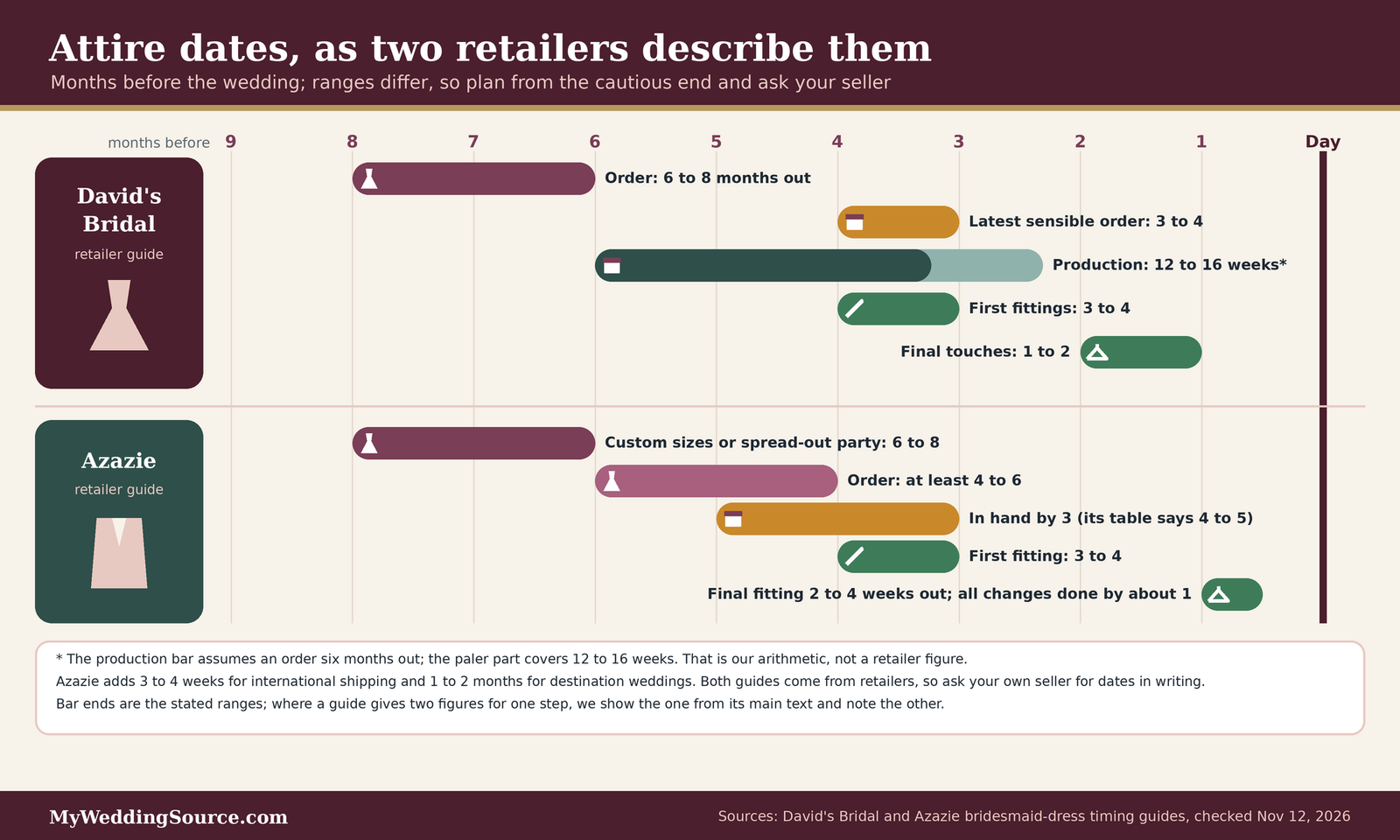
David’s Bridal says to order six to eight months before the wedding and gives the latest sensible order as about three to four months out, with less choice at that point. It says standard production takes 12 to 16 weeks for most designers, with peak season from May through October sometimes adding time. It puts minor alterations at two to three weeks, first fittings at three to four months before the wedding once dresses arrive, and final touches at one to two months out. Azazie says to order at least four to six months before the wedding, and six to eight months when dresses are custom-sized or attendants are spread out. It says dresses should be in hand at least three months before the wedding, first fittings should happen three to four months out, final fittings two to four weeks out, and all changes should be finished about one month before. Azazie adds three to four weeks for international shipping and one to two extra months for destination weddings.
How to use ranges that disagree
Where retailers differ, take the cautious end for planning and the optimistic end for hope. A practical approach is to pick the order deadline from the earlier recommendation, set the “dresses in hand” deadline from the later one, and add a buffer week for anything shipped. Then ask your own seller for its production and shipping estimate in writing, and use that number in your wedding party coordination checklist.
Different bodies, different cities, different timelines
Group orders fail at the edges: the person whose size changes, the person who lives abroad, the person who needs a different cut. Your wedding party coordination checklist should have a plan for each.
Sizing and size change
David’s Bridal advises ordering slightly early and scheduling fittings closer to the wedding to allow for changes such as weight changes or pregnancy, and notes that a pregnant attendant may need to delay a final fitting. A sensible approach is to treat the order date as a commitment to a style and a size estimate, and to leave alteration room for the rest. If a person’s size is likely to change, ask the seller about its policy on reorders or exchanges before you order.
Long-distance attendants
If a person lives far away, they cannot easily attend a fitting with the group. Options include ordering early and having them find a local tailor, having a seller measure them remotely, or arranging a fitting when they arrive for the wedding weekend, which only works if the garment fits well enough that last-minute changes are minor. Put each person’s plan in the attire status column. If the alteration happens in a different city, include the tailor’s name and the date.
Mixed styles and mix-and-match groups
The Knot suggests that for a mixed look, you choose a color palette and let each attendant coordinate within it, with details such as ties and pocket squares matched to dresses. A mix-and-match approach reduces the number of identical orders that must arrive on the same day, but it adds a coordination step: someone has to approve each choice. Decide who has that approval and by when. Our wedding color schemes guide can help you set the palette.
Shipping delays and what the federal rule does and does not cover
When a retailer is late, attendants often look to the couple, though the couple is not the seller. A basic understanding of the rule that governs most online merchandise orders helps you know what to ask the seller.
The Mail, Internet, or Telephone Order Merchandise Rule
According to the Federal Trade Commission’s business guide, a seller that states a shipping time must ship within it, and a seller that states no time must ship within 30 days after receiving a properly completed order. If the seller cannot ship on time, it must offer the buyer the choice to consent to a delay or cancel for a refund, and a refund generally must be made within seven working days for most payment methods, or within one billing cycle for credit. The rule covers merchandise orders placed by mail, internet, or telephone. It does not cover services, so it does not govern a tailor’s alterations. We are describing the rule, not giving legal advice, and a seller’s own return and cancellation policies may offer more.
What to do before a deadline is missed
Ask each attendant to save the order confirmation, including the estimated ship date. If a package has not shipped by the date promised, the attendant contacts the seller, and tells the honor attendant who updates the wedding party coordination checklist. If it looks like the dress will not arrive in time, the couple decides on a substitute before the final fitting window closes. Our wedding emergency kit guide covers the day-of backup.
Rentals and returns
Rentals add a different clock. A rental has a pickup date, a wedding date, and a return date, and late returns often have fees.
Who returns what
Emily Post says the best man gathers the groom’s clothing and returns rentals on the next business day, and that groomsmen and ushers coordinate the return of rental clothing with the head usher or best man. In a modern party, assign one person for returns, and put that person’s name next to the return date on the sheet. If the group scatters after the reception, the person responsible needs a plan: collect items in a labeled bag at the end of the night, or have attendants ship them themselves with a prepaid label from the shop.
Ask the rental shop in writing
Before anyone is measured, ask the shop what happens if the garment does not fit on the day, how late returns are charged, whether damage or stains are covered, and whether shipping is included. Our guide to renting wedding dresses lists similar questions for dresses.
Hair, makeup, and getting ready
Hair and makeup are often the largest scheduling constraint on the morning of the wedding, particularly for a large party. A schedule built backward from the time when the photographer or the ceremony begins gives each person a slot and a buffer. Our hair and makeup schedule guide shows how, and our wedding hair and makeup cost guide covers pricing.
Who pays, who books
Our costs guide reports that Zola and The Knot say a couple who requires professional hair and makeup is expected to pay or share the cost, and that attendants pay for it when it is an optional extra. For the wedding party coordination checklist, add a line for it in the money map before anyone books, and name one person who confirms the schedule with the vendor.
Buffers and the late-arriver problem
Someone will run late. Build a buffer of 15 to 30 minutes into the schedule before any fixed start, such as a photographer’s first-look time or the ceremony. That is our own planning suggestion, not a sourced rule. A calm buffer is kinder than a scramble, and it is more honest than telling people a false earlier time.
Rehearsals and the wedding weekend on your wedding party coordination checklist
A rehearsal is the one event where the whole party is in the same place before the ceremony. The wedding party coordination checklist should treat it as a working session with a clear start, a clear end, and a list of things to settle. Our guide to the wedding rehearsal covers the event in detail, and our guide to the wedding processional order covers the order of walking.
What a rehearsal is, and how long it takes
Sources describe the rehearsal slightly differently, so decide what you want it to be and tell your party.
Length and leadership
The Knot says the ceremony run-through usually lasts about an hour, with the dinner afterward running two to three hours. Zola says the rehearsal is usually run by the officiant and should take no more than about 30 minutes. Aisle Planner says the wedding planner leads. The range is a sign that the length depends on how complex your ceremony is and who is leading it. Ask your officiant and your venue how long they expect, and write a start and end time on the sheet. If you are not hiring a planner, ask the officiant or a trusted friend to run it and give that person a one-page order.
Who needs to be there
Zola says everyone with a ceremony role attends, including the couple, the wedding party, parents, siblings, and grandparents. Aisle Planner lists the wedding party, the officiant, the couple, and important guests such as parents and grandparents. Add readers, ushers, and children to your own list, along with anyone who has a procession or a task. The events column of the wedding party coordination checklist should show who is expected.
A run order for the rehearsal
A rehearsal feels easier when people know what is going to happen. A written order helps, even a short one.
One sequence from a planning source
Aisle Planner describes this order: line up the wedding party at the front, practice the recessional, practice the processional, have the officiant run through the ceremony, and repeat anything that needs it. It suggests starting with the recessional so everyone knows where they are heading, and having a partner demonstrate each move before the group tries it. It also says to tell each pair to go when the couple ahead is halfway down the rows of guests. Whether you follow that order is up to you; the value is in having one.
Use the time to settle questions, not only to walk
Use the rehearsal to confirm things you cannot confirm over text. Where does each person stand? Who holds the rings, the bouquet, and the certificate pen? What does the ceremony music sound like at the cue? Who is the contact if someone is late tomorrow? Where will people park, and when will each person need to arrive? Our wedding processional order guide covers the walk itself.
The rest of the weekend
Most weddings involve more than one day. Knowing which events are for the wedding party and which are optional prevents scheduling surprises.
A typical sequence
Zola describes a three-day wedding weekend: a welcome party the first evening, the rehearsal the night before the wedding, the rehearsal dinner right after it, the ceremony and reception, an afterparty, and a farewell brunch the next morning. It says the wedding party attends the rehearsal, the rehearsal dinner, the ceremony and reception, and is often invited to the brunch. Not every couple has every event, and some attendants will not be able to attend all of them.

Rehearsal dinner and gifts
Zola says the dinner is traditionally hosted by the groom’s family, and notes the host can be anyone close to the couple or the couple themselves. It says guests should not bring wedding gifts to it, that the couple usually gives gifts to the wedding party and special guests at the dinner, and that recipients should take them home since they may be accessories for the wedding. Emily Post similarly describes the rehearsal dinner as a suitable time to present gifts. The Knot suggests giving each attendant a gift on the morning of the wedding while everyone is getting ready. Choose one moment and put it on the sheet. If a gift contains an item for the day, give it earlier. Our guides to bridesmaid gifts and groomsmen gifts can help with ideas.
Events that are not the wedding
Showers, bachelor and bachelorette events, and engagement parties are part of the attendants’ calendar and wallet, even when someone else hosts, so each one belongs in the wedding party coordination checklist.
Hosting is optional, not assumed
Emily Post lists a shower, luncheon, bachelorette, or other pre-wedding gathering as optional for bridesmaids and notes that anyone except the couple can host a shower today. If you do not want a party, say so early so attendants do not feel obliged to plan one. If you do, tell the host the budget, the guest list, and the dates that will not work.
Inclusive events
The Knot suggests inviting guests of all genders to showers and bachelor or bachelorette parties and keeping games and decor gender-neutral, and Zola suggests holding a celebration open to all genders, either as one shared event or separate ones. For coordination, the question is simply who is invited, who is hosting, and who is paying; write all three on the sheet. Our guide to engagement party planning covers the earlier event.
Day-of responsibilities on a wedding party coordination checklist: who holds, carries, signs, and delivers
The wedding party coordination checklist pays off most on the wedding day, when many small tasks happen in a narrow window. The aim is not a minute-by-minute schedule for each person but a short list of jobs and arrival times that anyone can read in half a minute. Our wedding day timeline guide covers the full schedule, and our wedding week checklist covers the days before.
Morning: arrival, getting ready, and gifts
The morning sets the pace. People who arrive on time, with what they need, make the rest of the day easier.
Arrival times by group
Different people need to arrive at different times. Hair and makeup happens in sequence, so the first person arrives earliest. Photographers often want to capture getting-ready moments. Ushers need to be at the venue before guests. Children arrive closer to the ceremony. Put each person’s arrival time in the day-of column of your wedding party coordination checklist and send it in a single message, rather than relying on a general “be there by noon.”
What each person brings
Ask attendants to bring their attire, shoes, undergarments suited to the outfit, any accessories you asked for, a phone charger, medications they need, a snack, and water. If a person is carrying an item for you, such as a ring box or a vow booklet, name it on the sheet. Our wedding emergency kit guide covers what to pack for repairs.
Ceremony: the jobs that must have a name
Some tasks have to be done at specific moments. Assign each one to a person and a backup.
Holding and keeping items
Emily Post says the maid or matron of honor holds the other partner’s ring and the bouquet during the ceremony, and that the best man keeps the bride’s ring, though in your wedding the roles may differ. The Knot’s glossary also mentions the person of honor adjusting the train and the best man paying the officiant. Decide who keeps each ring, who holds bouquets during the vows, and who has the pen. Whatever you choose, tell each person and have them practice the handoff at the rehearsal. Our wedding vows and wedding ceremony guides cover what happens at the altar.
Witnesses and paperwork
Emily Post says the two honor attendants witness the signing of the marriage certificate, and The Knot’s glossary lists signing the license among their duties. Witness rules are set by each state, so confirm yours. Check your state’s requirements through your county clerk, and see our wedding witness requirements and marriage license guides. Name the witnesses on the sheet and make sure they know to bring photo identification if the office asks for it.
Ushers, programs, and seating
Emily Post describes ushers greeting and seating guests, handing out programs, helping guests who need assistance, and giving directions to the reception. If your venue is large, or if guests have access needs, tell the ushers in advance who might need help and where accessible seating is. Our guide to accessible wedding venues lists what to ask.
Reception: toasts, introductions, and handoffs
The reception introduces another set of tasks. Many of them belong to attendants.
Toasts and speeches
The Knot and Emily Post describe toasts from the honor attendants. Give speakers a time limit, tell them where in the schedule they are, and ask the DJ or emcee to cue them. Our wedding speeches guide covers structure.
Payments and envelopes
Emily Post says the best man prepares the groom’s wedding payments and delivers prearranged payments to the officiant, assistants, musicians, and singers. In your wedding, a planner or one trusted person may do this. Prepare labeled envelopes ahead of time, with names and amounts, and put one person in charge. Our guide to wedding vendor tipping explains what to consider. Whether a tip is expected, and how much, depends on the vendor and your contract.
Photos and the schedule
Give your photographer a list of the groups you want in family and wedding party photos, and give your attendants the times. Our wedding photographer shot list shows how to build that list.
End of night and the day after
The last jobs are the ones people forget, and they are the ones that cost money if missed.
Belongings, gifts, and clothing
Emily Post says the maid or matron of honor helps with the going-away clothes and cares for the dress and accessories afterward. Ask someone to gather gifts, cards, and personal items in the room, and give them a place to take them. Decide who keeps the bouquet and who preserves it; our wedding bouquet preservation guide covers timelines.
Returns and thank-yous
Rentals are due back on the schedule you recorded. Thank-you notes to attendants, in addition to the gift, are a closing line on the wedding party coordination checklist; our wedding thank-you cards guide covers timing. Close out the wedding party coordination checklist by marking each line complete.
Communication and decision rights for a wedding party coordination checklist
Every wedding party coordination checklist depends on how the group talks. A shared sheet only works if people know where to look, who can change it, and what counts as decided. These are small agreements, and making them early costs very little.
One channel, one brief
Groups tend to drift toward a single chat that holds everything: jokes, photos, money requests, and the one message that mattered. Separate the two kinds of content.
What belongs in the group chat
The chat is for coordination and warmth: logistics for the next event, quick questions, and encouragement. Keep money amounts, personal circumstances, and anything that someone might want to decline out of the chat, and handle those privately. Our guide to wedding party group chat rules that reduce planning confusion goes through norms such as muting, reply expectations, and pinning key messages.
What belongs in a one-page brief
A brief is a short document or message that people can find in two taps. Ours has five parts, which are our suggestion rather than a sourced format. The first is the dates and addresses of every event the person is invited to, with arrival times. The second is the person’s own day-of job and a backup contact. The third is the attire details: what to wear, where it is from, and when to bring it. The fourth is the money map in one line. The fifth is a contact for the day, ideally a planner or a trusted person who is not the couple.
Who can decide what
Unclear authority produces long, tense threads. A short statement of who decides what ends most of them.
Decisions that belong to the couple
The lineup, the titles, the attire direction, the cost lines you require, and the schedule belong to the couple. Say so. It is easier for an attendant to give an opinion when they know whether it is advice or a vote.
Decisions an honor attendant can make
Many choices can be delegated: which restaurant for the shower, which day for a group fitting, how to split a shared room. Give your honor attendants a budget and a deadline for each and say that you will not second-guess the result. Emily Post describes the honor attendants as organizing the group gift and helping with attire, so those delegations match the roles.
Changes after the sheet is shared
When a date, a cost, or a role changes, record the change, tell the affected person first, and then update the shared view. A short change log in a corner of the sheet, with the date and one line about what changed, prevents arguments about what was originally agreed.
Fairness among attendants
A group will notice unevenness even when everyone is gracious. You cannot prevent every comparison, but you can reduce the surprises.
Equal asks where it matters
Treat similar roles similarly. If one attendant is asked to host a shower and another is not, say why. If one gets a covered dress, decide whether the others need to know. Zola’s guidance on covering costs, summarized in our costs guide, suggests doing it privately, which also helps keep fairness from becoming a public topic.
Different roles, different loads
Not every role carries the same load. The honor attendants usually do more, and The Knot’s glossary gives those two roles the longest duty lists. Say so, thank them specifically, and check in more often. Give people with lighter roles a chance to take on more if they want it.
A routine that keeps your wedding party coordination checklist alive
A wedding party coordination checklist is only as good as its last update. Most sheets fail not because the design was wrong but because nobody looked at them for six weeks.
A short weekly review
Set a recurring ten-minute review with your partner or your honor attendant. Open the sheet, sort by the “last confirmed” column, and contact the two or three people who have gone longest without an update. Check whether any date has passed without a status change. Write one line in the change log. That is all. The habit matters more than the length.
A monthly look at the whole picture
Once a month, read the wedding party coordination checklist as a stranger would. Is any person’s row nearly empty? Is any person’s row crowded? Does the total of the cost lines on attendants still match what you said in the money map? Does any date in the next thirty days need a reminder? Adjust the plan while there is still time, and tell people when you do.
Edge cases: when the group does not fit the template
Real wedding parties include people who live abroad, who are expecting a child, who use a wheelchair, who have a job that does not allow time off, or who stop speaking to another attendant. A wedding party coordination checklist should have a short plan for each of these, because improvising one in the final month is stressful for everyone.
When the party changes
People drop out, and sometimes you add someone. Neither is a failure, but both change the numbers.
Someone steps back
Ask what changed and what they can still do. They might be able to keep a smaller role, such as doing a reading or joining the rehearsal dinner. Update the wedding party coordination checklist, pause any shared orders, and recalculate any shared cost on the per-person basis you set. Say clearly that the friendship matters more than the role. If their attire has been ordered, ask the seller about cancellation or exchange, and cover the loss yourself if the person cannot.
Someone is added late
If you add a person within the lead time of their attire, decide whether they will match, coordinate, or wear something of their choice. A person added after the order window might wear a color from the palette or a garment they already own. Update the processional order, the photo list, and the rehearsal list. The Knot describes honorary roles as one way to include someone without a full set of duties.
Someone cannot travel
A person who cannot attend in person may still be able to contribute: a recorded reading, a video message, or help with a shower or a sheet. Our guide to handling a wedding party member who cannot travel covers this. For the wedding party coordination checklist, record the person’s new role and remove the day-of job.
Different needs
Needs vary among attendants, and many of them are not visible to you. Each one belongs in the private version of your wedding party coordination checklist.
Access and health
Ask each person, in private, whether anything about the schedule, the venue, or the attire would make it difficult. Examples include stairs, long standing in the ceremony, heat, food at the rehearsal dinner, a need for rest breaks, or a dress code that conflicts with medical equipment. Offer options: a chair at the front, a shorter walk, a different position in the lineup, or help carrying items. Note the adjustments on the private sheet only, and tell the planner and venue what they need to know. Our guide to accessible wedding venues lists what to ask about the space.
Children and their families
If children are in the party, their guardians are part of your coordination. Share rehearsal times, meal and nap timing, and who will supervise during the reception. The Knot says junior attendants are not expected to contribute financially, which makes it your task to agree with the family who covers attire. Give the child a small, clear job, and a guardian a clear contact for the day.
Cultural, religious, and family roles
If your ceremony includes roles from a tradition, such as those The Knot lists from Jewish, Eastern Orthodox, and Muslim weddings, ask the person’s family or the officiant what the role requires. Put the details on the sheet, including any clothing, timing, or ritual preparation. If a person’s religion or family customs affect which events they can attend or what they can wear, accommodate that instead of asking them to explain it.
Tension and uneven effort
Long engagements strain friendships. A wedding party coordination checklist cannot repair a friendship, but it can remove the practical sources of friction. A few patterns come up often.
One person doing most of the work
If one attendant is carrying most of the coordination, name it and offer relief: split tasks, reduce the number of events, or take something back. Thank them in a way that is concrete. If the person has not asked for help, ask whether they want it.
Relatives with strong views
Parents and other relatives often have opinions about who should be in the party, what people should wear, and who should host which event. The Knot suggests hearing relatives out and remembering that the decision is yours. For coordination, set a time for their input and a time when decisions are final, and share the final version with them at the same time as with the party.
Conflict between attendants
If two people disagree, resist the urge to settle it in the group chat. Talk to each privately, restate the decision rights, and offer a practical arrangement, such as different roles at an event or different arrival times. This is a suggestion drawn from ordinary conflict practice, not a sourced rule.
A smaller party, or none
A smaller party is the simplest form of coordination, and the wedding party coordination checklist for it is short.
Honorary roles and quieter ways to include people
The Knot describes honorary roles as a way to limit the party’s size while including close friends, and says a person can have a title, a small bouquet, a place in photos, or a role during getting ready. The same source says the idea can also be used to skip a formal party entirely while still including close friends. Our guide to wedding party size looks at the choice itself.
A wedding party coordination checklist still helps
Even with no formal party, the people who help you on the day, such as a witness, a reader, and a person who holds the rings, deserve a row on the sheet, with dates, costs, and a job.
Questions to ask before you finalize your wedding party coordination checklist
These questions are for the three groups who can change your plan: attendants, sellers, and the people running the event. Asking early and in writing gives you a record and gives them a chance to flag problems.
Questions to ask before you finalize the tracker
- What can you comfortably spend, and what would you prefer I cover or change?
- Which of the listed events can you attend, and which would be hard?
- Is there anything about the venue, the schedule, or the attire that would be difficult for you?
- What is the seller’s estimated ship or ready date, in writing, and what happens if it is late?
- What are the fitting, alteration, and return deadlines, and what are the fees for missing them?
- Who leads the rehearsal, how long will it take, and who needs to attend?
- Which tasks does the planner or venue coordinator handle on the day, and which are ours?
- Who is the single contact for attendants on the wedding day?
Questions for attendants
Ask the same questions of everyone and keep the answers private.
Availability and money
Ask which dates are hard, which events are possible, and what total cost feels workable. Offer a way to answer privately, such as a short form or a phone call. If someone’s answer changes your plan, thank them for telling you.
Comfort and access
Ask whether any part of the role is uncomfortable, whether any part of the schedule or venue creates difficulty, and whether the person would prefer a different title or role. Give them time to answer.
Questions for sellers and vendors
Sellers answer clear questions clearly.
Attire sellers and rental shops
Ask for the production and shipping estimate, the cancellation and exchange terms, the alteration lead times, the late-return fee, the damage policy, and whether a group order can be split across payments. Get the answers in writing, with the date.
Hair, makeup, and photography teams
Ask how long each person takes, how many people each artist can handle, what the travel and early-start fees are, when the photographer wants the party ready, and which group photos will be taken and when. Our wedding makeup and wedding photography guides cover their own questions.
Questions for the officiant, venue, and planner
These three often own the rehearsal and the day-of timeline.
The officiant
Ask whether they run the rehearsal, how long they expect it to take, whether they need the ring bearers and the readers, and what they need signed and by whom. Our wedding officiant guide covers more.
The venue and planner
Ask when the venue is available for the rehearsal, when the party can enter to get ready, where the party can store clothing and belongings, and whether there is a day-of coordinator who will direct the party. Our wedding venue questions guide has a longer list.
FAQ: wedding party coordination checklist questions
Planning the party and the money
What should a wedding party coordination checklist include?
It should list every person with a role, cost lines and who pays for each, attire order and fitting dates, events they are invited to, day-of jobs, and a last-confirmed date. Add a private column for limits and access needs. Keep it to the columns you will actually update, because a heavy sheet stops being used.
Who is responsible for coordinating the wedding party?
The couple owns the decisions, and many delegate upkeep. Emily Post describes the maid or matron of honor as organizing the group gift and attire help, and the best man as coordinating the groomsmen’s gift and making sure they arrive on time and dressed. A planner may cover the ceremony run-through. Write down who does what.
Who pays for what in a wedding party?
Emily Post says attendants pay for their own attire, accessories, and transportation, and that arrangements can vary and be shared by couples and families. Sources differ on lodging and the rehearsal dinner. Decide your own lines, write them in a money map, and share it before anyone commits.
How do you keep wedding party costs fair?
Ask each person for a private ceiling and plan around the lowest one. Set per-person amounts, not totals, so a smaller group does not raise anyone’s share. If you require something specific, consider paying for it. Offer to cover a line quietly, and consider an honorary role for anyone the full cost would strain.
Timing, rehearsal, and the day
When should wedding party attire be ordered?
Retailers differ. David’s Bridal advises ordering six to eight months out, with production of 12 to 16 weeks. Azazie advises at least four to six months, longer for custom sizing. Ask your own seller for a ship date in writing, set the order deadline from the earlier guidance, and leave time for fittings and alterations.
How long is a wedding rehearsal?
Sources vary. The Knot says the ceremony run-through usually lasts about an hour, followed by a dinner of two to three hours. Zola says it should take no more than about 30 minutes. Ask your officiant or venue, share a start and end time, and hold the dinner reservation to match.
Who attends the wedding rehearsal?
Zola says everyone with a ceremony role attends: the couple, wedding party, parents, siblings, and grandparents. Aisle Planner lists the wedding party, officiant, couple, and important guests. Add readers, ushers, children with their guardians, and anyone with a task. The rehearsal dinner guest list can be larger or smaller.
What are the wedding party’s day-of responsibilities?
Typical jobs include holding rings and the bouquet, witnessing the license, seating guests, delivering payment envelopes, giving toasts, and caring for clothing afterward. Emily Post lists many of these by role. Assign each task to a named person with a backup, and confirm everyone’s arrival time in one message.
Your next steps
Build your wedding party coordination checklist this week
Create one row per person
Start with the columns from the table in this guide, delete what you will not use, and add every person with a role, including readers and ushers. Fill in what you already know and mark the rest as open.
Write the money map
List every cost line and mark it “you,” “we,” or “shared.” Check it against the require-and-pay test, then share it before asking anyone to commit. Our wedding budget guide helps you place those lines in the larger plan.
Set the dates and the brief
Put the deadlines on the calendar
Use the months-out calendar from this wedding party coordination checklist as a draft, replace it with your seller’s actual dates, and add the rehearsal, the dinner, and the return of rentals. Send the dates to each person with their own events only.
Send the one-page brief
A month before the wedding, send each person their arrival time, day-of job, attire details, and a single contact for the day. Keep the wedding party coordination checklist current, and thank each person when their line is complete. For the broader plan, see our wedding planning checklist.
Sources & methodology
How we built this guide
What we relied on
This guide combines etiquette guidance from Emily Post, The Knot, and Zola, a federal business guide and a federal consumer page from the Federal Trade Commission, retailer guidance on attendant dress timing from David’s Bridal and Azazie, and a planning-software publisher’s rehearsal guide from Aisle Planner. We checked the sources on November 12, 2026, and we did not verify whether any has changed since. Where a statement comes from a retailer, we say so, because retailer advice reflects the seller’s own products and schedules. The cost example and the months-out calendar are our own planning suggestions and arithmetic, and they are estimates, not survey results. The Knot’s 2025 Real Weddings Study page, our assigned primary reference, describes a survey of couples married in 2025; its public page lists wedding costs and vendor details, and we did not find wedding party figures there, so we do not quote any numbers from it.
What we did not do
We did not survey attendants, test any seller, or review any vendor’s contract. We found no sourced prices for any wedding party cost line in this guide, so we state none, and our separate costs guide covers published figures. We do not give legal, tax, or financial advice, and marriage license and witness rules are set by each state. Check your own contracts and your county clerk.
Source list
Government sources
- Federal Trade Commission, Business Guide to the Mail, Internet, or Telephone Order Merchandise Rule: https://www.ftc.gov/business-guidance/resources/business-guide-ftcs-mail-internet-or-telephone-order-merchandise-rule
- Federal Trade Commission, Making mobile payments: protect yourself from scams: https://consumer.ftc.gov/making-mobile-payments-protect-yourself-scams
Etiquette and survey sources
- Emily Post, Wedding attendants: https://emilypost.com/advice/wedding-attendants
- Emily Post, Wedding expenses: who pays for what: https://emilypost.com/advice/wedding-expenses-who-pays-for-what
- Emily Post, Inside weddings: the wedding party: https://emilypost.com/advice/inside-weddings-the-wedding-party
- The Knot, Real Weddings Study (couples married in 2025): https://www.theknot.com/content/real-weddings-study
- The Knot, Wedding party glossary: https://www.theknot.com/content/wedding-party-glossary
- The Knot, Bridesmen and groomswomen wedding etiquette: https://www.theknot.com/content/bridesmen-groomswomen-wedding-etiquette
- The Knot, The honorary bridesmaid is growing, but is it rude?: https://www.theknot.com/content/the-honorary-bridesmaid-is-growing-but-is-it-rude
- The Knot, Wedding rehearsal basics: https://www.theknot.com/content/wedding-rehearsal-basics
Retailer and industry sources
- Zola, Rehearsal dinner etiquette: https://www.zola.com/expert-advice/rehearsal-dinner-etiquette
- Zola, How to plan a wedding weekend: https://www.zola.com/expert-advice/plan-wedding-weekend
- Zola, How to make your wedding gender inclusive: https://www.zola.com/expert-advice/make-sure-my-wedding-is-gender-inclusive
- David’s Bridal, When to order bridesmaid dresses: https://www.davidsbridal.com/content/marriage-tips/everything-you-need-to-know-about-when-to-order-bridesmaid-dresses
- Azazie, How long before the wedding should I order bridesmaid dresses?: https://www.azazie.com/blog/how-long-before-the-wedding-should-i-order-bridesmaid-dresses/
- Aisle Planner, How to run a wedding ceremony rehearsal: https://aisleplanner.com/how-run-wedding-ceremony-rehearsal/