

Bridesmaid dresses look simple on a screen and turn complicated in real life, because each one has to fit a different body, survive a long day in a specific season and venue, arrive on time, stay inside several budgets at once, and still look like they belong in the same photograph.
Quick answer
Decide fit and function first, then color and style. Order standard sizes by measurements (not by your usual clothing size), place every order at the same time so the dye lot matches, and plan on roughly six months before the wedding for ordering, with alterations booked months ahead and the first fitting several weeks before the date. Retailers disagree about the exact schedule, so ask for the production and delivery estimate in writing. For budget, The Knot’s 2025 Real Weddings Study reports an average of $128 per dress for 2024 weddings, but that is the dress alone; alterations, undergarments, shoes and accessories come on top.
This guide is for the person choosing bridesmaid dresses for a group, and for bridesmaids who want to know what a reasonable process looks like before they spend money. It assumes you already have a wedding date and a rough idea of the wedding party. For the larger conversation about who pays for what and how to treat your friends well, our wedding etiquette guide covers the social side; this page stays with the garments themselves.
A note on how to read the numbers. Where a figure comes from a survey, we name the survey and the year. Where it comes from a retailer’s own advice, we say so, because a seller’s timeline reflects that seller’s production. Where we did the arithmetic ourselves, we label it an estimate. Nothing here is a quote from a specific shop, and prices change, so treat every dollar figure as a planning range to confirm with the seller you actually use.
Start with fit and function before aesthetics for bridesmaid dresses
A color swatch and a photograph are the most persuasive parts of any shopping experience, and they are also the least informative about whether a dress will work at hour nine of a wedding day. The more reliable order of decisions is the reverse: what must the dress do, what must it fit, and only then what should it look like. Choosing bridesmaid dresses this way removes a lot of expensive second-guessing later.
Translate body proportions and movement needs into design choices in the bridesmaid dresses decision
Your wedding party will rarely share one body type, one height or one comfort threshold. A single style can look wonderful on one bridesmaid and force another to hold her arms stiffly all night. Translating proportions and movement into design features is how a group avoids that outcome without making everyone dress identically.
Explain which measurements matter for bridesmaid dresses
Retailer guidance converges on a short list. Azazie’s sizing guide tells shoppers to take five measurements: bust, waist, hips, height, and the distance from the hollow between the collarbones down to the floor, measured while wearing the shoes you plan to wear. Its tips for taking them are practical and worth copying for your whole group: use a soft fabric tape rather than a metal one, measure over a strapless bra or undergarments instead of clothing, stand relaxed and breathe normally instead of holding your breath, keep the tape level and snug but not tight, and repeat each measurement a few times, ideally with a helper.
The same guide advises comparing each measurement to that brand’s own chart and choosing the size that matches your largest measurement, and, if you fall between two sizes, choosing the larger one because dresses are easier to take in than to let out. That is one retailer’s advice and other brands may give different instructions, so read the chart of the specific brand you are ordering from before you buy.
Our recommendation, which is ours and not a rule: ask every bridesmaid to send her measurements in a shared message before you commit to a style. Seeing the spread, for example a wide difference between bust and hip measurements within the group, tells you early whether a fitted bodice or an adjustable wrap style will cause trouble.
Identify where sample sizing distorts expectations for bridesmaid dresses
Two things commonly distort expectations. The first is the number on the label. Azazie’s guide says bridesmaid sizes run noticeably smaller than everyday clothing, often by one to two sizes, and tells shoppers not to order their usual size. This is a retailer statement about its own sizing, and brands differ, but it explains why a bridesmaid who wears one size in jeans may need a larger one on a formal chart.
The second is the garment you see when you try on or look at photographs. In many shops and in most product photos, you are looking at a single sample, often on a body quite different from the one that will wear the dress at the wedding. We could not find a published source quantifying this, so treat it as an editorial observation: judge construction, fabric and neckline from the sample, but judge fit from your own measurements and, once the real dress arrives, from your own fitting.
Bodies also change in the months between ordering and the wedding. David’s Bridal notes that weight changes and pregnancy can happen during an engagement and suggests ordering slightly early and scheduling fittings closer to the wedding. If a bridesmaid expects her body to change, ask whether the dress has an adjustable back, a wrap closure, or enough seam allowance to be altered either way.
Match fabric and construction to season and venue in the bridesmaid dresses decision
Fabric decides whether bridesmaid dresses feel comfortable or become something to endure. Fabric also decides how much alteration is needed, how the dress photographs, and how it behaves when someone sits down, hugs, or walks across grass.
Connect weight, lining, sleeves, train, and ventilation in bridesmaid dresses
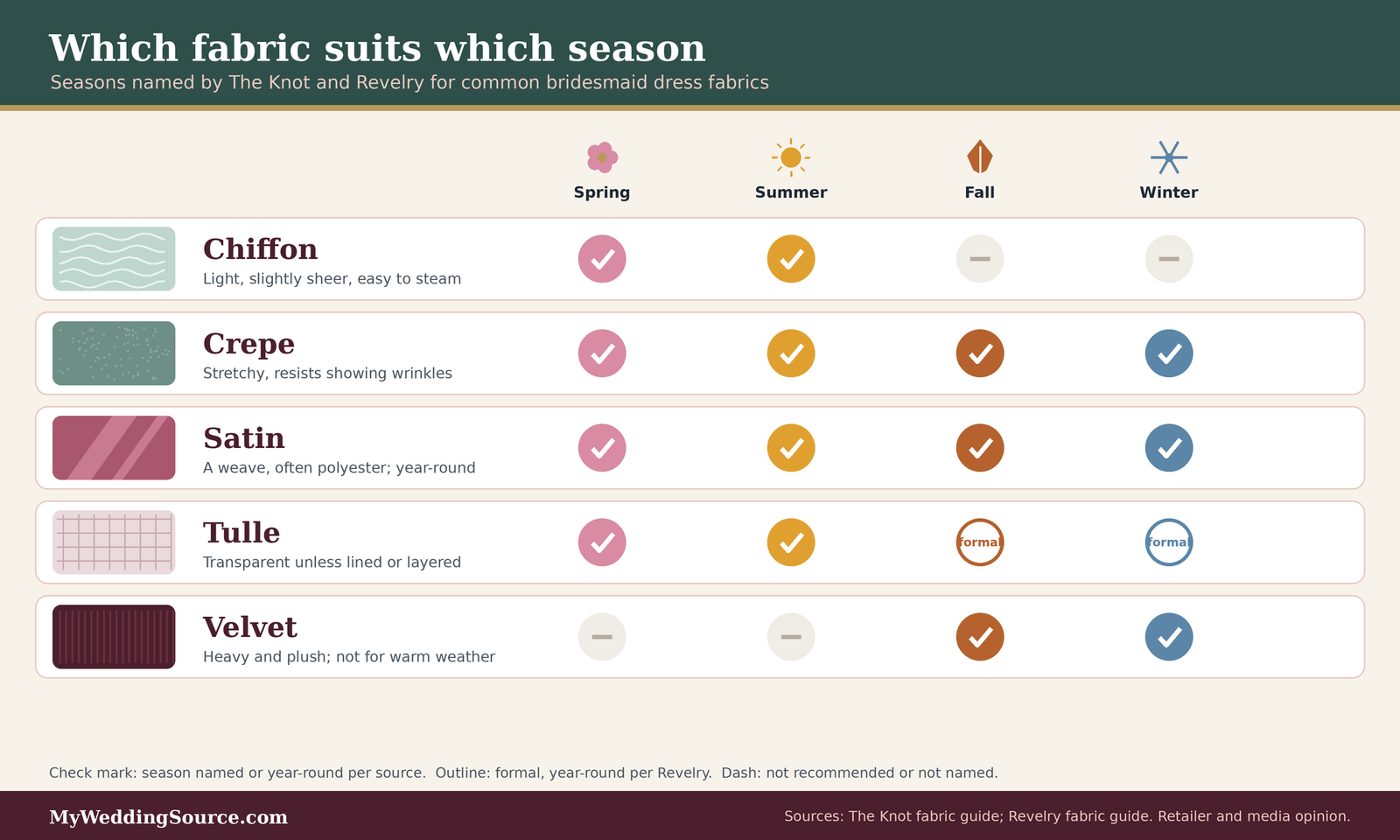
The Knot’s fabric guide describes the usual options in plain terms. Chiffon is light, airy and slightly sheer, and it is easy to steam, which is why it suits spring and summer and garden settings. Crepe has four-way stretch and a slightly textured surface and resists showing wrinkles, so it works across seasons. Velvet is plush and heavy, and The Knot calls it unsuitable for warm-weather or destination weddings. Tulle is fine and floaty but transparent unless it is lined or layered. Jersey is very stretchy and comfortable but tends to cling, so seamless undergarments matter. Satin describes a weave and is often polyester, which is why it is usually more affordable than silk.
Revelry’s fabric guide agrees on the broad pattern and adds that sequined dresses are heavier because of the embellishment, that tulle needs more floor space at a reception because of its volume, and that satin and crepe are workable year-round. Where the two guides differ slightly on specifics, treat both as retailer or media opinion and use them as a starting point for questions to the shop.
Beyond the fabric name, ask four construction questions. Is the dress lined, and with what? Do the sleeves or straps restrict movement when the arms are raised? Does the skirt have a train or a long hem that will drag on carpet, grass or stairs? And does the venue have air conditioning or heating, an open-air ceremony, or a long gap between the ceremony and the reception? Our wedding ceremony guide and wedding reception guide explain how those parts of the day unfold, which helps you picture how long your bridesmaids will be standing, sitting and dancing in their dresses.
Flag mobility, heat, snag, and transparency risks in bridesmaid dresses
A short risk check before ordering saves a lot of regret.
- Mobility: a very narrow skirt, a rigid bodice, or a halter with no give can make sitting, climbing stairs and lifting a child or a glass harder than it looks in a photograph.
- Heat: heavy fabrics, full linings and long sleeves hold heat. The Knot’s guidance on velvet is the clearest example of a fabric that warm settings rule out.
- Snag: beaded, sequined and lace fabrics can catch on jewelry, hair accessories and bouquet ribbon. They are also harder to alter, which we cover in the budget section.
- Transparency: tulle and chiffon can show a seam, a bra strap or a shadow in bright outdoor light. Ask about lining, and test the dress in daylight, not only under shop lighting.
A good habit is to ask the retailer for fabric swatches before anyone commits to a style, and to look at them outside, in the room where you plan to take photographs, and under the lighting the venue will actually have. Our wedding decor guide and seasonal wedding flowers guide can help you picture how the dress color will sit beside the flowers and tables.
Choose color and fabric together, because color names are not a standard
The color name on a product page is a label, not a measurement. Two shops can both sell a dress called “dusty blue” and deliver visibly different shades, and the same shade can look different in satin, chiffon and crepe because each fabric reflects light differently.
Order swatches and check them in the real lighting
Dessy’s guidance, specific to its own catalog, is to order fabric swatches before placing any order so you can see whether a color holds up across different fabrics. Swatch availability, number and cost differ by retailer, so check the current terms of whichever shop you use. Our recommendation is simple: put swatches next to the actual flowers, the bridesmaids’ skin tones, the wedding gown fabric and the groomsmen’s attire if you can, and look at them in morning light, afternoon light and indoor light.
Order every dress at the same time to protect the dye lot
The Knot, Dessy and Azazie each make the same point: ordering all the dresses together helps keep the color consistent, because dye lots can vary and the same color name from different orders may not match. This is also an argument against letting bridesmaids order whenever they like within the same color. If some bridesmaids will order late, tell the retailer you are ordering for a wedding party and ask how they handle later additions to the same color.
Read the fit-and-function matrix before you commit to a style
The matrix below turns the factors in this section into decisions. It is our synthesis of the retailer and media guidance cited in the sources, and it describes tendencies, not guarantees. Use it as a checklist when you are narrowing styles, not as a verdict.
| Factor | What it suggests | Alteration risk | What to ask the seller |
|---|---|---|---|
| Wide spread of bust, waist and hip measurements in the group | Wrap, empire or adjustable-back styles; avoid rigid fitted bodices for everyone | Lower for forgiving styles, higher for structured ones | Can the bodice be taken in or let out, and how much seam allowance is there? |
| Hot or outdoor venue | Light, breathable fabrics such as chiffon or georgette with a light lining | Chiffon is easy to steam but can be delicate to hem | Is the lining breathable, and what does the care label say? |
| Cold or indoor winter venue | Heavier fabrics such as velvet or jacquard, sleeves or a wrap | Heavy fabrics are harder to hem evenly | How long does a hem take on this fabric? |
| Beaded, sequined or lace detail | Statement look, heavier fabric | Highest: details must be worked around | Does the alteration price differ for embellished fabric? |
| Sheer fabric such as tulle or chiffon | Needs lining or layers for opacity | Lining adds hem and seam work | Is there a full lining, and can I see it in daylight? |
| Long hem, train or tiered skirt | Elegant, but can be hard on stairs and dance floors | Hem length depends on the exact shoe height | Can I bring my real shoes to the fitting? |
| Stretch knit or crepe | Comfortable, clings to the body | Often lower, but fit shows every line | Does the seller recommend seamless undergarments? |
| Structured fabric such as faille or mikado | Holds shape across body types | Often needs more alterations, per The Knot | What is the price for taking in a structured bodice? |
How to use the matrix with a group
Run each bridesmaid’s situation through the rows. If three of eight rows apply to the same person, that is a signal to offer her a different silhouette within the group color, which is the most forgiving way to handle fit differences. We return to that idea in the section on mismatched options.
When to ignore the matrix
The matrix cannot know a bridesmaid’s comfort needs, medical needs, religious or cultural dress preferences, or physical limits. Those override any table. If a bridesmaid tells you what she can or cannot wear, take her at her word and adjust the plan.
Build the shopping timeline around alteration reality for bridesmaid dresses
Timelines on wedding sites look tidy and then collide with a delivery delay, a size exchange or a tailor who is fully booked. The sturdier way to plan is to work backward from the last responsible fitting and treat every earlier date as a buffer that you may need.
Work backward from fittings and delivery in the bridesmaid dresses decision
Start with the wedding date and subtract in this order: the final fitting, the alteration work, the delivery, the production time, and the ordering decision. The sources disagree about some of these numbers, so the key is to understand what each retailer is assuming.
Show when custom order, rush, or off-the-rack changes the schedule for bridesmaid dresses
The advice from the sources we reviewed, all of it from retailers or wedding media, clusters around six months for ordering, but the details differ.
- The Knot suggests gathering inspiration about eight months out and ordering about six months out. For made-to-order dresses, it suggests ordering at least four months out because they can take up to eight weeks to produce and deliver, with extra time for an exchange. It advises booking the alterations appointment three to four months out and having alterations done four to six weeks out.
- Zola also suggests ordering about six months out, notes that designer and boutique dresses can take two to three months to arrive, and says alterations need about two more months. It suggests dresses arrive two to four months out and final fittings happen one to two months out.
- David’s Bridal recommends ordering six to eight months out, says standard production typically takes 12 to 16 weeks, and suggests first fittings three to four months before the wedding.
- Azazie suggests ordering at least four to six months out, or six to eight months for custom-sized or scattered groups, and says dresses should be in hand at least three months before the wedding.
Here is our own arithmetic, labeled as an estimate and using only those published figures. If you order at six months, about 26 weeks before the wedding, and a retailer’s production takes 12 to 16 weeks, the dresses are finished between 10 and 14 weeks before the wedding, before shipping time. That still leaves room for a first fitting four to six weeks out, but it does not leave room for the three-to-four-month first fitting David’s Bridal describes, and it leaves little room for an exchange. If the production is eight weeks, as The Knot says for some made-to-order dresses, the same order lands about 18 weeks out. The practical lesson is to ask the specific retailer how long this specific dress takes, and to ask whether that number includes shipping.
For off-the-rack or in-stock dresses, the schedule is shorter because there is no production wait, but the alteration window does not shrink. Azazie suggests ready-to-ship or in-stock styles and simple cuts if time is short, and notes that ordering within two to three months of the wedding can bring rush or express fees. Rush fees are a vendor’s policy, so ask before you rely on them.

Add buffer for correction, steaming, and accessories in bridesmaid dresses
Four buffers are easy to forget.
- Correction time. If a dress arrives in the wrong size or with a flaw, you need time to exchange it. Zola suggests ordering early enough to allow returns or size exchanges, especially for out-of-town bridesmaids.
- Alteration queue time. Azazie suggests booking a tailor six to eight weeks ahead because tailors are busy in wedding season, and The Knot suggests booking the appointment three to four months out. Book the appointment before the dresses arrive.
- Steaming and pressing. A dress that has been shipped in a bag needs steaming. Chiffon is easy to steam, according to The Knot, but delicate fabrics may need a professional. Plan who will do it and when, and do not leave it for the morning of the wedding.
- Accessories. Shoes affect hem length, and undergarments affect fit. The Knot suggests bringing the shoes you plan to wear to fittings. Order shoes and undergarments before the first fitting, not after.
Also consider how the dates fit into the wider plan. Our wedding planning timeline places major decisions across the planning months, and our wedding planning checklist is a good place to track each bridesmaid’s order status.
Read the shopping-to-final-fitting timeline as ranges, not deadlines
The table below combines the published ranges into a single working schedule. It is our synthesis, and the ranges overlap because the sources disagree. When two ranges conflict, use the more cautious one for any step that cannot be recovered if it slips.
| Stage | When (before the wedding) | What happens | Source range |
|---|---|---|---|
| Research and swatches | 8 to 10 months | Narrow style, color and fabric; order swatches; gather measurements | The Knot about 8 months; David’s Bridal 8 to 10 months |
| Order everything together | 6 to 8 months | Place all orders at once; get delivery estimate in writing | The Knot and Zola about 6 months; David’s Bridal 6 to 8 months |
| Dresses arrive | 2 to 4 months | Check size, color, flaws; start exchanges quickly | Zola 2 to 4 months; Azazie at least 3 months |
| Book the tailor | 3 to 4 months (or 6 to 8 weeks ahead of the appointment) | Reserve the alteration appointments | The Knot 3 to 4 months; Azazie 6 to 8 weeks ahead |
| First fitting | 4 to 6 weeks (some retailers say 3 to 4 months) | Pin and mark; test with real shoes | The Knot and Azazie 4 to 6 weeks; David’s Bridal 3 to 4 months |
| Second fitting | 2 to 3 weeks | Confirm the changes; flag corrections | Azazie 2 to 3 weeks |
| Final fitting and pickup | 1 to 2 months (Zola, David’s Bridal) down to about 1 week (Azazie pickup) | Take the dress home; store; steam | Zola and David’s Bridal 1 to 2 months; Azazie about 1 week |
Where the sources disagree, and what to do about it
The largest disagreement is the first fitting. A first fitting three to four months out, as David’s Bridal suggests, gives you more room to correct mistakes but risks changes in body size between the fitting and the wedding. A first fitting four to six weeks out, as The Knot and Azazie suggest, is closer to the real body but leaves less time to redo work. A reasonable middle path is our own suggestion: have the dresses arrive early, check them immediately for size and flaws, and book the real alteration fittings for the window when the sources overlap.
How to adjust the schedule for a spread-out wedding party
Zola notes that online ordering often works best when the group is spread across cities, and suggests ordering early enough to allow returns and size exchanges. If bridesmaids live far apart, ask each of them to find a local tailor now, share the retailer’s return window with the group, and send the same fitting checklist to everyone. Azazie also suggests allowing three to four extra weeks for international shipping and one to two extra months for destination weddings, which is useful if bridesmaids or the venue are overseas.
Budget for the finished garment, not the rack price in the bridesmaid dresses decision
The rack price is the number on the product page. The finished price is what each bridesmaid actually pays by the wedding day. Telling bridesmaids only the first number is the most common way a reasonable-sounding request becomes a burden.
Separate purchase, alteration, undergarment, and preservation costs for bridesmaid dresses
The Knot’s 2025 Real Weddings Study, which covers 16,956 U.S. couples married in 2024 who were recruited by email invitation from The Knot and WeddingWire members, reports an average bridesmaid dress cost of $128 per person for 2024, roughly flat since 2021. The page does not describe weighting or a margin of error, and the figure covers the dress itself. The Knot reports regional and generational differences too: about $140 in the Mid-Atlantic and Northeast, and averages of $146 for Gen X couples, $131 for millennial couples and $118 for Gen Z couples. An average is not a price you will find; treat it as a sense of the middle, not a target.
The same article lists the other items a bridesmaid may need to budget for: alterations, accessories such as jewelry, shoes and a clutch, undergarments such as shapewear or a specialty bra, and hair and makeup, which a couple may cover fully, cover partly or leave to each bridesmaid. Our bridal makeup guide explains what beauty services typically involve.
For alterations, the figures we found come from one retailer. Azazie’s blog gives an overall alteration range of $30 to $150 and a range of $30 to $60 for a simple hem. It also says rush service adds 50 to 100 percent and that group or package deals can save roughly 10 to 20 percent. Those are one seller’s estimates, not a survey, and local tailors will quote their own prices.
Preservation is the cost people forget. After the wedding, a bridesmaid may want the dress cleaned, stored or altered into something she can wear again, or she may sell it. We found no reliable published figure for cleaning or storage, so we have left it out of the estimate. The care label tells you what cleaning method the maker considers safe, and a quote from a local cleaner before the wedding is the way to put a real number on it. Ask the group whether anyone wants to rewear her dress, because that changes which hem length and fabric are worth paying for.
Cost reality check
Estimate, using only the published figures above. The Knot’s average dress cost is $128. Adding Azazie’s overall alteration range of $30 to $150 gives a finished garment of about $158 to $278 per bridesmaid, before shoes, undergarments, accessories, hair and makeup. If a rush surcharge of 50 to 100 percent applied to that alteration range, alterations alone would be about $45 to $300. If a group discount of 10 to 20 percent applied instead, they would be about $24 to $135. These are our arithmetic from other people’s figures, not quotes, and your local prices will differ. Before you set a price limit for the group, collect two real quotes from local tailors and use those instead.

For help turning those numbers into a full wedding budget, our wedding budget calculator can hold the line items together.
Show which design details drive alteration complexity in bridesmaid dresses
Azazie’s alteration guide lists the features that tend to raise cost and time: beaded, sequined or lace detail that must be worked around; delicate or difficult fabrics such as velvet, silk and satin; resizing by two or more sizes; replacing a zipper; built-in structure such as boning or a corset back; adding long sleeves or several bustle points; and making multiple major changes at once. It also lists time ranges: a simple hem about one to two weeks, lined or curved hems two to three, beaded or detailed hems three to four, taking in the sides or bust two to three, and most alterations two to four weeks overall.
Azazie also gives percentage surcharges by fabric, from about 10 to 20 percent for tulle up to 50 to 80 percent for beaded or sequined fabric. Because those numbers come from one seller’s blog and are not a standard, we use them only to show the direction: simple, lined, plain fabrics cost less to alter than embellished ones. If your group’s budget is tight, choosing a plain fabric with a hem you can predict is one of the few levers that reduces cost without reducing quality.
Check the care label and the order terms before you pay
Two federal rules matter to a bridesmaid buying a dress, and neither is complicated. This is general information, not legal advice.
Read the care label before the first wear
The FTC’s Care Labeling Rule requires apparel to carry a permanent care label that stays attached and legible for the life of the garment, and the label must be easy to find at the point of sale or, if the item is packaged so the label is hidden, shown on the package or a hang tag. The care instructions must cover the regular care needed for ordinary use, and a warning is required when a procedure a consumer would reasonably use could harm the item. In practice, that means you can check whether a dress is machine washable, needs dry cleaning or cannot be cleaned safely by any method before you buy. For a dress that will be pinned, hemmed and perhaps steamed, check the label for heat and cleaning limits.
Know what online sellers owe you on shipping
If you order online, the FTC’s Mail, Internet, or Telephone Order Merchandise Rule requires sellers to have a reasonable basis for any shipping time they state, and, if they make no clear promise, to expect to ship within 30 days of receiving a complete order. If a seller cannot ship on time, it must promptly offer you a choice to accept a delay or cancel for a full refund. The rule governs shipping, not delivery to your door, and not every dispute fits it. Keep your order confirmation and any shipping promise in writing so you have a record.
Use the fitting room to test the wedding day for bridesmaid dresses
A fitting is not a ceremony of approval. It is a rehearsal. The aim is to find out, while there is still time to fix it, what will bother a person at hour six of the wedding day.
Move, sit, dance, hug, and walk stairs in the garment in the bridesmaid dresses decision
Treat the fitting like a short scripted test. Stand, sit, walk up and down a few stairs if the shop has them, raise both arms, hug someone, bend to pick something up, and take a few dance steps. Do it for a few minutes, not seconds, because fabric and fit often behave differently once you have moved around.
Test the actual shoes or heel height with bridesmaid dresses
Hem length depends on the shoes, which is why Azazie’s measuring advice includes measuring from the collarbone hollow to the floor in the shoes you plan to wear, and why The Knot suggests bringing your shoes to the fitting. A hem set for flats is too long for heels and too short if the bridesmaid changes into flats for the reception. If she plans to change shoes, ask the tailor to set the hem for the shoes she will wear for the ceremony and photographs, and to discuss the reception shoes in advance. Test the shoes for stairs, grass or gravel at the venue, not only on a flat shop floor. Our wedding ceremony guide explains how long the processional and photographs often take, which affects how long shoes need to be comfortable.
Check neckline and support under photography movement in bridesmaid dresses
Most necklines look secure when you are standing still. Test them when you lean forward to hug, lift your arms for a group photograph, and turn to look over your shoulder. If the dress needs a particular bra or shapewear, wear it to the fitting, because the fit of a bodice changes with what is underneath. The Knot’s fabric guide notes that jersey tends to cling and that seamless undergarments help. Ask your photographer which poses are planned; our wedding photography guide and wedding photographer shot list describe common group shots and where bridesmaids usually stand.
Document what must change before the next fitting in the bridesmaid dresses decision
Fittings produce a lot of verbal decisions in a short time, and most mistakes happen in the space between what was said and what was written down.
Photograph pin placements and notes for bridesmaid dresses
Before the tailor removes the pins, take photographs from the front, the back and both sides, plus a close-up of any pinned seam or a marked hem. Photograph the tailor’s chalk marks and any note pinned to the dress. Keep the photographs in a shared folder with the bridesmaid’s name and the date. If the work later looks different from what you agreed, you have a record, and the tailor has a clear reference too.
Get alteration scope and deadlines in writing for bridesmaid dresses
Ask the tailor for a written scope that lists each change, a price for each change or a total, the date the dress will be ready, and what happens if the work needs correction. Azazie suggests scheduling a second fitting two to three weeks before the wedding and picking the dress up about a week before, leaving time for last-minute fixes that may take two to three days. Those numbers are one seller’s suggestion, so agree on your own dates with your own tailor.
Questions to ask before you order or alter
- What is the production and delivery time for this exact dress, and is shipping included?
- Which sizes can be returned or exchanged, and what is the deadline? Are custom sizes returnable?
- Will all the dresses ship from the same dye lot if we order together?
- Can I order swatches in this fabric and color, and what do they cost?
- What does the care label say, and can the dress be steamed or pressed?
- How much seam allowance is there, and can the bodice be let out as well as taken in?
- What will the tailor charge for each change, and does the price change for this fabric?
- Can I get the alteration scope and the ready date in writing?
- What happens if the dress arrives late, damaged or in the wrong size?
Mix and match bridesmaid dresses without losing the group look
Mismatched bridesmaid dresses solve a real problem: no single cut flatters or fits every body, and no single price suits every budget. They also create a real risk, which is that the group looks like it dressed without talking to each other. The difference comes down to deciding what stays fixed.
Anchor one thing and vary the rest in the bridesmaid dresses decision
Dessy’s guidance for a cohesive mix-and-match look is to pick one anchor, either color, fabric or silhouette, and vary the other two. Varying all three at once, it says, tends to look chaotic. That is one retailer’s view, and it matches the way many wedding stylists describe the approach, so we treat it as a sound working rule rather than a law.
Anchor on color, the most forgiving approach
Keeping everyone in one color family while letting each bridesmaid choose her own cut and fabric is the most common choice, and Dessy describes it as the most forgiving. It also solves the budget problem, because bridesmaids can choose a dress at different prices in the same shade. The weak point is the shade itself: the same color name from different shops, or from different fabrics, may not match. Order swatches from every shop you plan to use, or keep to one retailer’s color range, and check them together in daylight before anyone orders.
Anchor on silhouette or fabric, and know the trade-offs
Using the same cut in a range of related shades, such as a gradient of blues, gives the group structure, but Dessy notes that a single silhouette does not suit every body type equally well, which defeats one of the reasons to mismatch. Using one fabric in different styles and colors is the least common approach; Dessy says it suits outdoor summer weddings, but that fabric can vary between manufacturers and is hard to verify without swatches. The Knot’s fabric guide suggests mikado for mismatched looks because it keeps different silhouettes cohesive, and notes that a bride in a heavily detailed gown might prefer simpler, lighter fabrics for her bridesmaids, while a minimal gown pairs well with richer textures. If you are choosing a gown, our wedding dress styles guide is a good companion for deciding how much detail the bridesmaids’ dresses can carry beside it.
Set a rulebook the group can follow in the bridesmaid dresses decision
A mismatched look works best when the rules are short and written down. Without them, each bridesmaid fills the gap with her own guess.
Write a one-paragraph brief for the group
A brief that names the color family with a specific swatch or a link, the fabric family or finish to avoid (for example, no sequins, or only matte fabrics), the length (floor length, midi or either), the formality of the event, and the price ceiling is enough. Add a deadline for ordering and a note about who to ask if a bridesmaid cannot find something suitable. Formality matters: our black-tie wedding guide and cocktail attire guide explain what each dress code usually expects, which helps when bridesmaids ask whether a short dress or a certain fabric is appropriate.
Use a short approval step instead of a vote
Ask each bridesmaid to send a link or photo of her choice to the group before ordering, and give a short window for objections. This is faster than a vote and avoids the awkward moment when two people arrive in nearly identical dresses. It also catches fabric mismatches, such as a heavy velvet in a group of chiffons, before money is spent. Keep the tone friendly: the purpose is to coordinate, not to police.
Money is the part of bridesmaid dresses that people find hardest to talk about, which is why a clear, early statement works better than a late correction.
Decide who pays and say so early in the bridesmaid dresses decision
The Knot reports that bridesmaids are typically expected to pay for their own dresses, even when the bride picks the style, and that couples can cover the cost if they wish, which is more feasible with a smaller wedding party, or split it with the group. The Knot’s 2022 reference figure for the average dress was $130 per person, close to its more recent $128. Those are survey averages from The Knot’s own audience, not rules, and etiquette is a convention: nothing requires a couple to pay or to avoid paying. The kind choice is to decide before you invite people, and to tell them the full cost, not only the dress.
Quote the finished price, not the rack price
When you ask someone to be a bridesmaid, share an honest estimate of the total: dress, alterations, shoes, undergarments, accessories, and any beauty services they will cover. Use our worked estimate above as a starting point, and replace it with real quotes. A friend who sees a total of a few hundred dollars up front can say yes, say no, or suggest a cheaper version. A friend who discovers the total over several months may feel she cannot object.
Offer a graceful way out of an expensive dress
The Knot suggests several options if a bridesmaid cannot afford the dress: talk to the bride, find a similar dress in the same color family at a lower price, ask whether the couple would split the cost of the original, set clear personal limits, or consider a mismatched look inside a color palette. These work best when the couple raises them first, so the bridesmaid does not have to ask. A line in the group brief, such as “if the price is a stretch, tell me and we will find another option,” does most of the work.
Handle an out-of-town or in-a-hurry bridesmaid in the bridesmaid dresses decision
Bridesmaids who live in other cities, or who join the group late, cause most of the timeline surprises.
Use remote sizing and local tailoring
Zola suggests online ordering when the group is spread across cities. David’s Bridal mentions virtual consultations and detailed measurement guides for remote bridesmaids, and some retailers offer try-at-home programs or shipping for local alterations. Each bridesmaid should find a tailor near her, and the group should agree on a deadline for that appointment. Ask the retailer whether it will accept returns shipped from other states, and note the return deadline for each order.
Consider rental only if the schedule and the dress code allow
Zola’s guidance notes that many rental sites only allow dresses to be worn on the day of the event and returned the next day, suggests looking for a site that delivers up to a week early so there is time to exchange a poor fit, and says some services offer at-home try-ons. For rentals that arrive only days before the wedding, it suggests each bridesmaid order two sizes and keep the one that fits best. Rentals reduce the cost of owning a dress, but they limit alterations, since most rental dresses cannot be altered permanently, so they suit simple fits and bridesmaids who do not need hemming. That limit is our inference, so confirm the rental company’s alteration policy before you rely on it.
Put it together with a worked scenario for bridesmaid dresses
The scenarios below are illustrations, not case studies. They use only the figures cited earlier plus invented but plausible group sizes, and they show how the pieces connect.
Follow a six-bridesmaid group from decision to final fitting in the bridesmaid dresses decision
Imagine a couple with six bridesmaids spread across three cities, an October wedding at an outdoor venue with an indoor reception, and a price ceiling the couple has written in the group brief. The couple has chosen a color anchor, a deep green, and left style and fabric to each bridesmaid within a short list of fabrics.
The first two months: brief, swatches and approvals
About eight months out, the couple orders swatches in two fabrics and checks them in morning light beside the planned flowers. They write a one-paragraph brief with the color link, the fabric family, the length, the dress code and a price ceiling for the dress alone, plus a note that they will help with alteration costs. Each bridesmaid sends measurements and a photo of her choice. Two choose chiffon, which suits the outdoor ceremony, two choose crepe, and two choose a heavier satin for the cooler evening. The couple asks the retailer to confirm that all dresses ordered on the same day will ship from the same dye lot.
Ordering through the first fitting
At about six months out, each bridesmaid orders on the same day. The couple records each production estimate in the shared folder. Two dresses are made to order, with a quoted production time of 12 to 16 weeks, so by our earlier arithmetic they should be finished 10 to 14 weeks before the wedding, before shipping. When the dresses arrive, each bridesmaid checks size and flaws within days and tells the group. One chiffon dress is the wrong size and goes back for an exchange. Because the schedule had buffer, the exchange does not threaten the wedding. Four to six weeks out, each bridesmaid attends a first fitting with her real shoes and a photographed pin record, and a second fitting two to three weeks out confirms the changes. At about a week out, each bridesmaid collects her dress, steams it and hangs it.
Compare a tight timeline with a roomy one in the bridesmaid dresses decision
Now imagine the same couple with the same group but with only three months until the wedding. The schedule changes in three ways.
What a short timeline removes
A three-month schedule removes the made-to-order option for most retailers, because production alone may use the time. It also removes the chance to order swatches and wait for them, and it leaves no room to recover from a wrong size. The Knot and Azazie both point to ready-to-ship or in-stock dresses as the remedy for short timelines, and Azazie adds that simple cuts like A-line, sheath and wrap styles are easier to manage.
What the couple can still protect
Even on a short timeline, three things are worth protecting: the same-day order so the dye lot matches, a booked tailor appointment before the dresses arrive, and a first fitting that leaves two weeks for corrections. If something must give, give up the exact style you wanted, not the fitting buffer. A slightly simpler dress that is altered well looks better in a photograph than a more elaborate dress that is rushed.
FAQ: bridesmaid dresses questions
Ordering and timing
When should bridesmaids order their dresses?
The sources we reviewed cluster around six months before the wedding, with David’s Bridal suggesting six to eight months and Azazie suggesting longer for custom sizes or scattered groups. Order every dress on the same day so the color matches, and ask the seller for a written production and delivery estimate before you pay.
How long do alterations take?
Azazie says most alterations take two to four weeks, with simple hems around one to two weeks and detailed or beaded work longer. David’s Bridal says even minor changes can take two to three weeks, longer during busy season. Book the tailor before the dresses arrive, and confirm the ready date in writing.
Can I still get bridesmaid dresses on a short timeline?
Often, but with fewer choices. The Knot and Azazie both point to ready-to-ship or in-stock styles for short timelines, and ordering within two to three months of the wedding can bring rush fees, according to Azazie. Choose a simple cut, protect the fitting buffer, and ask the seller about exchanges before you buy.
Fit and fabric
What size should I order for a bridesmaid dress?
Order by measurements, not your usual size. Azazie advises comparing your bust, waist and hip measurements to the brand’s chart, choosing the size that matches your largest one, and sizing up if you fall between two. It also says bridesmaid sizes often run one to two sizes smaller than everyday clothing, so check that brand’s chart.
Which fabric is best for a hot or cold wedding?
For warm weather, The Knot describes chiffon and georgette as light options and calls velvet unsuitable for warm-weather weddings. For cooler weather, velvet and jacquard are heavier choices. Crepe is described as working across seasons. Check the venue’s heating or cooling, and test the fabric in daylight.
Do mismatched bridesmaid dresses still look cohesive?
They can, if one element stays fixed. Dessy suggests anchoring on color, fabric or silhouette and varying the other two, and warns that changing all three tends to look chaotic. Order every dress together for dye-lot consistency, check swatches in the real lighting, and give the group a short written brief.
Money and rules
How much do bridesmaid dresses cost?
The Knot’s 2025 Real Weddings Study reports an average of $128 per dress for 2024 weddings, covering 16,956 U.S. couples recruited from The Knot and WeddingWire members. That is the dress alone. Alterations, undergarments, shoes, accessories and beauty services add to it, so ask for finished-price estimates from sellers and tailors.
Who pays for bridesmaid dresses?
The Knot reports that bridesmaids typically pay for their own dresses, even when the bride chooses the style, though couples can cover or split the cost. No rule requires either. Tell bridesmaids the full expected cost before they agree, and offer a lower-cost option in the same color family so no one feels trapped.
Your next steps
Decide the plan before you shop
Write the group brief
Put the color link, fabric family, length, dress code, price ceiling, ordering date and the person to ask about budget concerns in one message. Ask everyone to reply with measurements and a photo of her choice. Our wedding planning guide shows where this step sits in the larger plan, and our plan a wedding guide covers the early decisions that come first.
Check the dates backward
Subtract from the wedding date: pickup, second fitting, first fitting, tailor appointment, arrival, production, order, swatches. If any date has passed, choose in-stock styles and keep the fitting buffer.
Protect the garment and the friendship
Keep the paperwork
Save order confirmations, shipping promises, return deadlines, alteration quotes and the pin photographs in one shared folder. Ask for the alteration scope and ready date in writing.
Plan the day with the dresses in mind
Check the shoes, the venue and the photograph plan one more time before the final fitting. Our wedding photographer shot list can help you ask your photographer for the group portraits you want, and our wedding planning checklist can hold the remaining tasks.
Sources & methodology
How we built this guide
What we relied on
This guide combines two federal rules that affect clothing purchases, The Knot’s 2025 Real Weddings Study and related guidance, and published ordering, sizing, fabric and alteration advice from wedding retailers and wedding media. Where a statement comes from a retailer, we say so, because retailer advice reflects that seller’s products and production. The finished-cost estimates and the production-time arithmetic are our own calculations from the published figures, and they are estimates.
What we did not do
We did not test dresses, measure bodies, collect tailor quotes, or survey bridesmaids. Prices, return policies, swatch terms and timelines change and differ by seller, so confirm them with the seller you use. Nothing here is legal advice, and the federal rules are summarized in plain language, not interpreted for your situation.
Source list
Government and regulatory sources
- Federal Trade Commission, Care Labeling of Textile Wearing Apparel and Certain Piece Goods, 16 CFR Part 423 (Code of Federal Regulations): https://www.govinfo.gov/content/pkg/CFR-2022-title16-vol1/pdf/CFR-2022-title16-vol1-part423.pdf
- Federal Trade Commission, Business Guide to the Mail, Internet, or Telephone Order Merchandise Rule: https://www.ftc.gov/business-guidance/resources/business-guide-ftcs-mail-internet-or-telephone-order-merchandise-rule
Wedding survey and media sources
- The Knot, Average Bridesmaid Dress Cost (2025 Real Weddings Study): https://theknot.com/content/average-bridesmaid-dress-cost
- The Knot, Who Pays for Wedding Party Attire: https://www.theknot.com/content/who-pays-forwedding-party-attire
- The Knot, Bridesmaid Dress Guide and Timeline: https://theknot.com/content/ultimate-bridesmaid-dress-guide
- The Knot, Bridesmaid Dress Fabric Guide: https://www.theknot.com/content/bridesmaid-dress-fabric
- Zola, When Should You Order Bridesmaids Dresses: https://zola.com/expert-advice/when-should-you-order-bridesmaids-dresses
Retailer guidance (a seller’s own advice)
- Azazie, How Long Before the Wedding Should I Order Bridesmaid Dresses: https://www.azazie.com/blog/how-long-before-the-wedding-should-i-order-bridesmaid-dresses/
- Azazie, How Long Does It Take to Alter a Bridesmaid Dress, and How Much Does It Cost: https://www.azazie.com/blog/how-long-does-it-take-to-alter-a-bridesmaid-dress-and-how-much-does-it-cost/
- Azazie, How Do I Know What Size to Order for a Bridesmaid Dress: https://www.azazie.com/blog/how-do-i-know-what-size-to-order-for-a-bridesmaid-dress/
- David’s Bridal, When to Order Bridesmaid Dresses: https://www.davidsbridal.com/content/marriage-tips/everything-you-need-to-know-about-when-to-order-bridesmaid-dresses
- Dessy, Cohesive Look: Mix and Match Bridesmaid Dresses: https://dessy.com/the-edit/p/cohesive-look-mix-and-match-bridesmaid-dresses
- Revelry, Best Bridesmaid Dress Fabrics: https://shoprevelry.com/blogs/wedding-inspiration/best-bridesmaid-dress-fabrics