
A wedding rehearsal is a short, practical walk-through of the ceremony, usually held the day before, and it works best when you treat it as a rehearsal of movement, cues, and hand-offs rather than a performance of the ceremony itself.
Quick answer
A wedding rehearsal is a run-through for the people who have a job in the ceremony: the couple, the officiant, parents, the wedding party, readers, ushers, children with roles, and any musician or coordinator. Most sources we read plan about an hour, and some venues and planners say 30 to 45 minutes is enough for a simple ceremony. You practice the processional, where everyone stands, the cues for readings and rings, and the recessional. You usually do not read your real vows, put the rings on, or deliver the officiant’s full script. It is optional, and a small ceremony at an experienced venue can sometimes skip it.
Do you need a wedding rehearsal at all?
Most couples hold one, but it is a custom, not a requirement. Before you book a time slot and send invitations, it helps to decide how much rehearsal your ceremony actually needs. That decision depends on how many people have a role, how unfamiliar the space is, and how nervous the group is. This guide covers the whole path: who comes, how long to plan, what to practice in order, what to leave alone, and how to hand the final week to people other than the two of you.
What a wedding rehearsal is and what it is not
A wedding rehearsal is a working session at the ceremony site. It exists to answer small, physical questions that are hard to answer on paper: where does the second bridesmaid stand, who carries the rings, when does the music stop, and which door does everyone use at the end?
It is a run-through of movement and cues
The Knot describes the wedding rehearsal as the time when the wedding party practices the ceremony, and The Park Savoy Estate, a New Jersey venue, describes a walk-through at the actual location covering where to stand, when to walk, and each person’s role. Those two descriptions agree with the others we read: the point is choreography. A wedding rehearsal rewards people who are specific about the order of events and puts everyone’s nerves at ease because they have done it once before.
It is not the rehearsal dinner
People often use the two terms as if they were one event, and they are usually back to back, but they are different. The rehearsal is the working session. The dinner afterward is a social meal, traditionally hosted by the groom’s family, though The Knot and Zola both note that many couples host or split the cost themselves. If you are planning the dinner too, our wedding etiquette guide covers hosting customs, and this article stays with the wedding rehearsal itself.
When you can shrink or skip the wedding rehearsal
An affordable-venue blog we read, written by a venue and vendor business, calls the rehearsal optional and says experienced venues and houses of worship often run smoothly without one. We treat that as one vendor’s view, not a rule, but it matches common sense: the more routine the setting and the smaller the cast, the less a wedding rehearsal adds.
Situations where a short check is enough
A courthouse or small-venue ceremony with two people and an officiant has almost nothing to rehearse. If your plan is a small gathering, our guides to small wedding planning and micro wedding planning show how the whole day shrinks, and a ten-minute walk-through with the officiant on arrival may replace a formal session. A phone call to review the order of events can also be enough when everyone has done this before.
Situations where you should insist on one
Several signs point the other way: a large wedding party, children with jobs, readers who will use a microphone, a ceremony in an unusual place such as a backyard, a beach, or a garden, a cultural or religious element that few people know, or a family with complicated seating. The affordable-venue blog itself says a rehearsal matters more for do-it-yourself weddings and unusual locations, where plans on paper may differ from reality. If your ceremony is outdoors, read our garden wedding venues guide for space questions that a wedding rehearsal can settle.
What a wedding rehearsal does not do legally
A wedding rehearsal is not part of the legal ceremony. Rules about the marriage itself come from your state, and the person who solemnizes the marriage is the best source for them.
The legal core is small
As one example, Maine’s public-health guidance for officiants says the couple must state their intent to marry, which usually sounds like “I do” but need not use exact words. The officiant must pronounce them married, and two witnesses must be physically present, with the officiant unable to serve as a witness. Maine also says the completed license goes back to the issuing office within a set number of working days, though the document we read was inconsistent about whether it says days or working days. This is one state’s rule and general information, not legal advice. Our marriage license guide explains the process, and your clerk and officiant can tell you what applies to you.
Why this matters for the rehearsal
Because no particular vow wording is required in that state, a rehearsal has no legal reason to repeat your vows. It can, however, answer logistics questions that touch the legal steps: where the license will be signed after the ceremony, who the two witnesses are, and who is responsible for handing the license to the officiant. We return to those questions in the checklist below.
Who attends the wedding rehearsal, and who runs it
The sources we read agree on one principle: invite people who have a job on the wedding day. Where they differ is at the edges, such as plus-ones, vendors, and grandparents. Setting the guest list early also helps you choose the venue time and the dinner size.
The core invitation list
The Knot lists anyone in the ceremony, including bridesmaids, groomsmen, flower girls, ring bearers, ushers, and readers, along with parents and close family and the officiant. Minted adds musicians and any special performers, and Emmaline Bride limits it to people with a ceremony role. Our reading of those lists gives a practical core.
People with a task
Include the couple, the officiant, both sets of parents or whoever will be escorting or seated in the front row, the full wedding party, ushers, readers, any child attendants, and the musician or DJ who will start and stop the music. The Park Savoy Estate also lists the wedding coordinator. If someone has a cue, a spot to stand, or an object to carry, they should be at the wedding rehearsal.
People who are optional
Grandparents, close relatives with no part in the ceremony, and plus-ones of the wedding party are usually welcome, particularly when there is a dinner afterward, but they do not need to attend the working session. The Knot mentions plus-ones of the wedding party and close relatives such as grandparents as part of the usual guest group, and Zola says the dinner list is the couple’s decision. A useful way to keep the session short is to invite everyone to the dinner and ask only role-holders to arrive for the rehearsal start time.
Who leads the wedding rehearsal
Sources disagree about who runs the session, so decide early. Emmaline Bride says the officiant typically runs it and strongly recommends a day-of coordinator. The planner-written posts we read, from a Philadelphia-area planner and a Chicago event company, describe the planner guiding the couple and directing the party. The affordable-venue blog says a coordinator usually leads, otherwise the officiant, or the couple themselves at a do-it-yourself wedding.
Officiant, coordinator, or a trusted friend
If you hire a coordinator, they are the natural leader because they will also cue the party on the wedding day. If you do not, ask your officiant whether they lead rehearsals, since the affordable-venue blog notes that officiants may or may not offer this service. Many officiants include it in their package and some charge extra, so ask before you assume. Our wedding officiant guide lists questions to put to an officiant before you hire one. If neither is available, name one calm friend to be the voice of the session.
Why the couple should not lead
The couple are the most emotionally involved people in the room and the least able to watch the whole picture. Giving the lead to a coordinator, officiant, or friend lets you walk the aisle and focus on your own cues. This is a recommendation based on how the sources divide the work, not a documented rule.
Children, plus-ones, vendors, and family dynamics
Rehearsals go wrong most often at the edges: a flower girl who was not told, a reader who never received the text, a stepparent unsure where to sit.
Children with a role
Fierce Productions, the Chicago planner, suggests including flower girls and ring bearers or at least their parents or guardians. Minted notes that young attendants may need extra run-throughs. Plan a time when children are alert, keep their part short, and tell parents the start and end times in advance. Zola says children may attend the dinner with parents but not at a bar or casino.
Vendors who need to be there
Most vendors do not attend. The exceptions are the coordinator, any musician or DJ who starts the processional, and sometimes the photographer if you want to plan photo stops. If you want the photographer’s input on the recessional pause, our wedding photographer shot list can help you decide which moments to plan, and you can pass those decisions along in writing instead of paying for a vendor’s time.
Plus-ones, exes, and complicated seating
Pairing and seating can involve feelings. The DPNAK Events planner post says to pair uneven sides sensibly, to avoid pairing former partners, and to ask escorts rather than assume. These are one planner’s preferences, but the underlying point is general: decide these things before the wedding rehearsal, so the session is not the place a family disagreement first appears.
How long a wedding rehearsal takes
Sources give a range, and the honest answer is that the length depends on how many people are in the party and how many extra elements you add. The range we found runs from about 30 minutes to about 75 minutes. A planned hour is the most common figure.
What the sources say about duration
The figures below come from different kinds of sources, so they do not carry equal weight. We list them so you can see the spread instead of trusting a single number.
The spread of reported lengths
The Knot says the ceremony run-through usually takes about an hour, and Minted gives a sample agenda that adds up to 60 minutes. Fierce Productions says to plan about an hour, which allows a couple of full run-throughs and a buffer for late arrivals. Emmaline Bride says about an hour and suggests booking one hour and 15 minutes. The affordable-venue blog says 30 to 45 minutes, longer for large bridal parties or religious ceremonies. WeddingFrontier says most people schedule an hour but that rehearsals often finish in about half that time.

How to read that spread
Treat 30 to 45 minutes as the figure for a small party in a familiar space, and an hour to 75 minutes as a safe block for a bigger party or a venue where people will arrive at different times. These ranges come from vendor and planner blogs, not a survey, so they describe common practice and not a measured average. Our recommendation is to book the longer block and finish early, because an early finish costs nothing and a rushed rehearsal costs confidence.
A 60-minute agenda you can adapt
Minted’s sample timeline is the most detailed one we found, and the minutes below are taken from it. We paraphrase the content and add our own notes in the right-hand column of the checklist later in this guide.
The sample, minute by minute
Introductions take 5 minutes, ushers 5, music decisions 5, the processional 15 minutes run twice, readings 10, the recessional 10, questions 5, and thank-yous with final instructions 5. That totals 60 minutes. Minted also lists special tasks, such as handling the dress or presenting the rings, without assigning minutes. If you have those, add time.
What to do when the agenda runs long
Cut in this order: socializing first, then repeat run-throughs of parts that went well, then readings that were already read once. Protect the processional, the recessional, and the cue points for the ring exchange, since those are the moments where confusion shows up in front of guests.
Adjusting the time for your own wedding
WeddingFrontier lists factors that stretch or shrink the session, and we have turned them into a simple planning method. It is our own rule of thumb built from that article and the others, not a published formula.
A planning method with labeled assumptions
Start with 45 minutes as a floor for a simple ceremony with a small party. Add about 15 minutes if you have more than a handful of attendants or any child with a role. Add up to about 30 minutes for readings, dances, cultural customs, or a second location, which is the amount WeddingFrontier says complex elements can add. Add a 15 to 30 minute break only if the session passes an hour, and add up to about 30 minutes of leeway if guests are traveling. Then round to a block the venue can give you.
Two worked scenarios
These are illustrations with assumed numbers, not typical weddings. Scenario A: a ceremony with six attendants in total, one reader, and a venue the couple has visited twice. 45 minutes plus a short buffer is plenty, so book 60. Scenario B: a ceremony with ten attendants, two child attendants, three readers using a microphone, and a family tradition that few people know. Start with 45, add 15 for the larger group and children, add 20 for readings and the custom, and you reach 80 minutes, which is a block to request in advance instead of discovering on the evening.
Why timing matters beyond the rehearsal
A rehearsal slot is not only about the ceremony. It also needs to fit the dinner, the venue’s other bookings, and the energy of children and older relatives.
Fit the slot to the dinner and the day
The Knot says the ceremony run-through is followed by a dinner that lasts about two to three more hours, and that one planner in its article caps dinner at two hours. Zola says the rehearsal usually happens the day before the ceremony, though it can be a few days earlier or the morning of the wedding. WeddingFrontier notes that a same-day dinner usually means a shorter daytime rehearsal, while a next-day dinner allows a longer rehearsal.
Same time of day, if possible
WeddingFrontier suggests scheduling at the same time of day as the wedding, so lighting, sound, and traffic resemble the real day. That is useful for outdoor ceremonies where the sun position matters. If the venue only offers the wedding rehearsal at midday, note how that differs from your ceremony time in your plan and ask the photographer or coordinator about lighting.
What to practice at a wedding rehearsal, in order
This is the heart of the guide. Each item below is written as a done-when statement so a helper can tell whether it is finished. The order follows the sample agenda, with a few additions from the planner and venue sources.
Arrival, introductions, and positions
The first ten minutes decide whether the rest runs smoothly. People who have never met need names. People who are nervous need to know where to stand.
Introduce everyone and set the leader
Done when: every role-holder knows the leader’s name and the person who will cue them on the wedding day. Minted gives introductions five minutes and says to introduce people who are meeting for the first time. The leader should state in the first minute how the session will run and when it will end, which keeps late arrivals from stretching it.
Walk the space before anyone lines up
Done when: the party has seen the entrance, the aisle, the front, the exits, and the place guests will gather afterward. The Park Savoy Estate emphasizes doing the walk-through at the actual location. If you cannot use the real site, confirm what is different: a restaurant, hotel, or backyard with enough space is an option Fierce Productions mentions when the venue is unavailable.
The processional
Run this at least twice. Minted allocates 15 minutes and recommends going through it twice, and Emmaline Bride suggests a second run-through of the processional and recessional at the end.
Set the order and the spacing
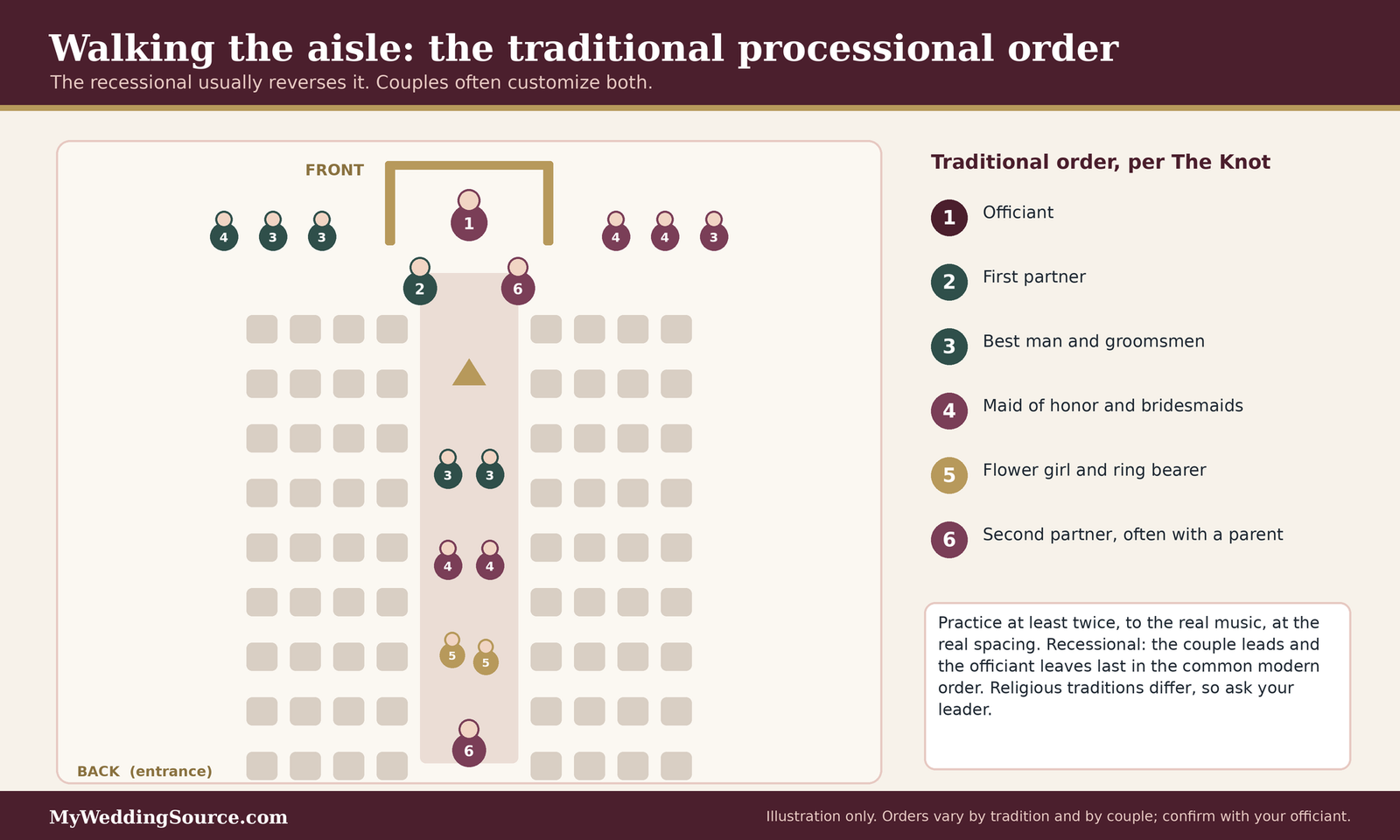
Done when: each person knows who walks before them, who walks after, and how far apart to start. The Knot lists a traditional order beginning with the officiant, then the groom or first partner, best man and groomsmen, maid of honor and bridesmaids, flower girl and ring bearer, and the second partner last, often escorted by a parent, and it says couples often customize it. The DPNAK planner post says to space entrances so no one crowds the aisle and to walk to the music.
Decide the escort, the pace, and the handoff
Done when: the person escorting, if any, has been asked and has said yes, and the party has agreed on the pace, whether anyone pauses at the front, and who takes the bouquet. The affordable-venue blog suggests placeholder flowers to practice the hand-off, and Fierce Productions mentions practicing how to hand off flowers after walking down the aisle.
Practice with the actual music
Done when: the person who starts and stops the music has done it, and everyone knows whether the song ends or fades. Minted says to decide who starts and stops the music and whether the processional song finishes or fades. If a musician or DJ cannot attend, ask them for the length of each piece in writing.
The ceremony at the front
You do not need the full script. The affordable-venue blog says the officiant should give an overview of each part rather than performing it, and Emmaline Bride says the couple only practice the sequence and positioning.
Positions, posture, and microphones
Done when: each person has a mark, a posture, and a place to look. The affordable-venue blog suggests agreeing on bouquet height for bridesmaids and hand positions for groomsmen so photos look consistent. Fierce Productions lists checking the officiant’s microphone setup as part of the session, and Minted says readers should practice at the ceremony spot with a microphone, if one will be used, to adjust speed and volume.
Readings and cues
Done when: each reader knows when to stand, where to go, and who cues them. The DPNAK planner post suggests sharing readings in advance and keeping a large-print backup with the coordinator. Minted advises readers to bring a printed copy. If the couple want a reading kept secret, Fierce Productions suggests having the reader mark the position and improvise words to convey the idea.
Rings, license, and witnesses
Done when: the person who holds the rings knows when to hand them over, the ring box is in the right pocket, and the license plan is clear. Fierce Productions says participants only confirm who carries the rings and when they are needed, not actually putting them on. Emmaline Bride mentions the plan for signing the license after the ceremony. Ask your officiant who collects it and who the two witnesses are, subject to your state’s rules.
The recessional and the first five minutes afterward
The exit is where the energy of the room changes and where the party can bunch up.
Reverse the order and decide who leaves first
Done when: everyone knows the exit order and what happens at the end of the aisle. The Knot says the modern recessional is usually the couple, then the wedding party, then family, with the officiant last, and it notes religious variations for Catholic, Jewish, and Christian ceremonies. Our reading is that the safe rule is to ask your officiant or religious leader which order your tradition uses, and to practice that order, not a generic one.
Plan the pause, the line, and the photos
Done when: the couple know where to pause, if they plan a kiss or dip photo, and where everyone meets afterward. Fierce Productions suggests deciding in advance where to pause during the recessional. The DPNAK planner post describes explaining post-ceremony plans, including photo meeting spots and any exit items such as bubbles. If the plan includes a receiving line, confirm its location and where the party goes after the aisle, as the affordable-venue blog suggests.
The operational checklist
How to use the table
The table below turns the sections above into owners, dates, and tests. The Blocks column shows what cannot happen until the item is done. The dates are our recommendations, counted back from the wedding date, and they should shift to match your venue’s schedule.
| Task | Owner | Due | Done when | Blocks |
|---|---|---|---|---|
| Confirm the rehearsal date, time, and length with the venue | Couple | 8 to 10 weeks before | The venue has put the block in writing, including any fee | Invitations, dinner reservation |
| Choose who leads the session | Couple | 6 to 8 weeks before | The leader has agreed and has the ceremony outline | Agenda, notices |
| Set the processional order and pairings | Couple with officiant | 4 weeks before | A one-page order is shared with the leader | Cues, escort requests |
| Send readings to readers and the coordinator | Couple | 3 weeks before | Each reader confirms receipt; a large-print backup exists | Reading practice |
| Send the rehearsal notice with place, start time, and dress | Couple or coordinator | 3 to 4 weeks before | Every role-holder has replied | Travel plans, child care |
| Confirm music cues and the person operating them | Musician or DJ | 2 weeks before | Song lengths and the start and stop plan are written down | Processional run |
| Confirm license, witnesses, and who returns it | Officiant | 1 to 2 weeks before | The license is in hand and the plan for signing is clear | Recessional plan |
| Run the session and record changes | Leader | Day before | A marked-up order of events is photographed and shared | Wedding-day cue sheet |
| Send the final cue sheet | Coordinator or friend | Day before | Everyone with a role has the final version | Wedding-day arrival |
What the table leaves out
The table does not include travel, lodging, or the dinner, which depend on your guests and your budget. Add rows for anything that is unique to your ceremony, such as a cultural element, a musician’s sound check, or a child’s nap, and give each row an owner and a date.
What not to rehearse
Knowing what to leave alone saves time and protects the moments you want to feel fresh. Sources agree on a few things and are silent on others, and we keep those apart.
Elements most sources say to skip
Two of the vendor sources we read are explicit, and we have not found one that contradicts them.
Your real vows and the ring exchange
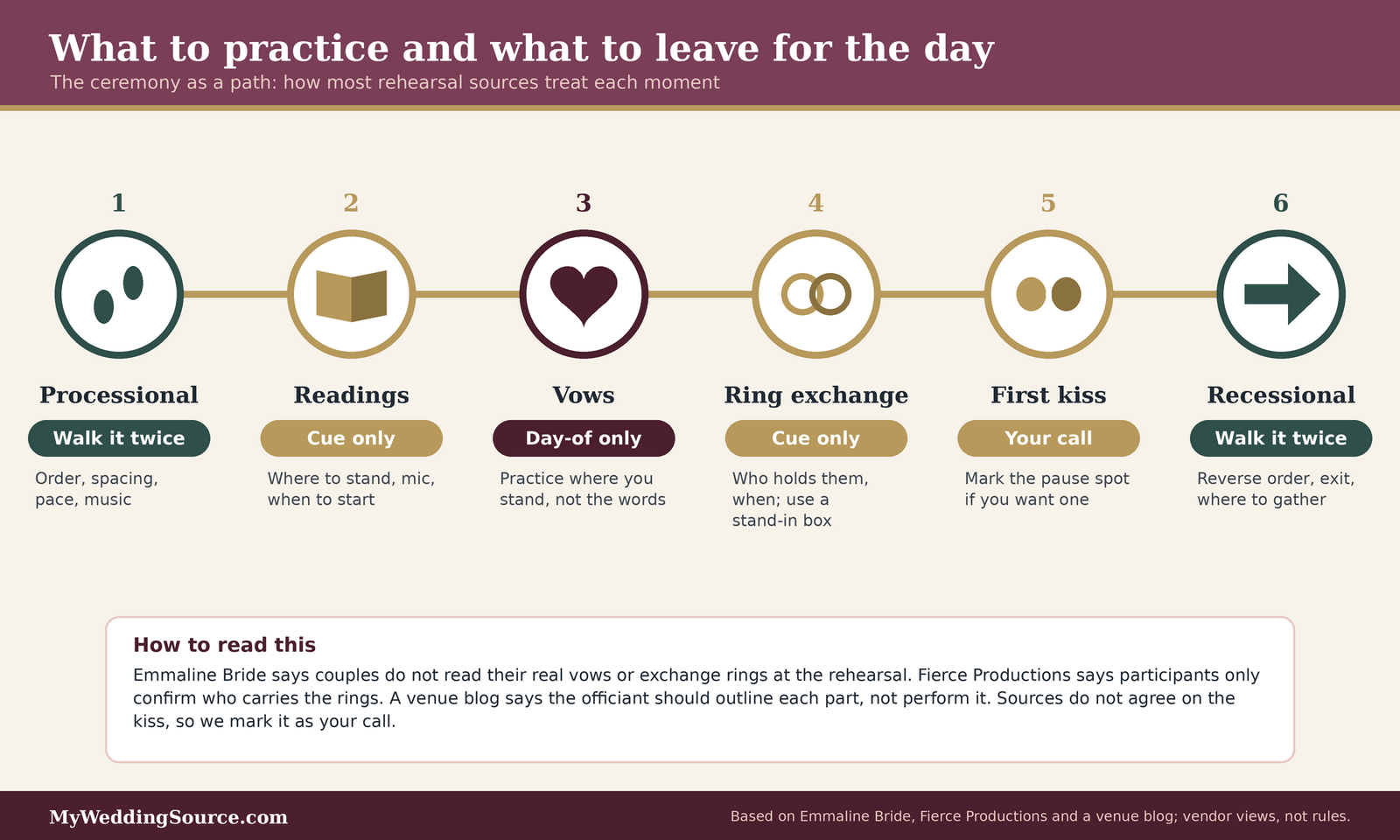
Emmaline Bride says the couple does not read their actual vows or exchange rings during the rehearsal and only practices the sequence and positioning. Fierce Productions says participants only confirm who carries the rings and when they are needed. If you want to feel your vows for the first time in front of your guests, the wedding rehearsal is the place to practice where you stand, not what you say. Our wedding vows guide covers writing, timing, and deciding what to keep private.
The officiant’s full script
The affordable-venue blog says the officiant should give an overview of each part and not perform the whole ceremony. That keeps the rehearsal short and spares the officiant’s voice. If your officiant has a long reading or ritual, ask for a one-sentence cue that signals when it ends, so the party knows when to move.
Elements that are a judgment call
For these, the sources give no consistent answer, so the choice is yours.
The first kiss and any dip or pause
We did not find a source that tells couples to skip or include the first kiss as a rule. Fierce Productions suggests deciding in advance where to pause in the recessional for a kiss or dip photo, which separates the logistics from the moment itself. A practical approach is to mark the spot and walk through without the kiss, if you want to keep it unrehearsed.
Surprise readings and personal moments
If a friend is reading something the couple has not heard, a full run-through can spoil it. Fierce Productions suggests marking positions and improvising words. Another option is to rehearse everything except that moment and tell the reader the timing in private, which keeps the surprise.
Elements that belong to other events
A wedding rehearsal is not the right place for everything that needs planning.
Reception moments, speeches, and dances
The Park Savoy Estate’s description of the wedding rehearsal focuses on the ceremony, and it mentions the reception only as the setting for an optional dinner afterward. Toasts, first dances, and the grand entrance belong in a conversation with your coordinator, DJ, or band. If you want to review those too, schedule a separate short meeting. Our wedding reception guide covers what to plan, and keeping it apart prevents a ceremony session from running long.
Dress, hair, and photos
The wedding party does not need to wear formal clothes. Minted says the couple sets the dress code, and The Park Savoy Estate notes that if a dinner follows, attire can match that venue. Comfortable shoes are worth requesting, and if bridesmaids will wear heels on the day, ask them to bring them for the walk. Our wedding party attire guide covers the choices that affect how the party moves.
Build the wedding rehearsal plan around deadlines and proof
A rehearsal fails quietly when a small item was never finished and nobody noticed. The fix is to count backward from the date and keep a record that shows each item is done.
Set the date each item must be true
Pick the wedding rehearsal date first, then attach every other date to it. Items that depend on other people need the longest lead.
Work backward from the venue and guest deadlines
Start with the venue, since it may have another event the day before, and Fierce Productions advises asking when you book whether the venue is available the day before, because there may be another event or a fee. Then count back: the rehearsal notice should reach participants early enough for work schedules and travel, as Minted advises. Zola says dinner invitations should go out at least four to six weeks ahead, and earlier for out-of-town guests who need lodging. We apply the same logic to the rehearsal notice, which is our recommendation.
Add a review date before each hard cutoff
For each hard date, add a review date a few days earlier. If the venue requires the final ceremony order a week out, review it two weeks out. If the music cue list is due to the DJ, ask yourself on the review date whether any song length has changed. This is a simple buffer, not a documented industry rule, and it works because it turns last-minute surprises into early questions.
Store evidence that each task is finished
The owner of each task should leave something you can look at. That is what turns “I think they know” into “I can see they know.”
Save contracts, confirmations, and receipts in one place
Create one shared folder or note with the venue’s written confirmation of the rehearsal block, the officiant’s agreement, any fee receipt, the musician’s cue list, and the dinner reservation. Put the contact numbers for every role-holder at the top. If you will have a coordinator, give them the same access. If the folder is the only place the final version lives, nobody will follow an outdated email.
Record the latest approved version of guest-facing information
The final processional order, the notice with the time and address, and the printed reading text should each have a version date. When something changes, save a new version and tell everyone, so the rehearsal does not run on last month’s plan. The DPNAK planner post recommends giving the coordinator or a large-print backup of each reading, and the same idea works for the order sheet.
Logistics, cost, and the venue conversation
A wedding rehearsal is mostly free in terms of fees, but the sources and our own reading point to a few places where money or space appears. We could not find a current national survey of rehearsal-specific fees, so the cost guidance here is about questions, not averages.
Ask the venue the right questions early
A venue may treat the rehearsal as part of the package, as an add-on, or as unavailable. The only way to know is to ask before you promise a date to your party.
Availability, fee, and time limit
Ask whether the space is open the day before and for how many minutes, whether a staff member will attend, whether there is a fee, and whether chairs, aisle runners, arches, and sound will be set up. If the venue offers only a short slot, use the planning method above to decide what to cut. Our wedding planning timeline shows where this conversation fits in the larger schedule.
What if the venue is not available
Fierce Productions suggests alternatives such as a backyard, a restaurant, or a hotel with enough space, and notes that some restaurants that host rehearsal dinners also host rehearsals. In that case, measure the real aisle at the ceremony site and mark it, so the group can walk the same distance. A rolled-out tape measure or a line of chairs is enough to simulate the walk.
Costs to expect and costs to question
Because we did not find a verified national figure, we describe cost categories and show our own arithmetic, with labeled assumptions.
Cost check
Possible costs around a wedding rehearsal include a venue fee for the extra block, a coordinator or officiant fee if the wedding rehearsal is not already in their package, rental of chairs or sound for the practice, and the rehearsal dinner itself. We found no verified national average for the first three, so ask each vendor for the figure in writing. Our own illustration, not a survey: if a vendor charges an hourly rate for an extra block and your session plus buffer runs 75 minutes instead of 60, you pay for the extra 15 minutes, or a quarter of an hour at that rate. Ask whether time is billed by the hour or the block before you decide how long to book. The Knot and Zola say the dinner is traditionally hosted by the groom’s family, though many couples pay or split costs. If your budget is tight, our wedding budget calculator can help you decide where a rehearsal block fits, and average wedding cost puts the wider spending picture in context.
Fees that deserve a question
The fee questions worth asking are whether the rehearsal is included in the venue or officiant package, whether it costs extra after hours, and whether cancellation or rescheduling changes the price. If you will hire a coordinator, ask whether the wedding rehearsal and the wedding day are billed together. If your insurance policy covers event changes, wedding insurance is the page that explains what to check, and a rehearsal itself is rarely the item at risk.
Cheap ways to rehearse well
A wedding rehearsal can be low cost. Bring placeholder flowers and an empty ring box, as the affordable-venue blog suggests, and use chairs to mark the aisle. Send readings in advance so you do not spend paid time on reading aloud. Keep socializing for the dinner.
A receiving line adds time somewhere else
The DPNAK planner post says to plan roughly 30 to 45 minutes for a receiving line with about 150 guests. Our arithmetic on that figure, which is an estimate, is that 30 to 45 minutes over 150 guests is about 12 to 18 seconds per guest, since 30 minutes is 1,800 seconds and 1,800 divided by 150 is 12.
Why this belongs in a rehearsal conversation
A receiving line changes the end of the ceremony, because the party stays near the exit and the photographer’s window may shrink. Settle whether you will have one, where it forms, and who stands in it, and confirm it with the venue.
What to do if you skip it
The DPNAK post says that without a receiving line, couples can thank guests personally during cocktail hour or the reception. Our wedding reception guide shows how to build time for that into the evening.
Special situations that change the wedding rehearsal
The default advice assumes a traditional ceremony at a single venue with a wedding party. Several common situations change the plan.
Religious, cultural, and multi-part ceremonies
If your ceremony follows a tradition you did not design, the leader of that tradition is the authority and the rehearsal should follow them.
Ask the religious leader first
The Knot’s recessional article describes different orders for Catholic, Jewish, and Christian ceremonies, and notes that Unitarian Universalist couples may recess in any order they choose. We take two things from that: tradition changes the order, and the leader should be consulted before the party practices a generic one. Ask whether the house of worship has its own rehearsal policy or fee.
Add time for unfamiliar elements
WeddingFrontier says unfamiliar customs lengthen a session. If part of your ceremony will be new to most of the party, such as a unity ritual or a multi-language reading, add time and give the party a short explanation in the notice. Our wedding ceremony guide covers how to structure these pieces.
Outdoor, destination, and unfamiliar sites
A new place raises questions that paper cannot answer: where the sun will be, how far the walk is, and whether the sound carries.
Test the weather plan
Walk the backup space too, if there is one. If the ceremony moves indoors in rain, the processional route, the music setup, and the seating all change, and the party needs to have seen it. If you will plan for weather, our garden wedding venues page explains what to ask about a rain location.
Plan for travel and late arrivals
For destination weddings, people may arrive the same day. WeddingFrontier suggests allowing leeway for guests traveling a long distance. If someone cannot attend, brief them privately at the venue on the wedding day, and give them a printed order and a buddy who will stand next to them.
Accessibility and comfort
A wedding rehearsal is the right time to catch problems with steps, surfaces, and distances.
Check the route for everyone in the processional
If anyone uses a mobility aid or tires easily, walk the real route with them, note where a seat or a shorter path helps, and tell the leader. WeddingFrontier notes that slower-moving attendees need extra time. Ask them what they need instead of guessing.
Include quieter options
A nervous child, a shy reader, or someone with a sensory need may do better with a brief private run before the group arrives. This is our suggestion, based on the planner sources’ focus on keeping the group calm, and it costs five minutes.
Use the final-week handoff to move execution away from the couple
The week before the wedding is when small gaps become emergencies. The goal is to hand every task to someone who is not you.
Give helpers exact responsibilities
A helper with a vague job produces a vague result. Write each job as a sentence with a time and a place.
Name the person for each moment
Choose one person for each moment: the person who starts the music, the person who carries the rings, the person who cues the readers, the person who gathers the party, and the person who keeps the license. If you have a coordinator, they take most of these. If you do not, ask friends, and give each a card.
Write the cue sheet in one page
A one-page cue sheet lists the order of the processional, the readers and their cues, the ring holder, the recessional order, and the meeting place after the ceremony. Print copies, share a digital version, and mark the version date. The Knot’s ceremony-order article lists the elements you can use as a base, from processional to recessional.
The final-week table
How to use the handoff table
Use this table to check that each handoff has a contact, a time, proof, and a next step. The timings are our recommendations.
| Handoff | Contact | Timing | Proof it is done | If it is not |
|---|---|---|---|---|
| Venue confirms setup for the rehearsal | Venue coordinator | 7 days before | Written reply with time and room | Call the next business day; ask for a named backup |
| Rehearsal notice reconfirmed | Couple or coordinator | 5 to 7 days before | Every role-holder has replied | Phone anyone silent; ask a friend to reach them |
| Readings final | Each reader | 5 days before | Reader confirms the version and the cue | Send a large-print backup to the coordinator |
| Music cues final | DJ or musician | 3 days before | Cue list with song lengths | Name a second person to start the music |
| License and witnesses | Officiant | 3 days before | Officiant confirms the license is in hand | Ask the clerk’s office what to do |
| Rehearsal runs | Leader | Day before | Marked-up order photographed and shared | Share a text version tonight |
| Wedding-day cue sheet | Coordinator or friend | Day before | Printed copies at the ceremony site | Print a second set and give one to the officiant |
When a row is still open
If a row has no proof by its date, move it to the top of the list and give it one name. An open row is not a failure, but an open row nobody is watching is how the day-of cue sheet ends up with a gap.
Create escalation rules for exceptions
Decide in advance who can decide when something goes wrong. Otherwise the couple will be asked every question.
Set a first call and a second call
For every handoff, name a first person to call and a second one. A late reader calls the coordinator, then the couple’s designated friend. A missing musician calls the venue, then the backup playlist owner. Put both numbers on the cue sheet.
Decide what counts as an emergency
A reasonable line is anything that would delay the start or leave the officiant without a license. Everything else the helper decides without asking. Tell the helpers this at the rehearsal, so they know they are trusted.
Run a last-pass failure check
On the night after the wedding rehearsal, read the cue sheet once with fresh eyes and look for gaps.
Look for missing owners, times, and addresses
Check that each moment has a person, that each person has a time to arrive, and that the address includes the entrance and the parking, not just the street number. If you see “someone will,” replace it with a name.
Confirm the backup path
Check the plan for weather, travel, or a vendor running late. Who decides to move indoors, and by when? Who starts the music if the DJ is stuck in traffic? Write the answers on the cue sheet and tell the people involved.
Questions to ask before you book the rehearsal
- Is the space available the day before, for how long, and is there a fee?
- Will a venue coordinator or staff member attend, and what will they set up?
- Does our officiant lead rehearsals, and is that included in the price?
- Does our tradition or house of worship have its own rehearsal rules?
- Who starts and stops the music, and can that person attend?
- Where will the license be signed, and who are the two witnesses?
- What is our backup plan if the ceremony moves indoors?
Wedding rehearsal questions
The answers below are short, and they point back to the sections above for detail.
Who and when
Who should attend the wedding rehearsal?
People with a role in the ceremony: the couple, officiant, parents, wedding party, ushers, readers, child attendants, and any musician or coordinator. The Knot also lists close relatives such as grandparents and plus-ones of the wedding party as common guests. Invite everyone to the dinner if you like, but ask only role-holders to arrive for the working session.
When should the wedding rehearsal happen?
Most commonly the afternoon or evening before the ceremony, according to The Knot and Zola, though it can be a few days earlier or the morning of the wedding if the venue requires. Schedule it as close to the wedding as you can, so the order is fresh, and check the venue’s availability when you book.
Do we need a wedding rehearsal for a small ceremony?
Not always. One venue-and-vendor blog we read calls it optional and says experienced venues and houses of worship often run smoothly without one. A short walk-through with the officiant on arrival can be enough for a small ceremony, but a large party, children, or an unfamiliar site make a wedding rehearsal more useful.
Length and content
How long does a wedding rehearsal take?
Sources we read say about an hour, with some saying 30 to 45 minutes for a simple ceremony and one suggesting booking an hour and 15 minutes. Larger parties, readings, and unfamiliar customs add time. These are vendor and planner estimates, not survey averages, so book the longer block and finish early if you can.
What do you practice at a wedding rehearsal?
The processional, where everyone stands, the cues for readings and rings, the music start and stop, the recessional, and what happens right after the ceremony, such as the receiving line or photos. Most sources suggest running the processional and recessional twice. The officiant reviews the order without performing the whole script.
Do you say your vows at the wedding rehearsal?
Usually not. Emmaline Bride says couples do not read their actual vows or exchange rings, and only practice the sequence and positions. Fierce Productions says participants confirm who carries the rings and when. Some couples practice a short line to check the microphone, but the choice is yours and the legal rules vary by state.
People and money
Who runs the wedding rehearsal?
It varies. Emmaline Bride says the officiant typically runs it and recommends a day-of coordinator. Planner posts describe the planner leading, and one venue blog says a coordinator usually leads, then the officiant, or the couple at a do-it-yourself wedding. Ask your officiant and venue early, and name one calm person to lead if neither can.
Who pays for the wedding rehearsal and dinner?
The rehearsal itself usually costs little beyond any venue, officiant, or coordinator fee, so ask each in writing. The dinner is traditionally hosted by the groom’s family, according to The Knot and Zola, though many couples pay or split costs. We found no verified national cost figure, so treat any number as a vendor quote to confirm.
Your next steps
Decide the shape of the session
Pick the leader and the length
Choose one leader and book a block that fits your party size, using the planning method above. If you want help with the wider timeline, use our wedding planning checklist and wedding planning guide.
Send the notice
Send a notice with the place, start time, end time, dress, and what each person should bring. If you are also planning the dinner, cocktail attire can help you pick a dress code to share, and the main plan wedding page shows how the weekend fits together.
Make the handoff
Write the one-page cue sheet
List the order, the readers, the ring holder, the recessional, and the meeting place. Share it the day of the wedding rehearsal after you have marked up any changes, and give a copy to the officiant and coordinator.
Check the license plan
Ask your officiant who collects and returns the license and who the witnesses are, and confirm the rules with your clerk. Our wedding rings guide can help you plan who carries the rings.
Sources & methodology
How we built this guide
What we relied on
This guide combines one state’s public guidance for officiants, the ceremony-order and rehearsal articles from The Knot, Minted, and Zola, and rehearsal advice from planners, a venue, and a wedding blog. Where a statement comes from a vendor or planner, we say so, because vendor advice reflects the seller’s habits and services. The duration figures are reported ranges from these sources and not survey averages. The planning method, worked scenarios, and receiving-line arithmetic are our own estimates, with assumptions stated in the text.
What we did not do
We did not attend rehearsals, survey couples, or obtain fee quotes, and we found no verified national figure for rehearsal-specific fees. We did not give legal advice: marriage requirements differ by state, so confirm yours with the clerk who issues your license and with your officiant. Where sources disagreed, we said so instead of picking one.
Source list
Government and legal sources
- Maine Center for Disease Control and Prevention, Performing a Marriage Ceremony: https://www.maine.gov/dhhs/mecdc/sites/maine.gov.dhhs.mecdc/files/Performing-a-Marriage-Ceremony.pdf
Wedding publishers and planners
- The Knot, Wedding rehearsal basics: https://www.theknot.com/content/wedding-rehearsal-basics
- The Knot, Wedding ceremony order: https://www.theknot.com/content/wedding-ceremony-order
- The Knot, How the recessional works: https://www.theknot.com/content/how-does-the-recessional-work
- Minted, Wedding rehearsal guide: https://www.minted.com/wedding-ideas/wedding-rehearsal-guide
- Zola, Who to invite to a rehearsal dinner: https://www.zola.com/expert-advice/who-to-invite-to-a-rehearsal-dinner
- Zola, Rehearsal dinner etiquette: https://www.zola.com/expert-advice/rehearsal-dinner-etiquette
- Emmaline Bride, How to plan your wedding rehearsal: https://emmalinebride.com/?p=263632
Vendor, venue, and planner blogs
- WeddingFrontier, How long do wedding rehearsals take: https://weddingfrontier.com/?p=4514
- DPNAK Events, 12 steps to a smooth and efficient wedding rehearsal: https://dpnak.squarespace.com/blog/12-steps-to-a-smooth-and-efficient-wedding-rehearsal
- Fierce Productions, What to expect during the wedding rehearsal: https://laura-reitsma.squarespace.com/blog/what-to-expect-during-the-wedding-rehearsal
- Affordable Wedding Venues and Menus, Wedding rehearsal checklist: https://affordableweddingvenuesandmenus.com/blog/wedding-rehearsal-checklist
- The Park Savoy Estate, What happens during your wedding rehearsal: https://theparksavoy.com/what-happens-during-your-wedding-rehearsal/