

Wedding bouquet preservation is really three decisions made in a hurry: which method fits the flowers you carried, who will do the work, and how to keep the blooms alive long enough for any of it to start, so it helps to settle the first two before the wedding and handle the third in the first forty-eight hours.
Quick answer
Every route to a keepsake follows the same arc: keep the bouquet cool and in water, choose a method, then give the flowers weeks to dry. Pressing gives a flat picture, air drying and silica gel keep more shape, resin turns dried flowers into a solid object, and freeze-drying keeps the most natural form but is usually done by a studio. Home methods can cost little (The Knot lists $10 to $30 for silica gel), while professional work is quoted in the hundreds of dollars and can take months. If you want a studio to do it, book before the wedding and ask for its arrival deadline in writing.
This guide is organized around the choices in the order you face them: what you want the finished piece to be, how the main methods behave, what the first two weeks should look like, which flowers cooperate, how to do the home work with checkpoints, how to compare quotes from studios, and how to look after the result. Nothing here is a promise that a particular bouquet will survive a particular method. Flowers vary, and a good preservationist will say so.
Decide what wedding bouquet preservation should produce
Before comparing methods, decide what you want to hold in five years. That one answer eliminates most of the options, and it keeps you from paying for a result you would not have chosen. Wedding bouquet preservation covers everything from a few pressed petals in a book to a framed three-dimensional arrangement, and those are very different projects.
Pick the outcome before the wedding bouquet preservation method
People tend to start with a method they have heard of, such as resin or freeze-drying, and then try to make it fit. It works better the other way around. Name the finished object first, then see which methods can reach it.
Shape, color, or both in wedding bouquet preservation
Different methods protect different things. Zola’s guide to preserving flowers suggests choosing by what matters most to you: shape, color, or speed. By its account, sand, silica gel, wax, and glycerin hold shape well, while sand, wax, and freeze-drying hold color well. Pressing, by contrast, produces a flat result and does not keep the form of the bouquet. If the full, rounded look of the arrangement matters, that rules out pressing as your main method, though pressing a few individual blooms alongside is common.
Color also shifts with drying, even when the method is good. University of Florida extension guidance notes that pinks tend to turn redder, reds drift toward purple or blue, pure blues turn lavender, and yellows and oranges usually hold up well and can even intensify. Missouri extension adds that dark red, purple, and blue flowers can look nearly black after drying and that white flowers usually turn cream or tan. If your bouquet was soft ivory and blush, expect warmer, deeper tones, not a replica.
Display, wear, or keep in a box
Think about where the piece will live. A framed shadow box hangs on a wall. A resin block or paperweight sits on a shelf and survives handling. A small pressed piece can become an ornament or a locket, and The Knot’s list of professional products includes pressed keepsakes, resin pieces, and framed or three-dimensional displays. A bouquet kept only in a box in a closet needs a different kind of protection than one that will be seen daily, which is covered in the care section below.
A practical rule is to match fragility to handling. Freeze-dried flowers are delicate, and one vendor, For Keeps Florals, says they break easily and are best shown in shadow boxes. If a toddler, a cat, or frequent moves are part of your life, a sealed display or a solid resin piece may suit you better than an open arrangement.
Document the starting point for wedding bouquet preservation
You cannot control the bouquet after the wedding as easily as you can before it, so the best wedding bouquet preservation decisions start with a record of what you have.
Make a flower inventory
Ask your florist for a written list of every flower and greenery in the bouquet, including any filler, and note which were dyed, sprayed, or wired. Photograph the bouquet from the front, top, and side in even light before the day gets busy, ideally on a plain background. These photos do three jobs: they help a studio quote accurately, they help you check the finished piece against the original, and they are insurance if a package is lost or damaged.
Our wedding photographer shot list is a good place to add one line asking for a bouquet portrait, taken before the bouquet is passed around. Count the stems too. Many studios price by size or by the number of flowers, so a stem count turns a vague phone conversation into a comparable number later on.
Conditions that change wedding bouquet preservation results later
Three things set the ceiling on quality before anyone touches the flowers. The first is freshness: The Knot says fresher blooms preserve better, so the hours before refrigeration or water matter. The second is anything sprayed on the flowers. The Knot advises asking your florist whether preservatives were applied, since they can cause browning when flowers are pressed. The third is physical wear, such as the toss, heat in a car, or a long reception with the bouquet lying on a table in sun.
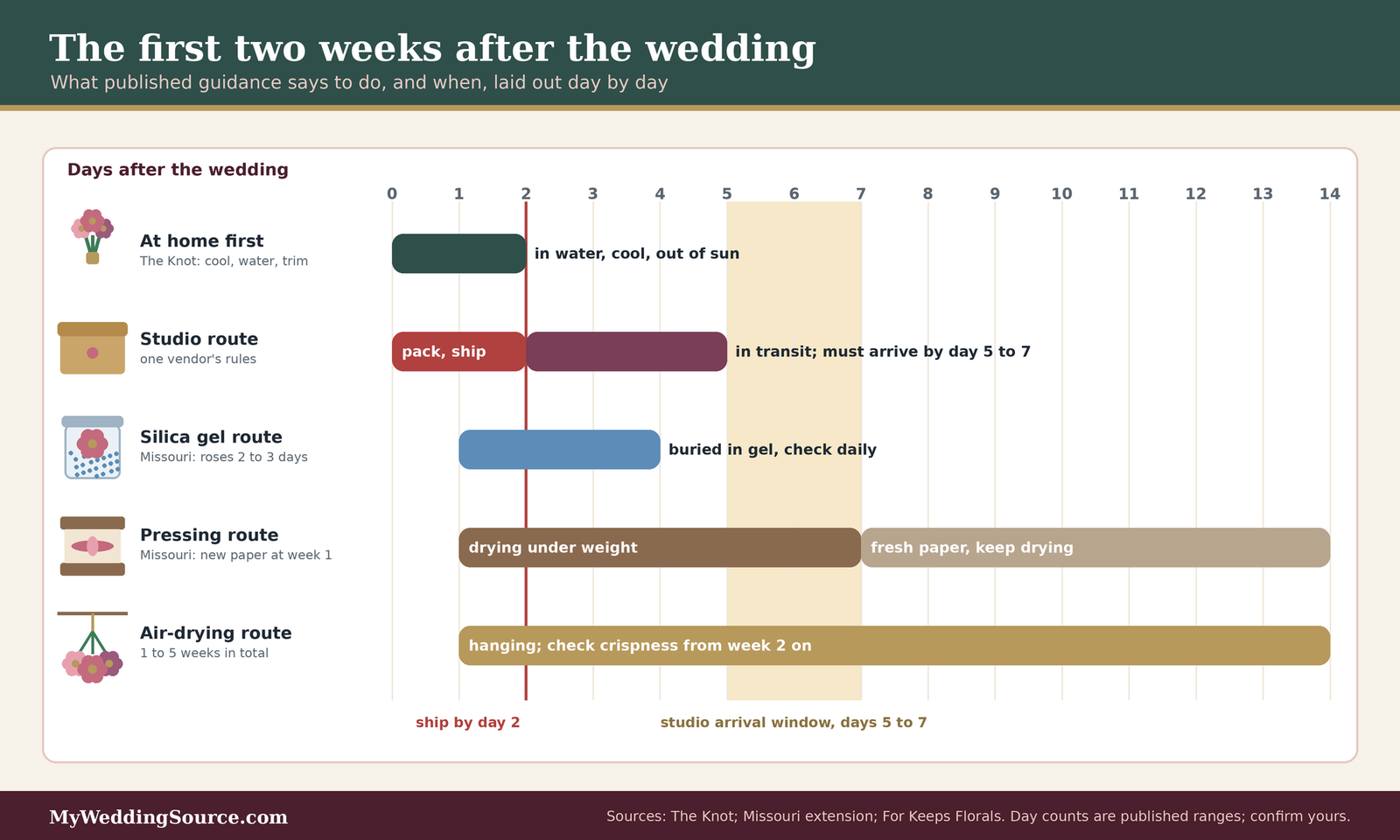
If a vendor will receive the bouquet, the clock is also set by their rules. For Keeps Florals, a pressed-flower studio, says flowers should arrive within five to seven days of the event and be shipped within two days. That is one vendor’s rule, not an industry standard, which is why you should ask each studio for its own.
Set the constraints early
Budget, calendar, and effort are the three constraints that decide wedding bouquet preservation methods. Write them down before you shop.
Budget and effort
Decide whether you want to spend money or time. A home project asks for materials and patience, not much cash, but it also asks you to act within days of the wedding when you may be traveling or exhausted. A studio asks for cash but shifts the labor. The cost section below gives published ranges, and our wedding budget calculator can hold a line for a keepsake so it does not become a surprise. For the larger money picture, see our guide on how to pay for a wedding.
Calendar and travel
Honeymoon travel can collide with preservation. If you leave the day after the wedding, someone else needs to keep the bouquet in water and ship it, or you need a method that begins the same day. The planning timeline below shows how to hand the job to a named person. If you are mapping the whole event, our wedding planning timeline shows where a small task like this fits.
How the main wedding bouquet preservation methods compare
Six approaches cover almost everything couples actually do: pressing, air drying, desiccant drying (silica gel and similar), freeze-drying, resin, and wax or glycerin. They differ in how much shape they keep, how long they take, whether you can undo them, and how much specialist equipment they need.
Home methods for wedding bouquet preservation
The home methods use inexpensive materials and reward patience. They also share one rule: moisture is the enemy, both during drying and afterward.
Pressing
Pressing flattens flowers between absorbent paper under weight. Missouri extension recommends nonglossy paper such as newspaper, with fresh tissues swapped in after the first week, and notes that flat flowers like pansies press best while fleshy stems and very thin petals are poor candidates. Florida extension says foliage dries in about a week and flowers in about two, and also warns that double or thick flowers may mold. Zola’s guide gives three to four weeks for pressing petals with a coffee filter between heavy books.
Pressing suits a few chosen blooms, individual petals, or a frame of flattened flowers. It does not suit the whole bouquet if you want volume. It is also easy to reverse in the early stage, since you can lift a pressed flower and reposition it before it fully dries, but once flowers are glued to a mat, they are not coming off cleanly.
Air drying
Air drying keeps more shape than pressing and costs almost nothing. You bind small bunches, hang them upside down in a dark, dry, ventilated place, and wait. Published times vary: Missouri extension says two to three weeks, Nebraska extension says three to five weeks, and Florida extension says one to three weeks depending on how thick the stems and foliage are. Those differences are mostly about the plant material and the room.
The trade-off is color. Zola says air drying loses color compared with other methods, and The Knot says it mostly keeps shape but fades color. The Nebraska and Missouri lists of flowers that air dry well lean toward everlastings such as strawflower, statice, baby’s breath, yarrow, and globe amaranth, which are not what many bouquets are made of. Roses and peonies air dry less predictably.
Silica gel and other desiccants
Burying flowers in a drying agent removes water quickly while the petals stay supported, which is why it keeps both shape and color better than hanging. Nebraska extension calls silica gel the best granular desiccant and says it is sold at most craft stores and can be reused. Missouri extension says it is the most satisfactory choice for home use and gives drying times by flower, from about one day for daylily and yarrow to two to three days for roses, peonies, and zinnias, and four to five days for hyacinth. Nebraska’s guidance runs longer, one to three weeks, so treat all of these as ranges and check the flower instead of the calendar.
You need an airtight container, a base layer of gel about one to two inches deep, and stems cut short, since Nebraska extension says to cut them to about an inch and replace them with florist’s wire afterward. Gel that turns from blue to pink is saturated; both sources describe drying it in an oven to restore it, with slightly different settings, so follow the instructions on your own product. Florida extension also lists cheaper borax-and-cornmeal mixtures and sand as alternatives, which dry more slowly.
Microwaving in desiccant is the fast version. Extension tables put dense flowers at roughly one to three minutes, followed by a long rest in the gel, anywhere from ten to thirty-six hours depending on the flower. Florida extension says to use microwave-safe containers, never metal, and to keep a cup of water in the oven. Microwaves vary, so test on a spare flower before using a wedding bloom.
Professional and specialty wedding bouquet preservation methods
These methods either need equipment you probably do not own or lock the flowers into a finished object.
Freeze-drying
Freeze-drying freezes the flowers and then removes the ice under vacuum so it turns directly to vapor. One vendor, For Keeps Florals, describes it as keeping cell structure and color, and says the process can take several days depending on equipment and flower type. Both Zola and Florida extension describe it as the closest to the original look, and both point out that it usually requires professional equipment. Zola advises keeping the bouquet in water after the wedding until it reaches the florist.
Freeze-dried flowers remain fragile and must stay away from moisture and light. The same vendor says they can last many years under those conditions. That is a vendor claim, not an independent test, so treat it as the best case. Quoted turnarounds in the sources we found range widely: a consumer-cost site says freeze-drying alone can take up to twelve weeks and the full process twelve to sixteen weeks, while The Knot says timelines range from weeks to about six months.
Resin
Resin casting encases flowers in clear epoxy. The Knot says resin hardens in about twenty-four hours in the mold and that flowers are dried first, and Zola gives about three days and advises stirring slowly to avoid bubbles and using a non-metallic cup. The Knot suggests practicing on flowers that are not from the wedding first. Resin turns a delicate bouquet into a durable object, but the choice is close to irreversible: once flowers are in cured epoxy, the flowers cannot be repositioned or taken out.
Resin needs real precautions, covered in its own section below. For many couples the sensible split is to dry the flowers at home, then commission the casting from a professional who works with resin every week.
Wax and glycerin
Wax dipping and glycerin are lesser-used. The Knot says dipping in paraffin keeps shape and color but lasts only about six months. Zola describes dipping at about 130 degrees Fahrenheit and warns that bubbles mean the wax is too hot. Glycerin involves stems taking up a glycerin and water solution over two to three weeks, per Florida and Zola, and Zola says it can darken leaves and stems. These suit a short-term display or a hobbyist, not an heirloom plan.
Reading the comparison
The table below pulls the published wedding bouquet preservation guidance into one place. The ranges come from the university extension and vendor sources named in each cell, they overlap because the sources disagree, and they describe flowers dried under good conditions.

| Method | What it keeps | Typical published time | Reversible? | Best suited to | Consider a pro when |
|---|---|---|---|---|---|
| Pressing | Color of flat flowers, not volume | 1 to 4 weeks | Yes until glued down | A few chosen blooms or petals in a frame | You want a large, even composition |
| Air drying | Shape, with faded color | 1 to 5 weeks | Yes | Sturdy everlastings and small bunches | You want color retained |
| Silica gel or desiccant | Shape and color, best of the home methods | About 1 day to 3 weeks, by flower and source | Yes | Roses, peonies, zinnias, daisy types | Flowers are numerous or thick |
| Freeze-drying | Most natural shape and color | Studio quotes run weeks to months | Not at home | A full bouquet kept three-dimensional | Almost always |
| Resin | Dried flowers sealed in a solid | Cure of about 1 to 3 days after drying | No | Durable keepsakes and gifts | You have not cast before |
| Wax or glycerin | Shape and color for a time | Minutes (wax), 2 to 3 weeks (glycerin) | Partly | Short-term display | You want an heirloom |
How to use the table
Start with the right-hand columns. If the bouquet is large and made of thick flowers such as peonies and garden roses, a professional route is likely to be more reliable than a home method. If you carried a small hand-tied cluster of sturdy flowers, a home method may be enough. The table gives you a shortlist, not a verdict.
What the table leaves out
No source we found tested methods against one another on the same bouquet, so there is no ranking of quality here, only reported behavior. Cost, which is covered separately, and the willingness to wait are the two things that most often decide between two workable options.
A wedding bouquet preservation timeline from booking to anniversary
Timing is where most plans succeed or fail, because the early steps are small and the deadline is set by flowers that wilt. The sequence below is built from the vendor and extension guidance we found, with our own scheduling suggestions labeled as suggestions.
Before the wedding
The most useful wedding bouquet preservation work happens before the bouquet exists.
Book the studio or gather supplies
If you want a studio, contact it while you are still planning flowers, because wedding bouquet preservation slots can fill. The Knot says to plan for preservation in your budget and notes that timelines range from weeks to about six months. Ask whether the studio accepts shipped flowers or only local drop-off, whether it sends a shipping kit ahead of time, and what its arrival window is. If you plan a home method, buy the silica gel, a lidded container, and florist’s wire in advance, and test the method on a few grocery-store flowers so the first attempt is not on your bouquet.
Tell your florist what you plan to do
Share your wedding bouquet preservation plan with your florist when you order. The florist can suggest flowers that dry well, skip sprays that may brown pressed petals, and place the bouquet in water and a cooler after photos. Our guide to seasonal wedding flowers explains which blooms are in season when you marry, and the florist can say how those particular flowers tend to behave when dried. If your florist offers a second, smaller bouquet or a toss bouquet, that spares the main one a rough night.
The first forty-eight hours
The first two days decide how much a studio or a home method has to work with.
Cool, hydrate, and separate
The Knot’s checklist for right after the wedding is short and practical. Keep the bouquet cool and out of direct sun, have a helper remove ribbons and pins, cut about half an inch off each stem on a diagonal, and set the stems in cool, fresh water that is changed daily. It also advises separating the blooms by type, since each type may call for a different technique. Zola’s guidance for freeze-drying agrees on the main point, which is to keep the bouquet in water until it reaches the florist.
As a suggestion, not a sourced rule: assign this job to a specific person, give them a vase and a written note, and make sure they know where the bouquet is at the end of the night. A bouquet left on a reception table is the most common way the plan fails. Our wedding reception guide covers how to hand off belongings at the end of the night.
Skip the toss, or swap in a stand-in
The Knot recommends skipping the toss or using an artificial bouquet, because tossing can damage the flowers. If the toss matters to you, the stand-in solves the problem, and our wedding ceremony and reception guides can help you decide where that moment fits.
The weeks and months afterward
After the first days the work becomes a waiting game, and the waiting is where the calendar lengthens.
What published turnaround looks like
Turnarounds from the sources we found vary enormously, which is a reason to ask each vendor for its own number. For Keeps Florals, a pressed-flower studio, says the drying itself needs four to six weeks without interruption and that preservation takes eight to ten weeks, with orders shipping around twelve weeks. The Knot’s vendor list includes one studio delivering in sixteen to twenty weeks and another taking about six months for custom framed work. A consumer-cost site puts the full freeze-drying process at up to twelve to sixteen weeks.
For home methods, the published times are shorter: a few days to a few weeks for gel or air drying, then a settling period. The timeline graphic below lays out the first two weeks.
Build a buffer for your first anniversary
If you hope to have the piece by a particular date, such as a first anniversary or a family gathering, count backward from that date using the longest quoted turnaround and add a few weeks. Studios can be backlogged after peak wedding months. That buffer is our suggestion, but it follows from the very wide range of published turnarounds. Add the date to your wedding planning checklist so it does not vanish after the honeymoon.
Scheduling rules of thumb
A few wedding bouquet preservation rules cut across all the methods.
Work backward from the vendor’s deadline
Take the vendor’s arrival window, subtract the shipping time, and you get the latest day the box can leave your hands. For example, if a studio asks for flowers to arrive within seven days and ground shipping takes three, the box must leave within four days, and the vendor in our example also wants flowers shipped within two days of the event. Those numbers are illustrative arithmetic based on one vendor’s published rules, so confirm yours.
Keep one name and one date
Write the studio’s name, the order number, and the expected completion date in one note shared with your keeper and your partner. When a wedding bouquet preservation project goes quiet for two months, you will want the date you were promised.
Choosing flowers and florists with wedding bouquet preservation in mind
Not every flower dries well, and the bouquet you already ordered may be a mix of easy and difficult blooms. Knowing which is which helps you set expectations or, if you are still ordering, adjust.
Flowers that tend to cooperate with wedding bouquet preservation
Extension guidance gives usable lists, though every list assumes flowers in good condition.
Sturdy and low-moisture blooms
Nebraska extension lists strawflower, statice, baby’s breath, yarrow, pampas grass, bells of Ireland, larkspur, and globe amaranth as good air-drying candidates, and rose, zinnia, marigold, pansy, dahlia, cosmos, calendula, and others as good desiccant candidates. Zola adds eucalyptus, lavender, hydrangea, celosia, chrysanthemum, rosebuds, gomphrena, and sunflowers, and says flowers with tight petal patterns hold up best and that blooms should be nearly fully open but not past full bloom. Florida extension says to pick flowers just before full bloom, which is a different timing for a different purpose, so pay attention to which advice applies when you start from a bouquet that was cut for a wedding.
Roses and peonies
Roses are the classic bridal flower and dry well in desiccant. Missouri extension puts roses, peonies, and zinnias at two to three days in silica gel, and Florida’s microwave table lists roses at 2.5 minutes with overnight standing and peonies at three minutes with a long rest of up to thirty-six hours. Peonies, though, are large and thick, and Florida’s guidance notes that double or thick flowers may mold when pressed. For a peony-heavy bouquet, gel or a professional freeze-drying studio is the safer plan than pressing.
Flowers that are harder to preserve
Some flowers come with a warning in the wedding bouquet preservation guidance. It is worth knowing before the wedding, not after.
Thin, fleshy, or shedding flowers
Missouri extension says poppies are unsuitable because they shed petals, and that pressing is poor for fleshy stems and very thin petals. Thick-petaled flowers also do not work well with microwave drying. If your bouquet includes such flowers, you can still preserve them in a professional’s hands, but ask the studio how it treats them, and consider drying the sturdier stems at home and photographing the rest.
Color surprises
Whites that turn cream, reds that darken, and blues that shift to lavender are common outcomes in the extension guidance. If a specific color matters, such as a blue ribbon or a particular blush, ask the studio to show finished examples of that color, not just their best work. Treat drying as a change in color, not a failure.
Working with your florist
On wedding bouquet preservation, the florist is the person who sees your bouquet before anyone else.
Ask about sprays, dyes, and wire
The Knot advises asking whether preservatives were sprayed on the bouquet. Add dyes, glitter, and floral paint to that question, since they can interfere with drying or with the studio’s process. Ask also whether the stems are wired, because a wired bouquet needs to be taken apart differently and a studio may want to know. We found no source that tests these effects directly, so treat the questions as precautions.
Hand-tied or cascading
A tight hand-tied bouquet is easier to hang and to reconstruct than a large cascade, and a smaller bouquet generally costs less to preserve by a studio that prices by size. That is our reasoning and not a sourced rule, but it is worth a question to your florist when you are choosing between shapes. Our wedding decor guide covers how other flowers can be planned for the day and perhaps set aside for preservation too.
A step-by-step home method for wedding bouquet preservation, with checkpoints
If you decide to handle wedding bouquet preservation yourself, treat it as a process of small checks, because each stage has a way to tell you whether it is working. This section follows silica gel, the best-documented home method, with notes where other methods differ.
Break the wedding bouquet preservation job into reversible steps
Do first the steps you can undo, and delay the ones you cannot.
Verify before you cut anything
Once stems are cut, you cannot lengthen them, and once you take a bouquet apart, you cannot put it back together exactly as the florist made it. Before disassembling, confirm four things: the flowers are fresh and in water, you have the container and gel ready, you have photographed the bouquet from several angles, and you know which blooms you will keep. Only then cut.
Photograph and record before changes
Take photos before untying, after untying, and when each bloom is laid out on a tray. Measure the diameter of a few of the biggest blooms with a ruler and write the numbers down. When the dried flowers come out of the gel, you will compare against these numbers to see how much they shrank, and you will use the photos to rebuild the arrangement. This is our suggested method, and it costs five minutes.
Check each stage of wedding bouquet preservation
Silica gel and the other home methods give you clear signals, but only if you look for them.
Do not rely on one signal
Time alone is a poor guide, since published drying times differ by source and by flower. Missouri extension warns that flowers left in gel too long become brittle, and Nebraska extension says flowers are done when crisp and dry but not brittle, with the thick parts drying last. As our own suggestion, use three signals together: the calendar, the feel of the petals, and the weight of a test flower compared with its starting weight on a kitchen scale. If all three agree, the flower is probably done.
Test in the setting where it will live
A flower that feels dry in a warm kitchen may reabsorb moisture in a humid bathroom or a coastal home. Missouri extension says microwave-dried flowers absorb moisture from the air and need protection, and The Knot suggests sealing DIY pieces with floral preserving sealant or hairspray. Before you commit to an arrangement, leave one dried bloom in the room where the piece will be displayed for a week and see whether it softens.
The wedding bouquet preservation checkpoint table
The table below turns the process into stages with a measurement, a pass test, and a correction. The tests are practical heuristics based on the extension guidance, not laboratory standards, and the values should be adjusted to your flowers and your product’s instructions.
| Stage | What to check | Pass looks like | If it did not pass |
|---|---|---|---|
| Day of the wedding | Bouquet in cool water, out of sun | Stems standing in clean water, no heat exposure | Move to a cooler spot and change the water now |
| Day 1 to 2 | Blooms separated, stems trimmed, photos taken | Each bloom type on its own tray, with photos | Do not wait longer than a few days; start with the sturdiest blooms |
| Setup | Gel about 1 to 2 inches deep, container sealed | Lid fits snugly, gel is blue, not pink | Dry or replace pink gel following the product instructions |
| Burying | Flowers fully covered, face position correct | No petals touching each other or the container wall | Remove and reposition while the petals are still soft |
| Checking | Petal feel and weight | Crisp, not brittle, and lighter than the starting weight | Return to the gel for another day and check again |
| Removal | Gentle pour and brush | Gel falls away, petals intact | Pause and loosen the gel by hand; do not pull |
| Finishing | Wire stems, seal lightly, hold a week in the display room | No softening, no sticky petals | Re-dry in fresh gel and use less sealer |
Reading the table
The table is read left to right: do the check, compare to the pass description, and use the last column when it fails. The most common correction is more time in the gel, since flowers pulled early are the ones that soften later.
Adapting it to pressing or air drying
For pressing, replace the gel rows with a paper-changing row: swap in fresh paper after the first week, as Missouri extension advises, and check for mold on thick flowers. For air drying, replace them with a hanging row: check for crispness at two weeks and again at three to five.
Resin and wedding bouquet preservation: what to know first
Resin is the method most likely to be chosen for looks and the one most likely to be underestimated. It combines a craft process, chemicals, and an irreversible result.
What resin asks of the flowers in wedding bouquet preservation
Resin does not preserve fresh flowers. It seals ones that are already dry.
Dry first, then cast
The Knot describes dried flowers set in epoxy in a mold, and Zola says the flowers must be dried first. That means resin is a second step after silica gel or a professional drying. A studio that offers resin from fresh flowers is almost certainly drying them first, so ask how, and for how long.
Practice, bubbles, and cure time
The Knot suggests practicing on non-wedding flowers, and Zola advises stirring slowly to avoid bubbles and using a non-metallic cup. The published cure times are short, about twenty-four hours in the mold per The Knot and about three days per Zola. A resin maker’s guidance on full cure is longer, though: the WEST SYSTEM epoxy page says epoxy can take over two weeks at room temperature to cure fully, even when it feels sandable sooner. That page is for a boat-building epoxy, not craft resin, so read your own product’s instructions, but it is a reminder not to handle a piece early.
Safety when casting resin at home
Craft epoxy is a chemical product, and a bridal keepsake is not a reason to ignore its precautions.
Gloves, ventilation, and skin
The WEST SYSTEM guidance, which is manufacturer guidance for its own epoxy, recommends gloves, eye protection, and protective clothing as a minimum, adequate ventilation, and a waterless skin cleanser for resin on the skin and soap and warm water for hardener. It says never to use solvents on skin, and that if a reaction develops you should stop using the product and, if it persists, consult a physician. We are not giving medical advice, and your product’s safety data sheet is the authority for your resin.
When to hand it off
If you have never cast resin, if you do not have a ventilated workspace, or if you share your home with young children or pets, a professional caster is a reasonable choice. Many studios that dry flowers also cast them, and some resin artists work only from flowers you send. Ask about their process, the drying method, and what happens if a bubble or a defect appears.
Hiring a studio: how to compare wedding bouquet preservation quotes fairly
Wedding bouquet preservation quotes rarely line up. One includes a frame, another does not, a third prices by flower. A simple normalization method turns three confusing quotes into numbers you can compare.
Normalize every wedding bouquet preservation quote the same way
The method has four parts, and you can do it on a notepad in ten minutes.
Total landed cost
Add everything you will pay to hold the finished piece in your hands: the studio price, the frame or case if it is separate, shipping to the studio, return shipping, any insurance, and add-ons such as including an invitation or engraving a name. One consumer-cost site lists postage, optional insurance, adding invitations or photos, and name engraving on a mat as common extras, with engraving at about $50. Those are one site’s examples from a page whose footer reads 2022, so use them as prompts for questions and not as prices.
Cost per flower and per week
Divide the landed cost by your stem count, then divide again by the quoted turnaround in weeks. You will not use these numbers to pick the cheapest option, but they will show you when a quote is high for what it includes. A quote that is cheaper per flower but takes twice as long may suit you less than one that costs a little more.
A worked scenario
This scenario is illustrative arithmetic, built from published prices at two different vendors, and it does not describe any real quote you will receive.
Two quotes for the same bouquet
Imagine a bouquet with thirty flowers, and two quotes. Studio A freeze-dries and charges per flower. A consumer-cost site cites one vendor at about $9 a flower, so 30 flowers is about $270. A display case is extra, and the same site says cases cost $100 or more, which brings the subtotal to about $370. Shipping from a pressed-flower studio’s page is typically $30 to $70, so landed cost is about $400 to $440. Studio B presses and frames. The For Keeps Florals page lists square frames from $300, and with the same shipping range the landed cost is about $330 to $370.
What the numbers do and do not say
Studio A’s landed cost per flower is roughly $13 to $15, and Studio B’s is $11 to $12, but those figures say nothing about the result. A pressed frame is flat, and a freeze-dried piece keeps volume. The lower price also comes with the lower claim on three-dimensional shape. The normalization tells you what you are paying, and your answer to “what do I want to hold” tells you whether it is worth it. For a different bouquet size, rerun the arithmetic with your own stem count.
Read the terms, not just the price
Terms decide what happens when something goes wrong, which in wedding bouquet preservation is not rare.
Arrival windows and handling
Ask for the arrival window in days, the shipping method they recommend, and what happens if flowers arrive wilted. One studio’s FAQ says flowers must arrive within five to seven days of the event and that it uses two-to-three-day shipping if necessary, so a flight home from the honeymoon could put you outside the window. Ask whether they accept flowers kept in a cooler, and who is responsible for damage in transit.
Turnaround promises and delays
The Federal Trade Commission’s Mail, Internet, or Telephone Order Merchandise Rule applies to many orders placed by mail, phone, or online. In the agency’s business guidance, a seller needs a reasonable basis for any shipping time it states, and if a seller cannot ship on time it must offer you the choice to accept the delay or cancel for a full refund. Whether the rule covers a custom keepsake that is made to order is a legal question we cannot answer for your order, so ask the studio how it handles delays and get its policy in writing. This is general education and not legal advice.
Vendors who are not studios
Florists and independent artists also offer services.
Your florist
Some florists preserve bouquets or partner with a studio. The Knot suggests starting with a floral professional, who is usually familiar with preservation. A florist who made the bouquet knows its flowers, which can be an advantage, but ask to see finished examples, not only photographs of fresh work.
Independent artists
Resin artists, pressed-flower artists, and wedding painters take commissions, as The Knot’s list of vendors illustrates. Check how many bouquets they have preserved, whether they will work from your photographs if the flowers are not usable, and what they do when a bloom fails. Our wedding photography guide explains how to ask for work samples in a way that applies equally to a floral artist.
What wedding bouquet preservation costs
Costs span a wide range, and published ranges come from different sources with different methods. Treat each as one reference point.
What this actually costs
The Knot reports that couples spend an average of $2,700 on wedding flowers and that professional preservation averages $250 to $600, with basic pressing or drying at $150 to $250, framed or resin keepsakes at $300 to $500 or more, and custom shadow boxes or resin blocks at $700 to $1,000. A home silica gel project is listed at $10 to $30. These are published ranges from a site that does not state the year of its study, not quotes. Compare studios on total landed cost, not the headline price.
Published wedding bouquet preservation ranges
The ranges are broad because the products are different.
What The Knot reports
The Knot’s guide gives the figures in the box above and says about 63 percent of couples want to preserve flowers and other items, citing an internal study without a year. The page does not explain how the ranges were gathered, so they describe what a typical couple might expect to see, and individual studios may price well above or below them.
Other published figures
A consumer-cost site, with a 2022 copyright footer, lists freeze-drying at $215 to $450 for an average bouquet of up to 36 flowers, pressed frames from $50 to $350, and shadow boxes at $350 to $750 from florist averages. For Keeps Florals lists frames at $200 to $550 and a $80 add-on for flower sourcing. Zola’s guide gives a broader range of about $35 to over $1,000 for dried flower bouquets in general, which concerns dried bouquets as décor rather than preserving your own. These sources disagree at the edges, which is normal.

Where the money goes
Understanding the wedding bouquet preservation cost drivers helps you decide where to save.
Labor, equipment, and materials
Freeze-drying needs specialized equipment, and The Knot and Florida extension both point to that cost. Framing and glass raise the price of a display piece, and resin work depends on molds and casting time. Home methods shift cost from equipment to hours, and the materials are cheap.
Choosing where to economize
You can save money by keeping the scope smaller, such as a few key blooms instead of the whole bouquet, by choosing a smaller frame, or by drying the flowers at home and paying only for the framing or the resin casting. Our average wedding cost guide puts a keepsake like this in the context of the full budget.
Questions to ask before you commit to wedding bouquet preservation
Ask for the answers in writing and keep them with your order confirmation.
Questions worth asking a preservation studio
- Which method will you use for these flowers, and why?
- What is the arrival window, and what happens if the flowers arrive late or wilted?
- What exactly does the price include: frame, glass, shipping, insurance?
- How long will it take, and what happens if you miss that date?
- Can I see finished pieces made from the same kinds of flowers?
- What do you do if a bloom fails in drying?
- What are the care instructions, and is there any warranty?
About the process
These wedding bouquet preservation questions confirm what will happen to the bouquet.
Method and materials
Ask the studio to name the method, the glass or sealant used, and whether materials are archival. The Library of Congress guidance on framing works on paper describes preservation matting and UV-opaque acrylic glazing, and while a floral piece is not a paper document, those materials are good questions for any framed keepsake.
Substitutions and failures
Ask what happens if a flower does not survive. Some studios fill gaps with similar blooms from their own stock, and others will tell you which flowers failed. Ask which they do before you pay. A rule in the FTC’s business guidance says sellers cannot substitute materially different products without your agreement, though how that applies to a custom piece is a question for the seller or a lawyer.
About the terms
These questions decide who bears the risk.
Shipping and insurance
Ask who pays return shipping, whether the finished piece is insured in transit, and how to file a claim. A framed glass piece is breakable. If you hold wedding insurance, see our wedding insurance guide, but note that we are not aware of a source that says such policies cover preservation work, so ask your insurer directly.
Deposits and cancellation
Ask whether a deposit is required, when it is refundable, and what happens if your wedding date moves. For Keeps Florals says on its FAQ page that ordering reserves your date and does not require a pre-order, which is one vendor’s approach and not a rule.
Fixing problems and caring for the finished wedding bouquet preservation piece
Even careful wedding bouquet preservation can come out different from what you pictured. Knowing which fixes are safe and which are not saves you from making a small problem permanent.
When the result is off
Start with the reversible fixes.
Safe adjustments
If dried flowers feel soft or sticky, return them to fresh gel, since extension guidance says moisture is what stops drying. If petals have fallen off, you can often glue them back onto the bloom with a small dab of clear craft glue, and if stems are loose, you can re-wire them. If color has faded unevenly, photograph the flowers and consider leaving that bloom out of the display. These are our practical suggestions and not sourced steps, so test on a spare flower first.
Fixes that cannot be undone
Spraying sealant, gluing flowers to a mat, trimming wired stems, and casting in resin cannot be taken back. Do these last, after you have lived with the dried flowers for a week and checked that they are stable. If something goes wrong after a professional has done the work, ask the studio before you try to repair it yourself, since repairs can void a warranty.
Record the final wedding bouquet preservation specifications
A short record helps you or a future owner care for the piece.
Save what you will need
Keep the studio name and contact, the order number, the date, the method, the materials, the dimensions, and a photo of the finished piece. For a home project, add the flower list, the drying dates, and the sealer you used. Keep the record with your marriage documents, or in a note you will find in ten years. If you also keep a planning binder, our wedding planning guide covers how to organize one.
Note resizing and replacement options
Dried flowers cannot be resized, but a frame can be re-matted, and a studio may be able to replace a damaged flower. Ask when you collect the piece whether the studio offers repairs and what they cost.
Care and storage
Wedding bouquet preservation is not permanent, and the guidance is consistent on what harms them.
Light, moisture, and heat
The Northeast Document Conservation Center explains that light damage is cumulative and cannot be undone, that visible light causes fading and ultraviolet radiation causes bleaching and yellowing, and that no organic object should be on permanent display. Dried flowers are not documents, but the logic carries over: keep a frame out of direct sun, away from radiators and vents, and on an interior wall, as the Library of Congress advises for framed paper. Florida extension also warns that dried plant materials are highly flammable, and Missouri extension says dried flowers are not permanent and fade over time.
Insects and dust
Missouri extension warns that insects such as museum beetles and silverfish can destroy dried flowers, and advises storing them in tightly sealed containers and checking periodically. Zola’s guide suggests dusting with a dry cloth. If you keep a bouquet in a box, check it once or twice a year, and consider including a fresh silica gel packet.
Rotating the display
An idea borrowed from museum practice is to rotate a piece on and off the wall.
A simple rotation
The NEDCC leaflet recommends limiting display time for light-sensitive materials. Applying that to a keepsake, as our own suggestion, you could display the piece for part of the year and store it in the dark for the rest, perhaps hanging it around your anniversary. This is optional, and a piece that is loved on the wall may be worth the slow fading.
When to let go
Eventually any dried bouquet will crumble or fade. Some couples photograph the piece professionally at its best and then retire it, or reuse the frame for a photograph. That is a personal decision, and the photograph preserves what you wanted to remember.
FAQ: wedding bouquet preservation questions
Timing and flowers
How soon after the wedding should wedding bouquet preservation start?
Start immediately. The Knot says fresher blooms preserve better and advises keeping the bouquet cool, in fresh water, with stems trimmed. One pressed-flower studio asks for arrival within five to seven days, so confirm your own deadline. For home methods, the same day or next morning is a sensible target.
Can I preserve a bouquet after it has already wilted?
Results will be limited. Studios and extension guides assume reasonably fresh flowers, and The Knot says fresher blooms preserve better. Slightly tired blooms can sometimes still be dried or pressed, but expect less color and shape. Ask a studio to assess photographs before you pay, and be prepared for a smaller piece.
Which flowers are hardest to preserve?
Missouri extension says poppies shed petals, and that fleshy stems and very thin petals press poorly. Florida extension says double or thick flowers may mold when pressed. Dark colors can look nearly black and whites turn cream. A studio can tell you how it handles your specific flowers.
Methods and results
Which method keeps the most natural look?
Zola and Florida extension both describe freeze-drying as closest to the original look, and both say it is usually done by professionals. Silica gel is the best-documented home method for keeping shape and color. Results still vary by flower, so ask a studio for finished examples that match your bouquet.
Is resin safe to do at home?
It can be done, but it needs precautions. Manufacturer guidance for epoxy recommends gloves, eye protection, protective clothing, and good ventilation, and says to stop using a product if a skin reaction develops. Read your resin’s safety sheet, and consider a professional if you have no ventilated space.
How long will a preserved bouquet last?
It depends on method and care. One freeze-drying vendor says its pieces can last many years away from moisture and sunlight, while Zola’s guide cites florists saying simple dried flowers last about a year. Wax dipping is described as lasting about six months. Light and humidity matter most.
Cost and hiring
How much does professional wedding bouquet preservation cost?
The Knot reports an average of $250 to $600 for professional preservation, with custom shadow boxes or resin blocks at $700 to $1,000, though it does not state the year of its figures. Other published ranges differ. Get written quotes, and compare total landed cost including shipping and frames before deciding.
Should I book wedding bouquet preservation before the wedding?
It is wise, though not always required. The Knot says to budget and check timelines in advance, and one studio’s FAQ says ordering reserves your date without a pre-order. Booking early lets you confirm the arrival window, receive any shipping kit, and name someone to handle the bouquet.
Your next steps
Before the wedding
Decide the outcome and the wedding bouquet preservation method
Write one sentence describing the finished piece, then use the comparison table to shortlist one method and one backup. If you want a studio, ask two of them for written quotes using the landed-cost method above.
Brief your florist and your keeper
Tell your florist about your plan, ask about sprays and wire, and name one person to put the bouquet in water and a cooler after photos. Add the studio’s arrival deadline to your wedding planning checklist.
After the wedding
Run the first forty-eight hours of wedding bouquet preservation
Keep the bouquet cool, trim the stems, change the water, separate the blooms, and photograph them. Then either box the flowers for the studio or start the gel.
Record and care for the result
Save the order details, keep the piece out of direct sun, and check it once or twice a year. If you are still shaping the wider plan, our wedding planning guide and seasonal wedding flowers guide are good next reads.
For a closer look, read Wedding Arch Ideas: Styles, Sizing, Wind Safety and Real Costs.
Sources & methodology
How we built this guide
What we relied on
This guide combines university extension publications on drying flowers, published guidance from The Knot and Zola, vendor pages from preservation studios, manufacturer safety guidance for epoxy, the Federal Trade Commission’s business guidance on mail-order shipping, and conservation guidance on light and framing. Where a statement comes from a vendor or a consumer-cost site, we say so, because those sources reflect what sellers offer and do not test outcomes. The worked scenario is our own arithmetic from published prices and is illustrative.
What we did not do
We did not preserve bouquets, test methods against each other, or obtain quotes from studios, and we found no independent tests comparing methods. The Knot’s cost figures and study share are undated on the page we read, and the consumer-cost site shows a 2022 copyright. Prices, turnaround times, and policies change, so verify them with the studio. Nothing here is legal, medical, or financial advice; check your product’s safety sheet and your order terms.
Source list
Government, extension, and conservation sources
- Federal Trade Commission, Business Guide to the Mail, Internet, or Telephone Order Merchandise Rule: https://ftc.gov/business-guidance/resources/business-guide-ftcs-mail-internet-or-telephone-order-merchandise-rule
- University of Nebraska-Lincoln Extension, Guide to Drying Flowers: https://lancaster.unl.edu/guide-drying-flowers
- University of Missouri Extension, Drying Flowers (G6540): https://extension.missouri.edu/publications/g6540
- University of Florida IFAS Extension, Drying Flowers (EP004): https://ask.ifas.ufl.edu/publication/EP004/pdf
- Northeast Document Conservation Center, Preservation Leaflet 2.4, Light: https://www.nedcc.org/assets/media/documents/Preservation%20Leaflets/2_4_Light.pdf
- Library of Congress, Matting and Framing Works on Paper: https://www.loc.gov/preservation/care/mat.html
Wedding, vendor, and manufacturer sources
- The Knot, How to Preserve Your Bouquet: https://www.theknot.com/content/how-to-preserve-your-bouquet
- Zola, How to Preserve Wedding Flowers: https://www.zola.com/expert-advice/decor-inspiration/flowers/how-to-preserve-flowers
- Zola, Your Complete Guide to Dried Flower Bouquets: https://www.zola.com/expert-advice/your-complete-guide-to-dried-flower-bouquets
- For Keeps Florals, Frequently Asked Questions: https://forkeepsflorals.squarespace.com/faq
- For Keeps Florals, How to Freeze Dry Flowers for Bouquet Preservation: https://forkeepsflorals.squarespace.com/blog/how-to-freeze-dry-flowers-for-bouquet-preservation
- HowMuchIsIt, How Much Does Wedding Bouquet Preservation Cost: https://www.howmuchisit.org/?p=158
- WEST SYSTEM, General Epoxy Safety Guidelines: https://www.westsystem.com/safety/preventing-overexposure/