

Groomsmen rental returns are the least glamorous part of a wedding and one of the easiest places to lose money, because a short deadline, a stack of boxes, and six people in six different places meet on the Monday after the party, so this guide gives you a return plan, the real fee numbers each major rental company publishes, and a private survey that catches size and accessibility problems before anyone is standing in a fitting room or at a drop-off counter.
Quick answer
Most major tuxedo and suit rental companies we checked on November 12, 2026 ask for rentals back within about three days after the event, and several charge daily or flat late fees that add up fast across a group. The safest plan for groomsmen rental returns has four parts: write down your company’s exact deadline, choose one return day for everyone, have each person send a photo of the drop-off receipt, and ask each person about fit and access needs weeks ahead, not the week of the wedding. Policies change, so confirm every number with your own rental company in writing.
Why groomsmen rental returns go wrong after a good wedding
Most of the stress around groomsmen rental returns has nothing to do with the clothes. It comes from timing, distance, and unclear ownership of a small job nobody was assigned. Weddings end late, people travel home on Sunday, and a rental box that felt urgent on Thursday becomes background noise by Monday. Understanding the usual failure points makes the rest of this guide on groomsmen rental returns easier to use.
The pattern behind late and missing rentals
In groomsmen rental returns, late fees and missing-item charges rarely come from someone who meant to keep a rental. They come from small gaps that line up. Looking at those gaps before the wedding is cheaper than arguing about them afterward.
The deadline is shorter than people expect
Several companies we reviewed state a window of roughly three days after the event, and one states a window of forty-eight hours, as described later in this guide. Compare that with a typical wedding weekend: a late Saturday night, a Sunday brunch, flights on Sunday or Monday, and a return to work. A three-day window sounds generous until you notice that two of the days may fall on a travel day and a work day.
Nobody owns the job
A group order usually has an organizer who built the event, and individual members who each have their own account, size, address, and payment. When the return deadline arrives, each person assumes someone else is tracking it. A clear owner and a clear backup, named in writing before the wedding, solves most problems with groomsmen rental returns.
Small items disappear first
The pieces that get lost are rarely the jacket. A belt, a pair of cufflinks, a tie, or a shoe is often left in a hotel room, a car, or a gift bag. Replacement prices for small pieces can be higher than people assume, so the section on fees for groomsmen rental returns gives the published numbers.
What a good return process looks like
A reliable process for groomsmen rental returns is dull on purpose. It has one deadline everyone can see, one person who checks in, and proof that each box left the building. Good groomsmen rental returns also treat each person as a capable adult who may have a real reason a plan will not work, such as travel, a disability, or a tight budget.
One date, written down
Pick the actual last on-time day for your company, then choose an earlier target day for your group’s groomsmen rental returns. If the company allows three days after a Saturday wedding, make Monday your group target and keep Tuesday as the safety net. We explain how to calculate this in the planning section.
One check-in, one proof
For groomsmen rental returns, ask each person to send a photo of the drop-off receipt or tracking confirmation when they hand the package to the carrier. This is not about distrust. A photo protects the person who returned it correctly if a charge appears later.
How this guide is organized
This guide to groomsmen rental returns covers what companies publish, what the numbers mean for a group, how to plan shipping for people who live apart, and how to ask about fit and access before it becomes a problem. It is general information, not legal or financial advice, and it is based on public pages we read on the date shown in the sources section.
What is in here
You will find a side-by-side summary of five rental companies, worked examples of late-fee arithmetic, a return-day plan, an attire size and accessibility feedback survey with a message you can copy, edge cases, and questions to ask your rental company. For the wider picture of how rentals fit into a wedding party budget and calendar, see our guides to wedding party attire and wedding tuxedos.
What is not in here
We did not test any rental service, place an order, or speak with any company. Everything we say about a company’s rules comes from its own public pages, which can differ from your contract. Your signed or accepted rental agreement is the document that controls your order.
How the return clock works for common rental companies
The return clock is the single most important fact about groomsmen rental returns, and it starts earlier than the wedding. Companies tell you when to expect your box, when to try it on, and when to send it back. The table and notes below summarize what five companies state on their public pages. Each company can change terms at any time, and some pages we read contradict themselves, so comparing groomsmen rental returns across companies takes care, so treat every number as a starting point for a question, not a promise.
| Company | Stated return window | How to return | Where we found it |
|---|---|---|---|
| The Black Tux | 3 calendar days after the event (older orders placed before July 16, 2026 were described as 5 days) | Prepaid label, any FedEx location or Walgreens, or home pickup | Timeline guide and how-it-works guide |
| Generation Tux | 3 days after the event | Prepaid bag and label, carrier named on the label | Support FAQ and shipping policy |
| Menguin | 3 days after the event | Prepaid bag, UPS Store drop-off | Return page and support FAQ |
| Men’s Wearhouse and Jos. A. Bank | The day after the event | Store during regular hours, or the carrier location on the free shipping label | Rental terms and conditions |
| Friar Tux | 48 hours after the event | UPS return kit or a store location | Order terms |
Reading the table without over-trusting it
A summary table of groomsmen rental returns hides the small print. Windows are measured in different ways, such as calendar days, hours, or the day after, and the same company can describe a deadline differently on different pages. Your order confirmation and rental agreement outrank every summary.
Calendar days, hours, and the day after
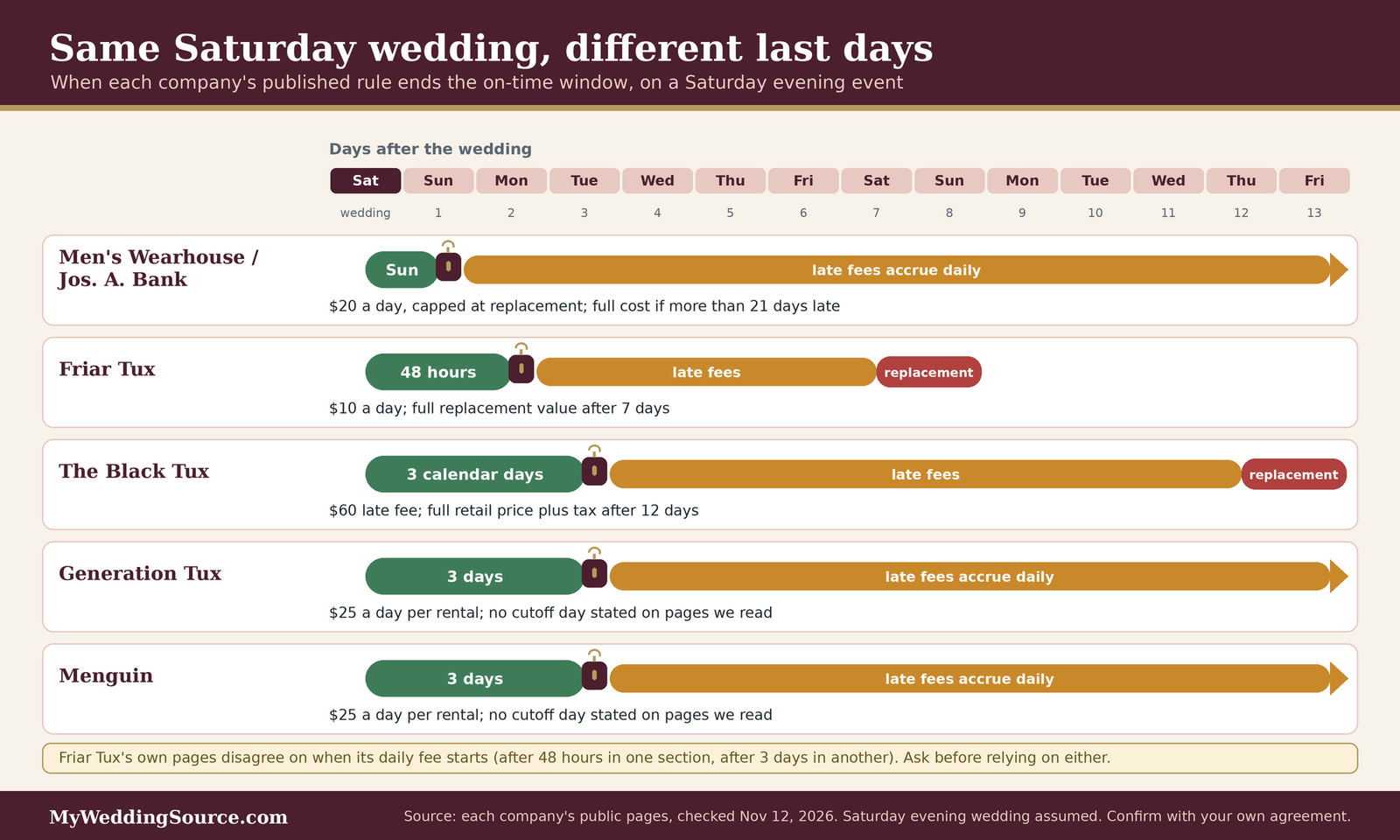
“Three calendar days” after a Saturday wedding lands on Tuesday. The Black Tux’s timeline guide states exactly that example, saying the package must be postmarked by Tuesday. “Forty-eight hours” after a Saturday evening wedding lands on Monday evening. “The day after the event” lands on Sunday. The same event date produces three different last days, which is why we recommend writing your own date instead of repeating a rule of thumb.
When a page disagrees with itself
Friar Tux’s order terms state a forty-eight-hour return window and a ten-dollar daily fee that begins after that window in one section, yet another section says the daily fee starts three days after the event. We cannot tell which statement controls. If your company has any contradiction like this, email and ask, and save the answer.
Timing that starts before the wedding
Groomsmen rental returns are easier when the earlier steps go smoothly, because a fit problem that is fixed early does not become a second shipment later.
Delivery windows and why they matter
Companies describe delivery in the days before the event. The Black Tux’s guide says a rental typically arrives about ten days before the event. Men’s Wearhouse says shipped rentals arrive about four days before the event. Generation Tux and Menguin ask you to choose a shipping address where the person will be fourteen days before the event. A person who receives a box four days before the wedding has far less time to swap a size than a person who receives it ten or fourteen days before.
Fit-check windows
Menguin and Generation Tux both ask customers to report fit problems within forty-eight hours of delivery, and The Black Tux’s guide describes the same forty-eight-hour window for a free replacement. This matters for returns because a replacement means a second box, and a second box is a second thing to send back.
Why one company’s rules should not be assumed for another
It is tempting to read one company’s policy for groomsmen rental returns and apply it to the others. The differences are large enough to cost real money.
Daily fees versus flat fees
Some companies charge per day per rental, and others charge a flat late fee in groomsmen rental returns, so a late return of the same length can cost very different amounts. The next section puts numbers on this.
Different carriers, different drop-off points
Menguin says returns must go through UPS and that using another carrier means you will not be reimbursed for shipping. Generation Tux says the same carrier handles its returns and that a different carrier means paying the extra shipping. The Black Tux names FedEx locations and Walgreens. If a groomsman lives where the named carrier is inconvenient, ask before the wedding, not after.
Late fees, damage fees, and replacement charges in plain numbers
Money is why groomsmen rental returns deserve a plan. A late fee on one rental is a nuisance, but the same fee across a group, or a replacement charge for one unreturned jacket, can reach hundreds of dollars. The figures below are what each company stated on its public pages on November 12, 2026. Our own arithmetic is labeled as an estimate.
What lateness can cost
Using only the rates each company publishes, five days past its own deadline costs about $125 per rental at Menguin or Generation Tux ($25 a day), $100 at Men’s Wearhouse ($20 a day, capped at the garment’s replacement cost), $50 at Friar Tux ($10 a day), and $60 at The Black Tux (a flat fee, which the company says keeps running). For a party of six, that is roughly $750, $600, $300, and $360 respectively. These are our estimates, they assume one rental per person, and they exclude damage charges, extension fees, and tax.
Late fees by company
Late fees are the most common charge in groomsmen rental returns and the easiest to avoid. They differ in structure more than in size, so the first question is whether your company charges a flat amount or a daily one.
Daily fees
Menguin and Generation Tux each state a late fee of twenty-five dollars per day for each rental kept longer than three days after the event. Men’s Wearhouse states twenty dollars per day, charged as a lump sum when the garments arrive, capped at the full replacement cost, with full replacement charged if a garment arrives more than twenty-one days late. Friar Tux states ten dollars per day.
Flat fees and paid extensions
The Black Tux states a sixty-dollar late fee, and it also sells extensions that must be requested before the return is due: fifteen dollars for one extra day, forty dollars for three extra days, and eighty dollars for seven extra days. Its guide says the full retail price plus tax is charged per item if the rental is still not returned after twelve days. If your group knows it will be late, an extension bought before the deadline is cheaper than the late fee.
Damage, cleaning, and handling fees
Wearing a rental to a wedding means normal wear, and groomsmen rental returns should treat it that way. Companies separate normal wear, which is included, from damage beyond repair, which is charged.
The damage waiver or handling fee
Generation Tux lists a twelve-dollar nonrefundable damage waiver covering inspection, minor repairs, and cleaning from normal use. Menguin lists ten dollars for the same purpose. Men’s Wearhouse states a mandatory nonrefundable twelve-dollar damage and handling fee per order. For six outfits, a twelve-dollar fee is seventy-two dollars, which is our estimate and should be checked against whether the fee applies per order or per person.
Damage beyond repair
Both Generation Tux and Menguin say garments they can restore in-house are repaired free, and that garments damaged beyond repair may incur a replacement fee assessed by the returns department. Men’s Wearhouse says damage beyond minor repair is charged at full replacement cost at the company’s sole discretion. Friar Tux says returned items are scanned and inspected, and missing or excessively damaged items are billed at replacement cost. Because the line between normal wear and damage is the company’s call, ask how it defines normal wear before you rent.
Replacement prices for lost or unreturned items
Replacement prices matter because they are the ceiling on what one forgotten item can cost. They are also where the companies differ the most.
| Item | Generation Tux | Menguin | Men’s Wearhouse (examples) | Friar Tux |
|---|---|---|---|---|
| Jacket or coat | 600 | 600 | 200 to 290 | 250 |
| Pants | 200 | 200 | 70 | 100 |
| Vest | 150 | 150 | 60 to 75 | 70 |
| Shirt | 100 | 100 | 25 | 49.95 |
| Tie | 50 | 100 | not listed in our summary | 25 |
| Cummerbund | 50 | 100 | 20 | not listed |
| Shoes | 200 | 200 | 50 | 50 |
| Belt | 100 | 100 | not listed | not listed |
| Cufflinks and studs | 50 | 50 | not listed | not listed |
Adding up a full outfit
Adding every item in the Menguin column gives sixteen hundred dollars for a complete outfit, and the Generation Tux column gives fifteen hundred. Those totals are our estimates and assume every piece is lost, which is unlikely, but they show why the jacket and shoes matter more than a tie. Adding the Men’s Wearhouse examples for a jacket, pants, vest, cummerbund, shirt, and shoes gives roughly $425 to $530, and the Friar Tux items listed for a coat, pants, vest, shoes, shirt, and tie come to about $545.
What lost in transit means
Menguin and Generation Tux both state that if you applied the label and handed the shipment to the carrier and it was then lost in transit, you are not charged. That makes the drop-off receipt valuable, because it is proof you did your part. Friar Tux states that once garments are picked up or marked delivered it no longer maintains responsibility for them, and that a replacement for a lost or stolen package costs the garment price plus shipping, so a box taken from a porch becomes the renter’s problem.

What the numbers say about group planning
A single late return is annoying, but groomsmen rental returns involve a whole group. A group where everyone assumes someone else is handling the job is expensive. This is where a plan for groomsmen rental returns pays for itself.
The group multiplier
Because most fees are per rental, the risk multiplies with party size. If a party of eight is each one day late at twenty-five dollars, that is two hundred dollars, which is our estimate. A single person who misses the deadline by a week at Menguin or Generation Tux owes about one hundred seventy-five dollars in daily fees on its own, before any other charge.
What the fee pages leave unsaid
None of the pages we read states how responsibility is divided if one member does not return a rental. Friar Tux says the event creator pre-selects items and each invitee provides measurements and payment, and Menguin says the organizer can pay for the whole group or for selected members, but neither says what happens if a paid-for member keeps a garment. Ask in writing, which the section on rental company questions covers.
Who is responsible when one groomsman does not return a rental
The hardest part of groomsmen rental returns is not the shipping, it is the awkward question of who answers for a missing box. A fair plan decides this before there is a problem, in a calm moment, and keeps it kind. This section is about etiquette and practicalities, not legal advice, and nothing here replaces your rental agreement.
What the company’s records usually show
Rental companies deal with the account holder who ordered, paid, or both, and groomsmen rental returns follow that account. The relationship between organizer and member is yours to define, because the pages we read do not define it for you.
The organizer builds the event, members complete their own orders
Menguin describes an organizer who creates an event and invites members, who each create an account and fit profile. The organizer can pay for the whole group or selected members. Friar Tux describes an event creator who pre-selects items while each invitee provides measurements and payment. Because each person has an account, charges for lateness or loss are likely to be tied to the person or the payment method on that order, though your agreement controls.
What no page told us
We found no statement on any page about whether an organizer is charged when a member who was paid for by the organizer keeps a garment. That gap matters if the groom or best person is covering the whole group. Ask before paying for anyone else, and keep the written answer with your receipts.
A fair way to divide responsibility
Many couples assume a groomsman will handle his own return, and groomsmen rental returns are often left to that assumption, and many groomsmen assume the same, but neither assumption is written anywhere. A short message that names the rule and the helper removes the awkwardness later. For more on the role that usually coordinates these tasks, see our guide to best man duties.
Each person returns their own box by default
Treat each wedding party member as responsible for their own box in groomsmen rental returns unless you agree otherwise. State it in plain words in the invitation message: the deadline, the drop-off method, and what you would like them to send back as proof. People respond well to clear, light-handed instructions.
A named backup for people who cannot do it
Some members will genuinely not be able to reach a drop-off point, because of travel, a disability, a work schedule, or a car-free life. Offer a named backup who can take a sealed box to the carrier. Do it as a standing offer to everyone, so nobody has to explain themselves to ask.
When money is part of the problem
Late fees and missing-piece charges from groomsmen rental returns can strain friendships if they surface without warning. People in a wedding party have different budgets, and some are quietly stretched. Our guides to wedding party costs and how to ask wedding party members about financial boundaries cover the wider cost conversation.
Agree on who pays for lateness before it happens
Decide in advance whether a late fee is paid by the person who was late, shared by the group, or covered by the couple. There is no right answer, but there is a wrong time to decide, and that is after the invoice arrives. Write the agreement in the group message so it is visible.
Keep the tone neutral
When a charge appears, start with facts: what the invoice says, what the tracking shows, and what the receipt proves. A calm first message that asks “can you check the tracking” leads to better outcomes than an accusation. If a person’s circumstances changed, such as illness or a family emergency, extending grace costs less than a lost friendship.
Keeping the group chat useful
A shared thread is the easiest way to coordinate returns and the easiest way to bury the important message. Our guide to wedding party group chat rules goes deeper, and the points below are the ones that matter for returns.
Pin the one message that matters
Post a short message about groomsmen rental returns, pin it, and keep it updated. It should hold the last on-time day, the target day, the drop-off method, and the name of the person to message with a problem. Everything else can scroll.
Move private details to private messages
Questions about sizes, bodies, disabilities, or money belong in a private conversation, not in front of the whole group. The survey later in this guide is designed to be answered one-on-one for that reason.
Shipping plans for groomsmen who live in different places
A group order usually means members in different states, and groomsmen rental returns turn into several separate shipping jobs. Each person needs a delivery address, a way to get the box back, and a back-up. The details below are drawn from the companies’ public pages, so check them against your own order.
Choosing the delivery address for each person
Delivery planning decides whether a fit problem can be fixed in time, and it shapes groomsmen rental returns later. It also decides whether a box is stolen from a porch, which is a return problem in disguise.
Where will each person be, and when
Generation Tux and Menguin ask you to choose the address where the person will be fourteen days before the event, which suggests the box arrives about then. The Black Tux’s guide says rentals typically arrive about ten days before. Men’s Wearhouse says shipped rentals arrive about four days before. Ask each person where they will physically be on the delivery date and whether someone can receive a package. A person who travels for work the week before the wedding needs a different address, such as an office or a family member’s home.
Delivery without a signature
Generation Tux’s shipping policy says packages are delivered without a required signature and are typically left at the door, and it asks you to ensure the address allows a package to be left at the door. That is convenient and a little risky. Ask each person whether a package left outside is safe where they live, and if not, choose a better address.
Getting the box back
The return path in groomsmen rental returns is where the plans differ between companies, so it is worth asking each member one practical question: where will you be, and how will you get to a drop-off point?
Check the named carrier
The Black Tux lists FedEx locations and Walgreens, and also describes home pickup. Menguin and Generation Tux name UPS or the carrier printed on the label. Men’s Wearhouse describes store drop-off during regular hours, or the carrier location on the free shipping label. Friar Tux describes a UPS return kit or a store location. A person in a small town or without a car may find one option far easier than another.
Plan for the label
Several companies say a lost label can be reprinted from the account or replaced by support, which is useful but takes time. Ask each person to open the box when it arrives, find the return label, and confirm they can see it. It is a two-minute job that avoids a scramble on return day.
Special shipping situations
Some members will not fit a standard plan for groomsmen rental returns. They are not problems, only cases that need an earlier conversation.
Members outside the contiguous United States
The Black Tux’s FAQ, as we read it, says returns from Alaska, Hawaii, or another country are not reimbursed, and international returns carry a late fee. Friar Tux states that returns from outside the continental United States incur extra shipping charges. Menguin states that it serves only US addresses, including Alaska and Hawaii, and no P.O. boxes or APO and FPO addresses. A member in any of those situations should get a specific answer from the company before ordering.
Members traveling for the wedding
If a groomsman flies in, ask whether the box should go to the destination or to their home. Some companies let you change the address, with deadlines: Menguin says address changes must be requested no later than sixteen days before the event, and Generation Tux says to contact support at least twenty-one days before. Returning from a hotel is easier if the box goes to the hotel, but it adds another place a box can be lost, so decide deliberately.
Costs and responsibilities of shipping
Shipping for groomsmen rental returns is usually free both ways when the rental includes the standard pieces, but it is easy to trigger a fee by changing the order.
When shipping fees appear
Generation Tux and Menguin say ground shipping is free for orders that include both pants and a jacket, and that removing either adds a twenty-five-dollar fee per shipping address. The Black Tux describes complimentary two-way shipping. If a groomsman owns a suit jacket or pants and wants to rent only part of an outfit, ask first about the per-address fee.
Using a different carrier
Generation Tux and Menguin both say that using a different carrier than the one on the label means you pay extra shipping or are not reimbursed. If a member wants to use another carrier for convenience, they should ask the company first and keep the receipt.
Building a return-day plan for the wedding weekend
A return-day plan turns a vague intention into a short calendar. It does not need an app, only a date, a name, and a habit of checking in. This is the part of groomsmen rental returns you can finish in twenty minutes with the groom, the couple, or the person coordinating the party.
Working backward from the company deadline
Start with the last on-time day your company states and move backward until the plan feels comfortable. Our wording below is a suggestion built on the rules each company published.
Counting from a Saturday wedding
For a Saturday wedding, one calendar day after is Sunday, two days is Monday, and three days is Tuesday. The Black Tux’s guide states that a package must be postmarked by Tuesday for a Saturday event, and Menguin and Generation Tux describe three days after the event. Friar Tux states forty-eight hours, which is Monday. Men’s Wearhouse states the day after, which is Sunday. A target of Monday morning fits most of these, apart from Men’s Wearhouse’s Sunday, which is why it helps to read your own agreement.
Counting from a Friday or Sunday wedding
A Friday wedding makes the window end on Monday for a three-day rule. A Sunday wedding ends on Wednesday, but the return day falls in the work week for everyone. Weekday or holiday weddings are a special case because drop-off locations may keep shorter hours, so check the carrier’s holiday schedule before choosing a target day.
A sample timeline
The timeline below is our own suggestion. Adjust the lengths to your company’s terms, and treat times as examples.
Before the wedding
About eight to ten weeks ahead, send the survey described later in this guide. About six weeks ahead, finalize sizes and addresses with the company. When boxes arrive, ask each person to confirm that everything is present, tried on, and fits, within the company’s reporting window, which is forty-eight hours for several companies. A week ahead, post the pinned return message.
The wedding weekend
Put one person in charge of the end of the night, which is when items get lost and groomsmen rental returns start to go wrong. Ask members to hang the garments in the garment bag at the end of the night and to put small pieces like cufflinks and studs in one pocket or the original container. Our guides to the wedding week checklist and the wedding emergency kit cover related last-minute preparations.
After the wedding
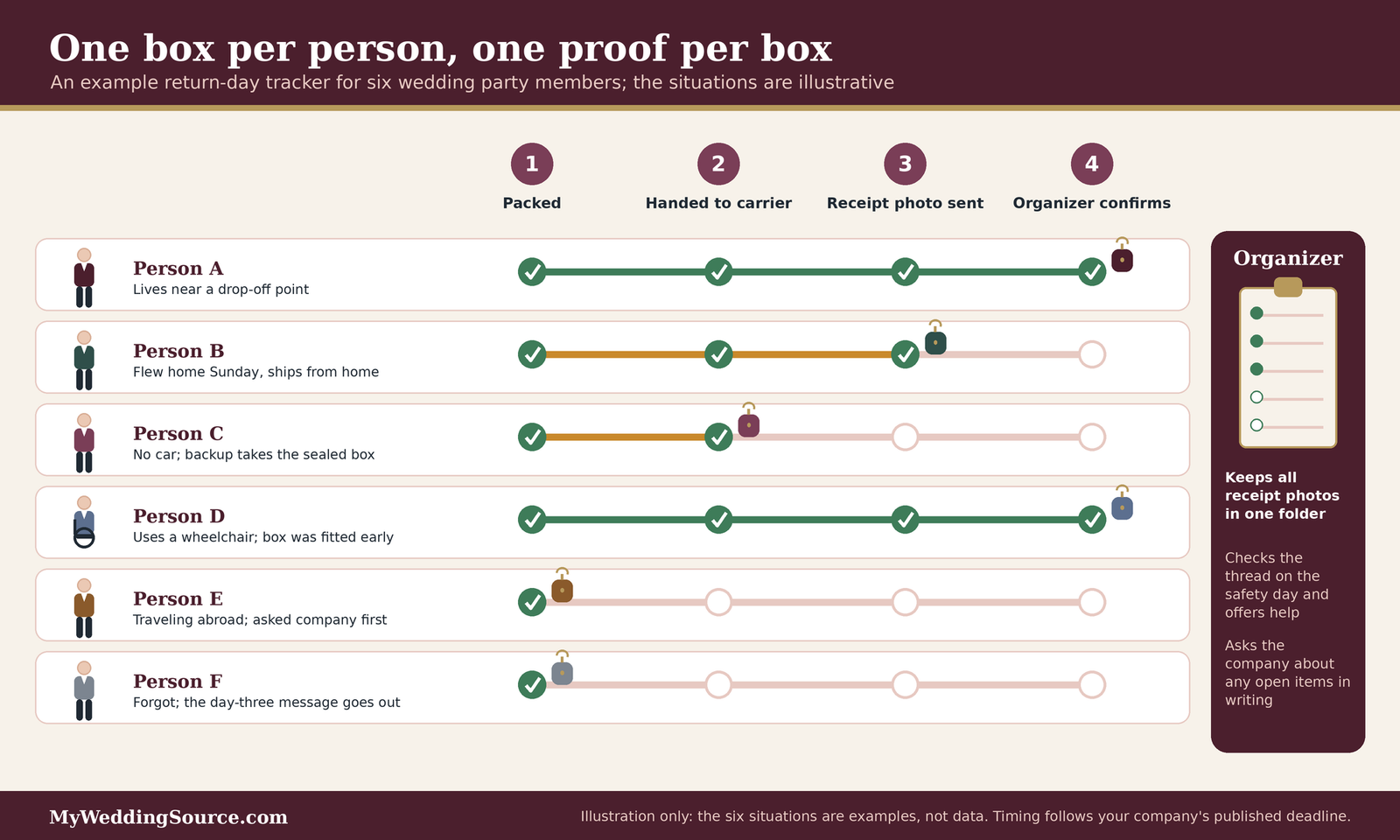
On Sunday, repack. On Monday, drop off, photograph the receipt, and send it to the pinned thread or to the organizer privately. On Tuesday, the safety day, the organizer checks that each person has confirmed. If anyone has not, the organizer messages them directly and offers help.
Packing the box correctly
Companies are specific about what goes back, and following their instructions on groomsmen rental returns avoids an avoidable charge.
Follow the company’s list
Generation Tux and Menguin say there is no need to clean or fold garments, and Generation Tux says not to include plastic packaging, hangers, or retail items such as socks, pocket squares, and cufflink or stud sets that were sold rather than rented. The Black Tux’s guide suggests keeping the original garment bag and carton to avoid repacking charges, though the amount is not stated. Rules differ, so read the paper in your own box.
Check the pockets
Men’s Wearhouse says it is not responsible for personal property left in a returned garment or garment bag. Ask every member to check pockets, the inside chest pocket, and trouser pockets for keys, vows, a phone, or a wallet. A lost wallet is a worse problem than a late fee.
Who checks that every box is gone
A plan for groomsmen rental returns is only useful if somebody notices when it fails. The check should be light, regular, and kind.
The one-photo rule
Ask each person to send a photo of the drop-off receipt, or a screenshot of the tracking page, once the box is handed over. The organizer keeps the photos in one folder. If a charge appears later, the folder answers the question in a minute.
What the organizer says on day three
If a person has not responded by the safety day, a short direct message works best. Ask whether there is anything in the way and offer to help, such as picking up a box or ordering a pickup. Companies charge by the day, so a quick, friendly nudge costs less than silence.
The attire size and accessibility feedback survey for your wedding party
The survey is the part of groomsmen rental returns that happens before the rental even arrives. In groomsmen rental returns, a box that fits, was tried on early, and can be handled by the person receiving it is a box that gets returned without a second shipment. A survey also gives people a private, low-pressure way to say what they would rather not announce in a group chat. It is written to be inclusive, so use it for anyone in your wedding party, whatever their gender, body, or ability. Questions are optional, and “I would rather talk by phone” is always an acceptable answer.
How to send and use the survey
The timing and the channel matter as much as the questions. Done late or in public, a survey becomes a source of pressure, and done early and privately, it works as an offer of help.
When to send it
Send the survey about eight to ten weeks before the wedding, and ask for answers within a week. That is our suggestion, built on the windows companies publish: The Black Tux’s guide suggests starting six to twelve weeks ahead, Menguin says fit profile changes are allowed up to thirty days before the event and members can be added or changed up to sixteen days before, and The Black Tux says style changes are allowed up to fourteen days before the wear date. Early answers leave room to act.
How to send it
Use a private form, an email, or a one-to-one message so each person answers without an audience. A form that goes to the organizer only is ideal. Tell people who will see the answers and what you will do with them. Never ask anyone to type body measurements or weight into a group chat. The rental company’s own fit profile collects measurements, and each person can enter them directly.
The survey itself
Copy the questions below, remove any that do not fit, and add your own. The plain-language “why we ask” column is useful to share, because people answer more honestly when they understand the reason.
| Section | Question | Why we ask |
|---|---|---|
| Contact | What name should we use, and what is the best way to reach you? | Makes sure messages reach the right person in the right way |
| Delivery | Where will you be about two weeks before the wedding, and can a package be left safely there? | Companies ask for the address two weeks out, and some leave packages at the door |
| Delivery | Do you have a backup address, such as an office, a relative, or a locker? | Avoids a stolen or missed box |
| Fit | Have you been measured recently, and by whom? | A recent measurement helps avoid a size swap |
| Fit | Is there any part of the fit you are worried about, such as sleeves, shoulders, waist, inseam, or shoe width? | Tells us where to look first when the box arrives |
| Fit | Would you prefer a fitting in person, a video call, or to enter measurements on your own? | Respects privacy and comfort |
| Comfort | Will you be sitting, standing, or walking for long stretches that day? | Affects jacket length, trouser rise, and shoe choice |
| Comfort | Do any fabrics, collars, waistbands, or shoe styles bother your skin, joints, or senses? | Helps pick pieces you can wear for hours |
| Access | Do you use a mobility device, a prosthesis, or other equipment that affects how clothing should fit or be put on? | Lets us ask the rental company about options early |
| Access | Would anything make getting dressed easier, such as help with buttons, a seat, or extra time? | Plans the morning of the wedding |
| Return | Where will you be on the Monday after the wedding, and can you reach the drop-off point we plan to use? | Prevents late fees |
| Return | Would you like someone to take your sealed box to the carrier? | Offers help without requiring an explanation |
| Return | Are you willing to send a photo of the drop-off receipt? | Gives you a record if a charge appears |
| Cost | Is there a cost concern you would like to raise privately? | Gives room for a quiet conversation |
What the contact and delivery questions do
These four questions prevent the most common avoidable mistakes: a box sent to an empty house, a box left outside for days, and a message that reaches nobody. They are also the questions people answer fastest, which helps response rates.
What the fit and comfort questions do
Fit questions point you to where a swap might be needed, so you can try the right part first when the box arrives. Comfort questions go further and ask about the day itself. A person who will be dancing and a person who will be seated for hours may want different things from the same jacket.
What the access and return questions do
Access questions invite a person to say what they need without requiring a diagnosis or an explanation. Return questions ask the practical thing that decides whether groomsmen rental returns happen on time. Neither question should be followed by a request for proof.
A message you can copy
A short, friendly message works better than a long form. Edit the voice to match your own.
An invitation to answer
“Hi, and thank you again for standing up with us. In a few weeks, our suits or tuxedos will be ordered, and we want everyone to be comfortable and able to wear and return them without stress. Here is a short, private questionnaire about fit, comfort, and how you would like to handle delivery and return. Every question is optional. Only I will see your answers, and I will not share them. If you would rather talk, tell me and we will find a time.”
A reminder that respects people
“Gentle reminder about the questionnaire, since the order dates are coming up. If anything is difficult, such as the form, the timing, or the cost, tell me privately and we will work something out.” Keep reminders short and never name who has not replied in a group thread.
Using the answers: size fixes, accessible fit, and return risks
Once the answers come back, sort them into three piles for your groomsmen rental returns plan: things to fix, things to ask the rental company, and things to plan around. The goal is to remove surprises, so the box that arrives is the box that works.
Sorting the answers
A simple sort works with a spreadsheet or a sheet of paper. Do not over-engineer it.
Things to fix now
Missing addresses, boxes that cannot be received safely, people who cannot reach a drop-off point, and questions that need the company’s advice belong in the first pile. They have deadlines tied to the company’s windows, and early action is cheap.
Things to ask the rental company
Questions about accessible options, an unusual size, a half-outfit rental, or an address outside the standard service area belong in the second pile. Ask in writing and keep the replies, using the question list later in this guide.
Things to plan around
Travel dates, work schedules, and long drives are the third pile. They are not problems, only facts that shape your groomsmen rental returns plan, such as offering a backup person to take a box to the carrier.
Accessible fit: what the sources said and what they did not
Accessibility needs vary a great deal, and no article can fit everyone. We looked at what a few sources say about seated fit and found useful starting points, plus a disagreement worth knowing about. Nothing here is medical advice, and the person wearing the clothes is the expert on their own body. For broader planning, our accessible wedding guest experience guide covers venue and day-of access.
Seated fit points to ask about
New Mobility’s guide to dressing well says a jacket should let a person wheel without pulling, and that suit trousers should have a back seam high enough to cover the person when seated, with few or no back pockets or buttons that could create pressure points. It also suggests straight, non-pleated legs to reduce gathered fabric. King & Allen, a tailor that describes its own adaptive suits, says seated fit is not based only on standing measurements and describes cutting jackets shorter and trousers longer with an elasticated waist. These are views from a magazine and a tailor, not clinical guidance.
Where the sources differ
The two sources disagree on sleeve length. New Mobility suggests sleeves that stop near the base of the thumb, while King & Allen describes cutting sleeves longer for a bent-arm seated position. That is a reminder to ask the wearer, not to follow a rule. A rental company that sends standard sizes may not be able to match either, so ask early about what adjustments or reimbursements it offers.
What rental companies say about adjustments
Rental clothing is not made to measure, and most companies limit alterations. Knowing the limits helps set expectations.
Tailoring allowances
Menguin says tailoring of pant hems or jacket sleeves is reimbursed up to twenty dollars, and other alterations are not reimbursable and may incur replacement fees. Generation Tux says pant hem or jacket sleeve adjustments are reimbursed up to twenty dollars as well, and asks that the fabric not be cut before adjusting. Because altering a rental can lead to replacement charges, never allow anyone to cut or alter a rental without written permission from the company.
Replacements and exchanges
Menguin and Generation Tux describe free ground shipping on replacements when a fit problem is reported within forty-eight hours of delivery, and The Black Tux describes free swaps within the same window. Every replacement is another box to track, so add it to your groomsmen rental returns plan. Menguin also says home try-on is only for grooms and wedding couples, so groomsmen do not qualify for it.
Edge cases that break return plans
Most groomsmen rental returns are simple, and a few are not. These cases come up often enough that a plan should cover them.
Timing surprises
Plans for groomsmen rental returns are built for the average case, and weddings are rarely average. When something changes, act early and ask the company in writing.
The party runs late, or the weekend is extended
If the group wants to keep outfits for a day-after brunch, a photo session, or a honeymoon send-off, ask about an extension before the deadline. The Black Tux sells extensions that must be requested before the return is due, and Menguin says that if you know you need a rental longer you should contact the company about special arrangements. Do not assume you can pay a late fee later at the same price as an extension.
A carrier delay or a holiday
Men’s Wearhouse says it is not responsible for carrier delays outside its reasonable control, and Menguin and Generation Tux say lost-in-transit shipments are not charged when the label was applied at an authorized drop-off. Drop-off receipts show you were on time even if tracking lags. If a holiday closes a carrier, ask the company whether the deadline moves.
People and pieces
The most common edge cases involve people changing and small pieces going missing.
A member drops out or is replaced
Menguin says members can be added or changed up to sixteen days before the event and that, after a member has paid, you should contact customer experience. Men’s Wearhouse states cancellation fees, including twenty dollars for individual orders and forty dollars for wedding groups, and says online orders cannot be cancelled once shipped. If the replacement is a different size, give them the survey and ask the company about the swap.
A missing or damaged piece
If a piece is missing, check the venue, hotel, and cars before the deadline, then contact the company rather than waiting for a charge. Generation Tux says that if items are missing the company contacts you to arrange a return. For damage, describe it honestly, include photos, and ask what the company can repair. A prompt explanation costs less than a surprise invoice.
Special situations for specific people
Some members have circumstances that need a thoughtful answer, not a rule. Good planning treats these as ordinary.
A member with limited mobility or no car
Offer a backup person to take a sealed box, or ask the company about a home pickup. The Black Tux’s guide describes home pickup for returns. A person should not have to explain why they cannot get to a drop-off point.
A member who is out of the country or far away
Ask the company about its rules before ordering. As noted earlier, the pages we read describe extra charges or non-reimbursed shipping for returns from outside the continental United States, and Menguin serves only US addresses. A person who lives abroad may be better served by a local purchase or a different rental source, which is a conversation for the couple.
Questions to ask your rental company about returns
Before anyone pays, ask your rental company the questions below about groomsmen rental returns in writing, and save the answers with your order confirmation. Every company we read left at least one thing unsaid, and the answers to these questions fill the gaps.
Questions to ask about groomsmen rental returns
- What is the exact last on-time day for returns, and does it count calendar days, business days, or hours?
- What time zone and cutoff time apply to the drop-off or postmark?
- What is the late fee, is it per day or flat, and does it have a cap?
- Who is charged when a paid-for member keeps a garment: the organizer, the member, or both?
- What counts as normal wear, and what is the damage waiver or handling fee for?
- What happens if a box is lost in transit after I hand it to the carrier?
- Can a different person drop off my box, and which carriers or locations are accepted?
- What are my options if I need the outfit a day or two longer?
- What accessible options, adjustments, or reimbursements do you offer for fit?
Questions about the deadline and fees
These questions pin down the numbers that cost money. Ask each in a way that produces a written answer.
Ask for the date in writing
Ask for the exact last on-time day for your event date and your carrier, written in a message you can save. A summary like “three days” is not enough, because some companies describe the window in different ways on different pages.
Ask what the fee does
Ask whether a late fee is flat or daily, whether it applies per person or per order, and whether it has a cap. Men’s Wearhouse states a cap at replacement cost, while the other companies’ pages we read do not mention one.
Questions about responsibility and loss
These questions fill the gaps we noted earlier. They protect the organizer and the members equally.
Ask who is charged
Ask whether charges follow the person or the payer when the organizer paid for others. Keep the answer in writing and share it with the group in simple language.
Ask what proof helps
Ask what proof of return the company accepts, and whether a photo of the receipt is enough. Menguin and Generation Tux say lost-in-transit shipments are not charged when the label was applied at an authorized location, so a receipt for that moment is the useful proof. For the broader habit of asking vendors for terms in writing, see our guides to wedding vendor contracts and the wedding vendor due diligence checklist.
Keeping records and disputing a charge
Even good plans for groomsmen rental returns occasionally end with a charge that looks wrong. A calm paper trail turns most of these into short conversations. This section is general consumer information, not legal advice, and a company’s own dispute steps vary.
What to keep
Records for groomsmen rental returns cost nothing and take minutes. Keep them in one place that more than one person can open.
Order and terms
Save the order confirmation, the rental agreement or terms as they were on the day you ordered, and any email in which a company confirmed a date or a rule. Pages change, and a screenshot with a date on it is proof of what you were told.
Return proof
Save the drop-off receipt, the tracking page, and a photo of the packed box. Both the receipt and the photos answer the question “did it leave and was it complete” quickly.
Disputing a charge with the company
Start with the company, in writing, and give it a reasonable chance to correct the charge. Friar Tux’s order terms describe a written dispute with a ten-day window, which shows that companies set their own deadlines for this.
Write a short factual message
State the order number, the charge, the date of return, and what you attach. Ask for an itemized explanation. Attach photos and receipts, and keep the tone neutral.
Watch the deadline
Friar Tux says disputes of damage or missing-item charges require a written letter within ten days, and that it replies within fifteen days of receiving it. Check your own company’s terms the day a charge appears.
When the card issuer is involved
If a company will not correct a charge you believe is wrong, a credit card dispute may be an option. Rules depend on your card and your facts, and this is not legal advice.
What the FTC says about billing disputes
The FTC’s consumer guidance says a dispute letter about a billing error must reach the card issuer within sixty days after the first bill containing the error was sent. It says the issuer must acknowledge the letter within thirty days and resolve the dispute within ninety days, and it advises sending copies rather than originals and keeping a copy of the letter. It also says that for a quality dispute you should first try to resolve the problem with the seller. Whether a rental charge qualifies is a question for the issuer or an attorney.
When a package carrier is involved
If your group mailed boxes with a carrier’s insurance rather than the rental company’s label, the U.S. Postal Service describes claims for insured mail, with proof of insurance and value and a filing deadline of no later than sixty days after mailing for damaged mail or missing contents. Most rental labels come prepaid, so a carrier claim is usually the company’s job and not yours. Keep the receipt anyway.
FAQ: groomsmen rental returns
Deadlines and fees
How long do groomsmen have to return rented tuxedos?
For groomsmen rental returns, it depends on the company. The Black Tux, Generation Tux, and Menguin state about three days after the event, Friar Tux states forty-eight hours, and Men’s Wearhouse states the day after. Those were the published terms on November 12, 2026. Confirm the exact last day for your order in writing.
What happens if one groomsman returns a rental late?
The company will usually charge a late fee to the account or card on the order. Published rates we found range from ten dollars a day at Friar Tux to twenty-five dollars a day at Menguin and Generation Tux, and sixty dollars flat at The Black Tux. Ask your company how fees are assigned in a group.
Shipping and logistics
Can groomsmen return rentals to a store if they ordered online?
Sometimes. Men’s Wearhouse says shipped rentals can go to a store during regular hours or to the carrier location on the label, and Friar Tux mentions a store location or a UPS kit. Menguin is online only and uses UPS Stores. Check your own order, because the answer depends on the company.
What if a groomsman lives in another state or country?
Ask before ordering. The companies we read describe different rules: Menguin serves only US addresses, Friar Tux describes extra shipping charges outside the continental United States, and The Black Tux’s FAQ says returns from Alaska, Hawaii, or abroad are not reimbursed. A member abroad needs a specific written answer.
Damage, loss, and responsibility
Who pays if a groomsman loses part of a rental?
Usually the person on the order, at the company’s replacement price, though your agreement controls. Menguin lists six hundred dollars for a jacket and fifty for cufflinks and studs, while Men’s Wearhouse examples start lower. If the organizer paid for the member, ask in writing whether the organizer or the member is charged.
Does the damage waiver cover a stained or torn rental?
A damage waiver, which was ten to twelve dollars at the companies we read, is described as covering inspection, minor repairs, and cleaning from normal use. Garments damaged beyond repair can still be charged at replacement cost. Ask how your company defines normal wear and what documentation it expects.
Planning and fit
How early should I ask groomsmen about size and accessibility?
Eight to ten weeks before the wedding is a reasonable target, which is our suggestion, not a rule. Companies publish windows such as thirty days for fit profile changes and sixteen days for member changes at Menguin. Asking early leaves time to fix problems and to ask about options privately.
What should I do if a groomsman cannot get to a drop-off point?
Offer a named backup, such as the organizer or another member, to take a sealed box to the carrier, or ask whether the company offers home pickup, which The Black Tux’s guide describes. Make the offer to everyone so nobody has to explain. Remind the person that a receipt photo protects them.
Your next steps
Set the plan this week
Write down the deadline
Open your order confirmation and rental agreement, find the last on-time day for groomsmen rental returns for your event date, and write it where the group can see it. Choose a group target day that is earlier. If the paperwork is unclear, ask the company in writing and save the reply.
Name an owner and a backup
Decide who checks that boxes went out and who steps in if the owner is unavailable. Tell the group in one short message. Our wedding party coordination checklist can hold this task alongside the others.
Send the survey and prepare for fit
Send the questions privately
Copy the survey, remove what does not apply, and send it individually. For wider help with different sizes and builds, see our guide to coordinating wedding party attire across different body types. Compare the suit or tuxedo choice with our guide to groomsmen suits vs tuxedos.
Fit the rest of your rentals into the plan
If you are renting other items, use our wedding rental planning checklist to give them the same attention. Add groomsmen rental returns to your wedding planning checklist and to the after-wedding checklist, and save a thank-you for your groomsmen with our groomsmen gifts ideas.
Close the loop after the wedding
Collect the receipts
Ask each member for a drop-off photo, and store the images with the order paperwork. Check your card statements for a few weeks after the wedding so that any unexpected charge is caught early.
Respond calmly to surprises
If a charge appears, start with the facts, ask the company for an itemized explanation, and use the dispute steps above if needed. Keep the group informed with neutral language, not blame.
Sources & methodology
How we built this guide
What we relied on
This guide relies on the public return, shipping, fee, and rental-terms pages of five tuxedo and suit rental companies, a federal consumer-protection guide on credit card billing disputes, the U.S. Postal Service’s claims page, and two published pieces on fit for seated wear. We read each page on November 12, 2026, and the details in this guide reflect those pages as we read them. Rental terms change often and two companies’ pages contradicted themselves or each other, so the numbers here are a starting point for your own questions. Arithmetic, examples, and the timelines are our own estimates and suggestions.
What we did not do
We did not place an order, test a service, or speak with any company, and we did not read the full rental agreements that several pages link to. We did not give legal, financial, or medical advice. The Knot’s 2025 Real Weddings Study page, which we also read, did not list wedding party or attire figures, so we did not use it for any statistic.
Source list
Rental company pages
- The Black Tux, Wedding tux rental timeline: book, fit, return: https://theblacktux.com/blogs/resources/wedding-tux-rental-timeline-book-fit-return
- The Black Tux, Online tuxedo rental: how it works and where to start: https://theblacktux.com/blogs/resources/online-tuxedo-rental-how-it-works-and-where-to-start
- Generation Tux, Support FAQ: https://generationtux.com/support/faq
- Generation Tux, Shipping policy: https://generationtux.com/shipping-policy
- Menguin, Return page: https://www.menguin.com/return
- Menguin, Support FAQ: https://www.menguin.com/support/faq
- Men’s Wearhouse and Jos. A. Bank, Rental terms and conditions: https://www.menswearhouse.com/slc/rental-terms-conditions
- Friar Tux, Order terms: https://www.friartux.com/orderterms
Government and consumer sources
- Federal Trade Commission, Using credit cards and disputing charges: https://consumer.ftc.gov/articles/using-credit-cards-and-disputing-charges
- U.S. Postal Service, File a USPS Claim (Domestic): https://www.usps.com/help/claims.htm?kbid=62548
- The Knot, Real Weddings Study (2025 weddings; read, not used for statistics): https://www.theknot.com/content/real-weddings-study
Fit and accessibility sources
- New Mobility, A wheelchair user’s guide to dressing well: https://newmobility.com/a-wheelchair-users-guide-to-dressing-well/
- King & Allen, Adaptive tailoring (the tailor’s own description of its service): https://kingandallen.co.uk/adaptive-tailoring/