
How far in advance to plan a wedding depends less on a magic number of months and more on which vendors fill up first. Here’s what 6, 12, 18, and 24 months each really get you, and how to pick the one that fits your wedding.
If you search for how far in advance to plan a wedding, you’ll find answers ranging from “at least a year” to “as soon as you get engaged.” Both are reasonable, and neither is very useful on its own. The better question is which parts of your wedding run on someone else’s calendar, and how much lead time those parts need.
A courthouse ceremony and a 150-guest destination weekend aren’t the same project, so they don’t need the same runway. This guide shows what each planning horizon realistically allows, what you give up when you compress it, and how to decide what’s right for your wedding. If you want the order of operations once you’ve picked a horizon, our wedding planning timeline walks through it month by month.
Quick answer For how far in advance to plan a wedding, twelve to eighteen months is the comfortable range for a traditional wedding of 100 or more guests in peak season. Six months works if you’re flexible on date, venue, and vendors. Twenty-four months helps for destination weddings, very popular dates, or large guest lists. The shorter your runway, the more you’ll trade choice for speed.

How far in advance to plan a wedding: start from what couples actually do
Averages for how far in advance to plan a wedding are a starting point, not a verdict. They tell you what the typical respondent did, which may or may not resemble your situation.
See what the survey data says about engagement length
Two of the biggest wedding surveys give slightly different pictures, and the gap is worth understanding before you copy anyone’s schedule.
Read the averages as ranges, not targets
The Knot’s 2026 Real Weddings Study, covering 10,474 U.S. couples married in 2025, reports an average engagement of about 14 months. Zola’s 2026 First Look Report, based on more than 11,500 couples marrying in 2026, puts the average at about 18 months. The difference in how far in advance to plan a wedding that each survey implies probably comes from who was surveyed and when. The Knot’s study looks back at weddings that already happened, while Zola’s asks people who are still planning.
Neither number says you need that long. It tells you that somewhere between a year and a year and a half is common, and that many couples feel that’s enough time.
Notice what an average hides
An average engagement of 14 months can be built from a pile of eight-month engagements and a smaller pile of two-year ones. Nobody actually has a 14-month engagement; they have a shorter or longer one for a reason. The useful question is which reason applies to you: a date that was fixed first (a family gathering, a lease, a school calendar), or a venue that was fixed first.
If you’re reading the surveys to decide how far in advance to plan a wedding, treat the two figures as the edges of a comfortable middle, then let your own constraints push you toward one edge or the other.

Check the season and day you want
The Knot’s study found that 76% of couples marry between May and October, and it forecast October as the most popular month for 2026. If you want a peak-season Saturday, you’re competing with most other couples for the same few dates.
That’s the most useful reason to start earlier. Flexible dates, such as a Friday, a Sunday, or a shoulder-season month like April or November, can shorten the runway you need. Our guide to outdoor wedding venues points out which seasons have the trickiest availability and weather.
Know who fills up first
When you decide how far in advance to plan a wedding, remember that not every vendor runs on the same clock. A few need much more lead time than the rest, and they set the real minimum for your plan.
Rank vendors by how fast they book out
In rough order, from first to fill to last: venues, then photographers and live entertainment with strong followings, then caterers (if not included with the venue), then officiants, florists, and stylists, and finally items like stationery and rentals that have many substitutes.
That order is our editorial judgment, built from how vendor calendars generally work. It isn’t a published industry ranking. Ask each vendor directly how far out your date is booking, because a tiny local photographer can be full 14 months out while a large studio still has room at six.
Count the lead time on anything made or shipped
Some items depend on production, not availability. Custom attire, alterations, printed stationery, and rentals shipped from elsewhere all need weeks or months. The right question for each is “what’s the last date you need my final decision by?” and the answer is the real deadline.
Compare the four horizons: how far in advance to plan a wedding at 24, 18, 12, and 6 months
Here’s how far in advance to plan a wedding at each horizon: what it realistically gives you, what it costs you, and who it suits. These are editorial guidelines, not industry rules.
Longer runways: 24 and 18 months
The long end isn’t for everyone, but it buys flexibility you can’t get later.
24 months: for destination weddings and tight date requirements
Two years makes sense if you’re planning a destination wedding with a lot of guest travel, a large wedding of 150 or more guests, or a date that’s likely to book out early. It gives your guests time to save and arrange travel, and gives you time to negotiate and compare without rushing.
The trade-offs are real. You’ll make decisions further from the date, prices may change by the time you pay balances, and some vendors won’t take bookings that far ahead. Our guide to destination wedding etiquette covers what to tell guests and when.
18 months: the comfortable runway for most traditional weddings
Eighteen months is the sweet spot for couples who want a peak-season Saturday with 100 or more guests and several vendors. You get your pick of venues, time to tour more than three or four, a calm pace for budgeting, and enough slack to recover if something falls through.
You can still change your mind about things. If a venue turns out to be a poor fit, you have time to look elsewhere, and if a vendor drops out, you have time to replace them without a premium.
Shorter runways: 12 and 6 months
A shorter answer to how far in advance to plan a wedding can absolutely work. It just requires clear priorities and a willingness to say yes to what’s available.
12 months: workable if you decide quickly
A year works well if you can make decisions without long debates, if you’re open to a few date options, and if you start with the venue. Most of the decisions in our guide to how to plan a wedding can be settled in the first six weeks, which leaves plenty of time for booking.
Where couples run into trouble at 12 months is indecision, not the calendar. Spending four months choosing between two venues can quietly turn a 12-month plan into an 8-month one.
6 months: possible, with trade-offs you should choose on purpose
Six months isn’t a crisis, but it does change the game. You’ll have fewer choices, especially for peak-season Saturdays. You may need to book the first venue that fits your budget and guest count rather than the ideal one. You’ll also want to simplify anything custom.
What helps most is flexibility on the date: weekday weddings, Sundays, and off-season months have far more availability. Our wedding planning checklist can help you triage once you’ve decided.
What this actually costs How far in advance to plan a wedding changes your costs, but compressing the timeline doesn’t have a fixed price, and any figure claiming it does should be treated skeptically. What it does is change your leverage: fewer vendors available means less room to negotiate, and rush fees for custom or shipped items can add up. The Knot’s 2026 study reports an average wedding cost of $34,000 (median $24,000), and Zola’s 2026 report expects $36,000. Whatever your budget, ask every vendor whether a rush fee applies before you commit. Our guide to hidden wedding costs shows which line items to ask about.
| Planning horizon | What it gives you | What you trade away | Best suited to |
|---|---|---|---|
| 24 months | Widest venue and vendor choice, time for guest travel, slow budgeting | Decisions made far from the date, some vendors won’t book that early | Destination weddings, large guest lists, in-demand dates |
| 18 months | Comfortable pace, several tours, room to recover from setbacks | Slightly longer wait before the day | Traditional peak-season weddings of 100+ guests |
| 12 months | Enough time if you decide quickly and start with the venue | Less room for indecision; fewer peak Saturdays | Couples with flexible dates and clear priorities |
| 6 months | Speed, and a short planning sprint | Fewer choices, less negotiating power, possible rush fees | Flexible dates, smaller weddings, weekday or off-season dates |
Choose how far in advance to plan a wedding with a simple constraint count
Months on a calendar are abstract. Constraints are concrete, and they’re what actually decide how far in advance to plan a wedding for your situation.
Count the constraints that lengthen how far in advance to plan a wedding
A constraint is anything that shrinks the pool of workable dates, venues, or vendors. The more of them you stack, the fewer options survive, and the earlier you need to start.
Add up the four hard constraints
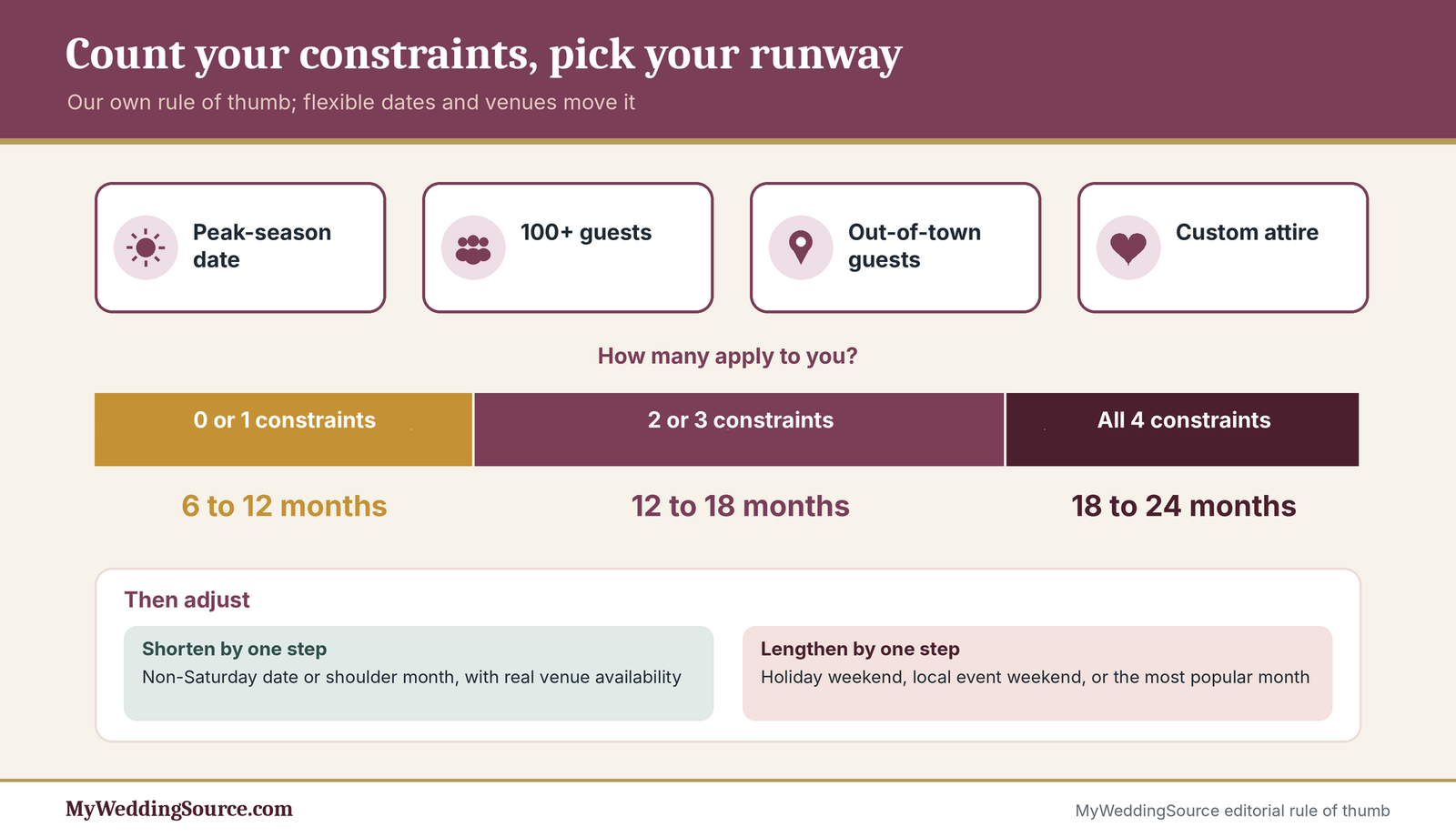
The four we count are a peak-season date, a guest count above 100, out-of-town guests, and custom attire. Each one narrows a different part of the plan: the date limits venues, the guest count limits venues again and drives catering, travelers need notice, and custom attire needs production time.
A simple way to choose To settle how far in advance to plan a wedding, count your hard constraints: peak-season date, guest count above 100, out-of-town guests, and custom attire. Zero or one, and six to twelve months is realistic. Two or three, aim for twelve to eighteen. All four, start with eighteen to twenty-four. This is our own rule of thumb, and it moves if your date or venue is unusually flexible. For a wider view, see our wedding planning guide.
Add the soft constraints that act like hard ones
These quietly change how far in advance to plan a wedding without ever showing up on the checklist. Some limits don’t make the official count but behave the same way. A venue you’ve loved since childhood, a specific photographer, a guest list that includes someone who needs a year of notice to take leave, or a religious officiant with a crowded calendar can each pull you one step longer. If a soft constraint is non-negotiable to you, count it as a fifth hard one and move up a horizon.
Know when to override the count
The count is a starting estimate. Two kinds of situations should override it, in opposite directions.
Move shorter when you are genuinely flexible
If you’d happily marry on a Thursday, accept any of four venues, and have no custom pieces, you may have a high constraint count on paper and a low one in practice. A 150-guest Sunday brunch in March doesn’t need the runway of a 150-guest Saturday in October, even though both have the same guest count.
Move longer when you are slow at deciding
How far in advance to plan a wedding depends on you as well as the date. The count measures the wedding, not the couple. If you know you take months to settle on anything, add a horizon. A couple who needs three months to choose a venue should treat a twelve-month plan as a nine-month plan and decide accordingly.
How season and day of week change how far in advance to plan a wedding
Two couples with identical guest counts can need very different lead times because one wants a Saturday in October and the other a Thursday in February. This section is editorial reasoning about how vendor calendars tend to behave, not published availability data, so confirm everything locally.
Peak season versus shoulder and off-season
The Knot’s study found that 76% of couples marry between May and October. When three quarters of the year’s weddings crowd into six months, those months are where supply runs short.
Why peak-season Saturdays set the longest lead times
A venue can only host so many Saturdays in October, and photographers and bands can only be in one place. Each vendor type has a small number of premium dates, and couples compete for them in the same order every year. If your wedding falls on one, you’re bidding for scarce inventory, and the right answer to how far in advance to plan a wedding leans toward eighteen months or more.
What shoulder months can buy you
April, early May, and November are the usual candidates for a shoulder date, though local climate changes the picture. You often have more availability, and a little more room to ask for a lower minimum or an added hour. Don’t assume a discount, though; some shoulder dates are popular for their own reasons, such as a regional festival or a university graduation weekend. Ask the venue to show you its open Saturdays for the month before you commit.
Rule of thumb Take whatever horizon the constraint count suggests and shorten it by a step if you’ll accept a non-Saturday date or a shoulder month, as long as the venue confirms real availability. Lengthen it by a step if you want a holiday weekend, a local event weekend, or the single most popular month in your region. This is editorial reasoning, not a measured discount.
Friday, Sunday, and weekday weddings
Day of week is the cheapest lever for shortening the runway you need, because it changes how many couples are competing for you.
Where Friday and Sunday dates help and where they don’t
A Friday evening or Sunday afternoon often leaves more open dates at venues that host Saturday weddings as their main business. A venue may also be more willing to talk about price and hours on a lower-demand day, but that’s a conversation, not a guarantee. The catch is your guests: out-of-town relatives may have to take an extra day off, and a Sunday wedding can feel rushed if people have to fly back that night.
Weekday weddings for very short runways
If how far in advance to plan a wedding has to be under six months, weekdays are your friend. Monday through Thursday dates are the most available, and on a short plan they can be the difference between a choice of venues and a single option. Local guests tend to manage weekday events better than travelers do, so this works best for smaller guest lists. Check whether your must-have vendors work weekdays; some run full-time day jobs and do weddings only on weekends.
How guest count and venue type change how far in advance to plan a wedding
Guest count and venue type decide how many places can host you at all. A smaller pool of qualifying venues means a longer runway, even if the date itself is flexible.
Guest count as a venue filter
Before you worry about months, find out how many venues in your area fit your number.
Under 50 guests: the pool opens up
At this size, how far in advance to plan a wedding is mostly a question of your date. A small guest list fits restaurants, private rooms, backyards, gardens, small galleries, and homes, in addition to wedding venues. Many of those places don’t book a year out because they aren’t running a wedding calendar. For a wedding this size, six to nine months is a comfortable runway as long as your date isn’t a peak Saturday and your must-have vendors are available. Our guide to small wedding ideas goes through formats that suit smaller lists.
100 to 150 guests: the mainstream bottleneck
This is the range where the venue pool is narrowest relative to demand, because most dedicated wedding venues are sized for it. Capacity for a seated dinner, a dance floor, a ceremony space, and room for vendors to work is a real filter. When you add a peak Saturday, you can end up with two or three realistic choices, which is why twelve to eighteen months is the usual advice.
150 and above: fewer venues, more logistics
Large lists cut the venue pool again and add logistics that need time, such as shuttles, bigger rental orders, and more catering staff. If you’re at this size and want a prime date, the 18 to 24 month horizon is reasonable. If you’re flexible on date, you can often work at twelve.
Venue type as a calendar signal
What kind of place you choose tells you how its calendar works, which tells you how early to call.
Dedicated wedding venues and estates
Barns, estates, and event halls built for weddings book by date and often hold their best dates a year or more out. They are also the places most likely to offer a clear package, a coordinator, and defined rules. Start touring early, and ask for the open-date list before the tour, so you don’t fall for a space with nothing available.
Hotels, restaurants, and all-inclusive resorts
Hotels and resorts often have a sales team and flexible inventory, and a restaurant may have a private room that opens up at short notice. Those can be good options for compressed timelines. Our guides to hotel wedding venues and all-inclusive wedding venues explain the trade-offs of package pricing.
Outdoor, tented, and private-property weddings
Outdoor and tented weddings add dependencies: tent rental, permits, a rain plan, portable restrooms, and power. Those items have their own booking lead times, and the rental inventory is limited in peak season. If you’re choosing a private property or a field, add a step to your runway and read our outdoor wedding rain plan guide before you commit.
Use a booking-order checklist for how far in advance to plan a wedding at each horizon
Knowing how far in advance to plan a wedding is only half the job. The other half is what to book in which order. These lists are editorial suggestions; shift items around to match your priorities.
Booking order for the long runways
The checklist for how far in advance to plan a wedding at 18 or 24 months is mostly about restraint. With 18 or 24 months, you can afford to be deliberate, and the discipline is not to book too much too soon.
The 24-month checklist
- Months 24 to 22: Set a rough budget, a guest-count range, and your top three priorities. Pick two or three target regions or cities.
- Months 22 to 20: Collect candidate dates and venues. Ask each venue for its open dates, not just a tour.
- Months 20 to 18: Tour, compare in writing, and sign the venue contract. Confirm the date with your must-have guests.
- Months 18 to 16: Book the photographer and, if you want one, a planner. Send a first heads-up to out-of-town guests.
- Months 16 to 14: Book the caterer if the venue doesn’t supply one, plus live music or a DJ.
- Months 14 to 12: Send save-the-dates (earlier for destination weddings), build the hotel block, and start attire research.
The 18-month checklist
- Months 18 to 16: Set the budget, guest range, and priorities. Ask venues for open dates and start touring.
- Months 16 to 14: Sign the venue. Confirm the date with essential guests.
- Months 14 to 12: Book the photographer, caterer (if needed), and entertainment. Consider a planner or day-of coordinator.
- Months 12 to 10: Book officiant, florist, and stylist. Begin attire shopping, because custom pieces need production time.
- Months 10 to 8: Send save-the-dates and open the hotel block.
- Months 8 to 6: Book rentals, hair and makeup, transportation, and the cake or dessert. Order stationery.
Booking order for the shorter runways
At 12 or 6 months, how far in advance to plan a wedding is no longer the question; sequencing is. With 12 or 6 months there’s no slack for sequencing mistakes, so the order matters more than the pace.
The 12-month checklist
- Weeks 1 to 4: Set the budget, guest range, and three priorities. Ask venues for open dates; offer three possible dates, not one.
- Weeks 5 to 8: Tour and sign the venue. Immediately confirm the date with must-have guests and your officiant.
- Months 3 to 4: Book the photographer, caterer if separate, and entertainment. Send save-the-dates.
- Months 5 to 6: Book florist, officiant if you haven’t, and hair and makeup. Start attire.
- Months 7 to 9: Order stationery, finalize rentals and transportation, and book lodging for the wedding party.
- Months 10 to 12: Send invitations, finalize the day-of timeline, and apply for your marriage license within your county’s window.
The 6-month checklist
- Week 1: Decide guest range, budget ceiling, and what you will not compromise on. Choose three acceptable dates, including a non-Saturday.
- Weeks 2 to 3: Ask every plausible venue for open dates. Book the first one that clears your three priorities.
- Weeks 3 to 5: Book photographer, caterer if separate, and entertainment, in that order. Take the best available, not the dream version.
- Weeks 5 to 8: Send save-the-dates or go straight to invitations if the date is under four months out. Order attire with a rush-time conversation up front.
- Months 3 to 4: Book florist, hair and makeup, rentals, and transportation. Simplify wherever there are substitutes.
- Final two months: Send invitations, handle the marriage license, finalize the timeline, and keep your buffer weeks free.
Pressure-test your own timeline before you commit to it
However far in advance to plan a wedding, a schedule that looks fine in a spreadsheet can still be fragile. Run a few tests before you trust it.
Check your plan against the dates you can’t move
Start with the things that have outside deadlines and count backward from there.
Run the “earliest and latest” test on every key date
For each fixed deadline, find the earliest you can act and the latest you can. A marriage license, for example, has both. A Justia 50-state survey (last reviewed in 2023) lists waiting periods ranging from none in Arkansas to three days in Florida, and license validity of 30 days in Delaware versus 60 days in Florida and Arkansas. That means you can’t just get it “sometime in the last month” without checking your county’s rules.
The same applies to anything tied to travel. If either of you needs a passport for a honeymoon, check the State Department’s current processing times and add mailing time on both ends. Our guide to save-the-date timing helps you place guest-facing dates.
Build in a buffer you won’t spend on purpose
Add at least two to four weeks of slack before your last hard deadline. Treat it as unusable. If something slips, it absorbs the delay, and if nothing does, you enjoy a calmer final month.
Be honest about the human delays too: vacations, sick days, and slow replies. A simple plan with a buffer beats an aggressive plan without one nearly every time.
Account for the people who can’t move
A planning horizon isn’t only about vendors. A few people on your list have their own calendars, and they can quietly decide your date.
Ask your must-have guests about dates before you commit
If a grandparent, a best friend, or an officiant is essential to the day, ask about their availability and travel limits before you sign a venue contract. It’s a short conversation, and it can save you from choosing a date that only works for everyone except the people you most want there.
The same goes for your own calendars. Work travel, exams, busy seasons, and family events can eat several weeks of a six-month plan. On a twenty-four-month plan they matter less, because there’s more room to work around them.
Plan for life changes on a long runway
The longer your runway, the more likely something unplanned will land in the middle of it: a job change, a move, a pregnancy, a family illness, a lease ending. That isn’t a reason to avoid a long engagement. It’s a reason to choose vendors with clear rescheduling terms, a point we come back to in the deposit section below.
Decide what happens if the plan slips
Your answer to how far in advance to plan a wedding needs a fallback just as much as a venue does. The failure points are predictable, so you can name them in advance.
Know your most likely failure points
Over a long runway, the usual risks are vendor cancellations and price changes. Over a short one, they’re limited availability and shipping delays. Write down your two most likely failure points and what you’d do about each.
A good test is whether you could still hold the wedding if your top-choice photographer or caterer became unavailable tomorrow. If the answer is “no idea,” keep a warm backup in your contacts. Our guide on wedding day timeline failure points covers the day-of side of this.
Pick the trigger that moves you from plan A to plan B
If you’re considering a shorter runway because you can’t find a venue, set a trigger. For example: “If we haven’t signed a venue by month three, we’ll widen the date window by 60 days.” Having the rule in advance keeps you from drifting.
The same goes for expensive deposits. Decide ahead of time what you’ll do if a vendor’s refund policy isn’t acceptable. The Ohio Attorney General’s consumer guidance suggests asking whether deposits are refundable and what the cancellation terms are before you pay. Our guide to vendor contract red flags helps you read those terms.
A 90-day triage plan for couples with a very short runway
If your date is closer than six months, the question of how far in advance to plan a wedding has already been answered for you. What’s left is deciding what to protect. This plan assumes about 90 days and a guest list that fits a typical venue; stretch or squeeze it to fit.
Weeks 1 and 2: decide what you are protecting
No one’s answer to how far in advance to plan a wedding includes a spare month here. The first two weeks decide whether the remaining ten go smoothly. Resist the urge to book anything until you’ve done this.
Name three non-negotiables and everything else is flexible
Sit down together and each write your top three: a specific place, a photographer’s style, great food, a guest who must attend, a particular ceremony tradition. Compare lists. Anything that appears on both is a non-negotiable, and anything that appears on one list is a negotiation between the two of you. Everything not on either list is flexible by default, and that’s what you’ll trade away for speed.
Fix the budget ceiling and the guest-count cap
A short runway is a bad time for an open-ended budget, because fast decisions tend to be expensive ones. Write down a ceiling and a guest cap, and treat the cap as firm, since guest count drives venue, catering, and rentals all at once. If you’re unsure where to start, our wedding budget guide covers how to split the money by priority.
Weeks 3 to 12: book in the order that protects the most options
After the first two weeks, your job is to book scarce things before common ones, and to stop shopping once something works.
Book the venue and date in a single week
Contact every plausible venue in one day, with three acceptable dates in hand, and ask for open dates in your window rather than a tour. Schedule tours back to back over one weekend. Sign the first venue that meets your non-negotiables, because the third-best option that’s available beats the best option that isn’t.
Chase the vendors who sell out and simplify the rest
Next, ask photographers and entertainment for your date, then caterers if the venue doesn’t include food. For florals, stationery, and rentals, accept the vendor with an open date and a simple menu of options. Cut custom items entirely: choose attire that can be altered in weeks, and use a printed or digital invitation set that is available now. Our 12-month wedding checklist is useful for deciding what you can safely drop.
Protect the last three weeks
Reserve the final three weeks for the marriage license, the final headcount, seating, vendor timelines, and a buffer. If any hard item slips past week ten, cut something from the plan instead of eating into that window. A simpler wedding that arrives calmly is a better outcome than a fuller one that arrives with everyone frantic.
Keep momentum and control budget drift on an 18 to 24 month engagement
Knowing how far in advance to plan a wedding at the long end solves the availability problem and creates two new ones: energy and money. Both fade or drift if you let them.
Keep the planning from stalling
A long runway tempts people to postpone everything, and then the final year gets compressed anyway.
Set milestones on dates, not on feelings
The way to keep how far in advance to plan a wedding from turning into drift is to date your checkpoints. Pick four or five checkpoints, such as venue signed, photographer booked, guest list drafted, attire chosen, and invitations ready, and give each a month. Put a monthly twenty-minute check-in on the calendar with your partner. The aim is to prevent one person from becoming the unpaid project manager, which is a common source of friction.
Decide what you will not decide yet
On a long runway, some decisions are better late: the exact menu, the florals, the playlist, the stationery design. Fashions change and tastes shift in two years. Write down a “do not decide before” date for each and keep a simple inspiration folder in the meantime, so you can collect ideas without being pressured to commit.
Hold the budget steady as prices and priorities move
The cost side of how far in advance to plan a wedding at 18 to 24 months is drift. Budgets drift on long engagements because there are more chances to add things and more time for small increases to pile up.
Lock the big categories early and track the small ones
Sign contracts for venue, photography, and catering early, where the contract fixes your price for the date. Keep a running sheet of every smaller purchase, with a dollar cap per category. Our wedding budget calculator is a good way to see where the money is going.
Run a quarterly review with a rule for additions
Every three months, compare what you’ve spent against the plan, and adopt one rule: any new line item must be paid for by trimming another one. That prevents “just one more thing” spending. Treat price increases from vendors as a prompt to read your contract, since signed prices are often fixed but add-ons, overtime, and service charges may not be.
How wedding format changes how far in advance to plan a wedding
Most advice on how far in advance to plan a wedding assumes a traditional reception. Other formats shift the clock in different directions, sometimes shorter and sometimes much longer. None of these timings are rules; they’re starting points for you to test against your own location.
Formats that need more lead time
Anything that depends on other people traveling, or on a place that rations its dates, tends to lengthen the runway.
Destination weddings
This is where how far in advance to plan a wedding stretches the most. A destination wedding adds guest travel, a distant venue, local legal requirements, and often a need to visit before you commit. Eighteen to twenty-four months is reasonable, and guests should hear about the location early because flights and time off take planning. Our destination wedding checklist and guide to room blocks for destination weddings cover the pieces that drive the schedule.
Elopements in popular places
An elopement can take a few weeks or more than a year, depending on where. A permit-based outdoor location or a scenic spot with limited ceremony slots may book far ahead, while a simple ceremony on a quiet date may need only a license and an officiant. The deciding factor is whether the place allocates its ceremonies by permit or reservation. Find that out first, then pick your runway.
Formats that need less lead time
Smaller and simpler events can move fast, as long as you protect the one or two things that can’t.
Courthouse and civil ceremonies
A courthouse ceremony often depends on the clerk’s office rules, appointment availability, and the marriage license timing in your county, which varies. It can take weeks, not months, but call the office early to ask about scheduling, witnesses, and ID requirements. Our guide to getting a marriage license explains how to find your county’s requirements. Plan the celebration afterward on its own timeline, whether that is a dinner next week or a party in the fall.
Micro-weddings
For a few dozen guests, how far in advance to plan a wedding can shrink to three to six months. Smaller guest lists fit because the venue options are broader and the vendor list is shorter. What lengthens it is a high expectation per guest: a chef’s menu, a hand-selected location, or a photographer with a long waiting list. Our guide to micro-wedding ideas helps you shape the format, and the constraint count from earlier still applies.
What to do when the vendor you want is already booked
Even with a good answer to how far in advance to plan a wedding, you’ll sometimes find your dream photographer or venue is taken. That’s a normal part of the process and it rarely means your wedding is in trouble.
Decide whether to substitute, shift, or wait
Your runway helps here: how far in advance to plan a wedding determines how many replacements you can consider. You have three real options, and they trade different things away.
Weigh the three options against your priorities
Substituting means keeping your date and choosing someone else. Shifting means keeping the vendor and moving the date, which works for a venue, a photographer, or a band you can’t replace. Waiting means asking to be put on a cancellation list and moving on with other bookings. If the vendor is on your non-negotiables list, shift the date. If not, substitute and keep moving.
Ask the questions that reveal real options
When a vendor says they’re booked, ask whether they have a second shooter or associate who works with the same style, whether they have an open weekday or Sunday, and whom they would refer. Good vendors know their local peers and are often glad to recommend someone, because a happy couple is good for the whole community.
Find a good substitute without settling
Rushed substitution is where couples overpay or regret, so use a structure.
Build a shortlist from the first vendor’s gaps
Look at what you loved about the first vendor and write it down: the editing style, the pace, the warmth, the way they handle a crowd. Then judge replacements on those traits, not on a general impression. Review full galleries or sets, not highlight reels, and ask for a reference from a recent wedding of similar size.
Keep a warm backup for every must-have category
For photography, music, and catering, keep one second-choice vendor in your notes with a quick email already sent about your date. If the first choice falls through, you’re not starting from zero. Our questions for caterers, DJs, and bands give you a ready list for the second call.
Editor’s note A vendor being booked on your date says nothing about their quality, and a vendor with open dates isn’t automatically a worse choice. New and smaller vendors often have the calendar room that established ones lack. Judge them on their actual work and contract terms, not on how full their schedule is.
Four illustrative couples deciding how far in advance to plan a wedding
These are invented composites to show the reasoning, not real couples and not data. Notice that each one is deciding how far in advance to plan a wedding by looking at their constraints, not at a calendar.
Couples who lean toward a long runway
Two of the four have constraints that stack up, so they start early.
Priya and Marcus: 150 guests, October Saturday, two out-of-town families
They count three hard constraints: peak season, over 100 guests, and out-of-town guests. The count says 12 to 18 months, but they also have a soft constraint, since Priya’s grandmother can only travel in the fall and only with notice. They choose 18 months, tour in the first four months, sign a venue before the one-year mark, and send save-the-dates ten months out.
Dana and Whitney: destination wedding for 70 guests
Their guest count is modest, but a destination wedding adds a flight, a visit to the location, and local paperwork. Even with no peak-season date, they choose 24 months so that guests have time to save and request leave, and so they can visit the venue twice. They block the first two months for research and budget, then book a coordinator who knows the area.
Couples who lean toward a short runway
For these two, how far in advance to plan a wedding is a smaller number, and that is a choice, not a failure.
The other two are flexible in ways that make a shorter plan comfortable.
Leo and Camille: 60 guests, flexible on day and month
They have one hard constraint, the guest count, and they’d happily marry on a Friday in April. The rule says six to twelve months, and they pick eight. They ask venues for open dates before touring, book in the second month, and choose attire that can be altered in a few weeks. Because they’re flexible, they have real options even at eight months.
Sam and Jordan: 90-day timeline after a family change
A relative’s health prompts them to move the wedding up to a date about three months away. They have 45 guests and decide their non-negotiables are family present and good food. They follow the 90-day triage plan: venue in two weeks, a caterer and a photographer who have open dates, a short invitation list, and a license appointment on the calendar. The wedding is smaller than they first imagined, and it happens in time for the people they wanted there.
Deposit and rescheduling risk on long timelines
The longer your answer to how far in advance to plan a wedding, the longer your money sits with vendors. That is where long timelines carry risk, and where a few contract questions reduce it.
Understand what you are exposed to
A long answer to how far in advance to plan a wedding means more deposits held for more months. Deposits are normal. What matters is what happens to them when plans change.
Separate the retainer from the balance
Many vendors take a non-refundable retainer to hold the date, then collect the balance closer to the wedding. A retainer secures your date and is often not returned if you cancel, though policies differ widely. Ask for the schedule of payments in writing, and note which amounts are labeled refundable, transferable, or neither. The Ohio Attorney General’s guidance on asking about deposits and cancellation terms applies to every vendor, not only the big ones.
Check what happens if the vendor closes or changes hands
On a two-year runway, a vendor can sell, relocate, or close. Ask what happens to your contract and deposit in that case, and whether the contract names a specific photographer or just “the studio.” A named person matters if that person’s style is why you hired them.
Protect your date if your plans change
You can’t predict a job move, but you can make a date change less painful.
Look for date-change language before you sign
The best rescheduling clauses allow a one-time date change with a fee or none, subject to availability. Ask each vendor for their policy on moving the date, and whether the deposit transfers. Our guide to wedding cancellation and postponement goes through what to ask, and our vendor contract guide explains the key clauses in plain language.
Consider event insurance as one tool, not a safety net
Event insurance policies vary a great deal in what they cover and exclude, and a policy generally won’t pay out for a change of heart. Read the exclusions before you buy, and treat insurance as one part of your protection alongside good contract terms. Markel and Here Comes The Guide both publish general guidance on what to look for; confirm details with the insurer.
How to talk to family about how far in advance to plan a wedding
The date you pick affects other people’s calendars, and the people closest to you often have the most opinions about it. A short, calm conversation early prevents longer ones later.
Decide who needs to hear what, and when
Not everyone needs the same information at the same time.
Tell the people who pay or travel first
Family needs to hear how far in advance to plan a wedding you’ve settled on before they hear anything else. If parents or other relatives are contributing, or if someone has to travel a long way, they should hear your date window before the wider family does. Share it as a window with a decision date, such as “we’re looking at October of next year and plan to sign a venue by March.” That gives them time to flag a conflict without making it a negotiation over every detail.
Expect questions about why so soon or so far away
If your runway is short, someone will wonder about a rush. If it’s long, someone will ask what’s taking so long. You don’t owe a long explanation. A calm, consistent line works better than a defensive one, and the same answer given to everyone avoids the sense that you’ve told different people different things.
Script “We’ve chosen a date window of October next year, and we’re signing a venue by March. If that range is a problem for you, please tell us before March, because after that the date is fixed. We’d love to have you there.”
Handle disagreement without moving the date every time
Disagreement is likely, and the aim is to keep the plan stable.
Separate preferences from true conflicts
A relative who dislikes the season has a preference. A relative who can’t travel because of surgery has a conflict. Treat them differently: ask whether a conflict can be solved with a ride, a livestream, or a separate gathering, and listen to a preference without changing the date for it. Our guide on wedding guest list problems is useful when the date conversation turns into a guest-list conversation.
Set a decision date and a single point of contact
Pick a day after which the date is final, and tell people when it is. If a parent is handling communication with extended family, ask them to send you questions in a batch, not as they arise. That keeps you from having the same conversation fifteen times.
Next step Today, write down your constraint count, your three non-negotiables, and the earliest date you could sign a venue. Then email three venues with three acceptable dates each. That single email session answers more about how far in advance to plan a wedding for your situation than another month of reading.
Frequently asked questions about how far in advance to plan a wedding
What is the minimum time to plan a wedding?
It depends on the format. A courthouse ceremony can happen in weeks, limited mostly by your county’s license rules and the clerk’s schedule. A full reception is realistic in about three to six months if you accept the dates and vendors that are open, but expect fewer choices. Confirm your local license requirements first, since those are fixed.
Is 12 months enough to plan a wedding?
For most couples, yes, provided you decide quickly and start with the venue. It gets tight if you want a peak-season Saturday with a large guest list or a destination location. The usual failure at 12 months is indecision, not the calendar itself.
Is 18 months too early to start planning?
Not usually. Eighteen months is a comfortable runway for a traditional peak-season wedding. The only real costs are making decisions farther from the day and living with a long to-do list, which monthly check-ins and “do not decide before” dates can manage.
How far in advance should I book a wedding venue?
Venues generally come first because their calendars fill first, so book as soon as you’ve settled on a date window and guest range. For peak Saturdays that often means a year or more ahead. For weekdays, Sundays, and off-season dates, shorter is often workable. Ask each venue how far out your preferred dates are booking.
How far in advance should I book a photographer?
Photographers with a strong following can be booked well over a year ahead for popular dates, while others have room at six months. Ask directly what your date looks like. Book right after your venue, since the venue date determines everything else.
When should I send save-the-dates?
Many couples send them roughly six to ten months before the wedding, and earlier for destination weddings or holiday weekends. Your guests’ travel needs matter more than any fixed number. See our guide to save-the-date timing for details.
Does a longer engagement cost more or less?
It depends. A longer runway gives you more time to compare and negotiate, and to save; it also gives prices and priorities more time to drift. Neither a short nor a long engagement carries a fixed price difference, so focus on locking big contracts early and tracking small ones.
Can I plan a wedding in under three months?
Yes, with a small guest list, a flexible date, and a willingness to accept what’s available. Use the 90-day triage plan: fix your non-negotiables, book the venue first, and drop custom items. Check your county’s marriage license waiting period at the start.
Should I wait for prices to drop before booking?
Waiting for lower prices is a gamble, because the thing that disappears first is availability, not price. If your date is a peak Saturday, availability matters more. If you’re flexible on day and month, you may find better terms by asking, but there is no guarantee.
Do I need a wedding planner if I have a short runway?
A planner can save time when you have little of it, because they already know local vendors and can make bookings quickly. Whether the cost is worth it depends on your budget and how much you can do yourself. Our guides on planner questions and on planners versus coordinators can help you decide.
Sources & methodology
This is an editorial planning guide, not original research. Survey figures are self-reported by couples who chose to respond, and the two surveys sample couples at different points (The Knot looks back at weddings already held; Zola surveys couples still planning), so their averages aren’t directly comparable. The vendor-order ranking and the constraint-counting rule are our own judgment. Marriage license rules and passport timing vary and change, so confirm them with the issuing office.
- The Knot, Real Weddings Study 2026 data read-out (PDF): average engagement length, cost, and wedding months for 2025 weddings; 10,474 U.S. couples.
- The Knot, Real Weddings Study overview: survey design and timeframe.
- Business Wire, The Knot Worldwide announcement of the 2026 Real Weddings Study, February 18, 2026: headline findings and methodology summary.
- Zola, The First Look Report: 2026 average engagement length, cost, and guest count.
- Zola, First Look Report 2026 landing page: sample of more than 11,500 couples marrying in 2026.
- Justia, Getting a Marriage License: 50-State Survey: examples of waiting periods and license validity windows (reviewed July 2023).
- U.S. Department of State, Passport processing times: the official page for current passport timing and mailing guidance.
- Ohio Attorney General, Tips for Savvy Wedding Planning: ask about deposits and cancellation terms (2014 newsletter).
- The Knot, How Much Do Wedding Planners Charge?: context on professional help for compressed timelines.