
Wedding witness requirements are set by the state where you marry and applied by the office that issues your license, so the reliable plan is to confirm the number, the qualifications, and the signing steps for your exact ceremony before anyone is asked to stand beside you.
Most couples meet this question late. The venue is booked, the officiant is lined up, and then a clerk’s page or an officiant’s email says something like “one witness required” or “bring two witnesses over 18,” and a small scramble begins. Sometimes the answer is a relief, because your office requires nobody at all. Sometimes it is a surprise, because the number changes with the type of license you buy or the way you choose to be married.
That variability is the whole story of wedding witness requirements. There is no national rule to memorize, and a friend’s experience in another state tells you very little about yours. This article is built around a repeatable way to find the answer: identify the right office, read three layers of rules, ask the questions that official pages leave out, and write down what you were told. We pull real examples from county pages and state statutes read in October 2026, so you can see how wide the range is, but those examples describe single offices and laws, not your jurisdiction.
If you want help choosing and thanking the people who stand with you, our wedding witness guide covers that side of the topic. This article is the verification workflow: what the rules actually say, who qualifies, what it can cost, and what to do when plans change. It is general education, not legal advice.
Witnesses, officiants, and wedding parties: what the word means
Four roles that get blurred together
The legal witness
A legal witness is a person who is present when you exchange your declaration and who, where the law requires it, attests to that fact. In New York, for example, Domestic Relations Law section 12 says at least one witness besides the officiant must be present, and the couple declares in front of the officiant and the witnesses that they take each other as spouses. The witness is not judging the marriage or vouching for your relationship. The role is narrow: be there, see it happen, and sign or be named where the paperwork asks. Because the job is small, the qualifications in most sources we read are small too, and we cover them in a later section.
The officiant is a different job
The officiant is the person who solemnizes the marriage, and in most places that person has to be authorized under state law. Witness rules often say “besides the officiant,” which means the officiant cannot double as your witness. Nevada’s Clark County instructions say you must state your vows in front of at least one witness who is someone other than the officiant, and that the officiant must be licensed in Nevada. If you are still choosing an officiant, our wedding officiant cost guide covers what to budget and ask. Confirm the officiant’s eligibility separately from the witness question, because the two requirements are written and enforced separately.
Where a witness can show up in the process
Sometimes at the application
Most people picture witnesses at the ceremony, but at least one office we read asks for a witness earlier. Sheridan County, Wyoming’s marriage license page says to bring a third-party witness to sign the application, and it says that witness and one of the applicants must have photo identification. The page does not mention a ceremony witness, so a couple reading it would still need to ask whether one is required at the wedding itself. Many other offices say nothing about witnesses at the application, and Texas’s Cooke County states that applicants do not need to bring witnesses to obtain the license. The practical lesson is that “do we need witnesses” is really two questions, one for the application day and one for the ceremony.
At the ceremony, and on the signed record
Where a ceremony witness is required, the witness is usually named or signs the license or certificate afterward. Iowa County, Wisconsin’s checklist asks for the names of the two witnesses who will sign the license after the ceremony, which means you may have to decide on witnesses before you even receive the license. Oregon’s statute goes further and says the commemorative certificate the clerk gives you at issuance must carry the names and addresses of at least two witnesses, while stating that this certificate is not the legal marriage record. Those are two different documents with two different jobs, and the legal record is the one that gets filed. When you read an office’s page, note which document the witness signs and when.
Why a witness is not a notary
Couples sometimes assume that a witness signature has to be notarized, or that the witness must hold some official status. In the sources we read, the witness requirement is simply a count of attendees and sometimes an age, with signature and address details. Notaries do appear elsewhere in the picture: Miami-Dade County’s clerk lists Florida notaries among the people who may perform a ceremony, which is an officiant question, not a witness question. The same page also lists an “Affidavit of Witness” form without explaining when it applies. That is a good example of a gap worth a phone call, because a form with the word “witness” in its title does not tell you whether you need one.
Zero, one, or two: how wide the range really is
What the sources we read say
Places where no witness is required
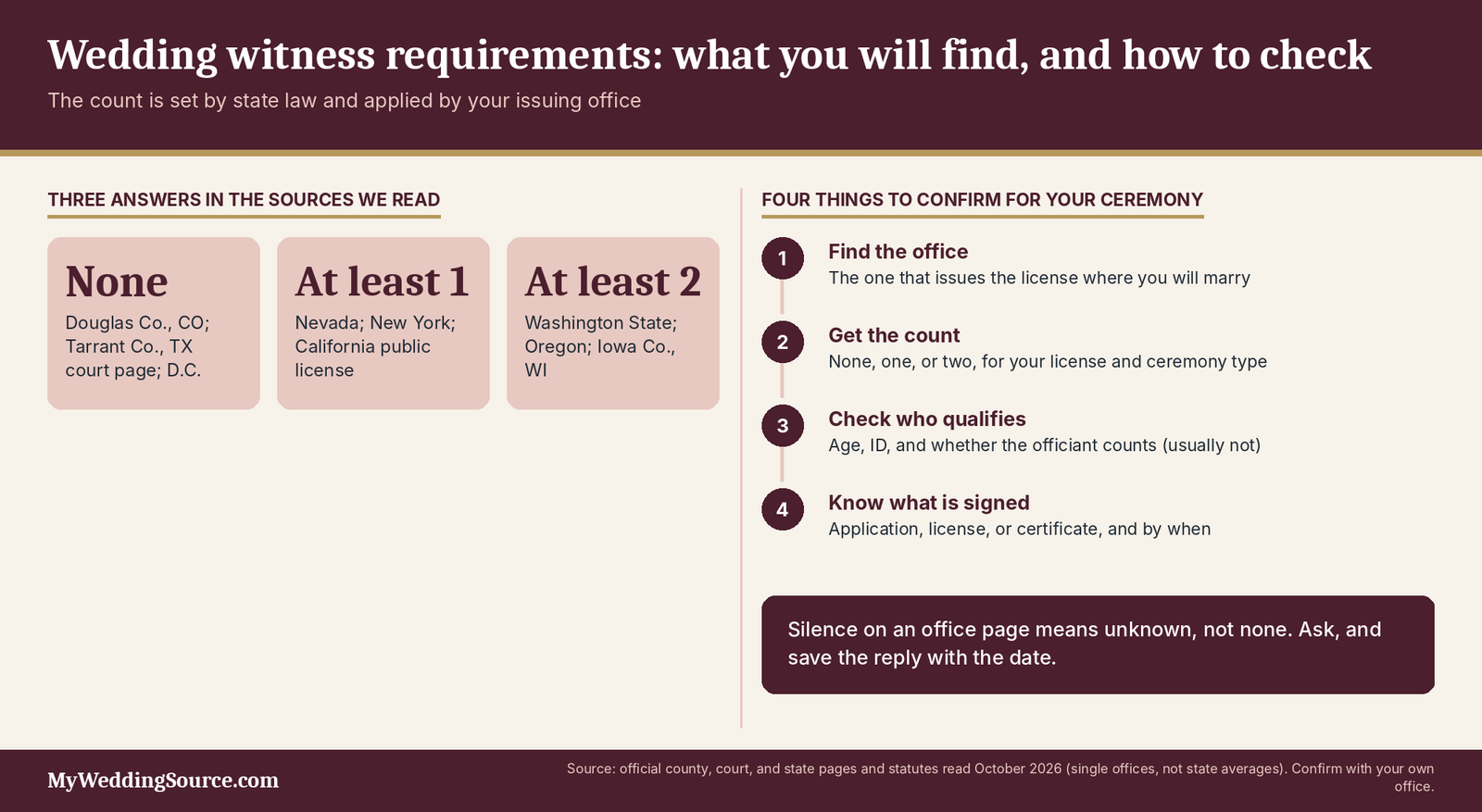
Several sources say outright that no witness is needed. Douglas County, Colorado says witness signatures are not required on the marriage license, though witnesses may sign if you want them to. Tarrant County, Texas has a justice court page for weddings it performs that states “No witnesses are required.” The District of Columbia Courts’ marriage FAQ says you do not need witnesses. These statements describe particular offices, and a neighboring county or a different type of ceremony may read differently, so treat “none” as a finding about the page you read, not a rule you can carry elsewhere.
Places where one witness is required
One witness is the middle of the range. Nevada’s statute says that in every case there shall be at least one witness present besides the person performing the ceremony, and Clark County repeats it in plain language. New York’s Domestic Relations Law section 12 sets the same floor. California’s Family Code section 359 contemplates at least one and no more than two witnesses for a public marriage, and Placer County’s page says one is required, with two also allowed. The upper limit matters: California counties like Tulare note that if you do have two witnesses, both must sign.
Places where two witnesses are required
Washington State’s RCW 26.04.070 says the couple declares their marriage in the presence of the officiant and at least two attending witnesses. Oregon’s ORS 106.150 uses the same two-witness floor. Iowa County, Wisconsin asks for two names and says they must be 18. Philadelphia’s self-uniting license, described below, also relies on two witnesses. If your wedding is in a two-witness place and you plan a tiny elopement, that second person is an extra logistics item you cannot skip, and it is worth solving early.
Same state, different paperwork
California: public versus confidential
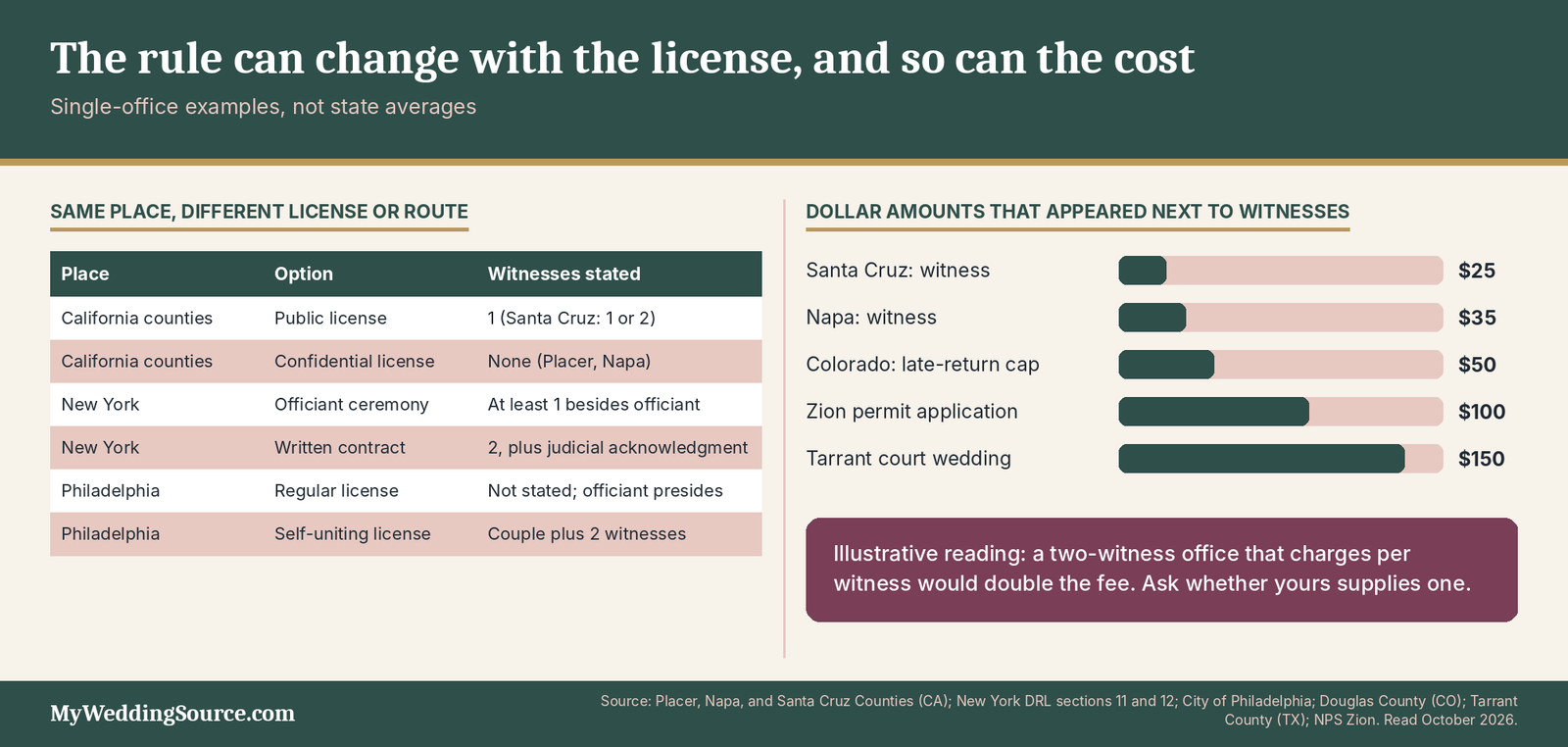
California is the clearest example of a rule that depends on the license rather than the state. Placer County’s page says one witness is required on the public license and that no witnesses are necessary for the confidential license. Napa County’s FAQ says the same split, adding that the public license is $83 and the confidential license is $95. Napa also says the office will provide a witness for $35, though its page does not say which license type that service applies to. Confidential licenses come with their own eligibility conditions, so the witness savings are not a reason to choose one, and you should read the county’s rules before deciding.
New York: two ways to be married
New York shows that the ceremony type can change the count. A ceremony with an authorized officiant needs at least one witness under section 12. Section 11 of the same law also lists a written contract of marriage as a route, and the text we read requires the parties and two witnesses to sign it, with acknowledgment before a judge of a court of record. That is a specialized, formal path that most couples will never use. It is still a useful reminder that the answer to “how many witnesses” can depend on which legal route you chose, not just where you stand.
Pennsylvania: the self-uniting license
Philadelphia’s marriage license page says a regular license needs an officiant qualified under 23 Pa.C.S. section 1503, and the officiant returns the signed license within 10 days. For a self-uniting license, it says the couple officiates their own ceremony and the couple and two witnesses sign the license, which the couple then returns within 10 days. The same page lists $90 for a regular license and $100 for a Quaker or self-uniting license. Dauphin County’s page, in turn, does not mention witnesses at all and simply tells couples who need a self-uniting license to say so at the start of the appointment. Same state, two pages, different levels of detail.
| Jurisdiction | Witness count stated | Detail worth noting |
|---|---|---|
| Douglas County, Colorado | Not required | Witnesses may sign if the couple wants them to |
| Tarrant County, Texas (justice court page) | Not required | Page describes weddings that court performs |
| Washington, D.C. | Not needed | Couples may apply to self-officiate in person |
| California (Placer County) | 1 on public; none on confidential | Statute allows up to two on a public marriage |
| Nevada (statute; Clark County) | At least 1 besides officiant | Officiant must be licensed in Nevada |
| New York (DRL section 12) | At least 1 besides officiant | Written-contract route uses two witnesses |
| Washington State (RCW 26.04.070) | At least 2 | Statute text says “attending witnesses” |
| Oregon (ORS 106.150) | At least 2 | Clerk’s commemorative certificate lists two |
| Iowa County, Wisconsin | 2, aged 18 | Names requested at application |
| Philadelphia, self-uniting license | Couple plus 2 witnesses | Returned within 10 days |
| Sheridan County, Wyoming | 1 third-party witness | Signs the application; ceremony rule not stated |
Who can be a witness: age, understanding, and relationship
What the sources we read actually say
Age: from no stated limit to 18
Age is where official pages differ most, and many say nothing at all. Iowa County, Wisconsin’s checklist states that witnesses signing the license must be 18 years of age. Tulare County, California says there is no age limit, but that witnesses should be old enough to understand they are witnessing a marriage and able to sign their names. Santa Cruz County, Clark County in Nevada, and Placer County state no minimum age on the pages we read. If your office is silent, the cautious move is to ask, and the easy habit is to choose adults regardless, since an adult witness removes a question you would otherwise have to settle with a clerk.
Understanding what is happening and being able to sign
Several sources frame the qualification as understanding rather than a birthday. The Tulare County page asks for someone who grasps that a marriage is being witnessed, and the Archdiocese of Baltimore’s policy on Catholic weddings says a witness must be over 18 and able to indicate what events transpired during the ceremony. That is a practical standard as much as a legal one: the point of a witness is that someone can later say what happened. It also explains why couples are told to choose a person who will be present, sober, and awake through the signing. A cousin who will be across the room dancing during the paperwork is a poor fit for a role that takes a few minutes and needs full attention.
Residency, relationship, and where the witness lives
Placer County states that there are no residency requirements for the parties or the witnesses, which is helpful news for a destination or out-of-state ceremony. None of the pages or statutes we read limited witnesses by family relationship to the couple, and none ruled out friends or relatives. Silence is not a guarantee, though, and a statute we did not read may differ. We did not find any of the sources addressing citizenship or immigration status, so if a guest from abroad is your likely witness, ask the office whether the same photo ID is acceptable. Treat every item here as a question to confirm for your own office.
Who cannot fill the role
The officiant
Where the rule says “besides the officiant,” as Nevada’s and New York’s statutes do, the officiant cannot count as your witness. That includes a friend who becomes your officiant through a one-day appointment: if they perform the ceremony, they are the officiant, not a witness. The reasoning is simple, since the law wants a second set of eyes on the event. This matters in small weddings where the officiant is also the person you would naturally ask for everything else. Count heads before the day: couple, officiant, and then however many witnesses your office requires.
The couple themselves
The partners are the two people being married, and the statutes we read treat the witnesses as additional attendees. Nevada says at least one witness present besides the person performing the ceremony, and New York’s section 12 says at least one witness beside the officiant. In the self-uniting examples, the couple signs and the witnesses sign separately, as Philadelphia’s page describes: the couple and two witnesses sign the license. That means a two-person elopement in a place that requires witnesses is not complete with just the two of you and an officiant. It needs outside people, which is a planning fact you want to learn before you book a remote trail or a private rooftop.
Someone who cannot stay for the signing or bring identification
Some witness duties have a document component. Sheridan County says the application witness must have photo identification, and Iowa County asks for names in advance. Clark County’s pages we read are silent on witness identification, which is exactly the kind of gap to resolve with a phone call. A witness who leaves right after the ceremony, forgets a pen, or cannot be reached for a missing address is a common cause of last-minute stress. Ask your witnesses to stay until the paperwork is finished, to carry photo ID, and to know their full legal name and mailing address.
| Source | Minimum age | Other conditions mentioned |
|---|---|---|
| Iowa County, Wisconsin | 18 | Two witnesses sign the license after the ceremony |
| Tulare County, California | No age limit stated | Old enough to understand; able to sign their name |
| Sheridan County, Wyoming | Not stated | Application witness must have photo identification |
| Santa Cruz County, California | Not stated | One or two witnesses must sign; county can provide one for $25 |
| Placer County, California | Not stated | No residency requirement for witnesses |
| Archdiocese of Baltimore (Catholic weddings) | Over 18 | Must be able to say what happened; Catholic witnesses preferred |
A lookup method: how to find the rule for your ceremony
Find the right office first
Start where the ceremony will happen
The rule that applies to you is generally the rule of the place where you marry, not where you live or where your guests do. The CDC’s Where to Write for Vital Records page tells you to determine the state or area where the marriage occurred and then open that state’s page, and USAGov says to contact the vital records office in the state where you plan to marry. If you are choosing between two venues across a county or state line, you may be choosing between two rule sets, so note both. Our companion guide on how to get a marriage license walks through finding the issuing office and reading the rest of its page.
Use official sources before blogs and look-alike sites
Offices go by different names: county clerk, recorder, register of wills, clerk of court, marriage bureau, or a state health department. Hawaii, for instance, handles marriage licenses through its Department of Health, where the page we read covers officiant licensing and does not mention witnesses. An official .gov page is the starting point because it is dated and accountable, while blogs and listicles tend to repeat older or mixed-up rules. If a site charges to “expedite” a license or sells a witness package, check that you are looking at a government office before paying. A good habit is to find the same fact on two official pages, such as the clerk’s page and the statute, and to be suspicious if they disagree.
Read three layers of rules
The office’s own page
The office page is the practical layer: what to bring, what to pay, whether appointments are required, and often how many witnesses. Its weakness is that it can be short, outdated, or silent. Several pages we read said nothing on witnesses at all, including Dauphin County, Pennsylvania, and the Clark County requirements page. Silence means “unknown,” not “none,” so a missing line becomes a question for the clerk.
The statute behind it
The statute is the legal layer, found on a state legislature’s website. Searching for words like “solemnization,” “attending witnesses,” or “witness” within the state’s family or domestic relations code usually leads to the right section, as with New York’s Domestic Relations Law, Washington’s RCW, or Nevada’s NRS. A statute tells you the baseline requirement, but it may not tell you how the local office handles it, and some statutes branch into multiple routes. Read it to understand the rule, not to argue with a clerk, and if the text leaves you unsure, ask the office or an attorney licensed in that state.
Your officiant’s and venue’s practice
The third layer is practical knowledge held by people who do this weekly. Experienced officiants can tell you which counties want witness names on the application, whether the office provides a witness, and how the return works. Ask your officiant what they have seen in your county and whether they bring a witness for small ceremonies. If your venue handles elopements or courthouse-style ceremonies, ask whether staff can serve as witnesses; our wedding photographer questions guide has a related list for another vendor who is often in the room.
Confirm and document
Questions worth asking the office
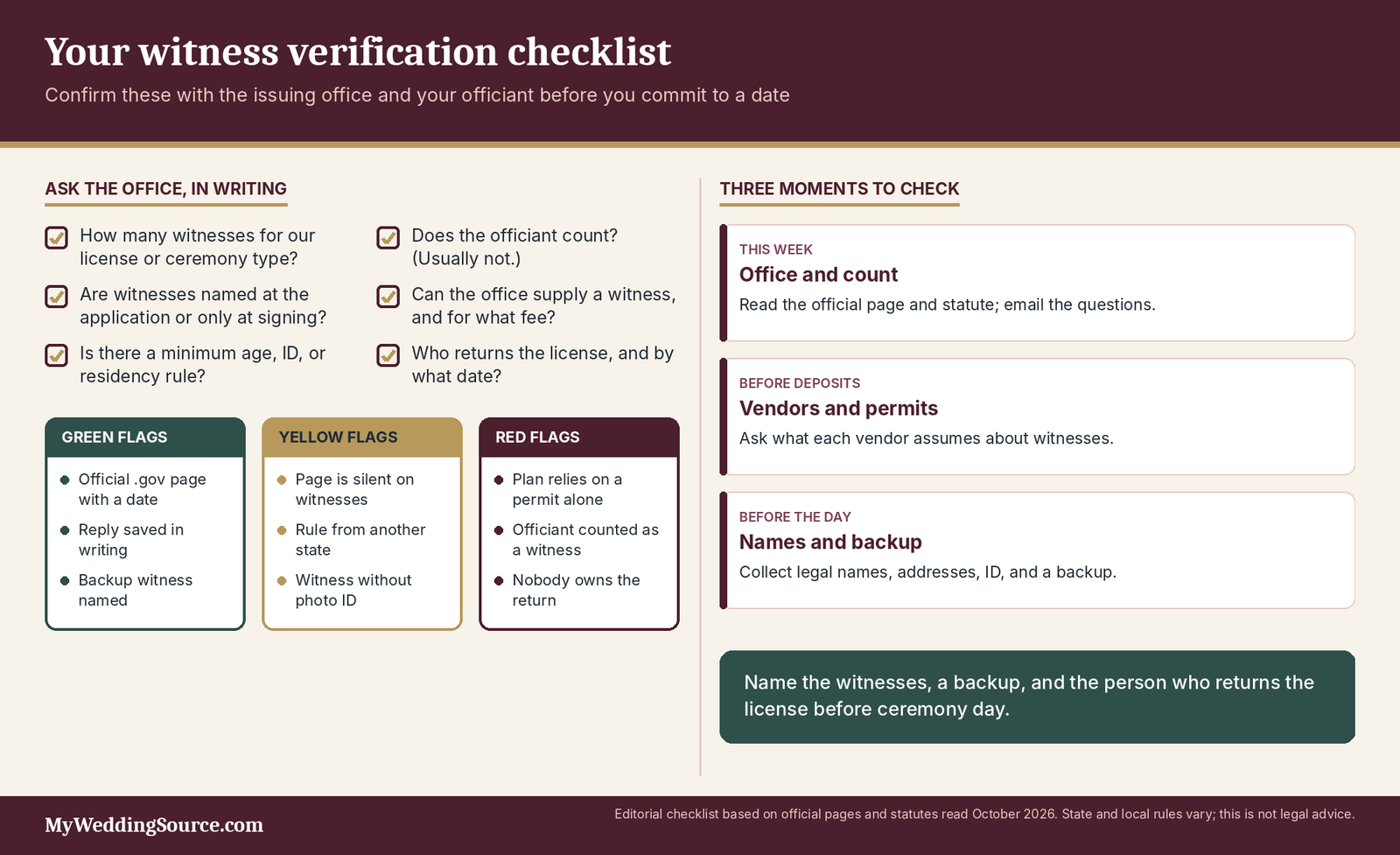
Send these as a short email so the answers arrive in writing. Offices are usually glad to answer, and it helps to mention your ceremony date and location so the reply fits your situation. If the response is vague, ask a follow-up in the same thread rather than starting a new one.
Save the answer with a date
Copy the clerk’s reply, the page address, and the date you read it into one note, and share it with your officiant and your planner. Pages change, and a screenshot of what the office said in October is useful in February if a question comes up. Add the witnesses’ full names and mailing addresses to the same note once chosen. Our wedding planning checklist is a place to drop this task alongside other legal items.
| Layer | What it tells you | What it can leave out |
|---|---|---|
| Office page | Fees, forms, appointment steps, often witness count | Silence on witnesses; outdated text |
| State statute | The baseline legal requirement and who may solemnize | Local procedure, forms, fees |
| Officiant or venue | Day-to-day practice in your county | Official answers; may be dated |
Elopements, courthouse weddings, and ceremonies with no guests
Finding witnesses when nobody is coming
Ask what the office or courthouse can provide
If your ceremony is small by design, the cleanest solution may be a witness supplied by the office. Santa Cruz County says that if you need the county to provide a witness, the fee is $25 per witness, and Napa County says its office will provide one for an additional $35. Those are single-office figures, and other offices may charge something different, nothing, or not offer the service. Ask when you schedule your appointment, since slots for ceremonies and witnesses can be limited and an unplanned request at the window may not be possible.
Bring a friend, a family member, or a vendor, with permission
For a destination elopement, a friend who travels with you is often the simplest witness, since the sources we read generally set few qualifications. If you will have a photographer or videographer present, they may be willing to serve, but ask first, and ask whether they are allowed to put down the camera for the signing. A working vendor may be bound by their contract, by their own policy, or by the office’s age and ID rules. A backup witness who is a guest, planner, or family member makes sense whenever the plan depends on a single outside person.
A park permit does not answer the legal question
Permits and legal requirements are different boxes. The National Park Service’s Zion wedding information sheet says a Special Use Permit is required for any ceremony in the park, explicitly including elopements, with a $100 application fee that must arrive at least three weeks before the date. The same sheet does not address marriage licenses, witnesses, or officiants, and it points couples to the park or their local county office. So a permitted ceremony can still be legally incomplete if you skip the license, the officiant, or the witness your state requires.
Self-solemnization and self-uniting routes
Colorado and the District of Columbia
Some jurisdictions let couples marry without a separate officiant. Douglas County says a couple can sign and record their license at the Recording office or at a self-solemnization ceremony elsewhere in Colorado, describing the result as legally binding. The District of Columbia Courts say you or your future spouse can apply to self-officiate by listing that person as the officiant, with both parties appearing in person at the Marriage Bureau with photo ID. Both sources report that witnesses are not required. The process has its own steps, so ask about appointments, ID, and return timing.
Pennsylvania and New York: more formalities, not fewer
Not every non-traditional route is lighter on paperwork. Philadelphia’s self-uniting license requires the couple and two witnesses to sign, and it costs $100 against $90 for a regular license. New York’s written-contract route requires witnesses and a judicial acknowledgment. These paths exist for particular traditions and circumstances, and they can be meaningful, but they do not reduce the number of people involved. Read the specific instructions before deciding that skipping an officiant simplifies the day.
Why a neighboring state’s plan may not fit
Elopement advice travels well, but legal details do not. A couple who read Colorado’s page and then drove to a Wyoming county would find, in Sheridan County’s case, a page asking for a third-party witness to sign the application. A couple who relies on a California confidential license for the no-witness rule would need to meet that license’s conditions. The better habit is to treat every source as describing one place on one date. If a post or video shows an elopement that worked somewhere else, use it for ideas, and use your own office for rules.
Religious ceremonies and the civil record: two sets of rules
When a faith tradition has its own witnesses
The Catholic requirement
Catholic weddings carry a church-law witness requirement that sits alongside, not instead of, the civil one. Canon 1108 of the Code of Canon Law, in the text published by the Vatican, refers to marriage being contracted “before two witnesses.” The Archdiocese of Baltimore’s policy adds that it is preferable for both witnesses to be Catholic, though non-Catholics may serve when circumstances warrant, and it states that civil requirements, such as a marriage license, must be met before the celebration. That is one archdiocese’s policy, so your parish may have its own forms and preferences. Ask the priest or deacon what the church needs, then separately confirm what the civil office needs.
Other traditions and special licenses
Other traditions have their own customs about who stands with the couple and who signs a ceremonial document, and the details differ by community and by clergy. We did not research each tradition’s practice, so the most direct source is your officiant or the leader of your congregation. One legal example sits in Pennsylvania: Philadelphia lists a Quaker license at $100 alongside the self-uniting license, with different procedures from a regular license. If your ceremony follows a tradition where the community plays an active role, ask whether it uses a special license, a particular certificate, or additional signatures. Then ask the civil office whether your plan fits its rules.
Keeping civil and religious paperwork apart
Which signature goes on which document
A wedding can generate several documents with signature lines: the civil license or certificate, a religious record kept by the congregation, a ketubah or similar ceremonial document, and a keepsake certificate. Only the first is the one the clerk files, and Oregon’s statute is a handy reminder that a commemorative certificate with two witnesses’ names is explicitly not the legal marriage record. Ask your officiant to tell you which document is which and who signs each. If you need witnesses for several documents, line them up before the ceremony so no one is chasing signatures during cocktail hour.
Using the same people twice
Many couples choose the same two people for civil and religious witness roles, which keeps things simple. Before you do, check that they meet the stricter of the two sets of requirements: the Baltimore policy asks for someone over 18 who can describe what happened, while a civil office might add photo ID or name-and-address details. If one of the people is a minor, a visiting relative without usable ID, or someone leaving early, split the roles. A simple chart of who signs what, written by your officiant or coordinator, is easier than reconstructing it on the day.
Choosing, briefing, and thanking your witnesses
Choosing the people
Traditional picks and modern alternatives
Many couples ask the best man and maid of honor, simply because they are already standing close by. Nothing in the official sources we read requires a member of the wedding party to be a witness, so you are free to choose whomever fits. Parents, grandparents, siblings, a close friend who is not in the wedding party, or a longtime mentor can all be meaningful choices when they meet the local qualifications. If you have a larger party and want to avoid ranking people, picking witnesses from outside the party removes the question.
Practical filters that prevent problems
Beyond sentiment, a few filters help. Choose adults who will be physically present at the moment of signing, who have photo ID, who know their full legal name and current mailing address, and who can sign clearly. Where the office asks for names in advance, as Iowa County does, you also need them chosen early enough to share details. Avoid assigning the role to someone who is also running a major task, such as the person responsible for the processional music or the one carrying the rings, unless you build in the time. A calm person with a pen is a better witness than a stressed one with three jobs.
Name a backup before the day
Illness, travel delays, and last-minute conflicts affect witnesses like anyone else. A named backup, who knows they are the backup and will be in the building, keeps a legal requirement from becoming a crisis. Tell your officiant who the backup is, and make sure the backup also meets the age and identification rules. If your office offers a paid witness, as Santa Cruz County and Napa County do, you also have a fallback if the plans for your own people fall apart.
Briefing and thanking them
What to bring and what to know
Send each witness a short note with the date, time, location, and the one thing you need from them. Ask them to carry government-issued photo ID, to confirm their legal name spelling and mailing address, and to arrive early enough to meet your officiant. Ask the officiant or the office whether a specific pen or ink color is required, since some offices have preferences. California’s statute, as we read it, contemplates the witnesses’ names, signatures, and addresses being recorded, and Oregon’s certificate calls for names and addresses, so an address ready in a phone note saves a scramble.
What the signature means, and what it does not
In the sources we read, a witness is asked to be present for the declaration and to sign or be named where the paperwork requires it. None of the pages we read assigned witnesses any further duty. A short explanation relieves anxiety: the signature records that they were there. It is not an endorsement of the marriage, a promise about the couple’s future, or a financial commitment. If a witness has a question about their role that goes beyond the instructions, send them to the office or the officiant.
Saying thank you
Thanking witnesses is a courtesy, not a legal step, and it does not need to cost much. A handwritten note, a mention during the ceremony, a seat near the front, or a framed photo of the signing all work. If you are also giving gifts to your wedding party, decide whether witnesses outside it get something comparable so no one feels left out. Keep it proportionate to your budget, and skip it entirely if a note is what feels right.
What witness requirements can add to your costs
The visible fees
License fees, and the way they differ by type
The license itself is the largest line item. Douglas County lists $30, Napa $83 for public and $95 for confidential, Philadelphia $90 for a regular license and $100 for a self-uniting or Quaker license, and Clark County $102 plus a card fee. These are single-office figures read in October 2026 and are not state averages. The point for witness planning is that the license type can change both the fee and the witness rule, so compare the total picture instead of the headline fee.
Witness fees where an office supplies one
Santa Cruz County charges $25 per witness and Napa County charges $35, and neither offer is universal. If a county page does not mention this service, assume it is unavailable until the clerk says otherwise. A two-witness requirement doubles the fee in an office that charges per witness. For a courthouse wedding where nobody is attending, the extra amount is small compared with a flight home to fetch a witness.
Ceremony, permit, and vendor time
A civil ceremony at a court can have its own price. Tarrant County’s justice court page lists $150 for weekday weddings, says it does not accept credit cards or checks, and notes different fees for after-hours, weekend, and holiday weddings. A Zion Special Use Permit starts with a $100 application fee, with additional administrative time billed at $50 per hour. If you hire a photographer for an elopement, ask whether the time at the courthouse, the permit location, or the signing is included in the package.
What goes wrong, and what it costs
Late or incomplete returns
The signed license has a deadline, and the numbers differ. Douglas County requires return within 63 days of the ceremony, with a minimum late fee of $20 plus $5 per day thereafter, not to exceed $50. Philadelphia says the officiant returns a regular license within 10 days, and so does the couple for a self-uniting license. Oregon’s statute asks the solemnizer to deliver the record within five calendar days, and Clark County says the officiant will file within ten calendar days. A missing witness signature can hold up the whole filing, so confirm the signatures are complete before everyone leaves.
Questions about validity
We found no source in this research that answers how a missing or ineligible witness would affect a marriage’s validity, and the answer depends on state law. The closest examples concern officiants: Dauphin County and Philadelphia both warn that if you use someone not qualified under Pennsylvania law, the burden of proof for the marriage’s legality is on the couple. Treat that as a signal to be careful rather than a rule about witnesses. If anything goes wrong, contact the issuing office promptly, and consider an attorney licensed in that state for questions about validity.
| Layer | Example from the sources | Planning note |
|---|---|---|
| License fee | $30 (Douglas, CO) to $102 (Clark, NV) | Fee may vary by license type |
| Office-provided witness | $25 (Santa Cruz, CA); $35 (Napa, CA) | Ask whether it applies to your license |
| Court ceremony | $150 weekday (Tarrant County, TX justice court) | Cash only on that page |
| Park permit | $100 application (Zion NPS) | Does not cover license or witnesses |
| Late return | $20 minimum plus $5 per day, capped at $50 (Douglas, CO) | Return deadlines vary by office |
When plans change: scenarios and edge cases
Day-of problems
A witness cancels or arrives late
Illustrative example, not a quote: a couple marrying in a two-witness state learns on the morning of the ceremony that one witness is stuck in traffic. With a named backup, the officiant simply asks the backup to step in, and the signature goes on the license at the planned moment. Without one, the couple may have to ask the venue staff, see whether the office offers a witness, or delay. The lesson is that the requirement counts people at the moment of the ceremony, so the most reliable insurance is one extra person who meets the same rules.
Names, IDs, and handwriting
Mistakes on the signature line are small but annoying. A witness who prints a nickname, forgets a middle initial the office requires, or writes an unreadable address can cause confusion when the clerk records the license. Ask the office whether it wants a signature, a printed name, or both, and ask the witnesses to bring ID so they can match what is printed. If the license is returned with questions, the clerk may contact the officiant or the couple, so list phone numbers on your planning note.
The license is signed, but nobody is holding it
At the end of the ceremony the license has signatures from the couple, officiant, and witnesses, and it has to travel to the office. Decide who carries it, who confirms it was filed, and who calls the clerk if nothing is recorded. Our guide on how to get a marriage license goes through the return step in detail, and the wedding timeline guide can hold the deadline on your calendar. Naming one person turns a shared assumption into an assignment.
Plans that cross borders or skip the license
Marrying in another state
If you plan a ceremony away from home, apply in the place where you will marry and read its witness rule for your license and ceremony type. Your home state’s rule does not travel with you, and a friend’s experience from a third state tells you little. Out-of-state witnesses are often fine; Placer County, for instance, states that there is no residency requirement for them. Build the unfamiliar office’s deadlines into your travel plan and ask what documents the local witnesses need to bring.
Marrying abroad
Overseas rules belong to the country where you marry. The State Department says you must follow local laws when marrying abroad, that local law decides who can perform marriages, and that embassy and consulate employees cannot perform marriages in foreign countries. The page we read does not mention witnesses, so ask the local authority or your wedding provider about the witness count and qualifications, and about documents. Our destination wedding checklist covers other planning items to line up.
Symbolic ceremonies and vow renewals
A ceremony that is not meant to create a legal marriage, such as a vow renewal or a celebration held after a courthouse wedding, does not involve a license, so the witness rules in this article have no document to attach to. Couples often hold the legal signing separately and the celebration later, which gives each part its own purpose. If you are unsure whether your plan is legally a marriage, ask the clerk before the date. A friend or family member can still stand up with you as a ceremonial witness, and no signature is needed unless you choose to make one a keepsake.
| Scenario | What to check | Likely fix |
|---|---|---|
| Witness cancels | Does the backup meet age and ID rules? | Step in the backup or ask the office or venue |
| Elopement in a remote spot | Witness count, permit, officiant | Bring witnesses or book an office-provided one |
| Out-of-state ceremony | Local office rules, deadlines | Apply in the ceremony state and verify |
| Religious plus civil | Whose signature is on which record | Chart signers with the officiant |
| Overseas ceremony | Local authority requirements | Ask the local office or provider early |
FAQ: wedding witness requirements couples ask
Before the wedding
Do we need witnesses to get married?
It depends on where you marry and sometimes on the type of license or ceremony. In the sources we read, Douglas County, Colorado and the District of Columbia Courts say no witnesses are needed, Nevada and New York require at least one besides the officiant, and Washington State and Oregon require at least two. California’s answer depends on whether the license is public or confidential. Ask the office that will issue your license, and get the answer in writing.
Can our officiant also be one of our witnesses?
Where statutes say the witness is present “besides” the person performing the ceremony, as Nevada’s and New York’s do, the officiant does not count as a witness. A friend who performs the ceremony through a one-day designation is still the officiant for that purpose. Plan for the officiant plus however many witnesses the rule requires. If your office’s wording is unclear, ask directly whether the officiant can sign in both roles.
Can a relative, a friend, or a minor serve as a witness?
The sources we read did not restrict witnesses by relationship, so relatives and friends were not excluded. Age rules vary: Iowa County, Wisconsin requires witnesses to be 18, while Tulare County, California says there is no age limit but the witness should understand what is happening and be able to sign. Because some offices say nothing about age, the simplest approach is to ask your office and choose adults with photo ID. A minor witness is a question to settle in advance, never on the day.
On the day and afterward
What happens if we do not have enough witnesses?
The practical options are a backup witness, an office-provided witness where available, or another date. Santa Cruz County and Napa County both describe providing a witness for a fee, but only some offices do. We did not find a source that answers whether a missing witness affects validity, and that depends on state law, so do not rely on proceeding without one. Contact the issuing office right away and, if needed, a local attorney.
Do witnesses need to attend the reception?
No source we read ties the witness role to the reception. The legal role is to be present at the ceremony and to sign or be named as the paperwork requires. Many couples hope their witnesses will attend the whole event because they are close friends, but that is an invitation, not a legal requirement. If your witnesses are not guests, such as office staff or vendors, thank them and let them go.
Can a witness attend by video?
We did not find official guidance in the sources we read on remote witnesses at a marriage ceremony. Some offices handle applications remotely, but that is a different step from the ceremony, and the rules can differ by office and over time. Do not assume that a video link counts. Ask your office and officiant whether a witness may attend remotely, and if the answer is yes, get the instructions in writing.
Your next steps
This week
Identify the office and read its page
Decide where the legal ceremony will happen, then find the clerk, recorder, register of wills, or equivalent office for that place. Read its marriage license page, note the date you read it, and write down what it says about witnesses, officiants, and the signed license. If the page is silent, mark it as unknown. Then look up the statute on the state legislature’s website to see the baseline rule.
Send the six-question email
Send the questions from the lookup section to the office, copy your officiant, and ask for a written reply. Mention your ceremony date and location, and ask whether the rule changes with the license type. Save the answer in your planning folder with the page address and date. Our wedding planning guide shows where this task fits in a larger planning order.
Before you pay a deposit
Check the vendors and permits against the rule
Before you pay a deposit to an officiant, a photographer, or a permit office, ask what they assume about witnesses. An officiant may bring a witness or expect you to supply one, a photographer may decline to sign, and a permit does not replace the legal requirements. If any contract depends on a witness appearing at a particular time, put that in writing. This is also the moment to compare the fees with your total budget.
Name your witnesses and a backup
Choose the witnesses and a backup who meet the age and ID rules, ask each in person or by phone, and send them the logistics note. Collect legal names and mailing addresses in one document and give a copy to your officiant. Put the license return deadline on your calendar. Once those steps are done, the paperwork will not stand in the way of the day itself.
Sources & methodology
- Placer County, California: marriage licenses — one witness on a public license, none on a confidential license, and no residency requirement for witnesses.
- Napa County, California: FAQs — public and confidential fees, witness requirement, and office-provided witness fee.
- Santa Cruz County, California: public marriage licenses — one or two witnesses who sign, and a county witness fee.
- Tulare County, California: marriage license — one witness on a public license, up to two, and the understanding standard.
- California Family Code section 359 — witness count and recorded details for a public marriage.
- New York Domestic Relations Law sections 11 and 12 — one witness besides the officiant, plus the written-contract route with two witnesses.
- Nevada Revised Statutes chapter 122 and Clark County, Nevada — at least one witness besides the officiant, licensed officiant, and fees.
- Washington RCW 26.04.070 — at least two attending witnesses.
- Oregon ORS chapter 106 — two witnesses, commemorative certificate, and record delivery.
- Iowa County, Wisconsin: marriage license checklist — two named witnesses aged 18.
- Douglas County, Colorado: marriage licenses — witness signatures not required, self-solemnization, fee, return deadline, and late fee.
- Tarrant County, Texas justice court weddings — no witnesses required and court ceremony fee; Cooke County — no witnesses needed to obtain the license.
- District of Columbia Courts: marriage FAQs — no witnesses needed and self-officiating.
- City of Philadelphia: get a marriage license — self-uniting license with two witnesses, fees, and return deadlines; Dauphin County — officiant disclaimer.
- Sheridan County, Wyoming: marriage license information — third-party witness on the application.
- Miami-Dade Clerk and Hawaii Department of Health — officiant categories and pages that do not state witness rules.
- Archdiocese of Baltimore policy 402 and the Code of Canon Law, Book IV — Catholic witness requirements.
- National Park Service, Zion wedding information sheet — special use permit for any ceremony, fees, and no license or witness guidance.
- U.S. Department of State: marriage abroad and USAGov: marriage certificates — local law abroad and applying in the state where you marry.
- CDC: Where to Write for Vital Records — locating the right state office by where the marriage occurred.
Methodology. Statutory witness counts for Nevada, New York, Washington, and Oregon and the Vatican canon text are verified from the cited texts. County and court details are statements on official pages read in October 2026, and each describes one office, not a state average. Where a source was silent, we say so and treat it as unknown. The scenarios, the three-layer lookup method, and the advice on choosing witnesses are editorial judgment and illustrative examples, not legal advice, and we did not find authoritative sources on witness qualifications beyond those cited.
Freshness note. Recheck your own office’s page and the statute when you start planning and again a few weeks before the ceremony, because fees, forms, and procedures change. Confirm any witness fee, age rule, or application-day requirement directly with the office. If your plans move to a new county, state, or country, restart the lookup for the new place.