
Choosing between groomsmen suits vs tuxedos comes down to a handful of facts you can check, namely the formality and start time of your wedding, what each outfit really costs per person once you add everything up, how many times anyone will wear it again, and how much time you have to fit and return it, so this guide walks through those checks in the order that settles the question fastest.
Quick answer
Pick a tuxedo when the wedding is formal and in the evening, when you have written “black tie” on the invitation, or when you want a large group to look uniform with the least effort. Pick suits when the wedding is daytime, warm, semi-formal or casual, or when your groomsmen will realistically wear the outfit again. For a single use, renting is usually the cheaper route for either garment, and buying starts to win only after the wear count passes a break-even you can calculate (we show how below). In the groomsmen suits vs tuxedos decision, the groom and couple set the standard, the dress code is the biggest deal-breaker, and cost, fit, and timing break ties.
Groomsmen suits vs tuxedos: what actually separates the two
Before weighing cost or style, it helps to be precise about what you are choosing between. The two outfits share most of their parts, and the differences are small, visible, and tied to formality. Once those differences are clear, the groomsmen suits vs tuxedos question stops being about taste and starts being about which signal you want the wedding party to send.
The garments, piece by piece
A suit and a tuxedo are both a jacket and trousers worn with a dress shirt. What changes is the trim, the shirt, the neckwear, and the shoes. The Knot describes a tuxedo as a formal suit with satin detailing, and Zola’s guide lists the same markers. Knowing the list matters because rental companies, tailors, and groomsmen will use the words loosely, and a quote for “a tux” can mean quite different things at two different shops.
What makes a tuxedo a tuxedo
According to The Knot, tuxedos traditionally have satin lapels and a contrasting satin stripe down the outside of each trouser leg, and the satin typically shows up on the waistband and sometimes on the pockets and button coverings as well. A tuxedo shirt is made for cufflinks and decorative studs instead of ordinary buttons, the neckwear is a bow tie, and the shoes are patent leather or highly polished formal shoes, with a cummerbund as the traditional waist covering. Zola adds that a tuxedo is usually paired with a bow tie and either a cummerbund or a vest, and that some jackets have tails. Zola also notes that tuxedo shirts are typically white with black buttons or studs, and that black is the most widely available color.
None of this is a legal definition, and shops interpret it differently. A jacket with a narrow band of satin on the lapel and a bow tie may be sold as a tuxedo at one retailer and a dinner jacket at another. When you compare groomsmen suits vs tuxedos, ask any seller to list which of these parts come with the outfit so you are not comparing a complete tuxedo to half of one.

What stays the same
A suit is a matching jacket and trousers in the same fabric, usually worn with a standard dress shirt, a necktie, and classic leather dress shoes, per The Knot. Suits come single-breasted, double-breasted, or as three-piece sets with a vest, and in fabrics from linen to flannel, so they stretch across a wide range of occasions. Under both outfits the same fit rules apply, and the same body measurements are used, which is why the fitting advice later in this guide applies to either choice.
The overlap is also why mixing is possible. A groomsman in a navy suit and a groom in a black tuxedo share a silhouette, and a wedding party in suits can still look polished when the details are coordinated. The Knot notes that couples sometimes put the groom in a tuxedo and the party in coordinated suits, or ask everyone to wear tuxedos. Both are normal, as long as the choice is deliberate.
Why the label on the invitation matters
The strongest single input is the dress code you have already announced or intend to announce. In the groomsmen suits vs tuxedos decision, an outfit that contradicts the invitation makes the whole wedding look unplanned, and an outfit that supports it does the opposite. Our guides to black tie weddings and cocktail attire cover the codes themselves, and this section only ties them to the wedding party.
The dress code ladder
The Knot says tuxedos are generally for black-tie evening events and are required at white-tie and black-tie events. For black-tie-optional events a tuxedo is not required and a formally styled suit is enough, and for cocktail attire and below, suits are appropriate while tuxedos are not. The Knot also says a black suit is not an acceptable substitute for a tuxedo at a white-tie or black-tie wedding. Generation Tux, a rental retailer, draws a similar ladder: tuxedo for black tie, tuxedo or a sharp suit for formal, suits preferred for semi-formal, and casual outfits such as khakis and collared shirts for casual weddings. Because that is a retailer’s view, treat it as one reading rather than the rule, but the three sources point in the same direction.
If you want one sentence to remember, it is this: for black tie, the tuxedo is the answer, and for cocktail attire or below, the suit is. The middle band, formal and black-tie optional, is where the groomsmen suits vs tuxedos choice is truly open, and it is the band where cost, season, and fit decide.
Time of day and what Americans actually do
The Gentleman’s Gazette, a men’s style publication, says black tie is evening dress, with evening starting at sundown or 6 p.m., whichever comes first. It adds that tuxedos are generally not worn in daylight, and that in the United States the tuxedo is more often treated as all-purpose formal wear than in the UK, Western Europe, or Japan. It lists weddings that begin after 6 p.m. as a place where groomsmen typically wear tuxedos, and observes that at most weddings only the groomsmen wear tuxedos while other men wear formally styled suits.
Generation Tux likewise calls a tuxedo a stronger fit for an evening ceremony or a large formal indoor venue like a ballroom, and suits usually better for daytime and summer weddings. Put together, a 4 p.m. ceremony in a garden and a 7 p.m. dinner in a hotel ballroom are different questions even if the guest list is identical. If your start time straddles the line, the wedding photography plan and the lighting are worth thinking about too, and our wedding photography guide covers how formal clothing photographs across a day.
The criteria that actually change the choice
Most online comparisons of groomsmen suits vs tuxedos list fifteen pros and cons and leave you where you started. A shorter method works better: separate the criteria that can end the decision on their own from the ones that only nudge it, then weigh the nudges.
Deal-breakers before preferences
A deal-breaker is a fact that rules an option out regardless of how much you like it. A preference is a feeling that can be traded against cost. Mixing the two is the main reason couples go around in circles, because a preference gets argued as though it were a rule.
Deal-breakers that decide it for you
Four facts can end the discussion. First, a stated “black tie” dress code, because The Knot says a tuxedo is required at black-tie events and that a black suit does not substitute. Second, a wedding that is plainly casual or on a beach, where Zola says a tuxedo looks out of place and The Knot says tuxedos are not appropriate at cocktail attire and below. Third, a religious or cultural ceremony that calls for specific clothing, which Zola says may require a specialty clothier or tailor. Fourth, a hard budget ceiling that a groomsman cannot exceed, since the traditional etiquette is that groomsmen pay for their own outfits, as Zola and Emily Post both describe.
If none of these four apply, your groomsmen suits vs tuxedos decision is in preference territory and you have room to choose. If one applies, you have already decided, and the rest of this guide helps you execute it well.
Preferences you can trade
Preferences include the look of a bow tie versus a long tie, how modern or traditional you want the photographs to feel, whether you want color or pattern, and how much you value uniformity. Zola says tuxedos create cohesion for a large group with less effort, while suits allow more personalization to match the theme. Those are real advantages, but they are tradeable. A group in matching navy suits and the same tie is quite uniform, and a group in tuxedos can look uneven if the fits are off.
Write your groomsmen suits vs tuxedos preferences down in rank order before you visit any shop. Salespeople and group-order tools tend to steer toward the full package, and a ranked list protects you from drifting into a choice you did not intend.
Weighing cost, logistics, experience, and flexibility
Once the deal-breakers are out of the way, four factors do most of the work: what it costs each person, how hard it is to coordinate, how the outfit feels to wear for ten hours, and how flexible you are if someone’s size, budget, or location changes.
A simple scoring method
Give each factor a weight from 1 to 3 according to how much it matters to you, then score suits and tuxedos from 0 to 2 on each. Multiply, add up, and compare. Nothing about this method is scientific, and the numbers are yours, but it forces a trade-off into the open. A couple whose groomsmen live in four time zones might weight logistics at 3 and cost at 2, while a couple whose party is local and in their twenties might reverse that.
If suits and tuxedos land within a point of each other, you have learned something useful: the groomsmen suits vs tuxedos decision does not matter much, so choose the one that is easier to organize. If the scores are far apart, trust the result and move on.
Who sets the standard
Generation Tux says the groom sets the standard and that groomsmen usually match his choice, because a groomsman in a tuxedo can upstage a groom in a suit and the reverse is also true. The Knot says the couple decides, and that a groom in a tuxedo with a party in coordinated suits is a normal pairing at a semi-formal wedding. These sources differ slightly, and that difference is a useful signal: matching is common, but a deliberate step-up for the groom is accepted.
Ask your partner’s party about their outfits, too. Zola notes that the groom should match the level of dressiness of his partner’s outfit, which is a better rule than any style trend. If the people at the altar are dressed at different levels of formality, the photographs will show it.
Questions to settle before you shop
- What dress code are we putting on the invitation and website, and what time does the ceremony start?
- Will each groomsman pay for his own outfit, and has everyone been told the likely cost?
- Do any groomsmen already own a suit that would work, or a tuxedo they would wear again?
- How many groomsmen live outside our area, and can they be measured in person?
- Is the groom matching the party or stepping up one level?
- Who is the contact person for orders, fit problems, and returns?
| Criterion | Tuxedo | Suit | What tips it |
|---|---|---|---|
| Stated dress code | Required for black tie; safe for formal | Right for cocktail attire and below; fine for black-tie optional | The invitation wording |
| Start time | Strongest in the evening, after about 6 p.m. | Strongest in daylight | Whether the ceremony is before or after sundown |
| Uniformity | High, especially for large groups | Good, but depends on matching fabric and fit | Party size and how much variety you want |
| Cost to rent | Usually lower, according to Zola | Usually higher, according to Zola | Quotes for the exact outfit |
| Cost to buy | Often higher, around $700 to $1,000 or more per The Knot | Often lower, around $300 to $800 for a three-piece per The Knot | Price of the garment you would actually buy |
| Reuse | Rare, unless the wearer attends formal events | Easy; works for work and events | Honest count of future wears |
| Comfort in heat | Can feel stuffy in summer, per one rental retailer | Easier to choose a lighter fabric | Season, venue, and shade |
| Personalization | Limited; the code is the look | Wide range of colors and cuts | How much theme you want |
Reading the matrix
Treat the matrix as a conversation starter and not a verdict. The rows are editorial synthesis from the sources named in the table, and no source weighs them for you.
Count the rows that agree
Go down the right-hand column and mark which option each row favors in your own groomsmen suits vs tuxedos comparison. If most rows lean one way, you have your answer. If the rows split, move to the cost and timeline sections, because those are the two areas where a small difference in facts changes the outcome.
Which row should win a tie
If the dress code row and the cost row disagree, we would weight the dress code more heavily, because it shapes how every guest reads the wedding, while a cost gap can usually be narrowed by shopping, rentals, or the couple covering part of the price. That is our editorial judgment, not a survey finding, and a couple facing hardship among the groomsmen may reasonably weigh it differently.
Comparing offers like with like
Prices in a groomsmen suits vs tuxedos comparison look simple on a web page and become complicated at checkout. A rental that starts at one number may end at another, and a purchased suit has costs that never appear in its tag price. Normalizing the offers is the way to see the real difference between groomsmen suits vs tuxedos in dollars.
Normalize package contents and time coverage
The method for pricing groomsmen suits vs tuxedos fairly is to turn every offer into a per-person, all-in, whole-event figure. Anything not in the offer must be added, and anything that expires too early must be extended or flagged.
List what is in the box
For a rental, ask whether the price includes jacket, trousers, shirt, tie or bow tie, cummerbund or vest, studs and cufflinks, belt or suspenders, and shoes. The Knot says small items such as cufflinks, studs, pocket squares, and cummerbunds add about $10 to $15 each when rented, and vests and shoes about $30 each. Some companies also rent only the jacket and pants at a lower price, and full packages add accessories. A “from” price of $139 or $159, which is the kind of starting figure The Knot lists for major rental companies, is for a base package, so confirm what the base contains.
For a purchase, the tag price is usually the jacket and trousers, and the shirt, tie, shoes, and alterations are extra. The Knot says extra costs include a shirt, tie, shoes, and possibly alterations unless you buy from an all-inclusive brand. Write each item on a line and put a price next to it, even if the price is zero.
Check the time covered and the fees
Rental prices cover a rental period, so confirm the delivery date, the event date, and the return deadline, and ask what a late return costs. The Black Tux, a rental retailer, publishes a $60 late fee and optional extensions of $15 for one day, $40 for three days, and $80 for seven days on its timeline page. Men’s Wearhouse includes taxes and a $12 damage and handling fee, according to The Knot, and The Black Tux charges a flat $12 fee that covers normal wear, dry cleaning, and restocking labor. Other retailers may add a damage waiver or rental insurance line.
Add fees to the per-person figure, because they apply to every groomsman and multiply across the party. Prices and policies change, so the figures here are examples of what to look for and not current quotes.
Features that sound equivalent but are not
Two offers can use the same words and mean different things. A few phrases deserve a follow-up question each, and a few come with legal labeling rules that help you read them.
Fit guarantee versus alterations
Generation Tux says it guarantees the right fit for your event and that rentals do not offer personal alterations the way a purchased tuxedo does. The Black Tux says it reimburses up to $15 per jacket or pair of pants for minor tailoring if you submit the receipt within 30 days of the event, and The Knot says Friar Tux reimburses up to $15 for temporary alterations when a rental does not fit. A fit guarantee is therefore typically a promise to exchange the garment, not to tailor it, and the two are not the same remedy.
Ask three things: how long you have to report a fit problem, how fast a replacement arrives, and what happens if the replacement does not arrive in time. The Black Tux says a fit issue should be reported within 48 hours of delivery for a free replacement, and that orders placed within five days of the event may not arrive in time. For a tailored purchase, the tailor’s deadline is the one that matters.
Fabric claims and what the label must say
Fabric is where the biggest value gap hides. The Knot reports that The Black Tux says its fully canvassed, fine-wool tuxedos would cost at least $1,500 to buy at retail yet rent at about the price of fused, synthetic tuxedos sold elsewhere, and that wool is considered the gold standard for tuxedo fabric while budget tuxedos are usually polyester or rayon. That is a retailer’s claim reported by The Knot, but it shows why a rental of a wool garment can be better value than a cheap purchase.
For purchases, U.S. law gives you a way to check. The Federal Trade Commission says labels on textile and wool products must show fiber content by percentage, the country of origin, and the company identity, and that terms such as “Super 120’s” may be used only if the wool meets the matching fiber-diameter threshold. A hang tag that praises a fabric must be consistent with the sewn-in label, and the FTC’s care labeling rule says garments need a permanent label with a washing or dry-cleaning instruction, so you can also learn up front whether a suit needs professional cleaning after each wear. Read the label before you pay and, if the hang tag and label disagree, ask the seller to explain. This is general information about the rule and is not legal advice.
Cost, rewear, and the point where buying wins
Cost is where the groomsmen suits vs tuxedos debate is most often argued from the wrong numbers. A tag price for a suit is compared with a rental price for a tuxedo, and the two are not the same kind of price. The sections below separate the sourced figures from our own arithmetic so you can see which is which.
Rental math
Renting converts a purchase into a fee for a few days of use. It removes storage, cleaning, and alteration decisions, and it caps the cost of a single wear.
The figures we found
The Knot’s 2025 Real Weddings Study, which covered 16,956 U.S. couples married in 2024, put the average cost for a male partner renting ceremony attire at $205, across all attire types from suits to custom tuxedos. The Knot’s rental guide says major retailers such as The Black Tux and Men’s Wearhouse average about $150 per rental and that a typical total, depending on type and accessories, is $150 to $300. A second Knot article gives a range of about $100 to $300. Starting prices differ by article and by date: one Knot piece lists The Black Tux at $129 and Men’s Wearhouse at $159, and another lists them at $149 and $138. That mismatch is itself the lesson, because retailer prices move and published lists age quickly.
We found no published average for what a groomsman pays for a suit or tuxedo in the U.S. The Knot’s 2026 Real Weddings Study, covering 10,474 couples married in 2025, reports an average wedding cost of $34,200, with 117 guests on average, but does not list a figure for suits or tuxedos. Treat the figures above as retailer and survey figures for groomsmen suits vs tuxedos, and get actual quotes for your party.
A worked example for five groomsmen
What it can cost: an editorial estimate
Assume five groomsmen each rent a tuxedo with a base price of $150 to $300 (The Knot’s typical range), add studs and cufflinks at $10 to $15 each and shoes at about $30 (The Knot’s accessory figures), which comes to $50 to $60 per person, and pay a $12 handling fee like the flat fee The Knot says The Black Tux charges. That is $212 to $372 per person, or about $1,060 to $1,860 for five, before shipping, taxes, and any damage waiver. Adding the groom brings six rentals to about $1,272 to $2,232. This is our arithmetic using published figures, not a quote, and your retailer’s package and fees will differ.
The point of the worked example is the method: take a sourced base price, add every accessory and fee you will actually pay, and multiply by headcount. When two retailers’ totals differ, the gap is the number to negotiate or investigate. For a wider budget view, our wedding budget calculator can hold the attire line next to everything else.
Buying math and rewear
Buying a suit or tuxedo makes sense when the wear count is high enough, when the buyer wants a garment tailored to him, or when the rental price is already close to the purchase price. It makes less sense when the outfit stays in a closet.
Break-even wears, with our arithmetic
The Knot says a three-piece suit costs roughly $300 to $800, that a tuxedo costs roughly $700 to $1,000 or more, and that an entry-level suit is about $200 while a tuxedo starts around $300. It suggests buying a tuxedo if you expect to wear it at least two more times. Generation Tux gives a retailer example of a $1,500 custom tuxedo that would need at least seven wears to be worth the money. Our own check of the same idea is simple: divide the purchase price by the rental price. A $300 suit against a $150 rental breaks even at 2 wears, an $800 suit against a $300 rental at about 3 wears, and an $800 suit against a $150 rental at about 5 to 6 wears. A $1,500 tuxedo against a $200 rental is about 7.5 wears, which matches the retailer’s figure.
That formula for groomsmen suits vs tuxedos leaves out alterations, accessories, cleaning, and storage, so the real break-even is higher. It also assumes the garment is worn. Ask each groomsman what he will honestly wear again in the next two years, and use that number instead of an optimistic one.

Who pays, and keeping it fair
Zola says that traditionally groomsmen pay for their own suits or tuxedos and accessories, that the groom chooses the style, and that the couple should tell people the cost when asking them to stand up. Emily Post says attendants pay for their own wedding clothing and accessories but not the flowers. The Knot says groomsmen typically buy or rent their own outfit, that the groom may let them wear clothes from their own wardrobes as a more affordable option, and that accessories are usually the groomsman’s responsibility unless the groom gifts specific pieces. It also cites a $160 average gift from wedding party members, from a 2023 Real Wedding Guest Study, as one more cost to the group.
Zola says the groom might pay when a groomsman is financially strained, when the chosen pieces are very expensive, or when the groom simply wants to. Whether to cover part of the cost of groomsmen suits vs tuxedos is a personal decision, not a rule. A practical way to keep groomsmen suits vs tuxedos fair is to set a per-person ceiling before you pick the outfit, so the budget picks the style and not the other way around. If you are planning how attire fits into a bigger set of expectations for the party, our wedding etiquette guide is a good companion.
Hidden labor, fees, space, and coordination
Some costs never show on a price tag. They are measured in hours, storage, and awkward text messages, and they differ between the two choices in ways that are easy to miss.
What a rental hides and what a purchase hides
A rental hides the return. The Black Tux says rentals must be returned within three calendar days after the event, with a prepaid label, and that a late return incurs a $60 fee. Emily Post notes that the best man handles the groom’s rentals and that groomsmen coordinate returns with the head usher or best man. At a destination wedding or a wedding with a Sunday departure, those three days can fall during travel, so someone has to own the return.
A purchase hides the tailoring and the closet. Alterations may be needed, Zola says to steam, press, wash, and store outfits properly in a dry, temperature-stable, pest-free place, and a groomsman who buys a garment becomes responsible for it for years. Neither route is free of labor, and the groomsmen suits vs tuxedos question is which labor your party will actually do.
The point where one option stops being cheaper
In groomsmen suits vs tuxedos terms, suits are the cheaper garment to buy and, per Zola, the more expensive garment to rent, while tuxedos are the reverse, so the crossover is real. If the party rents, tuxedos are usually the lower-cost route. If the party buys and expects to reuse, suits are. The crossover depends on the wear count, so the simplest test is to estimate each groomsman’s reuse honestly, compute the break-even above, and compare it with the number.
When the party is mixed, which is common in groomsmen suits vs tuxedos planning, with some groomsmen who would reuse a suit and others who would not, consider letting each groomsman choose rent or buy within a color and style the groom specifies, as long as the look stays coordinated. The Knot says some retailers have buy-back or rent-to-keep options for eligible items, so ask about those, too.
Fit, comfort, and season
An outfit that fits and feels comfortable looks better than a more expensive one that does not. Fit is also the part of the groomsmen suits vs tuxedos decision most likely to go wrong, because it depends on bodies, not on the product.
Getting the fit right
Fit problems show up late, usually when the garment arrives. The way to prevent them is to measure carefully, order early, and know what the remedy is.
Measurements and the between-sizes problem
The Knot says retailers offer in-store appointments with a stylist as well as at-home tools, including fit surveys and algorithms, and several offer free home try-ons. It also warns that people between sizes are more likely to end up with a poor fit and that alterations or replacements are not guaranteed to be easy. Zola says to get professionally measured by a tailor or retailer’s salesperson, and to confirm that items are tailored to your body.
For groomsmen who live far away, whichever you pick in the groomsmen suits vs tuxedos debate, ask each to be measured by a tailor or retailer in person and send the numbers in writing. Self-measuring is the riskiest step in a remote order, and a groomsman who is between sizes should be told early so he can try on a garment or ask for a free replacement window.
Trouser break, jacket length, and the details people notice
Zola’s fit notes are specific: no break makes legs look longer, a half break is the most standard, and a full break can look unfinished, especially on shorter men. Jackets should be slimmer and shorter, not baggy or overly long.
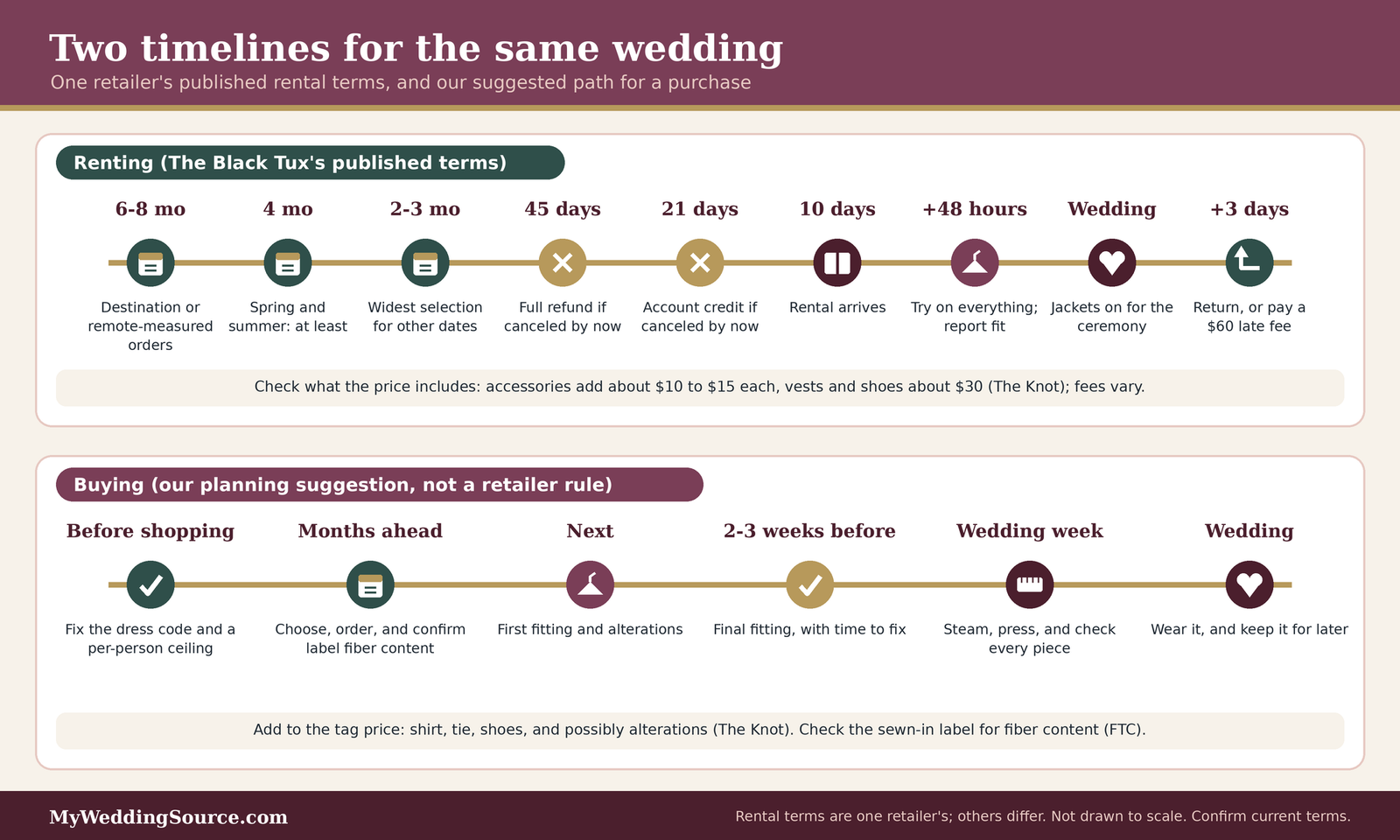
Rentals cannot be tailored the way a purchase can, so the best protection is to try on every piece soon after delivery and report any problem inside the retailer’s window. The Black Tux says to try on within 48 hours of delivery. For a purchased suit, schedule the final fitting at least two to three weeks before the wedding as our own planning suggestion, so any adjustment has time to be finished.
Heat, season, and photographs
A wedding party stands in the sun, dances, and is photographed for hours. Comfort and season belong in the decision.
Season and fabric
Suits come in a wide range of fabrics, per The Knot, which makes it easier to choose something lighter for a summer wedding. Generation Tux, a retailer, says suits are usually better for daytime and summer weddings and that tuxedos can feel stuffy in summer. Zola says light-colored suits work in fewer settings and seasons than darker ones.
The National Weather Service explains that the heat index combines air temperature and humidity, and that full sun can raise the value by up to 15 degrees Fahrenheit, so a ceremony in full sun can feel significantly hotter than the thermometer says. This is general information, not medical advice, and anyone sensitive to heat should talk with a clinician and plan for shade and water. Heat is a practical reason a daytime summer wedding often tips groomsmen suits vs tuxedos toward suits.
Jackets, photographs, and the group look
Generation Tux says that taking off a tuxedo jacket is generally considered poor form, which it lists as a drawback in hot weather, while the same retailer says semi-formal weddings may make jackets optional except for the ceremony and photos. Etiquette on this varies, so decide for yourselves, and tell the party before the day. A simple plan is to keep jackets on for the ceremony and portraits and to say that jackets may come off after the first dance if that suits your wedding.
For photos, a uniform look reads clearly in group portraits whichever side of groomsmen suits vs tuxedos you choose, and fit and pressing matter more than the choice of garment. Our wedding photographer shot list is a useful reference when you plan group portraits of the wedding party.
Timing and coordination
The best groomsmen suits vs tuxedos choice can still fail on a bad schedule. Rental retailers publish lead times, and a purchased suit adds a tailoring step, so the timeline for either outfit should be set early.
The rental timeline
Rental companies use similar patterns for groomsmen suits vs tuxedos orders, but the numbers differ. We use The Black Tux’s published timeline as a worked example, since it is one retailer’s policy and not an industry standard.
When to book
The Black Tux says to book two to three months ahead for the widest selection, at least four months out for spring and summer weddings, and six to eight months for destination weddings that need remote measurements. It says booking two to three weeks out is possible but limits styles, and rush orders within two weeks can add fees. The Knot’s advice is to reserve as soon as you know the date, colors, and theme.
If you are still choosing between groomsmen suits vs tuxedos, the choice itself should be made before these dates, not at them. Our wedding planning timeline shows where the attire decision fits among the other months of planning.
Delivery, try-on, and return
The Knot lists delivery or pickup windows by retailer: 3 to 4 days before the event for Men’s Wearhouse, 4 days for Jos. A. Bank, about 10 days for The Black Tux and Friar Tux, and 10 to 14 days or about 14 days for several others. The Black Tux says rentals arrive 10 days before the event, a fit problem should be reported within 48 hours for a free replacement, replacements ship within one to two business days, and return is due within three calendar days after the event.
Its cancellation terms, as published on the page we read, are a full refund 45 or more days before the event and account credit up to 21 days before. The page does not state terms for the days between or for the last three weeks, so ask. If your party is large, put these dates in a shared calendar and in our wedding planning checklist.
Coordinating the group
Groups fail on communication more often than on the groomsmen suits vs tuxedos choice itself. A clear system for orders, sizes, and deadlines does more than any discount.
Group tools, discounts, and when to be careful
The Knot says several rental companies offer package deals for the groom and groomsmen, and that Men’s Wearhouse and Jos. A. Bank have a group manager tool where wedding party members can add their own looks and the groom can pay online if he chooses. It also lists free-rental thresholds for the couple, such as after five paid rentals at Generation Tux and Menguin. The Black Tux’s page says groomsmen can save 20 percent by purchasing their assigned outfit through the group invitation, that the groom saves $200 when five or more party members order, and that only one discount applies per order.
Discounts are retailer terms and change, so read them at the time of ordering. A discount that applies only above a headcount can quietly push you toward a larger party or toward one retailer, so decide your party and your choice first and then see which offers apply.
Out-of-town groomsmen
For groomsmen who live elsewhere, assign one person to collect measurements, confirm the delivery address, and track shipping, and tell every groomsman the return deadline and who is responsible for it. Emily Post says rented clothing must be returned on time and that groomsmen coordinate with the head usher or best man.
If delivery goes to a home address and the wedding is in another city, decide whether each groomsman should ship the outfit to his hotel or bring it. A late box is hard to fix with a wedding in a few days, so leave a buffer of days, not hours, between the retailer’s delivery window and the day the party must be dressed.
Matching the choice to the wedding
Rules for groomsmen suits vs tuxedos are easier to trust once you have seen them applied. The three scenarios below are invented for illustration and are not case studies or reported outcomes. Their assumptions are stated so you can swap in your own.
Three illustrative weddings
Each scenario fixes a dress code, a time, a place, and a party, then reaches a recommendation using the criteria above.
Evening ballroom, black tie
Assume a 7 p.m. ceremony and dinner in a hotel ballroom, an invitation that says black tie, seven men in the party, and groomsmen who are mostly local. This is the clearest groomsmen suits vs tuxedos case: The Knot says a tuxedo is required at black-tie events, and Gentleman’s Gazette says weddings after 6 p.m. are a place where groomsmen typically wear tuxedos. The remaining questions are rental versus purchase and whose job it is to manage fit. Rental is the likely groomsmen suits vs tuxedos answer because the break-even wear count is high for a garment most groomsmen will not wear again, and a group order keeps the look uniform.
What would flip it is the budget. If one or two groomsmen cannot afford the rental, the answer is not to drop the code, but to pay for those outfits, or to move to black tie optional, which The Knot says does not require a tuxedo. Our black tie wedding guide covers how to word that change.
Garden ceremony, warm afternoon, cocktail attire
Assume a 3 p.m. outdoor ceremony in July, a cocktail attire invitation, five groomsmen, and a mix of locals and travelers. The Knot says suits are appropriate at cocktail attire and below and tuxedos are not, and Generation Tux says suits are usually better for daytime and summer. A suit in a lighter fabric is the practical choice, and because suits are the more reusable garment, buying becomes a real option for any groomsman who wants to keep one.
The flip is the color. Zola says light-colored suits work in fewer settings and seasons, so a pale suit that will not be worn again is a poor purchase even if it photographs well. In that case a rental, or a navy or gray suit the groomsman already owns, is the smarter route. Our cocktail attire guide describes what that code looks like for guests, which helps you keep the wedding party and guests in step.
Winter evening, formal, mixed budgets
Assume a December ceremony at 5 p.m. in a historic hotel, an invitation that says formal, six groomsmen with very different budgets, and two who live abroad. This is the open band: both a tuxedo and a dark suit are acceptable, per Generation Tux. Here cost and logistics decide the groomsmen suits vs tuxedos question. Two options are reasonable. The first is a rented tuxedo for everyone, with the couple covering the two groomsmen who would struggle. The second is dark suits that each groomsman may buy, rent, or wear from his own closet, with a required tie and shoe color.
The Black Tux says destination or remote-measured orders need six to eight months, so the groomsmen abroad should be measured early in either case. The choice that needs less coordination is probably the tuxedo rental because it moves the whole party into one retailer’s process, and that is the kind of editorial judgment you should check against your own party.
Why the answer changes
The three scenarios reach different groomsmen suits vs tuxedos answers because different criteria dominate, not because the sources contradict each other. Seeing which criterion dominated in each case is the transferable skill for any groomsmen suits vs tuxedos choice.
The criterion that dominated each time
In the first scenario the dress code dominated and cost was secondary. In the second, season and reuse dominated. In the third, budget spread and logistics dominated. If you can name the dominant criterion for your own wedding in one sentence, the choice usually follows. If you cannot, you probably need to settle the dress code before going further.
| Scenario | Assumptions | Likely winner | What flips it |
|---|---|---|---|
| Evening ballroom, black tie | After 6 p.m., indoor, mostly local party | Rented tuxedo | A groomsman who cannot afford it; consider paying or moving to black tie optional |
| Summer garden, cocktail attire | Afternoon, outdoors, warm | Suit, bought or owned | A pale color nobody will wear again; rent or choose navy or gray |
| Winter formal, mixed budgets | Evening, six groomsmen, two abroad | Rented tuxedo, or coordinated dark suits | Reuse that makes buying cheaper, or a couple’s decision to cover costs |
| Casual beach or backyard | Daytime, relaxed, warm | Light suit or own clothing | A dress code that suddenly becomes formal |
A threshold to remember
The threshold that most often flips groomsmen suits vs tuxedos is reuse. If every groomsman would wear the garment again after the wedding, suits can beat rentals on cost after a few wears. If almost none would, rentals win, and tuxedos are usually the cheaper rental. When reuse is mixed, a coordinated suit that each person buys or rents himself is the flexible compromise.
A decision rule you can actually use
After the criteria, the method, and the scenarios, you need a groomsmen suits vs tuxedos rule you can say out loud to your partner and your groomsmen. Here is a rule built from the sections above, plus the cases where neither option is right.
Choose a tuxedo when, choose a suit when
A groomsmen suits vs tuxedos rule is only useful if it names its thresholds, so each branch below ends with the condition that moves you to the other side.
State the threshold that changes the answer
Choose tuxedos when the invitation says black tie, when the ceremony starts after about 6 p.m. at a formal venue, or when you want strong uniformity and most of the party will rent. Choose suits when the code is cocktail attire or below, when the wedding is in daylight and warm, or when most of the party will buy and reuse. In the middle band, choose by cost per person after normalizing the quotes, and by whether anyone will wear the outfit again.
In the groomsmen suits vs tuxedos rule, move from tuxedos to suits if the budget fails for even one groomsman and the couple cannot cover it, or if the venue turns out to be hot and outdoors. Move from suits to tuxedos if the dress code moves up to black tie or the wedding moves to the evening.
Cases where neither option is ideal
Some parties fit neither side of groomsmen suits vs tuxedos well. A religious or cultural ceremony may call for specific clothing, which Zola says may require a specialty clothier or tailor, and a military groom can wear a uniform appropriate to rank. A groomsman with a hard-to-fit body may be better served by a tailored purchase than a rental. A very casual wedding may be best with an agreed color palette and ordinary clothes. In these cases, set the principle first, such as formality level and color, and let each person meet it in his own way.
Verify before you book
Before paying, collect the evidence that turns a groomsmen suits vs tuxedos plan into a commitment. A short list of documents settles most disputes.
List the evidence to request
Ask for the written package contents with each piece listed, the all-in price per person including fees and taxes, the delivery and return dates, the fit-problem window and remedy, the cancellation and substitution terms, and the late-return fees. For a purchase, ask for the fiber content on the label, the alteration quote, and the date the tailor will finish. Save these in one shared folder, so the person managing the party can answer any groomsman quickly.
Name the quote line that settles it
The line to look for is the total per person with every fee, accessory, and shipping charge included. If one seller will not give it in writing, take that as information. For a rental, the second line to confirm is the one that states what happens when a fit problem is found inside the window. Those two lines tell you most of what you need to know about a retailer.
Frequently asked questions
Style and etiquette
Can groomsmen wear suits at a formal wedding?
Yes, in most cases. The Knot says a tuxedo is required only at white-tie and black-tie weddings, and that a formally styled suit works for black-tie optional. A black suit does not substitute at black tie. Check the invitation wording, then choose a dark, well-fitted suit with a coordinated tie and polished shoes.
Should the groom and groomsmen match?
Not always. Generation Tux says groomsmen usually match the groom’s level because a mismatch can upstage someone, while The Knot says a groom in a tuxedo with a party in coordinated suits is an accepted pairing at a semi-formal wedding. Decide on purpose, tell the party early, and keep colors and fit consistent.
Who pays for groomsmen suits or tuxedos?
Traditionally the groomsmen pay for their own outfits and accessories, according to Zola, Emily Post, and The Knot. Couples can cover costs for a groomsman who is financially strained, or cover everyone if they wish. Tell each person the likely cost when you ask, so nobody learns it after saying yes.
Does a tuxedo have to be black?
Black is the traditional choice and, per Zola, the most widely available color, so it is the safest reading of black tie. Generation Tux, a retailer, also offers suits in black, blue, gray, and tan alongside its tuxedos. If you want a non-black tuxedo, confirm the style with the seller and make sure it fits your stated dress code.
Cost and logistics
Is it cheaper to rent a tuxedo or buy a suit?
For one wedding, renting is usually cheaper, per The Knot and Zola, with rentals of about $150 to $300 against about $300 to $800 for a three-piece suit. Buying wins after a few wears. Divide the purchase price by the rental price to estimate your break-even, then count the wears you will honestly get.
How far ahead should groomsmen order rentals?
The Black Tux says two to three months ahead for the widest selection, at least four months for spring and summer, and six to eight months for destination weddings with remote measurements. Other retailers vary. The Knot advises reserving as soon as the date, colors, and theme are set, since earlier orders leave more time for adjustments.
What if a rental does not fit?
Report it quickly. The Black Tux says to try on every piece within 48 hours of delivery and report a fit problem inside that window for a free replacement, and notes that orders placed within five days of the event may not arrive in time. Other retailers have different windows, so read your own terms and keep delivery dates in a shared calendar.
Can groomsmen wear their own suits?
Yes. The Knot says the groom can let groomsmen wear clothes from their own wardrobes, which it calls a more affordable option. Agree on a color, a fabric weight, a tie, and shoes, and ask for photos of each suit before the wedding so the group looks coordinated and nobody is surprised by a mismatch.
Your next steps
Decide the outfit
Write the dress code sentence
Choose one phrase for the invitation and website, because it drives the whole groomsmen suits vs tuxedos decision, such as black tie or cocktail attire, and use it everywhere. Our wedding invitations guide covers where dress code wording belongs, and the choice between groomsmen suits vs tuxedos becomes much easier once that sentence is settled.
Set a per-person ceiling
Pick the most you will ask any groomsman to spend, decide whether you will cover any part, and tell each person before ordering. If you want one planning document to hold dates and budget together, our wedding planning guide is a good place to start.
Lock in the logistics
Gather three written quotes
Normalize each groomsmen suits vs tuxedos quote to a per-person, all-in figure with fees and shipping, and compare them with the wear-count break-even. Keep the contract terms, fit remedies, and return dates in one place.
Put the dates on the calendar
Add booking, measurement, delivery, try-on, and return dates for every groomsman and assign one person to each date. Our wedding planning timeline helps you place these steps among the rest of the work.
Sources & methodology
How we built this guide
What we relied on
This guide combines published guidance on suits, tuxedos, and groomsmen etiquette from The Knot, Zola, Emily Post, and the Gentleman’s Gazette, published policies and prices from two rental retailers (The Black Tux and Generation Tux), The Knot’s published Real Weddings Study figures, National Weather Service heat-index information, and two Federal Trade Commission publications on clothing labels. Where a statement comes from a retailer, we say so, because retailers sell what they describe. The break-even calculations, the five-groomsman estimate, the decision matrix, the scenario table, and the three scenarios are our own editorial arithmetic and judgment, built on stated assumptions, and they are not research findings.
What we did not do
We did not survey couples or groomsmen, test rental services, price garments in stores, or confirm retailer terms beyond what each page said on the day we read it. We found no published average for what a groomsman pays for a suit or tuxedo, and the two Knot articles we read list different starting prices for the same retailers, so all prices here are illustrations. We also could not find sourced figures for alteration or dry-cleaning costs, so we left them out of the arithmetic. Etiquette varies by region and community, and retailer policies change, so confirm them directly. This guide is general information, not legal, medical, or financial advice.
Source list
Etiquette, style, and cost guidance
- The Knot, Tuxedo vs. Suit: https://www.theknot.com/content/tuxedo-vs-suit
- The Knot, An Expert-Backed Guide to Wedding Suit and Tuxedo Rentals: https://www.theknot.com/content/rent-or-buy-tuxedo
- The Knot, Average Tux Rental Cost: https://www.theknot.com/content/tux-rental-cost
- The Knot, Expenses Groomsmen Should Expect to Pay For: https://www.theknot.com/content/what-groomsmen-pay-for
- The Knot, Average Wedding Cost (2026 Real Weddings Study): https://www.theknot.com/content/average-wedding-cost
- Zola, Suits vs. Tuxedos: Which Is Right for the Groom: https://www.zola.com/blog/wedding-planning/suits-v-tuxedos-right-groom
- Zola, Who Pays for the Groomsmen Suits: https://www.zola.com/expert-advice/who-pays-for-the-groomsmen-suits
- Emily Post Institute, Wedding Attendants: https://emilypost.com/advice/wedding-attendants
- Gentleman’s Gazette, When to Wear a Tuxedo or Tails: https://www.gentlemansgazette.com/when-to-wear-a-tuxedo-or-tails/
Retailer, government, and weather sources
- The Black Tux, Wedding Tux Rental Timeline (retailer): https://theblacktux.com/blogs/resources/wedding-tux-rental-timeline-book-fit-return
- Generation Tux, Should You Wear a Tuxedo or a Suit for a Wedding (retailer): https://www.generationtux.com/blog/wedding-planning/tux-or-suit-for-wedding
- Generation Tux, Rent vs. Buy a Tuxedo (retailer): https://generationtux.com/blog/wedding-planning/rent-vs-buy-tuxedo
- Federal Trade Commission, Clothes Captioning: Complying with the Care Labeling Rule: https://www.ftc.gov/business-guidance/resources/clothes-captioning-complying-care-labeling-rule
- Federal Trade Commission, Threading Your Way Through the Labeling Requirements Under the Textile and Wool Acts: https://www.ftc.gov/business-guidance/resources/threading-your-way-through-labeling-requirements-under-textile-wool-acts
- National Weather Service, Heat Index: https://weather.gov/safety/heat-index