

A 6 month wedding planning checklist works best as a calendar, not a wish list: confirm what you have already booked, order the things that have production clocks, turn RSVPs into a headcount, and close the paperwork one week at a time from 26 weeks out to the wedding.
You are about six months from the wedding, the venue contract is signed, and a handful of deposits have left your account. The question is no longer “what should we book?” but “what has to happen, in what order, before the day?” At this stage the list that helps is not a 100-item master checklist. It is a short sequence of confirmations, orders, counts and handoffs, each with a deadline that someone else controls.
That matters because the final six months are where plans meet other people’s clocks. A gown that arrives three to four months out needs fittings on a schedule. Invitations need to be in hand about 10 weeks before the wedding to mail on time. A marriage license has a validity window set by your state, a caterer wants a final number, and a passport application can take weeks even when nothing goes wrong. None of these is difficult. Each one is just easy to start a few weeks too late.
This article covers only the last six months, and it assumes your date, venue and major vendors are booked. If you are still choosing a venue, start with our 12 month wedding checklist and the broader wedding planning hub, then return here once the big contracts are signed. If you are somewhere in the middle of the year and still deciding what to book first, our wedding planning timeline compares how different engagement lengths change the order of decisions.
What does a six-month checklist cover, and who is it for?
Which couple is this checklist written for?
What does this checklist assume you have already booked?
It assumes the decisions that shape the budget are made: a date, a venue contract, a caterer or food plan, a photographer, and at least a first pass at music and flowers. With those in place, the work in front of you is mostly confirming, ordering and counting rather than choosing. The Knot’s 2026 Real Weddings Study, which surveyed 10,474 U.S. couples married in 2025, found couples hired 13 professionals on average, and each of those relationships generates a few final details such as arrival times, deliverables and balances due. This checklist is built around those final details. It is also written so that nothing depends on a particular style, budget or guest list size, because the sequence of tasks is the same whether you invite 40 people or 140.
What if the venue or major vendors are still open at six months?
Then the order of operations is different, and the first job is to protect the big dates before you worry about stationery. The Knot’s own six-month guide, published in 2023, still lists booking the venue and hiring all vendors as month-six tasks, and it recommends a planner for tight timelines. That guidance is a reminder that six months is workable but leaves less choice, especially on popular dates. Use the runway comparison in our wedding planning timeline guide to decide what to book first, and treat weeks 26 to 19 below as a catch-up phase in which you add the missing bookings alongside the audit tasks. The venue questions in our wedding venues hub are the best place to start the comparison.
How is the six-month stretch organized?
Why four phases instead of one long list?
A single list of 80 tasks gives every item equal weight, which is not how the last six months work. A few tasks have long production or processing clocks, a few depend on other people’s answers, and many can be done in an evening. Grouping the weeks into phases tells you what kind of work you are doing: auditing, ordering, counting or closing. It also makes it obvious when you are doing the wrong kind of work for the moment, such as arguing over place cards in week 24 when no contract summary exists yet. Each phase in the table below ends with a specific output, so you can tell at a glance whether you are on track.
| Phase | Weeks before the wedding | Main job | You should have by the end |
|---|---|---|---|
| Confirm | 26 to 19 | Audit contracts, build the payment calendar | One-page contract summary; payment calendar; hotel block and guest logistics settled |
| Convert | 18 to 11 | Turn decisions into orders | Invitations ordered and proofed; fittings booked; tastings and trials done |
| Count | 10 to 5 | Turn guests into numbers | Invitations mailed; RSVP tracker live; seating draft; license rules confirmed |
| Close | 4 to the wedding | Confirm, pay and hand off | Final count sent; payments recorded; timeline shared; tip envelopes labeled |
How much time does each week actually take?
Most weeks in the first two phases are light if you decide on a fixed time to handle them. We suggest a 30-minute weekly check-in with your partner, with one shared document that lists open tasks, owners and dates; this is an editorial recommendation, not a measured figure. The load rises in weeks 10 through 5, when invitations go out and replies begin to arrive, and again in the last two weeks, when confirmations and handoffs stack up. If you know which weeks are heavy, you can schedule the quiet weeks for the tasks that have no external clock, such as writing vows, drafting seating or reading contracts again.
How do the weeks map to real dates?
What does the calendar look like for a specific wedding date?
Week numbers are easier to use once they are pinned to dates, so the table below maps them for an illustrative Saturday, June 5, 2027 wedding; swap in your own date and the arithmetic still works. The date markers come from simple subtraction applied to published lead times: invitations ordered 12 to 14 weeks out, mailed 6 to 8 weeks out, RSVPs due 2 to 3 weeks out, fittings at 6 to 8 weeks and again at 2 to 3 weeks, and the caterer’s count about one week before. Notice that holidays land inside this particular plan: the late-December weeks slow down vendor replies, and Memorial Day on Monday, May 31, falls in wedding week itself. That is worth knowing before you plan a courthouse errand, a post office trip or a delivery for that week, because many offices and carriers close on federal holidays.
| Weeks out | Date (for June 5, 2027) | What lands here |
|---|---|---|
| 26 | Sat., Dec. 5, 2026 | Start of the confirm phase; contract audit begins |
| 24 to 22 | Dec. 19, 2026 to Jan. 2, 2027 | Holiday weeks; vendor replies may be slower, so send audit emails early |
| 14 to 12 | Feb. 27 to Mar. 13, 2027 | Window to order invitations (12 to 14 weeks out) |
| 10 | Mar. 27, 2027 | Invitations in hand and ready to mail |
| 8 to 6 | Apr. 10 to Apr. 24, 2027 | Mail invitations; second fitting window |
| 4 | May 8, 2027 | License pickup window opens (about one month out); final confirmations begin |
| 3 to 2 | May 15 to May 22, 2027 | RSVP deadline (2 to 3 weeks out); final fitting and pickup |
| 1 | May 29, 2027 | Final count to the caterer (about one week out) |
| Wedding week | May 30 to June 4, 2027 | Memorial Day on May 31; rehearsal the day before |
How do you adjust the map for a different season or date?
Shift every row by the same number of weeks, then check each row against your own calendar for holidays, school breaks and local events that could slow a vendor or a post office. A wedding that itself falls on or near a holiday weekend deserves a longer buffer on guest-facing dates: The Knot’s invitation guidance says holiday weddings should aim for about eight weeks and up to three months if guests may need a bigger buffer. Weddings at a destination or with overseas guests also need earlier mailing, which The Knot puts at nine to ten weeks for overseas invitations. A destination wedding adds travel, legal and local-vendor layers that this domestic checklist does not cover.

Weeks 26 to 19: what should you confirm, audit and write down first?
How do you audit your vendor contracts without redoing the whole file?
What should the one-page contract summary include?
Build one page, or one spreadsheet tab, with a row for each vendor and columns for the service date, arrival and load-in times, deliverables, the total price, what has been paid, the next payment date, and the cancellation or reschedule terms. Copy these straight from the signed contract instead of from memory, because contracts and conversations drift apart over a year. While you are in the documents, flag anything vague, such as “décor setup” without a time or “gratuity” without a percentage. The point is to see all of your obligations in one place so that a missed payment or a missing delivery window is visible before it becomes a problem. Keep the PDF of each contract in the same shared folder so that either of you can find the original wording within a minute.
Which questions belong in a six-month confirmation email?
Send each vendor a short email with the date, location and your planned arrival window, then ask them to reply with anything that has changed. Useful questions differ by vendor: ask the florist which flowers will be in season and how many weddings they are handling that day, ask the venue what time load-in starts and ends, and ask the photographer when you will need to send a shot list. Zola’s planning checklist, updated May 2026, puts the florist questions and a walk-through of the venue with vendors at about six months out. For the venue, check the rules on outside vendors, overtime and end times first, because those are the details that change cost most often. Ask for a written reply, so that the answer lives beside the contract.
What should the money calendar look like?
How do you build a payment calendar from signed contracts?
List every payment in date order across all vendors, with the amount, who is paying it and the account it comes from. Then add a column for the total due in each month, so you can see whether March has three balances landing at once. The Knot’s 2026 data put the average wedding at about $34,200, and its cost page recommends keeping roughly a 5 percent reserve for the unexpected; on a $34,200 budget that reserve is about $1,710, which is an illustration of the arithmetic and not a target. If any month looks heavy, ask the vendor whether a due date can move a few weeks, since many vendors would rather adjust the schedule than chase a late payment. Record each payment as paid and confirmed, not just sent.
Which costs show up in the last six months that the original quotes did not include?
The surprise costs are small individually and sizeable together: alterations, postage, extra invitation envelopes, tips, a trial or two, and any rush fee if something slips. The Knot’s gown guidance notes that a basic hem can start around $200 and major alterations can exceed $1,000, and its tipping guide suggests ranges for almost every vendor type. Zola advises ordering 10 to 15 percent extra envelopes to cover addressing mistakes. The callout below lays the layers out so you can add a line for each to your own budget.
Which guest logistics need decisions before the paper goes out?
How do hotel blocks, cutoff dates and attrition clauses work?
If out-of-town guests will need rooms, the room block is the guest-logistics decision with the most financial fine print. Joy’s wedding glossary explains the three types: a courtesy block that holds rooms with no liability for you, an attrition block in which you agree to fill a share of the rooms (often 80 percent) and may owe a fee if you do not, and a guaranteed block that is rare for weddings. It also describes a cutoff date typically three to six weeks before the wedding, after which unreserved rooms go back to the hotel, and suggests blocking rooms for roughly 60 to 80 percent of the out-of-town guest count. Before you tell guests where to book, read the attrition and cutoff language in the contract, and put the cutoff date on your calendar and your wedding website.
What about showers, parties and the people who offered to help?
Zola’s six-month list suggests scheduling showers and other parties and assigning a point person to each, which works because parties planned by someone else are the easiest to forget in your own planning. Write down who is hosting each event, the date, the guest list and what you are expected to supply, such as a list of names and addresses or a time slot in your own schedule. This is also a good moment to turn vague offers of help into assigned jobs: someone to hold the emergency kit, someone to greet out-of-town guests, someone to collect gifts at the end of the night. A person with a named task is much more likely to deliver than a person who said “let me know if you need anything.” Add every name and job to the one-page summary so the owner of each task is visible.
| Week | Focus | Tasks | Done when |
|---|---|---|---|
| 26 | Audit | Pull every signed contract into one folder; start the one-page summary | Every vendor has a row with date, price and next payment |
| 25 | Money | Build the payment calendar; set a 5% reserve line | Each month’s total due is visible |
| 24 | Confirm | Send confirmation emails to all vendors; holiday weeks may slow replies | Written replies saved beside contracts |
| 23 | Venue | Confirm load-in/out, rain plan decision time and outside-vendor rules | Answers recorded in the summary |
| 22 | Guests | Settle hotel block terms, cutoff date and wedding website content | Block cutoff on your calendar; site live |
| 21 | People | Assign hosts for showers and parties; name day-of helpers | Every event and helper has an owner |
| 20 | Attire | Confirm fitting and pickup dates for every outfit | Dates on the shared calendar |
| 19 | Review | Weekly check-in; fix open items; update the payment calendar | No unanswered vendor emails |
Weeks 18 to 11: which orders and appointments have clocks you cannot speed up?
How do attire and fittings fit the calendar?
When does the gown arrive, and how many fittings should you book?
The Knot’s gown guidance (updated January 2025) says a dress typically reaches the salon three to four months before the wedding, which puts its arrival somewhere inside weeks 17 to 13 of this plan. It describes a first alterations fitting once the dress arrives, a second fitting at six to eight weeks out, and a final fitting two to three weeks out, with pickup after that final fitting. Plan for one to three sessions, and ask the salon or seamstress to put the dates on the calendar now rather than leaving them open. Fitting appointments can fill up, because a seamstress can only work on so many garments at once. Ask about the cost of alterations and the schedule when you book, so that the price is never a surprise at the final session.
What do alterations cost, and what should you bring to every fitting?
The same Knot guide says a basic hem starts around $200 and major adjustments can exceed $1,000, and it suggests asking whether a seamstress charges a flat fee or per service. The deposit on a dress is often about 50 percent of the price with the balance due at pickup, so read the contract for the designer, size, arrival date and any extras such as veils or alterations. For every fitting, bring the shoes you will wear, because heel height determines hem length, along with the undergarments and the veil or jewelry you plan to use. Everyone else with tailored attire follows the same logic. Suits, tuxedo rentals, bridesmaid dresses and children’s outfits each have their own ordering and fitting windows, and it is worth asking each shop for its dates in writing during this phase.
How do you order paper and signage without a reprint?
When should invitations be ordered and proofed?
The Knot’s invitation guidance (updated July 2026) says pre-designed online invitations should be ordered about 12 to 14 weeks before the wedding to allow for shipping delays or reprints, and should be in your hands at least 10 weeks before. Zola’s checklist places ordering at about four months out, with one invitation per household and 10 to 15 percent extra envelopes to cover addressing errors. The Knot’s average spend on stationery in its 2026 cost data is about $510, though your total depends on the design, the quantity and any custom work. Proof every name, date, time and address, and ask two people who did not design the suite to read it; a typo found after printing is far more expensive than one found on the proof. Before you commit to an envelope size, take one fully assembled sample to the post office and ask for the postage price, because inserts and unusual shapes can change it.
What other printed pieces belong on the list?
Programs, menus, table numbers, place cards and signage all depend on decisions that firm up at different times. Zola’s list has you ordering signage around four months out and the other paper goods around one month out, after the seating plan exists, while The Knot’s six-month list suggests ordering ceremony programs at about four months. A practical split is to order anything that does not depend on the guest list early, such as welcome signs and programs, and anything that does depend on it, such as place cards and table numbers, only after RSVPs close. If a piece includes names, order a few extras as Zola advises, since a last-minute plus-one is easier to add to a blank card than to a reprint.
Which tastings, trials and rentals belong in this window?
Which menu, cake and bar decisions should be settled before the count?
The Knot’s six-month list puts the reception menu and tasting at about five months out, and Zola’s checklist schedules cake tastings at the same point. Settle the menu and tasting early because the caterer will want meal selections, dietary notes and the final count together later on, and a menu that is still unsettled in week 5 is harder to change. Zola lists an average wedding cake cost of $917 and suggests confirming the baker’s delivery plan and whether a tip is expected. When you taste, ask the caterer and baker how allergies and dietary needs are handled and how guests will be identified at the table, so that you can add a dietary column to your RSVP tracker before the invitations go out. Bar decisions belong here too, including the hours, the service model and whether the venue sets minimums.
How should you schedule hair, makeup, transportation and the weekend extras?
Zola places securing the hair and makeup artists at about five months out and asks whether they stay for touch-ups, while The Knot’s list puts the trial around three months out, so the sources differ by a couple of months and a trial window of weeks 14 to 11 works either way. In The Knot’s cost data, hair and makeup average about $150 each per person; Zola’s checklist lists a combined average of $982, so the two sources measure slightly different things, and your quote is the number that matters. Zola also puts wedding-day transportation, any welcome gathering or farewell breakfast, and a getting-ready space at about four months out. The Knot reports an average transportation cost of $1,100.
| Week | Focus | Tasks | Done when |
|---|---|---|---|
| 18 | Attire | Book first-fitting date as the gown arrives; confirm outfits for the rest of the party | Fitting dates saved to the calendar |
| 17 | Paper | Finalize invitation wording, proof every name, date and address | Two readers have signed off |
| 16 | Tastings | Menu, cake and bar tastings; confirm dietary-needs process | Menu choices recorded in writing |
| 15 | Beauty and transport | Confirm hair and makeup artists, trial date and wedding-day transportation | Contacts and times in the summary |
| 14 | Ordering | Order invitations (12 to 14 weeks out); price a sample at the post office | Order confirmation and proof received |
| 13 | Ceremony | Confirm ceremony details with the officiant; start song lists and program text | Ceremony outline drafted |
| 12 | Honeymoon | Check honeymoon bookings and passport timing (see the paperwork section) | Travel documents status known |
| 11 | Review | Weekly check-in; update the payment calendar | Open items assigned to owners |
From invitation to final headcount: how does a guest list become a number?
When do invitations go out, and when should RSVPs come back?
What mailing and RSVP dates do the published sources support?
The Knot says to send invitations six to eight weeks before the wedding, with paper RSVPs needing the eight-week end so reply cards can return by mail, and digital RSVPs workable at about six weeks if the invitation includes a QR code to your website. Zola’s checklist recommends mailing no later than six weeks out. For the RSVP due date, The Knot’s etiquette guide (updated July 2026) says at least two to three weeks before the wedding, which leaves time to give the caterer a count and finalize seating, and it suggests moving the deadline earlier, to three to six weeks, if invitations may reach guests late. Out-of-town invitations go around eight weeks before the RSVP deadline, and overseas guests need nine to ten weeks of mailing time, according to The Knot. In practice, we suggest setting the RSVP date no later than three weeks out and then adding a week of cushion for guests who travel.
How do you chase missing RSVPs without awkwardness?
Zola suggests following up with missing guests one to two weeks after the RSVP deadline, and The Knot suggests using an RSVP reminder through your wedding website. Split the follow-up between you and your partner by whose guests are missing, and keep the message short: ask for a yes or no, say you need the number by a specific date, and thank them. Calling works better than texting for older relatives and for guests who may not have seen a mailed card. If a guest adds a person who was not invited, The Knot’s etiquette guidance is to call and explain that you could not extend a plus-one to everyone; invitations addressed by name are generally not transferable, while an “and guest” invitation allows them to choose. The same call-and-explain approach applies to children’s names added to an adults-only invitation.
How do you do the headcount math?
What does the 20 percent rule give you, and where does it fail?
The Knot’s RSVP guidance offers a rule of thumb: start by assuming about 20 percent of invited guests will decline, then adjust up or down from there. It is a starting point rather than a forecast, since The Knot notes that distance, flights, hotels and time off work push declines higher for out-of-town guests, without quantifying how much. The page cites The Knot’s 2023 Guest Study, which put the average cost of attending a wedding at about $580 per guest, a reminder that many guests are making a real trade-off to say yes. Your own list is the best evidence: tally close family, close friends and out-of-town guests separately, and apply a lower decline rate to the first group and a higher one to the last. Treat the arithmetic as a range, and keep the high and low numbers in your tracker until the replies arrive.
What does one guest change cost?
The table shows how much the decline rate moves a catering bill, using The Knot’s 2026 average of $80 per person for catering as the base. The service charge and tax rates are assumptions chosen to show the layering and are not quotes, since your contract and state decide the real figures. For a list of 140 invited guests, the gap between a 10 percent decline and a 30 percent decline is 28 guests, about $2,240 in base catering before extras, and more with them. Catering is only one of the per-head costs. Rentals, favors, stationery extras, bar service and sometimes the venue fee scale with guests as well, which is why the final count deserves the same attention as a payment. Our wedding food and catering hub explains how packages, minimums and service charges differ so you can ask the right questions.
| Scenario | Guests attending | Base catering at $80 each | With 20% service charge and 7% tax |
|---|---|---|---|
| 10% decline | 126 | $10,080 | about $12,943 |
| 20% decline (rule of thumb) | 112 | $8,960 | about $11,505 |
| 30% decline | 98 | $7,840 | about $10,067 |
Which deadline is real: yours or the caterer’s?
How do the RSVP date, the final count and the guarantee fit together?
Three dates sit near each other and are easy to confuse. The RSVP deadline is yours, the final count is the date your caterer or venue needs a number, and the guarantee is the contract clause that says what you pay for if the number falls later. The Knot’s etiquette guide puts the caterer’s headcount at about one week before the wedding and Zola’s one-week list says to give final numbers to the caterer in that same week, but both are general guidance, and your contract sets the real date. Read the contract for the exact day, whether the number is a minimum you will pay for even if guests cancel, and whether it includes meal selections. Then set your RSVP deadline at least two weeks before the caterer’s date so that you have time to chase replies and settle the seating.
What happens to changes after the final count?
Ask the caterer and venue, in writing, what happens when the number changes after the final count: can you add guests, at what price, and is there a cutoff after which additions are impossible. The answer matters because late changes are common, from a guest who falls ill to a cousin who suddenly can travel. Ask also whether vendors such as the photographer, DJ and planner need meals, and whether the count includes them, since those meals are often a separate line. Keep a short list of people to call if numbers change, with the caterer, venue and rental company at the top. If the answer to any of these questions is unclear, send a short email, so that the reply sits beside the contract in your shared folder.

Weeks 8 to 3: how do you build the seating chart, processional and day-of timeline?
How do you build a seating chart that survives late changes?
When should you start, and who gets a say?
The Knot’s seating guidance (updated January 2026) says not to procrastinate, and describes one planner who began tentative tables as soon as invitations went out and finished most of the work about two months before the wedding. Zola’s checklist puts finalizing the seating chart at about one month out, after you have followed up on missing RSVPs. Both fit the same rhythm: sketch groups while replies come in, then lock names to tables once the count is firm. The Knot adds that the couple makes the final plan but can delegate tables for parents’ and in-laws’ friends to those parents, which spreads the workload and gives family a real say without opening the whole chart to debate. Use a working draft you can erase, such as sticky notes or a spreadsheet tab, and save the clean version for last.
Which seating rules prevent the most arguments?
The Knot’s etiquette guidance offers a short list that holds up well. Seat guests by relationship, such as college friends or work friends, and split a large friend group across two tables rather than crowding one. Avoid a separate singles table by seating single guests with couples or married friends. Place a children’s table near the children’s parents, keep immediate family and the wedding party closest to the dance floor, and keep older guests away from the music while giving guests with mobility needs clear access to the dance floor and exits. Spouses and partners no longer need to be seated apart at a head table. Avoid seating couples directly across from each other behind a tall centerpiece. Finally, build a plan for last-minute changes, since the chart is a tool and not a contract.
What goes into the day-of timeline and the vendor handoff?
What does a usable day-of timeline contain?
A usable timeline has a time and a named owner for every transition: vendor arrivals and load-in, hair and makeup start times, photography windows, ceremony start, cocktail hour, dinner, toasts, dancing, last song and load-out. Zola’s checklist puts finalizing the day-of timeline at about one month out, with each vendor’s arrival time and contact information, and says to print it and send it to vendors. Check sunset and twilight times for your date and location using the U.S. Naval Observatory’s one-day sun and moon data tool, because an outdoor ceremony or portrait session scheduled after dark is a different event than one scheduled in daylight. Build in a few minutes of buffer between the transitions that tend to run late, such as the ceremony ending and the cocktail hour beginning. A timeline with only a few entries cannot be run by anyone but you, so aim for enough detail that a friend with a copy could keep it moving.
What do the photographer, musicians and officiant each need from you?
Each person needs a small, specific piece of information. The photographer needs a shot list; Zola suggests starting it about three months out and The Knot has you giving it to the photographer a few weeks before, so start the draft now and send the final version at about two weeks. The DJ, band and ceremony musicians need song choices and requests, which The Knot puts at about two weeks out for the final discussion and about four months out for the first song lists. The officiant needs the ceremony outline, readings and any vows you want to say; The Knot has finalizing ceremony details with the officiant at about four months out and writing vows a few months before the wedding. Send these items in one email per vendor, with the date in the file name, so that no one works from an older version.
| Week | Focus | Tasks | Done when |
|---|---|---|---|
| 10 | Paper in hand | Check that invitations arrived; verify every address; wedding website shows RSVP link and hotel cutoff | Ready-to-mail stack complete |
| 9 | Assemble | Stuff and stamp using the post office price you got for a full sample | Invitations at the post office or in the mail |
| 8 | Mail invitations; confirm honeymoon passports are in process | RSVP tracker is live | |
| 7 | Track | Log replies, meal choices and dietary needs; start tentative seating groups | Tracker updated weekly |
| 6 | Fitting | Second fitting (6 to 8 weeks out); latest sensible mailing date for invitations (Zola: no later than six weeks) | Alteration list from the second fitting |
| 5 | Ceremony | Draft processional order, vows and song lists; confirm officiant’s authority | Ceremony outline sent to officiant |
Which paperwork has a clock: license, officiant, passports and name change?
How do marriage license rules vary, and when should you apply?
What do official sources say about validity and waiting periods?
The short answer is that the rules belong to the state, and sometimes the county, where the wedding takes place. USA.gov (page updated November 2025) says a marriage license legally allows you to marry, that most licenses expire within 30 days to a year depending on the issuing state, and that you apply through the vital records office in the state where the wedding will happen. If a license lapses or is lost before the wedding, you must apply for a new one. Two statutes show how different the details can be: New York’s Domestic Relations Law section 13-b bars solemnizing a marriage within 24 hours after the license is issued or after 60 days from issuance, while Florida’s statute section 741.04 delays the effective date of a license by three days from application, with an exemption for couples who submit valid premarital course certificates. These are examples, not guidance for your state; use your issuing office’s own page.
When should you research, apply and pick up the license?
Zola’s checklist puts researching license requirements, including fees, documents, waiting periods and deadlines, at six months out, and getting the license at about one month out; The Knot’s six-month list also puts the license at about one month. Treat the six-month mark as a research step and the one-month mark as the earliest sensible pickup, but check that your state’s validity window and waiting period fit inside that plan. Ask the issuing office three questions: do both of you need to appear in person, which IDs and documents are required, and how is payment accepted. Plan for office hours as well, because a trip that falls on a federal holiday week or a short-staffed day can cost a week. Put the license pickup on your calendar with a backup date.
What about the officiant, the signing and travel documents?
How do you confirm the officiant’s authority and who returns the license?
Zola’s list has you confirming your officiant’s license or registration at about two months out, especially if a friend or relative is getting ordained, because state and local rules apply to officiants; a 1988 CDC handbook for marriage registration officials tells officiants to know the state and local regulations, including any registration requirements. Ask the officiant what they need from you, how the license is signed after the ceremony and who is responsible for returning it. The Los Angeles County Registrar-Recorder describes one version of this process: the license becomes a marriage certificate that must be returned to that office for recording, though its page does not give a deadline, so the deadline in your county is a question for your own clerk. Write the name of the person who will return the signed license in the contract summary and in the day-of handoff. Order certified copies only after the marriage is recorded, following the instructions from the vital records office, since USA.gov notes that a certificate proves the marriage while the license only authorizes it.
How do passport timing and a name change fit with a honeymoon?
The State Department’s page on faster passport service (updated September 30, 2026) lists routine processing at four to six weeks, expedited processing at two to three weeks for $60 extra, and mailing time of up to two weeks on top of either. For a honeymoon that starts right after the wedding, count back about eight weeks for routine service and add a cushion, which puts the application at about week 10 in this plan. A name change is a separate step because the paperwork follows the marriage. The State Department’s name-change page describes one route for a recent passport (Form DS-5504, no fee, with a certified marriage certificate) and another for older passports that involves a renewal or in-person application, and it gives no advice about timing a name change around travel. If you are not sure, many couples travel on the passport they already have and change it after the honeymoon; whichever you choose, book flights in the name on the passport you will carry.
| Item | Start | What official sources say | Watch for |
|---|---|---|---|
| Marriage license | Research at week 26; pick up about week 4 | Validity runs from 30 days to a year depending on the state (USA.gov) | Waiting periods; office hours; holiday closures |
| Officiant authority | Confirm by week 8 | State and local rules apply; officiants should know them (CDC handbook, 1988) | Friend or relative ordained online; return instructions |
| Honeymoon passports | Apply by about week 10 | Routine 4 to 6 weeks plus mail; expedited 2 to 3 weeks plus mail for $60 (State Dept., Sept. 2026) | Names on tickets matching the passport you will carry |
| Passport name change | After the wedding, once you have certified copies | Route depends on passport age (State Dept.) | Do not assume the new name is on file anywhere yet |
| Name-change research | Week 26 | Zola puts research at seven months out | Which accounts and IDs to change first |
Weeks 4 to 1: what does the closing plan look like, week by week?
What happens in weeks 4 and 3?
What belongs in the final confirmation round and the last payments?
Zola’s one-month list is dense: follow up on missing RSVPs, finalize seating, get the license, create the processional order, finalize the day-of timeline with each vendor’s arrival time and contact information, schedule beauty appointments, confirm transportation and hotel room blocks, finish DIY projects and settle final vendor payments. Turn that into a single confirmation email to each vendor, restating the date, arrival time, contact, deliverables and balance due, and ask them to reply with “confirmed” or a correction. Where a contract says a final payment is due on a particular date, pay on that date and record it as received, not just sent. If you are paying by card, remember that the Federal Trade Commission says billing errors must be disputed in writing within 60 days of the first bill, which is one reason to keep a dated record of every payment. For a quick reread of the final 30 days, our 30-day confirmation checklist, written for a November wedding, lists what to verify with each vendor and adapts easily to other months.
How should fittings, beauty bookings and attire pickups be handled?
Plan the final fitting and pickup around two to three weeks out, per The Knot’s gown guidance, and inspect the garment for snags, discoloration or damage before you leave the shop. The Knot’s tipping guide suggests $20 to $30 for an alterations professional at the final fitting, with more for major restructuring, so have the envelope ready. Schedule hair and makeup appointments, confirm the start time and the getting-ready address, and confirm whether the artists charge a travel fee. Ask a friend or family member to attend the final fitting if they will need to bustle a train or lace a corset, which The Knot notes can be learned at that session. Store each outfit somewhere safe and out of the way once it comes home, with the shoes, undergarments and accessories kept in the same place.
What happens in weeks 2 and 1, and in wedding week?
What do you send, pack and hand off?
Two weeks out, finalize the shot list and meet or call the vendors who need a final conversation. The Knot’s list has final vendor meetings and music requests at two weeks out, and the final headcount going to the venue, caterer and vendors in the week before the wedding along with a shared list of vendor contacts. Zola’s one-week list adds packing for the honeymoon, making final payments, putting tips into labeled envelopes, gathering ceremony and reception items and the day-of emergency kit, and holding a final call with your planner or coordinator. Give each item an owner, and write the owner’s name on the packing list. Name one person to field questions on the day, tell the vendors to call that person and not you, and send one version of the timeline to everyone with the date in the file name. For a tick-box version of this week, see our wedding planning checklist.
How do tips, the rehearsal and the day before fit?
Both Zola and The Knot place the ceremony rehearsal on the day before the wedding, with the Zola list adding confirmation of delivery times and packing the wedding-day items, and The Knot adding organizing gratuities and giving thank-you gifts that day. The Knot’s tipping guide (updated January 2026) says to tip delivery and setup staff the day before in an envelope to the lead person, and to give the officiant a tip before the wedding or at the rehearsal dinner, while most other vendors are tipped at the end of the reception. Check each contract first, since The Knot notes that some caterers and transportation companies include gratuity and that service charges may already cover it. Keep the rehearsal short and focused on movements, then eat a real dinner and stop planning, since an extra late-night email protects the next day less than sleep does.
| Week | Focus | Tasks | Done when |
|---|---|---|---|
| 4 | Confirm | Final confirmation email to every vendor; hotel block and transportation check; beauty appointments booked | All replies saved; balances on calendar |
| 3 | Count | RSVP deadline passes; follow up with missing replies; seating draft finalized; final fitting | Headcount known within a few guests |
| 2 | Hand off | Shot list and timeline sent; music requests to DJ or band; attire picked up | Every vendor holds the same timeline version |
| 1 | Numbers and money | Final count to caterer; final payments; tip envelopes labeled; emergency kit packed; coordinator call | Receipts saved; envelopes labeled by name |
| Wedding week | Rest | Rehearsal the day before; confirm delivery times; hand items to their owners | Phone handed to the point person |
What do couples forget in the last six months, and what does it cost?
Which forgotten items cost money?
Which contract line items tend to appear only at the end?
Most vendors price the main service clearly and then handle the edges in contract language that is easy to skim in month one. Ask each vendor, in the confirmation email, about overtime rates and how the clock is counted, whether setup and breakdown fall inside the booked hours, whether vendors who work through the event need a meal, and what the late-addition policy is for the final count. These are questions, not warnings; vendors build these terms for good operational reasons, and most will answer a clear question clearly. The Knot notes that tight timelines can bring rush fees, which is the other half of this problem: a task that slips from week 12 to week 4 can add a charge that the original quote never included. Write the answers beside the contract so that the final balance never has a surprise line.
Which contract details matter most on the day itself?
Four details cause more day-of stress than their size suggests: load-in and load-out times, the rain-plan decision time and the person who makes the call, vehicle and delivery access to the venue, and who meets each vendor on arrival. Zola’s six-month list recommends walking the venue with your vendors to decide where guests will greet, where the cake goes and where cocktail hour happens, and asking the florist how many weddings they handle that day and whether they offer a run-through. Put the rain-plan trigger in writing with your venue, for example the hour on the day before when someone decides. Then add a short line to your timeline for each vendor’s arrival time, parking instructions and the name of the person who will meet them. If a vendor needs an electrical outlet, a loading dock or a freight elevator, ask for it in writing now.
Which forgotten tasks involve people?
Who holds the rings, the license and the emergency kit?
Objects with no assigned owner tend to end up with the couple, which is exactly what the handoff is meant to prevent. List the items that cannot be replaced on the morning of the wedding, such as the rings, the signed or unsigned license, vows, the guest book, tip envelopes, shoes, medications and any family heirlooms, and write the name of the person who will carry each one. Zola’s one-week list includes gathering ceremony and reception items and a day-of emergency kit, which can be as simple as a small bag with basic first-aid and repair supplies. Hand the items over at the rehearsal or the morning of, and have each owner confirm back. This takes ten minutes and removes a long list of small anxieties from the day itself.
Which guests and helpers are easy to overlook?
Three groups are easy to miss. The first is guests with mobility or access needs, whom The Knot’s seating guidance says should have clear access to the dance floor and exits; ask during the RSVP stage so you can plan the room. The second is out-of-town guests, who benefit from a single page with the hotel block cutoff date, directions, parking and the weekend schedule, which can live on your wedding website. The third is the helpers, such as the friend holding the emergency kit or the relative returning rentals, who often have not eaten or been told the timeline. Add them to the vendor-and-helper contact sheet, share the same timeline, and ask the venue or caterer whether helpers can be fed.
| Easy-to-forget item | When it surfaces | Simplest fix | Owner |
|---|---|---|---|
| Vendor meals and overtime terms | Final invoice | Ask in the confirmation email | Couple |
| Rain-plan decision time | Forecast week | Write the hour and decision-maker into the venue contract | Couple and venue |
| Hotel block cutoff date | Guests booking late | Put the date on the website and calendar | Couple |
| Passport and honeymoon names | Ticketing | Book in the name on the passport you will carry | Couple |
| Tip envelopes and cash | Wedding day | Label by name, role and amount at one week out | Designated friend |
| Rental returns | Day after | Assign a person and a pickup time | Helper |
| Shot list and must-play list | Two weeks out | Send as a single email with the date in the file name | Couple |
| License return instructions | After the ceremony | Name the person who returns it in the handoff sheet | Officiant or helper |
What if you are behind at six months, or something breaks along the way?
How do you catch up if the checklist is already behind?
Which tasks do you protect first?
Protect the items with clocks that other people control: the attire fittings, the invitation order, the license and passport timelines, the final headcount and the payments. These are the tasks where a week of delay can cost money or options, while a late playlist or a late favor decision usually costs nothing. If you are behind, a good test is to ask of each open task: who has to do something before this can happen, and how long will they take? Whatever has the longest outside dependency goes first. Our wedding planning timeline guide covers how to sequence decisions when the runway is even shorter than six months.
What can be simplified without hurting the day?
Start with items that add work but not much to the day. The Knot’s six-month checklist describes save-the-dates as not mandatory, especially for shorter engagements, and lists favors and welcome-bag items as optional, so those are the first to drop. A digital RSVP with a QR code, which The Knot says can work at about six weeks out, can replace a printed reply card and its mailing lead time. Zola’s checklist advises starting DIY projects early and confirming rental décor orders, which implies that a long DIY list is a hazard in a short timeline; consider swapping one or two projects for a purchase.
What if a vendor cancels or a date changes?
Which documents and protections should you check first?
Start with the contract: look for the cancellation, refund and replacement terms, and the date by which a payment becomes nonrefundable. The National Association of Insurance Commissioners separates event insurance into liability coverage and cancellation coverage; its consumer page says cancellation coverage can respond to unforeseen covered events including a vendor who fails to deliver, that it may take several days to take effect, and that voluntary cancellation is typically not covered. The NAIC suggests considering coverage once contracts are signed or deposits paid, though the page is dated 2009, so read a current policy’s wording carefully. For card payments, the Federal Trade Commission says a billing error must be disputed in writing within 60 days of the first bill that shows it, and that a dispute about goods or services not delivered has additional conditions, including trying to resolve it with the seller first. This is general information; your contract and state law govern your situation.
How do you replace a vendor quickly?
Move the same day, because the pool shrinks with every week. The Knot’s 2026 study found 37 percent of couples contacted more vendors than they had planned in order to find options within budget, which is a reminder that replacing a vendor is common and takes more outreach than it seems. Ask your venue for the names of vendors who know the space, send each candidate a one-paragraph brief with the date, location, hours and budget range, and compare quotes on equal scope. Expect to pay more for a short-notice booking, since The Knot notes tight timelines can bring rush fees, and decide in advance which parts of the plan you will trade to cover it. Save the cancellation email from the old vendor and any refund confirmation in your shared folder.
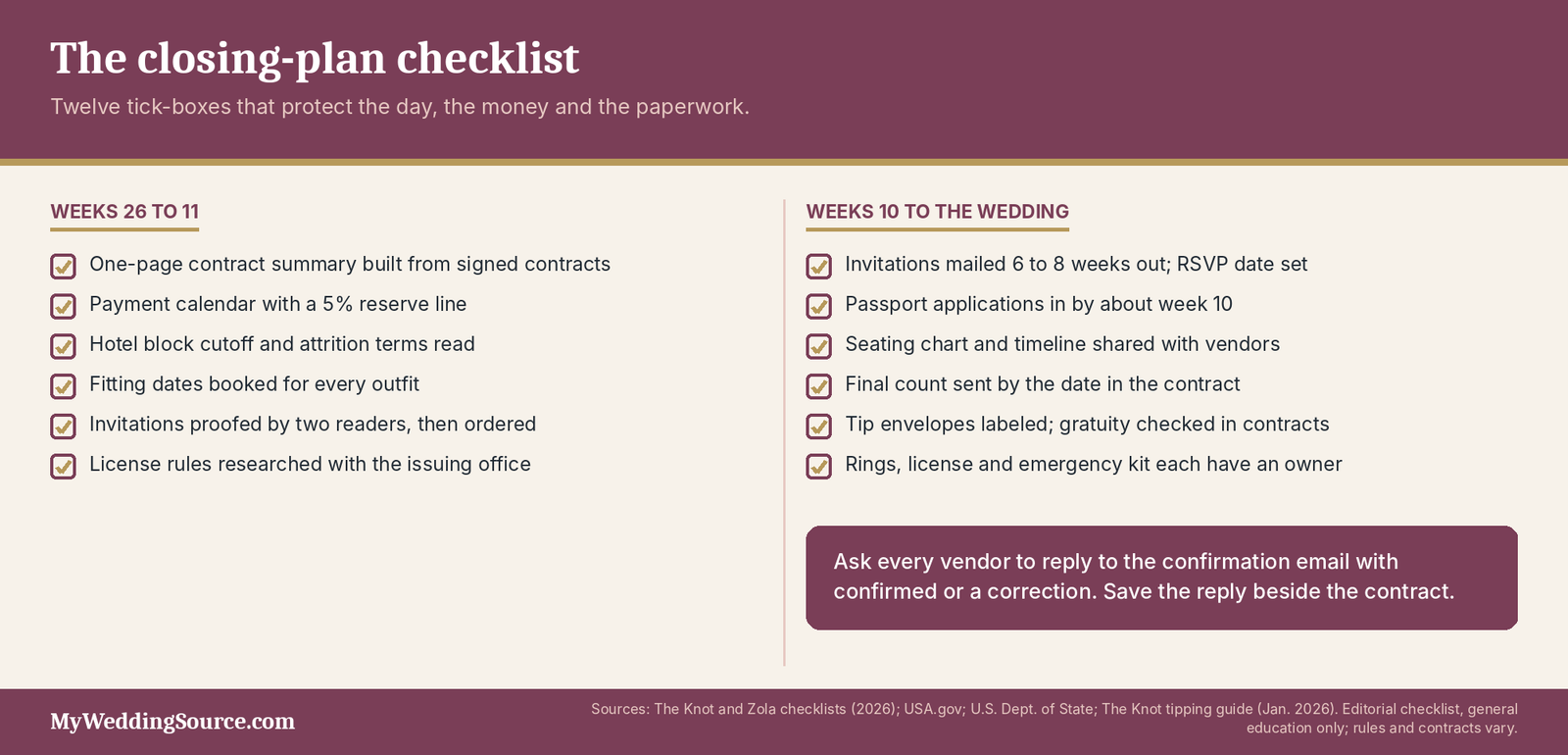
FAQ: six-month wedding planning questions
Timing and guests
Is six months enough time to plan a wedding?
Yes, if the date, venue and main vendors are booked, because the remaining work is mostly confirming, ordering and counting. The Knot’s six-month guide (2023) reports that 45 percent of couples spend less than a year planning, though it does not give a more recent sample. If major vendors are still open at six months, you will have fewer choices on popular dates, so prioritize the venue and photographer first and consider a planner or day-of coordinator. See our wedding planning timeline guide for shorter-runway strategies.
When should invitations go out, and when should RSVPs be due?
The Knot recommends mailing invitations six to eight weeks before the wedding, with the longer end for paper RSVPs and for guests who must travel, and setting the RSVP deadline two to three weeks before the wedding. Zola recommends mailing no later than six weeks out. Out-of-town invitations go earlier, and overseas guests need nine to ten weeks of mailing time, according to The Knot. Order the invitations about 12 to 14 weeks before the wedding so they arrive at least 10 weeks out.
How many invited guests will actually attend?
A common starting assumption from The Knot is that about 20 percent of invited guests will decline, and you can adjust up or down from there. Out-of-town guests tend to decline more often because of travel cost and time off work, though The Knot does not give a number for that. Count close family, close friends and out-of-town guests separately and apply a different rate to each group. Keep a low and a high number until the RSVP deadline passes, then use the real replies.
Paperwork and money
When should we get our marriage license?
Research your state’s and county’s rules at about six months out, and plan to pick up the license around one month before the wedding, as Zola and The Knot suggest. The right date depends on your state’s waiting period and the license’s validity window, which USA.gov says ranges from 30 days to a year across states. Ask the issuing office whether both of you must appear and which documents to bring. Use the office in the state where you will marry, and confirm its hours around holidays.
Do we need wedding insurance at six months out?
It is a decision to make once contracts are signed or deposits are paid, which is the point at which money is at risk, according to the NAIC. Liability coverage and cancellation coverage are different products, and voluntary cancellation is typically not covered. Coverage can take several days to start, so do not wait until the final week. Your venue may require a minimum liability coverage, so ask what it requires and then compare policy terms and exclusions.
How much should we tip wedding vendors?
Tipping is discretionary, and The Knot’s January 2026 guide gives ranges such as $50 to $200 per team member or 5 to 15 percent of the contract for a photographer, 15 to 25 percent for hair and makeup, and 15 to 20 percent of the food and drink fee for caterers and waitstaff. Check contracts first, because some caterers and transportation companies already include gratuity. Cash in labeled envelopes is the traditional method, and The Knot also mentions checks and Venmo. Ask a friend to hand them out so that you are not carrying envelopes during the reception.
Your next steps
This week
Build the one-page contract summary and the payment calendar
Open one shared document and list every vendor with the date, arrival time, price, amount paid, next payment due and the cancellation terms. Add a column for the total due each month. This takes about an hour for most weddings and makes the rest of the plan much easier to run, because you will see every deadline in one place. If you need a refresher on how the pieces fit, our wedding planning hub links to the other guides in this series.
Put the license and passport clocks on your calendar
Look up your issuing office’s page for marriage license rules and note the waiting period, validity window and office hours. Check your passport’s expiration date and count backward from your honeymoon departure using the State Department’s processing times. Then pick the dates for your first fitting and your RSVP deadline, and add them to the same calendar. These four dates are the ones most likely to cost you if they slip.
Before you pay a deposit or final balance
Read what the payment buys and when it stops being refundable
Before you send money, read the line in the contract that explains what the payment covers, the date after which it is nonrefundable, and what happens if the date or headcount changes. If the language is unclear, ask for a one-line clarification by email and keep the answer. Check whether gratuity or a service charge is already included so that you do not pay twice. Pay on the date the contract requires, not earlier or later, and note it on your payment calendar.
Pay in a way you can document
Use a payment method that leaves a dated record, and save the receipt or confirmation beside the contract. If you pay by credit card, the FTC says billing errors must be disputed in writing within 60 days of the first bill that shows them, so review each statement soon after it arrives. For goods or services not delivered, the FTC lists extra conditions, including trying to resolve the issue with the seller first. Terms vary by card issuer and contract, so treat this as general information and check your own agreements.
If this is on your list, see also Wedding Planning Schedule: Count Back From the Dates That Can’t Move.
Sources & methodology
- The Knot Worldwide: 2026 Real Weddings Study press release — 10,474 U.S. couples married in 2025; $34,000 average, 13 vendors on average, 37% contacting more vendors than planned (released February 18, 2026).
- The Knot: average wedding cost — $34,200 average, $80 per person catering, stationery, hair and makeup, transportation averages, 5% reserve, rush fees on tight timelines (updated June 24, 2026).
- The Knot: 6 month wedding planning checklist — six-month task timing, optional save-the-dates, planner recommendation, 45% of couples planning in under a year (page dated July 2023).
- The Knot: when to send wedding invitations — 6 to 8 week mailing window, 12 to 14 week ordering window, overseas and holiday guidance (updated July 2026).
- The Knot: wedding invitation etiquette — RSVP deadline 2 to 3 weeks out, caterer headcount about one week out, plus-one and children etiquette (updated July 2026).
- The Knot: wedding gown shopping and fittings — gown arrival, fitting schedule, alteration costs, deposits and what to bring (updated January 2025).
- The Knot: seating chart etiquette — when to start, family and head-table guidance, accessibility and placement tips (updated January 2026).
- The Knot: how much to tip wedding vendors — suggested tip ranges and timing, gratuity-included caution (updated January 2026).
- The Knot: how many people RSVP no — 20% decline rule of thumb and the 2023 Guest Study cost figure (updated February 2024).
- Zola: wedding planning checklist and timeline — task timing from 7 months out to the day before, invitation and envelope guidance, average cake and hair and makeup costs (updated May 14, 2026).
- Joy: what is a wedding room block — courtesy and attrition blocks, typical cutoff dates, how many rooms to block (no publication date shown).
- USA.gov: marriage certificates and licenses — license versus certificate, 30-day to one-year expiration range, where to apply (updated November 13, 2025).
- New York Domestic Relations Law section 13-b — 24-hour wait and 60-day validity example.
- Florida Statutes section 741.04 — three-day license delay and premarital course exemption example.
- CDC/NCHS: Handbook on Marriage Registration — state statutes govern license and filing requirements; officiants should know state and local rules (April 1988).
- Los Angeles County Registrar-Recorder/County Clerk: marriage licenses and ceremonies — license becomes a certificate returned for recording; example of one county’s process.
- U.S. Department of State: get your passport faster — routine and expedited processing times, $60 expedite fee, mailing allowance (updated September 30, 2026).
- U.S. Department of State: change or correct a passport — name-change routes by passport age (updated September 28, 2026).
- NAIC: event insurance consumer insight — liability versus cancellation coverage, timing, waiting period, voluntary-cancellation exclusion (page dated 2009).
- FTC: disputing credit card charges — 60-day written dispute window and conditions for undelivered services (last modified April 2024).
- U.S. Naval Observatory: sun and moon data for one day — sunrise, sunset and twilight lookups by date and location.
Methodology. Verified facts come from official or primary pages: USA.gov, the New York and Florida statutes, the CDC handbook, a county clerk page, the State Department, the NAIC, the FTC and the Naval Observatory. Survey findings and averages come from The Knot’s 2026 Real Weddings Study; planning timelines and lead times come from published checklists by The Knot, Zola and Joy, which are typical guidance rather than rules, and where two checklists disagree (for example on the hair and makeup trial) we say so. The week-by-week plan, the four phases, the June 5, 2027 date map and the headcount scenario are editorial arithmetic and judgment built on those sources; service charge and tax in the scenario are assumed, not quoted. This article is general education, not legal or financial advice, and license rules, contract terms and insurance policies vary by state and agreement.
Freshness note. Recheck your issuing office’s license rules, fees, waiting period and validity window before you apply, and recheck State Department processing times close to any international travel. The Knot’s six-month checklist page is dated 2023 and the NAIC page is dated 2009, so treat their figures as background and confirm current policy terms with your insurer. Review The Knot and Zola figures each spring when new annual data are released; researched October 2026.