

A wedding vendor due diligence checklist turns “they seemed great” into evidence you can point to: who the business really is, what it has promised in writing, how every change gets recorded, and what you will do if someone cannot show up.
Quick answer
Do three things in order. Verify the business (legal name, state registration, licenses, insurance, references), document the agreement (a signed contract treated as version zero, then every change in a dated variation log), and prepare a backup (an early-warning list, a short list of replacements, and the written steps you will take if a vendor fails). The wedding vendor due diligence checklist is cheap to run; the cost of skipping it is paid later and all at once. This guide is general education, not legal advice, and rules differ by state.
A wedding is usually built from many separate businesses, and many of them are small shops. That is part of what makes wedding work personal and flexible. It can also mean a vendor’s reliability depends on one person’s health, one bank account, and one calendar. A wedding vendor due diligence checklist does not assume anyone is dishonest. It simply replaces memory and goodwill with records, so that if a photographer gets the flu, a florist closes, or a contract quietly gets amended by email, you have the paper to deal with it.
This article is built around three working tools. The first is a proof ladder, which helps you judge how strong each piece of evidence really is. The second is the line-by-line wedding vendor due diligence checklist itself, which you can copy into a notes app or spreadsheet. The third is a contract variation log, a running record of every change after signing. Around those tools you will find edge cases (friends who “do weddings,” venue-mandated vendors, destination weddings, postponements), a backup plan, a question sheet, and an FAQ.
Use this wedding vendor due diligence checklist alongside our companion guide on the wedding vendor contract explains what the clauses in a typical agreement mean. This guide covers the other half of the job: confirming the party on the other side of the page is real and capable, and operating the contract once it exists. When a topic has its own full article, we link to it instead of repeating it.
What a wedding vendor due diligence checklist is for, and what it is not
A checklist is only as useful as the question behind it. Before the line items, it helps to be clear about what you are trying to learn and how much effort each vendor deserves. A florist who delivers centerpieces to a hall is a different exposure than a photographer who is the only person who can capture the ceremony, and a good wedding vendor due diligence checklist treats them differently.
Verification is different from trust
Trust is a feeling; verification is a record. You can and should have both, but only one of them survives a dispute, a staffing change, or a vendor’s closing. The goal of a wedding vendor due diligence checklist is not to interrogate people. It is to collect small, boring facts that either match what you were told or do not.
Proof is not the same as reassurance
Reassurance sounds like “we’ve done hundreds of weddings” or “don’t worry, we’re fully insured.” Proof looks like a certificate with dates and limits, a state record showing the business exists and is in good standing, or a signed paragraph naming who will be at your wedding. Reassurance is fine as a starting point and cannot carry weight on its own, which is why the wedding vendor due diligence checklist asks for documents. When you notice you are relying on a spoken promise, convert it: ask the vendor to put it in the contract, an email, or an amendment.
What verification can and cannot tell you
Checking a business registration tells you the business exists under that name. It does not tell you whether the work is good. A glowing reference tells you about one past client’s experience. It does not tell you whether the vendor’s calendar is overbooked this particular Saturday. Each line of the wedding vendor due diligence checklist answers a narrow question, and the value comes from stacking several narrow answers. Think of the wedding vendor due diligence checklist as a way of ruling out the preventable problems so that what remains is ordinary variation in service, not a surprise about who you hired.
The three layers: identity, capacity, and agreement
Almost every vendor problem traces back to one of three gaps. Either the business was not what it appeared to be (identity), it could not do what it promised on your date (capacity), or the paper did not say what both sides believed (agreement). Sorting the items on your wedding vendor due diligence checklist by layer keeps the list from turning into a pile of unrelated chores.
Identity: is this the business it says it is
Identity checks confirm the legal name, the entity type, where it is registered, and who is behind it. They matter most for vendors you found online and have never met. A business that operates under a trade name may be registered under a different legal name, and your contract should name the legal entity that is actually responsible for the work. The Better Business Bureau advises researching every vendor and notes that scam sites can use URLs and designs that look nearly identical to the real thing.
Capacity: can they deliver on your date
Capacity covers calendar, staff, equipment, insurance, and financial stability. A vendor can be honest and registered and still stretched too thin to serve you well. Signs of capacity trouble include slow replies, repeated rescheduling, and an unclear answer to “who is working my wedding?” One planning site notes that repeated unresponsiveness, not an occasional delay in peak season, is the real concern, particularly when a vendor keeps you informed.
Agreement: does the paper say what was promised
Agreement checks compare what you were told against what you signed. They look for vague deliverables, unstated fees, missing names, and changes that never made it into writing. The BBB’s contract advice lists the specifics worth seeing on paper: dates, times, products, quantities, prices, key staff names, arrival times, and cancellation, refund, and overtime terms. If any of those are missing, the gap is yours to close before signing.
How much checking is proportionate
You do not need to run a forensic investigation on the person who delivers a cake topper, and a well-scaled wedding vendor due diligence checklist reflects that. You do want to put more effort where a failure would hurt most or be hardest to fix. A simple way to decide is to look at two things: how much money is at risk, and how replaceable the vendor is on short notice.
Weigh money at risk against replaceability
A vendor who holds a large deposit and cannot be replaced in the final weeks (a photographer who books a year ahead, a venue, an officiant with a legal role) deserves the deepest check. A vendor who is paid in full on the day and has many local substitutes (a rental item, a balloon arch) deserves a light one. The two factors together give you a quick triage that avoids both extremes: under-checking the vendors who matter and burning out on the ones who do not.
A light, standard, and deep check
For a light version of the wedding vendor due diligence checklist, confirm the legal name and one recent reference, and put the main deliverable in an email you save. For a standard check, add state registration, insurance proof where it applies, a signed contract, and a payment trail on a credit card. For a deep check, add license verification, a certificate with the right named parties, a call with two recent clients, a written backup or replacement clause, and an entry in your variation log for every change. Our wedding planning checklist will help you decide which vendors you need and when.
The proof ladder: how strong is the evidence you actually have?
Not all evidence is equal, and one useful habit is to name the rung you are standing on. A vendor’s website that lists “licensed and insured” is a claim. A certificate of insurance is a document. A call to the insurance agent whose name is on that certificate is a confirmation. They all say “insured,” but they carry very different weight. The illustration below shows five rungs, from least to most reliable, and the rest of this section explains how to climb them.
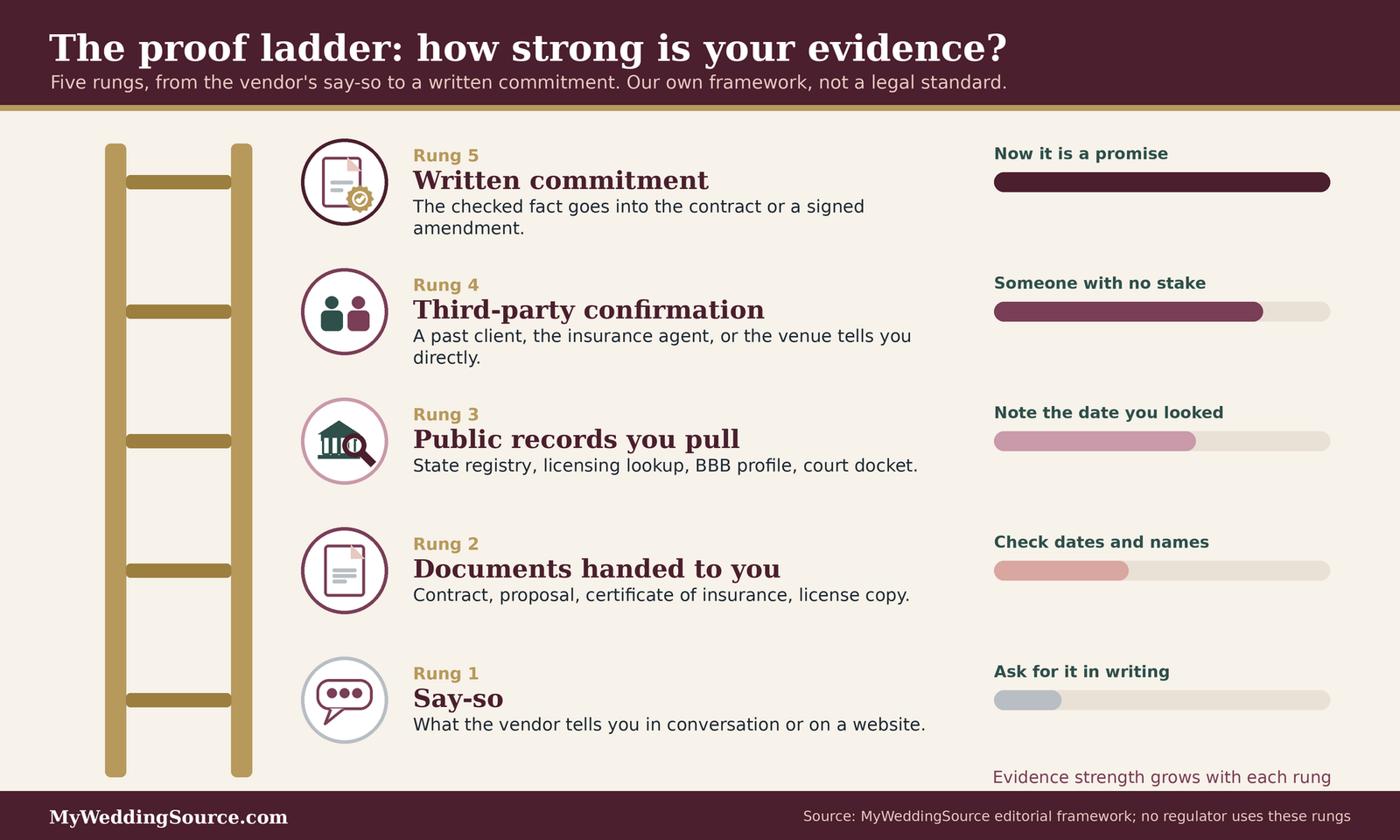
Five rungs, from say-so to confirmation
The rungs are our own framework for thinking about evidence. They are not a legal standard, and no regulator uses them. Their purpose is to help you notice when a decision rests on thin proof.
Rung one: the vendor’s say-so
This is everything the vendor tells you in conversation, on a website, or in a sales pitch: “we’re insured,” “we’re booked up that weekend,” “we have a backup photographer.” It is not worthless, because most vendors are truthful, but it is the weakest rung because nothing outside the vendor supports it. The BBB cautions against committing on the spot to “today only” offers at bridal shows and expos, partly because pressure pushes people to stay on this rung.
Rung two: documents the vendor hands you
Documents such as a contract, a proposal, a certificate of insurance, a license copy, or a portfolio are better than words, because they are specific and can be compared. They are still supplied by the vendor, which means they can be outdated, edited, or incomplete. A certificate is proof that a policy exists and shows basic terms, and it is not by itself proof that you or your venue are protected, as one event-insurance resource explains. Treat vendor documents as strong clues and not conclusions.
Rung three: public records you pull yourself
A state business registry, a licensing board lookup, a court docket search, and a BBB profile are records you retrieve without the vendor’s help. They are harder to fake and tell you things the vendor may not mention, such as the date a company was formed or who owns it. A wedding-planning publication recommends checking the Secretary of State website to confirm when a company was formed and who the owners are. Because these records are public, this rung is cheap and often the most revealing.
Rung four: confirmation from a third party
This is a person or organization with no stake in your booking telling you something directly: a past client who describes how the vendor handled a problem, an insurance agent who confirms the policy is active, a venue coordinator who has worked with the vendor many times. It takes more effort than the other rungs, which is why it is saved for high-exposure vendors. The advice to speak with past clients appears again and again in wedding guides, and one planning site goes so far as to call a refusal to provide references a red flag.
Rung five: a written commitment that makes the claim enforceable
The top rung is not an extra check; it is what you do with the checks. When the evidence is solid, you write it into the contract or an amendment: the named insured, the named photographer, the backup clause, the dates. Now the claim is no longer just something you learned, it is something the vendor promised in a signed document. Oral agreements can sometimes be binding, according to Cornell’s Legal Information Institute, but a specific signed writing is far easier to prove than a recollection, which is why the rest of this guide keeps pointing you back to the paper.
Matching the rung to the risk
Most vendors do not need every rung. What matters is that you choose the rung on purpose and that you notice when the vendor’s answer has not climbed as high as the exposure demands.
Set a minimum rung for each vendor type
A reasonable starting rule for your wedding vendor due diligence checklist is to require at least rung three (public records) for any vendor holding a significant deposit, and at least rung four (third-party confirmation) for vendors who are single points of failure on the day. For low-risk, easily replaced vendors, rung two is often enough. This is our suggestion, not an industry standard, and you should adjust it to your budget and comfort level. Writing the rule down before you start shopping keeps enthusiasm from lowering the bar halfway through.
Record the date and source of every check on your wedding vendor due diligence checklist
A proof you cannot date is a weaker proof. When you check a registry, screenshot the page or note the date, the exact legal name you searched, and what you saw. When you receive a certificate of insurance, note its policy period. Certificates expire, businesses dissolve, licenses lapse, and the useful fact is not just that something was true, but when you saw it. A single line in your log, such as “checked state registry, active, March 3,” is enough, and it takes about thirty seconds. ## The verify-vendor checklist, line by line
This is the core of the wedding vendor due diligence checklist. It is organized by what you are checking, not by vendor type, because the same checks apply to a photographer, a caterer, and a band, with different weight. Table 1 is the whole wedding vendor due diligence checklist on one screen. The sections after it explain each group, what the sources say, and where the limits of the check are.
Table 1 lists each check, where to look, what solid evidence looks like, and what should slow you down. Copy this wedding vendor due diligence checklist, add a column for “date checked,” and fill it in as you go.
| Check | Where to look | Solid evidence looks like | Slow down if |
|---|---|---|---|
| Legal business name | Contract, invoice, state registry | Name on the contract matches the registry record | The contract names a person or a trade name that does not match any record |
| State registration and status | Secretary of State or state business search | Active status, formation date, named owner or agent | No record, an inactive status, or a very recent formation with no explanation |
| Licenses and permits | State, county, or city licensing sites | A license number you can look up, current dates | “Licensed” with no number; a regulated service (food, alcohol) with no permit |
| Insurance | Certificate of insurance, then the agent | Policy period covers your date; limits and coverage types are listed | No certificate, expired dates, or a certificate that cannot be confirmed |
| Venue insurance requirement | Venue contract or policy page | Certificate names the venue as holder or additional insured if required | You do not know whether the venue needs a holder, an additional insured, or both |
| Website and domain | Browser, contact page, social accounts | Matching business name, address, phone, active posts | Look-alike URL, no physical address, no way to phone |
| References | Two recent clients you speak with | Specific stories about problems and how they were handled | Only testimonials on the vendor’s own site; refusal to share any contacts |
| Review pattern | Several review sites, BBB profile | Reviews spread across time, specific details, calm replies to criticism | A cluster of near-identical reviews in a short window |
| Portfolio authenticity | Full galleries; reverse image search | Complete weddings, shot by the person who will work yours | A handful of polished images; photos traced to someone else |
| Who will work your event | Contract, staff section | Named lead and a stated role for assistants | “Our team” with no names; the person you met is not the one assigned |
| Written scope | Proposal and contract | Dates, times, quantities, locations, deliverables | “Basic setup” or “additional charges may apply” with no triggers |
| Price and fees | Itemized quote | Taxes, delivery, overtime, and service charges stated | Fees that appear only after you ask, or a quote given piecemeal by phone |
| Payment schedule | Contract payment section | Deposit and balance dates; deposit due after signing | Full payment demanded up front; a payment method that cannot be traced |
| Payment method | Invoice or payment page | Credit card or another method that leaves a clear record | Gift cards, cash with no receipt, wire transfers, or a payment app for a deposit |
| Cancellation and refund | Contract | Written terms for your cancellation, postponement, and the vendor’s failure | Terms that only cover your cancellation |
| Backup or replacement | Contract, rider, or email | A stated process if the vendor cannot perform | No mention of illness, emergency, or equipment failure |
Identity and registration checks for your wedding vendor due diligence checklist
These first items on the wedding vendor due diligence checklist are the quickest and cheapest. Do them before you pay anything, ideally before you invest emotionally in a vendor.
Legal name and entity
Start with the name on the proposal or contract and compare it to what a state business search shows. A wedding-planning publication advises checking the Secretary of State website to learn when a company was formed and who owns it. Small vendors sometimes operate as sole proprietors under a personal name, which is common and not a warning on its own. What matters is that your contract names the party you would actually pursue if something went wrong, and that you can identify it. If the contract carries a trade name only, ask which legal entity is signing and have it added.
Licenses and permits
Whether a vendor needs a license depends on what they do and where they do it. The U.S. Small Business Administration explains that business activities regulated by a federal agency need a federal license or permit, that states generally regulate a broader range of activities, and that cities and counties may add their own rules. It lists alcohol as an example of a federally regulated activity and names restaurants among activities often regulated locally. For a wedding, that means a caterer that serves food, a bar service that pours alcohol, or a vendor working in a municipal park may each need something. Ask the vendor which licenses apply to your event and for the number, then check the issuing site. If a venue only allows licensed vendors, as WeddingWire notes many do, ask the venue what proof it accepts.
Website, domain, and social accounts
The Better Business Bureau warns that scam websites often have very similar URLs and can look nearly identical to the real website, and that fake social accounts exist. Before sending money, confirm the web address you are on matches the one the vendor gave you in person, and that the contact page lists a physical address and a phone number that someone answers. Look at the social account’s history: a long record of real posts and tagged clients is more reassuring than an account created last month. If an unexpected message asks you to change where you send payment, confirm by calling a number you already trust, not one in the message.
Insurance and liability proof
Insurance is easy to skip on a wedding vendor due diligence checklist, and it matters most when something physical goes wrong, such as a guest injured by equipment or a damaged venue floor. It is also an item with a lot of confusing vocabulary, so it is worth slowing down.
What a certificate of insurance shows
A certificate of insurance, often called a COI, is a document that shows an insurance policy exists. According to an event-insurance publisher, it lists details such as dates, coverage limits, and coverage types. The same source is clear about what it does not do: having a certificate does not by itself protect a venue or a client. The certificate is evidence of a policy, and the policy is what governs coverage. That makes a COI a good rung-two document and a starting point for rung-four confirmation.
Certificate holder versus additional insured
These two phrases are easy to confuse. The event-insurance source explains that a certificate holder receives a copy of the certificate as proof of coverage and is not covered by the policy, while an additional insured is a third party, such as a venue or a parks department, added to the policy through an endorsement and protected for certain claims related to the event. If your venue contract asks for one or both, the exact wording matters. The source suggests checking the venue’s full legal name, the required limits and coverage types, the event dates including setup and teardown, and the deadline for submitting the certificate, noting that many venues require it before the final deposit or thirty days before the event. This is a summary of one publisher’s explanation, and policy wording varies, so ask the vendor’s agent and the venue to confirm.
Confirming coverage is real and current
Our practical suggestion, not a regulatory rule, is to check four things on any certificate you receive: the policy period includes your date, the named insured matches the vendor’s legal name, the coverage types and limits match what your venue or contract requires, and the certificate lists an agent or broker you can contact. A short call or email to that agent to confirm the policy is active is a rung-four check. It takes a few minutes, and it is the difference between “a document says they are insured” and “someone with no stake told me the policy is in force.” Remember that a certificate is only as current as the day it was issued.
Track record: references, reviews, and portfolios
Track record items on the wedding vendor due diligence checklist tell you how a vendor behaves when things do not go to plan. Most of what you learn here is pattern, not proof, so you are looking for consistency across several sources.
References you actually speak with
A vendor’s website testimonials are selected by the vendor. The BBB advises asking recent couples for references, since reviews on a vendor’s own site may be selective or fake. Ask for two recent clients, ideally from the past year, and ask questions that invite stories: What went wrong, and how was it handled? Did the vendor arrive when promised? Were there extra charges? Was the person you met the person who worked your wedding? Specifics from one real client are worth more than twenty cheerful star ratings.
Reading reviews for patterns
Look for reviews spread across time, with specific details and reasonable variety, and read how the vendor responds to criticism. One wedding-advice article suggests looking for twenty or more positive reviews spread over time and being cautious about reviews that bunch into a short window. Treat that as a rule of thumb from one source, not a threshold. The Federal Trade Commission’s Consumer Reviews and Testimonials Rule, effective October 21, 2024, prohibits businesses from writing or buying fake reviews, from buying reviews with a required sentiment, and from suppressing reviews through intimidation or unfounded legal threats. It also requires insiders to disclose their relationship. The rule does not mean every review you see is genuine, since the FTC itself says its guidance is not comprehensive, but it does mean a vendor who threatens a reviewer is doing something the agency has addressed.
Checking that the portfolio is the vendor’s own
The BBB suggests that a reverse image search can reveal portfolio photos taken from other photographers, and a wedding-advice article lists a photographer in the portfolio who will not be the one working your wedding as a red flag. Ask to see two or three complete wedding galleries from start to finish, not only highlights, and ask who shot each one. For other categories the same idea applies: a florist’s full event photos, a band’s unedited live video, a caterer’s tasting. Our wedding photographer portfolio guide explains how to read a gallery in more detail, and it pairs well with the portfolio line of this wedding vendor due diligence checklist.
Money evidence: how the payment trail protects you
A payment trail is part of any wedding vendor due diligence checklist, because how you pay determines how much leverage you have later.
Deposit size and schedule
Standard practice, according to a wedding-planning site, is a deposit to hold the date with the balance due closer to the wedding, and a vendor who wants everything up front may be short on cash. The BBB advises paying a deposit only after both parties sign the contract and never paying the full amount up front. Spreading payments along the schedule of the work keeps the vendor motivated and limits what you have at risk if they stop responding. Our wedding budget guide can help you slot the payment dates into your cash flow.
Payment method and the paper trail
The BBB recommends a credit card, because it makes disputing a charge easier if a vendor does not deliver, and advises avoiding cash, wire transfers, gift cards, and payment apps for deposits. A wedding-advice article adds that a gift-card request is a red flag, and that credit cards generally offer zero liability for unauthorized charges if reported within sixty days while debit cards have tighter protections. The practical point is that some methods leave a record and some rights, and others do not. Whichever you use, keep the receipt or invoice and match it to the amount in the contract, as the payment lines of the wedding vendor due diligence checklist suggest.
Itemized quotes and what “all-in” means
Ask for an itemized price list. The BBB suggests asking whether tax and gratuity are included, and it mentions extras such as cake cutting or corkage at venues. Fees that appear only after you ask are not necessarily dishonest, but they are the main source of the gap between a quote and a final bill. If a quote is delivered by phone or in pieces by email, ask the vendor to consolidate it into one document, and sign that. The wedding vendor timeline guide shows how load-in, setup, and overtime can quietly add charges.
Who is actually delivering? Staff, subcontractors, and substitutions
The person you meet in the consultation is not always the person who shows up. That is not automatically a problem, since larger studios and companies run on teams, but it becomes one when the contract says nothing and the quality you were sold depends on a specific person. This part of the wedding vendor due diligence checklist makes “who” explicit.
Name the people and their roles
If your decision to hire rests on one person, that person needs to be in the contract. The BBB lists key staff names among the things a contract should specify, and a wedding-advice article names a portfolio photographer who is not the one working your wedding as a red flag.
Lead, associate, and assistant
Ask who the lead will be, who will assist, and what each does. A “lead photographer” and an “associate photographer” often mean different things at different studios, so ask for the definition. Add the named-lead line from the wedding vendor due diligence checklist to the contract: request that the lead’s name appear with language such as “will personally attend and perform the services.” If you are comfortable with an associate, write down what the studio promises about their experience and how you will see their work first.
The person you met versus the person assigned
Some businesses assign staff after booking, based on availability. This is a legitimate model, and the problem is only a surprise. If that is how the business works, ask for the assignment date, the criteria used, and whether you may meet or see the work of the person assigned. Ask what happens if you are not comfortable with the assignment. Get the answer in writing and keep it with your signed copy.
Subcontractors and substitutions
Many wedding businesses hire other businesses for part of the job: a rental company for linens, a second shooter, a freelance bartender, a delivery service. This is ordinary. The goal is to know about it, not to forbid it, and the wedding vendor due diligence checklist simply asks the question. We cover the topic in more depth in our guide to wedding vendor subcontractors.
Ask who else touches your event
Ask which parts of the service are performed by employees and which by outside businesses, and whether the vendor remains responsible for the subcontractor’s work. Ask whether subcontractors carry their own insurance or are covered under the vendor’s policy. You do not need the whole supply chain, only enough to know who to call if one link fails and whether the vendor you signed with will answer for it.
Substitution language and replacement policy
A contract can allow a vendor to substitute a person of “comparable skill” if the named person cannot attend because of illness or emergency. The wording is common, and the key questions are who decides what “comparable” means, whether you can see the substitute’s work, and what refund or credit applies if you object. Our article on the wedding vendor replacement policy covers this clause in detail. At a minimum, the contract should say who will be notified, how fast, and what you can do if the replacement is unacceptable. ## Contract operations: version zero, amendments, and the variation log
Signing a contract is not the end of the contract work. Between signing and the wedding, details change: the guest count moves, the ceremony time shifts, you add an hour, a vendor changes an assistant. Each change is an opportunity for the paper and the reality to drift apart. A wedding vendor due diligence checklist does not stop at signing, and contract operations is the habit of treating the agreement as a living record and keeping it tidy. The tool for that is a variation log, introduced below.
Treat the signed contract as version zero
Before anything changes, freeze what exists. Version zero is the fully signed agreement, with every attachment, exactly as both sides agreed to it. Every later change is measured against it, which is what makes a log useful.
Build a clean file for each vendor
Create one folder per vendor with the signed contract, the proposal it came from, the certificate of insurance, the receipts, and every email that clarifies a term. Name files with dates, such as “photographer-contract-signed-2026-03-03.” Keep a copy outside your email, because email accounts get closed and lost. It sounds fussy, but when a vendor says “that is not what we agreed,” the person with the dated file is the person who can show what was agreed. Keep this folder with the rest of your wedding vendor due diligence checklist records.
Read for gaps before you sign, not after, using your wedding vendor due diligence checklist
The BBB lists what a contract should contain: dates, times, products, quantities, prices, key staff names, delivery or arrival times, and cancellation, refund, and overtime terms. One contract-review article adds scope of service, payment schedule, non-performance, refunds, permits and insurance, dispute resolution, and a cancellation and exit plan. Read the contract once with this list beside you and mark every item that is missing or vague. Then ask for the missing items to be added before signing, when the vendor has the most reason to say yes. Our wedding vendor contract guide walks through the clauses themselves.
How changes should be made
Many couples make changes by text or in passing, and most of the time it works out. The point of a process is to protect the times it does not. The law here is complicated and varies by state and by the kind of contract, so what follows is general education drawn from published sources, not legal advice.
Why verbal changes are fragile
Cornell’s Legal Information Institute explains that informal or oral agreements can be binding if the basic elements of a contract are present, and that the statute of frauds requires certain contracts to be in writing and signed, including contracts that cannot be completed within one year and contracts for the sale of goods of $500 or more under the Uniform Commercial Code. So a spoken change may or may not count, depending on the facts and the state. What you can control is proof. A change that exists only in a phone call has no record, while a change confirmed in a dated message or a signed amendment does.
Written-modification clauses and informal changes
Many contracts say that changes must be made in writing and signed. The Uniform Commercial Code’s rule on modification, as published by Cornell, says that a signed agreement barring changes unless made in a signed writing cannot be changed any other way, and that if a merchant supplies the form, the other party must sign that clause separately. The same section says that a failed modification can still operate as a waiver in some cases, and that a party who waived a term can retract the waiver with reasonable notice unless that would be unjust. That section applies to contracts for the sale of goods, and many wedding services are mostly services, so whether it applies to your contract is a question for an attorney. The practical lesson holds either way: if your contract says changes must be in writing, make changes in writing.
What a simple amendment contains
An amendment does not need to be long. It should identify the original contract by date and parties, state exactly what is changing and what is not, give the new price or deadline if there is one, say whether other terms remain in force, and be signed or acknowledged by both sides with a date. For small changes, a short email chain where the vendor replies “confirmed” may be enough for your own records, but check whether the contract defines what counts as a valid change. If it requires signatures, an email may not satisfy it, so ask the vendor to sign a one-page amendment. Our companion article on wedding contract change orders looks at last-minute upgrades specifically.
The contract variation log
A variation log is a simple table that tracks every change after version zero. It answers four questions at any moment: what has changed, who agreed, what it cost, and where the proof is. It takes minutes to maintain and can save hours of reconstruction.
Table 2 shows the columns we recommend. Copy it into a spreadsheet and keep one tab per vendor, plus a summary tab that totals what you owe each vendor.
| # | Date | Change requested | Requested by | Agreed by and how | Price effect | Running contract total | Amount paid so far | Proof (file name) |
|---|---|---|---|---|---|---|---|---|
| 0 | Contract date | Original signed contract | Both | Signed by both | None | Contract price | Deposit | Signed PDF |
| 1 | Date of change | What changed, in one sentence | You or vendor | Signature, email “confirmed,” or other | Plus or minus amount | New total | Update | Email or amendment file |
Why each column earns its place
The date lets you reconstruct sequence. “Requested by” shows who initiated the change, which matters if a fee is disputed. “Agreed by and how” is the column people skip, and it is the most important, because it records whether the change was signed, confirmed in writing, or only discussed. “Price effect” and “running contract total” keep the arithmetic honest, and “amount paid so far” tells you what you still owe. “Proof” is the file name of the document, so that you can find it quickly under pressure.
A worked example with invented numbers
The following example is hypothetical and uses numbers we made up for illustration, with our own arithmetic. Imagine a photography contract at $3,600 with a $1,200 deposit paid at signing. Change 1 adds one hour of coverage at $300, confirmed by a signed amendment, making the total $3,900. Change 2 moves the reception to a venue forty minutes farther away, with a travel fee of $150 confirmed by email, making the total $4,050. Change 3 removes the printed album in exchange for a $400 credit, confirmed by signed amendment, making the total $3,650. After the deposit, the balance owed is $3,650 minus $1,200, which is $2,450. Without a log, it would be easy to remember the album credit and forget the travel fee, or the reverse.

What this actually costs
The log itself, like the rest of the wedding vendor due diligence checklist, is free: a spreadsheet and a few minutes per change. What it protects is real money. In our hypothetical example the final balance is $2,450 after a $1,200 deposit, and three changes moved the total by $50 net from the original $3,600. That is an estimate from invented numbers, not a quote. The point is that small changes accumulate, and a balance you cannot reconcile is a balance you may overpay or underpay. Ask each vendor to send an updated total whenever an amendment is signed.
Reconcile the log before the final payment
About a month before the balance is due, send each vendor a one-page summary: the original contract total, each change with its date, the current total, what you have paid, and the balance you expect. Ask them to confirm it in writing. Disagreements surface when they are cheap to fix and not in the wedding week. Treat the reconciliation as the last line of your wedding vendor due diligence checklist. This reconciliation also doubles as the vendor confirmation the BBB recommends, which advises confirming all details with each vendor one to two weeks before the wedding.
Money: deposits, schedules, and the dispute window
Payment terms are where the wedding vendor due diligence checklist and contract operations meet. How much you pay, when you pay it, and how you pay it shape both your risk and your options. The sources we reviewed agree on the broad strokes and differ in the details, so this section separates what they report from what we suggest.
Deposits and payment schedules
A deposit holds your date and tells the vendor you are serious. The question is how much, and what happens to it if plans change.
Pay after you sign, and pay in stages
The BBB recommends paying a deposit only after both parties sign and not paying the full amount up front. Another source advises scheduling payments as the date approaches or the work progresses. The reasoning is leverage: money paid early leaves little reason for a vendor to respond quickly, while a balance that is still unpaid keeps the relationship active. This is advice, not law, and some vendors, especially venues, do require large payments early. If so, ask what protections exist for your money, and weigh those terms against the other items in the contract.
What nonrefundable really means
A deposit described as nonrefundable may be treated differently depending on the contract wording and state law. Cornell’s Legal Information Institute explains that liquidated damages are a set amount or formula owed if a party breaches, that the clause must be clearly stated and agreed to in advance, and that courts will not impose liquidated damages if the clause is punitive. We cannot tell you how a particular court would treat your deposit. What you can do is ask the vendor to state in writing what the deposit covers (holding the date, planning time, or costs already incurred), what happens if you cancel or postpone, and what happens if the vendor cancels. A contract that only covers your cancellation leaves out half the picture.
Payment methods and dispute rights
Your payment method can matter if a vendor fails to deliver. The sources are consistent that a credit card is usually the safer choice for deposits, and the FTC’s description of how disputes work shows why timing matters.
What the FTC says about credit card disputes
The FTC’s consumer guidance on using credit cards and disputing charges says a dispute letter must reach the issuer within sixty days after the first bill containing the error was sent, and that the issuer must acknowledge it in writing within thirty days and resolve it within ninety days of receipt. It lists errors that can be disputed, including charges for goods or services you did not accept or that were not delivered as agreed. For disputes about the quality of purchases, the FTC says you may be able to assert the same claims against the issuer that you could bring against the seller, but only if the purchase cost more than $5, was made in your home state or within 100 miles of your billing address, and you tried to resolve the problem with the seller first.
Why a deposit paid a year ahead needs extra thought
A wedding deposit may appear on a statement a year or more before the service is due. The sixty-day window described by the FTC runs from the first bill containing the error, which raises a fair question about what happens when a vendor fails long after the charge. We cannot answer that, because card issuers have their own policies and the rules differ by card and by circumstance. Our suggestion is to ask your card issuer how it treats services paid in advance and not delivered, to keep every record, and to act promptly when a vendor fails, since the BBB’s advice is to contact the business in writing first and then dispute the charge with your card company. This is general information and not legal or financial advice.
Keep the money trail clean
Whatever method you use, the records behind your wedding vendor due diligence checklist determine how easy it is to prove what you paid.
Match every payment to a document
For each payment, save the receipt or invoice, the date, the amount, and the card or account used, and enter it in your variation log’s “amount paid” column. If a vendor accepts payment in a form that produces no record, such as cash, ask for a signed receipt. A wedding-advice article notes that cash is acceptable only with a receipt. A mismatch between what you paid and what the vendor says you paid is one of the most common and most avoidable disputes.
Watch for requests to change how you pay
A request to switch payment method or destination partway through, especially by text or by an unexpected email, deserves a pause. The BBB advises confirming requests through an independent contact method, and warns that scam messages can impersonate businesses you know. Call the vendor on a number from your signed contract, and ask them to confirm the change in writing before you send anything. ## Backup plans: preparing for a vendor who cannot deliver
Vendor failure is uncommon, and The Knot notes that cancellations are rare and that the vendor is often as disappointed as you are. But rare is not never, and the cost of having no plan is high enough to be worth an hour of preparation. A backup plan is the last section of a wedding vendor due diligence checklist, and it has four parts: early warning, a short list of replacements, financial protection, and written first steps. The illustration below shows how your options narrow as the date approaches and where the checkpoints in this guide fall.

Early warning signs
Most failures announce themselves in small ways before the large one, so a wedding vendor due diligence checklist should include a place to log warning signs. You do not need to be suspicious of every delayed email, but you do want to notice patterns.
Communication signals
One planning site lists slow replies, missed deadlines, and skipped meetings as common predictors of weak service later, while noting that occasional delays in peak season are not necessarily alarming if the vendor keeps you informed. A wedding-insurance publisher adds that vendors who stop posting on social media or become slow to answer calls and messages may signal that a backup is needed. Make a note of the date and the nature of each lapse in your variation log. Three small lapses in a month is a different situation from a single quiet week.
Process signals
Look also for process changes: a vendor who suddenly asks for the balance early, changes the payment destination, becomes vague about who will work your event, or cannot produce a certificate that was promised. Any one of these has an innocent explanation, and together they deserve a direct conversation. Ask plainly, in writing, whether anything has changed that affects your date, and keep the reply. If the answers get vaguer, move your backup plan from “just in case” to “active.”
Build a backup plan before you need it
A backup plan does not mean paying twice. It means knowing, in advance, who you would call and what you would say, so that a failure becomes a task and not a crisis.
Keep a short list of replacements
For each vendor who would be hard to replace, keep the names of two alternatives and a note of whether they have been contacted. A wedding-insurance publisher recommends keeping a list of backup vendors, and suggests asking a wedding planner, coordinator, or the venue’s on-site coordinator to help find and schedule a substitute. You do not need to pay a retainer. You need names, rough pricing, and an understanding of how far ahead each alternative typically books. Add the list to your contract folder.
Decide who is the point person
If a vendor fails on the wedding day itself, you will not be the right person to handle it. A wedding-advice article recommends assigning a point person to log no-shows, call attempts, and problems with timestamps. Choose someone calm, such as a planner, a coordinator, or a trusted family member, give them the vendor contact sheet and the contracts, and tell them what authority they have to spend money on a replacement. Our wedding week checklist shows how to organize the final days.
Write the notification and replacement steps into the contract
If a vendor will not agree to a replacement clause, that tells you something about how the wedding vendor due diligence checklist will go with them. A good clause says how quickly the vendor will notify you if they cannot attend, whether they will arrange a replacement of comparable quality, what credit or refund applies if they cannot, and whether you can terminate. A contract-review article lists non-performance, refunds, and a cancellation and exit plan among essential terms. Where a vendor offers only a refund, ask when it would be paid, because a refund two months after the wedding does not help you hire a replacement.
Financial protection
Insurance and platform programs may cover part of the cost of a vendor failure. They have limits and conditions, so treat them as supplements and not substitutes for the checks above.
Wedding insurance and vendor failure
The BBB says that wedding insurance may cover lost deposits if a vendor closes or does not show, and advises reading a policy’s exclusions. A wedding-insurance publisher says cancellation insurance may cover vendor cancellations and refund payments to the vendor, and that buying coverage early in planning protects deposits whenever a vendor closes. These are descriptions from two sources, and what a given policy covers depends entirely on its wording. Our wedding insurance guide explains how to read a policy. Whatever you buy, ask the insurer in writing what counts as a covered vendor failure, and read the exclusions yourself.
Marketplace guarantees and their limits
Some booking platforms offer programs for vendor cancellations. The Knot, for example, describes a Peace of Mind program for vendors booked through its marketplace. According to The Knot’s article, the cancellation must take place between ninety and fourteen days before the wedding, you submit your contract and a note of the cancellation, the team curates replacement options, and a credit of up to $500 may cover any price difference. That is a retailer’s description of its own program, it applies only to vendors booked through that marketplace, and its terms may change, so read the current terms before relying on it. Programs like this are worth knowing about, but they do not replace your own contract protections.
If a vendor does fail
If the worst happens, the order of steps matters more than speed. Panicked messages and half-finished records make later recovery harder.
First hours: document and contact
A wedding-advice article recommends contacting the vendor in writing to request a refund or remedy, documenting everything including emails, screenshots, receipts, and bank records, and following up in writing with a list of what happened and when. Start there. Read the contract for refund, default, and cancellation terms, which The Knot also recommends checking first. Then adjust your timeline: if you lose a second photographer, as The Knot’s example notes, you may need more time between locations. Tell your other vendors what changed, since one failure often affects another’s schedule.
Next days: replace, dispute, and report
Find a replacement, and keep the replacement contract, since the same advice notes it proves the price difference. Dispute the charge with your card issuer as soon as possible, subject to the issuer’s rules. The BBB suggests filing a complaint with it and reporting suspected scams to BBB Scam Tracker to warn other couples. For serious cases, the wedding-advice article lists small claims or county court for breach of contract or fraud, noting that some contracts include attorney-fee clauses. Your state attorney general’s office is another place to look for consumer information, and the National Association of Attorneys General maintains a directory that helps you find it. A licensed attorney in your state can tell you which remedies are realistic. One publisher is candid that in some cases, particularly close to the wedding, accepting the loss and finding the next-best option may be easier than pursuing recovery.
Edge cases: when the standard checklist needs adjusting
The wedding vendor due diligence checklist above assumes a commercial vendor, a written contract, and a local event. Real weddings often include something else. These edge cases show how to keep the spirit of the wedding vendor due diligence checklist when the usual steps do not fit.
Friends, relatives, and informal vendors
A friend with a good camera or an aunt who bakes is a gift, and a gift does not come with the formality of a contract. It still comes with risk, and the risk is mostly to the friendship.
Write down a lighter agreement
You do not need a formal contract with a relative, and a full wedding vendor due diligence checklist may be more than the situation needs, but you do need clarity. Agree in writing, in a short message, on the date, the time, what is being provided, whether any payment or reimbursement applies, and what happens if something goes wrong or the person cannot attend. This does not signal distrust. It is the same set of facts you would write into a contract, in friendlier words, and it prevents the disappointments that come from two people remembering a favor differently. Think of it as a one-line wedding vendor due diligence checklist: who, what, when, and what if.
Plan the backup before the favor starts
Informal vendors do not have insurance, replacement staff, or a business to keep alive. Make the backup plan more robust, not less: a second person with a phone camera on standby, a bakery on call, a playlist that can run itself. Ask the venue whether any outside food, alcohol service, or equipment requires its own insurance or a licensed professional, as venues sometimes set conditions, and confirm before the day.
Venue-required and preferred vendors
Many venues require that you use certain vendors or have their own rules for outside ones. That shifts some of the verification and changes whom you can hold responsible.
Ask what the venue vouches for
A venue’s preferred list is a list of vendors the venue knows, which is not the same as a list the venue has checked for insurance, licensing, or quality. Ask what the venue verifies, whether it holds current certificates, and who is responsible if a preferred vendor fails. Get the answer in writing, and still run your own wedding vendor due diligence checklist. Our wedding venue questions guide covers what to ask when you tour.
Insurance rules for outside vendors
The event-insurance source we reviewed notes that venues often ask for a certificate holder, an additional insured, or both, and that many require the certificate before the final deposit or thirty days before the event. If your venue has rules for outside vendors, get them early, share them with each vendor, and calendar the due dates. A vendor who cannot meet the venue’s insurance requirements may be unable to work at your venue at all, and it is far better to learn that in March than in the last week.
Destination, out-of-state, and multi-state vendors
When a vendor lives in one state and your wedding is in another, registration and licensing questions multiply and so does the cost of resolving a dispute.
Check both places
The SBA notes that requirements depend on business activities and location, and that each jurisdiction where a business operates may have its own rules. A vendor may be registered in their home state and still need a local permit where your event takes place. Ask the vendor which jurisdictions they are licensed in, and ask your venue or the local government whether any local permits apply. Add a line for the second state to your wedding vendor due diligence checklist. Our destination wedding checklist covers the larger planning picture.
Think about where a dispute would be heard
A contract may say which state’s law applies and where disagreements must be settled. A vendor located far from you, with a venue-state contract clause, can turn a small dispute into an expensive one. Add the dispute clause to your wedding vendor due diligence checklist and ask what it says, whether mediation or arbitration is required first, and whether you are comfortable with it. The contract-review article we read lists dispute resolution among essential terms. If the clause surprises you, an attorney can explain what it means in your state.
Name changes, rebrands, and sold businesses
Small businesses change names, merge, and sell. Your signed contract follows the legal entity, and the legal entity may not be the brand on the website.
Confirm the entity at signing and again later
At booking, confirm the legal name, and add a legal-name re-check to your wedding vendor due diligence checklist. A few months before the wedding, check the registry again and ask whether anything has changed about ownership, name, or staff. If a business has been sold, ask in writing whether the new owner will honor existing contracts and what happens to deposits. A vendor who answers this smoothly is usually a vendor who has thought about it.
Keep the original and the update together
If a vendor announces a rebrand or a new owner, ask for a short written acknowledgment that the original contract continues, and add it to your log as a numbered change. The record then shows the continuity of the agreement. It also gives you a dated document to use if the new owner later claims not to know about your booking.
Postponements and force majeure
When a wedding is postponed, every contract in your folder becomes a negotiation. Preparing for that possibility early is a form of due diligence, and a postponement line belongs on your wedding vendor due diligence checklist.
What force majeure language does
Cornell’s Legal Information Institute describes force majeure as a clause that releases both parties from obligations when an extraordinary event directly prevents performance, only for events beyond a party’s control. It explains that mere difficulty or unanticipated hardship is not enough, that whether an event qualifies depends largely on the clause’s wording, and that some jurisdictions read these clauses narrowly. In practice, this means two contracts with similar words can lead to different outcomes. Read the clause, see which events it names, and ask what happens to deposits and rescheduling if one occurs. This is general education and not legal advice.
Ask about date changes before you need one
Before a postponement is on the table, ask each vendor whether the deposit can transfer to a new date, whether there is a fee, and how availability is handled. Put the answer in the contract. Record any postponement as a numbered change in your variation log, with the new date, any price effect, and the proof. If the vendor cannot take the new date, the contract’s refund terms will determine what happens next, which is another reason to read them early. ## A decision framework: which checks for which vendor
A wedding vendor due diligence checklist is most useful when you can apply it quickly. This section turns the earlier ideas into a decision framework you can use with a new vendor in about ten minutes. The framework is ours, built from the sources above and common sense, and it is a starting point to adjust, not an industry standard.
Score the exposure first
Before you pick checks, score the vendor on two questions. Both take seconds, and together they set how deep to go.
Question one: how much money is at risk, and when is it due
Add up the deposit and any payments due before the wedding. A vendor holding a small deposit and paid at the event carries little money risk. A vendor holding a large share of the contract price a year ahead carries a lot. Write the number next to the vendor’s name. Our wedding budget calculator can hold these payment dates alongside the rest of your plan, and the figure keeps the effort proportionate.
Question two: could you replace them within two weeks
Think honestly about local availability on your date. A photographer, a venue, an officiant with a legal role, and a band often book far ahead, so replacing them near the date is hard. A rental item or a standard floral order may be easier. If the answer is “no, not easily,” treat the vendor as a single point of failure, and raise the minimum rung of evidence, require a named backup clause, and plan a standby alternative.
Apply the wedding vendor due diligence checklist by vendor type
Table 3 applies the two questions, and the wedding vendor due diligence checklist, to common vendor categories. The “usual exposure” column describes typical patterns and not rules, because any individual contract can change them, and your market may differ.
| Vendor | Usual exposure | Checks to prioritize | Suggested minimum evidence |
|---|---|---|---|
| Venue | High money, hard to replace | Legal entity, insurance rules, cancellation and date-change terms, who is responsible for on-site vendors | Public record plus a written reply from the venue |
| Photographer or videographer | High money, hard to replace | Named lead, full galleries, replacement clause, usage and delivery terms | Two references plus a named-staff clause |
| Caterer or bar service | High money, regulated activity | Permits or licenses that apply, insurance, final count deadlines, fee itemization | License lookup plus a certificate confirmed with the agent |
| Band or DJ | Medium to high money, harder to replace | Named performers, backup performer clause, overtime terms, equipment and insurance | Reference plus a written substitution policy |
| Florist | Medium money, partly replaceable | Itemized quote, substitution rules for flowers, delivery window | Reference plus itemized contract |
| Officiant | Low money, high importance | Whether they can legally perform the ceremony where you marry, backup person | Confirmation from the local authority plus a named backup |
| Planner or coordinator | Medium money, role is central | Legal entity, insurance, scope of day-of work, commission disclosures | Two references plus a scope-of-service amendment |
| Rentals, décor, extras | Low to medium money, replaceable | Delivery and pickup terms, damage fees, itemized list | Written quote plus delivery confirmation |
How to read the table
If a row says “reference plus a named-staff clause,” that is the minimum, not the maximum. Raise the bar when the exposure is higher than usual, for example if you paid a deposit in full a year ahead or are marrying abroad. Lower it when the vendor is a long-standing business your venue or family has used many times and the stakes are small. Our companion articles on wedding florist questions and wedding DJ questions give category-specific prompts to add.
What to do when a vendor will not cooperate
If a vendor will not complete your wedding vendor due diligence checklist by giving you a certificate, a legal name, a reference, or a contract that names who will perform, you have learned something, and it is fine to act on it. You can walk away, or you can ask the vendor to explain and decide whether the explanation satisfies you. The BBB’s advice to avoid committing on the spot applies here: you can take a day to think. A vendor worth hiring will usually understand why your wedding vendor due diligence checklist asks for the facts in writing, and any pressure to skip the checks is itself information.
Combine the tools into one wedding vendor due diligence routine
The wedding vendor due diligence checklist, the proof ladder, and the variation log work together. Here is a rhythm that keeps them manageable.
Before you sign
Run the wedding vendor due diligence checklist for the exposure level you set. Note the date and source of each check. Ask for missing contract items to be added. Sign only once the vendor’s legal name, scope, named staff, payment terms, and cancellation and replacement terms are on paper. File version zero.
After you sign
Log every change as it happens, with the date, who agreed, and the proof. Re-check the registry and the certificate a few months before the wedding. Send a reconciliation summary a month before the balance is due, and confirm all details one to two weeks before the wedding, as the BBB advises. Keep the backup list current, and tell your point person where the files are.
Questions to ask, and who to ask
Good questions are specific and answerable in writing, and these extend the wedding vendor due diligence checklist. The lists below are grouped by who you are asking, because the right question for a vendor is often not the right question for an insurance agent or a past client. Keep a copy of each reply with your contract.
Questions for the vendor
These belong in the first conversation and, where the answer matters, in the contract.
Questions to ask a vendor before you sign
- What is the exact legal name of the business that will sign the contract, and where is it registered?
- Which licenses or permits apply to my event, and what are the numbers?
- Can you send a certificate of insurance, and who is the agent I can contact to confirm it?
- Who, by name, will perform the services on my date, and what happens if that person cannot attend?
- Which parts of the service are done by subcontractors, and do you remain responsible for their work?
- What is the deposit, what does it cover, and what happens to it if I cancel, postpone, or you cannot perform?
- Which payment methods do you accept, and will you provide a receipt for every payment?
- How will changes be recorded, and will you confirm any new total in writing each time?
- What is your plan if you are ill or have an emergency on my date, and how quickly would you tell me?
- Can I speak with two clients from the past year?
Why these questions come first
They map to the three layers: identity (legal name, registration, licenses), capacity (named staff, backup plan, subcontractors), and agreement (deposit, changes, payment). If a vendor answers them fully and without defensiveness, you have already climbed rung two for most of the wedding vendor due diligence checklist. If answers are vague, ask for the reply in writing and note how long it takes. Our wedding venue questions article has a complementary list for venues.
How to ask without sounding suspicious
Frame the questions as your routine: “I ask every vendor the same list so my planner and I have the paperwork in one place.” Most professional vendors have heard the same questions and have answers ready. Ask by email when you can, so the replies are already in writing. If a vendor reacts to the routine questions on your wedding vendor due diligence checklist with irritation, that is information about how they will react to a routine problem.
Questions for the other sources
Vendors are only one source. The people and records around them can fill in what they will not or cannot say.
Questions for references and past clients
Ask what the vendor did when something went wrong, whether the final cost matched the quote, whether the person promised was the person who came, how quickly questions were answered in the last month before the wedding, and whether they would hire the vendor again for a similar event. Ask also whether the vendor was available during the planning period and not just at the start. Note the answers and the date in your file, next to the matching line of the wedding vendor due diligence checklist.
Questions for the insurance agent or the venue
To an insurance agent: Is the policy in force on my date, what are the limits and coverage types, and has the venue been named correctly if required? To a venue: Do you require a certificate holder, an additional insured, or both, what are the required limits, and what is the deadline? The event-insurance source we reviewed lists these items. A reply in writing from the agent or venue is a rung-four confirmation.
Questions for the registry or licensing office
For a state business registry, the question is built into the search: what is the exact legal name, status, formation date, and registered agent? For a licensing office, ask whether the license number is current and whether complaints or disciplinary actions are public. Policies differ by state and office, so check the office’s own website for what it makes available, and ask a human if the website is unclear.
FAQ: wedding vendor due diligence checklist
Short answers to common questions about the wedding vendor due diligence checklist, vendor verification, and contract changes. These are general information, not legal advice, and state rules differ.
Verification basics
What should a wedding vendor due diligence checklist include?
At minimum, confirm the vendor’s legal name and state registration, any licenses that apply, current insurance, two recent references, a written scope with named staff, itemized pricing, a payment schedule, and cancellation and replacement terms. Then record the date and source of each check so you can show what you verified and when.
How do I check that a wedding vendor is a real business?
Search your state’s business registry for the legal name on the contract and look at the status, formation date, and owner or agent. Confirm the website, phone, and address match, and ask for references you can call. One planning publication also suggests a reverse image search for portfolio photos, since images are sometimes copied from other businesses.
Is a certificate of insurance enough proof?
Not by itself. According to an event-insurance publisher, a certificate shows that a policy exists and lists its basic terms, but it does not by itself protect a venue. Check the policy dates, the named insured, the coverage types, and whether your venue needs to be an additional insured, then confirm with the agent.
Contracts and changes
Do changes to a wedding contract need to be in writing?
Often they should be. Informal agreements can be binding in some situations, but proof is harder, and many contracts say changes must be signed. Check your contract’s modification clause. A dated amendment or confirmed email, logged in a variation log, gives you evidence. Ask an attorney about your state’s rules.
What is a contract variation log and why keep one?
It is a running table of every change after signing: the date, what changed, who agreed and how, the price effect, the new total, what you have paid, and where the proof is stored. It helps you reconcile balances, resolve disagreements about what was promised, and show a clear history if a dispute occurs.
What does force majeure mean in a vendor contract?
Cornell’s Legal Information Institute describes it as a clause releasing both parties from obligations when an extraordinary event outside their control directly prevents performance. Whether an event qualifies depends largely on the wording, and mere hardship is not enough. Read the clause, see which events are named, and ask what happens to your deposit.
Payment and backup plans
Which payment method is safest for a wedding deposit?
The BBB recommends a credit card because charges are easier to dispute if a vendor does not deliver, and advises avoiding cash, wire transfers, gift cards, and payment apps for deposits. Dispute time limits apply, so ask your card issuer how it handles services paid long before the event.
What should I do if a wedding vendor cancels or does not show up?
Read the contract’s refund and default terms, contact the vendor in writing, and document everything. Find a replacement with the help of your planner or venue, and dispute the charge with your card issuer promptly. Consider small claims or an attorney if money is lost. Wedding insurance, if you bought it, may help.
Your next steps
Start the paperwork
Create one folder per vendor today
Make a folder for every vendor you have booked or are considering. Add the signed contract, the proposal, receipts, and a blank copy of the variation log. Name the files with dates. It takes less than an hour for a full vendor list, and every later step is easier.
Run the wedding vendor due diligence checklist on your highest-exposure vendor first
Pick the vendor with the largest deposit and the hardest replacement, and work through the wedding vendor due diligence checklist in Table 1. Note the date of each check. If anything is missing, send one email asking for it, and keep the reply. Our wedding planning guide shows where vendor decisions fit in the larger timeline.
Prepare for change
Add backup names and a point person
For each single-point-of-failure vendor, write two alternatives and decide who handles problems on the day. Share the contact sheet and the folder location with that person. If you have a planner, ask how they handle vendor failures. Our wedding vendor tipping guide and wedding vendor meals guide cover two day-of details to settle early.
Schedule three check-ins
Put three dates in your calendar: a registry and certificate re-check a few months out, a reconciliation summary a month before balances are due, and a confirmation call or email one to two weeks before the wedding. Insurance is worth deciding early, so read our wedding insurance guide before your next deposit.
Related reading: Writing fair and useful wedding vendor reviews.
Sources & methodology
How we built this guide
What we relied on
This guide draws on federal consumer guidance from the Federal Trade Commission on credit card disputes and on consumer reviews, the U.S. Small Business Administration on licenses and permits, Cornell Law School’s Legal Information Institute on contract basics, force majeure, liquidated damages, the statute of frauds, and the Uniform Commercial Code’s modification rule, a Better Business Bureau wedding guide and scam advice, and published advice from wedding publishers, an event-insurance publisher, and a wedding-insurance publisher. Where a statement comes from a company describing its own program or product, we say so, because those descriptions reflect the seller’s interests. The proof ladder, the three-layer model, the wedding vendor due diligence checklist in Table 1, the decision framework, the variation-log template, and the worked example are our own, and the dollar figures in the worked example are invented for illustration. We read each page between November 6 and November 12, 2026, and the date checked for all of them is November 12, 2026. Programs, rules, and prices can change, so verify current terms before relying on them.
What we did not do
We did not review any actual vendor contract, verify any vendor, or test any registry or lookup tool. We could not fetch several pages we tried, including the FTC’s scam page, USA.gov’s state business page, and the NAIC’s certificate page, so we did not rely on them. We did not give legal, insurance, or financial advice, and we could not verify state-specific rules on contracts, deposits, licensing, or consumer protection. A licensed attorney in your state can tell you what applies to your contract.
Source list
Government and regulatory sources
- Federal Trade Commission, Using Credit Cards and Disputing Charges: https://consumer.ftc.gov/articles/disputing-credit-card-charges
- Federal Trade Commission, The Consumer Reviews and Testimonials Rule, questions and answers: https://www.ftc.gov/business-guidance/resources/consumer-reviews-testimonials-rule-questions-answers
- U.S. Small Business Administration, Apply for licenses and permits: https://www.sba.gov/business-guide/launch-your-business/apply-licenses-permits
- National Association of Attorneys General, Find my AG: https://www.naag.org/find-my-ag/
Legal education sources
- Cornell Law School Legal Information Institute, Contract: https://www.law.cornell.edu/wex/contract
- Cornell Law School Legal Information Institute, Force majeure: https://www.law.cornell.edu/wex/force_majeure
- Cornell Law School Legal Information Institute, Liquidated damages: https://www.law.cornell.edu/wex/liquidated_damages
- Cornell Law School Legal Information Institute, Statute of frauds: https://www.law.cornell.edu/wex/statute_of_frauds
- Cornell Law School Legal Information Institute, UCC 2-209, Modification, rescission and waiver: https://www.law.cornell.edu/ucc/2/2-209
Consumer organizations, wedding publishers, and insurers
- Better Business Bureau, Wedding Planning Guide: Timeline, Budget, Vendors and Scams to Avoid (November 6, 2026): https://www.bbb.org/article/news-releases/19283-weddings-key-dates
- Better Business Bureau, Spot a scam: https://www.bbb.org/all/spot-a-scam
- Bridal Guide, Protecting your wedding: avoiding scams and breach of contract: https://bridalguide.com/node/163906
- The Knot, What to do if a wedding vendor cancels: https://www.theknot.com/content/wedding-vendor-canceled-now-what
- WeddingWire, The first questions to ask wedding vendors: https://www.weddingwire.com/wedding-ideas/questions-to-ask-wedding-vendors
- Here Comes The Guide, Wedding planning red flags: https://www.herecomestheguide.com/wedding-ideas/wedding-planning-red-flags
- Hello Prenup, How to spot red flags in wedding vendor contracts: https://helloprenup.com/wedding/how-to-spot-red-flags-in-wedding-vendor-contracts
- Brite, What to do if your wedding vendor goes out of business: https://brite.co/blog/wedding-vendor-goes-out-of-business/
- Insurance Canopy, Event insurance, additional insureds and certificates: https://www.insurancecanopy.com/blog/event-insurance-additional-insured-explained