

Wedding photography is a stack of decisions about time, people, paperwork, and risk, and the couples who feel good about their photos a year later usually settled those decisions in writing long before the wedding day instead of leaving them to the weekend itself.
Quick answer
Start with a timeline, not a photographer’s portfolio. Work out how long your portraits, family groups, ceremony, and evening events actually take, count the hours between your first and last must-have moment, and only then compare quotes. Reported national averages for wedding photography sit in the low thousands of dollars, with The Knot reporting $3,000 for 2025 weddings and Zola’s index reporting $4,400, but a price means little until you know the hours, the team size, the usage rights, the delivery window, and what happens if something fails. Get all of that into the contract, and ask to see how files are backed up.
What wedding photography planning actually covers
Most advice about wedding photography begins with a style or a price. This guide begins somewhere less glamorous: the handful of decisions that determine whether the pictures exist, whether you can use them, and whether you still have them in ten years. Style and budget matter, and we cover both, but they sit inside a larger frame of schedule, contract, and backup.
If you are still shaping the wider plan, our wedding planning guide and wedding planning checklist show where photography fits among the other bookings. This page goes deeper on one vendor category and tries not to repeat what those pages already say.
Who this guide is for, and what it leaves out
This guide is written for U.S. couples who are either choosing a photographer or reviewing a contract they have already been sent. It is general education, not legal or financial advice, and it describes common practice rather than rules that every photographer follows.
Couples who are still comparing photographers
If you have not booked wedding photography yet, the most useful parts are the timeline and light sections, the coverage-hours arithmetic, and the quote-normalization method. They help you ask every photographer the same questions so the answers can be compared fairly. Wedding photography quotes look similar on the surface and differ enormously in what sits underneath, so a repeatable comparison method saves both money and regret.
Couples who already have a contract in hand
If a photographer has already sent a wedding photography agreement, jump to the contract and backup sections and use the checklist table as a reading guide. You are not trying to rewrite the document. You are trying to confirm that the plan you have in mind and the plan on paper are the same plan, and to spot the few clauses that deserve a conversation or a review by a lawyer.
What the national numbers say, and what they do not
Two widely cited sources give national figures for what couples pay for wedding photography. They disagree, and the disagreement is instructive, because it shows how much a headline number depends on who was asked and how the figure was built.
The Knot and Zola figures, side by side
The Knot’s Real Weddings Study is an annual survey. Its most recent edition, according to The Knot’s photographer-cost page (dated May 2026), collected responses from 10,474 U.S. couples who married during 2025, and it reports an average photographer cost of $3,000. The same page reports regional averages ranging from $2,600 in the Southwest to $3,800 in the Mid-Atlantic, and averages that climb with guest count, from $2,000 for weddings of 50 or fewer guests to $3,500 for weddings of more than 100. Zola’s Wedding Cost Index, by contrast, puts the national average at $4,400 and says most couples spend between $3,500 and $5,300, about 9 percent of the total budget. Zola’s page, as we read it, does not state the year of its underlying data or explain how the index is calculated.
Why you should not average them
It is tempting to split the difference and plan for about $3,700. Resist that. The two figures come from different populations, different methods, and possibly different years, so the midpoint describes nothing in particular. A better use of the numbers is as a sanity check: if a quote sits far below the lower figures or far above the upper ones, ask why. Then compare quotes against each other using the method later in this guide, which is more reliable than any national average. In short, the national figures describe wedding photography as a market, not as your quote. For the broader budget picture, our wedding budget calculator can help you decide what share of your total plan photography deserves.
Choosing a style and a photographer you can verify
Style is the part of wedding photography couples enjoy most and can judge least from a website. A curated portfolio shows a photographer’s best twenty frames from perhaps a hundred weddings. It does not show how they handle a crowded church, a rainy tent, or a bridal party that is forty minutes late.
Style vocabulary, and why labels mislead
Wedding photography styles are described with a loose vocabulary: traditional or classic, photojournalistic or documentary, editorial, fine art, and a few newer labels. There is no governing body that defines these terms, so two photographers using the same word can deliver quite different work. Treat the labels as conversation starters and judge by the images.
Directed versus documentary coverage
The practical distinction is how much the photographer arranges versus observes. A directed approach poses people, builds groups, and controls light, which tends to suit couples who want a predictable set of formal portraits. A documentary approach watches events unfold and intervenes lightly, which tends to suit couples who care most about candid moments. Most working photographers blend the two, so the useful question is not which label they use but how they divide their time between the two modes during a day like yours.
Editing style and the look of the final gallery
Editing is a second style decision in wedding photography that gets less attention. Some photographers favor bright, airy color, others deeper contrast, others a film-like grain. Trends in editing change faster than trends in posing, and a heavily stylized look can date quickly. Ask to see a complete gallery from a real wedding in a light situation similar to yours, and check whether skin tones, dresses, and suits look natural from the first frame to the last, not only in the highlight reel.
Reading a portfolio the way a skeptic would
A wedding photography portfolio is marketing, and reading it critically does not insult the photographer. It is simply how a careful buyer looks at any sample.
Ask for a full gallery, not only highlights
A complete gallery from a single wedding shows pacing, consistency, and coverage. Look for the less photogenic moments: the walk back down the aisle, the toast reactions, the cousins at table seven. If the full gallery shows the same quality as the highlights, that is a good sign. If a photographer cannot share a complete gallery for privacy reasons, ask for two or three shorter ones, or for permission to speak with a recent couple.
Look for evidence in your kind of day
If your ceremony is in a dim sanctuary, find images from dim sanctuaries. If it is outdoors at midday, look for midday outdoor work. If your reception is in a dark barn, look for the barn. A photographer’s brilliant beach-at-sunset portfolio says little about a windowless ballroom. This is the single most practical way to match style to reality, because light is where wedding photography succeeds or struggles.
Design the photo plan around time and light for wedding photography
Time and light are the two resources that wedding photography cannot buy more of on the day. Everything else, from the second photographer to the album, can be added. The sun sets when it sets, and guests expect dinner when the invitation says dinner. A good wedding photography plan starts from those fixed points and works backward.
The idea in this section is simple: put your immovable events on the schedule first, then see how much room is left for portraits, and only then decide how much coverage and what shot priorities you can afford. Our wedding timeline guide covers the planning months before the wedding. Here we focus on the day itself.
Map ceremony time, sunset, travel, and venue access
Four facts shape the day: when the ceremony starts, when the sun sets, how long it takes to move between locations, and when you can get into each space. Write all four down before you talk about portraits.
Identify the most time-sensitive portrait blocks
Not all portraits are equally perishable. Portraits that depend on a specific kind of light, such as pictures near sunset, are the most time-sensitive, because the window does not move for you. Portraits that depend on other people being present, such as extended family, are time-sensitive in a different way, because guests disperse after the ceremony. Portraits that depend on neither, such as a few quiet details or the wedding party in open shade, are flexible and make good shock absorbers.
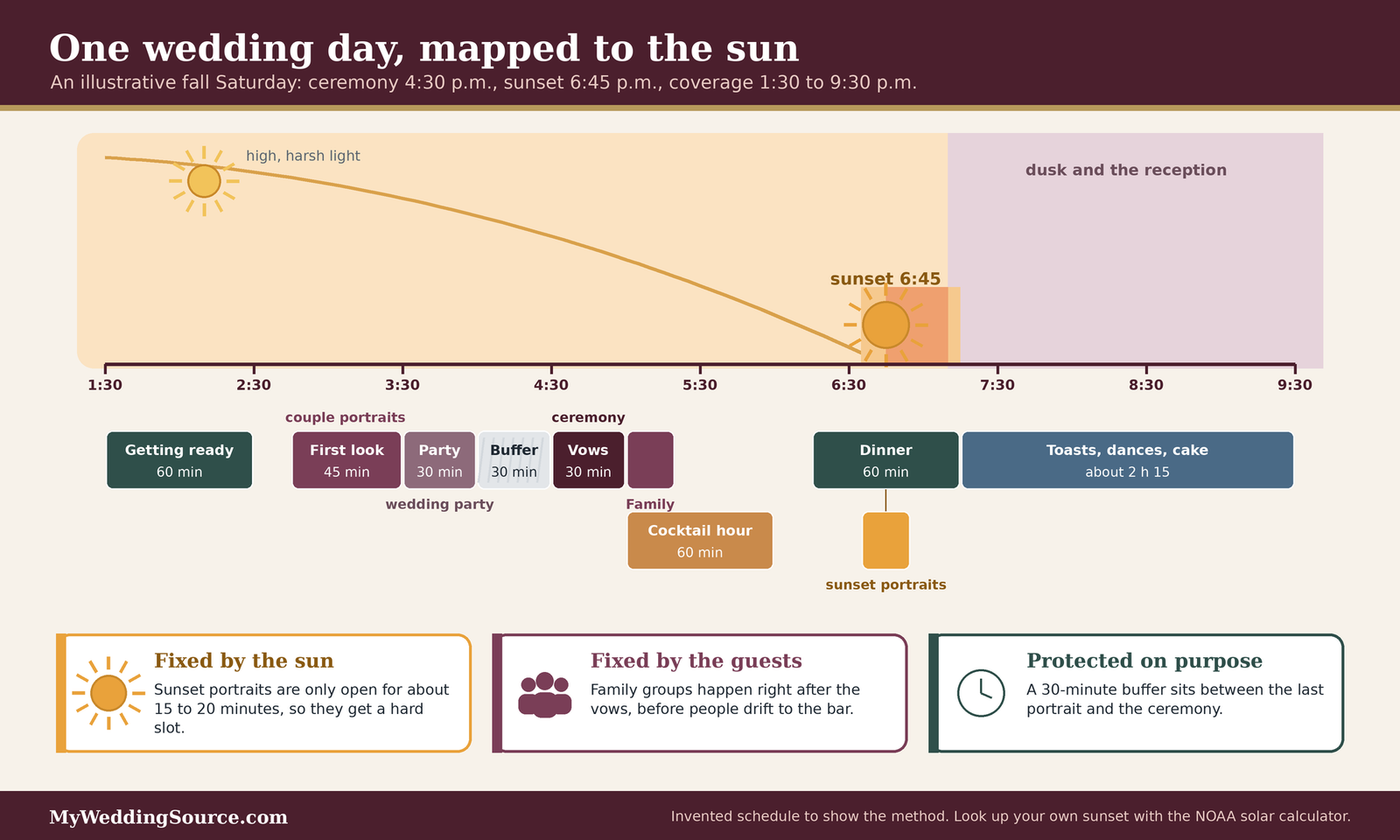
To find your sunset window, use a sun calculator for your exact venue and date. The National Oceanic and Atmospheric Administration publishes a solar calculator that returns sunrise, sunset, and twilight times for a location, with results corrected for the approximate effect of the atmosphere bending light near the horizon. NOAA’s glossary defines civil twilight as the period when the sun is six degrees below the horizon. Photographers who write about timelines commonly note that the richest color often arrives shortly after the sun drops, not at the moment it touches the horizon. One photographer’s published guidance puts the best color at about ten minutes after sunset, with blues, purples, and oranges lingering for roughly fifteen minutes more, and recommends planning about twenty minutes for sunset portraits. Another suggests expecting only about fifteen minutes. Both are rules of thumb from individual photographers, so treat them as ranges and ask yours what they need.
Protect buffer before guest-facing events
The most common timeline failure is not a lack of time for portraits. It is portraits that run into the ceremony. Photographers who publish timeline advice recommend keeping a buffer between the last portrait and the moment guests expect to see the couple. One suggests at least thirty minutes before the ceremony, and another suggests the bride stay out of sight for at least thirty minutes to rest and make final touches. Zola’s guidance adds small buffers of about five minutes sprinkled through the day, plus travel time wherever photos happen at more than one location.
Travel deserves its own padding. One photographer recommends treating a twenty-minute drive as at least thirty minutes, with another five minutes at each end for loading and unloading. That advice sounds fussy until you remember that a wedding party moves like a small convoy: someone always needs a charger, a boutonniere, or a bathroom.
Prioritize images instead of creating an endless shot list
A long shot list feels thorough and works against your wedding photography. Every added group costs minutes, and minutes taken from portraits come out of someone’s patience. A ranked list that the photographer can cut from the bottom is far more useful than a long list with no order.
If you want a reference list of common shots, our wedding photographer shot list is a good starting point. The point here is to turn any list into a ranking.
Rank people, moments, and locations
Use three simple tiers. Tier one is the short set of images you would be upset not to have: the couple, both sets of parents, siblings, grandparents, and any person for whom this may be the last big family photo. Tier two is the wedding party and a few extended-family combinations. Tier three is everything else. Give your photographer the tiers, along with the names and relationships, so they can call people by name instead of shouting “Smith family!” across a lawn.
Locations deserve a ranking too. Each location change adds travel, setup, and a risk of delay. A single beautiful location that is five minutes from the ceremony often yields better pictures than three locations that require a shuttle. Ask yourself which place you will most regret skipping, and treat it as tier one.
Separate must-have formals from nice-to-have candids
Formal groups are predictable, so they can be scheduled. Candid moments are not, so they should be protected rather than scheduled. The distinction matters because the two categories fail differently. A formal that is skipped can sometimes be recovered later in the evening. A candid moment that is missed, such as a grandparent’s reaction during the vows, cannot.
Photographers quoted by The Knot suggest roughly thirty minutes for family photos, and one of them budgets about two minutes for each combination of family members. That gives you simple arithmetic: fifteen combinations is about thirty minutes, and thirty combinations is about an hour. Another published sample timeline suggests keeping family formals to about fifteen groupings. Whatever number you choose, the order of the list should reflect who is most likely to leave early.
A timeline and light matrix you can reuse
The matrix below puts these ideas into one table. The minutes are drawn from the ranges that photographers quoted in the guides we reviewed, rounded for planning, and the trade-off column is our own editorial judgment about what to do when time is short. Adjust the numbers to your guest list and venue.
| Block | Priority | Minutes to plan | Light or timing sensitivity | If time is short |
|---|---|---|---|---|
| Couple portraits | High | 30 to 60 | Best near golden hour or sunset; also good in open shade | Split into two short sessions instead of dropping them |
| Sunset portraits | High if the venue is scenic | About 15 to 20 | Fixed by the sun, usually 10 to 15 minutes after sunset for color | Do them during dinner, five minutes at a time if needed |
| Immediate family | High | About 20 to 30 | Guests disperse after the ceremony | Cut combinations, not people |
| Wedding party | Medium | About 15 to 30 | Open shade works at most hours | Shoot one group shot and a few pairs |
| Extended family | Medium to low | 15 or more, grows with group size | Dependent on who is present | Shoot at the ceremony site before guests leave |
| Getting ready and details | Medium | 60 to 120 | Window light helps | Keep to the details you care about most |
| Ceremony | Highest | About 20 to 30 | Fixed by the venue | Do not trade away |
| Reception events | Medium | Varies | Often low light | Ask for a priority list of toasts, dances, and cake |
| Buffer and travel | Required | 5 minutes between blocks plus travel | None | Never cut it first |
How to use the matrix in a conversation
Print the table or copy it into a message to your photographer and fill in your own minutes. It is the quickest way to turn a general idea of wedding photography into a plan for your day. Ask them to mark any block where they would change your number, since a good wedding photography plan survives disagreement. Disagreements are the point. If your plan gives family fifteen minutes and your photographer says forty-five, you have found out now, not at 5:10 on the wedding day.
What to do if the venue limits access
Venues often limit when vendors can enter, where tripods or lights can go, and which rooms can be photographed. Ask the venue coordinator for the access schedule in writing, and share it with your photographer. A bridal suite that is not available until noon changes the getting-ready plan, and a ceremony space that is locked until thirty minutes before the start changes the empty-room detail shots.
How many hours of wedding photography coverage you need
Coverage hours are the single number in wedding photography that most affects price and most often gets set by guesswork. The way to avoid guessing in wedding photography is to build the hours from the timeline you just drafted, then compare that number with the packages on offer.
Zola describes a common package ladder: a basic tier of roughly six to eight hours with one photographer, a standard tier of eight to ten hours with one or two photographers, and a premium tier of ten or more hours with two or more. It also says eight hours is the most common length. Those are one planning site’s descriptions of typical packages, and individual photographers build their own. They are a useful starting point because they let you see which bucket your day falls into.
Build the hours from the day, not the day from the hours
Work from the first moment you want captured to the last, and add the blocks in between. The worked scenario below is illustrative. The times, the sunset, and the guest count are assumptions we chose to show the method, not a recommendation for your day.
A worked scenario: an eight-hour fall Saturday
Assume a ceremony at 4:30 p.m., sunset at 6:45 p.m., a first look, and a reception that ends with a send-off at 9:30 p.m. The photographer arrives at 1:30 p.m. for an hour of getting-ready details. A first look and couple portraits run from 2:45 to 3:30. Wedding party portraits run from 3:30 to 4:00, which leaves a half hour of buffer before the ceremony, in line with the thirty-minute buffer that published timelines recommend. The ceremony runs 4:30 to 5:00, and immediate family portraits take twenty minutes right after it. Cocktail hour runs 5:00 to 6:00, with the couple joining it. The reception begins at 6:00, dinner service starts around 6:15, and the couple steps out at about 6:35 for a twenty-minute sunset session. Toasts, dances, and cake fill the evening until 9:30.
Add it up and the photographer is working from 1:30 to 9:30, which is eight hours. Take the first look away and the couple portraits move after the ceremony, into the cocktail hour, which is why many couples with a short cocktail hour choose to keep it. Remove the getting-ready hour and you drop to seven hours, but you also give up the details, the dress, and the quiet moments before the ceremony.
Where the extra hour goes
Now suppose the ceremony and reception are at different venues, thirty minutes apart. The travel eats forty-five minutes once you include loading time, and the schedule slips unless the evening shifts. Many couples respond by adding an hour of wedding photography coverage, which is a legitimate decision, but it should be a decision. It is cheaper to move the start of getting-ready coverage by forty-five minutes than to buy a full extra hour at the overtime rate, so check how your photographer prices partial hours.
First look, no first look, and what each does to the hours
A first look is a private moment before the ceremony when the couple sees each other and has portraits taken. It is a personal and sometimes cultural choice, and it is entirely reasonable to skip it. The scheduling consequences are real, though.
With a first look
With a first look, most portraits can be finished before the ceremony, which frees cocktail hour. A photographer who writes about timelines reports that about 85 percent of his couples choose one, but that is one photographer’s clientele and not a national statistic. Plan about 45 to 60 minutes for the first look and couple portraits, according to the same source, and note that the primary benefit is that you attend your own cocktail hour.
Without a first look
Without one, you can still photograph separate wedding party and family groups before the ceremony, if your customs allow it, and photograph the couple together afterward. The Knot’s quoted photographers recommend at least thirty minutes for couple portraits and say more is needed if there are multiple locations. In sample timelines from WeddingWire, the no-first-look version moves couple and group portraits into a roughly hour-long block after the ceremony, which overlaps with cocktail hour. The trade is that you miss some of that hour with your guests, so ask your photographer to schedule sunset or golden-hour portraits separately and not rely on one long session.
Single photographer or second shooter
Team size is the other half of the coverage decision in wedding photography. The Knot notes that most professional photographers work with at least one second shooter, and that adding one raises the price. Zola says standard packages may include a second photographer and premium packages include two or more.
What a second shooter actually adds
A second shooter lets the team be in two places at once. While the lead photographs the couple, the second can capture the groom’s side getting ready, guests arriving, or details in the reception room. Zola’s sample timeline notes that a second shooter can cover guests and details during cocktail hour while the lead handles family portraits. A second shooter also provides a second angle on the ceremony, which matters if the lead is stuck behind a pillar.
When one photographer is enough
A small ceremony with a short guest list and a single location may not need a second shooter. The Knot’s figures suggest that smaller weddings tend to cost less, with an average of $2,000 reported for weddings of up to 50 guests. If most of your priorities happen in sequence in one place, you can often get what you need from one skilled photographer. Ask them honestly where a second person would help and whether the price is worth that for your day.
Budgeting for wedding photography and comparing quotes fairly
Two wedding photography quotes of $3,200 and $4,100 do not tell you which is the better value. They tell you the starting price of two different bundles. The task is to turn them into prices for the same bundle.
What drives the price of wedding photography
Published sources agree on the main drivers of wedding photography pricing: the photographer’s experience, your location, the hours of coverage, the number of photographers, the deliverables, and the date. Zola notes that Saturdays in peak season, May through October, tend to cost the most and that Fridays, Sundays, and the November through April off-season can lower prices. The Knot lists location, guest count, number of photographers, travel fees, editing and post-production, and scope such as engagement or rehearsal dinner coverage.
Date, day, and season
If your date is flexible, moving a wedding from a peak Saturday to a Friday or Sunday is one of the few levers that can reduce wedding photography cost without reducing coverage. It is worth asking whether a photographer offers a different rate for a weekday or off-season date, but do not assume it. Some photographers hold one rate year-round.
Deliverables and add-ons
Digital-only packages usually cost less than packages with a designed album and prints, according to Zola. Add-ons such as an engagement session, an album, a second photographer, drone footage, or a photo booth change the total quickly. Decide which of these you will use before you compare wedding photography packages, because a package that includes an album you do not want is not a bargain.

A quote-normalization method
Quote normalization is a simple way to make unequal wedding photography quotes comparable. First, decide what you need: the hours of coverage from your timeline, the team size, the usage rights, and any travel. Second, take each quote and add what it lacks to meet that need, using the photographer’s own rates for extras. Third, subtract nothing. If a quote includes something you do not need, note it separately as a bonus and do not let it lower the price.
An illustrative example
The three quotes below are invented to show the arithmetic. They are not real photographers or real prices. Assume you need eight hours, two photographers, and a print release, at a venue that triggers a travel fee for some photographers.
Quote A is $3,200 for six hours with one photographer, with travel and a print release included. Its overtime rate is $350 an hour, and a second shooter costs $500 extra. To reach eight hours and two photographers, add $700 and $500, which gives $4,400. Quote B is $4,100 for eight hours with two photographers and a print release, with no extras needed, so it stays at $4,100. Quote C is $2,700 for eight hours with one photographer, with $300 for travel, $600 for a second shooter, and $250 to buy a print release. Adding those gives $3,850.
The ranking flips. Quote A looked second cheapest and turns out to be the most expensive. Quote C looked cheapest and remains cheapest, but only by about $250 over B once you add what it lacks. Whether C or B is the better choice then depends on non-price factors such as style, communication, and how comfortable you feel with each photographer. The method does not choose for you. It removes arithmetic from the argument.
What the method cannot capture
Normalization cannot measure the quality of the work, the experience of the team, or the quality of the contract. It also cannot capture the value of items you did not need but might enjoy, such as an engagement session. Use the method to narrow the field, then use the portfolio review and a conversation to choose.
Planned versus paid, and other cautions about averages
When you read what couples spend on wedding photography, check what the figure represents.
Survey averages are not quotes
The Knot’s wedding photography figure is a reported average of what responding couples spent, as we understand the study. It is not a price list and it is not a recommendation. A photographer who charges more than the average is not necessarily overcharging, and one who charges less is not necessarily better value. Think of the survey as describing the market, not pricing your wedding.
Taxes, tips, and fees
Some photographers add sales tax, processing fees, or travel charges. Tipping is a separate question that we did not find a consistent source for, so ask your photographer how they handle it. Ask whether the wedding photography quote is the total you will pay, and put the answer in the contract. Our wedding budget calculator has a place for these extras so they do not surprise you later.
Cost note
The Knot’s 2025 survey figures, as reported in May 2026, put the average photographer cost at $3,000. Its regional averages run from $2,600 in the Southwest to $3,800 in the Mid-Atlantic, and its guest-count averages run from $2,000 for up to 50 guests to $3,500 for more than 100. Zola’s index reports $4,400. Videography averaged $2,300 in the same Knot study. These are survey figures, not quotes. Our own arithmetic, such as the quote example above, is an illustrative estimate and not a price you should expect.
Make the contract reflect the coverage plan for wedding photography
A wedding photography contract is where the plan becomes enforceable. A verbal promise to stay until the last dance is a kindness. A line in the contract that says coverage ends at 9:30 p.m. is a commitment. This section is general education and not legal advice. If any clause confuses you or worries you, ask a lawyer licensed in your state to review it.
Match hours, team size, and deliverables to the timeline
The wedding photography contract should describe the same day you described to the photographer. Compare it line by line with the timeline.
Check overtime and second-shooter terms
Look for the start and end times of coverage, not just the number of hours. Exact times often are not set until closer to the wedding, according to WeddingWire’s guide to contracts, so look for a clause that explains how they will be confirmed. Check how overtime is billed, whether it is charged by the hour or the half hour, whether it needs your advance approval, and whether other fees such as parking or processing apply. If a second shooter is included, confirm that they are named or described, how many hours they work, and whether their images are part of the delivered gallery.
Confirm album, gallery, raw-file, and turnaround language
Wedding photography deliverables should be countable. A contract that promises a “full gallery” leaves the number open. One that promises an approximate number of edited images, an online gallery, and a download window gives you something to hold the photographer to. Most standard packages exclude unedited raw files, according to a wedding publication’s contract guide, and not every photographer offers them, so ask early if you want them. Turnaround windows in the sources we reviewed ranged widely. One guide says delivery often falls between about four and twelve weeks, another contract-writing guide uses six to eight weeks, and a photographer-oriented guide suggests promising a longer window and delivering early. Ask for a specific window and what happens if it is missed. A contract that handles wedding photography deliverables this precisely is easier to trust.
Clarify rights, privacy, posting, and vendor usage
Rights are the part of a wedding photography contract that couples most often skim and most often wonder about later. The basic concepts are simple even if the legal language is not.
Separate copyright from print and share license
Under U.S. law, the author of a photograph is generally its initial owner, as the U.S. Copyright Office explains, and hiring a photographer does not by itself transfer that ownership. The Office notes that a transfer of copyright generally must be in writing and signed by the owner, and that owning a copy of a work, whether physical or digital, is not the same as owning its copyright. In practice, most photographers keep the copyright and give clients a license to use the images. WeddingWire’s guide says photographers usually keep the copyright and may reserve the right to promote their work, and that full printing rights let you print high-resolution copies anywhere. A typical contract language question is therefore not “who owns it?” but “what may I do with it?” Ask whether you may print anywhere, share online, make a photo book, and use the pictures on a wedding website or in a thank-you card.
Address embargoes and social posting before the wedding
Some photographers ask couples to wait before posting images, and some ask guests not to post before the couple does. Others want credit when you share. Decide your own rules and put them in writing. Ask whether a sneak-peek is part of the package and when it arrives. Ask whether there is any limit on your own posting, whether credit is required, and whether the photographer plans to share images from your wedding. A model release, if you sign one, can permit commercial use of your images, so read what it allows. If privacy matters to you, say so, and ask whether you can limit publication of images that show children, guests, or sensitive family situations.
There is one consumer-protection point worth knowing. The Federal Trade Commission’s guidance on the Consumer Review Fairness Act says it is illegal for a company to use a standardized contract provision that bars or penalizes honest reviews or that makes customers give up intellectual property rights in their review content. The FTC lists exceptions, including for reviews that reveal private information or are clearly false. If a contract attempts to stop you from posting an honest review, that is worth raising, and a lawyer can tell you how the rule applies.
A contract and deliverables checklist you can reuse
The table below converts the clauses into a checklist. Use it as you read the document, and mark each line as present, missing, or unclear.
| Item | What to look for | Why it matters | Mark |
|---|---|---|---|
| Hours | Start and end times, not only a number of hours | Prevents disputes about when coverage stops | Present, missing, unclear |
| Team | Named lead, second shooter hours, who edits | Makes sure the plan matches the day | Present, missing, unclear |
| Overtime | Rate, increments, approval method | Avoids end-of-night surprises | Present, missing, unclear |
| Deliverables | Approximate edited image count, gallery duration, album, prints | Makes the package countable | Present, missing, unclear |
| Raw files | Included, available for a fee, or not offered | Sets expectations early | Present, missing, unclear |
| Rights | Print release, social sharing, photographer’s promotional use | Clarifies what you may do with the images | Present, missing, unclear |
| Payment | Deposit, balance date, late terms, what is nonrefundable | Prevents cash-flow and refund confusion | Present, missing, unclear |
| Cancellation | What happens if you cancel, postpone, or the photographer cancels | Protects both sides | Present, missing, unclear |
| Backups | Equipment, file redundancy, storage period | Protects images that cannot be repeated | Present, missing, unclear |
| Substitution | Process if the named photographer cannot attend | Avoids a stranger arriving with no warning | Present, missing, unclear |
| Turnaround | Delivery window and sneak-peek timing | Sets your expectations for the aftermath | Present, missing, unclear |
| Liability | What the photographer will and will not be responsible for | Clarifies remedies if things go wrong | Present, missing, unclear |
Payment and cancellation terms
WeddingWire’s guide describes a deposit of about 50 percent due at signing, with the balance due around thirty days before the wedding, and notes the deposit is usually nonrefundable because it holds the date. That is one publication’s description of typical practice, and your photographer may differ. A photographer-oriented guide stresses that cancellation clauses are essential because a photographer who turns down other bookings for your date loses income if you cancel late. Seen from that angle, a nonrefundable deposit is a fair trade, and what you want to know is what happens if the wedding is postponed. Ask whether the deposit and the date can transfer.
Liability and the limits of a contract
Many wedding photography contracts limit what the photographer is responsible for, for example if equipment fails or illness occurs. One guide notes that typical exclusions include dissatisfaction with the photos or missed moments, and another recommends lawyer review of these clauses. A limit is not necessarily unfair, but you should know it exists. Compare it with the backup plan in the next section: the stronger the backup commitments, the less you will rely on a liability clause.
Build backup paths for moments that cannot be repeated in wedding photography
A wedding cannot be re-shot. That is why backup planning is the least glamorous and most protective part of wedding photography. Backups in wedding photography are about three different failures: equipment that stops working, files that get lost or corrupted, and people who cannot attend. Each has a different remedy, and each deserves its own line in your wedding photography contract.
Published contract guides for wedding photography are thin on this subject. One widely read contract guide does not address backups at all, and another mentions equipment failure only as an exclusion in the liability clause. That gap is the reason to ask directly and to ask for specifics in writing.
Ask about equipment, file, illness, and weather backups
Every professional photographer says they have backups. The questions below turn the statement into something you can evaluate.
Verify redundancy rather than accepting “we have backups”
Ask how images are recorded and stored at each step. A careful answer describes a chain: how images are written during the ceremony, when they are copied off the cards, how many copies exist before the photographer leaves the venue, and where the copies are kept afterward. Some cameras can write to two cards at once, and some photographers do so for key moments. You do not need to know the brand. You need to hear a specific description and be able to tell whether the photographer has thought it through.
A common reference point from data-protection guidance is the 3-2-1 rule: keep three copies of important data, on two different kinds of storage, with one copy kept offsite. The rule is attributed in some summaries to government cybersecurity guidance, and several data-protection vendors describe it the same way. It was not designed for wedding photographers, but it gives you a clear question. Ask where the three copies are, what two kinds of storage are involved, and which copy is in a different location. If the answer is “a hard drive on my desk and the cards,” you have one backup in the same room as the originals.
Ask what happens to your files after delivery
Delivery is not the end of the file’s life. Ask how long the photographer will keep your images after delivering the gallery. One guide to contract writing advises photographers to state how long they will store client images, though it gives no duration. Some galleries expire after a period, and some archives are deleted on a schedule. Ask for both the length of time and the method, and then make your own copies. The simplest protection is to apply the same 3-2-1 idea yourself: download the full gallery, store it in two places, and keep one outside your home.
Know who substitutes if the named photographer is unavailable
Illness, family emergencies, and travel disruptions happen to photographers as they do to everyone. The question is whether the contract says what happens next.
What a substitution clause should say
WeddingWire’s contract guide says established photographers usually have a network of colleagues who can step in, and that the process should be written down. Look for who chooses the substitute, whether you can approve or decline, what the substitute’s level of experience must be, and whether the substitute uses the lead’s editing style. Ask whether you can meet or see the work of the second shooter in advance, since they are the most likely substitute.
What happens if no substitute is found
A good contract also covers the case where no one can step in. One contract guide describes an “unavoidable circumstance” cancellation right that allows a full refund. Ask whether your payments come back in full, and in what time frame. Ask whether any part of the deposit is nonrefundable even then. If your photographer is a one-person studio, the answer may be more conservative, and that is information you can use in choosing.

Plan for weather and venue surprises
Weather is the backup couples most often think about in wedding photography, and the one photographers most often handle well, because they plan for it every season. Still, put the plan in the conversation.
Rain plan for portraits
Decide in advance where portraits happen if it rains: a covered porch, a hotel lobby, a large doorway with soft light, or a corner of the reception room before guests arrive. Ask your photographer to scout the indoor option when they visit the venue. Having a pre-agreed location prevents a thirty-minute debate under an umbrella, and because indoor light is often dim, it also tells you whether your photographer has the equipment to handle it.
Venue lighting and rules
Some ceremony spaces limit flash, restrict movement during services, or require photographers to stay in a designated area. Ask the venue or officiant in writing, and share the answer with your photographer. If rules are tight, adjust your expectations and your list. A photographer who cannot use flash in a dark sanctuary is working with different tools, and it is better to learn that in advance.
Create a plan when the schedule runs late
Almost every wedding runs late somewhere, and wedding photography is usually where the delay shows first. The useful question is which pictures give way and which do not. Decide before the day, while no one is stressed.
Define which photos get cut first
Use your tiered list. If the day runs thirty minutes behind, cut from the bottom: tier three groups, then tier two extended-family combinations, then second locations. Keep tier one and the sunset session if it matters to you. Share the cut order with your photographer and with whoever is coordinating the day, whether that is a planner, a venue coordinator, or a friend. A single decision-maker saves time. If you are using a planner, our general plan a wedding guide can help you decide how much day-of coordination you need.
Protect ceremony and reception experience from photo overrun
Portraits should not consume the ceremony or most of the party. If the schedule slips, trim the portrait session and move any remaining pictures to later in the evening, where several short breaks of five to ten minutes are often easier to manage than a single long one. The Knot’s quoted photographers split couple portraits into several short sessions across the day for this reason, including one near sunset and one after dark during the reception. You can also extend the cocktail hour by a few minutes to catch golden-hour light, as one photographer suggests, instead of shortening the portraits.
Details that change the plan
Some features of a wedding change the wedding photography plan in ways a generic list will not cover. A few come up often enough to be worth thinking about in advance.
Rings, clothing, and detail pictures
Detail pictures are quick to take and easy to forget until the day is moving fast. Collect the items in one place before the photographer arrives.
Ring photographs
Ask for a few images of the rings and give the photographer a clear place to photograph them. For wedding photography of the rings, our wedding band width guide and wedding ring metals guide explain how width and finish change how bands look in pictures, since a polished finish reflects light differently from a brushed one. If you have both an engagement ring and a band, bring both and keep them somewhere safe until the details session.
Outfits and what shows on camera
Clothing details matter more in pictures than in person. Wrinkles, lint, loose threads, and mismatched shades of white all show. If your wedding party is dressing in coordinated outfits, check how they look together in daylight. Our cocktail attire guide is a helpful reference if your event has a mixed dress code and you want guests to look cohesive on camera.
Drones, large families, and cultural customs
Some choices need their own conversation with your photographer because they affect rules, time, or sensitivities.
Drone footage and aerial pictures
If aerial images are part of your wedding photography package, ask whether the operator holds the right FAA authorization. According to the FAA’s summary of Part 107, commercial small drone operators need a remote pilot certificate with a small UAS rating, or must be directly supervised by someone who does, and each drone must be registered. The same page says flights are permitted from 30 minutes before official sunrise to 30 minutes after official sunset, with twilight operations allowed with anti-collision lighting, and it describes limits on flying over people. Venues may also have their own drone rules. Ask who handles permissions and what insurance applies. We are not suggesting every photographer needs a drone. We are saying that if yours uses one, ask for the credentials.
Large families and multiple traditions
If your families are large or your ceremony includes several customs, the shot list and timeline need more time and more people helping. Ask a relative on each side to be the person who finds family members for formals, so the photographer does not need to learn names. If your traditions have rules about what can be photographed and when, share them with the photographer ahead of time. Experienced photographers appreciate being told, and no one should have to guess in the middle of a ceremony.
After the wedding: delivery, albums, and long-term storage
In wedding photography, the wedding day starts the delivery work for the photographer and the preservation work for you.
From preview to final gallery
Delivery in wedding photography usually happens in stages: a few sneak-peek images soon after the wedding, then a full gallery after editing.
Setting expectations on timing
A sneak peek may arrive within days, though the contract may not require it, and the full gallery arrives within the delivery window. Delivery windows quoted in the guides we reviewed ranged from about four to twelve weeks, and some photographers note that waits beyond about eight weeks can be hard on couples. During the busy season, expect delays at the long end of the range. If your photographer’s contract gives a window, use it. If it does not, ask.
Reviewing the gallery
When the gallery arrives, check it against the contract. Count the images, test the download, and check that the file sizes support the printing you planned. Flag problems quickly, since galleries and download links can expire. If something is missing, ask politely and in writing, and keep the reply.
Albums, prints, and your own archive
A wedding photography album is optional, but a plan for your own archive is not.
Albums and prints
If you want an album, ask about timing. Some packages include an album credit, and one contract guide notes that you should check when add-ons like album credits expire. Order prints from a vendor you trust, and check the color profile instructions if you print outside your photographer’s lab. Our wedding planning checklist includes post-wedding tasks that are easy to lose track of in the weeks after the day.
Your own copy of everything
Download the gallery to at least two places and keep one outside your home. Name the folder clearly and add a note with the photographer’s name, the date, and your license terms. In five years, you will not remember the details, and your future self, or a family member, will be grateful for a short text file.
Working with your photographer before and on the day
The best wedding photography usually comes from a working relationship, not a transaction. A photographer who knows your venue, your families, and your priorities makes better decisions in the moment than one who meets you at the door. Most of that relationship is built in a few short conversations.
Meetings and sessions before the wedding
Three touchpoints do most of the work: a consultation, a venue visit, and, if you want one, an engagement session.
The consultation and the venue visit
Use the consultation to talk through the wedding photography timeline and the tiered list, and to see how the photographer responds when you push on a point. A photographer who explains why they would change your schedule is more useful than one who simply agrees. If the photographer has not seen your venue, ask whether they will visit before the wedding or at least study the venue’s photos and floor plan. Ask the venue coordinator for a point of contact on the day, so the photographer is not guessing at who can unlock a door.
Engagement sessions as a rehearsal
An engagement session is a low-stakes way to find out whether you like being photographed by this person. Zola’s package descriptions list an engagement session as an add-on in basic packages and a frequent inclusion in standard and premium ones. The pictures are useful for a wedding website or save-the-dates, but the larger value is practical. You learn how the photographer directs, how many instructions you can tolerate, and whether you both feel at ease. If you are uncomfortable in the session, tell the photographer, because it is easier to adjust now than on the day.
On the wedding day
Most of the work is done by then. The goal for wedding photography on the day is to remove friction.
One point person and a shared timeline
Choose one person, other than the couple, who has the timeline and the tiered list and who can find people when needed. That might be a planner, a coordinator, a sibling, or a friend with a loud voice. Give the photographer their phone number. Share the timeline with every vendor who touches the schedule, including the hair and makeup team, since delays there are among the most common reasons portraits start late. A shared timeline means that a delay in one place can be absorbed in another.
Meals, breaks, and the phone question
Photographers work long hours and often need a meal and a short break. Ask in advance whether the contract includes a vendor meal or whether you should provide one, and where they should eat. A photographer who has not eaten in eight hours is not at their best at the cake cutting. Decide, too, how you feel about guest phones during the ceremony. Some couples ask guests to put phones away so that the photographer’s view is not blocked by raised screens, and some do not mind. Either is fine. The choice should be yours and should be communicated before the day, for example with a sign or a line in the officiant’s welcome.
Two smaller scenarios
The eight-hour scenario earlier assumed a large wedding at a single venue. Here are two other shapes of day, again with invented times to show the thinking and not to prescribe your schedule.
A short ceremony with an evening reception
Suppose a couple holds a twenty-minute ceremony at a courthouse or small venue in the late morning, followed by a gap of several hours before an evening reception at another venue. This kind of day is common and tricky, because the coverage has two active windows with a long idle gap between them.
Paying for the gap or splitting coverage
The simple approach to wedding photography here is to book continuous coverage and pay for the idle hours. The alternative is to ask whether the photographer offers split coverage, with a morning block and an evening block, and what that costs. Some photographers will do it for a premium, some will not. Use the quote-normalization method to compare the options: price continuous coverage at the overtime rate for the gap, and compare it with the split price. If the gap is long, it may also make sense to use that time for portraits in a scenic location, so that the coverage is spent on something you value.
Using the gap well
If you plan portraits during the gap, think about lunch, rest, and changing clothes. Couples who add portraits in the afternoon often find they are tired by the reception. Schedule a break, and keep the portrait session shorter than you think you need. Light matters here too, because midday sun is harsh. Look for open shade, a covered porch, or a location with indirect light, and ask the photographer where they would shoot at that hour.
A small wedding with a short guest list
For a wedding of a few dozen people, many of the usual wedding photography constraints change. There may be no need for a second shooter, no cocktail hour, and a single location. The Knot’s reported average for weddings of up to 50 guests was $2,000, compared with $3,500 for weddings above 100, which suggests that smaller weddings tend to need fewer hours or fewer people, though your own quote will depend on your photographer.
Fewer hours, more intention
With a short guest list, you can often choose a shorter wedding photography coverage window and spend more time on portraits and quiet moments. Plan the hours around the three or four things you care most about, such as the ceremony, a long couple session in good light, and the toasts. Skip coverage of hours that do not serve those priorities. A shorter, intentional wedding photography plan often yields better pictures than a long day with no focus.
Keeping the contract proportionate
A small wedding does not need a small contract, but it can have a simple one. The same checklist applies: hours, rights, backups, substitution, and delivery. If a photographer offers a one-page agreement for a short session, read it with the same care and ask the same questions. Short does not mean unimportant.
Wedding photography and the rest of your vendor team
Photographers do not work alone. Hair and makeup artists decide when the bride is ready, the planner or coordinator decides when the ceremony starts, the caterer decides when dinner lands, and the DJ or band decides when the dances happen. A sound plan for wedding photography is therefore a shared plan, and it works best when the other vendors can see how their timing affects the pictures.
Videographers and photographers on the same day
Many couples add videography to their wedding photography. The Knot reports an average videographer cost of $2,300 in its study of 2025 weddings, which is lower than its photographer average, and a pairing can work very well when the two teams communicate.
Sharing space and sightlines
Two teams need to stay out of each other’s frames during the ceremony. Ask both vendors whether they have worked together, and share each other’s contact details. If they have not, ask them to speak before the day about where each will stand and who will cover which angle. A short call between them costs nothing and avoids a photographer’s tripod appearing in the middle of the video.
Coordinating the timeline between the two
Portraits are a shared priority. A videographer may want footage of the first look or the couple’s reaction at the end of the aisle, and the photographer needs a clear view at the same moment. Tell both what matters most so they can negotiate placement. Where interests conflict, decide in advance whose coverage takes priority for each moment, and write it into the timeline.
Planners, hair and makeup, and the venue
Delays that look like wedding photography problems often begin elsewhere. A beauty team that finishes forty minutes late pushes the first look back, and a venue that unlocks late pushes the details session. None of this is anyone’s fault, but a timeline that includes every vendor can absorb it.
Build the timeline backward from the ceremony
Start with the ceremony time, then work backward through the buffer, the wedding party portraits, the first look, and the getting-ready hour, as in our worked scenario. Share the resulting schedule with the beauty team and ask whether the start times are realistic for the number of people they will serve. If three bridesmaids need hair and makeup, thirty minutes of buffer in the plan is more likely to survive than five.
Confirm venue rules in one message
Send the venue coordinator a single message that lists your photographer’s questions: when vendors can enter, which rooms are available for portraits, whether flash, tripods, or drones are allowed, and where the photographer can stand during the ceremony. Copy the photographer on the reply. Having it in writing means that if the venue changes the rules, everyone has the same record.
Reading a wedding photography package line by line
Wedding photography packages are written to be skimmed. The way to read them is slowly, one line at a time, asking what each phrase would mean on the day. The aim is not to find fault, since most photographers write fair packages. It is to make sure the words mean what you think they mean.
Phrases that deserve a follow-up question
Some phrases sound specific and are not. A few examples come up often enough to be worth naming.
“Full day coverage” and “up to” language
“Full day” has no standard meaning, so ask for the number of hours and the start and end times. Similarly, “up to eight hours” sets a ceiling, not a promise, and the real number may depend on the day’s schedule. If your plan needs coverage until a specific event, such as the send-off, ask whether the package guarantees that or merely allows it. Wedding photography packages that describe coverage by events, such as getting ready through the first dance, can be easier to hold to than those that describe it by hours.
“Edited images” and “highlights”
Edited images are the finished pictures, but the number can vary widely and the contract may give a range. Ask how the number is determined. Some photographers deliver a number that is proportional to the hours, others deliver a curated set, and others deliver almost everything. Ask whether “highlights” refers to the full gallery or to a smaller set, and ask how the sneak peek differs from either.
Assembling a comparison you can reuse
Once you have read several wedding photography packages, put them in a simple grid so the differences are visible. This is where the quote-normalization method earns its place.
What to put in your own grid
Use one column per photographer and one row per item: price, hours, team, edited-image range, gallery length, travel, overtime rate, second-shooter rate, print release, album credit, turnaround, deposit, balance date, cancellation terms, and substitution process. Fill in the blanks by asking, not by guessing. A blank cell is information too, since it shows what the photographer did not say.
When the cheapest quote is still the right choice
Normalization sometimes shows that the lowest quote is also the best fit. If the cheapest photographer shows a full gallery that you love, communicates clearly, and offers terms that match your plan, there is no reason to pay more. The point of comparison is not to find a reason to spend; it is to be confident about the choice you make.
Wedding photography milestones from booking to delivery
Wedding photography decisions arrive in a rough order, and knowing the order helps you avoid doing the hard ones in a rush. The sequence below is general, and your dates will depend on your own timeline. Our wedding timeline guide shows how these milestones fit among the other planning tasks.
Before the contract is signed
The decisions that shape everything else come first.
Settling the questions that set the price
Before you ask for wedding photography quotes, decide your approximate guest count, your venue or shortlist, your preferred date range, and the hours of coverage you believe you need. These are the factors that Zola and The Knot both list as drivers of price, so a photographer who knows them can quote accurately. If you ask for a quote with none of them, you will get a vague number that tells you little.
Checking availability and confirming the lead photographer
Availability is a real constraint in wedding photography, particularly for popular dates, because a photographer who takes your date may turn down other work for it. Ask early whether your date is open, and when you sign, confirm that the photographer named in the contract is the one who will attend. If the studio has several photographers, ask which one is yours and whether you can meet them.
Between signing and the wedding
Once the contract is signed, the work becomes quieter but not absent.
Items to confirm in the final weeks
As the date approaches, confirm the final timeline, the venue’s access times, the point person, the list of priority groups, any final guest count that affects the number of formals, and the balance payment date. One contract guide describes the balance as due around thirty days before the wedding, so the final conversation often happens at the same time as the final payment. Send your photographer the timeline in writing and ask them to confirm they have received it.
What to do in the last week
In the last week, send a short reminder to the people who will help with formals, confirm weather plans if the forecast looks uncertain, and gather ring, invitation, and detail items in one place. Remind yourself that most of the work has already been done. A prepared wedding photography plan means you can spend the day in the moment, and that is the real benefit of the planning described throughout this guide.
Questions to ask before you book wedding photography
Bring this list to every wedding photography consultation. The answers matter less than how clearly and specifically they are given, and the questions are meant to be asked in the same order of every photographer so that you can compare the replies.
Questions to ask every photographer
- What is included in this price: hours, number of photographers, edited images, gallery length, travel, and rights?
- How do you bill overtime, and who has to approve it?
- Who exactly will be at my wedding, and who is the second photographer?
- What happens if you cannot attend, and who chooses the substitute?
- How are images backed up during the day and afterward, and for how long do you keep them?
- What may I do with the images, and what do you do with them?
- When will I receive a preview and the full gallery, and what happens if the window is missed?
- What happens to my deposit if I postpone or cancel?
About the work
These questions test the match between the photographer and your day.
How do you approach a day like mine?
Describe your venue, your guest count, and your timeline, and listen to how the photographer responds. A thoughtful answer names specific challenges, such as light in your ceremony space or travel between sites, and says how they would handle them. A generic answer that could describe any wedding is a sign that the photographer has not listened.
Can I see a full gallery from a similar venue?
Ask for a complete gallery and for work in light that resembles yours. If the photographer has never shot at your venue, ask about similar ones. A photographer who has not worked in a dark ballroom is not necessarily a bad choice, but you should know it and ask what they would do differently.
About the paperwork
These questions test the contract against the plan.
Will you add our timeline and priorities to the contract?
Ask whether the timeline, the coverage start and end times, and the list of priority shots can be attached to the contract or included in an addendum. Many photographers will accept this, and it prevents drift. The reply also tells you how the photographer treats your plan.
How do you handle a dispute?
No one wants to think about a dispute before the wedding, but it is a fair question. Ask what the process is if you are unhappy with the delivered gallery, whether the contract specifies mediation or a refund policy, and how long you have to raise concerns. A photographer who has a considered answer is one who has dealt with the situation before.
FAQ: wedding photography questions
Hours and timing
How many hours of wedding photography do most couples book?
Zola describes eight hours as the most common coverage length, with basic packages around six to eight hours and premium packages at ten or more. Your number should come from your own timeline, from the first moment you want captured to the last, and not from a package label alone.
Is a first look necessary for good portraits?
No. A first look makes it easier to finish portraits before the ceremony and attend your own cocktail hour, but many couples skip it. Without one, plan roughly an hour after the ceremony for couple and group photos, and ask your photographer to schedule a short sunset session separately.
How much time should I leave for family photos?
Photographers quoted by The Knot suggest about thirty minutes, and one budgets about two minutes per combination of family members. Keep the list short, put the people most likely to leave first, and ask a relative to gather everyone so the photographer can work.
Cost and contracts
How much does wedding photography cost?
The Knot reports an average of $3,000 for couples who married in 2025, while Zola’s index reports $4,400. The figures come from different methods, so they are not interchangeable. Regional prices, guest count, hours, team size, and deliverables all move the total, so compare real quotes after normalizing them.
Who owns the photos?
Under U.S. law, the creator of a photograph is generally its initial copyright owner, and a transfer must generally be in a signed writing. Most photographers keep copyright and license images to couples. Check the contract for print and sharing rights, and ask a lawyer if the wording is unclear.
Can I get the raw files?
Sometimes, but not often. Most standard packages exclude unedited raw files, and photographers usually consider the edited gallery to be the finished work. If you want raw files, ask before you book, because some will offer them for an added fee and some will not offer them at all.
Risk and backups
What if our photographer gets sick?
Ask before you sign. Established photographers usually have a network of colleagues who can step in, according to WeddingWire, and the process should be written into the contract. Look for who chooses the substitute, whether you can approve them, and whether a refund applies if no one is available.
How do I know my photos are backed up?
Ask for specifics instead of a yes. A useful answer describes how many copies exist before the photographer leaves the venue, what kinds of storage hold them, and where one copy is kept offsite. The 3-2-1 rule, three copies on two kinds of storage with one offsite, is a helpful reference point.
Your next steps
Before you request quotes
Draft your timeline and tiers
Write the day as a timeline with fixed times first, then rank people, moments, and locations into three tiers. Look up your sunset with a sun calculator, and add buffers. Our wedding timeline guide can help you set up the larger schedule, and our wedding photographer shot list is a good place to start the list.
Decide your coverage hours and team size
From the timeline, count the hours and decide whether you need a second shooter. Write the numbers down so every quote is answered against the same needs, then use the normalization method to compare the totals.
Before you sign
Read the contract against your plan
Use the checklist table to mark each clause as present, missing, or unclear, then ask about the unclear ones. If a clause worries you, ask a lawyer licensed in your state to review it. For the larger picture, our wedding budget calculator and wedding planning checklist show where photography sits in the rest of your plan.
Ask for the backup plan in writing
Request a short written description of how files are backed up and what happens if the photographer cannot attend. After the wedding, download your gallery to two places, keep one outside your home, and confirm that the images match what the contract promised.
Sources & methodology
How we built this guide
What we relied on
This wedding photography guide combines published survey figures from The Knot and Zola, photographer-written timeline advice, contract guides from wedding and photography publications, U.S. Copyright Office explanations of copyright ownership and transfer, FTC guidance on the Consumer Review Fairness Act, NOAA’s solar calculator glossary, FAA small-drone rules, and a common data-protection rule of thumb. Where a statement comes from a single photographer or a vendor, we say so, since such advice reflects the author’s own practice. The timelines, quotes, and totals in our worked examples are invented to show the method, and our arithmetic is an estimate.
What we did not do
We did not test photographers, review real contracts, or give legal or financial advice. We did not find a single authoritative source for typical turnaround times, for tipping practice, or for the definitions of photography styles, so we describe those cautiously. Laws and contracts vary by state and by vendor. Ask for terms in writing and consult a lawyer about specific clauses.
Source list
Government and regulatory sources
- U.S. Copyright Office, What is copyright: https://www.copyright.gov/what-is-copyright/
- U.S. Copyright Office, Circular 1, Copyright Basics: https://www.copyright.gov/circs/circ01.pdf
- Federal Trade Commission, Consumer Review Fairness Act: What businesses need to know: https://www.ftc.gov/business-guidance/resources/consumer-review-fairness-act-what-businesses-need-know
- NOAA Global Monitoring Laboratory, Solar Calculator Glossary: https://gml.noaa.gov/grad/solcalc/glossary.html
- Federal Aviation Administration, Small Unmanned Aircraft Systems (UAS) Regulations (Part 107): https://www.faa.gov/newsroom/small-unmanned-aircraft-systems-uas-regulations-part-107
Survey, planning, and industry sources
- The Knot, Average cost of a wedding photographer: https://www.theknot.com/content/average-cost-wedding-photographer
- The Knot, Average cost of a wedding videographer: https://www.theknot.com/content/average-cost-wedding-videographer
- The Knot, How long do wedding photos take: https://www.theknot.com/content/how-long-for-formal-photos
- Zola, Wedding photographer cost: https://www.zola.com/expert-advice/how-much-does-a-wedding-photographer-cost
- Zola, Wedding photography timeline: https://www.zola.com/expert-advice/how-long-do-wedding-photos-take
- WeddingWire, Wedding photography timeline: https://weddingwire.com/wedding-ideas/the-ultimate-wedding-photography-timeline
- WeddingWire, Wedding photography contract: https://www.weddingwire.com/wedding-ideas/wedding-photography-contract
Photographer and contract guides
- PetaPixel, How to create a wedding photography timeline: https://petapixel.com/2024/06/04/how-to-create-a-wedding-photography-timeline/
- SLR Lounge, Wedding photography timeline: https://www.slrlounge.com/wedding-photography-timeline/
- The Wed, Couples guide to wedding photography contracts: https://thewed.com/magazine/couples-guide-to-wedding-photography-contracts
- Adorama, Wedding photography contract guide: https://www.adorama.com/alc/wedding-photography-contract-guide/
- Rangefinder, What to include in a wedding photography contract: https://www.rangefinderonline.com/news-features/business-marketing/heres-everything-include-wedding-photography-contract-clients/
- Iris Works, Contract for wedding photography: https://iris-works.com/contract-for-wedding-photography/
- NAKIVO, The 3-2-1 backup rule: https://www.nakivo.com/blog/3-2-1-backup-rule/