

A wedding processional order is simply the sequence in which people enter your ceremony, and because no religion or etiquette authority treats one sequence as mandatory, the useful work is choosing a version that suits your officiant, your venue, and your family, then telling everyone clearly.
Quick answer
A common wedding processional order runs from the officiant, to family, to the wedding party, to young attendants, to the couple last, but that pattern is a template and not a rule. The Knot’s guide, which draws on planners and officiants, says no religious tradition requires a single order. Decide with your officiant first, then choose an entrance model, then handle divorced parents, stepparents, and same-sex couples by writing the plan as a rule that applies to everyone, not as a series of favors. Most published guides say the walk should take about five minutes at most.
Most people picture one version of the walk: a father and a bride, a row of bridesmaids, a flower girl scattering petals. Real ceremonies are more varied. Some couples enter together, some families enter from the side, and some religious services begin before anyone walks an aisle at all. This guide explains the traditional structures, shows how to adapt a wedding processional order for blended families and for same-sex couples, and offers workable alternatives, with a method for estimating how long your own version will take. It is general etiquette information. Your officiant, your house of worship, and your venue have the final say.
Why a wedding processional order matters less than people fear, and more than they expect
The stakes of a wedding processional order are small in one way and real in another. Nobody is legally married by the order in which people walk. But the order is the first thing every guest sees, and it quietly tells the room who is honored, who is not, and how the couple sees their family. That is why families tend to care about it more than the logistics suggest.
What a wedding processional order actually does
A wedding processional order has two practical jobs and one social one. It signals that the ceremony is starting, it moves the right people to the right places at the front, and it gives the couple a chance to acknowledge the people who matter to them.
It marks the start of the ceremony
Guests settle when something changes: the officiant steps forward, the music shifts, a door opens. Zola’s guide notes that a change in music is the usual cue for attendants to begin, and that in Jewish services the rabbi or cantor traditionally starts the procession. Thinking of your wedding processional order as a series of cues, not just a list of names, makes it easier to rehearse.
It places people where the ceremony needs them
By the end of the wedding processional order, the couple, the officiant, and any attendants should be standing where the rest of the service expects them. In many orders the first attendant to walk stands farthest from the couple, which keeps spacing even and puts the best man and maid of honor closest. If a tradition has people stand on particular sides, as in the Jewish chuppah arrangement described below, the entrance order is built around that.
Custom, not law
A wedding processional order is a matter of custom, family preference, and the rules of a particular venue or faith community. It is not part of the legal requirements for being married, which are set state by state and are a separate topic. Our wedding officiant guide and wedding ceremony guide cover who may legally officiate and how a ceremony is built, and we do not give legal advice here.
What the sources agree on
The Knot’s guide, last updated in March 2025, quotes an expert saying no religion requires a specific order, though each has customary patterns, and advises working with your officiant to set it. Zola’s guide describes the wedding processional order as something you can follow or reinvent. Rabbi Maurice Lamm, writing on Chabad.org about the Jewish procession, says the order, escorts, and decoration are flexible and not a matter of law. Three different sources, one shared message: choose deliberately.
Where a real rule might still exist
Flexibility has limits that come from the place, not from etiquette. A parish may have its own practice about how the couple enters. A venue may limit where people can stand, how long the aisle is, or whether it can be used for a procession at all. A house of worship may ask that certain music or movements be left out. These are rules of the host, so ask for them early and in writing, as we suggest in the questions section near the end.
The traditional structures, tradition by tradition
Published guides describe several recurring patterns. They differ in who enters first, how parents are involved, and where people stand. The overview below summarizes The Knot’s descriptions, with Zola’s and others’ details added where noted. Treat it as a map of common customs, not a definition of correct practice, and remember that individual congregations vary.
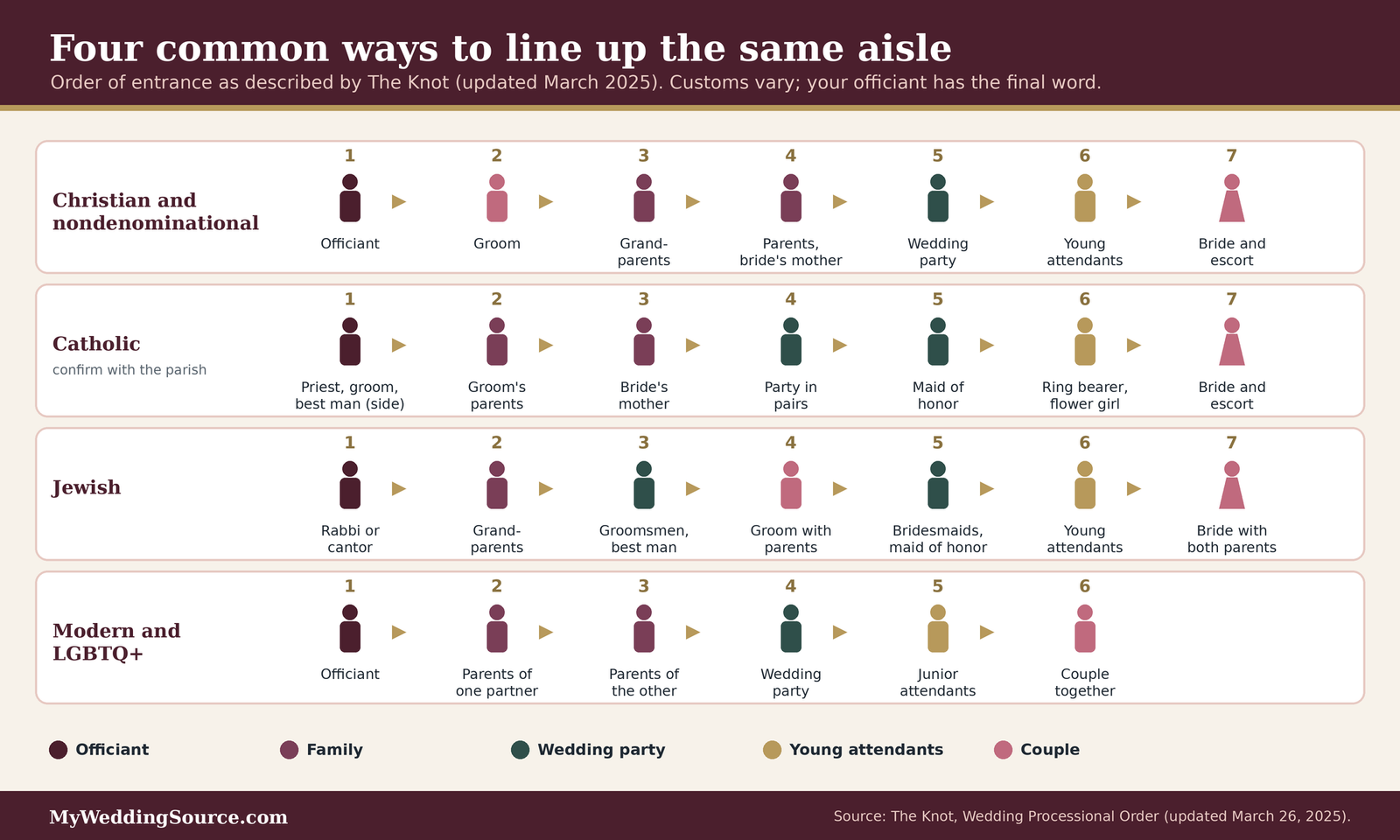
Christian and nondenominational orders
The most familiar American pattern comes from Protestant Christian practice, and many nondenominational and civil ceremonies borrow it. The Knot describes two versions: a traditional one in which the officiant and groom enter from the side, and a more modern one in which they walk the aisle with the rest of the processional.
The usual sequence
In The Knot’s Christian template, the sequence is the officiant if walking, the groom, with groomsmen either following directly or walking with or before the bridesmaids, then grandparents who sit in the front row, then the groom’s parents and the bride’s mother, then the wedding party, then young attendants, and finally the bride with her father, both parents, or another loved one. The best man comes last among the men and the maid of honor last among the women. Zola’s version of the same pattern has the pastor go first and the groom enter with his side of the family seated on the right.
Where people stand
By the end, the first attendant to enter stands farthest from the couple, and the best man and maid of honor stand closest. In The Knot’s nondenominational template, the groom’s group stands on the right and the maid of honor on the left next to the bride, which matches Zola’s Christian description of the maid or matron of honor standing at the bride’s left. These positions are conventions, so if your layout is unusual, build the order around the space.
Catholic orders
Catholic weddings are where the gap between American habit and the church’s own instructions is widest, so this is the tradition where checking with the parish matters most. The Knot’s guide labels its Catholic order as varying by church and says to confirm with the parish.
The common American pattern
The Knot’s Catholic template has the priest, groom, and best man enter from a side door, the groom’s parents walk together and sit on the right, and the bride’s mother walks alone or with an escort to the front left. Bridesmaids and groomsmen then walk in pairs and split at the front, the maid of honor goes last from the party, children follow, and the bride enters last with her escort, traditionally her father. The Knot also notes that some churches seat the parents from the side and that the familiar “Wedding March” may be inappropriate in some churches.
Walking in together
The National Catholic Register reported in September 2025 that, as the article describes the church’s marriage rite, if there is a procession the bride and groom enter last, behind the servers and priest, possibly accompanied by at least their parents and the two witnesses according to local custom. The article says none of the rite’s texts mention a father escorting the bride, and quotes priests and a theologian who describe the father-escort habit as a custom that is not required by the liturgy, while one Jesuit theologian said he is open to it if a couple prefers it. A photographer interviewed in the piece reported seeing couples enter together at four of ten Catholic weddings she photographed in 2025, which is one photographer’s experience and not a national statistic. If you are planning a Catholic wedding, ask the parish which entrance it expects.
Jewish orders
Jewish processionals are built around the chuppah, the wedding canopy, and around escorts for both partners. Practice differs among Orthodox, Conservative, Reform, and other communities, so your rabbi or cantor is the right person to confirm details.
Escorts for both partners
In the pattern The Knot and Zola describe, the rabbi or cantor leads, grandparents are seated or enter next, the groomsmen and best man follow, and the groom walks with his parents, then bridesmaids and the maid of honor, then children, and finally the bride with both parents. Rabbi Lamm’s article on Chabad.org says the traditional arrangement has both fathers escorting the groom and both mothers escorting the bride, and notes that Jewish tradition has no model of a bride walking alone with her father as a symbol of being given away. He also says the groom should arrive at the chuppah before the bride.
Standing under the chuppah
The Knot says men stand on the left and women on the right, and that the groom and his parents stand under the chuppah on the left while the bride’s parents remain under it too, with bridesmaids on the right. Some couples add a circling ritual at the end of the aisle, which is a good example of a custom to confirm with your officiant rather than assume.
Hindu, modern, and civil orders
Some ceremonies do not use a single-file aisle procession at all, and others borrow freely.
Hindu entrances
The Knot’s overview says the order depends on family tradition and the officiant’s direction. A common pattern begins with the bride’s family welcoming the groom, then the groom’s entrance with family and friends, called the baraat, often with music, then the bride’s entrance, called the kanya aagman, often escorted by loved ones such as an aunt and uncle or brothers. The Knot adds that a traditional Hindu processional can run an hour or more. Zola’s description of the baraat features a decorated horse, festive music, and dancing. If your wedding blends Hindu customs with a Western-style walk, the officiant or family elders can tell you where the two fit together.
The modern, nonreligious template
For couples without a faith tradition to follow, The Knot’s modern template is officiant, parents one set at a time, wedding party starting with the position farthest from the couple, junior attendants, then the couple alone, escorted by parents, or together. Its sample LGBTQ+ order is the same shape with the couple entering together. Because nothing is prescribed, this is the template most people adapt.
Building your own wedding processional order, step by step
Once you know the general patterns, building your wedding processional order is a matter of making decisions in a sensible sequence. This is the sequence we suggest for a wedding processional order. Doing it in this sequence avoids the common problem of designing a beautiful order that the officiant or venue then has to change.
Start with the people who set the rules
Two parties can constrain you: the officiant and the venue. Talk to both before you talk to your bridal party.
Ask the officiant what the service expects
Ask whether there is a customary entrance for your tradition, whether the officiant enters first or waits at the front, where attendants stand, and whether the couple may enter together. If you are working with a non-clergy officiant, ask how they usually cue the start. Our officiant guide lists other questions worth asking at the same meeting.
Ask the venue about the space
Ask how long the aisle is, whether there is a single or a double entrance, whether a side door is available, where guests will wait before the ceremony, and whether the space is accessible for anyone who needs a step-free route. If you are marrying outdoors, ask what happens to the aisle if the ground or weather changes. Our garden wedding venues guide raises related questions for outdoor settings.
Choose an entrance model
There are really only a few models. Most variations in a wedding processional order are combinations of them, and the four-panel illustration below shows the main ones.

Aisle procession or side entrance
An aisle procession gives every walker a moment in front of the guests. A side entrance, used in many traditional services according to The Knot, has the officiant and groom enter from the side and wait, which shortens the walk and keeps the first sight of the aisle for the final entrance. Either is acceptable; the difference is mostly how much of the ceremony is spent walking.
Who enters last
The last entrance is the moment guests stand and turn, so decide who it belongs to. In traditional orders it is the bride with an escort. In a Catholic rite as described above it may be the couple together. In a same-sex wedding it may be both partners, one partner, or two people entering at once. There is no wrong answer, but there should be one answer, agreed before the rehearsal.
Pair, space, and position the attendants
The mechanics are small but visible, and they are the part of a wedding processional order that people most often get wrong on the day.
Pairs, odd numbers, and walking alone
WeddingWire’s guide notes that bridesmaids and groomsmen often walk in pairs, and that an odd person out can walk alone or join a group of three. It also notes that the maid or matron of honor walks alone in Christian and Jewish orders, and that the best man does as well in Jewish ones. If your party is uneven or mixed, you can pair people in any combination, or have everyone walk individually, which is also an option The Knot mentions for modern orders.
Farthest first and who stands where
Zola and The Knot both describe attendants entering with the position farthest from the couple first, which means the first person in the line ends up at the far end of the row and the lead attendants are nearest the couple. Decide in advance whether you want sides assigned by role, by height, or by whatever looks balanced, and write the final positions down for the rehearsal. Our guides to bridesmaid dresses and groomsmen suits and tuxedos are useful if attire affects how you want people grouped, and our wedding party attire guide covers the wider picture.
How long a wedding processional order takes
Guests rarely complain that a ceremony started with too short a walk. They do notice when a long procession cuts into a short service, or when attendants bunch up at the front. Timing is the part of a wedding processional order you can estimate in advance.
What the published figures say about a wedding processional order
Two of the major planning sites give a range, and they are not identical.
The Knot and Zola ranges
The Knot’s guide gives an average length of about five minutes, citing one planner’s estimate, and adds that a traditional Hindu processional can run an hour or more. Zola’s guide says a processional should take five minutes at most, and says it usually runs about two minutes, depending on the size of the party, the length of the music, and the length of the aisle. Both are editorial estimates from planners, not measured surveys.
Why the numbers differ
A two-minute walk and a five-minute walk can both be accurate, because they describe different weddings. A couple with an officiant, two sets of parents, a maid of honor, and a bride is a very different walk from a party of six pairs with grandparents and two junior attendants. Use the published figures as a sanity check, not as a target.
A method to estimate your own
We built a simple estimate so you can test your wedding processional order before the rehearsal. It is our own arithmetic with an assumed pace, and the assumption is the weak point, so replace it with a stopwatch reading as soon as you can.
Count entrances, not people
Count each walker or walking group as one entrance: the officiant, the groom, each parent or grandparent set that walks separately, each attendant pair or solo attendant, each junior entry, and the bride or couple. Two bridesmaids walking as a pair are one entrance. A bride with her escort is one. This matters because the time between entrances, not the number of bodies, is what makes the aisle long.
Multiply by an assumed interval
At an assumed 20 seconds per entrance, which is our placeholder and not a measured figure, we estimate about two minutes for an intimate order of six entrances, about four minutes for a mid-size order of twelve, and about five minutes and twenty seconds for a large order of sixteen. The illustration below shows the three scenarios, and how sensitive the result is to pace: the same large party takes about two minutes forty seconds at 10 seconds per entrance and eight minutes at 30.

Music, cues, and spacing in a wedding processional order
Time is partly arithmetic and partly choreography. A wedding processional order that feels rushed or stalled is usually a cue problem.
Let the music mark the transitions
Zola notes that a change in music is the usual signal for attendants to begin in a Christian ceremony. If you are using recorded music, decide in advance whether the song continues through the whole walk or changes for the final entrance, and tell whoever controls the sound. If you have live musicians, ask them how they cue a change and how long a song runs, so the final entrance does not start before the music is ready.
Rehearse for pace
Zola recommends rehearsing the processional and the recessional, usually at the rehearsal, and asking the officiant or planner for help. Walk it twice. The first walk finds the problems; the second tests the fix. Time the second walk with a phone, add a small buffer, and share the result with the musicians and the photographer.
Divorced parents, stepparents, and blended families
This is the section where a wedding processional order is most likely to become an emotional negotiation. Etiquette sources offer options and, importantly, agree that there is no single correct answer. They also tend to agree on principles: include the people who raised you, avoid forcing people who are in conflict to walk together, and give ushers and photographers clear instructions.
Choosing who escorts whom
A traditional father-and-bride walk is one option among several. The sources we read describe a range of escorts.
Both parents, one parent, or a different person
Inside Weddings lists the options for the walk: both parents together if they get along, the father as the traditional choice, a stepfather if the biological father has not been part of the person’s life, both a father and stepfather, or walking alone. Zola’s guide adds that a close friend or other loved one can walk or give a partner away in place of a parent. The Knot’s template says the bride may be escorted by both parents, her mother and stepfather, or another loved one.
Two escorts for one walk
If you are close to both a father and a stepfather, Inside Weddings describes a way to honor both without a standoff: one starts the walk and the other joins partway to finish it. This is a design decision, so rehearse it. Decide in advance who takes which arm, where the handoff happens, and who sits where afterward.
Parents, partners, and the front row
The wedding processional order for parents and the seating for parents are two halves of one plan, because the person who walks in must have a place to sit.
Seating when parents are divorced
Emily Post’s ceremony seating guidance says divorced parents who get along can share the front row. If there is tension, they sit separately: using the bride’s side as an example, the mother, and her new husband if she has remarried, sits in the front row with her immediate family behind her, and the father sits a few rows back, usually the third or fourth, with his spouse and family. He still escorts the bride, presents her, and then takes his seat. The same arrangement applies on the groom’s side. Ushers need clear instructions so the plan holds on the day.
Partners and plus-ones
Inside Weddings suggests giving a parent without a partner a plus-one for support if the other parent has one, and, in a recent split, asking a parent not to bring a new partner if that will cause distress. Emily Post notes that a widowed parent may bring a companion to sit beside them, who is treated as an honored guest. These are judgment calls; the point is to decide them in advance and tell the people involved before the invitation, not at the door.
Honoring stepparents without creating a hierarchy
Stepparents can be central to a family or newly arrived. Inside Weddings advises including stepparents, especially those you grew up with, and warns that honoring a stepparent very prominently can make a parent feel pushed aside.
Sequences that include everyone
Inside Weddings gives a sample: if the bride walks with only her father or alone, the groom’s side can open with his stepmother walking with his father, followed by his mother with her partner or an usher, and on the bride’s side her stepmother can follow, escorted by an usher or by her father if she walks alone. The Knot’s template likewise notes that the parents can be escorted by siblings or stepparents. The common thread is that every parent figure has a defined place and an escort.
A worked scenario
Here is an illustrative example, not a real wedding. A bride’s parents divorced and her father remarried. She is close to her stepfather, who helped raise her. Her mother and stepfather would like to sit together in the front row, and her father and his wife would sit in the third row. One workable plan, using the sources above: her mother walks in escorted by an usher, her stepfather is seated beside her, her father walks her partway down the aisle and her stepfather meets them at the midpoint to finish it, and her father takes his seat in the third row after presenting her. The plan is only workable if all three adults have agreed to it in advance and the ushers know the seating.
| Situation | Reasonable expectation | How to share it | If someone objects |
|---|---|---|---|
| Divorced parents who get along | Share the front row; each walks or is escorted | A call from the couple, then print | Offer a role; do not move the seats |
| Divorced parents in conflict | Separate rows with their own immediate family (Emily Post) | Private conversations before the invitation | Keep the seating rule the same for both sides |
| Stepparent who raised you | Included in the order with an escort | Tell the parent first, then the stepparent | Offer a visible role that does not compete |
| Parent who is absent or estranged | Another loved one escorts, or walk alone | Brief note to the escort and officiant | Do not argue the history; state the plan |
| Parent who has died | Honor in the program or with a reserved seat (our suggestion) | Private word with the family; tell the officiant | Offer the person a choice of how it is marked |
| Two sets of divorced and remarried parents | Same rule for both sides | Write the rule once, send to both | Offer the same options to everyone |
Deceased and absent parents
For a wedding processional order, neither Inside Weddings nor Emily Post gives a script for every case, and we do not want to invent one. These are our own suggestions, drawn from the principle of writing the plan as a rule.
When a parent has died
Many couples reserve a seat, mention the person in the program or the officiant’s remarks, or have another loved one walk with them. Speak to the surviving parent before you decide, because some people find a visible tribute comforting and others find it difficult. Our wedding etiquette guide covers related family sensitivities.
When a parent is not part of the day
If a parent will not be attending or the relationship is strained, you do not owe anyone a public explanation. Name who is walking with you, tell the officiant and photographer, and keep the plan consistent. The Catholic Register article we cited describes one bride who, after her parents divorced and with a difficult father relationship, chose to walk in with her husband.
Same-sex couples and other alternatives to the traditional walk
Traditional versions of the wedding processional order assume a bride and groom, a father and a bride, and a groom waiting at the front. Many couples do not fit that picture, and the published advice is encouraging: there is no fixed order, and the options are workable.
Three entrances for two partners
Zola’s guide to reinventing LGBTQ+ wedding traditions, last updated in February 2024, describes three common approaches. The illustration earlier in this article shows them as diagrams.
One waits, one walks
One partner waits at the front and the other walks, alone or with a parent, much as in a traditional processional. This is the simplest option to explain to guests and to an officiant, and it works well if one partner has a strong wish to be escorted. It is a good choice when the couple wants the structure of a traditional wedding.
Two aisles or a shared aisle
If both partners want the experience of walking, Zola suggests taking turns or setting up two aisles and walking them at the same time, meeting at the front. WeddingWire’s guide also lists two aisles and notes that couples can walk together or separately, with or without escorts. Two aisles depend on the space, so check the layout with the venue before you decide.
Walking together
The couple can enter as a pair. Zola notes that exiting together is the traditional choice, but that entering together can also be meaningful. The Knot’s sample LGBTQ+ order places the couple’s entrance last, with the couple entering together as guests stand.
Families, escorts, and sides
The traditional “giving away” ritual carries assumptions about who gives and who is given. Same-sex couples, and many other couples, handle it in a variety of ways.
Who accompanies each partner
Inside Weddings says both parents can walk someone down the aisle, that a mother who raised a child alone can be a meaningful choice, and that families raised by two parents of the same gender can have both walk, or have one walk and the other give a toast. Zola’s template notes that a close friend can accompany a partner instead of a parent. Choose the person who matters, not the person the template expects.
Seating without sides
Emily Post notes that same-sex ceremonies may assign each family a side, often named for the partner, and that some weddings skip assigned sides altogether and let guests sit anywhere, with front seats reserved for close family. For a small guest list, open seating can relieve tension about sides. Our small wedding planning guide discusses how a smaller list changes ceremony choices.
Alternatives for any couple
Not every couple wants a single-file walk.
Family and liturgical entrances combined
The National Catholic Register article notes that some Catholic couples combine approaches, such as a family procession followed by a liturgical one. That idea travels well: parents and grandparents can enter or be seated first as one segment, and the couple and attendants can enter as a second segment, which gives each group its own moment.
Side entrance, shared entrance, or no procession
The Knot notes that the officiant and groom can enter from the side in traditional settings, and that modern couples may enter together. Some couples gather guests around them and skip an aisle altogether, which removes the question of order. If you take that route, tell guests where to stand and where to sit so the room is arranged before the ceremony begins. Our wedding vows guide can help you spend the saved time on the part of the ceremony that matters most to you.
Children, pets, and accessibility in your wedding processional order
Small details shape how a wedding processional order feels more than the big sequence does. They are also where the most avoidable stumbles happen.
Young attendants
Ring bearers and flower girls are charming and unpredictable, which is worth planning for rather than hoping around.
Where they walk and where they go
The Knot’s templates put flower girls and ring bearers just before the bride or couple in nearly every pattern, and say they may stand with the wedding party or sit with family depending on their age and preference. WeddingWire’s guide adds that children can walk in pairs or in sequence, with the ring bearer just before the flower girl. Decide where the child will end up before the walk, and make sure a trusted adult is waiting there.
Keep a backup plan kind
A child may freeze, run to a parent, or refuse to walk. Tell the child, in advance, that sitting with family is fine, and give the parent permission to step in. Zola’s template notes that the ring bearer and flower girl may sit with parents after the walk. Consider having a second person ready to carry rings, and keep real rings with a reliable adult until the ceremony.
Pets and other attendants
Zola’s alternative template mentions that a pet can carry the rings, among other creative options. If you want an animal in your wedding processional order, ask the venue first, because some venues restrict animals, and assign a handler whose only job is the animal.
Handlers and rules
A handler stands out of the photos and walks the animal in and out. Ask the venue about leash and cleanup rules, and whether the animal is allowed in the ceremony space. This is a matter of venue policy that we have not researched for any specific place.
Tell the photographer
Give your photographer the plan, since an animal changes where they stand. Our wedding photographer shot list guide suggests what to include when you brief a photographer.
Mobility and access
Many ceremonies include a grandparent, a parent, or an attendant who uses a cane, walker, or wheelchair, or who cannot stand for long. A thoughtful wedding processional order plans for that without singling anyone out.
Build the route around the slowest walker
Ask the venue whether the aisle and ceremony area have a step-free route and enough width, and where a seated family member can wait during the procession. Walk the route yourself. Decide whether the person enters first, so they are seated before the procession begins, or is escorted to the front row by an usher. We have not verified accessibility requirements for any particular venue, so ask the venue directly.
Give people options, not assumptions
Ask the person what they would like, since some will want to walk in the procession and others will not. Offer both choices privately, and let them change their mind. If a long standing ceremony is difficult, ask the officiant whether seats can be provided for the wedding party.
The recessional and the minutes after
The walk out is the second half of your wedding processional order, and it is often left to improvisation.
The usual recessional order after a wedding processional order
The Knot’s guide does not describe a recessional in detail. Zola’s guide describes it as generally the processional in reverse.
Couple first, then the party
In the usual pattern, the couple leaves first, then the wedding party, often in pairs, and then the officiant and family are released to follow. Zola says the recessional is generally the processional in reverse. If you entered separately, the exit is the moment you are together, which is why many couples find it the more emotional of the two.
Variations that are easy to add
Parents can leave behind the wedding party, children can walk out with their parents, and the officiant can announce when guests may stand or remain seated. The main point is to tell guests who leaves first, since a silent room does not know when to move.
From the aisle to the next part of the day
The recessional is also the point where the schedule changes, from a seated, quiet room to photographs and a reception.
Brief the ushers and the photographer
Decide who tells guests where to go, whether family photographs start immediately, and where the wedding party waits. Our wedding photographer shot list and our wedding reception guide can help you plan the handoff. If you are holding a private moment after the ceremony, build it into the timeline so the cocktail hour does not start without you.
Protect the schedule
Add the walk time you estimated earlier to your ceremony block, with a buffer for late arrivals and slow exits. Our wedding planning timeline shows where the ceremony fits in a longer plan.
Telling people the plan, and handling pushback
A good wedding processional order can still cause friction if it reaches people badly. The method that works best is simple: decide privately, communicate the plan in the right channel, and answer objections with one short, consistent response.
Choosing the channel
Different kinds of information about your wedding processional order belong in different places.
Use print and your website for durable facts
The order of the program, where guests sit, and when the ceremony starts are facts everyone needs. They belong in a ceremony program, an usher script, or a page on your wedding website, so no one has to remember a conversation. Keep these factual and brief.
Use a call or visit for sensitive changes
If someone’s role changed, or if a family situation is delicate, tell that person yourself, privately, before anyone else hears. A phone call usually works better than a text, because tone is easy to misread in writing. Our wedding planning stress guide has ideas for protecting your energy during difficult conversations.
Wording you can adapt
These are illustrative sentences, not scripts. Adapt them to how you actually speak, and keep the purpose of each sentence in mind.
A formal version
“We have decided that both of our families will be seated in the front rows, and that each of our parents will be escorted to their seats before the ceremony begins. We would be honored to have you as part of the procession. Please let us know if you have any questions about where to stand.” This version names the rule, states the honor, and invites a question, in that order.
A conversational version
“We wanted to tell you before anyone else: we are going to walk in together, and we would love for you to be at the front with us. Does that work?” The purpose is to give the person the news first and an honest invitation second, with a real chance to answer.
Predictable objections
The same few objections to a wedding processional order come up again and again. Preparing an answer in advance keeps you from changing the plan whenever someone pushes.
Keep the answer short and consistent
Choose one sentence for each objection and use it every time. The more you explain, the more there is to argue with. Say what the plan is, say you appreciate their feelings, and offer a role or alternative where possible.
Give guests a graceful way to decline
If someone does not want to walk, sit with a particular relative, or take part in a ritual, let them say no without a reason. A simple “Of course, we’ll make sure you’re seated comfortably” works better than persuasion.
| Objection | Response principle | Boundary | Graceful alternative | Escalation risk |
|---|---|---|---|---|
| “My father should walk you.” | Acknowledge the tradition | Your choice stands | Give him another visible role | Medium if unaddressed |
| “My new spouse must be in the procession.” | Say who is in the order and why | Same rule applies to everyone | Seat them in a reserved row | High in recent splits |
| “We do not want to be seated near my ex.” | Offer separate rows | No one is left out | Separate rows with immediate family | Low if planned early |
| “Why can’t I stand up front?” | Explain the size limit | Space is the reason, not preference | Give them another honor, such as a reading | Medium |
| “We do not want to walk in front of everyone.” | Accept it | No pressure | Seat them early or use a side route | Low |
When kindness means changing logistics
Sometimes the best response is not a better sentence, but a different arrangement.
Offer accessibility, childcare, or travel help
If a guest is hesitating because of mobility, a child, or travel, a practical change often helps more than reassurance. Ask whether a seat, an usher, or a different route would help. Our wedding planning guide can help you think through the rest of the day’s logistics.
Do not promise what the venue cannot deliver
If a venue limits how many people can stand at the front, do not promise a role you cannot fit. It is kinder to say so early. A small wedding may have a limit on attendants for space reasons alone; our small wedding planning guide covers how to make those choices fairly.
The rehearsal and the day-of run sheet
A wedding processional order is only as good as its rehearsal, and most rehearsals are short, so use the time on the parts that can go wrong.
Rehearsing efficiently
A rehearsal exists to move people through the space, not to perfect every step.
Walk each segment twice
Start with the officiant and the couple, who anchor the wedding processional order. Then walk the family and attendants, in the order you plan to use. Repeat any segment that was confusing, and note the final positions for each person on a sheet. Zola recommends rehearsing both the processional and the recessional.
Mark the spots for your wedding processional order
Use tape, flowers, or a simple card at the front so people know where to stop. A person who has a clear spot will walk with more confidence than a person who is guessing. Check the sightlines from the guests’ seats, and move anyone who is blocked.
The day-of run sheet
A written sequence, shared with everyone who has a role, keeps the plan from living only in one person’s head.
Who cues whom
Name one person, usually a planner, a coordinator, or a trusted friend, who signals the start. Name who tells the musicians, who lines up the attendants, and who checks the guests are seated. If you have no coordinator, assign this to someone who is not in the wedding party. Our wedding planning checklist can help you add these items to your own list.
What to do if something changes
Plan a short fallback for your wedding processional order: a late guest, a change in weather, a child who will not walk. Decide ahead of time who has authority to adjust the order on the day, and tell everyone the adjusted version briefly in the moment. The aim is a calm room, not a perfect line.
Questions to ask before you finalize your wedding processional order
Good questions protect you from surprises. Ask them early, and keep the answers in writing, since the people who hold the answers may not be the ones standing at the front on the day.
Questions worth asking before the rehearsal
- Does our tradition or house of worship expect a particular entrance, and may the couple enter together?
- Does the officiant enter first, wait at the front, or come in from the side?
- How long is the aisle, and is there a second aisle or a side door we can use?
- Is there a step-free route and a place for anyone who cannot stand for long?
- Who is walking, in what order, and with whom, for each family?
- Where will each parent, stepparent, and partner sit, and who is telling them?
- Who cues the music, and what does the cue sound like?
- What happens if a child, an animal, or a guest does not follow the plan?
About the people
Answers about people are the ones most likely to change, so confirm them closer to the date.
Confirm each role directly
Before you finalize the wedding processional order, ask each walker what they are comfortable with, and tell them the exact pairing and spot. Do this in person or by phone for anyone whose role is sensitive.
Write it down once
Keep one master document with the wedding processional order, the pairs, the positions, and the seating, and share the same version with everyone. Several slightly different versions are how an order goes wrong.
About the space and the schedule
These answers are mostly factual and can usually be settled with one call.
Confirm the venue’s limits
Ask about aisle length, door access, step-free routes, animals, and where guests wait before the ceremony. Ask whether the venue’s own coordinator will be present to help with cues.
Confirm timing with vendors
Share your estimated walk time with the musicians and the photographer, and add the buffer to the ceremony block on your timeline.
FAQ: wedding processional order questions
Basics
What is the traditional wedding processional order?
There is no single wedding processional order. The Knot’s Christian template runs officiant, groom, grandparents, parents, wedding party, young attendants, then the bride with her escort. Jewish, Catholic, and Hindu orders differ. Your officiant, parish, or family tradition should guide the final version, and many couples adapt the template freely.
Who walks down the aisle first?
Usually the officiant or, in some traditions, the groom or family. The Knot says the officiant may enter first or come from the side, and that grandparents and parents often follow. In Jewish services, the rabbi or cantor traditionally begins. The first walker mostly signals that the ceremony has started.
How long should a wedding processional order take?
For a wedding processional order, Zola says five minutes at most and usually about two. The Knot cites a planner’s estimate of about five minutes. The real length depends on party size, music, and aisle length, so count entrances and time a rehearsal rather than relying on a general figure.
Families
How do we handle divorced parents in the wedding processional order?
Inside Weddings and Emily Post suggest letting parents who get along share the front row and seating those in conflict in separate rows with their own immediate family. Each parent can still walk or be escorted. Tell each person the plan privately before the invitations go out, and give ushers clear instructions.
Can both my father and stepfather walk me down the aisle?
Yes. Inside Weddings describes one escort starting the walk and the other joining partway to finish it, or both walking together. Decide who stands where, practice the handoff, and tell both men in advance. Choose the version that feels respectful to both rather than the one that is simplest.
Who walks down the aisle at a same-sex wedding?
Whoever the couple chooses. Zola describes three options: one partner waits while the other walks, two aisles used at once, or both partners walking together. A parent, friend, or both parents can accompany either partner. There is no required order, so choose what suits your families and your space.
Details
Do the flower girl and ring bearer walk together?
Often, though not always. The Knot places them just before the bride or couple in most orders, and WeddingWire says they can walk in pairs or in sequence. They may stand with the party or sit with family. Tell them where to go, and plan for a child who freezes.
What if we do not want a wedding processional order at all?
That is allowed. The Knot notes that couples can enter together, from the side, or in other ways, and many gather guests around them. If you skip the aisle, tell guests where to stand, where to sit, and when the ceremony begins, and tell your officiant and photographer the plan.
Your next steps
Decide the frame
Talk to your officiant first
Ask what your tradition or venue expects, whether the couple may enter together, and where everyone will stand. Our wedding ceremony guide and wedding officiant guide can help you prepare for that meeting.
Choose an entrance model and a final entrance
Pick one of the models above for your wedding processional order, decide who enters last, and write it down in one sentence. If your family situation is complicated, apply the same rule to every side and tell each person yourself.
Put it on the calendar
Time it and add it to your timeline
Count your entrances, estimate the time, rehearse, and add the result to your ceremony block. Our wedding planning timeline and wedding planning checklist can hold the details.
Brief everyone once
Share one document with the officiant, musicians, ushers, photographer, and attendants. If you want help thinking through the vows or the rest of the ceremony, our wedding vows guide is a good next read.
Next step if you are comparing options: Unity Ceremony Ideas: Meaning, Setup, Safety, Cleanup, and When to Skip One.
Sources & methodology
How we built this guide
What we relied on
This guide combines published processional templates from The Knot and Zola, an essay on the Jewish procession from Chabad.org, a National Catholic Register report on how Catholic couples enter, and etiquette guidance on divorced parents, stepparents, and seating from Inside Weddings, Emily Post, and WeddingWire. The entrance counts and walk-time estimates are our own arithmetic with an assumed pace, and they are estimates. Where a source is a planner’s or a photographer’s opinion, we say so.
What we did not do
We did not interview officiants or clergy, observe ceremonies, or survey couples. We found no government or regulatory source for the order of a processional, because the order is a matter of custom and the host’s rules and not of law, so legal requirements for who may marry you are outside this article. We have not verified accessibility or animal rules for any specific venue. Customs differ by congregation, region, and family, so confirm your plan with your officiant and venue.
Source list
Planning and etiquette sources
- The Knot, A Comprehensive Guide to the Wedding Ceremony Processional Order (updated March 26, 2025): https://www.theknot.com/content/whats-the-traditional-wedding-processional-order
- Zola, Wedding Processional Order Walkthrough for Every Couple (March 2024): https://www.zola.com/expert-advice/wedding-processional-order
- Zola, LGBTQ+ Wedding Traditions and How to Reinvent Old Ones (updated February 2024): https://www.zola.com/expert-advice/lgbt-wedding-traditions-and-how-to-reinvent-old-ones
- WeddingWire, The Wedding Processional Order Guide (January 2021): https://www.weddingwire.com/wedding-ideas/wedding-processional-order
- Emily Post, Ceremony Seating Arrangements: https://emilypost.com/advice/ceremony-seating-arrangements/
Family, faith, and community sources
- Inside Weddings, How to Order Wedding Processionals for Nontraditional Families: https://www.insideweddings.com/news/planning-design/how-to-order-wedding-processionals-for-nontraditional-families/41265/
- Inside Weddings, How to Handle Divorced Parents at Your Wedding: https://www.insideweddings.com/news/planning-design/how-to-handle-divorced-parents-at-your-wedding/3499/
- Chabad.org, Rabbi Maurice Lamm, The Jewish Wedding Processional: https://www.chabad.org/library/article_cdo/aid/313720/jewish/The-Jewish-Wedding-Processional.htm
- National Catholic Register, Here Comes the Bride and the Groom: Why Catholic Couples Are Walking Into Their Wedding Mass Together (September 3, 2025): https://www.ncregister.com/news/bride-and-groom-process-together-catholic-marriage