

A wedding officiant is the one vendor whose work has legal consequences, so the sensible order is to confirm who is allowed to marry you where you will marry, then judge style, then compare quotes, and only then sign.
Quick answer
Start with the county clerk that will issue your license and ask one question: is the person I want to use recognized there, and by which route? Rules differ by state, and sometimes by city, so this guide covers only four states as examples and is not legal advice. Once the answer is yes, shortlist three to five people, give each the same written brief, price the same bundle from each, and book only when the contract names the date, arrival time, fee, travel, backup plan, and who returns the signed license.
Most couples picture the wedding officiant as the person with the warm voice at the front. That is half of the job. The other half is quieter: confirming the person is authorized, checking the license is still valid, witnessing the words, signing correctly, and getting the paperwork back to the right office on time. A charming speaker who skips the second half can leave you with an unrecorded marriage, and a meticulous clerk-type who skips the first half can leave your guests checking their phones. This guide is built around that split. It helps you choose a wedding officiant on both axes and shows how to turn the choice into a contract you can rely on.
It is deliberately narrower than our guides to the wedding ceremony and the marriage license, which cover the order of events and the paperwork in full. If you want a longer rundown of the eligibility rules, our wedding officiant requirements page is the place to look. Here the focus is the selection decision itself, and every fact comes from a source we name.
Check who may legally marry you before you fall for anyone
Falling for a wedding officiant first and checking eligibility later is the most expensive order of operations, because the check can end the plan. The legal rules sit with the state where the license is issued and the marriage takes place, not with your hometown or your guest list. This section shows how four states answer the question, what the sources disagree about, and how to get an answer you can point to later.
A note on coverage: we read pages from Texas, Florida, New York, and California, plus a general legal overview from FindLaw. That is a sample, not a survey of fifty states. A blank in our summary means we did not see it on the page we read, not that the rule does not exist.
What four state sources say about who may officiate
Legal authority to perform a marriage is usually granted by statute to a list of roles. The lists overlap on clergy and judges and diverge on almost everything else. Reading them side by side shows why the same plan can work in one state and fail in another.
Texas and Florida
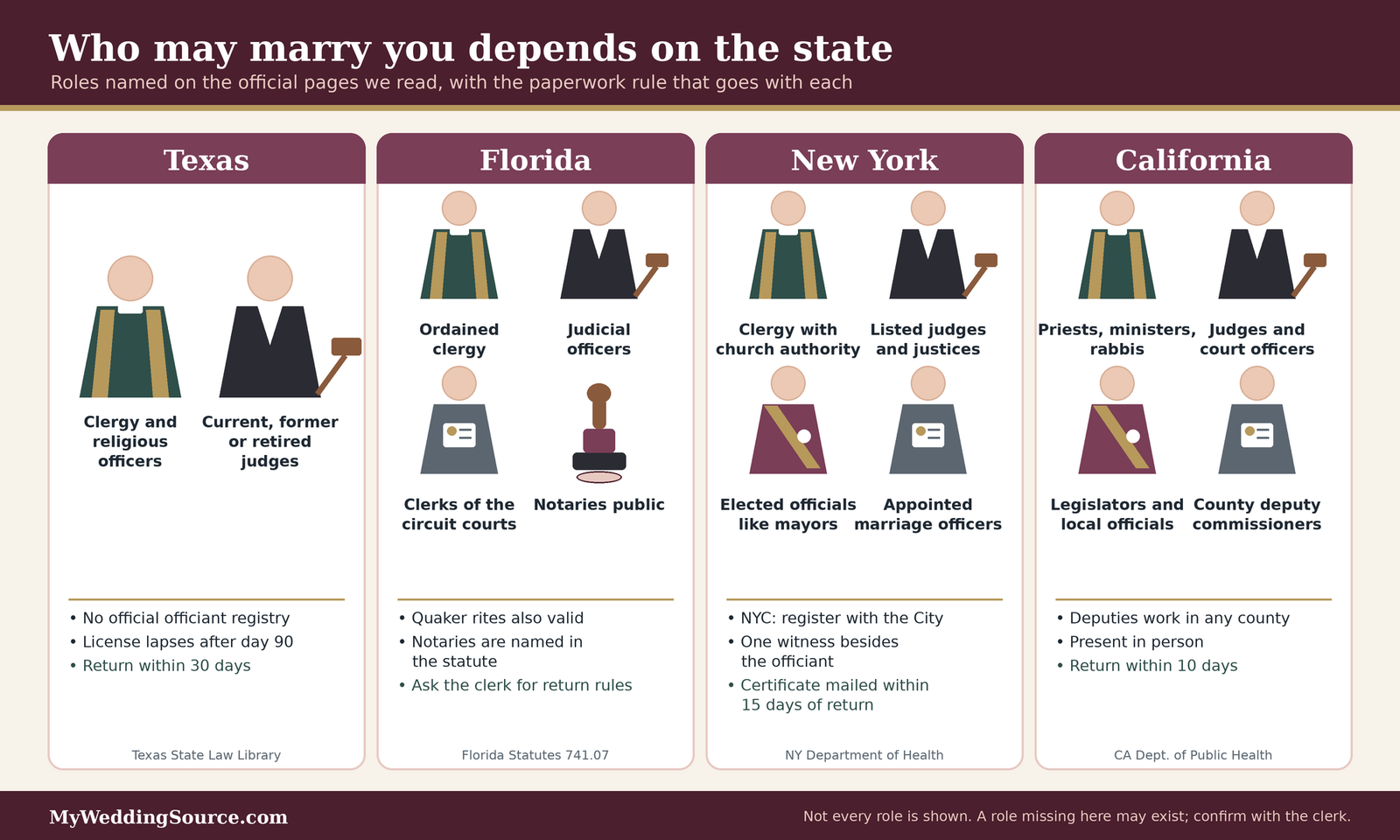
The Texas State Law Library, summarizing Texas Family Code section 2.202, says the people who may perform a marriage ceremony are a licensed or ordained Christian minister or priest, a Jewish rabbi, an officer of a religious organization authorized to conduct marriage ceremonies, and a current, former, or retired federal or state judge. The same page says Texas has no official registration for officiants: a person who reads the law and believes they qualify may perform the ceremony. That sounds permissive, but it moves the burden of checking onto you, because nobody maintains a list you can look the person up on.
Florida’s marriage statute, section 741.07, as displayed on the Florida Legislature’s website when we read it, names ordained clergy, judicial officers including retired ones, clerks of the circuit courts, and notaries public of the state. It also says marriages performed by Quakers according to their own rites are valid. The notary route is a feature of Florida that surprises people from other states, where a notary stamp gives no authority to marry anyone. We did not review local clerk practice in Florida for this guide, so ask the issuing office how it applies the statute.
New York and California
The New York State Department of Health’s publication on getting married lists the people authorized under section 11 of the Domestic Relations Law. They include current or former governors, mayors, certain city clerks, marriage officers appointed by a town or village board or city council, state legislators, listed judges and justices, ordained clergy or ministers with authority from a governing church body, and clergy chosen by a spiritual group to lead its affairs. The publication says the wedding officiant does not need to live in New York, that ship captains are not authorized, that at least one witness besides the officiant must be present, and that an officiant must be registered with New York City to perform a ceremony within the city.
The California Department of Public Health’s page describes who may solemnize a marriage under Family Code section 400: priests, ministers, and rabbis of any denomination, current or retired judges and certain court officers, specified federal judges, and California legislators and constitutional officers while in office. It adds that a county supervisor, city clerk, or mayor may solemnize after reviewing the County Clerk’s instructions, and that deputy commissioners of civil marriages, who are appointed by the county clerk in their role as Commissioner of Civil Marriages, may perform marriages in any California county.
Where the sources disagree and why online ordination is not a yes or no
Many couples hope a friend can become a wedding officiant online in an afternoon. Sometimes that works. The honest summary is that the answer varies by jurisdiction, and the sources we read do not agree with each other.
Two descriptions of New York
FindLaw’s overview says most states accept online ordination for religious officiants, with exceptions. It names New York as not accepting Universal Life Church ordination certificates as proof of clerical authority, and Tennessee as looking for what it calls a deliberate and responsible process. The Universal Life Church’s own New York page describes things differently. It says online ministers meet the requirements to solemnize weddings in New York, but it also lists online ordination as recognized “Not Always,” says the required documents vary by town or city, and describes a special registration process for the five boroughs.
Those two descriptions come from a neutral legal publisher and an organization that ordains people, so they have different incentives, and neither is the clerk. We are not saying who is right. We are saying that when two reasonable sources conflict, the only reliable move is to ask the office that will receive the license, and to ask in writing.
What a one-day route looks like
FindLaw also notes that, for civil ceremonies, a county clerk or judge can sometimes deputize a loved one, and that in some places the permission covers one wedding on one day. California’s deputy commissioner role, described above, is the kind of arrangement it means, although the California page we read does not describe a one-day program. Whether your county offers one, what it costs, and how far ahead you must apply are questions for your clerk. FindLaw adds that a ceremony performed by someone who is not a recognized officiant could be challenged in some jurisdictions, which is the reason to settle this before the day and not after.
How to get an answer you can keep
The goal of checking is not to feel reassured. It is to end up with something you can show a venue, a planner, or a friend who is nervous about doing it right.
Ask the clerk a narrow question
A broad question such as “can anyone officiate?” invites a broad answer. A narrow one works better: “We plan to be married in your county on a Saturday in June. Our officiant is ordained through an online ministry. Will your office accept the license if this person signs it? If registration is required, where do we send it and how long does it take?” Write down the name of the person who answered, the date, and the office’s web page if one covers the topic.
New York City is a good example of why timing matters. The City Clerk’s FAQ document we read, dated August 30, 2022, says registration is by mail and that applicants should allow two to four weeks for processing. That document is older than this article, so confirm the current process with the clerk, but it shows how a registration step can eat into a short timeline.
Keep the proof with the contract
Save the clerk’s answer next to the wedding officiant’s contract. If the wedding officiant is a professional, ask them to state in the contract that they are authorized to solemnize marriages in your wedding location. The Knot’s list of questions for officiants includes asking whether they are legally authorized at your location, including any destination, and WeddingWire’s list makes the same point. A professional should be able to answer it quickly. A friend may need help finding one, which is a reason to start early.
Who handles the license after the vows
Authority to marry you and responsibility for the paperwork are two different questions, and the second is where good intentions slip.
Deadlines the wedding officiant must meet
The Texas State Law Library says the wedding officiant must check that the license has not expired, because a Texas license expires if the ceremony is not held by the 90th day after issuance. The same page says the wedding officiant records the date and county and their own information, then returns the license to the issuing county clerk within 30 days after the ceremony. California’s health department says the person who solemnizes the marriage must return the original license within 10 days of the ceremony. New York’s publication says the clerk mails a Certificate of Marriage Registration within 15 calendar days after the officiant returns the license, and that couples who have not received it within four weeks should contact the issuing clerk.
Those three clocks run from three different starting points and end at three different lengths. Our marriage license guide goes into the application side, and this guide treats the deadline as a question to put to every wedding officiant you interview.
A hand-off card for a first-time officiant
California’s page adds a detail that is easy to miss. The license information must be legible and unambiguous, and changes, crossed-out entries, or white-out require a duplicate license, so questions go to the County Clerk. If your wedding officiant is a friend who has never signed a license, hand them a card before the day with the office address, the return deadline for your state, and a reminder to write carefully and to call the clerk before correcting anything. Designate one person to carry the license to the wedding officiant before the ceremony and take it home afterward.
Turn a vague search for a wedding officiant into a written brief
Searching for a wedding officiant without a brief produces quotes that cannot be compared, because each person answers a different question. A one-page brief fixes that. It also forces you and your partner to agree on what you want before a persuasive stranger tells you.
Define scope, hours, deliverables, and constraints
The brief has two jobs: it tells each candidate the same facts so the quotes line up, and it records what you actually care about so you do not drift toward whoever is most charming on the phone.
Give every candidate the same facts
List the date and time, the ceremony address, whether the space is indoors or outdoors, the approximate guest count, the language or languages, any religious or cultural elements you need, and whether you want help with vows. Add the logistics that change price: distance from the wedding officiant’s home base, whether a rehearsal is expected, and whether you want the wedding officiant at the reception for a toast or a blessing.
The Knot says officiant quotes commonly reflect consultations billed by the hour, the length of the ceremony, a custom script or vows, license signing, a rehearsal billed by the hour, and travel. If your brief covers those six items, the quotes you receive will be priced on the same basis. If it does not, you will spend an evening translating. Our wedding budget calculator can hold the number once you have it.
Separate must-haves from inspiration
Inspiration is a reading you loved at a friend’s wedding or a video of a ceremony that made you cry. Must-haves are the items that would disappoint you if they were missing. Keep the two lists apart. A must-have might be “under 25 minutes,” “includes a short statement in Spanish,” “no jokes about our families,” or “someone who will run the rehearsal so we do not have to.” An inspiration might be “a story about how we met, told warmly.” The distinction matters because a candidate can meet every inspiration and miss a must-have, and you will only notice the miss if you wrote it down.
A practical test for each must-have is whether a stranger could check it. “Warm” cannot be checked. “Gives us the full script a week ahead and accepts edits” can. Zola’s advice on choosing a wedding officiant adds a few of these checkable traits: the person should have performed weddings before, should speak clearly enough to reach the back row, and should have time for several meetings, writing, the rehearsal, and the ceremony itself. Someone with a heavy schedule or a major life change underway may not be a good fit, Zola says.
Screen the process before the price
Price is the easiest number to compare and the least informative. Process tells you how the person will behave when something goes sideways, and something usually does.
Look at complete examples
Ask each candidate for a full recording or a complete written script from a past ceremony, with the couple’s permission, not a highlight reel. A three-minute montage shows the best laugh and the best tear. A full script shows pacing, how the legal statement is handled, how the person addresses guests who are not family, and how the ceremony ends. If a candidate cannot share a full example because of privacy, ask to see a template and a description of how they customize it.
WeddingWire’s list of questions asks whether the wedding officiant uses a standard script or tailors each ceremony and how they gather details about you. The answer to that question predicts how many hours you will spend talking. A candidate who sends a questionnaire and drafts from it is working one way. A candidate who wants to sit and talk for ninety minutes is working another. Neither is better, but the second may cost more if consultations are billed hourly.
Ask about your hardest condition
Every wedding has one condition that makes it hard to officiate well. It might be wind at an outdoor site, a guest list with three languages, a venue with no sound system, a tight timeline between ceremony and photographs, or a family tension that the wedding officiant needs to steer around. Tell each candidate the condition and listen to the answer.
The Knot’s list suggests asking whether the wedding officiant has handled unexpected situations and what they would do, whether they have worked at your venue, whether they bring their own sound equipment, and what they advise about the aisle walk given the terrain. A good answer is specific: “At a lakeside site I carry a lapel microphone and a battery pack, and I stand with my back to the wind so the guests hear me.” A weak answer is a reassurance with no detail.
Ask questions that reveal how a wedding officiant works
A wedding officiant can be warm in the first meeting and unreliable in the thirtieth email. The questions below aim at operations: who shows up, when, with what, and what happens if they do not.
Questions to ask every candidate
- Are you authorized to solemnize our marriage in this county, and how can we confirm it?
- Who will personally officiate, and who is the backup if you are ill or delayed?
- What time will you arrive, and will that time appear in the contract?
- How many meetings are included, and what do extra meetings cost?
- Will we see the full script before the day, and how many rounds of edits are included?
- Do you attend and lead the rehearsal, and is that included in the fee?
- Who signs, who files, and by what date will the license be returned?
- How is travel priced, and what is the total for our location?
- What is the deposit, when is the balance due, and what happens if we change the date?
- What do you bring (microphone, folder, pen, copy of the script), and what should we supply?
Probe staffing, backups, and communication
The questions in the box are a summary. The sections below explain what a good answer sounds like.
Ask who personally performs the ceremony
Some officiants work alone. Others belong to an agency that assigns whoever is available. If you are meeting one person and an associate will show up, you have not booked the person you met. Ask directly: “Will you personally perform our ceremony?” and have the answer written into the contract. Agencies are not inherently worse, and a larger bench can make a substitution easier, but the person you interviewed should be the person standing in front of your guests, or the contract should name the substitute and the conditions under which one is used.
The same question applies to clergy and to friends. A priest may be assigned by a parish. A friend may be traveling for work. Ask each person to confirm their calendar for the date and the rehearsal, and ask a friend to tell you honestly if the role feels like a burden. Zola’s guidance on friends and family notes that a loved one adds intimacy and usually costs less but may need certification and will face a learning curve and more pressure.
Get equipment, staffing, and contingency answers in writing
The Knot’s questions include what the officiant brings, whether they stay for the reception, what they will wear, and what their backup plan is. WeddingWire’s list adds a plain question: if the wedding officiant becomes ill or is otherwise unavailable, is a substitute lined up? We found no source that sets a standard for what a backup plan must contain, so ask for the specifics and write them down.
A useful backup plan has three parts. First, a named substitute or a described process for finding one. Second, a time by which the officiant will tell you if there is a problem. Third, a statement that the substitute is authorized in your location. Put that last part in writing, because a stand-in who is not authorized cannot solve your problem. If you are using a friend, make the backup a second authorized person or a plan for a quick civil ceremony at the clerk’s office, and decide ahead of time who makes that call.
Read the quote and contract as one system
A quote tells you the price. A contract tells you what you are buying. The two should match line by line, and mismatches are where disputes begin.
Match each promise to a line item
Go through the wedding officiant’s emails, website, and conversation and list every promise: the number of meetings, the custom script, the rehearsal, the arrival time, the license filing, the travel. Then find each promise in the contract. Anything promised but not written down is a favor, not a term. The Better Business Bureau’s wedding tips say a contract should cover dates, times, products, quantities, prices, key staff, arrival times, cancellation and refund terms, and overtime charges. That list was written for vendors in general, and it fits a wedding officiant well: key staff means the named person, arrival time means the contract line, and overtime means what happens if the ceremony runs long or the venue is late.
The Knot’s guidance for officiants says to get a contract that states the final cost and the payment due dates. If the fee is flat, say so. If it is hourly, ask for a cap.
Flag vague language about changes and cancellation
Four phrases deserve a second look: “subject to availability,” “reasonable travel,” “additional meetings as needed,” and “fees may apply.” Each hides a number. Ask the wedding officiant to replace each with a figure or a formula. For example, “reasonable travel” can become “$0.75 per mile beyond 30 miles round trip.” Zola’s article says mileage often runs $0.50 to $1.00 per mile, which is a useful reference when judging whether a quoted rate is out of line, though it is an editorial estimate and not survey data.
Cancellation and date changes need the same treatment. The BBB advises asking whether a deposit can move to a new date, how much notice you must give, and who covers for the vendor if they are unavailable. Those three questions apply to a wedding officiant without modification. We are not giving legal advice about contracts. If a contract involves a large sum, an unusual clause, or something you do not understand, a licensed attorney can review it.
Compare finalists on risk-adjusted value for a wedding officiant
By now you should have two or three finalists who are authorized, who fit your style, and who sent quotes. The remaining question is value, and value includes risk. A cheap quote with a thin backup plan can cost more than a higher quote with a clear one. This section shows a simple way to put quotes on the same footing and to score what the numbers miss.
What this actually costs
The Knot’s 2026 Real Weddings Study, covering couples married in 2025, reports an average officiant cost of $260, which The Knot says is just under 1 percent of a typical budget. Zola’s editors describe a standard fee of about $200 to $450. Those two figures come from different kinds of sources and describe different things, so read them as a range for orientation, then price your own bundle. Your total depends on travel, rehearsal, scripting, and whether a donation or a friend’s ordination fee applies.
Normalize packages and exclusions
Normalizing means rebuilding every quote as if it covered the same bundle.
Price the missing pieces
Start with the six items The Knot says drive officiant quotes: consultations, ceremony length, custom script or vows, license signing, rehearsal, and travel. For each finalist, mark each item as included, extra, or unknown. Convert every extra into a dollar figure by asking the officiant, or, if they will not say, by using a clearly labeled assumption. Convert every unknown into a question you must have answered before booking.
Here is a worked example. All of the figures below are illustrative assumptions for one hypothetical couple, not survey results or real quotes. Our hypothetical couple lives 60 miles from three candidates and wants a custom script, a rehearsal, and the license returned for them.
- Candidate A quotes a flat $450 that includes two meetings, a custom script, the rehearsal, license return, and travel. Normalized total: $450.
- Candidate B quotes $300 for a standard ceremony with one meeting. Assume the custom script is an extra $100 and the rehearsal an extra $75. Travel is 120 miles round trip, and at $0.75 a mile, the midpoint of the $0.50 to $1.00 range Zola mentions, that is $90. Normalized total: $300 + $100 + $75 + $90 = $565.
- Candidate C is a close friend who will become ordained online. Assume the ordination costs $40, which is consistent with Zola’s statement that online ordination is free or usually under $50, and a thank-you gift of $75. Normalized total: $115. That number leaves out the friend’s preparation time, the learning curve, and the risk of a missed deadline, which the money cannot capture.
On the sticker prices, B looked $150 cheaper than A. After normalizing, B is $115 more expensive. That reversal is the reason to do this. The infographic below draws the same arithmetic so you can see where each dollar sits, and it adds a religious officiant at a $300 donation, a figure that sits inside the $200 to $300 range The Knot gives and below the $300 to $800 range Zola suggests for non-members.

Account for what is not priced
Some costs do not show up in any quote. A religious officiant may require premarital counseling, which The Knot notes may cost extra at some houses of worship. A destination wedding may require the officiant to be flown in and lodged, as The Knot says some travel arrangements do. Weekend dates in busy months can cost more, since Zola says Saturday ceremonies, especially May through October, cost more than weekday or Sunday ones. Add a line for each that applies. If it does not apply, write “none” so you know you checked.
Do not forget the small stuff: a tip, if you choose to give one, is separate from the fee and from a donation, The Knot says, and is optional. Zola suggests $50 to $100 for exceptional service from a professional, and says a donation to the house of worship is usually preferred for a religious officiant. Our guide to wedding etiquette covers thank-you gestures more broadly.
Score responsiveness, clarity, and backup strength
Once the numbers match, compare what the numbers leave out. A short scorecard keeps the decision from becoming a mood.
A scorecard you can reuse
This is our own method, not an industry standard, and the weights are a judgment call you should change to match your priorities. Treat authorization as a gate: a candidate who cannot show they are authorized does not get scored. For the rest, give each finalist up to this many points.
- Fit of style and tone: up to 25
- Process and responsiveness: up to 20
- Backup strength: up to 20
- Paperwork competence: up to 15
- Clarity of the contract: up to 10
- Price after normalizing: up to 10
Price carries the smallest weight on purpose. By the time you are scoring, the candidates are all within a range you can afford, and the differences that matter most are whether the person will listen, show up, and finish the paperwork. If you want price to count more, raise it, but decide the weights before you see the totals so you do not adjust them to land on a favorite.
How to measure responsiveness fairly
Responsiveness is easy to observe and easy to overrate. Note how quickly each candidate replied to your first inquiry, whether the reply answered your questions or sent a template, and whether they flagged anything you had not asked about. The BBB suggests checking a business’s profile for rating, complaint history, how it responds to complaints, accreditation, and years in business, and talking to recent couples instead of relying only on testimonials the vendor supplies. That applies to a wedding officiant who runs a business. For a friend or a clergy member, the equivalent is simply asking whether they can commit time between now and the wedding.
Define the condition for booking
A booking should be conditional on facts, not on a feeling that you have found the right person. Define the conditions in advance and keep them short.
List the unresolved questions
Before you sign or pay, write down every question still open. Typical ones are whether the clerk has confirmed the wedding officiant’s authority, whether the wedding officiant can attend the rehearsal on the date you plan, who files the license, and what happens if your date moves. Do not book while an item is on the list unless you have chosen to accept the risk on purpose and written that down. If the item is legal authority, do not accept the risk. Settle it first.
Confirm the deposit, payment schedule, and amendment process
Zola says a deposit is typically about half the total fee to reserve a date, and the BBB advises paying a deposit and not the full amount, and only after both parties have signed. The BBB also advises paying by credit card where possible because it makes disputing a charge easier, and avoiding cash, wire transfers, gift cards, and payment apps. Whether a card is accepted by a particular officiant is something to ask, and some clergy accept donations in other forms, so adapt this to the person.
Ask how amendments work. If you change the date, location, or ceremony length, what is the process, and does it cost anything? Ask for the answer in an email or in the contract. Then reconfirm a week or two before the wedding, which the BBB recommends doing by phone or email for every vendor, confirming the date, time, address, and final details.
Match the choice to your situation
The sections above are method. This section is shorthand for readers who want to see how the method turns out in a few common situations. Everything in the tables below is our editorial judgment, built from the sources named in this guide, and not a ruling for your state.
A decision matrix for the four common paths
The Knot describes four common paths: a religious officiant, a secular professional, a civil officiant, and a friend or relative. The matrix below compares them on the factors that most often change the answer.
How to read the matrix
The cost entries paraphrase the ranges published by The Knot and Zola, which we describe above as editorial estimates. The other rows are our judgment about trade-offs, not facts about every person who fills a role. A particular priest, clerk, or friend can beat the pattern. Use the matrix to decide which questions to ask, not to rule anyone out.
| Factor | Religious officiant | Secular professional | Civil or court official | Friend or relative |
|---|---|---|---|---|
| Legal route | Usually through clergy status; confirm with the clerk | Often ordained or registered; confirm | Holds office or appointment; confirm location | Online ordination or a deputy route, depending on the place |
| Cost, per The Knot | No set fee; donation commonly $200 to $300, sometimes travel | $200 to $1,000 or more | License fee of $30 to $100 plus possible ceremony fee | $10 to $100 for ordination or registration, plus a gift |
| Cost, per Zola | Non-members often $300 to $800 donation | $300 to $800, sometimes over $1,000 | Basic courthouse about $50 to $200; travel adds $100 to $300 | Free or usually under $50 |
| Personalization | Depends on the tradition and the person | Usually high; often the main selling point | Often a standard script; ask | Highest personal knowledge, least experience |
| Backup if ill | Ask the parish or congregation | Ask for a named substitute | Ask the office | Plan a second authorized person |
| Paperwork habit | Ask who signs and files | Ask who signs and files | Ask who signs and files | Needs a hand-off card |
| Best when | Faith requires it | You want help writing and leading | You want a short, simple ceremony | The person’s presence matters most |
Where the matrix can mislead
The matrix flattens variety. A civil ceremony in one place may be a ten-minute formality and in another a warm event with a personalized script. A friend who officiates weddings every summer may be more practiced than a professional who does it twice a year. The matrix also leaves out venue rules. Ask your venue whether it allows outside officiants, whether it requires its own, and whether any fee applies. We found no source that sets a standard for venue rules, so treat this as a question to ask and not a fact.
Four scenarios and what flips each recommendation
Scenarios help because they make trade-offs concrete. The four below are illustrations built on assumptions we state, not real couples.
The scenarios
| Scenario | Assumptions | Recommendation | What flips it |
|---|---|---|---|
| Backyard wedding in Texas, close friend wants to officiate | Friend is willing, clergy status confirmed with the clerk, 60 guests, Saturday in June | Friend officiates, with a hand-off card and a named backup | If the friend cannot attend the rehearsal or the clerk will not confirm status, hire a professional |
| Rooftop wedding in New York City, couple prefers an out-of-state professional | Officiant is not registered in the city, wedding in 10 weeks | Confirm registration first; if it cannot be done in time, use a registered local officiant | If the clerk’s current processing time is longer than the time left, switch |
| Interfaith ceremony with two traditions, guests from both families | Neither tradition’s clergy is available together, ceremony length matters | Secular professional with experience in both traditions, with clergy blessings written in | If a house of worship requires its own clergy or premarital sessions, plan the added time and cost |
| Tight budget, courthouse wedding followed by a party | Couple wants a short civil ceremony, then a casual reception | Civil officiant, then a friend gives a toast at the reception | If the courthouse will not permit guests or photographs, ask about alternatives |
Reading a scenario table honestly
Each recommendation depends on its assumptions, and the last column is the part to copy. For your own case, write the assumption, the choice, and the single fact that would change your mind. If you find yourself with no flipping condition, you may be deciding on feeling, and it is worth asking what evidence would change it. Our guide to the wedding reception covers the toast and the schedule that follow the ceremony.
A timeline you can work backward from
The calendar is a constraint, and popular dates can fill early.
Milestones from booking to filing
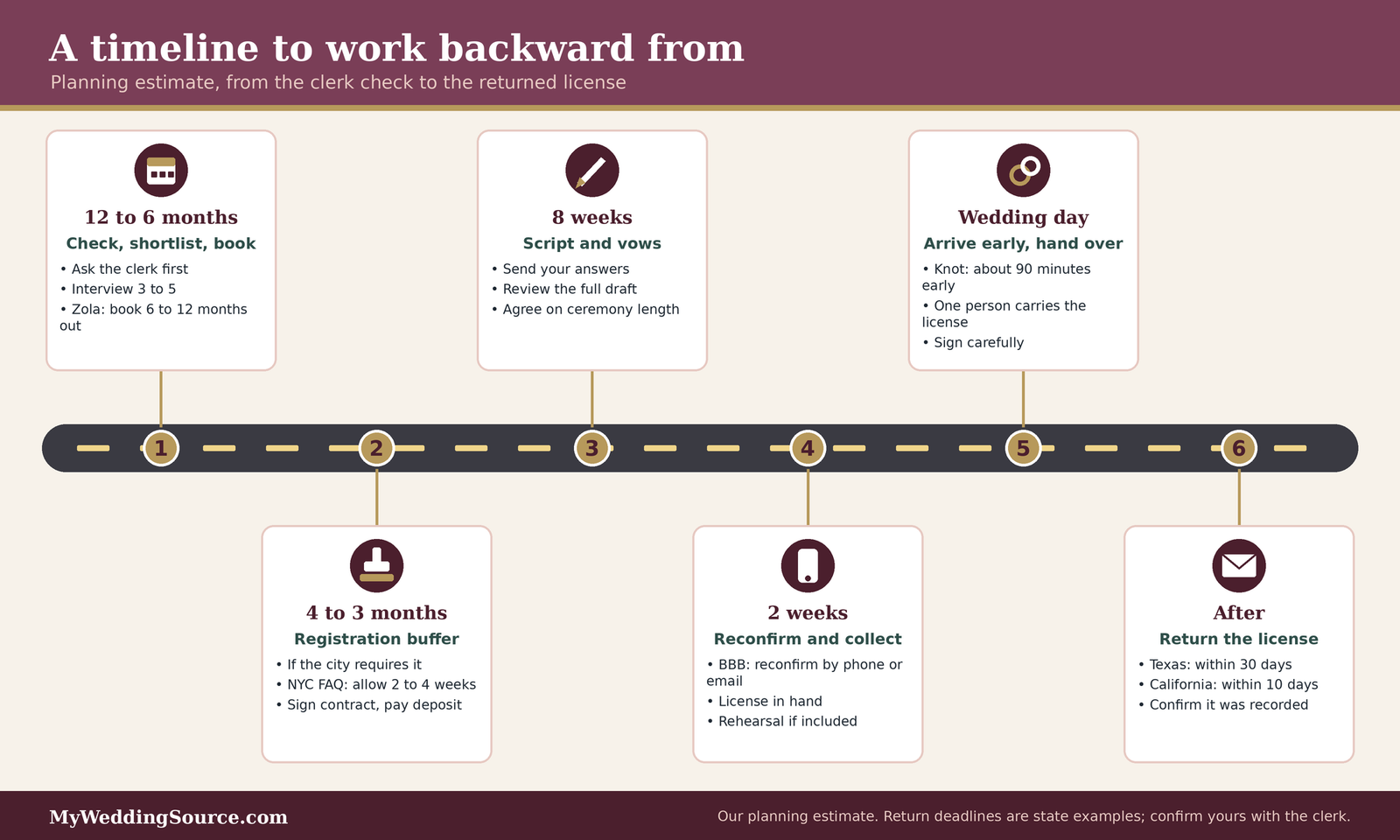
Zola’s guidance on lead time is inconsistent, saying six to nine months in one place and six to twelve in another, and The Knot’s guide gives no booking timeline. We therefore treat six to twelve months as a rough planning range, not a rule. The timeline below is our own planning estimate. It starts at the clerk check, builds in time for any registration step, and ends with the license return, using the Texas 30-day and California 10-day deadlines as examples.
Buffers worth keeping
Give yourself slack on three things. First, any registration, such as New York City’s, where the clerk’s FAQ says two to four weeks. Second, the script, because the first draft is rarely the last. Third, the license, which should be in the officiant’s hands before the ceremony and back at the clerk’s office well before the deadline. The Knot’s questions suggest asking the wedding officiant to arrive about 90 minutes early, which is a sensible buffer on the day. Our wedding planning timeline and wedding planning checklist help you place these steps among the rest of your tasks.
Frequently asked questions about choosing a wedding officiant
Legal checks
Can a friend or relative officiate our wedding?
Sometimes. FindLaw says that for civil ceremonies a county clerk or judge can occasionally deputize a loved one, and that online ordination is accepted for religious officiants in most states, with exceptions. Because the route varies by place, ask the clerk who will issue your license before your friend invests any time or money.
Does an online ordination certificate guarantee the marriage will be recognized?
No. Sources disagree even about New York, where FindLaw says Universal Life Church certificates are not accepted as proof of clerical authority and the church’s own page says online recognition is “Not Always.” Treat the certificate as a first step, then get the clerk’s answer for your county in writing.
Booking and cost
How much does a wedding officiant cost?
The Knot’s 2026 Real Weddings Study reports an average of $260 for couples married in 2025, drawn from its own members. Zola’s editors describe a standard fee of about $200 to $450. Travel, a custom script, a rehearsal, and a donation to a house of worship can all change your total, so price the same bundle from each candidate.
How far ahead should we book?
Published guidance is inconsistent. Zola gives six to nine months in one place and six to twelve in another, and The Knot’s fee guide gives no timeline. Treat six to twelve months as a planning range, book sooner for a busy season or a popular date, and allow extra time if your wedding officiant needs city registration.
Contract and backup
What should the contract say?
The Better Business Bureau advises that a contract cover dates, times, prices, key staff, arrival times, cancellation and refund terms, and overtime. For a wedding officiant, add the named person, the arrival time, the fee and travel, the rehearsal, who returns the license and by when, and a named substitute. Ask a lawyer about unusual clauses.
What if our officiant cancels or is ill?
Ask before you sign. WeddingWire suggests asking whether a substitute is lined up, and The Knot suggests requesting an emergency plan. Get the name or the process in writing, plus a statement that the substitute is authorized in your location. Keep a fallback in mind, such as a quick civil ceremony at the clerk’s office, if your area allows one.
Wedding day and after
Who returns the signed license, and by when?
Usually the officiant, and the deadline depends on the state. Texas’s law library says 30 days after the ceremony, and California’s health department says 10 days. New York’s publication says the clerk mails a registration certificate within 15 calendar days after the license is returned. Ask your wedding officiant for the date and confirm your clerk’s rule.
Do we tip or make a donation?
A tip is optional and separate from the fee and from any donation, according to The Knot. Zola suggests $50 to $100 for exceptional service from a professional and says a donation to the house of worship is usually preferred for religious officiants. A sincere thank-you note, a meal, or a gift can also be appropriate.
Your next steps
Do these first
Call the clerk this week
Phone the office that will issue your license and ask the narrow question from earlier in this guide. Record the date, the name, and the answer. If you plan to use a friend, ask about the exact route they would use and how far ahead to start. The answer decides whether the rest of your list is a hire or a favor.
Write the one-page brief
Put the date, place, guest count, languages, must-haves, and logistics on a single page. Send the same page to each candidate. Our wedding ceremony guide helps you decide the shape and length, and our wedding vows guide helps you decide how much you want to say yourselves.
Before you sign
Normalize, score, and compare
Rebuild each quote as the same bundle, score the finalists, and note what remains unresolved. If a photographer will capture the ceremony, share the ceremony length with them, and see our wedding photography guide for how to coordinate.
Use this decision rule
Book the candidate who is authorized, who answered your questions in writing, who named a backup, and whose normalized quote fits your budget, even if another candidate was more charming. If two candidates tie, pick the one with the clearer contract. If none qualifies, widen the search rather than lowering the bar.
If this is on your list, see also Something Old Something New Borrowed Blue: History and Modern Use.
Sources & methodology
How we built this guide
What we relied on
This guide draws on pages we read on November 11, 2026: the New York State Department of Health’s publication on getting married, the Texas State Law Library’s page on conducting the ceremony, the Florida Legislature’s page for section 741.07, the California Department of Public Health’s marriage license information, and the New York City Clerk’s FAQ document dated August 30, 2022. For cost and selection advice we read pages from The Knot, Zola, and WeddingWire, the Better Business Bureau’s wedding tips, FindLaw’s overview of who can officiate, and the Universal Life Church’s New York page, which we cite as an ordaining organization’s own description. The Knot’s average comes from its 2026 Real Weddings Study of 10,474 couples married in 2025 who were recruited through The Knot and WeddingWire, so it describes that audience and not every U.S. couple. The Zola and Knot ranges are editorial estimates, and the quote comparison, the scorecard, the scenarios, and the timeline are our own illustrations and arithmetic.
What we did not do
We covered four states and one city as examples, not all fifty states, and a blank in our summary means we did not see the item on the page we read, not that the rule does not exist. We did not call clerks, confirm a current New York City registration process, or review local practice in Florida. The Florida statute page we read did not describe the license return, so we did not state a Florida deadline. We tested no officiants and give no legal advice. Laws, fees, and procedures change, and individual counties differ, so confirm every point with the office that will issue your license, and consult a licensed attorney in your state for questions about your situation or a contract.
Source list
Government and public-agency sources
- New York State Department of Health, Information on Getting Married in New York State (publication 4210): https://www.health.ny.gov/publications/4210/
- Texas State Law Library, Marriage in Texas, Conducting the Ceremony: https://guides.sll.texas.gov/marriage-in-texas/conducting-the-ceremony
- Florida Legislature, Florida Statutes, section 741.07: https://www.leg.state.fl.us/statutes/index.cfm?App_mode=Display_Statute&URL=0700-0799/0741/Sections/0741.07.html
- California Department of Public Health, California Marriage License General Information: https://cdph.ca.gov/Programs/CHSI/Pages/California-Marriage-License-General-Information.aspx
- New York City Clerk, Frequently asked questions (August 30, 2022): https://www.cityclerk.nyc.gov/assets/cityclerk/downloads/pdf/FAQs%20as%20of%208.30.2022%20final.pdf
Consumer-protection and legal-information sources
- Better Business Bureau, BBB wedding tips: https://www.bbb.org/article/news-releases/16783-bbb-wedding-tips
- FindLaw, Who can officiate my wedding: https://www.findlaw.com/family/marriage/who-can-officiate-my-wedding-.html
- Universal Life Church, New York wedding laws (an ordaining organization’s description): https://www.ulc.org/wedding-laws/new-york
Wedding-industry sources
- The Knot, Wedding officiant fees, donations and basics: https://www.theknot.com/content/wedding-officiant-fees-donations-basics
- The Knot, The Average Wedding Cost, According to The Knot Data (2026 Real Weddings Study): https://www.theknot.com/content/average-wedding-vendor-costs
- The Knot, Questions to ask potential officiants: https://www.theknot.com/content/questions-to-ask-potential-officiants
- Zola, Wedding officiant cost: https://www.zola.com/expert-advice/wedding-officiant-cost
- Zola, How to choose a wedding officiant: https://www.zola.com/expert-advice/how-to-choose-wedding-officiant
- WeddingWire, Questions to ask wedding officiants: https://www.weddingwire.com/wedding-ideas/questions-to-ask-wedding-officiants