

Knowing how to coordinate attire for a mixed-gender wedding party mostly means writing a short, clear brief that lets each attendant dress in a way that feels like themselves, a plan for the people who live far away, and a backup for the day something does not arrive, rather than a matching uniform.
Quick answer
The sources we read agree on one idea: there are no fixed rules, so start from the photograph you want and pick a small set of shared anchors, usually a color palette, a formality level, and one or two repeated accessories. Then let each person choose the garment (suit, dress, jumpsuit, or separates) inside that frame. Ask each attendant privately what they would be comfortable wearing, give extra time for shopping and alterations, and keep a written backup plan for anyone ordering from a distance. That is the core of how to coordinate attire for a mixed-gender wedding party without singling anyone out.
What coordinating a mixed-gender wedding party really involves
Most advice about wedding party clothing assumes two tidy lines: bridesmaids in matching dresses on one side, groomsmen in matching suits on the other. A mixed-gender party breaks that assumption in small, ordinary ways. A best friend of the groom may be a woman, a sibling of one partner may be a man who stands with the other side, and some attendants may not describe themselves as either. The task is still familiar: make a group look related in photographs while keeping each person comfortable. What changes is that the usual shortcuts, like “bridesmaids get this, groomsmen get that,” stop doing the work for you.
Who this guide is for
This guide is for couples, planners, and attendants who want to know how to coordinate attire for a mixed-gender wedding party in a practical way. It covers couples of any makeup, parties with uneven numbers, parties that include bridesmen, groomswomen, or nonbinary attendants, and parties where one or more people live in another city.
Couples of any combination
The same approach applies whether you are marrying someone of a different gender, the same gender, or you are planning with a nonbinary partner. The Knot’s guide to bridesmen and groomswomen says couples can choose any title and that there are no set rules for what attendants wear, which is why we treat attire as a design problem rather than an etiquette test. The principles of how to coordinate attire for a mixed-gender wedding party do not depend on who is marrying whom.
Attendants who are helping a friend plan
If you are an attendant who has been handed a vague instruction such as “wear something navy,” you may find the questions and message templates later in this guide useful. They are written so an attendant can ask a clarifying question without feeling difficult. Knowing how to coordinate attire for a mixed-gender wedding party from the attendant’s side mostly means asking one good question early.
Planners and family helpers
A planner or family member coordinating on the couple’s behalf can use the briefing sheet and the backup ladder as handoff documents. Because many parents and relatives have opinions about how a wedding party should look, we also include a short section on explaining your choices kindly.
What this guide leaves out
Our scope is deliberately narrow. We cover coordinating clothes and accessories across a mixed lineup. Other topics have their own guides.
Topics with their own guides
Fit across different bodies is covered in our guide to coordinating wedding party attire across different body types. Formality and dress codes for the whole party are covered in wedding party attire. Suits versus tuxedos is covered in groomsmen suits vs. tuxedos. We refer to those pages rather than repeating them. Because this page is about how to coordinate attire for a mixed-gender wedding party, we leave the deeper details of fit and formality to those pages.
What is not advice
We are not giving legal, medical, or financial advice, and we do not tell any person how they should express their gender. Where money is involved we describe options and leave the decision to you. Where a claim comes from a retailer, we say so, because a retailer describes its own products and policies.
The vocabulary we use
Terms in this area are personal, and they change. We use the ones the cited sources use, and we recommend you ask each person which words they prefer.
Common titles
The Knot describes a bridesman as generally a male attendant who supports the bride, and a groomswoman as generally a female attendant who supports the groom, while noting that couples can use any title. Loverly lists groomsmaids, bridesmen, man of honor, and best woman as options, and suggests choosing terms everyone in the party is comfortable with. Lily and Lime proposes gender-neutral titles such as attendant of honor or best mate, or a group nickname.
Using the words people use for themselves
GLAAD’s media reference guide advises asking people how they describe themselves and what pronouns they use, and then using those words. The guide notes that LGBTQ people do not share a single way of identifying. We follow the same principle for wedding programs, introductions, and group chats: ask first, then use what you are told.
A note on the word “mixed”
In this guide, “mixed-gender” simply means that the people standing up with the couple are not all the same gender, or are not sorted into two groups by gender. It does not describe anyone’s identity and it is not a category any attendant needs to accept.
How to coordinate attire for a mixed-gender wedding party: start with the photograph
Before you look at a single outfit, decide what the group should look like from the back of a ceremony space and in a posed photograph. The Knot’s guidance is to begin with a vision for the day and the photos you want. Every later choice, from color to shoes, is easier when you can point at that picture and say whether an option moves toward it or away from it.
Pick the anchors that hold the group together
An anchor is a decision that stays the same for everyone, so the rest can vary. A mixed lineup usually needs fewer anchors than a uniform one, and the fewer you set, the more room each person has. In practice, how to coordinate attire for a mixed-gender wedding party comes down to choosing the few things everyone shares.
Color as the primary anchor
Color is the easiest thing to share across different garments. Apartment Therapy describes setting a general palette, such as soft grays on one side and neutral tones on the other, and letting each person choose their own pieces inside it. Friar Tux’s advice is to limit the palette to two main colors with at most one or two neutral accents. If you are unsure, start with two colors plus a neutral and test it against your flowers and venue. If you are still deciding how to coordinate attire for a mixed-gender wedding party, a two-color palette is the lowest-risk place to begin.
Formality as the second anchor
Formality is the anchor people forget, and it is why one attendant in a linen shirt can look wrong next to someone in a tuxedo even when the colors match. State the formality in plain words, such as black tie, cocktail, or garden formal, and say whether each term allows jumpsuits, short dresses, or suits without ties. If you need help with the vocabulary, our guide to wedding party attire explains the usual levels.
One repeated object
Many parties benefit from a single repeated object: a flower, a tie or pocket square, a metal tone for jewelry, or a shoe color. It lets two very different outfits feel intentional when they appear side by side. We cover accessories in their own section below.
Decide what is fixed and what is open
Write down three lists: what must match, what should coordinate, and what is entirely up to the attendant. The lists keep a long group chat from turning into dozens of small negotiations. Sorting decisions into fixed and open is the most practical answer to how to coordinate attire for a mixed-gender wedding party across several styles.
Must match
For many couples this is only color family and formality. If the ceremony is outdoors in sand or grass, it might also include shoe type for safety. Keep the “must match” list short enough that you could explain it in one sentence at a rehearsal.
Should coordinate
This list includes fabric weight, pattern, and accessories. “Coordinate” means the pieces should look related, not identical, so it is a good place for a few examples rather than a rule.
Up to the attendant
Silhouette, garment type, neckline, sleeve, and whether a person wears a dress, a suit, a jumpsuit, or separates belong here in most mixed parties. A Practical Wedding’s advice is that attendants need not match the couple’s genders or each other, and that couples can offer a range of outfit options so each person is comfortable.
Write the brief in one page
A one-page brief, sent to everyone at the same time, is the cheapest tool in this guide. It reduces repeated questions and makes it possible to hand the plan to a planner or a friend. A brief turns how to coordinate attire for a mixed-gender wedding party from a long conversation into a document people can act on.
What the brief contains
Include the date, the venue and its surface, expected weather, the formality, the palette (with a physical swatch if you can mail one), the must-match and open lists, the order deadline, and a name to contact. State in the first lines that attendants choose their own garments inside the frame.
What the brief avoids
Avoid gendered shortcuts like “the guys wear” or “the ladies wear.” Zola’s advice on gender non-conforming attire suggests replacing phrases like that with wording such as “for everyone,” and describing the mood in terms like casual, cocktail, or formal. The same advice works for the wedding party brief.
Where to send it
Send the brief by whatever channel your attendants already use, and keep the master copy somewhere editable. If you are also setting up a group chat, our guide to group chat rules that reduce planning confusion covers how to keep the attire thread from burying other decisions.
Five coordination patterns, and when each one works
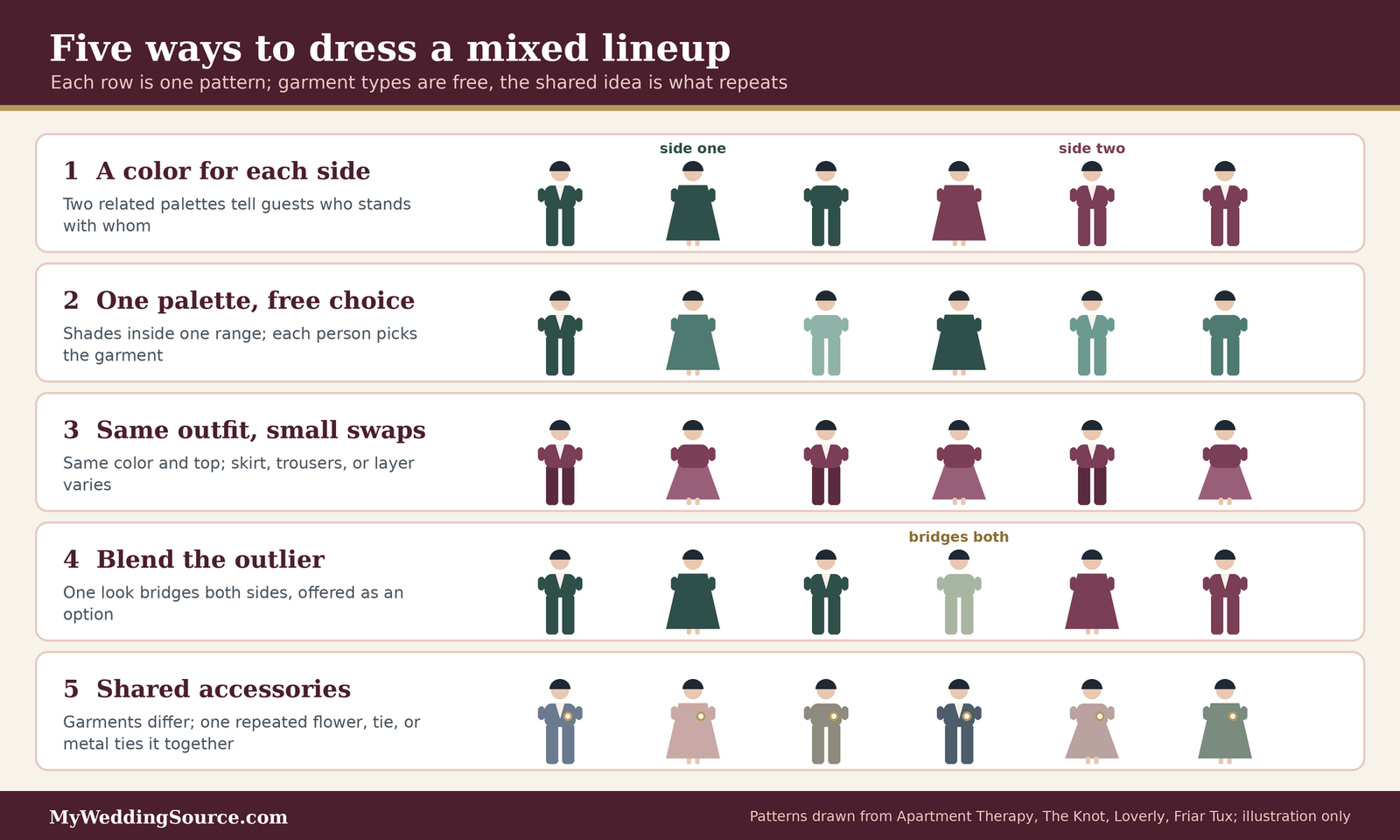
Apartment Therapy’s article on dressing a mixed-gender party lays out five approaches. Combined with ideas from The Knot, Loverly, and Friar Tux, they cover most real situations. They are not mutually exclusive: many parties use one as the base and borrow a detail from another.
Patterns built on color
Two of the five patterns lean on color to do the sorting. Color-based patterns are the quickest route when you are working out how to coordinate attire for a mixed-gender wedding party on a short timeline.
Pattern one: a color for each side
Apartment Therapy describes giving the bride’s side one palette and the groom’s side another so guests can tell who stands with whom, and notes this also works for same-sex weddings. Loverly describes the same idea, keeping the two sides related but distinct, for example by matching one side’s suit shade with the other side’s dresses. This works when you want guests to read the lineup at a glance, and it asks attendants to accept a side. It is a poor fit if the point of your party is that sides do not matter.
Pattern two: one palette, free choice inside it
In this pattern you choose a range of colors and let each person pick their own pieces within it. It is the most flexible pattern and the one that The Knot and A Practical Wedding both come back to when attendants have different style preferences. The risk is visual noise, so lean on the formality anchor and a repeated accessory to keep the group together.
Patterns built on silhouette and repetition
One pattern changes the garments themselves, and one pattern handles the person who does not fit either side. These two patterns show how to coordinate attire for a mixed-gender wedding party when color alone is not enough.
Pattern three: the same outfit with small changes
Apartment Therapy suggests everyone wearing a similar ensemble with swaps, such as skirts for pants or matching layers like cardigans. The strength is that the group looks unified in photographs even though each person wears something slightly different. The risk is availability and cost, since near-identical pieces in several cuts may not all come from one seller, so ask the seller before you promise the look.
Pattern four: blend the outlier
Apartment Therapy also suggests that a single person who does not fit neatly into either side can wear a look that bridges both, such as a dress in a shade nearer the suits or a suit with a tie that matches the dresses. We would phrase this carefully when you talk to the person. Offer it as one option rather than assigning it, so no attendant feels they have been labeled the exception.
Patterns built on accessories
The last pattern puts the repetition into small items rather than garments. Accessories are the most forgiving answer to how to coordinate attire for a mixed-gender wedding party when budgets differ.
Pattern five: shared accessories
Matching ties, bow ties, suspenders, or pocket squares, plus bouquets or boutonnieres, can tie a side together regardless of what each person wears. The Knot’s outfit guide describes letting each attendant personalize a tie while keeping the suit and boutonniere matched, and describes matching ties or suspenders to the dresses or bouquet. Accessories are also the cheapest way to repair a lineup that looks uneven the week before the wedding.
Choosing between patterns
A simple test works: say the pattern aloud in one sentence to someone who has not seen your Pinterest board. If you can, and they can picture the result, the pattern is clear enough to send to attendants. If you cannot, simplify it before you order anything.
Ask attendants what would make them comfortable
The most important step in how to coordinate attire for a mixed-gender wedding party happens before any shopping: a private conversation with each attendant. A Practical Wedding recommends asking attendants what makes them comfortable, considering their style and past preferences, and asking whether they would like a suit, a dress, or something else. Zola’s advice is similar: ask wedding party members how they want to present, since the answer can shape the dress code.
Open the conversation well
How you ask matters more than the exact words. The goal is to learn constraints and preferences without turning the conversation into a test of someone’s identity. Learning how to coordinate attire for a mixed-gender wedding party includes learning how to ask, since the same question can feel welcoming or pointed.
Talk to each person directly first
The Knot suggests speaking with an attendant directly, as well as sending a creative invitation, so you can answer questions about expectations. For attire, that means a call or a message to the individual before the group sees any plan. It spares people from having to state a preference in front of an audience.
Ask about comfort, not categories
Questions such as “What do you feel best in at a dressy event?” and “Is there anything you would rather not wear?” work better than “Are you wearing the suit or the dress?” The first two invite an answer in the person’s own terms, and they also reveal practical limits such as comfort in heat, mobility, or sensory preferences.
Make it easy to say “I need to think about it”
Some people need time, and some may not want to discuss gender expression with anyone. Offer a way to answer later and in writing. Zola observes that some guests may be nervous about raising questions, so offering several ways to reach you, such as email, phone, or in person, helps.
Offer a short menu
Choice is kind, but unlimited choice is tiring. A menu of two to four options inside your anchors gives people real options without sending them into a long search. A menu is a practical way to handle how to coordinate attire for a mixed-gender wedding party without dictating anyone’s clothing.
What a menu looks like
A menu is a short list such as a tailored suit in the palette color, a dress or jumpsuit in the same palette, or separates (trousers or a skirt with a top) from a shared color family. Zola lists mixing traditionally gendered pieces as an option: pants with ruffled shirts, skirts or skorts with button-downs, vests over puff-sleeve tops, or jumpsuits as a one-piece choice.
Include a “your idea” line
End the menu with a line inviting attendants to propose something else and send a photo for approval. Zola recommends bringing visual references so you and the couple can align on silhouettes, fabrics, and patterns, and the same habit helps attendants. A photo removes the guesswork about what “formal” means to a particular person.
Keep the menu private to each person
If you are sending the same menu to everyone, let people reply to you individually, not to the group. Group replies can create pressure to choose what the majority chooses.
Give extra time
A Practical Wedding notes that attendants may need extra time to shop and get alterations, because fitting clothing to a body that does not match its intended gender category can take longer. Whether or not that applies to a particular person, building in slack is a low-cost kindness. Extra time is an underrated part of how to coordinate attire for a mixed-gender wedding party, because some attendants will need to search longer for the right garment.
Move your deadline earlier
Treat your order deadline as a date by which everyone has decided, not a date by which everyone has shopped. Give your attendants the brief early, and ask for a decision before you need a purchase.
Offer to pay for a try-on or a stylist visit
Some stores run style appointments or home try-on programs. Friar Tux suggests booking a custom style appointment at the shop to plan outfits. If you can cover a try-on fee, say so plainly, with no strings attached, and see the money section below for how to handle costs without pressure.
Do not make the first fitting the last chance
A single fitting rarely leaves time to fix a problem. Plan at least two, as the timeline later in this guide shows.
Titles, sides, and the processional
Clothing and roles are connected. If you are not sorting attendants by gender into “bridesmaids” and “groomsmen,” decisions about titles, sides, and walking order affect how the outfits read in the aisle.
Pick titles everyone is comfortable with
A title shows up in programs, introductions, and thank-you notes. Choosing it carefully is part of making attire feel natural. Titles matter to how to coordinate attire for a mixed-gender wedding party because the words on the program shape how the outfits are read.
Use a title the person likes
Ask each person which title they prefer, and write it in your planning document. Our guide to wedding programs covers how names and roles appear on printed pieces, and the cited sources all suggest asking before assigning.
Consider a group name
Lily and Lime suggests a group nickname or a gender-neutral title for the whole party. A single name for the group sometimes removes the need to label each person by gender at all.
Sides and numbers
The number of attendants on each side does not need to match. A Practical Wedding says the party does not need equal numbers on each side and attendants do not need to match the couple’s genders. Numbers on each side change how to coordinate attire for a mixed-gender wedding party more than most couples expect.
When the sides are uneven
Uneven numbers are common. If you use a color-per-side pattern, an uneven lineup is easy to read in person but can look lopsided in a photograph. Standing in a slight curve, or interleaving sides in the aisle, can help. Our guide to bridal party size discusses how many attendants couples tend to choose and why.
When you skip sides entirely
Lily and Lime suggests that seating can reflect relationships rather than the bride’s side and groom’s side. The same logic can apply to the wedding party: some couples line everyone up by closeness or by height rather than by partner.
Walking order and what it means for outfits
The processional is the first time every outfit is seen together, so it is worth a few minutes of thought. Walking order is the last piece of how to coordinate attire for a mixed-gender wedding party that guests actually see in motion.
Pairs, solos, and small groups
Loverly notes that if each side has the same number of people, attendants can walk together, and otherwise they can walk solo or in same-sex pairs, with groups of two or three also an option. Lily and Lime suggests letting each person walk alone or with their closest friend in the group. Either way, think about how two garments will look as they pass each other, particularly where train lengths, capes, or long jackets are involved.
Walk a rehearsal in the real shoes
Shoes change posture and pace. If an attendant is wearing heels, boots, or new dress shoes, ask them to try the walk in them at the rehearsal. Our guide to the wedding rehearsal and the one on wedding processional order cover the logistics, and our guide to wedding party entrance logistics covers the mechanics of the entrance.
Suits, dresses, jumpsuits, and separates
Once the anchors and the conversation are in place, the garments themselves can vary. The categories below are not tied to gender; they are tied to how a garment behaves in the group.
Tailored suits and tuxedos
Suits and tuxedos give the most structure and are the easiest to coordinate in color. The Knot’s outfit guide says suit-wearers can match the bridesmaid dress color, and that this works best with navy or gray; for hues like peach or burgundy, a neutral suit with a tie or pocket square in the palette color may work better. Suits are the easiest garment to anchor when you are deciding how to coordinate attire for a mixed-gender wedding party.
Matching or contrasting the groomsmen
Friar Tux describes an attendant wearing the same tuxedo as the groomsmen, or wearing a women’s tuxedo with a white shirt, a bow tie, and a bold shoe. The Knot adds that using different suiting from the groomsmen, such as gray suits next to navy ones, can make bridesmen stand out. Decide whether you want a person to blend in or be distinguished, and say so.
Where tailoring matters most
Our guide to groomsmen suits versus tuxedos and the page on wedding tuxedos explain the garment choices. Zola mentions that a tailor who specializes in gender-neutral clothing can help customize a look, which is worth asking about if an attendant’s fit has been hard to find.
Dresses and skirts
Dresses are the other end of the formality spectrum for many parties, and they come in many cuts. Dresses fit into how to coordinate attire for a mixed-gender wedding party as one option among several, not as a default for anyone.
Same color, different cuts
Our guide to bridesmaid dresses covers the range of styles. In a mixed party, offering one fabric in a few cuts is a common way to keep the group related. The Knot notes that groomswomen can wear dresses that match or coordinate with the bridesmaid dresses on the groom’s side.
Dress as one option, not the default
If your menu includes a dress, include at least one non-dress option of the same formality. That keeps the dress from reading as the “female” choice and the suit as the “male” one.
Jumpsuits and separates
Jumpsuits and separates are the most flexible categories in a mixed lineup. Separates are often the missing piece in how to coordinate attire for a mixed-gender wedding party, because they bridge suits and dresses.
Why they bridge easily
The Knot’s outfit guide notes that mixed parties may include tuxedos, bow ties, dresses, or jumpsuits, with each attendant choosing what feels right. Friar Tux gives examples such as blue suits with blue skirts and cream tops, or pink gowns with rose pants. These work because they share a color story with the rest of the group even when the garment type differs.
What to check before you commit
Ask about fabric weight, lining, and whether pieces in the same color are cut from the same dye lot. A jumpsuit and a suit in “navy” from two sellers can look different next to each other in daylight, which is why Nathan Tailors recommends checking fabric color against a physical swatch rather than a product photo.
Accessories, flowers, and getting-ready outfits
Accessories are where mixed lineups look the most intentional. They are also cheaper to change than garments, which makes them the right place to put your repeated object.
Ties, pocket squares, and jewelry
The Knot describes bridesmen matching ties, bow ties, or pocket squares to the bridesmaid dresses. Apartment Therapy mentions shared ties, bows, and suspenders as a way to tie a side together regardless of what each person wears. Small accessories do a lot of work in how to coordinate attire for a mixed-gender wedding party.
A repeated tie or scarf option
Offer the repeated accessory in more than one form: a tie, a bow tie, a pocket square, or a scarf or brooch in the same color. A person who does not want a tie can choose another form without breaking the look.
Metal tones and small jewelry
Zola lists necklaces, brooches, bracelets, hats, and hair clips as accessories that add personality. If the group wears gold or silver, say so, because it is the kind of detail people only notice in the photos.
Flowers
Personal flowers are among the most visible signs of belonging to the party. Flowers are a simple, visible step in how to coordinate attire for a mixed-gender wedding party.
Boutonnieres and corsages
The Knot says groomswomen can wear corsages with flowers similar to the groomsmen’s boutonnieres, and bridesmen can wear a boutonniere in a shade similar to the bridesmaid or maid of honor bouquets. Our guide to boutonnieres and corsages covers the options and how they are worn.
Let people choose the form
Some attendants would rather carry a small bouquet, wear a wrist piece, or skip flowers on a garment. Offer a form for each, and ask the florist to keep the flower and color the same.
Getting-ready outfits and shoes
Pre-ceremony photographs happen long before formal clothes go on, so many couples extend the look.
Getting-ready sets
The Knot’s outfit guide mentions one couple who had custom tanks made that show each attendant’s title. A matching robe, shirt, or tank is a gift and a photo prop, and it avoids the question of who gets which robe.
Shoes
Shoes can shift the mood of a whole outfit. Zola notes that sneakers can casualize a dressy outfit and polished shoes can dress up a casual one. Decide whether shoes are in the “must match” list, particularly if the ground is grass, sand, or gravel.
The remote attendant participation plan
A wedding party often includes someone who lives in another city or country, and in a mixed lineup the person may be the only one in a particular style of outfit, which makes the distance matter more. Remote does not mean absent. This section is a plan for attendants who will be fitted from afar, who will arrive late, or who will take part in some preparations by video. If an attendant cannot travel at all, see our guide to handling a wedding party member who cannot travel, which covers that case.
Define what “remote” means for each person
Different distances create different problems. Naming the situation helps you pick the right steps. Distance adds a layer to how to coordinate attire for a mixed-gender wedding party, because every step has to travel.
Remote for fitting only
This person will be at the wedding but cannot visit the shop or the tailor with the rest of the group. The tasks are measurement, ordering, shipping, and a local alteration.
Remote until the wedding weekend
This person arrives one or two days before the ceremony. Fittings have to be done at their home, so the garment has to be right on arrival, with only light adjustments possible locally. Plan an earlier order date and an arrival buffer.
Remote on the day
This person is joining the preparations by video, or is part of the party in another way. Whether and how to do that is your decision as a couple. The practical point is to decide it early, tell the person what they are expected to wear if they appear on camera, and see our guide on wedding party gift delivery for sending getting-ready items ahead of time.
Measure and order from a distance
Nathan Tailors, a custom tailor, gives clear advice for measuring groomsmen remotely, and the principles apply to anyone ordering clothing remotely. For a far-away attendant, how to coordinate attire for a mixed-gender wedding party starts with accurate measurements.
Measure with a helper, not alone
Nathan Tailors says nobody should measure themselves: each person needs a helper to hold the tape, because self-measuring tends to shrink chest and waist readings. It also advises measuring over a thin shirt or bare skin rather than over a sweater, keeping the tape level with slight slack, and sending front and side photos in a standing posture.
Use one collector and one deadline
The same source suggests one group chat, one firm deadline, and one person who gathers all replies so numbers do not get mixed up. It also says to state whether measurements are in centimeters or inches and to avoid copying a size from an existing garment label, since brands vary widely. We would add that the collector should be someone the attendants trust with private information.
Check color against a swatch
Nathan Tailors recommends checking fabric color against a physical swatch rather than a product photo. For a remote attendant, mail a swatch with the brief, since a screen can shift color.
Try-on programs and what they promise
Several sellers now ship sample garments for home try-on. Their terms differ, and everything below is a retailer’s own description, checked on November 12, 2026. Read the current terms before you rely on them. Try-on programs can help with how to coordinate attire for a mixed-gender wedding party when attendants cannot visit the same shop.
Revelry’s home try-on
Revelry’s page says customers can order up to three sample dresses or suits, each costing ten dollars with free shipping up to three samples, with samples from rotating inventory so the color may not match. It describes a three-business-day try-on window and a Fit Commitment: report a fit concern within five business days of delivery on an unworn, unaltered garment with tags, and Revelry will aim to remake it in another size at no extra cost, which it says can take up to six weeks.
Generation Tux home try-on
David’s Bridal’s page about Generation Tux says its home try-on is free, packages typically arrive in three to five business days, customers should schedule a try-on six to eight weeks before the wedding, and everything must be returned within three days of delivery with the prepaid label. It also describes a second try-on with different sizes at no extra cost if the first does not fit.
What to ask before you rely on either
Ask each seller whether the sample matches the final color, whether remakes are possible inside your timeline, who pays return shipping if an item is lost, and what happens if an attendant needs a size or style that the program does not stock.
Local alterations for a remote attendant
An attendant living far from you can still use a local tailor. Alterations typically take two to four weeks according to Azazie, so the order has to arrive early enough that the tailor has room. Tailoring is the step in how to coordinate attire for a mixed-gender wedding party that most often runs late.
Book the tailor when you order
Azazie suggests scheduling alterations two to three months before the wedding with at least two fitting sessions, and having final changes settled about one month before. A remote attendant should book the tailor as soon as the order ships.
Send a photo and a note to the tailor
A short note describing how the garment should sit, plus a reference photo of the group look, helps a tailor who has never seen the lineup. Zola suggests that a tailor who specializes in gender-neutral clothing can help customize a look, which can matter for an attendant whose usual shops have not worked well.
Take part in the fitting calendar by video
Where a try-on is happening in a shop, a video call lets a remote attendant see the group’s progress and ask questions.
Share photos in a single album
An album shared with only the wedding party keeps images in one place. Ask each person before posting photos of them wearing a sample.
Hold a shared fitting call
A single call at an agreed time, with each attendant holding the garment up in good light, is often enough to catch a color mismatch before the order closes. It also helps a remote attendant feel included.
The backup plan
A backup plan is the document that says what happens if something does not arrive, does not fit, or changes. It is the most overlooked part of how to coordinate attire for a mixed-gender wedding party, and it is the piece that turns a good idea into a plan you can trust.
Build a ladder of three options
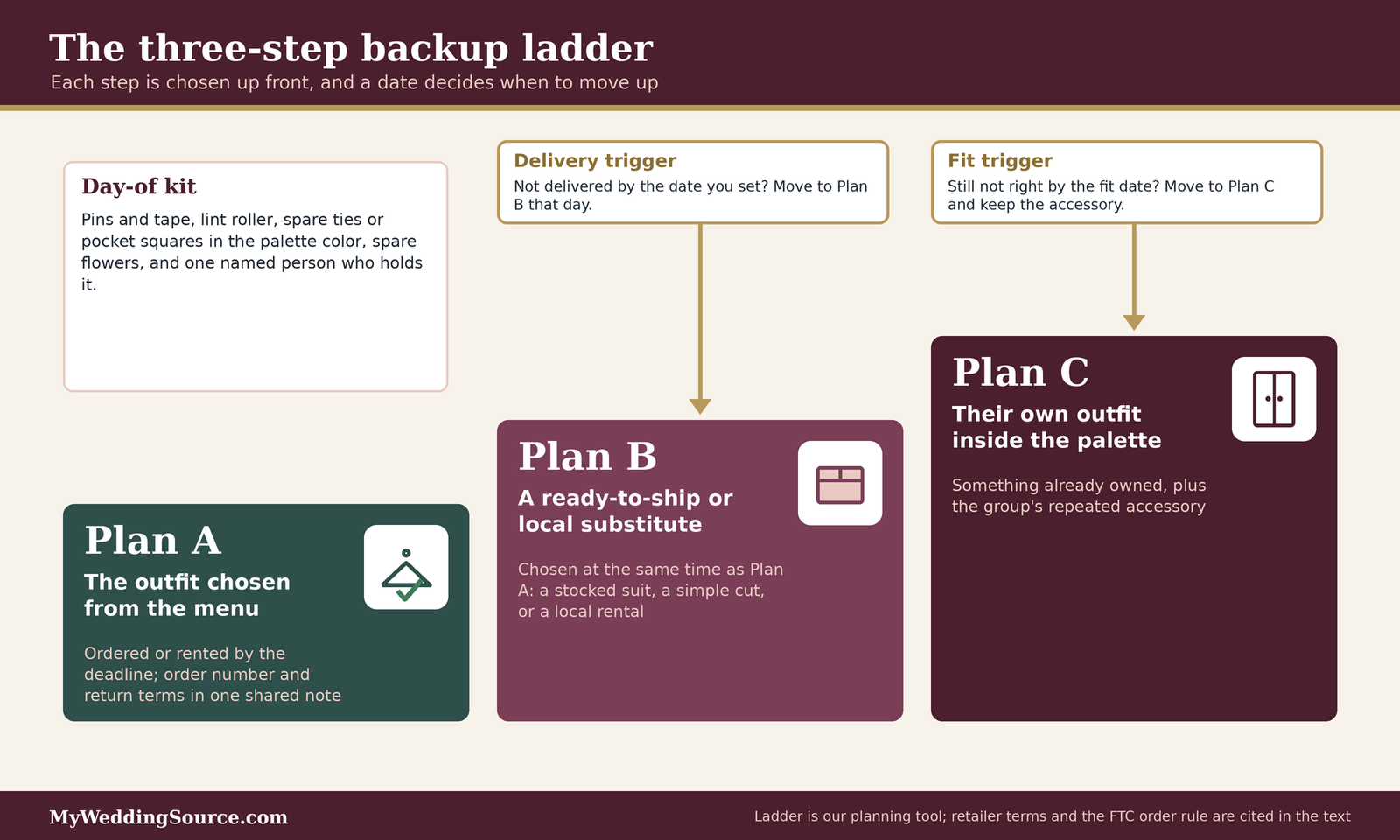
A ladder gives each attendant a next step if the first one fails, and it avoids last-minute improvisation. A ladder is the safety net for how to coordinate attire for a mixed-gender wedding party when something goes wrong.
Plan A: the planned outfit
This is the garment the person chose from the menu and ordered or rented by the deadline. Record the seller, the order number, the expected delivery date, and the return policy in a shared document.
Plan B: a ready-to-ship or local substitute
Azazie notes that when the wedding is only two or three months away, styles and sizes are limited and rush fees are possible, and that ready-to-ship dresses or simple cuts are easier to get on a short timeline. For suits, a local rental shop or store with stock is a common substitute. Plan B should be chosen at the same time as Plan A, not after a problem appears.
Plan C: the person’s own outfit within the palette
If Plan B also fails, an attendant can wear something already in their closet that fits the palette and formality, with the repeated accessory from the group. The Knot says there are no set rules about what attendants wear, which is the reason a Plan C is acceptable. It costs the couple nothing, and it gives the attendant control.
Set triggers and deadlines
A backup plan without dates is only a hope. Triggers tell you when to move from one rung to the next. Dates make the plan for how to coordinate attire for a mixed-gender wedding party real.
The delivery trigger
Choose a date, such as six weeks before the wedding, by which every order must have arrived. If it has not, the person moves to Plan B that day. Azazie advises having dresses in hand at least three months before, which is a comfortable margin if you can get it.
The fit trigger
Choose a date by which every garment has been tried on and any alteration has been booked. Revelry’s Fit Commitment requires reporting a fit concern within five business days of delivery, which is one reason to try garments the day they arrive.
The seller trigger
If a seller will not ship on time, federal rules may apply. The Federal Trade Commission’s guide to its Mail, Internet, or Telephone Order Merchandise Rule says that if no shipping time is advertised, the seller must reasonably expect to ship within thirty days of receiving a properly completed order, and that a seller who cannot ship on time must offer the buyer a choice to accept the delay or cancel for a full refund. This is general information, not legal advice, and a retailer’s own terms may add detail.
Build a day-of kit
A small kit solves the problems that arrive on the morning of the wedding.
What goes in the kit
Our wedding emergency kit guide lists items most couples keep nearby. For attire, add spare pins and tape suited to both fabric and skin, a lint roller, a steamer or iron if the venue allows it, extra pocket squares or ties in the palette color, a few spare flowers in the right shades, and small safety items such as shoe grips.
Who holds it
Give the kit to one named person, and tell attendants who that is. It should not be the couple.
A timeline that works for remote and local attendants
Retailers publish their own timelines. We summarize them here, attribute each, and give a single schedule that works for most parties. All dates count backward from the wedding date.

Eight to four months out
This is the planning and ordering window. The earliest months of how to coordinate attire for a mixed-gender wedding party are about decisions, not purchases.
Set the anchors and send the brief
Azazie recommends ordering four to six months before the wedding, or six to eight months if the party is spread out or sizes are custom. Send the brief, finish the private conversations, and let attendants choose.
Collect measurements and decisions
Gather measurements and photos using the remote method above, with one collector and one deadline. Confirm each person’s choice in writing, along with Plan B and Plan C.
Four to two months out
This is the delivery and fitting window. The middle months of how to coordinate attire for a mixed-gender wedding party are about delivery and fit.
Orders in hand
Azazie says dresses should be in hand at least three months before the wedding, with four to five months the recommended target, and that international shipping adds three to four weeks. Add margin for customs if an attendant is abroad.
Try-ons and tailor booking
David’s Bridal’s Generation Tux page says to schedule home try-on about six to eight weeks before the wedding, which suits suits and tuxedos that are ordered later than dresses. Book tailors now, since many have waiting lists.
The final six weeks
This is the checking and adjusting window.
Alterations and final fitting
Azazie says the final fitting should take place two to four weeks before the wedding and that last-minute changes should be settled about one month before. Hold your delivery and fit triggers here.
Rehearsal and arrival
At the rehearsal, ask everyone to wear or carry the real shoes, and have remote attendants bring their garment on the plane rather than checking it, if you can. Our wedding party coordination checklist has a wider checklist.
Money, fairness, and who pays
Mixed parties can raise different cost questions, since a suit rental, a dress, and a custom jumpsuit do not cost the same. We are not giving financial advice, and the right answer depends on your budget and your friends’ budgets.
Cost check
Costs we can cite are small and specific: Revelry’s page lists a ten-dollar fee per home try-on sample, and Generation Tux describes its home try-on as free. For everything else, such as dress prices, tailoring, and rentals, get written quotes from each seller before you promise anyone a number. We did not find a reliable independent source for typical alteration prices, so we do not offer one.
Decide who pays before anyone orders
Money surprises create the worst friction in any party. Money is part of how to coordinate attire for a mixed-gender wedding party, since a plan that some people cannot afford is not a plan.
Say it in writing
State in the brief whether attendants pay for their own outfits, whether the couple covers some items, and whether alterations or shipping are included. Our guides on wedding party costs and asking wedding party members about financial boundaries cover how to raise the topic respectfully.
Offer choices at different price points
A menu lets an attendant pick a lower-cost option without explaining why. Because the anchors are color and formality, a thrifted jumpsuit and a custom suit can sit side by side.
Rentals, purchases, and returns
A mixed party often combines rentals and purchases. Keep the return plan simple.
Consider the return date
Rental pieces have due dates, and a remote attendant has a longer return trip. Our guide to groomsmen rental returns explains how to organize returns after the event.
Keep receipts and order numbers together
Store them in the shared planning document so a missing parcel can be traced by anyone, not only the person who ordered.
Edge cases that break a simple plan
No plan survives every situation. These cases come up often enough in a mixed party to prepare for.
Uneven numbers and one-person sides
An uneven party can look lopsided in photographs if outfits are sorted by side. Uneven numbers are the most common test of how to coordinate attire for a mixed-gender wedding party.
One person on a side
Use a palette that places that person’s outfit in a family with the rest of the group, and consider an accessory that appears on both sides. A Practical Wedding’s point that numbers need not match applies directly: the answer to a lopsided lineup is usually to stand differently, not to add people.
A person who prefers not to be in the party’s “set”
Some people would rather attend as a guest or take a role that does not involve a coordinated outfit, such as reading or hosting. A Practical Wedding suggests couples consider stepping back and even skipping a wedding party entirely. Offer the choice kindly.
When someone proposes something outside the brief
You may receive a proposal that does not fit your anchors, such as a bold print or a different formality. A request outside the brief is a normal part of how to coordinate attire for a mixed-gender wedding party.
Use the three lists
Check the proposal against the must-match, should-coordinate, and attendant lists. If it only affects the last list, say yes quickly. If it touches the first, explain which anchor is affected and offer a modified version.
Keep the conversation about the picture
Say “I worry it will read differently in the photographs” rather than “that is not appropriate.” Keep the person at the center of the decision.
Family reactions
Parents and relatives may be surprised by a mixed party or by an attendant’s clothing. Family opinions sometimes complicate how to coordinate attire for a mixed-gender wedding party, even when the attendants are happy.
Prepare a short explanation
The Knot recommends talking with guests who may be surprised, especially parents, and asking about their concerns, while remembering that it is the couple’s celebration. A calm explanation of the plan is usually enough.
Protect the attendant
Do not forward family opinions about an attendant’s outfit. Take responsibility for the plan yourselves.
Questions to ask before anyone orders
Short questions catch most problems. Use these with sellers, tailors, attendants, and your photographer.
Questions to ask
For sellers: What is the delivery date in writing? Is the color guaranteed to match a swatch? What is the return and remake policy, and are there deadlines in business days? For attendants: What would you feel best in? Is there anything you would rather not wear? Do you need more time? For the photographer: How do you see this lineup, and does anything in the palette photograph poorly in the light at our venue?
Questions for sellers and tailors
Written answers protect everyone. Good answers from sellers keep how to coordinate attire for a mixed-gender wedding party on schedule.
Delivery, returns, and remakes
Ask for the shipping estimate, the cutoff for returns, and the remake timeline. Revelry states five business days for reporting a fit concern, and Generation Tux three days for returning try-on items, so the windows are short.
Tailor capacity
Ask how many weeks a tailor needs and whether they have experience with the garments in question. Azazie says alterations typically take two to four weeks.
Questions for your group
Questions for attendants should be private and optional.
Comfort and constraints
Ask about comfort, climate, mobility, and shoe needs, and ask whether any piece of the plan creates cost or discomfort.
Titles and introductions
Ask for each person’s preferred title and name for the program, and the same for the introduction at the reception.
FAQ: how to coordinate attire for a mixed-gender wedding party
Choosing the look
Do bridesmen and groomswomen need to wear matching outfits?
No. The Knot says there are no set rules and suggests starting with the photographs you want. Options include matching the bridesmaids’ color, matching the groomsmen’s suits, or choosing a palette and letting each person pick coordinating clothes. Pick the approach you can describe in one sentence, and ask each attendant what they are comfortable wearing.
What if one attendant does not fit either side?
Apartment Therapy suggests an outfit that bridges both looks, such as a dress closer to the suits or a suit with a tie that matches the dresses. Offer that as one option rather than an assignment, and ask the person what they would like. A shared accessory is another gentle way to connect them to the group.
Asking and communicating
How do I ask an attendant what they want to wear?
Ask privately and about comfort rather than category, for example what they feel best in at a dressy event. A Practical Wedding suggests asking whether they would like a suit, a dress, or something else, and allowing extra time for shopping and alterations. Offer a way to reply later or in writing.
How should I word the dress code for the party?
Describe the mood and the palette instead of gendered groups. Zola suggests replacing phrases such as “for the guys” with “for everyone,” and describing the event as casual, cocktail, or formal. Offer a range of options beyond suits and dresses, and share example images so attendants can see what you mean.
Remote attendants and timing
How do I handle an attendant who lives far away?
Use a helper to measure, one collector and one deadline, a physical color swatch, and a local tailor, as Nathan Tailors and Azazie advise. Consider a home try-on program, read its terms, and book alterations as soon as the order ships. Our guide on a party member who cannot travel covers the harder case.
When should everyone order?
Azazie recommends ordering four to six months before the wedding, or six to eight months if the party is spread out, and having dresses in hand at least three months before. Suit and tuxedo programs, such as Generation Tux, describe trying on about six to eight weeks before. Check each seller’s own dates.
What if an order arrives late or does not fit?
Move to your Plan B or Plan C on the date you set. Under the Federal Trade Commission’s order rule, a seller that cannot ship on time must offer you a choice to wait or cancel for a refund. Revelry asks for fit concerns within five business days, so try garments on arrival.
Who pays for the outfits?
There is no universal rule, and this is not financial advice. Many couples ask attendants to pay for their own clothing, and others cover part. Decide before anyone orders, put it in writing, and offer a range of price points. Our guide on wedding party costs covers the conversation.
Your next steps
This week
Write the one-page brief
Set the photograph, the palette, the formality, and the must-match, should-coordinate, and open lists. Add a Plan B and Plan C line for each attendant and a contact name.
Have the private conversations
Call or message each attendant, ask what they would feel best in, and record their preferred title. Offer extra time and a way to answer later.
Next month
Set deadlines and the backup ladder
Choose the order, delivery, and fit dates. Send swatches to remote attendants and name a measurement collector. Use our wedding planning checklist to place these dates alongside the rest of your plan.
Book the tailors and the rehearsal walk
Ask local and remote attendants to book alterations when orders ship, and add a shoes-on walk to the rehearsal. For hair and makeup timing, see our guide to scheduling hair and makeup for a large bridal party.
Sources & methodology
How we built this guide
What we relied on
This guide combines etiquette and styling articles on mixed-gender wedding parties, inclusive-language guidance, retailer and tailor descriptions of home try-on, remote measuring, and ordering timelines, and a federal rule on mail and internet order shipping. Where a statement comes from a retailer or tailor, we say so, because it describes that company’s own products and policies. We checked the pages on November 12, 2026, and policies, prices, and timelines can change, so confirm the current terms with each seller. The Knot’s real weddings study page confirms its survey covers 2025 weddings; we did not rely on it for figures, and the timing summary in this guide is built only from the sources named in the text.
What we did not do
We did not interview attendants, test garments, or verify retailer claims. We did not find an independent source for typical alteration prices, so we give none. Nothing here is legal, medical, or financial advice, and nothing here tells any person how to express their gender.
Source list
Etiquette, styling, and inclusive-language sources
- The Knot, Bridesmen and groomswomen wedding etiquette: https://www.theknot.com/content/bridesmen-groomswomen-wedding-etiquette
- The Knot, Bridesmen and groomswomen outfits: https://www.theknot.com/content/bridesmen-groomswomen-outfits
- Apartment Therapy, 5 cute and coordinated ways to dress a mixed-gender wedding party: https://www.apartmenttherapy.com/how-to-dress-a-mixed-gender-wedding-party-229595
- Loverly, How to pull off a mixed-gender bridal party: https://loverly.com/planning/wedding-101/mixed-gender-bridal-party-tips
- A Practical Wedding, Five tips for outfitting your queer wedding party: https://apracticalwedding.com/queer-wedding-party-advice/
- Zola, Gender non-conforming wedding attire: https://www.zola.com/expert-advice/gender-non-conforming-wedding-attire
- Lily and Lime, A modern guide to mixed-gender wedding roles and titles: https://www.lilyandlime.com/blog/p/a-modern-guide-to-mixed-gender-wedding-roles-and-titles
- GLAAD, Media Reference Guide: https://www.glaad.org/reference
- The Knot, Real Weddings Study: https://www.theknot.com/content/real-weddings-study
Government, retailer, and tailor sources
- Federal Trade Commission, A Business Guide to the Mail, Internet, or Telephone Order Merchandise Rule: https://ftc.gov/business-guidance/resources/business-guide-ftcs-mail-internet-or-telephone-order-merchandise-rule
- Friar Tux, How to style mixed gender bridal parties: https://www.friartux.com/blog/post/how-to-style-mixed-gender-bridal-parties/
- Revelry, How to try on bridesmaid dresses and groomsmen suits at home: https://shoprevelry.com/blogs/wedding-inspiration/home-try-on-bridesmaid-dresses-suits
- David’s Bridal, Generation Tux Home Try On FAQs: https://www.davidsbridal.com/content/wedding-looks/generation-tux-home-try-on-your-faqs-answered
- Nathan Custom Tailors, How to measure groomsmen remotely: https://www.nathantailors.com/en/blog/how-to-measure-groomsmen-remotely
- Azazie, How long before the wedding should I order bridesmaid dresses: https://www.azazie.com/blog/how-long-before-the-wedding-should-i-order-bridesmaid-dresses/