
A marriage license is the government’s permission slip for your wedding, and the rules for getting one, using it, and filing it are set by the state and often the county where you will say your vows, so the safest plan is to read your own clerk’s instructions early and work backward from them.
Quick answer
A marriage license lets you marry legally; the marriage certificate proves afterward that you did. Almost everything else varies by place. In the offices we read for this guide, waiting periods ranged from none to 72 hours or three days, licenses stayed valid for 60 to 90 days, and fees ran from $40 to $144. Both of you usually appear with photo ID, the officiant must be authorized in that state, and the signed license has to be returned to the clerk before you can order certified copies. This is general education, not legal advice. Confirm every rule with the office that will issue your marriage license.
Most couples meet the marriage license as a small line item between the venue deposit and the seating chart. It looks like an errand: show up, pay a fee, take a piece of paper home. For many couples it really is that simple. But the license also sets a clock (how long it stays valid), sometimes a second clock (how long you must wait after you get it), and a chain of signatures that has to finish after the party is over. Missing one link can leave a wedding that was joyful but not legally recorded, or a honeymoon booked under a name that does not match the passport.
This guide is built for the planning side of that problem. It does not try to summarize fifty states from memory, because that kind of summary goes stale and invites the one mistake the clerks warn about most, which is assuming that the rule you heard from a friend in another state applies to you. Instead, it shows you how to identify the office that governs your wedding, how to read what it tells you, how the pieces fit in order, and where couples tend to get tripped up. Where we cite a rule, we name the office that published it and say we read it in November 2026, so you can see exactly what we saw and check whether it has changed.
Identify the jurisdiction and the legal act behind your marriage license
Before you compare fees or book an appointment, settle two questions: which government office decides the rules for your marriage license, and what exactly the law requires from you as opposed to what tradition adds. Couples who skip this step often end up planning around the wrong deadline or paying for a service the law never required.
Separate ceremony custom from legal requirement
A wedding is two things layered on top of each other. One is a legal act: two people become spouses under the law of a particular state. The other is a celebration, with all the music, readings, rings, and toasts that families expect. The law cares about the first layer and mostly ignores the second. Knowing which parts belong to which layer helps you spend attention where it counts.
What the marriage license is
USA.gov, the federal government’s general information portal, puts the distinction plainly: a marriage license is the document that legally allows you to marry, while the marriage certificate is the record that proves you did. The license comes first and has an expiration date. USA.gov adds that licenses usually expire somewhere between 30 days and a year after they are issued, depending on the state, and that you reapply if yours expires or gets lost before the wedding. In practice this means a marriage license is a short-lived permission, not a document you collect early and file away.
What the certificate is
The certificate is what exists after the ceremony, once the signed marriage license has gone back to the issuing office and been recorded. Zola’s guide to marriage licenses describes the same sequence: the certificate is granted once the marriage license is returned to and validated by the issuing office. This is the document you will show to the Social Security Administration, the passport office, a motor vehicle agency, an employer, or an insurer. The practical lesson is that the signed marriage license is not yet the proof you need. The proof arrives after the clerk processes it, and you usually have to ask for certified copies of it.
What the ceremony adds
The ceremony is the moment the law recognizes the marriage as taking place, and the law attaches conditions to it. The New York State Department of Health’s publication on getting married says no particular form of words is required, but each person must state in front of an authorized officiant and at least one witness that they take the other as spouse. Other states set different conditions, as the sections below show. The point for planning is that the ceremony is not only a performance. It is also the moment when specific people (an authorized officiant, sometimes a witness) have to be present and sign.
Customs that are not legal requirements
Many things couples worry about are not part of the legal act at all. A processional, a unity candle, a first look, a reception, a particular venue, and even the wedding dress or ring exchange are matters of preference, not requirements in the sources we read. The reverse is also true. Some things that feel like logistics, such as who signs as witness, who drops the license at the clerk’s office, and how many days after the wedding it must be returned, are legal requirements that can invalidate or delay the record if handled wrong. A useful habit is to keep two lists, one for the celebration and one for the legal act, and to give the second list a named owner.
Name the state, county, or issuing authority
The next question is who writes the rules. In the United States the authority to license marriages sits with the states, and each state usually delegates the day-to-day work to a county clerk, a city or town clerk, a court clerk, a register of wills, or a health department. The name of the office changes from place to place, but the function is the same: it takes the application, issues the marriage license, and later records the completed license.
Where you marry, not where you live
USA.gov tells readers who want a marriage license to contact the vital records office of the state where they plan to marry. That matters for destination couples and for couples who live in one state but hold the wedding in another. The Orange County, Florida, clerk’s page, for instance, says non-residents can marry in the county the same day or buy a marriage license and marry anywhere in Florida within 60 days. The Sarasota County clerk’s page says a Florida license cannot be used to marry in another state or country. The New York State Department of Health says a New York license can only be used within New York. These are three official statements from the places we read, and they point in the same direction: you get the marriage license from the place where you will marry.
A state rule and a county practice are different things
The state sets the legal frame, and the county sets many of the practical details. The clearest example in our research was Texas. Three county clerks in Texas posted fees of $71, $80, and $81 for the same kind of license, and each posted a different reduced fee for couples who present a premarital education certificate. Their processes differed too: one county page describes an online application followed by an in-person visit within 10 days, another says no appointment is needed and walk-ins are accepted, and a third says appointments are available but not required. If you are tempted to rely on a statewide summary, remember that the office you will stand in front of is the one whose rules apply on the day.
Do not treat one jurisdiction as a national rule
It is easy to read a clear, confident guide to one state and assume the rest of the country works the same way. The offices we read show why that fails. New York requires a 24-hour wait before the ceremony, with a possible waiver from a judge. Texas and its county clerks describe a 72-hour wait with exceptions. Florida applies a three-day delay to residents who have not completed a premarital course, but not to non-residents. San Diego County says couples can marry as soon as the license is issued. Clark County, Nevada, says there is no waiting period. A couple comparing these places has five different answers to what looks like one question. The right habit is to treat every number you find as the answer for one named office, and to find the equivalent number for yours.
The federal government’s role is narrow
The federal government does not issue marriage licenses or keep marriage certificates. The Centers for Disease Control and Prevention’s vital records index says the federal government does not distribute certificates, files, or indexes with identifying information for vital records, and it sends readers to state or local offices. Federal agencies do matter after the wedding, because a passport or Social Security record is federal. The Respect for Marriage Act, signed in December 2022, also governs federal recognition of valid marriages and bars state officials from denying full faith and credit to another state’s marriage records on certain grounds. We return to that in the special-cases section.
Find the authoritative government source
The best source for your marriage license rules is the office that will issue it. Magazines, wedding sites, vendor pages, and this guide are useful for orientation and for deciding what to ask, but they are one step removed from the rule.
Use the issuing clerk, court, or vital records office
Start with the website of the county or city clerk for the place where you will marry. Many of the pages we read list the same core facts in the same order: who may apply, what identification to bring, whether both people must appear, the fee and accepted payment, the waiting period, the marriage license’s expiration, and what happens after the ceremony. If the local page is thin, the state health department or state vital records office usually publishes a statewide overview. The Centers for Disease Control and Prevention’s index of where to write for vital records links to every state, territory, and the District of Columbia, which makes it a reliable way to reach the right state office even if you are not sure what it is called.
Record the access date because requirements change
Write down the date you read each rule, the office that published it, and the web address. This takes a minute and saves arguments later, because fees, hours, and procedures change, and a clerk’s page can be updated between your first visit and your appointment. We read the pages in this guide on November 11, 2026. One caution from that reading: the Florida statute page we could open was the 2021 text of section 741.04, so we treated the Florida county clerks’ current pages as the better guide to current practice and used the statute only for the structure of the rule. When you do your own reading, note the same thing, whether you looked at a current page or an older copy.
Why summaries of the rules disagree
Charts that summarize all states in one table are tempting, and they can be useful for a first look. They are also copies of copies. In preparing this guide we compared two published state-by-state charts, and they did not agree on every detail: one gave Colorado’s license window as 35 days and the other gave it as 30. We did not try to settle that, because the right answer for a Colorado wedding is whatever the Colorado clerk says. The lesson is not that those charts are bad. It is that any secondary source, ours included, is a map of where to look rather than a ruling, and that a disagreement between sources is a reason to call the clerk.
A jurisdiction checklist you can reuse
The table below turns the idea into a one-page checklist. Fill it in once per jurisdiction, keep the source address next to each answer, and you will have the facts that drive the rest of your paperwork schedule.
| Item | What to find | Where to verify |
|---|---|---|
| Issuing authority | Which county, city, town, or court office issues the license for your wedding location | State health or vital records site, or the county clerk’s site |
| Application method | Online pre-application, appointment, or walk-in; whether both people must appear | The clerk’s marriage license page |
| Identification | Which photo ID, birth certificate, or Social Security number is required, and name rules | The clerk’s identification list |
| Prior marriages | Whether you need dates or certified divorce, annulment, or death records | The clerk’s page on prior marriages |
| Waiting period | Any wait between issuance and ceremony, and how to waive it | Clerk’s page and the state statute it cites |
| Validity window | How many days the license is good for, and how days are counted | Clerk’s page; ask how the first day is counted |
| Fee and payment | Fee, premarital course discount, card surcharge, accepted payment types | The clerk’s fee schedule |
| Officiant rules | Who may perform the ceremony and whether officiants must register | State statute and the clerk’s officiant page |
| Witness rules | Number required, if any, and any age or signing requirements | The clerk’s ceremony page |
| Return deadline | Who returns the signed license and by what date | The license itself and the clerk’s page |
| Certified copies | Whether copies are sent automatically, cost, and how to order | The clerk or vital records office |
How the marriage license process works from application to certified copy
Once you know which office governs your wedding, the process becomes a sequence you can plan around. The order below is common to most of the offices we read, though each adds its own details, and a few reverse or merge steps.
List the application, identification, waiting, ceremony, filing, and certified-copy steps
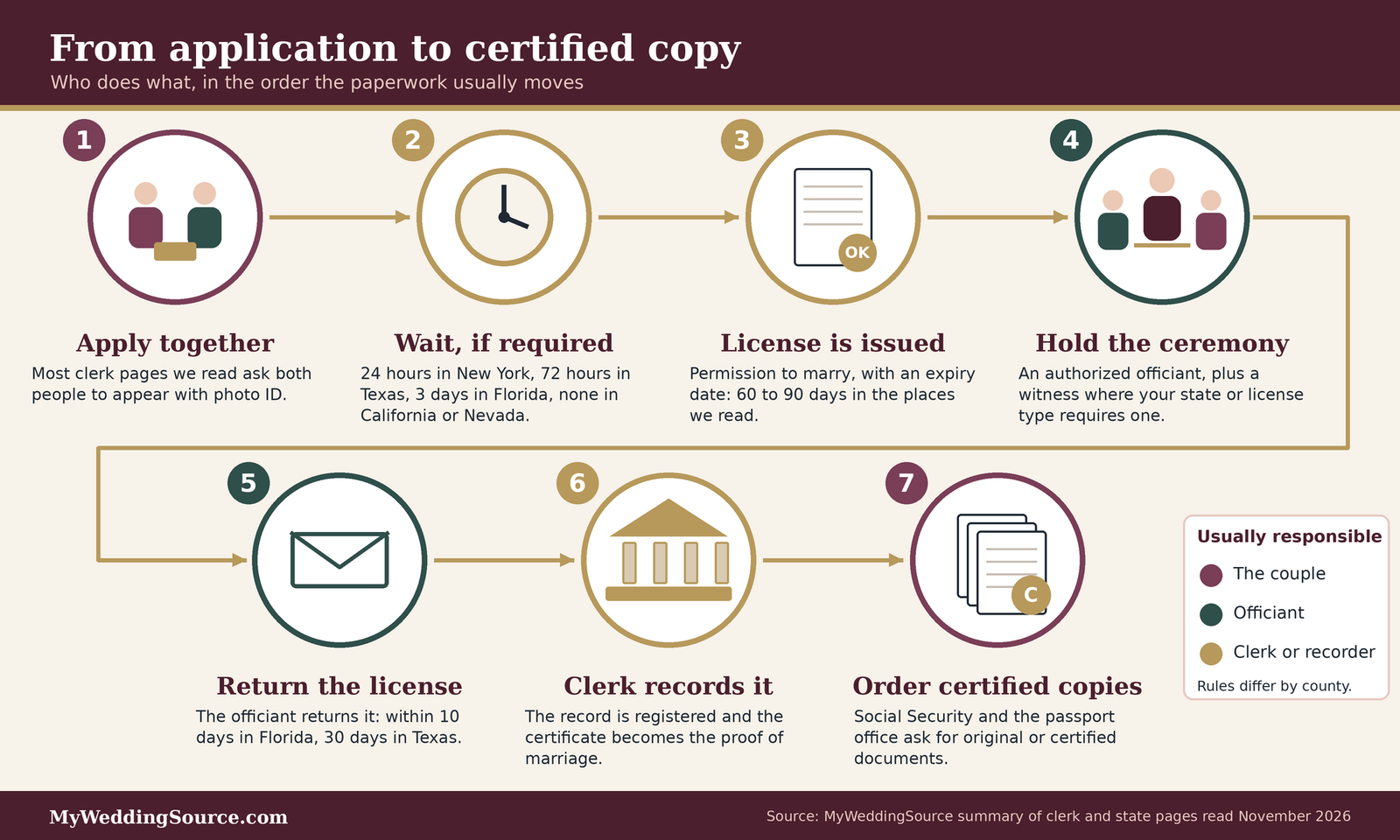
Think of the process as a relay with six legs. Each leg has a different runner, and the baton is the license. If it drops between legs, nothing happens until someone notices.
Step one: apply, usually together
Most of the clerk pages we read ask both people to appear at the same time with government-issued photo identification. Clark County, Nevada, says both of you must appear in person at the same time unless one qualifies for a narrow exception, such as being hospitalized or incarcerated. New York’s health department says both applicants must apply in person and sign in front of a town or city clerk, and that representatives, powers of attorney, and notarized affidavits cannot take the place of appearing. Some places allow a partial workaround: Hays County, Texas, describes an affidavit of absent applicant, signed and notarized, for a person who cannot attend, though that person must still attend the ceremony. Several offices also let you start online. Clark County says its pre-application stays in the system for one year, and Collin County, Texas, says online applicants must still appear at the clerk’s office within 10 calendar days. Starting online saves time at the counter, but it does not usually replace the visit.
Step two: wait, if your jurisdiction requires it
A waiting period is a mandatory gap, and it can sit in different places. In New York, the marriage license can be issued immediately, but the ceremony cannot occur within 24 hours of issuance, according to the state health department. In Texas, the State Law Library describes a 72-hour wait between issuance and the ceremony, with exceptions. In Florida, the statute describes a three-day delay of the marriage license’s effective date unless the couple submits valid premarital course certificates, with the clerk required to make exceptions for non-residents and couples asserting hardship. San Diego County says couples can marry as soon as the marriage license is issued, and Clark County says there is no waiting period. The place to confirm the gap is the clerk’s page for your county.
Step three: collect the license and read it
The license is the document you carry to the ceremony. Read it at the counter. The Clark County page says the license shows your name exactly as it appears on your identification, so bring identification that shows the name you want recorded. Check spelling, dates, and any bold-printed effective date. Florida’s statute says the effective date of a delayed license must appear in bold type on it. A typo is cheap to fix at the counter; some offices describe more paperwork to amend a marriage license later. Sarasota County’s clerk, for example, lists a notarized affidavit from each party, proof of the change, copies of both IDs, and a $7 fee for an amended license.
Step four: hold the ceremony in the right window
The ceremony has to happen after any waiting period ends and before the license expires, with an authorized officiant and any required witness present. The Texas State Law Library notes that the officiant is expected to check whether the marriage license has expired, and may not perform the ceremony if it has. In practice, couples should check the dates themselves instead of relying on the officiant to catch a problem on the day.
Step five: sign and return the license
After the ceremony, the officiant fills in the date, the place, and their own information, signs, and obtains witness signatures where required. Someone then has to return the marriage license to the issuing office. The offices we read set different deadlines: Orange County and Sarasota County, Florida, say within 10 days; Texas county clerks and the State Law Library say within 30 days; San Diego County recommends within 10 days. Who returns it varies too. Sarasota County says the officiant is responsible, and that if the officiant cannot return it, the couple or another trusted person may do so.
Step six: confirm recording and order certified copies
The clerk records the marriage license, and then the marriage certificate exists. Some offices send a certificate automatically, and some do not. The New York State Department of Health says the clerk mails the certificate within 15 calendar days after the officiant returns the completed license, and it suggests contacting the issuing clerk if nothing arrives within four weeks of the wedding. San Diego County says certified copies are not sent automatically and must be requested and paid for separately after registration. Hillsborough County, Florida, says the first certified copy is free and the clerk mails it within seven business days. These differences are the reason to ask, before the wedding, what you will receive and what you must order.
Show who is responsible for each step
A process fails most often where responsibility is vague. The couple assumes the officiant will file; the officiant assumes the couple will; the clerk assumes the paperwork will show up. Naming one person for each leg removes that gap.
What the couple controls
The couple controls the application, the identification, the choice of officiant, the date relative to the waiting period and expiration, and the decision about names. Those are the items that can be done early and in your own time. The couple also controls the final check. Even when an officiant returns the marriage license, the couple is the party that needs the certified copy and benefits from knowing it was recorded.
What the officiant controls
The officiant controls whether the ceremony is valid in form and whether the license is completed and signed correctly. The Texas State Law Library notes that the officiant must record the date, the county, and their own information on the marriage license. The Hillsborough County clerk’s page makes the limit of the clerk’s role explicit: officiants do not register with the clerk, and the clerk’s office does not determine whether an officiant is legally qualified, so couples should check the statute or consult an attorney. That puts the responsibility to verify an officiant’s eligibility largely on you.
What the clerk controls
The clerk controls issuing the marriage license, recording it, and producing the certificate and copies. The clerk does not control whether you chose a qualified officiant or whether the marriage license came back on time. Some clerks offer help in the gaps: San Diego County, for example, says its office only registers licenses it issued, and offers to check the registration status if you call or email with your license number.
Where handoffs break
Handoffs break at three points. The first is between ceremony and filing, when the license ends up in a bag, a car, or a gift basket. The second is between filing and recording, when a mistake on the form sends it back. The third is between recording and certified copies, when the couple assumes copies will arrive automatically. A short written plan that names who returns the marriage license, by which day, and how the couple will confirm recording closes all three.
Flag deadlines and expiration windows
Two numbers drive the calendar: how long you must wait after the license is issued, and how long the marriage license stays valid. Together they define a window in which the ceremony can legally happen.
Validity windows we found
The New York State Department of Health says a marriage license is valid for 60 calendar days starting the day after issuance, and that active-duty military applicants can extend that to 180 days with proof at application. Orange County, Florida, says 60 days from issuance. Hays and Fort Bend counties in Texas say 90 days, and Fort Bend describes the 90 days as including the purchase date. San Diego, Marin, and San Francisco counties in California all describe 90 days. USA.gov says the range nationally is roughly 30 days to a year. The Clark County, Nevada, page we read did not state a validity period for the marriage license itself, only that the pre-application stays in the system for one year, which is a different thing.
Waiting periods we found
New York: 24 hours between issuance and ceremony. Texas: 72 hours, with exceptions that the county pages describe, including a premarital course certificate, a judge’s waiver, and certain active-duty military applicants. Florida: three days for residents who have not completed a qualifying course, none for non-residents. San Diego County, California: none. Nevada’s Clark County: none. A legal publisher’s 50-state survey lists additional states with waits ranging from 24 hours to three days, including Illinois, Massachusetts, Pennsylvania, and Washington, but we use that list only as a pointer to which offices to check, not as the rule.
Return and recording deadlines
Return deadlines are the least visible and the easiest to miss, because they come after the party. We found 10 days (Florida clerks, with San Diego County recommending the same) and 30 days (Texas, according to the State Law Library and two county clerks). The New York State Department of Health describes the clerk mailing the certificate within 15 days of receiving the completed license, which implies a return that is prompt rather than leisurely. If your office does not state a deadline, ask for one and write it on the marriage license envelope.
A worked example of counting backward
Here is an illustration of how the arithmetic works. It is our own estimate, not a rule, and the counting conventions differ by office. Suppose a couple plans a Saturday wedding on June 12, 2027. To keep a cushion, we count back from the wedding using the validity window minus two days, and we count forward from the waiting period plus one day.
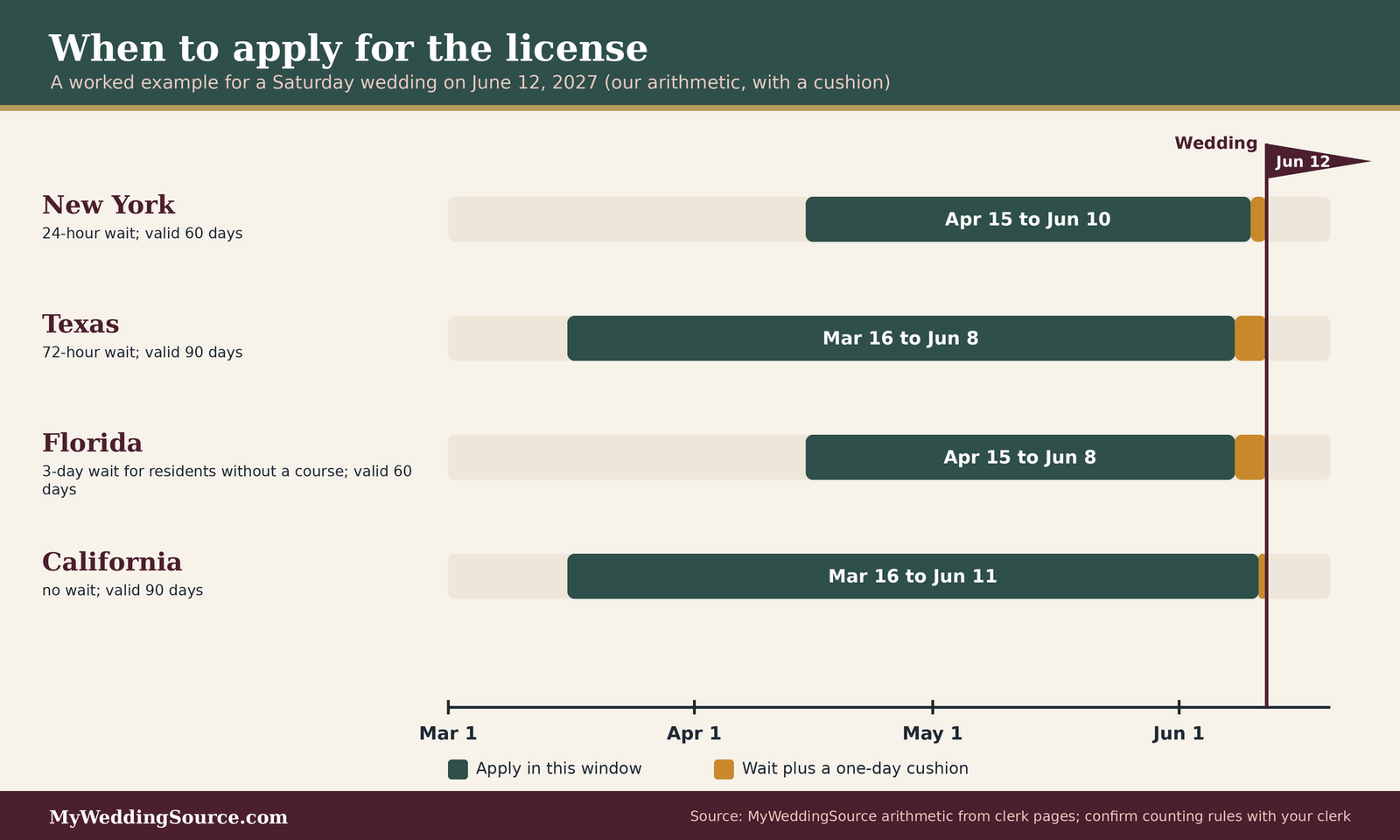
Under those assumptions, a couple marrying in New York could apply between about April 15 and June 10. In Texas, the window runs from about March 16 to June 8. In Florida, a resident without a premarital course could apply from about April 15 to June 8. In California, the window runs from about March 16 to June 11. These windows are wide, which is reassuring, but the practical limit is usually not the legal window. It is the office’s appointment availability. San Diego County says appointments are available up to seven weeks ahead and that you book only one, and San Francisco says appointments cannot be rescheduled, only canceled by phone, with no refunds. For most couples the better target is to book the application as soon as the appointment system opens inside the legal window, then use the extra time to confirm details.
What a marriage license costs, and why the number varies
The fee is the smallest dollar amount in most wedding budgets, but it is also one of the few that you cannot negotiate, and the range across offices is wider than many couples expect. The numbers below are what the offices we read posted in November 2026. They are not averages and they are not a prediction for your county.
Cost check
The fees we found run from $40 (a New York town or city clerk, per the state health department) to $144 (a confidential license in San Diego County). That is a spread of $104, or 3.6 times the lowest figure (our arithmetic). In Texas, three county clerks listed reduced fees of $11, $20, and $21 for couples with a premarital education certificate, which saves about $60 each against the full fee before the cost of the course itself, which we did not verify. Budget for the license, the certified copies you will need, and any ceremony fee the office charges, and treat every number as something to reconfirm.
The fees we found, side by side
A fee is only meaningful with its context: what it includes, which type of license it buys, and which discounts apply. The figures below come from the clerk or health department pages named, and you should read them as a snapshot.

The spread across the offices we read
The New York State Department of Health says town and city clerks outside New York City charge $40 for a marriage license, and that the fee includes a Certificate of Marriage Registration. Fort Bend County, Texas, lists $71. Collin County, Texas, lists $80, and Hays County, Texas, lists $81. Marin County, California, lists $85 for a public license. Orange County, Florida, lists $86. Clark County, Nevada, lists $102. San Diego County, California, lists $129 for a public license. Zola’s guide gives a general range of $10 to $115 depending on the state, city, or county, and The Knot quotes an expert saying cash fees typically run $35 to $150. Our sample sits inside the Knot’s range, but it also includes a confidential San Diego license at $144 that is above Zola’s upper figure, which is a small reminder that national ranges drift as local fees change.
Premarital education discounts
Texas and Florida both tie a reduced fee to a premarital course. The Fort Bend County page lists $71 reduced to $11, Collin County lists $80 reduced to $20, and Hays County lists $81 reduced to $21, and all three say the certificate also waives the 72-hour wait. Orange County, Florida, lists $86 reduced to $61 with course proof, and says the course must have been completed within one year before applying and the certificate must show details such as the provider, participants, completion date, and method of instruction. Based on those posted figures, the licenses we looked at are about $60 cheaper in the three Texas counties and $25 cheaper in the Florida county before the course fee is counted. If the course costs more than the savings, the discount is not a bargain on price alone, though a couple who would take a class anyway can pick up the fee reduction and the waived wait together.
Public and confidential licenses
California offers two license types. San Diego County lists $129 for a public license and $144 for a confidential one, and Marin County lists $85 and $93. The difference is not only price. San Francisco’s page says a public license requires at least one witness at the ceremony and is a public record, while a confidential license requires that you are living together, needs no witnesses, and is available only to the couple. San Diego County adds that confidential licenses require couples to be living together as spouses and to sign under penalty of perjury. Clark County, Nevada, says marriage records there are public and cannot be sealed or made confidential. If privacy matters to you, ask your clerk whether a confidential option exists and what it requires.
What the fee does and does not include
The New York fee includes the registration certificate, and some offices include or discount the first copy. Hillsborough County, Florida, says the first certified copy is free. San Diego County says copies are separate. Card payments often carry a surcharge: Orange County lists a $3.50 surcharge, Marin County and San Diego County list $2.50, Hays County lists a 2.5 percent convenience fee, and Clark County says cards carry an additional fee and checks are not accepted. Hays County also lists a $100 out-of-state fee if neither applicant can prove Texas residency, which is a good example of a rule that matters to destination couples and would not appear in a national summary.
Costs beyond the fee
The license fee is rarely the only cost the legal side of a wedding creates. Certified copies, an office ceremony, a witness, and updated identification all carry prices, and a few of them show up for the first time after the wedding.
Certified copies
We found copy prices from free to $30. The first certified copy in Hillsborough County, Florida, is free, with additional copies at $3. Sarasota County lists $3. San Diego County lists $19. In New York, a certified copy from the issuing town or city clerk costs $10, while one from the state health department costs $30, and New York City records come from the City Clerk’s office. As an illustration of the arithmetic, a couple who needs three certified copies would pay about $57 in San Diego County ($19 times three) and about $6 in Hillsborough County (the first copy free, then $3 each for two more), at the prices we read. That is our estimate for a hypothetical couple, not a quote.
Ceremony and witness fees at the clerk’s office
Some clerks offer a short civil ceremony. San Diego County lists $107 for a civil ceremony at the County Clerk, and $58 if you need the clerk to provide a witness. Hillsborough County, Florida, lists $30 for a ceremony performed by a deputy clerk. These fees are separate from the license fee and matter mostly to couples planning a small courthouse wedding or a legal ceremony before a larger celebration.
Documents you may need to replace
Identification after a name change has its own costs. The U.S. Department of State says a passport name change within one year of issuance by mail, using Form DS-5504, carries no fee unless you want expedited service, which it lists at an extra $60. Beyond one year, a mail renewal on Form DS-82 or an in-person application on Form DS-11 carries fees based on age. State driver’s license fees vary and we did not verify them. Social Security card replacement for a name change is a form-based process whose fee we did not verify. If you plan a name change, budget for the time and any state fees, and see the name-change section below.
Where this fits in the wedding budget
A reasonable way to handle all of this is to create one line in your budget for legal and administrative costs, with a conservative placeholder that you replace once you have read your clerk’s page. Our wedding budget calculator is a place to track it alongside venue, catering, and attire. We deliberately do not give a single national figure for this line, because the offices we read ranged from $40 to $144 for the marriage license alone, and a number we invented would only add false precision.
Officiants and witnesses: who must be in the room
The people who stand with you at the ceremony do real legal work. An officiant solemnizes the marriage, and in many places one or more witnesses see it and sign. The rules differ more here than almost anywhere else in the process.
Who can officiate
Most of the states we read keep a list of who is authorized, and the list is often longer than couples expect and shorter than they hope. If you want a friend or relative to officiate, find out early whether that is possible and how.
What the state lists say
The Texas State Law Library, citing Section 2.202 of the Texas Family Code, lists licensed or ordained Christian ministers and priests, Jewish rabbis, officers of religious organizations authorized to conduct marriage ceremonies, and current, former, or retired federal or state judges, and notes there is no official registration for officiants. Florida’s pages, citing Florida Statute 741.07, list judicial officers including retired ones, clerks of the circuit court, notaries public, ordained ministers and clergy, and members of the Society of Friends. The New York State Department of Health says only the people listed in Section 11 of the Domestic Relations Law may perform a valid ceremony, including certain elected officials, judges, town or village justices, appointed marriage officers, and ordained or authorized clergy, and that officiants need not be New York residents. Each list is different. That is the best evidence that an officiant who is valid in one state may not be valid in another.
Friends and family as officiants
Some places provide a path for a friend. San Diego County and Marin County in California both describe a program in which a friend or family member can be deputized as a marriage commissioner for a day, through an appointment with the County Clerk. Florida’s notary route is another, since a Florida notary can officiate, but the Sarasota County clerk notes that an out-of-state notary cannot, and that family or friends can only officiate if they fall into an authorized group under Florida law. The takeaway is that “my cousin will marry us” is a plan that needs a legal pathway, not only a script.
Checking an officiant’s eligibility
The Hillsborough County clerk’s page says the office does not determine whether an officiant is legally qualified and that officiants do not register with the clerk, so couples should check the statute or consult an attorney. That is a rare and useful clarity about where responsibility lies. Ask a prospective officiant what authority they rely on, whether they have performed ceremonies in that state before, and whether they know how to complete the marriage license. Then confirm the authority yourself against the state’s list or with the clerk.
Registration and local rules
New York says officiants performing ceremonies within New York City must be registered with the City of New York, and that ship captains cannot perform marriages in New York State. Florida’s Hillsborough County page says ship captains who are notaries and are in Florida waters may officiate. These are good examples of how a single type of officiant can be allowed in one state and barred in another. If your officiant is traveling in, ask them to confirm the local rules for the place where you will marry.
Who must witness
Witness rules vary even more than officiant rules, and the sources we read were not always explicit. Zola’s guide says most states require signatures from both spouses, the officiant, and one or two witnesses, but that requirements vary. The Knot’s guide says some states require witnesses and others do not.
What the offices say about witnesses
New York’s health department says the parties must state their consent in front of an authorized officiant and at least one witness, and that witnesses have no minimum age but should be able to testify competently in court about what they saw. San Diego County says a public license requires at least one witness at the ceremony, up to two may sign, the witness must understand they are witnessing a marriage and sign their own name without help, and there is no age requirement. Several other pages we read did not mention witnesses at all, which is not the same as saying none are required. If your page is silent, ask.
Witnesses and license types
California shows how the type of license changes the answer. A public license requires a witness. A confidential license, according to San Francisco and San Diego County, does not. If a small courthouse wedding is your plan and you do not bring a witness, check which license type you bought, and whether the clerk can provide one. San Diego County lists a $58 fee for a witness provided by the clerk. Note also San Diego County’s advice that witnesses should not attend a license-only appointment, since the witness requirement applies to the ceremony.
Choosing a witness with practical care
Whoever signs needs to be present for the ceremony, willing to sign legibly, and reachable if the clerk has a question. It helps to choose someone who will not be pulled away during the day and who can sign in the correct place on the correct line. Brief the witness on where to sign before the ceremony, not in the receiving line. If your photographer is planning a shot of the signing, our wedding photographer shot list can help you ask for it without delaying the paperwork.
What happens after the vows
The ceremony is not the end of the legal act. The license is a form, and the form has to be completed correctly and delivered.
Completing the form
The officiant records the ceremony date, the place, and personal details on the marriage license. The Texas State Law Library describes this explicitly for Texas, and the Florida clerks describe the officiant completing the Certificate of Marriage section of the license. Ink color, legibility, and not leaving blanks matter more than they seem, since many of the post-wedding problems we found come from forms that were incomplete or returned late.
Returning it on time
Plan for the return before the wedding. Decide who carries the marriage license, where it will be kept during the day, and who delivers it, and match that to the deadline your office states. The Sarasota County clerk’s page says the officiant is responsible, and the couple or another trusted person may return it if the officiant cannot. Fort Bend County says that when an officiant or other non-applicant drops it off, the recorded marriage license is mailed back to the couple. If the office is far from the wedding site, ask whether mail or an online drop is permitted. Each office decides.
A backup plan for the license
Write down the license number and take a photo of the unsigned license before the day, and a photo of the completed marriage license before it leaves your hands. These photos do not replace the original, and they are not legal documents, but they help the clerk locate a record and help you confirm filing later. San Diego County says to call or email with your license number to check registration status, so having the number saved is directly useful.
Special cases to settle before you apply
Most couples will never meet a special case. A few will, and for them a small surprise at the counter can mean a missed appointment or a delayed wedding. The sources we read mention several situations that deserve a phone call early.
Destination weddings and out-of-state licenses
Planning a wedding away from home multiplies the number of offices involved, and it brings the question of which state’s rules apply.
Marrying in another U.S. state
The license comes from where you marry. Orange County, Florida, says non-residents can marry the same day in the county or buy a license and marry anywhere in Florida within 60 days. Clark County, Nevada, lets you apply online, with both of you appearing at the counter. A non-resident couple is often exempt from a wait that residents face: Florida’s statute and clerks say the three-day delay does not apply to non-residents. If your destination is far, ask whether you can complete any part of the process remotely, whether your own ID will be accepted, and how the marriage license will get back to the clerk, since you may leave town the next morning.
Marrying abroad
If you marry outside the United States, the rules of that country govern the ceremony. USA.gov says couples married abroad should contact the embassy or consulate of the country where the marriage took place to get a copy of the certificate, and that couples who married abroad before November 9, 1989, can request a Certificate of Witness to Marriage Abroad from the State Department. For a wedding abroad, the planning step is to research the destination country’s requirements through that country’s embassy or consulate and, if you want a legally binding ceremony at home as well, to speak to the clerk about the timing. Clark County adds a general reminder that most countries recognize U.S. marriages but that you should check your destination’s rules before traveling.
A symbolic ceremony and a legal one
Some couples hold a ceremony away from home and complete the legal act separately, close to home, either before or after. This is a common and legitimate way to separate the celebration from the paperwork, and it can simplify timing. It requires care with the date: the legal marriage date is the date of the legal ceremony, which is what the certificate will show. If you plan to engrave a date inside your rings, decide which date it will be before you order, and see our ring engraving guide for how to choose and word it.
Prior marriages, name mismatches, age rules, and absent parties
The questions in this group sit behind the most common reasons applications are delayed.
Prior marriages
Offices ask about prior marriages because a person cannot marry while still married. The New York State Department of Health says applicants must disclose prior marriages, including whether former spouses are living and details of any divorce, and the clerk may require a certified divorce decree or certificate of dissolution. San Francisco says you need the exact end date of your most recent marriage or domestic partnership, and if it ended less than 90 days before your appointment you must bring a certified copy of the divorce, annulment, termination, or death record with an original court seal and clerk’s signature. Texas county pages describe a 30-day wait after a divorce decree is final, unless the decree waives it or the couple is remarrying each other. Clark County, Nevada, says the number of marriages you enter includes annulments and counts the current one, and that divorce decrees and death certificates are generally not required. Four offices, four answers. Order the certified record before your appointment if your office asks for one.
Names on identification that do not match
If the name on your ID is not the full legal name you want on the license, tell the clerk early. San Francisco says if the ID does not show your full legal name, bring a certified birth certificate or a Social Security card. Clark County says the marriage license shows your name exactly as it appears on your identification, so present ID with the name you want. New York’s health department says either or both spouses may adopt a new surname or middle name by entering it on the marriage license, within the options the law allows, and that the name change on the marriage license carries no charge. It also says a license cannot be amended to show a name adopted later through consistent use. The pattern across sources is the same: decide the name you will use before you sign the application, because changing the record afterward is harder.
Minors and age limits
Age rules are among the most state-specific. New York’s health department says that no license can be issued if either applicant is under 18. Florida’s statute describes an exception for a 17-year-old with written parental consent and a limit that the older party may be no more than two years older. Clark County says a 17-year-old Clark County resident needs a court order from a Nevada District Court judge. San Francisco says someone under 18 needs written consent from at least one parent or guardian plus written permission from a San Francisco Juvenile Court judge, and can only get a public license. A Texas county says a person under 18 needs a court order removing the disabilities of minority. These are five different pathways, and all of them are the kind of thing for which a couple should read the clerk’s page and, where it applies, speak with a family law attorney.
Military service and absent partners
Several offices provide for military members. New York says active-duty military applicants may extend a marriage license from 60 to 180 days with proof, and Texas county pages describe exceptions to the 72-hour wait for active-duty members and a fee waiver for certain members preparing to deploy. Hays County describes a proxy ceremony available only to members of the U.S. armed forces stationed abroad in support of a combat or other military operation and unable to attend. It also separates the affidavit of absent applicant, which covers a missing application visit, from a proxy ceremony, noting the affidavit cannot be used for a proxy ceremony. Do not assume the rule you read for one state applies to another. If one of you is unable to attend, call the clerk first and ask what the office allows.
Recognition, records, and immigration documents
A few legal questions sit above the clerk’s counter. They are not reasons to worry, but they are reasons to know where the limits of a guide like this one lie.
Federal recognition of valid marriages
The Respect for Marriage Act, approved on December 13, 2022, says that for federal purposes a marriage is recognized if it is valid in the state where it was entered. It also bars anyone acting under color of state law from denying full faith and credit to another state’s marriage records or proceedings based on the sex, race, ethnicity, or national origin of the couple. It states that it does not require or authorize federal recognition of marriages among more than two individuals. For most couples this is background: you apply to a state, and the marriage is recognized by the federal agencies you will deal with afterward. If your situation involves a complicated question about recognition, that is a conversation for a lawyer.
Privacy of the record
Marriage records are public in some places and restricted in others. Clark County says marriage records there are public and cannot be sealed. California offers a confidential license, available to couples living together, with copies limited to the couple or a person with a court order. If you are concerned about a public record, ask the clerk what a record contains and who can see it before you apply.
Documents in another language and non-citizen applicants
Clark County says a foreign certified birth certificate must be translated into English, with the translation signed by a qualified translator and notarized. San Francisco says foreign-language documents need a certified English translation. Florida’s statute says non-U.S. citizens may provide a Social Security number or an alien registration number and that a license may still be issued if one or both parties cannot provide a number. A marriage license is a state document, and it does not itself answer immigration questions. If either of you is not a U.S. citizen or is planning an immigration application based on the marriage, speak with a qualified immigration attorney before relying on any guide, including this one.
When to talk to a lawyer, and what the clerk cannot do
A guide can give you a map of questions. It cannot tell you what a statute means for your facts, and neither can a clerk.
Signs you need legal advice
Consider speaking with a family law attorney in the relevant state if you have a prior marriage whose end is unclear, if a divorce decree has conditions you do not understand, if a minor is involved, if one of you has an immigration question, if you plan a proxy or other nonstandard ceremony, or if you want a prenuptial agreement. These are examples, not a complete list, and this guide does not provide legal advice.
What the clerk can answer
The clerk can tell you what the office requires, what it charges, and when it is open. The Texas State Law Library notes that it cannot explain what the law means for a specific situation, and directs readers to its legal help resources. Clerks and librarians are generally permitted to explain procedures, not to advise. Use them for the procedural questions and use a lawyer for the interpretive ones.
A special-case matrix
The table below summarizes the cases above and what we found. It is a summary of specific offices, not a statement of the law for every state.
| Situation | What we found | What to do before you apply |
|---|---|---|
| Wedding in another state | License comes from where you marry; Florida and New York pages say their licenses are valid only in-state | Contact the clerk where the wedding will be; ask about non-resident rules |
| Wedding abroad | Rules are set by that country; USA.gov points to the embassy or consulate for records | Contact the destination country’s embassy or consulate; consider a separate legal ceremony |
| Prior marriage | Offices ask for end dates; some require certified divorce, annulment, or death records | Order a certified copy of the record if your clerk’s page asks for one |
| Name does not match ID | Clark County prints the ID name; San Francisco asks for a certified birth certificate or Social Security card | Decide the name before signing; bring the supporting document |
| Under 18 | New York issues none; Florida, Nevada, and San Francisco describe consent or court routes | Read the clerk’s page and consider a family law attorney |
| Military | New York extends validity to 180 days; Texas pages list wait exceptions and proxy limits | Bring orders or proof; ask what the office accepts |
| One partner cannot attend | Clark County allows narrow exceptions; Hays County describes an absent-applicant affidavit | Call the clerk before you book travel |
| Records privacy | Clark County: records public; California: confidential option for cohabiting couples | Ask what the record shows and who can see it |
| Documents in another language | Clark County and San Francisco require certified or notarized translations | Arrange translation before the appointment |
Protect travel and post-wedding plans from paperwork mistakes
The license gets you married. What follows determines whether the rest of your life lines up with the new fact. Most of the pain couples report after weddings is not about the ceremony at all. It is about names, copies, and records that did not match when they needed to.
Match legal names to tickets, IDs, banking, and employment records
A name change is optional, and the law in the offices we read does not require one. New York’s health department says neither spouse must change their last name and that spouses may have different last names. Whatever you decide, decide before the paperwork starts, because the name on the marriage license is the name every later document will rely on.
Decide the name before the application
Several clerks ask what name you intend to use, or print the name from your identification on the marriage license. As noted above, Clark County prints the name exactly as it appears on your ID, and New York lets you enter a new surname or middle name on the marriage license within limits. The Knot’s guide says the application may ask whether you plan to change your surname, and that you can wait to decide and handle a name change after the wedding. A conversation about names takes ten minutes and can save months of document corrections.
Do not change travel documents mid-trip without a plan
If you are traveling soon after the wedding, think about which name each document carries. The State Department’s name-change page says a mail submission within one year of passport issuance on Form DS-5504 requires sending your most recent passport along with an original or certified marriage certificate and a photo. A passport in the mail is a passport you cannot use. That means that a couple leaving on a honeymoon days after the wedding generally cannot change the passport name first without risking the trip. The simple plan, which is our suggestion and not an agency rule, is to travel on the passport you have, book tickets to match the name in it, and change the name after you return. Ask your airline and any hotel or tour operator how they want names entered, and keep the marriage certificate with you if you travel on documents in different names.
Identification you will need for domestic flights
Since May 7, 2025, the Transportation Security Administration says travelers 18 and older need an acceptable ID to fly within the United States, such as a REAL ID-compliant license (marked with a star), an enhanced license in a few states, a passport, a military ID, or a federally recognized tribal photo ID. The TSA page we read does not address name changes. If you are changing your name and renewing a driver’s license, ask your state agency which documents it needs, and check the timing before a trip that requires you to fly.
A sensible order for the name change
Here is our suggested order, based on what the agencies say. First, get certified copies of the marriage certificate. Second, update your Social Security record, since New York’s health department tells couples to update Social Security records with the SSA and driver’s licenses with the DMV, and the SSA’s form instructions require an original or certified name-change document. Third, update your driver’s license or state ID. Fourth, update your passport, using the correct form for the time since issuance. Fifth, update banks, employers, insurers, and other accounts, which usually ask for the new ID or the new card. The order is not a legal requirement. It is meant to avoid a situation where a document you need for one step carries a name that does not yet match the other.
Keep certified copies before mailing originals
The documents that prove a marriage are not interchangeable. A photocopy does not do the job of a certified copy, and some agencies keep or return documents on different schedules.
What counts as acceptable
The State Department says a passport name change requires an original or certified marriage certificate, and that photocopies are listed only for citizenship evidence and ID, not for the marriage certificate. The Social Security Administration’s application form says it can only accept original documents or copies certified by the custodian of the original record, and that notarized copies and photocopies not certified by the custodian are not acceptable, and that it returns submitted documents. The form also says a name-change document must be recent and identify you by both your old and new names. The common thread is that you need real certified copies, not a scan.
How many copies to order
There is no official number, and we found no agency that states one. As an estimate, a couple that expects to change one name might consider ordering at least three: one for Social Security, one for the passport, and one to keep. Add copies if both of you will change names, if you expect to apply for a mortgage or other financing soon, or if an employer or insurer wants a paper copy. Because some offices charge per copy and others include the first one, the cost of an extra copy is usually small compared with the cost of waiting for a second order.
Where to order and what to expect
Order from the office that recorded the license. The CDC’s vital records index sends you to the right state office, and USA.gov says to contact the vital records office of the state where the wedding took place. Hillsborough County, Florida, says a recorded copy is mailed within seven business days. San Diego County says certified copies are typically available about 10 business days after the office receives the marriage license. The New York State Department of Health says to expect the certificate by mail within 15 calendar days of the officiant returning the license. If you have a tight window for a passport renewal, build in the processing time.
Keep a scan, but file the originals
Scan the certified copy for your own records and keep the physical copies together with your birth certificates. A scan helps you answer a question or fill in a form. It does not replace the paper an agency requires.
Verify completion rather than assuming the officiant handled it
The most important step after the wedding is a quiet one: confirming that the marriage was recorded. It takes five minutes and prevents the worst surprise on this list.
Check filing status with the issuing authority
Do not wait for a letter that never arrives. The New York State Department of Health says to contact the issuing clerk if the certificate has not arrived within four weeks of the wedding. San Diego County says registration may take up to 10 business days and that you can call or email with your license number to check. Fort Bend County says the recorded marriage license is mailed back if someone other than the applicant drops it off. If your office does not state a time frame, call about two weeks after the wedding and ask whether the marriage license has been received and recorded. That timing is our suggestion, so adjust it to what your clerk says.
Store copies and confirmation numbers
Keep a single folder, paper or digital, with the license number, the date it was returned, who returned it, the recording or registration number if one is given, and the date you ordered copies. Add the names and phone numbers of the officiant and the clerk’s office. If something goes wrong a year later, that folder is the difference between a five-minute call and a week of searching.
If the record was not filed
If the clerk tells you the marriage license was never received or was rejected, act quickly and ask what the office requires. Deadlines and remedies vary and some are strict, and we did not find a source that describes a universal fix. This is a situation in which the advice to speak with a family law attorney is practical rather than cautionary, because the answer depends on the state’s rules and the facts. Keep every receipt, email, and note.
Two worked scenarios
These scenarios are illustrations that we constructed to show how the pieces fit. They use details from the clerk pages we read, and they are not real couples.
A destination wedding in another state
Imagine a couple living in one state who plan a Saturday beach wedding in Florida with a friend as officiant. This scenario uses Florida details from the clerk pages we read.
Planning the license
Because they are non-residents, the Orange County clerk’s page says they can marry in the county the same day, or buy the license and marry anywhere in Florida within 60 days, and that the three-day wait for residents does not apply. They both need identification, a Social Security number where the office requires one, and the fee, which that office lists at $86. They would apply together, since both must appear. If they have children born together in Florida, that office lists an additional affirmation form.
The officiant question
Their friend lives in another state and is not ordained in Florida. Under the Sarasota County clerk’s page, an out-of-state notary cannot officiate a Florida wedding, and family or friends can officiate only if they belong to one of the authorized groups. The couple’s options are to hire a Florida officiant, to ask a clerk’s office whether a deputy can perform a short ceremony (Hillsborough County lists $30 for a ceremony by a deputy clerk), or to have the friend join in a separate celebration. The best choice is to settle this at least a month out, not at the counter.
Getting the license home
The signed marriage license must be returned within 10 days to the clerk in the county that issued it. If the couple flies home Sunday, the officiant is the person responsible under the Sarasota County page, with the option of a trusted person delivering it. After that, the couple orders certified copies from Florida and keeps the record number. This scenario shows that a destination wedding adds three tasks to the couple’s list: choosing a locally valid officiant, returning the license from a distance, and ordering copies by mail.
A name change and a honeymoon in the same month
Now imagine a couple marrying in June who plan to leave for an international honeymoon eight days later. One of them has a passport issued ten months ago in their current name and plans to take their partner’s surname.
What the passport page implies
According to the State Department’s page, a change within one year of issuance can be done by mail with Form DS-5504, with the most recent passport and an original or certified marriage certificate, and no fee except for optional expedited service. The page describes mail and in-person routes and does not describe an online option. Because the passport must be sent in, the couple cannot both travel and change it in the eight days.
A workable sequence
Our suggestion is to travel on the existing passport and keep the name in it on the plane tickets. Before leaving, order two or three certified copies of the marriage certificate, once the clerk confirms recording. After the trip, update Social Security first, then the driver’s license, then submit the passport form. The passport’s one-year mark is the deadline to watch, since the page says after one year a different form applies. In this example, the form choice would change in about two months after the wedding, which is a reason to put the date on a calendar. These steps are an example, not advice about your situation.
A planning calendar for your marriage license
A calendar helps because many of the steps depend on dates that are set by someone else: the waiting period, the marriage license expiration, the return deadline, and appointment availability. The calendar below is general. Replace the numbers with those from your clerk.
Before the wedding
The legal work before the wedding is front-loaded with research and back-loaded with a short visit. If you do the research early, the visit takes an hour.
Six to three months out
Choose the state and county, find the clerk’s page, and fill in the jurisdiction checklist from this guide. Settle the name question in a conversation. Choose an officiant and confirm eligibility with the state’s list. If either of you has a prior marriage, order certified records if the clerk asks for them. If a premarital course would lower the fee or waive a wait in your state, decide whether to take it. This is also when to add the legal tasks to your overall plan: our wedding planning timeline and wedding planning checklist show where they fit among venue, vendor, and guest tasks, and the wedding planning guide has the broader picture.
The weeks before the visit
Use the counting-backward method from earlier to find the window in which the marriage license is valid on your wedding date, then book the earliest appointment that falls inside it. Gather identification, Social Security numbers if required, certified prior records, translations, and the fee in a form the office accepts. Remember that Clark County says checks are not accepted and that card payments carry an additional fee, and that Marin County lists cash, check, or card.
The visit
Bring everything, and read the marriage license before you leave. Ask the questions in the box below. Ask what the office will do after the license is returned, and how you will know it was recorded. Ask whether to bring a witness, and confirm the officiant’s eligibility in writing if the office will do so.
After the wedding
The calendar after the wedding is mostly about confirming that the legal act was completed and then using the result.
The first week
Make sure the marriage license is returned by the deadline. If the officiant is responsible, send a short thank-you message that also asks when and how it was returned. Photograph the completed license before it leaves your hands, if it is possible to do so. Note the license number.
The first month
Confirm recording. Order certified copies. Begin the name change, if you are making one, in the order above. If you have an engagement ring and wedding bands covered by an insurance policy, ask the insurer how it handles a name change and whether the policy needs updating, and see our guide to engagement ring insurance and its hidden costs for questions to ask. If you are hosting a large celebration separately, the legal steps can be finished while the party is still on the calendar. Our broader plan-a-wedding hub can help you keep those tracks straight.
Questions to ask the clerk and your officiant
Good questions reduce the number of surprises. Ask them by phone or email before you book, and keep the answers with the source and the date.
Questions to ask before you apply
- Which office issues the license for my wedding location, and can I apply online first?
- Do both of us have to appear, and which photo ID and other documents are required?
- Is there a waiting period, and how can it be waived?
- How many days is the license valid, and how are the days counted?
- What is the fee, which payment types are accepted, and is there a premarital course discount?
- Who may officiate, and do officiants register with your office?
- Is a witness required, and does the type of license change the answer?
- Who returns the signed license, by what date, and how?
- Will a certificate be sent automatically, and how do I order certified copies and what do they cost?
- How can I check that the license was recorded, and what number should I keep?
Questions about the application
Questions about the application are the ones you can answer at home, before anyone asks you to take time off work.
Before you book
Ask about availability, because the offices we read describe very different systems: San Diego County says appointments are required and available up to seven weeks ahead, Hays County says no appointment is needed and walk-ins are accepted, and San Francisco says you submit the application when you book. Ask whether the appointment can be moved, since San Francisco says it cannot be rescheduled. Ask whether the office has a cancellation fee.
At the counter
Ask the clerk to confirm how your names will appear on the marriage license, and to read back dates of birth and any prior marriage information. Ask what you should do if you find a mistake later. Sarasota County’s description of an amendment process shows that corrections after the fact need affidavits and additional fees, so a minute of review at the counter is a good investment.
Questions about the ceremony and filing
These are the questions to take to your officiant and then confirm with the clerk.
For your officiant
Ask what authority they rely on to officiate in this state, whether they have completed a marriage license before, how they will check the dates on the day, and whether they will return the marriage license or hand it to you. Ask them to tell you in writing when it was returned.
For the clerk after the wedding
Ask when the record was received, whether it has been recorded, and whether there is a recording number. Ask how long certified copies take and how to order them. If a document needs to be corrected, ask what the correction process is and whether it is easier within a certain time after the ceremony.
Marriage license questions, answered
Short answers to the questions couples ask most often. Each is general information, not legal advice, and each depends on the office that issues your license.
Applying and timing
Do both of us have to go to the clerk’s office for the marriage license?
Usually yes. Clark County, Nevada, and New York’s health department both describe both applicants appearing in person, with narrow exceptions. Some offices, such as Hays County, Texas, describe an affidavit for an applicant who cannot attend. Because the exceptions are specific, call the clerk before booking travel if one of you cannot be there.
How long is a marriage license good for?
It depends on the state. USA.gov says licenses usually expire between 30 days and a year after issue. In the offices we read, New York and Orange County, Florida, listed 60 days, and the Texas and California offices listed 90 days. Count carefully, because offices differ on whether the first day counts, and ask yours.
The ceremony
Can a friend or family member officiate our wedding?
Sometimes, but only through a legal pathway. Texas, Florida, and New York each publish a list of authorized officiants, and the lists differ. California counties we read describe a one-day deputy program for friends. Hillsborough County, Florida, says it does not check whether an officiant is qualified, so verify eligibility yourself before the wedding.
Do we need witnesses?
It depends on the state and sometimes on the marriage license type. New York says at least one witness must be present. San Diego County says a public license requires at least one witness and a confidential license does not. Several pages we read did not mention witnesses, so ask your clerk instead of assuming the answer is none.
After the wedding
What is the difference between a marriage license and a marriage certificate?
USA.gov explains that the license legally allows you to marry, while the certificate proves that you did. The license comes first and expires. The certificate is created after the signed marriage license is returned and recorded. You typically need certified copies of the certificate for Social Security, a passport, and other name changes.
How do I get certified copies, and how long does it take?
Order from the vital records office or clerk that recorded the marriage license. Timing in the places we read ranged from about seven business days in Hillsborough County, Florida, to about 10 business days in San Diego County. New York says the certificate is mailed within 15 days after the marriage license is returned. Costs we found ranged from free to $30.
Special situations
Can I use my license in a different state?
Generally no. Florida clerks and New York’s health department say their licenses can be used only within those states, and San Francisco says a California license is for use in California. Get the license where you will marry. If you are marrying in more than one place, ask each office, and speak to a lawyer about complicated plans.
Do we need a blood test or physical exam?
Not in the offices we read. New York’s health department says no premarital physical exam or blood test is required, Clark County says there is no blood test, and Hillsborough County says blood tests are not required. A legal publisher’s survey says such requirements have largely been eliminated. Confirm with your clerk, since rules can change.
Your next steps
Start the legal side now
Pick your jurisdiction and read its page
Confirm the state and county where you will marry, find the clerk’s marriage license page, and fill in the checklist from this guide with the source address and today’s date. If the page is unclear, call.
Put the dates on a calendar
Work backward from the wedding date to find the window for applying, and forward to find the return deadline. Add both to your shared calendar. Our wedding planning timeline shows where these tasks sit among the others.
Close the loop after the wedding
Confirm recording and order copies
Call the clerk about two weeks after the wedding, or sooner if your office gives a shorter timeline. Order certified copies and keep a folder with the license number and confirmation details.
Update names and records in order
If you are changing a name, start with Social Security, then your driver’s license or state ID, then the passport, then banks and employers, and use certified copies as the agencies require. Our wedding planning checklist can hold these tasks for you, and the wedding budget calculator can hold the fees.
Sources & methodology
How we built this guide
What we relied on
This guide draws on pages published by state agencies, county clerks, and federal agencies, which we read on November 11, 2026: the New York State Department of Health’s marriage publication, the Texas State Law Library and three Texas county clerks, Florida county clerks and the state statute on marriage licenses, Clark County, Nevada, three California county offices, USA.gov, the State Department’s passport name-change page, the Social Security Administration’s application form, the TSA’s REAL ID page, the Centers for Disease Control and Prevention’s vital records index, and the text of the Respect for Marriage Act. We also used a few published guides and a legal publisher’s 50-state survey for orientation, and we say so where we did. The fee comparisons, date windows, and copy-cost examples are our own arithmetic from posted figures and are estimates. The two scenarios are illustrations, not real couples.
What we did not do
We did not read every state’s rules, and we did not verify rules for states not named here. We could only open the 2021 text of the Florida statute, so for Florida we leaned on the county clerks’ current pages. Some federal pages, including Social Security’s name-change page, could not be opened during our research, so for Social Security we relied on the agency’s application form. We did not contact clerks by phone, and we do not provide legal advice. Fees, waiting periods, validity windows, and procedures change, and individual counties differ. Confirm every rule with the office that will issue your license, and consult a licensed attorney in the relevant state for questions about your situation.
Source list
Government, court, and public-agency sources
- USA.gov, How to get a copy of a marriage certificate or a marriage license: https://cms.usa.gov/marriage-certificate
- Centers for Disease Control and Prevention, Where to Write for Vital Records: https://www.cdc.gov/nchs/w2w/index.htm
- New York State Department of Health, Publication 4210, Getting married in New York State: https://healthweb-back.health.ny.gov/publications/4210.pdf
- Texas State Law Library, Marriage in Texas, Conducting the ceremony: https://guides.sll.texas.gov/marriage-in-texas/conducting-the-ceremony
- Florida Senate, Florida Statutes 2021, Section 741.04: https://flsenate.gov/Laws/Statutes/2021/741.04
- Clark County, Nevada, County Clerk, Marriage license requirements: https://www.clarkcountynv.gov/government/elected_officials/county_clerk/marriage-license-requirements
- City and County of San Francisco, Get a marriage license: https://sf.gov/get-marriage-license
- San Diego County Assessor/Recorder/County Clerk, Marriages: https://sdarcc.gov/marriages
- Marin County Assessor-Recorder-County Clerk, Applying for a marriage license: https://arcc.marincounty.gov/services/marriage-birth-and-death/applying-marriage-license
- U.S. Department of State, Change or correct a passport: https://travel.state.gov/namechange
- Social Security Administration, Form SS-5, Application for a Social Security Card: https://www.ssa.gov/forms/ss-5.pdf
- Transportation Security Administration, REAL ID: https://www.tsa.gov/real-id
- Respect for Marriage Act, Public Law 117-228 (December 13, 2022): https://www.govinfo.gov/content/pkg/PLAW-117publ228/html/PLAW-117publ228.htm
County clerks in Florida and Texas
- Orange County, Florida, Clerk of Courts, Marriage licenses and ceremonies: https://www.myorangeclerk.com/divisions/marriages
- Sarasota County Clerk of the Circuit Court, Marriage license FAQs: https://www.sarasotaclerk.com/Marriage/Marriage-License-FAQs
- Hillsborough County Clerk of the Circuit Court, Marriage license FAQ: https://www.hillsclerk.com/marriage-license-faq
- Hays County Clerk, Marriage license FAQs: https://hayscountytx.com/download/county_clerk/Marriage-License-FAQs.pdf
- Collin County Clerk, Marriage licenses: https://www.collincountytx.gov/County-Clerk/marriage-licenses
- Fort Bend County Clerk, Formal marriage license: https://fortbendcountytx.gov/government/formal-marriage-license
- City of Elmira, New York, City Clerk, Marriage licenses: https://www.cityofelmirany.gov/197/Marriage-Licenses
Guides and surveys used for orientation
- Zola, A guide to marriage licenses: https://www.zola.com/expert-advice/a-guide-to-marriage-licenses
- The Knot, How to get a marriage license and certificate: https://www.theknot.com/content/marriage-license-basics
- Justia, Getting a marriage license: 50-state survey: https://justia.com/family/getting-a-marriage-license-50-state-survey
- Nolo, State marriage license and blood test chart: https://www.nolo.com/legal-encyclopedia/chart-state-marriage-license-blood-29019.html