

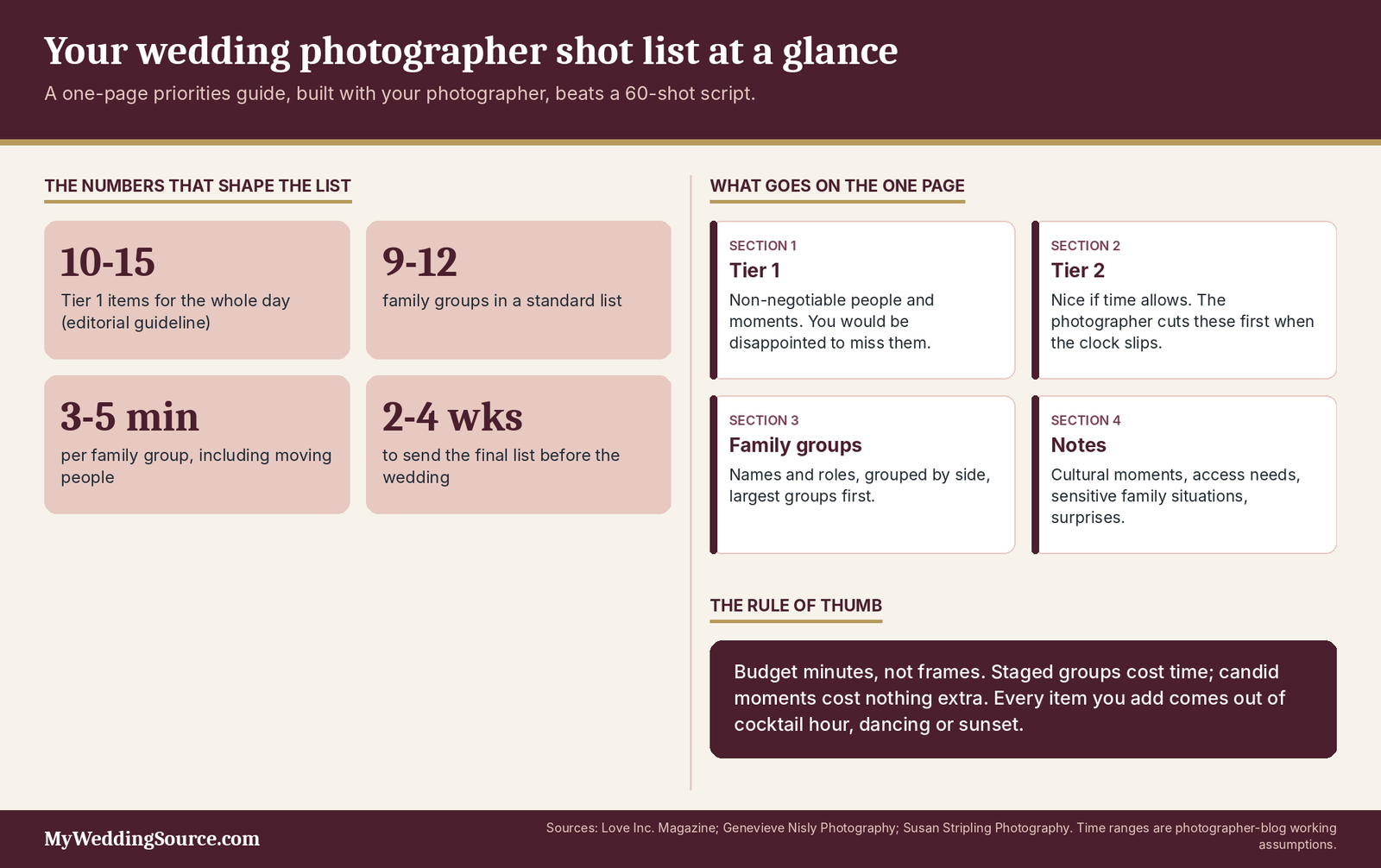
A good wedding photographer shot list is a one-page priorities guide, built with your photographer, that names the people and moments you cannot lose and leaves the rest to their eye and your coverage hours.
Most couples hit the shot list question the same way: the photographer sends a worksheet, or says “send me your must-haves,” and suddenly you are staring at a Pinterest board of 140 images, a parent who does not speak to another parent, and a nagging worry that the only photo of Grandma will be a blur. The instinct is to write everything down. The better move is to decide what actually matters, put it in order, and give the photographer enough time to deliver it. A list of 60 posed shots can quietly eat the cocktail hour; a list of 12 well-chosen priorities, plus a named family-formal list, rarely does.
This guide treats the shot list as a planning tool rather than a script. You will see how to build it with your photographer, which moments belong in a first tier and which are nice extras, how long each segment realistically takes, and how coverage hours turn into minutes you can spend. There are copy-ready sample lists, a method for family formals that holds up for blended and complicated families, notes on cultural, religious and accessibility needs, and a plain-English set of contract questions about usage rights, delivery, backups and second shooters. The contract material is general education only; terms and state laws vary, and a local attorney can review your actual agreement.
What a wedding photographer shot list is for (and what it is not)
Before you write a single item, it helps to know what a shot list can and cannot do. It cannot guarantee a particular photograph, because light, weather, crowds and people’s moods are not under anyone’s control. It can make sure the photographer knows who matters, where the time should go, and which moments are emotionally non-negotiable for you. That framing keeps the document small and useful instead of long and stressful.
The job of the list
A shot list has two jobs: it tells the photographer who the important people are, and it tells them what you will be disappointed to miss. Everything else, the lighting, the angles, the in-between glances, is the part you hired them for. The two jobs sound modest, but they solve the most common failure, which is a photographer who cannot tell your college roommate from your great-uncle and a couple who assumed the photographer would just know.
A priorities guide, not a script
A script tells the photographer exactly what to shoot and in what order; a priorities guide tells them what you value and lets them solve the rest. Photographers who write about this tend to agree that long lists backfire. In one planning Q&A, a wedding-industry photographer is quoted warning that if you list 50 required shots, the photographer may miss candid hugs and tears while checking boxes, and recommends writing down only what they truly must get (Love Inc. Magazine). That is the practical rule: every item you add takes attention from the moments nobody could script. If an item would not make you sad to lose, it belongs in Tier 2 or off the list entirely.
Why experienced photographers still want something from you
Even a photographer who says “I do not use shot lists” needs three things from you: the family groupings, the names of the people who matter most, and any surprise or cultural moment they could not guess from a floor plan. Those are facts, not creative direction, and no amount of talent lets someone invent them. Think of the document as a briefing note, similar to what you would hand a day-of coordinator, rather than a creative brief. A good photographer will usually read it once, fold it into their own timeline, and not look at it again until a family group needs calling out.
What belongs on it
The list works when it is organized around people, moments and details, in that order. People come first because they are the hardest to fix later: a missing grandparent cannot be reshot at 8:45 p.m. Moments come second because they happen once. Details come last because they are the only category that can be photographed calmly at almost any time.
People: the short list of faces that matter
Write down five to ten people you would regret not having a clear, well-lit portrait with, such as grandparents, a parent who traveled a long way, or a friend who flew in from overseas. Put each person’s role in parentheses (for example, “Aunt Rosa, groom’s mother’s sister”) so the photographer can recognize them from a description rather than a first name. You do not need to list every guest, and you should not try. A useful test is whether you would mention this person if a stranger asked, “Who must be in your wedding album?”
Moments and details that a photographer cannot guess
Photographers can anticipate a first kiss, a ring exchange, and a first dance. They cannot anticipate that your grandmother is bringing the veil she wore in 1962, that your brother will read a poem in Korean, or that your dog is walking the aisle. Those are the line items that earn their place: heirlooms, surprises, readings in another language, a song with a story, a handwritten note you will read before the ceremony. List them with a time or a cue (“after the toasts, brother surprises us with a dance”), because the photographer needs to be in position before the moment, not after it.
What a wedding photographer shot list costs: price benchmarks, coverage hours, and the price of an overrun
A shot list has no price tag of its own, but it controls how much photographer time you need, and photographer time is what you are paying for. A list that creates 90 minutes of formal portraits pushes you toward a longer package; a list that fits in 45 minutes may let you keep a shorter one. The number that matters is minutes of coverage, and minutes cost real money.
Benchmarks for what couples pay
Photographer pricing is wide, regional and style-dependent, so use national figures as context, not a quote. The two most cited sources, The Knot and Zola, measure different things and land in different places, which is useful to know before you compare your own quotes. A national average also hides the fact that a studio in a small Midwestern town and a studio in a large coastal city may be pricing the same eight hours very differently. Use the numbers below to sanity-check a quote, not to negotiate one.
What couples report paying
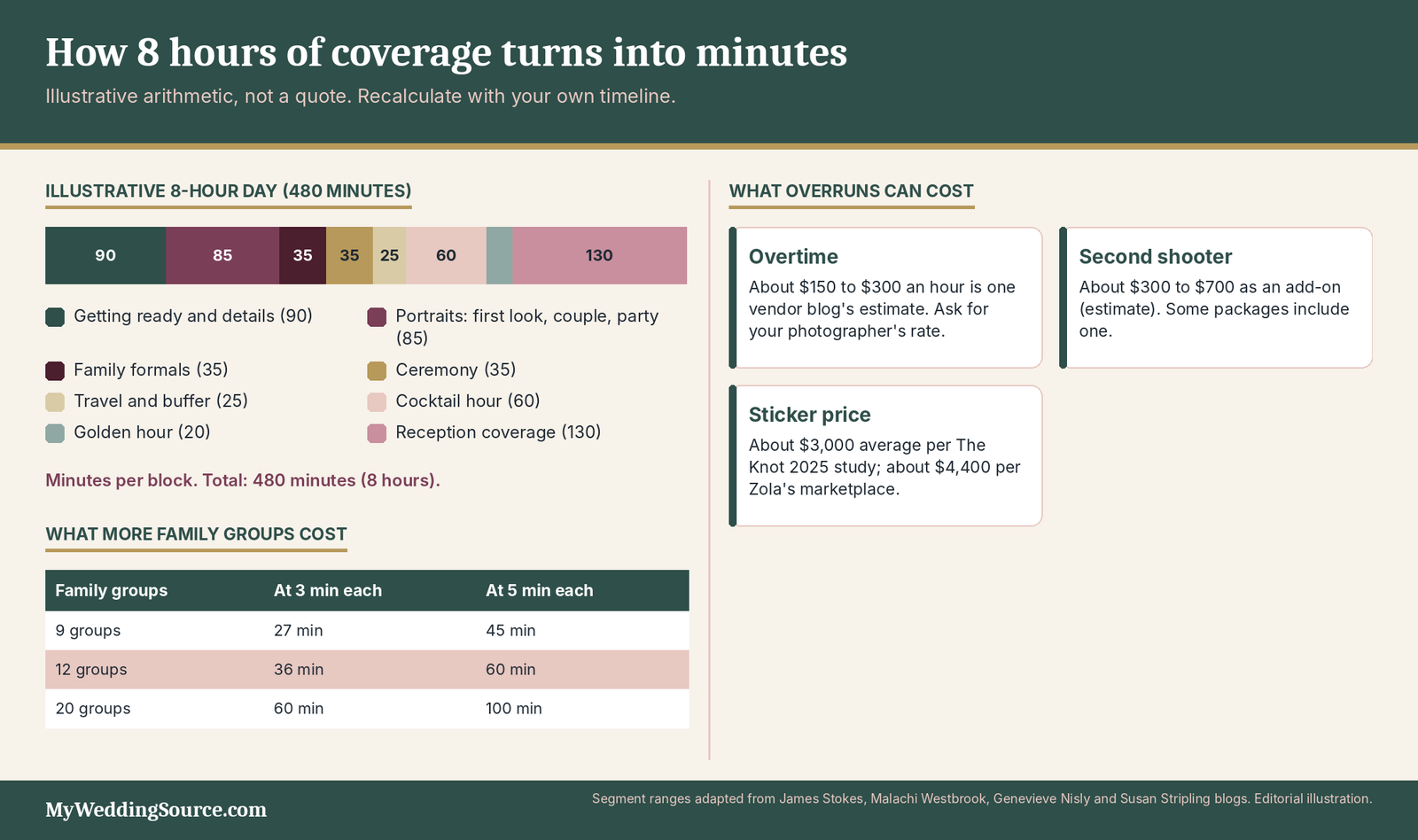
The Knot’s 2025 Real Weddings Study, which surveyed about 10,500 couples married in 2025, puts the average professional wedding photographer at $3,000, with a lower quartile of $1,500, a median quartile of $2,800 and an upper quartile of $4,700 (The Knot). Zola’s Wedding Cost Index reports a national average of $4,400 for photographers booked through its marketplace, with a typical range of $3,500 to $5,300, or roughly 9% of a total wedding budget (Zola). The gap is normal: one dataset reflects what married couples say they paid, the other reflects marketplace pricing, and neither is a quote for your city.
| Benchmark | Figure | Source and scope |
|---|---|---|
| National average | About $3,000 | The Knot, 2025 weddings, about 10,500 couples |
| Cost quartiles | $1,500 / $2,800 / $4,700 | The Knot, lower, median and upper quartile |
| Regional averages | $2,600 (Southwest) to $3,800 (Mid-Atlantic) | The Knot, 2025 weddings |
| By guest count | $2,000 (1-50) to $3,500 (101+) | The Knot, 2025 weddings |
| Marketplace average | About $4,400 | Zola Wedding Cost Index, article updated February 2026 |
| Second shooter add-on | $300 to $700 (estimate) | One vendor blog citing market ranges; treat as indicative |
Why the range is so wide
Photographer pricing moves with experience, location, editing time, coverage hours, number of photographers and deliverables such as albums or printed products. Zola also notes that peak-season Saturdays from May through October usually cost the most, while Fridays, Sundays and November-through-April dates often come with lower prices. So the same photographer can quote different totals for the same hours depending on the date. That matters for shot lists because a shorter, tighter list can make a Friday or off-season package workable, whereas a long family list pushes you toward a bigger Saturday package.
How hours, minutes and shot lists connect
The honest way to think about a shot list is as a minutes budget. The photographer is on the clock from arrival to departure, and every staged item takes minutes from that total. Candid moments cost nothing extra, because they happen while the day happens. That distinction is the most useful thing to understand about coverage math.
Minutes, not frames
Photographers do not shoot a fixed number of frames per hour, and contracts that promise exact image counts are usually promising a range. What the list changes is staged time: a group portrait of eight people takes minutes to gather, pose, shoot and release, whether the photographer takes five frames or fifty. Genevieve Nisly Photography uses a rule of three minutes per group, including moving one group out and the next in, and puts a standard list of nine to twelve groups at roughly 27 to 36 minutes (Genevieve Nisly Photography). Another photographer, Susan Stripling, plans four to five minutes for groups of more than four people (Susan Stripling Photography). Both are photographer blogs, so treat their numbers as working assumptions from people who sell this service, not industry standards.
What typical coverage packages include
Zola describes basic packages as six to eight hours with one photographer, standard packages as eight to ten hours with one or two photographers, and premium packages as ten or more hours with two or more photographers. Susan Stripling’s blog reports that most weddings choose between eight and ten hours, with six hours suited to intimate weddings and elopements. Those are packaging conventions, not rules, and your day may need more or fewer hours depending on the number of locations, the schedule between ceremony and reception, and whether you want getting-ready coverage or a send-off. The next table turns those conventions into an illustrative minutes budget.
| Block of the day | 6-hour day | 8-hour day | 10-hour day |
|---|---|---|---|
| Getting ready and details | 45 min | 90 min | 120 min |
| First look, couple and wedding-party portraits | 70 min | 85 min | 100 min |
| Family formals | 25 min | 35 min | 45 min |
| Ceremony | 30 min | 35 min | 40 min |
| Travel and buffer | 20 min | 25 min | 30 min |
| Cocktail hour | 45 min | 60 min | 60 min |
| Golden-hour or sunset portraits | 0 min | 20 min | 20 min |
| Reception coverage | 125 min | 130 min | 185 min |
| Total | 360 min | 480 min | 600 min |
The overrun problem
When a day runs long, the usual casualty is not the photographer’s patience but the last block of coverage: the dancing, the send-off, or the night shots. If your contract says eight hours and formals consume an extra 30 minutes, those 30 minutes come off the end unless you pay for overtime. This is why the coverage-hours table above leaves a 25- to 30-minute buffer row, and why the same schedule problems appear on our page about wedding day timeline failure points. Build your list against the real timeline, not the hopeful one.
Pricing questions to settle before the list is final
Ask what the quote includes in hours, photographers and travel, and ask how overtime is charged and approved. If the answer is “per hour after the contracted end time,” note that the shot list may make overtime more likely, and decide in advance whether you would rather add hours or trim the list. For deeper cost coverage of the second shooter and videographer, see our guide to what second photographers and videographers actually cost. For wider budget leakage, our hidden costs checklist covers the extras that appear after you sign.
How to build a wedding photographer shot list with your photographer
The most reliable process is a conversation followed by a one-page document, not a document followed by a surprise. Your photographer has shot dozens or hundreds of weddings in your venue type, and they know where the schedule tends to break. Bringing them into the list early turns it from a wish list into an agreed plan.
Start the conversation early
What to ask at the consultation
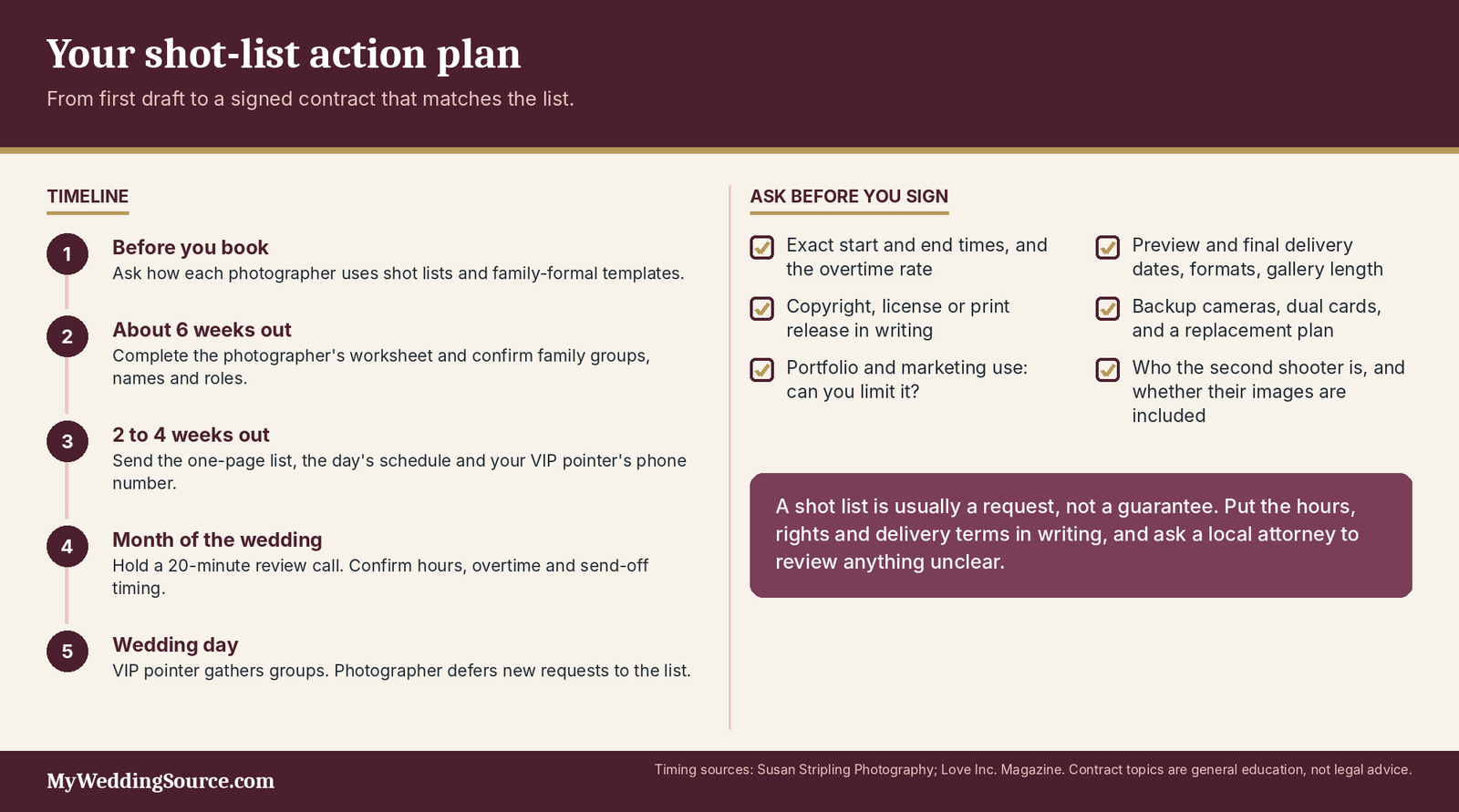
Ask each photographer how they use shot lists: do they send a worksheet, do they prefer a short list of must-capture items, and do they have a standard family-formal template. Ask what they do when a relative requests extra group photos on the day, and whether they defer to your list. Genevieve Nisly Photography describes deferring new requests from relatives unless the couple approves them, which is the behavior you want (Genevieve Nisly Photography). Our 30 questions to ask a wedding photographer include several that cover process, style and backup, so you can combine those with the list-specific questions here.
When photographers send their own worksheet
Many photographers send a “wedding day worksheet” that includes a checklist of basic family groupings and space for additions. Susan Stripling’s practice, for example, is to send hers about six weeks before the wedding and to ask couples to share the final list with everyone who needs to be there (Susan Stripling Photography). If your photographer has a worksheet, use it as the skeleton of your list rather than starting from scratch. It already reflects how they like to work, which makes the day smoother than a document in a format they have to translate.
Sort every item into two tiers
Tier 1: the non-negotiables
Tier 1 usually holds the ceremony essentials, a handful of family portraits, and two or three personal moments that no one else would think of. A realistic Tier 1 for most weddings has 10 to 15 items, including items like the ring exchange, the first kiss, a portrait with each set of grandparents, and a quiet moment of the two of you after the ceremony. If your Tier 1 has more than 20 items, you either need more coverage hours or a shorter list. Be honest about which bucket each item belongs in; the point of tiering is that it forces trade-offs before the day instead of during it.
Tier 2: nice if time allows
Tier 2 holds everything that would be lovely but would not break your heart to lose, such as a flat lay of invitation suites, a group photo of your college friends, or a dramatic wide shot from the rooftop. These items give the photographer permission to skip them when the schedule slips. Keep Tier 2 to five to eight items. The advantage of naming them is that the photographer knows what to cut first, so your Tier 1 does not get squeezed when the toasts run long.
| Tier | Item | Who or what | Cue or timing |
|---|---|---|---|
| 1 | Ring exchange and first kiss | Both partners, officiant | Ceremony, with a photographer in position early |
| 1 | Portrait with each set of grandparents | Name each person | Family formals, first 10 minutes |
| 1 | Parents seeing you dressed | Each parent, separately if preferred | Before the ceremony, during getting ready |
| 1 | Private vow or letter moment | The two of you | First look or morning, with photographer at a distance |
| 1 | Surprise dance or toast | Name the performer | Reception, after dinner |
| 2 | Heirloom close-up | Veil, watch, family recipe card | Getting ready |
| 2 | Group photo of college friends | Names or a table number | Cocktail hour |
| 2 | Wide shot of the full guest list | Guests together | After the ceremony or at dusk |
| 2 | Detail photos of stationery and signage | Invitation suite, welcome sign | Before guests arrive |
Table: A tiered list keeps non-negotiables first and gives the photographer clear permission to trim the rest
The one-page format
Aim for a single page with four sections: Tier 1 moments, Tier 2 moments, family formals, and notes (cultural, accessibility, sensitive situations). Use names and roles, not pronouns, and add times when a moment has a fixed cue. Photographers read these in a hurry, often on a phone in a hallway, so formatting that works at a glance is more useful than clever design. Shared documents are fine, but also send a PDF so there is a stable version everyone can find.
Moment-by-moment shot lists: getting ready, details, first look and portraits
Once the tiers are set, the next step is attaching them to the day’s timeline. In our editorial judgment, the morning and portrait blocks are where schedules slip most often, because they involve the most people moving between locations. This section covers the first half of the day, with timing ranges that are working assumptions, not guarantees.
Getting ready and details
Getting ready: what to list
For getting ready, list the moments you want rather than the poses: a parent helping with a button, the first look at the dress, a note from your partner, a toast with the people in the room. One photographer’s published timeline allows a minimum of 90 minutes for getting-ready coverage, adding 30 more minutes for more than four bridesmaids or complex hair and makeup (James Stokes Photography). If you want both partners covered at once, that is the situation where a second photographer starts to earn their fee, which is covered in more detail later in this guide. Tell the photographer which room will be ready first and who should not be photographed in a state of undress.
Details and heirlooms
Details are the rings, shoes, stationery, bouquets and any heirloom that has a story. Stokes allots 20 to 30 minutes for details, and the efficient way to hit that number is to gather everything in one spot before the photographer arrives. Put the rings, invitation suite, vow books, perfume bottle and any family heirloom in a tray or on a table by a window. Write a short note for each item with a one-line story, because the photographer can then make a more meaningful image of the watch your grandfather wore than of a generic watch.
First look and private moments
A first look is a private moment before the ceremony, usually followed by portraits. Zola’s 2025 First Look Report, based on close to 6,000 couples getting married in 2025, found that 56% have a first look with their partner and 41% add a second first look with other loved ones (Zola). One photographer describes the main advantage in terms of time: without a first look, the gap between ceremony and reception is often 30 to 45 minutes, leaving about 20 to 30 for portraits, while a first look can give roughly 45 uninterrupted minutes (Maroo). A first look is not required, and the choice is personal, but if portrait time is a priority, it is the biggest single time lever you control.
Portraits: couple, wedding party and golden hour
Couple portraits
Write down the kind of couple portraits you want rather than a set of poses: close and quiet, playful and moving, formal and posed, or in a specific location that matters to you. Photographers who publish timelines commonly allow 30 to 45 minutes for couple portraits after a first look, and Malachi Westbrook Photography puts the combined first look and couple block at 30 to 45 minutes (Malachi Westbrook). If the budget or schedule is tight, tell the photographer which two or three locations matter most and let them find the rest.
Wedding party groups
For the wedding party, ask for the full group, the two sides separately, and each of you with your closest attendants, then let the photographer improvise from there. Stokes allots 45 to 60 minutes for a party of 12 or fewer people and adds 15 minutes for every four additional people, while Westbrook plans 45 minutes. A short list: all attendants together, each partner with their side, then a quick fun group that shows personalities. If your party is large, remember that each additional person adds time as well as portraits.
Golden hour and sunset portraits
Golden-hour portraits are the most common Tier 2 item, because they depend on the weather and on reception timing. Stokes allots 20 to 25 minutes, and Westbrook plans about 15. Look up sunset for your date and location (the NOAA Solar Calculator does this, with the caveat that NOAA says it no longer actively maintains the tool and that real-world conditions may differ), then build a 20-minute window starting about 30 minutes before. Winter weddings need extra attention, since sunset can arrive before dinner; our guide to winter wedding photography covers light, layers and timeline adjustments. The wedding photography timeline article lays out the schedule these segments fit into.
| Segment | Typical time range | Source and notes |
|---|---|---|
| Getting ready | 90 min minimum, plus 30 for large parties | James Stokes Photography |
| Details | 20 to 30 min | James Stokes Photography |
| First look and couple portraits | 30 to 45 min | Stokes and Malachi Westbrook |
| Wedding party | 45 to 60 min for 12 or fewer, plus 15 per 4 more | James Stokes; Westbrook uses 45 |
| Family formals | 20 to 30 min for a standard list | Westbrook; Stokes uses 30 plus 3 to 5 per added group |
| Golden-hour portraits | 15 to 25 min | Westbrook and Stokes |
Table: Photographer-published ranges are working assumptions; your venue, party size and travel time can move them
Moment-by-moment shot lists: ceremony, cocktail hour, reception, dances and send-off
The second half of the day is less flexible. Ceremony and reception moments happen once, in front of guests, and a photographer has to be in the right place at the right time. That is the reason cues, positions and permission matter more here than posing.
Ceremony and cocktail hour
Ceremony: positions, rules and cues
Ask the venue or officiant about photography rules before you write the list. One Boise, Idaho cathedral’s published policy, for example, bans flash during the ceremony, bars photographers from moving through the aisles, pews or altar area, and requires equipment to be cleared from the sanctuary 25 minutes before the service (Boise cathedral wedding photography guidelines). That is one venue’s policy, but it shows why a “walk down the aisle from the front” shot may be off the table. Put the ceremony’s Tier 1 items on the list: processional, readings, vows, ring exchange, first kiss and recessional, with notes about anything unusual like a unity ritual or a child ring bearer.
Phones, guests and the unplugged ceremony
Guests holding phones into the aisle are one of the most common obstacles to ceremony photos. Zola’s report lists phone-free, unplugged ceremonies as an “in” trend for 2025, although it gives no percentage. If you want one, communicate it in more than one place: a note in the program, a sign at the entrance, and an announcement by the officiant, as suggested in Carlson Craft’s guide to unplugged weddings (Carlson Craft). Offering guests a clear moment to take their own photos, such as a staged pose at the front after the recessional, makes the request easier to follow.
Cocktail hour: candid coverage versus family formals
Cocktail hour is the usual place for family formals, which puts it at the center of a real trade-off: guests are mingling, but you are posing. Some photographers run formals alongside cocktail hour and capture candids with a second shooter or in the minutes before and after. If you want to be present for your guests, schedule only the key family groups there and move wedding-party portraits earlier. Telling guests what to expect during this window, such as drinks, lawn games or a guest book, keeps them occupied while you are being photographed.
Reception, dances and send-off
Entrance, toasts and cake
List the order of events and who is speaking, with names. Photographers can only capture a toast well if they know where the speaker will stand, whether a microphone is involved, and who will react. Ask your DJ, band or coordinator for a schedule, and send it to the photographer along with the shot list. For the cake cutting, tell them if there is anything special, such as a family recipe, a topper with a story, or a tradition like feeding each other slowly.
First dance, parent dances and the dance floor
First dance, parent dances and a dance-floor sequence are Tier 1 for many couples. Mention songs with special meaning, a choreographed routine, a dip or a surprise guest joining, so the photographer is facing the right way when it happens. If you are doing an unplugged ceremony, consider letting guests photograph the dance floor after the first dance, a suggestion from the same Carlson Craft guide. Ask the photographer how long they typically stay on the dance floor and whether extended dancing is included in your hours.
Send-off and night shots
A send-off is the shot that usually requires the most coordination: sparklers, bubbles or petals, a vehicle, a path and a timeline. Ask your venue about rules for fire, flammables and cleanup, and tell the photographer what time the send-off is planned. Night shots, such as a low-light portrait with off-camera flash or a sparkler exit, take preparation and often need a few minutes of calm to set up, which is why they often fall in the last hour of coverage. If the send-off is Tier 1, check the contract: if coverage ends before it, you will need to buy extra hours.
| Moment | What to tell the photographer | Tier | Timing note |
|---|---|---|---|
| Processional | Order of walkers, music, any child or pet | 1 | Photographer positioned before guests are seated; confirm venue rules |
| Vows and ring exchange | Who stands where, any readings or rituals | 1 | Confirm venue limits on movement and flash |
| First kiss and recessional | Cue from officiant, unplugged request | 1 | Plan 2 to 3 min for a quick portrait |
| Receiving line or greetings | Who is in line, time limit | 2 | Pad 10 to 15 min if guests are greeting |
| Grand entrance | Introductions and music | 2 | Photographer inside before doors open |
| Toasts | Speaker names and order | 1 | Ask for the order from the DJ or coordinator |
| First dance and parent dances | Songs, surprises, who joins | 1 | Mark times on the schedule |
| Cake cutting | Story, topper, family recipe | 2 | Confirm cake table lighting |
| Send-off | Method, location, venue rules | 1 if wanted | Needs hours that cover it |
Table: The ceremony-to-send-off list works well when each item has a cue, a tier and a timing note
Family formals that work for blended and complicated families
Family formals are the section of the shot list where a little preparation prevents the most friction. They involve the most people, the tightest clock, and the highest emotional stakes, and they are the one part of the day where a photographer cannot improvise around a family dynamic they have never heard about. A short, named, ordered list solves most of it.
How to build the family list
Names, roles and an order that moves fast
Write each group with names and roles, not just “Mom and Dad” or first names, because the photographer will be calling people by title and last name across a crowded lawn. Genevieve Nisly Photography recommends listing titles and last names, grouping by side (one partner’s family first, then the other’s, then the joint groups), and shooting the largest extended-family groups first so those relatives can leave early for the cocktail hour (Genevieve Nisly Photography). That order reduces movement and keeps relatives from standing around for 40 minutes waiting for their turn. It also means the photographer has the people who are most likely to be tired, elderly or restless done first.
How many groups the schedule can afford
The same photographer’s blog describes a standard list of nine to twelve groups as covering most families, and notes that past about 20 groups the extra time comes out of the cocktail hour or reception. At three minutes per group, that is 27 to 36 minutes for a standard list and roughly an hour for 20. At the four-to-five-minute estimate used by Susan Stripling for groups of more than four people, the same 12 groups run closer to 50 or 60 minutes. Because these are photographer-published working numbers, treat them as a range and confirm your photographer’s own estimate before you finalize the list. A good rule is to cut the list rather than the buffer: dropping two extended-family groups saves more time than rushing eight others.
A sample family-formal list you can copy
The table below is a template for a two-sided family with some blended elements. Replace the bracketed names, delete rows that do not apply, and add a row for any household that needs its own portrait. Rows 1 and 2 are optional extended-family groups, and the core list (rows 3 to 10) takes roughly 27 minutes at the estimates shown, while all 13 rows take about 46. These minutes are editorial estimates drawn from the three-to-five-minute ranges above, not a quote or a standard.
| # | Group (use names and roles) | Priority | Est. minutes |
|---|---|---|---|
| 1 | Everyone on [Partner A]’s side, extended family | Tier 2 | 5 |
| 2 | Everyone on [Partner B]’s side, extended family | Tier 2 | 5 |
| 3 | Couple with [Partner A]’s parents (and step-parents if agreed) | Tier 1 | 3 |
| 4 | Couple with [Partner A]’s parents and siblings | Tier 1 | 4 |
| 5 | Couple with [Partner A]’s grandparents | Tier 1 | 3 |
| 6 | Couple with [Partner B]’s parents (and step-parents if agreed) | Tier 1 | 3 |
| 7 | Couple with [Partner B]’s parents and siblings | Tier 1 | 4 |
| 8 | Couple with [Partner B]’s grandparents | Tier 1 | 3 |
| 9 | Couple with both sets of parents | Tier 1 | 4 |
| 10 | Couple with all siblings, both sides | Tier 1 | 3 |
| 11 | [Partner A] with siblings only | Tier 2 | 3 |
| 12 | [Partner B] with siblings only | Tier 2 | 3 |
| 13 | Any extra household (for example, couple with a parent and step-parent) | Agreed in advance | 3 each |
Divorce, stepfamilies, estrangement and loss
Divorced or separated parents
The simplest approach is to list each parent’s household as its own group. Genevieve Nisly Photography reports that photographers often ask about parents’ marital status during planning, that couples can choose separate portraits with each parent or a combined portrait with both biological parents, and that divorced biological parents are generally not posed together unless the couple asks for it. Settle that before the wedding so it is not negotiated in front of guests. A New Orleans etiquette column on mobility-challenged attendants makes a related point: tell the photographer about sensitive dynamics such as a difficult divorce or family conflict, so they can avoid awkward poses or groupings (My New Orleans). A sentence in your notes, such as “Mom and Dad are not photographed together; Dad’s partner is included in the Dad group,” is enough.
Stepfamilies, half-siblings and chosen family
Stepparents, half-siblings and chosen family should appear on the list by name, with the relationship spelled out the way the family describes it. If a stepparent raised you, say so; if a stepparent is new and you are not sure whether they want to be in family portraits, ask them and the relevant parent before the day. Chosen family, such as a mentor or a close friend who has been a parent figure, can be listed as their own group or folded into a larger one. The photographer has no way of knowing these relationships exist, so a short note saves an awkward moment.
Estrangement, tension and absent loved ones
When a relative is estranged or simply difficult, the list should make the logistics clear without detailing the history: who should not be placed next to whom, which groups should be photographed separately, and who handles any pushback. If someone has died, couples sometimes include a framed photograph, a boutonniere, or a chair in the family portrait, and sometimes prefer to leave it unmarked. Either approach is valid, and the photographer’s job is to follow your lead without commentary. Ask relatives about their comfort with being photographed in sensitive groupings, since a small conversation in advance spares a hard moment on the day.
Letting people say no
Not everyone wants to be in every photograph, and a list that assumes otherwise can create pressure. Children may be tired, some adults may be uncomfortable with cameras, and a few guests have personal reasons for staying out of photographs or social media. Tell the photographer if any guest should not appear in images that are shared online, and ask them how they handle that in their galleries and portfolio use. A relative who is quietly excused from a group is a smaller problem than a relative who is quietly resentful about being included.
Cultural, religious and accessibility considerations for your shot list
The sections of the shot list that matter most to a family are often the ones a photographer cannot guess. Cultural and religious traditions have a sequence, specific roles and sometimes specific rules, and your photographer needs to know them in advance. Accessibility needs call for similar advance notice, because the right setup is easier to arrange than to fix.
Cultural and religious moments
Ask your family first
Generalized articles describe the common version of a tradition, but your family may do a different one. A photographer’s guide to Jewish weddings notes that traditions vary by branch of Judaism and that not every couple observes every tradition, so confirm with the family which elements will be included (SLR Lounge). The practical step is to ask a parent, grandparent or officiant for the order of events and the names of the participants, then write that into your notes. Do not hand your photographer a general article and assume they will apply it; hand them your family’s actual sequence.
Examples of moments that deserve a line on the list
The table below shows the kind of moments that tend to belong on a list, drawn from published guides. Treat it as a prompt for the conversation with your family, not an authority on any tradition. A line like “tea ceremony after the processional, grandparents served first” is more useful to a photographer than the tradition’s name alone.
| Tradition | Moments worth listing | Planning notes | Source |
|---|---|---|---|
| Jewish ceremony | Ketubah signing, bedeken (veiling), chuppah, breaking the glass, yichud, hora | Signing rooms can be dark; some Orthodox weddings avoid contact between men and women | SLR Lounge |
| Hindu ceremony | Baraat, milni, jai mala, kanyadaan, mangal phera or saptapadi, mangalsutra, ashirwad | Often one of several events, such as haldi, sangeet and mehndi; ask which you want covered | The Knot |
| Chinese tea ceremony | Serving tea to elders in order, red envelopes (lai see) | Timing varies: before the wedding, after the ceremony, during cocktail hour or the next day | The Knot |
| Church or cathedral ceremony | Processional, readings, communion or blessing as applicable | Venue may restrict flash and photographer movement | Boise cathedral |
Multi-event weddings and sacred spaces
Some traditions spread across several days and venues. The Knot’s Hindu wedding guide describes weddings as multi-day events with pre-wedding gatherings such as haldi, sangeet and mehndi (The Knot), and the Knot’s Chinese tea ceremony guide notes the ceremony can happen before the wedding, after the ceremony, during cocktail hour or the next day (The Knot). If more than one event matters to you, ask whether the quote covers each event or only the wedding day, and get that in the contract. For sacred spaces, ask about flash, movement and positioning before the rehearsal, not after. The Orthodox guidance in the SLR Lounge guide, to avoid physical contact such as handshakes between opposite sexes, is the sort of detail worth asking the family about rather than guessing.
Accessibility and sensitive needs
Accessibility rarely requires special equipment. It requires planning for where people sit, how long they stand, how bright the lights are and where they can step away. The photographer cannot plan for needs they have not been told about, so the list should include them.
Mobility, seating and photo locations
Tell the photographer which guests or attendants use wheelchairs, canes or walkers, and decide the formal locations with them in mind. A wedding-planning feature on disability-friendly weddings quotes one photographer who notes that a popular overlook path was unpaved and difficult for wheelchair or cane users, so routes should be checked before choosing a spot, and another who advises working together to decide where family photos happen so a wheelchair user is included (Offbeat Bride). The same piece recommends having a handful of chairs available for people who cannot stand for more than a few minutes and avoiding plastic chairs or chairs with arms where possible. Plan to shoot the group with the person who needs a chair first, and have the chair there before the group arrives.
Sensory needs, flash and quiet spaces
If a guest has photosensitive epilepsy or sensory sensitivities, say so well ahead. One photographer quoted in the same Offbeat Bride piece avoids flash for guests with epilepsy because of the strobe-like effect and rents continuous lighting when told in advance. For guests who find loud environments difficult, a quiet space and a nearby retreat can make the difference between staying and leaving; another source in the piece describes a family choosing a photo spot near their car so a child had a safe respite close by. Ask the photographer how they handle low-light ceremonies and what lighting alternatives exist.
Energy, age and comfort
Elders, young children and anyone managing health conditions have limited energy for standing and posing. Put those groups early in the family list, shoot them in shade or indoors in warm or cold weather, and give them a place to sit between groups. If a relative has a short window of energy, ask whether their most important portraits can happen before the ceremony. A comfort-first schedule tends to produce better photographs anyway, because tired people look tired.
Privacy and safety
Some guests have reasons to keep their image out of photographs that circulate online, including personal safety, custody or privacy concerns. If that applies to anyone in your wedding, tell the photographer and your guests clearly, and ask what the contract says about portfolio use and posting. A model release or portfolio clause that gives the photographer broad rights to use your images can also reach photographs that include guests, so read that clause carefully. This is general education; if you have a specific legal concern, a local attorney is the right person to ask.
Handing the list to your photographer and who points out the VIPs
A list that sits in an inbox does not help anyone on the day. The hand-off is a small operation with three parts: timing, format and a person. Get all three right and the shot list does its job without anyone thinking about it.
When and how to send it
Timing: weeks, not days
Love Inc. Magazine’s planning Q&A advises sending the list two to four weeks before the wedding so the photographer can plan lighting and scouting, and holding a call in the month of the wedding to review expectations (Love Inc. Magazine). Susan Stripling’s workflow sends a worksheet about six weeks out. If the photographer has a deadline, treat it as the real one. Setting your own earlier deadline, such as one week before theirs, leaves a buffer for relatives who change their minds.
Format: one page, named groups and a cover note
Send a PDF or a shared document with four sections: Tier 1 moments, Tier 2 moments, family groups with names and roles, and notes. In the email, put the three most important things in the first paragraph, such as “Our family list assumes my parents are photographed separately, and the first dance has a surprise at 8:15 p.m.” Attach the day’s schedule and the contact information of your VIP pointer. Photographers read these in a hurry, so the cover note matters as much as the file.
The review call
A 20-minute call a few weeks out turns a list into a plan. Walk through the Tier 1 items, the family list, and any sensitive notes. Ask the photographer what they would trim, where they expect delays and whether the hours in your contract match the timeline the list creates. Take notes during the call and email a one-paragraph summary afterward, so there is a record of what you agreed.
On the day: who does what
The VIP pointer
Choose one relative or friend who knows the family and who is comfortable raising their voice to gather people. Give them the list and a phone. Genevieve Nisly Photography notes that the photographer calls out groups and arranges people while the couple’s job is to make sure family knows when and where to be, which in practice means a trusted person who can find Aunt Rosa in the cocktail crowd. Your day-of coordinator can fill this role if you have one, but a family member who is not in the portraits is often better, because they recognize everyone by sight.
Handling new requests on the day
Relatives will ask for additional photos. Decide in advance who says yes and who says no, and tell the photographer. A common approach is for the photographer to say “Let me check with the couple” and to defer to the list unless you approve a change. If you do approve an addition, treat it as a trade, since every minute added to formals comes out of cocktail hour, dancing or sunset. Small additions compound quickly, which is why a one-minute favor for one relative can become a ten-minute delay by the time the fourth request arrives.
A responsibility matrix
Writing the roles down, even informally, keeps everyone from assuming someone else has it covered. The matrix below splits the work among the couple, the photographer and the person pointing out VIPs, and you can paste it into your cover email. Its main purpose is to move the clock-watching and the people-wrangling away from you, so that on the day your only job is to show up for each group when called. Adjust the columns if you have a planner, a parent who runs everything, or a venue coordinator who already handles the schedule.
| Task | Couple | Photographer | VIP pointer or coordinator |
|---|---|---|---|
| Write and tier the list | Leads | Advises on timing and format | Reviews the family list |
| Confirm family groups and names | Approves | Checks for clarity | Collects phone numbers |
| Send final list and schedule | Sends by deadline | Confirms receipt | Receives a copy |
| Gather people for formals | Lets the team lead | Calls groups and poses them | Finds and delivers people |
| Handle new requests on the day | Decides in advance | Defers to the list | Relays and says no politely |
| Track the clock | Stays out of it | Watches the schedule | Warns when time is short |
Contract questions about usage rights, delivery, backups and second shooters
The shot list and the contract have to agree with each other. If your list assumes a send-off at 10:30 p.m. and the contract ends at 9:30, one of them is wrong, and it is easier to fix before you pay a deposit. This section is general education about the kinds of terms photography contracts commonly address. It is not legal advice, contract terms and state laws vary, and a local attorney can review your actual agreement.
Rights and usage
Who owns the photographs by default
Under U.S. copyright law, copyright generally belongs initially to the person who creates the work. The U.S. Copyright Office explains that the photographer is generally the initial owner of a photograph, the person who shoots or takes it (U.S. Copyright Office). Its Circular 30 explains that a commissioned work is a work made for hire only if it falls into one of nine statutory categories and both parties sign a written agreement, and photographs are not among those categories (U.S. Copyright Office, Circular 30). A transfer of copyright ownership, outside of limited exceptions, generally has to be in writing and signed (17 U.S.C. chapter 2). In plain terms, a wedding photographer usually keeps the copyright unless a signed document says otherwise, and couples receive permission to use the images rather than ownership.
What your license or print release should say
Because the photographer typically owns the copyright, what you receive is a license or release, and its details matter. The Professional Photographers of America (PPA) describes a Photo Licensing Agreement as a limited license that lets the photographer keep copyright while setting where, when and how images can be used, and a Print Release as a document covering the client’s personal use of prints (PPA). Ask whether you can print anywhere, post to social media, share with guests and use the images in a wedding website or a photo book. A vendor checklist also notes that contracts commonly ask clients to credit the photographer when posting on social media (Foto Owl); that is a vendor blog, so check whether your contract actually requires it.
Portfolio use, model releases and guests
Many contracts include a clause that lets the photographer use your images in their portfolio, website or marketing. If you want to limit that, ask for it to be changed before you sign. Guests are a separate question, since a clause that covers “images from the wedding” can include photographs of people who never signed anything. If a guest or family member has privacy concerns, ask whether the contract lets you exclude their images from portfolio use, and put your request in writing. Our guide on reviewing a wedding photographer’s portfolio and contract covers image rights and model releases in more detail.
Delivery, backups and who actually shoots
Delivery timelines and what arrives
Delivery times vary widely, so get the date in writing. One regional wedding magazine’s question guide cites six to eight weeks as the industry standard for a full gallery, with sneak peeks usually much sooner and some photographers offering expedited delivery for an extra fee (Rocky Mountain Bride), while a photo-delivery software vendor’s contract checklist suggests quick previews within 48 to 72 hours and final images in roughly three to six weeks (Foto Owl). That spread, from three to eight weeks, is a reminder that no single number is a standard. Ask what you receive (high-resolution files, web-size files, a printable release), how long the online gallery stays active, and whether your shot list priorities are included in a preview batch.
Backups: gear, files and the photographer
Backups come in three layers: equipment, files and people. For equipment, ask whether the photographer carries backup cameras and lenses; the Rocky Mountain Bride guide calls a “no” a major red flag. For files, ask whether images are recorded to two memory cards at the same time and how they are stored after the wedding. The PPA acknowledges in a member-benefit article that even experienced photographers can have a memory card fail (PPA). For people, ask what happens if the lead photographer is ill or has an emergency, and whether the contract names a replacement process.
Second shooters and substitutions
A second photographer is common for larger weddings, simultaneous getting-ready rooms and busy cocktail hours, and the cost varies by market. The Knot says that packages often include one or more second shooters in the flat fee, while one vendor blog reports that about a third of photographers include one in the base package and prices add-ons between $300 and $700 (Paperlust); treat that as indicative. Ask who the second shooter is, whether their images are included in your gallery and license, and whether they can be substituted without your approval. Our guide to second photographer and videographer costs goes deeper on pricing and what the add-on does and does not cover.
Linking the shot list to the contract
A shot list does not need to be a contract exhibit, but a few lines should connect them. Ask whether the contract states the coverage start and end times, how overtime is billed, and whether the photographer will review your timeline before the wedding. Consider adding a sentence that your shot list and family-formal list will be provided by a set date and that the photographer will review them. A shot list is typically a request rather than a guarantee unless the contract says otherwise, so it helps to know that going in. If you want a fuller question set for vetting a photographer, the consultation questions linked earlier in this guide cover many of the same topics.
| Topic | Question to ask | What a clear answer looks like |
|---|---|---|
| Coverage hours | What are the exact start and end times, and what happens if the day runs late? | Times and overtime rate in writing |
| Shot list | How do you use our list, and when do you need it? | A named deadline and a review call |
| Copyright and license | What can we do with the images, and what can you do with them? | A written license or print release |
| Portfolio use | Can we limit or exclude portfolio and marketing use? | A clause you can edit or strike |
| Delivery | When do previews and final images arrive, and in what formats? | Dates, file types and gallery length |
| Backup gear and files | Do you shoot to two cards and carry backup equipment? | A specific yes with how they do it |
| Lead photographer | What if you cannot attend? | A written substitution or referral process |
| Second shooter | Who is it, and are their images included? | Named person or role, and included in license |
| Cancellation | What if we postpone or cancel? | Deposit and rescheduling terms spelled out |
FAQ: wedding photographer shot lists
Planning and building the list
How long should a wedding photographer shot list be?
Short. A practical target is about 10 to 15 Tier 1 items for the whole day, a handful of Tier 2 extras, and a separate family-formal list of roughly 9 to 12 groups. Photographers quoted in planning guides warn that very long lists can distract from candid moments, and the extra staged items cost minutes you may not have. If your list feels long, move items to Tier 2 or ask the photographer which ones they would drop. The right length is the one that fits the coverage hours you have bought.
Do I need a shot list if my photographer is experienced?
You still need to give them the facts they cannot guess, namely who the important people are, which family groupings you want and which cultural or personal moments are happening. Experienced photographers often do not need pose suggestions, and some prefer not to receive them. A one-page list with names, roles and a few cues is usually welcome. Ask your photographer in the consultation what they prefer, and follow their format.
Who should point out family members during formals?
Choose a trusted relative or friend who knows the family and is comfortable calling people over. They should have a copy of the list, a phone and a clear sense of the order. The photographer calls out groups and arranges them, but someone local to the family has to find the people. A coordinator can do this if you have one, but a relative who recognizes everyone by sight is often faster.
Money, hours and contracts
How many hours of coverage do I need for my shot list?
It depends on your timeline, but photographer-published guidance suggests six hours for intimate weddings, eight for average-sized weddings and ten for larger ones or those with several locations, extended dancing and a send-off. Add up your list in minutes using the illustrative table in this guide, then compare it with the contracted hours. If the list needs more time than the package has, you can add hours, trim the list or move portraits earlier with a first look. Ask how overtime is billed so you can compare options.
Who owns my wedding photos?
Under U.S. copyright law, the photographer generally owns the copyright unless a signed written agreement transfers it, and couples usually receive a license or print release. What your license allows, such as printing, social posting and sharing, is set by the contract. Read that clause closely, and ask for edits before you sign if something does not fit your plans. For legal questions about your specific contract, consult a local attorney.
What if the photographer misses a shot on my list?
A shot list is typically a request, not a guarantee, unless your contract says otherwise, and some moments cannot be recreated. Ask the photographer before the wedding how they handle missed formal portraits and whether they can reshoot family groups after the ceremony if time allows. Review what your contract says about guaranteed images, remedies and refunds. The most practical protection is a short list, adequate hours and a person who keeps the schedule.
Your next steps
The work in this guide fits into a few focused sessions. Start with the list, then the family groups, then the contract, in that order, so each step informs the next. Most couples can finish the first two in an evening each, and the contract review is faster once you know what your timeline needs. Keep the final one-page list and the signed contract together so you can check one against the other.
This week
Draft your Tier 1 and Tier 2 lists
Set a timer for 30 minutes and write every moment and person you can think of, then sort each into Tier 1 or Tier 2. Cut Tier 1 to 15 items or fewer. Share the draft with your partner and decide what moves down a tier. Save it as a one-page document you can send to the photographer later.
Call two relatives about family groups
Call one person on each side of the family who knows everyone, and ask them to help you build the family-formal list with names and roles. Ask about divorces, stepfamilies, estrangements and anyone who needs a chair or a quiet space. Take notes and update your list. Ask each relative whether they would be willing to be the VIP pointer.
Before you pay a deposit or sign
Match the hours to the list
Add up the minutes from your list and your timeline, using the table in this guide as a template. Compare the total with the contracted hours and the photographer’s overtime rate. Decide whether to add hours, cut the list or schedule a first look. Lay out the full schedule on paper so you can see where the list’s minutes fall.
Get rights, delivery and backup in writing
Using the checklist table, ask for the license, delivery dates, backup practices, second shooter and substitution terms in writing, and ask a local attorney to review the contract if anything is unclear. Save the final list, the cover email and the signed contract in one folder. Send the list to the photographer by their deadline, and schedule a short review call for the month of the wedding.
Sources & methodology
- The Knot: Average cost of a wedding photographer — 2025 Real Weddings Study average ($3,000), quartiles, regional and guest-count figures
- Zola: Wedding photographer cost — Zola Wedding Cost Index average ($4,400), package tiers and seasonal pricing
- Zola: 2025 First Look Report — first look prevalence (56%), phone-free ceremony trend, survey of close to 6,000 couples
- U.S. Copyright Office: What photographers should know about copyright — initial ownership of photographs and the work-made-for-hire exception
- U.S. Copyright Office: Circular 30, Works Made for Hire — the nine categories for commissioned works and the written-agreement requirement
- U.S. Copyright Office: 17 U.S.C. chapter 2 — initial ownership and the written transfer requirement
- PPA: Sample contracts — descriptions of photo licensing agreements, print releases and wedding contracts
- Genevieve Nisly Photography: Family photos — photographer’s time-per-group rule, list building, divorced-parent approach
- Susan Stripling Photography: Planning family photos — four-to-five-minute estimate, worksheet timing, list sharing
- James Stokes Photography: Wedding photography timeline — segment time allotments for getting ready, details, portraits and formals
- Malachi Westbrook Photography: How much time you need for photos — combined portrait and family time ranges
- Maroo: First look vs. no first look — ceremony-to-reception gap and first look time comparison
- Love Inc. Magazine: Shot list questions answered — list length, what to include and when to send it
- Offbeat Bride: Disability-friendly wedding tips — photographer advice on mobility, seating and flash
- SLR Lounge: Jewish wedding photography guide — Jewish wedding moments and variation by branch
- The Knot: Hindu wedding program — Hindu ceremony elements and multi-day structure
- The Knot: Chinese tea ceremony — tea ceremony order, timing options and red envelopes
- Boise cathedral wedding photography guidelines — example of venue limits on flash, movement and timing
- NOAA Solar Calculator — sunrise and sunset times for planning golden-hour portraits
- Rocky Mountain Bride: 12 questions about wedding photography — delivery-time standard, backup equipment and second shooter questions
- Foto Owl: Photography contract clauses — vendor checklist for license, delivery windows and credit clauses (vendor blog; indicative only)
- Paperlust: Wedding photographer cost guide — second-shooter and overtime estimates (vendor blog; indicative only)
- PPA: Wedding photography resources — acknowledgment that memory cards can fail and the role of professional insurance
- Carlson Craft: How to have an unplugged wedding — ways to communicate a phone-free ceremony
- My New Orleans: Group photos with mobility-challenged attendants — telling the photographer about mobility needs and family conflict
Methodology: Price figures are survey findings (The Knot, Zola) or vendor-blog estimates (second-shooter and overtime ranges), and the minutes-per-segment ranges come from individual photographers’ published blogs, which reflect their own workflows and are working assumptions, not industry standards. Copyright statements come from U.S. Copyright Office materials and are general education, not legal advice; contract terms and state laws vary. The coverage-hours table, the sample lists and the “What this actually costs” example are editorial arithmetic and templates, labeled as illustrative, and they are not quotes. Cultural examples are prompts for a conversation with your family and officiant, not authoritative descriptions of any tradition.
Freshness note: Recheck The Knot and Zola photographer figures when their next annual studies publish, usually in early to mid-year, and recheck vendor-blog ranges against actual quotes in your market. Confirm any venue or house-of-worship photography rules directly with the venue before your rehearsal. Review your contract’s current wording with your photographer and, if needed, a local attorney before you sign.