
Bridesmaid gifts are a way to say thank you for months of time, effort, and money, so the best ones are chosen for the person receiving them, bought on a schedule that survives a late shipment, and personalized only where a mistake would be cheap to live with.
Quick answer
No source we reviewed treats bridesmaid gifts as required. The Knot suggests a budget similar to what you would spend on one person’s birthday or holiday gift, and Zola’s 2026 survey found that about two-thirds of couples who gave wedding party gifts spent $25 to $99 per person. A good plan has three parts: set one per-person ceiling and keep values close across the group, put a handwritten note with every gift, and personalize the note and the wrapping freely but be careful with names, dates, and sizes on items that cannot be returned. Order anything personalized at least two months ahead.
Why bridesmaid gifts matter, and when they matter most
Bridesmaid gifts sit in an odd place in wedding etiquette. Everyone agrees they are kind, and nobody agrees on a number, a day, or a type. That gap is why couples end up comparing themselves with photos online instead of asking what the gift is meant to do. This section starts with the job a gift performs, because the job tells you what to spend and where to be careful. If you are still deciding whether to give bridesmaid gifts at all, our wedding registry guide covers the wider gift conversation, including what couples receive. This article stays on bridesmaid gifts, meaning what couples give.
What the sources agree a gift is for
Etiquette and wedding-planning sources are unusually consistent on purpose. They are less consistent on details, so it helps to separate the two before you shop for bridesmaid gifts.
A thank-you, not a payment
The Knot describes the sentiment a gift should carry as appreciation for the time, effort, and money an attendant has put into the wedding. Emily Post says bridesmaid gifts do not need to be elaborate or expensive but should convey heartfelt appreciation. WeddingWire states plainly that bridesmaid gifts are not required. Put together, the sources describe a thank-you, which means that no price can be wrong in the way a bill can be wrong. A $30 gift with a thoughtful note does the job, and a $300 gift with no note may not.
This framing also removes a common source of stress. If a gift is a thank-you, you do not need to match what a friend spent on her own wedding, what a celebrity posted, or what the largest retailer’s gift-set page implies. You need to decide what you can comfortably give each person and then give it with care.
Where the published guidance differs or stays silent
Three points are unsettled. The first is timing: The Knot has two pages that point in slightly different directions, one placing wearable bridesmaid gifts at the rehearsal dinner and another saying wearable gifts such as jewelry are best given during getting-ready time so they are not lost. The second is whether bridesmaid gifts are needed when the couple covers costs: WeddingWire says couples can cover expenses such as dresses or lodging instead of giving gifts, but still advises a handwritten card. The third is amount: Zola gives a survey range, The Knot gives an average and a rule of thumb, and WeddingWire gives only examples.
None of the pages we read addresses return rules for personalized merchandise, so any statement about those rules in this guide is a question for you to ask a seller, not a fact we can report.
When bridesmaid gifts are most meaningful
Among bridesmaid gifts, the meaningful ones show that you noticed something about the recipient. The sources describe this in different words, but the principle is the same, and it does not depend on budget.
When the gift fits the person, not just the role
Zola advises matching bridesmaid gifts to a person’s interests, not only to her role in the wedding, and says gifts do not need to be identical. WeddingWire says to make bridesmaid gifts personal to each recipient, not just monogrammed. The practical reading is that a monogram answers the question “whose is this?” while an interest answers “who is she?” A friend who hikes might value a good insulated bottle. A friend who cooks might want an engraved cutting board, an idea WeddingWire lists. A friend who does not wear much jewelry will not wear a necklace because it came in a pretty box.
The effort is small if you plan for it. Before you shop, write one line about each person: what she does on a free Saturday, what she carries daily, what she would never buy for herself. That list also protects you from buying five identical items because they were easy to find in bulk.
When a note comes with it
Zola calls a handwritten letter that refers to a specific memory the most impactful addition to any gift, and notes that presentation, such as a box, tissue paper, and a card, can make a modest gift feel more valuable. The Knot also recommends a handwritten thank-you card and verbal appreciation after errands, planning calls, and events. Because a note costs nothing, it is the one element of bridesmaid gifts that should never be cut for budget reasons.
A note is also where personalization is safest. A mistake in a handwritten sentence can be fixed with another card, while a mistake engraved on metal cannot.
When covering costs can stand in for a gift
Some couples would rather reduce what bridesmaids pay than hand them an object. The Knot says the couple may pay for items such as dresses, accessories, hair, makeup, or lodging near the venue instead of giving gifts, and WeddingWire says the same about dresses and accommodations.
Paying for something the attendant would have bought
This option works best when the attendant would otherwise bear a real cost. Our bridesmaid dresses guide explains how attire costs build up, and our wedding party costs guide places bridesmaid gifts alongside the rest of the ledger. If you cover a dress, a hotel night, or hair and makeup, you have already given something with a dollar value. A small token on top is a pleasant extra and is not required by anything we read.
The limit is that a covered cost is a gift only if the attendant did not expect to be reimbursed. If you required a specific dress and then pay for it, you are meeting your own requirement, which Zola and The Knot describe as the couple’s responsibility, as our wedding party costs guide explains. In that case a separate thank-you gift is still reasonable.
Still write the card
WeddingWire advises a handwritten thank-you card even when the couple covers expenses instead of giving gifts, and we agree with that advice because a covered cost can feel like an administrative fact unless someone says it was meant as a thank-you. Two or three sentences are enough: name what she did, say what it meant, and say the wedding was better for it.
What to spend on bridesmaid gifts
Published guidance gives you two kinds of anchors: a survey of what other couples did and a rule of thumb about what is reasonable. Neither is a rule. Together they tell you where the middle of the road is, and our own arithmetic turns that into a budget you can enter in a spreadsheet. If you want to place the number in the full wedding budget, the wedding budget calculator has a line for it.
What the published figures say
The two most useful sources for bridesmaid gifts are a 2026 Zola survey of couples and a long-standing rule of thumb from The Knot. Both have limits, which we state so you can weigh them.
Zola’s 2026 survey bands
Zola’s page on wedding party gifts, published June 5, 2026, reports results, including bridesmaid gifts, from its 2026 Registry & Gifting Survey of 656 respondents. The page does not describe how the survey was collected, and says some figures come from post-wedding couples who gave gifts. With those limits in mind, here is what it reports for the wedding party: 10 percent of couples spent under $25 per person, 32 percent spent $25 to $49, 31 percent spent $50 to $99, 17 percent spent $100 to $149, 5 percent spent $150 to $199, and 4 percent spent $200 or more. Zola summarizes this as nearly two-thirds of couples spending $25 to $99 per person, with the largest share at $25 to $49. Zola’s own suggested range for bridesmaids and groomsmen is also $25 to $99 per person.
Our arithmetic from those bands, which is an estimate and not a figure Zola published, is that about 42 percent of couples spent under $50 per person and about 26 percent spent $100 or more. So a gift under $50 is common, and one above $100 is not rare.

The same survey says that about 61 percent of respondents gave wedding party gifts and that about one in ten gave no gifts. Because the survey page does not describe sampling, treat the percentages as a picture of one group of couples, not as a measurement of all U.S. weddings.
The Knot’s average and its birthday-gift rule
The Knot says there is no required amount and suggests spending about what you would on one person’s birthday or holiday gift. Its page, last updated July 13, 2023, cites its own research showing couples spend an average of $80 per bridal party member, though it does not state the survey year. It also calls $50 per person acceptable and says the maid of honor may merit a larger gift because she is usually the most involved.
The birthday rule is a useful sanity check because it is personal: you already know what you spend on a friend’s birthday without resenting it. If your usual birthday gift is $30, spending $30 on a bridesmaid is consistent with the rule. If your usual budget is $100, the rule would allow that too, as long as you can afford it for everyone in the party. WeddingWire adds the most practical sentence of the three sources: spend only what you can comfortably afford.
Turning a per-person figure into a budget
A per-person number for bridesmaid gifts feels small until you multiply it. This section does the multiplication and adds the parts that people forget, such as wrapping, shipping, and a reserve. All dollar amounts in this section are our own illustrative assumptions unless a source is named.
A worked example for five bridesmaids
Suppose you have five bridesmaids and decide on a base gift of $60 per person, with a maid of honor gift of $90, which is one and a half times the base. That is our illustrative choice and not a sourced rule. The bridesmaid gifts cost 4 × $60 + $90 = $330. Add an assumed $5 per person for a box, tissue, and card (5 × $5 = $25) and an assumed $40 for shipping and sales tax together. That brings the total to $395. Keep a reserve of about 10 percent, or $40, in case an item arrives damaged, misspelled, or in the wrong size, and the working budget becomes about $435, which works out to roughly $87 per person. The reserve is the line most couples leave out, and it is the one that saves you in the final month.
What the arithmetic looks like
The table below multiplies five per-person amounts by three party sizes. The $25, $50, and $99 figures come from Zola’s survey range and The Knot’s acceptable level, and $80 is The Knot’s cited average. Totals are our arithmetic, before shipping, tax, wrapping, and any reserve. Add roughly 10 percent for a reserve as an editorial rule of thumb.
| Per person | 3 bridesmaids | 5 bridesmaids | 8 bridesmaids |
|---|---|---|---|
| $25 | $75 | $125 | $200 |
| $50 | $150 | $250 | $400 |
| $80 | $240 | $400 | $640 |
| $99 | $297 | $495 | $792 |
| $150 | $450 | $750 | $1,200 |
The pattern to notice in bridesmaid gifts is that party size matters as much as the per-person amount. Moving from five bridesmaids to eight at $80 adds $240, which is about the same as raising the per-person budget for five people from $80 to $128. If you are choosing between a larger party with modest bridesmaid gifts and a smaller party with generous ones, our wedding party costs guide explains how the other lines in the ledger scale.
What changes when the party is larger or smaller
The Knot says one luxury gift can be as meaningful as several smaller ones, which is a reminder that the number of items is a poor measure of generosity. With a large party, a single well-chosen item at a lower price usually beats a bundle of small extras that all feel alike. With a very small party, you can afford to choose something specific for each person without a bulk order.
A practical limit worth knowing is that many personalized items are sold individually, so cost scales almost linearly with party size. Some sellers offer bundle pricing, but we found no sourced figures, so ask for a written quote before assuming a discount. If the quote only holds for a minimum quantity, check that your party meets it.
Fair, not identical
Fairness among bridesmaids in choosing bridesmaid gifts is one of the few places where etiquette sources and ordinary social instincts agree. The aim is that no one feels ranked, not that every item is the same.
Keep values close and choices personal
The Knot recommends keeping bridesmaid gifts roughly even across attendants, and Zola says gifts do not need to be identical, with couples often keeping value ranges similar while choosing items by preference. A simple rule is to fix a price band, such as within about $10 of the base, and then choose freely inside it. Everyone receives something of similar value, and each person receives something that fits her.
The one thing to avoid is a visible gap. If one bridesmaid receives engraved jewelry and another receives a candle, and the recipients compare notes, the difference will be remembered even if the dollar gap is small. Choose items that look comparable in effort, not just in price.
The maid of honor and extra helpers
Zola says the maid of honor, like the best man, may merit a nicer version of the group gift or a separate present. WeddingWire says she does not need an extra gift but suggests spending somewhat more on her than on the rest. Our maid of honor duties guide describes the tasks that might justify the difference. If you decide to give her more, give it privately, which The Knot also recommends for the maid or man of honor and best man.
Other people who helped, such as a sister who is not in the party but spent weekends addressing envelopes, may warrant a note and a smaller gift. That is a judgment call, and no source we read sets a rule. A card describing what she did is a good minimum.
What not to personalize in bridesmaid gifts
Personalization is the part of bridesmaid gifts where couples spend the most time and take the most risk. The Knot lists drinkware, totes, clutches, makeup bags, apparel, and jewelry as personalizable options, and Zola’s survey found that 62 percent of couples who gave wedding party gifts chose personalized accessories. Personalization is popular for good reasons, and it is easy to overdo with bridesmaid gifts. It is also the part of the order that usually cannot be undone, which is why it deserves its own plan.
A risk ladder for personalization
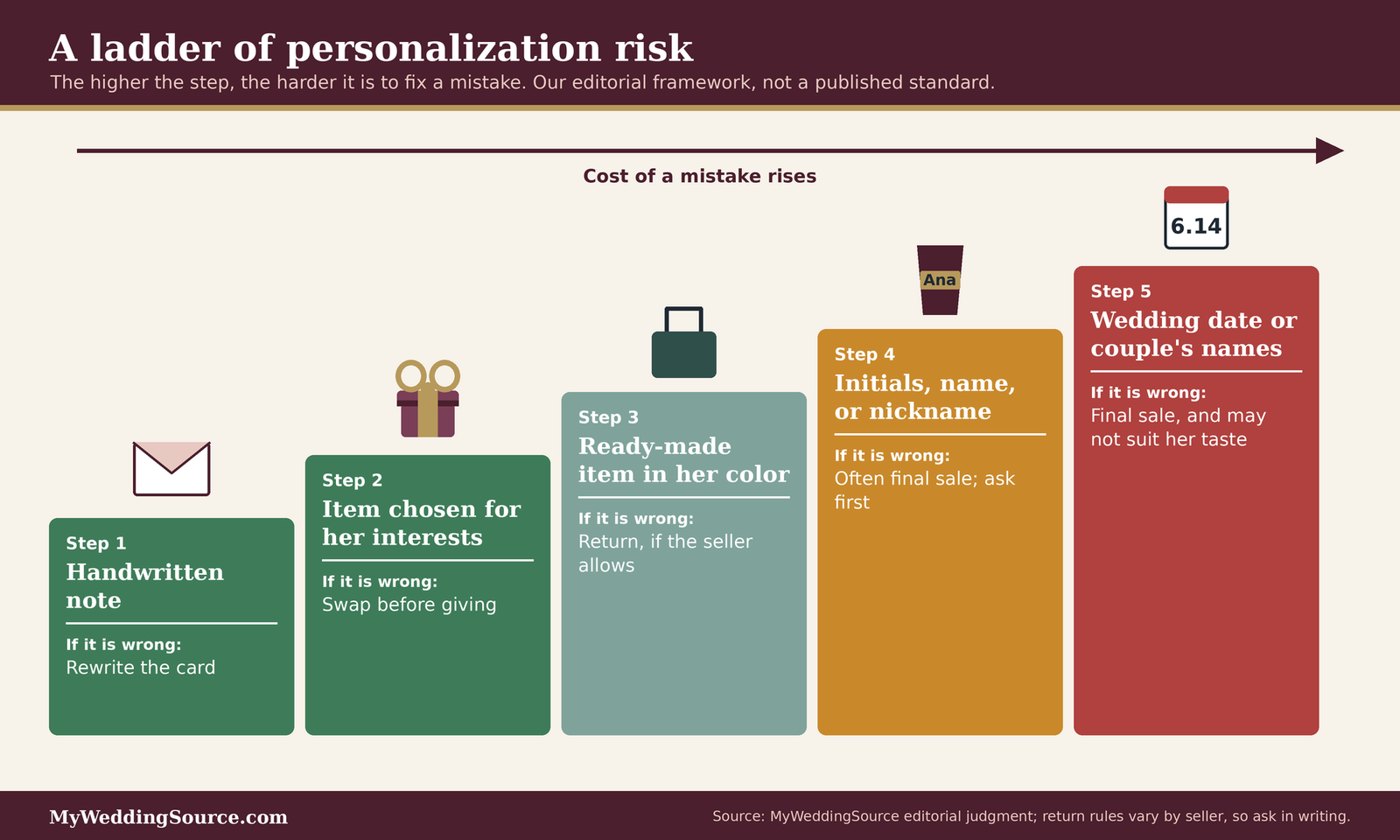
Instead of asking whether to personalize, ask how costly a mistake would be. The ladder below is our own editorial framework, not a published standard. It ranks common choices from the cheapest mistakes to the most expensive ones.
Low risk: the note, the wrapping, and the choice of item
At the bottom of the ladder are things that are personal but reversible. A handwritten card can be rewritten. A box can be re-wrapped. Choosing an item that matches someone’s interests costs nothing extra and cannot be misspelled. Zola’s guidance that a note referring to a specific memory is the most impactful addition fits here, and so does its point that presentation can make a $25 gift feel more valuable. If you only personalize at this level, you give up very little and avoid nearly all of the common failures.
A step above is an item chosen from a ready-made set, such as a tote that comes in the recipient’s favorite color. A wrong choice there may be returnable under the seller’s ordinary policy, though you should confirm that before buying.
Higher risk: names, dates, and monograms on bridesmaid gifts that cannot be changed
Further up the ladder are initials, full names, nicknames, and wedding dates applied to a product, whether by engraving, embroidery, or printing. Here the item is made for one person, so a typo, the wrong order of initials, or a spelling variation can turn a gift into something no one can use. Because the sources we read do not state return rules for personalized goods, assume the sale is final until the seller says otherwise in writing.
The top of the ladder is a personalized item with a date or a couple’s names. It carries both a production risk and a taste risk, because the recipient may not want to display someone else’s wedding date for years. That is our judgment, not a sourced fact, and some bridesmaids will love it. The point is that a risk exists, and you can reduce it by choosing a design that stays meaningful without the date.
Details that go wrong
Most personalization problems come from small details that nobody checked. A short checklist, run before you pay for bridesmaid gifts, prevents nearly all of them.
Names, initials, and spelling
Confirm the exact spelling of each name by asking the recipient or someone who knows, since nicknames and spelling variants are common. If you use a monogram, ask the seller what order the letters will appear in and whether the order depends on the style chosen, because conventions vary and a seller may follow its default if you do not specify. Ask for a digital proof before production, and if a proof is not offered, keep the personalization to a short, simple string so there is less to get wrong.
Consider whether a name might change. A bridesmaid who is engaged or recently married may use a different surname later, and a nickname that suits a friend group may not suit a formal setting. First initials, a first name, or a short phrase tend to age better than a full name, though this is a judgment call and not a rule.
Sizes, skin, taste, and allergies
Apparel is the category with the most room for error. Sizes vary between brands, and a robe or pajama set that is a gift in your mind can feel like a chore if it does not fit. WeddingWire lists robes and pajamas as better extras than main gifts, which is consistent with the sizing risk. If you do give clothing, ask for sizes quietly or choose items sold in one size or adjustable fits, and keep the receipt.
Jewelry raises a related question about skin. The American Academy of Allergy, Asthma and Immunology notes that a rash under a ring can come from soap, moisture, and debris trapped beneath it, which is a form of irritation and not necessarily an allergy, and that patch testing can sort out contact allergy. We did not find a current prevalence figure for jewelry allergy in the sources we could reach, so we cannot say how common it is. Ask whether a recipient has trouble with certain metals, or give a gift that does not touch skin. Food, drink, and scented products need the same care: Zola’s survey found that 15 percent of couples gave alcohol or specialty food and drink, and not every bridesmaid drinks.
Matching sets and wedding-date bridesmaid gifts
Matching items have a different kind of risk. They are less likely to be wrong for an individual and more likely to be wrong for the group.
When matching items work
Zola says matching items such as socks, ties, or cufflinks unite a group on the wedding day, and that they work best as a complement to an individual gift and not as the main gift. In the survey, 42 percent of couples gave matching sets. For bridesmaids, a matching robe, hair accessory, or tote is practical because everyone uses it on the same morning and appears in the same photos. Our wedding photography guide explains why getting-ready photos can make small matching items worthwhile.
The condition is that the matching item must be wearable by everyone. If the group varies a lot in size, style, or comfort with being photographed in robes, a matching item can feel like an obligation. Offer a choice of two or three coordinated options if you are unsure.
When a wedding-date or couple-name item ages poorly
An item printed with the wedding date or the couple’s names is a keepsake of the event, and some people treasure that. Others prefer a gift that stands on its own, such as a piece of jewelry or a useful bag. We cannot say which group is larger, and we found no source that measures this. The safer choice, which is our recommendation and not a published rule, is to put the wedding date on the card and not on the object, so that the object is useful whether or not the recipient wants a reminder of the day. If you prefer to personalize the object, choose something that will be used, such as a bag or a bottle, and keep the print small.
Choosing the gift: an option matrix for bridesmaid gifts
Once you have a budget and a personalization rule, the remaining decision is what to buy. The survey data tell you what other couples chose, and the sections below tell you what each choice costs in risk, lead time, and effort. The matrix is our own editorial comparison, built from the sources we read, and the risk and lead-time columns are our judgments, not measured values.
Common categories compared
Zola’s 2026 survey asked couples what kinds of gifts they gave the wedding party and reports these shares, which add to more than 100 percent because couples chose several: personalized accessories 62 percent, getting-ready items 55 percent, jewelry 51 percent, custom keepsakes 45 percent, matching sets 42 percent, alcohol or specialty food and drink 15 percent, cash or gift cards 8 percent, and experiences 3 percent.
| Gift type | Zola share | Best fit | Main trade-off | Lead time | Failure risk |
|---|---|---|---|---|---|
| Jewelry, simple | 51% | Friends who already wear it | Metal and style are personal | Short if unpersonalized | Medium |
| Personalized accessory (tote, clutch, bag) | 62% | Large or mixed-style groups | Spelling and final-sale risk | Longer, depends on seller | Medium to high |
| Getting-ready items (robe, hair accessories) | 55% | Groups photographed together | Sizing, and a robe is easy to ignore | Short to medium | Medium |
| Custom keepsake (frame, engraved item) | 45% | Close, sentimental friendships | Engraving errors | Longer | High |
| Matching set | 42% | Shared morning-of photos | Fit and taste vary | Short | Medium |
| Alcohol, food, or drink | 15% | Known tastes and habits | Not everyone drinks; shelf life | Short | Medium |
| Cash or gift card | 8% | Tight timelines, distant friends | Can feel impersonal | Immediate | Low |
| Experience (spa, class) | 3% | Friends who value time over objects | Scheduling and expiry | Variable | Medium |
Jewelry and accessories as bridesmaid gifts
Jewelry was chosen by about half of couples in Zola’s survey, and accessories were the most common category when personalized. Emily Post lists classic jewelry and shawls among traditional ideas, and WeddingWire suggests a necklace or bracelet with a birth flower or stone. These choices suit friends who already wear similar pieces, and they are small enough to ship and store easily. Our wedding jewelry guide goes further into metals and styles, and our ethical wedding jewelry guide covers sourcing questions if that matters to your group.
The trade-off is personal taste. A necklace that suits one bridesmaid may not suit another, so choose a simple style or a set of two or three coordinating options. If the recipients will wear the jewelry with their bridesmaid dresses, check neckline and metal tone with our bridesmaid dresses guide before ordering.
Getting-ready items, robes, and bags
Getting-ready items were chosen by 55 percent of couples in the survey. The Knot says robes or pajamas suit gifts meant to be worn that day, and WeddingWire says they work better as extras than as the main gift. Those two views fit together: a robe is a good morning-of item and a weak thank-you if it is the only thing a bridesmaid receives.
A bag, a hair accessory set, or a small kit of items for the morning are useful because the bridesmaids use them on the day. The risk is that they are forgettable. If you give a getting-ready item, add a smaller gift or a note that speaks to the person, so the thank-you is not carried by a robe.
Experiences, cash, and consumables
At the other end of the matrix are bridesmaid gifts that do not sit on a shelf. Few couples choose them, according to Zola, and that rarity may reflect habit as much as preference.
Experiences and gift cards as bridesmaid gifts
Zola reports that 3 percent of couples gave experiences and 8 percent gave cash or gift cards. The Knot lists gift cards and self-care items among non-wearable gifts and suggests giving them a few days after the wedding. Their advantages are fit and flexibility: nothing to size, nothing to misspell, and nothing to store. The disadvantage is that they can feel generic if they arrive with no note.
If you give an experience, give it with enough lead time and flexibility that the recipient can use it, since a spa voucher with a tight expiration date is a chore. Ask the seller about expiration, transferability, and what happens if she cannot attend. For bridesmaids who live far away, a gift card to a place she already visits is usually easier than an experience in your city.
Food, drink, and beauty
Zola found that 15 percent of couples gave alcohol or specialty food and drink. Such bridesmaid gifts are quick to buy, but they depend on knowing your recipient: not everyone drinks, some have dietary restrictions, and scented or skin-contact products may not suit everyone. WeddingWire lists a skincare set and mini bottles of bubbly as gift-basket fillers, and The Knot lists wine accessories among non-wearable ideas.
If you choose a consumable, add a durable element, such as a reusable glass or a small dish, so the gift still has a presence after it is used. Keep a sealed receipt and check shelf life, since a gift ordered months ahead may be close to its date by the wedding.
Reading jewelry and metal claims
Jewelry listings use terms that sound similar and mean different things. The Federal Trade Commission’s Jewelry Guides, as revised in 2018, set out how some of those terms should be used, and they are the best sourced reference we found for the words you will see in a bridesmaid gift listing. This is general education, not legal advice.
Sterling, plated, filled, and vermeil
Under the guides, “sterling” or “solid silver” should describe silver that is at least 92.5 percent pure, and silver-plated items should not be stamped sterling. For gold, the guides describe electroplated gold as needing a minimum layer of about 0.175 microns of at least 10 karat gold, with a thicker layer of about 2.5 microns eligible for “heavy” electroplate. Gold-filled items require a gold layer of at least one-twentieth of the item’s total metal weight. Vermeil requires a sterling silver base covered with at least 10 karat gold at about 2.5 microns, and a base metal between the silver and the gold must be disclosed.
You do not need to memorize these numbers. The useful habit is to read what a listing actually says: if a necklace is called gold with no qualifier, ask whether it is solid, filled, or plated, and what the base metal is. If a seller cannot answer, choose another seller.
Skin reactions and what to ask
The American Academy of Allergy, Asthma and Immunology page we reviewed says that dermatitis under a ring is often occlusion, which is irritation from moisture and trapped debris, and that metal allergy can be confirmed by patch testing. It reports a study in which two of 446 patients tested positive to platinum. That page is about rings, and we are applying it by analogy to other jewelry, so treat the connection as an inference.
The practical question for a gift is simple. If you know a recipient reacts to certain metals, avoid them. If you do not know, choose a style that sits lightly on the skin, such as a pendant or earrings, and include a note and a receipt so she can exchange it. Do not make health claims about a piece of jewelry on a card.
Timing bridesmaid gifts and ordering without a scramble
Bridesmaid gifts have two clocks. One is the social clock, which decides when the recipient receives the gift. The other is the production clock, which decides when the seller can deliver it. Most last-minute stress comes from planning only the first.
When to hand over bridesmaid gifts
Etiquette sources describe several moments for giving bridesmaid gifts. None calls any one of them mandatory, and The Knot says there are no strict rules for timing, so choose the one that suits your group and your schedule.
Proposal gifts and the first two months
The Knot says proposal gifts, which accompany the request to join the wedding party, are best given early, and that most couples in its survey asked their party within two months of getting engaged, though it does not give the survey year. Zola describes a small proposal gift as separate from the later thank-you, and suggests a split approach: a fun gift when asking, and a heartfelt one at the rehearsal dinner.
A proposal gift is optional, and it does not replace the thank-you gift. If you give one, keep it small enough that the later gift is still a surprise. If you do not, nothing is lost. A short note or call when you ask is enough.
Rehearsal dinner, getting-ready morning, or a separate meal
The Knot calls the rehearsal dinner the most common time, and Zola says the same. The Knot also lists the morning of the wedding and a separate bridal brunch or dinner a few days before. The sources differ on wearable items: one Knot page places jewelry or cufflinks at the rehearsal dinner, and another says wearable gifts are best given while getting ready, so they are not lost. WeddingWire notes that the rehearsal dinner gives bridesmaids time to present and store gifts before the wedding, while the wedding day suits jewelry worn with attire.
Our recommendation, which is a judgment, is to give anything bridesmaids will wear that day during getting-ready time, and everything else at a calmer moment, such as the rehearsal dinner or a brunch. If the rehearsal is crowded, The Knot says it can be simpler to wait until the morning. Hand the maid of honor her gift privately, as The Knot suggests. If you want a plan for the whole weekend, our plan wedding timeline guide shows where the rehearsal and getting-ready windows fall.
A backward timeline for ordering
WeddingWire advises starting to shop a couple of months before the wedding and allowing extra time for personalization because the last month is busy. That is sound advice, and the arithmetic below shows why.

Counting back from the wedding
Suppose you want the bridesmaid gifts in hand one week before the wedding, for a rehearsal dinner or a getting-ready morning. If a seller states a shipping time, count back from that. If it does not, the Federal Trade Commission says a seller of mail, internet, or telephone orders needs a reasonable basis to expect to ship within 30 days of receiving a properly completed order. So the worst reasonable case without a stated time is 30 days to ship. Add an assumed 7 days in transit, which is our estimate, and an assumed 14 days of buffer for a proof correction or a reorder, also our estimate. That is 30 + 7 + 14 = 51 days, plus 7 days of margin before the wedding, or 58 days in all, a little more than eight weeks.
That is why “order at least two months ahead” is our rule of thumb for personalized items. For items that are not personalized and ship from stock, a few weeks is usually enough, but check each listing. Use the wedding planning checklist to place the order date on your calendar.
What the FTC rule gives you if an order runs late
The FTC’s guidance on its Mail, Internet, or Telephone Order Merchandise Rule says that if a seller cannot ship by the promised date, it must offer you a choice, without being asked, to agree to a delay or cancel for a prompt refund. The notice must give a revised shipping date or say that none can be given, and it must provide a free way to cancel. For most payment methods the refund is due within seven working days of cancellation, and a store credit cannot replace a required refund. The same guidance says a seller cannot substitute a materially different item, such as one with a different design, style, or color, without your express agreement.
This is general education about a federal rule and not legal advice. The page we reviewed does not address personalized or custom merchandise, and we did not find a source that says how the rule treats made-to-order goods. Ask the seller how it handles delays and cancellations for personalized items before paying, and keep the confirmation email.
If a gift is late or wrong
Even with a careful plan, one order in a set can fail. A fallback for bridesmaid gifts made in advance costs a few minutes and avoids a panicked decision the week of the wedding.
Decide the fallback early
Choose a backup that does not depend on shipping: a gift card to a shop she likes, a hand-delivered item from a local store, or a card promising the gift when it arrives. A promised gift with a warm note is far better than a rushed, mismatched one. If a replacement is cheaper, buy it, and keep the original for after the wedding.
Set an internal deadline, for example ten days before the wedding, after which you switch to the fallback. A deadline you set in advance spares you from guessing whether the tracking page is about to update. If a gift arrives after the wedding, give it with a card that says it is a bit late, because most recipients will care more about the note than the date.
Questions to ask a seller before you order
- Can I see a proof of the spelling and layout before production, and can I change it?
- What is the production time, and what is the shipping time, in writing?
- What is your return, exchange, or refund policy for personalized items?
- If the order is delayed, will you tell me, and can I cancel for a full refund?
- What are the materials, and if it is jewelry, is the metal solid, plated, filled, or vermeil?
- What sizes or color options exist, and can I exchange for a different size?
- Is a gift receipt or packing slip without prices available?
What to ask the seller in writing
The table below turns those questions into a short checklist you can keep with your order. Nothing in it is a legal requirement. It is our editorial list of what to confirm, with a fallback for each.
| Confirm | What to ask for | Why it matters | If it fails |
|---|---|---|---|
| Spelling and layout | A proof, or a written copy of the text | Typos on engraved items cannot be fixed | Ask for a remake, or switch to an unpersonalized item |
| Production and shipping time | Dates in writing | The worst case drives your order-by date | Move to your fallback gift |
| Return and exchange terms | Policy in writing for personalized items | The sources do not say how these are treated | Keep to unpersonalized items |
| Delay and cancellation | The seller’s stated process | The FTC rule describes a notice and a refund path | Cancel and refund, then use the fallback |
| Materials | Metal, plating, or fabric named plainly | Terms such as plated, filled, and vermeil differ | Choose a seller who states it |
| Size and fit | Exchange terms for the size | Apparel varies by brand | Choose one-size or adjustable styles |
| Fallback | A backup item and a switch date | Late gifts are common | Give a card and the gift afterward |
The checklist does not require special skills. It asks for the same information you would want about any gift you cannot easily return.
Writing the note and handling awkward moments with bridesmaid gifts
The object is only half of the gift. The note and the way you handle uncomfortable situations are the other half, and they cost little. This section covers both, plus a few cases where bridesmaid gifts need a little extra thought.
The note that makes the gift
Every source we read that discusses notes recommends a handwritten one. Zola calls it the most impactful addition to any gift, and recommends a note that tells each bridesmaid what she means to you. WeddingWire and The Knot both advise a handwritten thank-you card.
What a specific note says
A specific note names something that happened. It does not say “thanks for everything.” It says “thank you for driving three hours to try on dresses with me,” or “thank you for staying on the phone the night I could not decide on the venue.” Zola’s advice to refer to a particular memory or inside joke points the same way. Three sentences are enough: what she did, what it meant, and what you hope for her.
If you are writing five or eight notes, write them over several evenings instead of in one sitting. A tired note tends to repeat itself. Keep a short list of one memory per person, written when you buy the gift, so the note is half-drafted before the wedding week.
Sending notes after the wedding
A gift given before the wedding does not replace a note afterward, and many couples write a second one once the day is over and they know how everything went. Our wedding thank-you cards guide covers wording, timing, and postage for the full set of notes after the wedding. If a bridesmaid did something specific on the day, such as managing the train or calming a crowd, that detail belongs in the second note.
Awkward situations with bridesmaid gifts
Most questions about bridesmaid gifts are really questions about money and fairness. The ones below come up often enough to plan for, and where no source gives a rule, we say that the answer is our judgment.
When the budget is tight
WeddingWire advises spending only what you can comfortably afford, and says that on a tight budget small items such as affordable earrings or personalized drinkware are enough. Zola says the thoughtfulness of presentation and a handwritten note can make a $25 gift feel more valuable. A smaller gift with a good note is better than a larger gift that strains your budget, and none of the sources we read suggests otherwise.
If cost is the main concern, our wedding party costs guide offers ways to reduce what attendants pay, which may matter more to them than a gift. For general budgeting, our average wedding cost guide puts the line in context, and our wedding planning stress guide has ideas for keeping the planning list manageable.
When the party changes size
A bridesmaid may step back, or you may add someone close to the wedding. No source we read gives a rule for these cases, so this is our judgment. If someone leaves the party on good terms, you can still give her a gift or a note, because the gift thanks her for what she has done. If someone joins late, give her a gift of similar value, and tell her privately that you are glad she is there.
If your reserve is part of the plan, an extra person is easy to absorb. If it is not, buy a gift card as a placeholder and give the full gift afterward. Whatever you decide, avoid having the new person receive an obviously different item from the rest, since a mismatch will stand out in photos and conversation.
Keeping the rest of the party in proportion
Bridesmaids are not the only people who may receive gifts, and fairness across the group matters. Zola reports that 61 percent of respondents gave wedding party gifts, 43 percent gave gifts to their own parents or family, 31 percent to their partner’s parents or family, 24 percent to the officiant, 23 percent to flower girls and ring bearers, and 8 percent to a day-of coordinator.
Groomsmen and the whole wedding party
Zola’s suggested range for bridesmaids and groomsmen is the same, $25 to $99 per person, and The Knot recommends keeping gifts roughly even across attendants. Applied across the whole party, that means similar budgets for both sides, even if the items differ. Our best man duties guide describes the groom’s side of the work, and our groomsmen suits vs tuxedos guide covers attire that may also be part of what the groom’s side covers. Our wedding party attire guide gives an overview of both sides.
If the groom is choosing his own gifts, share the per-person ceiling and the timing plan with him. A difference of a few dollars is invisible, but a difference of a different kind of effort, such as handwritten notes for one side and none for the other, is not.
Flower girls, junior attendants, and other helpers
Zola suggests $15 to $30 for flower girls and ring bearers, and ideas such as a charm bracelet, a stuffed animal, an activity book, or a personalized backpack. For teens in the party, it suggests a gift card, headphones, or event tickets with a personal card. Our flower girl dresses guide explains how to plan for the youngest members of the party.
For the officiant, Zola suggests a bottle of wine or spirits, a restaurant gift card, or a donation in the officiant’s name, with a thank-you card, and says the amount depends on whether the officiant is a friend or a professional. Our wedding officiant guide covers fees and gratuity questions. The principle that applies across the group is the same: give each person something proportionate to what she or he did, and write a note.
Budget and etiquette
Do you have to give bridesmaid gifts?
No. WeddingWire says bridesmaid gifts are not required, and The Knot says gifts are not mandatory. Couples can instead cover costs such as dresses or lodging and still send a handwritten card. If you do give a gift, it works best as a thank-you that fits the person and your budget, with a note that mentions something she did for you.
How much should I spend on bridesmaid gifts?
Zola’s 2026 survey found that nearly two-thirds of couples spent $25 to $99 per person, and The Knot cites an average of $80 per bridal party member without giving a year. Spend what you can comfortably afford, keep values roughly even across the group, and consider a somewhat larger gift for the maid of honor.
Should the maid of honor get a different gift?
She may. Zola says the maid of honor may merit a nicer version of the group gift or a separate present, and WeddingWire suggests spending somewhat more on her. It is a courtesy, not a requirement. Give it privately, as The Knot suggests, and keep the difference modest enough that the other bridesmaids do not feel ranked.
Does a gift replace paying for the dress or hair?
Not automatically. The Knot and WeddingWire say a couple may cover expenses instead of giving bridesmaid gifts, but a covered cost is a gift only if the attendant did not expect to pay it anyway. If you required a dress or professional hair and makeup, you are meeting your own requirement, so a separate thank-you gift is still reasonable.
Personalizing and ordering
What should I not personalize?
Be cautious with full names, nicknames, wedding dates, and monograms on items you cannot change, because sources we reviewed do not state return rules for personalized goods. Personalize the card, the wrapping, and the choice of item freely. If you do engrave or print, ask for a proof and the seller’s policy in writing before you pay.
How early should I order personalized bridesmaid gifts?
WeddingWire advises shopping a couple of months ahead and allowing extra time for personalization. Our own arithmetic, using the 30-day default in the FTC’s mail-order rule plus assumed transit and buffer time, comes to a little over eight weeks before the wedding for a gift to arrive a week early. That is an estimate, so use any shipping time the seller states instead.
When should I give the gifts?
The Knot and Zola call the rehearsal dinner the most common time for bridesmaid gifts, and The Knot also lists the morning of the wedding or a separate brunch. Sources differ on wearable bridesmaid gifts, so we suggest giving anything worn that day during getting-ready time and everything else at a calmer moment. Hand the maid of honor her gift privately.
What if a gift arrives late or in the wrong size?
Use your fallback: a gift card, a local purchase, or a card promising the gift. If the seller delayed the order, the FTC’s guidance says it must offer you a choice to accept the delay or cancel for a refund. Keep your order emails, and give the late gift afterward with a note that explains.
Your next steps
Decide the plan
Set one number and one rule
Choose a per-person ceiling for bridesmaid gifts and a price band, such as within about $10 of the base. Enter the total, plus a 10 percent reserve, in the wedding budget calculator. Choose one rule for personalization, for example the card and wrapping only, or one initial. Our wedding etiquette guide covers the surrounding social questions.
Write one line about each person
Write one sentence on what each bridesmaid would use from your bridesmaid gifts list, and one memory for her note. Those two lines make the gift and the note much easier to write, and they keep the set from becoming five copies of the same item.
Order and confirm
Pick the order date
Count back from the wedding using the arithmetic in this guide, and add the date to your wedding planning checklist. Choose a switch date for the fallback gift too, and put both dates in your shared wedding notes.
Keep the record and write the notes
Save the proof, the seller’s policy, and the delivery confirmation in one folder. Write the notes over several evenings, and send a second set after the wedding using our wedding thank-you cards guide and our wedding planning guide for the wider schedule.
If this is on your list, see also Wedding Favors: Which Guests Keep, Which Get Left, and When to Skip Them Entirely.
Sources & methodology
How we built this guide
What we relied on
This guide combines published etiquette and planning guidance from The Knot, Zola, Emily Post, and WeddingWire, a 2026 Zola survey as reported on its own page, two federal sources (the FTC’s guidance on mail, internet, and telephone orders and the FTC Jewelry Guides), and an allergy organization’s page on ring dermatitis. Where a figure comes from a survey, we give its year and say when the page does not state a sample or method. Where a statement comes from a retailer or wedding site, we attribute it, because such sites also sell products. The worked example, the budget table, the order-by timeline, the risk ladder, and the option matrix ratings are our own arithmetic or judgment, and they are estimates.
What we did not do
We did not survey couples, test products, or contact sellers. We did not find a source that states return rules for personalized goods, a current prevalence figure for jewelry allergy, or any survey of how bridesmaids feel about receiving personalized items, so we say so where they matter. This is general education and not legal, medical, or financial advice. Verify any seller’s terms and the current text of any rule before relying on it.
Source list
Government and professional sources
- Federal Trade Commission, Business Guide to the FTC’s Mail, Internet, or Telephone Order Merchandise Rule: https://www.ftc.gov/business-guidance/resources/business-guide-ftcs-mail-internet-or-telephone-order-merchandise-rule
- Federal Trade Commission, Guides for the Jewelry, Precious Metals, and Pewter Industries, 16 CFR Part 23, final revisions (Federal Register, August 16, 2018): https://www.govinfo.gov/content/pkg/FR-2018-08-16/html/2018-17454.htm
- American Academy of Allergy, Asthma and Immunology, Ask the Expert: Wedding ring dermatitis: https://www.aaaai.org/ask-the-expert/wedding-ring-dermatitis
Etiquette and wedding-planning sources
- The Knot, How much to spend on bridesmaid gifts: https://theknot.com/content/bridesmaid-gift-shopping-tips
- The Knot, When to give thank-you gifts: https://www.theknot.com/content/when-to-give-thank-you-gifts
- Zola, Wedding party gifts, with the 2026 Registry & Gifting Survey: https://www.zola.com/expert-advice/wedding-party-crew-gifts
- Zola, Top 10 ways to thank your bridesmaids: https://www.zola.com:443/expert-advice/top-10-ways-to-thank-your-bridesmaids
- Emily Post, Gifts for bridesmaids and groomsmen: https://emilypost.com/advice/gifts-for-bridesmaids-and-groomsmen
- WeddingWire, Bridesmaid gift etiquette: https://weddingwire.com/wedding-ideas/you-asked-we-answered-bridesmaid-gift-etiquette