
Knowing how to ask wedding party members about financial boundaries comes down to three habits: settle your own limits first, put every likely cost in front of each person privately before they answer, and keep a written record of what the group agreed so nobody has to guess or feel singled out.
Quick answer
Decide what you will cover and write a one-page cost sheet. Ask each person one-on-one, with the sheet in hand and a few days to respond, and say plainly that “no” and “yes, with changes” are both welcome answers. Move only the group decisions into the group chat, set spending ceilings before anyone proposes a plan, and log each decision in a short pinned note. Etiquette sources agree that attendants customarily pay for their own attire, travel and a gift, but they also describe these as flexible traditions, so your own written agreement matters more than the custom.
Most advice about money and the wedding party is written for the person who was asked. This guide on how to ask wedding party members about financial boundaries is written for the person doing the asking, and for the maid of honor, best man or person of honor who ends up running the group. It is a working method: what to settle before you speak, what to say, how to organize the conversation so it does not turn into a group argument, and what to do when someone’s answer is not the one you hoped for. We are an editorial team, not financial planners, and nothing here is financial, tax or legal advice. Figures from published sources are named as such, and any arithmetic of our own is labeled as an estimate.
There is a reason this deserves its own plan. A request to stand beside you at a wedding is an emotional request, and a money conversation is a practical one. Put them in the same sentence without preparation and the practical part tends to get skipped, because nobody wants to answer a question about budget at the exact moment someone is telling them they matter. Learning how to ask wedding party members about financial boundaries starts with accepting that the solution is not to avoid the money talk. It is to separate the moments, so the person you are asking can say yes to you and still take an honest look at the numbers.
This guide sits alongside our broader pieces on wedding party costs, wedding party attire and the wedding party coordination checklist. Those explain what things cost and who customarily pays. This one explains how to talk about it.
Why money is the hardest part of asking someone to stand with you
Before you can ask well, it helps to understand why the question is awkward for both sides. The awkwardness is not a personality flaw in you or in them. It comes from the structure of the invitation itself, and once you can see the structure, you can design around it.
What an invitation to the wedding party actually commits a person to
When you ask someone to be an attendant, you are asking for a bundle of commitments, and only the first one is obvious. Each commitment has a price tag that the person has probably not added up.
The bill is many lines, not one
The Knot’s guidance for bridesmaids describes the customary list: a dress and accessories, a shower gift and a wedding gift, a share of the bachelorette party, travel and lodging for the wedding, outfits for pre-wedding events, and a few day-of essentials. Its groomsmen guidance describes a similar list: a suit or tuxedo bought or rented, accessories, the bachelor party, a gift, and travel and lodging. None of those lines is large on its own. The weight comes from the number of lines, which is why a person can say yes to the role and be surprised by the total six months later.
Emily Post describes the same customary core for attendants: they buy their own attire and accessories, pay their own travel, and contribute to a group gift, while hosting a shower or bachelor dinner is optional. The same source treats these as traditional guidelines that vary with each situation, not fixed rules. That is useful for you as the person asking, because it means you are not breaking any law of etiquette by changing who pays for what. You are simply deciding, and the only real obligation is to decide openly.
The commitments that arrive later
Costs are only part of the picture. The role also asks for time, days off work, and attention across many months. A person who is stretched on time may be fine on money, and a person who is stretched on money may have plenty of time. When you ask about financial boundaries, you are asking about only one of the several limits the person is carrying, which is a good reason to keep the question narrow and kind, not interrogating.
It also helps to remember that the total grows in steps. The dress is chosen first, the shower arrives next, the travel dates come later, and the bachelor or bachelorette plan can appear last and carry the largest single bill. If you reveal costs one at a time, each step feels small and the person has no moment at which declining feels reasonable. Showing the whole list at the start gives them a fair chance to say what they can and cannot do.
Why people say yes before they have done the math
Most people who agree to stand with a friend or relative agree within seconds, and that is a sign of affection, not of a careful budget review. It is worth designing your ask around that fact.
The yes that feels like loyalty
A quick yes is usually a statement about the relationship: I want to be there for you. The financial implications have not yet been considered, and the person may feel that bringing them up now would look like a lack of enthusiasm. The Knot’s guidance for people who are asked says that being honest early matters, and notes that people who step back late often do so for financial reasons. The best way to protect both of you is to make the money conversation a separate, scheduled step, so it feels like part of the process instead of a retraction.
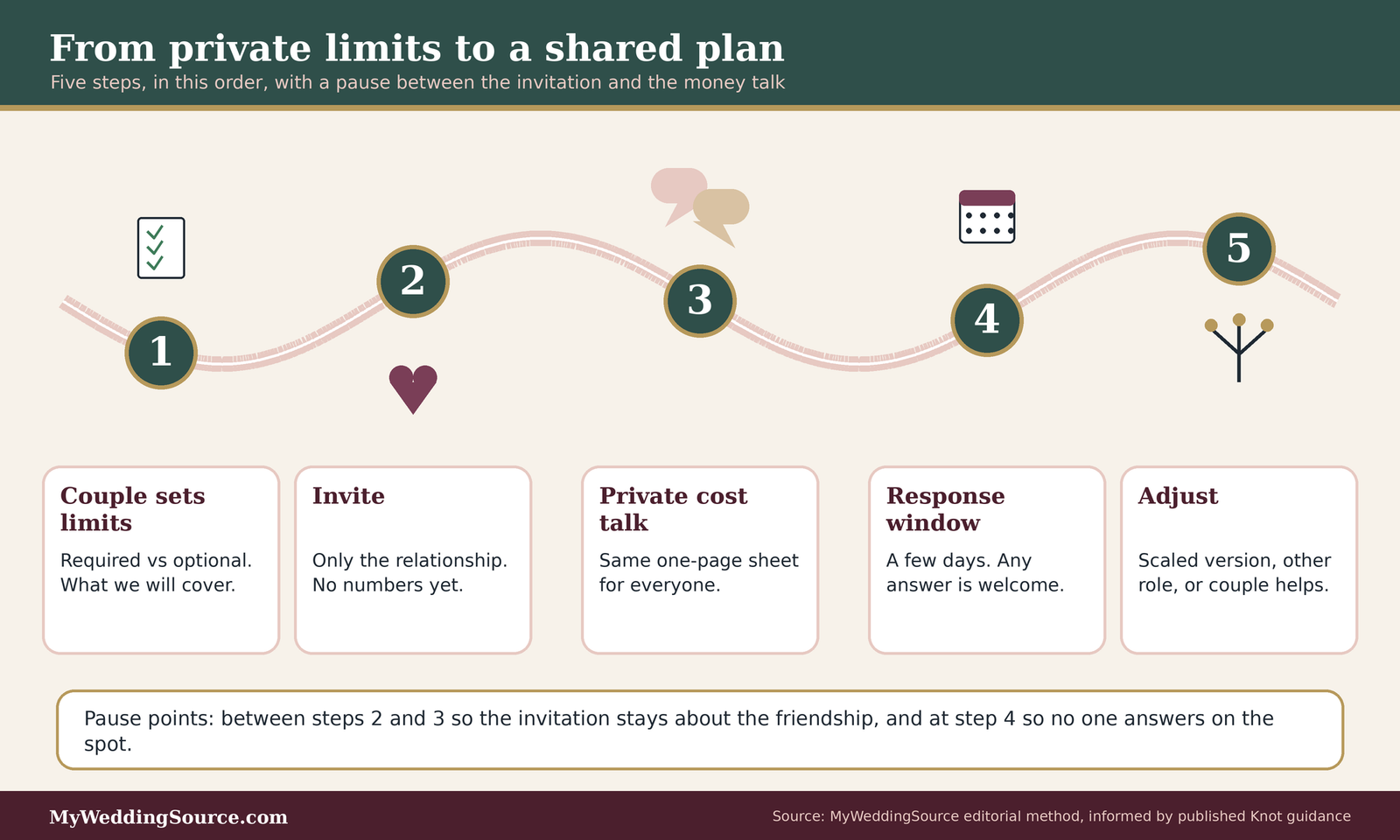
That is why we suggest splitting the ask into two moments: the invitation, which is purely about the relationship, and the cost conversation, which follows within a few days. The person has time to enjoy the invitation, then time to look at real numbers, then a clear and easy chance to tell you what works.
What the data says about financial slack
Financial slack varies more than most couples assume, even among people who seem to be doing well. In the Federal Reserve’s survey of U.S. adults fielded in October 2025, 63% said they would cover a hypothetical $400 emergency expense using cash, savings or a credit card paid off at the next statement, and 73% said they were doing at least okay financially. Read the other way, roughly a third could not cover a small surprise from their own resources in the way the survey defines it, and about a quarter were not doing okay. Those are national figures about adults in general, not about wedding parties, and we are not claiming they describe your friends. The point is smaller: in any group of five or six people, it is statistically ordinary for at least one to be running tight, and you cannot tell which one by looking.
Because you cannot tell, the fair approach is to treat every attendant the same way. Give everyone the same cost sheet, the same privacy and the same easy exit, and nobody has to explain themselves to get it.
Set your own boundaries before you ask anyone about theirs
The most common mistake in these conversations is asking attendants what they can afford before the couple has decided what it wants. A person who does not know the plan cannot judge whether it fits their budget, and a couple who has not decided what it will pay for cannot respond fairly when someone says a cost is too high.
Decide what you will cover, with a number
The first step in how to ask wedding party members about financial boundaries is knowing your own. You do not need to commit to an exact total before you ask, but you do need to know where your own limits are. This is a conversation the two of you have first, in private.
Required costs versus optional costs
Start by sorting every likely cost into two lists. A required cost is something you need every attendant to do for the wedding to look the way you want, such as wearing a specific outfit or being in a specific city on a specific day. An optional cost is something that is nice but not necessary, such as a destination bachelorette weekend or matching robes. The Knot’s guidance on bridesmaid expenses makes a related point: if you want professional hair and makeup but are not willing to pay for it, it advises against requiring it. The principle is simple. Anything you require is something you should be prepared to help with, and anything you are not prepared to help with should be optional.
This sorting step does the most work in the whole process. It turns a vague worry about whether people can afford things into a short, concrete question about each line: do we need this, and if we need it, who pays?
Where you will step in
Decide in advance how you will respond if someone says a required cost is out of reach. The Knot’s money guidance suggests several options for couples: scale back expensive plans so close friends can still take part, offer alternatives to paying such as helping with a task, give non-financial roles, and, where possible, offer financial help to someone who is struggling. Choose which of these you are willing to do before anyone asks, because deciding on the spot, with a friend waiting and a face-to-face conversation underway, is how couples end up promising more than they planned or refusing something they would have agreed to.
You might decide, for example, that you will cover the matching accessories, that you will pay for professional styling if you require it, and that you will allow any attendant to wear an outfit of their own choosing within a color family. You might also decide that the bachelor or bachelorette plan is entirely the group’s, with the couple’s only requirement being that it is local. The exact choices matter less than having made them.
What this actually costs
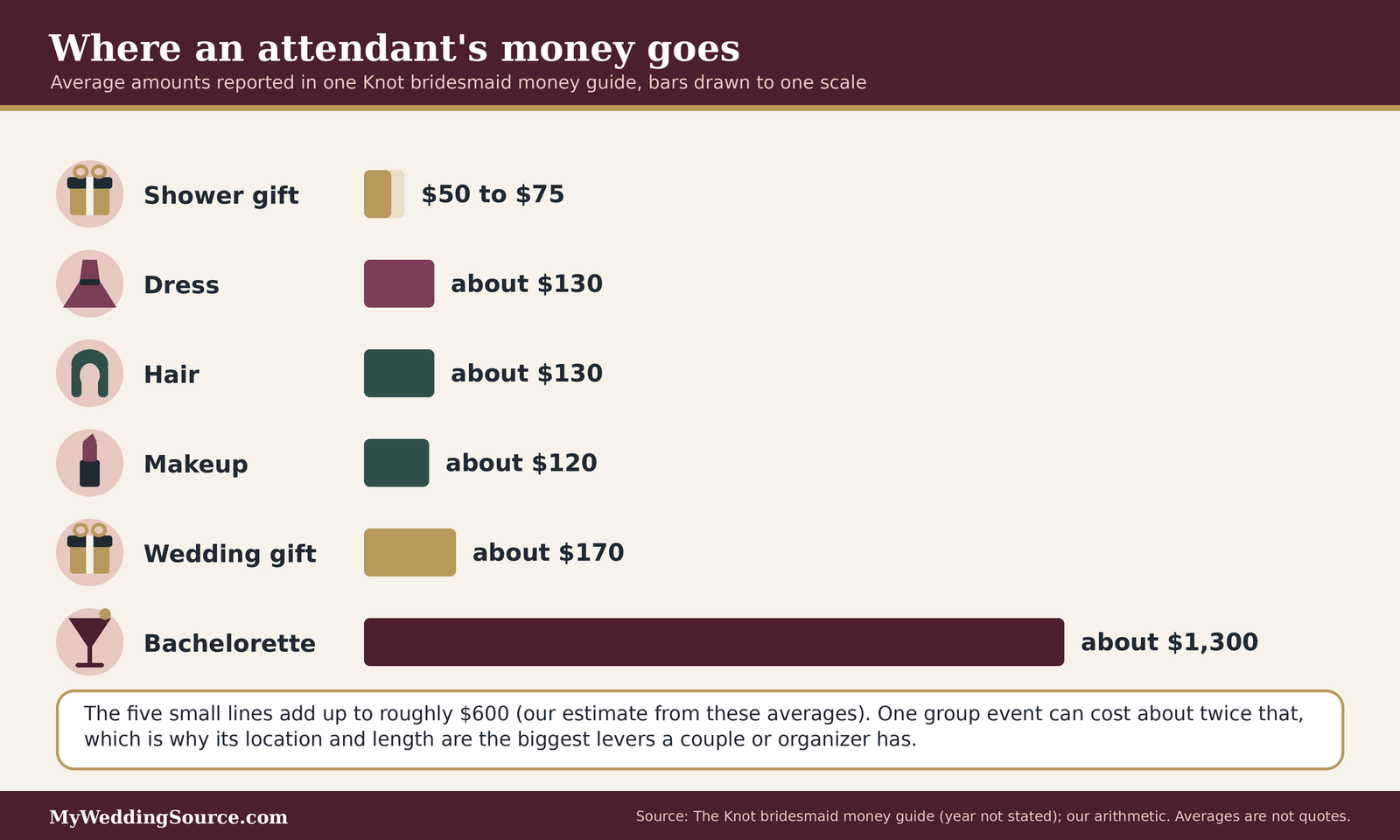
Figures in published guides are useful as a starting point and not as a prediction. One Knot guide to bridesmaid money matters reports averages of about $130 for a dress, $170 for a wedding gift, $130 for hair and $120 for makeup, with a bachelorette party averaging about $1,300 depending on location and lodging. A separate Knot guide to bachelor and bachelorette parties puts the average at over $1,000 per person. We could not confirm a publication year for either set of figures, and an average is not a quote for your city. Use them to see the order of magnitude, then replace them with real quotes. If a bachelor or bachelorette weekend is the largest single line, the biggest lever you have is whether it is a destination trip or a local one.
Write the one-page cost sheet
Once you know your limits, put them on a page that you can hand to each person. The sheet does two jobs: it removes the burden of remembering what was said, and it makes the conversation about the page instead of about the person.
What goes on the sheet
A useful cost sheet is short and plain. List each cost line, whether it is required or optional, who is expected to pay, a rough range or a “to be confirmed” note, and the date when you will know more. Leave out wording that sounds like a verdict. “Dress: attendant pays, range to be confirmed once the style is chosen, you may choose a different dress in the same color family” is better than “dress: your responsibility.”
Include the dates that matter: when a decision is needed, when a payment is due, and when travel needs to be booked. People manage money better when they can see when the money leaves their account. Also include the couple’s contribution, even if it is small. A line that says “we are covering accessories and bouquets” tells the person that the plan has been thought through on both sides.
What stays off the sheet
The sheet is not the place for the other attendants’ choices, for comparisons, or for anyone’s income. It should not include a “suggested” amount that quietly sets a social standard, and it should not include a line for something that has not been decided. If the plan for the bachelor or bachelorette event is not set, write “to be decided by the group, with a stated ceiling” and leave it at that.
Keep the sheet free of pressure too. A phrase such as “we need everyone to commit by Friday” is a deadline written as an ultimatum. A better phrase is “please tell us what works for you by the 15th, and we will adjust the plan if we need to.” One protects the plan, and the other protects the person.
If you want a deeper look at what the largest lines usually involve, our guides to bridesmaid dresses, groomsmen suits versus tuxedos and bridal party size can help you decide what to require. A smaller party often means a smaller total, and the number of people you ask is itself a financial boundary.
The ask: how to ask wedding party members about financial boundaries in person
With your own limits written down, you are ready to talk to people. The structure matters more than the exact words when you ask wedding party members about financial boundaries. The aim is to make it easy for the person to be honest, and to make honesty cheap.
Pick the channel and the timing
Where and when you ask money questions changes how people answer them. A public setting makes honest answers harder, and a rushed setting makes thoughtful answers impossible.
Ask privately, one person at a time
The Knot’s guidance suggests holding a one-on-one conversation with each attendant after you have chosen them, spelling out what you expect them to pay for, and giving them time to decide. A private conversation protects dignity. Someone who cannot afford a dress is far less likely to say so in front of five other people than in a phone call with you. A one-on-one also stops people from comparing themselves in real time and from anchoring on whichever person answered first.
Private does not have to mean in person. A phone call, a video call or a walk works well. If you prefer writing, send each person the same message individually, not through a group thread, and make sure the tone invites a reply. Whichever channel you choose, use the same channel and the same cost sheet for everyone, so no one feels they were handed a different standard.
Give a response window
Do not ask for an answer on the spot. A window of a few days to a week, stated plainly, gives the person time to look at their finances, talk with a partner, and decide without pressure. It also gives them time to think of an alternative that works. You are not asking whether they love you, which is the question a quick yes answers. You are asking whether the plan fits their year.
Say what happens after the window closes, too. Something like “we will check in again on the 15th, and if the plan needs to change we will tell you before we tell anyone else” is reassuring. It signals that you are going to keep this private and that a change is possible.
Scripts you can adapt
Words matter, especially when the topic is uncomfortable, so here is how to ask wedding party members about financial boundaries in plain language. The scripts below are starting points. Put them in your own voice, and keep the structure: a statement of care, the facts, an explicit easy exit, and a time frame.
A script for the invitation
“I would be honored to have you stand with me. Before you answer, I want you to have the full picture, because I would rather you say yes with open eyes than feel stuck later. I will send you a one-page sheet with what is expected, what is optional and what we are covering. Take a few days with it. If something does not fit, tell me, and we will work out what to change. And if the answer is that you would rather support us another way, that would mean just as much.”
Notice what the script avoids. It does not ask the person to disclose their finances, and it does not frame a “no” as a loss of the friendship. It also does not say “no pressure,” a phrase that often lands as pressure. It describes the process instead.
A script for the cost conversation
“Here is the list of what usually comes with the role, and what we are planning. The required items are marked. The optional ones are things we will decide together, with a ceiling that nobody has to go above. If any line is a stretch, we can change the plan: a different dress in the same colors, an outfit you already own, a local event instead of a trip, or a different role. You do not have to explain.”
The final sentence, “you do not have to explain,” is important. It spares people from justifying their finances, which is the part that makes them hesitate to speak up at all.
A script for when you do not know their situation
Sometimes you do not know whether someone is comfortable, and you do not want to assume. A neutral version works well:
“I am asking everyone the same questions, so please do not read anything into it. Are there any costs on this list that worry you? If so, I would rather hear it now, and we can find another way.”
The phrase “asking everyone the same questions” does real work. It tells the person that they are not being singled out, which makes it easier to answer honestly.
Make “no” and “yes, with changes” easy
An honest answer only happens when the person believes you can handle it. You can build that belief into the way you ask.
Offer non-financial roles
The Knot’s guidance for bridesmaids describes support that does not depend on spending: a private dinner, a mailed gift, or another role such as usher or speaker. For couples, it suggests giving attendants non-financial roles, such as a reading, a blessing or a special song. If someone cannot take on the full cost of the role, there may be a place for them that fits. Offer these as real options, not as consolation prizes. A reading or a toast can matter as much as a place in the lineup.
You can also offer a smaller version of the role. Someone might attend the wedding and the rehearsal but skip the bachelor or bachelorette weekend, or might stand with you but skip the shower travel. Making the optional parts truly optional is the surest way to allow people to say yes.
Offer scaled versions of the plan
The Knot’s guidance on attire suggests several ways to reduce cost for an attendant on a limited budget: a similar dress in the same color from another brand, splitting the cost of the original, or a mismatched look in which each person picks a dress within their budget. Its groomsmen guidance mentions wearing their own wardrobe where the groom allows it, which is usually cheaper, and sharing rentals or rooms for travel. Offering a menu of scaled versions up front means that no one has to ask for special treatment. The accommodation is part of the plan.
For deeper help with how outfits fit different people and budgets, see our guide to coordinating wedding party attire across different body types, which covers fit alongside cost.
A group-chat information architecture with a decision log
A group chat is the natural home for wedding party planning, and it is also where money conversations go wrong. Messages scroll away, people reply to the wrong message, and a single offhand comment about price can anchor the whole group. The fix is not fewer messages. It is deciding in advance what belongs where.
We use three layers: a private layer for anything personal about money, a group layer for decisions the whole party shares, and a short written record that survives the scroll. This is our own organizing method, not an industry standard, and you should adapt it to your group. Our sibling guide on wedding party group chat rules that reduce planning confusion covers the tone and etiquette of the chat itself.
Three layers: private, group and written
Each layer has one job. Mixing the jobs is what creates the trouble, so the rule of thumb is simple: if a message could embarrass one person, it does not belong in the group.
Layer one: private threads for personal money
Anything about one person’s finances belongs in a one-to-one thread between that person and the couple, or that person and the organizer. That includes “I cannot afford the trip,” “can I pay in installments,” and “could you cover my share.” The Knot’s guidance for bridesmaids suggests sharing a budget with the bride first and then with the group in a constructive way, which is the same order we recommend: private first, group second, and only if the person chooses.
Tell everyone this layer exists at the start. A sentence such as “if any cost is a problem, message me directly, and I will keep it between us” changes the group’s behavior, because people stop feeling they must announce their limits in front of others.
Layer two: the group chat for shared decisions
The group chat is for decisions that affect everyone and for logistics. It is a good place to ask “which weekend works for the bachelorette,” “what is our spending ceiling for the shower gift,” and “who is arranging the shuttle.” It is a poor place to ask “who can pay for the hotel,” because that question invites public answers.
Set a rule for money messages in the group: ceilings and options first, no individual amounts. Ask the group “what is the most each person is comfortable spending on this,” and let people respond with a number or a thumbs-up on a ceiling. The Knot’s guidance on bachelor and bachelorette parties recommends asking the group what they can afford before finalizing plans and sharing ballpark per-person costs early, and it suggests floating options such as destinations, themes and dates to gauge reactions. Those are group-level questions, so they belong in the group layer.
Layer three: a pinned decision log
The third layer of any plan for how to ask wedding party members about financial boundaries is a short written record, kept in a pinned message, a shared note or a single document. Each time the group settles something that involves money, one person writes it down. This prevents the most common group-chat failure, which is that three weeks later nobody can find or agree on what was decided.
Keep the log boring. It records what, who and when, and nothing else. It should not record individual excuses, individual amounts or any opinions about people. The aim is a plain record that anyone can open and read in thirty seconds.

The decision log template
A decision log works best when each entry is the same shape. The table below is one layout. Copy it into a note or a document and adapt the columns.
The fields that matter
| Date | Decision | Ceiling or amount per person | Required or optional | Decided by | Revisit by |
|---|---|---|---|---|---|
| Date of the conversation | One sentence stating what was agreed | The agreed limit, not anyone’s personal budget | Whether people must take part | Couple, organizer or group vote | A date, so decisions do not drift |
Each field earns its place. The ceiling field forces the group to agree on a limit instead of a plan. The required-or-optional field protects people who opt out. The decided-by field avoids later disputes about whether a choice was a suggestion or a ruling. The revisit-by field acknowledges that circumstances change.
Example entries
These entries are illustrations of the format, not recommendations, and the amounts are placeholders for you to replace.
| Date | Decision | Ceiling per person | Required or optional | Decided by | Revisit by |
|---|---|---|---|---|---|
| First week | Attire: each attendant chooses an outfit in the agreed color family | Ceiling set by the group, placeholder amount | Required | Couple | After the first fittings |
| Second week | Shower gift: one group gift | Ceiling set by the group, placeholder amount | Optional to join | Group vote | Before the shower invitations go out |
| Third week | Bachelor or bachelorette plan: local, one night | Ceiling set by the group, placeholder amount | Optional | Organizer, with group input | Before any deposit is paid |
| Fourth week | Lodging: room block at one hotel, with one cheaper alternative | Not set, hotel quotes pending | Optional | Couple | When quotes arrive |
Notice the pattern: attire is required because the couple has a vision for it, and nearly everything else is optional. If you find yourself marking many lines required, revisit the required-versus-optional sorting from earlier. Every required line is a line you are asking people to fund.
Rules for money in the group chat
A few simple rules keep the group layer calm. They sound strict, but in practice they let people relax.
Ceilings first, then ideas
Before anyone suggests a plan, agree on a ceiling. If someone proposes a villa weekend and the group has not set a ceiling, the proposal becomes the default. If a ceiling is set first, proposals have to fit inside it. The Knot’s bachelor and bachelorette guidance notes that destination choices can exclude people, since each guest pays their own flights and lodging, and that a lower-key local plan is an option if most of the group cannot afford an elaborate trip. Setting the ceiling first makes that decision automatic.
It also helps to separate the opinion from the vote. Let people share ideas freely, then ask for a response to a specific, costed option with a clear deadline. That keeps the loudest voice from setting the price.
Handle payments carefully
When one person fronts money, the group needs a simple, safe way to settle up. The Knot’s guidance notes that the maid of honor or best man often fronts costs and is reimbursed later, and it recommends choosing one organized, financially comfortable person to manage budgets and payments. If you are that person, you are handling other people’s money, which is a responsibility worth taking seriously.
The Federal Trade Commission’s consumer guidance on payment apps gives practical rules that apply here. Make sure you know who you are paying before you send money. Sending money through an app is like sending cash and can be very difficult to recover. If someone you know seems to be asking for money unexpectedly, confirm using a phone number you already know is real, since scammers sometimes pretend to be friends or family members. In a wedding group, that means one named person collects money, the name on the payment account matches the person everyone knows, and the details are shared once in the pinned note, not repeated in scattered messages. Our own suggestion, not the FTC’s, is to confirm payment details by voice the first time.
Vendor and source questions that protect your attendants
Many costs that reach attendants come through a third party: the attire shop, the hair and makeup artist, the hotel, the transport company. A vague answer from a vendor becomes an unexpected bill for someone else. Asking good questions before you commit protects the people you are asking to stand with you.
Questions to ask before attendants commit
- What is the total per person, including tax, shipping, alterations, and any fees, in writing?
- What are the payment dates, and is a deposit refundable if someone withdraws?
- Can an attendant order or rent individually, or must the group order together?
- What is the cutoff date for changes, and what happens after it?
- Is there a group rate or room block, and what are the cancellation and attrition terms?
- Who is financially responsible if a person drops out: the attendant, the organizer, or the couple?
- Which of these costs does the couple pay directly?
Attire and fitting terms
Clothing is the largest required line for most attendants, and the one with the most hidden steps. The visible price is rarely the final price.
Deposits, deadlines and withdrawals
Ask each shop what happens if a person has to withdraw after ordering. Custom orders and made-to-measure items are often non-returnable, so an attendant who leaves after ordering may owe money for something no one else can use. If you are the couple, decide in advance whether you will absorb that cost or ask the person to. Put that decision on the cost sheet. Nothing damages a friendship faster than a surprise bill after someone has already stepped back.
For rentals, ask about the return deadline, late fees and damage terms, and who handles the return. Our guide to groomsmen rental returns walks through those details, because the return is a part of the cost people often forget.
Alterations, accessories and extras
Ask whether alterations are included, whether shoes, ties or accessories are separate, and what the typical add-on costs are. The Knot’s guidance on groomsmen notes that accessories such as shoes, socks, cufflinks and ties are usually the attendant’s cost unless the groom gifts them. If you want specific pieces, buying them yourself is a clean, inexpensive way to control the look and the cost. Our guides to bridesmaid dresses and wedding party attire cover what to ask about specific styles.
Beauty, lodging and transport
These lines are the most variable, because they depend on where the wedding is and what you require. They are also the easiest to make optional.
Hair, makeup and styling
Ask the artist for an itemized quote per person, including any trial, travel or early-morning fee, and whether gratuity is included. We do not quote prices here because they vary widely by city and artist. On who pays, The Knot’s guidance is that if the bride wants professional services, she may pay as a gift or split the cost, and that requiring professional services without paying for them is not advised. Our guide to wedding hair and makeup cost covers the ranges and the questions to ask.
Room blocks, shuttles and travel
For lodging, ask the hotel for the block terms in writing: the rate, the cutoff date, whether the block carries an attrition clause that makes the couple responsible for unfilled rooms, and the cancellation policy. This is a case where a “yes” from the hotel is worth little until you have the paper. The Knot’s guidance notes that day-of transportation for the wedding party is typically arranged and paid by the bride’s family and that a night-before shared suite is typically paid by the bride if she wants it. Both are customs, not rules, so write down what you decide.
Showers, bachelor parties and bachelorette parties
The pre-wedding events are where wedding party spending most often runs past what people expected. They are also the events that couples have the least control over, because the attendants usually organize them. Your role is to set the tone, not the budget.
Who organizes, and who fronts the money
These events usually start with a well-meaning person who has a lot of energy and no formal budget. Without a plan, the costs grow with the enthusiasm.
Name one organizer and one ceiling
The Knot’s guidance for these parties recommends choosing one organized, financially comfortable person to manage budgets and payments, asking the group what they can afford before finalizing plans, and following up with a final total within a week or two after the party. Tell the organizer what you would like, and also tell them you do not want anyone stretched. Then let them run it. The couple should avoid proposing the plan, because a plan that comes from the couple feels like a requirement.
If you are the organizer, share a rough per-person cost before anyone pays a deposit, and say clearly which parts are optional. A person who can join the dinner but not the weekend should be able to do exactly that without comment.
The honoree’s share
Whether the group pays for the honoree is a decision that often goes unspoken and then causes friction. The Knot’s guidance calls covering the honoree a nice gesture but says it should not be an expectation, and mentions a common compromise: the honoree pays their own travel and lodging while the group covers meals, drinks and activities. If you are the honoree, offer to pay your own share, or say that you do not expect the group to cover it. That one sentence takes pressure off everyone.
Choosing a plan the least-resourced person can join
The simplest test for any group event is whether the attendant with the tightest budget could join without hardship. If the answer is no, the plan is probably too big.
Let the ceiling choose the plan
Ask what the group is comfortable with, then pick the plan that fits the lowest comfortable ceiling. The Knot’s guidance suggests that if most of the group cannot afford an elaborate trip, a lower-key local party is the better option. It also points out that costs per person fall as group size grows, but cautions against inviting people just to lower costs. Treat those as separate decisions: choose the guest list for the relationships, and choose the plan for the budget.
If you are weighing destination options, our guide to destination wedding etiquette covers how costs fall on guests and attendants when travel is involved.
Include people who cannot attend
The Knot’s guidance suggests that guests who cannot afford to attend can still be included through a group video call or a surprise gift. That principle applies to attendants as well. Someone who cannot make the weekend can join a dinner by video, contribute a note, or be part of a group gift. Offering that in the first message tells people their absence will not be read as a lack of love.
Edge cases: what to do when the conversation does not go to plan
Even a well-run plan for how to ask wedding party members about financial boundaries meets surprises. These are the situations we see most often, with a suggested response for each. They are suggestions, not rules, and you know your people best.
When someone declines or hesitates
A decline is information, not a verdict. How you respond decides whether the friendship survives it.
A late withdrawal
The Knot’s guidance observes that people who step back late often do so for money reasons. If someone withdraws after the group has made commitments, respond with thanks first and logistics second. Ask what, if anything, they have already paid for and whether any of it can be returned or reassigned. If the couple absorbs a cost, say so plainly and do not suggest it was an inconvenience.
Then change the plan if needed. A wedding party of five is not a failure, and a lineup that is slightly uneven is a normal wedding. Our guide to bridal party size covers how to think about the shape of the party, and our sibling guide on handling a wedding party member who cannot travel covers the related situation where distance is the obstacle.
Someone hesitates but will not say why
Sometimes a person does not decline but goes quiet. Do not push. Send one gentle follow-up that repeats the offer of private conversation and the menu of alternatives, and then give them space. Silence is often someone waiting until they are sure what they can do. If the response window passes, check in once by phone, with no accusation, and restate that any answer is fine.
When someone offers to pay more, or less, than their share
Generosity and constraint both complicate a fair plan. Neither should be handled in public.
A generous offer to cover someone else
Sometimes one attendant offers to cover another’s costs. That is kind, and it can also create an obligation the second person did not ask for. If you hear about it, suggest that the offer be made privately and that the receiving person can accept or decline with no explanation. Do not log it in the group note. The decision log records group decisions, not private favors.
A request for help from the couple
If an attendant asks for financial help, thank them for trusting you and take time before you answer. The Knot’s guidance notes that couples might offer financial help to a bridesmaid who is struggling. Whether you do is your decision, and you can decide on terms that feel right to you: covering a specific line, such as the outfit, is cleaner than an open-ended offer. Say what you are covering in writing, and keep it private. If you cannot help, say that kindly and offer one of the scaled alternatives instead.
When other people want a say
The wedding party is rarely the only audience. Families and friends often have views about what attendants should do and pay.
Family members who set expectations
A parent or relative may announce what attendants should wear or pay for, based on their own experience. Thank them and tell them the couple is handling it. Emily Post describes the traditional division of costs as guidelines that are often shared among the couple and both families, so you can say honestly that you are deciding what suits your group. If a family member offers to contribute, accept in a way that does not tie strings to the attendants’ choices.
An organizer who overreaches
Sometimes the person running the bachelor or bachelorette plan makes choices that exceed the ceiling the group agreed. Point to the decision log, not to the person. “Our note says the ceiling is the agreed amount, so can we find a version that fits?” is a neutral way to bring a plan back inside its limits, and it relies on the agreement and not on an argument.
Mixed groups and inclusive assumptions
A wedding party is made up of people with different incomes, family situations and identities. A plan built on assumptions about any of those will fit some people and miss others.
Do not assume by role or gender
The Knot’s glossary of inclusive terms suggests “wedding attendants” in place of gendered group names, and “person of honor” as a neutral alternative for the lead role, and it advises asking the person which title they prefer and using it. Costs should follow the same logic. A person standing on one side of the lineup may be asked to wear something different from the rest, and the cost, the fit and the comfort should be discussed with them directly, not assumed from a category. Our sibling guide on coordinating attire for a mixed-gender wedding party goes deeper on that topic.
Do not assume anyone’s circumstances from their job, family or lifestyle. A person who seems comfortable may be supporting relatives, paying down debt or saving for something else. The reason to give everyone the same sheet, the same privacy and the same exit is that you do not need to know.
Different resources, different histories
Some attendants are close friends who can contribute generously, some are relatives who feel obliged, and some are newer friends who have said yes out of enthusiasm. Their budgets may differ widely, and so may their comfort in saying so. If the group includes a student, someone between jobs or someone supporting family, the scaled-version approach is not just polite, it is what allows them to say yes at all. Keep the standard attainable for the person with the least, and let those with more contribute through choices that do not set the bar for everyone else, such as a gift they give privately.
Keeping the agreement alive until the wedding
A conversation about how to ask wedding party members about financial boundaries is not finished when the first answers come in. An agreement made in spring can become stale by autumn. Prices change, jobs change, and plans grow. A little maintenance keeps a good agreement from quietly breaking.
Checkpoints that catch problems early
You do not need frequent meetings. You need a few moments at which the plan gets a quick, honest review.
Revisit dates in the decision log
The revisit-by column in the decision log is the mechanism. When a date arrives, the organizer asks one question in the group: “Does this still work?” People who are fine will say yes, and a person who is struggling can message the organizer privately. A quick check costs nothing and avoids the situation where someone silently stretches past what they can afford.
Add one extra checkpoint after the largest payment, usually the attire or the travel booking. People often relax after a big purchase and are more willing to mention a new problem.
When costs change
If a cost rises, tell people right away, privately where it affects one person and in the group where it affects everyone. Do not hide an increase and hope it washes out. The Knot’s guidance for couples is to raise new expenses before making plans final, and that applies to every change. Offer the same scaled options you offered at the start, and update the log.
Closing the books
When the wedding is over, the money conversation should end as cleanly as it began.
Settle up promptly
The Knot’s guidance suggests following up with a final total within a week or two after a group party. The same applies to the wedding itself: if one person fronted anything, settle it quickly and in writing. Delayed reimbursement is a quiet source of resentment, and it is easy to avoid.
Say thank you, and mean the specifics
Thank each attendant for the specific things they did, and be honest about the cost they bore. Our guides to bridesmaid gifts and groomsmen gifts cover the thank-you gift, and our maid of honor duties and best man duties guides cover the lead roles. A thank-you that names the effort, such as “thank you for taking on the weekend planning,” lands better than a generic one.
Starting the conversation
When should I ask wedding party members about financial boundaries?
Ask within a few days of the invitation, not at the same moment. Let the person enjoy the invitation first, then hold a private conversation with a one-page cost sheet and a response window of several days. That sequence keeps the relationship and the budget conversation separate, so neither one feels like a trap.
Should I ask about finances in the group chat or privately?
Privately. A one-on-one conversation lets people be honest without comparing themselves to others. Use the group chat only for decisions that affect everyone, such as spending ceilings, dates and logistics, and invite anyone with a personal concern to message the couple or organizer directly.
What if I do not know what my friends can afford?
You do not need to know. Give every attendant the same cost sheet, the same privacy and the same easy way to adjust, and ask the same open question of everyone: are any costs on this list a concern? Treating everyone identically lets people speak up without being singled out.
Handling the answers
What should I say if someone says they cannot afford a cost?
Thank them for telling you, and do not ask for details. Offer scaled options: a different outfit in the same colors, a local event instead of a trip, a smaller version of the role, or a non-financial role such as a reading or toast. Decide privately whether the couple can help with a specific cost.
Can a wedding party member decline without ruining the friendship?
Yes, if you make it clear in advance that a decline is welcome. Say so in your first message, offer other ways to be involved, and respond with thanks and not disappointment. People usually step back out of concern for their finances, not lack of care, and a warm response protects the friendship.
Costs and agreements
Who is expected to pay for what in a wedding party?
Etiquette sources describe a customary pattern: attendants pay for their own attire, travel and a gift, while the couple pays for items it requires beyond that, such as bouquets or professional styling. These are traditions, not rules, so decide what suits your group and write it down.
What should be in a cost sheet for attendants?
List each cost line, whether it is required or optional, who pays, a range or a note that it is to be confirmed, and the date a decision or payment is due. Include what the couple is covering. Keep the tone neutral, and leave out anyone’s personal budget or other attendants’ choices.
How do I keep money conversations from taking over the group chat?
Set three layers: private threads for personal money, the group chat for shared decisions with ceilings agreed before ideas, and a short pinned decision log recording what was agreed. Ask for no individual amounts in the group, and point to the log when plans drift past the agreed limit.
Your next steps
Before you ask anyone
Settle your own limits
Sit down together and sort every likely cost into required and optional. Decide what you will cover, what you will help with and what you will leave to the group. Our wedding budget guide can help you place these decisions inside the larger plan.
Draft the one-page cost sheet
Write the sheet in plain language, with dates and a clear note about what the couple is covering. Read it as if you were the person with the tightest budget, and change anything that sounds like pressure.
When you are ready to talk
Hold the private conversations
Ask each person individually, with the same sheet and the same response window, and make sure that a “no” or a “yes, with changes” is clearly welcome. Add each conversation to your wedding planning checklist so none are missed.
Set up the three layers
Create the group chat, tell people that private threads exist for money, pin a decision log, and agree on a ceiling before anyone suggests a plan. Revisit the log on the dates you set. For ideas on who pays for the wider plan, see our guide on how to pay for a wedding.
Sources & methodology
How we built this guide
What we relied on
This guide combines published etiquette guidance from The Knot and Emily Post, a Federal Reserve household survey, and Federal Trade Commission consumer guidance on payment apps. The Knot and Emily Post figures and customs are editorial guidance, not legal rules, and the dollar averages cited come from The Knot articles named below, for which we could not confirm a publication year. The group-chat layers, the decision log layout, the cost sheet and the scripts are our own editorial methods, not an industry standard. Sources were fetched and read on November 12, 2026.
What we did not do
We did not survey attendants, test any payment app, or give financial, tax or legal advice. Prices, customs and app policies change, so verify current terms with each vendor and provider.
Source list
Government and regulatory sources
- Federal Trade Commission, Making Mobile Payments: Protect Yourself from Scams: https://consumer.ftc.gov/making-mobile-payments-protect-yourself-scams
- Federal Trade Commission, Consumer Alert, Do you use payment apps like Venmo, Cash App or Zelle? Read this (August 2023): https://consumer.ftc.gov/consumer-alerts/2023/08/do-you-use-payment-apps-venmo-cashapp-or-zelle-read
- Federal Reserve Board, Economic Well-Being of U.S. Households in 2025, Executive Summary: https://www.federalreserve.gov/publications/2026-economic-well-being-of-us-households-in-2025-executive-summary.htm
Etiquette and wedding-industry sources
- Emily Post Institute, Wedding Expenses: The Traditional Division: https://emilypost.com/advice/wedding-expenses-the-traditional-division
- The Knot, Bridesmaids and Money Matters: https://www.theknot.com/content/bridesmaids-money-matters
- The Knot, What Bridesmaids Pay For: https://www.theknot.com/content/what-bridesmaids-pay-for
- The Knot, Bridesmaid Budget Tips: https://www.theknot.com/content/bridesmaid-budget-tips
- The Knot, Who Pays for Wedding Party Attire: https://www.theknot.com/content/who-pays-forwedding-party-attire
- The Knot, What Groomsmen Pay For: https://theknot.com/content/what-groomsmen-pay-for
- The Knot, Who Pays for Bachelor and Bachelorette Parties: https://www.theknot.com/content/who-pays-for-bachelor-and-bachelorette-parties
- The Knot, A Glossary of Gender-Neutral Titles and Inclusive Wedding Terms: https://www.theknot.com/content/alternative-wedding-titles-equally-wed
- The Knot, 2026 Real Weddings Study (survey of couples married in 2025; the page we read gave no attendant-cost figures): https://www.theknot.com/content/real-weddings-study