
Best man duties are a mix of a few fixed jobs, such as keeping the rings safe and signing the license, and a larger set of favors that depend on the groom, the couple’s plan, and your own budget, so the useful move is to sort the two early and write the list down.
Quick answer
The best man duties that every major source we read agrees on are these: help the groom and his groomsmen stay organized before the wedding, keep the rings secure and hand them over at the right moment, stay close to the groom on the day, sign the marriage license as a witness if asked, and give a toast at the reception. A typical toast runs about two to five minutes, according to Zola. Almost everything else, including who pays for the bachelor party, who drives, and whether you carry the officiant’s envelope, depends on the couple, so ask them directly and confirm in writing. This guide gives you a timeline, a ring-custody plan, a speech plan, a cost estimate, and a way to say no without damaging the friendship.
What best man duties include, and what they do not
If you have just been asked, the first thing to know is that there is no single official list. Etiquette sources overlap heavily, but they were written by different publishers for different readers, and they disagree in small ways. That is good news, because it means the couple’s preferences carry more weight than any article, including this one. Before you build a plan around best man duties, it helps to see where the sources agree and where they leave room for judgment.
What the main sources agree on
We compared guidance from The Knot, Zola, Emily Post, and WeddingWire. Their lists are not identical, but the same few jobs appear in all of them. Those are the jobs to treat as firm.
The shared core of the job
Four items show up in nearly every list we read. The first is keeping the wedding rings safe and handing them over when the officiant asks. The second is standing next to the groom during the ceremony. The third is signing the marriage license as a witness, usually together with the maid of honor. The fourth is giving a toast at the reception. Around those four, the sources also describe a coordinating side to best man duties: you are the person who keeps the groomsmen on schedule, relays information so the groom is not fielding questions from everyone, and helps with the bachelor party. Zola describes the best man as the person who leads the groomsmen and mediates between them and the groom, which is a useful way to think about it: you are the point of contact for that group.
Where the sources differ
The differences are small but they matter in practice. Emily Post’s page says the best man keeps the bride’s ring during the ceremony, while The Knot and Zola describe him as keeping track of the rings more generally. The Knot says the best man gives the officiant a sealed envelope with the fee, while WeddingWire says to confirm with the couple whether that is your job at all. Emily Post’s list also includes dancing with the bride, the mothers, the maid of honor, and other single female guests, which reads as an older convention; WeddingWire’s version is more relaxed and mentions getting the dancing started with the maid of honor and dancing with the bride. When sources disagree about best man duties, the sensible reading is that the point is covered either way, and the couple chooses who does it. Write down their choice so nobody is guessing on the day.
Duties versus favors
The most common mistake new best men make is treating every item on a long checklist as an obligation. Several tasks in published lists are described as optional or dependent on the couple. Zola, for example, says keeping an eye on the groom’s drinks and food at the reception is not required, and that pre-wedding events are yours to attend and help with “unless otherwise communicated.” Separating the fixed from the flexible in best man duties protects your time and helps you protect the couple’s plan.
A three-tier test: fixed, usual, and only if asked
Here is a simple method for sorting best man duties. It is our own suggestion, not an etiquette rule. Put each task in one of three tiers. Fixed tasks are the ones tied to a moment that cannot be repeated: the rings, the license signature, the toast, and being where the timeline says you must be. Usual tasks are the ones most best men do, such as leading the groomsmen group, collecting attire measurements, and organizing a bachelor party, but where the scale is negotiable. Only if asked tasks are the extras, such as driving the couple, decorating a getaway car, holding checks, or managing a guest who has had too much to drink. Naming the tier makes it easy to say yes to the first, plan the second, and agree on the third in advance.
Who to ask when the list is unclear
If a task among best man duties is not obviously yours, ask the groom first and the planner or venue coordinator second. WeddingWire suggests introducing yourself to the venue coordinator or planner on the wedding day and getting the day’s timeline from the couple. That advice scales back to earlier months: if the couple has a planner, ask what the planner already covers so you do not duplicate it. Zola points out that a wedding planner may already provide an emergency kit, for example. Our wedding planning checklist is a good reference for what a couple is typically tracking, so you can see which items are likely already owned by someone else.
A timeline for best man duties, from the first “yes” to the morning after
Best man duties are mostly small tasks spread across many months, and the work that goes wrong is usually the work that was left until the last week. The timeline below is organized by dependency, meaning each step is placed before the thing that cannot happen without it. Only a few dates come from published sources; we flag them as we go, and the rest are our suggestions that you should adjust to your own wedding.

The months before the wedding
The earliest best man duties are about people and decisions rather than objects. You are building a small working group and getting the information that everything else depends on. Our wedding party attire guide is the broader reference for the wedding party as a whole, and it pairs well with this section.
Have the first conversation with the groom
Before you contact anyone else, spend an hour with the groom. Ask what he wants from you and what he does not want. Ask how many groomsmen there are, whether anyone is likely to need extra support or flexibility, and what the couple’s date, venue, and dress code are. Ask whether he wants a bachelor party at all, and if so, what kind. WeddingWire’s guidance is to plan around the groom’s preferences, not your own, and Zola says the groom decides who is invited to a bachelor party. Write the answers down in one note and share it with the groom so that you both have the same version. If you do nothing else in this stage, do this one.
Set up the group and the attire deadline
Once you know who is in the party, start one group thread and use it for everything. WeddingWire suggests introducing the groomsmen once the engagement, date, and venue are set, either in person if you live near each other or by group chat or email if not. The attire step has the first published timing: Zola says the best man should collect each groomsman’s measurements and send them to the shop or tailor two to four months before the wedding, relay the groom’s choices on details like tie color and shoes, and confirm everyone meets the rental or purchase deadline. The Knot adds that if everyone is matching, ordering as a group may save money. Our groomsmen suits vs tuxedos guide explains how to compare rental and purchase quotes so that the deadline you set is a realistic one.
Help out-of-town groomsmen book travel early
WeddingWire advises getting groomsmen to book flights and hotels early, especially if the couple has a room block, and pairing people to share rooms or rental cars. Zola says the best man can help arrange lodging for out-of-town groomsmen. The reason to do this early is not etiquette; it is cost. A groomsman who finds out about the trip late pays more, and a groomsman who cannot afford the trip may need time to decide whether to stay in the party. Ask each person to confirm travel plans by a date you choose, and keep a simple list showing who has booked.
The final month and the final week
As the date approaches, best man duties shift from deciding to confirming. This is the stage where a few phone calls and messages prevent most wedding-day problems. We suggest treating the final week as a handoff window, and the table later in this guide shows how to structure it.
Confirm the details that cannot be fixed on the day
About a month out, check that every groomsman has what he needs: attire ordered and delivered or fitted, shoes, any accessories the groom specified, and a clear arrival time. Ask the groom or planner for the final timeline and read it for gaps, such as a gap between when the wedding party must be at photos and when transportation arrives. The best man’s role as a “time enforcer,” in The Knot’s words, starts here. If you notice that a groomsman has not responded to the group thread, call him instead of sending another message.
Attend the rehearsal and the rehearsal dinner
The Knot and WeddingWire both say the best man attends the ceremony rehearsal and the rehearsal dinner, which usually take place the day before the wedding. The rehearsal is where you learn where you stand, when you walk, and who you are paired with at the recessional. The dinner is a chance to meet the couple’s relatives and the other attendants. The Knot also notes that a best man may be asked to give his toast at the rehearsal dinner instead of, or as well as, at the reception, so confirm that detail with the couple well ahead of time.
The wedding day, in order
On the day, best man duties come down to three things: keep the group moving, keep the groom calm, and keep the small objects safe. A good approach is to think in four blocks: morning, ceremony, photos and reception, and send-off. Each block has a short list of things that only you are positioned to do.
Morning: be the calm one
Zola suggests getting dressed with the groom and helping him stay calm, with music and drinks if the groom wants them, while making sure he eats and drinks water before the ceremony. The Knot adds that you might help with dressing and ties, deliver a letter from the groom to his future spouse if he has written one, and hold his phone. Pack a basic emergency kit; Zola and WeddingWire both list items such as a sewing kit, stain remover, first aid supplies, spare socks, and a spare tie, and WeddingWire adds cash. Confirm that boutonnieres are pinned on before the processional, as WeddingWire advises.
Ceremony: place, pace, and rings
Among best man duties at the altar, the first is to stand beside the groom. The Knot says the best man walks in after the groom in the typical ceremony, and before him at a Jewish wedding, while WeddingWire says he walks solo in the processional and pairs with the maid of honor for the recessional. Because ceremonies differ by tradition, the rehearsal is the authority. Pass the rings when the officiant asks, and sign the license as a witness before or after the ceremony as the couple’s plan requires.
Photos and reception: be useful, not busy
Another of the best man duties on the day is to gather the groomsmen for their photographs and keep them focused, as Zola suggests. Our wedding photographer shot list shows the kinds of group photos couples commonly ask for, which is a useful prompt when you ask the couple which groupings they want and who needs to be ready when. At the reception, The Knot describes the role as an “unofficial host”: help guests find seats, check on the wedding party, and keep the mood social. Our wedding reception guide is a good companion when you want to see how the evening fits together before you decide when to slip away and collect your notes before the toast.
Send-off: gifts, cards, and the getaway
Among best man duties at the send-off, The Knot says the best man may collect gifts or cards handed to him and deliver them to the gift table, card box, or a secure room, and may be asked to hold checks safely until the couple returns from their honeymoon. If you hold anything of value, give it to a named person and write down who and when. Decorating a getaway car is something The Knot says to do only with the owner’s permission, and Zola notes it may not be allowed if the couple hires a transportation company.
After the wedding: the loose ends
The wedding is not quite over when the music stops, and neither are best man duties. Several published lists include tasks for the next day, and they are the ones most often forgotten.
Return the rentals
Among the after-wedding best man duties, Emily Post says the best man returns the rented attire the next business day, and the Knot lists returning rented attire among the after-reception tasks. Do not assume the rental company will wait. Ask each groomsman to leave his items in a labeled bag at the end of the night, and agree in the group thread who drops them off. When the group orders, ask the seller for the return deadline and any late-fee terms in writing, so the returns plan has a real date on it.
Close out payments and gifts
The Knot says the best man may help tip and pay vendors and transport gifts to a safe location or the couple’s home. Emily Post says the best man makes sure prearranged payments to the officiant, assistants, musicians, and singers are handed out. These tasks require trust and a clear list. Agree with the couple on who is paying whom, how much, and in what form, and get the envelopes labeled before the wedding. Keep receipts or a written note of what you handed over. This is general etiquette, not financial advice, and the couple’s contracts decide who actually pays what.
The whole job on one sheet
Timelines are easier to follow when best man duties live in one place. The table below puts the main tasks, the person who owns each, the date by which it should be true, a test for when it is done, and the thing that blocks it. Only the two-to-four-month attire window and the next-business-day return come from published sources, as noted in the table. The other dates are our suggestions and should move to fit your wedding.
| Task | Owner | When | Done when | Blocked by |
|---|---|---|---|---|
| First conversation about what the groom wants | Best man and groom | Soon after you say yes | A shared note lists his wishes, the party, the date, the venue, and the dress code | The couple’s date and venue |
| Start one group thread | Best man | Within a week of that talk | Every groomsman has joined and shared contact details | The groom’s list of groomsmen |
| Relay the attire choices | Groom decides, best man relays | Before anyone orders | Written details on color, style, and accessories are in the thread | The dress code |
| Collect and send measurements | Each groomsman, best man collects | Two to four months before (Zola) | The shop confirms every order | The attire decision |
| Confirm travel and lodging | Each groomsman | A date you set, early | The list shows every person booked | The room block or date |
| Agree the bachelor party budget | Best man, group, groom’s wishes | Before booking anything | Every invited person has accepted a per-person estimate | The groom’s wishes |
| Draft and time the toast | Best man | Two weeks before (our suggestion) | It fits the slot, and one friend has heard it | The slot in the schedule |
| Confirm the ring plan | Couple and best man | By the rehearsal | Everyone can say who holds which ring | The couple’s choice |
| Hold the final timeline | Best man | One week before (our suggestion) | A copy is saved offline and printed | The planner or couple |
| Label envelopes for payments | Couple supplies, best man hands over | Before the day | Each envelope names its payee, with a list | The couple’s contracts |
| Return the rentals | Best man and groomsmen | Next business day (Emily Post) | A return receipt or confirmation | The wedding itself |
How to use the sheet
Copy the table into a shared note, add names and dates, and delete rows that do not apply. A task with two owners usually has none, so choose one name for every row, even when several people help. Zola’s description of the best man as the person who keeps groomsmen on track fits this: you are not doing every task, you are making sure each task has an owner and a date. Review the sheet once a month, and weekly in the final month.
Keep one version
Several versions of the plan for best man duties are worse than one imperfect plan. Pick a single place for the sheet and the latest timeline, and post a link in the group thread. When the couple changes a start time or a venue detail, replace the old version instead of adding a new one, and write the date of the update at the top. If something in the thread contradicts the sheet, the sheet wins until you update it. This habit costs a minute and prevents the most common wedding-day confusion, which is two people holding two different start times. Our wedding planning timeline is a useful comparison, because your sheet depends on dates the couple sets.
Questions to ask the groom in your first conversation
- What do you want me to handle, and what do you want me to leave alone?
- Who else is in the wedding party, and who will be my contact on the bride’s or partner’s side?
- Is there a planner, and which of these tasks does the planner already cover?
- Do you want a bachelor party, and if so, what budget and what style fit you?
- Should I carry both rings, or only one, and is there a ring bearer?
- Am I paying the officiant or anyone else on the day, and in what form?
- Will you want your toast at the rehearsal dinner, the reception, or both?
- Who will drive you and your partner at the end of the night?
Keeping the rings safe: a custody plan
Of all the best man duties, the ring job is the one with the clearest failure mode. A late groomsman can be waited for, and a stumbled toast is forgiven, but a missing ring stops a ceremony. This part of best man duties is simple in principle and easy to get wrong in practice, because the rings change hands several times and each handoff is a chance for confusion. A short written plan removes most of the risk.
Who holds which ring, and when
The sources describe the same moment in slightly different ways, so start by learning which version your couple expects. This is a question for the groom, the partner, and the officiant, and it takes two minutes to settle.
What the sources say about custody
Emily Post’s page says the best man keeps the bride’s ring during the ceremony, which fits the older convention in which the maid of honor holds the groom’s ring. The Knot describes the best man as keeping the wedding rings safe in a reliable pocket and handing them over when the officiant asks, and Zola says he keeps track of the rings before and during the ceremony. If the couple uses a ring bearer, The Knot says the best man may fasten the rings to the pillow before the processional and take them from the ring bearer at the end of the aisle. The practical reading is that custody varies, and the safest plan is the one everyone has heard out loud at the rehearsal: who has which ring, in which pocket, and who hands it to whom.
Choose the pocket and keep it the same all day
Pick one pocket, and use it only for the rings. An inside jacket pocket is a common choice, and our suggestion is a pocket that closes, if your jacket has one, because a ring box can slide out when you sit or lean. Do not move the rings between pockets as the day goes on. Before you leave for the ceremony, touch the pocket, and touch it again before you walk in. If you want background on the rings themselves, our wedding rings and wedding bands guides are the places to start, and a quick look at the actual rings with the couple before the day helps you recognize them in the box.

From the couple to the officiant: a handoff you can document
A chain of custody is a record of who had an object, when, and in what condition. You do not need to be formal about it, but a simple version protects you and the couple, because it replaces memory with a note.
Write a handoff note
When someone gives you the rings, ask three questions and write the answers in your phone. Which rings are these, and is each one clearly labeled? Does either ring need anything done before the ceremony, such as sizing or ring engraving that has not been collected? And who else, if anyone, has a backup, such as a ring bearer or a family member? Then take a clear photo of the rings in the box and send it to the person who gave them to you. This is our own suggestion, and it takes less than a minute. It means that if a ring is later thought to be missing, there is a timestamped record of the last place it was seen.
Hand them over, and say so
When the rings leave your hands, say so out loud to whoever receives them and ask them to confirm: “These are the two rings, one for each of you.” If the officiant takes them for a moment, ask the officiant where they will be kept. A short exchange feels awkward only for a second, and it removes the question of where the rings are. If you are unsure whether to raise this with the officiant at the rehearsal, our wedding officiant guide is a useful background read.
When the rings have to travel
At a destination wedding or a wedding far from home, best man duties include getting the rings there, and they travel with you or with the couple. This is where the risk concentrates, because airports and rental cars add chances to lose or leave an item behind.
Flying with the rings
TSA advises keeping valuable items such as jewelry on your person instead of packing them in checked bags. TSA also says that if you are carrying valuables, you can ask for a private screening of yourself and those items, and that the TSA officer has the final say on whether any item goes through the checkpoint. Our suggestion is to carry the rings in a small bag that stays attached to you, not in the overhead bin, and to keep the box closed in a pocket while you go through screening. If you are asked to open it, do so calmly and have the photo from your handoff note ready.
Insurance and what to ask the couple
Whether the rings are covered by an insurance policy is something only the couple can answer, and the answer depends on the policy. We cannot tell you what a given policy covers, and this is not insurance advice. What you can do is ask whether the rings are insured, what the policy requires if a ring is lost, and who should be called first. If the couple wants to read more, our engagement ring insurance guide and wedding insurance guide are the related reads. Keep the policy phone number in your handoff note.
If a ring goes missing or gets dropped
If a ring drops during the ceremony, stay still, tell the officiant quietly, and let people look; do not crouch and search while the whole room watches, unless the ring is clearly within reach. Before the day, ask the officiant what the plan is if a ring is delayed. One option, which is our suggestion and not a rule, is to agree that the ceremony continues and the ring is placed afterward. Legal requirements for a valid marriage come from the license and the state’s rules and not from the ring, so ask the officiant or the county clerk if you want to confirm what your state requires. If a ring is lost before the ceremony, tell the couple immediately, retrace the day with the photo and the note, and call the insurer if there is a policy. Early honesty is much better than delayed honesty.
The toast: length, shape, and what to leave out
The toast is the most visible of all the best man duties, and it is also the one people dread most. A short plan helps. It does not need to be a perfect speech; it needs to be short, specific, kind, and finished on time. The advice below on this part of best man duties combines Zola’s published guidance with our own suggestions, which we label as such.
How long the toast should run
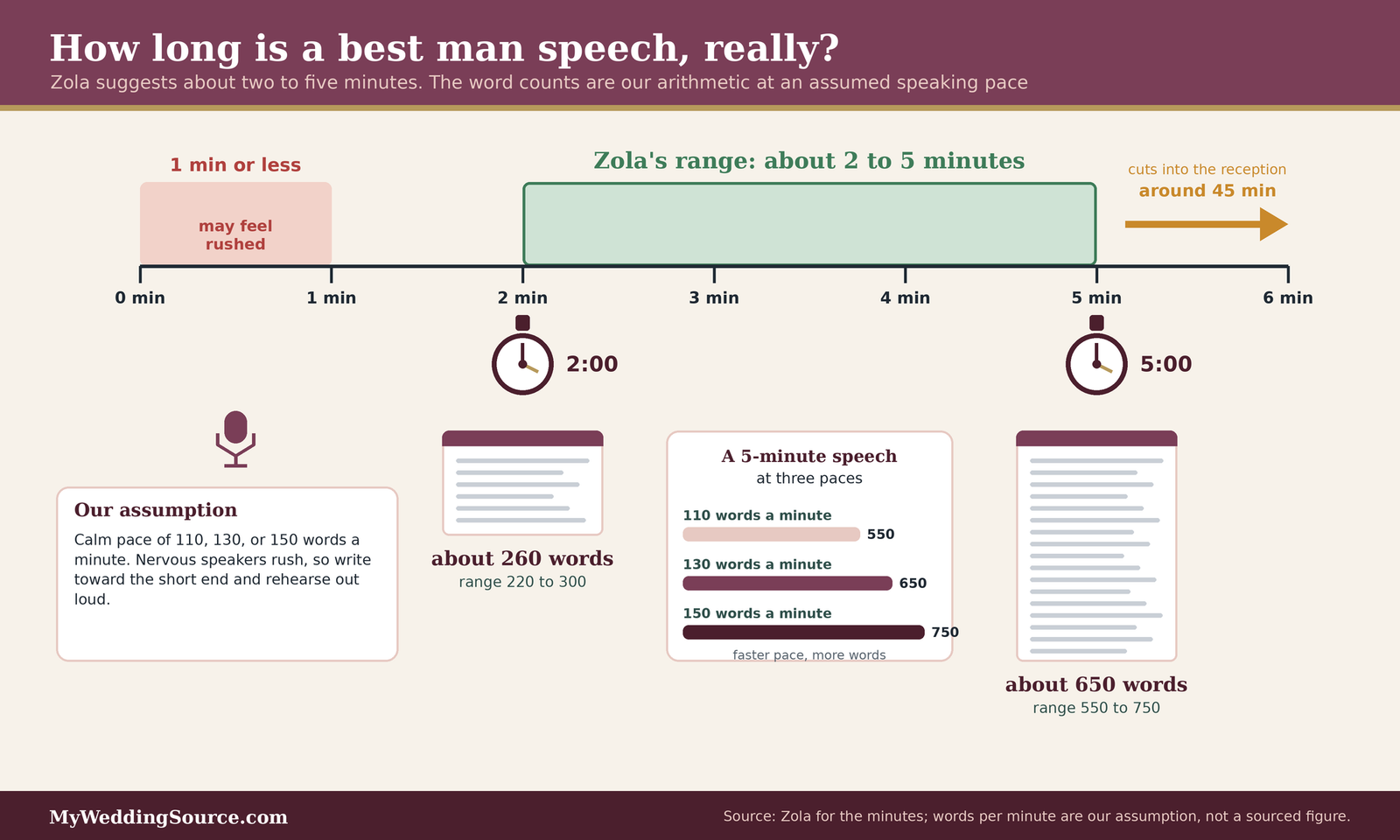
Zola recommends a toast of about two to five minutes, which it calls a “Goldilocks” range: long enough for a story or two and a toast, short enough to keep the reception moving. It warns that a speech of around 45 minutes would cut into other reception activities, and that one of a minute or less can feel rushed or impersonal.
Turn minutes into words
Zola does not give a word count, and it suggests testing your pace by practicing. To give you a starting point, here is our own arithmetic. We assume a calm speaking pace of roughly 110 to 150 words per minute, which is our own assumption and not a sourced figure. At 130 words per minute, two minutes is about 260 words and five minutes is about 650 words. Nervous speakers tend to rush, as Zola notes, so write toward the shorter end and let the pace be slower on the day. The illustration above shows the same arithmetic for three paces.
Know where you are in the order
The Knot says the usual order of reception speeches is the father or fathers of the couple, then the maid of honor, then the best man. WeddingWire describes the best man traditionally giving the second toast, after the father of the bride, so sources differ slightly. Either way, the best man often speaks near the middle or end. Ask the couple, the planner, or the emcee where you fall in the schedule and how long the room expects you to speak, because the DJ or the caterer may be working to a timeline. The Knot also notes that the best man may be asked to speak at the rehearsal dinner instead of the reception, so confirm that early. For the average room, The Knot’s 2026 Real Weddings Study, which surveyed 10,474 U.S. couples married in 2025, reports an average of 117 guests, which is a useful reminder that you are probably talking to a large and mixed audience.
A structure you can build in one evening
Zola suggests including favorite memories you have shared with the couple, a few funny stories, your excitement about their new life, and a toast. The structure below is our own and fits inside the two-to-five-minute window.
Open by saying who you are
Many guests will not know how you know the groom. Start with your name, your relationship, and one sentence about how long you have known him. This takes fifteen to thirty seconds and settles the room. If you are nervous, this opening is the one line to memorize word for word.
Choose one story, not five
A single well-chosen story usually works better than a series of small ones. Pick a story that shows something true about the groom’s character, that he would be comfortable hearing in front of his grandmother, and that ends on a warm note. Our suggestion is to test it by asking whether the story would still be funny if the partner’s parents are listening. If the answer is uncertain, choose another.
Turn toward the couple
Many speeches are entirely about the groom, which leaves the partner as an observer. Spend part of the speech on the couple together: what you noticed about him when he met his partner, what you see in the relationship, or what the partner brings out in him. If you know the partner less well, ask the groom or a close friend for one specific detail. This is where the speech earns its place.
End with the toast itself
Zola’s guidance on the ending is simple: ask the guests to raise their glasses, wish the couple health and happiness, congratulate them, and take a drink. Make the last sentence the toast, so people know when to lift their glasses. Do not trail off or add a final joke after the toast.
What to leave out, and how to practice
The decision about what to leave out matters more than the decision about what to include. A toast that embarrasses the couple is hard to repair, and a recording or a retelling will outlast the evening.
Topics to skip
Zola advises avoiding anything that could embarrass or upset the couple or make guests uncomfortable, naming past relationships, excessive drinking, sex, and illegal activity, and suggests saving those stories for the bachelor party. We would add inside jokes that need three sentences of explanation, references to people the guests will not know, and anything that could read as a comment on the partner’s looks, family, or past. Before the wedding, ask the groom whether anything is off-limits and ask a trusted friend to read the draft. Zola recommends running it by a friend or family member so that problems are caught before the wedding. Our wedding etiquette guide is a useful companion for the wider rules of the day.
Rehearse out loud, and slow down
Zola’s guidance is to start early and rehearse out loud several times, noting that the wedding day should not be the first time you give the speech. It also says that nerves make most speakers talk faster, so you should slow down more than feels natural, and that it will sound normal to the audience. Time yourself on your phone, stand when you practice, and say the toast line out loud at the end. Zola does not say whether to use notes, so that is your decision; many speakers feel steadier with a card or a phone in hand, and nobody will mind. Our suggestion is to wait until after your toast to have a drink, or to have only one, because the speech is easier to deliver with a clear head, and a slip on a microphone is difficult to take back. ## What best man duties cost, and where to draw the line
Money is the part of best man duties that people discuss least and regret most. The role usually costs real money, the amounts depend on choices you and the group make, and surprises tend to appear after you have already said yes. This section separates the figures we found from the arithmetic we did ourselves, and then moves to boundaries, which are easier to set before the bills arrive.
What best men typically pay for
The published guidance on who pays is fairly consistent, even though the dollar figures are thin and come from different sources and years. Our wedding budget calculator can help you hold your own numbers in one place, and the sections below explain what to include.
The expense categories
The Knot says the best man is expected to pay for his own attire, his share of the bachelor party, his travel, and a gift for the groom, and that he is not expected to cover the whole bachelor party. The Knot’s separate article on groomsmen expenses, updated in September 2024, says groomsmen generally pay for their own outfit and accessories such as shoes, socks, cufflinks, ties, and pocket squares unless the groom provides them, and for their own travel and lodging. It adds that the couple typically covers boutonnieres, any special items the groom wants everyone to wear, wedding-day transportation for the party, and thank-you gifts. Zola’s guidance and WeddingWire’s guidance agree in broad terms. WeddingWire lists attire, the bachelor party, travel and accommodations, pre-wedding grooming, and a wedding gift as traditional expenses.
The figures we found, and their limits
We found few sourced figures, and none that cover the whole role. SoFi, a financial company that also sells personal loans, writes that renting a tuxedo averages $150 to $300 and does not cite a survey for that figure. SoFi also reports an average bachelor party cost of $1,400 per person, which it attributes to a 2023 The Knot survey of about 500 people who attended or planned to attend a bachelor party, with guests who drove averaging $1,000. The Knot’s own article on who pays for bachelor and bachelorette parties cites a Knot study putting the average cost of those parties at more than $1,000 per person, without giving the year. For gifts, The Knot’s groomsmen article says wedding party members spend an average of $160, and WeddingWire suggests budgeting about $120 for the best man’s gift, more if bringing a guest. SoFi’s own overall estimate for a groomsman is about $1,800. None of these include a figure for wedding travel, and none of them are best-man-specific, so treat them as signs of scale and not as a forecast.
What it can cost: an editorial estimate
Adding the figures above gives a rough range for what best man duties cost when a best man rents attire, joins a bachelor party, and gives a gift. At the low end, $150 for attire, $1,000 for a bachelor party where guests drove, and $120 for a gift total $1,270. At the high end, $300 for attire, $1,400 for the average bachelor party, and $160 for a gift total $1,860. That range excludes travel and lodging for the wedding, pre-wedding grooming, and any group gift contribution, and it uses a mix of retailer-style figures, survey averages from different years and a gift suggestion from a wedding site. It is our own arithmetic and not a quote, so use it to frame a conversation about what you can afford, not as a budget you must hit.
Be cautious with these averages
An average cost of best man duties hides a wide spread. SoFi says 29% of bachelor party attendees in a major metro area spent $2,000 or more, and that about one-fifth of attendees fly to the destination. A weekend in a nearby city and a flight to a beach house can differ by hundreds of dollars per person. If a number from an article is higher than what you can afford, that is not a signal that you are doing something wrong; it is a reason to set the budget before the plan, as the next section explains. Each source also reflects its own sample: the survey behind SoFi’s bachelor party figure is described as about 500 people, which is small, and the sources disagree on the year of the guest-spending study that underlies the $160 gift number. We could not find a published average for what a best man spends on all of these categories together.
The bachelor party: budget first, itinerary second
The bachelor party is the largest and most variable line among best man duties. It is also the part where your decisions affect other people’s money, so it deserves a process.
Share an estimate before anyone commits
Zola advises sharing a rough per-person estimate early so that guests can decide whether they can afford to attend, agreeing on a few big-ticket splurges in advance while letting people choose their own spending on smaller items, and appointing one person to track shared expenses, perhaps with an app such as Splitwise. The Knot says the best man’s role includes meeting with the group to determine what everyone can afford and agree on a plan. Our suggestion is to send one message with a date, a place, a per-person range that includes lodging, and a deadline for a yes or no, before you book anything. Include the line “no hard feelings if this is too much” and mean it. Also ask the groom who he wants there, because Zola says the groom decides the guest list and that everyone invited should also be on the wedding guest list.
Decide who covers the groom, in advance
The Knot’s bachelor party article says costs are usually split evenly among attendees and that the best man pays his own expenses and usually helps cover some or all of the groom’s costs, split evenly among groomsmen. It also says the groom’s costs being covered should be a bonus and not an expectation, and offers a compromise in which the groom pays his own travel and lodging while the group covers meals, drinks, and activities. Zola says the groom’s share is typically covered by his friends, but that for a costly, far-off destination he may pay his own travel or contribute to lodging. Ask the groom what he prefers, then tell the group. Raising the question before booking prevents the most uncomfortable version of the conversation, which is learning the split after the invoices arrive.
Be careful about fronting money
The Knot notes that the best man may front costs until the others reimburse him. That is a real risk: you are lending money to friends, and any payment that does not arrive becomes your cost. Our suggestion is to collect payments before you book where possible, to front only an amount you could absorb if someone did not repay, and to put every payment and reimbursement in the shared record that Zola recommends. This is a general suggestion and not financial advice, and you should decide what is right for your own finances.
Setting boundaries that protect the friendship
A boundary around best man duties is a statement about what you can and cannot do, made early enough that the other person can plan around it. Most wedding conflict comes from boundaries that were never stated.
Boundaries with the groom
Tell the groom what you can afford and how much time best man duties will take you, and do it in the first conversation. A sentence like “I can plan the weekend, but I can only spend about this much on it, so let’s design around that” gives him a real choice. WeddingWire’s guidance to plan around the groom’s preferences, and not your own, applies in both directions: you can accept his wishes and still be honest about your limits. If he asks for something that stretches you, offer a smaller version, such as a dinner instead of a trip, rather than quietly absorbing the cost.
Boundaries with the groomsmen
In best man duties, you are the coordinator, not the enforcer. Set deadlines, state them once, and follow up with a call, not a lecture. If a groomsman cannot afford part of the plan, let him skip that part without comment, and consider whether the group’s plan is too expensive for the people in it. Our wedding planning stress guide is a useful read if group conflict starts to weigh on you. A short group message that restates the shared plan, the next deadline, and who owns what usually settles an argument faster than a long debate.
Boundaries with yourself
It is easy to say yes to every request and then resent best man duties. Decide in advance which best man duties you will take on and which you will pass to another groomsman. The Knot says the best man is expected to make sure the other groomsmen fulfill their duties, and in practice that includes delegating. If the role is clearly more than you can manage, say so early. WeddingWire notes that some couples have two best men, which suggests that sharing the role is an accepted option; if you and the groom agree, split the work by task and make sure the two of you get along. Declining early, with an offer to help in a smaller way, is kinder than failing late.
Rides, paperwork, and the final-week handoff
The logistics side of best man duties is mostly small, specific, and dull, and it causes most of the day’s stress when it is missing. This section covers three categories where the best man’s role is most likely to matter: transportation, paperwork, and the plans for what could go wrong.
Getting people home safely
Drinking is a normal part of many weddings, and so is getting people home. As a best man you may be the person asked to drive, to arrange a ride, or to notice that someone should not be driving. Our open bar wedding guide is a useful read if you want to know more about the bar itself.
Plan the ride before the first drink
The National Highway Traffic Safety Administration advises lining up a sober driver or another way home before the party starts, and notes that its SaferRide app can connect a person to a taxi or a friend. It also advises not letting a friend drive after drinking and arranging a safe ride for them. For a wedding, a practical version is to ask the couple or planner what transportation is booked for the wedding party, and to confirm the return trip for out-of-town groomsmen at their hotel. If a ride is not booked, set a plan in the group thread before the reception begins, not at midnight.
If you are driving the couple
The Knot says a best man who is driving the couple should stay sober, and that the alternative is to hire transportation so he can drink. Emily Post’s guidance also lists driving the couple to the reception, when no driver is hired, among the best man’s traditional tasks. Treat this as a choice to make with the couple. If you are the driver, check the route, the parking, and the car’s fuel before the day, and decide whether you are comfortable being the sober person for the whole evening. If you would prefer not to be, say so early so a car service can be booked.
The paperwork: license, witness, and envelopes
Two small paper tasks appear among best man duties in most published lists. Both are easy and both are easy to forget.
Signing the license as a witness
The Knot says the best man signs the marriage license as a witness, together with the maid of honor. Zola says the best man signs as a witness before or after the ceremony. Rules about witnesses vary by place, so the useful step is to ask the couple or the officiant what applies. One California county clerk’s FAQ says that anyone signing the license must be at least 12 years old and understand what they are signing, and it directs people to the clerk’s office for the number of witnesses required. That is one county’s page, and your state may differ. Our marriage license guide and wedding ceremony guide are the related reads. This is general information and not legal advice, and the couple’s county clerk is the authority on the exact requirements.
Envelopes and fees
The Knot says the best man gives the officiant a sealed envelope with the fee, and Emily Post says the best man hands out prearranged payments to the officiant, assistants, musicians, and singers. WeddingWire advises confirming with the couple whether the best man should pay the officiant after the ceremony. That difference is the lesson: do not assume. Ask, and if you are asked to carry envelopes, get them labeled and sealed by the couple, with a written list of who is to receive each. Hand them over at the time the couple specifies, and keep a short note of what you handed to whom. For background on the officiant’s role, see our wedding officiant guide.
The final-week handoff
The last week is when best man duties turn into actual contact with actual people. The table below organizes it by who to contact, when, what proof you want, and who to call if something is wrong. It is our own template, built from the tasks the sources describe, and the timing is a suggestion.
| Item | Contact | Timing | Proof | If it goes wrong |
|---|---|---|---|---|
| Groomsmen arrival | Each groomsman | Two days before and the morning of | Each person has replied with his arrival time or a photo from the hotel | Call him, then tell the planner, and tell the groom only if it affects the schedule |
| Attire | The shop or tailor | One week before | Each garment has been tried on or delivered | Call the shop with the order number and ask for the next step |
| Rings | The couple | At the rehearsal | The handoff note and the photo in the box | The couple first, then the insurer if there is a policy |
| Timeline | Planner or couple | Three days before | A saved copy offline and a printed copy | The planner, who owns changes |
| Transportation | The driver or car service | The day before | Confirmation, pickup time, and phone number | The company’s phone number, then a backup ride |
| Payments | The couple | The day before | Labeled, sealed envelopes and a payee list | The couple or planner decides |
| Gifts and cards drop point | The venue coordinator | The day before | A named person and a place, written down | The venue coordinator |
| Toast slot | Planner or emcee | The day before | The speaking order and your time | The planner, who can move you |
Fill in the table
Copy the table into your notes and add real names and phone numbers. A phone number written down at home is more useful than a phone number you plan to find on the day. Share the final version with the groom’s chosen backup, such as a family member, so that someone besides you knows where everything is.
Run a last-pass failure check
On the day before the wedding, read through the table and check each row for three things: is there a name, is there a time, and is there a place? A row missing any of the three is a risk. Ask: if I could not be reached for an hour tomorrow, who could do each task, and would they know where to find the information? If the answer is nobody, fix that row today. This kind of check is simple, and it is where most last-minute surprises are caught.
Backup plans for weather, travel, and delay
Most of what can go wrong with a wedding day is not unusual. Weather changes, flights are late, and vendors arrive after they said they would. A short plan for each makes the difference between a delay and a crisis. The suggestions below are our own judgment, and the couple’s planner or venue will usually have more specific plans.
If the weather changes
Ask the couple or planner what the weather plan is, including where the ceremony moves, who decides, and by what time. Ask what changes for the wedding party: footwear, umbrellas, photo locations, and arrival times. Then include one line in your group message: “If the plan changes, the update will come from me in this thread.” A single source of updates reduces confusion. Our garden wedding venues guide is a relevant read if the venue is outdoors.
If someone is late or stuck
Decide beforehand who is the contact for each groomsman and what the cutoff is for a decision. If a groomsman is stuck in traffic or delayed by a flight, tell the planner as soon as you know, not when the ceremony is about to start. Ask what the planner wants to do about the missing person’s role in photos and the processional, and offer a stand-in plan. Note that the person most affected by a groomsman’s absence is the groomsman, who is probably stressed already, so be kind.
If a vendor is late
If a car, a photographer, or a caterer is late, the first call is to the vendor, using the number you wrote down, and the second is to the planner or the couple’s designated contact. Do not tell the groom first unless he is the only person who can fix it. The Knot’s description of the best man as an aide who liaises with vendors and keeps the groom calm points in the same direction: you absorb the problem so he does not have to. ## Working with the maid of honor, the planner, and the groomsmen
Best man duties rarely run alone. Almost every task touches another person, and the role goes more smoothly when you know who those people are and what each of them expects. This section covers the key working relationships and the situations that change the job.
The maid of honor
The maid of honor, or the equivalent person on the other side of the wedding party, is your closest counterpart. Published lists pair you with her in several places, so a short conversation early saves confusion later.
Where your jobs overlap
The Knot says the best man exits the ceremony with the maid of honor and signs the marriage license as a witness together with her. WeddingWire says he enters the reception with her and gets the first dance started with her, and adds that if she would rather not dance together first, that is fine, as long as you are among the first on the floor and encourage others to join. Treat the shared best man duties as a practical arrangement. Introduce yourself early, ask how she prefers to be addressed on the day, and agree on who walks which side. A few minutes together at the rehearsal usually settles this.
Share what the two of you track
You and the maid of honor are often the two people who receive the timeline first and who are asked the most questions by the rest of the wedding party. Our suggestion is to keep a short shared thread for the two of you, separate from the groomsmen thread and the bridesmaids thread, where you confirm the schedule, pass along changes, and check on each other. If you both give toasts, coordinate the order and the length so the two toasts do not repeat each other’s story. Our bridesmaid dresses guide is a useful companion if you want to understand the other half of the wedding party’s planning.
The planner, the venue coordinator, and vendors
If the couple has a planner or the venue provides a coordinator, best man duties do not include running the day. You need to know who does, and you need to be an easy person for them to work with.
Make one introduction and know one number
WeddingWire advises introducing yourself to the venue coordinator or planner on the day, and The Knot describes the best man as liaising with vendors on the groom’s behalf. Do both in a limited way. Introduce yourself, write down the coordinator’s mobile number, and say how you can be reached. After that, send questions through the coordinator and not directly to vendors, so that there is one answer to each question. If the couple has no planner, ask who has been designated as the day-of contact, and use that person.
Know what is not yours to decide
Best man duties make you a helper, not the host. Do not agree to changes with vendors on the couple’s behalf, do not sign anything, and do not promise guests anything the couple has not approved. When a vendor or guest asks you something you cannot answer, the right reply is “I’ll check with the couple’s contact and come back to you.” That sentence protects you, and it protects the couple’s plan from well-meaning improvisation.
Situations that change the job
Some weddings change what best man duties look like. The points below are our own reading of the published guidance and not rules.
Weddings that involve travel
When the wedding is far from where most of the party lives, the early best man duties grow: booking travel, sharing rooms, and confirming arrival times. WeddingWire’s advice to get groomsmen to book flights and hotels early matters more here, as does Zola’s note that the best man can help arrange lodging for out-of-town groomsmen. Ask the couple whether there is a room block, and look for shared rentals to lower the cost per person. Our wedding planning guide can help you see where the couple is in their own travel plans.
Small weddings and small parties
At a small wedding with only one or two attendants on each side, you may find yourself doing tasks that a larger party would split, such as handing out programs or collecting gifts. Ask the couple which tasks are yours. If the wedding is intimate, the toast is also often shorter and more personal, though this is our observation, not a sourced figure. Our small wedding planning and micro wedding planning guides describe how couples scale their plans down, which can help you scale your own role to match.
Ceremonies with their own traditions
Many ceremonies follow traditions that differ from the general pattern. The Knot notes, for example, that the best man walks in after the groom in a typical ceremony and before him at a Jewish wedding. The rehearsal is the authority, and the officiant is the person to ask if you are unsure. If the ceremony includes customs you do not know, ask the couple or the officiant to walk you through your part. Asking is a courtesy, and it is far better than guessing.
Frequently asked questions
The role
What are the main best man duties?
The common core is helping the groom and groomsmen stay organized, keeping the rings safe, standing beside the groom at the ceremony, signing the license as a witness if asked, and giving a toast. Most other tasks, such as planning the bachelor party or carrying envelopes, vary by couple, so ask the groom what he wants.
Does the best man have to plan the bachelor party?
Traditionally the best man and groomsmen plan it, according to Zola, but any close friend or relative can take it on. Zola describes the best man as coordinating the group. If you cannot manage it, say so early and offer a smaller role, and plan around the groom’s wishes and the group’s budgets.
Does the best man pay for the groom at the bachelor party?
Often the group covers part or all of the groom’s costs, and The Knot says the best man usually helps with that share, split among the groomsmen. The Knot also calls it a bonus and not an expectation. Ask the groom what he prefers, tell the group before booking, and agree who tracks the costs.
On the wedding day
Who holds the rings?
It depends on the couple. Emily Post says the best man keeps the bride’s ring, while The Knot says he keeps the rings safe and takes them from a ring bearer if there is one. Confirm at the rehearsal who holds which ring and in which pocket, so that everyone, including the officiant, knows the plan.
How long should a best man speech be?
Zola recommends about two to five minutes. It warns that a minute or less can feel rushed or impersonal, and that a very long speech cuts into the rest of the reception. At a calm pace of about 130 words a minute, which is our estimate, that is roughly 260 to 650 words. Rehearse out loud and time it.
Does the best man sign the marriage license?
Often yes. The Knot and Zola both say the best man signs as a witness, and The Knot and WeddingWire say it is usually alongside the maid of honor. Witness rules vary by place, so ask the couple or officiant what applies. One California county clerk’s FAQ says signers must be at least 12 and understand what they sign. This is not legal advice.
Saying yes, and saying no
Can a best man say no to a task?
Yes, with notice, because some best man duties depend on the couple. Several tasks, such as driving the couple, decorating a car, or watching the groom’s drinks, depend on the couple’s plans or are described as optional. Zola says keeping an eye on the groom at the reception is not required. Tell the groom early which tasks you cannot do, and offer a smaller alternative.
How much does it cost to be the best man?
No source we found gives one all-in average for best man duties. Pieces include a tuxedo rental, which SoFi says averages $150 to $300, a bachelor party averaging $1,400 per person in a Knot survey SoFi cites, and a gift of about $120 to $160. Adding those gives roughly $1,270 to $1,860 before wedding travel, by our arithmetic.
Your next steps
This week
Book the first conversation
Ask the groom for an hour and bring the questions from the callout above. Write down what he wants from you, what he would like left alone, and who else is helping. Send him the note so you both hold the same version. If you want to see what the couple is tracking overall, our wedding planning checklist is a good reference.
Start the task sheet
Copy the task sheet for best man duties from this guide into a shared note, add names and dates, and remove anything that does not apply. Choose one owner for every row. Then start the group thread and post the link, so everyone is looking at the same plan from the beginning.
In the months ahead
Settle the money early
Work out what you can afford before you agree to any plan for best man duties, and use the arithmetic here as a starting point, not a target. Our wedding budget calculator can hold your numbers, and the couple’s wedding registry is the usual place to find a gift if you decide to give one. Tell the groom your limits in a friendly, specific way.
Draft the toast early
Write a first draft well before the wedding, then put it down for a week and read it again. Cut it to fit the slot, take out anything you would not say in front of the partner’s grandparents, and rehearse it out loud. The wedding planning timeline can help you see where your own deadlines fall among the couple’s.
In the final week
Run the handoff table
Fill in every row of the final-week table with a real name and a real number. Send the rings photo to the person who gave you the rings, save the timeline offline, and confirm each groomsman’s arrival. If a row has no owner, a time, or a place, fix that row first.
Plan your own day
Pack the emergency kit, decide how you are getting home, and pick the pocket for the rings. Eat, drink water, and sleep. The core of best man duties on the day is to be calm, on time, and useful, and a rested person is better at all three. After the wedding, return the rentals on the next business day and close out any envelopes or gifts you were holding.
Related reading: Bridal Skincare Timeline: What to Start and What to Stop.
Sources & methodology
How we built this guide
What we relied on
This guide combines published etiquette and planning guidance on best man duties from The Knot, Zola, Emily Post, and WeddingWire, a financial company’s article that cites a Knot survey on bachelor party costs, The Knot’s Real Weddings Study figures, a TSA page on traveling with valuables, a National Highway Traffic Safety Administration page on planning a safe ride home, and a California county clerk’s marriage ceremony FAQ. Where a statement comes from a company that sells something, such as SoFi, which offers personal loans, we say so. The timeline, the task sheet, the final-week table, the cost range, the speech-length arithmetic, and the ring-custody plan are our own editorial work, built on stated assumptions, and are not research findings.
What we did not do
We did not survey best men, couples, or groomsmen, and we did not verify any retailer prices. We found no published average that covers the whole cost of the role, and the figures we cite come from different years and samples. The Knot’s page on bachelor party costs does not state the year of the study it cites, and its article on groomsmen expenses and SoFi’s article give different years for the guest-spending study behind the $160 gift figure. We cite one California county clerk’s page on witnesses, not a national rule, because witness requirements vary by state. Etiquette varies by region, culture, and couple, and the couple’s own plan always comes first. This guide is general information, not legal, medical, insurance, or financial advice.
Source list
Etiquette and role guidance
- The Knot, Best Man Duties in Detail: https://www.theknot.com/content/best-man-duties-in-detail
- The Knot, Expenses Groomsmen Should Expect to Pay For: https://www.theknot.com/content/what-groomsmen-pay-for
- The Knot, Who Pays for Bachelor and Bachelorette Parties: https://www.theknot.com/content/who-pays-for-bachelor-and-bachelorette-parties
- Zola, Best Man Duties: A Full Breakdown: https://www.zola.com/expert-advice/what-are-the-best-man-duties
- Zola, How Long Should the Best Man Speech Be: https://www.zola.com/expert-advice/how-long-should-the-best-man-speech-be
- Zola, Tips for Giving a Best Man Speech: https://www.zola.com/expert-advice/tips-for-giving-a-best-man-speech
- Zola, Everything You Need to Know About Bachelor Party Planning: https://www.zola.com/expert-advice/everything-you-need-to-know-about-bachelor-party-planning
- Emily Post Institute, Duties of the Best Man and Groomsmen: https://emilypost.com/advice/duties-of-the-best-man-groomsmen
- WeddingWire, The Ultimate Best Man Duties Checklist: https://www.weddingwire.com/wedding-ideas/the-ultimate-best-man-duties-checklist
Cost, government, and local sources
- The Knot, Average Wedding Cost (2026 Real Weddings Study): https://www.theknot.com/content/average-wedding-cost
- SoFi, The Cost of Being in a Wedding (financial company that sells personal loans): https://www.sofi.com/learn/content/cost-of-being-in-a-wedding
- Transportation Security Administration, Jewelry: https://www.tsa.gov/travel/security-screening/whatcanibring/items/jewelry
- National Highway Traffic Safety Administration, Plan a Safe Way Home Before You Start to Drink: https://www.nhtsa.gov/press-releases/put-safety-first-st-patricks-day-plan-safe-way-home-you-start-drink
- Contra Costa County Clerk-Recorder, Marriage License and Ceremony FAQs: https://www.contracostavote.gov/countyclerk/ceremony-information/ceremony-faqs/