
Wedding party attire works best when you decide what the group should communicate (formality, palette, and ease) and then let each person solve the details, instead of buying matching outfits first and discovering the problems at the fitting.
Quick answer
Pick one formality level, one palette, and one or two details that repeat, and leave everything else flexible. Agree on a budget with the group before anyone shops, because bridesmaids and groomsmen usually pay for their own clothes. Order the slowest items first: sources we reviewed put bridesmaid dress orders about six to eight months out and rental suits and tuxedos about two to three months out. Then photograph the whole group together in daylight at least a few weeks before the wedding, while a fix is still possible.
Most advice about wedding party attire starts with a color or a trend, and that is the wrong end to begin from. This guide starts with the decisions underneath: how formal the day is, where it is held, who has to pay, how long each item takes to arrive, and what you will do if something does not fit. Those questions decide whether a group of friends looks relaxed and intentional in the photographs, or looks like several people dressed for different events.
We wrote it for couples with a wedding party of any size, including couples who are skipping matching outfits altogether. It covers bridesmaids, groomsmen, and attendants of any gender, plus parents, grandparents, and children, because those people end up in the same photographs. It does not tell you what to wear or what to buy, and it does not recommend a retailer. Where a price, timeline, or rule comes from a source, we say who said it and when. Where we are doing arithmetic or giving a judgment call, we label it as ours, because your venue, your friends, and your budget will differ from any average.
Translate the style label into observable choices for wedding party attire
A style label such as “romantic,” “modern black tie,” or “garden party” is a mood, and a mood cannot be ordered, measured, or returned. Before you can brief a group of people about wedding party attire, you have to turn the label into things a person could see in a photograph and check against a tag: how long the garment is, what it is made of, how much it shines, how structured it is, and what color family it sits in. Those are the signals that make wedding party attire look related across a group, so they are the ones worth deciding on purpose.
Define the silhouette, color, material, and formality signals in the wedding party attire decision
Four signals do most of the work of telling a viewer how formal a day is and whether the people in it belong together: silhouette (the outline of the garment), color, material, and formality. Silhouette includes length, neckline, and structure. Material includes the fabric, the sheen, and how it drapes or holds a shape. Formality is the combined impression the other three create. When couples say their wedding party attire “looks off,” one of these four is usually out of step, and it is rarely the one they first suspect.
Show what belongs to the style: wedding party attire
Here is a working definition we use throughout this guide. Wedding party attire is the clothing worn by the people standing with the couple, chosen so that the group reads as one deliberate set at the formality the wedding calls for. It does not require identical clothes. It requires that any two people picked at random from the group look like they were invited to the same event.
In practice, that definition produces four observable tests. First, the length test: if one bridesmaid is in a floor-length gown and another is in a knee-length dress, the group suggests two different dress codes. David’s Bridal advises keeping the whole group at one level, such as all floor-length or all knee-length. Second, the material test: the same retailer notes that satin and chiffon look different under the same light, so if colors vary, keeping the fabric consistent helps the group look related. Third, the palette test: that retailer suggests staying within roughly two to four colors from one family, and warns that five or more can look chaotic. Fourth, the formality test: an outfit that would not look out of place at the couple’s own ceremony belongs to the style, and one that would look like a different kind of event does not.
These tests are rules of thumb from retailers who sell the clothing, so treat them as a starting point rather than a standard. They are useful because each one can be checked in a minute, with a tape measure, a swatch, or a photo of the pieces laid side by side.
Show what often gets mislabeled under the same keyword: wedding party attire
The phrase gets stretched to cover several things that are separate decisions. Keeping them apart saves arguments later.
The first is the dress code for guests. What guests wear is set by the invitation and the website, and it is a different decision with different stakes. Our guide to the wedding guest dress code covers it. The wedding party should usually sit at or slightly above what guests are asked to wear, but the two instructions are not the same document.
The second is the bride’s or couple’s own outfits. A wedding party is dressed in relation to the couple, not in competition with them, but choosing the couple’s clothing is its own project. See our guide to wedding dress styles for that side.
The third is a theme or costume. Matching a color is attire. Asking attendants to wear a period costume or a branded outfit is a theme, and it carries different costs and a different level of consent. If you are thinking of it, treat it as an ask rather than an assumption, and talk to each person first.
The fourth is a uniform. Identical outfits are one way to get a cohesive group, and they are often the simplest way when a rental company is handling the whole party. But “cohesive” and “identical” are not synonyms. A group in the same color and the same fabric but different necklines is cohesive. A group in identical dresses that fit three of the five people badly is only identical.
Fit the style to venue, season, body, and movement in the wedding party attire decision
Once the signals are decided, test them against the real conditions of the day. A beautiful choice on a screen can fail in a field, in August, or on the third hour of dancing. The checks below take a few minutes each and catch most of the problems that people only notice on the day itself.
Test temperature and terrain: wedding party attire
Start with where people will stand and for how long. A ceremony outdoors in summer, a church in January, and a ballroom with a fixed thermostat all ask different things of a garment. The CDC’s guidance on extreme heat recommends loose, lightweight clothing in light colors, and regular fluids even when you are not thirsty. It also names older adults, young children, and people with chronic medical conditions as being at higher risk. That is general public-health advice, not wedding advice, but it applies to a wedding party standing still in the sun for a long ceremony and then posing for photographs afterward.
Use that as a design constraint rather than a warning. Heavy fabrics, lined jackets, and long sleeves are harder to wear in heat. Menswear experts quoted by The Knot suggest velvet for cooler months and lightweight linen or wool blends for summer, which gives groomsmen a concrete way to adapt the same color to the season. For bridesmaids, a lighter fabric and a skirt that moves are the equivalent adjustments. If your group includes older relatives or anyone with a medical condition, add shade, water, and a place to sit to the plan, and let them dress for comfort first.
Terrain matters just as much. Grass, gravel, sand, cobblestone, and wooden decks each treat shoes and hems differently. Heels sink into lawns and catch in decking. Long hems collect dirt and can be a tripping hazard on steps, so a hem that clears the ground is worth asking about when the venue has steps or uneven paths (that is our judgment, not a sourced rule). If the ground is soft, tell the group in the first message, not at the rehearsal. Flat shoes, block heels, or a sturdy wedge are options to offer, and it costs nothing to say that bringing a second pair for the reception is welcome.
Movement is the third constraint. The people in the wedding party will walk, stand, hug, carry things, bend to help a child, climb into a car or a shuttle, and dance. A dress with a fitted bodice and no stretch, or a jacket that binds at the shoulder when someone raises their arms, will be noticed all night. In the fitting, ask people to raise their arms, sit down, and take a few steps. It is a simple test and the single most useful one on this list.
Check photography and lighting effects: wedding party attire
Photographs are the most lasting record of wedding party attire, so it helps to understand how light changes it. We are not photographers and we do not have measurements for you, so treat the following as questions to ask your photographer rather than rules. Our guide to wedding photography covers how to choose and brief one.
David’s Bridal makes the useful observation that fabric tends to photograph more consistently than color. Chiffon and satin reflect light differently, and a shiny fabric can show creases and bright highlights that a matte one hides. That is a reason to keep fabric consistent when colors vary and to look at swatches in the kind of light you will actually be in. Color shifts between daylight, shade, and warm indoor lighting, and a swatch seen on a phone screen has shifted again. Ask the retailer whether swatches are available, and look at them near a window at the time of day when your photographs will be taken.
Think too about contrast with the setting. A pale group against a pale wall can disappear, and a dark group against dense foliage can lose their outlines. Bring this up when you scout the ceremony site and the portrait locations. A photographer who has worked in the venue will often know which spots flatter which colors, and that is worth a short conversation. Our wedding photographer shot list is a useful starting point for what to request, and the group portrait is usually the shot where wedding party attire is judged most closely.
Table 1 pulls these factors together. It is our own synthesis of the sources above, not a standard, and the right-hand column is a prompt for conversation, not a rule.
| Factor | What it changes | Question to settle first | Common trade-off |
|---|---|---|---|
| Formality of the day | Length, fabric, tuxedo versus suit | Is the invitation black tie, formal, semi-formal, or cocktail? | The more formal the day, the less room for personal variation |
| Season and temperature | Fabric weight, sleeves, jackets, shoes | Will the group stand outdoors for long? | Lighter fabrics wrinkle and show sweat more easily |
| Terrain | Heels, hem length, shoe options | Grass, sand, gravel, stairs, or a polished floor? | Flat shoes change the apparent height of the group |
| Budget range in the group | Brand, rental versus purchase, accessories | What can the least-flush person afford without strain? | Setting the budget low narrows choice, setting it high excludes people |
| Body and mobility | Silhouette, stretch, closures, alteration needs | Can each person sit, raise their arms, and dance comfortably? | Identical silhouettes rarely flatter every body |
| Photography and light | Fabric sheen, color depth, contrast with setting | Where and when will the group portraits happen? | A color that photographs well in shade may look different indoors |
| Lead time and returns | Order date, buffer, brand choice | When does the slowest item need to be ordered? | Faster options often cost more or narrow the choice |

Read the formality level as a ladder you can match
The word on the invitation sets the top of the range for wedding party attire, and the ladder below shows what each rung asks of men and women. The Knot’s menswear experts describe the ladder this way for men: a tuxedo suits white-tie, black-tie, and formal events, while suits work for everything else. Formal is described as still customary for a tux or suit but not necessarily black, with bold colors and patterns fitting if they suit the theme. Semi-formal is a suit and tie or a blazer and slacks. Cocktail attire is the evening counterpart and a little more playful. Casual is dressed-up everyday wear.
The same ladder applies to bridesmaids, even if the vocabulary is different. A floor-length gown in a structured or flowing fabric suits formal and black-tie days. A midi or tea-length dress suits semi-formal and cocktail days. A knee-length or simpler dress suits casual days. Our guides to the black tie wedding and cocktail attire explain what those two levels mean for guests, and the wedding party should usually be dressed at or just above those levels.
Match both sides of the party to the same rung
A frequent mismatch in wedding party attire is a formal group on one side and a casual group on the other, usually because the two sides shopped independently. If the bridesmaids are in floor-length gowns and the groomsmen are in khakis and open collars, the photograph looks like two different weddings. The remedy is to name the rung once, in writing, to everyone. A simple sentence works: “The wedding is formal, so we are asking for floor-length dresses and dark suits or tuxedos.” Everyone can then choose within it.
Let the invitation and the party say the same thing
The wedding party attire is the first visible example of your dress code, since guests will take their cue from the people standing at the front. If your invitation says cocktail attire and your party appears in black tie, some guests will feel underdressed, and if it is the other way round some will feel overdressed. Our guide to wedding invitations explains where to put the dress code line, and the wedding etiquette guide covers how to word it kindly. Settle the formality level before the invitations go out and the rest of the decisions get easier.
Build a cohesive look without copying an inspiration photo for wedding party attire
An inspiration photo is a useful starting point and a poor specification. It shows one group, in one light, with clothing that was chosen, fitted, and styled for those particular people. When you try to reproduce it, you inherit its hidden assumptions: someone’s budget, someone’s body, someone’s venue, and an editor’s retouching. A better approach is to pull out what the photo is doing and decide which of those things you actually want to repeat.
Choose two or three anchor elements in the wedding party attire decision
An anchor is a deliberate constant: something you decide will be the same across the group so that everything else can differ. Two or three anchors are usually enough. Fewer than that and the group may look random, and more than that and you are back to identical outfits with extra steps. The Knot’s coverage of mismatched looks makes a related point, advising couples to vary only one or two elements per dress, such as color and silhouette, or print and solid, because less variation keeps the group looking intentional.
Repeat them selectively across attire, paper, and décor: wedding party attire
Good anchors come from a short list. A color family is the most common, and it is the easiest to carry into other parts of the wedding. A fabric can unify a group in a way that color alone cannot, a point David’s Bridal makes when it says to keep one fabric across the party while color and silhouette vary. A length keeps a group at the same formality level. A single accessory such as a lapel flower, a tie in one tone, or a metallic shoe can tie the men and women together. A texture such as velvet, crepe, or linen can serve as the common thread when the palette is wider.
Repetition should be selective. If the same dusty green appears in the bridesmaids’ dresses, the groomsmen’s ties, the flowers, the invitation suite, and the table linens, it can read as thoughtful. It can also read as a single note held too long. A better pattern is to repeat the anchor in two or three places and let other areas contribute contrast. Our guides to wedding decor and seasonal wedding flowers discuss how palette carries through the reception and the bouquets, and our wedding invitations guide covers paper. The aim is to have the group recognizable as part of the same day, not to match every item to the same swatch.
One practical rule for wedding party attire: choose your anchors before you collect inspiration photos. If you pick them afterward, you will tend to pick whatever is most visible in your favorite image, which is often a color that depends on lighting you will not have.
Avoid matching every item to the same motif: wedding party attire
Matching everything has costs. It narrows what people can buy, which raises prices and can leave someone wearing something they would not otherwise choose. It also makes any single failure more visible, since one dress in the wrong shade stands out when the rest match exactly, whereas in a group that is allowed to vary, the same shade difference is less noticeable. Our reasoning about wedding party attire here is an editorial judgment, but it is consistent with the advice in the retailer guides we reviewed, which generally treat variation as a way to reduce risk and cost.
Allow variation in wedding party attire where it costs little and helps most. Let people choose their own shoes within a color range. Let bridesmaids choose a neckline that suits them, which David’s Bridal frames as a way to suit different bodies and comfort levels, noting that prices can differ when silhouettes differ. Let groomsmen choose a tie or pocket square within a palette. Reserve exact matching for the one or two items where a mismatch would show most, which are usually the main garment’s color and the fabric.
If you do want identical pieces, there is nothing wrong with that. A rental company’s package is a reasonable way to get matching clothing for a large party without anyone having to coordinate by hand. The point is that identical should be a choice you made, not an assumption you inherited from a photograph.
Edit out competing signals in the wedding party attire decision
Even a well-chosen palette for wedding party attire can fail if too many things are asking for attention at once. The edit is the part most people skip, because adding is more fun than removing. But the groups that look best in photographs are often the ones where somebody made a few quiet cuts.
Use a priority hierarchy: wedding party attire
Rank what matters most and let the ranking settle disputes. A hierarchy we find useful, as an editorial suggestion, goes like this: first, safety and comfort of each person; second, affordability for each person; third, formality match to the day; fourth, palette; fifth, individual preference; sixth, trend. When two goals collide, the higher one wins. If a bridesmaid cannot afford the dress that photographs best, affordability outranks palette. If a groomsman is allergic to a fabric, comfort outranks the tie color. Having the order written down lets the couple say no kindly and consistently.
Emily Post’s wedding guidance supports the early steps of this ordering. It advises opening with a conversation about budget, formality, and any religious restrictions, and says there is no set price range, so the group should settle on a budget everyone can manage. It also says a bridesmaid can raise a concern about a color or style, preferably with alternatives, and that the bride makes the final call. A hierarchy is a way of making that final call predictable.
Keep one focal point per visual zone: wedding party attire
Think of the photograph of your wedding party attire as having zones: the faces, the torso, the waist and hands, and the feet. In each zone, let one thing be the focus. If the neckline is dramatic, keep the jewelry modest. If the bouquets are bold, keep the dress simple. If the groomsmen are in patterned ties, keep the pocket squares plain. When several elements in the same zone all ask for attention, none of them gets it.
The same idea applies across the group. Many couples want the maid of honor or the best man to be distinguishable. One way is to change a single element, such as a different texture or a different tie, rather than changing everything. The Knot’s coverage of mismatched looks mentions using texture to make a maid of honor stand out, which is an example of changing one zone while leaving the others. And if someone in the party is wearing a family heirloom, a cultural garment, or a religious head covering, give them space around it rather than trying to coordinate the rest of their outfit to compete.
Coordinate mixed styles when the group is not one shape
Many wedding parties are not uniform: bridesmaids and groomsmen of different heights, sizes, ages, and budgets, and sometimes attendants who do not fit those two labels at all. Cohesive wedding party attire in that case is a design problem with an answer, not a compromise.
Mixed dresses: keep two variables and fix the rest
Retailers that sell mix-and-match dresses give consistent advice. Choose a color family rather than a single exact shade, according to The Knot. Keep the length constant, according to David’s Bridal. Keep the fabric constant if colors vary. Cap the number of colors, according to David’s Bridal at no more than about three if you want more variety, and vary silhouettes or fabrics instead. If you want prints, The Knot suggests starting with one you love and pulling the other colors from it, and that mixing prints works best when they share a color scheme.
A simple rule of two is a good starting point for mixed wedding party attire: of color, fabric, length, silhouette, and print, let two vary and hold three constant. If color and silhouette vary, hold fabric, length, and print constant. If silhouette and length vary, hold color, fabric, and print constant. The rule is ours, drawn from those retailer tips, and it is easy to explain to a group in a single message.
Mixed genders and roles: one set of rules for everyone
Not every wedding party splits into bridesmaids and groomsmen. Some couples have a “bridesman,” a “man of honor,” a best woman, or attendants of any gender standing on either side. The principle that works is to name the formality level and the palette, and then let each person choose clothing within them, including a suit, a dress, a jumpsuit, or a skirt and top. Avoid assigning outfits by gender label and ask each attendant what they would be comfortable in.
For the person who is dressing in a different category from the rest of their side, a swatch or a photo of the fabric or the tie, in the same color family as everyone else, usually works better than a description. A suit in the same fabric tone as the dresses on the other side of the aisle, or a dress in the same tone as the suits, makes the whole group read as one. If the person is more comfortable with a tailored, structured look, that is a style choice and not a problem to solve.
Mixed ages, budgets, and body types
A group that includes a college student, a parent, and a friend of fifteen years may have very different budgets and levels of comfort with certain silhouettes. In that case, a shortlist is more useful than a mandate. David’s Bridal suggests curating a shortlist of roughly five to ten approved options, which keeps choices on-brand while leaving room for personal preference. A shortlist also reduces the number of conversations a couple has to have, since people are choosing from a small set.
Silhouette is where bodies differ most. Let each person choose a cut that is comfortable and flatters them, and consider the difference between a style that is flattering and a style that is merely popular. And if the group includes people who are pregnant, using a mobility aid, or dressing around a medical device, ask them privately what they need and adapt the options rather than making them request an exception. We are not medical professionals, so leave health decisions to the person and their clinician and treat their answer as a design requirement.
Dress the groomsmen, parents, and children as part of one picture for wedding party attire
Bridesmaids get most of the attention in articles about wedding party attire, partly because dresses vary so much. But the other half of the group, and the family members who join them in the photographs, have their own decisions: rent or buy, tuxedo or suit, and who coordinates with whom. Handling those early is what keeps the group portrait balanced.
Choose between renting and buying for groomsmen and the groom
For men’s wedding party attire, the practical question is usually rental versus purchase rather than style. Rental companies exist to solve a group problem: sizes for several people in different cities, delivered together, returned together. Buying makes sense when people will wear the clothing again or when a tailor can fit it precisely.
What rental prices include and exclude
The Knot reports, from its 2025 Real Weddings Study covering couples who married in 2024, an average of $205 for a male partner’s ceremony attire, a figure that covers everything from suits to custom tuxedos. In the same article it describes a typical total range of $150 to $300 depending on the style and accessories, and lists starting prices by retailer: The Black Tux at $129, Generation Tux at $139, Stitch & Tie at $155, Men’s Wearhouse at $159, and Jim’s Formal Wear at $180. Those are starting prices at one point in time and will change.
The article also flags what may be added. Men’s Wearhouse adds a $12 damage and handling fee at checkout, according to The Knot, and The Black Tux charges a flat $12 that it says covers dry cleaning, restocking labor, and normal wear and tear. Small accessories such as cufflinks, button studs, pocket squares, and cummerbunds are listed at about $10 to $15 each, and larger items such as vests and shoes at about $30 each. Other retailers may use terms like “damage waiver” or “rental insurance,” which the article treats as a signal of added fees. When you compare quotes, ask each company what the total is with shoes, accessories, shipping, and fees, so the comparison is between complete outfits and not between starting prices.
The Black Tux is quoted in that article saying its fully canvassed, fine-wool tuxedos would typically cost at least $1,500 to buy at retail while renting at a price comparable to synthetic, fused-construction tuxedos. That is the retailer’s claim about its own product, and we have not verified it. It is useful mainly as a reminder that the same rental price can buy different construction and fabric, so ask what the jacket is made of.
When buying or tailoring changes the math
Jim’s Formal Wear’s suit-timeline guide describes two purchase paths. For custom or made-to-measure suits it suggests starting six to nine months out, with a first fitting about three to four months before the wedding and a second fitting a few weeks later. For off-the-rack suits it suggests starting four to five months out, buying three to four months before the wedding, and allowing several weeks for alterations. That is a retailer’s timeline, but it is a reasonable proxy for how much longer buying takes than renting.
A simple, labeled estimate shows where buying becomes competitive. If a single rental complete with shoes and accessories costs, say, $220 (our illustration, built from the starting prices and accessory ranges above), then a suit that costs $220 to buy and that someone will wear again to other events has a lower cost per use than the rental from the second wear onward. If the suit will never be worn again, rental wins on convenience. The figure is ours and the threshold depends on your quotes.
Match the tuxedo-or-suit decision to the formality level
The Knot’s menswear experts say tuxedos suit white-tie, black-tie, and formal events, and suits work for everything else. They also note that with a tuxedo you wear a tie, and with a suit a tie is classic but a pocket square or lapel pin can replace it. Bow ties generally read as formal. That is enough to build a clear rule for wedding party attire: if the invitation says black tie, the wedding party should be in tuxedos, and if it says anything less formal, a suit is appropriate.
Black tie and formal: where the rules are tight
At a black-tie wedding, the experts describe a classic black tuxedo, a crisp white dress shirt, and polished black dress shoes, with personal style appearing through tailoring and accessories such as a cummerbund. At formal weddings a tuxedo or suit is still customary but does not have to be black, and bold colors and patterns can work, particularly if they match the wedding’s theme. Our guide to the black tie wedding goes deeper on that end of the ladder. If the party is at black-tie level, pairing floor-length gowns with tuxedos is the straightforward match.
Semi-formal, cocktail, and casual: where there is room to play
For semi-formal days the experts suggest a suit and tie or a blazer and slacks, with room for color and pattern and black or brown loafers. For cocktail attire they say suits or a blazer with slacks, with fabrics such as satin, crepe, and jacquard adding polish. For casual days they suggest dressed-up everyday clothing in chinos or slacks and a button-down, with loafers or ankle boots instead of sneakers. Jeans are generally discouraged, though they might work at a laid-back venue such as a barn or backyard. See our cocktail attire guide for how to describe that level to guests. In a less formal setting, groomsmen can wear their own suits in a shared color, which sidesteps rental fees entirely.
Coordinate the people who are not in the lineup
The group photographs are not limited to the wedding party, and neither is the planning of wedding party attire. Parents, grandparents, and children appear in them too, and their outfits are often decided late and independently. A few early conversations prevent most of the surprises.
Mothers and fathers of the couple
Emily Post’s advice for the mothers is specific. The groom’s mother should ask the bride’s mother what she is wearing and then choose an outfit that neither matches nor clashes. The bride can give gentle input but each mother chooses her own outfit, and the bride should share the venue’s dress rules with her future mother-in-law. Beyond that, the groom’s mother’s style is her own choice unless she asks for advice. The same logic extends to fathers and stepparents: tell them the formality level and the palette in the same message you send everyone else, and let them choose.
In practice, a one-sentence note to parents about wedding party attire works well: the formality, the main palette, any colors you would like them to avoid, and the date by which you would like to hear what they have chosen. It is easier for a parent to say “we are wearing navy and gray” than to describe a specific suit, and you will have enough time to adjust if two outfits clash. A fuller guide to who tells whom appears in our wedding etiquette guide.
Flower girls, ring bearers, and other young attendants
Emily Post describes flower girls and ring bearers as typically young relatives, around three to seven years old, but the guidance we reviewed does not say who pays for their outfits, so settle that with the child’s parents before anyone buys anything. Children grow quickly, so ordering too early can mean a garment that no longer fits by the day. The advice we would give, as editorial judgment, is to buy within a few months of the wedding, choose a size with room, and pick something the child can sit, walk, and run in. Comfort matters more for a young child than any other group in the party: a scratchy tag or tight collar can end the day’s cooperation faster than any schedule problem.
The CDC’s extreme-heat advice names young children among those at higher risk, which is a reason to pick lightweight fabrics and keep the outfit loose for an outdoor summer wedding. Offer a change into something comfortable for the reception, and keep a spare outfit with an adult for spills.
Handle honorary roles and last-minute additions
Wedding parties change. Someone is added after a sibling’s engagement, a friend drops out, or a family member asks to be included. Roles that do not require attire, such as readers, honorary attendants, and people who “stand with” the couple, can ease those situations.
Roles that carry no wardrobe requirement
In wedding party attire, a corsage, boutonniere, or a lapel flower can mark someone as part of the group without any new clothing. Our guide to seasonal wedding flowers explains what to choose in each season. For readers or honorary attendants, a simple note that they are welcome to wear their own formal attire at the same level as the guests removes the cost question entirely. We are describing an option rather than a standard practice, and it works best when the couple says so plainly.
Adding or replacing someone after orders are placed
If someone joins late, check availability before promising a place. A custom-order dress or a swatch-matched color may not be reproducible, and a rental may have a size or style limit by the time the party grows. If someone drops out, ask what the order policy is before assuming a refund. Retailers and rental companies differ, and some make-to-order items cannot be returned, so confirm in writing. The practical protection is to hold the final headcount to a date: tell the group that attire orders will be placed on a certain day, and that additions after that day are possible only if the style can still be ordered.
Set a fair budget for wedding party attire and say who pays
Money is where most conflict about wedding party attire starts, and it is usually avoidable. The disagreement is rarely about a dress. It is about an expectation nobody stated: how much each person would spend, whether the couple would help, and what happens if the answer is “I cannot afford that.” Settling the numbers in the first message removes most of it.
Start from published averages, and read them carefully
Survey averages for wedding party attire are a useful sanity check, but each has a sample, a year, and a scope. Quote the wrong one and a group can end up with a budget that does not match anything real.
What the surveys report, and what they leave out
The Knot’s 2026 Real Weddings Study reports on 10,474 U.S. couples who married between January 1 and December 31, 2025, recruited by email through The Knot and WeddingWire memberships, and gives an average wedding cost of $34,000 and an average guest count of 117. The press release we read does not include the wedding party or attire figures, which sit in the full report, so for those we rely on The Knot’s earlier article based on the 2025 study of 2024 weddings (16,956 U.S. couples). It says the average bridesmaid dress cost in 2024 was $128 per person, unchanged since 2021, with regional and generational variation: closest to $140 in the Mid-Atlantic and Northeast, $146 for Gen X weddings, $131 for Millennial weddings, and $118 for Gen Z weddings. For the male partner’s ceremony attire, The Knot gives an average of $205.
Those are averages of what couples reported about their weddings, so they include bridesmaids who paid for pricey dresses and others who spent far less. They are not quotes. They also describe the dress, not the total, and The Knot notes that bridesmaids often also pay for shoes, accessories, alterations, and undergarments, with hair and makeup paid by the couple in full, in part, or not at all. A budget built on the dress price alone will be short.
On party size, Axios reports, citing The Knot research, an average wedding party of eight people, four per side, down from ten in 2019, without giving the year of the current figure. It also cites a 2026 Zola survey finding that 85 percent of engaged couples planned to have a wedding party. Treat both as indications of direction, not as exact current measurements.
Cost ranges from retailer guides
Zola’s guide to bridesmaid dress costs gives a typical range of $100 to $300 and groups retailers into budget (about $60 to $120), mid-range (about $90 to $180), and designer ($200 to $400 and up) tiers. It lists alterations at about $30 to $100 overall, with hemming at about $20 to $40, taking in or letting out a bodice at about $40 to $80, and complex changes or multiple fittings at about $80 to $150. It puts shoes, accessories, and undergarments at about $50 to $150 combined, and rush-order surcharges at about $50 to $100. The page does not say where those figures come from or what year they describe, so we treat them as a retailer-style guide and not as survey data. Zola’s separate bridesmaid guide gives an average of about $150 per person for hair and makeup, again without a year or method.
What this can add up to (our estimate)
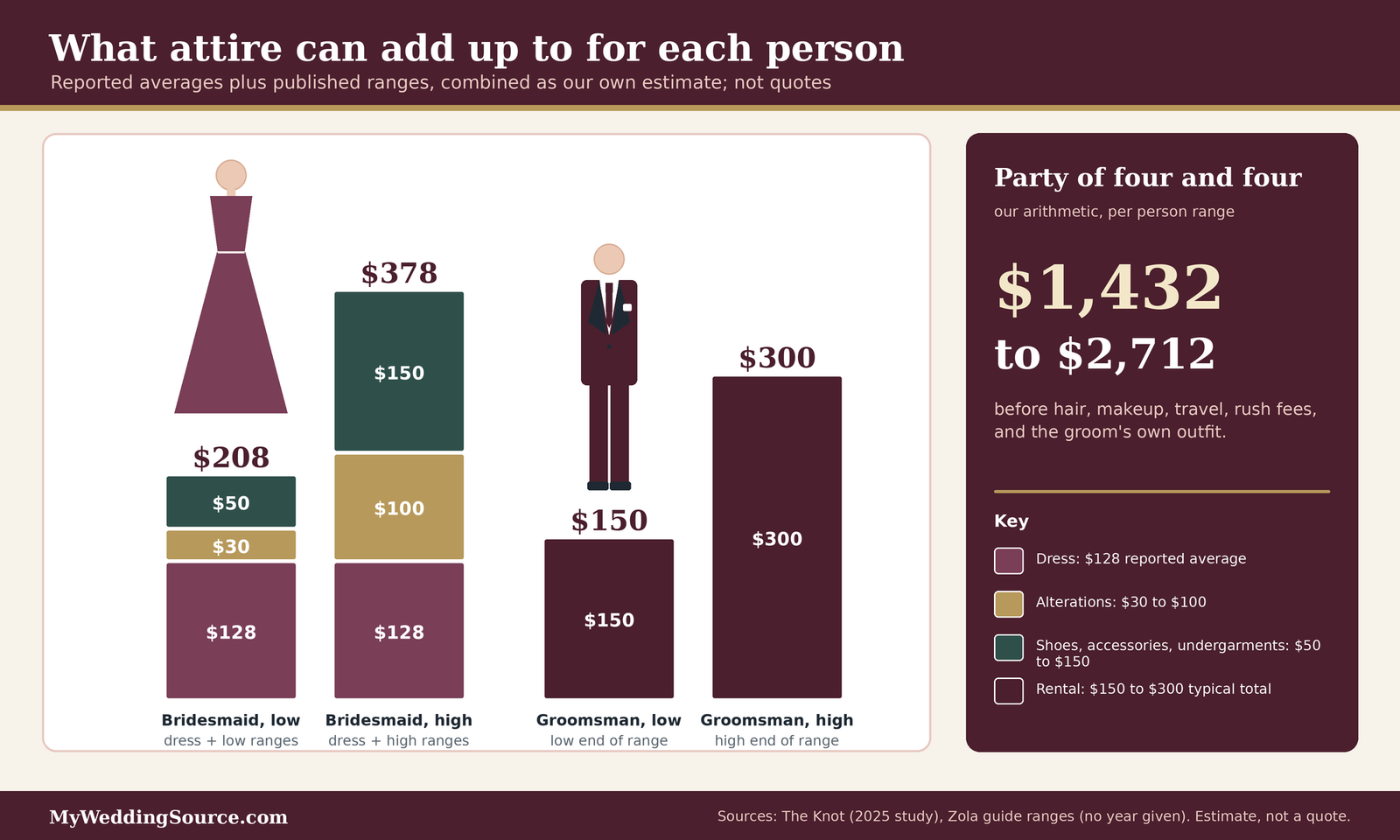
This is editorial arithmetic, not a survey result or a quote. We combined The Knot’s reported average bridesmaid dress price ($128, 2024 weddings) with Zola’s unsourced guide ranges for alterations ($30 to $100) and for shoes, accessories, and undergarments ($50 to $150). That gives roughly $208 to $378 per bridesmaid before hair, makeup, travel, and rush fees. For a groomsman, we used The Knot’s typical rental range of $150 to $300 per person. For a party of four and four, that is about $1,432 to $2,712 combined, which the people involved would cover unless the couple steps in. Your own quotes should replace every number here.
Decide who pays for what, and put it in writing
The sources agree on a default and disagree about the edges. The default is that attendants buy their own clothing. The edges are shoes, accessories, hair, makeup, lodging, and what to do when someone cannot afford the cost.
Where the guidance agrees
Emily Post says bridesmaids cover their own dresses, alterations, shoes, accessories, travel, and their share of the group gift. The Knot says bridesmaids usually pay for their own dresses even when the couple chooses the style, and that couples may cover the cost, especially with a smaller party, but are not obligated to. Zola likewise says bridesmaids buy their own dress, but adds that the bride should consider everyone’s budget. All three also tell the couple to talk about money early. Emily Post advises starting with a conversation about budget, formality, and religious restrictions, and says the bride may cover the difference if she loves a dress the group cannot afford.
None of the pages we read give a clear rule for who pays for groomsmen’s wedding party attire. Emily Post’s wedding party page says the best man coordinates fittings or rentals but does not state who pays, and The Knot’s page does not address groomsmen. Since the convention is unclear, state who pays in your first message rather than assuming.
Where the guidance differs, and how to choose
Zola says the bride is expected to pay for shoes and accessories, and that if she requires professional hair and makeup for everyone, she customarily pays. The Knot says that if the bride requires professional services with a specific look, she customarily pays, and otherwise it depends on the couple. Emily Post’s wedding party page lists shoes and accessories among bridesmaid costs and says the couple traditionally arranges lodging for the bridal party, whereas Zola says bridesmaids pay for their own travel and lodging, with a suggestion not to ask them to pay for more than one or two nights. These are real differences, which tells you the etiquette is a matter of convention and not law.
A practical rule, which is our suggestion and not a standard: if you require something specific, pay for it. If you require a particular dress, shoe, hairstyle, or cufflink, the requirement is a cost you are choosing to impose, and covering it removes the awkwardness. If you only suggest a color, bridesmaids and groomsmen can choose within their means. Put the decision in a short message: what is required, what is optional, and what the couple will cover. See our wedding etiquette guide for wording, and use the wedding budget calculator to see how any contribution fits the whole plan.
Use scenarios to see where your own answer flips
Averages are not a plan for wedding party attire. The table below sets out five situations with their assumptions, our recommendation, and the point at which the recommendation changes. The cost figures reuse the numbers above, and the arithmetic is ours.
| Scenario | Assumptions | Suggested approach | What flips it |
|---|---|---|---|
| Friends with uneven budgets | Four bridesmaids; no one has stated a limit; dress averages near $128, with other costs on top | Choose a color family and a shortlist of five to ten styles; ask each person privately for a comfortable maximum | If anyone names a number well below the shortlist, the couple covers the gap or the shortlist drops a price tier |
| Couple pays for everyone | Four bridesmaids and four groomsmen; reported averages used as a proxy: $128 per dress and $205 per male partner outfit | About $512 for dresses plus about $820 for male attire, or about $1,332 before alterations and accessories (our arithmetic) | If the couple also requires shoes, hair, or makeup, add those lines before committing |
| Hot outdoor summer ceremony | Standing outdoors for a long ceremony; formal or semi-formal invitation | Lightweight fabrics, light or mid tones, shade and water for the group, suits instead of heavy jackets where the invitation allows | If the invitation is black tie, keep tuxedos but ask for lighter-weight wool and allow jackets off after the ceremony |
| Large party across several cities | Ten or more people; fittings cannot happen in one place; rentals or one online retailer | One retailer for the whole group, one order date, one return coordinator, at-home try-on where offered | If a retailer cannot ship everyone together, split by retailer but keep color and fabric identical |
| Short timeline | Wedding about ten weeks away; made-to-order dresses quoted at 12 to 16 weeks | In-stock or sample dresses, or rental for the men; ask about rush options and their surcharge | If a rush option exists within budget (Zola cites about $50 to $100 extra), a made-to-order dress may still work |
How to read the table
The table is meant to be adapted. The first column tells you whether your situation resembles one of ours, and the last tells you what would change the advice. If you cannot tell which row you are in, the missing information is usually either a budget number or a date, and both are cheap to get.
What to do if costs rise after the decision
If prices change after you commit, treat it as a new decision, not a failure. Tell the group promptly, say what you can cover, and offer a lower-cost option in the same color family. The Knot’s guidance for bridesmaids who face a dress above their budget is to ask about a lower-cost alternative in a similar color or to ask about splitting the cost, and that approach works equally well in reverse: the couple can offer it before anyone has to ask.
Respect the cost of being in a wedding
Wedding party attire is one line in a longer list of costs for the people standing next to you. Axios, citing a Zillow analysis, reports that attending one wedding plus a bachelor or bachelorette party comes to about $2,010, though it does not give a year for that figure. Zola points out that bridesmaids typically also cover their own travel and lodging, and share the costs of a bachelorette party and sometimes a shower. That is the context in which a $128 average dress is one expense among several.
Total up what you are asking of each person
Make a short list of every required expense, with wedding party attire first: attire, alterations, shoes, travel, lodging, shared gifts, and parties. Put approximate figures beside it. The total is often larger than anyone intended, and seeing it written down makes it easier to trim. Our wedding planning checklist is a good place to track those lines.
Offer an easy exit
Tell each person, in writing and privately, that they can step back from the party or move to a role with no attire cost, such as reader or honorary attendant, without losing the friendship. Saying it out loud may feel unusual, which is exactly why it helps: someone who is strained but too polite to say so can use it. The offer costs nothing and the answer you get may be a relief for both sides.
Buy or assemble the look with a correction path for wedding party attire
Planning wedding party attire is mostly a sequencing problem. Some items take months to arrive, some can be bought in an afternoon, and some cannot be tested until the others are in your hands. The goal of this section is a plan in which every risky step comes early enough to be corrected, and in which you know what you will do if a step fails.
Order or test the highest-risk pieces first in the wedding party attire decision
Rank each piece of wedding party attire by how hard it would be to replace in the final month. A made-to-order dress in a specific color is hard to replace. A tie is not. Starting with the hard-to-replace items means any problem shows up while there is still time to respond.
Prioritize fit, lead time, and return rules: wedding party attire
Three properties decide how risky an item is: whether it has to fit closely, how long it takes to arrive, and what the return policy allows. Fit matters most for fitted dresses and tailored jackets. Lead time matters most for made-to-order items. Return rules matter most for anything customized, since many sellers limit returns on made-to-order or altered goods, and we cannot say what any particular seller’s rule is, so ask.
The sources we reviewed give consistent lead times for the slowest items. David’s Bridal recommends placing bridesmaid dress orders six to eight months before the wedding, starting research eight to ten months out, and describes ordering as late as three to four months out as possible but narrowing style and color options and sometimes adding rush shipping costs. It describes standard production at about 12 to 16 weeks for most designers, with peak season from roughly May through October often meaning longer lead times, and with custom colors or intricate details needing more time. The Knot’s article on who pays suggests buying about six months before the wedding, citing its study.
For men’s rentals, the timelines are shorter. Generation Tux recommends ordering about two months ahead, says orders can still be placed about three weeks before the event, and suggests fitting the groom and groomsmen two to three months before. Jim’s Formal Wear suggests groomsmen submit measurements and place orders two to three months out. Those are retailer guidelines, so they describe how those companies operate. A different rental company may have different deadlines, so confirm each one.
If you are buying, not renting, the timeline stretches. Jim’s Formal Wear describes six to nine months for custom or made-to-measure suits and four to five months to start shopping for off-the-rack suits. The point of those ranges is that the slowest path is the one with the most customization.

Avoid custom work before measurements or palette are stable: wedding party attire
Custom work is wasted if the inputs change. Two things commonly change: the body and the palette. People’s measurements can shift over several months, and a palette can shift when a venue, a season, or a florist changes the picture. Placing a made-to-order commitment before either is settled can leave you with something that fits last season’s measurements or last month’s color.
A simple rule from us: freeze the palette first, then take measurements as late as the lead time allows, and keep the buffer. For fitted dresses with a long production time, that means taking measurements at the order date and being prepared for alterations at the end, since alterations exist to handle small changes. David’s Bridal suggests scheduling initial fittings about three to four months before the wedding once the dresses arrive, minor alterations taking about two to three weeks and often longer in busy seasons, and final alterations finished and picked up one to two months before. Zola gives a similar window, allowing two to four weeks for alterations plus time for any extra adjustments.
For anything a person will wear next to their skin, prefer a short return window you can actually use over a generous one you will miss. At-home try-on programs help, as The Knot notes that these services give about a week with the dresses and Generation Tux says wedding customers get three days to try the tux at home. Put the deadline on your calendar the day the package arrives.
Know your basic protections when an order is late or the label is unclear
Two federal rules are worth knowing, as general education and not legal advice. Neither covers every purchase or every seller, and the rules about your particular order depend on the contract, the seller, and where you live. If something goes wrong, read the seller’s terms and, where it matters, consider speaking to a qualified professional.
Late shipments and the FTC’s mail-order rule
The Federal Trade Commission’s Mail, Internet, or Telephone Order Merchandise Rule applies to many online and phone orders. According to the FTC’s business guide, a seller must have a reasonable basis for any shipping time it advertises, and if it states none, the default is 30 days after receiving a complete order. If the seller cannot ship on time, it must offer the buyer a choice before the deadline: accept the delay or cancel for a prompt refund. The notice must give a revised ship date or the reason for delay, and explain the right to cancel. The guide also says that sellers cannot substitute store credit for a required refund and that refunds for payments by cash, check, money order, or third-party credit are due within seven working days after cancellation.
The practical lesson is to save the order confirmation and any stated delivery date. If a dress or suit looks like it will miss your date, contact the seller early and in writing, and decide quickly between waiting and replacing. The rule has details and exceptions, and the FTC’s own guide is the place to read them.
Care labels and what they tell you
The FTC’s Care Labeling Rule requires manufacturers and importers to attach permanent care labels to covered clothing before sale in the U.S., and says the instructions must cover washing, bleaching, drying, ironing, and dry cleaning where relevant, and warn against harmful procedures a consumer might reasonably try. For wedding party attire, the label is a practical tool. A satin dress that says to dry-clean only is not a garment to steam at home, and a fabric that cannot be washed is one to protect from spills. Read the label at the first try-on, not the night before, and ask your tailor or dry cleaner about anything embellished, because the FTC’s guide itself notes that beads and some dyes can be affected by cleaning.
Run a full-look test before the final week in the wedding party attire decision
A full-look test means putting every piece on together, with the shoes and accessories, and seeing them as the photographer will. Individual items are usually checked one at a time. Problems usually come from combinations.
Photograph the combination in similar light: wedding party attire
For the full-look test of your wedding party attire, choose a day a few weeks before the wedding, at a time of day close to your ceremony or portraits, and ask each person to bring the real pieces. Photograph the group on a phone, outdoors if the ceremony is outdoors, using the same kind of background if you can. Look at the photo on a screen and on paper if possible. The goal is to catch color differences between dyed lots, fabrics that show creases, visible undergarments, hems that sit at different heights, and shoes that do not suit the rest.
This is not a professional shoot and it does not need to be. It is a quick, low-cost test, and it takes the same few minutes as a group hug. Ask a neutral person to look at the photo and say what stands out. If the same item stands out for two people, treat it as real. Share the photo with the photographer if you like, since it helps them plan, and see our guide to wedding photography.
Timing matters. Generation Tux says garments arrive about 14 days before the event and advises trying everything on right away, leaving at least two weeks before the event for any changes, and contacting the company within 48 hours of delivery if something is wrong. Jim’s Formal Wear says a rental suit should arrive about 5 to 10 days before the wedding. If your test is the same day the box arrives, you have used up most of your buffer, so do the test for dresses and owned items earlier and treat the rental try-on as a quick check.
Document substitutions and backup accessories: wedding party attire
Write a short list of what you will do if something fails. For each important piece, note the backup: a second pair of shoes, a spare tie in the same color, a sewing kit, a steamer, safety pins, fashion tape, a lint roller, and a small stain remover. A named person, such as a sibling or the best man, can hold the kit. Jim’s Formal Wear suggests assigning someone, such as the best man, to handle returns for the group to avoid late fees, and it advises returning the suit by the next business day.
Record substitutions too. If you change a tie color, swap a size, or approve a different shoe, write it down in the same group message so that nobody arrives with the old version. A shared note or a short group thread is enough. Our wedding planning checklist and plan wedding timeline guide are good places to keep those dates, and the wedding planning guide gives the wider picture.
Work backward from the date with buffers
A timeline for wedding party attire is only useful if it has slack. The numbers below come from the retailer guidance quoted above, and the buffer is ours.
A backward timeline you can adapt
Counting back from the wedding, a reasonable plan using those sources looks like this. At eight to ten months, settle formality and palette, set the budget, and brief the group. At six to eight months, order bridesmaid dresses. At about four to six months, begin shopping for suits you plan to buy. At three to four months, expect dresses to arrive and schedule first fittings. At two to three months, collect measurements and place rental orders for the men. At one to two months, finish alterations. At about two to three weeks, run the full-look test and confirm shoes and accessories. At one to two weeks, expect rentals and do the final try-on. The day after, return rentals. Every number here comes from a retailer’s recommendation, and your own sellers may differ.
Where to put your buffer
Put your buffer where the cost of a miss is highest. That is usually the made-to-order dress, since it takes the longest and offers the fewest ways out, and it is usually the alterations, since tailors are busier in peak season. Add two to four weeks to the dress timeline above and a week to the alterations date. If that pushes the order date earlier than you can manage, treat it as a signal to choose a faster path, such as in-stock dresses, not to compress the schedule.
Handle the situations that break a simple plan for wedding party attire
A plan for wedding party attire that works for five similar people on one lawn can fail quickly when real life adds a pregnancy, a long-distance friend, a religious ceremony, or a budget that cannot stretch. These are the cases in wedding party attire that come up most often in the guidance we reviewed, and the common thread is to ask early and offer options before anyone has to ask for an exception.
Plan for bodies, health, and access
People differ in size, shape, mobility, and sensory comfort, and wedding party attire has to work for that variety. The aim is for each person to be able to stand, sit, move, and eat comfortably in what they wear.
Sizing and silhouette across a varied group
David’s Bridal’s advice is to let each person choose a silhouette that flatters her body and feels comfortable, noting that mixing silhouettes suits size-diverse parties and that prices can differ when silhouettes differ. A related point is to check the size range before choosing a brand: a color you love is of limited use if a quarter of your group cannot order it in their size. Ask the retailer for its size range and for how it handles alterations before you commit, and if several people need extensive alterations, ask what they cost and how long they take, because Zola’s guide notes that complex changes or multiple fittings sit at the higher end of its alteration range.
Another way to reduce risk is to separate the choice of color from the choice of style. Pick the color and fabric as a group and let each person choose a style within a shortlist. That way someone who needs a particular neckline, strap, or sleeve for comfort or confidence does not have to explain why.
Pregnancy, medical needs, and mobility
If someone in the party is pregnant, may become pregnant, uses a mobility aid, or manages a medical condition, ask them privately what they need rather than guessing. Pregnancy changes measurements over months, so a dress ordered early may not fit on the day; ask about stretch, adjustable styles, or a late alteration plan. For anyone with a condition that affects temperature regulation or standing, the CDC’s heat guidance on lightweight, loose, light-colored clothing, regular fluids, and cooler indoor spaces is a reasonable basis for a conversation about comfort. We are not medical professionals, and the person and their clinician should decide what is safe. For you, the practical step is to build in a place to sit, shade, water, and a quick way out of the line if they need it.
Respect venue, faith, and culture
Some venues and traditions have expectations that override style. Learning them early avoids last-minute changes.
Houses of worship and venue rules
Emily Post advises that if the wedding is in a house of worship, you should ask about dress rules, such as covered shoulders or head coverings, and it advises sharing venue dress rules with the groom’s mother. The same holds for the whole party. Ask the officiant or the venue for any rules in writing, and pass them to everyone in the first message. If a sleeveless gown is planned, a wrap or shawl in the same fabric or color can solve the problem without changing the dress. Our guide to the wedding ceremony covers the wider planning of that part of the day.
Cultural and religious garments
Many families wear traditional or religious clothing to weddings: a saree, a hanbok, a barong, a kente cloth, a kippah, or a head covering, among others. These are not exceptions to a dress code. They are part of the day. The simplest approach is to ask the people who will wear them what they plan to wear, share your palette, and let them decide how to coordinate. Resist the urge to assign a substitute that approximates the look. If a garment would clash with the palette, a conversation about a neutral accessory or a shared color element can help, and the decision stays with the wearer.
Manage distance, timing, and change
Modern wedding parties are often spread across cities and time zones, and the plan for wedding party attire has to work for people who cannot try anything on together.
Attendants who live far away
The earlier recommendation to use one retailer, one order date, and one return coordinator is most valuable here. Ask each person to send measurements by a set date, order at the same time, and photograph their own try-on in daylight. A group video call to look at everyone in the dresses and suits is a decent substitute for a group fitting. For people traveling to the wedding, factor in shipping times, and ask whether items can be delivered to the hotel or to a family member’s address. Generation Tux notes that destination weddings need extra time for travel and possible delays, which is worth building into the schedule.
Changes in the party and the plan
Wedding parties shift. Someone cannot attend, someone is added, a venue changes, or the season moves. Build in a single decision date after which changes become costly, and tell the group when it is. After that, handle each change on its own terms: ask the seller about the policy for a canceled or changed order, and check whether a replacement can be sourced in time. If a person has to withdraw, thank them and keep the conversation about the friendship, not the dress. Our plan wedding guide covers how to keep changes like these from cascading through the rest of the schedule.
Handle disagreement kindly
Differences of opinion about wedding party attire are often about something else: money, inclusion, or the feeling of being overruled. Treating them as the real issue is usually faster than arguing about hemlines.
When someone dislikes the color or style
Emily Post’s guidance is that a bridesmaid can raise concerns about a color or style if she also suggests alternatives, and that the bride makes the final call. That balance is a good model for any attendant. Invite objections with a short deadline, ask for alternatives in the same color family, and decide. If the objection is about comfort or confidence, give it more weight than an objection about taste. If it is about cost, return to the budget conversation and the offer to cover the difference.
When someone cannot afford it
This is the case where your earlier decisions pay off. If you have told everyone the budget, said what the couple will cover, and offered an easy exit, a person in this situation has options. Offer a lower-priced alternative in the same color, a rental or a resale option, a role with no attire cost, or a contribution from the couple. Do not ask the person to justify their finances. The couple’s role is to make the choices available, and the person’s role is to pick one.
Questions to ask before anyone buys for wedding party attire
Written answers about wedding party attire protect everyone, especially when orders are made to order or customized. Keep them with the order confirmation, and share the relevant parts with the group.
Questions for the seller
Sellers of wedding party attire make many promises in marketing, but only the policies in writing count. These questions turn marketing into commitments.
Fit, color, and timing
Ask about the size range, whether the color is dyed to match across orders, how long production takes, and what happens if a dress arrives late or a color is off. Ask whether swatches are available, because The Knot’s advice on mismatched dresses suggests ordering swatches to compare colors and textures side by side, since colors can look different online. Dessy, one retailer, offers up to three free swatches with shipping paid by the customer, according to the page we reviewed, which is a reminder that swatch terms differ between sellers.
Questions worth asking before you order
- What is the size range, and how are sizes and alterations handled for people between sizes?
- Is there a swatch, and is the color dyed in lots that can differ between orders?
- What is the production time, the shipping time, and the date the order will arrive?
- What happens if the order is late, and will you tell me before the deadline?
- Can the item be returned, exchanged, or altered, and what changes after alteration?
- For rentals: what is the total with shoes, accessories, fees, shipping, and damage waivers?
- Who handles returns for a group, and what are the late fees?
- What does the care label say, and is anything on the garment sensitive to cleaning?
Returns, fees, and responsibility
Ask for the return and exchange window in days, the fees for damage and handling, and what the company considers normal wear. The Knot notes that Men’s Wearhouse adds a $12 damage and handling fee at checkout and The Black Tux charges a flat $12 that it says covers dry cleaning, restocking labor, and normal wear and tear, which shows how the same line can be described differently. Also ask who is responsible if a group member returns an item late, since Jim’s Formal Wear suggests assigning one person, such as the best man, to coordinate returns for the group to avoid late fees.
Questions for your group
The group needs clear answers too, and they are better asked together than discovered separately.
Budget, comfort, and constraints
Ask each person for a comfortable maximum, any size, medical, religious, or cultural constraints, and any date conflicts. Ask privately if you can, since people are more honest about money one to one. Give a date to reply, and say plainly what will happen if they do not.
Decisions you can make once
Share the formality level, the palette, the anchor elements, the order dates, and who pays for what for wedding party attire, in one message. Repeat the message before each deadline. A single clear document saves the weeks of back-and-forth that come from several partial ones, and it is the thing you will be glad of in the last month.
Frequently asked questions about wedding party attire
Choosing the look
Does wedding party attire have to match?
No. The sources we reviewed describe both matching and mixed looks as acceptable. What helps is consistency in a few places, such as formality, length, fabric, and a limited palette. Retailers such as David’s Bridal suggest holding fabric constant and capping colors when the group varies. Choose what to hold constant and let the rest differ.
How many colors can a wedding party wear before it looks chaotic?
David’s Bridal suggests staying within about two to four colors from one palette family, and says five or more can look chaotic. It also says that if you want variety, you can cap colors at three and vary silhouettes or fabrics instead. That is a retailer’s rule of thumb, so judge it against your own palette.
Money and etiquette
Who pays for wedding party attire?
Emily Post, The Knot, and Zola all say attendants usually pay for their own clothing. Zola and The Knot add that a couple who requires a specific item or professional hair and makeup customarily pays for it. Conventions differ on shoes and lodging, so state who pays what in your first message instead of assuming.
What is the average price of a bridesmaid dress?
The Knot reports an average of $128 per person for 2024 weddings, from its 2025 Real Weddings Study, unchanged since 2021. That figure covers the dress only. Alterations, shoes, accessories, and undergarments add to it, so a budget should include them. Your own quotes will vary by retailer and style.
Timing and logistics
When should bridesmaid dresses and groomsmen outfits be ordered?
David’s Bridal recommends ordering bridesmaid dresses six to eight months before the wedding, with standard production around 12 to 16 weeks. Generation Tux suggests ordering rental tuxedos about two months ahead, and Jim’s Formal Wear suggests two to three months for groomsmen. These are retailer guidelines, so confirm each seller’s deadlines.
What if a dress or suit arrives late?
Contact the seller early and in writing, and keep your order confirmation. For many online and phone orders, the FTC’s mail-order rule requires a seller who cannot ship on time to offer a choice between accepting a delay and cancelling for a prompt refund. The rule has exceptions and details, so read the FTC’s guide or the seller’s terms.
Special situations
What should parents and grandparents wear?
Emily Post advises that the groom’s mother ask the bride’s mother what she is wearing and then choose something that neither matches nor clashes, and that each mother choose her own outfit. Tell parents the formality level and palette in one message, ask what they plan to wear, and avoid dictating details.
What if a member of the wedding party cannot afford the outfit?
Offer options before they have to ask: a lower-priced alternative in the same color, a rental or resale item, a contribution from the couple, or a role without an attire cost. Emily Post notes that the bride may cover the difference if she loves a dress the group cannot afford. Ask privately and do not request justification.
Your next steps
Decide the frame
Settle formality, palette, and anchors
Write down the invitation’s formality level, a palette of two to four colors, and two or three anchor elements. Share it with the whole group in one message. Our wedding guest dress code guide helps you keep what guests are told in line with what the party wears.
Set the budget and say who pays
Choose what is required, what is optional, and what the couple will cover. Use the wedding budget calculator to see how a contribution fits the full plan, and the wedding etiquette guide for wording.
Run the plan
Order the slow items first
Place the made-to-order wedding party attire orders first, then rentals, then accessories, and add a buffer to each date. Keep the order confirmations, the delivery dates, and the return deadlines in a shared note, alongside the dates in our plan wedding timeline guide.
Test the whole look and keep a kit
Photograph the group in daylight a few weeks ahead, fix what stands out, and assign someone to carry a small repair kit and handle returns. Tell your photographer what the group will wear, and use the wedding photographer shot list to plan the group portraits.
Sources & methodology
How we built this guide
What we relied on
This guide combines two federal consumer-protection sources (the FTC’s mail-order and care-labeling rules), one federal public-health source (the CDC’s extreme-heat guidance), published etiquette guidance from Emily Post, and survey reporting and retailer guidance from The Knot, Zola, David’s Bridal, Generation Tux, and Jim’s Formal Wear. Where a figure comes from a survey, we give its year and what it covers. Where a statement comes from a retailer, we say so, because retailer advice reflects the seller’s own products and timelines. The cost totals in this guide are our own arithmetic from the cited averages and ranges, and they are estimates, not quotes.
What we did not do
We did not test garments, survey couples, or request quotes. We did not verify retailer claims about their own products. Prices, rental terms, and policies change, and the Zola price ranges we cite are not attributed by that page to a survey or a year. The FTC and CDC material is general education, not legal or medical advice. Confirm the terms of your own orders, and ask a qualified professional about contracts or health questions.
Source list
Government and public-health sources
- Federal Trade Commission, Business guide to the Mail, Internet, or Telephone Order Merchandise Rule: https://ftc.gov/business-guidance/resources/business-guide-ftcs-mail-internet-or-telephone-order-merchandise-rule
- Federal Trade Commission, Clothes Captioning: Complying with the Care Labeling Rule: https://www.ftc.gov/business-guidance/resources/clothes-captioning-complying-care-labeling-rule
- Centers for Disease Control and Prevention, Protect Yourself From the Dangers of Extreme Heat: https://www.cdc.gov/climate-health/php/resources/protect-yourself-from-the-dangers-of-extreme-heat.html
Etiquette and wedding-industry survey sources
- The Knot Worldwide, 2026 Real Weddings Study press release: https://www.theknotww.com/press-releases/the-knot-worldwide-unveils-2026-real-weddings-study
- The Knot, Average bridesmaid dress cost (2025 Real Weddings Study, 2024 weddings): https://theknot.com/content/average-bridesmaid-dress-cost
- The Knot, Average tux rental cost: https://www.theknot.com/content/tux-rental-cost
- The Knot, Who pays for wedding party attire: https://www.theknot.com/content/who-pays-forwedding-party-attire
- The Knot, Mismatched bridesmaid dress tips: https://www.theknot.com/content/mismatched-bridesmaids-dress-tips
- The Knot, Wedding dress codes for guys: https://www.theknot.com/content/wedding-dress-code-for-guys
- Emily Post, Inside weddings: wedding attire: https://emilypost.com/advice/inside-weddings-wedding-attire
- Emily Post, Inside weddings: the wedding party: https://emilypost.com/advice/inside-weddings-the-wedding-party
- Axios, Latest wedding trend: smaller entourages: https://www.axios.com/2026/01/17/wedding-party-bridesmaid-groomsmen-cost
Retailer and rental-company guidance
- Zola, What do bridesmaids pay for?: https://www.zola.com/expert-advice/what-do-bridesmaids-pay-for
- Zola, How much do bridesmaid dresses cost?: https://www.zola.com/expert-advice/how-much-do-bridesmaid-dresses-cost
- David’s Bridal, When to order bridesmaid dresses: https://www.davidsbridal.com/content/marriage-tips/everything-you-need-to-know-about-when-to-order-bridesmaid-dresses
- David’s Bridal, Mix-and-match bridesmaid dresses: https://www.davidsbridal.com/content/wedding-planning/mix-and-match-bridesmaid-dresses-how-to-pull-off-the-look
- Generation Tux, How far in advance should I rent my tuxedo or suit: https://generationtux.com/blog/wedding-planning/how-far-in-advance-should-i-rent-my-tuxedo-or-suit
- Jim’s Formal Wear, Essential wedding suit timeline for grooms: https://blog.jimsformalwear.com/2025/11/essential-wedding-suit-timeline-for-grooms/
- Dessy, How to coordinate mismatched bridesmaid dresses: https://www.dessy.com/blog/post/wedding-trends-how-to-coordinate-mismatched-bridesmaid-dresses