

Learning how to coordinate wedding party attire across different body types comes down to deciding what the group will share (usually a color and a level of formality), then letting each person’s cut, size, and tailoring differ so everyone looks comfortable and intentional in the photographs.
Quick answer
For how to coordinate wedding party attire across different body types, pick one anchor (most often color) and let the other choices vary. Offer a short list of approved styles, not a single outfit. Have each person measure privately and order by measurements, not by their usual size. Plan fittings and alterations backward from the date, because alterations are what make different bodies look alike in a lineup. And on the wedding morning, schedule dressing and departure as a critical path, since the last zipper or a missing safety pin can delay the whole photo schedule.
What “coordinated” means when bodies are different
Many couples start with a photograph from a magazine or a social feed and try to reproduce it with their own friends. The trouble is that the people in that photograph were fitted to those particular outfits, in that particular light. Your group will include different heights, different proportions, different comfort levels, and probably different budgets. A good plan treats those differences as inputs to the design, not as problems to hide.
This guide on how to coordinate wedding party attire across different body types is written for couples, planners, maids and men of honor, and anyone else who has been handed the job of making a wedding party look like one group. It covers dresses, suits, tuxedos, jumpsuits, and mixed looks, and it does not assume that people on one side of the couple wear one kind of clothing. It is about process: how to set rules, how to ask, how to measure, how to schedule, and how to handle the awkward cases. It does not tell anyone what their body should look like, and it does not recommend a brand.
Coordination means shared anchors, not identical outfits
An anchor is a deliberate constant. When one thing stays the same across the group, other things can change without the lineup looking random.
The one-anchor rule
Dessy, a bridesmaid dress retailer, describes the idea as choosing one anchor (color, fabric, or silhouette) and varying the other two, and says that changing all three at once tends to look disorganized instead of curated. That is a retailer’s design rule of thumb, not a law, but it is a useful test for any group. If you cannot say in one sentence what is the same about everyone’s outfit, the group probably has no anchor yet.
What can differ without breaking the look
David’s Bridal, another retailer, suggests keeping color consistent while letting neckline, sleeve length, and back details vary, and keeping fabric finish similar, so matte pairs with matte and sheen with sheen. Applied to a group with different builds, this means the things that most affect how a garment sits on a body (neckline, sleeves, waist treatment, skirt shape) are the things you let people choose. The things you hold constant (color family, finish, length range) are the things that make the group read as related.
Fit decides whether anyone is comfortable
Matching color is easy. Matching comfort is the hard part, and it is the part that changes how people stand, smile, and move for hours.
Comfort shows up in motion
People in a wedding party walk, hug, carry bouquets, help children, climb into cars, sit at dinner, and dance. A garment that looks fine on a hanger can bind at the shoulders, gape at a button, or ride up when someone sits. For that reason, the most useful fitting test is also the simplest: ask each person to raise their arms, sit, take a few steps, and bend slightly, in the exact shoes and undergarments they will wear.
Why identical cuts can look stiff on different builds
The Black Tux, a suit rental company, says identical cuts on different builds can look stiff in photos, and suggests keeping the color family and formality level consistent while letting jacket cut and lapel style vary to suit each man. The same logic applies to dresses. When the fabric and color are shared, a slightly different cut often looks more natural than the same cut on everyone.
Who this guide is for, and what it leaves out
Because the topic involves bodies, it is worth being explicit about the boundaries of this article.
Any gender, any size, any role
The advice below applies to bridesmaids, groomsmen, attendants of any gender, honor attendants, and parents or children who are dressed to match. Where a section refers to a dress or a suit, the principle usually transfers to any garment. We avoid assigning clothing by gender label, and where we cite a retailer that uses gendered categories, we say so.
Not medical or financial advice
We are not describing any particular body as “problematic,” and we are not giving health, medical, or financial advice. Questions about pregnancy, injuries, or medical equipment belong with the person’s own clinician, and questions about who should pay belong to the people involved. Nothing here is a prediction of how a specific garment will fit a specific person. A tailor or fit specialist who can see the person is the final authority.
How to coordinate wedding party attire across different body types: pick the anchor first
The most useful early decision is not a dress or a suit. It is the answer to the question, “What will be the same?” Once that is settled, everything else becomes a set of choices inside a frame.
Color as the anchor
Color is the most common anchor, and the one that gives the most flexibility on fit.
Same shade, different cuts
Dessy describes anchoring on color as the most common and most forgiving option: everyone wears the same shade in different cuts and fabrics. Zola, a wedding planning site, makes a related point in its mismatched-dress advice, noting that similar shades in varied silhouettes are easier to flatter across different body types. Both are the retailers’ and publishers’ views, and they match common sense: a cut chosen for the person is easier to get right than one chosen for the group.
Dye lots and swatches
If everyone is buying the same color from the same maker, Dessy advises ordering all dresses at the same time, because dresses from different orders may not match exactly even when the color name is the same. It also suggests ordering swatches to confirm that a color looks consistent across different fabrics before anyone buys. For a group with different silhouettes, swatches matter more, because a color can look noticeably different in chiffon, crepe, and satin.
Silhouette as the anchor
Anchoring on a shared cut is the hardest approach for a group with different bodies, and it deserves caution.
When a shared cut works
Dessy says an anchor on silhouette, with everyone in the same cut in different shades from a single color family, creates structure but is harder to pull off, because fit varies more by body type than color does. A shared silhouette can work when it is forgiving, such as a wrap style with an adjustable bodice. David’s Bridal lists adjustable or wrap bodices among the styles that can accommodate different chest sizes without custom ordering.
When it backfires
A rigid or highly structured cut leaves little room for alteration. If one person’s bust, waist, and hips fall in different sizes, a single cut may fit one measurement well and the others poorly. In that case a shared silhouette turns into a fitting problem for the person who has the least room to adjust. If you are unsure, choose color as the anchor and let silhouette vary.
Fabric as the anchor
Fabric is the quietest anchor, and it can work well when the weather or setting makes it the obvious choice.
Same fabric, many shapes
Dessy notes that anchoring on fabric, with everyone in the same material in different styles and colors, is less common but suits outdoor summer weddings. For groups with different builds, a fabric anchor means you can offer different shapes that all drape in the same way, which keeps the group related without forcing one cut.
Finish and drape matter as much as the name
David’s Bridal says chiffon and satin can work together if their drape is similar, and advises against mixing a heavy fabric such as velvet with chiffon. The practical lesson is to compare weight and sheen, not just the fabric name, and to check how a fabric behaves when someone sits, since stiff fabrics and clingy fabrics treat different bodies differently.

Ask in a way that does not single anyone out
When you are working out how to coordinate wedding party attire across different body types, how the request is phrased often matters more than which dress or suit is chosen. A well-meant message can still make a person feel evaluated, and people who feel evaluated tend to stay quiet about problems until the fitting.
Make the ask about comfort and constraints, not size
The goal is to learn what a person needs, without requiring them to describe their body to a group.
Words that put the focus on the garment
Compare “What is your size?” with “Which of these styles would you feel good in, and is there anything that would make you uncomfortable?” The second invites a preference and a constraint (heat, mobility, a medical device, a sensory issue, a budget limit) without asking for measurements in public. Ask about shoes and undergarments too, because those change how a garment fits.
A short message you can adapt
This is our own sample wording, not a script from a source: “We are choosing a color and a formality level, and each of you will choose the style that feels best on you from a short list. Please tell me privately if anything on the list would be uncomfortable, too expensive, or hard to get in your city. Nothing is final until you say it works for you.” Sending it individually, not in a group chat, keeps the answers honest.
Offer a short menu instead of a single outfit
People can make decisions more easily when the choices are limited and all of them are acceptable.
Two to five approved styles
David’s Bridal suggests offering a handful of pre-selected styles in your color, and its guidance mentions both two or three and three to five, so the exact number is a judgment call. Zola cautions that too much freedom can be overwhelming, and that guardrails on style or price help people choose with confidence. Between those two ideas, a short list of approved options (and a clear way to ask for an exception) tends to work better than either one outfit or a blank page.
Let people propose their own piece
The Knot suggests that each attendant choose an outfit that fits them, whether that is a suit, a dress, or a jumpsuit, and build the looks around the wedding palette. If the palette color is a neutral such as navy or gray, a suit can match it directly. For brighter shades, the same source suggests a neutral suit with a tie or pocket square in the palette color. Allowing a person to propose their own piece, within the anchor, often solves a fit problem that no catalog can.
Let people measure and decide privately
Privacy removes most of the social pressure around size.
Measure individually
David’s Bridal says each bridesmaid should measure herself independently, since sizes will likely vary across the party. Azazie, another retailer, recommends having someone help and measuring several times to get an average. Neither source suggests collecting measurements in a group chat, and we would advise against it. Let each person place their own order, or send measurements directly to the seller or the tailor.
Do not compare sizes in public
Retailer size labels are not consistent, and they say very little about a person. Azazie and Jenny Yoo both warn that your usual dress size may not match their size chart, so a number on a tag can feel surprising. If a group order needs a size list, collect it through the seller’s own form, or have a single trusted person (a maid of honor or a planner) handle it quietly.
Dresses and dress-like looks: silhouettes, necklines, and length
For attendants who wear dresses, jumpsuits, or skirts, a few design choices do most of the work of accommodating different bodies. The list below comes from retailer styling guides, so treat it as a starting set of ideas, not a rulebook. Our guide to bridesmaid dresses covers the wider buying decision, including cost and shopping options.
Silhouettes and fabrics that adapt
Some constructions leave more room for adjustment than others, and that room is what lets one color work on several bodies.
Adjustable bodices and forgiving fabrics
David’s Bridal lists adjustable or wrap bodices as a way to accommodate different chest sizes without custom ordering, and names stretchy jersey or knit as forgiving across body types. It also mentions A-line and fit-and-flare silhouettes as styles that move well and photograph cleanly, and empire waists for anyone who wants midsection comfort. These are one retailer’s suggestions, but they share a theme: structures that adjust or stretch tolerate difference better than structures that do not.
Styles that leave less room for error
The same retailer advises, for a group that mixes plus-size and petite attendants, a floor-length A-line in a medium-weight fabric, and cautions against very structured ballgown skirts, which can overwhelm petite frames, and very clingy column styles. A related point that is our own judgment, not a retailer’s claim: the more a garment depends on exact seam placement (a strapless corset bodice, a close-fitting column), the more the fitting schedule matters, because the margin for alteration is smaller.
Necklines, sleeves, and backs as the flexible variables
If the color and skirt shape are shared, the upper half of the garment is where people can personalize.
Pair different necklines with the same skirt
David’s Bridal suggests pairing different necklines, such as a V-neck and a square neck, with the same skirt shape. This gives each person a choice about comfort and coverage while keeping the lower half of the group visually similar. It is also a way to respect different preferences about sleeves, straps, and support without turning the choice into a discussion about anyone’s body.
Strapless and strapped styles fit differently
Azazie notes that strapless styles fit snugly, while strapped styles often run larger in the bust. That detail matters when a group shares a style name: the same dress in a strapless and a strapped version may need different sizes for the same person. If the group is mixing, ask each person to check the size chart for the exact version they choose, not the version someone else ordered.
Length and height
Hem length is where height differences show first, and it is usually the easiest thing to correct.
Floor-length is the easiest common ground
David’s Bridal calls floor-length the most universally wearable length, with petite bridesmaids able to hem it slightly, and midi a strong second choice for outdoor or garden settings that needs little alteration. Mini and tea lengths, it says, need more checking on individual comfort. Our own suggestion is to keep the whole group in one length category, so that no one’s hem reads as a different dress code.
Hollow-to-hem and heel height
Length depends on the shoes, so the measurement should be taken in the shoes that will be worn. David’s Bridal describes the hollow-to-hem measurement as running from the small dip at the base of the throat down the front of the body to the floor or the desired hem, taken in the heels you plan to wear, and says standard floor-length measurements fall around 58 to 61 inches, with the specific dress to be checked. If someone plans to change from heels to flats during the evening, ask the tailor about a hem that works for both, or plan a second pair of shoes with similar heel height.
Suits, tuxedos, and jackets across different builds
Menswear has its own set of decisions for how to coordinate wedding party attire across different body types, and a group that includes people of different heights, chest sizes, and proportions needs a plan for them. If you are still deciding between a suit and a tuxedo, our guide to groomsmen suits versus tuxedos walks through that choice, and wedding tuxedos covers rentals in more detail. The advice here applies to any attendant who wears a jacket and trousers.
Cut, lapel, and trouser choices
These are the variables that retailers say most often make a mixed group look balanced.
Jacket cut and lapel
David’s Bridal says classic fits give more room through the chest and waist, which suits larger builds, while modern fits suit athletic or leaner builds better. It calls single-breasted jackets its safest choice for a mixed group, says a two-button jacket lengthens the look for shorter wearers while three-button styles can improve proportions for taller ones, and describes notched lapels as the classic default and peak lapels as a way to balance broader shoulders. It advises avoiding extreme or very trendy cuts, since they flatter only some builds. The Black Tux makes a compatible point: keep the color family and formality level consistent and let cut and lapel vary to suit each man.
Trousers, shirts, and fabric
For trousers, David’s Bridal says flat-front styles suit most body types and that pleats add volume where needed. It also says wool blends drape well on most builds, advises solids over bold patterns because bold patterns can emphasize size differences, and recommends scaling accessories to each person’s build. The same retailer says shorter wearers can wear trousers slightly higher on the waist and taller wearers slightly lower. These are styling opinions from a retailer, and a tailor may see the person differently, so use them as prompts for a fitting conversation.
Shoulders, seat, and the places tailoring cannot fix
Not every adjustment is equally easy, and knowing which are hard changes how early you should begin.
Shoulders are the hardest alteration
The Black Tux says standard sizing assumes an average body, so shoulder placement, lapel gapping, and fit through the seat can be wrong for some men, and it calls shoulders the hardest part of a jacket to alter. David’s Bridal says common alterations include sleeve length, trouser hemming, and waist adjustments, with shoulder work needed in some cases. The practical consequence is that a person with an unusual shoulder or chest proportion should try on a jacket early, before the date when only quick fixes are possible.
Quick fixes versus structural problems
The Black Tux describes hemming and sleeve length as manageable late in the process, and structural problems such as shoulder placement as needing much more time. It also warns that rushed alterations can produce seams that do not lie flat, uneven trouser breaks, and jackets that gape across the chest. If you must choose between a rush on a complicated alteration and a different jacket, ask the tailor which is realistic and decide early.
Rental, purchase, and group orders
How the clothing is acquired changes how much room there is to fit it.
Rentals and fit surveys
The Black Tux describes an online fit survey that gathers height, weight, and build proportions rather than chest size alone, completed by each man on his own schedule, with no store visit required. Jim’s Formal Wear, a regional rental company, lists seven measurements (chest, overarm, waist, outseam, hip, neck, and sleeve) and suggests having two people measure, using a good-quality tailor’s tape. For rentals, the lesson is to follow the company’s own process exactly, since its sizing system is built on it. Our guide to renting wedding dresses covers the broader rental trade-offs, and our guide to groomsmen rental returns covers what happens after the day.
One pickup point for inspection
The Black Tux suggests having suits sent to one central pickup point, not individual addresses, so that the best man can inspect each garment before the wedding. Our reading is that a single point of inspection is helpful for any group order, because it turns a problem found at the church door into a problem found with time to fix it. If people live in different cities, a planner or a trusted friend can coordinate the inspection by video.
Measuring and sizing without guesswork
In any plan for how to coordinate wedding party attire across different body types, most fit problems begin with a measurement or a sizing choice made by assumption. A little discipline here saves money on alterations later.
Measure the body, not the label
All of the retailers we read agree on this principle, and it is the single most useful habit for a mixed group.
Taking the measurements
David’s Bridal describes using a soft fabric tape over form-fitting underwear or the undergarments planned for the dress, ideally with a helper. It describes bust as the fullest part of the chest, kept level with the floor and resting flat without pulling tight; waist as the narrowest point, roughly a couple of inches above the navel; and hips as the fullest part, about 7 to 9 inches below the natural waist. Azazie adds that standard sizing needs bust, waist, and hips, while custom sizing also needs hollow-to-floor and height, and suggests an unpadded bra for the bust measurement and event shoes for the hollow-to-floor measurement.
Do not substitute everyday sizes
Azazie says plainly not to use your regular dress, bra, or pants size, and Jenny Yoo, a bridesmaid dress brand, says your usual dress size may differ from its size. Treat the size chart on each item page as the only valid translation, and measure again if more than a few weeks pass before ordering.
When measurements fall between sizes
This is the situation that most often confuses groups, and sources give a consistent answer with one internal inconsistency worth noting.
The larger size is the usual rule
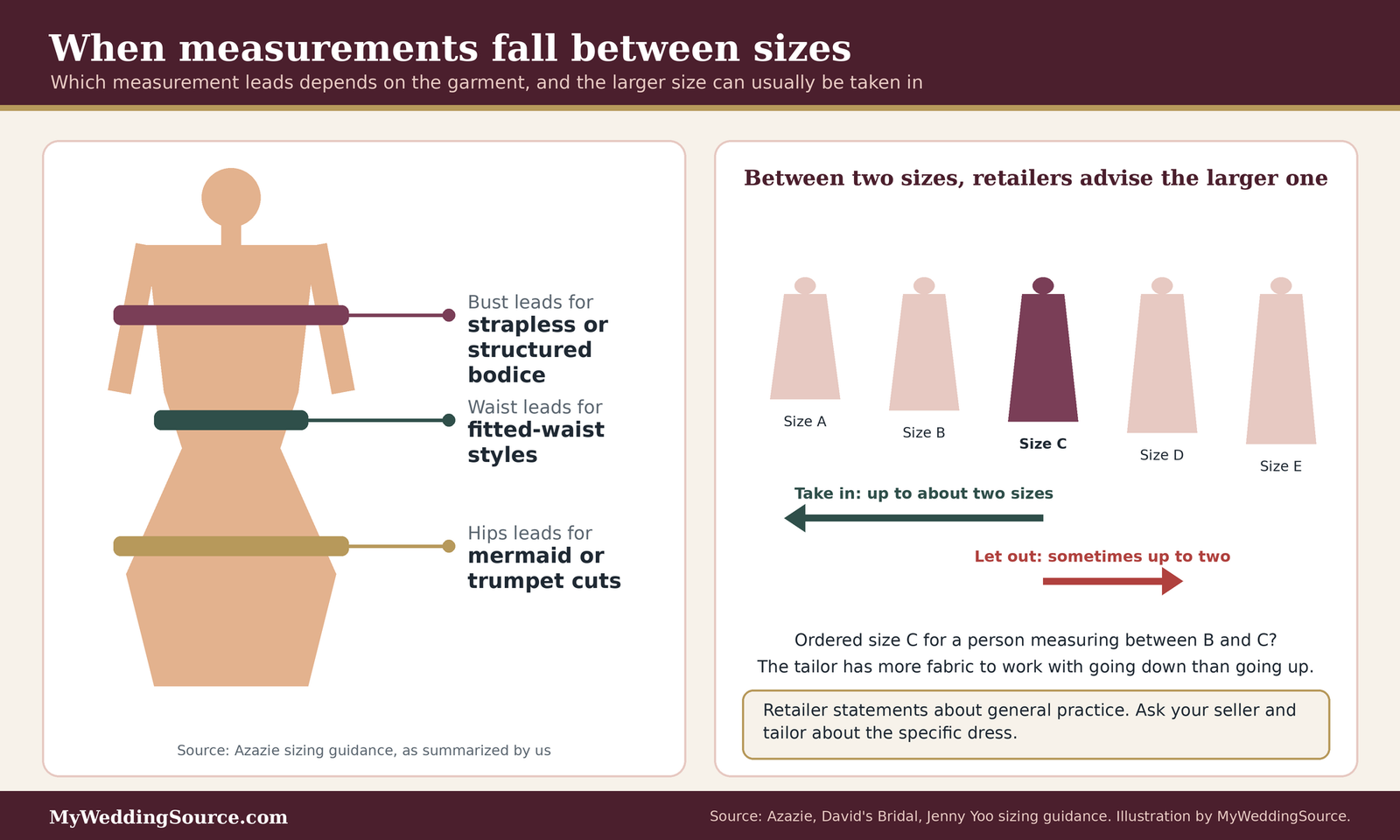
David’s Bridal, Azazie, and Jenny Yoo all advise choosing the larger size when between sizes, because taking a garment in is easier than letting it out. Azazie adds that dresses can usually be taken in up to two sizes and sometimes let out up to two sizes, which is the seller’s general statement and not a promise about any single dress. David’s Bridal also says that if bust and hips land in different sizes, you should order for the larger measurement, and that you should not order a size smaller in hopes of losing weight.
Which measurement leads depends on the style
Azazie says that if measurements span several sizes, the bust should lead for strapless or structured bodices, the waist for fitted-waist styles, and the hips for mermaid or trumpet styles. That guidance gives a group a way to talk about fit without comparing bodies: the garment decides which measurement matters. The same source’s FAQ suggests simply ordering custom in this case, which is a separate option with a different trade-off, discussed in the timeline and money sections below.
Menswear measurements and size charts
Jackets and trousers use different measurements, and the sources describe different workflows.
Convert chest to jacket size, then check proportions
The Black Tux says to use a suit jacket size chart to convert each man’s chest measurement into a jacket size before ordering, and notes that its own survey considers build proportions too. If a person falls between jacket sizes or has proportions that differ from the chart, a tailor who can see them is a better guide than a conversion table.
Let each person confirm their own details
The Black Tux recommends that each groomsman confirm his details and address, and that anyone whose measurements change tell the coordinator early. That is a good rule for every kind of attire: a measurement is a snapshot, and a message such as “tell me if anything changes” costs nothing.
| Garment | Measurements the sources mention | Who describes it |
|---|---|---|
| Standard-size dress | Bust, waist, hips | Azazie, David’s Bridal |
| Custom-size dress | Bust, waist, hips, hollow-to-floor, height | Azazie |
| Floor-length hem | Hollow-to-hem, taken in the planned shoes | David’s Bridal |
| Suit or tuxedo rental | Chest, overarm, waist, outseam, hip, neck, sleeve | Jim’s Formal Wear |
| Suit rental by survey | Height, weight, and build proportions | The Black Tux |
A fitting and alteration timeline that works for different bodies
The more different the bodies in your group, the more the schedule matters to how to coordinate wedding party attire across different body types, because alterations are what bring different bodies to the same level of polish. The dates below come from retailers and are specific to their products, so replace them with the dates your own seller and tailor give you. The wider planning picture is in our wedding planning checklist and our wedding vendor timeline.
Order windows
Everything else in the schedule depends on when the garments arrive.
Dresses
Azazie says production typically takes two to four weeks and delivery about three and a half weeks, suggests ordering about four months before the event, and describes two to three months as the minimum comfortable window, with possible delays from January through March. David’s Bridal notes that some styles ship in three to four days with a 48-hour rush option, and that most wedding dresses otherwise take several months to produce and ship. Those figures describe two different retailers’ systems, so check your own seller’s quoted dates in writing.
Suits and tuxedos
David’s Bridal advises ordering suits at least six to eight weeks before the wedding. The Black Tux suggests starting three to four months ahead. The spread between those two sources is wide, which is the point: the right window depends on the seller, on whether you are renting or buying, and on how much alteration the garment needs, so ask for the seller’s own dates.
Alteration lead times
Alterations are the step most likely to be underestimated, especially in a group where several people need work.
Typical durations
Azazie lists one to two weeks for a simple hem or strap shortening, two to three weeks for taking in the sides, and three to four weeks for beaded hems or added sleeves. David’s Bridal says to plan two to three weeks for suit alterations, longer if they are complex. Those are the sellers’ general estimates, and a busy tailor may be slower.
Booking a tailor
Azazie suggests starting alterations four to six weeks before the event, with fittings about four to six, two to three, and one week before, and booking a tailor six to eight weeks ahead because tailors fill up during wedding season. Our guides to wedding dress alterations and the wedding dress fit and alterations guide explain how fittings work in more detail.
| When | Step | Source of the timing |
|---|---|---|
| About four months before | Order dresses; start suit or tuxedo process | Azazie, The Black Tux |
| Six to eight weeks before | Book the tailor; confirm all garments have arrived | Azazie |
| Four to six weeks before | First fitting; start alterations | Azazie |
| Two to three weeks before | Second fitting; complex alterations should already be finished | Azazie, David’s Bridal |
| About one week before | Final fitting in full outfit, shoes, and undergarments | Azazie |
| Day before | Steam or press, pack the repair kit, confirm departure time | Our suggestion |
Changing bodies and late changes
People’s bodies change over months, and a long lead time raises the chance that someone’s measurements will move.
Pregnancy and postpartum timing
David’s Bridal says that for a pregnant bridesmaid, empire waists and stretchy jersey or knit are good options, to order at least five to six months out, and to leave the hem and side seams open until the last fitting. Jenny Yoo says that up to about four months pregnant a standard style in a larger size usually works, that maternity styles are recommended beyond five to six months, that bust size often increases during pregnancy and while breastfeeding, and that once an order is in production it cannot be stopped or changed. Because those are retailer statements, ask your seller about their own policy, and let the person and her clinician decide what is comfortable.
Weight change, injury, and recovery
David’s Bridal advises ordering for current measurements and relying on alterations for change, and says not to order a smaller size in hope of weight loss. Treat that as a rule of kindness as much as of fit: it takes the pressure off the person and gives the tailor room to work. If someone has surgery or an injury before the date, ask the seller and tailor about options early, because a late change may not be possible.
When an order is late
Delays can affect a single person’s outfit in a group order, so it helps to know the baseline protections.
What the FTC’s rule says
The Federal Trade Commission’s guide to its Mail, Internet, or Telephone Order Merchandise Rule says a seller must have a reasonable basis for any shipping time it states, and that if it states none it must reasonably expect to ship within 30 days of receiving a properly completed order. If a seller cannot ship on time, it must notify the buyer and offer a choice between accepting the delay and canceling for a refund, and refunds generally cannot be given as store credit. This is a summary of the FTC’s business guidance, not legal advice, and special-order or custom items may raise other questions.
Why it matters for a mixed group
If one person’s outfit is late and the others have arrived, the dye-lot issue returns: a replacement ordered later may not match the others exactly, a risk Jenny Yoo describes for late orders. Keep proof of the order date and the promised ship date, and tell the group’s coordinator at the first sign of trouble so that a backup can be arranged while there is still time.
The wedding-morning attire critical path
On the wedding morning, coordinating wedding party attire across different body types becomes a scheduling problem. Several people need to be dressed, steamed, checked, and photographed in a window that is bounded by a fixed departure time. A critical path is simply the chain of steps that cannot be shortened without delaying the end, and it helps to name that chain before the day. Our guides to the wedding beauty timeline and the wedding emergency kit cover related parts of the morning.
Plan backward from departure
Work from the moment the group has to leave and subtract.
A sample from one planning site
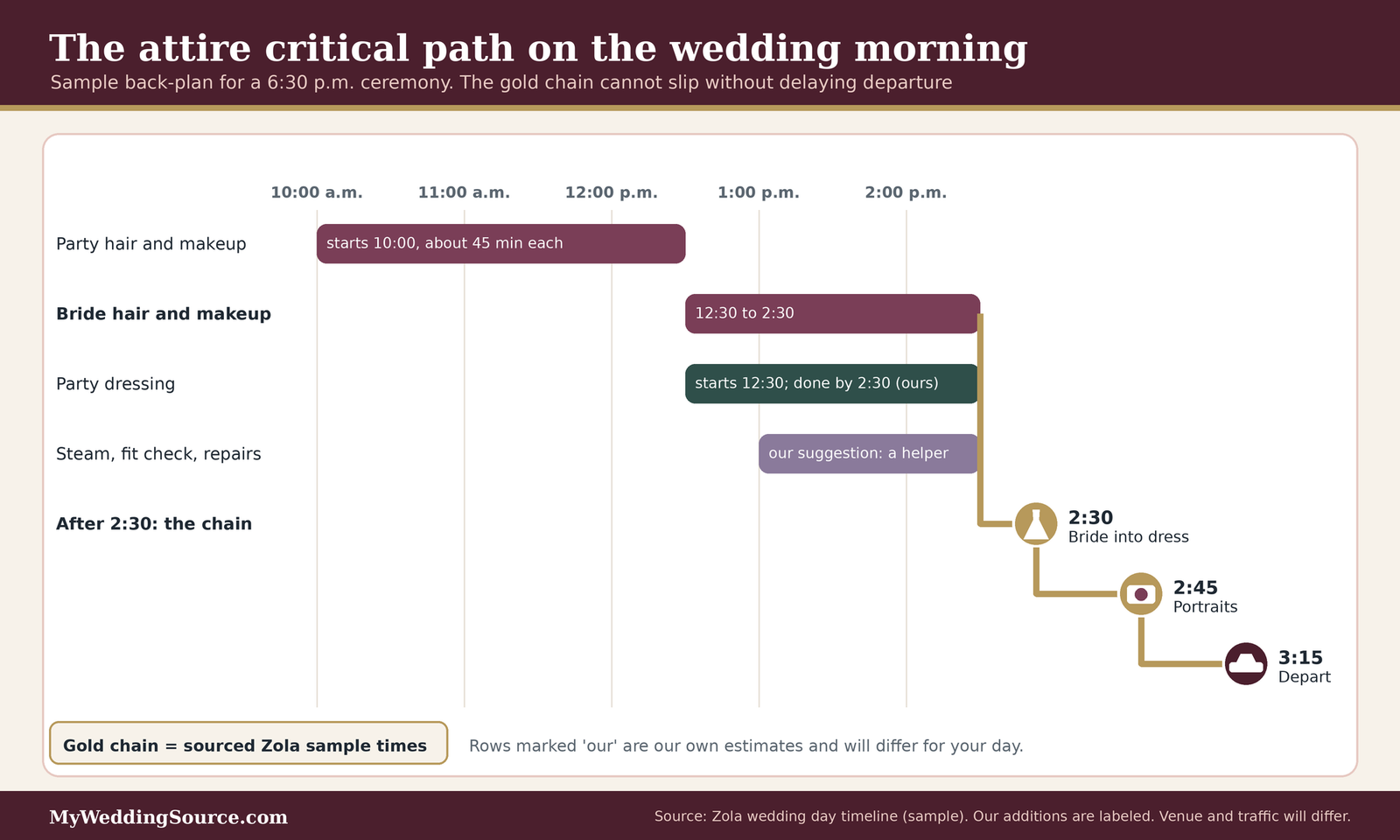
Zola’s sample timeline for a 6:30 p.m. ceremony starts the wedding party’s hair and makeup at 10 a.m. with about 45 minutes per person, has the rest of the party start dressing at 12:30 p.m. while the bride’s hair and makeup are underway, puts the bride into her dress at 2:30 p.m., begins wedding party portraits at 2:45 p.m., and leaves for the venue at 3:15 p.m., with extra time advised for traffic. It is one example for one ceremony time, not a rule, but it shows the shape: attire is done well before the car arrives, and portraits fit between dressing and departure.
Our estimate of dressing time
Zola’s timeline does not say how long dressing takes, so the estimate in our chart is ours and uncertain. We assumed that a simple pullover or zip-up garment takes a few minutes, that a corset back, buttons, or a tie takes longer, and that a person who needs help from someone else should be scheduled with that helper. Ask each person how long they usually need, and add a buffer rather than trusting an average.
Order the steps by what depends on what
Some steps must happen first because others rely on them.
Hair and makeup before garments that go over the head
A garment that must be pulled on over the head will disturb styled hair and makeup, so schedule button-front shirts, wrap tops, or garments with a front zipper after hair and makeup, and put the pull-on items on first or use a veil-safe technique. Ask your stylist for advice, since they know what their work can tolerate. Our guide to the wedding beauty timeline explains the sequence in more detail.
Pressing, steaming, and the repair kit
Plan one person to steam or press everything, and place a repair kit (safety pins, double-sided fashion tape, a small sewing kit, a lint roller, and a stain pen) within reach. Our guide to the wedding emergency kit lists what to pack. A final check in full outfit, with arms raised and a sit-down, catches the kind of problem that becomes visible only on the day.
Who needs extra time
Planning for different bodies also means planning for different needs on the morning, without making a point of it.
Garments that require help
Corset backs, long rows of buttons, and some ties are hard to do alone. Assign a specific helper for each, and let people choose their own helper. For anyone who uses mobility aids, has limited reach, or has sensory sensitivities, ask beforehand what would make dressing easier, and schedule that person earlier, not later, so they are not racing the clock.
Shoes, undergarments, and layering
The hollow-to-hem measurement is taken in the planned shoes, and a hem will look wrong in any other pair. Undergarments change how a garment sits. Ask people to bring and wear the final versions to the last fitting, and to have a backup in case the weather turns, since jackets, wraps, and layers change the line of the outfit.
Edge cases that break a simple plan
Even a good plan for how to coordinate wedding party attire across different body types will meet situations it did not anticipate. A few are common enough to prepare for.
A group that spans a wide range of sizes
When the range is wide, no single style will be ideal for everyone, and the group should be designed with that in mind from the start.
Offer the same range of options to everyone
If the approved styles include a plus-size range and a petite range, the choice should come from the person and not the group. David’s Bridal recommends a floor-length A-line in medium-weight fabric for a mixed plus-size and petite group, and Jenny Yoo’s adult size range runs from 00 to 32. Check the size range of each seller before choosing, because a style that is not made in everyone’s size is not really an option for the group. Our guides to plus-size wedding dresses and petite wedding dresses cover each side of that range.
Avoid the “one size is the standard” trap
A group with one person at the edge of a size range sometimes ends up designed around that person’s constraints, or around the majority’s. Neither is fair. It is better to choose an anchor that does not depend on size (color or fabric) and to let each person’s fit follow their own measurements, with the seller’s own size chart as the guide.
Gender, roles, and mixed lineups
Not every group divides into two sides, and the attire plan should not depend on it.
Ask, do not assume
Zola’s gender-non-conforming attire advice recommends asking wedding party members how they want to present, using inclusive wording, and avoiding group phrases like “for the guys” or “for the girls.” It also suggests offering more choices than suits and dresses, including pants with blouses, blazers with skirts, and jumpsuits, and encouraging people to start with pieces they already feel confident in. Those are one publisher’s suggestions, and we agree with the core idea: ask privately and let the answer shape the plan. Our guide on coordinating attire for a mixed-gender wedding party takes this further.
Keep roles distinguishable without changing bodies
The Knot suggests distinguishing attendants from groomsmen or ushers with a different suit color, and showing which partner each attendant supports with a color assigned to each side or matching ties. A small change in one element, such as a tie, a pocket square, or a sash, can mark a role without asking anyone to wear a different silhouette.
Distance, budget, and disagreement
Logistics and money produce more conflict than aesthetics do.
People in different places
If the wedding party lives in different cities, a single local fitting is not possible. Use the sellers’ remote-fitting tools (a fit survey, video measuring, or a local tailor in each city), and agree on a date by which each person will send a photo of themselves in the outfit. Our wedding party coordination checklist and wedding transportation guide help with the logistics of a spread-out group.
When someone says the outfit does not work
Treat a “no” as information. If a person says a style is uncomfortable, too costly, or does not work for them, the question to ask is what would work. Offer an alternative inside the anchor. If the problem is money, our guide to asking wedding party members about financial boundaries offers a way to raise it privately, and the wedding party costs guide shows where the costs add up.
Who pays, and what fit can add to the bill
Money is part of how to coordinate wedding party attire across different body types, and fit-related costs are the ones people tend to forget.
What fit can add to the cost
Alterations, shoes, undergarments, rush fees, and shipping are often not in the price of the garment. Azazie says standard-size dresses can be returned or exchanged but custom-size dresses cannot be returned for any reason, so a custom order trades flexibility for fit. David’s Bridal says to factor alteration time into the schedule, and Jenny Yoo says it does not provide tailoring and is not responsible for changes made after delivery. The Knot’s Real Weddings Study page (couples who married in 2025) did not report attire figures on the page we read, so we do not quote an average. Ask each person for a total, including tailoring, before the group commits.
Decide who pays for what, in writing
The simplest policy is a clear one.
Say it before anyone orders
State, in the first message, what the couple will cover and what each person will pay, and say whether the couple will help anyone who needs it. Ambiguity creates silent resentment. Because we are not giving financial advice, and because circumstances differ, the right split is up to the people involved.
Include fit costs in the conversation
If alterations may be needed, say who covers them. Azazie mentions alteration reimbursement for custom dresses, with amounts varying by dress, which shows that some sellers help with this, so ask. If the couple wants to protect a friend from an unexpected tailoring bill, they can offer to cover alterations for everyone, which treats everyone alike and avoids singling anyone out.
Return, exchange, and custom-order rules
These rules matter more when sizes differ, because the people with the least standard measurements are the people most likely to need an exchange.
Read the policy before ordering
Standard-size items are generally easier to exchange than custom-size items, and Azazie states that difference explicitly. Ask each seller about returns, exchanges, restocking fees, and who pays for shipping, and ask for the answer in writing.
Keep the paperwork together
Save order confirmations, promised ship dates, and size charts, as the FTC’s business guide says a seller bears the burden of proving its systems if challenged, and your own records help you. If someone orders for themselves, ask them to share the date and confirmation with the coordinator so the group can see the whole picture.
Questions to ask before anyone orders
A short list of questions, asked at the right time and in the right order, prevents most of the problems described above.
Questions for the seller
These go to the retailer, rental company, or tailor.
Sizing and fit
Ask which measurements the size chart uses, whether the garment is sold in the full range you need, whether alterations are possible and how far (for example, how many sizes it can be taken in or let out), and whether the seller offers a fit specialist or a remote fitting.
Dates and policies
Ask for the production time, the promised delivery date, the policy on late orders, the exchange and return terms, and whether a replacement ordered later will match the dye lot of the first order.
Questions for your group
These go to the people who will wear the clothing.
Comfort and constraints
Ask what styles they feel good in, what would be uncomfortable, whether there are mobility, sensory, or medical considerations, and what they would like to avoid. Ask privately.
Budget and logistics
Ask whether the budget works, where they will shop or be fitted, who they would like to help them dress, and whether anything may change between now and the wedding.
Questions worth asking before anyone orders
- Which anchor are we sharing (color, fabric, or silhouette), and what can each person choose?
- Which two to five styles are approved, and how do I ask for an exception?
- Which measurements does this seller use, and what do they say about between-size choices?
- What is the total cost per person, including alterations, shoes, and shipping?
- Is this order returnable or exchangeable, and for how long?
- What is the promised delivery date, and what happens if it slips?
- Who is booking the tailor, and what are the fitting dates?
- How long will each person need to dress on the wedding morning, and who will help?
- What is the backup if a garment does not arrive or does not fit?
FAQ: how to coordinate wedding party attire across different body types
Choosing the look
Should everyone wear the same dress or suit?
Not necessarily. Retailers such as Dessy and David’s Bridal describe a shared color with varied cuts as a forgiving approach, because fit differs more by cut than by color. If you want identical garments, choose a forgiving construction and confirm that each person’s size range is available. The best test is whether everyone is comfortable and the color, fabric, and formality match.
What is the safest silhouette for a group with different body types?
No single silhouette is safe for everyone, and a tailor who can see the person is the best guide. David’s Bridal suggests a floor-length A-line in medium-weight fabric for a mixed plus-size and petite group, and a flowy V-neck or square neck in chiffon or stretch fabric as a flexible option. Treat those as starting points, then let each person choose.
Sizing and fit
What if my measurements fall between sizes?
Retailers including David’s Bridal, Azazie, and Jenny Yoo advise choosing the larger size, because taking a garment in is easier than letting it out. Azazie adds that the leading measurement depends on the style: bust for strapless or structured bodices, waist for fitted-waist styles, and hips for mermaid or trumpet cuts. Confirm with the seller and your tailor.
When should alterations start?
Azazie suggests starting four to six weeks before the event, with fittings roughly four to six, two to three, and one week out, and booking a tailor six to eight weeks ahead. Those are one retailer’s dates. Complex work such as beaded hems or added sleeves takes longer, so ask your tailor for an honest estimate and book early.
Money and etiquette
How do I ask someone to change their outfit without embarrassing them?
Ask privately and make it about the garment. Say what is not working in the photographs or the fit, offer two or three alternatives inside the anchor, and ask what would make them comfortable. Avoid group messages about sizes or bodies. If cost is the barrier, offer to adjust the plan before asking the person to adjust themselves.
Who should pay for alterations?
There is no universal rule, and we are not giving financial advice. People commonly pay for their own outfits, but couples can decide to cover alterations, which treats everyone alike. Decide before anyone orders, say it in writing, and ask sellers whether they offer alteration reimbursement, as Azazie describes for custom dresses.
Timing and special situations
How do I handle a pregnant attendant?
Ask her what she prefers, order early, and ask the seller about maternity options. David’s Bridal suggests empire waists and stretchy jersey or knit, ordering five to six months out, and leaving hem and side seams open until the last fitting, while Jenny Yoo notes that production orders cannot be changed. Her clinician and her comfort come first.
What if the group lives in different cities?
Use remote tools and a local tailor for each person. The Black Tux, for instance, uses an online fit survey, and its page suggests sending suits to one pickup point for inspection. Agree on a deadline for photos of everyone in the final outfit, and keep one coordinator who sees all order dates.
Your next steps
Set the frame this week
Choose the anchor and the approved list
To put how to coordinate wedding party attire across different body types into practice, decide what is shared (usually color and formality) and pick two to five approved styles. Write both in two sentences so everyone hears the same thing. Our wedding party attire guide helps you decide formality and budget.
Send a private, comfort-first message
Ask each person individually what they would feel good in, what they would avoid, and whether the budget works. Offer a way to propose their own piece.
Build the schedule
Back-plan from the date
Work from the wedding date to the order date, the tailor booking, and the three fittings. Our wedding planning checklist is a good place to record them.
Draft the wedding-morning path
Write a one-page morning plan with dressing order, helpers, a steamer, a repair kit, and a departure time with a buffer. Share it a week ahead, and review it at the final fitting.
Sources & methodology
How we built this guide
What we relied on
This guide combines the Federal Trade Commission’s business guidance on late mail and internet orders with sizing, styling, and alteration guidance published by bridal and formalwear retailers, and with planning advice from wedding publishers. We fetched and read each page listed below in November 2026 and did not verify whether any page has changed since. Where a statement comes from a retailer, we name the retailer, because retailer advice reflects that seller’s products, sizes, and policies. Dates and lead times are the sellers’ own and will differ for your order. The sample dressing times in our chart are our own estimates.
What we did not do
We did not test garments, measure bodies, or interview tailors. We did not give medical, legal, or financial advice, and nothing here describes how a specific garment will fit a specific person. Ask a tailor who can see the person, a clinician for health questions, and each seller for its policies in writing.
Source list
Government and research sources
- Federal Trade Commission, A Business Guide to the FTC’s Mail, Internet, or Telephone Order Merchandise Rule: https://www.ftc.gov/business-guidance/resources/business-guide-ftcs-mail-internet-or-telephone-order-merchandise-rule
- The Knot, Real Weddings Study (couples married in 2025; page updated February 2026): https://www.theknot.com/content/real-weddings-study
Retailer and planning-site guidance
- David’s Bridal, How to Coordinate Bridesmaid Dresses for Different Body Types: https://www.davidsbridal.com/content/style-guides/how-to-coordinate-bridesmaid-dresses-for-different-body-types
- David’s Bridal, How to Dress Groomsmen of Different Sizes: https://www.davidsbridal.com/content/wedding-looks/dress-groomsmen-different-sizes-a-guide
- David’s Bridal, How to Measure Yourself for a Wedding or Bridesmaid Dress: https://www.davidsbridal.com/content/style-guides/how-to-measure-yourself-for-a-wedding-or-bridesmaid-dress
- Azazie, How do I know what size formal dress to order: https://www.azazie.com/blog/how-do-i-know-what-size-formal-dress-to-order/
- Jenny Yoo, Measurements and sizing (fit guide): https://www.jennyyoo.com/page/fit-guide
- Dessy, Cohesive look: mix and match bridesmaid dresses: https://dessy.com/the-edit/p/cohesive-look-mix-and-match-bridesmaid-dresses
- The Black Tux, Groomsmen suit coordination: https://theblacktux.com/blogs/resources/groomsmen-suit-coordination-match-without-looking-uniform
- Jim’s Formal Wear, How to measure for a suit or tuxedo: https://blog.jimsformalwear.com/2020/06/how-to-measure-for-a-suit-or-tuxedo
- Zola, Mismatched bridesmaids dresses: how to pull off the look: https://www.zola.com/expert-advice/mismatched-bridesmaids-dresses-how-to-pull-off-the-look
- Zola, Gender non-conforming wedding attire: https://www.zola.com/expert-advice/gender-non-conforming-wedding-attire
- Zola, How to master your wedding day timeline: https://zola.com/expert-advice/wedding-day-timeline
- The Knot, Bridesmen and groomswomen outfits: https://www.theknot.com/content/bridesmen-groomswomen-outfits