
Renting wedding dresses is not a smaller version of buying one: it is a different contract, with a different calendar, different risks, and a different cost curve, so the honest comparison starts by pricing the same outcome, being dressed on the day, instead of pricing two garments.
Quick answer
On cash alone, renting wedding dresses usually costs less than buying new and altering a gown. The Knot’s 2026 Real Weddings Study puts the average dress for couples married in 2025 at about $2,100, before alterations, while rental examples reported by The Knot start near $200 and mostly sit under $500 at some shops. The advantage narrows when the rental includes alterations and cleaning, and it flips when you need permanent changes, an event window longer than the rental period, or a dress you want to keep. Compare the all-in cost to be dressed, read the damage clause before you pay, and ask what the rental window really covers.
Most couples meet the idea of renting wedding dresses late, often after a salon appointment ends in a sticker shock or a lead-time warning. That is the wrong moment to learn how the terms for renting wedding dresses work. This guide to renting wedding dresses is built for the person who is already weighing a rental against a purchase and wants to see the arithmetic, the fine print, and the situations where each option wins. It does not tell you whether renting wedding dresses is better in general, because the answer depends on three or four facts about your wedding that only you know.
A note on method before the details. Prices below come from published sources and are attributed to whoever published them: a survey, a retailer, a shop, or a trade article. Where we combine figures, we say so and label the result an estimate. We did not rent or buy any dress for this guide, we did not test any service, and nothing here is legal or financial advice. Contracts for renting wedding dresses differ from shop to shop, so the contract you are offered is always the final authority.
Define the decision before declaring a winner for renting wedding dresses
Renting wedding dresses, a preowned purchase, and a new purchase all end with you in a gown at the ceremony, but they get you there by very different routes. Treating them as three prices for one product is the most common mistake in this decision, and it makes rentals look either miraculously cheap or suspiciously flaky. Sort out what you are actually comparing first, and the later numbers become much easier to read.
What each route actually gives you
Think of renting wedding dresses and the two purchase routes as three bundles. Each bundle contains a gown, a degree of control over how the gown fits, a set of obligations after the wedding, and an exit option. The bundles differ most in what happens after the ceremony ends, which is the part that product photos and price tags never show.
Renting wedding dresses: a temporary right to use
When you are renting wedding dresses, you pay for a window of use and you return the gown. The shop keeps the asset, so the shop keeps the right to set rules about what you can do to it. One U.S. rental boutique’s published terms, for example, allow rentals of up to 10 days, forbid washing or dry cleaning by the renter, and allow only small, temporary changes such as a skirt pickup or a bustle made with removable stitches. Cutting, hemming, gluing, taping and dyeing are not allowed. That is one shop’s policy, not an industry standard, but it shows the shape of the arrangement: you get the look, and you give up control.
Buying new or preowned: ownership, work, and an exit
Buying gives you a gown you can alter permanently and keep forever, and it hands you the job of cleaning it, storing it, or selling it. A preowned purchase sits between the two: it costs less than new, it can usually be altered, and it comes with a condition risk because someone else has worn it. Ownership is the only route that lets you resize, reshape, or shorten the dress without asking permission, and it is the only route with a resale option.
Why the usual comparison goes wrong
Search results for renting wedding dresses tend to compare the rental fee with the sticker price of a new gown. That comparison ignores alterations, cleaning, shipping, insurance, resale value, and the time you spend managing each of them. It also ignores a quieter factor in renting wedding dresses, which is that the price often comes with strings: a short window, a size range, and a damage rule.
The sticker price versus the finished price
A rental fee covers the right to wear the dress for a stated number of days. A purchase price covers a gown that will almost certainly need work. The Knot’s 2026 study notes that its average dress price does not include alterations, which add to what couples end up paying. If you compare the rental fee with only the gown price, you compare a finished outfit with an unfinished one.
The finished price versus the net price
There is a third number that matters for buyers and almost never appears in comparison articles: what the dress is worth to you after the wedding. A buyer who resells recovers some money, a buyer who keeps the gown recovers sentiment and perhaps a photo shoot, and a buyer who stores it forever recovers nothing but closet space. A fair comparison of renting wedding dresses with buying therefore uses the net cost: what you pay minus what you get back. We build that calculation step by step later in this guide.
List the criteria that genuinely change the choice in the renting wedding dresses decision
Dozens of factors could appear in a comparison, but only a handful change the answer when you are renting wedding dresses or buying. The rest are tie-breakers. Sorting the two groups before you shop keeps a persuasive stylist, or a persuasive spreadsheet, from deciding for you.
Separate deal-breakers from preferences
A deal-breaker is a condition that rules a route out regardless of price. A preference is something you would like but would trade away. Write both lists down before you look at a single listing. Typical deal-breakers include a wedding date that falls outside any rental window you can book, a body measurement outside a shop’s size range, a gown that needs a permanent hem or bodice change to look right on you, a need to wear the dress for several events spread over more than a week, and a firm wish to keep the dress. Typical preferences include a specific designer, a specific silhouette, owning something that is new, or the experience of a bridal appointment.
A useful test is to ask whether you would still choose a route if it were free. If the answer is no because of something other than cost, that something belongs on the deal-breaker list. Someone who would never feel comfortable handing back the dress after the wedding should not rent, even if the numbers favor it.
Weight cost, logistics, experience, and flexibility
Once the deal-breakers have removed some routes, weight the remaining criteria. A simple approach is to score each of four criteria from 1 to 5 for each route you still have, then multiply by a weight that reflects how much that criterion matters to you. Cost, logistics, experience, and flexibility are the four that tend to matter.
Cost means the net, all-in figure described above. Logistics means how many appointments, shipments, deadlines, and returns the route requires. Experience means how much the route feels like the wedding-dress moment you want, which varies enormously from person to person. Flexibility means how well the route survives a change, such as a weight shift, a date change, or a size problem discovered late. A couple on a tight budget with a short timeline might weight cost and logistics at three each and experience and flexibility at one each. Someone else might weight experience at five and cost at one. The point is not to compute a perfect score, it is to notice which criterion is actually driving your preference.
Table 1 sums up how the criteria usually move the decision. The cells describe tendencies, not guarantees, and individual shops and sellers vary.
| Criterion | Tends to favor renting when | Tends to favor buying when | What to verify |
|---|---|---|---|
| Net cost | All-in rental fee is well below the net cost of owning after resale | Rental package approaches the price of a preowned gown | Itemized quote for both routes |
| Alterations | Temporary adjustments are enough | Hem, bodice, or strap changes need to be permanent | The shop’s written alteration rules |
| Calendar | The wedding is close and a gown is in stock | There is time to order and complete fittings | Delivery or production estimate in writing |
| Size availability | Your size is listed and a backup size is offered | Your size is outside the shop’s range | Size range and exchange policy |
| Damage exposure | The setting is controlled and the dress is protected | The setting is outdoors or high-traffic and you are anxious | What the damage clause charges and how |
| Window length | One event inside the rental period | Several events across weeks, or a late return risk | Exact start, end, and return-ship dates |
| Keepsake value | You do not want to store or sell a gown | You want to keep it, restyle it, or pass it on | Your own answer, written down |
| Effort | You prefer one shipment and one return | You prefer to handle the gown yourself | Who handles pressing, packaging, and tracking |
Compare like with like in the renting wedding dresses decision
Once you have a quote in hand, the next job is to make it comparable to another quote. Rental shops and bridal salons describe their offers in different units: days, weeks, packages, appointments, and so on. Without a common unit, the cheapest-looking number is often just the least complete one.
Normalize package contents and time coverage
Start with what is inside each quote when you are renting wedding dresses. A rental package may include one gown, a set number of days, a number of alterations, dry cleaning, shipping both ways, and a damage waiver, or it may include only the gown and a window. The Knot reports that one Atlanta shop’s packages start at $1,500 and include a seven-day rental, dry cleaning, and three alterations, while another shop’s gowns start at $200 for a 10-day rental and include temporary alterations. Those two quotes are not competing prices for the same thing. One is a fee for a gown, the other is a fee for a managed service.
Build a short list of lines and fill each in for every quote: gown or rental fee; days of coverage and the exact start and end dates; shipping both ways; insurance or damage waiver; alterations included; cleaning included; taxes; and the refundable deposit, if any. A quote with blank lines is not a cheaper quote, it is an unfinished one. Ask the seller to fill the gaps in writing.
Time coverage deserves its own line. A seven-day window around a ceremony means the dress arrives with only a few days to try it on, and returns almost immediately afterward. A 10-day window gives slightly more room, and a three-week window, which The Knot reports for one Idaho shop, gives the most. Convert each price to a cost per day only if the days are truly comparable, and remember that the days before the wedding are worth more than the days after it.
Expose features that sound equivalent but are not
Several words appear in listings for renting wedding dresses and sound alike while meaning different things. A few are worth testing every time.
Insurance versus damage waiver. The Knot says many shops include some kind of protection in the package price or offer it as an add-on, often around $5 to $10, and that coverage varies. The label does not tell you what is covered, what is excluded, or whether you still owe a deductible. Ask for the wording.
Alterations included versus alterations allowed. One shop’s package may include three alteration appointments performed by its tailor, while another may only permit temporary changes you make yourself. The first is a service, the second is a restriction. Neither word, on its own, tells you which one you are getting.
Dry cleaning included versus dry cleaning forbidden. Some terms forbid the renter from cleaning the gown at all, because the shop handles it. Others include cleaning in a package fee. Confirm whether you owe anything for cleaning after a normal day of wear, and what counts as more than normal.
Try-on versus fit guarantee. An at-home try-on, such as shipping up to three styles to your home, which The Knot reports for one California shop, lets you see a gown before you commit. A fit guarantee promises something about what happens if the dress does not fit. They are not the same promise.
Refundable deposit versus full retail charged upfront. One published U.S. rental policy charges the full retail price at checkout as a refundable deposit, then refunds it minus the rental fee and any extra charges after a clean, on-time return. That is a very different cash-flow event from a $50 deposit. We come back to it in the damage section.
What the money looks like when renting wedding dresses meets the real price of owning
Cost is where most comparisons of renting wedding dresses begin, so it needs the most care. The figures below are drawn from a survey, from trade articles that quote shops, and from published rental terms. Each has a different meaning, and mixing them without labels produces a number that looks precise and is not.
Reported averages for buying a new gown
A survey average describes what a particular group of couples reported paying. It is a useful anchor, but it is not a quote, and it does not describe your dress.
What The Knot’s 2026 study reports
The Knot’s 2026 Real Weddings Study covers couples married in 2025 and draws on 10,474 U.S. couples recruited by email invitation through The Knot and WeddingWire members during 2025. The Knot reports an average wedding dress cost of about $2,100, with about $1,200 for low-budget couples, about $2,000 for the middle tier, and about $3,200 for high-end budgets. It also reports regional differences, such as about $2,200 in the Mid-Atlantic and about $2,500 in the Midwest. The Knot says the average mainly reflects off-the-rack and made-to-order dresses, and that only 19 percent of female respondents wore custom-made attire.
Because the sample is made up of people who joined a wedding platform and chose to respond, it is not a random sample of all U.S. weddings, and The Knot does not claim it is. Treat the figure as a reasonable anchor for couples who plan with typical wedding resources, not as a national census. For a broader view of how attire fits into a wedding budget, our guide to the average wedding cost puts the dress beside every other line.
What that average leaves out
The Knot states that alteration costs are not included in the average dress price. The same article leaves out cleaning, preservation, tax, shipping, and the veil, shoes, and undergarments that most brides add. Retailers also typically ask for a deposit of 30 to 50 percent to confirm an order, with the balance due at pickup, according to The Knot, which affects cash flow but not the final price. In short, the gown line in a budget is rarely the finished cost of being dressed. Our wedding budget calculator is a good place to give every one of those lines its own row.
Rental prices that shops and trade articles report
Prices for renting wedding dresses are not tracked by a survey of the same size, so the evidence is a set of examples from shops and trade coverage. They are real, attributed, and varied, and they are not a price list you can expect to find in your city.
Examples that have been published
In a September 2024 article, The Knot reports that used wedding dress rentals typically cost between $200 and $2,000. It then gives examples. An Atlanta shop’s packages start at $1,500 and include a seven-day rental, dry cleaning, and three alterations. A Sonoma, California shop’s gowns start at $200 for a 10-day rental, with most options under $500. An Idaho shop charges $300 to $600 for a three-week rental. Rent the Runway’s bridal whites are described as part of a catalog that starts at $15 for a four-day rental, though that starting price reflects the broader catalog, not a bridal gown. The consumer guide Checkbook reports an example from a Sonoma boutique in which a strapless tulle and lace gown rents for $710 for 10 days and sells for $2,500, with the caveat that its prices were last updated in September 2025 and may have changed.
None of these is a quote you can rely on today. They show a range and, more usefully, they show what drives it: whether alterations and cleaning are inside the price, how long the window lasts, and how current and designer-heavy the catalog is.
Why the range is so wide
The spread in renting wedding dresses is large because a $200 gown rental and a $1,500 package are priced for different jobs. The lower figure pays for a gown in a standard size for a short window, with the renter handling pressing and shipping and accepting only temporary changes. The higher figure pays for fittings with a tailor, cleaning, and a concierge-style process that a bridal salon would charge for separately. When a rental is expensive, it is often because it has absorbed services that a buyer would pay for elsewhere. That is why the comparison in the next sections goes line by line.
Preowned purchases and what they cost
A preowned gown is the third option, and it is often left out of the rent-or-buy conversation even though it can undercut both.
The discount reported by trade sources
The Knot’s article on used wedding dresses, published in September 2024, says resale dresses can cost 50 to 75 percent less than the roughly $2,000 average, which implies a range of about $500 to $1,000 for a preowned gown. It adds that cleaning, repairs, and alterations come on top. A bridal retailer that sells preowned designer gowns, Kleinfeld Again, notes that most wedding dresses are worn for only a few hours, so a used gown can look close to new, and it advises buyers to ask for detailed photos and look for tears, stains, missing embellishments, yellowing, and past alterations. That advice comes from a seller with an interest in selling used gowns, so treat it as a checklist, not a guarantee.
What condition and size risk add
The discount comes with two risks. The first is condition. The Knot notes that delicate fabrics such as organza and lace may have only a few wears left, and that buyers should decide whether flaws are cosmetic or structural. The second is size. Kleinfeld Again suggests looking for a slightly larger size, because taking a dress in is easier than letting it out. Neither risk disappears with a rental, but a rental shop that owns its inventory usually inspects and cleans it, which moves some of the condition risk from you to the shop.
Cost check
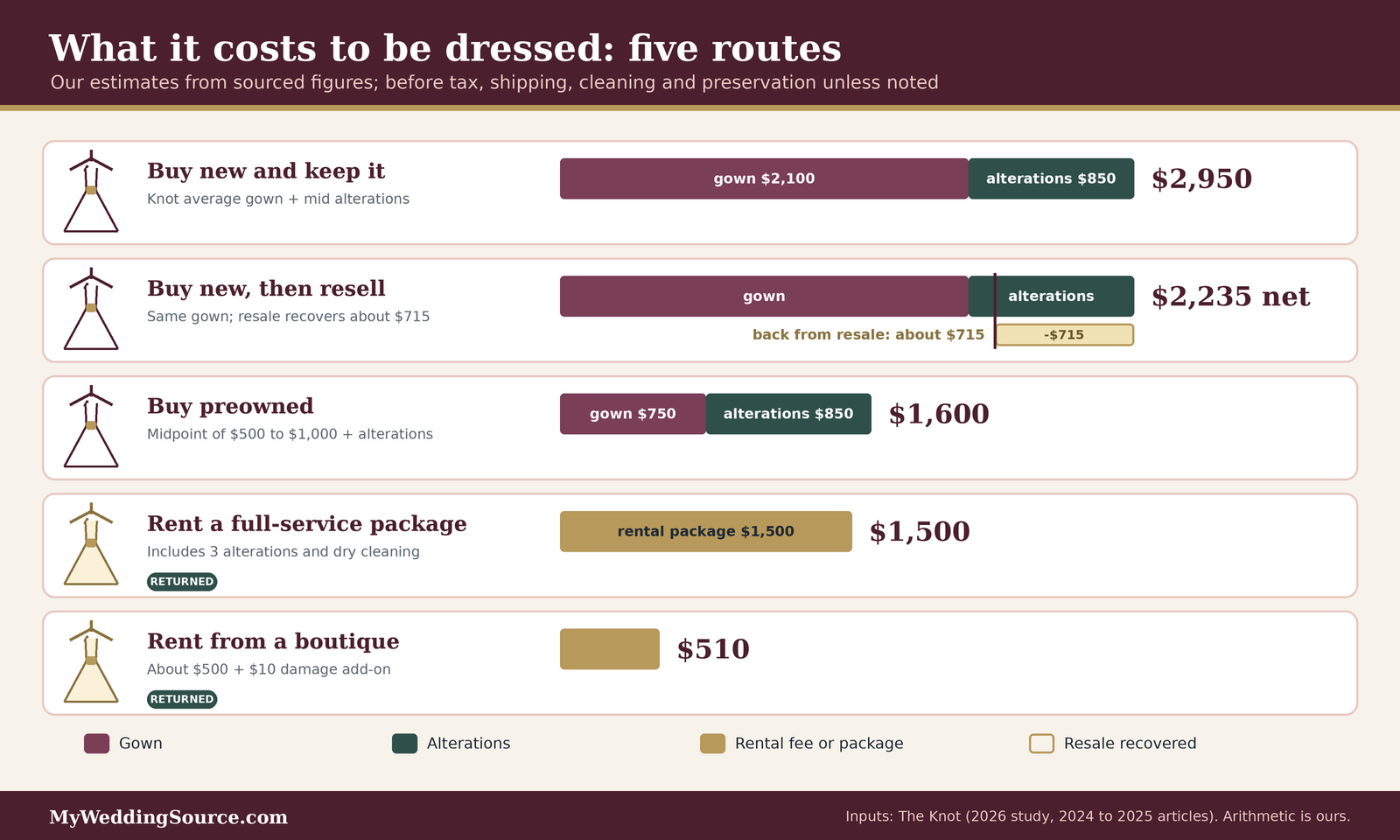
Our estimates, built from the sources above, put the net cost of being dressed in five routes between roughly $510 and $2,950 before tax, shipping, cleaning, and preservation unless noted. Renting from a shop that quotes about $500 plus a $10 damage add-on lands near the bottom. Buying new at The Knot’s average and paying $850 for alterations lands near the top. These are illustrative figures, not quotes, and the next section shows every step so you can replace our assumptions with yours. Our guide to paying for a wedding covers how to fund these lines.
The all-in worksheet: how to normalize a quote
This is the first of our two original tools. It is a seven-line worksheet that turns any dress quote, rental or purchase, into a comparable number. You can fill it in with a calculator and a notes app.
The seven lines
Write the following lines for each route. Line one is the gown price or rental fee. Line two is tax and shipping, both ways for a rental. Line three is damage protection, whether a waiver, an add-on, or the deposit you have tied up. Line four is alterations, either included, quoted by a tailor, or zero. Line five is cleaning and preservation. Line six is the recovery, meaning what you expect to get back by reselling, which is zero for a rental. Line seven is your own time, which you can leave as a note or price at an hourly figure you choose. The all-in cost to be dressed is lines one through five minus line six. Leave any line you cannot price blank and flag it, so a blank is never mistaken for a zero.
A worked example with stated assumptions
We apply the worksheet to five routes, using only figures reported above. Every result is our arithmetic and an estimate. We assume The Knot’s average gown price of $2,100 for the new purchase, and the midpoint of the $700 to $1,000 standard alteration range that a bridal alterations owner quoted to The Knot, which is $850. We use $750, the midpoint of the $500 to $1,000 preowned range implied by The Knot, for the preowned gown. We use $500 plus a $10 add-on for a boutique rental, taking the top of the “most options under $500” example and the middle of the $5 to $10 add-on range. We use $1,500 for the full-service package, which The Knot says includes a seven-day rental, dry cleaning, and three alterations.
For the resale route, we assume the gown is under two years old and in great condition and resells for about half its retail price, a figure The Knot attributes to Nearly Newlywed data. Half of $2,100 is $1,050. If the seller keeps 70 percent after the platform’s cut, which The Knot reports for Nearly Newlywed, and pays a $20 listing fee, the seller receives $715. We assume the altered gown resells at the same price, which is optimistic, because alterations are made to one person.
- Buy new and keep it: $2,100 plus $850 alterations is about $2,950.
- Buy new and resell: $2,100 plus $850 minus $715 is about $2,235.
- Buy preowned: $750 plus $850 is about $1,600, with a plausible range of about $1,200 to $2,000 using the low and high ends of both ranges.
- Rent from a boutique: $500 plus $10 is about $510, before shipping, tax, and any tailor visit.
- Rent a full-service package: about $1,500, which already includes alterations and cleaning.
None of these figures includes cleaning or preservation for the purchase routes, because we did not find a sourced price for them, and none includes tax. Two things stand out. Renting from a boutique is far cheaper than any ownership route under these assumptions, and a full-service rental package is close to the price of a preowned purchase, which is a reasonable thing to learn before you fall for the package.
Fit, alterations, and the calendar when renting wedding dresses
Fit and time are where the promises of renting wedding dresses are most often tested. They deserve a section of their own because they decide whether a cheap rental stays cheap.
How fit works when the dress belongs to someone else
A rental gown has to fit you without permanent changes when you are renting wedding dresses, which is a tighter constraint than it sounds. Fit is partly a size question and partly a rule question.
Size ranges, try-ons, and backup sizes
The Knot lists size ranges for several shops: 0 to 32 at the Atlanta shop, 2 to 22 in Sonoma with made-to-order sizes available, and 00 to 22 at the Idaho shop. It also reports that the Atlanta shop can consolidate fittings for out-of-town brides, that the California shop ships up to three styles for at-home try-ons, and that the Idaho shop requires an in-person appointment. In a separate guide to attire rentals, The Knot says Rent the Runway offers a free backup size on one-time rentals, although that guide discusses guest outfits and not bridal gowns. The practical lesson is to ask three things before paying: the size range, whether you can try the dress on before you commit, and what happens if the dress does not fit when it arrives.
Start with your measurements, not your usual size. Wedding gown sizing is its own system, and a rental shop’s chart may differ from the chart you used for a different brand. Ask the shop to confirm a size from your measurements in writing.
Temporary alterations versus permanent ones
Because the gown goes back to the shop, changes must be reversible. One published U.S. policy allows small temporary changes such as a quick skirt pickup or a train bustle done with removable stitches, and forbids cutting, hemming, gluing, taping, and dyeing. A 2022-updated article on rental pros and cons from Woman Getting Married says alterations on rented gowns typically are not allowed, because the dress must fit a range of brides. The Knot reports that some shops fold alterations into the package, with three appointments at one shop and temporary alterations at another.
These facts together define a simple rule. If a gown needs a permanent change to look right on your body, such as a shortened hem, a taken-in bodice, or added straps, the options are to rent from a shop that performs the work itself and expects the gown to be reworked, or to buy. A hem alone can range widely: The Knot’s alterations article quotes a range of $125 to $450 for a hem, $100 to $200 for taking in a bodice, and $75 to $175 for a bustle. Our guide to wedding dress alterations explains each step in more detail.
The calendar: when each route needs a decision
Time is where renting wedding dresses has a real advantage and a real risk, and both come from the same fact: a rental shop already owns the gown.
The rental calendar
A shop that has a gown in stock can often deliver it in days. One published policy gives a typical delivery time of 5 to 10 days for in-stock rentals, and 8 to 10 weeks for pre-order rentals that include production and transit. The Knot warns that shops generally cannot guarantee a gown will stay available after your appointment, so you may need to decide on the spot. Renting wedding dresses therefore rewards two behaviors: deciding early enough to secure a specific gown, and deciding late enough to have a stable size, while allowing time for a replacement if something goes wrong.
The buy-new calendar
For a purchased gown, the calendar has a second clock for alterations. The Knot recommends beginning alterations at least two to three months before the wedding and says they usually take six to eight weeks to complete. The gown must therefore be in hand before that, and the production time for a made-to-order gown comes before that. We did not find a sourced figure for typical made-to-order production time in our research, so ask any salon for a written delivery date and add the alteration window after it.

The picture above is our reading of the published figures, and it shows why rentals fit short timelines: the work that takes a buyer months mostly disappears. It also shows the trade-off, which is that a rental leaves you with a short, fixed window that must contain the fitting, the ceremony, and the return.
Damage rules, deposits, and liability when renting wedding dresses
This is the section that marketing for renting wedding dresses tends to skim. The idea of a gown you can hand back sounds like freedom, and it is, but the freedom comes with a clause that decides who pays if the gown does not come back the way it left.
What the contract usually says
Contracts for renting wedding dresses differ, so treat this section as a map of the questions, not a summary of your contract. The same few ideas appear in most published terms.
Normal wear versus damage
The Knot says renters are generally responsible for damage beyond normal wear and tear. The published U.S. terms we reviewed describe light, normal wear from trying on the dress or wearing it once as acceptable, and refer to a separate damage and loss section for everything else. The difficulty is the word “normal.” A hem that picks up a gray edge from a floor is normal to most brides and may be a charge to a shop. A small wine spot is a stain to everyone. Ask the shop to define normal wear with examples, and ask who decides. Rent the Runway’s subscription page, which describes clothing memberships and not bridal gowns, says minor mishaps and normal wear are covered while significant damage, lost pieces, and theft are not, and that in those cases the member is charged the current purchase price plus tax. It is one company’s wording, but it shows how a damage clause tends to end at the retail price.
How the deposit works
A deposit is a promise to pay if something goes wrong, held in advance. One published U.S. policy asks for the full retail price at checkout as a refundable deposit, then returns it minus the rental fee and any additional charges if the gown comes back on time and in acceptable condition. For a gown with a four-figure retail price, that is a large hold on a card or account for the duration of the rental and until the shop inspects the dress. Other shops may charge a smaller deposit or none. The right question is not whether there is a deposit, but how large it is, when it is released, and what is deducted.
A risk register for the wedding day
This is our second original tool, and it is designed to be used with a pen. A risk register lists what could go wrong, how likely it feels in your setting, how costly it would be, and what you can do about it. For a rental, the cost column is whatever the contract would charge, which can be as high as the gown’s retail price.
The common hazards
Think through the day in order. Before the ceremony, hazards include makeup transfer at the neckline, deodorant marks, a snagged zipper during a rushed change, and hair product on the shoulders. During photos, they include grass, dirt, and wet hems if you are outdoors. At the reception, they include wine, candle wax, cake, a dancing partner’s shoe on the hem, and a bustle that fails. After the event, they include a gown packed damp or wrinkled and a return shipment that goes astray. Every one of these happens to purchased gowns too, but a buyer absorbs the cost, while a renter owes it to a contract.
Matching each hazard to a mitigation
For makeup, ask for a protective cover and put the gown on last. For hems, ask a bridesmaid to handle the train and consider a longer-wear plan, such as changing into a short second look after photos. For wine and cake, plan the clothing change before the cake cutting, not after. For the bustle, practice it twice before the wedding, and if the rental terms allow only a removable-stitch bustle, test the stitches. For the return, photograph the dress when it arrives, when you try it on, and again before it is packed, and keep the tracking number. These steps are good practice for any gown, but they are essential when the gown is on a contract.
Protection add-ons and wedding insurance
The Knot says many shops include insurance in the package price or offer it as an add-on, often around $5 to $10, and that coverage varies by shop. Read what the add-on actually covers, whether it has a deductible, and whether it excludes stains. Separately, some wedding insurance policies cover attire, but terms vary, so read the policy and compare it with the shop’s protection. Our wedding insurance guide explains what these policies tend to cover and exclude, and we do not recommend any product here.
Late returns and unexpected charges
A rental has a clock, and the clock has a price. The most common unpleasant surprise in renting wedding dresses and other clothing is a late fee.
How late fees can scale
Checkbook reports that one large clothing rental company charged up to $50 a day per late item, while another service says it has no late or damage fees. For wedding gowns, a shop’s own terms govern, and some shops charge a daily fee. A 2018 Daily Beast report described a different rental company’s penalty for late or missing dresses at 200 percent of retail, which the company then lowered to 100 percent. The example is old and concerns a different company, but it shows how a rental penalty can be tied to a gown’s full retail price, and how policies change. Ask for the current figures in writing.
A return plan that protects the deposit
Treat the return as a task with a deadline. Ask when the clock stops: when the package is shipped, when it is delivered, or when the shop inspects it. Schedule the drop-off for the first business day after the wedding, ask someone to handle it if you are traveling, and keep proof of shipment. One published policy provides a prepaid return label, and the renter repacks the dress in its garment bag or box. If you leave on a honeymoon the day after, assign the return to someone you trust before you go. Woman Getting Married makes the same point, advising brides to return the gown before the honeymoon.
When something goes wrong
Even careful people end up in a dispute, usually over a stain, a size, or a delivery date. Knowing which tools exist, before you need them, changes how you handle the first phone call.
Document first, then contact the shop
Keep every message, every photo, every receipt, and the contract. If a gown arrives damaged or the wrong size, photograph it immediately, message the shop in writing, and keep the original packaging. Describe the problem, state what you want, such as a replacement or a refund, and give a reasonable deadline. Written records are far more persuasive than memory, and they matter if you later dispute a charge.
Federal rules that may apply
Two federal resources are worth knowing. The FTC’s Mail, Internet, or Telephone Order Merchandise Rule requires sellers to have a reasonable basis for any shipping time they state, and if they state none, to expect to ship within 30 days. If a seller cannot ship on time, it must notify the buyer and offer a choice between a delay and a full refund. The FTC also explains how to dispute credit card charges under the Fair Credit Billing Act, including writing to the card issuer within 60 days of the first bill showing the error. For quality problems, the FTC says you generally must first try to resolve the issue with the seller, and the protection has limits on purchase amount and distance, unless the seller is also the card issuer. These rules are general information, they may not apply to your situation, and a rental contract is a different kind of transaction from a sale, so check with a qualified professional or your card issuer for your case.
Show where each option is stronger, and what it costs to get that advantage when renting wedding dresses
Having defined the routes, priced them, and mapped the risks, we can now model the trade-offs directly. The goal is not a score, it is a clear view of where one route stops being the better value.
Model the real trade-offs in the renting wedding dresses decision
A trade-off has a visible side and a hidden side. The visible side is the price. The hidden side is the work, the space, the coordination, and the tolerance for risk.
Include hidden labor, fees, space, or coordination
Renting wedding dresses asks for a different set of chores than a purchase. You schedule a try-on or ship-in, check the dress on arrival, steam or press it if the terms allow it, arrange the return, and track the refund. A purchase asks for fittings, pickups, storage, and a decision about the dress afterward, whether that is cleaning and boxing it, listing it for sale, or donating it. Selling a gown has its own labor: photographing it, writing an honest description, answering questions, packing it, and handling shipping. The Knot’s advice for sellers is to get the dress professionally cleaned first and to photograph it in good light from every angle, and it reports, citing Nearly Newlywed data, that professionally cleaned dresses sell about twice as fast as uncleaned ones. None of that labor appears on a price tag.
Space matters less than people expect, but it is real. A gown in a preservation box takes up closet space for years, while a rental leaves your home within days of the wedding. Coordination matters most when other people are involved, such as a parent paying a deposit or a bridesmaid handling the return.
Identify the point where one option stops being cheaper
Here is the break-even logic for renting wedding dresses in one line. Renting wins on cash when the all-in rental cost is less than what you pay for a gown and its alterations minus what you recover by reselling it. In symbols, with R for the rental all-in, G for the gown price, A for alterations, and S for net resale proceeds, renting is cheaper when R is less than G plus A minus S.
Using the numbers from our worked example, G is $2,100 and A is $850, so G plus A is $2,950. With the 50-percent resale and 70-percent payout we assumed earlier, S is $715, so the break-even for renting is about $2,235. Any rental all-in below that number wins on cash against buying new and reselling. That makes the comparison sensitive to resale, so we tested other assumptions.
- Pessimistic resale. If the gown resells for 30 percent of retail and the seller keeps 70 percent, less a $20 listing fee, S is about $421, and the break-even rises to about $2,529.
- Optimistic resale. If the gown resells for 60 percent of retail, which The Knot says designer gowns can reach, and the seller keeps 80 percent with no listing fee, as The Knot reports for Poshmark, S is about $1,008, and the break-even falls to about $1,942.
- No resale. If you keep the gown, S is zero, and the break-even is $2,950.
All of these are our estimates from sourced inputs, and they leave out cleaning, tax, and your time. They show that the break-even is a band, from roughly $1,900 to $3,000, and not a single threshold. A full-service rental package near $1,500 sits below the band, while a luxury rental that charges near the cost of a new gown does not. When a rental quote approaches the lower end of the band, the extra convenience may not justify the loss of ownership.
The same arithmetic applies to preowned gowns, with a lower gown price. A $750 gown plus $850 alterations is $1,600 before any resale, which is above a $510 boutique rental and just above a $1,500 package.
Match the options to different wedding scenarios in the renting wedding dresses decision
A decision rule for renting wedding dresses is only useful if it survives contact with a real wedding. The scenarios below are illustrative composites we wrote for this guide, not case studies, and the numbers are the same estimates used above.
Use at least three distinct couple and venue examples
A backyard wedding ten weeks away. A couple plans a small ceremony at home with 40 guests. The bride wants a simple gown, has not shopped, and has a short timeline. A made-to-order gown with two to three months of alterations is not realistic. A rental that is in stock, delivered within 5 to 10 days according to one published policy, fits the calendar, and temporary alterations are enough for a simple silhouette. The grass is a damage risk, so she chooses a shop with a clear definition of normal wear and plans to change her hemline protection. For couples planning at this scale, our guides to small wedding planning and micro-wedding planning cover the rest.
A cathedral ceremony and a long reception, with a specific designer gown. A bride has tried on a fitted gown that needs a hem shortened and the bodice taken in. She expects to dance for hours and wants the dress to feel hers. A rental shop that allows only temporary alterations cannot do that work. Her options are a preowned gown, which retail data suggest might cost about $500 to $1,000 before alterations, a new gown at about $2,100, or a full-service rental package that includes alterations, which The Knot says one shop offers from $1,500. The permanent alteration need pushes her toward ownership or the package, and the budget decides between them.
A beach wedding with travel. A couple is flying to a coast for a small ceremony. Carrying a gown through airports is a worry. A rental shipped to the destination removes that, and some shops ship within the continental U.S. But the setting is wet and sandy, so the damage exposure is the highest of the three. One option is to rent a lower-priced gown whose deposit exposure she is comfortable with. Another is to buy an inexpensive gown that she will not mind getting wet. Our guide to beach wedding dresses covers fabrics and hems for this setting.
A bride who wants to keep the dress. For someone who knows she will want to wear the dress again, restyle it, or pass it on, a rental cannot deliver the outcome at any price. This scenario is the shortest one: the deal-breaker list makes the decision.
Explain why the recommendation changes across scenarios
The recommendation changes because different facts hit different parts of the break-even. Time pressure removes new-gown options. Permanent alteration needs remove standard rentals. Setting risk raises the cost of a damage clause. A wish to keep the dress removes rentals entirely. The price is almost never the deciding fact, which is why a simple “rentals are cheaper” statement is true on average and wrong for you.
Table 2 shows when each option wins in these scenarios and the threshold that flips the recommendation. The thresholds are our judgment, built on the estimates above, and your numbers may differ.
| Scenario | Likely winner | Why | Threshold that flips it |
|---|---|---|---|
| Backyard wedding, 10 weeks out, simple gown | Rent from a shop with in-stock gowns | Calendar and cost both favor it | The gown needs permanent hemming or bodice work |
| Cathedral ceremony, fitted designer gown | Buy preowned or a full-service package | Permanent alterations are expected | Preowned plus alterations exceeds the package price |
| Beach wedding with travel | Rent a lower-priced gown, or buy inexpensive | Shipping avoids carrying a gown, damage risk is high | The deposit hold is more than you are willing to risk |
| Keep, restyle, or pass on the gown | Buy | Rentals cannot deliver ownership | None, the goal rules rental out |
| Several events over more than 10 days | Buy or negotiate a longer window | Window length is a hard limit | A shop offers a longer window at an acceptable fee |
| Size outside the shop’s range | Buy or choose a made-to-order option | No fit guarantee can fix a missing size | The shop offers a made-to-order size in time |
Resale reality: what a gown is worth after the wedding
Resale is the part of the buying route that makes the arithmetic closer to renting wedding dresses. It is also the part with the most optimism, so it deserves a careful look.
What sellers can realistically expect
Resale prices depend on the age, the condition, the designer, and the platform. The numbers here are the ones trade sources report, and they are not promises.
Price expectations from published sources
The Knot reports that a used gown under two years old, in great condition, typically sells for about half its original retail price, citing Nearly Newlywed data, and that designer gowns from labels such as Oscar de la Renta and Vera Wang can reach about 60 percent. Those are generalizations from one marketplace’s data and one article, so the best use is as a planning figure, not a forecast. Ask yourself how you would feel if the gown sold for 30 percent, and see whether the decision still holds.
Fees, payouts, and changing platforms
The Knot’s 2024 article lists these terms as stated then: Nearly Newlywed charged a $20 listing fee and paid sellers 70 percent of the final price, Stillwhite charged $25 for a listing or $35 for a premium listing with no commission, Poshmark let sellers keep 80 percent on sales of $15 or more, and a luxury resale site charged roughly 20 percent. These fees change. Stillwhite’s own help page now says sellers who joined or listed after November 1, 2025 pay a one-time listing fee plus a small success fee, and that earlier sellers stay on the previous commission-free model, without giving amounts on that page. When we visited, the Nearly Newlywed web address redirected to Stillwhite, so confirm which platform and fee schedule apply before you plan around a payout.
Comparing resale with rental in the same budget
The honest comparison of resale with renting wedding dresses treats resale as a possibility, not a refund.
Net cost with a resale haircut
Take the $2,235 break-even from earlier, which assumes a 50-percent resale and a 70-percent payout. If the dress sells at 30 percent instead, you recover about $421 and your net cost is closer to $2,529. If it never sells, it is $2,950. A rental all-in of $510 or $1,500 does not have that range. It has a different risk, which is the damage clause, and the deposit that backs it.
Time and emotional cost
A resale takes weeks to months, and the buyer pool is smaller for unusual or very recent gowns. Some brides are glad to see the dress go to someone else, and others find listing it harder than they expected. Renting wedding dresses ends in a shipping label. If a clean ending matters to you, it belongs in the experience column of your weights, even though it will not appear in the arithmetic.
End with a decision rule readers can actually use for renting wedding dresses
By now you have the criteria for renting wedding dresses, the worksheet, the risk register, and the break-even. This last section turns them into a rule you can apply in about ten minutes with your quotes in front of you.
Create a choose-rent-when, choose-buy-when matrix in the renting wedding dresses decision
The matrix below is written as questions, because a rule that depends on your facts should ask for them. Work through the questions in order and stop at the first one that settles the answer.

State the threshold that changes the answer
Choose renting wedding dresses when all of these are true: your size is in the shop’s range and a backup size or fit policy exists; the gown you like needs only temporary changes; the entire event fits inside the rental window with a day of margin on each end; you do not want the dress afterward; and the all-in rental cost, using the seven-line worksheet, sits below your break-even band with room to spare. A reasonable margin is at least a few hundred dollars below the lower end of the band, because the band itself is uncertain.
Choose a preowned or new purchase when any of these is true: the dress needs permanent alterations; you want to keep, restyle, or pass on the gown; the event spans more than the longest window you can book; your size is not available; or the rental all-in is near or above your break-even. Between preowned and new, the questions are condition tolerance and calendar. A preowned gown costs less but you inherit its history, and a new gown costs more but has the time and the choice to match your fit. For the dresses worn by the rest of the wedding party, the same logic applies and our guides to bridesmaid dresses and wedding party attire show how it plays out.
Here is the single threshold we would write on a card: if a rental’s all-in cost is within about $500 of what you would net by buying, the extra convenience rarely justifies giving up ownership, and if it is more than about $1,000 below, the savings are usually worth the constraints. Both numbers are our judgment, not a rule from any source. Between them, let your deal-breakers decide.
Call out cases where neither option is ideal
Some situations fit neither renting wedding dresses nor a standard purchase. If you are outside every shop’s size range and short on time, a made-to-order gown with a firm production date, or a gown from a seamstress, may fit better. If your venue is rough on fabric, a short, inexpensive, wash-friendly dress may serve you better than any bridal gown. If you want a designer look at a low price, a preowned gown with a modest alteration budget can beat both routes. If you are weighing a second look for the reception, a rental of the second outfit may give you variety without a second purchase. And if your budget is tight enough that a single damage charge would be a crisis, no rental of a high-value gown is a good idea, regardless of the average cost.
Our wedding planning checklist can help you place the dress decision beside your other deadlines, and our wedding planning timeline shows where it usually falls.
Give the next verification step before booking in the renting wedding dresses decision
Before you pay a deposit for renting wedding dresses, collect evidence. The point of this step is to turn a promising quote into a confirmed arrangement, in writing.
List the evidence to request
Ask the shop or seller for the following, and keep every answer. The full contract, not a summary, before you pay. The exact rental start date, end date, and return deadline, with the rule for what counts as “returned.” The size range and the policy if the dress does not fit. The alteration rules, in words that distinguish what the renter may do from what the shop provides. The definition of normal wear, with examples. The amount of any deposit and the date it is released. The damage waiver or insurance wording, including deductibles and exclusions. The late fee, stated as a number. The cancellation and substitution policy, including what happens if the gown you chose is damaged by an earlier renter. Photos of the actual gown, not the catalog image, and a statement of its condition.
For a preowned purchase, ask for detailed photos, a written description of any repairs or alterations, measurements, the return policy, and who authenticates the listing. Remember that, according to The Knot, one general marketplace has no authentication process and treats all sales as final, while another says it authenticates listings.
Questions to ask before you pay
- What is the exact start date, end date, and return-ship deadline, and what counts as returned?
- What is the full deposit, when is it released, and what can be deducted?
- Which alterations are allowed, which are included, and who performs them?
- How do you define normal wear, and who decides whether damage exceeds it?
- What does the damage waiver cover, and what are the deductible and exclusions?
- What is the late fee per day, and is there a cap?
- What happens if the gown is unavailable, damaged, or the wrong size when it arrives?
- Can I see photos of this exact gown and its condition history?
Name the contract or quote line that should settle the question
If you read only one line of a contract for renting wedding dresses, read the one that says what you owe if the dress is damaged beyond normal wear. It will state either a fixed fee, a repair cost, or the retail price, and it decides how much risk you are actually taking on. If that line is vague, ask for it in writing before you pay. If you read only one line of a purchase quote, read the one that says what is included in the price: alterations, pressing, and cleaning. A purchase price with those lines blank is not complete.
When a line settles the question, write the number next to it and compare it with the worksheet. If the number sits inside the margin you chose earlier, decide. If not, ask for a better quote or move to the next route.
FAQ: renting wedding dresses questions
Cost and value
Is renting a wedding dress cheaper than buying one?
Usually on cash, yes, when renting wedding dresses. The Knot reports used rentals typically cost $200 to $2,000, against an average new dress of about $2,100 before alterations. Full-service rental packages can approach the price of a preowned gown, so compare all-in totals that include alterations, cleaning, shipping, and any damage waiver.
How much does renting wedding dresses cost at different shops?
Published examples vary by service. The Knot reports a California shop starting at $200 for 10 days, an Idaho shop charging $300 to $600 for three weeks, and an Atlanta package from $1,500 with a seven-day rental, dry cleaning, and three alterations. Treat these as examples from September 2024, and ask any shop for a current written quote.
Can I sell a wedding dress I bought, and how much will I get?
You can, but plan conservatively. The Knot says a great-condition gown under two years old typically sells for about half its original retail price, with designer labels reaching about 60 percent. Platform fees reduce proceeds and change over time, so check each marketplace’s current terms before relying on a payout.
Fit and alterations
Can I alter a rented wedding dress?
Usually only temporarily. One published U.S. policy allows small changes such as a removable-stitch bustle and forbids cutting, hemming, gluing, taping, and dyeing. Some shops include alterations performed by their own tailor. If your gown needs permanent changes, ask what the shop provides in writing, or consider buying.
What happens if a rented dress does not fit?
It depends on the shop, so ask before paying. Some ship several styles for at-home try-ons, some require an in-person appointment, and some offer a backup size. The Knot says Rent the Runway includes a free backup size on one-time rentals. Confirm the size range and the exchange policy in writing.
Damage, deadlines, and disputes
What if I stain or damage a rented wedding dress?
When renting wedding dresses, renters are generally responsible for damage beyond normal wear and tear, according to The Knot. Some shops sell an add-on, often around $5 to $10, but coverage varies. The charge can be as high as the gown’s retail price, so read the damage clause, ask for examples, and photograph the gown on arrival.
How long can I keep a rented wedding gown?
It varies by shop. Published examples include up to 10 days at one U.S. boutique, seven days in an Atlanta package, and three weeks at an Idaho shop, according to The Knot and the shop’s terms. Count the days before the wedding as more valuable than the days after, and confirm the return deadline.
What are the late fees for a wedding dress rental?
Fees are set by each shop, so ask for the number in writing. Checkbook reports one large clothing rental company charging up to $50 a day per late item and another stating it has no late fees. A 2018 report described one company’s late penalty tied to the dress’s full retail price.
Your next steps
Decide the route
Write your deal-breakers and your break-even
Before renting wedding dresses, spend ten minutes on the two lists from the first section, then fill in the seven-line worksheet for the one or two routes that survive. Our wedding budget calculator can hold the numbers, and the wedding planning guide shows where attire sits among the other decisions.
Check the calendar before you fall in love
Work backward from the wedding date using the published ranges: alterations starting two to three months out, six to eight weeks of work for a purchase, and delivery times for a rental. Our wedding planning timeline can help you place the dress beside your other deadlines.
Lock in the details
Get the contract, the deposit terms, and the return plan
Collect the documents on the evidence list, confirm the damage and late-fee lines, and assign the return to a named person. If a gown needs alterations, our guide to wedding dress alterations explains what to ask a tailor.
Think about the rest of the look
Renting wedding dresses extends beyond the gown. The Knot and Woman Getting Married both mention accessories that can be rented, and our wedding jewelry guide covers what to buy and what to borrow. Tell your photographer about the dress, and use our wedding photographer shot list to plan the portraits that matter most before the dress goes back.
For a closer look, read Wedding Makeup: Natural, Soft Glam, Full Glam, and Lighting.
Sources & methodology
How we built this guide
What we relied on
This guide combines The Knot’s 2026 Real Weddings Study and several of its published articles on rentals, used gowns, and alterations, a consumer guide to clothing rental, published terms from one U.S. rental boutique, a second-hand marketplace’s help page, a bridal retailer’s FAQ, press coverage of rental late fees, and two federal consumer resources. Where a statement comes from a shop, retailer, or marketplace, we say so, because those sources describe their own products. The break-even figures, worked examples, and scenario thresholds are our own arithmetic and judgment from the sourced inputs, and they are estimates. The scenarios are illustrative composites, not real cases.
What we did not do
We did not rent or buy a dress, test a service, or speak to a shop. Several sources are from 2024, and prices, fees, and policies have probably changed since. We found no sourced figure for made-to-order production time, for cleaning or preservation cost, or for the contents of any one shop’s damage clause, so the guide does not assert them. Nothing here is legal, insurance, or financial advice. Your contract and your state’s law control.
Source list
Government and consumer-protection sources
- Federal Trade Commission, Business guide to the Mail, Internet, or Telephone Order Merchandise Rule: https://www.ftc.gov/business-guidance/resources/business-guide-ftcs-mail-internet-or-telephone-order-merchandise-rule
- Federal Trade Commission, Disputing credit card charges: https://consumer.ftc.gov/articles/disputing-credit-card-charges
- Checkbook, Considering clothing rental? Here’s how: https://checkbook.org/national/clothing-rental
- The Daily Beast, Rent the Runway alters predatory late fee after Daily Beast story (June 2018): https://www.thedailybeast.com/rent-the-runway-alters-predatory-late-fee-after-daily-beast-story
Survey and trade sources
- The Knot, Average wedding dress cost (2026 Real Weddings Study): https://www.theknot.com/content/average-cost-of-wedding-dress
- The Knot, Is renting a wedding dress a smart way to save money? (September 2024): https://theknot.com/content/wedding-dress-rental
- The Knot, How to buy and sell used wedding dresses (September 2024): https://www.theknot.com/content/used-wedding-dresses-buy-sell-online
- The Knot, Wedding dress alterations cost (updated March 2025): https://www.theknot.com/content/wedding-dress-alterations-cost
- The Knot, Wedding gown alterations 101 (updated March 2024): https://www.theknot.com/content/wedding-gown-alterations-101
- The Knot, Wedding attire rentals: https://theknot.com/content/wedding-attire-rentals
- Woman Getting Married, The pros and cons of a wedding dress rental: https://www.womangettingmarried.com/wedding-dress-rental/
Shop, retailer, and marketplace sources
- Mia Bambina Boutique, Dress rentals terms and conditions (US and Canada): https://www.miabambinaboutique.com/pages/dress-rentals-terms-conditions-us-canada
- Stillwhite, What are the fees on Stillwhite?: https://www.stillwhite.com/help/244
- Kleinfeld Again, Frequently asked questions about buying used designer wedding dresses: https://kleinfeldagain.com/blogs/pre-owned-wedding-dresses/frequently-asked-questions-about-buying-used-designer-wedding-dresses
- Rent the Runway, Clothing subscription page: https://renttherunway.com/update