
Maid of honor duties are mostly a matter of custom, so the most useful thing a couple or a maid of honor can do is turn a loose list of expectations into a short set of tasks, each with one owner, one deadline, and a plain way to tell when it is finished.
Quick answer
The sources we reviewed agree on the core of maid of honor duties: lead and coordinate the other bridesmaids, help with attire, take the lead on the bridal shower and bachelorette party (often with help), stay close to the bride on the wedding day, hold her bouquet, witness the marriage license where a witness is needed, give a short toast, and tie up loose ends afterward. Money is where they differ. Attendants traditionally pay for their own attire, travel, and gifts, and no source we found makes the maid of honor responsible for paying for the whole shower or the whole bachelorette. Before you start on any of the maid of honor duties, settle two things in writing within the first few weeks: who owns each task, and the spending ceiling for the group.
What maid of honor duties are, and what they are not
Ask five people what a maid of honor does and you will get five lists. One person remembers holding a bouquet, another remembers a weekend away, a third remembers a speech. That variety is not a sign that anyone is wrong. It reflects the fact that the role has no rulebook, no license, and no governing body. What exists instead is a body of etiquette advice from wedding publications and etiquette authorities, plus local habits that differ by family, community, and region.
This section sets the ground rules for the rest of the guide: what we mean by maid of honor duties, how much of them is genuinely expected and how much is optional, and why we think the couple should say out loud which parts they want.
A role defined by custom, not by law
Almost nothing in the list of maid of honor duties is legal in nature. There is one exception, covered later, which is signing the marriage license as a witness in places that require witnesses. Everything else is social expectation, and social expectation is flexible.
Where the major sources agree
The Knot, Emily Post, and several wedding planning sites describe a similar core set of maid of honor duties. The Knot, in an article last updated in February 2025, groups maid of honor duties into before the wedding, wedding day, and after the wedding. Emily Post’s page on wedding attendants gives a shorter, more formal list: help the bride choose attendant attire, make sure the bridesmaids have it, hold the bouquet and, in that source’s description, the groom’s ring during the ceremony, witness the signing of the marriage certificate, stand in the receiving line if there is one, help at the reception, and look after the dress and accessories afterward.
Across those lists the pattern is consistent. The maid of honor is the bride’s closest helper, the informal leader of the bridesmaids, and the person who absorbs small logistical problems so the couple does not have to.
Where modern practice differs
The lists also differ in telling ways. Emily Post treats helping to organize a pre-wedding party as optional for the maid of honor, while The Knot says the maid of honor is usually primarily responsible for planning the bachelorette party and often leads the bridal shower. The Knot describes the ring and bouquet duties within maid of honor duties as part of the ceremony, while Emily Post places the groom’s ring with the maid of honor and The Knot’s list does not mention it.
We read this as a sign that custom is moving toward the role as a coordinator of group effort and away from a fixed list of ceremonial acts. Couples now commonly blend roles, share tasks among several attendants, and keep the formal traditions that matter to them. If you are the maid of honor, the safest reading of maid of honor duties is that anything on a published list is a reasonable thing to ask about, and nothing on it is automatically yours.
Separating duties from favors
In the context of maid of honor duties, a duty is something the wedding needs to function or that nearly everyone in your circle would expect. A favor is something the couple would appreciate and that you may choose to do. The difficulty is that favors drift into duties when nobody names them.
Core tasks and optional extras
Our working split of maid of honor duties, drawn from the sources above, treats these as core: being reachable and reliable, helping coordinate the bridesmaids, attending the ceremony and rehearsal, being present on the wedding day, and giving a toast if the couple wants toasts. These are typically optional: hosting a shower yourself, paying for the bride’s share of a trip, addressing invitations, handling vendor payments, and writing a personal gift list.
This split is our editorial judgment, not a published standard. The point is the habit it builds. Before you accept an extra, ask whether it is a core duty, an optional favor, or something someone else could own. Our wedding etiquette guide covers the wider customs around hosts, guests, and attendants if you want more context.
The couple’s job is to say it out loud
The Knot advises couples to set expectations early, and Zola’s guidance on money in a wedding party tells attendants to ask the couple what they expect them to spend before accepting. Both pieces of advice point at the same gap: roles are rarely discussed until something goes wrong.
A five-minute conversation closes most of that gap. The couple can say which traditions they want, what they do not, what the group budget should look like, and what they are happy to pay for themselves. The maid of honor can say what her schedule and finances allow. Writing the outcome in two or three sentences, even in a text message, gives everyone something to point back to.
Turn maid of honor duties into tasks that can actually be completed
A list of maid of honor duties becomes useful when each line can be finished. “Help with the shower” cannot be finished, because nobody can tell when it is done. “Confirm the shower date, venue, and guest list with the host by a specific day” can be. This section shows how to rewrite the list, and the table at the end of the section gives a working operational checklist you can copy.
Write each item as a done-when statement
A done-when statement describes the state of the world that proves the task is finished. It has a deliverable, a deadline, and a test someone else could apply without asking you.
Replace vague verbs with a concrete deliverable
Verbs like help, coordinate, support, and handle hide the work inside maid of honor duties. Replace them with a thing that exists. Instead of “coordinate dresses,” write “all bridesmaids have confirmed their size and order date, and the order is placed in one batch.” Instead of “support the bride,” write “the bride and maid of honor have a standing weekly check-in, and the bride has named one thing she would like off her plate this month.”
The test is whether a bridesmaid who was not in the conversation could look at the line and say whether it is done. If she cannot, rewrite it. Our bridesmaid dresses guide covers the details behind the dress example, including ordering and fittings.
Assign one owner even when several people help
Shared ownership usually means no ownership. When three bridesmaids are all “in charge” of the bachelorette lodging, each assumes one of the others booked it. Name one owner per task, and list helpers separately. The owner is the person who answers questions, makes the final call when helpers disagree, and tells everyone when the task is finished.
The Knot describes the maid of honor as the person who leads the bridal party and delegates tasks, and also notes that bridesmaids help while the maid of honor makes the final calls. That description makes the maid of honor the owner of the group’s overall list of duties, not of every item on it. A good delegate gives away whole tasks, not fragments.
Group tasks by dependency rather than by aesthetics
Many lists of maid of honor duties sort tasks by theme: dresses together, parties together, wedding-day items together. That is tidy but not helpful. A more useful sort is by what blocks what, because that tells you what to do first.
Flag the blockers that stop later work
Some tasks have to happen before anything else can move. The guest list for a shower cannot be finished until the couple confirms who is invited. A group bachelorette plan cannot be priced until each attendant has shared a comfortable budget. Bridesmaid dress orders cannot be placed until the group has agreed on a style and a deadline. These are blockers, and they deserve attention before the satisfying, visible tasks such as decorations and playlists.
A short way to find them among your maid of honor duties is to ask of each task: what has to be true before I can start, and who controls that? If the answer is someone else, send the request now and put a date on the follow-up.
Separate must-do items from optional enhancements
Every plan has a few elements that make the day work and a larger number that make it nicer. Hair and makeup logistics, a timeline everyone has, and a plan for who holds what are must-dos. A custom playlist, a scavenger hunt, and matching robes are enhancements. When time or money tightens, optional maid of honor duties go first, and they should be marked as such from the start so dropping them does not feel like failure.
The operational checklist
How the table was built
The table below is our own synthesis of the published duty lists into tasks with owners, deadlines, and tests. The timing column is a suggestion and should be adjusted to your wedding date and local conditions. The sources do not give most of these dates, so treat them as starting points we built, not as industry standards.
| Task | Owner | Suggested timing | Done when | Blocked by |
|---|---|---|---|---|
| Confirm roles and group budget ceiling | Maid of honor with the couple | First weeks after accepting | The couple has written down which traditions they want and the amount attendants should plan to spend | Couple’s availability |
| Set up one group chat and share contact details | Maid of honor | First weeks | Every attendant is in the chat and has replied once | Final attendant list |
| Collect each attendant’s comfortable budget, privately | Maid of honor | Before any group plan is priced | Every attendant has given a number or “no limit,” and the lowest comfortable number is recorded | Group chat |
| Agree on attire order deadline and process | Maid of honor with the bride | After the style is chosen | Every attendant has confirmed size and an order date | Style decision |
| Confirm who is hosting the shower | Maid of honor with the bride and family | Early in the engagement | A named host or hosts, date range, and budget are recorded | Family conversation |
| Start bachelorette planning | Planner chosen by the group | Several months before the trip | A tentative plan, cost estimate, and date range have been shared for feedback | Budget numbers |
| Send shower invitations | Shower host | Several weeks before the shower | All invitations are sent with a response deadline | Guest list, registry |
| Final timeline shared with attendants | Maid of honor | Week of the wedding | Everyone has the same timeline and arrival times | Planner or venue schedule |
| Bag with emergency kit and spare items packed | Maid of honor | Day before | The kit is in the car or room and has been checked against a list | Kit list |
| Ceremony and reception tasks done | Maid of honor | Wedding day | Bouquet, belongings, license signature, toast, and gift envelopes are all accounted for | Timeline |
| Gifts, cards, and belongings delivered | Maid of honor with a designated helper | Day after or at the farewell event | Every card and gift is with the couple or in a named safe place | Event ends |
| Shared expenses settled | Whoever fronted the money | Within a couple of weeks of the event | Everyone has paid their share and the spreadsheet reads zero | Receipts |
How to adapt it
The table of maid of honor duties is not meant to be copied wholesale. Most weddings need fewer rows, and some need more. A wedding with a planner will hand off many of these tasks, and a wedding with a very small party may collapse several into one conversation.
Maid of honor duties before the wedding: from yes to the week of
The months before the wedding carry the largest share of maid of honor duties, and also the part with the most room for quiet frustration. Nothing here is urgent on day one, but a few early decisions make every later task easier. The sections below follow the order in which the work usually unfolds.
The first month: roles, a group chat, and honest numbers
The first conversations are cheap and unglamorous, and they prevent the most common problems later.
Have the role conversation before the dress conversation
When you say yes, ask the couple three things: which traditions they care about, which tasks they would like you to own, and what they expect attendants to spend overall. Zola’s advice for people in a wedding party is to ask this before committing, particularly when a destination wedding or a tight budget is involved. The same advice works in reverse for the couple. If they know the budget they would like attendants to stay within, they can say so.
Keep the answer about maid of honor duties short and write it down. A message such as “bachelorette is a local weekend, shower is hosted by my mom and aunt, dresses are ordered together, please keep the total under X” is enough.
Set up the group chat and make introductions
The Knot lists introducing bridesmaids who may not know each other and creating a shared channel as early maid of honor tasks. A single chat prevents the version of the plan that lives in three separate threads. Early on, post the wedding date, the couple’s names, and the first decision the group needs to make, so the chat has a purpose beyond hellos.
A small habit helps: pin or save a single message with the latest dates and decisions. The tools differ by app, but the practice is the same. When someone asks “wait, what time is the fitting,” there should be a place to point.
Attire coordination
Attire is one of the clearest recurring maid of honor duties across the lists we reviewed. Emily Post says the maid of honor helps the bride choose attendant attire and makes sure the bridesmaids have it, and The Knot lists helping choose dresses, coordinating shopping and orders, and making sure everyone has accessories on time.
Dresses, orders, and alterations
The maid of honor is not the person who decides the look. The bride does, sometimes with input from the group. The maid of honor’s job is to turn the decision into a process: one deadline for sizes, one order date, one place to share tracking numbers, and a date by which everyone has tried the dress on. Our bridesmaid dresses guide covers sizing, fabric, and ordering timelines, and our wedding dress alterations guide explains how fittings and tailoring fit into the schedule. For the bigger picture of coordinating everyone’s outfits, see our wedding party attire guide.
A useful done-when statement here is: every attendant has the dress in hand, has tried it on, and has booked any alterations with a ready date before the final-week handoff.
Accessories, shoes, and the attendants’ own kit
Accessories are where small gaps appear: the shoes that do not arrive, the undergarments that show through, the jewelry someone assumed would be provided. The Knot says attendants typically pay for their own dresses and accessories, and that a personal day-of kit is the attendant’s own responsibility. A short shared list, posted a few weeks ahead, closes most of those gaps. The maid of honor does not have to buy anything. She only has to make the list visible.
The bridal shower
The Knot describes the shower as one of the maid of honor’s main pre-wedding tasks and also notes that the bride’s mother or another relative may take the lead as host. Emily Post lists helping to organize a pre-wedding party as optional. The right reading is that you should find out early who is hosting, then offer help sized to what you can give.
Who hosts and who pays
According to The Knot, the host traditionally covers part of the shower rather than all of it, and the maid of honor is usually the one who leads planning but is not expected to pay for the whole event. She can ask the bride’s parents, close relatives, and other attendants to help with costs, and attendants are often asked to chip in on smaller things such as decorations or favors. People who cannot contribute money can still help with invitations, setup, or cleanup. That is a useful reminder that a contribution does not have to be cash.
If a family member is hosting, ask what they would like from you. If you are co-hosting, agree on how costs are divided before anything is booked, and keep a running record.
Working the shower timeline backward
Zola’s guidance on shower invitations suggests sending them about four to eight weeks ahead, with six weeks commonly recommended, and setting the response deadline at least two to three weeks before the event. It also suggests having the registry finished around two months before the shower. Showers are usually held on a weekend, most often in the afternoon, and Zola puts the typical number of showers per couple at one to three, with a suggested maximum of around thirty guests.
Put together, those ranges give a backward schedule, which is our arithmetic, not a published plan. Counting back from the shower date, the registry should be ready about eight weeks ahead, invitations should go out about six weeks ahead, the response deadline falls three weeks ahead, and the final headcount goes to the caterer or venue after that. If the shower is on a Saturday, each of those dates can be placed on a calendar the day you agree on the date.

The bachelorette party
The Knot says the maid of honor is usually the primary planner for the bachelorette party, though it also notes that many groups now plan together so that the work does not fall on one person. Emily Post lists hosting a bachelorette as optional for bridesmaids. The practical lesson is that the maid of honor’s job is to start the conversation and keep it moving, not necessarily to do every booking.
Ask about budgets privately, then plan to the lowest number
The Knot recommends that the host ask each guest privately what she is comfortable spending, and then plan around the lowest comfortable level. It also suggests a shared spreadsheet that lists known costs and estimates, with the bride’s share tracked separately, and sharing a tentative plan before anything is booked so guests can give feedback. We think this is the single most protective habit in the whole process. Asking privately removes the pressure to agree with a louder number in a group chat, and planning to the lowest number means nobody is priced out without anyone having to say so.
Lead time and logistics
The Knot suggests starting bachelorette planning about three to six months before the event, even for a local party, and more for a destination trip that involves passports, flights, and lodging. Guests should receive dates as early as possible, ideally several months ahead. The article ties these windows to the party itself and not to the wedding date, so choose the party date first and count back from there.
Logistics fall into a handful of groups: dates that work for the bride and the closest attendants, the budget ceiling, the location, lodging, transportation, activities, meal reservations, and a plan for payment collection. Pick one person to hold the payment record, and put each deposit date on a shared calendar.
Money: who pays for what, and how to keep it fair
Money is where good intentions go wrong, and maid of honor duties are no exception. The role is often presented as an honor, but maid of honor duties come with real costs, and the published guidance is thinner on numbers than most people expect. This section sets out what the sources say, flags where they are silent, and gives a worked scenario you can adapt.
What it can cost, and how much we can verify
Zola says being in a wedding party can cost, on average, roughly $1,200 to $1,800 per member, covering gifts, bachelor or bachelorette expenses, the member’s outfit, and gifts for the couple, but it does not say which survey the figure comes from or how it was calculated. The Knot says its study puts the average bachelor or bachelorette party at over $1,000 per person, without a year on the page we read. The Knot’s shower guidance gives an average of about $50 to $150 or more per person to host. We treat all of these as rough orientation, not as a budget. Your own number should come from the attendants’ real answers and the vendor quotes in front of you.
What the sources say each person pays
The most consistent published guidance on the cost of maid of honor duties is about who typically pays for what, not about averages.
Typically paid by the attendants
According to The Knot, attendants usually pay for their own dresses and accessories, a share of the shower costs, a shower gift (which is traditionally separate from the wedding gift), the bachelorette party (at minimum their own costs, and sometimes the bride’s), a wedding gift, their own travel and lodging for the wedding, and outfits for pre-wedding events. Emily Post says attendants pay for their own attire and accessories and arrange and pay for their own transportation, and that wedding hosts are expected to provide accommodations. The two sources differ on lodging, which is a useful reminder to ask rather than assume.
Typically paid by the couple or family
The Knot says the couple or the bride’s family typically pay for bridesmaid bouquets and other floral accents, which are treated as wedding decor, and for day-of transportation for the wedding party, sometimes also for guests. Professional hair and makeup is a gray area. If the bride wants professional services, the article says she often covers them as a gift or the couple splits the cost, and if she has no preference, bridesmaids usually pay. A night-before hotel suite and matching robes follow the same logic: if the bride wants them, they are usually treated as gifts she provides.
The takeaway is simple. If the couple asks for something beyond a standard dress, it is fair to ask whether they are covering it.
A worked scenario: pricing a bachelorette weekend
The following is an illustration with invented numbers, labeled as such. It shows a method, not a market price. Real quotes will differ. All arithmetic is ours.
The assumptions
Imagine a bride and six attendants, seven people in total, planning a two-night weekend in a rented house. Suppose the quotes are $1,400 for the house, $420 for a group dinner, and $350 for one organized activity. The shared total is $2,170. Each person pays her own travel, which is not included here. This is a pure sketch and does not reflect any specific destination.
Two ways to split it
If all seven people split the shared costs equally, each pays $310. If the bride’s share is covered by the six attendants, which The Knot describes as the usual arrangement, her $310 is divided by six, which adds about $52 to each attendant’s share, bringing each to about $362. Now suppose the lowest comfortable number from the private budget check is $250. Swap the house for a $900 rental and drop the activity. The shared total becomes $1,320, each of seven pays about $189, and covering the bride’s share adds about $31, so each attendant pays $220. That is under the ceiling.

The method matters more than the numbers. First, collect each person’s comfortable number privately. Second, price the plan against the lowest one. Third, show the bride’s share on its own line so attendants can choose whether to cover it. The Knot notes that the bride may also decline the group’s generosity and pay her own way, which is worth offering as an option. Our wedding budget calculator and average wedding cost guide are useful for the couple’s side of the numbers.
Saying no, scaling down, and protecting friendships
Zola’s guidance on maid of honor duties and money is blunt on one point: being asked is not the same as being required. That applies to the role itself and to each individual add-on.
Declining or negotiating the role
If you cannot afford the role, Zola suggests declining politely and in person, and showing support in other ways, such as a meal together. If you want to accept but have limits, it advises naming the costs you cannot cover and pairing each objection with a cheaper alternative, such as a local getaway in place of an expensive trip. These are sensible scripts. They keep the conversation about solutions and avoid a standoff.
Scaling a plan down without drama
When the numbers do not fit, cut in this order: optional extras first, then the number of paid activities, then the length, then the destination. Keep the part that matters most to the bride. Tell the group what changed and why, in one message, so nobody hears it secondhand. Zola’s advice to avoid complaining about the couple or others, and to take concerns directly to the couple or the organizer, applies here too. A group chat is a poor place to argue about money.
Build the checklist around deadlines and proof for maid of honor duties
A checklist with no dates is a wish list. A checklist with dates but no proof is a trust exercise. The most dependable lists attach both to every line: the date by which the thing must be true, and a record that shows it is.
Set the date each item must be true
Deadlines come from three places: the wedding date, the dates other people impose, and the lead times of the things being booked. Most published lists of maid of honor duties start from the wedding date and stop there. That misses the other two.
Work backward from contract and guest deadlines
Start with the fixed points. These are the wedding date, the shower date, the bachelorette date, any venue or vendor deadline that has a payment attached, and any guest-facing deadline such as an RSVP date. Write them on one page. Then count backward from each, using the lead times you have actually been given, not the ones you assume.
For the shower, the published ranges we found (invitations four to eight weeks ahead, responses due two to three weeks ahead, registry ready about two months ahead) give you a backward schedule. For the bachelorette, The Knot’s three-to-six-month planning window gives you the start of the process. For attire, the retailer’s own written delivery estimate gives you the order date. Our wedding planning timeline can help you place these against the couple’s larger schedule.
Add review dates before hard cutoffs
A deadline you only check on the day it arrives is a deadline you will miss. For each hard cutoff, put a review date a few days earlier on your calendar, and make the review a specific question. Three days before invitations are due to go out, ask whether the guest list, the address list, and the registry link are all final. A week before a deposit is due, ask whether everyone who said they were in has paid or confirmed.
Review dates are cheap, and they turn surprises into small corrections. They also give you a natural moment to tell the group what has changed, instead of finding out on the deadline that two people dropped out.
Store evidence that the task is finished
The reason to keep proof of finished maid of honor duties is not suspicion. It is memory. By the week of the wedding, nobody will remember which deposit was paid to whom or which version of the timeline was the final one.
Save contracts, confirmations, and receipts in one place
Pick one shared folder or one pinned thread for all maid of honor duties, and put everything there: booking confirmations, deposit receipts, order confirmations with tracking numbers, the shared budget spreadsheet, and the final timeline. Name the files plainly, with the date and what they are. When a vendor emails a confirmation, forward it to the folder the same day.
If you are fronting money for the group, a short record of who owes what, and who has paid, protects you and the group. This is a simple bookkeeping habit and not financial advice, and the right approach for a large expense is to agree on payment rules before booking.
Record the latest approved version of guest-facing information
Guest-facing information changes: a shower start time, a bachelorette arrival day, a dress-code note, a shuttle schedule. When it changes, the old version tends to survive in old messages. Keep one document or one pinned message labeled “current,” with the date it was last updated, and post a short note each time it changes. When anyone asks, point to the same place.
Maid of honor duties on the wedding day
The wedding day is the part most people picture when they think of the role, and it is also the part where the role is most physical and least glamorous. It is a lot of small tasks, handled quietly, so the couple can be present. Most of these duties can be planned in advance, which is the point of the earlier sections.
From getting ready to the ceremony
The morning and the ceremony are when timing matters most, and the maid of honor is often the person who watches the clock.
The emergency kit and the timeline
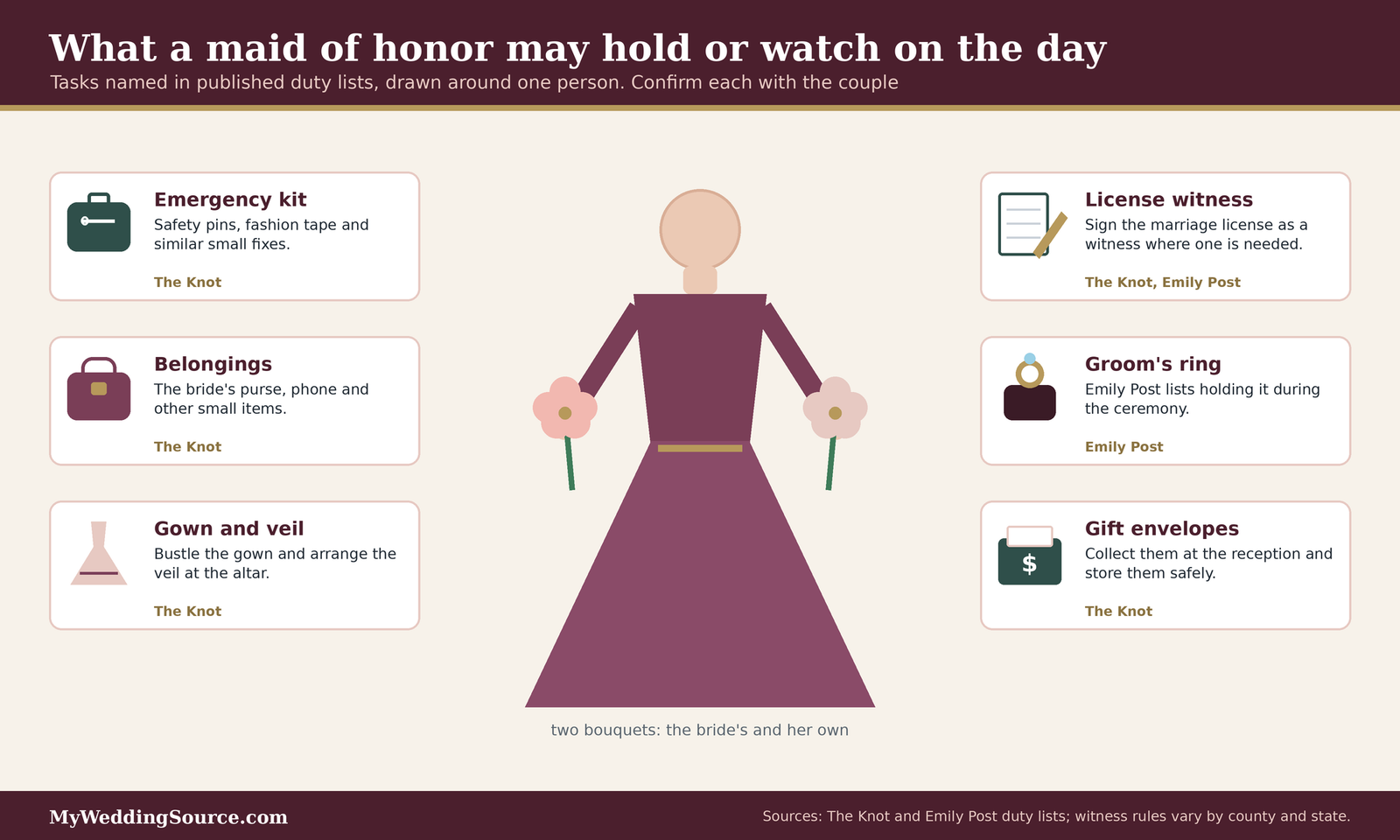
On the wedding day, The Knot says the maid of honor typically carries an emergency kit with items such as safety pins and fashion tape, reviews the schedule that the planner or venue coordinator sends shortly before the wedding, and reminds the bridal party of key times. The sources give examples, not complete kit lists, so build yours from the problems your own day could create: the dress, the weather, the shoes, and the schedule. A small bag with the basics is easier to carry than a large bag with everything.
The timeline is the more important document. Make sure each attendant has the same version, the same arrival time, and the same address for each stop. If hair and makeup start before the ceremony, share the order and the start times with the group. Our wedding photographer shot list can help the group understand when photos are planned so the schedule is realistic.
Holding things, signing things, and arranging things
During the ceremony, The Knot and Emily Post both describe the maid of honor holding the bride’s bouquet, with Emily Post adding the groom’s ring in its description. The Knot also mentions arranging the gown and veil at the altar and keeping track of the bride’s purse, phone, and other belongings, and it suggests wrapping tissues around the stems of a bouquet you hold along with your own.
The other task in this group is signing the license. Both The Knot and Emily Post say the maid of honor witnesses the signing alongside the best man. Whether a witness is needed at all depends on where you are. The San Diego County Clerk’s office, for example, describes a public license that requires at least one witness at the ceremony, and a confidential license that does not require one. A legal explainer from Bridge Legal says most states require two witnesses who are not the officiant, and FindLaw says most states require the spouses, the officiant, and one or two witnesses to sign. Those sources do not fully agree, which is exactly why the couple should confirm the rule with the county clerk where they will be married. Our marriage license guide and wedding officiant guide cover the paperwork and the officiant’s role. This is general information, not legal advice.
The reception
At the reception, maid of honor duties shift from managing logistics to supporting the couple and the guests.
The toast
The Knot says the toast should be written and rehearsed in advance and kept fairly short, covering your relationship with the couple and expressing love and congratulations. MasterClass puts the typical maid of honor speech at about four minutes, with a range of three to five, and suggests an opening story, a focus on the couple, some advice or good wishes, and a closing toast. It recommends avoiding inside jokes that need explaining, adult humor, anything negative about the couple, speaking too long, and reading word for word from a page.
Our own advice is to ask the couple whether they want toasts at all, and who else is speaking, before you start writing. If you are nervous, practice out loud twice. Our wedding reception guide and wedding ceremony guide cover how toasts fit into the flow of the day.
Backup hostess, gift envelopes, and keeping the couple fed
The Knot describes the maid of honor as a backup hostess who points guests toward seats, restrooms, gift tables, and the guest book. It also lists collecting gift envelopes and storing them safely, helping the bride with her gown in the restroom, and making sure the couple eats and drinks. These maid of honor duties are quiet and useful, and none requires a speech. Before the day, ask the couple who should hold the envelopes and where they will be stored overnight.
Use the final checklist as an operational handoff for maid of honor duties
In the final week, the goal shifts from planning to transfer. The plans exist. What is needed now is a handoff: the right people know what they are responsible for, the right contacts are in the right phones, and everyone knows what to do when something goes wrong.
Move execution away from the couple
Moving maid of honor duties off the couple’s plate has a clear purpose: the couple should not be the person answering vendor questions or the guest who cannot find the shuttle. The Knot describes the maid of honor as the main vendor contact on the day, exchanging details with the planner, and as a point of contact for guests who have questions. A handoff only works if the contacts and responsibilities are written down.
Give helpers exact responsibilities
Name each helper and each of the maid of honor duties they take. “Bridesmaid A holds the dress bag and the shoes until the first look. Bridesmaid B gathers gift envelopes after the toasts and brings them to the car. Bridesmaid C is the contact for the hair and makeup artist.” Vague offers such as “I’ll help with whatever” are kind, but they leave the maid of honor holding the whole list. If the wedding has a planner or day-of coordinator, find out which tasks they already cover so you do not duplicate or contradict them.
Create escalation rules for exceptions
Decide in advance what counts as a problem the maid of honor handles, a problem she hands to the planner, and a problem that goes to the couple. A late attendant, a missing shoe, and a spilled drink usually belong to the first group. A vendor no-show or a venue issue belongs to the second. A family conflict or a medical situation should reach the couple or the right family member quickly. Write the rules down, and share them with the attendants and the planner so the same person answers the same question every time.
The final-week handoff table
What goes in each column
The table below turns the final week into a set of named contacts, times, and backups. It is a template. Replace every cell with names, numbers, and times from your own wedding.
| Handoff | Who holds it | When | Proof it is ready | If it fails |
|---|---|---|---|---|
| Final timeline with arrival times and addresses | Maid of honor | Sent a few days before | Every attendant has replied “got it” | Call the attendant and read the times aloud |
| Vendor contact list | Maid of honor and planner | Shared before the wedding day | Each vendor’s phone number saved by two people | Ask the planner or venue coordinator to relay |
| Emergency kit and spare items | Maid of honor | Packed the day before | Items checked against a written list | Ask the venue or a nearby store for substitutes |
| Dress, shoes, rings, and license pen | Named attendants | Counted at departure | Each item checked off aloud | Name a backup holder in advance |
| Gift envelopes and cards | Named attendant | During the reception | Box or bag has a designated location | Move to the couple’s hotel room or a family member |
| Transportation for attendants | Couple or planner, with maid of honor as contact | Confirmed the day before | Driver name and pickup times in the shared note | Rideshare as a backup, paid by whoever agreed |
| Gown or suit storage after the event | Maid of honor or named family member | End of the night | Bag, tag, and a person’s name | Hotel front desk or the couple’s room |
Why the table has a failure column
The last column is the one people skip, and it is the one that matters on the day. Writing down what happens if each handoff fails turns a surprise into a decision that was already made. If you can only fill in one column honestly, fill in that one.
Run a last-pass failure check
A last-pass check is a short list of questions you ask while there is still time to fix the answers. Run it a few days before, and run a shorter version the night before.
Look for missing owners, times, and addresses
Go through the checklist and the timeline line by line. Does every task have one named owner? Does every time have an AM or PM and a time zone if people are traveling? Does every location have a full address that has been tested in a map app? Is each phone number saved by at least two people? The simplest failures at weddings are the ones that were not written down: no name, no time, or the wrong address.
Confirm the backup path for weather, travel, or vendor delay
For each of the three risks, write one sentence that begins with “If.” If it rains, who calls the venue about moving the photos indoors? If a flight is delayed, who is the first backup for the toast and the license witness? If a vendor is late, who calls them, and what is the threshold to call the planner? The sources we reviewed do not prescribe backup plans, so these are our recommendations. The principle is to decide before the day who acts, not what to do in every possible case. Our wedding planning stress guide has more on keeping the final weeks manageable.
After the wedding: closing the loop
The last of the maid of honor duties are small and often forgotten, because everyone is tired. The Knot lists attending a farewell event if the couple hosts one, delivering cards and gifts, and finishing group administration. Emily Post adds helping the bride change for her departure and caring for her dress and accessories afterward.
Gifts, cards, and belongings
The couple will write thank-you notes later, and they need the cards and gifts to do it.
Deliver cards, gifts, and the dress
Confirm where each item is and who is taking it to the couple. If the couple is leaving on a trip, agree on a safe place and a handoff date. Take a quick photo of the gift table or the envelope box before it is packed, which is our suggestion, so the couple has a record if anything goes missing. If the dress needs special storage or cleaning, check whether the couple has arranged it, and do not assume that is yours to handle.
Return or pass on rented and borrowed items
Rented items, borrowed jewelry, and loaned decor have return dates. Make a list on the wedding night and assign each item to a person with a date. If an item is lost or damaged, tell the owner promptly and plainly, and offer to make it right.
Settling shared money and staying in touch
The last financial tasks are usually small, and they are the ones that cause the most lingering awkwardness if they are left unsettled.
Close out the group expenses
Go through the spreadsheet or the notes from the shower and the bachelorette and settle every balance within a couple of weeks. Send each person a short message with what they owe or are owed and how to pay. The Knot lists splitting outstanding group expenses as one of the final administrative tasks. If someone fronted a large amount, make that a priority.
Keep the friendship going
After the event, a short message to the couple and the attendants, thanking them and sharing a favorite moment, closes the loop in a way no spreadsheet can. Maid of honor duties end with the wedding, but the friendships it was built on usually continue.
Special situations that change maid of honor duties
The published lists assume a certain kind of wedding: a bride, a group of female friends, a traditional sequence of events. Many weddings look different, and the tasks change with them.
When the setup is not the usual one
Not every wedding has one maid of honor, and not every maid of honor is a woman or a bride’s friend, so maid of honor duties get divided in different ways.
Co-maids, matrons, and people of other genders
Some couples name two honor attendants, use a different title, or choose a friend of any gender for the role. Customs on titles vary, and there is no single correct choice. The practical question is how to divide maid of honor duties. Split by phase if it helps, with one person taking the pre-wedding events and the other the wedding day, and let each own a column of the checklist. Whatever the title, the same maid of honor duties need owners.
Weddings with a planner or a small guest list
A planner takes over many of the maid of honor duties in the vendor and timeline groups, and the maid of honor’s job becomes liaison and support. A very small wedding may have no shower, no bachelorette, and no formal toast, and the role may reduce to being present and helpful. Our small wedding planning guide and micro wedding planning guide cover how the rest of the day changes when the guest list is short.
When distance, money, or health limit what you can do
You can carry out maid of honor duties well from a distance, on a budget, or with limits you did not plan for.
Long-distance and travel-heavy roles
If you live far away, trade in-person maid of honor duties for remote ones. Take the shared spreadsheet, the vendor research, the group chat, the invitations, and the budget. Leave on-site tasks, such as decorating and pickup runs, to a local attendant. Tell the couple at the start what you can and cannot do. Being honest early is more useful than overpromising.
Limits on money, time, or energy
Everyone has a limit on maid of honor duties, and the couple would almost always rather hear about it early. Use the scripts in the money section, name what you can contribute, and offer an alternative that costs less. If a health or family situation changes what you can give, tell the couple directly and offer a specific smaller role. The role is meant to support the couple, not to test the maid of honor.
Questions to ask the couple before you say yes
- Which traditions matter to you, and which would you rather skip?
- What do you hope attendants will spend in total, and are there things you plan to cover, such as hair and makeup or a hotel suite?
- Who is hosting the shower, and what would you like from me?
- Do you want a bachelorette trip, a local night, or neither?
- Do you want toasts, and who else is speaking?
- Does the wedding have a planner or day-of coordinator, and what do they handle?
- Which tasks would you most like to hand off completely?
- What is the best way to reach you when I have a question?
FAQ: maid of honor duties questions
Role and expectations
What are the main maid of honor duties?
According to The Knot and Emily Post, the core maid of honor duties are leading the bridesmaids, helping with attire, taking a leading role in the shower and bachelorette, staying close to the bride on the wedding day, holding her bouquet, witnessing the marriage license, giving a toast, and helping afterward. Which of these apply depends on the couple’s wishes.
Does the maid of honor have to plan the bachelorette party and the shower?
Not by rule. The Knot says the maid of honor usually leads bachelorette planning and often leads the shower, while Emily Post lists helping organize a pre-wedding party as optional. Many groups now share the work. Ask the couple what they want from the maid of honor duties, then offer the help you can realistically give.
What does the maid of honor do on the wedding day?
Sources describe carrying an emergency kit, watching the timeline, serving as vendor contact, holding the bouquet, adjusting the gown and veil, witnessing the license, giving a toast, and acting as a backup hostess. Agree in advance with the couple and any planner which of these maid of honor duties she owns.
Can I say no to being a maid of honor?
Yes. Zola says being asked is not the same as being required, and suggests declining politely and in person if you cannot afford the role, then showing support in other ways. You can also accept with limits by naming the costs you cannot cover and proposing a cheaper alternative.
Money, paperwork, and timing
Who pays for the bridal shower and bachelorette party?
The Knot says shower costs are traditionally shared, with the host covering part of the bill, and that the maid of honor leads planning but is not expected to pay for all of it. For the bachelorette, guests cover their own travel and activities, and the group often shares the bride’s costs. Agree on this before booking.
Does the maid of honor pay for her own dress?
Usually yes. Both The Knot and Emily Post say attendants typically pay for their own attire and accessories. Hair and makeup depend on the bride: The Knot says that if she wants professional services, she often covers them as a gift or the couple splits the cost. Ask before you book anything.
Does the maid of honor need to sign the marriage license?
Only where the law requires a witness, and the rules vary. San Diego County, for instance, requires at least one witness for a public license but none for a confidential one, and other sources describe two witnesses as common. The couple should confirm requirements with the county clerk where they are marrying. This is general information, not legal advice.
How long should a maid of honor speech be?
MasterClass puts a typical maid of honor speech at about four minutes, within a range of three to five. It suggests an opening story, a focus on the couple, some advice or good wishes, and a closing toast, and recommends avoiding inside jokes, adult humor, and reading the speech word for word.
Your next steps
Start with the conversation
Have the role and budget talk this week
Ask the couple which traditions they want, what they hope attendants will spend, and who is hosting the shower. Write the answers in two or three sentences, and share them with the group. Our wedding etiquette guide has more on customs around attendants and hosts.
Copy the checklist and give every line an owner
Take the operational checklist of maid of honor duties above, delete what does not apply, and add a name and a date to every row. Use our wedding planning checklist and wedding planning guide to see where these tasks sit in the couple’s larger plan.
Protect the week itself
Fill in the handoff table a week before
Replace each example in the final-week handoff table with real names, times, and phone numbers, and send it to every attendant and to the planner. Then run the last-pass failure check once, and again the night before.
Plan for the aftermath
Name who carries the cards, the gifts, and the dress, and put a date on settling any shared money. A single message after the wedding, with each person’s balance, ends most lingering awkwardness. Our plan a wedding guide can help the couple see the rest of the schedule.
Sources & methodology
How we built this guide
What we relied on
This guide combines published etiquette advice from The Knot, Zola, and Emily Post, speech guidance from MasterClass, and county and legal-information sources on marriage license witnesses. Where a statement comes from a publisher or a wedding company, we say so, because those sources describe custom and reflect the publisher’s perspective. The cost scenarios, the shower backward schedule, and the operational checklist are our own arithmetic and editorial synthesis, built on the published ranges, and they are labeled as estimates or suggestions in the text.
What we did not do
We did not survey maids of honor, test any vendor, or give legal or financial advice. The dollar figures from Zola and The Knot come from pages that do not describe a survey year or method, so we treat them as rough orientation. We looked at The Knot’s 2025 Real Weddings Study page for wedding-party figures and did not find any on the public page, so we did not use any. Witness rules vary by state and county, so confirm them with the county clerk where the wedding takes place.
Source list
Government, legal, and clinical-style sources
- San Diego County Assessor/Recorder/County Clerk, Marriages (public and confidential licenses, witnesses, return of the license): https://www.sdarcc.gov/marriages/
- FindLaw, Legal requirements for marriage FAQ: https://www.findlaw.com/family/marriage/legal-requirements-for-marriage-faq-s.html
- Bridge Legal, Does the officiant count as a witness: https://bridgelegal.org/does-officiant-count-witness/
Etiquette, planning, and industry sources
- The Knot, Maid of honor duties: https://www.theknot.com/content/maid-of-honor-duties
- The Knot, Maid of honor wedding day duties: https://www.theknot.com/content/maid-of-honor-wedding-day-duties
- The Knot, What bridesmaids pay for: https://www.theknot.com/content/what-bridesmaids-pay-for
- The Knot, Who pays for the bridal shower: https://www.theknot.com/content/who-pays-for-the-bridal-shower
- The Knot, Should the bride help pay for the bachelorette party: https://www.theknot.com/content/should-the-bride-help-pay-for-bachelorette-party
- The Knot, Bachelorette party etiquette: https://www.theknot.com/content/bachelorette-party-etiquette
- The Knot, 2025 Real Weddings Study: https://www.theknot.com/content/wedding-data-insights/real-weddings-study
- Emily Post Institute, Wedding attendants: https://emilypost.com/advice/wedding-attendants
- Zola, How to talk money when you are in a wedding party: https://zola.com/expert-advice/talk-money-in-a-wedding-party
- Zola, When to send out bridal shower invites: https://zola.com/expert-advice/when-to-send-out-bridal-shower-invites
- MasterClass, Maid of honor speech: https://www.masterclass.com/articles/maid-of-honor-speech