
Wedding transportation for split ceremony and reception locations comes down to one number, the gap between the last “you may kiss” and the first guest settled with a drink, and this guide shows you how to estimate that number from your own route, your own guest count, and your own vehicles instead of guessing.
Quick answer
Add five pieces: release time at the ceremony, loading time, a drive time padded with a reliability buffer, unloading time, and a short cushion before the reception begins. For one 20-minute drive with a full coach, that can land near 65 minutes. For the same couple using one small van that has to make two trips, it can land near 150 minutes. Planning guides from wedding sites generally suggest keeping the gap to about an hour or an hour and a half, so check the vehicle count before you set the reception time. This guide gives you the formula, three worked examples, and the questions to ask each provider. It is general planning information, not legal or safety advice for your specific vendors.
Wedding transportation for split ceremony and reception locations starts with the gap
Couples choose two venues for good reasons: a chapel, a beach, a family property, or a place of worship that cannot host dinner, paired with a hall, restaurant, or garden that can. One planning site’s guide describes booking two venues as sometimes the only way to get exactly the ceremony setting you want, and also notes that it means a gap between ceremony and reception, less reuse of décor, and a bit more effort for the couple. Transportation is the part that turns that gap from a scheduling detail into an experience, because every minute of it belongs to your guests.
This guide is about wedding transportation for split ceremony and reception locations, meaning the movement between the two places. It does not try to cover every transportation topic. For the full overview of vehicle types and vendors, our wedding transportation guide is the right starting point, and our guest transportation planning article covers lodging runs and arrivals. Here we stay on the one leg that split venues create.
Why the gap is the real product
A guest does not experience “a 20-minute drive.” They experience the walk from their seat to the curb, a wait for the vehicle, a ride, a walk into a different building, and a pause before anything is served. In wedding transportation for split ceremony and reception locations, the drive is often the smallest piece you control, and the pieces around it are the ones couples forget.
The gap starts when the ceremony ends, not when the car leaves
Between the recessional and the first wheel turning there is a human delay. People hug, find their coats, take photos, and look for the person they came with. If the ceremony site has one narrow door or a gravel lot, that delay grows. We call this release time in the estimator below, and we plan for it in minutes instead of treating it as zero.
The gap ends when the reception can actually begin
The other end is not the moment the vehicle parks. It is the moment guests are inside, have a place to put wraps and gifts, and the room is ready for the first toast or the first drink. If the first guests arrive before the venue expects them, the staff may be mid-setup. If the last guests arrive after the couple, the couple waits on their own party. Both are avoidable if you plan the end of the gap deliberately.
What guests tend to feel during a gap
Planning guidance from wedding sites tends to agree on a few ideas. One site’s guide says guests should be able to move from ceremony to reception within roughly an hour to an hour and a half, and warns that very short gaps can feel rushed while very long ones can leave people bored or tempt them to eat and drink before the reception starts. Another suggests keeping travel between sites to 30 minutes or less and never more than an hour. These are editorial rules of thumb from wedding publishers, not research findings, but they match what planners describe: the gap should be long enough to move people calmly and short enough that the day still feels like one event.
Rushed guests
A gap that is too short is not only stressful for guests. It also squeezes your photographer, caterer, and venue. When a vehicle runs late, every other vendor’s clock is affected. Our vendor timeline guide explains how one late block moves the rest.
Bored or over-served guests
A gap that is too long makes guests invent their own plan. Some will go to a bar, some to a hotel room, and some will not come back. The longer the gap, the more you need a plan for where people wait. We cover that in the section on gap length below.
The two questions that shape everything else
Before any vehicle is priced, two answers decide the size of the problem: how many guests will actually need a ride, and how far apart the two sites really are at the hour guests will be driving. Everything else in this guide is arithmetic built on those two answers.
How many guests need a ride
Some guests will drive themselves, some will carpool, and some will rely on you. A shuttle is optional for many weddings. One wedding-website company’s guide calls guest shuttles a courtesy rather than a requirement and says they are most common when guests share a hotel block, parking is limited, or alcohol is served. Your number may be a quarter of the guest list or most of it. We show how to count in the “Who rides” section.
How far apart the sites really are
Map distance is not travel time, and travel time on a quiet Tuesday is not travel time on a Saturday evening. Use a map application to look up the same route at the same weekday and hour as your wedding, as we explain in the section on drive buffers. The distance you put on a form is only a starting point.
The ceremony-to-reception transfer buffer estimator
Our estimator for wedding transportation for split ceremony and reception locations is a short formula you can do on paper. It is our own planning method, built from published definitions of travel-time reliability and from published operator-style guidance on loading time. It is not an industry standard and not a guarantee. Its value is that it makes every assumption visible, so you and your vendors can argue about the numbers instead of about feelings.
Gap = Release + Load + Drive plan + Unload + Cushion
All values are in minutes. “Drive plan” is the typical drive time multiplied by one plus a buffer percentage. We explain the buffer in its own section, because it is the piece most often skipped.

The five pieces, one at a time
Each piece has a range, and each range comes with a reason. Where a value comes from a source, we say so. Where it is our assumption, we say that too, and you should replace it with your own observation as soon as you have one.
Release time: our starting value is 10 minutes
This is the time between the end of the ceremony and the first guest at the vehicle door. We use 10 minutes as a starting value, which is our assumption, not a published figure. Raise it if the ceremony site has stairs, a long walk to the lot, or a receiving line that happens before guests leave. Lower it if the vehicles wait at the exit and guests can step straight on.
Load time: about a quarter of a minute per rider
One wedding-website company’s transportation guide says that getting 50 guests onto a shuttle takes 10 to 15 minutes. That works out to roughly 0.2 to 0.3 minutes per rider, and we use 0.25 as a middle value. Loading is slower in formal clothing, with long dresses, with wraps, or when guests need help with steps. If you have two vehicles loading at once, use the number of riders on the larger vehicle, not the total.
Drive plan: typical time plus a buffer
Take the typical drive time from a map application at your wedding’s weekday and hour, then multiply by one plus the buffer. A 25-minute drive with a 40 percent buffer becomes 35 minutes. The next section explains where buffer percentages come from and how to choose one without pretending to precision you do not have.
Unload time: our starting value is 5 to 8 minutes
This covers the vehicle stopping at the correct door, guests stepping off, and the first few steps to the entrance. It is longer if the drop-off is on a gravel drive, if the venue has stairs, or if anyone uses a mobility device. We use 8 minutes for a coach with a full load and 5 minutes for a smaller van.
Cushion: our starting value is 10 minutes
The cushion is what protects the reception start from the small slips that always happen. It is an assumption, not a published rule. Some couples set it to zero and rely on the bar being open when guests arrive. Others make it 15 minutes to let a late vehicle catch up. Pick a value you can explain to your caterer.
Worked example one: a full coach and a calm drive
Imagine a ceremony at a small chapel and a reception at an inn. The typical drive is 20 minutes midday on a quiet road, and 50 guests will ride a single coach while others drive themselves. We assume a buffer of 20 percent, which we take from a published freight-corridor example in the next section, and we use the starting values above.
Release is 10 minutes. Loading is 50 riders at 0.25, which we round to 13 minutes. The drive plan is 20 times 1.2, which is 24 minutes. Unloading is 8 minutes and the cushion is 10. The total is 65 minutes.
What this means for the invitation
A ceremony ending at 3:30 p.m. would put guests inside the reception by about 4:25 p.m., with the cushion bringing the planned reception start to 4:35 p.m. Add the first look or portrait time for the couple separately. We treat the couple’s own timeline in its own section, because their gap and the guests’ gap are not the same.
What this means for the vendor
If the shuttle is billed with a minimum number of hours, a 65-minute need does not reduce the bill. We cover that in the cost section. The lesson of this example is not that coaches are cheap or expensive. It is that a single full vehicle and a calm drive give a gap close to the one-to-one-and-a-half-hour range that wedding publishers often cite.
Worked example two: a busy city on a Saturday evening
Now change the setting. A ceremony at a city church, a reception across town, a typical drive of 25 minutes, a Saturday evening, and a congested route. We use a 60 percent buffer, which is our assumption informed by the higher published examples in the next section. We assume two vehicles, each carrying 28 riders, loading at the same time.
Release is 10 minutes. Loading is 28 riders at 0.25, which we round to 7 minutes. The drive plan is 25 times 1.6, which is 40 minutes. Unloading is 8 minutes and the cushion is 10. The total is 75 minutes.
The buffer is most of the change
Compared with the first example, loading got faster because two vehicles load in parallel, but the drive plan grew by 16 minutes. The buffer, which is 15 minutes of that 40, is the biggest single block of uncertainty in the plan. This is why a calm midday estimate should never be copied to a busy evening route.
The hidden assumption: two vehicles really are available
The example works because both vehicles are at the curb at the same time. If the operator can only provide one vehicle for your window, the example is wrong, and the next one shows how wrong.
Worked example three: one small van and two trips
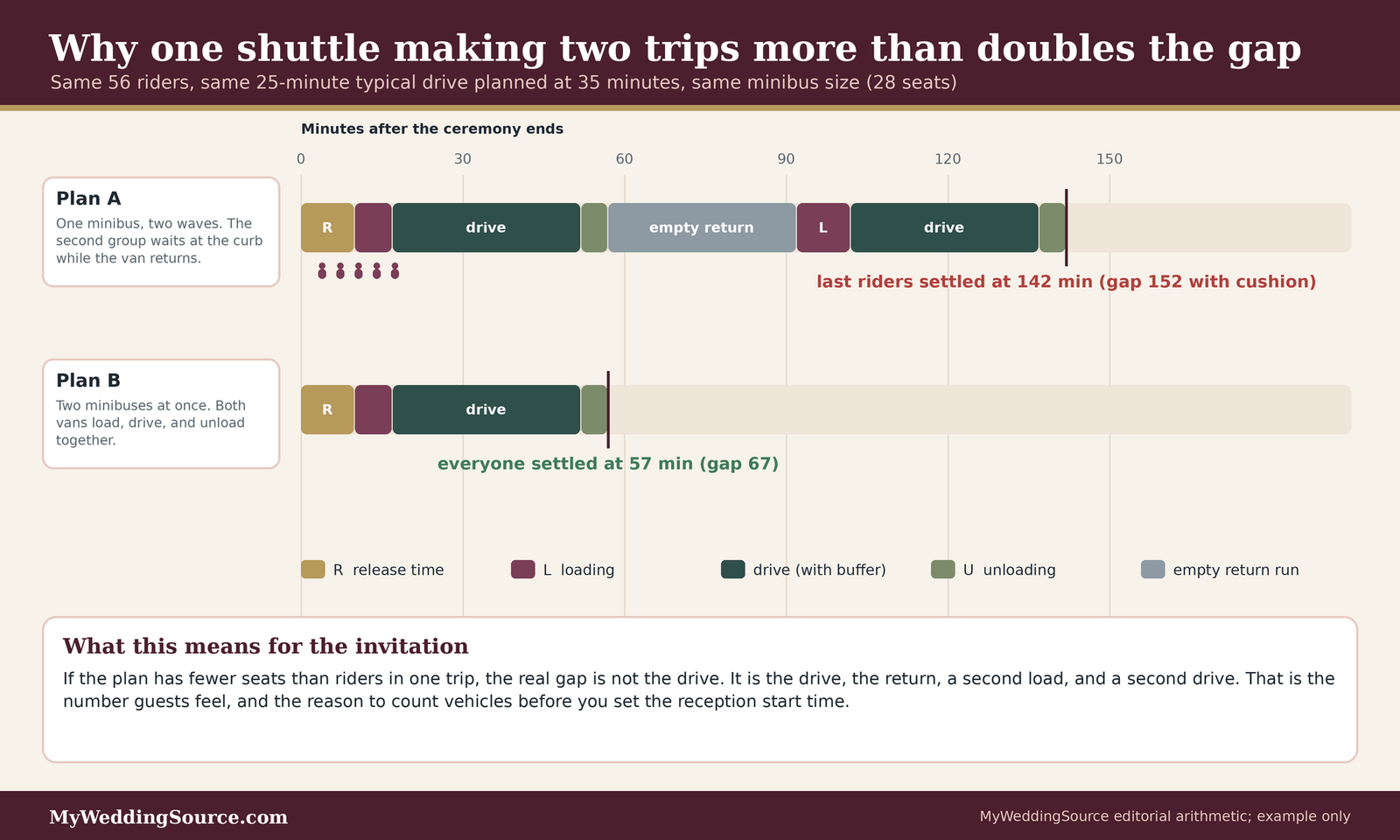
Take 56 riders and one minibus with 28 seats. The typical drive is 25 minutes with a 40 percent buffer, so the drive plan is 35 minutes. Release is 10 minutes, loading is 7 minutes, and unloading is 5 minutes.
The first group leaves at minute 17, arrives at minute 52, and is unloaded at minute 57. The van drives back, arriving at minute 92. It loads again in 7 minutes after a 3-minute reset, leaves at minute 102, arrives at minute 137, and is unloaded at minute 142. With a 10-minute cushion, the gap becomes 152 minutes.
Why the gap more than doubled
The only change from the previous plan is the vehicle count. One vehicle making two trips adds the empty return, a second load, and a second drive. A two-vehicle plan with the same riders finishes at minute 57 and needs a 67-minute gap with the same cushion. The arithmetic is the whole argument for counting seats before you choose a reception time. For a deeper treatment of trips, cycle times, and staggered departures, see our guide to calculating wedding shuttle capacity with staggered departures.
When a second wave is acceptable
Sometimes a second wave is fine. If your reception begins with a long, informal cocktail hour, if the first group can be welcomed with drinks and the second group arrives to a room already in motion, and if guests have been told in writing, a longer gap for some riders may be a good trade. The key is that it is a decision, not a surprise.
How to read the results
An estimate is a range, not a promise. Run the numbers three times: a calm case, a likely case, and a stressed case. Give the calm case to the couple, the likely case to the caterer and photographer, and the stressed case to the shuttle operator, so that the contract covers the version that could actually happen.
Calm, likely, and stressed
For example one, the calm case might use a 10 percent buffer and a 7-minute loading time, the likely case is the 65 minutes above, and the stressed case might use a 60 percent buffer and an extra 5 minutes of release. Use whatever changes you think are realistic. What matters is that you write them down and agree on them with each vendor.
The number you send to the caterer
Caterers and venues care about when guests will actually be through the door. Give them the likely case as the planned start, and tell them the stressed case as a possible delay. A kitchen that knows the stressed case can hold appetizers. A kitchen that is told only the calm case will plate food that waits.
Choosing a drive buffer you can defend
The most common mistake in wedding transportation for split ceremony and reception locations is using the map’s typical drive time as if it were a promise. The Federal Highway Administration’s work on travel-time reliability explains why that fails. Averages hide variation: its example describes a commute that takes about 18 minutes on a typical day and nearly 25 minutes when incidents and weather combine, which is 39 percent longer. For a wedding, where a late vehicle affects dinner, photos, and a dozen vendors, planning to the average means planning to be late about half the time.
What reliability measures say
The FHWA defines the buffer index as the extra cushion travelers add to an average trip so they arrive on time, calculated from the 95th-percentile travel time minus the average, divided by the average. A 95th-percentile plan means on-time arrival for about 95 percent of trips, which the agency describes as roughly one late weekday per month. It also describes a planning time index, which divides the 95th-percentile time by the free-flow time, so it includes ordinary congestion as well as unexpected delay.

Published examples we use for illustration
The FHWA page gives example buffer indexes for freight corridors: 4 percent on one interstate, 20 percent on another, and 25 percent, 16 percent, and 6 percent on others. At a busy border crossing, it reports 56 percent outbound and 66 percent inbound. For planning time, it describes a peak-hour index of about 2.0 in Los Angeles, which means a commuter needs nearly double the light-traffic time to arrive on time. These are measurements of specific roads, not of your route. We use them only to show that cushions can range from nearly nothing to a doubling.
How we turn them into planning values
We apply a buffer of 10 to 20 percent for quiet roads in clear conditions, about 40 percent for ordinary busy roads, 60 percent for known congestion, and up to 100 percent when you must cross a notorious bottleneck at peak time. These are our planning assumptions, not FHWA recommendations. Replace them with your own observations as soon as you have a few.
How to test your own route
You cannot buy certainty, but you can reduce it. Pick the same weekday and hour as your wedding and look at what a map application predicts, then check the route on the real day type at least once.
Check the route at the right hour
Most map applications let you set a future departure time and show a typical range. Look up the route for the hour the vehicle will actually leave, not the hour the ceremony starts, and look at several weeks if you can. If you are planning far ahead, remember that the prediction is a typical pattern, not a forecast for your date.
Drive it once, in the real vehicle size if possible
A route that works for a sedan may not work for a coach. Low bridges, tight turns, gravel shoulders, and narrow venue drives matter more for a large vehicle. Ask the operator whether they have driven to both addresses with a similar vehicle, and ask them for the access route they plan to use.
What moves a buffer up on the day
Several things push a drive toward the long end of its range. The FHWA’s congestion material lists traffic incidents, work zones, weather, fluctuations in normal traffic, special events, traffic signals and railroad crossings, and physical bottlenecks as the main sources. Many of those are visible before the wedding, and some are not.
Things you can check ahead of time
Look for known construction, a drawbridge, a railroad crossing on the route, and a stadium, race, festival, or graduation near either venue on the same date. Local event calendars, the venue manager, and the operator’s dispatcher are good sources. A special event can add demand beyond what a normal Saturday carries. Our wedding permits guide covers when a permit may be involved.
Things you cannot check ahead of time
A crash, a breakdown, or a sudden storm cannot be scheduled. That is the reason for a buffer instead of an average. It is also the reason to ask the operator what they do when a vehicle is delayed, which we cover in the vendor questions.
Deciding how long the gap should be
For wedding transportation for split ceremony and reception locations, the estimator tells you the minimum gap that the logistics require. A separate question is how long you want the gap to be as a guest experience. The answer depends on the style of day, the age mix of guests, the time of year, and what else you have planned for the couple.
The range wedding publishers suggest
Two wedding planning sites we reviewed agree on a shape. One says guests should be able to get from ceremony to reception in about an hour to an hour and a half, with a cocktail hour in the same venue typically lasting an hour and rarely more than 90 minutes. Another says to keep the gap to 60 to 90 minutes at most. Neither is a measurement of guest satisfaction. Both are editorial advice from publishers, and both are helpful as a sanity check against your own arithmetic.
When your logistics need less than an hour
A gap near an hour is possible when sites are close, a vehicle is waiting, and guests are ready. It is hard when there are many riders, steps, or formal dress. Treat anything under 50 minutes with suspicion unless you have timed the loading and the drive.
When your logistics need more than 90 minutes
If your estimate is over 90 minutes, do not hide it. You can shorten it with another vehicle, a closer pickup point, or a staggered send-off, or you can accept it and fill it. Both are legitimate choices. The mistake is to publish a start time that the estimate cannot support.
Planning for a long gap
Some weddings have a gap of two or three hours because of venue availability, religious observance, or a ceremony in the afternoon and a reception in the evening. One planning site says that gaps of one or three hours can work with good planning, and the rest of its advice is practical: keep guests informed, give them a map, and offer a place to be.
Give guests a reason and a place
Tell guests early and plainly on your wedding website. A short list of nearby cafes, parks, shops, or a lobby bar is enough. A pre-reception gathering at a hotel bar or garden, or snack tables at the ceremony site if space allows, are options another site mentions. Our wedding website accessibility audit helps you check that these instructions are readable for everyone.
Keep the food and drink promise honest
A long gap where guests are drinking without food leads to a harder evening. Plan for light food or tell guests to eat. The same publisher notes that a gap long enough for guests to eat a full meal or drink heavily before the reception is a risk to avoid.
Who is moving and who is waiting
During the gap, three groups are doing different things. Guests are traveling or waiting. The couple and wedding party are doing portraits or traveling separately. Vendors are setting up and resetting. Mixing those timelines is the main reason a gap feels chaotic.
The couple and the wedding party
Portraits after the ceremony often fill the couple’s gap. One site’s advice is that a cocktail hour gives the photographer time for wedding party photos and group shots while guests are occupied. If you are doing a portrait session in a third location, count that drive too. Our first look photos guide and photographer shot list explain how photo blocks fit around the ceremony.
The vendors
Florists, rental teams, and the caterer need to know when guests arrive. If your florist is moving the ceremony arrangements to the reception, as one planning guide advises assigning someone to manage, add that task to the timeline. Our vendor communication deadlines article suggests when to confirm each one.
Who rides: shuttles, self-drive guests, and the couple
Wedding transportation for split ceremony and reception locations only works if you know how many guests are in each vehicle. That requires a rider count, a plan for people who drive, and a separate plan for the couple.
Counting riders without guessing
Start with your invitation list and divide it into groups: people staying at the same hotel, people who live locally, people traveling with children or older relatives, and people who are probably going to drive anyway. Then use your RSVP form to find out who wants a ride.
Ask on the RSVP
Add a plain question to your RSVP or website: “Would you like a ride from the ceremony to the reception?” with yes, no, and “not sure yet.” Give a deadline that is earlier than the vehicle’s booking deadline. Our RSVP wording guide has examples of how to phrase optional questions kindly.
Add a reserve you can explain
A reserve protects you against late changes and guests who decide at the curb. We use about 10 percent as a starting value, which is our assumption. If your operator suggests a different number based on events like yours, use theirs. For the seat arithmetic behind reserves and loads, see our shuttle capacity method.
Guests who will drive themselves
Self-drive guests do not need a vehicle, but they still affect your plan. They arrive in a stream instead of a wave, they need parking at both venues, and they may leave at different times.
Parking at the ceremony site
Ask the ceremony venue how many cars the lot holds, whether there is overflow parking, and whether cars can stay after guests leave. Some places require lots to clear by a certain hour. If the lot is tight, a shuttle from remote parking may be better than a shuttle to the reception. Our parking attendants vs valet service article explains staffing options for busy lots.
Parking at the reception
Ask how many cars the reception venue can accommodate and where overflow goes. A guest who drives from the ceremony to a packed lot may arrive late and frustrated. It is also worth asking whether guests who plan to drink will be able to leave their cars overnight. We cover the end-of-night side in our end-of-night ride plan.
The couple and the wedding party
The couple’s gap is not the guests’ gap, and it should be planned separately. They may leave first, last, or in a different vehicle.
A private vehicle for the couple
Some couples leave in a classic car or a car chosen for photos. If this is a choice you are considering, our vintage wedding car rental guide covers questions about condition, insurance, and timing. Whatever the vehicle, confirm how many people it carries with a dress or train, and what it needs to arrive on time.
The wedding party and family
The wedding party may travel together, which is another rider group. Include them in your count, along with parents and grandparents who may want a smoother path. If anyone is taking items to the reception, like programs, guest book, or gifts, assign a person and a vehicle. A second planning site advises making a list of items to move between sites and assigning someone reliable to handle it.
Safety, access, and vendor checks for a short but important ride
A transfer of 20 or 30 minutes in wedding transportation for split ceremony and reception locations still carries passengers in formal clothing, some of whom may have limited mobility, many of whom have been drinking, and some of whom are children. The checks below are consumer-protection basics from government and safety-agency sources, applied to a wedding. They are not legal advice, and rules differ by state and by the type of vehicle.
Checking the company before you book
Federal transportation agencies publish plain checklists for people who hire buses. We reviewed two pages from the Federal Motor Carrier Safety Administration and a safety alert from the National Transportation Safety Board. Both FMCSA pages carry 2014 update dates, so use them as a checklist of what to ask, and confirm current rules and ratings with the agency before relying on any specific number.
Authority, insurance, and safety record
The FMCSA pages say that for-hire bus companies providing interstate passenger transportation need operating authority from the agency, that a company should have a USDOT number, and that a bus designed to carry 16 or more passengers must carry a specified amount of insurance, which the pages state as $5 million. They also describe a safety rating of Satisfactory, Conditional, or Unsatisfactory and say that unrated companies have not been evaluated against the agency’s fitness standards. The NTSB checklist tells hirers to get the company name and USDOT number, search the carrier in FMCSA’s passenger carrier search, and review its safety scores. For a carrier that operates only within one state, or a small carrier without a score, the NTSB says to contact the state oversight agency. If your operator uses a small van, state or local rules may apply instead, so ask them to explain which authority covers your vehicle.
Drivers
The FMCSA pages say drivers should hold a commercial driver’s license with a passenger endorsement and a valid medical examiner’s certificate for the vehicles that require them. They suggest asking about a texting ban and a drug and alcohol testing program. For a wedding day, also ask how many hours the driver has already worked and whether a second driver is available, because a long day can include early pickups and late runs. One page notes that interstate drivers face hours-of-service limits, including a 10-hour cap on consecutive driving.
Accessibility is part of the plan
If any guest uses a wheelchair, a walker, or a mobility scooter, the transfer needs to work for them from the start, not as an afterthought. We have separate guides on guests who use wheelchairs and on elderly guests with walking aids. The points here are the part that is specific to a split-venue day.
What the ADA resources say, in plain terms
The ADA National Network describes private transportation providers, including airport and hotel shuttles, private buses, and taxis, as subject to accessibility requirements. For charter and tour buses, it says demand-responsive over-the-road bus companies must provide service in an accessible bus with 48 hours’ advance notice. Where a provider uses a vehicle that is not accessible, the service must be equivalent, meaning the same schedule, response time, fare, and service area. A taxi provider may not charge a higher fare for carrying a person with a disability or refuse to help stow a mobility device. Service animals may accompany a person with a disability. Federal regulations also explain that some shuttles run by hotels or parks are treated as private entities not primarily in the transportation business, so which rules apply depends on who operates the vehicle. Ask your operator which category they fall into, and ask them to describe in writing what they will provide.
What to do in practice
Ask each guest with an access need what they need, at the RSVP stage, and give your operator that information well before 48 hours. Request a vehicle with a lift or ramp when needed, and also confirm the pickup point has a level surface. If an accessible vehicle will not be available in your window, ask the operator how they will provide equivalent service, and plan a backup. Our guide to guests with service animals covers what to tell staff and drivers, and our seating guide helps once guests arrive.
Seat belts, children, and safety briefings
The belts and the briefing are two of the few safety items a hirer can see and ask about directly. The NTSB safety alert recommends requiring a pre-trip briefing that covers belts, how to raise urgent concerns, and where the exits and extinguishers are. It also advises choosing vehicles with lap and shoulder belts at every seat.
What the belt rule covers
A U.S. Department of Transportation announcement describes a federal rule requiring lap and shoulder belts on new over-the-road buses and other new buses with a gross vehicle weight rating above 26,000 pounds, effective for buses newly manufactured from November 2016. Transit and school buses are excluded. The NTSB alert adds that smaller buses do not have the same requirement. Because wedding shuttles are often minibuses or older coaches, ask the operator whether each vehicle has belts at every seat and what the model year is.
Children and car seats
The National Highway Traffic Safety Administration publishes age and size guidance for car seats and boosters. Its page does not discuss buses, taxis, rideshare vehicles, or limousines, so we cannot tell you whether an exemption applies to your vehicle. Rules vary by state and by vehicle type. If children will ride, ask the operator about their policy, ask your state’s traffic safety office, and consider whether a parent-driven car is the safer choice for young children.
A short test for any provider
If a provider cannot answer a plain question about authority, insurance, driver hours, accessibility, or the belts, treat that as information. Our vendor due diligence checklist and the broader wedding insurance guide go deeper on certificates and liability coverage.
Ask for documents, not reassurance
Ask for the USDOT number, a certificate of insurance listing the vehicles for your date, and the vehicle details in writing. A good operator will do this routinely.
Check the claim against the record
Use FMCSA’s public tools to confirm the company name and number, and compare what the operator says with what the record shows. If something does not match, ask again. If it still does not match, choose another provider.
Edge cases that change the estimate
The formula covers the common case. These situations are where plans for wedding transportation for split ceremony and reception locations tend to break, and each one has a practical adjustment.
When the ceremony runs late
A ceremony that begins late or runs long pushes everything after it. The release time starts from the end of the ceremony, not the planned end, so a late finish moves the whole gap.
Decide a late-start policy
Choose, with your officiant and venue, how long you will wait for guests, and when the ceremony must begin to keep the reception on time. We suggest 10 to 15 minutes as a planning allowance, which is our assumption and not a standard. Share it with the operator, because a driver who has waited has fewer hours left. Our wedding rehearsal guide explains how a rehearsal helps you check the timing.
Decide who calls the operator
Name one person, not the couple, to call the dispatcher if the ceremony runs more than a few minutes late. Put that person’s phone number in the contract and the day-of timeline. Our wedding party coordination checklist is a place to record this.
Weather, daylight, and the season
Rain slows loading and driving, and heat affects guests waiting at a curb. Evening ceremonies in autumn and winter can end after sunset, and rural roads without lighting feel longer in the dark. We cannot give you a number for those effects, so use a higher buffer and a larger cushion when the forecast or the season suggests it.
Rain and cold
Ask whether the pickup point is covered, and whether the operator will run the vehicle with heat on while guests board. Our winter wedding weather plan and photography rain backup cover related decisions.
Heat and long waits
In hot weather, guests who wait at the curb for a vehicle need shade and water. See our summer wedding heat plan for ideas. The second wave in a one-van plan is the group most affected.
Remote sites, crossings, and poor signal
Rural and island venues add problems that a map application will not show. Cell service can be poor, roads can be unpaved, and some places have a single access route. Our guide to guest pickup windows for rural venues covers this kind of plan in detail.
Rail crossings, drawbridges, and ferries
If the route includes a crossing that can delay vehicles, ask the operator how it affects them and look up the schedule for your date. The FHWA congestion material lists railroad crossings and poorly timed signals among the physical features that interrupt traffic. A ferry or drawbridge may have a schedule you can check but cannot change.
Gravel, steps, and narrow drives
A coach that cannot reach the ceremony door must stop farther away, which lengthens release and loading. Walk the last 100 yards from the likely stop to the door and time it, wearing the shoes guests will wear.
When the ceremony site has its own rules
Places of worship, parks, and historic sites may have rules about timing, vehicles, and photography. Ask whether vehicles may idle, where they may wait, and whether there is a time limit for the lot. Some public places require a permit, which our wedding permits article explains.
Pickup and drop-off points
Ask the venue to agree a specific pickup point in writing, and ask the operator to confirm they can reach it. A point that is “near the entrance” will not help a driver who needs a precise location.
A second ceremony-site use
If the ceremony site is also hosting another event before or after yours, the lot and the curb may be shared. Ask the venue manager when the next group arrives.
What a split-venue transfer costs, and what to put in the contract
Costs for wedding transportation for split ceremony and reception locations vary widely by region, season, vehicle, and operator, so we do not offer a price list. We can show how the pieces add up and which contract terms decide whether the final bill matches the quote.
Cost reality check
One wedding-website company’s national-average estimates put a large coach at about $120 to $250 per hour and a minibus at about $110 to $200 per hour, usually with a 3-hour minimum. It adds that peak season (May through October) can add 15 to 25 percent, that contracts often include a 15 to 20 percent gratuity, and that regional rates differ widely. These are one company’s estimates, not quotes. As our own estimate, a single coach booked for the 3-hour minimum might land between roughly $475 and $1,125 after the peak-season adjustment and gratuity, before taxes, fuel, mileage, or overtime. Your quote may be higher or lower. Ask for the number in writing.
What drives the bill
The hourly rate is only one part. The same source says to count total hours the vehicle must be available, not only the transfer time, and to watch for overtime if the timeline runs long and for mileage charges at rural venues. A 65-minute gap does not mean a 65-minute bill.
Minimums and the meter
Many operators charge a minimum number of hours. If you only need a vehicle for a short transfer, you may still pay the minimum, so ask whether a short transfer can be combined with another run, such as the late-night departure. Our vendor overtime rates guide explains how overtime is commonly charged and how to ask about it.
Number of trips
The same company’s planning calculator describes one-trip, two-trip, and three-trip plans: ceremony only, ceremony to reception and back, and a third late departure. A split-venue wedding is at least a two-leg trip, and a late return adds a third. It also says that using one venue for both events can remove the transit leg and can cut one to two hours off the vehicle rental, which is the cost of choosing two venues made visible.
Vehicle choice and cost per rider
One large vehicle usually costs less per rider than several small ones, according to the same guide, which gives typical capacities of about 55 passengers for a coach and 20 to 30 for a minibus. The seats you can actually use are fewer than the seats listed, because formal clothing, bags, and mobility aids take space. We use 90 percent as a working load for that reason, which is our assumption.
When two small vehicles beat one large one
A large vehicle makes sense when most riders leave at once and the venue can handle it. Two smaller vehicles can make sense when the ceremony site has a narrow drive, when you want a staggered flow, or when you have a few riders who need an accessible vehicle. Run the estimator for both.
When a school bus or a vintage car belongs in the plan
A school bus is a low-cost option some couples consider, and it has its own safety and access questions. Our guide to school bus wedding shuttles covers them. A vintage car is usually a couple’s choice, not a guest solution.
Contract terms that matter
Write the plan into the contract so that your assumptions are the operator’s obligations. Our change orders guide explains how to amend a booking when the timeline moves.
The plan itself
List pickup address, drop-off address, pickup time, number of vehicles, seats per vehicle, and number of trips. Add the access route if it matters, and name an accessible vehicle if you need one.
The failure terms
Ask what happens if a vehicle is late, breaks down, or does not arrive. Ask whether a replacement is provided, how fast, and whether you are refunded. Decide with the operator how long a ceremony can run over before overtime starts and what it costs. Add the dispatcher’s phone number and the person on your side who can approve a change.
Telling guests what to expect
Even a perfect plan for wedding transportation for split ceremony and reception locations fails if guests do not know it exists. Transportation instructions belong in more than one place, in plain language, early.
What to say and where to say it
One site advises sharing pickup times and locations at least two weeks before the wedding, ideally on your wedding website, and sending details one to two weeks out. That is a company’s recommendation, not a rule, but it matches common planning advice about giving guests time to adapt.
The invitation and website
Put the ceremony address, reception address, travel time, and shuttle information on the website, and a short pointer on the invitation. Give both street addresses and a link to a map. If there is a gap, say how long it is and what guests may do during it. Our invitation wording guide can help with phrasing.
The reminder message
A day or two before, send a short reminder with the pickup time, the pickup location, and a phone number. Ask guests to arrive early enough for loading to begin on time, and tell them what to do if they miss the vehicle. Keep it kind and specific.
On the day
The best plan for wedding transportation for split ceremony and reception locations is the one that survives guests who are in a hurry, in heels, or lost. Staffing and signs are inexpensive protection.
A named person at each end
Assign one person at the ceremony site to count riders and one at the reception to greet arrivals. They should have the operator’s number and your plan on paper. Our transportation signage guide shows how clear signs at the curb save minutes.
A kit for the curb
Keep a small kit at each pickup point with a printed schedule, a phone charger, water, and a few umbrellas or fans depending on the season. Our wedding emergency kit guide covers the larger kit.
Build your own transfer buffer worksheet
Use this worksheet to run the estimator for your own wedding. Fill it in three times: calm, likely, and stressed. The first column tells you where each value comes from, so you know which ones to replace first.
| Piece | Calm | Likely | Stressed | Where the value comes from |
|---|---|---|---|---|
| Release time | 5 | 10 | 15 | Our assumption; observe the ceremony exit |
| Load time (larger vehicle) | riders × 0.2 | riders × 0.25 | riders × 0.3 | Derived from one company’s 10 to 15 minutes for 50 guests |
| Typical drive | map | map | map | Map application at the same weekday and hour |
| Buffer percent | 10% | 20% to 40% | 60% or more | FHWA examples; our assumptions |
| Drive plan | drive × 1.1 | drive × 1.2 to 1.4 | drive × 1.6 or more | Formula |
| Unload time | 5 | 5 to 8 | 10 | Our assumption |
| Cushion | 5 | 10 | 15 | Our assumption |
| Second wave, if any | 0 | add cycle | add cycle | Seats versus riders |
Fill in the sheet
Work through the sheet in order and write the sources next to each value. The point is not to produce a perfect estimate but to make the assumptions visible.
Start with the vehicle count
Before anything else, divide riders by usable seats. If the result is more than one, either add a vehicle or add a second wave to the gap, as in the example above. Do not choose a reception time until you have done this step.
Then the buffer
Choose the buffer from your route and hour, not from the previous example. If you are between two values, use the higher one for the shuttle contract and the lower one for the couple’s expectations.
Run three what-if tests
Once the sheet is full, ask three questions and see how the number changes.
What if the drive takes 10 minutes longer
Add 10 minutes to the drive plan and recompute. If the answer is still acceptable, the plan has slack. If it breaks the caterer’s timing, you need more buffer somewhere else.
What if one vehicle does not arrive
Remove a vehicle and recompute with a second wave. If the answer is unacceptable, ask the operator what the backup is, how fast it can arrive, and who pays.
Turn the sheet into a day-of schedule
The sheet becomes a one-page schedule: the ceremony end time, the first departure, the last departure, the arrival time for each group, and the planned reception start. Give a copy to the operator, photographer, caterer, and the two people on site. Our wedding vendor timeline and plan wedding timeline explain how to build one that includes every vendor.
Work backward from the reception
Start from when the reception program should begin, subtract the gap, and subtract the ceremony length. The result is the latest the ceremony can start. If that time does not suit your guests or your photographer, change the vehicle plan, not the arithmetic.
Print it, and carry it
Digital copies fail when phones die or signal drops. Carry a paper copy to each site, and make sure the two people on site have it.
Questions to ask before you book
Questions to ask each provider
- What is your USDOT number, and which agency licenses the vehicle you plan to send on my date?
- Can you give me a certificate of insurance that lists the vehicle, and what are its limits?
- How many seats does each vehicle have, and how many riders do you consider comfortable in formal clothing?
- Do all seats have lap and shoulder belts, and what is the model year?
- Have you driven to both addresses in a vehicle of this size, and which route will you take?
- How much time do you allow for loading and unloading at each stop?
- What is the minimum booking, the overtime rate, and the mileage or fuel charge?
- Can you provide an accessible vehicle on my date, and what notice do you need?
- What happens if a vehicle is late, breaks down, or does not arrive, and who pays?
- Who is the dispatcher on my day, and what is their phone number?
Questions to ask the venues
The operator is only one side of the plan. The two venues control the curb, the lot, and the doors.
The ceremony venue
Ask where vehicles may stop and wait, whether the lot has a time limit, how long guests may linger, and whether another event shares the space. Ask about any rule on idling, and whether stairs or gravel affect a vehicle.
The reception venue
Ask where vehicles may drop off, whether the staff can receive guests before the planned start, where wraps and gifts go, and how overflow parking works.
Questions to ask yourselves
Planning is easier if you decide the following early.
How long a gap are we willing to host
Choose a range, such as an hour to 90 minutes, then see whether your estimate fits. If it does not, change the plan.
Who owns the day-of calls
Pick the people who will count riders, call dispatch, and handle surprises, so that the couple does not.
FAQ: transportation between two wedding venues
Planning the plan
Do we need a shuttle for wedding transportation for split ceremony and reception locations?
Not always. A shuttle is a courtesy rather than a requirement in most weddings, and many guests will drive. It is most useful when guests share a hotel, parking is limited, alcohol is served, or the sites are far apart. Ask on your RSVP who wants a ride, then decide how many seats you need.
How long should the gap between ceremony and reception be?
Wedding publishers commonly suggest about an hour to an hour and a half, and no more than 90 minutes if you can help it. Your own number depends on the vehicles, riders, and route, so use the estimator, then adjust the plan if the answer falls outside the range you want to host.
The drive
How far apart can the two venues be?
One planning guide suggests keeping travel between sites to 30 minutes or less and never more than an hour. Treat that as editorial advice. A longer drive can still work if you plan the gap, the vehicles, and guest information carefully, and if the extra time is something your guests will accept.
How much buffer should I add to the drive?
It depends on the road, hour, and weather. Federal reliability examples range from a few percent on quiet freight corridors to more than 50 percent on a congested crossing. As our own planning assumption, use 10 to 20 percent for quiet roads, about 40 percent for busy roads, and 60 percent or more where traffic is known to be heavy.
Access and safety
Do wedding shuttles need to be wheelchair accessible?
The ADA National Network says private transportation providers must be accessible and that charter and tour buses must provide an accessible bus with 48 hours’ advance notice. Rules depend on who operates the vehicle, so ask the operator in writing what they will provide and tell them each guest’s needs early.
How can I check that a shuttle company is legitimate?
Ask for the company name and USDOT number, search it in FMCSA’s passenger carrier tools, and ask for a certificate of insurance that lists your vehicle and date. The NTSB checklist also recommends reviewing safety scores and contacting the state agency for carriers that operate only within one state.
Day of
What if the ceremony runs late?
Set a late-start policy ahead of time, and give the operator a person to call. A short delay uses the cushion. A longer delay may require overtime or a later departure. Put the terms in the contract so that nobody argues about them on the day.
What if a vehicle does not show up?
Ask in advance for the operator’s backup plan, response time, and refund terms. Keep a rideshare or taxi option in mind for small groups, and ask the venue about nearby services. For a larger group, a written backup in the contract is more reliable than hope.
Your next steps
Get your numbers
Look up the route at the right hour
Use a map application to check the drive at your wedding’s weekday and the hour the vehicle will leave. Note the range, then choose a buffer you can defend.
Count riders and seats
Ask guests who want a ride, add a reserve you can explain, and divide by usable seats. If the answer is more than one trip, decide whether to add a vehicle.
Book and communicate
Compare operators on the same plan
Send each provider the same written plan and the questions above, and compare answers on authority, insurance, vehicles, access, and cost for your wedding transportation for split ceremony and reception locations. Our wedding transportation guide can help you compare vehicle types.
Tell guests early
Put the gap, the shuttle, and the pickup points on your website and invitation, and send a reminder a few days before. See our guest transportation planning guide for the arrival side.
Sources & methodology
How we built this guide
What we relied on
This guide to wedding transportation for split ceremony and reception locations combines federal transportation safety guidance on hiring bus companies, a federal rule summary on bus seat belts, ADA network and federal regulation material on accessible private transportation, Federal Highway Administration material on travel-time reliability and congestion, NHTSA car seat guidance, and published planning advice from wedding publishers and a wedding-website company. We fetched and read each source below in November 2026. Where a statement comes from a company, we say so, because a company’s advice reflects its own products and market. The transfer buffer estimator, the buffer percentages, the loading rate per rider, and every worked example are our own arithmetic and planning assumptions, not published standards, and they are estimates.
What we did not do
We did not test vehicles, audit operators, or give legal or safety advice. Two federal pages we cite carry 2014 update dates, so confirm current rules, insurance requirements, and ratings with the agency before relying on any specific figure. Rules vary by state and by vehicle type. Prices in this guide come from one company’s national-average estimates and are not quotes. We do not rank or recommend any company named here.
Source list
Government and safety-agency sources
- Federal Motor Carrier Safety Administration, Tips for chartering a bus (page dated 2014): https://www.fmcsa.dot.gov/safety/passenger-safety/tips-chartering-bus
- Federal Motor Carrier Safety Administration, Top things to know when planning your next bus trip (page dated 2014): https://www.fmcsa.dot.gov/safety/passenger-safety/top-3-things-know-when-planning-your-next-bus-trip
- National Transportation Safety Board, School District Checklist: Charter the Safest Vehicles (Safety Alert SA-106): https://www.ntsb.gov/advocacy/safety-alerts/Pages/SA-106.aspx
- U.S. Department of Transportation, NHTSA announces final rule requiring seat belts on motorcoaches: https://www.transportation.gov/briefing-room/nhtsa-announces-final-rule-requiring-seat-belts-motorcoaches
- Federal Highway Administration, Travel Time Reliability: Making It There On Time, All The Time: https://ops.fhwa.dot.gov/publications/tt_reliability/TTR_Report.htm
- Federal Highway Administration, Traffic Congestion and Reliability: Trends and Advanced Strategies, chapter 2: https://ops.fhwa.dot.gov/congestion_report/chapter2.htm
- Electronic Code of Federal Regulations, 49 CFR Part 37, Subpart B: https://www.ecfr.gov/current/title-49/subtitle-A/part-37/subpart-B
- National Highway Traffic Safety Administration, Car seats and booster seats: https://www.nhtsa.gov/equipment/car-seats-and-booster-seats
Accessibility, wedding-publisher, and company sources
- ADA National Network, The ADA and Accessible Ground Transportation: https://adata.org/factsheet/ground-transportation
- Zola, How much time should you have between a wedding ceremony and reception: https://www.zola.com/expert-advice/how-much-time-should-you-have-between-a-wedding-ceremony-and-reception
- Here Comes the Guide, Wedding ceremony and reception: same place or two different venues: https://www.herecomestheguide.com/wedding-ideas/wedding-ceremony-reception-same-place
- Joy (wedding website company), Wedding transportation guide: https://withjoy.com/blog/wedding-transportation-guide/
Date checked: November 12, 2026. Prices, ratings, and rules change, so confirm current figures with each source and provider.