
A wedding silent disco puts the dance floor on headphones, so the number of pairs you rent and the way you split the music into channels decide whether the night feels generous or fiddly, and both choices are easier to make on purpose than to fix at nine o’clock on the day.
Quick answer
Plan about one headphone for each guest you expect on the floor in the evening, not for everyone who was invited. One vendor guide suggests 70% to 90% of evening guests at a wedding, and two vendors suggest adding a spare buffer of 5% to 10%. Most rental systems offer up to three channels, and each channel needs its own transmitter, so choose the number of channels by counting the audio sources you actually want to play. Before you sign, walk the room with the vendor to confirm that the transmitter can “see” every corner where guests will wear headphones.
A wedding silent disco is a simple idea with a few details that are easy to overlook. Guests wear wireless headphones. A transmitter sends one or more audio feeds to those headphones. Each guest chooses a channel and sets their own volume. The room itself can be nearly quiet, which is the reason many couples consider it in the first place, and the reason it deserves a plan that is separate from the rest of the entertainment.
This guide is written for couples and planners in the United States who are deciding whether a wedding silent disco fits, how many headphones to order, how many music channels to use, and what to ask before paying. It does not tell you which company to hire. It uses published vendor guidance, attributes every vendor claim to the vendor, and labels our own arithmetic as an estimate. It is not legal, medical, or financial advice, and nothing here replaces the advice of your venue, your sound professional, or your hearing-care provider.
What a wedding silent disco is and how the pieces fit
Before you count anything, it helps to know what you are renting. A wedding silent disco is less a single product than a small wireless system with three parts that must agree with each other: the audio source, the transmitter, and the headphones. Most of the mistakes couples make with a wedding silent disco come from treating those parts as one item on a quote.
The three parts of the system
The parts are easy to name and easy to mix up, so it is worth separating them. Each has its own limits, and each one shows up on a different line of a rental quote.
The audio source
The source is whatever produces the music: a DJ’s mixer, a laptop, a phone, or a streaming account. One vendor, Quiet Events, says any DJ mixer, laptop, or audio interface with an RCA, 3.5 mm, or XLR output can feed its transmitter. HUSH, another vendor, describes connecting sources to the transmitter with RCA cables and assigning each source to a channel. In plain terms, your wedding silent disco can run from a professional DJ rig or from a playlist, as long as the source has an output the transmitter accepts.
The transmitter
The transmitter sends the audio to the headphones through the air. A silent disco vendor, Silence Activations, says each channel connects to a separate transmitter. Quiet Events adds that two transmitters on the same channel in the same location cause static. This matters because the number of transmitters, not only the number of headphones, can show up as a separate charge on a quote.
The headphones
The headphones receive the signal and let the guest pick a channel and a volume. Quiet Events describes headphones with three-color LEDs, red, blue, and green, so guests can see at a glance which channel each person is listening to. HUSH says its headphones run roughly 8 to 10 hours on a charge, and Quiet Events lists 10 to 12 hours for one of its models. Those are vendor figures for specific products, so ask for the numbers that apply to the headphones you will actually receive.
How a wedding silent disco differs from a speaker-based dance floor
A conventional reception sends the same sound to everyone at once, and the volume belongs to the room. A silent setup moves the volume and the song choice to the individual. That difference helps in some situations and creates new work in others, and it is useful to see both sides before deciding.
What changes for guests
Each guest controls their own volume, and each guest can switch channels. HUSH describes this as useful for guests who prefer quieter audio or have hearing sensitivities, while noting that its own article is a seller’s view. Guests who do not want to wear headphones can stay in the room and talk, and the room is quiet enough for conversation. Guests who do want to dance have to put something on their heads, which is a small ask that some people enjoy and some people skip.
What changes for the room
When the music is in headphones, the room is quieter, which can matter for neighbors and for ordinances. HUSH presents this as a reason a party can run late without disturbing neighbors, but a vendor’s statement is not a permit or a legal clearance. Your venue and your local rules decide what is allowed, and we cover that in the noise section below. The room also loses the shared sound that makes a crowd feel like a crowd, which some couples love and some miss.
What changes for the planner
Someone has to hand out, count, collect, and recover the headphones. Someone has to be sure each channel is playing what the label says. And someone has to decide what happens at moments that used to be easy, such as a toast, a cake cutting, or a last song for everyone. A wedding silent disco takes on a short checklist of tasks that a speaker rig does not, which is why this guide spends time on logistics as well as quantities.
Where it fits in a wedding day
A wedding silent disco is rarely the whole evening. More often it is one segment, sometimes the final stretch, sometimes an alternative to the main dance floor. How it fits shapes both the headphone count and the channel plan.
As the whole dance floor
In this version the main dance floor is silent from the first song to the last. The count of headphones needs to be close to your dance-floor population, and the channel plan carries all of your music. This approach suits venues with strict sound limits, and it suits couples who want every guest to choose their own volume. It also puts the most weight on the vendor, since there is no loud backup if the system fails.
As an after-party segment
Here the reception runs normally and a wedding silent disco segment begins later, often after a sound curfew or after the formal moments are done. The headphone count usually follows the guests who stay. A later segment tends to shrink the crowd, so a smaller order can be reasonable. Our guide to last dances can help you decide how the evening ends if one section goes quiet and another continues.
As a second room or a side option
Some couples keep a conventional dance floor and add a silent area, such as a patio or lounge, for guests who want a different sound. This is the smallest order and the simplest to run. It also lets the quieter group choose a channel that suits them, which fits a mixed-age crowd. For ideas on how it sits beside other attractions, see our roundup of wedding entertainment ideas.
Is a wedding silent disco right for your reception?
A wedding silent disco is a good fit for some crowds and a poor fit for others. The honest way to decide is to look at your guests, your venue, and your goals, not at photos of other people’s parties.
Reasons couples choose one
Couples who consider a wedding silent disco usually have a specific problem or a specific wish. Naming it helps you judge whether the format solves it.
A sound limit or a close neighbor
If a venue or neighborhood limits amplified sound after a set hour, the dance floor can go quiet while the party continues. Quiet Events says the format began in the late 1990s as a way around noise rules for after-hours dance parties. That is the vendor’s account of the history, not a legal statement about your venue, so confirm the details with your venue and with your local authorities.
Different tastes on one floor
A single DJ can only play one thing at a time. With multiple channels, a younger group can dance to current songs while an older group chooses throwbacks, as Silence Activations describes in its example of a two-channel setup for mixed ages. If your guest list spans several generations, this is often the most persuasive reason to use the format.
A conversation-friendly room
Some couples want the room quiet enough for people to talk while others dance. With the music in headphones, guests who prefer conversation can stay at the tables. That separation is the main thing a wedding silent disco offers that a quieter conventional dance floor does not.
Reasons to hesitate
Every format has costs. These are the ones couples most often meet.
Guests who will not wear headphones
Some guests simply decline. That is fine, but it changes the feel of the floor, and if many guests decline, the headphone count and the energy both drop. If you are not sure how your crowd will respond, a smaller order or a second-room approach lowers the risk.
Less of a shared sound
The roar of a crowd singing along to the same chorus is part of many receptions. A silent floor can reproduce it only if most people are on the same channel. If group singalongs matter, plan a time when every channel plays the same song, which is a decision for the DJ and the channel plan.
Another vendor, another contract
A rental company, a transmitter operator, or a technician becomes another party to coordinate, and another contract to read. Our wedding vendor contract guide is a useful companion if you have not reviewed one recently.
A quick fit check
You can test the idea with a few honest questions before you request a single quote. The answers will shape everything in the rest of this guide.
Questions to ask yourselves
Do you expect a mixed-age crowd with different music tastes? Is there a sound curfew or a close neighbor? Will your guests enjoy wearing headphones for part of the evening? Do you have someone who can manage distribution and collection? If you answer yes to most of these, a wedding silent disco is worth pricing. If you answer no to most, a conventional floor with a quiet lounge may suit you better.
Questions to ask your venue
Ask whether the venue allows outside audio equipment, whether it has a sound policy that affects a wedding silent disco format, and whether it needs the equipment vendor to carry insurance. Our list of venue questions covers the wider conversation. The venue may also have views on charging, storage, and power for the equipment.
Questions to ask your DJ
If you already have a DJ, ask whether they have worked with a transmitter and how they would feed multiple channels. Our guide to wedding DJ questions covers the general interview, and the wedding silent disco format is a good reason to add a few specific questions to it.
How many headphones a wedding silent disco needs
The quantity question is the one couples ask first and the one with the least precise answer. Vendors agree on the method more than on the number: start from the people who will really be on the floor, then add a buffer. This section turns that method into a worksheet you can fill in with your own guest list.
Start from evening attendance, not the invitation list
The most common error is ordering for everyone invited. Hedfone Party, a rental company, advises basing the count on realistic attendance. Its example is 150 invitations with 120 people expected, which means planning for 120. That is a sensible habit for any vendor order, and it matters more here because every headphone is a line on a quote.
Count who is there when the dancing starts
Dinner attendance and dance-floor attendance are different numbers. Older relatives, small children, and early departures all reduce the evening crowd. Pull your RSVP list, remove people you know will leave after dinner, and add anyone who joins only for the evening. The result is your evening number, and it is the starting point for everything else in this guide.
Use the number you expect, then stress it
An expected count is a best guess. Try the optimistic and the cautious version, for example your RSVP total and ten percent fewer. If both versions lead to a similar headphone order, you can stop worrying. If they differ a lot, ask your vendor how late you can change the order and what a change costs.
Watch for late additions
Plus-ones, a surprise guest list change, or a venue that lets in staff and vendors can all raise the number on the day. Vendors usually build in a buffer for this reason, which we cover below. If your vendor lets you adjust the count close to the date, ask for that policy in writing.
The worksheet: from guests to headphones
Here is the method in four steps. The ratios come from vendor guides, and the arithmetic is ours. Treat the outputs as estimates to discuss with your vendor, not as quotes.
Step one: your evening number
Write down the number of people you expect on the dance floor or in the room during the wedding silent disco segment. For this example we will use 120 evening guests. It is a round number chosen for the arithmetic, not an average wedding.
Step two: a participation rate
Hedfone Party suggests that at weddings, hire for about 70% to 90% of evening guests, and closer to full coverage if your guests are heavy dancers. Silence Activations takes a simpler view and suggests one headset per expected guest or active participant. Pick a rate that matches your crowd. Our worked table below shows four.
Step three: add the buffer
Both Silence Activations and Hedfone Party suggest a 5% to 10% buffer, which covers walk-ins, swaps, and units that fail. Multiply your participating guests by 1.05 for the low end and 1.10 for the high end, and round up. For 96 guests, that gives 101 to 106 headphones.
Step four: check it against the room
Compare the result with your dance-floor size. A floor that holds forty people at a time does not need a headphone for every guest to be on it at once, though everyone will want one at some point. Our guide to wedding dance floor size helps you judge how many people the floor can hold, and the number can inform how you split the order.
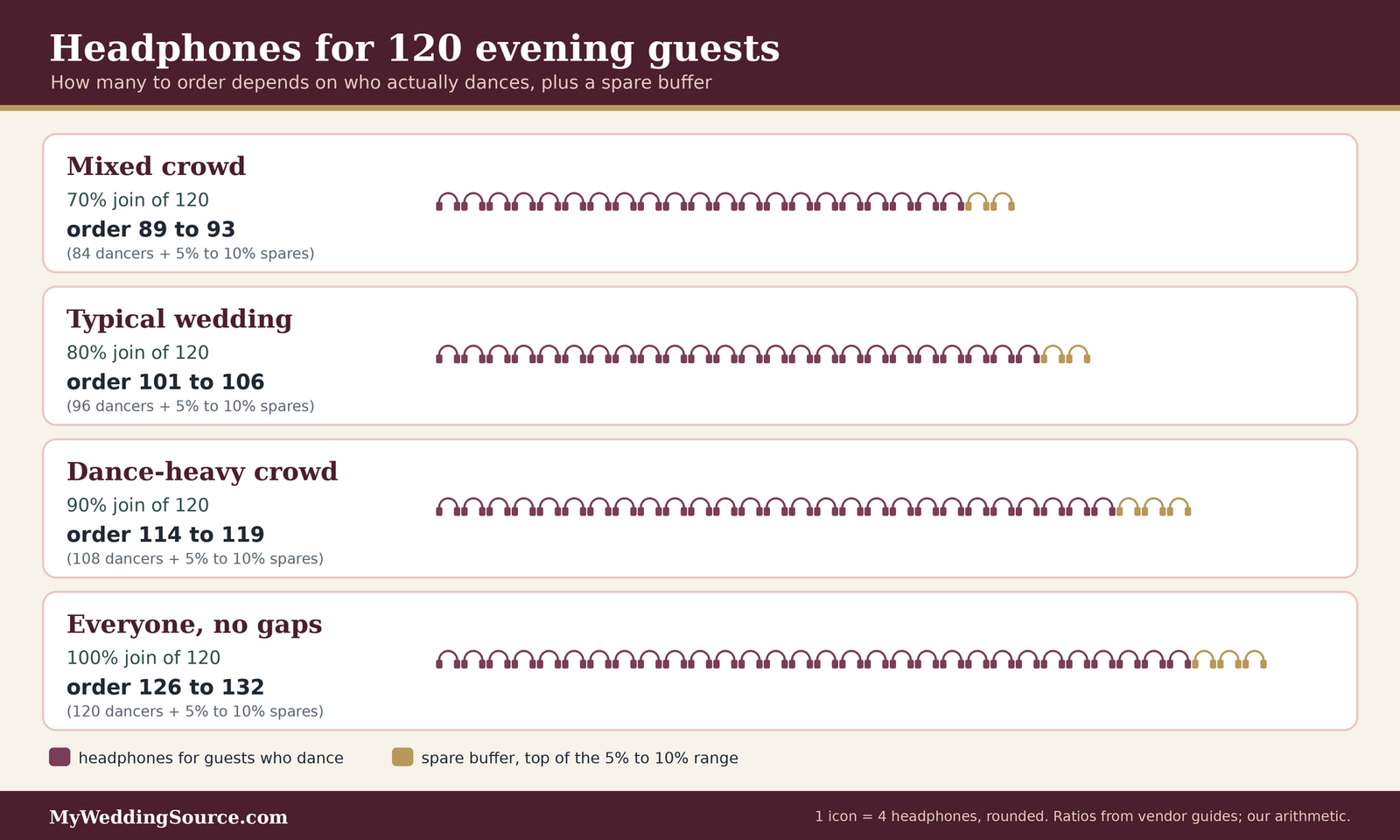
| Crowd type | Share who wear headphones | Dancers out of 120 | Order with 5% to 10% spares |
|---|---|---|---|
| Mixed crowd, many sitting | 70% | 84 | 89 to 93 |
| Typical wedding | 80% | 96 | 101 to 106 |
| Dance-heavy crowd | 90% | 108 | 114 to 119 |
| Everyone, no gaps | 100% | 120 | 126 to 132 |
Compare vendor rules of thumb
Vendors do not all say the same thing, and the differences are informative. It is better to know where the advice disagrees than to pick one rule and treat it as law.
The “one per guest” approach
Silence Activations plans one headset per expected guest or active participant, then adds a 5% to 10% buffer. Its example is 100 guests needing about 105 to 110 headsets. This approach is the safest against running short, and it costs the most, so it suits a wedding where a wedding silent disco floor is the main entertainment.
The “share of guests” approach
Hedfone Party gives ratios by event type, with weddings at 70% to 90% of evening guests and private parties at 90% to 100%. Its example is 140 evening guests needing about 100 to 120 headphones. This approach is leaner, and it works when a wedding silent disco floor is one feature among several.
What the guest-count ranges tell you
Silence Activations lists typical wedding sizes of 50 to 150 guests, with larger weddings running 200 to 300 or more. Those ranges are a reminder that a 120-guest wedding is in the normal band for these systems, and that a very large guest list may need more than one transmitter, as we describe below.
Edge cases that change the count
The worksheet assumes a single evening segment and a single crowd. Real weddings bend that, and a few situations are worth planning for in advance.
Staggered sessions
If you run the wedding silent disco in two blocks, with different groups at different times, the same headphones can serve both. Hedfone Party notes that staggered sessions or multiple zones let the same stock cover more people. That requires a clean handoff, with collection and redistribution, so assign someone to that task.
Children and teenagers
Children can be eager participants, but headphones sized for adults may not fit them well, and the volume of a headphone matters more for young ears. The World Health Organization and the International Telecommunication Union set a lower reference level for children in their safe listening standard for personal audio devices, which we cover in the hearing section. Ask your vendor what they offer for younger guests.
Vendors and staff
Photographers, videographers, and venue staff may want to listen, and some will need to monitor the audio for their work. Silence Activations suggests the buffer can cover staff who want to monitor audio. If you want vendors to wear headphones, count them separately so they do not eat into your guest supply.
Planning music channels for a wedding silent disco
Channels are where a wedding silent disco becomes more than a quiet version of the same dance floor. They are also where couples most often over-plan. The right channel count depends on your audio sources and your guests, not on how many switches the headphone has.
How many channels you can use
The number of channels is limited by the equipment, and the numbers differ by vendor and model. It is a common mistake to assume that more is always available.
What vendors say about the limits
Silence Activations says most professional silent disco systems support up to three channels at once, and that one to three usually gives the right balance of simplicity and variety. Quiet Events recommends three channels for weddings and single-DJ events, and describes premium equipment with more channels, up to 45 for multilingual events. Its own pages are inconsistent about how many channels the premium models carry, so confirm the actual model and channel count in writing.
One transmitter per channel
Silence Activations says each channel connects to its own transmitter. Quiet Events says two transmitters on the same channel in the same location cause static. In practice this means a three-channel wedding needs three transmitters, plus any spares or zone transmitters, and the quote should say so.
Why more is not always better
Each added channel adds a source to feed, a label to print, and a choice for the guest to make. A guest who has to choose among many options may spend more time switching than dancing. For most weddings, two or three channels cover every reasonable need.
Choosing one, two, or three
Rather than starting from a number, start from the question of what each channel is for. Here is how the three common choices compare, drawing on the vendor descriptions above.
One channel
One channel suits a wedding with a single DJ or a single playlist. Silence Activations lists weddings with one DJ among the uses for a single-channel setup. The advantage is simplicity: everyone hears the same thing, and the singalong effect survives. The trade-off is that you lose the main reason many couples choose a wedding silent disco, which is the ability to split tastes.
Two channels
Two channels let guests choose between two programs, such as current hits and throwbacks. Silence Activations describes this as useful for mixed age groups. It is the easiest way to give variety without asking the DJ to manage a third feed, and it keeps the choice simple for guests.
Three channels
Three channels suit larger weddings, multiple DJs, or a mix of music and announcements. Silence Activations lists music mixed with announcements or translation feeds among the uses. A third channel carrying a microphone feed lets a host make announcements without taking off the headphones. The channel plan in the next figure shows one example.

Build a channel menu
A channel plan should be printed and easy to read. Quiet Events recommends labeling each channel with its source, for example “Channel 1: DJ Main,” and printing a channel guide for attendees. Here is a sample menu for a typical mixed crowd.
A sample three-channel menu
| Channel | Color | What plays | Who it serves |
|---|---|---|---|
| 1 | Red | Current dance music from the DJ | Most of the dance floor |
| 2 | Blue | Throwbacks and singalongs | Older guests and groups who want familiar songs |
| 3 | Green | Announcements and a calmer playlist | Hosts, toasts, and guests who want lower energy |
Keep the labels consistent
The label on the sign, the number on the headphone, and the color on the LED should all agree. If the headphone shows a channel number but not a color, make the sign show the number. Ask the vendor for a headphone sample so you can design the guide around what guests will see.
Plan a shared moment
Choose one or two songs when every channel plays the same track, such as the first dance or a last song. That gives the room a shared moment. Coordinate with your DJ so the switch happens cleanly, and see our guide to first dance lighting if you want the visuals to match.
Sources, levels, and who runs the feed
Channels are only as good as the audio feeding them. A few practical points keep the feeds clean and consistent.
A DJ is optional, but someone must run it
Quiet Events says a DJ is optional, since a phone, laptop, or streaming service can feed the system, and that its free curated music library can save prep time. The convenience is real, but someone still has to start playlists, watch the levels, and fix problems. Assign that role to a person, not to a hope.
Match levels across channels
Quiet Events advises setting the source volume so a headphone at about 50% sounds full, and matching levels across channels. A channel that is much quieter than another sends guests to the louder one, and a channel that is too hot is a hearing concern. Ask your vendor to test all channels on one headphone before guests arrive.
Mind the licensing question
Playing music in public can carry licensing considerations that depend on the venue and the way you play it. We have not verified how this applies to wedding silent disco formats, so ask your venue and your DJ what licensing they already hold. This guide does not give legal advice, and we recommend you ask before assuming a streaming account covers a public event.
The sightline test: checking that every headphone hears the same thing
In a silent setup the signal travels from the transmitter to each headphone, and anything in between can weaken it. A sightline test is a short, repeatable walk you can do with your vendor before the day to find those weak spots while there is still time to fix them.
Why placement matters
Quiet Events advises mounting the transmitter high and central, away from DJ booths, metal racks, and screens that block the line of sight. It also lists a range of up to 1,500 feet in line-of-sight conditions and says to use one transmitter per zone, with frequency coordination, for venues larger than that. These are vendor claims for specific equipment, and a full room is not open air.
Height and position
A transmitter that sits above head height and near the middle of the dance area has a clearer path to more headphones than one tucked behind a speaker stack or a DJ table. If the vendor proposes a spot, ask why and ask for a different one if the room has pillars, walls, or equipment in the way.
Metal, screens, and people
Metal racks, large screens, kitchens, and walls can all interfere with a line of sight. People also matter, since a packed floor is a lot of bodies between the transmitter and the headphone. The sightline test is the only way to know how your room behaves. Our guide to wedding projection screens covers a related question, because a screen can block a path as well as a view.
Indoor and outdoor differences
An open tent and a ballroom behave differently. Outdoors, distance and weather matter more. Indoors, walls and equipment matter more. Ask your vendor what they have run in rooms like yours, and ask to see photos of those setups.
The walk-through, step by step
Do the test with the vendor, ideally in the room with the real layout. If you cannot visit the room, ask for a video call and a floor plan, then repeat the test when the vendor arrives on the day.

Mark the zones
On a floor plan, mark the dance floor, the bar, the patio, the restrooms, and any place guests are likely to wear headphones. Mark the DJ position, the power sources, and any metal or screens. This gives you a list of places to test and a way to explain the layout to the vendor.
Walk with a test headphone
Stand where the transmitter would go and confirm that it is above heads and near the middle. Then walk the zones with one headphone on and a test track playing. Listen for dropouts, static, and changes in volume near metal, walls, kitchens, and entrances. Note each problem on your plan.
Fix and repeat
If a zone has dropouts, move the transmitter, raise it, or ask whether a second transmitter in a separate zone would help. Quiet Events recommends one transmitter per zone for larger venues. Walk the route again. Then repeat the test once the room is set up and again when it is full, since furniture and people change what the signal meets.
A one-page test sheet
A written record keeps the vendor, the venue, and your planner aligned. It also protects you if the system performs differently on the day than it did in the test.
What to record
Record the transmitter position and height, the zones you tested, any trouble spots, and the fixes you agreed. Add the time of day, the room setup, and the people who were present. A single page is enough.
Who should sign off
Have the vendor and your planner or venue contact confirm the sheet. If the vendor changes the setup, ask them to update the page. This is a courtesy to everyone, and it makes day-of problems easier to diagnose.
What to do if you cannot test in person
If you are planning from a distance, ask for a floor plan, photos of past setups in similar rooms, and a commitment to test on arrival. Then schedule time on the day for the walk-through, before guests arrive, so there is room to adjust.
Hearing, comfort, and access
A wedding silent disco changes how loud the music is for each guest, which can help and can also hurt. Good planning treats the guest’s ears as something to protect. This section summarizes public health guidance and vendor claims, and it is not medical advice.
Volume and hearing safety
Public health agencies describe how sound level and time combine to cause hearing damage. These are general references for the topic, not a rule for any particular headphone.
What the health agencies say
The National Institute on Deafness and Other Communication Disorders (NIDCD) says long or repeated exposure to sounds at or above 85 dBA can cause hearing loss, and lists headphones at maximum volume, concerts, and sporting events among sources in the range of 94 to 110 dBA. The CDC’s NIOSH sets a recommended workplace limit of 85 dBA over eight hours and says each 3 dBA increase halves the allowed time. Those workplace limits do not translate directly to a party, but they show why louder and longer matters.
The WHO and ITU reference
The WHO and ITU published a standard for safe listening in personal audio devices. It sets a reference of 80 dB for 40 hours a week for adults, and 75 dB for children. A wedding silent disco lasts a few hours, not a work week, but the idea of limiting level and time applies. Ask your vendor whether the headphones have any volume limiting and how they set the source level.
What you can do on the day
Quiet Events suggests setting the source so that a headphone at about 50% sounds full, which leaves room for guests to turn down. Tell guests that they control the volume and that lower is fine. Our own advice is practical: put a short note on the channel guide that invites guests to start low and adjust. Ask a hearing professional if you have specific concerns.
Guests with hearing differences
Some guests wear hearing aids or use cochlear implants, and some have sensory sensitivities. The research available to us is mostly vendor material, so treat these as questions to ask rather than promises.
Hearing aids and implants
Quiet Events says its ADA-oriented headphone model has an audio-out port for devices such as cochlear implants, and it says the product works for guests with or without hearing aids. It also states that the product is not a medical hearing aid. Ask any vendor directly what they offer, and ask guests who use hearing devices what they need rather than assuming. Our guide to the accessible wedding guest experience covers the wider planning.
Sensory-sensitive guests
HUSH describes adjustable volume, calm separation from a crowded room, and the option to engage at one’s own pace as benefits for guests with sensory sensitivities, while noting this comes from a company that rents the equipment. Whether it works for a particular person depends on the person. A quiet zone away from the dance floor can help, and our guide to low-stimulation dining areas has ideas that apply here.
Guests who prefer not to wear them
Some guests will not wear headphones, and that should be fine. Plan a seating area where conversation is possible. If you want those guests to hear the toasts, consider whether a channel for announcements, or a short speaker moment, is appropriate.
Comfort and fit
A guest who is uncomfortable will take the headphones off. A few small points make a difference.
Ear pads and long wear
HUSH describes custom ear pads with passive noise canceling and says they are comfortable for long use. Those are the vendor’s words. Ask for a sample, and try them with glasses, earrings, and hairstyles. A headphone that presses on a veil comb or a hair piece may not last the night.
Dress and hair
Formal hair, veils, and headpieces can conflict with a headband. Some guests will wear the headphones around their neck or hold them to one ear. That is a normal use, and it is part of the culture of the format. Consider whether your photographer needs to know that headphones will be in many shots.
Fatigue and breaks
A guest who dances for hours in headphones may want a break. Build in moments when everyone takes them off, such as a toast, a cake cutting, or an exit send-off, and make sure the channel plan allows it.
Noise rules, venue policies, and weather
A silent floor changes the sound, but it does not remove every rule. This section explains what to check, with the caveat that rules are local and that we are not giving legal advice.
Noise ordinances and venue policy
Your venue and your city may each have a say. A wedding silent disco format may reduce what neighbors hear, but it does not guarantee compliance.
Ask the venue first
Many venues have their own sound policies, curfews, and vendor rules. Ask whether the policy covers a wedding silent disco format and whether the venue needs to approve the vendor. Our guide to the wedding audio and lighting checklist covers the broader list of items to confirm, and our guide on reception noise limits goes deeper on sound rules.
Check local rules
HUSH says a party can run later without disturbing neighbors or breaking noise ordinances. That is a marketing claim, not an authorization. Local rules vary and may cover more than amplified music, such as crowd noise and vehicle traffic. Ask your city or county for the rules that apply to your date and place.
Get approvals in writing
If the venue or an authority tells you the wedding silent disco format is acceptable, ask for the answer in writing and keep it with your contract. Verbal reassurances are easy to forget and hard to prove.
Power, charging, and equipment
Headphones and transmitters need power, and a poorly planned setup can leave the floor silent at the wrong moment.
Battery life
HUSH lists about 8 to 10 hours of use and about 2 hours to recharge. Quiet Events lists 10 to 12 hours for one headphone model and a 12-hour internal battery in its transmitters. Compare the numbers with your event length, including setup and sound check, and ask what happens if the party runs long.
Charging and storage
Ask who charges the headphones, where they are stored, and how they are kept organized. Charging trees or hubs need outlets and space. If the venue is outdoors, our guide to the outdoor wedding infrastructure checklist and generator rental can help you think through power.
Backup equipment
Ask what the vendor brings if something fails: spare headphones, spare transmitters, spare cables. Our guide to a wedding AV backup plan goes into detail. A vendor who has a clear answer is more reassuring than one who says it never happens.
Weather and outdoor events
Outdoor receptions add weather to the list. The National Weather Service’s safety pages are a good place to start for storm guidance.
Lightning and storms
The National Weather Service says that when thunder roars, go indoors, and that there is no safe place outside when thunderstorms are nearby. A wedding silent disco on a lawn or in an open tent does not change that. Have a clear plan for moving guests and collecting equipment, and keep the plan with your vendor.
Rain and moisture
We have not verified how any specific headphone handles rain or humidity. Ask the vendor what their equipment is rated for and what they do in wet weather. Our guide to summer wedding heat plans covers the other side of outdoor risk.
Heat and handling
Equipment left in sun can heat up, and guests wearing headphones in warm weather may tire faster. Ask the vendor about storage and shade for the equipment, and plan shaded or cooled spaces for guests who need a break.
What a wedding silent disco can cost
Prices change, and they depend on the number of headphones, the length of the rental, and the services you add. The figures below come from one vendor’s published guide and are a snapshot, not a quote. We checked them on November 12, 2026, and they may have changed since.
What one vendor publishes
Quiet Events lists standard headphones at $7.00 for the first day, $3.50 for a second day, and $2.75 per day after that, with transmitters at $40 each billed separately. Its published one-day packages include $430 for 50 guests and $820 for 100 guests, with free shipping both ways and no security deposit. It says an on-site technician is quoted separately, typically $400 to $900 for 100 guests, and that replacement fees for lost or damaged units run $50 to $80. Other vendors price differently, and HUSH and Silence Activations direct you to a custom quote instead of listing prices.
Reading a quote
Quotes for a wedding silent disco can look simple and still hide the pieces that change the total. A line-by-line read is worth the time.
The pieces to look for
Look for the headphone count, the number of transmitters, the rental length, shipping, an on-site technician, setup and teardown, and damage or loss fees. Quiet Events bills transmitters separately and charges extra for options such as color matching. Ask each vendor to list every item so quotes can be compared fairly.
A sample estimate
Using the vendor’s published rates, a 120-person evening with about 106 headphones for one day would be roughly $742 for the headphones, since 106 times $7 is $742, plus about $120 for three transmitters at $40 each, for an estimate near $860 before any technician or optional extras. That is our arithmetic from one vendor’s published rates, and a real quote may differ.
What drives the total
The headphone count is the largest driver, so the worksheet earlier in this guide has a direct effect on the budget. Each extra spare costs roughly the first-day rate. A smaller order with a good buffer is often cheaper than a large one that no one needs.
Fees and contract terms
The price is only part of the picture. The terms decide what happens if things go wrong.
Loss and damage
Quiet Events lists replacement fees of $50 to $80 per lost or damaged unit. At a party with many guests, a few missing units are plausible. Ask who is responsible, how losses are counted, and whether the fee applies to the couple or the venue. Our wedding rental planning checklist is a useful companion for any rental with return and damage terms.
Overtime and extended hours
If the party runs long, you may owe more. Our guide to vendor overtime rates explains the pattern, and it is worth asking how a silent disco vendor charges for extra time.
Cancellation and changes
Ask when the headphone count can change, what a late change costs, and what happens if you cancel. For the wider picture, see our guide to wedding insurance, which covers some of the risks that a contract does not.
Fitting it into the budget
A wedding silent disco competes with other entertainment for the same money. Deciding where it sits in the plan helps you avoid paying for the same job twice.
Replace or add
If the wedding silent disco replaces a speaker-based dance floor, you may still need a DJ or an audio source. If it adds to one, it is an extra. Our wedding budget guide helps you place it among your other categories.
Ask about bundling
Some vendors offer packages that include the headphones, transmitters, and a technician. Others sell only the equipment. Ask what is included and compare packages by total, not by headphone rate.
Disclose relationships
This article contains no affiliate links, and we have no commercial relationship with any vendor named here. Vendor figures are attributed to the vendor and are not endorsements.
Running the night: distribution, collection, and timing
The equipment works only if the handoff does. A small team and a simple process keep it smooth.
Handing out headphones
Distribution is the first moment guests meet the system. A clear process prevents lines and confusion.
Choose a place and a person
Pick a table near the dance floor and assign someone to staff it. Quiet Events suggests collecting headphones at the same table where they were handed out and reconciling against a sign-out list. A friend, a planner, or a vendor technician can do it, but it should be a named person.
Explain the channels
Give each guest a short explanation: how to turn the headphones on, how to change channels, and how to adjust volume. A printed channel guide, as Quiet Events recommends, saves repetition. A one-line reminder to start with a low volume is a kind touch.
Track who has what
Quiet Events suggests checking IDs, using barcode scanners with sign-out sheets, or using its loss-reduction system. You may find a simple sign-out list enough for a friendly wedding. Talk to your vendor about what suits your crowd and your contract.
Collecting and returning
The end of the night is where units go missing. A little structure goes a long way.
Announce the last call
Tell guests when the wedding silent disco segment ends and where to return headphones. Tie it to a moment, such as the last song, so people do not drift off with them.
Reconcile and pack
Count the returns against the list and note any missing units before the guests leave. Quiet Events says it supplies return labels and scheduled pickup, so ask how return works for the vendor you choose. Our guide to returning wedding rentals after a Sunday reception covers the wider logistics.
Hygiene and cleaning
We did not find vendor guidance on cleaning in the pages we reviewed, so ask how the headphones are cleaned between events and whether the ear pads are replaced or wiped. This is a fair question for any shared item worn on the head.
Where it sits in the timeline
A wedding silent disco has a start time, a sound check, and an end. Writing it into the wedding timeline keeps everyone aligned.
Set up and sound check
Allow time before guests arrive for setup, the sightline test, and a check of every channel. Equipment may need to arrive in advance. Silence Activations says equipment should arrive at least 3 days before the event and that it ships about 10 days ahead, and Quiet Events says it ships 7 to 10 days ahead. Confirm delivery and pickup with the venue.
Run of show
Decide when the wedding silent disco segment begins and what happens at key moments. Our guides to the wedding vendor timeline and the reception show how to fit a new segment into the evening.
Toasts and announcements
Plan how speeches are handled. If your toast is on a channel, guests with headphones hear it, and others hear nothing unless there is a speaker. Our guide to wedding speeches can help you decide whether to pause the wedding silent disco format for those moments.
Edge cases and judgment calls
Some situations fall outside the main worksheet. These are the ones we think are most useful to consider before you sign.
Large guest lists and multiple zones
A big wedding can strain a single transmitter and a single floor.
More than one transmitter
Quiet Events says venues larger than its stated range may need one transmitter per zone with frequency coordination. Even in smaller venues, a second zone can help if the layout includes separate rooms. Ask the vendor how they handle it.
Splitting the floor
If you have a main floor and a patio, you might run the same channels in both, or give each zone its own. The second option adds transmitters and complexity, and the first is easier to explain to guests.
Staff and security
For a large crowd, a technician on site, which Quiet Events quotes separately, may be worth the cost. Ask what they do during the night and whether they remain until the end.
Mixing live and silent music
Some couples want a live band and a silent option. The two can coexist if planned carefully.
Live band on a channel
HUSH gives an example of a live band on one channel, a DJ on another, and a playlist on the third. Our guide to a live wedding band stage plot explains how a band is set up, which helps when feeding a transmitter.
Ceremony use
We found no vendor guidance on using a silent system for a ceremony. If you are curious, our guide to wireless ceremony audio covers the more usual tools for that moment.
The first dance
A first dance is usually a shared moment. Decide whether to run it on speakers, on all channels, or on one. Our guide to first dance songs can help with music choices.
When to choose something else
A wedding silent disco is not always the right answer, and it is fine to say so.
When a quiet lounge is enough
If your aim is simply a calmer room, a lounge with softer music may be enough. Our guide to lounge furniture rentals can help.
When the budget is tight
If the price is too high, a smaller wedding silent disco segment or a second-room option can lower it. You can also skip the format and use another idea from the entertainment guide.
When guests are unlikely to join
If you know your guests will resist headphones, listen to that. A format that sits unused is an expensive way to learn a lesson.
Questions to ask before you sign
These questions cover what a quote often leaves out. Ask for answers in writing and keep them with your contract. Our guide to vendor due diligence covers the general approach.
Questions to ask a silent disco vendor
- How many channels does this exact model support, and how many transmitters are in my quote?
- What is the real range in a room like mine, and will you do a sightline test on arrival?
- How many headphones do you recommend for my evening number, and how late can I change the count?
- How long do the batteries last, and what is the plan if the party runs long?
- Do the headphones limit volume, and how do you set the source level across channels?
- What do you offer for guests with hearing devices, and for children?
- Who is responsible for lost or damaged units, and what are the fees?
- What backup equipment will be on site, and who fixes problems during the night?
- How are the headphones cleaned between events?
- What does the contract say about cancellation, delivery, and pickup?
About the equipment
Equipment questions tell you whether the vendor knows the product.
Model and channel details
Ask for the model name, the channel count, the battery life, and the transmitter range. Get these in writing, since vendor pages can be inconsistent.
Volume and safety features
Ask whether the headphones have a limiter, how the source is set, and how you can keep the level reasonable for guests. Mention that you want lower levels for children.
Backup and support
Ask about spare units, support during the event, and the person who answers the phone. A named contact matters more than a general line.
About the contract and the day
The contract decides who does what. Read it with the day in mind.
Delivery and pickup
Confirm delivery dates, who receives the equipment, and how pickup works. For an outdoor site, confirm where equipment is stored.
Fees and responsibility
Ask about damage, loss, overtime, and cancellation fees. Compare them with other rentals.
Insurance and permits
Ask whether the vendor carries insurance and whether the venue requires proof. We cannot say what your venue requires, so ask the venue as well.
FAQ: wedding silent disco questions
Planning basics
How many headphones do we need for a wedding silent disco?
Start with the guests you expect on the floor in the evening, not the invitation list. One vendor suggests 70% to 90% of evening guests at a wedding, and others plan one per guest. Add a 5% to 10% buffer for swaps and failures. Confirm the final count and change deadline with your vendor.
How many music channels should we use?
Most rental systems support up to three channels, and each channel needs its own transmitter. One channel suits a single DJ, two suit mixed tastes, and three add a third program or an announcements feed. Count the audio sources you really want to play, then choose the smallest number that serves your guests.
Equipment and setup
Do we need a DJ for a wedding silent disco?
Not necessarily. Quiet Events says a DJ is optional and that a phone, laptop, or streaming service can feed the transmitter. Someone still has to run the playlists, watch levels, and fix problems, so assign that role to a named person or hire a technician.
How far does the signal reach?
Quiet Events lists up to 1,500 feet in line-of-sight conditions for its transmitters, but that is a vendor figure for open conditions. A crowded room with metal, screens, and walls behaves differently. Ask for a sightline test in your venue and repeat it once the room is set up.
Guests and comfort
Is a wedding silent disco safe for hearing?
Guests control their own volume, which helps, but loud headphones for long periods can harm hearing. Public health agencies describe 85 dBA and above as a risk over time. Ask your vendor about volume limits, set source levels sensibly, and invite guests to start low. Talk to a hearing professional about personal concerns.
Can guests with hearing aids or implants join?
It depends on the equipment and the person. Quiet Events says one model has an audio-out port for devices such as cochlear implants and states it is not a medical hearing aid. Ask the vendor what they offer, and ask the guest what they need before assuming anything.
Rules and cost
Does a silent disco avoid noise rules?
Not automatically. A silent floor can reduce what neighbors hear, but venue policies and local ordinances vary, and a vendor’s marketing is not a permit. Ask your venue and your city or county what applies, and keep any approval in writing with your contract.
What does a wedding silent disco cost?
It depends on headphone count, rental days, transmitters, and services. One vendor’s published rates, checked November 12, 2026, start at $7 per headphone for a day plus $40 per transmitter, and list a 100-guest package at $820. Other vendors quote individually, so request itemized quotes.
Your next steps
Decide and count
Settle the fit
Use the quick fit check above to decide whether a wedding silent disco suits your guests and your venue. If it does, choose whether it will be the whole floor, a late segment, or a side option, since that choice sets the scale of everything else.
Fill in the worksheet
Write your evening number, pick a participation rate, add the buffer, and compare it with your dance-floor size. Our guide to wedding dance floor size and the wedding planning checklist can help you place it in the wider plan.
Talk to vendors and your venue
Request itemized quotes
Ask two or three vendors for quotes that list headphones, transmitters, technician, shipping, fees, and terms. Use the questions in this guide and compare totals, not rates.
Schedule the sightline test
Book a time to walk the room with the vendor, or agree on a test on arrival, and write the result on a one-page sheet. Then add the segment to your timeline with the wedding audio and lighting checklist beside you.
Sources & methodology
How we built this guide
What we relied on
This guide combines published guidance from silent disco rental companies, public health agencies on noise and hearing, the World Health Organization, and the National Weather Service. Rental companies sell the equipment they describe, so we attribute their figures and claims to them. The headphone worksheet and the sample cost estimate are our own arithmetic from published ratios and rates, and they are estimates. We reviewed these pages on November 12, 2026, and prices, models, and policies may have changed since.
What we did not do
We did not test any headphones, measure signal range, or verify vendors’ claims independently. We did not review local ordinances, licensing rules, or accessibility law, and nothing here is legal, medical, or financial advice. Check your venue’s policies and your local rules, and ask a hearing professional about personal concerns.
Source list
Government, public health, and standards sources
- CDC NIOSH, Noise and Hearing Loss Prevention: Noise-Induced Hearing Loss: https://www.cdc.gov/niosh/noise/about/noise.html
- National Institute on Deafness and Other Communication Disorders, Noise-Induced Hearing Loss: https://www.nidcd.nih.gov/health/noise-induced-hearing-loss
- World Health Organization, Safe listening devices and systems: a WHO-ITU standard: https://who.int/publications/i/item/9789241515276
- National Weather Service, Lightning Safety: https://www.weather.gov/safety/lightning-safety
- National Weather Service, Lightning (overview): https://www.weather.gov/safety/lightning
Silent disco rental companies and vendor guides
- Silence Activations, How many headphones for a silent disco: https://silenceactivations.com/support/getting-started/how-many-headphones-for-silent-disco/
- Silence Activations, How many channels can a silent disco have: https://silenceactivations.com/support/products-equipment/how-many-channels-can-silent-disco-have/
- HUSH, Silent disco rentals for weddings and parties: https://hushconcerts.com/silent-disco-rentals/weddings-and-parties/
- HUSH, Silent discos: safe, inclusive dance spaces for all: https://hushconcerts.com/hush-vibes/silent-disco/silent-discos-a-safe-and-inclusive-space-for-all/
- Quiet Events, Silent disco rental pricing guide: https://www.quietevents.com/blogs/quiet-events-blog/silent-disco-rental-pricing-guide-2026
- Quiet Events, Guide to putting on a silent disco dance party: https://www.quietevents.com/blogs/quiet-events-blog/the-ultimate-guide-to-putting-on-a-silent-disco-dance-party-2026
- Quiet Events, Assistive listening devices: https://www.quietevents.com/collections/assistive-listening-device
- Hedfone Party, How many headphones for silent disco: https://hedfoneparty.com/?p=896