
A wedding photography rain backup is a written plan for where portraits happen, when the decision gets made, and who pays for what if the sky turns on you, and it is far easier to build in a calm week than in a hotel hallway an hour before the ceremony.
Quick answer
A workable wedding photography rain backup has four pieces: a named indoor or covered portrait space you have actually seen, a decision time (a clock time, not a mood), a second timeline that shows where portraits move if it rains, and contract language that says who can move the shoot and what extra time costs. Start your wedding photography rain backup with the venue’s own rain plan, ask your photographer to walk the backup space with you, and write the decision time into the day-of schedule. Check the forecast in stages instead of obsessing over it, and treat lightning as a separate, non-negotiable safety call.
Rain is not rare enough to ignore, and it is not frightening enough to dread, which is the right mood for a wedding photography rain backup. What goes wrong on a wet wedding day is almost never the water itself. It is the scramble: a photographer who has never seen the lobby, a family of fourteen trying to fit in a stairwell, a venue that says the ballroom is being reset, a contract that never mentioned what happens to the portrait hour. Each of those is a planning gap, and planning gaps can be closed in advance.
This guide is built around that idea. We walk through how to read a forecast, how to choose and score indoor portrait spaces, how to rebuild the timeline, what to put in writing with your photographer and venue, and how to handle the awkward cases like lightning and tented venues. It includes three original illustrations, a scorecard you can copy, and four worked change-order examples that show what a clear written adjustment looks like. Nothing here is legal advice, and we have not verified any specific price, so check every number against your own contracts.
What a wedding photography rain backup actually covers
Couples often picture a rain backup as a single place, the room you go to when it pours. In practice a good wedding photography rain backup is a small bundle of decisions that work together. If any piece is missing, the others carry less weight. A beautiful ballroom does you no good if no one has the key at 4:15, and a perfect timeline is useless if the room it points to is booked.
The three parts of a backup plan
Think of the plan as location, timing, and paperwork. Each answers a different question, and each belongs to a different person on your team.
Location answers where
The location is the specific space where portraits happen if the outdoors is off the table. It should be named, not implied. “Somewhere inside” is not a location. “The second-floor library with the east windows” is. A strong wedding photography rain backup usually has a primary indoor option and a covered, semi-outdoor option, such as a porch or portico, because some rain is light enough to use.
Timing answers when
Timing is the clock. It includes the point at which you decide to switch, the time portraits start, and how long each group gets. Photographers and planners interviewed in the sources for this guide agree on one theme: decide early and build slack in. A decision made at the last minute leaves no room for the room itself to be prepared.
Paperwork answers who and how much
Paperwork covers who can authorize the move, whether the venue charges for the backup space, whether the photographer’s coverage hours change, and how any of that is recorded. This is the part couples skip, and it is where most disagreements begin. Our guide to wedding vendor contracts covers the broader reading checklist, and this article focuses on what a rain-day change looks like in writing.
What rain actually changes for photos
It helps to be specific about what changes, because it keeps your wedding photography rain backup proportionate. Rain changes the light, the logistics, and the people.
The light changes, not always for the worse
Several photographers describe overcast and rainy skies as flattering. Susan Stripling, a wedding photographer, notes that overcast skies soften light and that rain darkens stone and deepens color, while wet pavement can reflect. Another photographer points to rain-streaked windows and candlelit rooms as good settings for intimate moments. These are professional opinions and they depend on the space, but they are a useful reminder that a wedding photography rain backup is not a downgrade by default.
The logistics change, and logistics are the real risk
Moving a group of people through wet weather, over slick surfaces, and into a space with different dimensions takes more time than the same move on a dry afternoon. Umbrellas, shoes, dress hems, and doors all become tasks. A wedding photography rain backup that ignores walking time between the ceremony site and the portrait space will quietly eat the schedule.
The people change their mood
Guests who were looking forward to an outdoor ceremony may be disappointed, and family members may have strong opinions about whether to move. Tori Kelner, a wedding photographer, suggests telling family and the wedding party in advance that you will make the final call and hope they will support it. That small conversation, held in advance, spares you a debate on the day.
Reading the forecast without losing a week to it
You cannot control the weather, but you can control how much attention it gets. A plain schedule for checking the forecast keeps a wedding photography rain backup from becoming a source of daily anxiety. The goal is to match your actions to how reliable the forecast is at each stage.
What a rain percentage really says
Most weather apps show a chance of rain as a percentage. People tend to read it as “it will rain for that percent of the day,” which is not what it means. The National Weather Service defines probability of precipitation as a combination of two things, confidence and coverage, according to a University of Wisconsin explainer on the definition.
Confidence times coverage
In the NWS approach, as explained by the University of Wisconsin-Madison’s Space Science and Engineering Center, the probability of precipitation reflects how confident the forecaster is that rain will fall and how much of the forecast area is expected to get it. A thirty percent figure could mean rain is certain over thirty percent of the area, or that rain is possible everywhere but the forecaster is only thirty percent sure. The measure is based on at least one hundredth of an inch of rain, which is a very small amount.
What that means for portraits
A low percentage does not tell you how hard it will rain, how long, or at what hour. It does not tell you whether the shower will land on your portrait window. So a low chance is not permission to skip the wedding photography rain backup, and a moderate chance is not a reason to cancel the outdoor portraits. The practical reading is that any non-trivial chance means your wedding photography rain backup should be ready to use, and the hourly outlook matters more than the daily number.
The forecast ladder: what to do at each stage
Forecasts improve as the day gets closer, so the timing of your wedding photography rain backup should follow suit. NOAA’s education pages say a five-day forecast is correct about ninety percent of the time and a seven-day forecast about eighty percent. Those are general figures for forecasts overall, not a guarantee for any specific location or for rain in particular, but they support a simple ladder: do the preparation when the forecast is vague, and make the decision when it is firm.
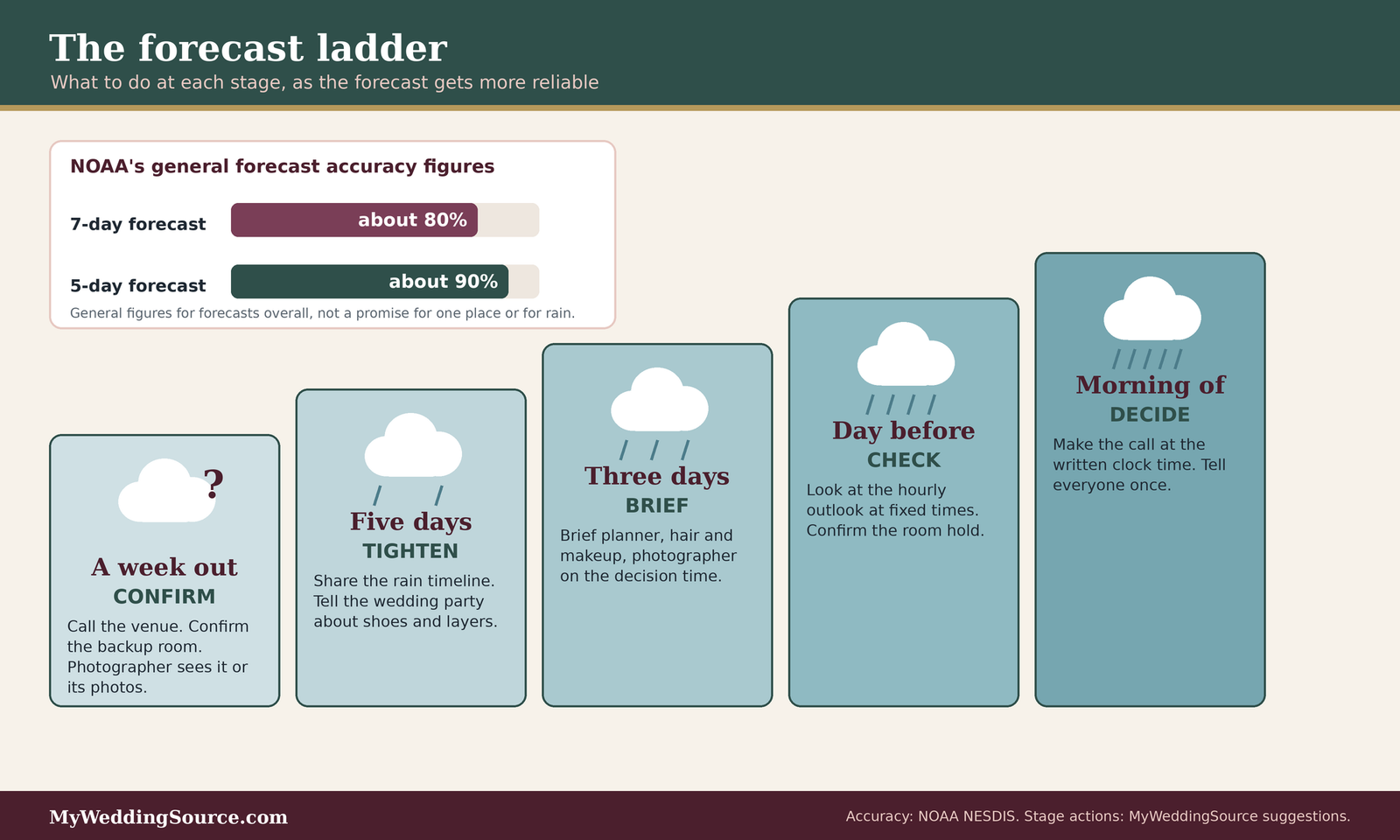
The illustration above lays the ladder out in stages. The two accuracy bars come from NOAA’s figures. The actions attached to each stage are our own suggestions, not a standard.
A week out: confirm, do not decide
At seven days, the forecast is right about eight times in ten by NOAA’s general figure, which is good enough to tell you to confirm your backup, not good enough to abandon the outdoor plan. Use this stage to call the venue, confirm the backup space is available, and make sure your photographer has seen it or has photos of it.
Five to three days out: tighten the plan
By five days the figure rises to about nine in ten. This is when to share the wedding photography rain backup timeline with your planner, your hair and makeup team, and your photographer, and to tell the wedding party what shoes and layers to bring. Our wedding hair and makeup schedule article explains how to build buffers into getting-ready time, which matters if the portrait start moves earlier.
The day before and the morning of: make the call on schedule
In the last day you are choosing between plans you have already built, not inventing them. Check an hourly forecast at a few fixed times, such as the evening before and early morning, rather than constantly. Decide at the time written in your plan, and tell everyone once.
Lightning is a different decision
Rain is a comfort and scheduling matter for your wedding photography rain backup. Lightning is a safety matter, and the two should not share a decision process. The National Weather Service’s lightning safety guidance is direct: when thunder is audible, go indoors, and stay indoors until thirty minutes have passed since the last flash or thunderclap.
What counts as safe shelter
According to the National Weather Service, large, solid buildings and hard-topped vehicles are safe shelters, while small sheds, rain shelters, and open-sided vehicles are not. For a wedding, that means a pop-up canopy, a gazebo, or an open-sided tent should not be treated as lightning shelter, even if it keeps the rain off. When you scout a backup, ask yourself whether it is a real building.
The thirty-minute rule changes the arithmetic
If the last thunder is heard at 3:10 p.m., the earliest anyone should return outdoors under the National Weather Service guidance is 3:40 p.m., and any new thunder resets the count. That is our own example, but the rule is the agency’s. A wedding photography rain backup with an indoor space available loses very little to a thirty-minute pause, while a plan with no indoor option loses the whole window.
Choosing indoor portrait spaces that actually work
The word “indoor” covers a lot of ground in any wedding photography rain backup, from a grand ballroom to a service corridor. The trick is to look at spaces the way a photographer and a group wrangler would, and to score them against the same few questions every time.
Where to look first
Start close to where you already are. The best wedding photography rain backup locations tend to be the ones a family can reach in a minute or two without outdoor travel.
Inside the venue itself
Ask the venue which rooms are free between the ceremony and dinner. Susan Stripling lists doorways, foyers, overhangs, hallways with window light, and hotel lobbies as places that have worked for portraits. Tori Kelner adds well-lit, covered spaces such as greenhouses, museums, and universities with covered walkways, though those are off-site and bring their own logistics. Maroo, a photography business, recommends looking for window light and architectural details inside the venue so the session keeps its style.
Covered but still outdoors
A porch, portico, arcade, or breezeway lets you keep some of the outdoor look. These spaces work in light rain and wind-free conditions. They do not work in thunderstorms, and they may be crowded by guests who also want shelter, so check how the space will be used during cocktail hour.
Nearby sites that are not part of the venue
A museum lobby, a greenhouse, a historic building, or a hotel next door can be a backup, but they are separate bookings with their own rules. A Canadian photography blog writing about backup locations notes that popular indoor spaces can book up far ahead in peak season and often charge non-refundable fees, which it compares to insurance. That is one source’s local experience, so check your own market, but the principle of asking early holds anywhere.
A scorecard for any candidate space
A scorecard keeps the choice honest when you build a wedding photography rain backup. When you are standing in a beautiful room, it is easy to forget that it has one outlet, two steps, and no door you can prop. We suggest scoring each candidate from one to five on six questions and adding a few notes.
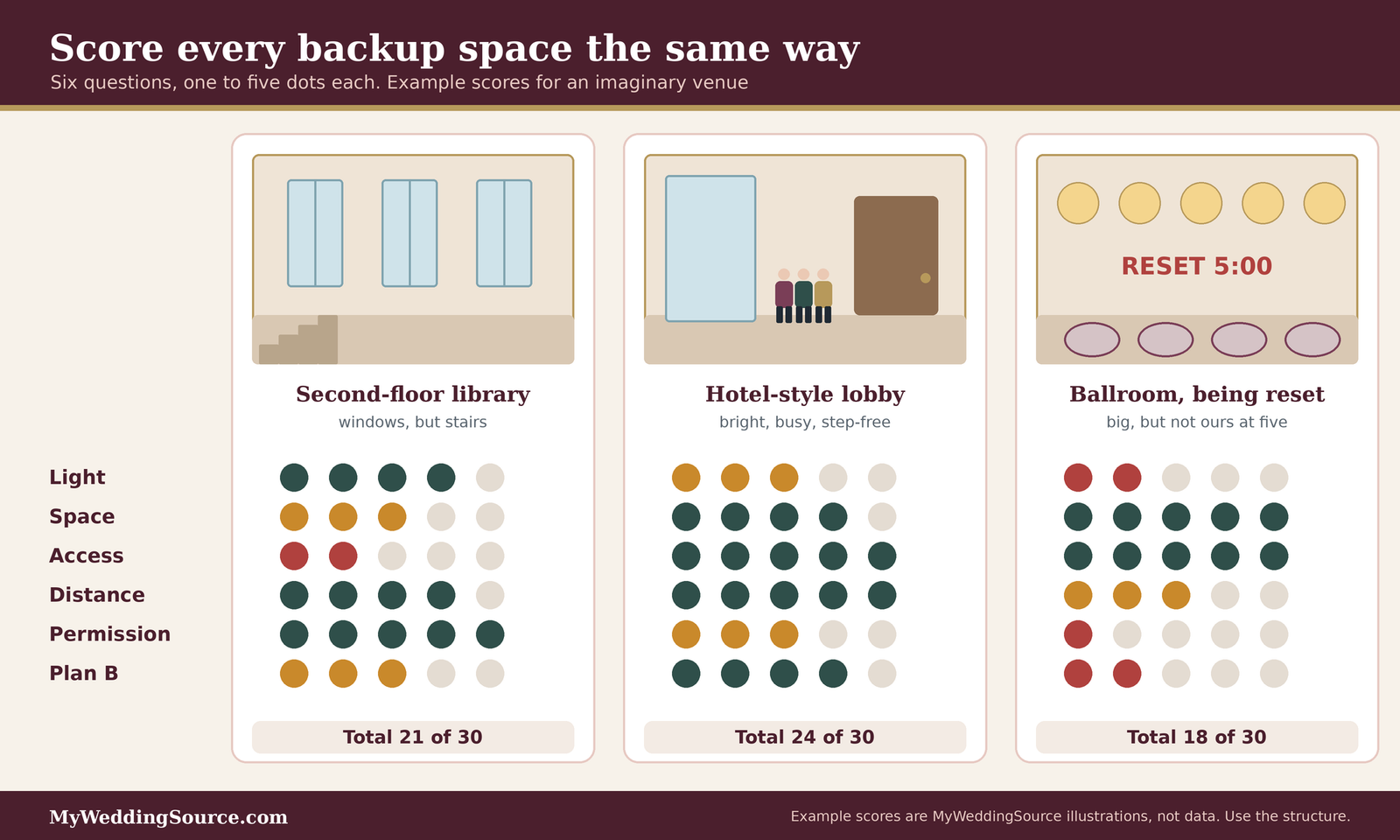
The illustration shows the six questions applied to a made-up venue with three candidate spaces. The scores are our own example, not data. Use the structure, not the numbers.
Light: windows, color, and clutter
Ask your photographer to look at the space at the hour you would use it. Window light can be soft and flattering, but a dark room with no window light may need added lighting gear, which takes setup time. The Canadian blog above warns that poor lighting or cluttered backgrounds can make a space unsuitable. Score the room on how much natural light it gets and how busy the background is.
Space: room for the biggest group
Walk the space with the largest group on your list in mind. Some rooms look generous until you try to stand twelve people in two rows with enough distance for the photographer to step back. Count steps, measure with your eyes, and ask the photographer how much depth they need. If the room only suits a couple and a bridal party, score it that way and plan family groups elsewhere.
Access: stairs, ramps, and doors
A space is only a backup if everyone can get to it. Check for stairs, elevators, door widths, and thresholds. We return to this below in the accessibility section, because it deserves more than a line.
Distance and timing
Measure the walk from the ceremony site to the backup space in minutes, not in feet, and then add time for umbrellas and slow walkers. A beautiful space across a parking lot may cost more time than it earns.
Permission and cost
Confirm that the room is yours, for a stated time window, with the venue’s agreement in writing. Ask whether there is a fee, whether other events may use the space, and whether staff can open doors and turn on lights.
Backup to the backup
The last question is what happens if this space is taken. Having a second indoor choice, even a plain one, is what makes a wedding photography rain backup resilient.
Accessibility and big family groups
Groups are where a wedding photography rain backup fails first. A family portrait list with grandparents, young cousins, and a guest using a wheelchair needs a space everyone can reach and stand in.
Ramps and slopes, in numbers
The U.S. Access Board’s guide to ramps and curb ramps lists a maximum running slope of one to twelve for ramp runs, a minimum clear width of thirty-six inches between handrails, a maximum rise of thirty inches per run, and level landings at the top and bottom of each run. Our own arithmetic from the one-to-twelve slope is that a thirty-inch rise needs about thirty feet of ramp run, which is a good reminder that a few stairs outside a lobby can mean a long detour. These are the federal design standards for accessibility, and a venue’s actual access may differ, so ask them directly rather than assuming. Our guide to wedding transportation for guests using wheelchairs and the accessible wedding guest experience article go deeper on the day-of details.
Group size and the room’s real capacity
Compare the family list on your shot list against the space. If the largest group has twelve people, imagine two staggered rows, then add room behind the photographer. If the room cannot hold it comfortably, plan to shoot that group in a different space or to split it. Our wedding venue capacity guide explains why a room’s stated capacity and its comfortable photo capacity are different numbers.
Slippery surfaces and tired feet
Wet shoes on polished stone and marble are a common hazard. Ask the venue about mats, and ask guests who will join portraits to bring flat shoes for the walk. This is common-sense safety advice, not a rule from a source, so apply judgment for your own group.
Getting permission, holds, and fees for the backup space
A room you like but have not reserved is a wish, not a wedding photography rain backup. This section is about turning wishes into holds. It applies to the venue’s own rooms and to any separate location your wedding photography rain backup might use.
Asking the venue the right questions
Venues handle rain more often than couples do, and many have a standard plan. Tori Kelner suggests asking what the rain plan is, whether the ceremony would be tented, moved indoors, or placed on a covered patio, how the space is rearranged for cocktail hour, and the latest time you can decide to move indoors. Add portrait-specific questions to that list.
Which rooms are free, and until when
Ask which spaces will be empty between the ceremony and the reception, and for exactly how long. A ballroom that is being reset for dinner at five is not available at five, even if it looks empty at four-thirty. Ask for the schedule of room turnovers and request that the portrait window be noted next to your name.
Who opens the door and who adjusts the lights
Small practical points decide whether a room is usable. Ask whether a staff member will unlock the space, turn on lights, move furniture, or block the door during portraits. Confirm who that person is and how to reach them. The Legal Paige, a legal-templates company for photographers, notes in a clause checklist that a photographer is typically bound by a venue’s rules and that the client handles negotiations with the venue, so the conversation is yours to have, not your photographer’s.
Rules about lighting gear, flash, and furniture
Some venues restrict equipment, furniture movement, or where photographers may stand, particularly in historic buildings, museums, and houses of worship. Ask in advance and pass the answer to your photographer. Rules like these are venue-specific, and we did not find a general standard, so ask rather than assume.
Off-site and shared locations
Using a space outside your venue requires a different level of care.
Check the booking calendar and the fees
For a church, museum, greenhouse, university building, or hotel lobby, ask if the space is open to a wedding party at your time, whether there is a rental or access fee, and whether the fee is refundable if you do not use it. The Moments in Digital article advises confirming that no other wedding is scheduled after yours if you use a church. If the fee is non-refundable, think of it as an insurance premium and decide whether the peace of mind is worth it for your date and season.
Count travel time honestly
A short drive turns into a long delay once you add loading, parking, umbrellas, and waiting for stragglers. Moments in Digital recommends staying close to the main site, since a distant backup cuts into photo time and some relatives get lost. If an off-site space is part of your wedding photography rain backup, treat travel time as portrait time you will not get back.
Think about transportation and who drives
If portraits move off-site, someone has to move the bridal party. Confirm car or shuttle arrangements in advance, and keep a rain version in your transportation plan. Our wedding transportation article covers the broader logistics.
Holding the space in writing
A wedding photography rain backup lives or dies on its paperwork. A verbal “that should be fine” is not a hold. Ask for an email or an addendum that names the room, the time window, the fee if any, and the contact.
What a simple written hold includes
A short message is enough: the room name, the date, the start and end times, who will open it, whether the fee applies only if you use it, and a place for the venue to confirm. Save it with your other vendor documents, and bring a copy on the day. Our wedding vendor due diligence checklist explains how to keep that paper trail organized.
Share the hold with the people who need it
Your photographer, planner, coordinator, and anyone who runs the timeline should have the same document. A backup that only one person knows about is not a backup.
Rebuilding the timeline for a wet day
The timeline is where a wedding photography rain backup becomes real. Maroo suggests showing two timelines in a proposal, one for good weather and one for rain, so that the expectation is set early. That approach works for couples too. Draft a dry timeline and a wet timeline side by side.
How much portrait time you really have
Time is the scarce resource in a wedding photography rain backup, because every move takes longer. A worked example makes the trade-off visible.
A worked example, labeled as an estimate
Suppose the dry plan has a ninety-minute portrait block after the ceremony. On a wet day, imagine twelve minutes lost to moving people to the backup space, fifteen minutes lost to setting up the room and any lighting, and ten minutes of buffer for stragglers and umbrellas. That leaves about fifty-three minutes of true portrait time. These figures are our own illustration, not measurements, but they show how a “ninety-minute” block can shrink by almost half. The third illustration draws this budget to scale.

Decide what gets cut, not what gets squeezed
Instead of rushing every shot, choose in advance which images matter most. Rank the family groups, the couple’s portraits, and the wedding party shots. Our wedding photographer shot list article explains how to build that list so the priority order is already written down when the weather changes.
Move the unmovable items earlier
If hair, makeup, and dressing are on the critical path, start them earlier on a wet day. Dooley Photography suggests starting hair and makeup earlier so there is room to shift if the schedule slips. Our plan wedding timeline guide and wedding vendor timeline guide explain how to keep every vendor on the same clock.
Using a first look as rain insurance
A first look is a private moment before the ceremony when the couple sees each other and has portraits taken. Several photographers recommend it as a weather hedge.
Why it creates more windows
Tori Kelner notes that rain often comes and goes rather than lasting all day, so a first look creates several chances for outdoor portraits. Without a first look, the main option is portraits after the ceremony during cocktail hour, which may end up indoors if it rains. Dooley Photography similarly suggests scheduling a first look so you can get photos before the rain arrives. Our wedding first look photos guide covers the pros and cons in more detail, including couples who prefer to wait.
When a first look is not the answer
Some couples value seeing each other for the first time at the ceremony, and that preference is valid. In that case, your wedding photography rain backup leans on the indoor space and on shooting wedding party and family portraits earlier, with the couple’s portraits after the ceremony.
Waiting out a shower
Short showers are common, and the decision about whether to wait is separate from the decision about portraits.
The fifteen-minute pause
Tori Kelner says that if rain clears within about fifteen minutes of the ceremony, you can usually push the start back, and suggests asking the officiant whether the ceremony can be shortened to catch up. Treat that as one photographer’s rule of thumb, not a standard, and check it against your venue’s schedule and your guests’ comfort.
Plan a second session as a fallback
If you wanted sunset or garden photos that rain took away, a separate short session later or the next day can recover them. Tori Kelner mentions scheduling a separate session, possibly the next day at the venue. That would need to be agreed with your photographer, and it is likely to involve extra time and cost, so it belongs in the change-order discussion below.
Rain-day gear and small details
Rain brings a short list of objects into a wedding photography rain backup. None is expensive, but all of them are easier to arrange early.
Umbrellas, ponchos, and footwear
Umbrellas are the most visible rain-day item, and the way you choose them affects the photos.
Clear umbrellas and why they help
Tori Kelner says clear or white umbrellas let natural light through and keep faces visible, which is a photography reason to prefer them over dark ones. Dooley Photography says the photographer brings about twenty umbrellas and several ponchos whenever rain is even slightly possible. Before buying anything, ask your photographer, planner, and venue whether they already have clear umbrellas you can use.
Shoes, boots, and dress hems
Tori Kelner suggests rain boots so you can save heels for the ceremony. For long gowns, ask your seamstress and your attendants about hem-lifting plans before the day. Our wedding dress train lengths article explains how different trains behave and why a bustle plan matters, and our wedding emergency kit guide includes items worth packing for wet weather.
Protecting equipment and keeping portraits safe
Photography gear and people both need protecting.
The photographer’s gear
Maroo, a photography business, advises against shooting in rain without adequate protection because water damage can destroy expensive equipment, and says a clear weather clause lets a photographer choose to stay inside without financial exposure or arguments with the couple. That is a photographer’s perspective, but it is also useful for couples: a photographer who is protected by the contract is more likely to be flexible on the day.
Cords, lights, and wet floors
If your backup space needs added lighting, ask who is responsible for cables and power. Taping down cords and placing mats near entrances are simple measures. Ask the venue about their own practice.
Contract language and change-order examples
This is the part of a wedding photography rain backup that most couples skip, and it is the part that prevents the most disputes. We are not lawyers and this is not legal advice. What follows describes what photography contract resources say and shows the kind of plain writing that can help. Have a lawyer review anything binding.
What photography contracts usually say about weather
The Legal Paige’s clause checklist describes several clauses relevant to a rain day. They are worth looking for in your own agreement.
The inclement weather clause
An inclement weather clause tells clients what happens if rain or snow affects a session, including when and how the session will be rescheduled, according to the checklist. It is most often written for sessions rather than weddings, so ask whether your agreement says anything about weather at all, and if not, ask for a sentence.
Coverage hours and overtime
The coverage clause sets the hours the photographer will cover the event and the rate for additional hours. This matters because a rain-day plan may need extra time before or after the ceremony. If your portrait block is longer on a wet day, ask whether it fits within the contracted hours or triggers overtime. Our wedding photography deliverables guide explains how coverage hours connect to what you receive.
Venue rules and who negotiates
The venue and location limitations clause describes the photographer as bound by venue rules, with the client handling negotiations. If your backup space has restrictions, they apply to your photographer too.
Force majeure versus ordinary rain
A force majeure clause excuses a party from performing when an extraordinary event, such as a hurricane, war, or pandemic, prevents it, according to the checklist. Maroo recommends separate language for everyday disruptions like rain, wind, and overcast light and for extreme events under force majeure. As a general matter, ordinary rain is not usually treated as an extraordinary event, so do not assume your agreement lets anyone cancel because of showers. Ask how your agreement treats it.
Four change-order examples in plain language
A change order is a short written record of an agreed change to the plan. The examples below are illustrations of the kind of wording that can work. They are not legal templates, the amounts are placeholders, and they should be adapted and reviewed for your situation. Each follows the same pattern: what changes, what stays the same, what it costs, who agrees, and by when.
Example one: moving portraits to a named indoor space
“If the decision is made by 1:30 p.m. that outdoor portraits are not possible, the couple’s, wedding party’s, and family portraits will take place in the second-floor library, which the venue has reserved from 4:15 to 5:15 p.m. The photographer’s coverage hours and fee do not change. The couple is responsible for any venue fee for the room, which the venue has stated in writing. Signed or confirmed by email by the couple and photographer before the wedding.”
Example two: adding time for a rain-day portrait block
“If portraits move indoors, the couple may extend coverage by up to thirty minutes at the contract’s additional-hour rate, prorated. The couple must tell the photographer by 1:30 p.m. on the day. If the extension is not requested, coverage ends at the original time and portraits are limited to the time available.” The sentence about proration is only useful if the contract defines it, so check how your photographer bills partial hours.
Example three: a second short session if weather removes the outdoor portraits
“If outdoor portraits are not possible on the wedding day, the couple and photographer may arrange a separate session within thirty days at an agreed location. The session length is forty-five minutes, the fee is a stated amount, and travel is a stated amount. Scheduling is subject to the photographer’s availability and to weather. This does not apply to portraits that were taken indoors by choice.” This is the kind of arrangement that can protect both sides, and it may not suit every photographer.
Example four: removing a shot from the list
“If the rain plan is used, the following portraits are removed from the shot list and will not be re-shot: the long walk through the garden and the sunset field series. The shots of the couple at the window, the wedding party in the foyer, and the three family groups remain.” Removing items in writing avoids disagreement later about what the photographer was supposed to deliver. Our wedding photo retouching requests guide explains how to talk about changes after delivery, and the sibling guide on wedding photography usage rights covers what you can do with the images you receive.
What a rain backup can cost
We did not find a reliable national price for rain-day photography changes, and we are not going to invent one. The costs fall into five buckets, and each depends on your contracts. Venue fee for a backup room, which Moments in Digital says is often non-refundable at popular venues. Photographer overtime, billed at the additional-hour rate your contract names. A second session, if you agree to one. Transportation to an off-site space. Small supplies such as umbrellas, mats, or rain boots.
For a sense of how the arithmetic works, imagine a hypothetical additional-hour rate of 300 dollars. A thirty-minute extension prorated would be 150 dollars. That number is an illustration only, so replace it with your own rate before you plan around it.
Who has the right to call the move
The most useful sentence in any wedding photography rain backup names the decision maker.
Naming a decision maker and a backup
Choose one person, often the planner or the couple, and name a second person if the first cannot be reached. Maroo notes that photographers often want the final say on whether conditions warrant moving the shoot, for safety and equipment reasons. A fair compromise is that the couple decides the ceremony and the photographer can decline to shoot in unsafe conditions such as lightning.
Writing down the decision time
Put the clock time in your schedule: “Decision at 1:30 p.m., announced by the planner to all vendors by 1:35.” It sounds formal, but it spares everyone from guessing.
Edge cases that break simple plans
Most versions of a wedding photography rain backup handle drizzle. These are the situations that need a little extra thought.
Lightning during portraits
Lightning ends outdoor photography immediately, and it should end it without argument.
Stop and move to a real building
The National Weather Service says to go indoors when thunder is audible, to use large solid buildings or hard-topped vehicles, and to avoid small sheds and rain shelters. Agree in advance that the photographer, planner, or venue coordinator can call a pause, and that everyone will follow it. The NWS also advises making a plan ahead of time and calling off or rescheduling activities early when storms are expected.
Restart only after the wait
Under the NWS rule, outdoor activity should not resume until thirty minutes after the last flash or thunder. Write that into the day-of plan, and let the timeline absorb it with indoor portraits.
Tented and open-air venues
Many outdoor venues rely on a tent as their rain plan, which complicates a wedding photography rain backup. A tent keeps rain off, but it is not always a good portrait space.
What tents do and do not solve
A tent can protect a ceremony from rain, but it is not lightning shelter according to the NWS guidance on shelters. It may also be dim, noisy in rain, and occupied by caterers or rentals during portrait time. Ask whether portraits can happen inside a nearby building even when the ceremony stays in the tent. Our outdoor wedding infrastructure checklist and wedding rental planning checklist cover the rentals side.
Sound and speech in rain
Rain on a tent roof can be loud. Our guide on preventing feedback at an outdoor ceremony is a useful companion for planning microphones, though it does not address rain directly.
Small weddings, winter weather, and other twists
A few special cases call for an adjusted wedding photography rain backup.
Elopements and very small groups
A small group can fit in places a large group cannot, such as a hotel lobby corner, a covered porch, or a window alcove. Susan Stripling lists parked cars and covered stoops as places that have worked for portraits. That flexibility is an advantage, though privacy and permissions still apply.
Cold, snow, and early darkness
Rain is not the only weather. Our winter wedding weather plan covers cold, snow, and short days, and many of its steps apply here. If your date falls in a season when dusk comes early, check sunset time and build the portrait block around daylight.
Candid shots and documentary style
If you favor a documentary approach, a rain day offers moments like guests arriving under umbrellas. Our guide to candid wedding photography and the sibling article on documentary wedding photo coverage explain how that style works and how to talk to your photographer about it.
The day-of decision script
A wedding photography rain backup is only as good as the minute it gets used. This section is a script you can adapt, so the day-of conversation is short and calm.
Before the call
Prepare the pieces so the decision takes five minutes, not fifty.
Gather four facts
Before the decision time, collect the hourly forecast for the portrait window, the radar or alerts for the area, the status of the backup room, and the photographer’s view on conditions. The NWS advice on lightning is the reason to include alerts, since thunder changes the question from preference to safety. Our wedding planning stress article is a reminder that deciding early lowers the number of open questions you carry into the day.
Tell the wedding party the plan once
Send one message to the wedding party, family members who are in portraits, and vendors. Include the location, the time, what to wear, and the name of the person with the answers. Tori Kelner’s advice to tell people ahead of time that the couple will make the final call is the same idea applied earlier.
The huddle
Keep it short, fixed, and written.
Who is in the room
The couple, the planner or coordinator, and the photographer are usually enough. Add the venue contact by phone if the backup room depends on them. More voices make a longer discussion without making a better decision.
What the huddle decides
It decides three things: outdoor or indoor portraits, the start time, and which shots are priorities. Write the answer in the group chat, confirm the venue has the room ready, and reset the timeline. If the photographer calls a safety pause for lightning, accept it and move to the indoor plan.
After the move
Once portraits shift, small things keep the day on track.
Keep one person on the clock
Ask someone, such as a planner or a trusted friend, to track the time and tell the photographer when the block is half over. That one job prevents the common problem of a perfect first group and a rushed last one.
Take the unexpected shots
A rain day can produce images you would not have planned: reflections in windows, guests under clear umbrellas, a couple sharing a doorway. Ask your photographer to watch for them. If you want them, mention it in your shot list notes. They are a bonus, not a substitute for the priority groups.
A simple rain-backup worksheet you can copy
Pulling your wedding photography rain backup into one page keeps it from living in five inboxes. Copy the list below into a note or document and fill it in with your photographer and planner.
The worksheet
Each line is a decision or a fact. Leave nothing blank, and write “none” where that is the honest answer.
Location and access lines
Primary indoor space: name, floor, and who opens it. Covered semi-outdoor space: name and whether it is lightning-safe (a real building, not a canopy). Second indoor space if the first is taken. Walking time from the ceremony site, with and without umbrellas. Step-free route confirmed by the venue: yes or no, and who confirmed it. Largest group and the space’s comfortable limit.
Time and decision lines
Dry timeline start of portraits. Wet timeline start of portraits. Decision clock time. Person who announces the decision. Backup decision maker. Lightning rule: pause until thirty minutes after the last thunder. Latest time portraits can end before cocktail hour or dinner.
Paperwork lines
Venue hold in writing: date received. Venue fee and refund terms. Photographer coverage hours and additional-hour rate. Change order signed or confirmed by email: date. Force majeure clause: reviewed, and who reviewed it. Date the worksheet was last updated.
Keeping it current
A worksheet from six months ago is a historical document, and a stale wedding photography rain backup is a risk. Update it when the forecast gets firm and when anything changes about the venue.
Review at three checkpoints
Review at booking, about a month before, and in the final week. Each time, confirm the room is still yours and the contacts are still right. Our wedding party coordination checklist is a good place to track who knows what.
Share the final version
Send the final worksheet to your photographer, planner, and venue contact, and keep a copy on your phone. In a stressful moment, the page in your pocket is worth more than the plan in your head.
Questions to ask before the day
Good questions turn a hope into a wedding photography rain backup. Ask them early, ask for answers in writing, and keep the answers with your contracts.
Questions worth asking about a rain backup
- What is the venue’s rain plan, and what is the latest time we can decide to use it?
- Which indoor rooms are free during our portrait window, and can you hold one in writing?
- Is there a fee for the backup room, and is it refundable if we do not use it?
- Can everyone reach the backup space without stairs, and who can confirm that?
- Photographer: have you shot in this space, and how much time and light do you need there?
- Does our contract say who can move portraits, and what happens to coverage hours and overtime?
- Who will announce the decision, and how will every vendor hear about it?
- If lightning is nearby, who can call a pause and where will we wait?
Questions for the venue
These establish what you can use and when.
Space, staff, and timing
Ask for the specific room, the exact window, the contact who will open it, and whether anything else is booked next to it. Ask whether the staff can reset the room if the ceremony moves indoors. Our wedding venue questions article has a broader list for the venue tour.
Rules and fees
Ask about restrictions on lighting equipment, furniture, and flash, and about any fee. Ask for the answers by email.
Questions for the photographer
These establish what the wedding photography rain backup means for the work.
Experience and equipment
Ask whether they have worked at the venue, what they would use in the backup space, and how much setup time they need. Moments in Digital advises consulting the photographer early since they may need extra time to set up lighting gear. Ask what they bring for rain, such as umbrellas and ponchos.
Contract and changes
Ask how the contract handles weather, overtime, and a second session, and request a short written change order if the plan is used. Ask who has the final say when conditions are unsafe.
FAQ: wedding photography rain backup questions
Planning and timing
When should I decide to use the rain backup?
Decide your wedding photography rain backup at a clock time written into your plan, ideally with your planner and photographer. Venues often have their own cutoff for moving indoors, so ask for it early. Forecasts improve over time, with NOAA citing about ninety percent accuracy at five days, so tighten the plan then and decide on the day.
Is a first look worth it for rain protection?
It can be. Photographers like Tori Kelner point out that rain often comes and goes, so a first look creates more windows for outdoor portraits before the ceremony. It is not required, though. If you prefer to wait, plan wedding party and family portraits earlier and keep indoor options ready for couple portraits afterward.
Do I need a backup if the forecast is dry?
Yes, a short wedding photography rain backup. Forecasts are right most of the time but not always, and NOAA’s general figures are about eighty percent at seven days. A named room, a decision time, and a short written note cost little and protect a lot. If the day stays dry, you simply never open the file.
Locations and logistics
What makes a good indoor portrait location?
A good space has window light, a clean background, room for your biggest group, step-free access, and a short walk from the ceremony. Photographers suggest foyers, lobbies, hallways with windows, and covered porches. Ask your photographer to see it first, because poor light or clutter can make a pretty room unusable.
Can we use a church, museum, or greenhouse as a backup?
Possibly, but each is a separate booking with its own rules. One photographer names greenhouses, museums, and universities with covered walkways as options. Ask about availability, fees, refund terms, and whether another event follows yours. Remember that travel eats portrait time, so a space close to the venue is easier to use.
Is a tent safe shelter if there is lightning?
No. The National Weather Service says large, solid buildings and hard-topped vehicles are safe shelters, and that rain shelters and small sheds are not. A tent protects from rain, not from lightning. If thunder is audible, move to a real building and wait thirty minutes after the last thunder before returning outdoors.
Contracts and costs
Who pays if rain means extra photography time?
It depends on your contract. Coverage clauses usually set the hours and an additional-hour rate, so extra time may be billed at that rate. A short written change order that names the extension and the rate avoids surprises. This is general information, not legal advice, so ask a lawyer about anything unclear.
Can my photographer refuse to shoot outdoors in the rain?
Often the contract allows it. Photography business advice suggests clauses letting the photographer move work indoors or to covered spots, with the photographer deciding whether conditions warrant it, partly to protect equipment. Ask how your agreement handles this, and agree in advance that safety, such as lightning, overrides schedule preferences.
Your next steps
This week
Small, concrete actions turn a worry into a plan.
Ask the venue for its rain plan in writing
Email the venue, explain that you are building a wedding photography rain backup, and ask for the rain plan, the decision cutoff, and the rooms available during your portrait window. Save the reply with your contract documents.
Ask your photographer to see the backup space
Send your photographer the room name and any photos, and ask whether they would like to visit it or see it on a venue walkthrough. Our wedding photography overview explains how to work with your photographer on planning.
Before the wedding
A little structure in the final weeks keeps your wedding photography rain backup alive.
Fill in the worksheet and the second timeline
Complete the worksheet above for your wedding photography rain backup, build the wet timeline next to the dry one, and share both with your planner, photographer, and venue. Our wedding vendor contract article is a good companion for the paperwork side.
Write a change order you can use
Draft one or two of the examples above in your own words for your wedding photography rain backup, with your own times and rates, and ask your photographer to confirm by email. If anything is binding or unclear, have a lawyer review it.
On the day
Keep it small and calm, and let the wedding photography rain backup do its job.
Decide at the clock time, then tell everyone once
Make the call at the time you wrote down, share it in one message, and let the planner run the clock. If lightning appears, pause outdoors and move to the real building.
Let the rain be part of the story
Ask the photographer to watch for window light, umbrellas, and quiet moments. A plan that is ready lets you enjoy them.
Sources & methodology
How we built this guide
What we relied on
This guide combines National Weather Service and NOAA material on lightning safety and forecast reliability, the U.S. Access Board’s ramp guidance, a University of Wisconsin explainer on how precipitation probability is defined, photography contract resources, and advice from wedding photographers and a venue-planning blog about rain days. Where a statement comes from a photographer or business, we attribute it, because it reflects their experience and may not match every market. The portrait time budget, the ramp-length calculation, the lightning restart example, the scorecard values, and the hypothetical overtime figure are our own illustrations and arithmetic, labeled as estimates. We checked the sources on November 12, 2026, and we did not verify whether they changed after that date.
What we did not do
We did not test venues, measure rooms, or interview photographers. We did not verify any price, and the dollar figure in the cost box is hypothetical. Contract examples are illustrations, not legal templates, and nothing here is legal advice. Photographers, venues, and local rules differ, so confirm every detail in writing.
Source list
Government and agency sources
- National Weather Service, Lightning safety overview: https://www.weather.gov/safety/lightning-safety-overview
- NOAA National Environmental Satellite, Data, and Information Service, How reliable are weather forecasts: https://www.nesdis.noaa.gov/about/k-12-education/weather-forecasting/how-reliable-are-weather-forecasts
- U.S. Access Board, ADA guide, Chapter 4: Ramps and curb ramps: https://www.access-board.gov/ada/guides/chapter-4-ramps-and-curb-ramps/
- University of Wisconsin-Madison Space Science and Engineering Center, What does a percent chance of rain mean: https://wxguys.ssec.wisc.edu/2024/04/01/pop
Contract and business sources
- The Legal Paige, Wedding photography contract clauses checklist: https://cdn.shopify.com/s/files/1/0030/8356/7177/files/The-Legal-Paige-Wedding-Photography-Contract-Clauses-Checklist.pdf?v=1654780530
- Maroo, What to do when weather ruins your wedding day plans, a photographer guide: https://www.maroo.us/blogs/weather-ruins-wedding-day-plans-photographer-guide
Photographer and planning sources
- Moments in Digital, Five tips for selecting a backup location for wedding photography: https://momentsindigital.com/5-selecting-backup-location-wedding-photography/
- Tori Kelner Photography, Preparing for rain on your wedding day: https://torikelner.com/preparing-for-rain-on-your-wedding-day/
- Susan Stripling, What happens if it rains on your wedding day: https://susanstripling.com/blog/what-happens-if-it-rains-on-your-wedding-day-and-why-its-fine/
- Dooley Photography, What if it rains on my wedding day: https://dooleyphotography.squarespace.com/blog/what-if-it-rains-on-my-wedding-day-heres-what-you-need-to-know