

Knowing how to handle multiple rehearsal dinner hosts and separate bills is mostly a matter of deciding in advance who decides, who signs, who gets the check, and who gives a toast, because the money itself is rarely the hard part, and settling those questions early lets the night be about the people in the room.
Quick answer
If you are working out how to handle multiple rehearsal dinner hosts and separate bills, settle four things in writing before you book: which hosts there are, what each one is paying for (a share of the total, certain guests, or certain items such as the bar), who signs the restaurant’s contract and gives the card on file, and how the restaurant will issue the check. Many restaurants will not split a private event into several bills, so the simplest path is usually one bill paid by one person and a clear reimbursement plan among the hosts. This guide includes a split calculator worked through with illustrative numbers, a one-page host agreement, and questions for the restaurant. It is general planning advice, not legal, tax, or financial advice.
Why more than one host makes the dinner harder
A single host has one budget, one set of opinions, and one name on the contract. Add a second host and you add a second budget and a second set of opinions, and you add a conversation nobody wants to have over appetizers: who is covering what. The good news is that the problems are predictable. They show up at the same four moments in almost every shared rehearsal dinner, and each one can be handled before it becomes awkward.
Who counts as a host
Hosting is a role, not just a payment. Etiquette sources describe a range of arrangements: Emily Post says it is customary, though not obligatory, for the groom’s family to host, and that the bride’s family or the couple can host if the groom’s family declines, or the two families can co-host or divide the cost. The Knot adds that parents, other relatives, close friends, or the couple themselves may host, or several people may share the costs and planning.
The traditional host and the modern list
The traditional picture is simple: the groom’s parents host. That picture comes from an older arrangement in which the bride’s family paid for the reception and the groom’s family took the dinner the night before, a history that the wedding-planning platform Joy describes. Today, the same sources describe at least five common arrangements: the groom’s parents, both sets of parents, the bride’s parents, the couple, and a friend or relative who volunteers. None of these is wrong, and the right one is the one your families can say yes to without resentment.
Hosts who pay and hosts who only host
A person can be a host without paying, and a person can pay without hosting. A grandparent might send a check and stay away from the planning. A friend might offer to run the logistics and nothing else. Naming each person’s role early keeps one kind of host from assuming the other kind’s privileges. The Knot notes that anyone who pays generally gets a say in decisions such as the guest list and the venue, and that hosts typically give a toast, so it matters whether someone is a host in the full sense or a generous contributor.
The four moments where it goes wrong
Across the sources we read, the friction concentrates in four places. We have organized the rest of this guide around them because it is easier to prevent a problem you can name.
Before booking: who decides
The first failure point is the decision itself. If two families each assume they will choose the restaurant, one will be disappointed. The Knot’s advice is to talk with all parents early about how much each can contribute and how involved each wants to be. We would add that you should decide who has the final word on the venue and the menu before anyone calls a restaurant, since it is far easier to agree on a process than to resolve a disagreement about a particular room.
At the contract: who signs
The second failure point is the contract. A restaurant needs one person to agree to its terms: the guest count, the minimum spend, the cancellation fee. That person usually also provides the card on file. If this is not decided, the restaurant will decide it for you by dealing with whoever called first.
At the table: who gets the bill
The third failure point is the moment the check arrives. If the plan was “we will figure it out then,” somebody will reach for the check while somebody else is mid-toast. We cover the mechanics of this moment in detail below.
After the night: who reimburses whom
The fourth failure point is the days afterward, when one host has paid the restaurant and is waiting for the others. A short written plan with dates and a payment method prevents a surprisingly large share of family friction. Our general guide on how to pay for a wedding covers the wider funding conversation, and this article focuses on this one dinner.
Start with the host conversation
The conversation comes before the restaurant. The sources we read are consistent on that point, and so is common sense: you cannot compare a venue’s price to a budget that does not exist yet.
Talking to each family
PNC’s wedding-money guidance suggests deciding your own wedding vision, budget, and contribution before you talk to family, giving relatives advance notice that you want to discuss money, asking whether they are willing to help instead of assigning them expenses, and talking with each side separately. We think that approach applies directly to the rehearsal dinner.
What to settle before you call anyone
Before you speak to either family, write down three things: the guest list you would like if money were no obstacle, the least expensive version of the evening you would be happy with, and the amount you can put in yourselves. Having a floor and a ceiling lets you respond calmly if a parent offers less or more than you expected. Joy suggests raising the budget about six months before the wedding and proposing a specific ballpark figure with two or three venue options at different price points, instead of asking open-ended questions. That is a practical way to give people something to say yes or no to.
Separate calls, then one shared summary
Speak to each family on its own first, as PNC recommends, so nobody has to answer in front of the other side. Then send a short shared summary of what you heard: the hosts, the amounts or shares, the decision-maker for the venue, and the date by which you need final numbers. A written summary turns a warm conversation into a plan, and it gives everyone the chance to correct a misunderstanding while it is still small.
What to say when someone cannot or will not host
Not every family can contribute, and not every family wants to. The Knot is explicit that parents are not obligated to host if their budget or schedule does not allow it.
Declining without drama
If one family says no, thank them and ask nothing further. Do not ask them to explain, and do not pass the news along to the other family as a complaint. A simple reply works: thank you for thinking about it, we will plan around that. If a family says yes to a smaller role, such as hosting the toast or paying for the dessert course, accept that gracefully too.
Offering a different role
If a family cannot afford to pay but wants to be involved, there are roles that cost little: hosting the welcome drinks, organizing the toasts, helping with the invitation list, or hosting the next morning’s coffee. Our guide to welcome drinks versus a full welcome dinner can help you decide whether a lighter event might suit a family with a smaller budget, and rehearsal dinner toasts explains how to share the speaking time among several hosts.
Choose a split method before you pick a restaurant
There are only a few ways to divide a rehearsal dinner among hosts. Each one has strengths and each one fits a different family situation. The trick is to choose it before you see a quote, because the method affects which restaurants are practical.
The four common split methods
We describe four methods below. These are our own categories, built from the way the sources describe shared hosting; no source we read publishes a standard list, so treat the names as labels, not as industry terms.
Split by percentage
Each host pays an agreed share of the final bill, such as half and half, or sixty and forty. This is the cleanest method when families have comparable means and similar guest lists, and it does not require anyone to count heads. It works best when the bill goes to one payer and the shares are settled afterward.
Split by guest group
Each host pays for the guests they are responsible for: one family covers its relatives, the other covers theirs, and the couple covers the wedding party. This feels fair when the guest lists are uneven, because a family with a much longer list pays for more seats. Its weakness is shared guests, such as grandparents, the officiant, and out-of-town friends, who belong to nobody, so the plan needs a rule for them in advance.
Split by item
One host pays for food and another pays for drinks, or one pays for the room and the other for dessert. Item splits are intuitive and give each host something concrete to point to. They are harder to administer, because tax and service charge apply to the whole bill and must be divided in proportion, and because the bar total is not known until the night ends.
One payer, then reimbursement
One person pays the restaurant and the other hosts send them their share afterward. It is the least elegant method and often the most practical, because it fits the way restaurants actually take payment, a point we return to shortly. The cost is that the payer fronts the money and takes the risk of delay, so this method depends on a written reimbursement plan.
How to choose among them
The right method depends on four facts about your situation, not on a general rule.
Match the method to the families
If the hosts have similar means and the guest lists are similar, a percentage split is easy and low-conflict. If one family is hosting far more people, split by guest group. If one family would feel uncomfortable paying for alcohol, split by item. If the restaurant will not divide the check, use one payer with reimbursement under any of the three.
Match the method to the restaurant
A restaurant’s payment policy can rule methods out. One winery’s published policy, for example, says parties of five or more receive one check per table, with no exceptions, though that single check can be divided evenly and paid on multiple cards. That is one business and not a rule, but it shows why the restaurant’s policy should be checked before you promise anything to the hosts. Two restaurants’ private-event policies that we read did not address separate checks at all, which means you will need to ask.

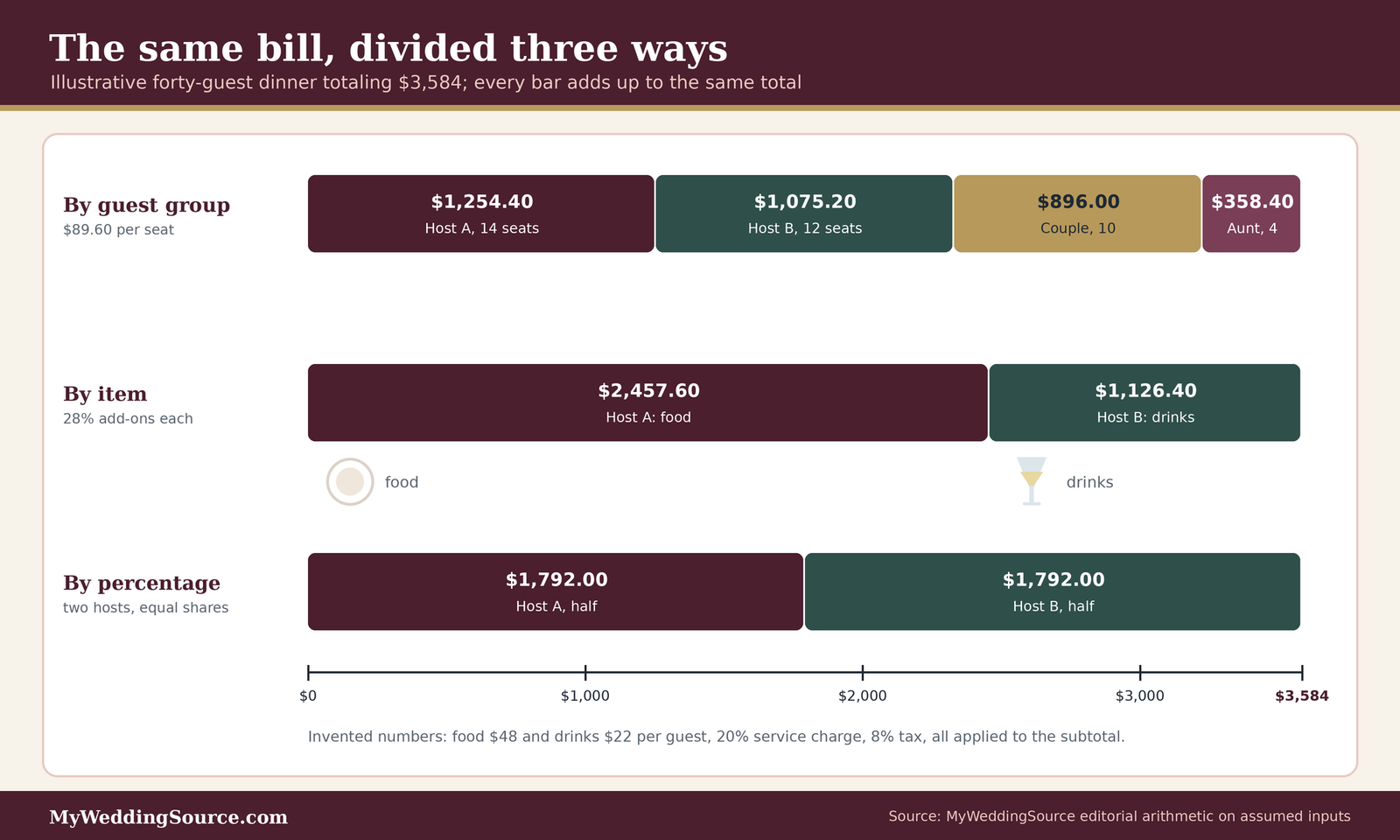
A worked example: one bill, three ways to split it
The following arithmetic uses invented numbers. They are not real prices and not a benchmark; they are here so you can see how the pieces interact. Please substitute your own quote.
The hypothetical bill
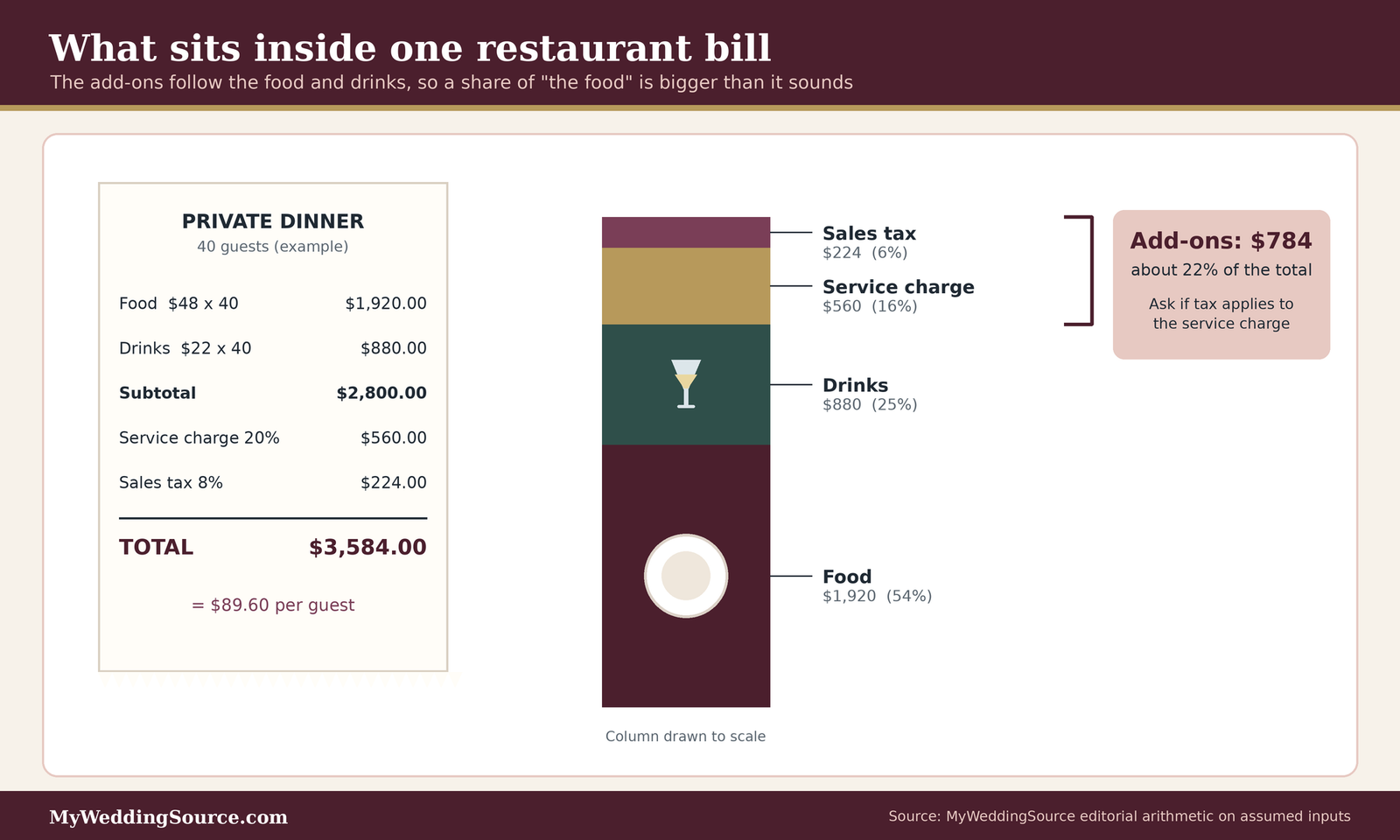
Suppose a restaurant quotes a rehearsal dinner for forty guests. We will assume the food is $48 per person, the drinks are an estimated $22 per person, the restaurant adds a 20 percent service charge, and local sales tax is 8 percent. For simplicity, we apply both percentages to the food and drink subtotal, so the combined add-on is 28 percent. Real restaurants differ: some tax the service charge, some do not, and some quote tax-inclusive. Ask for the arithmetic in writing.
Building the total
Food is forty times $48, or $1,920. Drinks are forty times $22, or $880. The subtotal is $2,800. A 20 percent service charge adds $560 and 8 percent tax adds $224, for a total of $3,584, or $89.60 per guest. These figures are our own arithmetic on assumed inputs and are an estimate only.
Why add-ons matter more than they look
The add-ons are $784 of the $3,584, or about 22 percent of the total. That is why a host who agrees to “pay for the food” can be surprised: the food alone is $1,920, but if tax and service charge follow it, the food-related charge is $2,457.60. Anyone agreeing to a share should know whether tax and service charge travel with it.
Three ways to divide the same total
Imagine four groups at the table: the groom’s family and friends with fourteen seats, the bride’s family and friends with twelve seats, ten seats for the wedding party, partners, and officiant whom the couple hosts, and four seats for aunts and uncles whom a relative has offered to cover.
By guest group
At $89.60 per seat, the groom’s side pays $1,254.40, the bride’s side pays $1,075.20, the couple pays $896.00, and the relative pays $358.40. These add up to $3,584.00. The strength of this method is that nobody pays for people they did not invite. Its weakness is that bar spending is spread evenly across seats, so a table that drinks more costs the others nothing and a table that drinks nothing still pays the same.
By item
If one family takes the food and the other takes the drinks, with tax and service charge following each in proportion, the food host pays $1,920 times 1.28, or $2,457.60, and the drinks host pays $880 times 1.28, or $1,126.40. These also add up to $3,584.00. The food host here pays more than twice what the drinks host pays, which can feel lopsided, so the item method often needs a third host or a balancing contribution from the couple.
By percentage
A fifty-fifty split of $3,584 between two hosts is $1,792 each. If the couple contributes a fixed $500 first, the remaining $3,084 is $1,542 each. The percentage method hides the structure of the bill, which keeps the conversation simple, but it also means nobody can see why the number is what it is, so a shared copy of the quote is worth sending.
What restaurants will and will not do with separate bills
A restaurant is not designed to be a ledger. Its point-of-sale system produces checks, and a private event usually produces one master check. Knowing this before you promise anything to a host saves an awkward renegotiation.
Why the restaurant may insist on a single check
The published policies we found are brief and vary by business, and we cannot generalize from them. Still, they point in a consistent direction: private events involve contracts, minimum spends, and guaranteed counts, and those are tied to one customer account.
One contract, one account
The two private-dining policies we read from restaurants, Laurel in Utah and Revival Bar and Kitchen in California, both require a signed contract or a minimum spend that applies to the event as a whole. Laurel says every private group event must meet a food and beverage minimum, and that a shortfall is billed as a room charge. Revival lists minimums by event type and says the minimum excludes tax and gratuity. A minimum applies to the group, not to each host, which is one reason a restaurant may prefer a single payer.
Policies are not promises
Neither of those two policies addresses split checks. A policy page that is silent has not said yes, and it has not said no, so the question belongs in your email. A winery policy we read, on the other hand, states plainly that a table of five or more receives one check and that the check may be divided evenly and paid with several cards. These are three different businesses, and the only lesson is that the answer varies and must be asked about for your specific restaurant.
What to ask for instead of separate bills
If the restaurant will not issue several checks, there are still ways to keep the money clean without a spreadsheet war.
A split on the final payment
Some restaurants will charge several cards for one check, either evenly or in amounts you specify. Ask whether the amounts can be uneven, because a policy that allows an even split among cards does not necessarily allow a 60-40 split. If uneven amounts are allowed, ask whether the restaurant charges any fee for processing multiple cards, and whether the service charge is applied before or after the division.
Separate line items on the master check
You can ask for the food and the bar to appear as separate lines, or for the bar to be tracked on a separate tab. This does not create separate bills, but it gives the hosts an item-by-item view and makes the item split practical. It also helps if one host wants to pay only for alcohol that was served and not for a package.
A pre-event prepayment by one host
If one host will pay for part of the dinner ahead of time, ask how the restaurant records a prepayment and how it appears on the final check. Written confirmation matters, because a prepayment that disappears into the master account can lead to a double charge on the night. Our guide to wedding credit card reconciliation shows how to check statements against receipts afterward.
Service charge, gratuity, and tax
These are the three add-ons that turn a quote into a bill, and they are the most common source of “I thought it included that.”
Service charge versus tip
The restaurant software company 7shifts explains that an automatic gratuity is a fixed charge the restaurant adds, usually for large parties, and that it is treated as a service charge for tax purposes and not as a voluntary tip. It reports typical rates between 15 and 22 percent, and says that many places require disclosure before guests order. Two private-event policies we read set a 25 percent service fee in one case and a 21 percent service charge in the other. These are the published numbers of two specific restaurants and should not be taken as typical. The practical point is that the add-on can be large, and hosts agreeing to a share should know whether the share includes it.
Is an additional tip expected
Whether anyone should leave more on top of a service charge depends on what the charge covers, and policies differ. Ask the restaurant what the charge covers and whether any of it goes to the staff who serve your table. If the answer is unclear, ask for it in writing. We did not find an authoritative source that gives a single rule here, so we are not proposing one.
Tax and who sees the receipt
Sales tax rates vary by place, and rules about taxing service charges vary too. The sample policies we read list tax as a separate line, at 9.45 percent in one case and 10.25 percent in the other. Ask for an itemized final check and keep it, since every host who contributes may want to see it.
Deposits, guarantees, and cancellations
The money rules before the dinner can matter more than the money rules on the night, because they decide who is exposed if plans change.
Deposits and cards on file
One restaurant we read requires no deposit but a signed contract; the other did not mention a deposit but keeps a card on file for cancellation fees. Policies differ, so ask what is due and when, and whose card is charged. Whoever gives the card on file carries the early risk, which is another reason to settle who signs.
Guaranteed counts
Laurel’s policy asks for a confirmed guest count at least 72 hours before the event; Revival asks for written confirmation at least five working days before and charges for that confirmed number. A guaranteed count is a financial commitment. If two hosts each invite people, someone must collect the final list and send one number to the restaurant, and everyone should agree on who that person is.
Cancellation fees
Cancellation fees in those same two policies range from a flat $250 or $500 to a percentage of the contracted minimum, and they rise as the event gets closer. Agree in advance how the hosts would share a fee if the dinner were cancelled or shrank, and if one host withdraws late, whether the others absorb that share. Our guide to wedding contract change orders explains how to document a change so nobody has to reconstruct it from memory.
How to handle multiple rehearsal dinner hosts and separate bills: who signs, pays, and decides
If the restaurant needs one name, the hosts need to decide whose it will be. This section is about authority, which is different from money, and it is the part of how to handle multiple rehearsal dinner hosts and separate bills that families most often skip.
Choose one point person
We recommend that one person, not one family, be the point of contact with the restaurant. That person receives the quote, signs the contract, gives the final count, and receives the final check.
What the point person does
The point person asks the restaurant the questions in this guide, forwards every quote to all hosts in the same message, tracks the final guest count, confirms menus and dietary needs, and keeps a folder of receipts. The role is administrative and should not carry extra decision-making power unless the hosts agree to that. Our article on wedding vendor due diligence gives a useful way to check a venue before anyone commits.
Who should not be the point person
Avoid choosing the host who is most uncomfortable with spreadsheets or the one who is most likely to travel in the final week. A couple can also serve, but weigh the cost of having them handle logistics in the weeks before their own wedding. A close friend, a relative with time, or a planner can take the role, as long as the hosts name who is paying the person’s expenses, if there are any.
Decide who has a say
The Knot notes that those who pay generally get a say in decisions, and that couples who want full control may do best to pay themselves. This is a useful principle, and it also needs boundaries.
Which decisions are shared
List the decisions: date and time, venue, guest list, menu and bar, seating, toasts, and invitations. Mark each one as decided by the couple, decided by the hosts together, or delegated to the point person. An explicit list avoids the situation in which one host assumes the right to add guests and the other discovers it from the guest count.
What to do when hosts disagree
If two hosts disagree about the venue or the guest list, return to the budget and to the written summary of roles. If the disagreement is about who is invited, the honest rule is that every added guest adds a cost, and the person who adds the guest might be asked to cover that seat. We offer that as a suggestion and not as etiquette, since the sources we read do not state it.
A one-page host agreement
A short written agreement is not a legal contract, and it does not need a lawyer. It is a shared note that reduces misunderstandings. Use it as a conversation guide and, if the money involved is large, ask a professional about anything that feels like a legal or tax question.
What the agreement should include
The headings below are our suggestion, not a legal template: the date and venue; the names of the hosts and their roles; the split method; each host’s share or items; the budget ceiling and what happens if the bill exceeds it; who signs and whose card is on file; the date by which the final guest count is due; each host’s payment deadline and method; the plan if a host withdraws or the event is cancelled; and who gives a toast.
How to share and store it
Send the agreement as a plain message that every host can reply to, so the acknowledgments are in one thread. Store it with the restaurant quote and receipts. If your hosts are not comfortable with a formal note, a friendly summary that says “here is what we understood” does the same job.
The host worksheet
The worksheet below is the practical core of the guide, and it puts how to handle multiple rehearsal dinner hosts and separate bills onto one page. It is a set of five tables you can copy into a message or a spreadsheet. Fill them in order. The numbers shown are the invented examples from our worked bill, so you can see how the entries work.
The host and share sheet
This sheet turns the conversation into a small set of facts.
Table one: hosts and roles
| Host | Pays? | Share or items | Makes decisions on | Gives a toast |
|---|---|---|---|---|
| Host A (example: groom’s parents) | Yes | Fourteen seats | Their own guest list | Yes |
| Host B (example: bride’s parents) | Yes | Twelve seats | Their own guest list | Yes |
| Couple | Yes | Ten seats | Venue, menu, timing | Optional |
| Relative (example: an aunt) | Yes | Four seats | Nothing, by choice | Optional |
Table two: the shared-guest rule
Decide in advance who covers guests who belong to no single host: grandparents, the officiant and a partner, the planner if there is one, children of the wedding party, and out-of-town friends. Etiquette sources describe a typical core list that includes both sets of parents and stepparents, grandparents, the wedding party and their partners, and the officiant. Emily Post also lists siblings who are not in the wedding party and the parents of young attendants. Zola adds that it is courteous to invite the plus-one of any traveling wedding party member. Pick a rule such as “the couple covers anyone who belongs to neither family,” and write it down.
The calculation sheet
This sheet takes the quote and produces each host’s amount.
Table three: the quote
| Line | Amount (example) | Notes |
|---|---|---|
| Food, per person | $48 | Illustrative |
| Drinks, per person | $22 | Estimate; the final bar total can change |
| Guests | 40 | Guaranteed count |
| Subtotal | $2,800 | Food plus drinks |
| Service charge, 20% | $560 | Ask whether it is taxed |
| Sales tax, 8% | $224 | Ask for the local rate |
| Total | $3,584 | About $89.60 per guest |
Table four: the shares
| Method | Host A | Host B | Couple | Relative |
|---|---|---|---|---|
| By guest group | $1,254.40 | $1,075.20 | $896.00 | $358.40 |
| By item (A food, B drinks) | $2,457.60 | $1,126.40 | none | none |
| By percentage (A and B only, equal) | $1,792.00 | $1,792.00 | none | none |
The payment sheet
This sheet gets the money to the right place at the right time.
Table five: who pays whom, and when
| Step | Who | Amount | By when | How |
|---|---|---|---|---|
| Deposit or card on file, if any | Point person | Per contract | At booking | Card |
| Final count sent | Point person | n/a | Per restaurant policy | |
| Dinner paid | Point person | Total | Night of event | Card |
| Reimbursement from Host A | Host A | Their share | Within an agreed number of days | Check or bank transfer |
| Reimbursement from Host B | Host B | Their share | Within an agreed number of days | Check or bank transfer |
A note on payment apps
If hosts reimburse each other through a payment app, the Consumer Financial Protection Bureau’s archived guidance recommends confirming the recipient, for example by requesting a payment through the app, or sending a small test payment first, and warns that many app payments leave your balance immediately and cannot be recalled. The Federal Trade Commission advises sending money only to people you know and verifying any request by contacting the person at a number you already trust. A bank transfer or a check is also fine, and the better method is the one every host will actually use.
What this actually costs
Published averages vary and depend on guest count and region. The Knot’s article on who pays for the rehearsal dinner cites its Real Weddings Study at about $2,300 on average, and the wedding platform Joy gives broad ranges of roughly $1,500 to $3,000 for a casual dinner of 20 to 30 guests, $3,000 to $8,000 for a mid-range dinner of 30 to 50 guests, and $8,000 to $15,000 or more for an upscale dinner of 40 to 75 guests. Joy also says food and catering usually take about 40 to 50 percent of the budget and drinks about 15 to 25 percent. These are the sources’ figures and are not a guarantee of what you will pay. Our own worked example above, at roughly $89.60 per guest, is invented arithmetic and not a price benchmark.
Questions to ask the restaurant
The list to send
Send these in one email, written by the point person, and keep the answers in your host folder. The right answers are the ones that match your host agreement.
Keep it to one thread
Ask all the questions in a single message and ask the restaurant to reply in the same thread, so every answer sits beside its question. Forward the reply to every host the same day.
Ask for it in writing
A verbal answer from a host stand or a phone call is easy to misremember. If the restaurant answers by phone, send a one-line summary by email and ask them to confirm it.
Questions to ask before you book
- Can the event be paid with more than one card, and can the amounts be uneven?
- Do you issue separate checks for a private event, and is there a fee or a limit on how many?
- Can food and bar be listed as separate lines, or can the bar run on its own tab?
- What is the food and beverage minimum, and does it include tax and service charge?
- What is the service charge, what does it cover, and is any additional tip expected?
- Is the service charge taxed, and what is the local sales tax rate?
- When is the guest count due, and what happens to the bill if the count changes?
- What are the deposit, card-on-file, and cancellation terms, and who is named on them?
- Can a host prepay part of the dinner, and how will it appear on the final check?
- Who will hand the final check to whom, and can it be delivered privately at the end of the night?
The night itself
The restaurant’s answers on the night determine whether the hosts experience the evening as hosts or as accountants.
Who receives the check and when
Ask the staff to give the check to the point person only, at the end of the evening, and not to place it at the table during toasts. Say this in advance and repeat it at the start of the night, since service staff may change during a long event.
Late additions and extra drinks
Decide how to handle a guest who orders something off the plan, or a friend who wants to buy a round. A simple rule is that anything not on the agreed menu goes on a separate tab paid by whoever ordered it, if the restaurant allows. Ask whether the staff can do that without confusing the master check.
Edge cases that need a plan
Most rehearsal dinners are straightforward. The few that are not tend to share a handful of situations, and each one has a calm answer.
Families that do not share a table easily
The Knot describes a plan for divorced parents: if they can cooperate, both can co-host and split the cost, though they may sit separately and give separate toasts. If they cannot work together, one parent can host the rehearsal dinner and the other can host a different event, such as a next-day brunch.
Divorced or separated parents
Each parent may also have a spouse and extended family. Count them as separate hosts for the purposes of this guide, with a share and a toast each, unless the parents agree otherwise. For seating and photo planning that follows from this, our guide to family photo combinations when parents are divorced is a useful companion.
Stepparents and a stepparent’s family
Stepparents usually appear on the invitation list of the core group, and a stepparent who wants to host should be asked the same questions as any other host. Agree up front whether a couple of parents counts as one host or as two, because it affects the toast schedule and the shares.
Uneven money and uneven guest lists
One of the most common stresses is a mismatch: one family can afford more, or one family has many more relatives who expect to attend.
When one family can pay more
If one host can pay more, the couple can ask them to cover a larger share without giving them a larger role, but be honest about that tradeoff. The Knot’s point that those who pay generally have a say means a larger payer may expect a larger voice. Decide in advance whether a larger share changes the decision list, and say so in the host agreement.
When one family has a much longer list
A split by guest group handles this directly. A host with a long list can choose a smaller list or pay for the larger number. Joy’s article offers one rule that helps everyone: if you invite out-of-town guests, invite all of them, since inviting only some can cause hurt feelings. The cost implication is that the family with more out-of-town relatives may need to decide earlier. For ideas on lighter options for the full group, the Knot suggests inviting everyone to a casual dessert or drinks afterward, and our guide to who needs to attend a ceremony rehearsal helps you separate rehearsal attendees from dinner guests.
When a host changes their mind
Plans change. A host might lose income, fall ill, or decide they want a different kind of evening.
A host withdraws late
If a host pulls out after the contract is signed, the money has to come from somewhere. Your agreement should say whether the other hosts and the couple divide the gap, whether the dinner is reduced, or whether the restaurant is asked to change the guaranteed count. A change this late may carry a fee, so ask the restaurant about its limits as soon as you know. Our article on wedding insurance explains what that kind of policy does and does not usually cover, and we would not assume that a change of heart is covered.
A host wants to add guests
Added guests change the bill and the guaranteed count. Ask the host to send names by the deadline and tell them what the added seats cost. Joy suggests sending invitations six to eight weeks ahead and finalizing the headcount two to three weeks out, which is a useful rhythm for these changes.
Alcohol, tipping, and gifts
A few topics are easy to overlook until the night.
Who pays for the bar
The bar is the least predictable part of the bill, so many hosts prefer a cap, a limited menu, or a package with a defined price. Our guide to wedding bar service planning covers the choices. Whoever signs the contract is usually the person the restaurant looks to for the bar tab, so confirm that the hosts agree on it before the evening.
A short note on alcohol and responsibility
Alcohol liability rules vary a great deal by state. A federal report summary says that as of January 1, 2020, 34 states imposed social host liability through statute or common law and 15 did not, and that the rules usually concern underage drinking. The Community Preventive Services Task Force describes dram shop laws as applying to those who sell or serve alcohol. Neither source is a guide to your situation. If you have a question about liability for a hosted event, ask the restaurant what its policies and insurance cover, and ask a lawyer in your state.
When parents give money instead of paying the restaurant
Some families offer money to the couple in place of hosting. The IRS says the annual gift tax exclusion is $19,000 per recipient for gifts made in 2026. We are not offering tax advice, and a rehearsal dinner share is typically far below that amount, but if you have a question about large gifts, ask a tax professional.
The timeline below is our own synthesis of the sources we read, including Joy’s suggested planning rhythm. It is a planning guide, not a standard, and you should adjust it to your date.
Months before the wedding
The money conversation should come before the venue search.
Six to four months out
Talk with each family separately, decide the split method, name a point person, and draft a first guest list. Joy suggests raising the budget about six months out and starting venue research at four to six months.
Four to three months out
Send the written summary, ask the restaurant the questions above, compare at least two quotes, and book. The Zola advice to send details to out-of-town guests at least four to six weeks before the wedding means your venue and date should be firm well before that.
Weeks before and the night itself
The details tighten as the date approaches.
Eight weeks to one week out
Send invitations that name every host, confirm the guest count and menus, and confirm payment details. Your invitations should name the hosts exactly as they have agreed to be named. Our companion guide on wedding weekend event invitations covers wording for the weekend’s events; see wedding weekend event planning for how the dinner fits with the rest of the schedule, and rehearsal dinner for a destination wedding if you are far from home.
The night and the week after
Have the point person receive the check privately, keep the itemized copy, and send it to all hosts the next day. Follow the reimbursement plan, and send thanks to every host. A short, specific thank-you note to each host, naming something they contributed, is a graceful way to close the loop. For a sense of how the dinner’s cost might sit alongside your other wedding costs, see our guides to wedding party costs and the wedding budget.
What to do if the evening goes off plan
Even a good plan meets surprises. These are the three that cause the most stress.
The bill is higher than expected
The most common reason is the bar. The second is the add-ons.
Check the itemized check first
Compare the final check to the quote line by line before anyone argues. Many surprises are tax or service charge that nobody calculated. If a charge was not disclosed beforehand, 7shifts notes that guests may be able to dispute it, though the details depend on state and local rules. Raise any question with the manager privately.
Share the difference by the agreed rule
If your agreement says shares are fixed percentages, the overage follows the percentages. If the agreement says shares are fixed dollar amounts, decide who absorbs the difference. This is exactly why the agreement names a ceiling, and it is why we suggest putting that ceiling in writing.
A host objects on the night
Occasionally a host objects to a bill, a toast, or a guest during the evening.
Defer it, kindly
Say that you will sort it out the next day and ask them to enjoy the evening. A dinner is the wrong place to renegotiate, and almost every disagreement is easier when the check is behind you.
Come back to the written plan
Afterward, return to the agreement. If there was a misunderstanding, the document usually shows where it happened. Fix the template for the next event, such as the next morning’s brunch, and carry on.
A guest asks to pay their own way
Guests sometimes offer. Accept graciously in the moment only if the hosts agreed to it, and otherwise thank them and say it has been arranged. The Knot notes that the wedding party is required to attend the rehearsal and should not be asked to cover their own meal, so hosts generally cover every guest.
Accepting an offer without confusion
If a friend wants to buy drinks for the table, have them speak with the point person, who can decide whether it fits the plan and tell the restaurant. A one-sentence note to the other hosts avoids surprise.
Declining an offer without offense
Say that you are so touched and that the hosts have it covered, and suggest they contribute a toast, a story, or a card instead.
Hosting and etiquette
Who traditionally pays for the rehearsal dinner?
According to Emily Post and The Knot, the groom’s family traditionally hosts, though both describe that as custom and not obligation. Today the bride’s family, both families, the couple, relatives, or friends may host. The Knot adds that parents are not required to host if their budget or schedule does not allow it.
Do all hosts get a say in the plans?
Often, yes. The Knot says anyone who pays generally gets a say in decisions such as the guest list and venue, and that hosts typically give a toast. If you want full control, it suggests paying yourselves. Whatever you choose, list in writing which decisions are shared and which belong to the couple.
Should each host give a toast?
It is common for hosts to give a toast, according to The Knot. With several hosts, agree on an order and a time limit so the speeches do not crowd out the meal. Our guide to rehearsal dinner toasts offers a way to split the speaking time, and a short toast from each host usually works well.
What if one family cannot contribute?
Thank them and move on without asking why. Parents are not obligated to host, and you can offer a smaller role, such as hosting welcome drinks or helping with the invitation list. Plan the budget around the hosts who said yes, and avoid comparing the families’ contributions in front of anyone.
Money and the restaurant
Will the restaurant give each host a separate bill?
It depends on the restaurant. One winery’s policy says parties of five or more get one check per table, while two restaurant policies we read were silent on the subject. Ask whether the check can be split across several cards, in even or uneven amounts, and whether there is a fee.
Is the tip included in the bill?
Maybe. A restaurant may add an automatic gratuity, which the company 7shifts explains is treated as a service charge, often for larger parties, at rates it reports between 15 and 22 percent. Two restaurant policies we read list 21 and 25 percent. Ask what the charge covers and whether more is expected.
What if a host withdraws after the contract is signed?
Your host agreement should answer this before it happens. The remaining hosts may cover the gap, the guest count may drop, or the dinner may be reduced, and the restaurant’s cancellation terms will limit your options. Tell the restaurant promptly and ask in writing what changes are allowed and what they would cost.
Is it safe to reimburse hosts through a payment app?
It can be, with care. Federal guidance advises confirming the recipient, sending a small test payment first or requesting a payment through the app, and understanding that app payments often cannot be recalled. A check or bank transfer is also reasonable. Choose the method everyone uses comfortably.
Your next steps
Before you call the restaurant
Do the thinking that makes the call short.
Hold the host conversations
Talk with each family separately, thank them for whatever they offer, and send a written summary of what you heard. Name the point person and the split method in that message.
Fill in the worksheet
Complete the host sheet, the shared-guest rule, and the payment sheet with your real numbers once you have a quote. Keep it in the same folder as the restaurant’s terms.
After you book
Keep the plan alive as the date approaches, since how to handle multiple rehearsal dinner hosts and separate bills is a job that continues until the last reimbursement lands.
Confirm in writing
Ask the restaurant to confirm the payment method, the check delivery, the count deadline, and the cancellation terms. Add the answers to the host folder, and use the wedding planning checklist to keep the rest of the weekend on track. If hosts need a general reference on wedding etiquette, our wedding etiquette guide is a good place to start.
Close the loop
On the next day, send the itemized check, the reimbursement amounts, and your thanks. A calm close is the part hosts remember. For a related situation with two families, see our guide to a joint engagement party with two families.
Sources & methodology
How we built this guide
What we relied on
This guide combines published etiquette and planning advice from Emily Post, The Knot, Zola, Joy, and PNC, the published private-dining policies of two restaurants and a winery, an industry explainer on automatic gratuity, federal consumer guidance on payment apps, an IRS page on the gift tax exclusion, and public-health and government summaries of alcohol liability. The goal throughout is to show how to handle multiple rehearsal dinner hosts and separate bills without pretending there is one right answer. Every named policy and figure is attributed to the party that published it. The worked bill, the split tables, and the percentages that follow from them are our own arithmetic on invented inputs and are estimates. We checked each page when we wrote this guide in November 2026; policies, prices, and tax rules change, so confirm current terms with your own restaurant.
What we did not do
We did not survey restaurants, test payment apps, or verify any host’s budget. We did not find an authoritative source on tipping on top of a service charge or on how restaurants generally handle separate bills at private events, so we say so where it matters. Nothing here is legal, tax, or financial advice. For questions about contracts, liability, or taxes, ask a qualified professional in your state.
Source list
Etiquette and planning sources
- Emily Post, The Rehearsal Dinner: https://emilypost.com/advice/the-rehearsal-dinner
- The Knot, Who Pays for the Rehearsal Dinner: https://www.theknot.com/content/mandatory-wedding-rehearsal-dinner
- The Knot, Real Weddings Study: https://www.theknot.com/content/real-weddings-study
- Zola, Who to Invite to a Rehearsal Dinner: https://www.zola.com/expert-advice/wedding-planning-101/wedding-planning-questions/who-to-invite-to-a-rehearsal-dinner
- Joy, Rehearsal Dinner Planning Guide: https://withjoy.com/blog/rehearsal-dinner-planning-guide-everything-you-need-to-know/
- PNC Insights, Who Pays for the Wedding: https://www.pnc.com/insights/personal-finance/save/who-pays-for-the-wedding.html
Restaurant, venue, and service-charge sources
- Laurel Brasserie and Bar, Private Dining Policies: https://grandamerica.com/dining/laurel/private-dining/policies
- Revival Bar and Kitchen, Private Event Policies: https://revivalbarandkitchen.com/private-event-policies
- Nashoba Valley Winery, Splitting of Checks: https://nashobawinery.com/knowledge-base/splitting-of-checks
- 7shifts, Restaurant Automatic Gratuity: https://www.7shifts.com/blog/restaurant-auto-gratuity/
Government and public-health sources
- Consumer Financial Protection Bureau, Helpful tips on using mobile payment services (archived 2018 post): https://www.consumerfinance.gov/about-us/blog/helpful-tips-using-mobile-payment-services-and-avoiding-risky-mistakes
- Federal Trade Commission, Making mobile payments: protect yourself from scams: https://consumer.ftc.gov/making-mobile-payments-protect-yourself-scams
- Internal Revenue Service, Frequently asked questions on gift taxes: https://www.irs.gov/businesses/small-businesses-self-employed/frequently-asked-questions-on-gift-taxes
- Community Preventive Services Task Force, Dram shop liability: https://thecommunityguide.org/findings/alcohol-excessive-consumption-dram-shop-liability
- StopAlcoholAbuse.gov, Social host liability summary (2021 report to Congress): https://www.stopalcoholabuse.gov/media/ReportToCongress/2021/profile_summaries/15_social_host_liability.pdf