

Wedding first look photos work best when you treat them as a scheduling decision first and a sentimental one second: they trade extra time in the morning and the aisle reveal for calmer nerves, more daylight for portraits, and a shorter wait between your ceremony and your reception.
Picture a mid-October Saturday with a 4:00 p.m. ceremony. The vows wrap up around 4:30, the sun is already heading toward a sunset a little after 6:00 p.m. in a city like Chicago, and your guests are walking toward the bar while your photographer asks for family groups, the wedding party and a few minutes of just the two of you. Every one of those photos now competes with cocktail hour and with fading light. A first look moves most of that work to before the ceremony, which is the whole appeal, and it is also why the choice has real consequences for your wedding timeline, your photography coverage hours and the way the day feels.
This guide is built around the decisions couples actually have to make. It explains what a first look is and how common it is, lays out the genuine pros and cons without pushing you either way, and shows how the choice reshapes your schedule, your light and your getting-ready buffers. It then covers how to stage the moment and protect your privacy, the alternatives that give you part of the benefit, how faith and family expectations fit in, and what it costs in photography coverage. The last section is the contract language to clarify before you sign, because a first look touches start times, overtime and usage rights more than most couples expect.
One honest limit before we start: the surveys on first looks are large but they are not the same as your wedding. Ceremony times, venue rules, religious customs and your photographer’s working style change the right answer, so treat the numbers and sample timelines here as ballparks for planning conversations, not as a prescription.
What a First Look Is and How Common It Really Is
Before weighing pros and cons, it helps to agree on what is being decided. A first look is a planned, private moment before the ceremony when the two of you see each other for the first time that day, usually with a photographer nearby. This section defines it, separates it from ordinary pre-ceremony portraits, and puts the survey numbers in context so that “everyone does it” does not make the decision for you.
What exactly happens during a first look?
What does a first look look like from start to finish?
In a typical first look, one partner waits in a chosen spot with their back turned, the other walks up, and a tap on the shoulder or a spoken name starts the reveal. The moment usually lasts a few minutes, then continues into a quiet conversation, a hug, possibly a letter or a gift, and the first round of couple portraits. The Knot’s pros-and-cons guide, which draws on nine wedding professionals, says a first look can take anywhere from a few minutes to 30 or more minutes depending on location, light and whether vows or gifts are exchanged. Most of that time is not the reveal itself but the settling in afterward, when nerves drop and the best expressions tend to appear. Plan the block as a small event of its own rather than a quick hello squeezed between hair touch-ups.
How is a first look different from taking portraits before the ceremony?
Portraits before the ceremony are a scheduling choice, and a first look is an emotional one. You can photograph a wedding party and family groups before the ceremony without the couple ever seeing each other, using a doorway, a hedge or a closed car door to keep the reveal for the aisle. A first look means the couple’s reveal happens early, and the shots of your faces seeing each other are taken in private rather than in front of guests. This distinction matters because couples sometimes say “no first look” and mean “no portraits before the ceremony,” which can push every group photo into cocktail hour. Decide the two questions separately: whether you want to see each other early, and whether you want formal photos done early.
How many couples actually do one?
What do the big wedding surveys say?
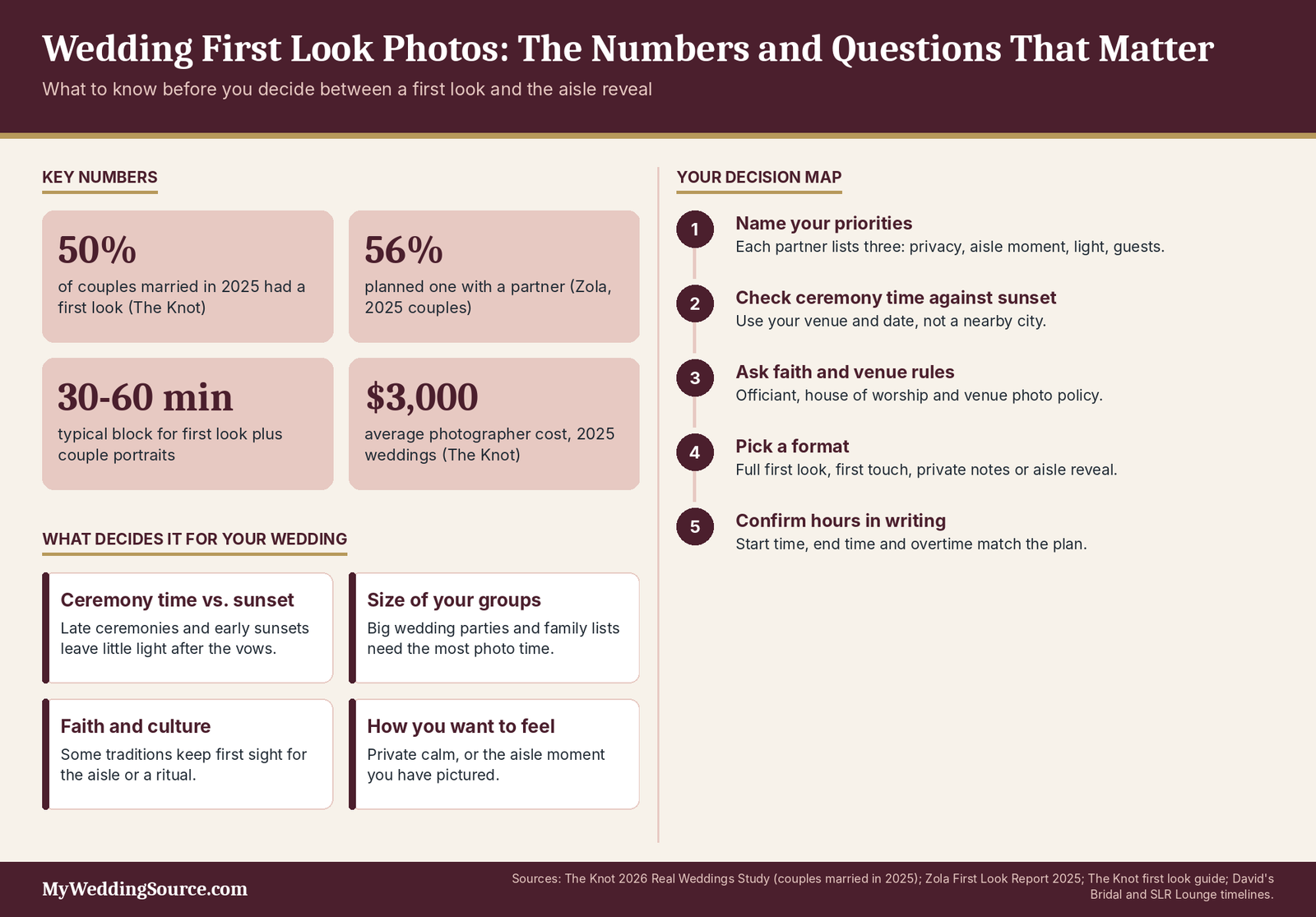
Three data points give a useful range, though they come from different samples. The Knot’s 2026 Real Weddings Study readout surveyed 10,474 U.S. couples married in 2025 and reports that one in two had a first look. The Knot’s earlier 2023 study put the figure at 56%, as cited in its first look pros-and-cons article. Zola’s 2025 First Look Report, a survey of roughly 6,000 couples getting married in 2025, found that 56% planned a first look with their partner and 41% planned an additional first look with friends or family. These are survey findings from couples who use those platforms, so they describe a trend, not the whole country.
What should that number mean for your decision?
Treat a figure near 50% as proof that either choice is ordinary, not as a nudge toward one of them. About half of couples skip the first look, and the surveys give no sign that they regret it, so the aisle reveal is not an old-fashioned holdout. The more useful signal in Zola’s data is the 41% planning a second or third first look with friends or family, which shows couples have started to treat the first look as a flexible format rather than a single yes-or-no ritual. That flexibility is good news for you, because it means you can build a version that fits your priorities, your family and your timeline. The next section helps you figure out which version that is.
Pros and Cons: How to Decide Without Guessing
Wedding photographers, planners and couples disagree on first looks in a friendly way, and that disagreement is useful because it exposes the real trade-offs. The goal here is to sort the arguments into the ones that are about feelings, the ones that are about logistics and the ones that depend on your situation. By the end you should be able to say which three factors matter most for your wedding.
What do you gain from a first look?
Can a first look calm wedding-day nerves?
Experts quoted in The Knot’s guide name easing nerves as the top reason couples choose a first look, since a hug or a kiss in a quiet place can release tension that would otherwise build as you wait at the altar or the end of the aisle. Seeing your partner privately also lets you cry, laugh or exchange a note without a room of 100 guests watching, which some people find far easier than reacting in public. Photographer Trista Hidalgo, quoted in a Love Inc. Mag pros-and-cons piece, says you get “the real emotions of the couple when they are by themselves.” The caveat is that a first look does not erase nerves for everyone, and for some people the added intensity of an early, photographed reveal makes the morning feel heavier, so think about how you handle being watched.
Does a first look really give you more time and better light?
The logistical case is strong when portraits are the bottleneck. Completing couple, wedding party and family photos before the ceremony shortens the gap between the ceremony and the reception, because the people you need are already dressed and in one place. Love Inc. Mag adds that earlier photos can avoid rain or harsh midday sun and give the photographer room to use more locations and softer light when the ceremony is later in the day. In practical terms, a first look can turn a 60-minute post-ceremony portrait window into 20 minutes of remaining family groups, so you reach cocktail hour while guests are still mingling. You are trading morning time for evening time, which is a good trade when the evening has the fading light and the guests.
What do you give up or risk?
Is the aisle reveal worth protecting?
For many couples it is the emotional center of the ceremony, and The Knot’s guide lists breaking that tradition as a leading reason to skip a first look. The moment of watching a partner appear at the end of an aisle, with family standing and music cueing the reveal, is a shared experience that a private first look cannot replicate. Some photographers also note that doing both a first look and an aisle moment can produce shots that look alike, and that a first look can feel staged to couples who dislike being directed. If you picture that walk as the moment you will remember most, the portrait logistics can usually be solved another way, as the alternatives section shows. You are allowed to want the aisle moment simply because you want it.
What are the practical downsides?
The most common cost is an earlier, tighter morning. The Knot’s guide says the day may need to start “at least by a couple of hours” earlier, particularly with a large wedding party or a house of worship that sets the ceremony time, and it warns that hair and makeup have to stay camera-ready for longer, which can mean touch-up time or extra beauty-team hours. Outdoor settings add wind, sun and tears to the mix, and Fox News lists a dirty train or suit and windblown hair among the risks of shooting outside before the ceremony. A first look also needs a quiet location, and onlookers or noisy vendors can puncture the moment unless you plan for privacy. None of these are dealbreakers, but each one is a line on the timeline that deserves a buffer.
Which situations tip the balance?
How does ceremony time change the answer?
The later your ceremony, the more a first look helps your photos, and the earlier it is, the less necessary it becomes. Love Inc. Mag notes that an evening ceremony makes a first look more useful for daylight photos, while an early ceremony leaves time for portraits afterward. In a season with early sunsets, that advice gets sharper, because a 4:00 p.m. ceremony in November leaves very little usable light after the vows, a problem explored in detail in our guide to a November wedding timeline built around earlier sunsets. A noon ceremony in June with a two-hour cocktail hour is a different case, since the light stays good for hours and portraits can happen afterward without any pressure.
How do group size, faith and personality change it?
Large families and wedding parties are the second big factor, because a group list of 15 or 20 formal combinations takes real time and herding people after a ceremony tends to take longer than expected. Faith or cultural customs are the third, covered in their own section below, and they can make the decision for you or change what a first look looks like. Personality is the last and most underrated factor, since a couple who find public attention draining might value the private moment more than anything else, while a couple who feel the opposite might prefer the audience. Table 1 pulls the common situations together so you can see where you land.
| Your situation | Why a first look helps | Why the aisle reveal may fit |
|---|---|---|
| Ceremony starts late in the afternoon or near sunset | Moves portraits into better light before the ceremony | Works if you plan a short, tight photo window and a sunset session |
| Large wedding party and long family group list | Spreads photos across the afternoon instead of one rushed hour | Works if you trim the list or add a second photographer |
| Strong nerves or a wish for privacy | Gives you a quiet minute before the crowd arrives | A private note or call can offer similar calm |
| Tradition or faith centers the aisle moment | Not needed, and it may conflict with customs | Keeps the custom intact |
| Short getting-ready window or early start already | Adds pressure to a morning that has no slack | Keeps the morning lighter |
| Outdoor wedding with heat, wind or rain risk | Gets portraits done before the elements change | Shifts photos to later, possibly more comfortable conditions |
How a First Look Changes Your Wedding Timeline
A first look does not remove photography from the day, it relocates it. That relocation affects when you start getting ready, how much time you spend with guests during cocktail hour and how much natural light you have left when the real portraits happen. This section works through the schedule, the sunlight and the buffers with sample numbers you can adapt, and it points to our wedding photography timeline guide for the full booking-to-wedding-day schedule.
How does a first look change the day’s schedule?
What does a timeline look like with and without a first look?
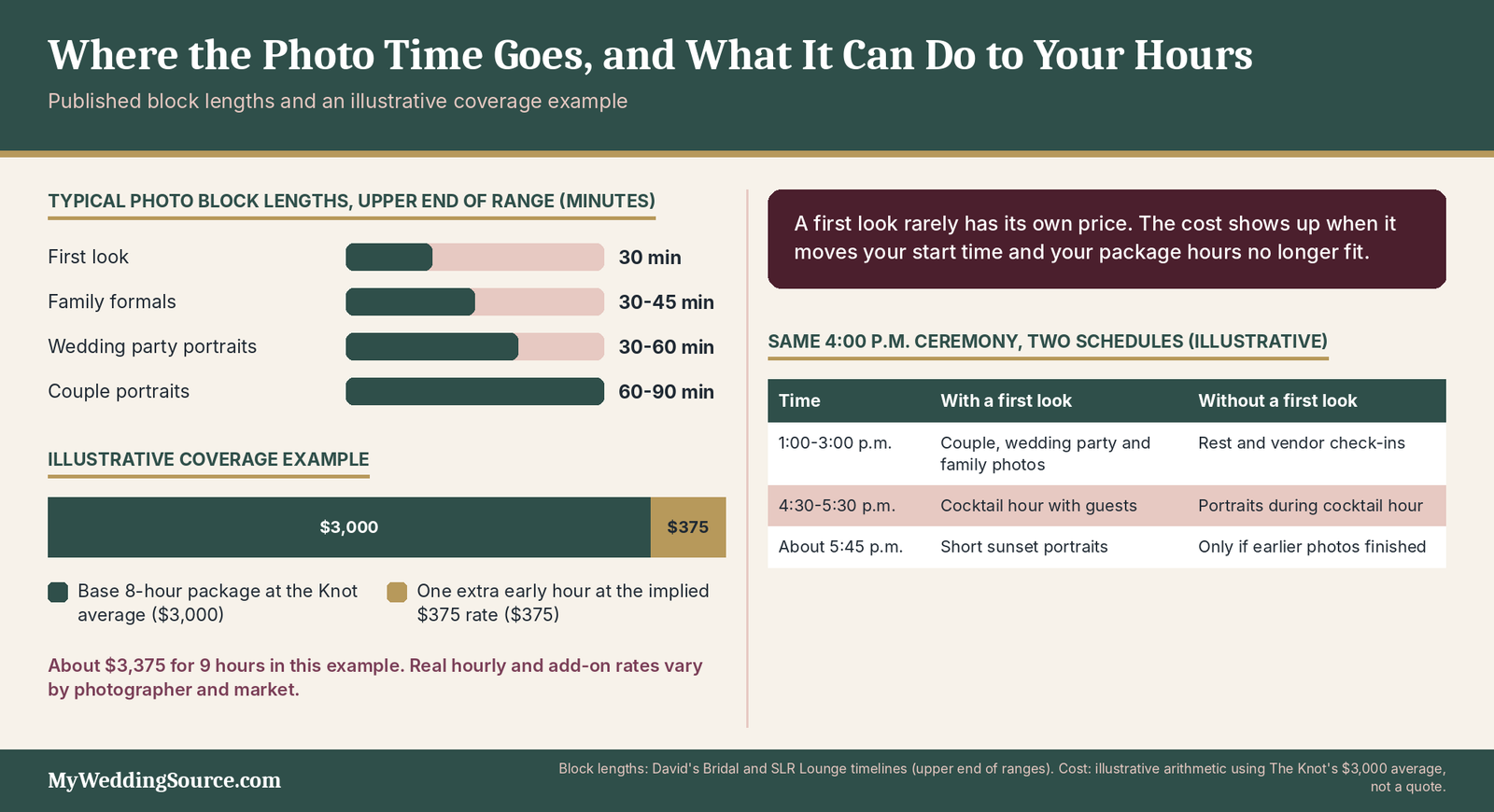
The clearest way to see the effect is to line up the same wedding two ways. David’s Bridal’s photography timeline guide lists a first look at about 30 minutes, wedding party portraits at 30 to 60 minutes, family photos at 30 to 45 minutes and couple portraits at 60 to 90 minutes, which together explain why the post-ceremony hour disappears without a first look. SLR Lounge’s timeline advice from photographer Trevor Dayley puts the first look and couple portraits together at 45 to 60 minutes and family formals at about 20 minutes plus 5 to 10 for signing a marriage certificate. Table 2 applies figures in those ranges to an illustrative 4:00 p.m. ceremony and a roughly 6:00 p.m. sunset. It is an example for conversation with your photographer, not a schedule for your venue.
| Time block | With a first look | Without a first look |
|---|---|---|
| 12:45 p.m. | Both partners dressed and ready | Both dressed, staying separate |
| 1:00 to 1:45 p.m. | First look and couple portraits | Lunch, vendor check-ins, rest |
| 1:45 to 2:30 p.m. | Wedding party portraits | Rest and photos of ceremony details |
| 2:30 to 3:00 p.m. | Family formals | Final touch-ups |
| 3:00 to 3:45 p.m. | Break and touch-ups, then hidden before seating | Hidden; guests start arriving at 3:30 p.m. |
| 4:00 to 4:30 p.m. | Ceremony | Ceremony |
| 4:30 to 5:30 p.m. | Cocktail hour with guests after a few quick group photos | Family, wedding party and couple portraits while guests are at cocktail hour |
| 5:30 p.m. on | Dinner, with 10 to 15 minutes of sunset portraits around 5:45 p.m. | Dinner; sunset portraits only if the earlier photos finished on time |
What happens to your cocktail hour?
Cocktail hour is where the schedule difference becomes visible to everyone else. Without a first look, the couple and their families are often pulled away for most of that hour, so guests arrive at a bar without the hosts and the people they traveled to see. With a first look, the post-ceremony photos shrink to a handful of ceremony shots and a group photo or two, and the two of you can walk straight into the cocktail hour. That matters for hospitality, because guests who wait without the couple tend to feel it, and it matters for you, because cocktail hour may be the only time you talk to every guest. If your venue or caterer runs a short cocktail hour, a first look can be the difference between a relaxed pace and a crowded timeline.
How do sunlight and sunset factor in?
When does a first look protect your light?
Sunset does not move for your ceremony, and in the cooler months it arrives early enough to affect every decision about when photos happen. Table 3 shows approximate sunset times on four 2027 Saturdays in four cities, computed with a standard solar-position formula of the kind used by the NOAA solar calculator. NOAA notes that the calculator is no longer actively supported, so use it or a second sunset tool for your exact venue and date and treat the table as a rough guide. The pattern is what matters: in mid-November a 4:00 p.m. ceremony ends at or within about 15 minutes of sunset in Chicago, Denver and Seattle, which leaves almost no daylight for post-ceremony portraits, while in June the same ceremony leaves roughly four hours of good light.
| City | Jun 12, 2027 | Oct 16, 2027 | Nov 13, 2027 | Dec 18, 2027 |
|---|---|---|---|---|
| Chicago | 8:26 p.m. | 6:07 p.m. | 4:31 p.m. | 4:21 p.m. |
| Atlanta | 8:48 p.m. | 7:02 p.m. | 5:35 p.m. | 5:31 p.m. |
| Denver | 8:28 p.m. | 6:19 p.m. | 4:45 p.m. | 4:37 p.m. |
| Seattle | 9:07 p.m. | 6:19 p.m. | 4:35 p.m. | 4:18 p.m. |
How do you handle midday sun, heat and weather?
The same logic that rescues evening light can cause trouble earlier in the day, because a first look at 1:00 p.m. in July is a first look in the harshest, hottest part of the afternoon. Photographers handle this by choosing open shade, covered porches or indoor spaces with large windows, which is also kinder to hair, makeup and fabric. Heat is a safety question too, not just a comfort one: the National Weather Service’s heat illness guidance lists heavy sweating, dizziness, headache and fainting among the signs of heat exhaustion, and it advises moving the person to a cooler place. Build in shade, water and a place to cool off for the couple and the wedding party, and give yourself a second location, such as a hallway or lobby, if rain or storms appear in the forecast.
Where do hair, makeup and buffers fit?
How early does getting ready need to start?
Getting ready earlier is the cost most couples underestimate. The Knot’s guide quotes planner Loni Peterson, who budgets about 45 minutes per person per service, and who notes that for a large party a 10:30 a.m. ready time could mean starting at 4 a.m. to fit in a first look. Work backward from the first look: subtract the time for portraits, the time to dress, the time for hair and makeup per person, and a travel allowance, since Dayley recommends adding at least 10 minutes to every drive estimate. A couple with a four-person bridal party and a 1:00 p.m. first look might need to start the first hair appointment around 7:30 a.m. in this illustrative math. Ask your hair and makeup team how long each person takes and whether an on-site touch-up is included.
Which buffers keep the first look from slipping?
Timelines usually fail at handoffs, not at the big events, and a first look has several: hair and makeup to dressing, dressing to the first look, the first look to wedding party portraits, and portraits to guest arrival. Our guide to wedding day timeline failure points recommends sizing buffers to your vendors’ realistic pace, and it uses a fifteen-minute buffer between hair and makeup and the first look as an example worth copying. Add a 30-minute window between the end of photos and the start of guest seating so you can hide, drink water, fix makeup and breathe. If the first look runs late, the thing to cut is a group photo, not the buffer, so ask your photographer in advance which shots are flexible.
How to Stage a First Look That Feels Private
A first look that goes well usually looks effortless, which means it was planned. Location, light, choreography and privacy are the four ingredients, and none of them takes long to arrange. This section covers where to do it, how to direct it without ruining it, and how to protect the moment from guests, vendors and phones.
Where and how do you stage the moment?
How do you choose the location?
The best location is quiet, close to where you are getting ready and has a sheltered backup. Walk the venue with your photographer or look at the venue’s photo gallery to find a spot with open shade, a plain background and no foot traffic, such as a garden path, a courtyard, a staircase landing or an empty ballroom. Check with the venue before the wedding day, because some require permission or have rules about where couples can be photographed, and confirm that the spot is not on the caterer’s or florist’s delivery route. Think about accessibility for you, your partner and your family: a first look in a rose garden is lovely until a grandparent or a partner who uses a mobility aid cannot reach it. Check surfaces for gowns and trains, and choose a spot that your outfits can handle.
Who stands where, and who says what?
Most photographers ask one partner to stand still with their back turned while the other approaches from a distance, because it creates a natural, unposed reveal. Some couples prefer to face each other from the start or to hold hands and turn around together, and either is fine as long as your photographer knows in advance. Agree on a signal, such as a word or a gentle tap, and decide whether you want to hear what the other partner says, which affects whether the videographer wears a microphone. Spend the first minute without posing, and let your photographer step back and use a longer lens. A prior photo session, such as the one described in our engagement photos guide, helps you learn how your photographer directs and how comfortable you are being watched.
How do you protect privacy during the moment?
Should the photographer, the videographer or no one be there?
The default is a photographer at a distance, with a videographer if you have one, but the format is yours. Some couples want no one near and ask the photographer to shoot from far away with a telephoto lens, which gives more private reactions at the cost of a slightly less intimate frame. Others prefer a fully private first look with only a phone for the first few minutes, followed by the photographer joining for portraits. Tell your photographer what you want and ask whether a second photographer would help with simultaneous angles, a trade-off covered in the cost section below. If you want audio, ask the videographer how they capture it without crowding you.
What about guests, phones and drones?
Guests who see the first look early can spoil it, and a phone video posted online can reveal the outfit before the ceremony. Ask your coordinator or a trusted friend to guard the entrance, and tell family where the first look will happen so that no one wanders in. If drones are part of your plan, remember that a photographer flying one for pay generally needs to follow the FAA’s rules for commercial operators, which, according to the FAA’s commercial drone page, include holding a Remote Pilot Certificate under Part 107, and confirm that the venue allows drones. Ask each vendor about social media posting rules too, including whether anyone will post a sneak peek before the wedding is over.
First Look Alternatives: Getting the Benefits Without Giving Up the Aisle
The choice is rarely all or nothing. Most of what couples value about a first look, which is privacy, calm and daylight, can be rebuilt in smaller pieces. This section describes the main alternatives, how to split photos so the aisle reveal survives, and how to widen the first look to include other people.
What if you want some of the benefits without a full first look?
What is a first touch, and when does it work?
A first touch is a version of the first look where you do not actually see each other. You might stand on opposite sides of a door, a hedge or a hanging curtain, or back to back, and hold hands or exchange a few words while the photographer captures the moment from the side. It works well for couples who want to keep the visual reveal for the aisle but still want a private minute and a way to calm down. The trade-off is that it gives you less usable portrait time than a full first look, since you still cannot take couple photos in full outfits until after the ceremony. Treat it as a way to buy peace of mind, not as a way to buy daylight.
Can you exchange letters, gifts or private vows without seeing each other?
You can, and many couples find that this is the part of a first look they wanted all along. The Knot’s guide notes that a first look gives couples a setting to cry, share private vows or exchange gifts, and none of those activities requires seeing each other: a courier can deliver letters, a trusted friend can carry a gift, and a phone call or voice memo can replace the first few minutes. Some photographers will capture the quiet reaction of a partner reading a note, which creates the emotional photo without the reveal. If you want the words to be private, ask your photographer to step out of earshot. If you want them captured, let your videographer know ahead of time.
How do you keep the aisle reveal and still protect portrait time?
How can you split the photos around the ceremony?
Photography has three groups that matter for timing: the couple, the wedding party and the families. You can photograph the wedding party and each partner’s family groups before the ceremony while the two of you stay out of sight of each other, then reserve only the couple portraits and the combined family photos for after the ceremony. This shaves 30 to 45 minutes from the post-ceremony window without changing the reveal, and it puts the people who may be older, younger or on a tight schedule at the front of the line. Review the group list with your photographer, using a wedding photographer shot list as a starting point, and mark which combinations must happen before the ceremony. A shorter, prioritized list is the single most effective way to protect cocktail hour.
What about first looks with parents, the wedding party or friends?
Zola’s 2025 data found that 41% of couples planned an additional first look with friends or family, and the format can be touching without being complicated. A parent might see you in your outfit for the first time in a quiet room, the wedding party might do a short reveal together, or you might have a private moment with a grandparent who cannot stand for long at the ceremony. As an editorial rule of thumb, each extra reveal adds roughly 5 to 10 minutes of photography time, so price it into the timeline the way you would any other photo block. These smaller reveals also protect the aisle moment, since your partner remains the one person you have not yet seen. Be thoughtful about who is included, because a list of people who get an early look can create the opposite of the closeness you intended.
| Option | What it is | Best for | Main trade-off |
|---|---|---|---|
| Full first look | You see each other privately before the ceremony | Late ceremonies, large groups, nervous partners | Earlier start; no aisle reveal |
| First touch | You hold hands or talk with a barrier between you | Couples who want calm and the aisle reveal | Little extra portrait time |
| Private letters or gifts | Words or presents exchanged without seeing each other | Couples who want intimacy and tradition | No pre-ceremony couple photos |
| Family or wedding party reveal | Loved ones see your outfit early | Families who want an early moment | Adds 5 to 10 minutes per reveal |
| Traditional aisle reveal | First sight happens during the processional | Couples or faiths centered on the aisle | Portraits fall after the ceremony |
Family, Faith and Culture: When the Answer Is Not Just Yours
No wedding etiquette rule requires or forbids a first look, which means the people around you have opinions without having authority. Still, families and faith communities often have deep feelings about the moment of first sight, and the right approach is to ask early and plan around what you learn. This section looks at specific traditions, at house-of-worship rules and at the awkward conversations that tend to come with them.
How do religious and cultural customs affect the decision?
How do Jewish traditions such as the badeken fit with a first look?
In many Jewish weddings the partners spend time apart before the ceremony, and the first sight happens at the badeken, the veiling. As Smashing the Glass explains, the groom traditionally veils the bride shortly before the ceremony, usually with close family and friends present, and the more religious the couple, the longer the separation tends to be. That same article notes that many couples now hold a first look as well, and that the badeken can be moved to a separate room, an aisle or a lobby for photography. Practices differ widely across communities, so ask your rabbi or officiant how they handle pre-ceremony contact and photography before you plan a first look. A couple might keep the badeken as their reveal and use a separate private moment for photos.
What about Hindu and South Asian weddings?
South Asian weddings include many traditions, and families practice them differently, so start with a conversation with your elders and officiant instead of an assumption. Maharani Weddings notes that in traditional South Asian weddings it is common for the partners to see each other for the first time at the ceremony, and it suggests that couples who want a first look schedule it a few hours before the ceremony, ideally near a temple or other sacred space, sometimes with part of the outfit such as a dupatta. SLR Lounge’s Hindu wedding photography guide says a Hindu ceremony involves 15 or more distinct ritual moments, so the schedule is dense. A sample timeline from Lin and Jirsa puts the first look and couple session at least 30 minutes long, on a day that starts with hair and makeup at 5:00 a.m. and includes a baraat, so the time you set aside for a first look must fit within those rituals.
How do house-of-worship and venue rules change the plan?
Many churches and temples set the ceremony time, limit where photographers can stand and restrict when equipment is allowed in the sanctuary. As one example, the published guidelines from Boise’s cathedral say photographers may take pictures until 30 minutes before the ceremony, must clear equipment from the sanctuary 25 minutes before it starts and may not use flash during the ceremony. Those rules do not mean that a first look is impossible, but they do mean that it often has to happen outside the sanctuary or well before the ceremony. Your venue’s rules matter for a first look just as much as your photographer’s preferences. Ask the venue coordinator for the written photography policy, share it with your photographer and build the first look around the restrictions.
How do you handle family expectations and disagreements?
What if a parent or grandparent wants to see you at the aisle?
A parent or grandparent may look forward to seeing you walk in, and a first look does not have to take that away. You can still process down the aisle with the full ceremony, music and guests; the family’s reaction in that moment remains intact because they are the audience, not the partner. If a grandparent will be seeing you for the first time, a short family first look before the ceremony can give them a close, unhurried moment that a crowded aisle cannot. Tell the family early and let them know which parts of the day are still unseen. Most people respond better to “here is what we are keeping for the aisle” than to a surprise on the day.
What if you and your partner disagree?
When one of you wants the aisle reveal and the other wants a private moment, the useful question is what each of you is trying to protect. One partner may be protecting nerves or a family tradition and the other may be protecting time or photo quality, and often those needs can be met with a first touch or a letter exchange. Talk it through with your photographer in the room if you can, since they know what the day will actually need. Agree on a decision date, and consider a trial run, such as your engagement session, to see how each of you feels being photographed. Remember that neither choice is the more romantic or more serious one, and the best outcome is a plan both of you can live with on the day.
What a First Look Costs and What to Put in Your Photography Contract
Pricing for photography is complicated, and that is not a sign that photographers are padding their quotes. Packages bundle hours, people, editing and delivery, and a first look changes how those hours are spent more than it changes the total. This section breaks down what a first look does to wedding costs, how coverage hours and a second photographer affect the math, and which questions to ask before you pay a deposit. It is general education, not legal advice, and contract terms and state laws vary.
What does a first look cost?
Does a first look add a charge on its own?
In most photography packages the first look does not carry its own price, because it is a way of using hours you have already bought. The Knot’s 2026 study reports a $3,000 average for a wedding photographer among couples married in 2025, when the average wedding cost $34,200 and the average guest count was 117. The study’s readout also appears to show a wide spread from roughly $1,500 at the low end to about $4,700 at the high end, so a quote well above or below $3,000 is not a red flag by itself. The real cost shows up when the first look pushes your start time earlier, since a package that used to end at the first dance might now need to start two hours sooner. Ask the question as “does our timeline fit inside the hours in the contract” rather than “do you charge extra for a first look.”
How do coverage hours and a second photographer change the math?
Coverage hours run consecutively from the moment the photographer starts shooting, which means a package cannot be paused between the first look and the reception. Photographer Susan Stripling’s coverage guide describes 6 hours as typical for intimate weddings, 8 hours as common for average-sized weddings and 10 hours for larger weddings or multiple locations, and her 10-hour sample schedule includes a 1:00 p.m. first look before a 2:30 p.m. ceremony. David’s Bridal calls eight hours the industry-standard starting point and suggests a second photographer for the first look and cocktail hour if the budget allows. Table 5 shows illustrative arithmetic using the Knot average, and it is not a quote; actual hourly and add-on rates vary by photographer and region.
| Scenario | Coverage | Illustrative math | Illustrative result |
|---|---|---|---|
| Base package without a first look | 8 hours | $3,000 average package | About $3,000, or $375 per hour implied |
| First look added, same start and end, last events trimmed | 8 hours | No change in hours | About $3,000 |
| First look added, one hour earlier start | 9 hours | $3,000 plus one hour at the implied rate | About $3,375 |
| Second photographer for first look and cocktail hour | 8 hours plus second shooter | Priced separately by the photographer | Ask for a written quote |
Which contract questions matter for a first look?
What should the contract say about hours, start time and overtime?
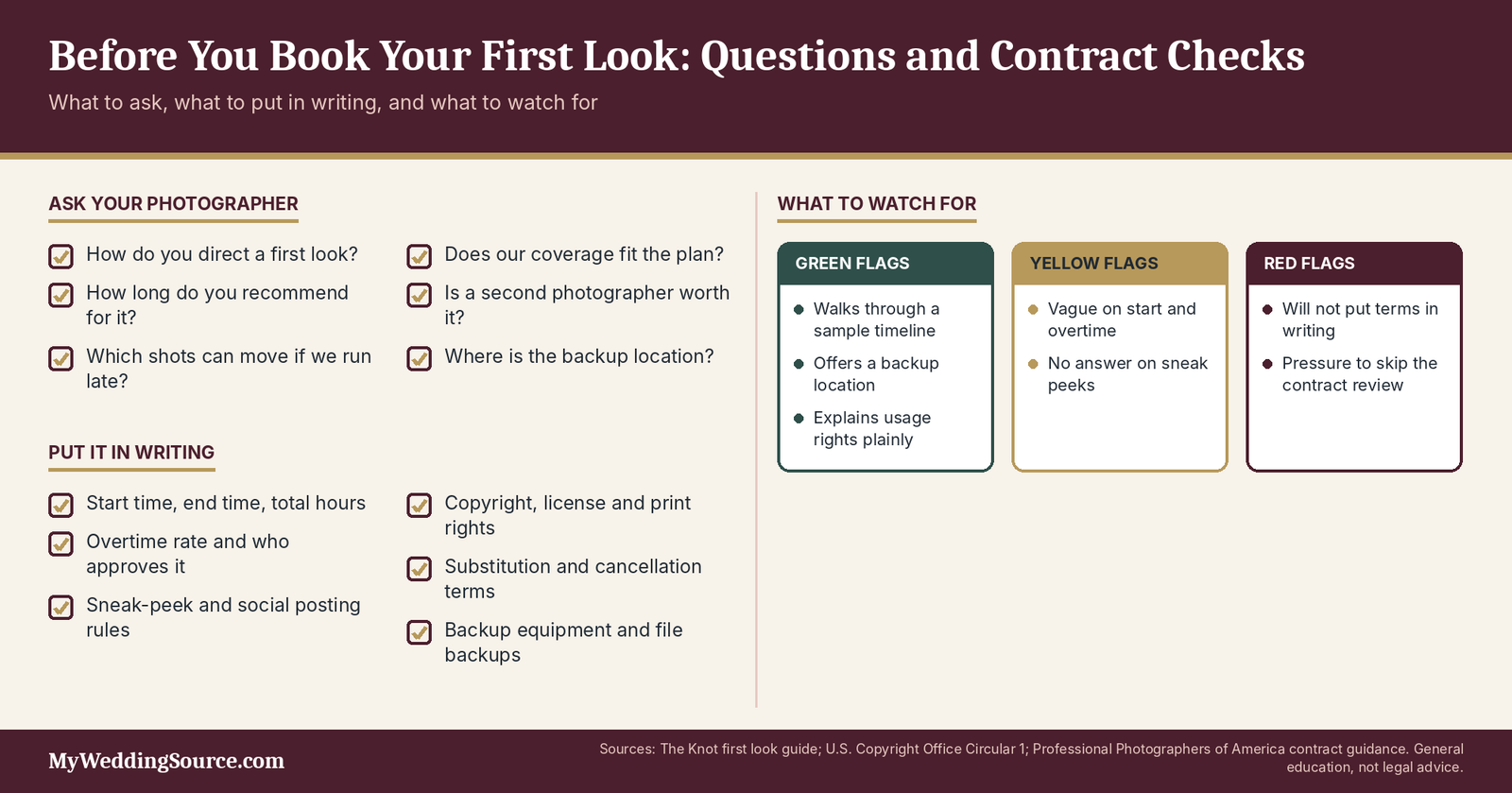
The contract should state the start time, the end time, the total hours and the hourly rate for overtime, because a first look moves the start earlier and can quietly eat the final hour. Check that the start time in the contract matches the time the photographer needs to arrive for getting-ready photos, and that the first look is listed in your timeline document, not just agreed over email. Our guide to a wedding photographer portfolio contract covers overtime, deliverables and backup terms in more depth, and the broader wedding vendor contract guide shows the clauses worth checking in any vendor agreement. Table 6 collects the first-look-specific questions in one place so you can take them to a consultation.
| Question to ask | Why it matters | Where to find the answer |
|---|---|---|
| What are the exact start and end times? | A first look moves the start earlier | Coverage clause |
| What is the overtime rate and who approves it? | Delays can push you past the end time | Overtime clause |
| Which shots are flexible if the timeline slips? | Protects priority photos | Shot list or timeline addendum |
| Is a second photographer included for the first look? | Covers two angles or a split schedule | Staffing clause |
| Can the photographer post sneak peeks before the wedding? | Protects the reveal and your privacy | Usage or marketing clause |
| What happens if it rains or the location closes? | Moves the first look to a backup spot | Weather or contingency clause |
Who owns the photos, and what can you do with them?
Under U.S. copyright law, the copyright in a work generally belongs to its author, and a transfer usually has to be in writing and signed by the owner of the rights, as the U.S. Copyright Office’s Circular 1 explains. In practice that means many wedding photographers keep the copyright and give the couple a license to print and share the images. Rocket Lawyer’s overview describes three common approaches: permission before reproducing, a limited license, or a full copyright assignment, and it notes that some photographers charge more for a release because print sales are a major source of income. For a first look, ask whether the photographer may use the images in marketing, whether they will post anything before the wedding, and how a model release is handled. The Professional Photographers of America contract guidance lists copyright, usage, deliverables and cancellation among the clauses a photography contract should cover.
What happens if the first look goes wrong?
Contracts should answer what happens if the weather turns, the venue closes the location, a vendor runs late or the photographer cannot attend. Ask for a backup location for the first look, a clause that names the photographer assigned to your wedding and a process for substituting someone comparable if they become unavailable. Ask what equipment backups and file backups they use, since a first look is a one-time moment and a failed memory card cannot be reshot. Understand the cancellation and refund terms before you pay a deposit, and pay by credit card when possible so you have dispute options if something goes wrong. If any clause is unclear, ask for it to be rewritten in plain language and keep the signed version.
FAQ: Wedding First Look Questions Couples Ask
These are the questions couples most often raise once the basic decision is made. Short answers appear here, and the sections above explain the reasoning in detail.
Timing and emotion questions
How long should a first look take?
Plan for about 30 minutes, and expect 45 to 60 minutes when you combine the first look with couple portraits. The Knot’s guide says a first look can take anywhere from a few minutes to 30 or more minutes, depending on location, light and whether you exchange vows or gifts. SLR Lounge’s sample timeline gives the first look and couple portraits 45 to 60 minutes together. If a complicated outfit, a long walk to the location or a larger audience is part of the plan, ask your photographer to add a cushion. The reveal itself may last two minutes, but the quiet conversation afterward is where the best photos tend to come from.
How far ahead of the ceremony should it happen?
Most photographers schedule it a few hours before the ceremony. The Knot’s guide says it usually happens a few hours before, depending on the ceremony start time and how long getting ready takes, and Maharani Weddings suggests at least one to two hours. After the first look you will need time for wedding party and family photos, and SLR Lounge suggests hiding for at least 30 minutes before the ceremony. Build in time for touch-ups and a break, since you will probably be photographed for the better part of the afternoon. A good rule is to protect the last 30 to 45 minutes before the ceremony as a quiet buffer.
Will we still feel emotional at the ceremony if we do a first look?
Many couples still feel plenty at the ceremony, because the vows, the music and the people in the room are all still ahead of you. The Knot’s guide says there is no right or wrong way to react, and experts quoted there describe easing nerves as the top reason couples choose a first look. What a first look does change is the surprise of the first sight, and you may find that your reaction at the altar is quieter but steadier. If you want more drama at the ceremony, choose a first touch or the traditional aisle reveal.
Etiquette, privacy and cost questions
Is it rude to skip guests or family at the first look?
There is no wedding etiquette rule that guests must attend, and a first look is traditionally a private moment for the couple and the photographer. Guests generally do not expect to be there, and parents and grandparents often just want to know where the photos will happen and when they will see you. If a loved one will be hurt by being left out, a short family reveal before or after the first look can solve it. Tell people the plan ahead of time so the day does not turn into a surprise.
Will a first look mess up our hair, makeup and outfits?
It can, especially outdoors, which is why timelines include touch-up buffers. Wind, sun, humidity and tears can all affect hair and makeup, and Fox News lists a dirty train or suit and windblown hair among the risks of outdoor photos before the ceremony. Ask your hair and makeup team to stay on site or leave a touch-up kit, pick a sheltered location and wear shoes you can walk in over grass or gravel. A damp cloth, a fan and blotting papers are small things that save time later. Plan for 15 to 20 minutes of touch-ups between the final portraits and the ceremony.
Does a first look cost extra?
Usually not as a separate charge, but it can change the number of hours you need. A first look moves your photography start earlier, so you may need a longer package or a plan to trim late-evening events. Use the contract questions above to confirm hours, start times and overtime, and ask for a written quote if you want a second photographer.
Your Next Steps
Deciding on a first look is easier when you break it into a few conversations. These steps take you from a general preference to a plan your photographer and venue have agreed to. If you are still building the rest of your schedule, our wedding planning hub collects the related checklists.
This week
Talk with your partner and write down your priorities
Sit down together and each list your top three priorities for the day, such as privacy, the aisle moment, daylight photos, time with guests or keeping the morning calm. Compare the lists, because the overlap usually points to the answer, and the differences tell you what needs a compromise. Share any family or faith expectations you have been carrying, and decide who will talk to the officiant or the relatives involved. Choose a decision date, ideally before your timeline is finalized, and note the options you would be happy with, such as a full first look, a first touch or an aisle reveal with early family photos.
Send your photographer four questions
Email your photographer and ask how they approach first looks, how long they recommend for the first look and couple portraits, which photos they would move earlier or later, and whether your current coverage hours fit the plan. Ask for a sample timeline from a wedding with a similar ceremony time and season. Share your venue, ceremony start time and approximate sunset time, and ask them to flag any concerns about light or location. Their answers will tell you whether the plan fits inside your package or whether you need to adjust hours or priorities.
Before you pay a deposit or sign
Check hours, start time and overtime in writing
Read the coverage clause and match it to the timeline you have in mind. Confirm the start time, the end time, the overtime rate and who approves extra hours. Ask for any changes to be added as a written amendment, and keep the signed copy somewhere you can find it. If the contract is silent on the first look, add a line describing the planned time and location so it becomes part of the agreement.
Confirm venue and officiant rules before you finalize the schedule
Ask the venue for its photography policy, the available first look locations and any rules on drones, flash and equipment. Ask your officiant or house of worship about photography limits and whether the couple can see each other before the ceremony. Put the answers in your timeline and share the document with your photographer, coordinator and hair and makeup team. A one-page timeline that everyone has seen is the best protection for the first look, and our wedding photography timeline guide can help you build it.
Sources & methodology
- The Knot, 2026 Real Weddings Study readout (PDF) — 10,474 U.S. couples married in 2025; one in two had a first look.
- The Knot, Real Weddings Study landing page — study scope, timeframe and design.
- The Knot, average wedding cost — $3,000 average photographer cost, $34,200 average wedding cost and 117 average guests.
- The Knot, pros and cons of a first look — expert pros and cons, timing, 56% figure from the 2023 study.
- Zola, First Look Report 2025 — 56% planning a first look with a partner and 41% planning additional first looks.
- Zola, First Look Report data deep dive — first look percentages and survey size.
- David’s Bridal, wedding day photography timeline — block durations and eight-hour coverage.
- SLR Lounge, realistic wedding timeline — first look, family formals, travel and sunset durations.
- Susan Stripling, wedding coverage hours — 6, 8 and 10 hour coverage examples.
- Love Inc. Mag, first look pros and cons — ceremony-time and photographer perspective.
- Fox News, wedding first looks — outdoor first look risks.
- NOAA Solar Calculator — sunrise and sunset by location and date.
- National Weather Service, heat illness — signs of heat exhaustion and heat stroke.
- Smashing the Glass, the badeken — veiling custom and modern first looks.
- Maharani Weddings, first look tips — South Asian first look timing and traditions.
- SLR Lounge, Hindu wedding photography guide — ritual density and consultation advice.
- Lin and Jirsa, Indian wedding timeline — sample first look block within a full day.
- Boise cathedral wedding photography guidelines — an example of house-of-worship photography limits.
- FAA, commercial drone operators — Part 107 Remote Pilot Certificate requirement.
- U.S. Copyright Office, Circular 1 — default authorship and written transfers.
- Rocket Lawyer, wedding photo ownership — common photographer license structures.
- Professional Photographers of America, contract guidance — clauses a photography contract should address.
Verified facts in this article include the survey figures, which are survey findings from couples on the named platforms, and the legal references, which are general education rather than legal advice. Sunset times, sample timelines, the cost arithmetic and the 5-to-10-minute estimates for extra reveals are illustrative or editorial estimates, and cultural and religious practices vary by family and community, so they are described as examples to confirm with your officiant. Photographer pricing is a national average from a single survey and not a quote for any specific place.
Freshness note: recheck The Knot and Zola figures when each publishes its next annual study, normally early in the year, and confirm sunset times for your venue and date about two months before the wedding. Re-read photographer contract terms and venue photography policies each time they change, and verify drone and copyright rules on the FAA and Copyright Office sites before relying on them.