

Wedding insurance is not one product but a bundle of separate promises, usually liability on one side and cancellation or postponement on the other, and the useful question is never “is it worth it?” but “which specific loss would I be unable to absorb, and does this policy’s wording actually pay for it?”
Quick answer
Wedding insurance generally means two things you can buy together or apart. Liability coverage pays for injury or property damage to other people caused by the event, and it does not pay for a canceled wedding. Cancellation or postponement coverage reimburses covered losses such as a vendor’s failure to deliver, a covered illness or injury, or extreme weather. The National Association of Insurance Commissioners (NAIC) says most policies exclude pandemics and communicable diseases, and reimbursement is generally not available if you call the event off yourself. Before you pay for any wedding insurance, list the money you could lose, check what your homeowners, renters, or umbrella policy already does, and compare the exclusions of each quote before you compare the price. This guide gives general information, not insurance, legal, or financial advice.
Most couples spend the early months of planning signing contracts, and each signature creates a small financial promise that you cannot easily take back. A venue deposit, a catering minimum, a photographer’s retainer, and a dress that has already been ordered all become money at risk the moment you pay. Wedding insurance exists to transfer some of that risk to an insurer, but only the part the policy language actually names. The Massachusetts Division of Insurance puts the principle plainly in its consumer guide: a policy is a legal promise to pay for covered losses, not a savings account.
This article is built around that idea. It does not recommend an insurer, a product, or a coverage amount, because those choices depend on your contracts, your venue, your state, and your tolerance for risk. It shows you how to sort the possible losses for wedding insurance purposes, read the wording that decides a claim, normalize quotes so they can be compared, and keep the records an insurer will ask for. If you are still building the overall plan, our wedding budget calculator is the place to find out how much money is committed and when, and our wedding planning checklist shows where an insurance decision fits in the sequence.
Start with the risk the policy is meant to transfer for wedding insurance
Wedding insurance works backward from a loss. Before you read a single quote, it helps to name the losses you are worried about and attach a rough dollar figure to each one. That exercise often shows that the risk you feared most is small, that a risk you had not considered is large, or that your existing policies already cover a piece of it. The first section of any decision about wedding insurance is therefore not shopping but inventory.
Separate cancellation, liability, property, travel, and jewelry exposures in the wedding insurance decision
Five different kinds of loss tend to get lumped together under the single phrase “wedding insurance,” and they are not interchangeable. Each one is triggered by a different event, paid by a different kind of coverage, and documented in a different way. Separating them makes it much easier to see which part of a package you actually need.
List the financial loss attached to each risk, wedding insurance included
Start with a worksheet of your own. For each exposure below, write down the amount of money that would be gone if the worst plausible version happened, and whether the money is already paid or only promised.
- Cancellation or postponement. This is the money you have paid, or are contractually committed to pay, for services that would be wasted if the date fell apart. It includes nonrefundable deposits, final balances that come due before the date, and the cost of rebooking. NAIC describes cancellation coverage as reimbursing rescheduling costs when weather, or the illness or injury of someone in the wedding party or event talent, forces a postponement, and as potentially covering a lost vendor deposit plus extra costs for last-minute replacement vendors.
- Liability. This is not money you have spent but money you might owe someone else. NAIC explains that liability coverage addresses your responsibility for injury or property damage to others caused by the event. A guest who trips on a dance floor and a rented tent that damages a lawn are examples of the kind of event the coverage is designed for. The potential loss is hard to cap, which is why liability limits are quoted in the hundreds of thousands to millions of dollars.
- Property. This covers things that can be damaged or stolen: rented furniture, borrowed equipment, attire, and gifts. NAIC notes that a policy can cover repair or replacement of rented furniture and equipment, and that your homeowners or renters policy may already cover gifts and attire, subject to its limits.
- Travel. If part of your plan involves flying people or yourselves somewhere, the loss includes airfare, lodging, and the honeymoon. NAIC says travel coverage can address lost luggage or a canceled destination wedding or honeymoon, and it warns that a general event policy may not apply to weddings abroad. Our honeymoon planning guide covers the booking side of that exposure.
- Jewelry. Rings are small, valuable, and easy to lose. They are also the item most likely to be treated differently from everything else. NerdWallet lists theft or loss of an engagement ring among typical exclusions in wedding insurance, which means jewelry usually needs its own protection. Our article on engagement ring insurance and its hidden costs goes deeper on that specific decision.
To make the worksheet useful, give each line a status of “paid,” “committed,” or “possible.” A paid deposit that the vendor will not return is a firm exposure. A committed balance that you could still negotiate is softer. A possible liability claim has no ceiling you can calculate, which is the main reason it is sold in large round limits. The Massachusetts guide suggests buying only enough coverage to protect what you need, such as nonrefundable deposits, and avoiding duplicate coverage you already hold. The worksheet is how you find that “enough.”
For scale, the Insurance Business article on 2025 Travelers claims notes that The Knot reported an average U.S. wedding cost of $34,200 in 2025. That is a survey average across couples who responded, not a target and not a measure of your own exposure. Your own worksheet matters more than the national figure.
Identify risks already covered elsewhere
Many couples discover that a portion of their risk is already insured. This is the second half of the inventory, and it can lower the cost of the whole decision. The Massachusetts consumer guide says traditional property and casualty policies usually cover unexpected property losses and liability lawsuits, but they generally do not cover wedding payments already made if plans are disrupted. That sentence divides your worksheet in two: liability and some property exposures may already be handled, while prepaid-vendor exposures usually are not.
Consumer Reports, in an article last updated in 2018, lists the places to look:
- Homeowners or renters insurance may reimburse stolen or lost wedding gifts from your home or car, and it covers guest injuries. Zola adds a caution that coverage may not apply if you pay to use someone else’s home, since an insurer may treat that as a business activity.
- An umbrella policy raises liability coverage for a small premium, according to Consumer Reports, and Zola notes it may already cover special events, so you might not need separate liability coverage.
- Credit cards may reimburse stolen or accidentally damaged gifts, according to Consumer Reports, which gave an example of a basic American Express protection of 90 days from purchase, up to $1,000 per occurrence and $50,000 per account per year. Those figures are from 2018 and card benefits change, so treat them as an example of the type of benefit, not a current promise.
None of these existing policies is likely to reimburse a vendor deposit lost because a caterer went out of business. That is the gap a standalone cancellation policy tries to fill. Whether the gap is large enough to price is a question only your worksheet can answer.
Read exclusions before limits in the wedding insurance decision
Shoppers tend to look at the big number first: a million dollars of liability, a seventy-five thousand dollar cancellation limit. The number matters, but it tells you only how much the insurer will pay if a covered event happens. Exclusions tell you whether the event is covered at all. Reading them first protects you from the most common disappointment, which is a claim for a loss that the policy never promised to cover.
Check known events, weather, illness, vendor failure, alcohol, and valuables
Compare the exclusions that appear across the sources we reviewed. These are the categories to look for in any quote, and each one deserves a direct question to the insurer or agent.
- Known events. NerdWallet lists known or pre-existing conditions among typical exclusions, and Zola lists illnesses tied to pre-existing conditions. In plain terms, a policy is meant to cover surprises, not situations you already knew about when you bought it. If a key family member is already seriously ill when you apply, ask the insurer in writing how that is handled.
- Weather. Zola says most insurers do not accept rain as a reason to cancel or postpone, and NerdWallet draws the same line between rain and extreme weather. Consumer Reports quotes a Travelers representative saying that when weather is declared a state of emergency the policy typically pays, while a localized severe storm is decided case by case, partly on whether the customer had control over the situation. The practical lesson is to ask how the policy defines extreme weather, and whether a tent or indoor backup changes the answer.
- Illness and injury. NAIC says cancellation coverage may apply if key wedding party members or event talent become ill or injured. Zola says triggers can include the illness or injury of you or immediate family members in the wedding party. The definitions of “key” and “immediate family” differ by policy, so read them.
- Communicable disease. NAIC says most policies exclude pandemic and communicable diseases, that many insurers stopped offering communicable disease coverage in mid-March 2020, and that “all cause” or epidemic policies may include such losses. It adds that communicable disease coverage can sometimes be added as a rider, usually at higher cost. NerdWallet lists COVID-19 claims among typical exclusions.
- Vendor failure. NAIC says cancellation coverage may cover a lost deposit when a vendor such as a caterer, florist, or photographer does not deliver, plus extra costs for a last-minute replacement. NerdWallet adds that switching vendors after paying a deposit is a typical exclusion, and that disappointing photos or video quality is as well. The difference is between a vendor who cannot perform and a vendor whose work you did not like.
- Alcohol. NAIC calls liquor liability an optional add-on for alcohol-related incidents before, during, or after the event. NerdWallet says liability policies often include host liquor liability but the treatment differs: one insurer includes it at no extra charge, another charges extra, and another lets you remove it for a premium credit if you will not serve alcohol. If you plan an open bar, our guide to the open bar wedding explains how bar service is typically structured, and the insurance question is worth raising alongside it.
- Valuables and risky activities. NerdWallet lists theft or loss of an engagement ring and risky activities such as fireworks, hayrides, bounce houses, or live animals among typical exclusions. If any of those are on your plan, ask before you assume they are included.
- Changing your mind. Zola and NerdWallet both list cold feet as excluded, and NAIC says reimbursement is generally not available if you call off the event voluntarily.
Note that these are exclusions reported by consumer sources about the market in general. The policy you are quoted controls, and the only reliable way to know is to read the specimen policy form before you pay. If an agent cannot provide the form, that is information too.
Explain deductibles, sublimits, and documentation rules
Three structural features of a policy decide how much you collect even when a loss is covered. They sit in the declarations page and the fine print, and they are easy to miss.
Deductibles. The Massachusetts guide defines a deductible as the amount you pay before the insurer pays, notes that a higher deductible lowers the premium, and cautions that deductibles may apply separately to each loss within a year. For a wedding that might mean two claims, such as a failed vendor and a damaged dress, each with its own deductible. Ask whether the deductible applies per claim or per policy.
Sublimits. A sublimit is a lower cap on a specific category inside a larger limit. It is our plain-language definition, not a term drawn from the sources, and the practical point is simple: a cancellation limit of a certain amount does not mean every kind of loss is paid up to that amount. Gifts, attire, photos, and honeymoon costs are the categories most likely to carry their own caps. Ask for the sublimits as a list. Zola describes optional riders for military deployment, gift theft or damage, wedding attire damage, and honeymoon costs if you cannot travel, each of which is a separate add-on instead of part of the base coverage.
Documentation rules. Every source we reviewed pairs coverage with proof. NAIC advises keeping copies of the policy, vendor contracts, and deposit records, and the Massachusetts guide describes a list of damaged, destroyed, or stolen property and a copy of any police report. We cover the evidence trail in detail in a later section. For now, notice that the documentation rule is part of the policy: if you cannot show the contract and the deposit, you cannot show the loss.
What claim data suggests about where losses come from
It would be convenient to know which risks are most common, so you could focus on those. Public data on wedding insurance is thin, and nearly all of it comes from insurers, which sell the product. With that caveat, one recent data point is worth reading carefully.
Reading the 2025 Travelers claim mix
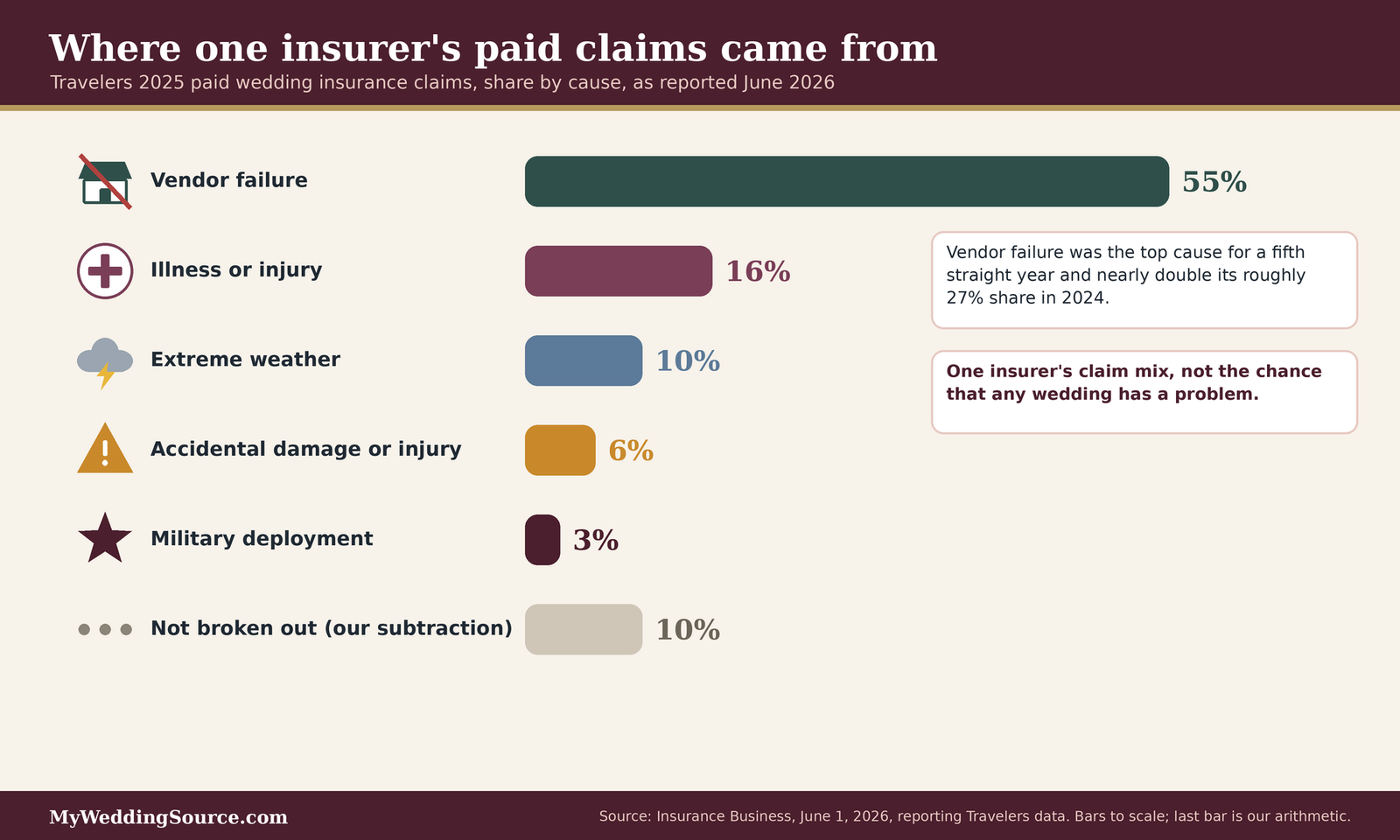
Insurance Business reported on June 1, 2026 that Travelers’ 2025 data showed vendor failures made up 55 percent of paid wedding insurance claims, the top cause for the fifth straight year and nearly double the roughly 27 percent share in 2024. Illness or injury accounted for 16 percent, extreme weather for 10 percent, accidental damage or injury for 6 percent, and military deployment for 3 percent. By our arithmetic, those listed causes add up to 90 percent, which leaves about 10 percent that the article does not break out.
Why the claim mix is a clue, not a forecast
Two cautions apply. First, this is the claim mix of one insurer’s paid claims, not the rate at which weddings suffer each problem, so it cannot tell you how likely a vendor failure is. Second, the share of one cause rising does not mean the total number of claims rose. The same article says vendor risk is rising alongside business bankruptcies and cites bankruptcy statistics, but the article does not show a causal link for wedding vendors specifically. We treat the data as a prompt to read the vendor-failure wording of any policy very carefully, not as a prediction about your wedding.
What wedding insurance costs and how to compare quotes fairly
Prices are the part of wedding insurance where precise numbers are scarce and old numbers linger. Before the figures, a plain statement of limits: the dollar amounts below are published examples from consumer-finance sources, not quotes we obtained, and your own quote will depend on your state, guest count, venue, limits, and the insurer’s underwriting.
What the published numbers say
NerdWallet’s July 2026 update says wedding insurance ranges from under $100 for a single coverage type to over $1,000 for a larger policy covering both liability and cancellation. Its sample Travelers quotes were about $310 for a 50-guest wedding in Utah with $1 million of liability and $7,500 of cancellation coverage, $450 for 100 guests in Illinois, and $780 for 200 guests in California with $2 million of liability and $75,000 of cancellation coverage. The Massachusetts Division of Insurance says the premium depends mainly on the amount of coverage and the deductible. These are examples, not predictions, and they differ in state and limits, so they cannot be compared one-to-one.
Published price points and what drives them
Reading the sample quotes honestly
The three NerdWallet samples are useful mainly for showing the shape of the wedding insurance market. Dividing each premium by its guest count is simple arithmetic, and by our estimate it gives about $6.20 per guest for the Utah example, $4.50 for Illinois, and $3.90 for California. That looks like a volume discount, but it is not safe to conclude that, because the three examples also differ in state, liability limit, cancellation limit, and likely deductible. The only honest takeaway is that a larger wedding with larger limits cost more in total and, in these examples, less per guest.

What moves the price
NerdWallet lists the factors that affect price: guest count and location, which coverage types you buy, the deductibles you choose, and the policy limits. It adds that some insurers discount when you buy liability and cancellation together. NerdWallet also reports that liability limits generally range from $500,000 to $5 million, and that cancellation limits vary: it names Travelers at up to $500,000 in many states, WedSafe from $7,500 to $175,000, and eWed from $5,000 to $100,000. We mention these companies only because the source names them, as data about ranges. This article does not rate, rank, or recommend any insurer.
A caution about age: Consumer Reports published prices in 2018, such as $255 for $25,000 of cancellation and postponement coverage from one program and $235 from another. Those numbers are useful only as history. Do not use a price from a years-old article to decide whether a current quote is fair.
A quote-normalization method you can reuse
When you collect two or three wedding insurance quotes, they will arrive in different formats, with different limits and different definitions. The method below is our own editorial approach, not an industry standard, and it is designed to make the quotes comparable before you look at the premium.
Build the comparison sheet
Create one row per quote and fill in the same columns every time:
- Insurer and licensing. NAIC advises confirming the company or agent is licensed in your state, and the Massachusetts guide suggests checking license status with the state insurance division.
- Cancellation limit and what it counts. Does it cap total reimbursement, or is each covered cause capped separately?
- Liability limit and liquor treatment. Is host liquor liability included, extra, or removable?
- Deductible, and whether it applies per claim.
- Sublimits and riders. Gifts, attire, photography, honeymoon, military deployment.
- Exclusion list, copied word for word. Especially known conditions, weather definition, communicable disease, and vendor-failure wording.
- Effective date and waiting period. NAIC says coverage can take several days to take effect.
- Venue requirements met or not. A column for whether the certificate matches what the venue asked for.
Only after the first eight columns are complete should you add the premium and divide it by the amount of the exposure you actually need to protect.
A worked example with invented numbers
The following scenario is illustrative, not a real quote. Suppose your worksheet shows $14,000 in nonrefundable deposits and balances due before the date. Quote A costs $380, covers up to $20,000, and has a $250 deductible but defines vendor failure to include only bankruptcy. Quote B costs $460, covers up to $15,000, and has a $500 deductible but defines vendor failure to include bankruptcy and a vendor’s failure to appear. Per dollar of limit, Quote A looks cheaper at about 1.9 cents per dollar insured against about 3.1 cents for Quote B, by our arithmetic. But if the risk you are worried about is a no-show photographer rather than a bankruptcy, Quote A may pay nothing in the very case you care about. After normalization, the cheaper quote is the more expensive one in practice, because the trigger you care about is not covered.
The point of the example is the order of operations: match the definitions, then compare the cost. For help deciding how much of your total budget should go toward protection at all, our wedding budget calculator can show how a few hundred dollars fits against your other line items.
Compare policy wording instead of headline coverage amounts for wedding insurance
The headline amount on any wedding insurance policy is a marketing number. The wording around it decides what you will actually be paid. Two policies with the same limit can behave very differently, and the difference nearly always lives in definitions, exclusions, and conditions. This section shows how to line the documents up against each other.
Build an apples-to-apples coverage matrix in the wedding insurance decision
A matrix is simply a way of forcing every policy to answer the same questions. The table below is a starting framework, built from the sources reviewed for this guide. It summarizes the typical position described by NAIC, the Massachusetts guide, Zola, NerdWallet, and Consumer Reports, and it is not a description of any one policy.
| Risk | What is typically covered | Common exclusions | Deductible or sublimit to ask about | Proof you will need | Alternative protection |
|---|---|---|---|---|---|
| Vendor failure | Lost deposit and extra replacement costs when a vendor does not deliver (NAIC) | Switching vendors after paying; disappointing results (NerdWallet) | Per-claim deductible; cap per category | Signed contract, payment records, vendor communications | Written vendor refund and cancellation terms |
| Illness or injury | Rescheduling costs if key people are ill or injured (NAIC) | Known or pre-existing conditions (NerdWallet, Zola) | Definition of key person or immediate family | Medical or provider documentation of the event and date | Flexible contract terms and a date-change clause |
| Weather | Extreme weather; state of emergency typically pays (Consumer Reports) | Ordinary rain (Zola, NerdWallet) | Waiting period; purchase cutoff, such as 15 days before (NerdWallet) | Weather authority reports and venue notices | Indoor backup space; tent contract |
| Liability | Guest injury and third-party property damage (NAIC) | Risky activities such as fireworks or live animals (NerdWallet) | Limit, commonly $500,000 to $5 million (NerdWallet) | Incident report, guest information | Homeowners, renters, or umbrella policy (Consumer Reports) |
| Liquor liability | Alcohol-related incidents, as an add-on (NAIC) | May be removed or excluded if no alcohol served | Whether included, extra, or credited back | Bar service records and bartender details | Venue’s own liquor liability |
| Gifts and attire | Theft or damage, sometimes by rider (Zola) | Items outside the sublimit | Rider sublimits | Receipts, photos, police report for theft | Homeowners or renters policy (NAIC) |
| Travel and destination | Cancelled destination wedding or luggage (NAIC) | Weddings abroad if not stated; foreign-currency limits | Territory; currency of the limit | Itineraries, airline and lodging records | Separate travel insurance; credit card benefits |
| Rings and jewelry | Usually excluded from wedding policies (NerdWallet) | Loss and unexplained disappearance (Travelers) | Per-item cap on standard policy, roughly $1,500 to $5,000 (Travelers) | Appraisal and bill of sale | Scheduled jewelry coverage |
Use the table as a checklist of columns for your own sheet. The empty cells in the real quotes will tell you more than the full ones.
Match definitions and exclusions
The most common mistake is matching the words on the cover page instead of the definitions in the form. “Vendor failure” in one policy can mean bankruptcy only, while another extends to a vendor failing to appear. “Illness” may need a physician’s confirmation. “Extreme weather” may need an official declaration. Copy the definitions onto your sheet word for word, and where two policies use different language for the same idea, write the difference in a note. If a definition seems to be missing, ask the agent where it appears in the form.
Flag endorsements required for the venue or lender
NAIC says some venues require a minimum amount of liability coverage and may want to be named as additional insureds. Your policy may need an endorsement, which is an added form that changes the base coverage, to add them. NerdWallet adds a practical detail: a venue’s own policy typically covers the venue’s liability, not yours, and some insurers will refund a liability policy that does not meet a venue’s requirements. Ask your venue for its requirements in writing before you buy, not after. If you are still comparing venues, our guide to the wedding reception lays out what to ask a venue about contracts, and the wedding catering article does the same for the food contract.
If anyone else, such as a lender or a family member who is financing part of the event, has asked to be protected by your coverage, ask the insurer how that request is handled. For most weddings the party that asks is the venue.
Test realistic claim scenarios in the wedding insurance decision
Reading wedding insurance in the abstract is hard. Running it against concrete events is easier. The table below uses invented, labeled scenarios and classifies each one as likely covered, uncertain, or likely excluded, based on the general positions reported by the sources. This is an editorial illustration and a conversation starter with your insurer. It is not a prediction of how any claim will be decided.
| Scenario | Likely position | Why |
|---|---|---|
| A caterer closes after taking a deposit, and a replacement costs more | Uncertain, often covered if the policy includes vendor failure | NAIC describes lost deposits and replacement costs as possible coverage; definitions vary |
| A hurricane prompts a declared state of emergency | Likely covered under extreme weather, if bought in time | Consumer Reports quotes a Travelers representative saying such events typically pay |
| A heavy rain shower on the day | Likely excluded | Zola and NerdWallet say rain is generally not enough |
| A key wedding party member is hospitalized after the policy took effect | Uncertain, often covered | NAIC lists illness or injury; wording on who is key varies |
| A family member was already seriously ill when you bought | Likely excluded | Known or pre-existing conditions are listed exclusions |
| You decide to cancel because plans changed | Excluded | NAIC, Zola, and NerdWallet all say voluntary cancellation is generally not reimbursed |
| A guest slips and is injured at the reception | Likely covered under liability | NAIC describes injury to others as liability |
| A guest who drank at the reception causes a crash afterward | Uncertain, depends on liquor liability | NAIC calls liquor liability an add-on; NerdWallet says treatment differs |
| The photographer delivers poor-quality images | Likely excluded | NerdWallet lists disappointing photo or video quality as typical exclusion |
| The engagement ring is lost on the honeymoon | Likely not covered by the wedding policy | NerdWallet lists ring loss as typical exclusion; Travelers notes standard policies may not cover unexplained disappearance |
| Flights to a destination wedding are canceled | Only if travel coverage was bought | NAIC says travel can be added; general event policies may not cover other countries |
What happens if the venue closes, a ring disappears, or travel is delayed?
Take the three events named in this heading and follow each through the sources. A venue that closes is the most financially painful of the vendor-failure cases, because it is usually your largest contract. Whether a policy responds depends on whether it treats a venue as a covered vendor and how it defines failure. If a venue closes before the date, you also face the practical problem of finding another one on short notice, which is why NAIC mentions extra costs for last-minute replacement vendors as a covered category in some policies. Ask about both pieces: the deposit and the replacement premium.
A ring that disappears is a different animal. NerdWallet lists ring theft or loss as typical exclusion in wedding insurance, and Travelers explains that standard homeowners and renters policies cap jewelry at a per-item amount that may fall roughly between $1,500 and $5,000 and may not pay for an item that cannot be found without clear evidence of theft. Scheduled coverage, according to Travelers, raises the limit for specific items, and it can address gaps such as accidental damage and unexplained disappearance. Travelers is an insurer and the statement is part of its guidance to customers, so read it as a description of how this product is positioned.
Travel delays are covered only where travel coverage exists. NAIC says travel coverage can address lost luggage or a canceled destination wedding or honeymoon. A general wedding policy may not cover a delayed flight at all, so the right question for your insurer is whether the travel component is part of the policy or a separate one. Our honeymoon planning guide can help you list what you have prepaid.
Show when a claim would fall outside coverage
Most denied wedding insurance claims follow a handful of patterns, and you can check yourself against each one before you buy.
- The loss was foreseeable at the time of purchase. A situation you already knew about is the category of known events. Buy before you know, or accept that the known item is not covered.
- The loss was a choice. Cancellation by your own decision, replacing a vendor you liked less, or being unhappy with results fall outside reimbursement.
- The cause does not match the trigger. Rain and extreme weather are different words, and so are illness and anxiety.
- The paperwork does not match. A deposit paid in cash, without a contract, is hard to prove.
- The timing missed a cutoff. Both Zola and NerdWallet mention that extreme-weather cancellation coverage may need to be purchased a set number of days before the wedding. Zola says some states require at least two weeks, and NerdWallet says it may need at least 15 days. Policies differ, so read yours.
- The property was not in the covered list. Rings, rented items, and gifts can each be a separate category.
If a claim is denied, the Massachusetts guide says to first contact the licensed producer or insurer, and then you may file a complaint with the state division of insurance. NAIC likewise advises contacting your state insurance department when confused about options. That is a general pathway, and details vary by state.
Verify the policy against contracts and timing for wedding insurance
Wedding insurance that fits your worksheet can still fail you if it does not line up with your contracts and your calendar. This section covers the two practical tests: do the paper documents match each other, and does the coverage start when you need it to start.
Check certificate requirements and effective dates in the wedding insurance decision
Two clocks run during planning: the vendor payment schedule and the policy’s effective date. They need to be aligned, and the first mistake people make is to assume they are.
Buy before known-event exclusions become relevant
NAIC suggests considering coverage once vendor contracts or deposits are made, noting that coverage can take several days to take effect. Zola says to start shopping once you are putting down deposits and booking venues, observes that some insurers limit how far in advance you can buy, and says you may be able to add documented, nonrefundable deposits already paid. NerdWallet says insurers generally recommend buying as soon as you start paying deposits, that some allow coverage up to two years ahead, and that liability can often be bought up to the day before the event.

Putting those pieces together, an editorial timeline for wedding insurance emerges. Cancellation coverage has a clear reason to be early: anything that goes wrong before the policy starts is, in effect, a known event. Liability coverage has less urgency, and Zola points out that waiting until you know your RSVP count can help you size it. Our wedding RSVP wording guide and the month-by-month wedding timeline can help you see when the guest count settles.
NAIC also says you can look into coverage in the weeks before the event if you are worried about a covered disruption. Last-minute buying may still be possible, but the waiting period and any purchase cutoffs described above apply, and a problem you already know about is unlikely to be treated as a surprise.
Confirm named insureds and additional insureds
Who is protected is as important as what is protected. The named insured is the person or people the policy is issued to. Many couples assume both partners are included, and they usually should be, but the policy should say so. An additional insured is someone else the policy extends to, typically because a contract requires it. NAIC says venues may want to be named as additional insureds. Ask the venue whether it needs a certificate of insurance, which is a short document the insurer issues to prove coverage exists, and what wording it expects. Check the spelling of the venue’s legal name against the contract, not the logo.
NAIC also advises asking your planner or venue for a list of providers, and confirming the company or agent is licensed in your state. If your wedding is hosted at a private home that you do not own, Zola warns that homeowners coverage may not apply if you pay to use someone else’s home, which is another reason to ask who is named and who is protected.
Keep evidence needed for a claim in the wedding insurance decision
Wedding insurance claims are won on paper. A good file, started early, turns a stressful event into a routine process. The Massachusetts guide and NAIC both emphasize records, and our checklist below adds the pieces that the specific wedding scenarios above would require.
Save receipts, contracts, appraisals, police reports, and communications
Create a folder, physical or digital, and keep these in it for any wedding insurance claim:
- The policy and the specimen form. Keep the declarations page, endorsements, and any certificate issued to a venue. NAIC says to keep the agent’s and insurer’s contact information handy, along with copies of the policy, vendor contracts, and deposit records.
- Vendor contracts and payment proof. Signed contracts, invoices, and a record of how each deposit was paid.
- Communications. Emails and texts with vendors, especially anything that shows a failure to perform or a change of terms.
- Appraisals and bills of sale for jewelry. Travelers says proof of value can include an appraisal or a recent bill of sale, and it recommends professional appraisals at least every five years.
- Police reports for theft. The Massachusetts guide says to give a copy of the list of stolen property to police when theft is involved.
- Photos of items and the venue setup. Photographs of the attire, the rented items, and the setup are cheap and useful.
Our wedding photography guide can also help you decide which of your vendors should deliver a written backup plan.
Document the incident timeline
When something goes wrong, write down what happened while it is fresh. The Massachusetts guide gives the minimum: notify the insurer, protect against further loss, give your producer or adjuster a list of damaged, destroyed, or stolen property and keep a copy, show damaged property if requested, and do not dispose of it until the insurer says you can. The guide notes that it does not specify claim filing deadlines, so assume your policy has one and read it.
A timeline is a simple list. Record the date and time you learned of the problem, who you told, what you were told, what you did to limit the loss, and what you spent. Save screenshots. If a vendor goes silent, note each attempt to reach them. If a guest is hurt, record the facts and names and avoid speculating about fault in writing. The goal is a calm, factual record that you can hand to an adjuster without having to reconstruct it from memory.
Decide whether a standalone policy fits your wedding
Nothing in the sources we reviewed says every couple needs standalone wedding insurance. The Massachusetts guide states that no Massachusetts law requires wedding insurance, and Consumer Reports reports an expert’s skepticism. The decision is genuinely personal, and it helps to look at the case for and against without pressure in either direction.
When existing coverage and contract terms may be enough
Contracts that already limit your loss
If your deposits are small, refundable, or protected by a generous reschedule clause, the amount of risk a policy would transfer is small. Zola’s advice to calculate your potential deposit losses before getting quotes captures the idea: the exposure sets the ceiling on what a policy is worth. Read each contract for refund, rebooking, and substitution terms. Our wedding etiquette guide can help with the conversations about changing plans that follow a postponement.
Policies you already hold
Consumer Reports and NAIC both point to homeowners, renters, and umbrella policies as possible sources of liability, gift, and attire protection that overlap with wedding insurance. If your venue’s requirements are modest and these policies already extend to a scheduled event, a separate liability policy may add little. The question to ask your own agent is whether coverage extends to an event of this kind, in this location, with this guest count.
When a standalone policy is worth pricing
Large nonrefundable commitments
If a large share of your budget is committed to nonrefundable deposits, and you could not absorb the loss of any one of them, then a cancellation policy responds to the very exposure your existing policies leave open. The Massachusetts guide’s advice is to buy enough to protect what you need, such as nonrefundable deposits, without duplicating other coverage.
Venue requirements and hosting alcohol
If a venue requires a certificate of insurance, a short liability policy may be less a choice than a condition of booking. Likewise, if you are serving alcohol, the liquor liability question is worth asking directly. Our wedding ceremony guide and wedding decor guide help you inventory rented items and outside vendors that may add to what the venue asks you to cover.
The skeptic’s case, fairly stated
What critics say
Consumer Reports quotes Robert Hunter of the Consumer Federation of America calling wedding insurance a bad economic deal with many exclusions and limits, and says Consumer Reports generally does not favor specialty insurance covering limited events for a short period. That article was last updated in 2018, so treat it as a long-standing critique, not a current review of today’s policies.
What the other side says
Travelers’ 2025 claim data, as reported by Insurance Business, shows vendor failure as the leading cause of paid claims, and the article says a basic policy costs little relative to the exposure it covers. Both statements about wedding insurance come from sources with a view, one critical and one commercial. Your own worksheet, not either side, should settle the question. As the article reports, about 30 percent of couples buy wedding insurance according to the NAIC, though we did not locate the NAIC’s own statement of that figure.
Questions to ask an agent or insurer before you pay
Write the answers down when you shop for wedding insurance, and ask for the policy form itself, not a summary. If an answer is not in the form, treat it as unanswered.
Questions to ask before you buy wedding insurance
- Is this company, and are you as the agent, licensed in my state?
- How do you define vendor failure, extreme weather, and illness, and where is each defined in the form?
- What is the deductible, and does it apply to each claim or to the whole policy?
- Which categories have sublimits, and what are they?
- What are the purchase cutoffs and the waiting period before coverage begins?
- Does the policy cover a wedding outside the United States, and in which currency?
- Is host liquor liability included, extra, or removable?
- Can you issue the certificate my venue requires, with the exact wording and additional insured name?
- What do I need to submit with a claim, and what are the deadlines?
About the coverage
Definitions and triggers
Ask for the specimen form and read the wedding insurance definitions first. The same word means different things in different forms, and the definition decides the claim. Ask how a known or pre-existing condition is treated and how extreme weather is established. If you are buying cancellation coverage specifically for vendor risk, ask whether a vendor’s failure to appear counts as well as bankruptcy.
Limits, deductibles, and sublimits
Ask for each wedding insurance limit in writing, with the deductible and any category cap. If the policy includes riders, ask for their separate limits. Ask whether the amounts are in U.S. dollars, particularly for destination weddings, as NAIC advises.
About the paperwork and the process
Certificates and effective dates
Ask when coverage starts, how long a binder lasts if one is issued, and what happens if the insurer declines the application. The Massachusetts guide says an insurer can refuse an application and that a binder can provide temporary protection while it decides. Ask for the venue’s certificate request in writing and send it to the insurer yourself.
Claims and complaints
Ask where to report a claim, who to call after hours, and how long you have to report. If you are not satisfied with a response, the Massachusetts guide describes contacting the licensed producer or insurer first and then the state division of insurance. NAIC says your state insurance department can help with questions about event insurance options.
FAQ: wedding insurance questions
Basics
Does wedding insurance cover a canceled wedding?
Wedding insurance pays for a canceled wedding only if you bought cancellation or postponement coverage and the cause is one the policy lists, such as covered illness, extreme weather, or vendor failure. Liability coverage alone does not pay for cancellation, according to NAIC. Reimbursement is generally not available if you cancel voluntarily, so read the triggers and exclusions before you rely on it.
Is wedding insurance required?
Wedding insurance is not required by law in Massachusetts, according to its Division of Insurance, and the sources we reviewed describe it as optional. A venue may require a liability policy or a certificate as a condition of booking, according to NAIC, so ask the venue for its requirements in writing before you decide.
Cost and timing
How much does wedding insurance cost?
NerdWallet’s July 2026 update says under $100 for a single coverage type to over $1,000 for larger policies covering liability and cancellation. Its Travelers examples ranged from about $310 to $780 depending on guest count, state, and limits. Your quote will differ, so collect written quotes with identical limits and compare the exclusions first.
When should we buy wedding insurance?
NAIC suggests considering coverage once vendor contracts or deposits are made, and it notes coverage can take several days to take effect. NerdWallet says insurers generally recommend buying when you start paying deposits and that weather coverage may require purchase at least 15 days before. Policies vary, so check the cutoffs in yours.
Coverage details
Does wedding insurance cover the engagement ring or wedding rings?
Usually not under wedding insurance. NerdWallet lists theft or loss of an engagement ring among typical exclusions. Travelers says standard homeowners policies cap jewelry per item, roughly $1,500 to $5,000, and scheduled coverage can address gaps. Ask your own agent how rings are handled, and keep the appraisal and receipt, as discussed in our ring insurance article.
Does it cover a vendor who goes out of business?
It may. NAIC says cancellation coverage can cover a lost vendor deposit if a vendor does not deliver, plus extra costs for a replacement, but definitions differ between policies. NerdWallet lists switching vendors after paying a deposit as an exclusion. Ask whether failure to appear counts as well as bankruptcy and how deposits are proven.
Liability and existing policies
Do I need liability coverage if my venue has its own insurance?
Possibly. NerdWallet says a venue’s own policy typically covers the venue’s liability, not yours, so check what it includes. NAIC says homeowners or renters policies may cover gaps, depending on whether they extend to a scheduled event. Ask the venue for its requirements and ask your own insurer what applies.
Does wedding insurance cover alcohol-related incidents?
Sometimes. NAIC calls liquor liability an optional add-on for incidents before, during, or after the event. NerdWallet says treatment differs: one insurer includes it, another charges extra, and another allows removal for a credit if no alcohol is served. Ask which applies to your policy, and read how it defines serving alcohol.
Your next steps
Size the exposure
Fill in the risk worksheet
List cancellation, liability, property, travel, and jewelry exposures, with the amount and a status of paid, committed, or possible. Use the wedding budget calculator to confirm what is committed, and mark which contracts are refundable.
Check what you already hold
Before buying wedding insurance, call your homeowners, renters, or umbrella insurer and ask whether the policy extends to your event, and what the limits are for gifts, attire, and jewelry. Write down the answers. Our wedding registry guide can help you plan where gifts will be stored on the day.
Compare and document
Collect two or three written quotes
Request the specimen form from each wedding insurance provider, fill in the comparison sheet, and compare exclusions before premiums. Put the effective date and purchase cutoffs on your month-by-month wedding timeline as dated reminders.
Start the claim folder
Save contracts, deposit proof, appraisals, and the policy documents in one place now. Our wedding planning guide can help you place this step alongside the rest of the plan, and a conversation with your state insurance department is a reasonable step if anything is unclear.
Sources & methodology
How we built this guide
What we relied on
This guide to wedding insurance draws on consumer pages from the National Association of Insurance Commissioners, the Massachusetts Office of Consumer Affairs and Business Regulation, Consumer Reports, Zola, NerdWallet, and Travelers, plus a trade-press report of Travelers’ 2025 claim data. Where a claim comes from an insurer or a commercial publisher, we say so and treat it as practical guidance, not independent verification. The per-guest figures and the quote comparison are our own arithmetic or invented illustrations and are labeled as such. Liability, cancellation, and jewelry terms are described as general positions reported by these sources, not as the terms of any policy.
What we did not do
We did not obtain quotes, read specimen policy forms, test claims, rank insurers, or recommend any product or company. Companies appear only when a cited source names them. Insurance rules and prices vary by state and change over time, and some sources are years old. This is general information, not insurance, legal, or financial advice. Confirm details with a licensed agent and your state insurance department. We also could not locate the original NAIC statement behind the roughly 30 percent purchase rate quoted in the trade-press article.
Source list
Government and regulatory sources
- National Association of Insurance Commissioners, Consumer Insight: Special Event Insurance, hunting for event space: https://content.naic.org/article/consumer-insight-special-event-insurance-hunting-event-space-you-say-yes-learn-about-your-insurance-options
- National Association of Insurance Commissioners, Consumer Insight: Event Insurance: https://content.naic.org/article/consumer-insight-event-insurance
- Massachusetts Office of Consumer Affairs and Business Regulation, What to know before purchasing wedding insurance (May 24, 2018): https://www.mass.gov/news/what-to-know-before-purchasing-wedding-insurance
- Massachusetts Division of Insurance, Wedding insurance consumer guide (PDF): https://www.mass.gov/files/documents/2016/07/ro/weddinginsuranceguide.pdf
Consumer, trade, and insurer sources
- Consumer Reports, Should you buy wedding insurance? (last updated 2018): https://www.consumerreports.org/insurance/should-you-buy-wedding-insurance/
- Zola, Wedding insurance guide: https://www.zola.com/expert-advice/wedding-insurance-guide
- NerdWallet, How to find the best wedding insurance (updated July 30, 2026): https://www.nerdwallet.com/insurance/homeowners/learn/wedding-insurance
- Insurance Business, Vendor failures drive more than half of all wedding insurance claims, Travelers (June 1, 2026): https://www.insurancebusinessmag.com/us/news/breaking-news/vendor-failures-drive-more-than-half-of-all-wedding-insurance-claims–travelers-577323.aspx
- Travelers, Do I need extra insurance for jewelry and other valuable items? (insurer guidance): https://www.travelers.com/resources/home/insuring/when-do-I-need-extra-insurance-for-jewelry-and-other-valuable-items