

Guest pickup windows for rural wedding venues work when each pickup point gets a short, honest range of minutes instead of a single promised time, and when every range is built from drive time, dwell time, and a buffer you can defend, then written onto a one-page dispatch card that the driver, the coordinator, and a trusted friend all hold.
Quick answer
For guest pickup windows for rural wedding venues, give each pickup point a window of about 15 to 30 minutes (our planning range, not a rule) and tell guests the vehicle leaves when the window closes. Build the window from four things: the drive time you measured yourself, the longest stop you will allow, a buffer for slow roads, and the latest arrival that still leaves guests time before the ceremony. Confirm a precise pin, such as a Plus Code, for every pickup point, check phone coverage on the real route, and print the card so nothing depends on a signal. Verify the operator through the Federal Motor Carrier Safety Administration (FMCSA) before you pay a deposit. Every example number in this guide is our own planning arithmetic; replace each one with your operator’s and your own test drive.
A wedding in a field, a farm, a lodge at the end of a county road, or a ranch an hour from the nearest hotel is a lovely thing to plan, and it is a different transportation problem from a ballroom downtown. There is usually no curb to wait at, no rideshare surge to fall back on, and sometimes no address a map app understands. Guests are staying in two or three different places, and one late arrival can push the whole afternoon behind. Guest pickup windows for rural wedding venues are the tool that keeps that from happening, because they turn a vague “the shuttle will come around three” into a plan with edges.
This guide is narrower than our general guide to wedding guest transportation planning, which covers how to size a fleet and check a carrier. Here we assume you already know you need rides, and we focus on the part that goes wrong in the country: when and where each guest is picked up, how long a vehicle will wait, and how everyone stays in touch when a phone shows no bars. The centerpiece is a pickup dispatch card for rural addresses that you can copy, fill in, and hand to a driver. Nothing here is legal, insurance, or safety-engineering advice; where rules matter, we point to the agency that publishes them.
What guest pickup windows for rural wedding venues are, and what changes in the country
Before building anything, it helps to be exact about words, because guest pickup windows for rural wedding venues only work when everyone means the same thing by them. People use “pickup time,” “pickup window,” and “arrival time” interchangeably, and in a rural setting the difference between them is the difference between a calm afternoon and a parking lot of frustrated relatives. This section defines the terms, then lists what is specifically different when the venue is far from a town.
A window is a promise about a range, not a minute
A single pickup time looks tidy on an invitation, but it asks a vehicle to be in exactly one place at exactly one minute, and it asks guests to guess how early to show up. A window replaces that with a range the operator can actually keep. Guest pickup windows for rural wedding venues are most useful when the range is short enough that nobody waits long and long enough that one slow stretch of road does not break the promise.
Three clocks run at once
At every pickup point, three clocks matter. The first is when guests should be ready, which is the moment the window opens. The second is when the vehicle is planned to arrive, which sits inside the window. The third is when the vehicle leaves, which is the moment the window closes. Guests only need the first and third. Drivers and coordinators need all three, and the dispatch card later in this guide has a line for each.
What a window is not
A window is not a guarantee that a vehicle will wait for anyone, and it is not a promise that a guest can arrive at any minute inside it and expect a seat on a specific run. It is also not the same as the ceremony start time, which is a separate deadline that the whole schedule works backward from. Saying plainly what the window does and does not mean, in the first message guests receive, prevents most of the arguments that come later.
What changes when the venue is rural
Rural does not automatically mean harder, but it changes several variables at once, and each one bends the way you set guest pickup windows for rural wedding venues. The U.S. Department of Transportation runs a program for rural and Tribal communities that names safety, mobility, and infrastructure gaps as its focus, which is a reminder that the road network itself is a different animal from a city grid. For a couple, the practical effect shows up in four places.
Distance and sparse lodging
Guests often stay in several small places spread across a wide area: a motel in the nearest town, a few cabins down a lane, a bed and breakfast on another road, a family member’s spare room. Each stop adds a drive and a dwell. A route that looks like one trip on paper is really a chain of short trips, and the window for each stop depends on the ones before it. This is why pickup points deserve deliberate choice instead of defaulting to every guest’s front door.
Addresses, gates, and access
Many rural properties have a street address that routes a driver to the road but not to the right gate, or no address at all for a field entrance. Others sit behind a gate, a cattle guard, a locked lane, or a private road where a large vehicle may not fit. A driver arriving from a different direction than the coordinator expected, or arriving after dark, may not recognize the turn. Precise pins and written arrival notes matter more here than in a town.
Weak or missing signal
A rural drive can include stretches with no phone coverage, which breaks the habit of fixing problems by text. The FCC’s own coverage map is careful to say that its mobile layer models outdoor, stationary use and that real service varies with the device, the tower, and the terrain, so a map is a starting point and not a guarantee. A good plan assumes at least one stretch of the route will be quiet and decides in advance how people check in without a signal.
Fewer backup options
In a city, a stranded guest can usually call a rideshare, flag a taxi, or walk to a lobby. In the country, the nearest backup may be a call to a friend twenty minutes away. That does not make a rural wedding risky; it means the plan has to carry its own backup. A spare seat, a named standby driver, or a rule that the last vehicle sweeps the route are cheap insurance compared with the cost of one stranded grandparent.
Building a pickup window from the ground up
The method below is our own planning approach, not an industry standard. It treats a window as a short sum: the time a vehicle needs to get there, the time it spends loading, and a margin for the unknowns, all measured against the latest arrival the ceremony allows. Do the arithmetic once with real numbers and the rest of the planning becomes a matter of filling in blanks. The same steps apply to guest pickup windows for rural wedding venues of any size, from a dozen riders to a few hundred.
Start with drive time you measured yourself
Drive time is the biggest number in any plan and the one most often taken from an app on a Tuesday morning, which is a weak foundation for guest pickup windows for rural wedding venues. For guest pickup windows for rural wedding venues, the number that matters is the drive time on the day, in the vehicle you will use, on the actual road.
Run the route in the right vehicle
If you can, drive the route yourself, or ask the operator to, at the day of the week and the time of day you will use it. A navigation app is a fair first estimate, but passenger vans and buses are slower on gravel, climbs, and tight turns than a sedan, and a driver unfamiliar with the road may go slower still. Write down the time from each pickup point to the venue and the time between pickup points, and record any stretch where you slowed down and why.
Record two times, typical and slow
One number hides the risk. Record a typical time and a slow time, where the slow time reflects the bad version of a normal day: a farm vehicle ahead of you on a two-lane road, a washboard stretch, a low-water crossing, a school bus, a train. Use the typical time to place the vehicle on the schedule and the slow time to check that the latest arrival still works. If the slow time breaks the ceremony deadline, the window is too tight or the pickup is too early.
Check light, season, and weather
The same road feels different at dusk, in fog, in a hard frost, or after heavy rain. If any of the pickups or returns happen near sunset, look up the sunset time for the date and note it on the card. In a cold or wet season, ask the operator what they do when a road is icy or flooded, and decide whether you would rather move a pickup to a paved hub than run a gravel lane in bad conditions. Our guides to the winter wedding weather plan and the summer wedding heat plan cover the weather side in more detail.
Count dwell time honestly
Dwell time is the minutes a vehicle stands at a stop with the doors open, and it decides how wide guest pickup windows for rural wedding venues need to be. It is the number most often left out of a rural plan, and it quietly eats the window.
Boarding takes longer than it looks
People in formal clothes carry bags, hold gift boxes, help relatives, and stop to talk. A few guests may need extra time on steps or a lift. A planner might guess two or three minutes for a van, and the real number is often several times that. We suggest planning dwell with a stopwatch at the first practice run, or, failing that, assuming about ten minutes for a small group and adding time for every guest who needs help. Treat that as an estimate and replace it with your operator’s experience.
Set a maximum wait, then keep it
A pickup window is only credible if the vehicle leaves when it says it will. Decide the longest the vehicle will stand at any stop, write it on the card, and tell guests. The rule protects the people already on board, and it protects guests who are waiting at later stops. A kind exception made at the first stop becomes a late arrival at every stop after it, which is why the rule works best as a policy and not a judgment call made in the moment.
Plan for guests who need more time
Some guests need extra time to board, or need a vehicle with a lift or ramp, and the window should be built around them and not against them. Ask about access needs on the RSVP, give those guests a named seat and a named pickup, and put their boarding time on the dispatch card. Our guide to wedding transportation for guests using wheelchairs goes into securement, lifts, and what to ask an operator.
Add a buffer for rural unknowns
Buffer is the margin that absorbs the things you could not measure, and it is what lets guest pickup windows for rural wedding venues survive a normal day. It is the difference between a plan that works on a good day and a plan that works on a normal one.
What the buffer is for
On a rural route, the unknowns are ordinary: a tractor, a herd crossing, a detour for road work, a flooded dip, a wrong turn by a driver who has not been there before, a guest who is not at the pickup point. None of these is likely on any single trip, but one of them is likely somewhere in a long day. A buffer lets the plan absorb one small surprise without moving the ceremony.
How much to add
There is no standard figure, and anyone who quotes one is guessing. We suggest sizing the buffer from your own two drive times: the gap between your typical and slow time is a reasonable starting buffer, and a second small buffer at the end of the route protects the ceremony deadline. If your slow time is eight minutes longer than your typical time, plan eight minutes of buffer per leg and one more margin before the ceremony. Adjust after the test drive.
Where to hide the buffer
Put buffer where it protects the people who cannot absorb it. A buffer at the start of the route is wasted if everyone has already boarded. A buffer in the final approach to the venue protects the ceremony. A buffer in the return schedule protects the last guest waiting at the venue. Spreading a few minutes into each of those places is usually better than loading all of it in one spot.
Work one example from start to finish
The example below is invented for illustration. The numbers are assumptions, not quotes, and your route will differ.
The setup
To see guest pickup windows for rural wedding venues in numbers, suppose a farm venue sits 22 minutes from a small town where most guests stay, with a cluster of cabins 12 minutes beyond the first stop and a bed and breakfast on another road, 7 minutes from the cabins. The ceremony is at 4:30 pm. Twenty-four guests need a ride. The operator has two 14-seat vans, so 28 seats are available in a single wave. We assume 10 minutes of dwell at each stop and 8 minutes to unload at the venue.
Door to door versus a hub
If one vehicle visits all three stops and returns, we estimate the full loop at 84 minutes: 22 out, 10 dwell, 12 to the cabins, 8 dwell, 7 to the bed and breakfast, 8 dwell, 9 to the venue, and 8 to unload. If guests instead gather at a single hub in town, the same vehicle needs about 62 minutes: 22 out, 10 dwell, 22 back, and 8 to unload. The hub saves about 22 minutes per loop in this example. The cost is that guests at the cabins and the bed and breakfast have to reach the hub on their own.

What the window becomes
With the hub plan and two vans leaving together, we would set the vehicles to arrive at the hub at 3:20 pm, give guests a window of 3:10 to 3:30 pm, and have the vans leave at 3:30 pm after the 10-minute dwell. On a typical day the vans reach the venue at 3:52 pm and finish unloading by 4:00 pm. On a slow day, with an extra 8 minutes, they finish unloading by 4:08 pm. That leaves 22 minutes of margin before the 4:30 ceremony. If the slow-day arrival ate more than the margin, we would move the window earlier or add a second wave.
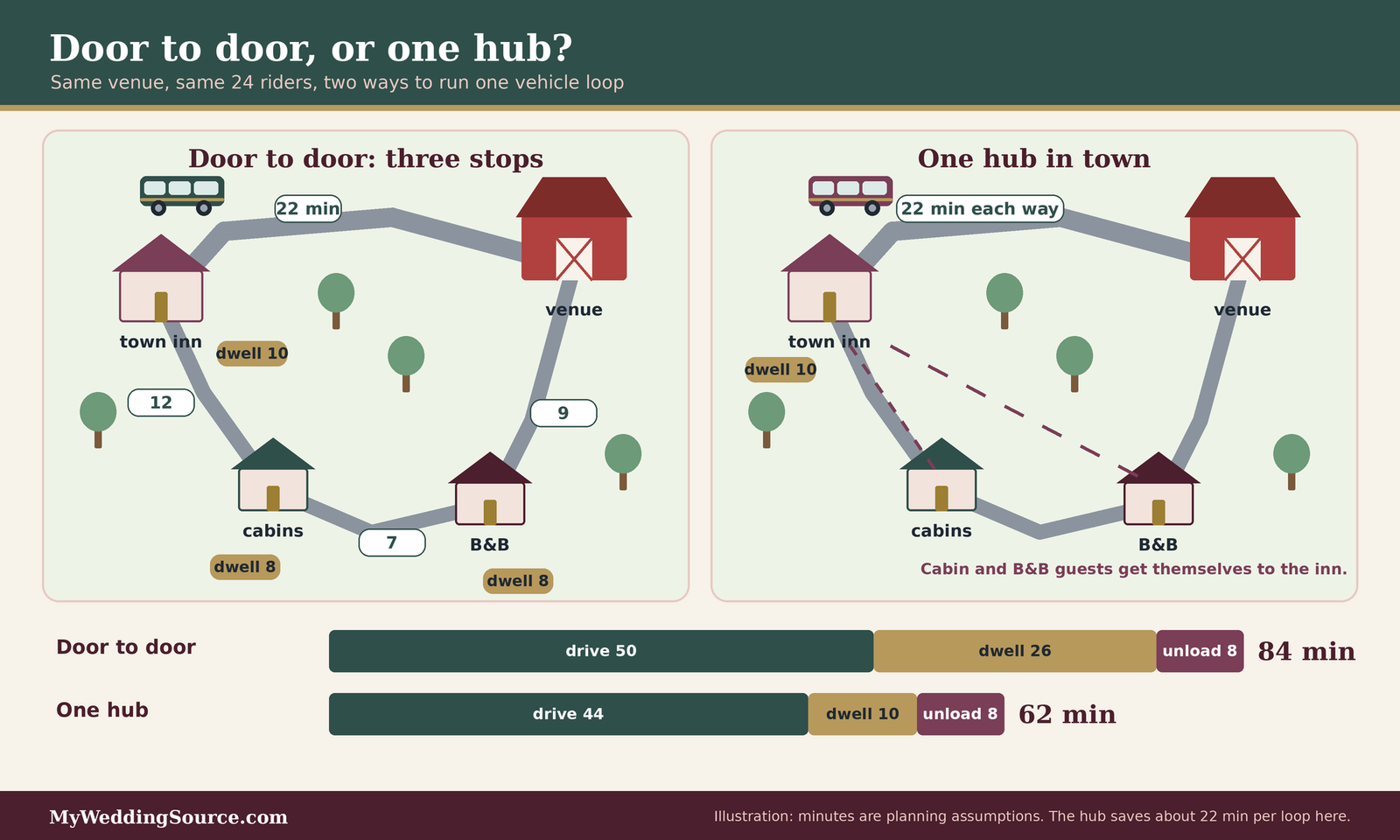
Choosing pickup points: hubs, front doors, or a mix
Once you know how a window is built, the next decision is how many windows you need, since the number of pickup points drives the whole shape of guest pickup windows for rural wedding venues. Every pickup point you add is another window to honor, another dwell, and another place a vehicle can be late. The goal of guest pickup windows for rural wedding venues is not the most convenient stop for every guest; it is the smallest number of stops that still gets everyone there with a margin.
When a hub is the better choice
In practice, guest pickup windows for rural wedding venues are easiest to keep around a hub, a single, easy-to-find place where several guests gather for a vehicle. In a rural area it is often the parking lot of the host hotel, a church, a fire hall, a community center, or a farm stand at a crossroads, and it usually cuts the loop time substantially.
Signs a hub fits your guests
A hub tends to work when most guests are staying within a short drive of one town, when the route to the venue is long, and when the venue road is narrow or unpaved so that fewer vehicle trips are better. It also works when you have limited fleet hours, because a hub lets one vehicle serve many guests in one stop. In our worked example, the hub saves about 22 minutes per loop, which is the difference between needing a second wave and not.
What makes a good hub site
Look for a paved lot with room for the vehicle to turn, clear signage, a safe place to wait, restrooms if the wait could be long, lighting if any window falls near dusk, and permission from whoever owns the lot. A well-known landmark beats an address nobody recognizes. Ask the owner in advance, in writing, whether wedding vehicles may stand there, and whether guests may leave cars there for the evening. Do not assume a business will not tow.
Parking and getting guests to the hub
A hub shifts the first leg onto the guest, so give them real choices: park at the hub, get a ride from a family member, or use a short extra pickup for guests without a car. Our article on wedding signage shows how to mark a pickup point so guests can find it, and the same ideas apply to a lot or lane with no sign of its own.
When door to door still makes sense
A hub is efficient, but it is not kind to everyone, and guest pickup windows for rural wedding venues should leave room for exceptions, and a rural plan should keep a few door-to-door stops for the guests who truly need them.
Guests with mobility or health needs
A guest who uses a wheelchair, walker, or oxygen, or who tires easily, may not be able to reach a hub, and a hub with a long walk from the parking spot defeats the purpose. Decide early which guests get a door-to-door pickup, and ask on the RSVP so the answer is a request and not a surprise. Our accessible wedding guest experience guide has a fuller approach to asking without putting anyone on the spot.
Remote lodging and unusual vehicles
A cabin at the end of a long private lane may be too far to walk and not suitable for a large vehicle. In that case a small vehicle, a pickup truck with a covered bed arranged by a host, or a driver the family knows may do the first leg to a pickup point on a main road. Tell the operator about any road where a long vehicle, low clearance, or a steep grade might matter, and ask whether they would take it.
Small groups and the wedding party
A wedding party, a family, or a few older guests traveling together can ride from the door in a smaller vehicle on a separate window, and the main shuttle then covers the hub. That keeps the large vehicle on the efficient route and gives special groups the time they need. It also gives the couple a quiet departure window that does not depend on the main run.
Naming the pickup point so a driver can find it
Every one of the guest pickup windows for rural wedding venues rests on a stop that a stranger can find. A rural pickup point must be findable by someone who has never been there, in daylight and in the dark, without a signal. That takes three layers of description, and the dispatch card later in this guide has a field for each.
Pins and Plus Codes
A street address often gets a driver to the road but not to the right entrance. Google’s Plus Codes are short codes derived from latitude and longitude that work as an address for places without one, and Google says they work offline and are free to use. To find one, drop a pin in Google Maps, open the pin details, and copy the code. Because a Plus Code covers an area, add or remove characters after the plus sign to make it larger or smaller. Check the code on a second phone before you print it.
Landmarks and turn-by-turn notes
Add a plain-language note a human can follow: the color of a gate, the name on a mailbox, the turn after a particular barn, the distance from the last paved road. Write the note from the direction the driver will approach, because “turn left at the red barn” is wrong if the driver arrives from the other side. If a guest or a host will be waiting, add a high-visibility item, such as a sign, a balloon on the gatepost, or a person in a bright vest.
Gates, codes, and permission
If any stop is behind a gate or a locked lane, name the person with the key or code, confirm that the code works, and put a backup holder on the card. Check whether the vehicle fits through the gate and around the turn, and whether the lane surface can handle it after rain. Do not publish a gate code on a website or an invitation, because those can reach people you did not intend; share it with the driver and the coordinator only.
The pickup dispatch card for rural addresses
This is the working document that guest pickup windows for rural wedding venues are built to produce. A dispatch card is a single page for each pickup point that tells a driver, a coordinator, and a backup person exactly where to be, when, and what to do if the plan breaks. It is not an industry form; it is a planning tool we designed for this article, and you can copy it into a note, a spreadsheet, or a printed sheet.
The card, field by field
A good card for guest pickup windows for rural wedding venues has four blocks: identity, timing, people, and fallback. Fill in one card per pickup point and one per return stop. The table shows every field with a short explanation.
| Block | Field | What to write |
|---|---|---|
| Identity | Guest-facing name | The name guests will see, such as “Hilltop Inn lobby entrance” |
| Identity | Plus Code and pin | The code from a dropped pin, checked on a second phone |
| Identity | Street address | The mailing address, with a note if the map places it wrongly |
| Identity | Approach notes | Turns and landmarks from the direction the driver will come |
| Identity | Access and clearance | Gate, code holder, turn radius, surface, any height or length limit |
| Identity | Waiting spot | Where guests stand: lit, sheltered, off the road |
| Timing | Window opens and closes | The guest-facing range, such as 3:10 to 3:30 pm |
| Timing | Planned arrival | When the vehicle should reach the stop, inside the window |
| Timing | Maximum dwell | The longest the vehicle will stand, such as 10 minutes |
| Timing | Typical and slow drive to next point | Two numbers from the test drive |
| Timing | Latest safe departure | The last time the vehicle can leave and still make the ceremony |
| Timing | Sunset or daylight note | The sunset time on the date, if the window is near dusk |
| People | Expected riders | A count, with a list kept by the coordinator |
| People | Access needs | Lift or ramp, mobility device, service animal, seat transfer, extra time |
| People | Host at stop | Name and number of the person who will be there, if any |
| People | Driver and dispatcher | Names and numbers, plus a backup number |
| Fallback | No signal | Where to check in by voice or in person, and who waits for whom |
| Fallback | Guest not present | What the driver does when the window closes |
| Fallback | Road blocked | The alternate route and who may approve a change |
| Fallback | Vehicle problem | The standby vehicle or driver and how long it would take |
| Fallback | Confirmation | How the driver reports “all riders accounted for” |
Identity: where exactly
The identity block of the card answers the question a driver asks first: where do I stop. The most common failure in rural pickups is a driver at the right road and the wrong entrance, so the pin and the approach notes do most of the work. Make the guest-facing name the same one used on every invitation and sign, so a guest and a driver are always describing the same place.
Timing: when exactly
The timing block holds the three clocks, the dwell rule, and the two drive times. Put the latest safe departure on the card in plain numbers. Guest pickup windows for rural wedding venues only hold if the closing time is real, and this is the line that tells a driver to go when the window closes and a kind-hearted guest asks for one more minute. It is also the line a coordinator checks when the first stop runs late.
People: who and with what
The people block names who is expected, who needs extra help, and who can be reached. Keep the full guest list with the coordinator, not on the card the driver carries, for privacy and to avoid leaving personal information in a vehicle. The card needs counts and needs, not a list of names, which keeps guest pickup windows for rural wedding venues private as well as practical. Include a host at the stop whenever possible, since a familiar face at the gate solves many small problems.
Fallback: what if
The fallback block is what separates a card from a schedule. It answers four questions in advance: what happens with no signal, what happens when a guest is missing, what happens when the road is blocked, and what happens when the vehicle fails. The right answer matters less than having one written down, because decisions made in the moment, in the dark, with no signal, are worse decisions.
A filled-in example
The cards below are invented for illustration. Every name, number, and code is a placeholder to replace.
Hub card: the Hilltop Inn lot
Guest-facing name: Hilltop Inn, front lot. Plus Code: placeholder, to be replaced after a pin check. Approach: from the highway, turn at the sign for the inn; vans park along the left curb. Window: 3:10 to 3:30 pm; planned arrival 3:20 pm; maximum dwell 10 minutes; typical drive to venue 22 minutes, slow 30 minutes. Expected riders: 24. Access needs: one wheelchair user, ramp vehicle assigned to the first van. Host at stop: the coordinator’s assistant. Fallback: if a guest is missing at 3:30, the host texts and offers the next run only if one exists; otherwise the guest receives a ride from the host.
Lane card: the cabin cluster
Guest-facing name: Cedar Lane cabins, gate at the mailbox. Approach: from the county road, the gate is on the right after the creek crossing, about a quarter mile past the last paved driveway. Access: the owner holds the gate code, and the lane is gravel; vehicles over a set length do not fit the last turn. For this reason the pickup is a small vehicle at 3:00 pm, with guests transferred to the main run at the hub. Fallback: if the creek crossing is flooded, guests meet the vehicle at the county road, and the owner brings them up by truck.
Return card: the last sweep
A return card is the same format, in reverse. It lists the venue stop, the planned departure, a second departure for guests who leave late, and the order of drop-offs. The last vehicle of the night sweeps the route, checks each stop for a waiting guest, and reports back before going home. Our guide to a wedding end-of-night ride plan covers return rides in more depth.
Who holds the card, and in what form
A card helps only if the right people have it, in a form that works without a signal.
The coordinator and the driver
Give the full set of cards to the coordinator, the operator’s dispatcher, and the driver of each vehicle. The driver should have a paper copy in the vehicle, because a phone can lose a signal, a battery, or a screen in the sun. If you have a planner or coordinator, ask them to own the cards and see our comparison of a wedding planner vs coordinator for who usually takes this role.
A guest-facing short version
Guests need a short card, not the full one: the pickup name, the window, the rule that the vehicle leaves at the end, and a number to call. Send the short card by message a few days before and again the day before, and print copies for the front desk of any lodging. Do not include gate codes or the driver’s cell number on guest-facing material unless the driver agrees.
A named backup person
Pick one person who is not in the wedding party, who has a car and a phone, and who has the cards. If the coordinator is busy with the ceremony and the dispatcher is out of range, this is the person who can answer a driver’s question. Brief them in person the day before and give them authority to make small decisions, such as releasing the standby vehicle.
Staying in contact when signal is unreliable
A dispatch card works only if people can reach each other, and in rural areas the phone is the weakest link in guest pickup windows for rural wedding venues. The aim is not to assume a signal and not to give up on one, but to learn where the quiet stretches are and plan around them.
Check coverage before you promise anything
Do not guess about coverage. Test it where the vehicles and the guests will actually be.
Use the FCC map as a first pass
The FCC National Broadband Map has a mobile layer that models where certain carriers’ 4G LTE service is expected. You can enter an address or zoom to a location and view each carrier’s layer. The FCC notes that the data reflects outdoor, stationary use and not indoor use or a moving vehicle, and that real service can vary with the device, tower capacity, and terrain. Treat it as a hint about where to look, not as an answer, because guest pickup windows for rural wedding venues need tested numbers.
Drive-test with more than one carrier
On the test drive, watch the signal on your own phone and, if you can, on phones from two or three other carriers. Note where calls drop, where texts stall, and where data stops. Carriers’ own maps may differ from the FCC’s because they can use different assumptions, so people on different plans can have different experiences on the same road. Mark the quiet stretches on a sketch of the route, and share it with the driver and the dispatcher.
Check the pickup points as well as the road
Signal at a hub in town may be fine while the lane to the cabins has none. Check each pickup point, and check indoors too if guests will wait inside. If a pickup has no coverage, plan for it explicitly: a host who waits there, a paper note with the schedule, or a landline at the nearest house with the owner’s permission.
Plan check-ins that do not need a signal
Once you know where the quiet stretches are, add check-ins before and after them.
Check-in points before and after the quiet stretch
Choose a spot just before the signal drops, and a spot just after it returns, and ask the driver to report at each. A short message such as “leaving the hub, 12 aboard” at the last good spot, and “through the ridge, on time” at the first good spot, gives the coordinator a clear picture. If a report is missed, the coordinator knows which stretch to worry about. We drew an example route with a quiet stretch below; the numbers in it are an illustration, not a measurement.

Paper, offline maps, and a voice fallback
Print the cards and a simple map. Many navigation apps let you download an area for offline use, so ask each driver to do that ahead of time and test it with the phone in airplane mode. Ask the operator whether the vehicle has a two-way radio or a company dispatch channel, since either one gives you a way to reach the driver outside phone coverage. If a landline or a host’s home sits near the quiet stretch, note it on the card.
Decide who waits for whom
When a vehicle is late and no one can reach it, the plan needs a rule about how long to wait before acting. For example, if a vehicle has not checked in 15 minutes after a planned report, the coordinator calls the dispatcher, and after 30 minutes, the standby vehicle starts out. Those numbers are ours, as an illustration. Choose your own, write them on the card, and tell the people who must act on them.
Telling guests about their window
The best plan fails if guests do not understand it, and guest pickup windows for rural wedding venues depend on guests following a rule most of them have never met. Communication for guest pickup windows for rural wedding venues has two jobs: give people the few facts they need to be in the right place, and set the expectation that a vehicle leaves when its window closes, in a tone that sounds helpful and not stern.
What guests need to know, and when
Guests are more likely to follow guest pickup windows for rural wedding venues when the plan reaches them in small pieces at sensible times than when it arrives as one long message months early.
On the invitation or wedding website
Say that transportation is provided from a named pickup point, that guests should reserve a seat on the RSVP, and that details will follow closer to the date. Avoid listing precise times this early, because they may change. If your venue is far from lodging, a sentence about distance helps guests plan their stay. Our guides to wedding invitation wording and wedding RSVP wording include ways to ask about transportation without cluttering the card.
A week before
Send each guest their pickup point, window, and the rule about the vehicle leaving, along with a number to call. Include a Plus Code or a pin link for any stop that is hard to find, and the guest-facing name of the stop exactly as it will appear on the sign. If guests might arrive without a signal, suggest they screenshot the message so they have it offline.
The day before and the morning of
Send a short reminder with the window and any change. Ask the lodging owners to place a printed copy at the front desk or in the room. On the morning of the wedding, have the coordinator or a friend confirm with each host that guests know where to go. A short reminder about guest pickup windows for rural wedding venues is less likely to be ignored than a long one, and it gives you a last chance to catch a guest who has the wrong time.
Wording that sets the rule without pressure
A firm rule can be warm, and a warm tone makes the rule easier to follow.
A sample message
Here is a sample of the kind of message that works: “Your shuttle leaves from the Hilltop Inn front lot between 3:10 and 3:30 pm. Please be there by 3:10; the vans will leave at 3:30 so everyone reaches the ceremony in time. If anything changes, call our coordinator at the number below.” It states the place, the window, the reason, and the contact in four sentences. Replace the example details with your own.
Explain the why, once
People accept a rule more readily when they know the reason. A single clause such as “so everyone reaches the ceremony in time” is enough. Repeating the rule in several messages starts to sound like a scolding. Say it clearly in the week-before message, put it on the printed card, and leave it there.
Offer a way out for late guests
Tell guests what to do if they miss the window: call the coordinator, and expect to be offered another ride only if one is available, or to arrange their own. Naming this in advance is gentler than improvising it in the parking lot, and it keeps the rule credible. If a second run exists, say so; if not, say that too.
Choosing and checking an operator for rural runs
A rural route changes what you ask an operator, and the quote should reflect guest pickup windows for rural wedding venues, not just a drive from point A to point B. Most of the questions in our general guides still apply, such as licensing, insurance, and contracts, but a few matter more in the country. The questions below sit on top of the basic checks in our wedding transportation guide and our wedding vendor due diligence checklist.
Questions that matter more in the country
Operators price and plan by the hour, and a rural trip changes how many hours that is.
Distance to your venue and minimum hours
Ask whether the operator charges for the drive from their yard to your first pickup and back, sometimes called deadhead time, and whether there is a minimum number of hours. A venue an hour from the operator’s base can add real cost before a guest boards. Ask for a quote based on your actual itinerary, with every stop and the return, so you can compare operators fairly.
How the cost builds up
Quotes for a rural route often combine an hourly or flat rate, a minimum number of hours, mileage or fuel, travel time to and from your first stop, gratuity or a service fee, and any extra charge for waiting or late changes. Our worked example shows why billable time is longer than ride time: the hub plan is about 62 minutes per loop, but the vehicle is also on your clock while it waits and while it drives to and from the operator’s base. Ask each company to price the same itinerary, including a second wave and a standby vehicle if you want one, and compare the all-in total, not the hourly rate. These figures are our own estimates, not quotes. Our wedding budget guide shows where transportation fits in the larger plan.
Familiarity with the route and the vehicle
Ask whether the driver has run the route and whether the vehicle is suited to the road. A coach that fits a highway may not fit a farm lane, and a van that fits a lane may not fit a group. Invite the operator to do a drive-through if it is practical. A driver who has seen the gate and the turn in daylight is a better bet than one meeting them in the dark.
Driver hours and the length of the day
A long rural day can add up. FMCSA’s hours-of-service summary for passenger carriers says a driver may drive up to 10 hours after eight consecutive hours off duty, and may not drive after the 15th hour since coming on duty without another eight-hour break. A wedding day rarely approaches those limits, but a long itinerary with a long deadhead can. Ask the operator how they schedule drivers for long days, and whether a driver change is planned.
Questions to ask an operator about rural pickups
- Have you driven to this venue and these pickup points, and can the driver do a daylight drive-through?
- What is the longest vehicle you would bring down our lane, and what is your clearance?
- How do you charge for travel from your base, for waiting time, and for late changes?
- What do you do if a road is flooded, icy, or closed on the day?
- What is your standby plan if a vehicle breaks down, and how long would it take?
- How does your driver stay in contact outside cell coverage?
- Will the driver stay on the schedule even if a guest is missing at the end of a window?
- What is your USDOT number, and may we see the insurance on file?
Safety, licensing, and access checks
The basics still apply in the country, and the rural setting makes some of them more important.
Look up the carrier
FMCSA tells travelers to use its Bus Safety Search before choosing a company. You can search by USDOT number or name, then check the safety rating, any out-of-service notice, the five public safety categories, active for-hire passenger authority, and the insurance report. FMCSA also notes that a company without a USDOT number may operate only within one state, so you would contact that state’s oversight agency instead. Look-ups take a few minutes and are worth doing before any deposit.
Insurance levels
FMCSA lists minimum public liability insurance for interstate for-hire passenger carriers of $5,000,000 for vehicles that carry 16 or more passengers including the driver, and $1,500,000 for vehicles that carry 15 or fewer, and the page notes exemptions and was last updated in 2019, so confirm current figures. Intrastate operators follow state rules. Ask for a certificate of insurance, and for any venue or landowner that requires you to be named as additional insured. Our guide to wedding insurance covers event policies.
Accessibility and service animals
Which accessibility rules apply depends on who operates the vehicle and how. Federal rules at 28 CFR 36.310 cover transportation provided by certain businesses that are not primarily in the transportation business, and the Department of Transportation’s Part 37 covers private entities providing certain public transportation. We are not lawyers, so ask the operator directly and, if the question is a close one, a qualified advisor. In plain terms, ADA.gov says staff may ask only whether a dog is needed because of a disability and what task it is trained to do, and may not ask for documentation. A service animal belongs on the card and in the seat plan.
Venue and landowner permissions
Rural venues bring their own set of permissions, and a driver cannot work around a locked gate.
What to ask the venue
Ask the venue about the road to the property, the weight and length limits for vehicles, the turnaround area, the drop-off point, the lighting after dark, and whether any shuttle needs a permit or notice to the neighbors. Our wedding venue questions guide has a longer list. Ask for the answers in writing, and share them with the operator.
Hubs on someone else’s land
If your hub is a business lot, a church, or a farm stand, ask for permission and for the name of someone who can unlock a gate or move a vehicle. Ask whether guests may leave cars overnight, and whether they would be towed. Also ask whether a permit is needed for a large vehicle on a local road; our wedding permits guide explains how to start.
Put it in the contract
Whatever the operator agrees to for guest pickup windows for rural wedding venues, such as the route, each window, the maximum wait, the standby plan, and the fees for changes, should appear in the contract or a written addendum. Our wedding vendor contract guide covers what to look for. A verbal promise is hard to rely on when the vehicle is late and the person who made it is out of range.
Edge cases that break a clean plan
A clean plan survives a normal day. Edge cases show whether guest pickup windows for rural wedding venues were written for the country or copied from a city. These are the situations that test whether the plan was written for the country.
Weather and road conditions
Weather matters more on unpaved or low-lying roads than on a city street, and it can change guest pickup windows for rural wedding venues within a single afternoon.
Flooded crossings and washed-out lanes
A creek crossing that is dry in the morning can be unsafe after a storm. Decide in advance who may call the crossing closed, which alternate pickup you will use, and how guests will be told. A pickup moved from a lane to a paved road should be named on the card as a fallback, and the host with the truck or the extra vehicle should be briefed.
Ice, fog, smoke, and heat
Cold and wet seasons bring ice and fog; dry seasons can bring dust and wildfire smoke; summer can bring heat that makes a long wait at a hub unsafe for some guests. Check the forecast the week before and the morning of, and decide what changes at each threshold. Shade, water, and a shorter dwell help in heat; an earlier window helps in fog or approaching dusk.
Agree on a call rule
Pick one person with the authority to change the plan for safety, usually the operator’s dispatcher or the driver, and agree that their decision stands. Put that on the card. When a driver says a road is unsafe, a couple’s wish to keep the plan is not a reason to override them.
Timing surprises and people surprises
Not every problem for guest pickup windows for rural wedding venues is the road. Some are people, and the plan needs a response for each.
The late guest and the missing guest
A guest arrives after the window closes, or does not arrive at all. The driver leaves on time, and the host at the stop handles the guest. Decide whether the host has a car, whether a second run exists, and who pays for it. Make sure the guest is not left alone at an empty lot, and tell them gently, and in advance, that this is what the rule means.
Extra riders and last-minute changes
A guest brings an unannounced plus-one, or a relative decides to ride at the last minute. Count the seats in the plan, keep a few spare, and ask the operator what happens when a vehicle fills. Our guide to wedding venue capacity and our article on how to calculate shuttle capacity with staggered departures help with the seat math.
Alcohol and the return trip
Rural roads are dark, the nearest backup is far away, and the return half of guest pickup windows for rural wedding venues carries the most risk, and guests have been celebrating. NHTSA reports that 11,904 people died in drunk-driving crashes in 2024, and advises planning a sober ride before the party starts. The return plan matters as much as the arrival plan, so give guests a clear final departure and a clear message that the vehicle is the way home. Our open bar wedding guide covers alcohol planning more broadly.
Guests who drive themselves
Not every guest will ride. Some will drive, and guest pickup windows for rural wedding venues should account for them too.
Parking and directions
Give drivers the same precise pin and approach notes as the shuttle, and tell them about the last stretch of road, the lighting, and where to park. A guest who follows an app to the wrong gate is one more problem for the coordinator. If parking is limited, say so, and offer a hub with a shuttle as the better choice.
The designated driver and the overnight option
Encourage any guest who plans to drink to use the shuttle or to stay nearby, and suggest that couples who drive designate a sober driver in advance. If lodging is available at or near the venue, say so. A guest who has somewhere to sleep does not need a ride at all, which is the simplest return plan of any.
A word about children and the very old
Families with young children and older relatives often leave early. Plan an early return window for them, with a vehicle that suits their needs, and make sure that child seats and mobility aids are addressed with the operator in advance. If you have a child-free wedding, say so on the invitation, since it changes who needs to ride.
FAQ: guest pickup windows for rural wedding venues
Setting the window
How long should a pickup window be?
There is no standard for guest pickup windows for rural wedding venues. Our planning range is about 15 to 30 minutes per stop, long enough to absorb a slow boarding and short enough that guests do not wait long. Base yours on your own drive times, your longest allowed dwell, and the latest arrival that leaves a margin before the ceremony, then adjust after a test drive.
Should the vehicle wait for late guests?
We suggest no, beyond the stated maximum dwell. The window protects the guests already aboard and those waiting at later stops. Tell guests the rule in advance, offer a gentle fallback such as a second run or a host with a car, and let the driver stick to the schedule.
Finding and reaching the stop
How do I give a driver a pickup point with no street address?
Use a Plus Code from a dropped pin in Google Maps, confirm it on a second phone, and add a short written note from the direction of approach. Google says Plus Codes work offline. Also add a landmark and the name of anyone who holds a gate code, and print the card for the vehicle.
What if there is no cell signal on the route?
Check coverage on a test drive with more than one carrier, since the FCC map models outdoor, stationary service and real service varies. Print the cards, download offline maps, choose check-in points before and after the quiet stretch, and agree on how long anyone waits before acting.
Hubs, doors, and guests with needs
Is a single hub better than door-to-door pickups?
Often, because it cuts the loop. In our example a hub took about 62 minutes per loop against 84 for three door-to-door stops. But a hub puts the first leg on the guest, so keep door-to-door pickups for guests with mobility needs or remote lodging, and ask about needs on the RSVP.
How do I plan for a guest who uses a wheelchair?
Ask on the RSVP, then confirm with the operator which vehicle has a lift or ramp, how many securement positions it has, and how long boarding takes. Give that guest a named pickup and extra time on the card. See our wheelchair transportation guide for more detail, and ask the operator in writing.
Operators, rules, and costs
How do I check that an operator is legitimate?
Ask for the USDOT number and look it up in FMCSA’s Bus Safety Search. Check the safety rating, out-of-service status, passenger operating authority, and insurance on file. FMCSA says a company with no USDOT number may operate only within one state, so then contact that state’s agency. Rules vary by vehicle type and operator.
Does a rural route cost more?
Often, because quotes may add travel from the operator’s base, mileage, a minimum number of hours, and waiting time. Ask each company to price the same itinerary, including any standby vehicle, and compare the total. Our figures are estimates, not quotes, so use them only to see where the time goes.
Your next steps
Build the plan
Walk the route and write down two times
Guest pickup windows for rural wedding venues start with a test drive, not a spreadsheet. Drive each leg in daylight, ideally in a vehicle like the one you will use, and record a typical and a slow time. Note every quiet stretch of signal, every gate, and every turn that was hard to see. Our wedding week checklist shows where this fits in the final days.
Fill in one dispatch card per stop
The card is the finished form of guest pickup windows for rural wedding venues. Use the card in this guide, one per pickup and one per return. Confirm each Plus Code on a second phone, write the approach notes from the driver’s direction, and name a host and a backup. Share the set with your coordinator, your operator, and one trusted friend. If you are building the larger schedule, our wedding vendor timeline and wedding weekend event planning guides show how transportation fits.
Tell people and test it
Send the guest-facing card in stages
Guests need guest pickup windows for rural wedding venues in plain words, not in operator shorthand. Put the plan on the invitation or website in general terms, send the specific window a week out, and send a short reminder the day before. Include the rule that vehicles leave at the end of the window. For wider planning, start with our wedding transportation guide and our wedding guest transportation planning article.
Do a short practice run
A practice run is the cheapest way to test guest pickup windows for rural wedding venues before they matter. If the operator can, run one vehicle through the first leg with a stopwatch before the wedding. Time the boarding, check the turn at each gate, and confirm the signal at each check-in point. Adjust the windows to what you learn, and put the updated cards in the vehicle. A small fix at this stage costs nothing on the day.
Sources & methodology
How we built this guide
What we relied on
This guide combines federal guidance on checking passenger carriers, federal summaries of insurance and driver-hours rules, the Federal Communications Commission’s description of its mobile coverage map, Google’s published description of Plus Codes, ADA guidance on service animals and on transportation provided by businesses, and a federal traffic-safety page on impaired driving. The pickup-window method, the dispatch card, every example route, and every minute count are our own planning arithmetic and invented examples; they are estimates to replace with your operator’s numbers and your own test drive. We read each source on November 12, 2026; policies and figures change, so confirm anything that affects a contract.
What we did not do
We did not test routes, vehicles, or operators, and we did not verify any specific company. We are not giving legal, insurance, or safety advice. Which accessibility and licensing rules apply depends on who operates the vehicle and where, so confirm with the operator, your state transportation agency, and a qualified advisor. This guide recommends no operator, product, or service, and it names no company other than the public agencies and Google, whose tools we describe.
Source list
Government and regulatory sources
- U.S. Department of Transportation, Rural Opportunities to Use Transportation for Economic Success (ROUTES): https://www.transportation.gov/rural
- FMCSA, Look Before You Book: Put Bus Safety First: https://www.fmcsa.dot.gov/travelplanner
- FMCSA, Licensing and Insurance Requirements for For-Hire Motor Carriers of Passengers: https://www.fmcsa.dot.gov/safety/passenger-safety/licensing-and-insurance-requirements-hire-motor-carriers-passengers
- FMCSA, Hours of Service for Motor Carriers of Passengers (2022): https://www.fmcsa.dot.gov/sites/fmcsa.dot.gov/files/2022-07/Hours%20of%20Service%20for%20Motor%20Carriers%20of%20Passengers_2022.pdf
- FMCSA, Safety Information for Travelers and Trip Planners: https://www.fmcsa.dot.gov/safety/passenger-safety/safety-information-travelers-and-trip-planners
- eCFR, 28 CFR 36.310, Transportation services provided by public accommodations: https://www.ecfr.gov/current/title-28/chapter-I/part-36/subpart-C/section-36.310
- Federal Transit Administration, Part 37, Transportation Services for Individuals with Disabilities: https://www.transit.dot.gov/regulations-and-guidance/civil-rights-ada/part-37-transportation-services-individuals-disabilities
- ADA.gov, Frequently Asked Questions about Service Animals and the ADA: https://www.ada.gov/resources/service-animals-faqs/
- NHTSA, Drunk Driving: https://www.nhtsa.gov/risky-driving/drunk-driving
- Federal Communications Commission, National Broadband Map, mobile coverage: https://www.fcc.gov/BroadbandData/MobileMaps/mobile-map
Mapping and addressing
- Google Maps, Plus Codes: https://maps.google.com/pluscodes/