

Knowing how to calculate wedding shuttle capacity with staggered departures means counting trips and minutes as carefully as you count seats, because a shuttle that looks big enough on paper can still leave guests standing at the curb when the clock runs out.
Quick answer
Count trips, not just seats. For each vehicle, capacity in your window is the number of trips it can finish before the last useful departure, multiplied by the riders it can realistically carry. A trip takes loading, driving, unloading, the empty return, and a small buffer, and that total is the cycle time. Staggering departures spreads guests evenly and keeps the curb calm, but it can also make a second trip miss the cutoff. Compare total capacity with your rider count plus a reserve of roughly ten percent, then test what happens if the cycle runs five minutes long. This guide shows how to calculate wedding shuttle capacity with staggered departures using formulas, two worked examples, and the questions to put to an operator. It is planning help, not legal, safety, or insurance advice.
What staggered departures change about shuttle capacity
Most couples first ask a seat question: how many people fit on the bus? The better question is how many guests the transport can move to the right place by the right time, and in what order. Staggered departures turn one big, stressful loading moment into several smaller ones, and that changes the math in ways that are easy to miss.
Seats are not capacity
A seat count describes a vehicle standing still. Capacity describes what the vehicle can deliver across a window of time, and the window is set by your ceremony start, your cocktail hour, or the end of the reception.
A seat is a one-time number, capacity is a rate
A 28-seat vehicle that makes one trip moves at most 28 people. The same vehicle on a short route can make several trips and move many more. That is why two couples with the same guest count and the same vehicle can have opposite experiences: one has a ten-minute drive, the other a forty-minute one. When you compare quotes, translate each into riders per hour, not just seats per vehicle. This guide uses simple arithmetic you can do on a phone, and every number in the examples is an assumption you should replace with your own.
Why the rated number rarely gets used
Operators describe vehicles by how many passengers they can carry, but wedding guests rarely fill every seat. Formal clothing, long dresses, gift bags, floral pieces, and groups who prefer to sit together all lower the practical fill. Some guests also need a seat that stays empty beside them. We call the share of seats you plan to use the planned load factor, and we use ninety percent in the examples. That figure is our planning assumption, not an industry standard, so ask your operator what they treat as a comfortable load for formal attire.
Why a wave of guests behaves differently from a line of seats
Guests do not arrive at the pickup point one at a time at a steady pace. They gather in clumps, and clumps create queues even when total capacity is adequate.
Staggering trades a crowd for a cadence
When every vehicle leaves at once, you need every vehicle at the same moment, and all of them return at the same moment. That is wasteful in the middle of the window and tight at the edges. Staggering offsets the departures by a few minutes. The curb sees a steady flow, a volunteer can greet one group at a time, and vehicles come back in a rhythm instead of a pile. The cost is that the last vehicle in the sequence has a later first departure, which matters when the window is short.
Where staggering can hurt
If the cutoff is a hard one, such as guests seated before a ceremony begins, a late-starting vehicle may not complete its second trip before the cutoff. The shortfall shows up as a cliff, not a slope: one vehicle either gets a second run or it does not. The worked example later in this guide shows a plan that is comfortable at one drive time and short by a quarter of the riders when the route takes five minutes longer. Understanding that cliff is the main reason to model the plan before you sign.
How to calculate wedding shuttle capacity with staggered departures
The method has five inputs and six steps. None of it needs special software, only a pencil, a map app, and honest estimates. If you want the wider planning context first, our wedding guest transportation planning guide covers who needs a ride and our wedding transportation overview covers vehicle types and hiring.
Gather the five inputs
Good estimates beat precise guesses. Write down a number for each input and note where it came from, so you can revise it after a test drive.
Riders and the deadline
Start with the number of guests who will actually use the shuttle, not the whole guest list. Use RSVP data and a transportation question on your wedding website to estimate it, then add a reserve. Our wedding RSVP etiquette guide explains how to collect that information politely. Then set the deadline: the time by which riders must be seated and settled, which is usually earlier than the ceremony start. For a ceremony at 4:30 p.m., our example uses 4:10 p.m. as the deadline.
Vehicle seats and load factor
For each vehicle type, write down the usable seats from the operator’s written quote, not from a brochure. Then apply your planned load factor. The result is the effective seats per trip. A 28-seat vehicle at ninety percent gives 25 effective seats, because we round down. Rounding down is deliberate: a fraction of a person is not a rider.
Times for each leg
Estimate four durations. Loading time is how long guests take to board at the pickup point. Drive time is the loaded run, ideally measured at the same time of day as the event on the same day of the week. Unloading time is how long it takes to empty the vehicle at the drop-off. Return time is the empty run back, which can differ if the route is one-way or if a gate closes. Add a buffer of a few minutes per cycle for traffic lights, trains, and slow walkers. We use five minutes.
Apply the six steps
Work through these in order, and keep each answer on your sheet.
Steps one to three: effective seats, cycle time, last useful departure
Step one: effective seats equals usable seats times the planned load factor, rounded down. Step two: cycle time equals loading plus drive plus unloading plus return plus buffer. Step three: the last useful departure equals the deadline minus the unloading time minus the drive time. A vehicle that leaves after that moment cannot get its riders settled in time, so it is not part of the plan.
Steps four to six: trips, total capacity, margin
Step four: for each vehicle, count the departures it can make from its first departure up to the last useful departure, spacing them one cycle apart. Step five: add the trips across all vehicles and multiply by effective seats to get total capacity in the window. Step six: compare that with your rider count plus a reserve, and write down the margin in seats. If the margin is thin or negative, change one input at a time and recalculate.
Define the staggered offset
The offset is the gap between the first departures of consecutive vehicles. It is the one input you control directly.
Pick the offset from the curb, not from the clock
An offset should match how fast a greeter can load one vehicle and send it away. If loading takes ten minutes and the offset is six, the next vehicle will sit behind the first; if the offset is ten or more, each vehicle gets a clean turn but the last one leaves later. In our example we use six minutes because the vehicles line up and board in sequence at one hotel entrance, which is itself an assumption about the site. Check the pickup layout before you decide.
Keep the stagger when vehicles return
Vehicles that leave six minutes apart will return roughly six minutes apart, so the rhythm survives into the second round. That is good for loading but it exposes the cutoff, because the last vehicle’s second departure is also its latest. When you build the schedule, write each vehicle’s departures by name, such as Vehicle A at 2:50 and 3:41, so that nobody has to infer the plan on the day.
Worked example: the arrival run
Here is the full calculation for one realistic scenario, the kind of example people look for when they search for how to calculate wedding shuttle capacity with staggered departures. Every figure is an illustrative assumption and not a vendor specification, so treat it as a template and replace each number.
Set the scene
Imagine 120 guests who will ride from a hotel to a ceremony site. The ceremony begins at 4:30 p.m. and the deadline for being seated is 4:10 p.m. The drive is 14 minutes each way, loading takes 10 minutes, unloading takes 8, and we allow a 5-minute buffer.
The inputs on one line
Each vehicle has 28 usable seats and a planned load factor of ninety percent, so effective seats are 25. Cycle time is 10 plus 14 plus 8 plus 14 plus 5, which is 51 minutes. The last useful departure is 4:10 minus 8 minus 14 minutes, which is 3:48 p.m. We assume the first vehicle can start loading at 2:50 p.m., which gives a departure window of 58 minutes.
Why the first departure is a decision
The first departure is not given by the clock but by how early guests will tolerate waiting. Leaving at 2:50 means guests arrive at the site about an hour and forty minutes before the ceremony, with a long wait in their formal clothes. If the venue has a welcome area with shade and seating, that may be fine; if not, it argues for a later start and more vehicles. Our guide to wedding venue capacity covers how to think about arrival space at the site.
Run the numbers for three vehicles
The table shows what happens with three vehicles under different offsets. We calculated each row with the six steps above.
Compare offsets side by side
| Offset between vehicles | Departures in window | Trips | Total capacity | Margin against 120 riders |
|---|---|---|---|---|
| None (all leave together) | 2:50 (three vehicles), 3:41 (three vehicles) | 6 | 150 | 30 seats |
| 6 minutes | 2:50, 2:56, 3:02, 3:41, 3:47 | 5 | 125 | 5 seats |
| 10 minutes | 2:50, 3:00, 3:10, 3:41 | 4 | 100 | 20 seats short |
| 13 minutes | 2:50, 3:03, 3:16, 3:41 | 4 | 100 | 20 seats short |
What the table is telling you
Leaving together gives the most capacity on paper but forces every guest to be ready at one moment and puts three vehicles at the curb at once. A six-minute stagger keeps most of that capacity, because the third vehicle’s second trip leaves at 3:47, just inside the 3:48 limit. Ten and thirteen-minute staggers lose a trip, and capacity drops below the rider count. The same fleet, the same drive, and the same riders produce a pass or a fail depending only on the offset.

Read the result
A margin of five seats on 120 riders is thin. That is about four percent, well under the ten percent reserve we recommended.
Decide whether the plan is good enough
Ask whether any of your inputs are optimistic. The loading time is the most common culprit, because guests chat, photograph each other, and carry bags. If you cannot defend the ten-minute loading estimate, treat the plan as marginal and add capacity. Four vehicles at a six-minute stagger give 150 seats, a margin of 30, which comfortably exceeds the reserve. A smaller fix is a second pickup point, which cuts loading time for each vehicle and is covered in the edge cases below.
Write the plan so a driver can read it
Turn the calculation into a one-page schedule: vehicle name, first departure, second departure, pickup point, and drop-off point. Put the cutoff time at the top in bold. Hand it to the operator, your planner, and one friend or family volunteer who will manage the curb. Our wedding vendor timeline guide shows how to fold a transport schedule into the broader day-of document.
Stress test: the cliff effect
Anyone learning how to calculate wedding shuttle capacity with staggered departures should also learn how the plan breaks. In the arrival run, one trip is the difference between success and failure, so small delays matter more than they seem.
Test the drive time
Traffic, weather, road work, and event crowds all lengthen the loaded run and the empty return together, which doubles the effect on the cycle.
Add minutes to the route
We reran the six-minute stagger with a longer drive in each direction and a cutoff that moves earlier as the drive grows. At a 14-minute drive, capacity is 125. At 16 minutes, the cycle is 55 minutes and only four departures fit, so capacity falls to 100. At 19 minutes, the cycle is 61 minutes and only the first three departures fit, so capacity falls to 75. These figures come from our arithmetic with the assumptions above, and the pattern, not the exact numbers, is the lesson.
What a few minutes cost
Two extra minutes each way turn a plan that covered every rider into one that left twenty guests behind. That sounds alarming, but it is useful, because it tells you where to spend effort. Measure the drive at the right time of day, ask the operator what route they will take, and consider a dry run if the route is unfamiliar. Our guide to rural pickup windows discusses long and variable drives in more detail.

Test the loading and unloading times
Dwell time is the other half of the cycle, and it is the half most couples forget to estimate.
Slow loading is as costly as a slow road
When we raised loading from ten to twelve minutes in the same scenario, the cycle became 53 minutes, the first vehicle’s second departure moved to 3:43, and the third vehicle’s second departure no longer fit. Capacity fell from 125 to 100. At fifteen minutes of loading, capacity stayed at 100. Loading is controllable in ways that road time is not, which makes it the cheapest lever you have.
Ways to shorten dwell
Stage guests in groups before the vehicle arrives. Assign a greeter with a printed list. Use clear signs that say which vehicle goes where; our wedding signage guide covers wording and placement. Keep one lane open so a vehicle does not wait for another to leave. Ask the driver to open all doors, not only the front one, if the vehicle design allows it. These steps will not remove the need for a buffer, but they help the buffer stay small.
Choose a reserve on purpose
A reserve is the extra capacity you buy to absorb uncertainty. Choose it deliberately, and write down why.
Set the reserve from your weakest input
If your rider count is firm and your drive time is measured, a smaller reserve may be fine. If RSVPs are loose or the route is unfamiliar, a larger reserve is cheaper than a stranded cluster of guests. We suggest starting at ten percent as a planning default and adjusting from there. This is an editorial rule of thumb, not a standard, and the right number depends on your own risk tolerance and budget.
Plan what happens if you run short
Decide in advance who gets priority if capacity falls short: guests with mobility needs, older guests, and anyone traveling with young children are common priorities, but your guests and families may differ. Pick a backup, such as a rideshare credit or a rolling shuttle that keeps running through the ceremony. Put the backup in writing so your driver and your volunteer do not have to improvise.
Peak departure load: the return run
The method for how to calculate wedding shuttle capacity with staggered departures changes slightly on the way home. The trip to the ceremony has a firm deadline and a known crowd. The trip home is the opposite: no deadline, but a crowd that gathers in one or two surges. The ride home needs a different model, built around the peak departure load.
Build the demand curve
Peak departure load is the largest number of guests who want to leave in the same short period. It is a property of your evening, not of your vehicles.
Estimate when guests leave
Guests leave in a pattern. A few go early, a bigger group goes after the cake or the last dance, and a final clump leaves at the end. For the example we assume 120 riders and the following shares across six 15-minute slots from 10:00 p.m.: 10, 15, 20, 25, 20, and 10 percent. Those percentages are our illustration, not data. You can improve the guess by asking the DJ or band when the last major moment falls, and by looking at how the evening is structured. Our wedding weekend event planning guide helps with that wider schedule.
Find the peak slot
In the example, the peak slot is 10:45 to 11:00 p.m., with 30 riders wanting to leave in 15 minutes. That is a rate of about 120 riders per hour. A single 25-rider vehicle on a 47-minute cycle moves roughly 32 riders per hour, which we calculate as 25 times 60 divided by 47. Dividing the peak rate by one vehicle’s rate gives a first estimate of the fleet: 120 divided by 32 is just under four vehicles. This is the quick check, and the simulation below refines it.
Run the queue
A queue model asks what happens minute by minute. We ran a simple one so you can see the pattern, and you can reproduce it on a sheet of paper in a few rows.
The rules of our simulation
The rules were: guests arrive evenly within each 15-minute slot; a vehicle departs when it holds 25 riders or when the oldest waiting guest has waited ten minutes; a vehicle returns to the curb after a 47-minute cycle of loading, driving, unloading, returning, and buffer; all vehicles are at the curb at 10:00 p.m. These are modeling choices, and a different hold rule would change the results. The simulation is our own arithmetic and is an estimate.
What the fleet size did
| Vehicles | Longest queue at the curb | Longest wait for a guest | Average wait | Last vehicle leaves |
|---|---|---|---|---|
| Two | 59 guests | 51 minutes | 28 minutes | 11:55 p.m. |
| Three | 45 guests | 27 minutes | 12 minutes | 11:44 p.m. |
| Four | 27 guests | 13 minutes | 6 minutes | 11:30 p.m. |
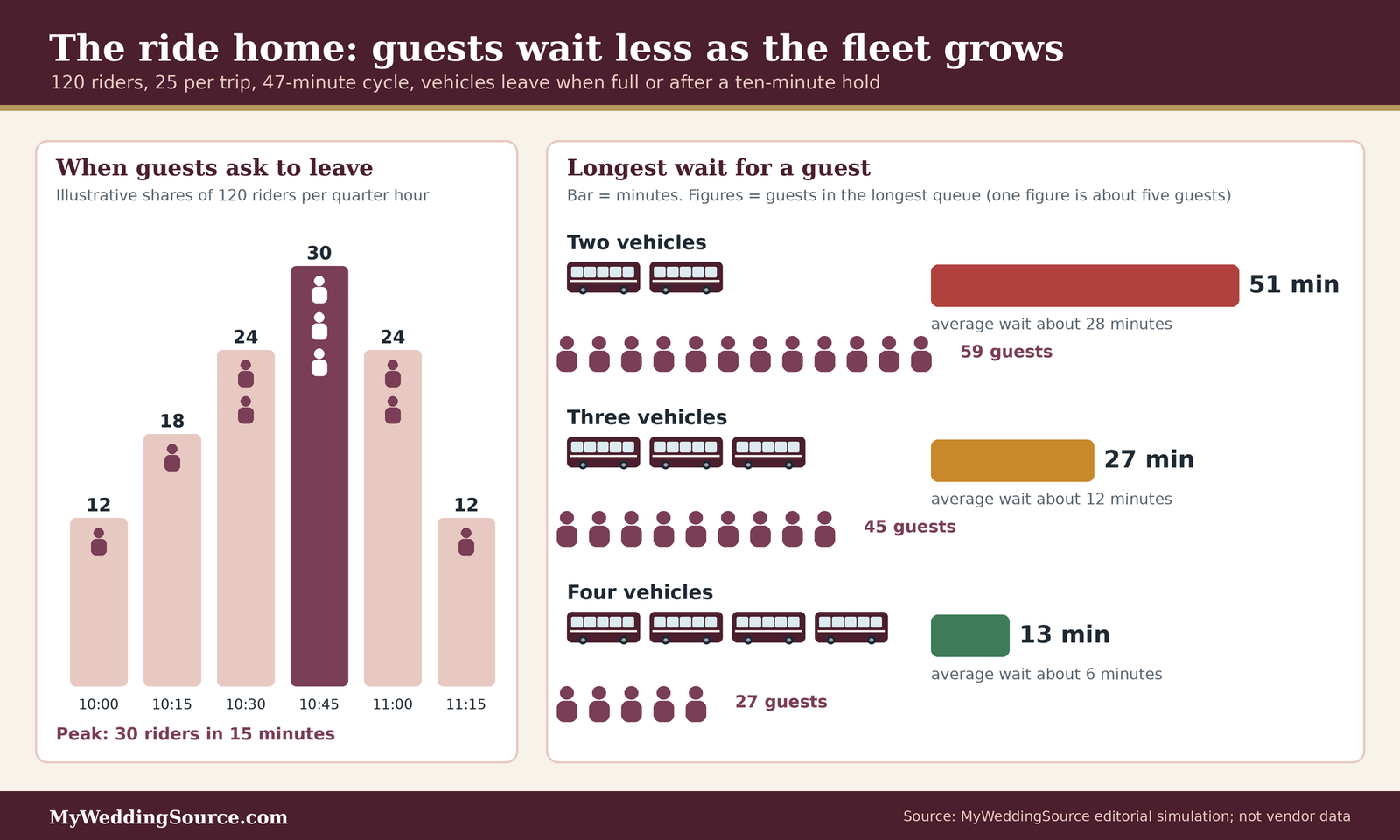
Two vehicles can move everyone eventually, but guests wait nearly an hour at the worst moment. Three vehicles cut the worst wait roughly in half, and four bring it to a little over the ten-minute hold. The gain from the third and fourth vehicle is large because the peak is sharp; a fifth would help less. The right fleet depends on how long you think guests should wait, which is a hospitality decision as much as a math one.
Choose the hold rule
The hold rule is the second lever, after fleet size. It decides how long the first guest in line waits before a part-empty vehicle leaves.
Short holds reduce waiting but burn trips
A short hold sends vehicles out part-empty, which uses up cycle time. In our four-vehicle run, several departures carried well under 25 riders, which is the cost of keeping waits short. A long hold fills vehicles but lengthens the wait. Pick the hold based on the setting: a chilly parking lot argues for a shorter hold, and a comfortable lounge area argues for a longer one.
Tie the hold to a visible signal
Guests will accept a wait if they can see the plan. A volunteer with a sign that says which vehicle leaves next and roughly when, plus a small shaded or heated waiting area, lets guests choose to stay for one more song instead of fretting. If a rideshare backup exists for the last wave, say so, so the final guests do not feel left behind. For a fuller plan for the end of the night, our upcoming wedding end-of-night ride plan goes further into curfews and last calls.
Fleet size and vehicle mix
Once you have a rider count and a cycle time, the remaining choice is what to put on the road. More small vehicles and fewer large ones behave differently under stagger, and accessible vehicles change the arithmetic again.
Many small or few large
The seat count of a vehicle changes the number of departures, the loading time, and the cost of an empty return. None of these is a fixed rule, which is why you should run the numbers for each quote.
Large vehicles mean fewer, heavier departures
A large vehicle carries many riders per trip, so you need fewer trips for the same group. But loading and unloading take longer, and a mostly empty large vehicle wastes more of its cycle. Stagger helps less because a single departure covers a big share of your riders. For a short window with a single, tightly packed group, a larger vehicle often works. For a long, spread-out window, it may sit idle.
Small vehicles mean flexibility and more drivers
Smaller vehicles let you stagger finely and send a part-full vehicle without much waste. They also load faster, can use narrower roads, and give you a better chance of an accessible option. The tradeoff is more drivers, more vehicles to coordinate, and more curb space. Ask how many vehicles the pickup and drop-off areas can hold at once, a point we return to in the edge cases.
Model an accessible vehicle on its own
Do not mix wheelchair-accessible vehicles into a seat total without checking how they are configured. Our guide to wedding transportation for guests using wheelchairs goes deeper on boarding and securement, and our accessible wedding guest experience guide covers the wider picture.
Count positions, not seats
A vehicle with wheelchair positions usually has fewer standard seats than the same vehicle without them. The exact tradeoff differs by vehicle and operator, so ask for a written layout. For a planning example only, suppose a lift-equipped vehicle trades four standard seats for two wheelchair positions. A 20-seat version would then carry 16 standard seats plus two positions. That is an assumption, not a vendor specification, and you should replace it with the real layout.
Allow extra dwell time on purpose
Boarding with a lift or ramp usually takes longer than stepping onto a stair. Ask the operator how long they plan for it and add that time to the loading input for that vehicle only. Do not shorten it to fit a schedule. Guests who need the vehicle should not be the ones who are rushed. Build the accessible vehicle’s departures first and fit the others around them, and note that ADA obligations for transportation providers are a legal matter that your operator should be able to explain.
Vendor, safety, and access checks
A capacity model assumes the vehicle runs the trips you scheduled. Whether it can depends on who operates it, how long the driver can work, and what the operator is legally and financially prepared to do. This section is a consumer checklist, not legal advice.
Check the operator
You can verify more than most couples expect with public tools, and a few minutes of checking can prevent a bad hire.
Look up the carrier with federal tools
The Federal Motor Carrier Safety Administration publishes passenger carrier resources for travelers, including a bus safety search, a guide to looking before you book, and tips for chartering a bus. The agency’s SAFER system lets the public look up company safety data and a licensing and insurance search. FMCSA’s registration page says that a vehicle designed or used to carry more than eight passengers including the driver for compensation needs a USDOT number if it operates in interstate commerce, and it notes that some states require numbers for intrastate operations too. Ask for the operator’s USDOT number and check it yourself.
Ask who actually drives
Some companies sell the booking and subcontract the vehicle. If the company you hire is not the company running the vehicle, you need the subcontractor’s details too. Our guide to wedding vendor subcontractors explains how to ask, and our wedding vendor due diligence checklist gives you a wider set of checks. Put the answer in the contract.
Check hours and insurance
These two checks protect the schedule and protect you. Both can be confirmed in writing.
Driver hours can limit your plan
FMCSA’s summary of hours-of-service rules says passenger-carrying drivers may drive a maximum of ten hours after eight consecutive hours off duty, and may not drive after fifteen hours on duty. For a wedding with a long day, a morning pickup, and a late-night return, the same driver may not be able to cover everything. Ask whether the operator will use more than one driver and how they schedule breaks. These rules apply to covered commercial drivers, and exemptions and state rules vary, so treat this as a prompt for a question and not a conclusion.
Insurance is a document, not a promise
FMCSA lists minimum financial responsibility limits for for-hire passenger carriers: $1,500,000 for vehicles with 15 or fewer passengers and $5,000,000 for vehicles with 16 or more. Those are federal minimums for covered interstate carriers. They are not a measure of whether a given policy suits your event. Ask for a certificate of insurance that names the vehicles, and have your planner or an attorney review it if the contract is unusual. Our wedding insurance guide covers event policies and liability.
Questions to ask
Use these before you book or sign. Ask for the answers in writing, and keep them with the contract.
For the operator
Questions to ask a shuttle operator
- What is your USDOT number, and who owns and operates each vehicle on the day?
- How many usable seats does each vehicle have, and what load do you consider comfortable for formal clothing?
- What cycle time do you assume for this route at this time of day, and how did you estimate it?
- How do you handle a vehicle that runs late, breaks down, or cannot reach the curb?
- How many drivers will you assign, and how do you manage hours and breaks over the whole day?
- Which vehicles have a lift or ramp, how many wheelchair positions do they have, and how long do you plan for boarding?
- What do your hourly rates, minimums, overtime, and waiting charges look like in writing?
- Can you give me a certificate of insurance that lists the vehicles for my date?
For the venue and your own team
Ask the venue how many vehicles can stage at once, where the pickup lane runs, what gate or road limits exist, and whether sound or curfew rules affect departure times. Ask your planner or day-of coordinator who will manage the curb, who holds the schedule, and who has authority to change the plan. Ask your hotel or lodging contact whether guests can board at the entrance, and what to do if the entrance is blocked by deliveries.
Edge cases and adjustments
Real events rarely match a neat template. These situations change the inputs, and each one can be handled with the same six steps.
Route shapes
The simple hotel-to-venue run is only one route shape. Others change the cycle time and the number of places where something can go wrong.
Multiple pickup points
If guests stay at two hotels, you can run a loop that stops at both, but each stop adds loading time and a second cutoff for latecomers. Alternatively, assign one vehicle to each hotel and treat them as separate routes. Compute each route separately, because the cycle times differ, and then check the venue drop-off for congestion when vehicles from both routes arrive together. Stagger across routes as well as within them.
Split ceremony and reception
When the ceremony and reception are in different places, you have two runs and a hard deadline for each. The same vehicle may need to carry guests twice with a wait between, or you may use a second set of vehicles. Our upcoming guide to transportation for split ceremony and reception locations goes deeper. For now, build a separate sheet for each leg and a short list of which vehicles do which job.
Day-of disruptions
Even a good plan needs a margin and a communication path.
Weather and traffic
Rain slows boarding, because guests move more carefully and want to keep dresses dry. It can also slow roads. If rain is possible, lengthen loading and drive by a few minutes in your sheet and check whether the cutoff still works. Our wedding vendor timeline guide helps you think about how a delay moves through the other vendors.
Late guests and no-shows
Plan for the guest who arrives after the last vehicle has left. The options are a standby vehicle, a rideshare credit, or a simple rule that late guests make their own way. Pick one and tell your volunteer. Plan for no-shows too, since they free up capacity: a part-empty vehicle can leave early if the hold rule allows it, which is a good reason to define the hold rule in advance.
Guest differences
Guests are not interchangeable. A few groups change the math.
Families, older guests, and people with limited mobility
Families with strollers, older relatives, and guests with canes need more room and more time. Add boarding time for those groups and consider assigning them to the first departure so they have space and a seat. Do not announce this in a way that singles anyone out; a quiet message in the transportation details works. Our guide on seating for guests who cannot stand for long periods offers related thinking for the venue itself.
Wedding party and vendors
Your wedding party, photographers, and musicians may have different timing from guests and usually should not share a guest shuttle. Make a separate list for them and a separate route if needed. If vendors need to travel between sites, check our wedding vendor meals guide for the broader point that vendors have logistics too, and agree who covers their transport.
Cost and contract
Money decisions are easier when you know what you are buying. In capacity terms, you are buying vehicle-hours and a margin.
What drives the cost
Operators commonly price by the hour with a minimum, and the number of vehicles, the length of the window, and any waiting time all affect the total. We do not quote prices here because rates vary by region, season, and vehicle. For your own estimate, multiply the number of vehicles by the hours each is booked, using your schedule, then compare that with a plan that uses one more or one fewer vehicle. Those figures are your own arithmetic and should be checked against written quotes.
Compare plans by vehicle-hours
A cheaper plan on paper can cost more if it fails and forces a rideshare backup. A fair comparison counts both the hire cost and the risk.
Count vehicle-hours for each plan
For each plan, list when each vehicle starts and ends. Include the first positioning time and the last return. In our arrival example, a three-vehicle plan with a six-minute stagger needs each vehicle for about two hours and fifteen minutes of the afternoon if it runs both trips, and an extra vehicle adds a similar block. That is our estimate from the schedule and not a quote. Ask the operator whether they bill from garage to garage or from first pickup to last drop.
Weigh margin against price
A fourth vehicle in the arrival example raised margin from 5 seats to 30. Whether that is worth the price depends on your budget and how much a stranded group would cost you in stress and goodwill. Our wedding budget guide helps you place the transport line in your overall plan. The answer is yours, and it is fine to accept a thin margin if you have a clear backup.
Put the plan in the contract
Verbal assurances do not survive a busy wedding day. The contract should carry the model.
Write the schedule and the cutoff into the agreement
Attach the departure schedule, the cutoff time, and the number and type of vehicles. Add what happens if a vehicle is late or not available, and who pays for a backup. Our wedding vendor contract guide walks through clauses to look for. If anything is unclear, ask a lawyer licensed in your state. This site cannot give legal advice.
Keep a change log
If you revise the plan after a test drive or RSVP update, write the date and the change. Share the latest version with the operator and your volunteer and ask them to confirm it by reply. An updated schedule that only you have seen helps no one on the day.
Where this method comes from and where it stops
The approach to how to calculate wedding shuttle capacity with staggered departures here is a deliberately small version of ideas used in professional transit planning. Knowing the connection helps you borrow from it without overstating what a wedding sheet can do.
Borrowed ideas from transit planning
Transit planners have long measured how much service a vehicle can deliver across a period, not just how many people it holds.
Capacity as a rate
The Transit Capacity and Quality of Service Manual, published through the National Academies’ Transit Cooperative Research Program, describes quantitative methods for calculating the capacity and operating characteristics of bus, demand-responsive, rail, and ferry services, as well as stops and terminals. The manual is written for public agencies and covers far more than a wedding needs. We took only the habit of thinking in terms of capacity over time and the idea that stops and dwell time matter as much as the road.
Equivalent service as a fairness test
Federal rules for public transportation describe equivalent service for riders with disabilities in terms such as response time, fares, hours, information, and capacity constraints. A private wedding shuttle is not a public transit system, and the legal duties of an operator depend on its type and the services it provides. The ADA’s Title III covers privately operated transit such as charter buses and hotel shuttles, according to ADA.gov. Still, the fairness idea is useful: guests who need an accessible ride should not wait longer or arrive later than everyone else. Ask the operator what the law requires of them and what they will do for your guests.
Limits of a planning sheet
A sheet is a thinking tool. It does not replace an operator’s local knowledge.
What the model leaves out
Our examples treat each trip as identical, with fixed times and a steady load. Real trips vary. The model ignores driver breaks, refueling, parking limits, one-way streets, and the time a vehicle needs to turn around. It also assumes guests arrive on schedule at the pickup point. Treat the numbers as a first draft, and let the operator’s dispatcher correct them.
When to ask a professional
If you are moving a large group, using a complicated route, or relying on rural or restricted roads, a transport dispatcher can build a schedule from experience in minutes. Bring your sheet and ask them to check it. A good dispatcher will tell you whether your cycle time is believable. A transportation or accessibility specialist can review the plan for guests with disabilities. We have not tested any operator’s schedule, and we are not offering safety certification.
Build your own capacity sheet
You can copy the structure of this guide into a spreadsheet or onto one page, so that how to calculate wedding shuttle capacity with staggered departures becomes a document and not a mental exercise. The goal is a document you can hand to someone else.
Set up the sheet
Two small tables are enough: one for inputs and one for departures.
The inputs table
List the rider count, deadline, seats per vehicle, planned load factor, effective seats, the four leg times, the buffer, the cycle time, and the last useful departure. Add the reserve percentage and the resulting target capacity. Color the cells you have measured one way and the cells you are guessing another, so you know which ones to test. A sheet that shows its assumptions is easier to improve and easier for an operator to correct.
The departures table
List each vehicle as a row. For each one, write its first departure, its second departure, and its third, if any, and mark any that fall after the last useful departure. Add a column for the pickup point and one for notes, such as accessible vehicle or family group. Total the trips and multiply by effective seats. Compare that with your target capacity and write the margin at the bottom.
Share the plan
A plan that lives in one head will fail on the day. Share it early and in the right form.
What guests see
Guests need a short message: where to meet, which departure window is theirs, how long the ride is, and who to contact. Avoid presenting the full model. Give each group a clear departure time and a backup. Send the details with your other wedding-weekend information and repeat them on signs at the pickup point. Our plan-your-wedding-timeline guide shows where this message fits among your other deadlines.
What drivers and volunteers see
Drivers and volunteers need the schedule, the cutoff, the pickup and drop-off points, and a phone number for each other. Print it, and give a copy to the venue coordinator. Assign a person who can call the operator and make decisions, which is rarely the couple. Hold a short briefing before the first departure so everyone knows who does what.
FAQ: shuttle capacity and staggered departures
The basics
How do I work out how many shuttles I need?
Divide your rider count plus a reserve by the riders one vehicle can carry in your window. A vehicle carries its effective seats times the number of trips it can finish before the last useful departure. Start with ten percent reserve, count trips for each vehicle, and test the plan with a longer drive and slower loading.
What is staggered departure?
Staggered departure means vehicles leave a few minutes apart instead of all at once. It smooths loading, reduces crowding at the curb, and keeps arrivals flowing. The tradeoff is that later vehicles start later, so in a short window a vehicle may lose a trip. Compare staggered and simultaneous schedules before choosing.
Numbers and assumptions
What load factor should I use?
There is no single right value. We use ninety percent in examples because formal clothing and group seating leave some seats empty. Ask your operator what load they consider comfortable, and use a lower figure for guests with bags, children, or mobility aids. Treat our value as a starting assumption and replace it with theirs.
How long should I allow for loading?
Loading depends on group size, the number of doors, and how organized the pickup point is. We assumed ten minutes for a 25-person group in the example. Time a dry run with friends if you can, or ask the operator what they plan for similar events. Add more time for any vehicle carrying guests who need a lift or ramp.
Safety and access
How do I check that a shuttle company is legitimate?
Ask for the company’s USDOT number and look it up using FMCSA’s public tools, such as the SAFER system and its licensing and insurance search. Ask for a certificate of insurance listing the vehicles for your date, and confirm who actually operates them. Rules differ by state and vehicle size, so ask the operator to explain their authority.
Do driver hours affect my schedule?
They can. FMCSA’s summary of hours-of-service rules says passenger-carrying drivers may drive up to ten hours after eight consecutive hours off duty and may not drive after fifteen hours on duty. A long wedding day can approach those limits, so ask whether the operator will use more than one driver. Exemptions and state rules vary.
Planning for problems
What if guests wait too long on the return run?
Add a vehicle, shorten the hold time, or move part of the surge away from the peak by timing a send-off moment earlier. In our example, a fourth vehicle cut the longest wait from 27 minutes with three vehicles to 13. Give guests a comfortable place to wait and a clear sign of who leaves next.
What if my shuttle runs late?
Decide in advance who calls the operator, how long you will wait before using a backup, and who pays for it. Include those terms in the contract. A short buffer in each cycle and a spare vehicle or rideshare credit for the last group reduce the risk, though they will not remove it entirely.
Your next steps
Build the first draft
Start with numbers you can find today, and revise as you learn more about how to calculate wedding shuttle capacity with staggered departures for your own route.
Estimate riders and measure the route
Add a transportation question to your RSVP, count likely riders, and add a reserve. Drive or map the route at the right time of day and note the loaded and empty times. Our wedding guest transportation planning guide can help you decide who needs a ride. Write both numbers on your sheet with the date.
Run the six steps and one stress test
Fill in the inputs table, work through the six steps, and then rerun the plan with a longer drive and a slower load. If the margin disappears, change one input at a time. The point is to find the cliff before the day does.
Confirm with people who run vehicles
A calculation is only as good as the people who carry it out.
Send the sheet to two operators
Ask each operator to review your cycle time and tell you what they would change. Compare the replies, not just the prices. A response that engages with your numbers is a good sign. Use the questions in this guide, and check each company’s registration and insurance before you sign.
Lock the plan in writing
Attach the schedule and cutoff to the contract, name the person who manages the curb, and send guests a short, clear message. Our wedding vendor timeline guide helps you put it all in one day-of document. Review the plan again a week before the date and confirm any changes in writing.
Sources & methodology
How we built this guide
What we relied on
This guide combines public federal pages on passenger carrier registration, insurance minimums, driver hours, and accessibility with the National Academies’ description of the Transit Capacity and Quality of Service Manual. We fetched each page listed below on November 12, 2026, and we state what each page said without claiming that it is current beyond that date. The FMCSA passenger carrier safety page shows a last-updated date of 2018, so confirm details with the agency. Every seat count, drive time, load factor, offset, demand percentage, and simulation result in this guide is our own illustrative arithmetic, labeled as an estimate, and not a vendor specification or an industry standard.
What we did not do
We did not test any operator, measure any route, or review any policy. We did not give legal, insurance, or safety advice. Rules for charter and shuttle operators vary by vehicle size, interstate or intrastate use, and state law, so confirm requirements with the operator and, where it matters, with a qualified professional. The ten percent reserve and ninety percent load factor are planning defaults we chose, not published standards.
Source list
Federal government sources
- U.S. Department of Transportation, home page: https://www.transportation.gov/
- U.S. Department of Transportation, Trucking and Motorcoaches: https://www.transportation.gov/trucking-and-motorcoaches
- Federal Motor Carrier Safety Administration, Passenger carrier safety: https://www.fmcsa.dot.gov/safety/passenger-safety/passenger-carrier-safety
- Federal Motor Carrier Safety Administration, Do I need a USDOT number: https://www.fmcsa.dot.gov/registration/do-i-need-usdot-number
- Federal Motor Carrier Safety Administration, Summary of hours of service regulations: https://www.fmcsa.dot.gov/regulations/hours-service/summary-hours-service-regulations
- Federal Motor Carrier Safety Administration, Insurance requirements: https://www.fmcsa.dot.gov/registration/insurance-requirements
- Federal Motor Carrier Safety Administration, SAFER company safety data: https://safer.fmcsa.dot.gov/
- Code of Federal Regulations, 49 CFR Part 37, Transportation services for individuals with disabilities: https://www.ecfr.gov/current/title-49/subtitle-A/part-37
- ADA.gov, Introduction to the ADA: https://www.ada.gov/topics/intro-to-ada/
- Federal Transit Administration, Americans with Disabilities Act: https://www.transit.dot.gov/regulations-and-guidance/civil-rights-ada/americans-disabilities-act
Professional and research sources
- National Academies of Sciences, Engineering, and Medicine, TCRP Report 165, Transit Capacity and Quality of Service Manual, Third Edition: https://www.nationalacademies.org/publications/24766