
A winter wedding weather plan is a short set of decisions, thresholds, and named owners that you settle weeks before the date, so that snow, ice, early darkness, a cold room, or a stalled shuttle changes your schedule instead of your guests’ safety.
Quick answer
Write your winter wedding weather plan around five questions: what can fail, what number or alert triggers plan B, who decides and by when, what backup space and transportation exist, and who tells guests and vendors what. Use official National Weather Service alerts and wind chill values as triggers, plan the schedule around sunset on your date and in your city, and treat heaters, power, walkways, and late-night departures as safety items, not decor. This guide gives you a risk register, a contingency activation table, a daylight table for five cities, and a worked scenario you can copy.
Winter weddings have real advantages, and a winter wedding weather plan keeps them: venues are sometimes easier to book, candlelit rooms feel warm, and the season has its own look. The problem is that weather is the one vendor you cannot hire, brief, or replace. A summer rain shower is an inconvenience. A freezing rain event on the road to a venue forty minutes from the nearest hotel is a different category of problem, because it affects whether guests, the caterer, the officiant, and the photographer can arrive at all, and whether they can leave safely afterward.
This guide is for couples, parents, and planners who want a winter wedding weather plan that is specific enough to act on. It assumes your date and venue are chosen. If you are still building the broader schedule, start with our wedding timeline guide and our wedding planning checklist, then come back here to add the winter layer. It is general education, not legal, insurance, or medical advice, and weather rules, venue policies, and contracts vary by place.
What a winter wedding weather plan covers and what it leaves out
A good winter wedding weather plan is narrower than people expect. It does not try to predict the weather months ahead, and it does not replace a full day-of schedule. It adds a layer of conditional decisions on top of the schedule you already have. Keeping that boundary clear stops the plan from turning into a second, competing timeline that no one reads.
A plan is a set of decisions, not a forecast
Long-range forecasting is unreliable, so the useful move is to decide in advance what you will do under each of a few conditions. The plan answers “if this, then that, decided by this person, by this time.” Everything else in this winter wedding weather plan hangs from that structure.
Decide the response before you see the forecast
When a storm is two days away, couples tend to negotiate with each other, with parents, and with vendors at the same time, usually while anxious. Decisions made in that state skew toward either denial or panic. Deciding months ahead that “if the National Weather Service issues a winter storm warning for our county for the wedding day, we move the ceremony indoors and open the shuttle option” removes the argument. You can still adjust, but you are adjusting a plan, not inventing one.
Write the winter wedding weather plan so a stranger could run it
Assume the person running the plan on the day is a coordinator, a venue manager, or a trusted friend who was not in the planning meetings. A good winter wedding weather plan fits on two pages and states each trigger, each action, each owner, and each phone number in plain words. If your winter wedding weather plan only works when you are standing next to it, it will not work at 3 p.m. on the day, when you are in a dress or a suit and not looking at your phone.
What this guide assumes you already have
To keep this page from repeating our broader planning material, we assume you have a date, a venue, a rough guest count, and a draft timeline. If you do not, our wedding planning guide covers the sequence, and our venue questions guide covers what to ask before you sign. Here we focus only on what changes between a mild-weather day and a winter one.
The baseline schedule and vendor list
Have a draft schedule with arrival, ceremony, photos, cocktail hour, dinner, and send-off times, plus a list of every vendor with a mobile number. The winter wedding weather plan will add decision points to that schedule and add backup instructions to each vendor’s contact sheet.
The contract details that matter in winter
Pull out your venue and vendor contracts and look for four things: who is responsible for snow and ice removal on walkways and parking, what the venue’s heating and backup power arrangements are, what each vendor’s weather and cancellation language says, and whether any backup space is included or needs to be reserved. We treat these as questions to confirm, because contracts differ and we cannot read yours. For deeper context on how to evaluate a venue’s terms, see our venue questions guide.
Reading weather alerts without guessing
You do not need to be a meteorologist, but you do need to know what the alert words mean so that the triggers in your winter wedding weather plan are tied to something official instead of a friend’s phone app. In the United States, the National Weather Service issues the alerts, and each local forecast office publishes its own criteria.
Advisory, watch, and warning in plain language
According to the criteria published by the National Weather Service office serving the Detroit area, a winter weather advisory describes a widespread winter event that is hazardous but below warning level, and a winter storm warning is tied to larger snowfall, for example at least 8 inches over 12 or more hours or at least 6 inches over 6 to 9 hours, sometimes combined with rain, freezing rain, sleet, wind, or cold. The same page describes an ice storm warning as a significant, potentially damaging ice accumulation, normally at least a quarter inch, and a blizzard warning as sustained winds or frequent gusts of at least 35 mph with visibility frequently below a quarter mile for at least three hours. It describes a freezing rain advisory as ice that causes driving or walking problems without meeting warning criteria.
Those numbers come from one office. Thresholds differ by region, because a few inches of snow mean something different in Atlanta than in Buffalo, so find your own forecast office’s winter weather definitions and write the alert names, not the numbers, into your winter wedding weather plan. The practical point is the ladder. A watch generally signals that conditions are possible but not certain (the Detroit page we reviewed does not define it separately, so confirm the wording with your own office). An advisory means “expect trouble and prepare,” and a warning means “the event is serious enough that you should be acting on plan B.”
Wind chill is about people, not objects
The National Weather Service describes wind chill as how cold it feels to people and animals when wind pulls heat from exposed skin, and it applies only to people and animals, not to objects such as cars or pipes. The formula is defined for air temperatures at or below 50 degrees Fahrenheit and wind speeds above 3 mph. NWS gives one example: at 0 degrees with a 15 mph wind, the wind chill is about minus 19, and exposed skin can freeze in about 30 minutes. The Detroit office page lists a wind chill advisory for values from minus 15 to minus 24 and a wind chill warning for minus 25 or colder. For a wedding, wind chill matters most for the outdoor moments: the guest walk, the ceremony if it is outside, and the photo session.
Identify the failure modes before designing the pretty version of your winter wedding weather plan
The pretty version of a winter wedding is lanterns, a snowy backdrop, and a hot drink at arrival. The working version asks what has to keep functioning for the day to be safe: roads, parking, walkways, heat, light, power, water, and communication. This section sorts the risks for your winter wedding weather plan and decides which ones deserve a trigger.
List the environmental, access, health, and infrastructure risks
Most winter hazards fall into four buckets, and a single event often hits several at once. Freezing rain can ice a walkway, close a road, and take down a power line within the same afternoon. Listing the buckets helps you see which items are connected.
Separate likely inconvenience from high-impact failure
Not every winter problem deserves a place in the winter wedding weather plan. Some risks are common and mild, such as a few flurries, a slushy parking area, or a late shuttle. Others are unlikely but severe, such as a prolonged power outage in a room with no backup heat, or an icy approach road with no alternative route. A simple test sorts them: ask how likely the risk is on your date in your region, and ask what happens to guest safety if it occurs and nothing is done. Anything with a serious safety consequence gets a trigger and an owner even if it is unlikely. Anything that merely makes the day less comfortable gets a line in the checklist.
The table below is a starter risk register for a winter wedding weather plan. It is our own editorial synthesis, built from the official guidance cited in the Sources block, and the likelihood and impact ratings are judgments that will differ by region and venue, so adjust them to your date and place.
| Risk | Likelihood | Impact | Trigger | Prevention | Owner | Plan B |
|---|---|---|---|---|---|---|
| Snow or ice on approach roads | Region dependent | High | NWS winter weather advisory or warning for the venue county | Lodging near the venue, flexible arrival window | Couple | Shuttle from lodging, shift the schedule later |
| Ice on walkways and parking | High in freezing climates | High | Air temperature at or below freezing with any moisture | Written snow and ice removal duty, salt or sand on hand | Venue, with a couple check | Close the icy route, use an alternate entrance |
| Early darkness | Certain | Medium | Sunset before the ceremony ends | Lighting on every route, ceremony time set around sunset | Couple and planner | Move photos earlier, light the path |
| Cold at the outdoor moment | Likely | Medium to high | Wind chill at the level you choose in advance | Short outdoor segment, blankets, indoor waiting room | Planner | Move the ceremony indoors |
| Heating failure or power outage | Low | High | Venue reports an outage or heat below comfortable temperatures | Ask about backup power and heat; carbon monoxide alarms | Venue | Move to backup room, shorten the event |
| Vendor cannot arrive | Medium | High | Road closure or travel advisory | Vendor arrives early, backup contacts | Vendor, with planner | Substitute plan in the contract |
| Late-night departure on icy roads | Medium | High | Conditions worsen after dinner | Shuttle, lodging, an earlier send-off | Couple and planner | Offer rooms, serve a late snack, wait |
Identify which risks the venue controls and which you control
Responsibility is often unclear until something goes wrong. The venue usually controls the building: heat, backup power, snow and ice removal on its own property, and the layout of any indoor backup space. You usually control your own guests’ arrival plan, the schedule, attire guidance, and which vendors you hire. Vendors control their own travel. Mapping who controls what in advance turns arguments into assignments, and it is the backbone of a workable winter wedding weather plan.
Put a column in your own planning document with three headings: venue, couple, and vendor. Write each risk under the party that can actually fix it. If you cannot assign a risk to anyone, it is a gap, and gaps are exactly what this plan exists to find. We cover how to document these assignments later, in the on-site verification section.
Set objective triggers for plan B
In a winter wedding weather plan, a trigger is a measurable condition that starts a specific action. Without triggers, plan B becomes a mood. With triggers, it becomes a procedure that anyone on the team can follow.
Use weather, capacity, temperature, or access thresholds
Good triggers are things you can check without opinion. Examples include an official National Weather Service winter storm warning or ice storm warning covering the venue or the major approach roads, a wind chill value at or below a number you choose for outdoor segments, a road closure reported by the state transportation department, a venue notice that heat or power is out, or a vendor reporting that they cannot arrive by the time you set. Choose the wind chill number yourself, with your oldest and youngest guests in mind. The National Weather Service example of about 30 minutes to frostbite at minus 19 shows how serious the extreme end is, but discomfort and risk for older adults, children, and people in thin formal clothing start far earlier. Consider setting a more conservative outdoor threshold than the extreme end, and treat that as a judgment, not a rule.
Capacity thresholds matter too. If the backup room holds 90 and you have 120 guests, you need a different plan than if it holds 150. We work through that math in the redundancy section.
Name who decides and by what deadline
A trigger without a decision-maker is a recommendation nobody has to follow. Name one person with the authority to say “we are moving indoors,” and name a backup if that person is unreachable. Many couples choose the planner or day-of coordinator, with the couple holding veto only for the ceremony location. Then attach deadlines, because the lead time is what makes the decision workable. A caterer needs time to re-plan service, a shuttle company needs time to dispatch, and guests need time to read a message. The table below shows a sample set of deadlines. These time marks are our editorial suggestions, not industry standards, so confirm each vendor’s own lead time.
| Decision point | Typical timing before the ceremony | Who decides | Guest communication | Vendor action |
|---|---|---|---|---|
| Watch the forecast | Seven days out | Planner | None yet, unless lodging advice helps | Confirm contacts, ask about early arrival |
| First go or no-go on the outdoor segment | Three days out | Planner with the couple | Short note: possible change, check the wedding website | Caterer and rental company told the likely plan |
| Final decision on the venue layout | Twenty-four hours out | Named decision-maker | Text or email with the exact plan and arrival advice | Rentals, florals, and catering set to the final layout |
| Transportation go or no-go | Twelve hours out | Planner with the shuttle company | Departure times and pickup points | Dispatch drivers, confirm routes |
| Day-of check | Four to six hours out | Coordinator | Only if something changes | Vendors confirm ETA by text |
| Last-minute change | Two hours out or less | Coordinator | One short message, then staff at entrances | Vendors follow the written backup |
Treat the table as a template for your own winter wedding weather plan. A venue with limited indoor space may need its final layout decision earlier, and a caterer with a long drive may need a different deadline.
Early darkness: plan the day around sunset
In winter, the short days change the schedule in a way no single forecast does. If your ceremony is at 4 p.m. in December, there may be almost no daylight left by the time it ends. Building sunset into the winter wedding weather plan early is easy, and cheap compared with fixing it on the day.
Sunset math for your date and city
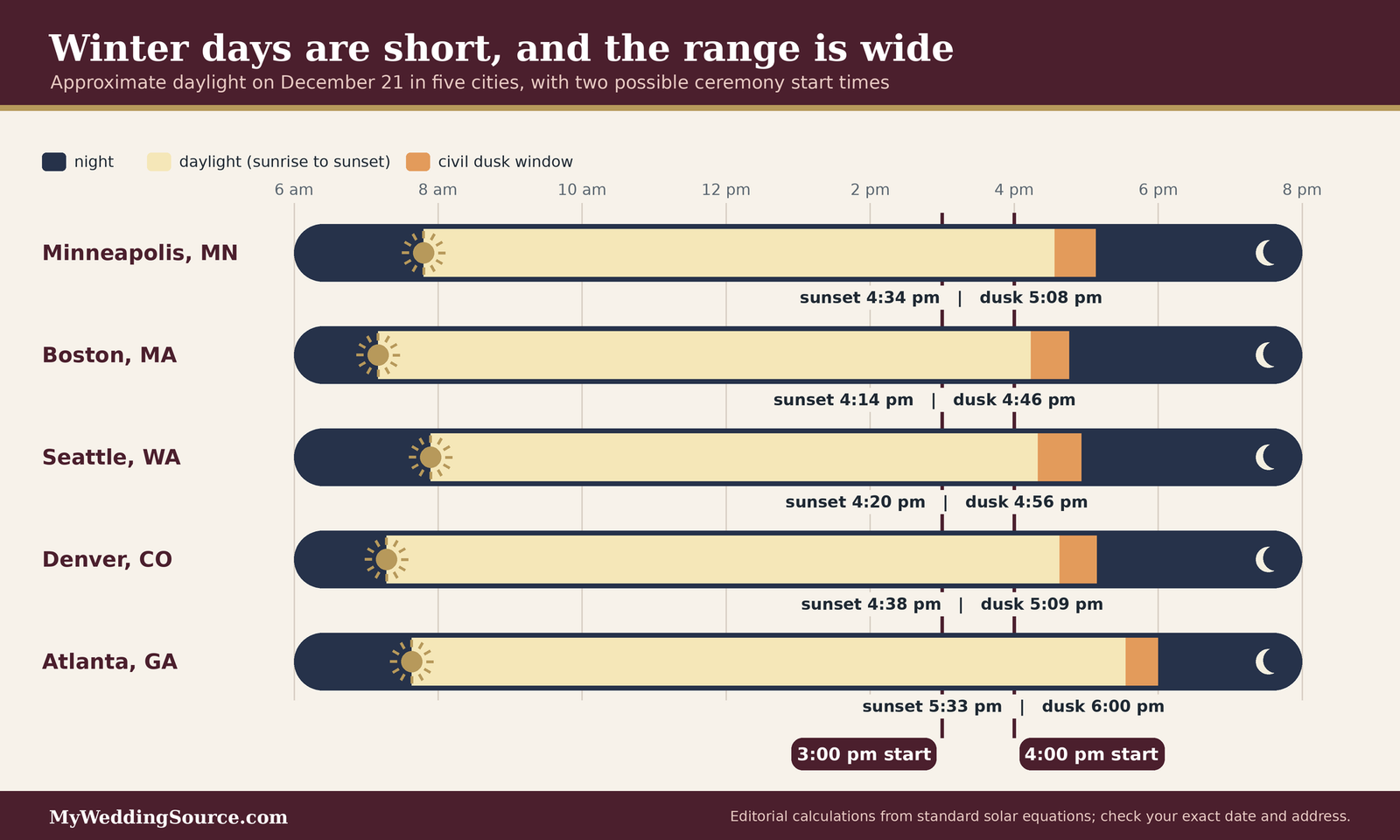
Sunset is not guesswork, so you can build it into the timeline months ahead. For the graphic below we calculated approximate sunset times for December 21, 2026, using standard solar position equations, and we also calculated civil dusk, the point when the sun is six degrees below the horizon and outdoor activity without lights becomes difficult. These are our own estimates, rounded to the minute and accurate to within a few minutes, so check your exact date and address with an official sunrise and sunset calculator before locking times.
What the cities show
Even in this small sample, the range is useful. On the shortest day of the year, sunset falls around 4:14 p.m. in Boston, 4:20 in Seattle, 4:34 in Minneapolis, 4:38 in Denver, and 5:33 in Atlanta, according to our calculations. A northern venue loses its light about an hour earlier than a southern one. A ceremony that begins at 4 p.m. in Boston begins nearly at sunset, while the same time in Atlanta leaves over an hour and a half of light. By mid-February the same cities gain roughly an hour or more of daylight, so the timing of a winter wedding changes sharply between December and February.
Civil dusk and why photos change
Civil dusk comes roughly half an hour after sunset in our calculations, so there is usable but fading outdoor light for about thirty minutes after the sun drops. Some photographers like this soft light, but it is also when walkways become hard to see. If portraits outdoors are important, plan them before sunset, and treat the post-sunset period as a bonus, not a plan. Our wedding photographer shot list and wedding photography guide explain how to sequence portraits, and a photographer experienced in winter weddings can tell you how much light they need for each shot.
Lighting the route and the room
Early darkness is a safety issue as much as an aesthetic one. A guest who cannot see an icy patch is more likely to slip on it, and a parking area that feels fine at noon may be dim and confusing at 6 p.m.
Walkways, parking, and entrances
Ask the venue which paths and parking areas have fixed lighting and which rely on string lights or temporary fixtures. Plan a continuous lit route from where guests park or are dropped off to the door, including the way to restrooms and to any outdoor ceremony space. Add portable lighting where the venue’s fixed lights end. Battery lanterns and string lights can be pretty and useful, but they should light the surface, not only the surroundings, because the hazard is on the ground. If you use any temporary electrical lighting outdoors, ask the venue or rental company how it is rated and powered, since wet snow and extension cords are not a good pairing.
Choosing a ceremony time around the light
If you want a daylight ceremony, work backward from sunset. In the Boston example, a 3:00 p.m. ceremony of about 25 minutes ends around 3:25, which leaves roughly 50 minutes of sun for outdoor portraits before the 4:14 sunset, in our estimate. A 4:00 p.m. ceremony leaves almost none. A candlelit evening ceremony is a different plan and needs the lighting and heating arrangements described below. Our wedding ceremony guide covers ceremony structure, and the right choice depends on your priorities. If you want a dark, warm room, accept that outdoor photos will need to happen early, or in a prepared lit area.
Cold, heat, and indoor air: keep guests warm without creating a hazard
Cold is the most predictable winter problem and the one couples most often under-plan, because everyone assumes guests will simply put on a coat. Guests in formal clothing, thin shoes, and sleeveless dresses are not dressed for a long outdoor wait, and people who have been sitting still for twenty minutes lose heat faster than people walking briskly.
Cold exposure on the walk and at the outdoor moment
The goal of this part of a winter wedding weather plan is not to eliminate cold. It is to keep exposure short, shelter close, and the riskiest guests protected. That requires a rough sense of how fast conditions become uncomfortable and when they become dangerous.
What wind chill does to a short outdoor ceremony
Wind chill is calculated from air temperature and wind speed using the formula the National Weather Service publishes. We ran that formula for a few common winter conditions to show how much wind matters. These values are our own arithmetic from the published formula, rounded to whole degrees.

At 30 degrees Fahrenheit, a 5 mph breeze feels like 25 and a 25 mph wind feels like 16. At 20 degrees, the same range runs from 13 down to 3. At 10 degrees, a 15 mph wind feels like minus 7, and at 0 degrees a 15 mph wind feels like minus 19, which matches the National Weather Service example. The lesson for planning is that a forecast of “20 and breezy” is not a 20-degree ceremony. Ask your venue where wind collects, because an open field and a courtyard between buildings can feel very different on the same day.
A short outdoor segment is the easiest control in any winter wedding weather plan. A fifteen-minute ceremony with seating in a sheltered spot is a different risk from a forty-minute service in an open field. If the outdoor moment matters to you, keep it brief, start on time, hold guests inside until the last moment, and have blankets or warm drinks ready. Our wedding ceremony guide covers ways to shorten a ceremony without losing its meaning.
Cold-related signs your staff should know
Hypothermia and frostbite are medical conditions, and this article is not medical advice. The National Weather Service describes hypothermia as a body temperature below 95 degrees Fahrenheit, with signs that include uncontrollable shivering, memory loss, confusion, slurred speech, drowsiness, and extreme exhaustion. It describes frostbite as loss of feeling and white or pale skin on fingers, toes, earlobes, and the nose. A CDC page, preserved in a web archive, gives similar signs for adults and says a temperature below 95 degrees is an emergency requiring immediate medical attention. For a wedding, the practical step is to ask one or two trusted people, such as a coordinator and a family member, to watch for guests who seem confused, unusually quiet, or very cold, and to know who to call. Call emergency services for anything that looks serious. Do not rely on a wedding plan to handle a medical event.
Do not offer alcohol as a way to warm up. The official guidance we reviewed says to avoid alcohol and caffeine for someone who is very cold, and to warm the core first. In practice, that means a warm room, dry clothing, and a call for help, not a champagne toast. Our open bar planning guide covers how to pace alcohol, which matters more when guests are driving home on cold roads.
Heating: space heaters, tents, and fuel
If any part of your plan uses a tent, a barn, a porch, or a space without a permanent heating system, the heating plan is a safety plan and belongs in your winter wedding weather plan. The federal product safety agency warns about fire and carbon monoxide risks from winter heating and generators, and a crowded room full of formal clothing and decorations is not a place for improvisation.
What the federal product safety agency recommends
The U.S. Consumer Product Safety Commission’s winter guidance, written for homes, is a useful baseline for any heated space. It says portable generators should never be used indoors, including in garages and sheds, and should be placed outside at least 20 feet from a building with the exhaust pointed away from doors, windows, and vents. For portable electric space heaters, it advises keeping all sides at least three feet from flammable items such as furniture, curtains, and paper, placing them on a flat and stable surface, not leaving them running unattended in a confined space, plugging them straight into a wall outlet and not a power strip, and keeping cords out from under rugs. It also recommends carbon monoxide alarms and advises getting outside and calling 911 if one sounds, and it suggests battery-operated candles in place of real ones where possible. Those are home recommendations. Commercial venues and tents have their own rules, and a venue or rental company should know them.
For a wedding, translate that guidance into questions. Who supplies and operates any heater? Is it designed for the space? Is there a carbon monoxide alarm in any enclosed heated area? Where are the exits, and are they clear? Does the local fire authority require anything for tents or temporary heating? We cannot tell you what your local code says. Ask the venue and the rental company, and ask for their answers in writing. Our wedding decor guide covers decor choices, and decor near heaters is a real fire consideration, so keep draping, paper, and greenery away from any heat source.
If heat or power fails
Ask the venue what happens when the power goes out. Some venues have a backup generator that powers lights and heat, some power only emergency lighting, and some have nothing. If the venue has no backup, your plan B is a smaller, shorter event, a move to a location with power, or a delay. The National Weather Service winter safety guidance for power outages suggests closing off unused rooms, blocking drafts, closing curtains, eating and drinking regularly, and dressing in loose layers. At a wedding, that means consolidating guests into one smaller room and removing wet outer clothing, not running a fuel-burning appliance indoors to make up for lost heat. If you cannot guarantee safe heat, shorten the event and help guests leave while roads are still passable.
Attire, coats, and shoes
Guests will take their cues from your invitation and website, and they will dress for the event, not for the walk. A short line on your website saves a lot of problems on the day.
Coat check and cold weather logistics
Wet coats and boots pile up fast. Decide where they go: a staffed coat check, a labeled rack, a closed room, or the back of chairs. A coat check needs space, a person, and a way to return items quickly at the end of the night, because a crowd waiting for coats at 11 p.m. is itself a cold-weather risk if the lobby is drafty. For the wedding party, our wedding party attire guide covers fabric and layering choices, and a wrap, jacket, or coat that matches the outfit is a practical addition, not an afterthought.
Shoes, hems, and the dress
Ice and slush are hard on heels and long hems. A pair of flat or low-heeled shoes for the walk, with formal shoes changed into inside, is one practical option. If you will wear a long dress, ask your alterations professional about hem length for a damp floor, and read our wedding dress alterations guide for timing. We are describing options here, not rules, and what works depends on the dress and the venue.
Transportation and guest safety from driveway to last dance
Most of the risk in a winter wedding weather plan is not at the wedding. It is on the road to and from it. A venue can have heat, light, and a clear walkway and still have a safety problem if guests cannot arrive or leave in conditions they can handle.
Roads, lodging, and arrival windows
You cannot control the roads, but you can control how many guests need them at the worst moment and how long they are on them.
What official winter driving guidance says
The National Weather Service winter storm safety guidance advises driving slowly because roads that look only wet may be icy, clearing snow and ice from the whole vehicle before leaving, telling someone your route and destination, and keeping a charged phone and an emergency kit in the car. It says that if visibility is poor, drivers should pull off the road, turn off their lights, and set the parking brake so that other drivers do not run into them. A National Weather Service extreme cold page recommends a winter kit with warm clothing, boots, blankets, a flashlight with spare batteries, and food bars. You can pass a short, plain version of this to guests as part of your winter wedding weather plan communication, for example: “Roads may be slippery. Leave extra time, and check the forecast before you travel.”
Lodging near the venue and room blocks
The most reliable control for late-night road risk is a place to sleep close to the venue. A room block at a hotel within a short drive, ideally with a shuttle, means that guests who do not want to drive can stay put. Our wedding budget calculator can help you see what lodging support or shuttle service might add. Ask whether the hotel has a policy on winter weather cancellations and early arrival, so that out-of-town guests who need to come a day early have an option.
Walking surfaces and accessibility
Slips are a physical hazard to plan for at any winter event, and they may not affect all guests equally. Older guests, guests who use mobility aids, and guests carrying children or gifts may face more risk.
Who clears snow and ice, and when
Ask the venue who is responsible for removing snow and ice, how often they check during an event, what material they use, and whether they can have the main route treated before guests arrive. Ask what happens if snow falls during the reception, because a path that was clear at 4 p.m. may not be at 9. If the venue does not cover parking areas, ask who does. If your contract is silent on this point, ask for a short written addition. We are not giving legal advice here, and a venue’s responsibilities depend on the contract and local rules, so treat these as questions, not conclusions.
Keeping an accessible route
The federal 2010 ADA Standards for Accessible Design include sections on accessible routes, walking surfaces, and ramps, and a venue that welcomes the public should know what applies to it. In practice, ask the venue which entrance is the accessible one, whether it is cleared and lit in winter, and whether the route from accessible parking to the ceremony and reception spaces is continuous. Do not assume that a ramp is usable if it is covered in ice. Plan a clear and treated accessible route as a first-order item, not a favor, and tell guests who need it how to find it. If a guest uses a wheelchair or walker, ask them privately what would make the day workable, and then plan for it.
Leaving safely at the end of the night
The end of a winter wedding is when risk peaks: temperatures are lowest, guests are tired, some have been drinking, and the road is at its worst.
Shuttles, rides, and an earlier send-off
Offer a way to leave without driving: a shuttle to the hotel, rides arranged in advance, or rooms at the venue. If you can, end the main event while roads are likely to be at their best, and treat the formal send-off as flexible. You can always keep dancing for an hour with fewer guests, but you cannot easily call back someone who left too late. We cover etiquette around ending a reception in our wedding etiquette guide, and the same logic applies here: a considerate host plans the exit.
If guests get stranded
The National Weather Service guidance for a stranded vehicle says to stay in the car, because wind-driven snow can disorient a person quickly, to run the engine about ten minutes each hour while keeping the exhaust pipe clear and a window cracked, and to make the vehicle visible. Guests who are stuck can call the venue or your named contact. Put that number on the guest message. If the venue can host guests overnight, such as in a lounge or lobby, agree to that in advance, with blankets, water, and a plan for staff.
Build redundancy into the guest and vendor plan for a winter wedding weather plan
In a winter wedding weather plan, redundancy means having a second way to do each critical thing: a second room, a second route, a second way to reach people, a second source of heat or light. It costs something, and the goal is to spend that money where failure would hurt most.
Provide backup space, power, transport, communication, and equipment
For each item on your risk register, ask what the backup is and who owns it. Do not accept “we will figure it out.” If the backup is a second room, check that it exists, is available, and works.
Test the backup for the same capacity and accessibility
A backup that cannot hold your guests is not a backup, and it will fail your winter wedding weather plan. Compare the backup room’s stated capacity with your guest count and your seating layout, because capacity at a standing reception is different from capacity at a seated dinner with a dance floor. Our venue capacity guide explains how to read capacity numbers. The backup also needs the same accessible route, restrooms, and lighting, and it needs power for the band or DJ.
Here is a simple check. Suppose the backup room lists a seated capacity of 110 and you expect 120 guests. You are 10 seats short before counting a head table, a dance floor, or a cake table. Your options are to reduce the guest count, move to a standing or lounge format for part of the evening, split the event across two spaces, or choose a different backup. The arithmetic is simple, but only if you do it before the storm.
Put transition time into the schedule
Moving a ceremony indoors is not instant. Chairs have to be reset, guests need to be told, the music may need to be moved, and the photographer needs a new position. Build a buffer into the day so that a move does not cascade into a late dinner and an unhappy caterer. We suggest asking each vendor how long a switch would take and adding the longest answer to the schedule as an explicit buffer. We cannot give you a universal number because venues differ, but forty-five minutes is a reasonable starting question to put to your coordinator. Our wedding reception guide can help you see where the schedule has slack, and our catering guide explains what caterers need to know about timing changes.
Communicate the contingency without creating panic
How you say it matters as much as what you say, and tone is part of a good winter wedding weather plan. A message that sounds alarmed may cause guests to cancel unnecessarily, and a message that is too casual may leave people unprepared.
Tell guests only what changes their behavior
Guests need to know three things: what is different, what they should do, and where to look for updates. A good message might read: “Snow is expected on Saturday. The ceremony will now take place indoors at the same time. Please allow extra time to arrive, and park in the north lot. We will post updates on our wedding website.” It does not discuss the weather forecast in detail, apologize at length, or list every possible scenario. Set up the channel in advance, such as a wedding website banner, a group text, or both, and tell guests where to look. Our wedding invitations guide and save-the-date cards guide both note that the website and the printed items work together, so mention a weather-update page early. Do not rely only on social media, which not every guest uses.
Give vendors the operational version with exact instructions
Vendors need more detail than guests. Give each one a one-page version of the plan: the trigger, the new load-in time or location if it changes, the contact person with a mobile number, and what you want them to do if the road is closed. Ask each to confirm in writing and to share their own backup, such as a second driver or an alternate route. For a caterer, include the final headcount date and any change to service timing. For the photographer, include the sunset estimate and the backup indoor location. A vendor who has the instructions in advance can act without calling you.
A worked scenario with transparent assumptions
The scenario below is illustrative. We invented the venue and numbers to show how the pieces connect, and they are not market prices or real events.

The setup
Imagine a couple marrying on December 21 at an inn near Boston, with 120 guests. Sunset is about 4:14 p.m. by our estimate. The ceremony is planned for 3:00 p.m. outdoors on a garden terrace, with a 25-minute service. The inn has an indoor room that seats 110. Forty guests are staying at a hotel about ten minutes away. The couple has two 14-seat vans on call, assumed for illustration.
On the Wednesday before, the forecast shows a possible winter storm. The planner checks the National Weather Service office’s page and sees a winter storm watch. The planner moves into the “watch” stage of the plan and alerts the caterer and rental company to the likely indoor layout.
What the plan does
On Thursday evening, the watch becomes a warning. The decision-maker, using the written trigger, moves the ceremony indoors. The indoor room seats 110 for dinner, so the couple tells the inn to set the ceremony for 120 in a standing-room-friendly layout with a short aisle, then to flip the room for dinner during cocktail hour. They allow forty-five minutes for the flip, as agreed with the inn’s manager, which pushes dinner back slightly. They send guests a short message, tell the vendors the new load-in plan, and ask the shuttle company to confirm. With two 14-seat vans carrying 28 guests per loop, the 40 hotel guests need two loops each way. If each loop takes about 20 to 25 minutes including loading, the first group can arrive before the ceremony and the second is safely inside before the doors close. Because the ceremony is indoors, the photographer can plan portraits for the last daylight before 4:14, with a backup indoor location after.
Notice what this winter wedding weather plan did not require: a perfect forecast, a big budget, or anyone guessing. It required that someone wrote the trigger down, that the backup room existed, and that vendors had the instructions.
What a winter plan might cost
We do not have a sourced average for winter contingency costs, and prices vary widely by region and vendor, so please treat any figure you see as a quote, not a norm. Instead of a price, use a method. Ask each vendor to quote the backup separately: the indoor room rental or flip fee, shuttle service by the hour with a minimum, heater or tent heating rental if used, extra lighting, and a coat check attendant. Then add a simple estimate for your own situation. For example, if a shuttle company quoted a hypothetical hourly rate of X dollars with a four-hour minimum and you need two vans, your cost is 2 x 4 x X. That is arithmetic, not a market price. Compare the total with what a missed ceremony, a stranded guest list, or a cancelled event would cost you, and read our wedding insurance guide for what event insurance may or may not cover, since policies differ and exclusions matter. For the broader budget, see our average wedding cost guide and our wedding budget calculator. This is not financial or insurance advice.
Verify the winter wedding weather plan on site before the wedding
A winter wedding weather plan on paper can hide gaps that a short walk reveals in minutes. A site visit is cheap, and it is the single best way to find what you missed.
Walk the route as a guest would experience it
Start where guests start. Go to the parking area or drop-off point, and walk the entire route to the ceremony, the restrooms, the reception, and back. Do it more than once, and do it slowly.
Check lighting, surfaces, distances, restrooms, and shelter
On the walk, check these things: Is the path lit at every point? What is the surface, and how will it feel wet or icy? How long is the walk at an easy pace, and could an older guest or someone with a walker do it? Where are the restrooms, and can guests reach them without going outside? Where is the nearest shelter if the weather turns during the outdoor segment? Where is the wind strongest? Take photos and notes. If something looks like a problem, ask the venue what they would do about it in winter.
Test the plan at the relevant time of day
If you can, visit at the time of day your event will happen, in the same season. A site that looks welcoming at noon in October may be dark and confusing at 4:45 p.m. in December. If a winter visit is not possible, visit at dusk and imagine the setting with snow. Ask the venue for photos of last winter’s events, and ask how they handled snow and ice. Test the route with your own phone’s flashlight to see how dark it is without the venue’s event lighting.
Close gaps with written responsibilities
At the end of the walk, you will have a list of gaps. The last step is to turn each one into a task with a name and a deadline.
Assign each contingency task
Write each task in one sentence with one owner and one deadline, for example, “Confirm salt and sand are on site and the entrance route is treated by 2:00 p.m. Owner: venue manager, checked by coordinator.” If a task has two owners, it has none. If a task cannot be assigned, either find a person who can take it or change the plan. Share the list with everyone involved, and ask each to confirm they have seen it. Our wedding planning stress guide explains why handing off tasks, instead of carrying them, is important for the couple on the day, and our small wedding planning guide shows how fewer guests can simplify a weather plan.
Store emergency contacts and vendor escalation paths
Make a one-page contact sheet with the venue manager, the coordinator, each vendor’s mobile number, the shuttle dispatcher, the hotel front desk, the nearest urgent care, and the local non-emergency line. Add a second contact for each vendor, because the person who answers on the day may not be the person you spoke to in July. Print it, keep a copy on a phone, and give one to a trusted person who is not in the wedding party. Add an escalation path for each critical issue: who to call first, who to call if they do not answer, and who decides. For serious medical or safety events, call emergency services first.
Questions to ask before you finalize a winter wedding weather plan
Good questions turn vague reassurance into written answers for your winter wedding weather plan. Ask them by email or in a call you summarize afterward.
Questions to ask
- Who is responsible for snow and ice removal on walkways, parking, and the accessible route, and how often is it checked during an event?
- What heating system serves each space we will use, and what happens if it fails?
- Is there backup power, and what does it run: lights, heat, kitchen, sound?
- What is the capacity of the indoor backup space in our seating layout, and is it available on our date?
- How long does it take to switch the room from ceremony to dinner, and what does it cost?
- What is your policy if a storm closes roads or a vendor cannot arrive?
- Do you have a staffed coat check or a place for wet coats?
- Are any outdoor heaters or temporary lighting used, and who operates them?
About the venue
These questions confirm what the building and grounds can actually do for your winter wedding weather plan.
Grounds, heat, and power
Ask for specifics about who clears the route, what the heating plan is, and what happens in an outage. Ask to see the backup space. A venue that has handled winter events before will have clear answers, and a venue that hesitates is telling you something. If answers are vague, ask for them in writing before you sign or adjust the schedule.
Policies and fees
Ask what the venue charges to move an event indoors, whether there are overtime fees if the schedule shifts, and whether the contract allows a date or time change because of weather. Ask how the venue defines force majeure if that term appears in your contract, and have a professional review the language if the stakes are high. We cannot interpret your contract, and this is not legal advice.
About the vendors
These questions confirm that each vendor can still do their job under your winter wedding weather plan when conditions change.
Arrival, backups, and substitution
Ask each vendor how early they can arrive, what their policy is if roads are closed, and whether they have a backup person or a substitute. Ask the caterer whether the kitchen can run on a different schedule, the photographer whether they have winter experience and lighting gear, and the shuttle company how they dispatch in snow, whether they use chains or winter tires, and what triggers a cancellation. Ask for the answers in the contract or in an email, and keep them with your winter wedding weather plan.
Cancellation and rescheduling terms
Ask what happens to your deposit if a vendor cannot arrive and if you must change the date. Read the cancellation and substitution clauses, and ask to add a clause if the contract is silent on weather. Our wedding planning guide can help you keep track of paperwork, and a professional can review any contract you are unsure about.
FAQ: winter wedding weather plan questions
Planning and timing
When should I write my winter wedding weather plan?
Write your winter wedding weather plan when you finalize your venue and vendors, ideally several months ahead, and review it a week before the wedding. Early writing lets you negotiate backup space, shuttle options, and contract language while you still have choices. Last-minute plans tend to rely on whatever is available, which may not be safe or affordable.
Who should make the call to move the ceremony indoors?
Name one person before the day, often a planner or coordinator, with a backup if they are unreachable. Base the decision on written triggers, such as an official National Weather Service warning or a wind chill value you chose in advance. A single decision-maker avoids a group debate when time is short.
What time of day is safest for a winter wedding?
There is no single safest time, but earlier ceremonies leave more daylight for outdoor photos and for guests to arrive and leave in light. Sunset falls around 4:14 p.m. in Boston and 5:33 p.m. in Atlanta on December 21, by our calculation, so check your own date and city before choosing.
Do I need wedding insurance for a winter wedding?
Not necessarily, and we cannot advise you. Policies differ on weather, cancellation, and venue closure, and exclusions matter. If you are considering it as part of your winter wedding weather plan, read the policy language, ask what counts as a covered cause, and see our wedding insurance guide. Compare the premium with what a cancellation would cost you, and consider asking a licensed professional.
Guests, safety, and communication
How do I keep older guests safe on icy walkways?
Ask the venue to treat the main route before arrival and check it during the event, provide a covered drop-off, and offer an arm or golf cart if available. Make sure the accessible route is clear and lit. Tell guests with mobility needs how to find it, and ask them privately what would help.
What should I tell guests about a possible weather change?
Tell them what changes, what to do, and where to find updates. For example, say the ceremony moves indoors at the same time, ask them to allow extra travel time, and point them to your wedding website. Keep the message short and calm, and avoid long forecasts or apologies that may cause unnecessary worry.
Are outdoor heaters safe at a wedding?
They can be, if the venue or rental company supplies and operates them for the space. The Consumer Product Safety Commission advises keeping heaters at least three feet from flammable items, never leaving them unattended in a confined space, and using carbon monoxide alarms. Ask the venue about local rules, because tents and temporary heating may have specific requirements.
What if a vendor cannot reach the venue because of snow?
Use the substitution and backup instructions you collected in advance: a second driver, an alternate route, or a replacement vendor named in the contract. Ask each vendor to arrive early, and check in by text on the morning of the wedding. If a key vendor cannot arrive, the decision-maker follows the written plan and tells guests only what changes.
Your next steps
Write the winter wedding weather plan
Draft the risk register and triggers
Copy the starter risk register in this guide and adjust it to your region and venue. Choose the triggers for your winter wedding weather plan: the alert level, the wind chill number, the capacity limit, and the vendor arrival time. Name a decision-maker and a deadline for each. Keep the whole plan to two pages.
Share it with your team
Send the winter wedding weather plan to your planner, venue manager, and key vendors. Ask each to confirm in writing and to add their own backup. Add the winter wedding weather plan to your wedding planning checklist so that it gets reviewed a week before the date.
Check it on site
Walk the route twice
Walk the route once in daylight and once at dusk, and take notes. Fix what you can and assign the rest. Our timeline guide can help you add buffers to the day.
Send one calm message
Prepare the guest message in advance, with blanks for the date and the change, so that you can send it in minutes. If you want a deeper look at how couples set a day’s schedule, our wedding planning guide is a good starting point, and our garden wedding venues guide covers outdoor spaces that need extra planning in cold months.
Related reading: Winter wedding venue heating and safety.
Sources & methodology
How we built this guide
What we relied on
This winter wedding weather plan guide combines National Weather Service alert criteria, wind chill and cold safety pages, and winter storm safety guidance, a U.S. Consumer Product Safety Commission release on generators and heaters, an archived CDC page on hypothermia, and the federal ADA Standards for Accessible Design. The sunset and civil dusk times are our own calculations from standard solar position equations, and the wind chill values are our own arithmetic from the National Weather Service formula. Both are estimates, rounded, and should be checked for your date and place. The risk register, the contingency activation table, the timing suggestions, and the worked scenario are our editorial synthesis and illustration, not industry standards or real events.
What we did not do
We did not test venues, read any contract, or verify local fire or building codes, and we did not find a sourced survey of winter wedding contingency costs, so we give a method and not a price. We do not give legal, insurance, financial, or medical advice. Alert thresholds differ by National Weather Service office, so use your local office’s definitions. For emergencies, call emergency services.
Source list
Government and public safety sources
- National Weather Service, Detroit/Pontiac, Winter weather definitions and criteria: https://www.weather.gov/dtx/winter_defs
- National Weather Service, Extreme cold, wind chill, frostbite, and hypothermia: https://www.weather.gov/dlh/extremecold
- National Weather Service, Wind chill chart and formula: https://www.weather.gov/safety/cold-wind-chill-chart
- National Weather Service, Cold safety overview: https://www.weather.gov/safety/cold
- National Weather Service, Winter storm safety during a storm: https://www.weather.gov/safety/winter-during
- U.S. Consumer Product Safety Commission, Winter storm carbon monoxide and fire risks (2026): https://cpsc.gov/Newsroom/News-Releases/2026/Winter-Storm-May-Knock-Out-Power-CPSC-Warns-of-Deadly-Carbon-Monoxide-and-Fire-Risks
Health and accessibility sources
- CDC, Hypothermia, archived page: https://webarchive.library.unt.edu/web/20121014020718/http://www.bt.cdc.gov/disasters/winter/staysafe/hypothermia.asp
- U.S. Department of Justice, 2010 ADA Standards for Accessible Design: https://www.ada.gov/law-and-regs/design-standards/2010-stds/