

Wedding contract change orders are the short, signed pages that turn a casual “can we add this?” into a written change to your agreement, with the new service, the new price, the new due date, and both signatures in one place, so that a last-minute upgrade does not become a disagreement on the wedding weekend.
Quick answer
A wedding contract change order is a written amendment to a signed vendor contract. Each of your wedding contract change orders should name the contract it changes, describe exactly what is added, removed, or swapped, state the price difference and the new balance, set the payment date, and carry a signature or a clear written approval from the vendor. The surest habit is simple: nothing changes until the vendor has confirmed it in writing, and you save that confirmation with the original contract. Price the change with a short cost model (added labor, miles, lodging, meals, and fees) so you can check the vendor’s number instead of guessing. This is general education, not legal advice.
What wedding contract change orders are, and what they are not
The phrase “change order” comes from construction, where a homeowner who decides mid-project to move a wall or upgrade a countertop signs a separate form that adjusts the scope, the price, and the schedule. Wedding vendors rarely use that exact term, but the idea fits well. You signed an agreement for a specific package on a specific date, and any later change to that package should be recorded the same way the original deal was. Most vendors call it an addendum, an amendment, an add-on form, a revised invoice, or simply “the updated agreement.” This guide uses wedding contract change orders as the plain-language name for all of them.
A change order is a written record of one change
Think of a wedding contract change order as a small contract that sits on top of the big one. It does not replace your original agreement. It points to it, changes one or a few terms, and leaves everything else alone. That narrowness is useful, because a one-page document is easy to read, easy to sign quickly, and easy to find again six months later when someone asks what was agreed. It is the main reason wedding contract change orders work better than a long email thread.
What a change order usually covers
In practice, wedding contract change orders handle changes in scope (more hours, another event, extra staff, an added deliverable), changes in quantity (more guests, more centerpieces, more shuttles), changes in substitution (a different menu item, a different flower, a different room), and changes in logistics (a new arrival time, a different loading dock, a second location). They also handle price and payment: the amount owed for the change and the date it is due.
What a change order does not do
A wedding contract change order does not cancel the contract, move the wedding date, or replace a vendor. Those are different events with their own rules, and they are usually governed by the cancellation, rescheduling, or replacement clauses in your original agreement. If you need to understand how a vendor can swap staff, our guide to the wedding vendor replacement policy covers that situation. A wedding contract change order also does not erase a clause you dislike in the original contract, unless both sides agree in writing that it should.
Change order, add-on, addendum, and new contract
Vendors use several words for similar documents, and the names matter less than the content. Still, a quick map helps you recognize what you have been handed.
Add-on and upgrade forms
Many vendors keep a menu of add-ons, such as an extra hour, a second shooter, an upgraded linen, or a late-night snack. Some have a one-page form where you tick a box. That form can work as a wedding contract change order if it names your contract, shows the price, and is signed or approved in writing. If it is only a price list, it is not yet a record of your decision.
Addendum, amendment, and revised agreement
An addendum or amendment is a written change attached to the original. A revised agreement is a fresh version of the whole contract. Either can work. The practical difference is that an addendum shows you exactly what moved, while a revised agreement makes you reread everything to find the difference. If you receive a revised agreement, ask the vendor to list what changed, and compare the two versions line by line before signing.
When a change is big enough for a new contract
If an upgrade changes the nature of the job, such as turning a ceremony-only booking into a full-day booking with a second location, a new or fully revised agreement may be cleaner than a stack of small amendments. A vendor may also prefer a fresh agreement when the total price changes a lot. That is reasonable, as long as the new document carries over the protections from the old one and you do not lose a term you negotiated.
Why last-minute upgrades go wrong without paperwork
Most wedding disputes that start with a change begin the same way: two reasonable people had a friendly conversation, each left with a slightly different memory, and nobody wrote down the details. The Better Business Bureau advises getting promises in writing, including dates, products, and prices, and folding any oral agreements into the written contract. That advice is simple, and it matters most for changes, because changes tend to happen when everyone is busy. Wedding contract change orders are how that advice gets applied after the first signature.
The memory problem
Wedding planning is long, and details change in many small conversations: a call from a venue, a text from a caterer, a note from a florist about a flower shortage. By the final month, you may be handling several vendors at once, and so are they.
Verbal promises are hard to prove
Rock n Roll Bride’s guide to supplier contracts points out that spoken promises can be forgotten, for example when the coordinator who made them leaves the company. A Practical Wedding makes a similar point about waived fees: a verbal assurance is hard to prove later. Neither source says vendors act in bad faith. The point is that good intentions do not make a record, and wedding contract change orders do.
Staff turnover and handoffs
The person who agreed to your change may not be the person who staffs your wedding. A venue manager might hand off to an event captain, a studio might send an associate, and a catering sales lead might not be on site. A signed change order travels with the file, so the person on site can read what was agreed without relying on anyone’s memory.
What the contract may already say about changes
Before you ask for anything, find out whether your original contract has rules for changes. Many do, and those rules shape how formal your wedding contract change order needs to be.
No-oral-modification clauses
Some contracts say that changes are valid only if they are in a signed writing. Under the Uniform Commercial Code, which governs sales of goods in most states, a signed agreement that requires modifications to be in a signed writing generally cannot be modified another way, and between merchants that is the whole rule. If a merchant supplied that clause on its own form, the other party must separately sign the clause. The same section says a modification does not need new consideration to be binding, and that an attempt that fails the formal requirements can still operate as a waiver, which the other party may later retract with reasonable notice unless that would be unjust.
That is useful background, but it has limits. The UCC governs goods, such as flowers, cakes, and rental items, and many wedding contracts are mainly for services, such as photography, music, and planning, where state contract law applies instead. Whether a particular clause is enforceable depends on your state and your facts. If a dispute is serious, a licensed attorney in your state is the right person to ask how your wedding contract change orders would be treated.
Price-adjustment and minimum-spend clauses
Rock n Roll Bride notes that package prices may exclude items such as delivery, travel, corkage, security, parking, cleaning, equipment hire, staff meals, and overtime, and that minimum-spend requirements can apply even if your guest list shrinks. It also advises caution with wording that lets a business raise prices or reduce what it provides with unlimited freedom. If prices can rise before the wedding, the contract should say when, why, and by how much. Look for these clauses first, because they decide whether a change might trigger a price reset on the entire package and not just the new item.
How to read your contract for change rules before you ask
A few minutes of reading before you ask for an upgrade can save a surprise later. You are looking for the rules that govern wedding contract change orders in your agreement, whether or not those rules use that name.
The clauses to find
Take the signed contract and a highlighter, or search the PDF. The sections below are the usual homes for change rules.
Modification, amendment, and entire-agreement language
Search for “amend,” “modify,” “change,” “written,” and “entire agreement.” An entire-agreement clause usually says the written contract is the full deal, which means anything you were told verbally and did not get written down may not count. A modification clause says how changes must be made. Note who is allowed to sign for the vendor, because a change approved by an employee without authority can be disputed.
Guest-count, headcount, and deadline language
For food, beverage, rentals, and transportation, the contract usually sets a date by which you must confirm your final number, and sometimes a rule about how far the number can drop. Rock n Roll Bride’s reminder about minimum spends applies here. Write the deadline on your calendar, because a change request that arrives after the deadline may be priced differently or refused, and wedding contract change orders filed late can carry different terms.
Overtime, travel, and service-fee language
Search for “overtime,” “additional hour,” “travel,” “mileage,” “lodging,” “meals,” “service charge,” and “administrative fee.” FindLaw’s overview of common vendor terms lists overtime for staff, travel costs, parking, staff meals, per-head surcharges, and service fees among the extra charges vendors may add, and it says service fees can reach 20 percent or more in some contracts. If your contract already states a rate, a wedding contract change order should use it. Our guides to vendor overtime rates for weddings and wedding vendor travel and lodging fees explain how those lines are built.
When the contract is silent
Some contracts say nothing about changes. That does not mean you cannot make one, but it does mean you are working from the vendor’s goodwill and the general principle that both sides should agree in writing.
Ask for the vendor’s change process
A simple email works: “We would like to explore an adjustment to our contract dated [date]. What is your process for changes, and what is the earliest you can send a written quote?” A vendor with a standard process will usually tell you. A vendor without one will probably improvise, and your written follow-up becomes the process for your wedding contract change orders.
Offer your own one-page change order
If the vendor has no form, you can send the template later in this guide and invite edits. Many small vendors appreciate not having to draft something. The Practical Wedding method, writing the change on a copy of the original or signing a new amended contract, works as well, as long as both sides date and sign.
The anatomy of one-page wedding contract change orders
A wedding contract change order does not need legal-sounding language. It needs complete information. If a stranger picked up the page a year from now, they should be able to answer five questions: which contract changed, what exactly changed, what it costs, when it is paid, and who agreed. The template below is ours, written for this guide as plain education. It is not a legal form, and it is not a substitute for advice from an attorney licensed in your state.
The fields every wedding contract change order needs
Each field below earns its place in wedding contract change orders by closing a gap that causes arguments. Where a field feels redundant, remember that redundancy is the point.
Identify the contract and the parties
Write the names of both parties as they appear in the original, the date of the original contract, the event date, and the venue. If the vendor is a business, use the business name on the contract. This tells anyone reading that the wedding contract change order belongs to that agreement and not to some similar booking.
Describe the change in measurable words
Avoid “extra coverage” or “better flowers.” Write “Add one hour of photography coverage from 10:00 p.m. to 11:00 p.m. on the event date” or “Replace the 24 ivory spray roses in the ceremony arrangements with 24 white garden roses.” Measurable language includes quantities, times, places, names of items, and who delivers them. If something is removed or reduced, say that too.
State the price change and the new total
Show the change as its own line, then show the original total, the change, and the new total. If tax, a service fee, or a gratuity applies, list it as a separate line so it can be checked. Label every amount as a flat amount or as an estimate that may be adjusted, and say what would trigger an adjustment.
Set the payment date and method
Say when the added amount is due and whether it is added to the final balance or paid now. If you pay by credit card, say so on the page. The Better Business Bureau and the Wisconsin Department of Agriculture, Trade and Consumer Protection both suggest paying by credit card where possible because the card company may be able to help if something goes wrong. We return to that point in the payment section.
A fill-in template you can adapt
The table below shows each field, what to write, and an example. The examples are invented for illustration and do not describe any real vendor.
| Field | What to write | Example |
|---|---|---|
| Original contract | Date, parties, event date, venue | Agreement dated March 3 between [Vendor LLC] and [Client names], event June 20 at [venue] |
| Change number | Count each change in order | Change Order 2 of this agreement |
| What is added, removed, or swapped | Quantity, time, place, item | Add one hour of coverage, 10:00 to 11:00 p.m. |
| What stays the same | One sentence | All other terms of the agreement remain in effect |
| Price of this change | Line item, tax, fees | One hour at the contract rate of [amount], no travel change |
| New total and balance | Original, change, new total | Original [A] + change [B] = new total [C]; balance due [date] |
| Payment method and date | Card, check, due date | Added to final balance, due 14 days before the event |
| Approval deadline | When the offer expires | Valid if signed by [date] |
| Effect on cancellation terms | Does the new amount follow the old schedule? | Added amount refundable under the same schedule as the original |
| Signatures and date | Both parties | Signed and dated by both |
Two fields people forget
The first is “what stays the same.” One short sentence preserves your original protections and prevents an argument over whether the wedding contract change order replaced the contract. The second is “effect on cancellation terms,” because added money can be treated differently from the original deposit, and a vendor may consider a late add-on nonrefundable even when the main contract is not. Ask rather than assume.
Keep a change log
If you expect several changes, number them and keep a single list of what each one changed. A cumulative total prevents the slow creep that makes a final bill feel unexpected. The log can be a note on your phone or a tab in the spreadsheet you use for your budget. Our wedding budget calculator is one place to track the new totals.
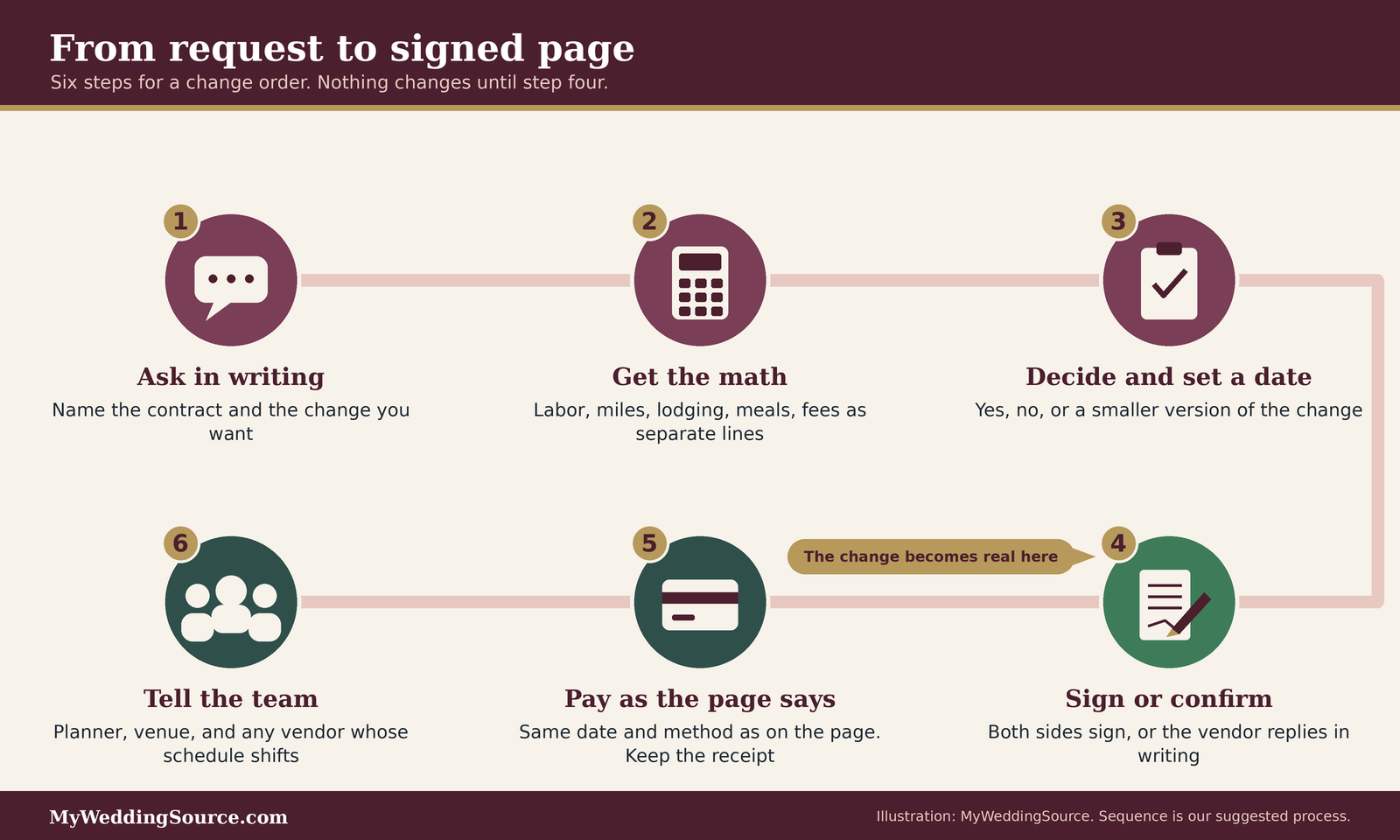
From request to signed page: the six-step process
The process for wedding contract change orders is short and the same for almost every vendor. The value is in doing the steps in order, especially the one most people skip: stopping the change until the written confirmation exists.
Steps one through three: ask, quote, and decide
The first half of the process happens by message or phone. Keep it light and keep it written wherever possible.
Step one: ask in writing
Send a short message that names the contract, names the change you want, and asks for a written quote. For example: “We would like to add a welcome dinner to our photography agreement. Could you send a written quote showing the added time, any travel or lodging effect, and the new total?” Asking in writing from the start gives you a dated record of the request.
Step two: get a written quote with the math visible
A good quote lists labor, travel, lodging, meals, equipment, and fees as separate lines. If the vendor sends only a total, ask for the pieces. You are not being difficult. You are checking the same arithmetic the vendor did, and the cost model later in this guide shows you how.
Step three: compare, decide, and set a deadline
Take a day if you can. Ask whether the quote expires. Talk to your partner and, if you work with one, your planner or coordinator, because a change in one vendor’s schedule can affect another vendor’s work. Decide yes, no, or a smaller version of the change.
Steps four through six: sign, pay, and spread the word
The second half of the process turns a decision into a record and makes sure everyone who needs to know actually knows.
Step four: get the signature or written approval
The page needs both sides. Many vendors send an e-signature link, which is fine; federal law gives electronic signatures and records the same general legal footing as paper in transactions in or affecting interstate commerce. If the vendor does not use a form, the exchange of messages in which you state the change and the vendor replies confirming it can work as a record, but a handwritten or e-signed page is stronger. The evidence ladder in the records section explains the difference.
Step five: pay according to the page
Pay on the date and by the method on the page, and keep the receipt with your wedding contract change orders. If the vendor asks for a different method than the page says, ask them to update the page. A payment that does not match the paperwork is the kind of mismatch that causes trouble later.
Step six: tell the people who need to know
Send the signed change order to your planner or coordinator, the venue contact if the change affects timing or access, and any vendor whose schedule depends on the change. If you added a late-night snack, the venue, the DJ, and the photographer may all need to know. Our wedding vendor timeline guide shows how those schedules fit together.
Pricing a change: a vendor travel and per-diem cost model
Many last-minute upgrades cost more than the price of the item itself, because they change when or where the vendor works. Wedding contract change orders are the place to show that difference. An extra hour is mostly labor. An added event on the day before the wedding can also add miles, a hotel night, and meals. The model below breaks a quoted change into parts so you can ask sharper questions. It is a way to check the shape of a quote in your wedding contract change orders, not a way to predict what any vendor will charge.
The parts of a change-order price
Start with a simple sum. Every added cost belongs to one of a handful of buckets, and a clear quote shows each one.
The model in one line
Change price = added labor + added travel miles + added lodging + added meals and incidentals + equipment or pass-through costs + any fee the contract allows + tax, if applicable. If a bucket does not apply, the quote should say zero rather than leaving you to guess. A vendor may bundle some buckets into one flat number, and that is fine if the flat number is stated and the assumptions are written next to it.
| Bucket | How it is usually calculated | What to ask |
|---|---|---|
| Added labor | Added hours (or people) times the contract rate, or a flat add-on price | Is this the same rate as the contract, and does it include prep and editing time? |
| Added travel | Added miles times a stated rate, or a flat fee | Is the distance one way or round trip, and what rate applies? |
| Added lodging | Nights times rooms times a room rate, if the vendor stays overnight | Who books it, how many people, and is it billed at cost with a receipt? |
| Meals and incidentals | Days times people times a daily amount | Is a daily amount used, and is it a flat amount or at cost? |
| Equipment or pass-through | Rental, permits, or third-party charges | Are receipts provided, and is there a markup? |
| Contract fees | Service fee, administrative fee, rush fee | Is each fee in the original contract, and what is the percentage? |
| Tax | Depends on the state and the item | Is tax added, and on which lines? |
Why per-diem is a useful benchmark
A per diem is a flat daily allowance for meals and incidental expenses, used instead of collecting receipts. The U.S. General Services Administration sets the maximum per diem rates that federal agencies use to reimburse employees for lodging and meals and incidental expenses while traveling within the continental United States, with a standard rate for most areas and individual rates for roughly 300 non-standard areas. Private wedding vendors are not bound by those rates, and many do not use them. They are still a public, neutral reference that lets you see whether a daily meal charge is in a reasonable neighborhood.
GSA’s published meals-and-incidentals breakdown lists tiers. For the $68 tier, the amount for a first or last day of travel is $51, which is 75 percent of the daily total, and the daily total divides into $16 for breakfast, $19 for lunch, $28 for dinner, and $5 for incidentals. The $74 tier gives $55.50 for a first or last day, the $80 tier gives $60, the $86 tier gives $64.50, and the $92 tier gives $69. We read this page on November 12, 2026, and its table notes a date range, so confirm current-year amounts for your venue’s location with GSA’s lookup tool before relying on them. The same GSA pages do not list a standard lodging amount in the text we could read, so lodging in the example below is our assumption, not a GSA figure.
Mileage: a second public benchmark
The Internal Revenue Service sets a business standard mileage rate. For 2026, it is 72.5 cents per mile for January 1 through June 30 and 76 cents per mile for July 1 through December 31. The IRS rate exists for tax purposes, and private vendors are not required to use it, but it is a widely recognized reference point. If a vendor charges well above or below it, that is not wrong in itself, but it is a good reason to ask how the rate was set. A 2027 rate may differ, so check the IRS page if your wedding is after this year.
A worked example: adding the night before
Suppose you booked a photographer for eight hours on Saturday. The venue is 90 miles from the photographer’s studio, and the contract assumes a same-day round trip. Three weeks before the wedding, you decide to add a three-hour welcome dinner on Friday evening. Everything in this example is invented to show the arithmetic. None of the amounts is a quote, and no vendor is described.
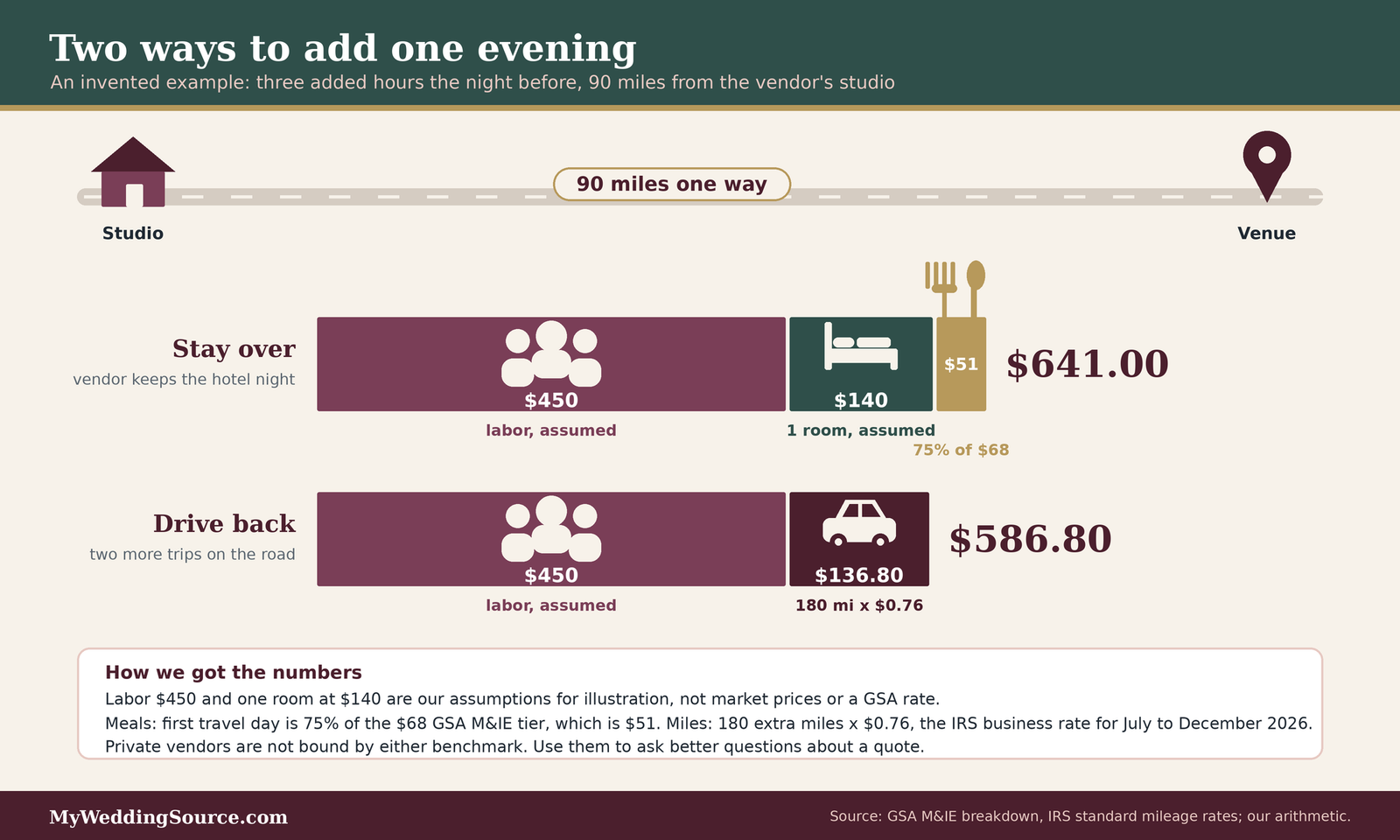
Option A: the vendor stays over
The vendor arrives Friday, stays one night, shoots the dinner, and works Saturday as planned. The outbound drive that was Saturday morning becomes Friday afternoon, so the number of miles does not change. The added costs are the added labor, one hotel night, and meals for the extra day. We assume $450 for the added three hours, $140 for one room (a number we picked for illustration, not a GSA rate), and a first-day meals amount of $51, taken from the 75 percent figure in GSA’s $68 tier. The total is $450 + $140 + $51 = $641.
Option B: the vendor drives back and forth
The vendor drives to the venue Friday, shoots the dinner, drives home, and returns Saturday. That adds one extra round trip of 180 miles. At the IRS rate of 76 cents per mile, that is 180 × $0.76 = $136.80. The labor is the same $450, there is no hotel, and we assume no meal charge. The total is $450 + $136.80 = $586.80. A vendor might also charge for added travel time, and a long drive after a late Friday event may not suit every vendor, so the cheaper number on paper may not be the one the vendor prefers.
Cost check
In our invented example, the same three-hour addition comes to about $641 if the vendor stays over and about $587 if the vendor drives home and back. The $54 gap is small compared with the labor, which is the biggest line either way. The lesson is not which option is cheaper. It is that a good change order shows each line so you can see where the money goes and ask about the lines that surprise you. Every amount here is our own arithmetic and an assumption, not a market price. A second traveler can roughly double the meal line, and the lodging line too unless the two share a room.
Reading a vendor’s number against the model
Once you have the buckets, a vendor’s quote becomes easier to read. You do not need to argue every line. You need to notice which lines are missing, which are unusually large, and which were not in the original contract.
Missing lines and bundled totals
If a quote is a single flat number, ask whether it includes travel, lodging, meals, and fees, and ask the vendor to write the assumptions beside the number: how many people, how many nights, which miles. If the vendor will not break it down, ask for a written statement that the flat number is final and covers those items.
Lines that were not in the original contract
If a new fee appears, such as a rush fee, a short-notice fee, or an administrative fee, ask where it comes from. Rock n Roll Bride advises asking for an estimate of the total cost based on your actual plans, and cautions against wording that lets a business raise prices without limits. A new fee that is written into the original contract is part of the deal. A new fee that is not may still be negotiable.
Common last-minute upgrades and what to write down for each
Different vendors change in different ways, so wedding contract change orders look different for a florist than for a photographer. The lists below are not price guides. They are prompts for the specific words each kind of change should contain, so your wedding contract change orders do not leave out the detail that matters for that vendor.
Changes to time and people
Time and staffing changes are the most common, and they are the ones where the clock is the most likely source of disagreement.
Photography and video: hours, second shooters, and deliverables
Write the exact start and end time of added coverage, the number of people, whether the added time includes editing and delivery, and whether any added images or footage change the delivery date. The Wisconsin consumer agency advises making sure a contract names the specific photographer you chose, so if an upgrade adds a second shooter, name who it is or say that the studio chooses. Our guide to wedding photography deliverables explains what to ask about files and timelines, and the wedding photographer shot list helps you decide whether extra time is really needed.
DJ, band, and officiant: extra hours and extra moments
For music, write the new end time, whether equipment stays set up, and any curfew set by the venue. If you add a ceremony sound system, a second location, or a cocktail-hour set, say who handles the setup and when. Our wedding DJ questions guide lists what to ask before you commit, and the overtime guide linked earlier explains how added hours are priced.
Planners and coordinators: scope creep in plain words
A planner who agreed to month-of coordination may be asked to take on design, vendor sourcing, or a rehearsal-day event. Write the added tasks, the added hours or days, and whether the planner may subcontract. If your planner receives commissions or referral fees from vendors, you should know it, and our guide to wedding planner commission disclosure covers that topic.
Changes to things and food
Substitutions and quantities are where small changes add up. They are also where seasonal shortages and counts matter.
Caterers and bars: headcount, menu, and service
The Wisconsin agency notes that small order changes can add charges. For food, write the new count, the new price per person, any minimum, and the final-count deadline from your original contract. For menu changes, name the dish and the item it replaces. For bar changes, name the service level and the hours. Our wedding catering and wedding catering service planning guides cover the planning side, and the vendor meals guide shows how to handle the meal for your own vendors, which a late headcount increase can affect.
Florists and decor: substitutions and quantities
The BBB suggests asking a florist how last-minute substitutions and related charges will be handled and specifying a minimum bouquet size or number of stems. In a change order, name the flower, the color, the quantity, and what happens if a flower is unavailable. Write an acceptable substitute in advance, so a morning-of swap is something you already agreed to. The Wisconsin agency also notes that out-of-season flowers may cost more, so ask whether the new price assumes the flower is in season. Our wedding florist questions page is a useful companion.
Rentals and linens: quantity, delivery, and return
Add or remove items by name and count, and write the delivery and pickup windows in the change order. If you rent from more than one source, make sure the change does not leave a table without chairs or a chair without linens. Our wedding rental planning checklist helps you count what you actually need.
Changes to place and logistics
Place changes ripple. Moving an item by thirty feet can change what a vendor needs to bring, who needs to approve it, and how long setup takes.
Venue and permit changes: rooms, hours, and access
Write the new room, the new hours, and who must approve the change, such as a facilities manager or a permit office. If the change needs a permit, say who applies and who pays. Our guide to wedding permits explains when one may be needed. If the venue’s hours extend, tell the vendors who work after the original end time, because their own overtime terms may apply.
Transportation changes: pickup times, vehicles, and stops
Write the vehicle type, the number of vehicles, each stop, and the pickup and return times. Transportation is often priced by the hour with a minimum, so an added stop that adds an hour should be written as such. Our wedding transportation and guest transportation planning guides cover what to ask.
Changes that touch several vendors at once
Some upgrades affect more than one contract. A move from an outdoor ceremony to an indoor space can change the florist’s setup, the DJ’s equipment, the photographer’s lighting, and the rental order. Make one change order per contract, and send each vendor the others’ changes so that nobody builds a plan on an outdated schedule. Wedding contract change orders work best when each vendor sees the whole picture.
Payment, refunds, and what a change does to deposits
Money is where wedding contract change orders prove their worth. A change that is written clearly can be paid, tracked, and, if needed, disputed. A change that is vague turns a small amount into a long conversation, which is why wedding contract change orders state amounts and dates plainly.
Paying for a change
Treat the added amount like any other payment under the contract, and pay it in a way that leaves a record.
Choose a traceable method
The BBB advises against paying cash up front and notes that a credit card may offer protection if there is a problem. The Wisconsin consumer agency likewise suggests trying to pay by credit card and putting down as little money as possible up front. If a vendor adds a card surcharge, ask for it to be listed as its own line on the change order.
Match the payment to the paperwork
If the wedding contract change order says the added amount is due with the final balance, do not prepay it. If it says it is due now, pay by the method on the page. Keep the receipt with the change order. If the vendor sends a new invoice, check it against the signed change order before paying.
Deposits, refunds, and cancellation effects
A wedding contract change order can quietly alter the refund picture, so read how the added money would be treated if you later cancel or reduce the order.
Does the added amount follow the original refund rules?
Add a line that says whether the added amount is refundable and on what schedule. FindLaw notes that most contracts charge a fee if you cancel, and that the fee often rises as the event approaches. If your original deposit was nonrefundable, ask whether the add-on follows the same rule. If the answer is no, a late change might be less flexible than the original deal.
Using a card dispute as a last resort, not a plan
The Federal Trade Commission explains that the Fair Credit Billing Act covers credit cards and other revolving accounts, and that a billing error includes goods or services not delivered as agreed. A dispute letter generally must reach the issuer within 60 days after the first bill showing the error was sent, and the issuer must acknowledge it within 30 days and resolve it within 90. For quality problems, further conditions can apply, including trying to resolve the problem with the seller first. A clear change order makes a dispute easier to explain, since it shows what was agreed. This is general information, not legal advice, and a dispute should be the last step after you have tried to work it out with the vendor.
Fees that surprise people
Wedding contract change orders can hide small charges. Ask about them early.
Rush, short-notice, and administrative fees
Some vendors charge extra for changes inside a window before the event. Ask whether such a fee applies, what the window is, and whether it is in your original contract. If it is not, ask the vendor to explain why it is being added. The Federal Trade Commission’s 2025 rule on unfair or deceptive fees is limited to live-event tickets and short-term lodging, and the portion we read does not mention wedding vendors, so do not assume it governs a vendor’s fee for a change. A venue that sells overnight rooms is a separate question for an attorney.
Taxes, service charges, and gratuity
Whether tax applies to an added item depends on the state and the item, and we cannot tell you how your state handles it. Ask the vendor to show tax as its own line. If a service charge or gratuity is attached to the added food, ask whether it is calculated on the new total or only on the added amount. Ask each vendor directly how gratuity works on the change, and write the answer on the page.
Signatures, emails, and texts: how strong is your record?
Not every agreement is documented the same way, and some forms of record for wedding contract change orders are stronger than others. The ranking below is our judgment based on the sources we read, not a legal rule, and the weight a court gives any record depends on your state and the facts.
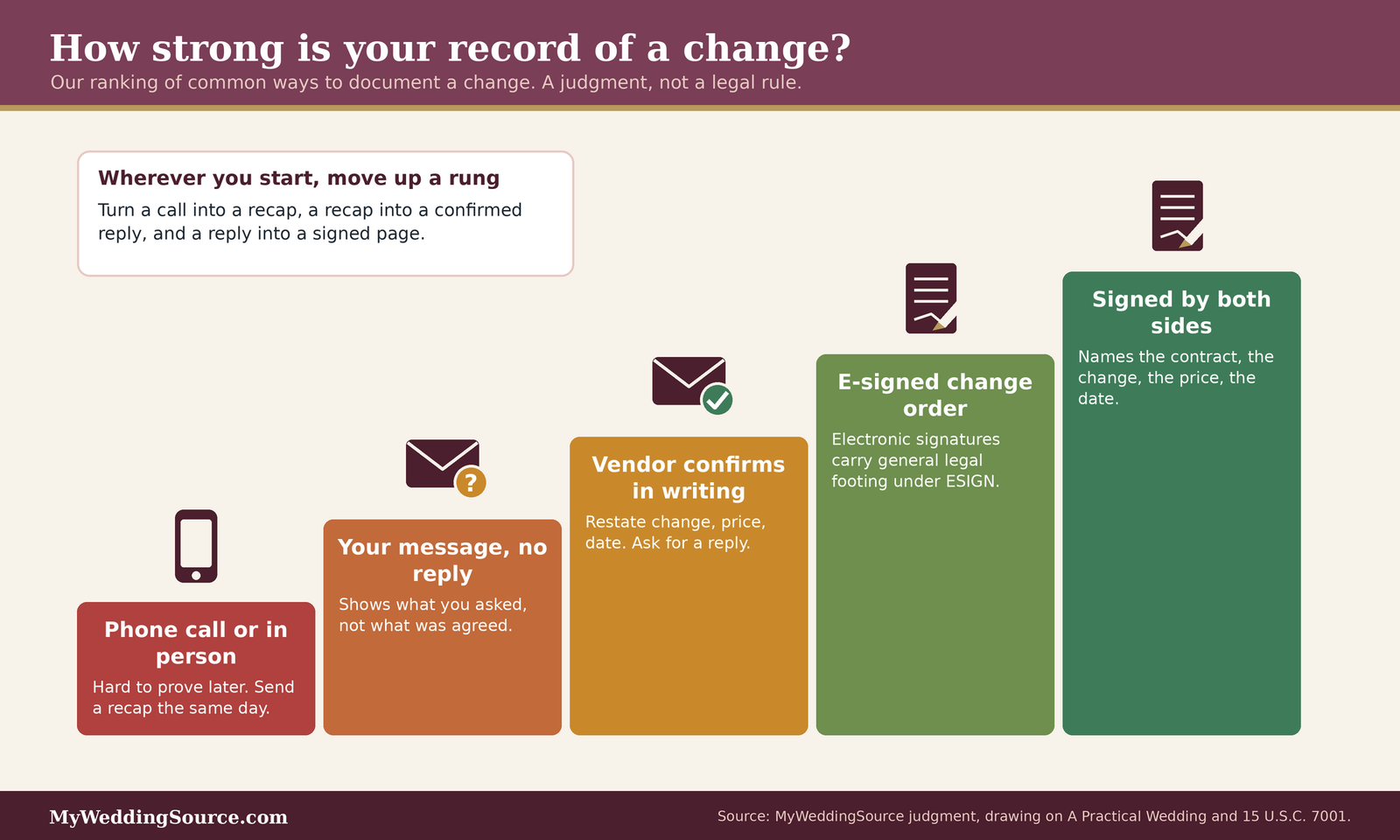
The evidence ladder
Picture a ladder with the strongest forms of record at the top. Where you can, aim for the top rungs.
Strongest: a signed amendment from both sides
A page that names the original contract, describes the change, states the price, and carries both signatures is the clearest form. A Practical Wedding suggests writing the change on a copy of the original contract, dating it, and having both parties sign, or creating a new signed amended contract. The Uniform Commercial Code treats a signed writing as the form a signed no-modification clause can require, for goods.
Strong: an e-signature or an e-form
Electronic signatures are widely used. Under the federal ESIGN Act, a signature, contract, or other record cannot be denied legal effect only because it is in electronic form, for transactions in or affecting interstate commerce. For consumer disclosures the law has extra consent rules, so if a vendor says the law requires them to give you something in writing, an electronic copy needs your consent and certain disclosures, such as your right to a paper copy. This is a summary, not legal advice.
Useful: a message exchange where the vendor confirms the change
A Practical Wedding says an exchange of emails or texts can work if the vendor replies in writing confirming the change, and warns that without the reply, the vendor could deny agreeing. Write the confirmation request so it is easy to answer: restate the change, the price, and the date, and ask the vendor to reply “confirmed.”
The weaker rungs
Sometimes you only have a conversation. Do not stop there. Turn it into something better.
Weak: your message with no reply
An email from you that the vendor never answered shows what you asked for, not what was agreed. If you are in this position, send a short follow-up that restates the request and asks for a written yes or no.
Weakest: a phone call or a conversation in person
Spoken agreements are real, but hard to prove. After any call, send a recap the same day: “Thanks for the call. To confirm, we agreed to [change] for [price], due [date]. Please reply to confirm.” That recap is the bridge between the weakest rung and the useful one.
Where to keep the records
A good record is useless if you cannot find it. Decide where wedding contract change orders live before you need them.
One folder, one naming habit
Create a shared folder with your partner. Name each file with the vendor, the document type, and the date, such as “Photographer – Change Order 2 – signed – 2027-05-14.” Keep the original contract in the same folder, and keep a plain-text copy of any approval email.
Give a copy to the person on site
On the wedding weekend, you will likely not be reading contracts. Give your planner, coordinator, or a trusted friend a one-page summary of each vendor’s agreed changes and the signed pages. Our wedding vendor contract guide explains what the rest of a typical agreement contains, and the vendor due diligence checklist helps with the groundwork before you sign.
Edge cases and awkward situations
Real changes are messier than templates, and wedding contract change orders have to cope with that. These situations come up often enough to plan for.
When the other side makes the change
Not every change starts with you. Vendors sometimes propose changes, and other people sometimes make changes on your behalf.
The vendor proposes a change
If a vendor asks to change a term, such as the arrival time, the staff, or the product, treat it the same way: ask for the change in writing, ask what it does to the price, and say clearly whether you accept. Silence is not consent. Our guides to the wedding vendor replacement policy and wedding vendor subcontractors explain how to respond when the change is about who does the work.
A relative or friend calls the vendor
Well-meaning family members sometimes call a vendor to add a toast, a cake, or a flower. Tell the vendor in your first message who is authorized to change the agreement, and ask them to route all changes through that person. Tell your family the same thing, kindly.
Your planner makes a change for you
If you work with a planner, ask in your planner agreement whether the planner can approve changes up to a stated amount, and require that any change be confirmed to you in writing. This limits surprises and keeps your signature meaningful.
When the change is a reduction or a mistake
Upgrades get the attention, but downgrades and corrections need wedding contract change orders too.
Reducing guests, hours, or items
A reduction may not lower the price as much as you expect. Rock n Roll Bride notes that minimum-spend requirements may apply even if your guest list shrinks. Ask for the reduction in writing and ask what the new total and balance will be.
Correcting an error in the original contract
If you spot a wrong date, a wrong name, or a wrong venue on the original, ask for a correction in writing right away. Rock n Roll Bride suggests checking that the contract matches your quote and recent discussions, and asking for a corrected version before paying if the package, price, date, or service differs.
When time is short
The last week is when upgrades tend to happen. Plan for the compressed timeline.
A change in the final two weeks
The BBB suggests confirming services one or two weeks before the event and verifying the agreed-upon details. Use that confirmation call or email as the moment to list every change and ask each vendor to reply with a summary of what they have on file for you. Any difference you catch then can still be fixed.
A change on the wedding day itself
On the day, you may need to approve something verbally, such as an extra thirty minutes of music. Keep the decision with one person, write it in a message or a notes app as soon as you can, and send the vendor a one-line confirmation: “Approved: extra thirty minutes, as quoted, to be added to the balance.” Settle the paperwork the next business day, and keep the amount reasonable so nobody has a reason to dispute it.
Insurance, permits, and downstream effects
Some changes ripple outside the vendor agreement.
Insurance and certificates
If an upgrade adds a new activity, such as a fire element or a bounce house, ask the venue and vendor whether insurance or a certificate of coverage needs to change. Our wedding insurance page explains what an event policy may cover, and you should check the policy language, because we cannot promise coverage.
Vendors who need to eat and rest
An added hour or a larger crew may mean vendor meals or breaks. Our wedding vendor meals guide explains what to include so that your wedding contract change order is complete.
Questions to ask and scripts to send
The questions below help you start a change conversation with facts in hand, whether or not your vendor uses wedding contract change orders by name. The scripts are short enough to paste into an email. Edit them to sound like you.
Questions to ask before you agree
Ask for the answers in writing and attach them to the change order.
Questions worth asking before you agree to any change
- Does our contract have a process for changes, and who may sign for you?
- Can you send a written quote that shows labor, travel, lodging, meals, equipment, fees, and tax as separate lines?
- Is the price flat or an estimate, and what would change it?
- Does the added amount follow the same refund and cancellation schedule as the original?
- Is there a short-notice, rush, or administrative fee, and is it in our original contract?
- Does the change affect your staff, your schedule, or the other vendors we have booked?
- When must we sign for the quote to stand, and when is payment due?
Questions about price and payment
Ask how the quote was built, which rates apply, and whether any lines carry a markup. Ask for receipts for items billed at cost. Ask what happens to the total if the change is reduced later.
Questions about people and schedule
Ask who will do the added work, whether that is the same person named in your contract, and whether the added time fits their schedule. A change that is possible on paper but tight in practice is worth discussing before the wedding.
Short scripts you can adapt
Scripts remove the awkwardness. The goal is to be clear and kind, in that order.
Asking for a change
“Hello, we would like to adjust our agreement dated [date] for our event on [date]. We would like to [describe the change]. Could you send a written quote that shows the added labor, any travel, lodging, or meals, and the new total? Please also tell us how your change process works and when payment would be due. Thank you.”
Confirming a phone call
“Thank you for talking with us today. To confirm what we discussed: we agreed to [change] for [price], added to our contract dated [date], with payment due [date]. Everything else in the agreement stays the same. Please reply to confirm, or send us a change order to sign.”
Responding to a quote that is too high
“Thank you for the quote. Could you walk us through the lines for travel and lodging? We would like to understand the assumptions: how many people, how many nights, and how the mileage was calculated. We are also open to a smaller version of the change if that fits better. Please let us know what is possible.”
FAQ: wedding contract change orders
The basics
What are wedding contract change orders?
They are written amendments that change one or more terms of a signed vendor agreement. It names the original contract, describes what is added, removed, or swapped, states the price difference, and carries signatures or written approval from both sides. Vendors may call them addenda, amendments, or add-on forms instead.
Do I really need wedding contract change orders for small upgrades?
For anything with a price or a timing effect, yes, even a short page. Sources like the Better Business Bureau and A Practical Wedding advise putting changes in writing, because spoken promises are hard to prove later. A two-line email that the vendor confirms can be enough for a small change.
Can a text message or email count as a change order?
It can work as a record if the vendor replies in writing confirming the change, according to A Practical Wedding, but a signed page is stronger. Restate the change, price, and due date in your message, and ask the vendor to reply “confirmed.” Whether it holds up in a dispute depends on your state and facts.
Price and payment
How should I check a vendor’s price for a change?
Ask for the quote in lines: added labor, travel miles, lodging, meals, equipment, fees, and tax. Then check the arithmetic. Public references such as the IRS mileage rate and the GSA per diem tables are benchmarks, not rules, but they help you ask informed questions about a quote that seems high.
Will the added amount be refundable if I cancel?
Not necessarily. Many contracts charge a fee for cancellation that rises as the event approaches, according to FindLaw, and a vendor may treat a late add-on differently from the original deposit. Add a line to the wedding contract change order that says whether the amount follows the original refund schedule, and keep the answer in writing.
What if a vendor charges more than we agreed?
Start with the signed change order and a polite written note asking the vendor to reconcile the bill. If you paid by credit card, the FTC says a billing-error notice generally must reach the issuer in writing within 60 days after the first bill showing the error. This is general information, not legal advice; consider an attorney for serious disputes.
Timing and special cases
What if I decide on a change the week of the wedding?
Ask right away, keep it simple, and document it as soon as you can. The BBB suggests confirming services one or two weeks before the event. Use that call to list every change and ask each vendor to confirm what they have on file. For a day-of approval, send a one-line written confirmation afterward.
Who should sign on my side if I have a planner?
Decide that in your planner agreement. Many couples sign changes themselves and ask the planner to coordinate. If the planner may approve changes up to a stated amount, write that limit down and require written confirmation to you for each one. Clear authority prevents a well-meant change from becoming a surprise charge.
Your next steps
Prepare before you ask
A little preparation makes the conversation shorter and your wedding contract change orders clearer.
Reread the contract for change rules
Search your signed agreement for modification language, headcount deadlines, overtime, travel, and fee terms. Note what it says about who can sign and how changes must be made. Our wedding vendor contract guide walks through the rest of a typical agreement.
Price the change with the cost model
Write the change in buckets: labor, miles, lodging, meals, equipment, fees, and tax. Compare your estimate with the vendor’s quote, and ask about the lines that differ. Keep your arithmetic simple and label every assumption.
Make it official
A change is real only when both sides can point to the same page.
Send or sign the wedding contract change order
Use the vendor’s form, or send the template from this guide for the vendor to edit. Ask for both signatures or a written confirmation, and save the file next to the original contract.
Update the plan and tell the team
Record the new total in your budget, update your timeline, and send the signed page to your planner and any vendor the change touches. For the larger plan, use our wedding planning checklist and wedding budget guide.
Sources & methodology
How we built this guide
What we relied on
This guide combines federal consumer guidance on credit card billing errors, the text of the federal electronic signature law as summarized by Cornell’s Legal Information Institute, the Uniform Commercial Code section on modification and waiver, public per diem and mileage references from GSA and the IRS, consumer-protection advice from the Better Business Bureau and a state consumer agency, and wedding contract advice from legal and editorial publishers. Where a statement comes from a publisher or a vendor, we say so, because that advice reflects the author’s point of view. The cost model and the worked example are our own arithmetic and our own invented assumptions, and they are estimates, not quotes. We checked these pages on November 12, 2026, and rates and policies change, so confirm current figures before relying on them.
What we did not do
We did not review any real vendor’s contract, and the examples are invented. We are not lawyers and this is not legal advice. Whether a clause is enforceable, whether a change binds a vendor, and how tax applies all depend on your state and facts, so consult a licensed attorney for a serious dispute. The template is an educational outline, not a legal form.
Source list
Government and legal sources
- Federal Trade Commission, Disputing credit card charges: https://consumer.ftc.gov/articles/disputing-credit-card-charges
- Federal Trade Commission, Trade Regulation Rule on Unfair or Deceptive Fees, Federal Register, January 10, 2025: https://www.govinfo.gov/content/pkg/FR-2025-01-10/html/2024-30293.htm
- Cornell Law School Legal Information Institute, 15 U.S.C. 7001, electronic signatures in global and national commerce: https://www.law.cornell.edu/uscode/text/15/7001
- Cornell Law School Legal Information Institute, Uniform Commercial Code 2-209, modification, rescission and waiver: https://www.law.cornell.edu/ucc/2/2-209
- U.S. General Services Administration, Per diem rates: https://www.gsa.gov/travel/plan-book/per-diem-rates
- U.S. General Services Administration, M&IE breakdown: https://www.gsa.gov/travel/plan-book/per-diem-rates/mie-breakdown
- Internal Revenue Service, Standard mileage rates: https://www.irs.gov/tax-professionals/standard-mileage-rates
- Wisconsin Department of Agriculture, Trade and Consumer Protection, Avoiding wedding catastrophes: https://datcp.wi.gov/Pages/Publications/Wedding219.aspx
Consumer and industry sources
- Better Business Bureau, BBB wedding tips: https://www.bbb.org/article/money/16783-bbb-wedding-tips
- A Practical Wedding, Everything you need to know before you sign a wedding vendor contract: https://apracticalwedding.com/wedding-contract/
- Rock n Roll Bride, What every couple should know about wedding supplier contracts: https://www.rocknrollbride.com/?p=427452
- FindLaw, Common wedding vendor contract terms you should know: https://www.findlaw.com/legalblogs/law-and-life/common-wedding-vendor-contract-terms-you-should-know/