

Bridal makeup touch-up kits work best when they are small, matched to the finish you chose with your artist, and built around the few things that actually fade between the ceremony and the last dance, so that one calm person can fix shine, lips, and tears in under a minute.
Quick answer
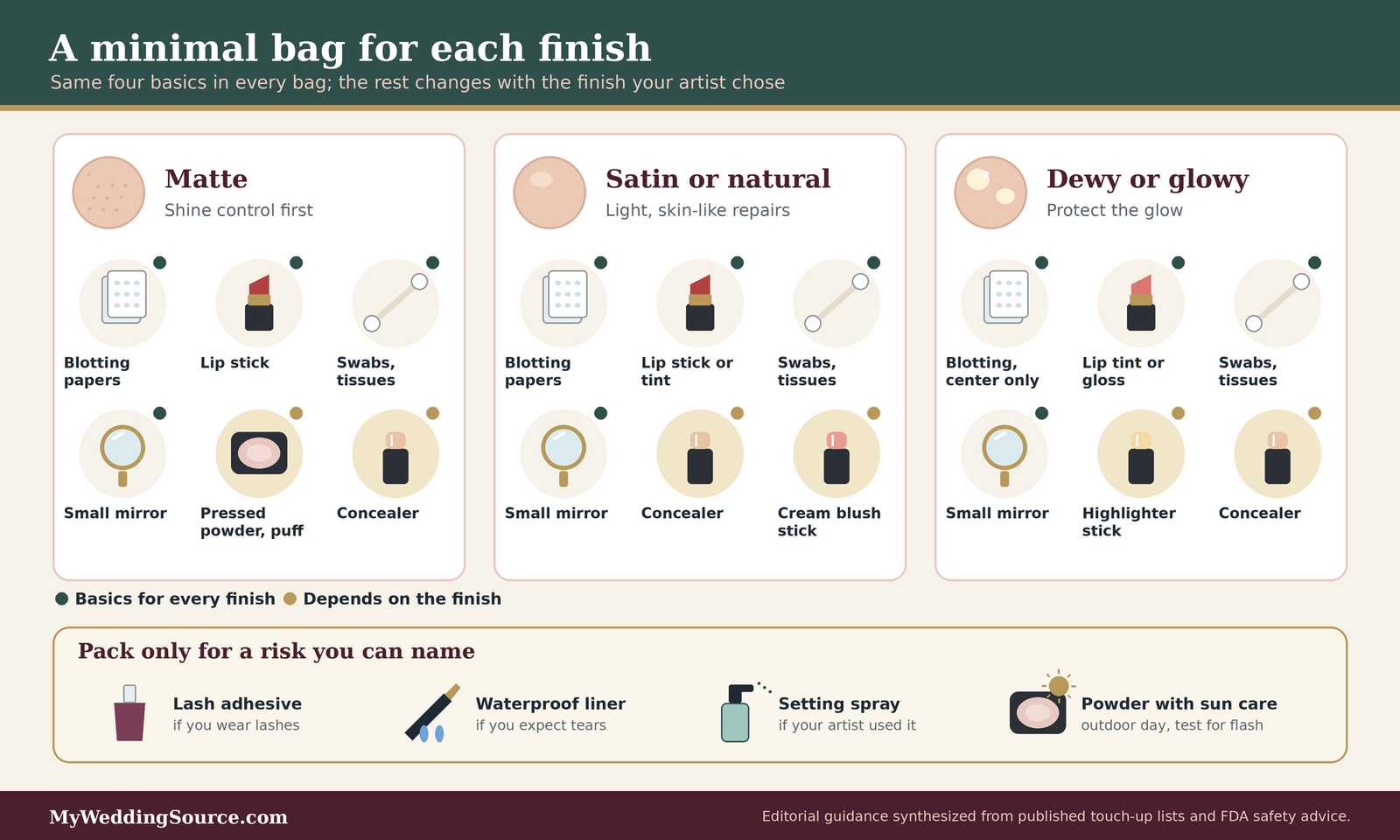
A useful touch-up bag has three tiers. Always pack: oil-blotting papers, your exact lip product with a lip brush or liner, cotton swabs and tissues, a small mirror, and a pressed powder or cream stick that matches the finish of your face makeup. Pack if your finish calls for it: a concealer, a cream blush or highlighter stick, a puff, and a travel-size setting spray. Pack only for a specific risk: lash adhesive, waterproof liner or mascara, and a powder with sun protection. Leave out anything you did not wear at your trial. Keep every item clean, labeled, and out of hot cars, and do not share eye products.
What bridal makeup touch-up kits are actually for
Search for bridal makeup touch-up kits and you will find lists of ten to twenty products, each one cheap and each one plausible. The trouble with a kit built that way is that it becomes a second makeup bag, heavy to carry and slow to search at the moment you need it. This guide starts from a different question: what really changes on your face during a wedding day, and what is the smallest set of things that puts it right?
The answer depends on the finish you and your artist chose, which is why most good bridal makeup touch-up kits differ from one bride to the next. We organize the inventory by finish instead of by product category. Our advice comes from published guidance from the FDA and from retail and editorial lists written by makeup artists and wedding publishers, which we attribute where we use them. We also share our own reasoning, which we label as ours. None of this is medical advice.
The job of a touch-up kit
Well-built bridal makeup touch-up kits share one job: to restore the look your artist created, in the moments between photographs and events. It does not redo your makeup, and it does not fix problems that belong to the application itself.
Fix, do not redo
The most helpful rule for packing is that every item should repair something you can name. Shine on the forehead and nose, lip color that has worn off after a toast, a smudge under the eye after happy tears, and a lash corner that lifts are all specific, small repairs. A full second foundation or a palette of eyeshadows is not a repair, and carrying one invites you to start over in a hotel bathroom twenty minutes before photos. If your base needs a rebuild, that is a conversation with your artist about product choice and prep, not a reason to pack more.
Who the kit serves
Bridal makeup touch-up kits serve you, but they are often used by someone else. A bridesmaid, parent, or your artist may be the person holding it while you hold your bouquet. That changes how you pack. Items need to be obvious, labeled with the shade name, and simple enough that someone who has never used a lip brush can follow a note. We come back to this idea in the section on who carries the bag.
How this differs from an emergency kit
Many couples already plan a general bag for pins, sewing supplies, and pain relievers. Bridal makeup touch-up kits are a narrower, makeup-only cousin, and keeping the two separate makes both easier to use.
Beauty items only
Our wedding emergency kit guide covers the broad problems of a wedding day: a loose button, a headache, a missing phone charger. Bridal makeup touch-up kits should not compete with it. If an item does not change how your face looks in photos, it belongs in the other bag. Separating them also helps with hygiene, because makeup products sit better away from loose pins, scissors, and bandages.
Where the rest of your beauty plan lives
Bridal makeup touch-up kits are the last step of a longer plan that begins with skin preparation and ends with the schedule on the day. For the earlier steps, see our guides to the wedding beauty timeline, hair and makeup planning, and the hair and makeup schedule. The kit assumes those decisions have been made.
Why makeup fades, and what bridal makeup touch-up kits must fix between the ceremony and the send-off
Before choosing items, it helps to know what you are repairing. Most wedding-day wear falls into a few predictable patterns, and each one points to a different tool for bridal makeup touch-up kits. The patterns below are our own summary of what the touch-up lists we reviewed are trying to solve, so treat them as a framework rather than as research findings.
Shine and oil on the face
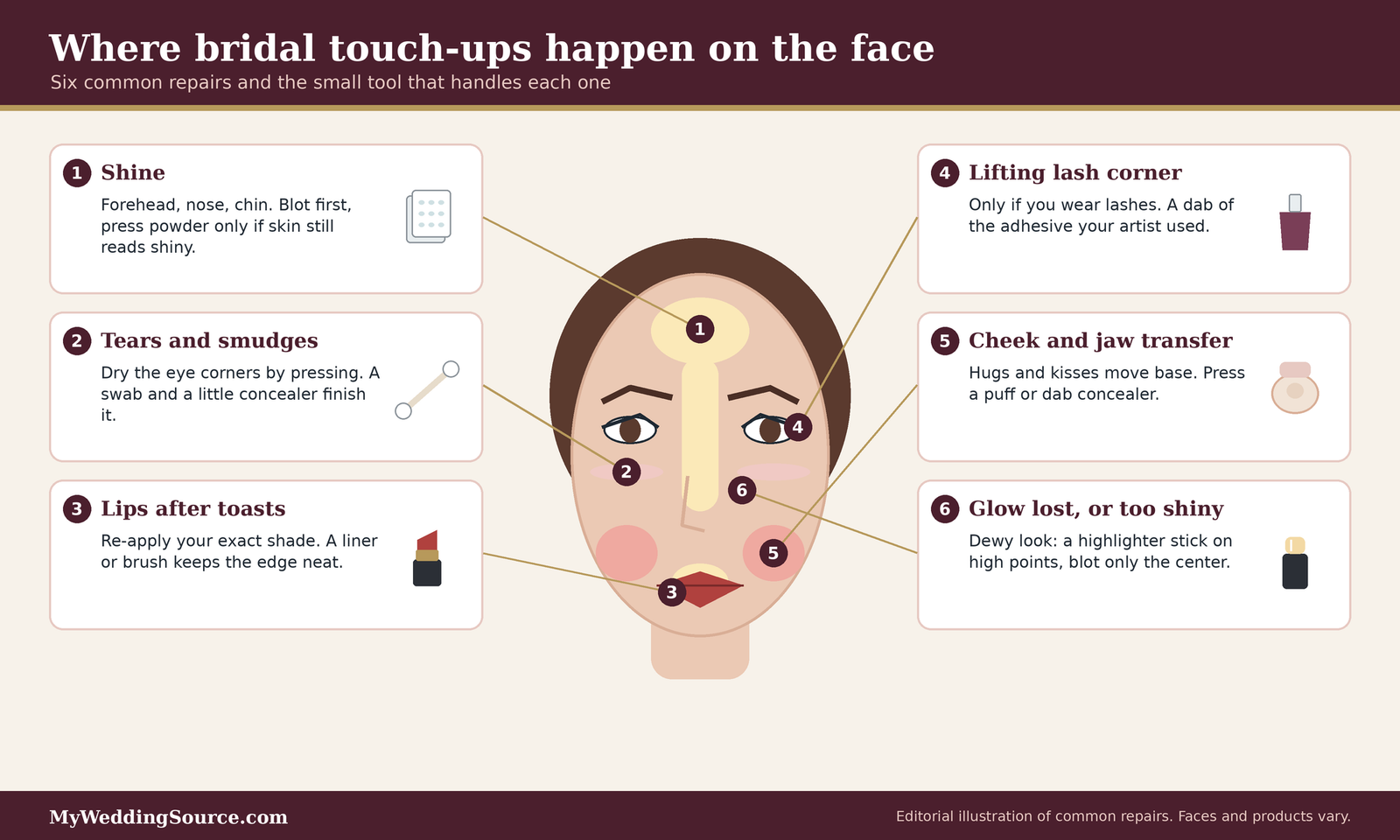
Shine is the most common complaint in the lists we read about bridal makeup touch-up kits, and it is the reason blotting papers appear in nearly every one of them. Warm rooms, outdoor light, dancing, and nerves all add to it.
Where shine shows first
The forehead, nose, and chin are the places where shine is easiest to see in photographs, because those areas catch the light first. Our guide to wedding makeup for oily skin goes deeper on prep and product choices. For the touch-up kit, the point is simply to decide in advance how you want shine handled, since the answer is different for a matte finish than for a dewy one.
Absorb first, then add powder only if needed
WeddingWire’s list pairs blotting papers with an oil-control powder to take down shine, and Polka Dot Wedding recommends blotting paper for oily skin and sunny weather. Our own suggestion follows from that: blot first, because paper lifts oil without adding product, and press powder only if the skin still reads shiny. Powder over oil can look heavier than the base underneath it.
Lips after toasts, meals, and kisses
Lip color is the item every list of bridal makeup touch-up kits includes, because it wears off through eating, drinking, speaking, and kissing, and because it is the most visible change in close-up photos.
Match the exact shade
Polka Dot Wedding advises picking up the tube your artist used on you, and Style Me Pretty suggests carrying custom shades in a small depotting container so the exact color is always available. The practical point is the same: a near match is not a match, and a slightly different red or pink stands out in photographs. Ask your artist for the names and finish of every lip product used, and write them on your card.
Liner and brush for neat edges
Style Me Pretty also lists a lip liner for bold shades, especially red, and a lip brush, and The Wed recommends a matte or satin lipstick for longer wear with a hydrating gloss for comfort. A retractable brush keeps the bristles clean in a bag and lets a helper apply color without smearing. If your lip is a soft tint, you may need only a stick and a mirror.
Tears, hugs, and transfer
Wedding days involve crying, hugging, and being kissed on the cheek. Each of those moves product from your face to someone else’s clothing, or from theirs to yours.
Happy tears and the under-eye area
The Wed lists concealer for hiding redness from happy tears and brightening under-eye shadows. WeddingWire suggests water-resistant eyeliner for emotional moments such as vows, and advises drying the inner and outer corners of the eyes with a tissue first. We add that tissues should be used by pressing, not rubbing, which is the same advice WeddingWire gives for cotton swabs: blot instead of wiping, since wiping can cause irritation and redness.
Cheek and jaw transfer
Hugs and kisses leave marks along the cheek and jawline, where base makeup is easiest to disturb. A small puff pressed over the area, or a dab of the same concealer, usually restores it. Plan for a helper to check the collar and shoulders of your dress as well, since transferred foundation is easier to fix before it sets. Our wedding emergency kit guide covers fabric spot fixes.
Lashes and small mechanical failures
The last group is the small failures that have nothing to do with oil: a lash corner that lifts, a mascara smudge, a flake of powder in a brow.
A lifting lash
WeddingWire’s list includes false-lash adhesive for a lash that lifts or shifts during dancing or cake cutting, and Style Me Pretty includes lash glue as a backup, noting that disposable applicators are helpful for hygiene when others will use the kit. If you are not wearing strip or individual lashes, you do not need adhesive at all.
Smudges and stray product
Cotton swabs handle most of the rest. Almay-style pre-loaded swabs appear on the Polka Dot Wedding list for smudged mascara or eyeliner, but a plain swab and your artist’s preferred remover can do the same job. Ask which remover is safe near your eyes, and keep a few dry swabs in the bag as well.
Choose your finish first: matte, satin, or dewy
The finish of your skin makeup decides most of what belongs in bridal makeup touch-up kits. A matte finish needs tools to control shine. A dewy finish needs the opposite: tools to keep glow in the right places without turning shiny. A satin or natural finish sits between the two and is the easiest to repair. Our finish labels below are editorial shorthand, not industry standards, so ask your artist how they describe your look.
Matte finish
A matte finish minimizes visible shine across the face. It is often chosen for oily skin, hot weather, or very long days, and it is the finish most likely to need touch-ups for dryness at the end of the evening.
What a matte bag holds
For a matte finish, bridal makeup touch-up kits are built on blotting papers, a pressed powder in your shade, a puff, a concealer, and a long-wear lip product. Who What Wear’s expert round-up describes MAC Studio Fix Powder Plus Foundation, pressed over foundation, as the choice of one artist for a soft matte, oil-free finish that lasts all day, which gives a sense of the kind of product this finish uses. Your own powder should be whatever your artist used.
What a matte bag skips
You can usually skip a highlighter, since glow is the opposite of the look. Setting spray is optional: it may help makeup last, but it is a second product that can change texture. If your artist used it, ask for the exact product. If not, test any new spray before the day rather than adding one to the bag.
Satin or natural finish
A satin or natural finish looks like skin with a little life in it: neither flat nor glossy. It tolerates small touch-ups well because it does not depend on a particular balance of powder and glow.
What a satin bag holds
Satin bridal makeup touch-up kits hold blotting papers, a concealer, your lip product, cotton swabs, a mirror, and a pressed or cream product that matches your cheeks. In our view, cream sticks suit this finish because they blend with fingertips. Polka Dot Wedding’s list includes a cream blush stick and advises using only a little, blended with the fingertips.
How to keep it from drifting matte or shiny
The main risk is over-correcting. Powder pushes a satin finish toward matte, and repeated blotting can lift too much product. A simple rule is to blot only when shine is visible in a mirror, then stop. We would rather you see slightly more skin than slightly too much powder.
Dewy or glowy finish
A dewy finish reflects light on purpose, usually on the cheekbones and the bridge of the nose. It is popular for its fresh look, but the line between glow and shine is thin, and touch-ups are about protecting that line.
What a dewy bag holds
For a glowy look, bridal makeup touch-up kits carry a highlighter stick or cream product that matches what your artist used, a very small amount of powder for the T-zone only, blotting papers, a concealer, and lip products. Who What Wear’s round-up includes several glow products used by artists, such as a glossy highlighter for cheekbones and the nose, which shows how common cream and stick formats are for this finish. Ask your artist which product, if any, to bring.
Where powder should never go
If you want glow, avoid powdering the high points of the cheek. Use blotting paper at the center of the face, and leave the cheekbones alone. If skin looks oily in a way that photographs badly, ask your photographer to take a test frame, and see the section on photos and flash.
Mixed finishes
Some of the looks artists describe combine two finishes: glow on the skin and a matte lip, or a soft matte base with a dewy highlight.
Balance rather than match
Who What Wear’s round-up describes one artist switching to a matte lipstick for the evening to balance shimmery eyes and last through dancing, and it notes pairing glowy skin with a matte lip. If your look mixes finishes, pack the product for each zone of your bridal makeup touch-up kits separately, and label them so a helper does not use the lip gloss as a cheek highlight.
Keep a written finish note
Write one line per zone on your card: skin matte, cheek satin, lip matte, for example. A helper who sees the note will know which product to reach for and which to avoid, and you will not have to explain it while someone is holding your veil. ## The minimal inventory for bridal makeup touch-up kits: which items truly matter
The table below is the core deliverable of this guide. It sorts the products that appear most often in bridal makeup touch-up kits on the lists we reviewed into three tiers and shows how each one changes by finish. The tiers and the finish columns are our editorial judgment, built from those lists and from the FDA safety guidance later in this guide. They are not a standard, and your artist’s advice about your own skin outranks any table.
| Item | Tier | Matte finish | Satin or natural | Dewy or glowy |
|---|---|---|---|---|
| Oil-blotting papers | Always | Yes, first fix for shine | Yes, only when shine shows | Yes, center of face only |
| Lip product in your exact shade | Always | Long-wear or matte stick | Stick or tint | Tint or gloss |
| Lip brush or liner | Always for bold lips | Yes | Optional | Optional |
| Cotton swabs and tissues | Always | Yes | Yes | Yes |
| Small mirror | Always | Yes | Yes | Yes |
| Pressed powder and puff | Finish-dependent | Yes | Small amount | T-zone only |
| Concealer in your shade | Finish-dependent | Yes | Yes | Yes |
| Cream blush or highlighter stick | Finish-dependent | Skip highlighter | Blush stick | Yes, both |
| Setting spray | Situational | Only if artist used it | Only if artist used it | Skip unless advised |
| Lash adhesive | Situational | If wearing lashes | If wearing lashes | If wearing lashes |
| Waterproof liner or mascara | Situational | If you expect tears | If you expect tears | If you expect tears |
| Powder with sun protection | Situational | Outdoor day only | Outdoor day only | Outdoor day only |
Tier one: bring it every time
Five items cover the majority of wedding-day repairs, and every finish uses them. They are small, cheap, and take little space.
Blotting papers
Nearly every list we reviewed includes them, from WeddingWire to Style Me Pretty to The Wed, which describes them as absorbing shine without disturbing makeup. They are the lowest-risk way to handle oil, because they add nothing to the face. Pack a small booklet in a pocket you can reach, and tell your helper how to use them: press, hold a second, lift. Dragging across the skin can move your base.
Your lip product, a brush, and a liner if the shade is bold
Lip color is the one item where a near match fails. Ask your artist to write down every product and shade used, and consider buying the same ones. If your lip is bold, a matching liner keeps the edge crisp, a point made in Style Me Pretty’s list. If your lip is a sheer tint, a stick and a mirror may be all you need.
Cotton swabs and tissues
These are the unglamorous tools that fix most smudges, and they cost almost nothing. WeddingWire advises dampening a swab with cool water and blotting instead of wiping, and Style Me Pretty includes tissues and swabs for happy tears. Pack a few dry and a few damp in a small sealed bag. Throw each one away after one use rather than returning it to the kit.
A small mirror
Polka Dot Wedding suggests carrying a compact that stands on its own so both hands stay free, and notes that if no one in the bridal party has a mirror, you should bring one. A mirror matters more than it seems: if the person holding the kit cannot show you the result, you will not know whether the fix worked.
Tier two: pack what your finish needs
The second tier depends on your finish, so decide with your artist before buying. These are the items where a mismatch is easiest.
Pressed powder and a puff
For matte and satin finishes, a compact of the exact powder your artist used lets you press out shine after blotting. Style Me Pretty recommends a puff to press powder lightly rather than rub it, which keeps makeup looking fresh. For a dewy finish, powder is a small-area tool for the T-zone. If your artist used a loose powder, ask whether a pressed version is available, since loose powder is hard to carry.
Concealer
Concealer shows up on The Wed, WeddingWire, and Polka Dot Wedding lists for blemishes, redness, and under-eye shadows, and Who What Wear’s expert round-up quotes one artist who kept a tube handy for touch-ups. The best choice is the exact shade and formula used on your face, in a stick or small pot so a helper can dab it with a fingertip.
Cream blush or highlighter stick
Cream sticks suit touch-ups because they blend with fingers and need no brush. Polka Dot Wedding lists a blush stick, and Who What Wear’s round-up includes a cream stick blush that one artist describes as strong in staying power and easy to top up. For dewy looks, a highlighter stick is the glow product to bring. Matte looks can skip it.
Tier three: pack only for a specific risk
Some items belong in the bag only when you can name the risk they address. Otherwise, they add weight, expense, and one more product to keep clean.
Lash adhesive and disposable applicators
Pack adhesive only if you are wearing false lashes. WeddingWire’s list says it can fix a lash that lifts during dancing or cake cutting, and Style Me Pretty advises disposable applicators when others will use the kit. Ask your artist for the exact adhesive used on your lashes, since a different one may not hold or may irritate. Do not apply lash adhesive in a moving vehicle.
Waterproof liner or mascara
If you expect to cry, a water-resistant liner can help. WeddingWire’s list includes one for emotional moments, and Who What Wear’s round-up mentions a waterproof mascara for tears. Test any waterproof formula at your trial, since these are harder to remove. The FDA advises throwing away eye products you have used during an eye infection and not sharing them with anyone, so keep these for your own use.
Setting spray and sun protection
Setting spray appears on WeddingWire’s and The Wed’s lists, and The Wed ties anti-humidity spray to humid days. Style Me Pretty advises avoiding powders with sun protection because they can cause flash in photos, while a separate point from the American Academy of Dermatology is that sunscreen should be reapplied every two hours, so the two goals pull in different directions. The section on photos and flash walks through the trade-off.
What to leave out
Smaller bridal makeup touch-up kits are safer ones. Everything you add is one more thing to store, clean, and explain to a helper.
Duplicates of your whole routine
You do not need a second foundation, a full palette, or a brush roll. Your artist’s work is built to last the length of the schedule you gave them, and if it will not, the fix is a conversation with your artist before the day. If you are unsure, ask whether your timeline demands a second layer of anything. Our hair and makeup schedule guide explains how to give an artist the information they need.
Products you have not worn
New products on the wedding day are a risk. The FDA advises stopping any product that causes a rash, redness, or burning, and our own suggestion is simpler: if it was not in your trial, it is not in your bag. This applies to the clever new gadget someone gives you at the shower as much as to a new lipstick.
Packing bridal makeup touch-up kits safely: hygiene, storage, and shelf life
Bridal makeup touch-up kits may sit in a bag, a car, or a room that gets warm, and it may be handled by people other than you. FDA guidance on using cosmetics safely is practical and short, and it applies directly. We summarize it here and attribute it. Where the FDA does not speak to a question, we say so.
Clean hands, no sharing
The FDA’s advice on contamination is among the easiest to follow and the easiest to forget when many people share a kit.
Do not share eye products
The FDA says not to share or swap eye cosmetics, even with close friends, because another person’s germs may be hazardous to you. Bridal makeup touch-up kits pass through many hands, so decide in advance that eye products are for you only. If a bridesmaid needs a mascara fix, she uses her own, and your lash adhesive stays in your bag.
Wash hands and use single-use tools
The FDA advises washing your hands before applying eye cosmetics and making sure any instrument near the eye is clean. For bridal makeup touch-up kits, that translates into a small pack of hand wipes or sanitizer, and disposable applicators and swabs. Style Me Pretty’s list also recommends disposable applicators for lash glue when others will use it. For how artists handle sanitation in their own kits, see our guide to wedding makeup artist sanitation.
Never moisten a dried-out product
The FDA says not to add saliva or water to mascara, because saliva can introduce mouth bacteria and water can dilute the preservative. If a product has dried up, throw it away. A single tube of mascara for a wedding is inexpensive compared with the risk of an eye infection, so replace it instead of reviving it.
Heat, age, and expiration
The FDA says cosmetics can go bad if stored somewhere too warm or moist, and its pages give two numbers worth knowing.
Keep the bag cool
The FDA advises not storing cosmetics above 85 degrees Fahrenheit and notes that a hot environment, such as a parked car, can break down a preservative. For a summer wedding, that means your bridal makeup touch-up kits ride with you in a cooled space, not in a trunk or on a sunny dashboard. Our summer wedding heat plan covers broader steps for keeping a day manageable.
Check ages and write dates on containers
The FDA says that U.S. law does not require cosmetics to carry a set shelf life or expiration date, and that determining shelf life is the manufacturer’s responsibility. Manufacturers usually recommend discarding mascara two to four months after purchase, and writing the opening date on a container helps you track age. For bridal makeup touch-up kits, buy fresh eye products close to the wedding date, and discard anything that changes color or smell, hardens, or separates.
Buy from trustworthy sellers
The FDA also notes that products from flea markets or internet resellers may be expired, used, diluted, tampered with, or counterfeit. When you buy duplicates of your artist’s products, buy from the brand or a retailer you trust, and check the seal.
Patch testing and reactions
Wedding-day skin is not the time to learn that you react to something. A product that is safe for most people can still bother yours.
How to test a new product
A health-news item published by an Atlanta orthopedic practice, which cites American Academy of Dermatology guidance, describes applying a quarter-sized amount to the underside of the arm or inner elbow twice a day for seven to ten days, then starting use if no red, itchy, or swollen patches appear. That is a long runway for a lip stick or a concealer, so test new items early, ideally during your trial period. See our bridal skincare timeline for where this fits.
What to do if you react
The FDA says to stop using a product that causes a rash, redness, burning, or another unexpected reaction, to contact your healthcare provider, and to report the problem to the FDA. We cannot give medical advice, and neither can your artist. If you have known sensitivities, see our guide to sensitive skin bridal beauty and ask a clinician before the trial.
Ask about ingredients early
If you have a known allergy, give your artist the list ahead of time and ask to see the ingredient label of any product they plan to use or recommend for your bag. A label is a more reliable source than a memory or a sales claim. Keep a photo of each label in your phone for the day.
Photos, flash, and sunlight: what touch-ups do on camera
Bridal makeup touch-up kits only matter if they help in photographs, and a few products can quietly make photographs worse. This is one area where a small test beforehand pays off.
Powder and flashback
Flashback is the pale cast that appears on skin in flash photographs when a product reflects light back at the camera.
What causes it
The beauty site Lab Muffin explains that flash photos show white patches when powder on the skin reflects the light straight back, and that silica, found in many translucent powders and especially those marked “HD,” is the main culprit. It adds that titanium dioxide, zinc oxide, mica, shimmer, and glitter can brighten under flash, usually less. This is a blogger’s testing rather than a regulatory source, so treat it as practical guidance.
How to test before the wedding
Lab Muffin’s advice is to use less product, to apply silica under liquid makeup rather than over it, and to take flash photos of your full makeup before the event. We agree with the last step: ask a friend to take a few photographs with flash, in your full face of makeup, with each touch-up powder you plan to carry. If one looks pale, ask your artist about an alternative.
Sun protection and touch-ups
Sun protection and makeup do not always fit together neatly, and you should plan for it if your wedding is outside.
What the dermatology guidance says
The American Academy of Dermatology advises broad-spectrum, water-resistant sunscreen with an SPF of 30 or higher, applied about fifteen minutes before going outdoors, reapplied every two hours and immediately after swimming or sweating. The page we read does not explain how to reapply over makeup, so we cannot offer a technique. Ask your artist and your dermatologist together, since a product that protects you may not suit your finish.
How this interacts with your photographer’s advice
Style Me Pretty’s list advises avoiding powders with SPF because of flash, while Lab Muffin reports that most sunscreens did not cause flashback in its tests. The two do not contradict each other as much as they seem to: the concern is a particular type of powder, not sun protection itself. Test your own product with flash, then decide.
Working with your photographer
Your photographer and videographer are part of the touch-up plan, because they know when a fix will be most useful.
Ask for a touch-up window
Tell the photographer when you expect to need a minute, for example after the ceremony and before group portraits, and ask them to build thirty to sixty seconds into the schedule. Our wedding photographer shot list and first look photos guides show how a timeline is built around such pauses.
Retouching is a separate conversation
A quick shine fix beats a photo edit later, but editing is available for what remains. Our guide to wedding photo retouching requests explains how to ask without surprising your photographer. Do not count on retouching to cover a problem you could have prevented with a blotting paper. ## Who carries the kit, and when it comes out
Even well-planned bridal makeup touch-up kits are no help if they are sitting at the hotel while you are in a garden at four in the afternoon. Planning who holds the bag, and when it appears, is as important as what is in it.
Three ways to carry bridal makeup touch-up kits
There are three common arrangements. Each has trade-offs, and the right one depends on your artist’s contract and your group.
Your artist stays
Some artists stay through photographs and do the touch-ups themselves. That is the most reliable option, because the person who built your look knows how to repair it. It is also the most expensive, since extra time is usually billed. Our wedding hair and makeup cost guide explains how fees are commonly structured. Ask about stay time before you book, not on the morning of the wedding.
A trusted friend or family member
A calm person who is not in the photographs, or who has a free moment between them, can hold the kit. Choose someone who will say what they see rather than what you want to hear. Give them the card described below and a short walkthrough on the morning. Avoid giving the job to someone who is also your hair stylist, your driver, and your primary photographer’s assistant.
Your own small bag
Style Me Pretty and Polka Dot Wedding both write as though the bride packs the kit herself, and for a short event with a small bag it works. The trade-off is that you cannot see your own back or your own shine without a mirror and a free hand. If you carry the kit yourself, keep it small enough to fit a clutch and do the checks in a restroom with decent light.
A day-of touch-up schedule
The schedule below is our own planning suggestion, not an industry standard. Adapt it to your timeline.

Before the ceremony
After your artist finishes, take a close-up photograph of your face in natural light, so you and your helper know what the baseline looks like. Do a quick blot and lip check about ten minutes before you walk, when nerves and a warm room have had time to show. Hand the kit to your helper before you put on your veil.
After the ceremony, before portraits
This is the highest-value moment. Tears, hugs, and sun may have changed your face, and you are about to be photographed at length. Dry corners of the eyes with a tissue, blot shine, press concealer if needed, and refresh lips. A short touch-up window at this point can improve every photograph that follows. Ask your photographer to leave a minute for it.
Cocktail hour and dinner
Eating and drinking take lip color first. Refresh the lip after the meal, not before, and check teeth for lipstick. If you changed into a second outfit, see our outfit changes guide for timing, and use the change as the natural moment for a quick face check.
Dancing and send-off
By the end of the night, a small powder press, a blotting paper, and a lip refresh are enough for the send-off photographs. This is also when helpers are tired, so a simple card makes the final touch-up easier.
The one-page card
A written card turns bridal makeup touch-up kits from a personal habit into something that anyone can use. It takes ten minutes to write and can save a lot of confusion.
What goes on the card
List each product by name and shade, what it is for, and where on the face it goes. Add a line of the finish for each zone, such as “skin satin, lips matte.” Include the names of any products to avoid, such as “no powder on the cheekbones,” and your artist’s phone number in case of a question. Keep it to one page.
Where to keep it
Tape or tuck the card inside the bag so it travels with the kit. Photograph it with your phone and send the photograph to your helper. If your artist is willing to review the card at your trial, that is a good use of five minutes and a reason to ask your artist, not your best guess, about shades.
Working with your makeup artist: contracts, kits, and vendor questions
Your artist is the best source of information about what belongs in bridal makeup touch-up kits, and the contract is where you settle the details. These are practical points to confirm, not legal advice. If a contract is complicated, ask a lawyer, and see our broader guide to vendor communication deadlines.
What to settle in the contract
The contract should say what you get, for how long, and what happens if the plan changes. Ambiguity about touch-ups is common and easy to fix.
Stay time and touch-up service
Ask whether the fee covers any time after the first application, how much extra time costs, and whether the artist or an assistant will be there for touch-ups. If your plan depends on a touch-up before portraits, make sure it is written in the schedule. Our hair and makeup schedule guide shows how to lay it out.
Products and who owns them
Ask whether your artist provides bridal makeup touch-up kits, whether it is included in the fee or sold separately, and whether the products are yours to keep. If the artist leaves a kit with you, ask whether the items are new, how they were transferred, and whether you should discard them after the wedding. If the answer is not clear, write it down.
What happens if you react
Ask what the artist’s policy is if you have a reaction at the trial or on the day, and whether the trial is the time to test every product, including lip and cream items. Our professional bridal makeup versus DIY guide discusses trade-offs between a professional and doing it yourself.
Buying or decanting the products
If you want your own bridal makeup touch-up kits built from the artist’s products, there are two paths. Both come with hygiene questions.
Buying duplicates
Buying the same products your artist used is the simplest option, since you can see the label, shade, and ingredients. Ask for a written list of product names and shades. The FDA’s caution about unfamiliar resellers applies here, so buy from the brand or a reputable store.
Depotting into small containers
Style Me Pretty mentions depotting, which means moving a product into a small container so the exact color is available in a smaller bag. We cannot verify any particular method, so ask your artist how they do it and what tools and cleaning they use. A product transferred with unclean tools can carry contamination, which is why the FDA advises clean hands and clean instruments.
Reading labels and asking about claims on bridal makeup touch-up kits
Labels and claims are where a sales conversation can drift away from facts.
What a label can tell you
The FDA’s cosmetics pages list ingredient names, labeling claims, and expiration dating among its labeling topics, and state that companies and individuals who market cosmetics have a legal responsibility to ensure the safety of their products. A label will not tell you whether a product will suit your skin, but it gives you a starting point for an allergy question. We do not make claims about ingredients or health effects.
What a claim cannot promise
Be cautious of “all-day,” “kiss-proof,” or “tear-proof” claims. Those phrases describe a marketing goal, not a guarantee, and wear varies with skin, climate, and use. Test any claim at your trial, and keep your expectations modest. If a claim matters to you, ask the seller to show the source.
Questions worth asking your makeup artist
- Will you or an assistant stay for touch-ups, and how is extra time billed?
- Can you write down every product and shade you used on my face, lips, and eyes?
- Which of those products do you recommend I carry, and which should I skip?
- Do you provide a touch-up kit, and are the products new and mine to keep?
- How do you transfer product into small containers, and what do you use to keep it clean?
- Can I see the ingredient label for products I will use, in case of an allergy?
- What is your policy if I have a reaction at the trial or on the day?
- Will you review my one-page card at the trial?
Where the money goes
We did not find reliable, current prices for touch-up products in the sources we read, so we do not quote any. Instead, here is a way to estimate your own costs. List every item you plan to buy, check the price at your preferred retailer, and total the list. Then cross out any item that duplicates something you already own, and any item you cannot name a use for. In our experience of reading these lists, the savings come from fewer items, not cheaper ones. Mascara and other eye products are the items to buy fresh, since the FDA says manufacturers usually recommend replacing mascara two to four months after purchase.
Edge cases: when bridal makeup touch-up kits need adjusting
Standard advice about bridal makeup touch-up kits assumes a typical day, a typical venue, and a typical skin type. Many weddings are not typical, and a few situations justify changing the bag.
Weather and venue
Weather changes what bridal makeup touch-up kits need to do, and it also changes where they can safely sit.
Hot or sunny weddings
Heat raises shine, sun raises the need for sunscreen, and a hot car harms products. Pack extra blotting papers, keep the kit in the shade or a cooler bag, and follow the FDA’s guidance not to store cosmetics above 85 degrees Fahrenheit. If you wear a powder with SPF, test it for flashback. See our summer wedding heat plan for other steps.
Humid, windy, or rainy days
The Wed ties setting or anti-humidity spray to long days, and WeddingWire says setting spray is especially useful in warm-weather or outdoor weddings. If you plan to use it, test it at your trial. Wind and rain also move hair across lipstick, so a lip refresh after photos outdoors is likely. See our rain backup photography guide for planning photographs in poor weather.
Cold weather weddings
Cold, dry air can make lips and skin feel dry and can make powder look heavier. Our winter wedding weather plan covers broader planning. For the kit, favor cream formulas over powder, and carry a hydrating lip product if your artist recommends one.
Skin and body situations
Skin differs from person to person, and bridal makeup touch-up kits that work for one face may not work for another.
Oily or mature skin
Our guides to wedding makeup for oily skin and wedding makeup for mature skin cover product choices in more depth. In general terms, oily skin leans on blotting papers and small amounts of powder, while mature skin often looks better with less powder and more cream. These are our general observations, so ask your artist.
Sensitive skin and allergies
If you have sensitive skin or a known allergy, shorten your bridal makeup touch-up kits and test every item. Ask your artist to avoid products that have bothered you in the past, and read labels. See our guide to sensitive skin bridal beauty. If you have a medical condition affecting your skin or eyes, ask a clinician before choosing products.
Contact lenses and eye comfort
The FDA says to avoid eye cosmetics during an eye infection or when the skin around the eye is inflamed, and to stop using a product that irritates. We do not have guidance specific to contact lenses, so ask your eye-care professional. Pack your usual lens supplies in the other bag.
Travel and logistics
A wedding away from home changes how products travel.
Destination weddings and flights
Check current airline and security rules for liquids, aerosols, and gels before you pack setting spray, remover, or liquid products in a carry-on. We tried to read the Transportation Security Administration’s liquids rule and could not retrieve the page, so we do not quote its limits. Solid products such as blotting papers, powders, and sticks travel more simply.
Outfit changes and long days
If you change outfits, plan a face check at the change, since you will be looking in a mirror anyway. Our bridal outfit changes guide covers timing. For a day that runs very late, restock blotting papers and swabs from the bag rather than carrying a second kit.
Large bridal parties
If your bridesmaids will also need touch-ups, give each of them their own lip and cheek items, and keep your eye products to yourself. Our guide on scheduling hair and makeup for a large bridal party explains how to plan time for several people.
Traditional and imported products
Some traditional eye products and imported cosmetics call for extra care.
Kohl and similar products
The FDA says kohl, also known as kajal, surma, or al-kahl, is not approved for cosmetic use in the United States and may contain heavy metals such as antimony and lead. It also notes that some products labeled kohl only describe a shade and do not contain true kohl, so check the ingredient list. If kohl is part of your wedding tradition, talk to your artist about how to honor it safely.
Products from unfamiliar sellers
The FDA warns that products from flea markets or internet resellers can be expired, used, diluted, tampered with, or counterfeit. If you are buying products from abroad or from a reseller for cultural or personal reasons, check the seller carefully and consider asking your artist to review the label.
A one-evening plan for building your own bridal makeup touch-up kits
Instead of buying pre-made bridal makeup touch-up kits, build your own in one evening. This approach keeps the bag small and makes sure everything in it has been tested.
Step one: list what failed at your trial
Your trial is the best evidence you have about how your makeup wears, and a short list from it is better than any template.
Wear it through a full day
If you can, wear your trial makeup for several hours, run errands, and take photographs in different light. Write down what changed: shine at midday, lip color after lunch, any smudges. Lan Nguyen-Grealis, a makeup artist quoted by Who What Wear, recommends trialing the look from morning to night. Bring that list to your artist.
Take photographs, with and without flash
Photograph your face at the beginning and end of the test, in natural light and with flash. Compare them. If a powder looks pale in the flash photograph, put it on the list of products to ask about. If your lips lose color by lunchtime, that is a product to match and carry.
Step two: fill the inventory
Use the table in this guide as a starting point and cross out everything that does not match your list.
Write down shades and names
For each item, note the brand, shade name, and finish, and photograph the label. If your artist supplied a product, ask for the details in writing. This takes ten minutes and makes it easy to replace an item if you lose it.
Pack in the order you will reach for it
Put blotting papers and lip color on top, since they are used most. Put swabs and tissues in a separate bag, so that used and clean items do not mix. Put eye items in a separate pouch that is labeled as yours.
Step three: test and label
Do a dry run of your bridal makeup touch-up kits a week before the wedding. It will show gaps and reveal products that do not work.
A dry run with your helper
Ask your helper to use the kit while you stand in a mirror. If they cannot find a product or do not know how to use it, rewrite the card. Walk through the schedule together, and agree on a signal for when you need a quick check.
Date and discard
Write the opening date on any new product, as the FDA suggests, and discard anything that changes color or smell. Replace mascara or other eye items if they are close to the end of their recommended life. Add your bridal makeup touch-up kits to your wedding planning checklist so that it is packed with everything else, and see our wedding morning beauty room setup guide for where it should sit.
FAQ: bridal makeup touch-up kits
Choosing what to pack
What are the most important items in bridal makeup touch-up kits?
Most lists put oil-blotting papers, your exact lip product, cotton swabs, and a mirror at the top, followed by concealer and a pressed powder or cream stick that matches your finish. Our tiered table sorts these by finish. Add lash adhesive or waterproof products only if you have a specific reason.
Should my touch-up kit match the finish of my makeup?
Yes. A matte face needs tools that control shine, while a dewy face needs very little powder and a glow product instead. A mismatch, such as heavy powder on a dewy look, can undo the style your artist chose. Ask your artist to name your finish and the products used.
Do I need to buy the same products my artist used?
For lip color and concealer, matching matters because a near shade can look different in photographs. For other items, your artist may recommend simpler options. Ask for a written product and shade list, and buy from the brand or a trusted retailer, since the FDA warns that products from some resellers may be counterfeit.
Safety and storage
Can bridesmaids share my makeup during touch-ups?
The FDA advises not sharing makeup, and especially not eye cosmetics, because another person’s germs may be hazardous to you. Keep your eye products to yourself and give bridesmaids their own lip and cheek items. Disposable applicators and swabs help when more than one person handles the kit.
How long do touch-up products last?
U.S. law does not require cosmetics to carry an expiration date, according to the FDA, and shelf life is the manufacturer’s responsibility. The FDA notes that manufacturers usually recommend discarding mascara two to four months after purchase, and that products that change in color or smell should be thrown away. Writing the opening date on each container helps.
Is it safe to leave my touch-up kit in a car?
Heat is a risk. The FDA advises not storing cosmetics above 85 degrees Fahrenheit and says a hot environment such as a parked car can break down the preservative. Keep the kit with you or in a cool, shaded place, especially for summer and outdoor weddings.
On the day
When should I use my touch-up kit?
Our suggestion is a quick check before the ceremony, a longer one after the ceremony and before portraits, a lip refresh after dinner, and a short fix before the send-off. This is an editorial plan, not a rule. Ask your photographer to leave a minute after the ceremony so the touch-up can happen without rushing.
Will powder with sun protection show up in photos?
It can for some products. Style Me Pretty advises avoiding powders with SPF because they can cause flash in photos, while the blog Lab Muffin links flashback mostly to silica and notes that most sunscreens did not cause it in its tests. Test your own product with flash before the wedding.
Your next steps
Decide the plan
Name your finish and your fixes
Ask your artist to name the finish of your look and the products used, and list the two or three fixes your trial showed you will need. Use our minimal inventory table to turn that list into a short shopping list, and compare it with your wedding hair and makeup cost plan.
Choose who holds the bag
Pick one person and tell them early. Agree on the touch-up windows with your photographer and put them in the timeline. Our wedding hair makeup schedule guide can help you lay them out.
Build and test the kit
Buy, label, and test
Buy fresh eye products close to the date, test new items early, write opening dates on containers, and photograph labels. Keep bridal makeup touch-up kits small and keep them cool. For more on the wider beauty plan, see our guide to bridal hair and makeup planning and the bridal makeup overview.
Do a dry run
A week before the wedding, ask your helper to use your bridal makeup touch-up kits with the one-page card. Fix any confusion, then pack the kit with the rest of your wedding-day bag from the wedding planning checklist.
Sources & methodology
How we built this guide
What we relied on
This guide combines U.S. Food and Drug Administration guidance on using cosmetics safely, eye cosmetic safety, and shelf life, American Academy of Dermatology guidance on sunscreen, and published touch-up lists from wedding and beauty publishers, including WeddingWire, The Wed, Style Me Pretty, Polka Dot Wedding, and Who What Wear. We attribute list items to the publisher that wrote them. The tiered inventory table, the finish labels, and the day-of schedule are our own editorial judgment, built from those lists and from the FDA guidance. We checked each source on November 12, 2026, and we cannot vouch for later changes.
What we did not do
We did not test products, interview artists, or give medical advice. We could not retrieve the American Academy of Dermatology’s patch-testing page directly, so the patch-test method comes from a health-news item that cites the Academy. We also could not retrieve the Transportation Security Administration’s liquids page, so we quote no limits from it. Skin, sensitivities, and products vary; ask your artist, and see a clinician for reactions or eye problems.
Source list
Government, clinical, and professional sources
- U.S. Food and Drug Administration, Eye cosmetic safety: https://www.fda.gov/cosmetics/cosmetic-products/eye-cosmetic-safety
- U.S. Food and Drug Administration, Using cosmetics safely: https://www.fda.gov/cosmetics/consumers/using-cosmetics-safely
- U.S. Food and Drug Administration, Cosmetics safety Q&A: shelf life: https://www.fda.gov/cosmetics/consumers/cosmetics-safety-qa-shelf-life
- U.S. Food and Drug Administration, Cosmetics (overview of regulation and consumer resources): https://www.fda.gov/cosmetics
- American Academy of Dermatology, How to apply sunscreen: https://www.aad.org/public/everyday-care/sun-protection/shade-clothing-sunscreen/how-to-apply-sunscreen
- Ortho Atlanta (health news citing American Academy of Dermatology guidance), Trying out a new skin care product? Test it first: https://www.orthoatlanta.com/health-news/trying-out-a-new-skin-care-product-test-it-first
Editorial, retailer, and artist-written sources
- WeddingWire, Bridal touch-up kit beauty products: https://weddingwire.com/wedding-ideas/bridal-touch-up-kit-beauty-products
- The Wed, Bridal SOS: the beauty emergency kit every bride must pack: https://thewed.com/magazine/the-bridal-beauty-emergency-kit
- Style Me Pretty, Ten bridal beauty touch-up bag must-haves: https://stylemepretty.com/2015/08/03/10-bridal-beauty-touch-up-bag-must-haves
- Polka Dot Wedding, Ten tools for your wedding day makeup touch-up kit: https://polkadotwedding.com/2013/08/10-tools-for-your-wedding-day-makeup-touch-up-kit
- Who What Wear, Items every bride should have in their wedding makeup bag, according to insiders: https://www.whowhatwear.com/beauty/makeup/wedding-makeup-bag
- Lab Muffin Beauty Science, Why make-up flashback happens and how to avoid it: https://labmuffin.com/why-make-up-flashback-happens-and-how-to-avoid-it/