
A misspelled name, a wrong date, or a missing detail on your marriage record is usually fixable, but the fix runs through a specific office, with specific proof, on a timetable that differs by state, so the smartest first step is to learn how to request corrections to a marriage certificate before you send anything anywhere.
Quick answer
In most places, how to request corrections to a marriage certificate comes down to five moves: identify the exact error, find the office that holds the record (often the county clerk that issued the license, sometimes a state vital records office), complete that office’s correction form or sworn statement, attach original or certified proof that the correct information was true at the time of the marriage, and pay the stated fee, if there is one. Rules, forms, fees, and timing are set locally, so confirm each step with the official office for the place where you married. This guide is general information, not legal advice.
Start with the error: diagnose before you file
Every successful correction begins with a clear description of what is wrong and why it is wrong. Offices can only act on a specific statement such as “the middle name is missing” or “the date of the ceremony is one day off.” A vague complaint that “the certificate looks wrong” gets a vague answer. Spending a little time on diagnosis shortens everything that follows, and it is the part of how to request corrections to a marriage certificate that you can do tonight, at the kitchen table, without calling anyone.
Read the record you actually have
Errors sometimes come to light only when a name-change office, a passport agency, or a bank compares the document to an ID and the details do not match. Before you assume the certificate is wrong, confirm which paper you are holding and whether the mistake is on the original record or only on a copy.
Compare the license, the certificate, and any copy
The paper you signed before the ceremony, the record your officiant returned afterward, and the certified copy you ordered later are related but not identical. Our guide to the marriage license vs marriage certificate explains how those documents differ. For this purpose, lay them side by side and look for the same error on each one. If the mistake appears on every version, it probably sits in the underlying record. If it appears on only one, the problem may be a copying or data-entry slip that an office can fix more simply.
Mark each error and the proof you already own
Make a plain list with three columns: what the record says, what it should say, and a document that shows the correct version. A birth certificate usually proves a birth name and birth date. A government photo ID may prove a current name. A letter from the officiant can speak to the date and place of the ceremony. Write the name of the document next to each error, and note whether you hold the original or only a photocopy, because many offices will not take photocopies. Anyone learning how to request corrections to a marriage certificate soon finds that this short list is the first thing every office wants.
Sort the error into a type
Offices treat errors differently depending on what they are. The state pages we reviewed sort them into overlapping groups, and thinking in the same groups helps you predict what proof will be asked for.
Clerical slips and misspellings
These are typing mistakes, a transposed digit in a birth date, or a pre-marriage name that was spelled wrong or left incomplete. One county instruction we reviewed treats clerical errors and misspelled pre-marital names as the simplest category, where only the applicant who was affected signs the correction. Other offices apply their own rules, so treat that as one example, not a universal rule. When you study how to request corrections to a marriage certificate, expect each type to come with its own proof.
Facts about the ceremony or about your history
A wrong ceremony date or place, a wrong residence, a prior marriage that was recorded incorrectly, or an officiant detail belongs in a different group. These often need a statement from someone other than you. In New York, for example, the state health department’s instructions ask for a notarized letter from the officiant when the date or place of the marriage is being corrected. In the same county instruction mentioned above, a date or place correction needs the officiant and both applicants to sign.
Decide whether you need a correction or a different legal step
Not every mismatch is an error. Some are the result of a name change that happened after the wedding, and those travel a different road.
A correction fixes what was wrong on the day
A correction aligns the record with the facts as they were when the marriage was recorded. If your birth name was misspelled on the license, that was wrong on the day, and a correction is the natural remedy. The key idea in how to request corrections to a marriage certificate is that you are proving a past fact, not creating a new one.
Later changes are not corrections
If you changed your name by court order years after the wedding, the marriage record generally still reflects what was true on the wedding day. One county instruction states plainly that changes to last names that occur after the marriage cannot be made through its amendment process, and that a legal name change after the marriage is handled through the court. Maine’s vital records page likewise says some changes, such as a legal name change, require a court order. If your situation sounds like this, our overview of changing your name after marriage lays out the usual order of operations, and an attorney or the clerk’s office can say what applies in your state. In short, how to request corrections to a marriage certificate and how to change a name later are two separate questions.
Find the office that holds your record
Marriage records are not kept in one national database. The Centers for Disease Control and Prevention says on its “Where to Write” page that the federal government does not distribute certificates, files, or indexes with identifying information for vital records, and that you start by choosing the state or area where the event occurred. That one fact explains why the correct office is almost always local to where you were married, not where you live now. It is the first thing to settle in how to request corrections to a marriage certificate.
Marriage records are local first, state second
The structure behind your record determines who can change it. Two states can both have a county clerk and a state vital records office, yet split the work in opposite ways.
Where the marriage took place decides the office
If you married in a different state from the one you live in, you still deal with the state and county where the license was issued. USAGov advises contacting the vital records office in the state where you were married to learn the cost, the information to provide, and whether you can order online, by mail, or in person. If you married abroad, USAGov points to the embassy or consulate of the country where the marriage took place. Our guide to destination wedding legal requirements covers the paperwork side of marrying away from home.
County clerk, state office, or both
The state examples we reviewed show real variety. In Oregon, the county clerk that issued the marriage license must approve the request, and then the clerk asks the state vital records office to correct the state record. In California, the health department says confidential marriage records must be amended through the county clerk in the county where the license was issued. In Texas, a state rule has both parties sign a notarized affidavit and file it with the county clerk, who files it as an amendment to the license. In Maine, the state vital records office handles corrections and its page says these services cannot be completed at local municipalities. New York splits by error type: name or gender-designation changes go through the town or city clerk, and other corrections go to the state health department’s vital records unit. The practical lesson is to ask first instead of guessing. Because of that variety, the answer to how to request corrections to a marriage certificate in one state may be wrong in the next.
Check that you are on the official site before you pay
Searching for how to request corrections to a marriage certificate brings up a mix of government pages and commercial services. The commercial ones may charge for forms that are free.
Free forms and official addresses
The Virginia Department of Health warns that some websites unaffiliated with any government entity charge unnecessary and inflated fees, says application forms are free, and notes that payments should go directly to the Office of Vital Records. It advises confirming the official web address before downloading a form or paying. The warning is from Virginia, but the habit applies anywhere: start from the clerk’s or the state health department’s own page, and be suspicious of any site that charges to hand you a form. That holds no matter how you approach how to request corrections to a marriage certificate.
Marriages in New York City, abroad, or before certain dates
The CDC lists New York City separately from New York State, and the New York State health department says its records for licenses obtained outside New York City go back to 1881 but do not include New York City licenses. USAGov also notes that couples who married abroad before November 9, 1989 can ask the State Department for a Certificate of Witness to Marriage Abroad. If your marriage falls into one of these special lanes, confirm the right office with a phone call before you mail documents. Special lanes like these deserve their own line in any plan for how to request corrections to a marriage certificate.
Make the first call count
A short first call to the clerk or vital records office can save weeks. Come with your list of errors and a short set of questions.
Questions to ask the office on the first call
- Which office amends the record: the county clerk that issued the license, the state vital records office, or both?
- Is there a correction form or affidavit, and where do I download the current version?
- Who must sign, and does each signature need to be notarized or witnessed by the clerk?
- Which proof documents do you accept for this specific error, and do you accept certified copies or only originals?
- Does the age of the record change the requirements, such as extra evidence after a certain number of days or months?
- What is the fee, who is the payee, which payment types do you accept, and is the fee refundable if you decline the change?
- How long does review usually take, and how will I be told it is done?
- What will I receive afterward: a new certificate, an amendment attached to the old one, or just a corrected record that I must order copies of?
Take notes during the call
Write down the name of the person you spoke with, the date, and what they told you, and read the key points back. Offices change forms and fees, so a dated note of what was said is useful if instructions later conflict. Good notes are an underrated part of how to request corrections to a marriage certificate.
Follow up in writing when the stakes are high
If a deadline matters, such as an upcoming passport application, send a short email afterward summarizing what you understood. A written reply, even one line, gives you something to point to later. The same written-trail habit is useful with vendors, and our wedding vendor contract guide covers that side of post-wedding paperwork.
Who may sign, and what the application usually contains
Once you know the office, the next question is who is allowed to ask for the change. Marriage records involve two spouses, an officiant, and a clerk, and different offices give each a different role. Understanding those roles is a large part of how to request corrections to a marriage certificate without having the packet returned.
Who can ask for a correction
The state pages we reviewed agree on one principle: the people named on the record, or someone with a court order, can ask. They differ on everything else.
The spouses
New York’s instructions say the bride, groom, or spouse on record, or anyone with a New York State court order, can request a correction. The Tennessee affidavit form states that applicants should only correct or amend information relating to themselves. A county instruction in Minnesota says only you can correct your own record. If you and your spouse both have errors, plan on both of you being involved. Who signs is a central question in how to request corrections to a marriage certificate.
The officiant and the clerk
Some errors belong to someone else. Maine’s page lists three groups that can apply: the parties listed on the certificate (to correct their own information), the marriage officiant (to correct ceremony information), and a municipal clerk who made a clerical error, but only if the marriage intentions on file show the correct information. Tennessee’s form has a county clerk’s error box marked for office use. If the mistake came from the office or the officiant, say so on your first call, because it may change who signs and what proof is needed. Our guides to wedding officiants and officiant legal requirements explain that role if you need to reach yours.
The sworn statement at the heart of most requests
The typical correction request is a signed statement under oath that names the error and gives the correct information. It is the core document, and the supporting evidence is attached to it.
What the statement must say
Texas offers a clear example in its state rule. The affidavit must include the full names of both applicants, including the female applicant’s maiden surname, the date of the marriage, a statement identifying the error, and the corrected statement. Under that rule the affidavit is considered part of the marriage license, and the county clerk must include a copy with any future certified copy. Tennessee’s form takes a different shape: it lists each data item as the record currently reads, beside the requested correction. Both approaches reward the same preparation: state what is wrong and what is right in plain, specific terms.
Notary or clerk witness
Most of the forms we read require signatures to be notarized or witnessed. Maine’s page says the affidavit must be signed before a notary public or municipal clerk. The Minnesota county instruction says all signatures must be witnessed by a county clerk or notary public. Do not sign in advance. If the form requires a witness, sign only in front of that person, and bring photo identification, in case the witness asks for it. Getting the signing step right is a small but decisive part of how to request corrections to a marriage certificate.
When one signature is enough and when you need more
The number of signatures usually depends on whose information is being changed and whether the spouses are still living together as a married couple.
Both parties versus one
New York’s instructions call for the correction affidavit to be signed by both parties, unless the marriage has ended by divorce or death. The Minnesota instruction takes a split approach: for clerical errors or misspelled pre-marital names, only the applicant signs, while a correction to the date or place of marriage needs the performing officiant and both applicants to sign. These are two different jurisdictions with two different rules, which is exactly why a general checklist cannot replace the local form. A general guide to how to request corrections to a marriage certificate can orient you, but the office’s own form governs.
Separated, divorced, or widowed
If the marriage has ended, you may still need to fix the record, for example because a divorce decree or a benefit claim relies on it. New York’s instructions explicitly relax the two-signature requirement when the marriage ended by divorce or death. Other offices may have their own approach. Ask the office directly and be ready to provide the divorce decree or death certificate. If you are facing a legal dispute or an inheritance question, speak with a lawyer, because we cannot advise on those. Those situations sit outside a basic guide on how to request corrections to a marriage certificate.
Match the proof to the error
Proof is where most correction requests succeed or stall. The office needs to see that the corrected information was true when the marriage was recorded, using documents that are hard to alter. The pattern across states is that older, official, first-hand records beat newer or informal ones.
What counts as strong evidence
Offices tend to rank documents by how close they sit to the original event and how difficult they are to fake.
Original and certified documents
New York’s instructions ask for original or certified copies with a raised or original seal, and they say notarized copies or altered documents are not accepted. Originals are returned after review, whether the request is approved or declined. The Minnesota instruction asks for original or certified copies issued before the marriage date, with the date clearly marked, showing the name exactly as it should appear. Maine accepts original, attested, or notarized copies and gives examples such as marriage intentions, passports, medical or immunization records, court orders or divorce records, and church ceremonial certificates. Because acceptable forms differ even among these three, never assume that a photocopy or a notarized copy will do. This is why the proof step weighs so heavily in how to request corrections to a marriage certificate.
Documents in another language
If a supporting document is not in English, New York requires an official English translation, which it says embassies, consulates, or established translation services can provide. The Minnesota instruction likewise asks for a translation and a certificate of translation. Consider arranging the translation early, since it is one more item to line up. A missing translation is an avoidable snag when working out how to request corrections to a marriage certificate.
A decoder for common errors
The table below reflects New York’s published list for non-name-change corrections. It is one state’s list, offered as an example of how an office links an error to a document, not as a national rule.

| Type of error | Proof New York asks for | What to confirm with your own office |
|---|---|---|
| Birth name, date of birth, age, birthplace, sex or gender, parents’ names | Certified copy of the birth certificate of the person affected | Whether an older birth record or a replacement is acceptable |
| Current name | Government-issued photo ID valid when the license was issued | Whether an expired ID or a passport is accepted |
| Surname after marriage | Letter from the issuing office stating the error was its own | Which office issued the license and who signs the letter |
| Date or place of marriage | Notarized letter from the officiant | Whether the officiant must also sign the affidavit |
| Residence | Utility bill, tax bill, or government agency letter dated one month before the marriage | How close to the license date the document must be |
| Employment | Employment record or employer letter dated one month before the marriage | Whether self-employed people have an alternative |
| Marriage sequence, prior marriages, how a prior marriage ended | Death certificate, divorce decree, or certificate of marriage dissolution | Whether a certified copy of the decree is required |
Name and birth details
Birth names and birth data are the most common category and the most straightforward, since a birth certificate is the standard first-hand record. If your birth certificate itself is wrong, you may have to correct that first, using the birth-record process in the state where you were born, before the marriage record can be fixed to match.
Dates, places, residence, and history
Ceremony date and place are different, because the first-hand witness is the officiant. Residence and employment corrections rely on dated third-party documents, which is why New York asks for items dated about one month before the marriage. Prior-marriage corrections lean on divorce decrees or death certificates, which should be certified copies. Each of these categories shows a different side of how to request corrections to a marriage certificate.
Gather the packet once
The cheapest correction is the one you only do once. A packet that is complete the first time avoids a return trip through the mail. Completeness is the practical heart of how to request corrections to a marriage certificate.
Build a checklist before copying anything
Use the office’s own form as the checklist. Tick each document it asks for, note whether it must be original or certified, and add anything the first-call answers required. If you are mailing originals, ask whether they will be returned, how, and in what time frame, as New York says it returns originals after review.
Keep copies and a log
Photocopy everything you send, including the signed form, and write down the date, the method, and any tracking number. Use a trackable mail service when sending originals, and keep digital scans in a private folder. If you share planning files with a spouse, our guide to sharing wedding planning passwords safely is a good reference, and scans of birth certificates and IDs deserve the same care. Careful handling of the paperwork is part of how to request corrections to a marriage certificate, not an afterthought.
Watch the clock: how time windows change a correction request
There is no single national deadline for correcting a marriage record, and none of the sources we read set a general cutoff. What they do show is that the age of the record often changes what you must send or pay. Reading those thresholds is a practical part of how to request corrections to a marriage certificate, and the sooner you file, the fewer extra hurdles tend to apply.
Thresholds inside the correction process
Some offices make the process lighter for fresh records and heavier for older ones. The examples below come from different agencies, are not interchangeable, and may have changed since we checked.
Examples from state offices
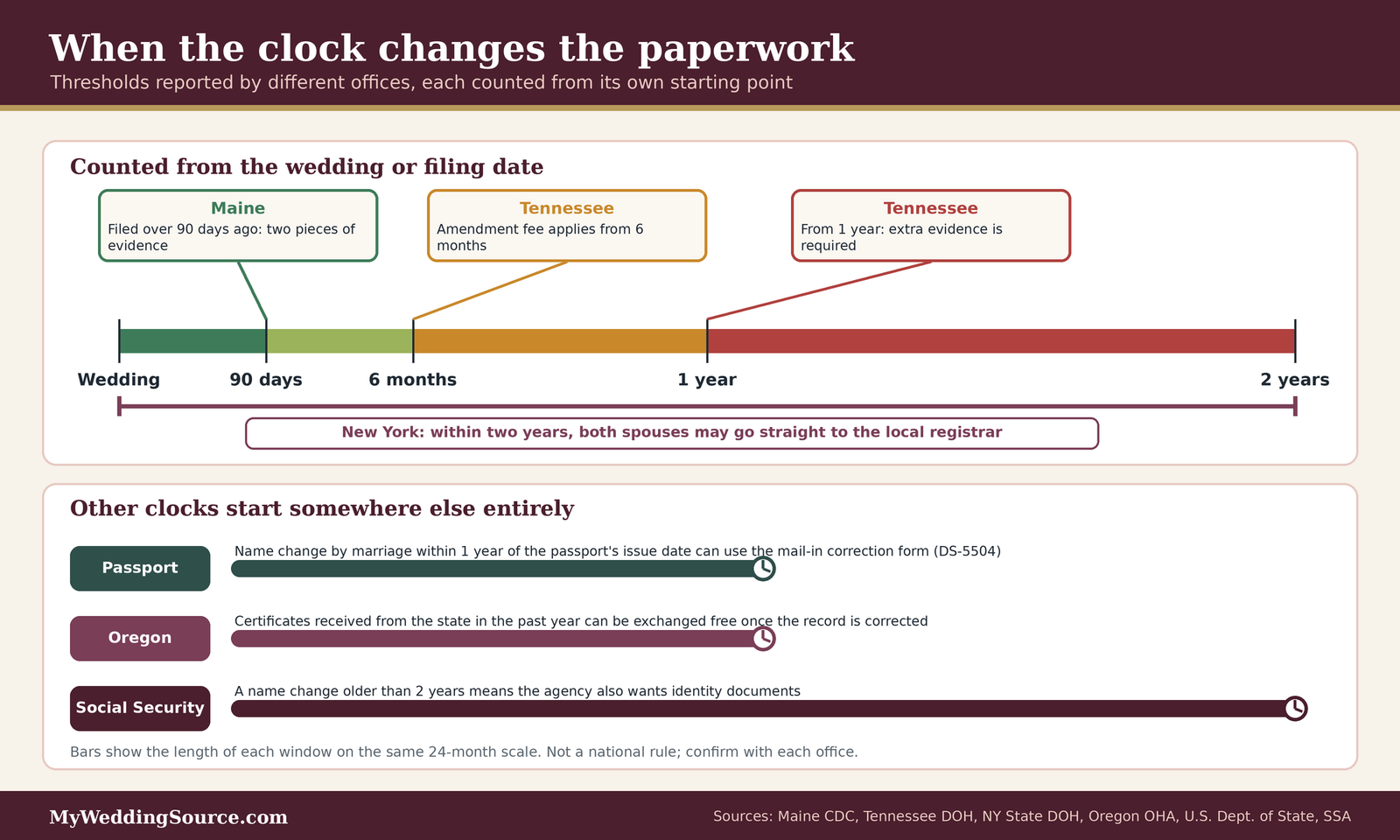
Maine asks for two pieces of documentary evidence if the record was filed more than 90 days earlier. Tennessee’s affidavit says a copy of the document used to complete the original certificate of marriage must be included for corrections made one year or more after the marriage date, that evidence supporting the change is required for corrections over one year after the marriage, and that a fifteen-dollar amendment fee applies to amendments made six months or more after the marriage date. New York says that if the marriage took place within the last two years, both parties can go directly to the Registrar of Vital Statistics where the affidavit was originally filed to expedite the change. Texas’s state rule gives no deadline. A single office’s rule says little about how to request corrections to a marriage certificate elsewhere.
Review times the offices mention
Processing times are given only sometimes. Maine’s page says processing takes approximately four to six weeks. The Minnesota county instruction says review can take up to two weeks and that the original record on file is not changed. California’s health department says processing time starts when its vital records office receives the request, and it links to current times without stating them in the text we read. New York’s pages list no standard processing time and note delays in order processing at the time we checked. Treat any number as a snapshot and ask for the current expectation. Plan for those ranges when thinking through how to request corrections to a marriage certificate on a deadline.
Windows in the offices that rely on the certificate
A correction is rarely the last step. The same certificate usually supports a Social Security name update, a passport change, or a driver’s license update, and those agencies have their own clocks.
Passports
The State Department’s guidance says a name change by marriage within one year of your passport’s issuance can use Form DS-5504, mailed with your most recent passport, an original or certified document showing the name change such as a marriage certificate, and a photo, with no fee unless you want expedited service. The department also says a data or printing error in a still-valid passport is corrected free using the same form, and that a passport corrected for an error reported within one year of issuance is valid for ten years, while one corrected after one year expires on the original date. If your passport was issued more than a year ago, other forms apply, and our passport name change after marriage guide walks through the choices. If a wrong marriage record is the reason you cannot yet prove the name change, fixing the record may be a prerequisite. That link between agencies is why how to request corrections to a marriage certificate matters beyond the clerk’s office.
Social Security
The Social Security Administration’s application form says a document supporting a name change must be recent and identify you by both your old and new names, and that if the change happened over two years ago, or the document does not sufficiently prove your identity, you must also provide identity documents in your prior name or new legal name. It accepts original documents or documents certified by the custodian of the original record, not notarized copies or uncertified photocopies. The agency’s materials describe the card as free. These rules matter here because a certificate with an error may not match your ID, which is the situation that sends some people to a clerk in the first place.
Build your own correction calendar
Because the thresholds differ, a small calendar of your own dates can keep you from being surprised.
List the dates that matter
Write down the wedding date, the date the officiant filed the record if you know it, your passport issue date, and any deadline you are working to, such as an upcoming trip or a visa filing. Count the months and days between the wedding date and today. Our own arithmetic, offered as an estimate, is only useful for checking against an office’s thresholds such as ninety days, six months, one year, or two years.
Do not invent deadlines
Do not assume a cutoff beyond what the office tells you. None of the pages we reviewed set a general expiration on correcting a marriage record, and delay mostly adds paperwork. If you have a hard deadline, such as a flight or a benefits filing, tell the office when you call, ask whether any faster option exists, and ask what temporary documentation, if any, they can provide. Our honeymoon name mismatch guide covers one common travel version of that pressure. Deadlines make how to request corrections to a marriage certificate feel urgent, but the process still rewards care.
What it costs and how to pay safely
Costs for corrections range from free to a modest fee, and they depend on the state, the county, and sometimes the age of the record. The fees we saw were small, but the rules for how to pay were strict, and a payment sent the wrong way can send the whole packet back.
What the sources say about cost
Fees vary widely. New York’s health department says corrections and amendments are free, with a charge only if you order copies of the corrected record. Tennessee lists a fifteen-dollar amendment fee for changes made six months or more after the marriage. A Minnesota county instruction lists a forty-dollar non-refundable fee. Oregon’s state office charges nothing for the correction, though the county may. Maine says it cannot waive correction fees, and California and Maine both return requests that arrive without the right fee. These amounts were reported by each office at the time we checked and can change, so confirm the current fee, the payee, and the accepted payment methods before you send money.
Fees differ by office and by record age
The simplest thing to remember is that “free” and “paid” can both be right, depending on where the record lives and how old it is.
State and county fees
Where the state handles the change, the state sets the fee. Where the county clerk does, the county may set its own. That is why Oregon’s page separates the two: the state office does not charge a correction fee, but the county may require one, and you should check with the county. If two offices are involved, ask about each one. That question belongs on every checklist for how to request corrections to a marriage certificate.
Copy and exchange fees are separate
Paying for the correction and paying for new certified copies are often different transactions. In Oregon, if you received marriage certificates from the state vital records office within the last year and the record was later corrected, you can exchange them free for amended certificates by returning the originals within one year of their issue date with photo ID and the order form. Other places charge for each new copy. Ask whether a copy fee applies and whether any exchange or free-copy option exists.
Pay in a way that survives a mistake
Several offices say that requests without the right fee are returned, so the payment details matter. Money details are a smaller but real part of how to request corrections to a marriage certificate.
Follow the exact payee and payment type
California’s page says payment must be a check or money order payable to “CDPH Vital Records,” drawn on a U.S. bank, and that cash should not be mailed. New York says checks and bank-issued money orders are payable to the state Department of Health and that cash and postal money orders are not accepted. Maine specifies a check or money order payable to the state Treasurer. Copy the payee exactly as the office states it, and ask whether a card or online option exists. Payment rules deserve attention in how to request corrections to a marriage certificate.
Keep a record of every payment
Save the check number or money order receipt, the date, the amount, and the office. Our credit card reconciliation guide shows one way to track wedding-related spending, and a small line for “records and certificates” in your wedding budget keeps this cost from being forgotten. We do not give financial advice, and the amounts here are small enough that the main goal is simply knowing where the money went.
Avoid paying twice
Paying an unofficial site by mistake is a risk the Virginia warning describes.
Check the web address and the payee
Look at the web address before typing any payment details. The Virginia warning cited earlier says to confirm the official address and to send payment directly to the vital records office. If a site is not clearly the government’s own, close it and navigate from the clerk’s or health department’s own homepage.
If you suspect you paid an unofficial site
Contact your card issuer or bank promptly, and tell the official office what happened. The specific protections depend on how you paid and on your card agreement, which is outside what we reviewed, so ask your issuer directly. That is outside what a guide on how to request corrections to a marriage certificate can answer.
After the correction: confirm it, order copies, then update everything else
Approval is not the finish line. A corrected record only helps once the new version is in your hands, checked, and used wherever the old mismatch caused trouble. The after-correction steps are the final stretch of how to request corrections to a marriage certificate, and they decide whether the fix actually sticks.
Confirm what the office changed
Offices describe the result in different ways, so the first job is to understand what you will receive.
Three outcomes you may see
Texas attaches an affidavit to the license, and the county clerk includes a copy with any future certified copy. New York has the town or city clerk issue a new Certificate of Marriage Registration after a name or gender-designation correction and file it with the state. Oregon lets recent recipients exchange earlier certificates for amended ones. The Minnesota instruction states that the original record on file is not changed, which signals that the amendment sits alongside it. Ask which of these applies to you. Knowing the outcome in advance is part of how to request corrections to a marriage certificate with confidence.

Read the new copy line by line
When the new copy arrives, check every field against your original list, not just the one you fixed. Compare names, dates, places, and any other field against your birth certificates and IDs. If a new problem has appeared, call the office promptly and ask how to fix it without starting from scratch. Checking the result is the last step of how to request corrections to a marriage certificate.
Order certified copies thoughtfully
Many agencies want a certified copy, not a photocopy, and certified copies cost money, so planning how many you need saves both.
Think about who will ask for one
Social Security, passport, motor vehicle, bank, employer, and benefits offices may each ask to see the certified document at different times, and some may ask to keep it. We cannot tell you the right number. List the institutions on your own to-do list, ask each whether it keeps the document or returns it, and order accordingly. The right number is a personal call when you are learning how to request corrections to a marriage certificate. Our after-wedding checklist is a good place to start building that list.
Store the copies somewhere safe
New York says altered documents are not accepted, so keep certified copies flat, dry, and unmarked, with a note of where they are. Our guide to wedding keepsake storage covers physical storage for paperwork and keepsakes alike.
Update the places that relied on the old record
Whatever caused you to look at the certificate probably involves another agency. Revisit each one with the corrected document.
Social Security and passports
The agencies discussed earlier have their own forms and standards. The Social Security Administration wants a recent document showing both names and accepts only originals or documents certified by the record’s custodian. The State Department’s rules turn on your passport’s age and whether the issue was your name or a printing error. Follow each agency’s current instructions, since those pages are updated independently of the clerk’s office. Both sit downstream of how to request corrections to a marriage certificate.
Everyday records
Driver’s license, bank accounts, employers, insurance, and professional licenses usually follow after the main identity records are consistent. Keep a simple list of what you updated, the date, and what you provided, so a later mismatch is easy to trace. Our wedding planning checklist can host that list if you already use it, and our guide to the logistics of changing your name covers the usual sequence.
Edge cases that change the route
Most corrections are routine. A few situations need more care, and in those cases a phone call or a conversation with a lawyer is worth more than guessing.
When the proof you need does not exist
Sometimes the document an office asks for is lost, was never issued, or itself contains an error.
Missing documents and the court route
New York’s instructions say that if you cannot provide the required documents, you will need a New York State court order. Court procedures vary by state, and we have not researched them. If you find yourself in this position, ask the vital records office what alternatives exist, and consider speaking to an attorney or a legal aid clinic. Even a careful plan for how to request corrections to a marriage certificate sometimes ends at a courthouse.
Alternative evidence
Maine’s list of acceptable supporting documents is broad, including medical or immunization records and church ceremonial certificates, and it asks for two pieces of evidence if the record was filed more than ninety days earlier. That list suggests that offices sometimes accept a combination of sources when a single ideal document is unavailable. Ask what combinations your office will take, and get the answer in writing if you can. Flexibility on evidence is worth asking about in how to request corrections to a marriage certificate.
Unusual marriage situations
Some marriages are outside the standard county-clerk flow.
Marriages abroad
For a marriage that took place outside the United States, USAGov says to contact the embassy or consulate of the country where the marriage took place. The marriage record is held by that country’s authorities, not by a U.S. state, so a correction follows that country’s procedure. If you used the record for U.S. immigration or citizenship, that is a legal matter. Please consult a qualified immigration attorney or an accredited representative. A foreign record changes how to request corrections to a marriage certificate entirely.
Name or gender designation changes
New York treats these separately from other corrections, through the clerk where the license was obtained, with a court judgment, order, or decree, or an amended birth certificate, and for a gender designation change, a notarized affidavit. If your situation involves one of these, ask the clerk’s office which route they follow, because states differ. The route differs, and so does how to request corrections to a marriage certificate in these cases.
If the office says no
A refusal is rarely the end of the road, but it is the moment to slow down and gather information.
Ask for the reason in writing
Politely ask for a written explanation and the specific rule or missing item. A denial usually points to missing proof, a signature problem, or a request that belongs to a different office. Knowing which one it is tells you whether to resubmit, redirect, or escalate. A refusal is information, and it is a normal branch of how to request corrections to a marriage certificate.
Know when to ask a professional
If the office declines and the record affects inheritance, immigration status, benefits, or a divorce, talk to a licensed attorney in the state where you married. We are a planning resource, not a legal one, and the sources we reviewed did not address those questions.
Questions about how to request corrections to a marriage certificate
Getting started
Who do I contact first to request a correction?
Start with the county clerk or the state vital records office where your marriage license was issued. Some states route corrections through the county, others through the state, and a few split by error type. A short call to the clerk can confirm which office handles your record and which form to use.
Can I fix the record myself or does my spouse need to sign?
It depends on the office and the error. New York asks for both spouses to sign unless the marriage ended in divorce or death, while a Minnesota county lets only the affected applicant sign for clerical errors. Date or place corrections can also require the officiant. Ask your office who must sign.
Is there a deadline for correcting a marriage certificate?
None of the sources we reviewed set a general deadline. However, the age of the record can change the process: Maine asks for more evidence after ninety days, and Tennessee adds requirements after six months and one year. Filing sooner usually means fewer requirements, so start as early as you can.
What if the mistake was made by the clerk or the officiant?
Say so when you call. Maine lets the officiant correct ceremony information and lets a municipal clerk fix its own clerical error when the marriage intentions on file show the right information. Tennessee clerks correct errors made by their own office. Ask whether an office-error route exists and what proof it needs.
Documents, cost, and results
What documents will I need to prove the correct information?
Usually original or certified records showing the correct fact, such as a birth certificate for birth details, a photo ID for a current name, or a letter from the officiant for ceremony details. New York does not accept notarized copies. Your own office will list what it accepts for your specific error.
How much does a correction cost?
Costs vary. New York says corrections are free and charges only for copies, Tennessee lists a fifteen-dollar fee for amendments six months or more after the marriage, a Minnesota county lists forty dollars, and Oregon’s state office charges nothing though the county may. Confirm the current fee and payee with your office.
How long does it take?
Offices give different answers or none at all. Maine says about four to six weeks, a Minnesota county says up to two weeks, and New York lists no standard time and notes delays. Ask your office for the current estimate, and add mailing time and the time for any proof documents to arrive.
Will I need to update my passport or Social Security record afterward?
Only if the error affected the documents those agencies hold, or if you are using the certificate to change a name. The agencies have their own forms and rules, including a one-year window for certain passport name changes, so check their current instructions before you reapply.
Your next steps
Get ready to ask
Write down the exact error and the proof
List each error, the correct information, and the document that proves it, then note whether you hold an original or certified copy. If one of those documents contains a mistake of its own, fix it first. That list is the base of how to request corrections to a marriage certificate.
Find your office and make the call
Locate the clerk or vital records office for the place where you married, using its official website, and use the questions in this guide on the first call. If you married abroad, start with the relevant consulate or embassy. This is the practical start of how to request corrections to a marriage certificate.
Submit and follow through
Send one clean packet
Complete the official form, sign in front of the required notary or witness, include the exact fee in the accepted form, and keep copies and a mailing record. For the bigger picture of what comes after the wedding, see our after-wedding checklist and our guide on sorting wedding photos for albums for the other keepsake projects on your list.
Update the other records
Once the corrected record arrives, check it line by line, order only the copies you need, and then work through the agencies that rely on it. For related background, see marriage license basics and witness requirements.
Sources & methodology
How we built this guide
What we relied on
This guide combines official pages from state and county offices, the Centers for Disease Control and Prevention directory of vital records offices, USAGov, the Social Security Administration, and the U.S. Department of State. State examples come from the states whose pages we could read: California, Maine, Minnesota (one county), New York, Oregon, Tennessee, and Texas. We checked these sources on November 12, 2026, and rules, forms, and fees change, so confirm each detail with your own office. The calendar suggestions in the timing section are our own arithmetic and are estimates.
What we did not do
We did not review every state, did not test any office’s process, and did not give legal, immigration, or financial advice. A county or state not named here may follow a very different process. Where a rule appeared in one office’s instructions only, we attribute it to that office and do not present it as a national rule.
Source list
Government and official sources
- Centers for Disease Control and Prevention, Where to Write for Vital Records: https://www.cdc.gov/nchs/w2w/index.htm
- USAGov, Marriage certificates and licenses: https://www.usa.gov/marriage-certificate
- New York State Department of Health, Public instructions for marriage corrections: https://Health.ny.gov/vital_records/docs/public_instructions_for_marriage_corrections.pdf
- New York State Department of Health, Marriage certificates: https://healthweb-back.health.ny.gov/vital_records/marriage.htm
- California Department of Public Health, Amending a California marriage record: https://www.cdph.ca.gov/Programs/CHSI/Pages/Amending-a-California-Marriage-Record.aspx
- Oregon Health Authority, Change a marriage or domestic partnership record: https://www.oregon.gov/oha/PH/BIRTHDEATHCERTIFICATES/CHANGEVITALRECORDS/Pages/MarriageAmend.aspx
- Maine CDC, Amend, correct, or complete vital records: https://www3.maine.gov/dhhs/mecdc/vital-records/amend-correct-or-complete-vital-records
- Texas Administrative Code, 25 TAC section 181.25, Affidavit of correction to marriage license: https://law.cornell.edu/regulations/texas/25-Tex-Admin-Code-SS-181-25
County, federal agency, and consumer-warning sources
- Tennessee Department of Health, Form PH-4481 Marriage Affidavit: https://www.tn.gov/content/dam/tn/health/documents/vital-records/PH-4481-Marriage-Affidavit.pdf
- Dakota County, Minnesota, Marriage record amendment instructions: https://www.co.dakota.mn.us/Permits/MarriageLicensesCertificates/Certificates/Documents/MarriageRecordAmendmentInstructions.pdf
- Social Security Administration, Application for a Social Security Card (Form SS-5): https://www.ssa.gov/forms/ss-5.pdf
- U.S. Department of State, Change or correct a passport: https://travel.state.gov/namechange
- U.S. Department of State, Form DS-5504: https://eforms.state.gov/forms/ds5504.pdf
- Virginia Department of Health, Warning about unofficial vital records websites: https://www.vdh.virginia.gov/news/?p=3697