
Wedding weekend event invitations go wrong in one predictable way: a guest holds one piece of paper, sees several events, and cannot tell which of them are meant for her, which one needs an answer, and who is waiting to hear back.
Quick answer
Keep the main invitation for the ceremony and reception, and put every other event on its own card, its own invitation, or the wedding website, depending on who is invited. Route each guest circle to exactly the pieces that apply to them, name a host and a reply contact for every event, and give each event its own reply line and its own reply-by date. Before anything is printed, hand the set to someone who has never seen it and ask what they think they are invited to. Wedding weekend event invitations work when that stranger answers correctly.
Why wedding weekend event invitations cause RSVP confusion
A wedding with only a ceremony and a reception asks guests one question: will you come? Wedding weekend event invitations multiply that question. A weekend with a welcome party, a rehearsal dinner, a brunch, and perhaps a religious or cultural gathering asks several questions at once, to different people, with different hosts and different deadlines. Most stationery is designed for the first situation and then stretched to cover the second. The stretching is where guests lose the thread.
This guide is about that stretch, and about how wedding weekend event invitations should be built to survive it. It does not decide which events you should hold (our wedding weekend event planning guide covers that) and it does not explain basic invitation wording (see our wedding invitation wording guide). It covers the paper, links, and messages that carry several events to several groups of people, and the decisions behind them.
Where the confusion starts
Confusion is rarely caused by a careless guest. It is usually caused by an invitation that answers a question the guest did not ask and skips the one they did. Looking at where it starts makes the fixes in later sections easier to accept.
One envelope, several events
When a welcome party, a rehearsal dinner, and a brunch all arrive in the same envelope, every recipient has to work out which cards belong to them. Zola’s advice on weekend events is to keep the main invitation to the ceremony and reception and to move the other events to a separate details card, a separate mailing, or the wedding website. The reasoning is simple: a main invitation that carries only the core information cannot be misread as an invitation to everything.
A reply with no question attached
A response card asks, in effect, “will you attend?” If the card does not say which event it refers to, a guest will answer for the one they care about most, usually the wedding itself, and leave you guessing about the rest. Emily Post’s guidance describes the response card as the tool for counting reception guests, and notes that it is not used on a ceremony-only invitation. That tells you what the card is for. It is not a general-purpose form, so it will not collect answers to weekend questions unless you design it to.
The four kinds of weekend confusion
Almost every problem with wedding weekend event invitations falls into one of four buckets. Naming them helps you diagnose a draft quickly.
Who is invited to what
A guest cannot tell whether the rehearsal dinner is for everyone or just for the wedding party. Paperless Post’s etiquette guidance advises keeping rehearsal dinner details off the main invitation so other guests do not feel left out, and using either a separate insert for invited guests only or a separate invitation. Whenever an event has a smaller list than the wedding, its details need a smaller audience too.
Who is hosting and who to answer
If an event has a host, the guest wants to know who it is and how to reply. The Knot’s guidance on rehearsal dinner invitations says that the host or hosts serve as the RSVP contact and that the wedding website should list that contact and the deadline. When nobody is named, replies drift to the couple, who are the busiest people in the weekend.
When and how to reply
Different events have different headcount needs. A venue may want a rehearsal dinner count days before the wedding, while the wedding itself needs numbers weeks earlier. If every event is given the same reply-by date, the earlier needs are missed. If none of them has a date, nobody replies in time.
What the guest already knows
Guests who traveled for a save-the-date, who read the website, or who were told about a brunch by a relative will arrive with a partial picture. The invitation either confirms it or contradicts it. Contradictions, such as a different start time on the card than on the website, generate the most anxious messages.
What belongs where in wedding weekend event invitations: the main invitation, cards, and the website
Before you decide who receives what, decide what each format is for. Wedding stationery has more options than most couples use, and the right choice depends on how many guests are invited to an event and how formal it is.
What the main invitation should carry
The main invitation is the one piece every guest receives, so it should contain only information that applies to every guest.
The core details
Emily Post’s guidance lists what an invitation should include: the hosts, the nature of the event, the location, the date and time, and how to respond if a reply is needed. It also advises spelling out the date and year, and including the city and state unless every guest is local. Those details are enough for a ceremony and reception, and they leave no room for a second event to be mistaken for part of the first.
What to leave off
Leave off anything that applies to only some guests. That includes the rehearsal dinner, the details of a brunch for close family, and any event with a capped list. Emily Post also advises against including registry or gift information on the invitation. Keeping the main invitation clean means that every later piece has an obvious job.
Five ways to carry the other events
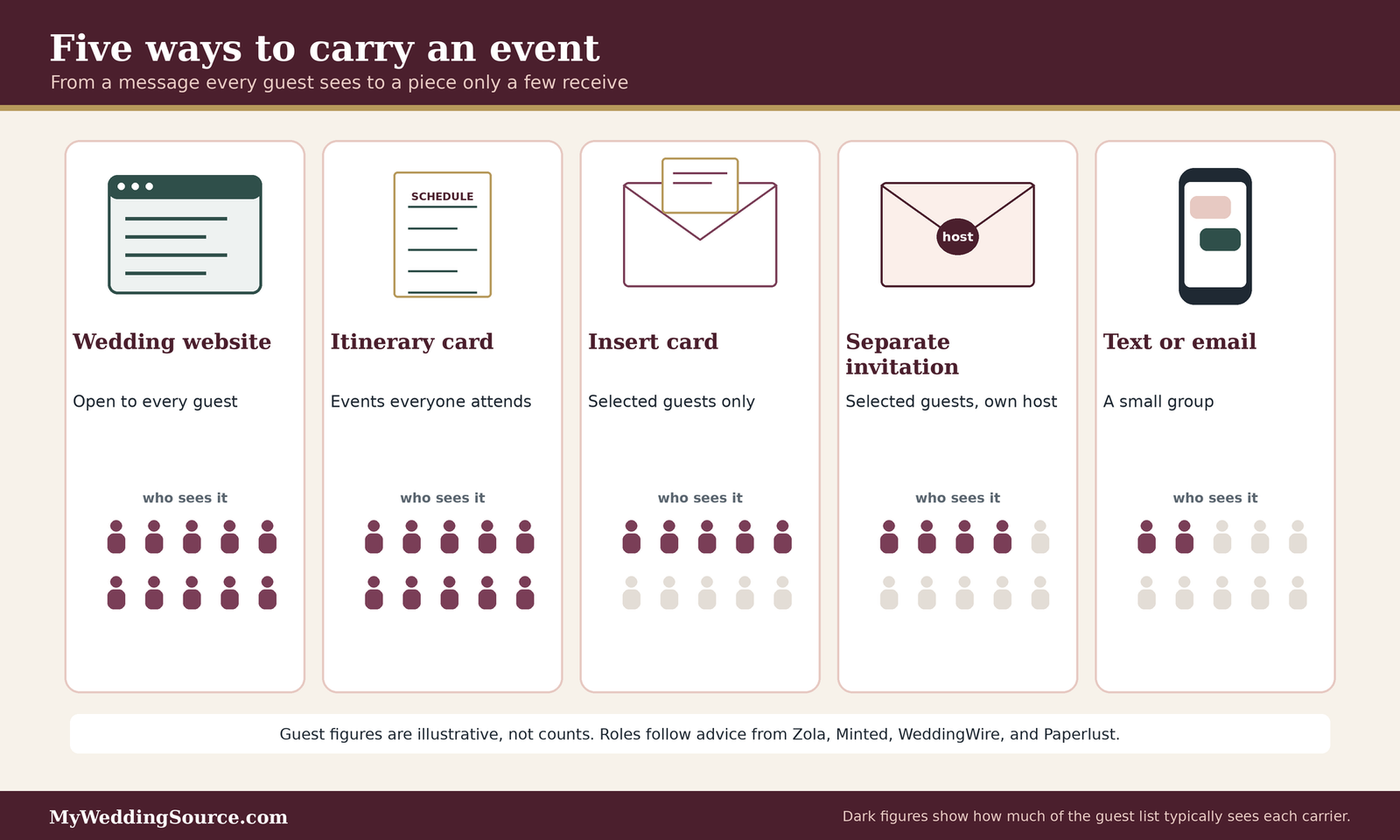
Zola describes several ways to communicate the rest of the schedule, and Minted and WeddingWire add more detail on enclosure cards. Taken together, there are five options, and each one has a use.
A details card or an itinerary card
A details card carries information that does not fit on the invitation. Minted’s guide lists nine kinds of card, including reception, accommodation, directions, itinerary, rehearsal dinner, and other events. Zola suggests an itinerary card when every guest is invited to everything, as at a destination wedding or a weekend with many activities. Minted’s rule of thumb is useful: only events that all guests are invited to belong on the general itinerary card, while events with smaller lists, such as a rehearsal dinner, get their own.
An insert for selected guests
Paperlust describes the insert card as the most common way to carry a welcome party: a smaller card, about 5 by 3.5 inches, placed only in the envelopes of invited guests, which keeps postage to a single envelope. This is the format that suits wedding weekend event invitations with different guest lists, because the card itself is the filter. If it is not in the envelope, the guest was not invited.
A separate invitation
A separate invitation is full-sized and mailed on its own. Zola says this suits showers, bachelor and bachelorette parties, and luncheons, especially if they are held well before the wedding or hosted by someone other than the couple. Paperlust adds that a standalone welcome party invitation suits a formal dinner or a case where the guest list matches the wedding list. WeddingWire’s guidance on inserts is blunt about the risk of the alternative: events for only some guests need their own invitation to avoid confusion.
The wedding website
A website is a good supplement and sometimes a good primary channel. Zola recommends it for informal weddings, short timelines, and budget-conscious plans, and suggests listing events on the public site only if all guests are invited. Paperlust recommends printing a physical card for a key weekend event rather than relying on the website alone. A reasonable reading of both is that the website should repeat what the paper says, not replace it for events that require a reply.
A text, email, or digital invitation
For small, casual gatherings, a digital invitation is often enough. The Knot says that a casual email or digital invitation is typical for a small rehearsal dinner, sent at least a month ahead, and Paperlust suggests digital invitations for last-minute out-of-town additions or events where guests already share a group chat. Digital invitations are cheaper and faster, but The Knot notes that some guests may find them less formal or less accessible, which is worth remembering for older relatives.
Choosing a format per event
You do not have to choose one format for all of your wedding weekend event invitations. Choose per event, based on three questions.
How many people are invited, and are they the same people as the wedding list?
If the list for the event matches the wedding list, a line on the itinerary card or the website is enough. If the list is a subset, use a separate piece that only the subset receives. That one rule prevents most of the “was I supposed to be there?” messages.
Who is hosting, and does the paper show it?
When the couple hosts everything, a matching suite works. When a parent, a grandparent, or a friend hosts an event, a separate invitation with the host’s name in the first line makes it clear whose party it is and who to answer. This matters even more when the host is paying separately; our guide on handling multiple rehearsal dinner hosts and separate bills covers the money side of that arrangement.
Routing each guest circle: the invitation routing sheet
The sheet below is the working tool in this guide. It is built on one idea: decide which pieces each group of guests receives before you design a single card. Most printing mistakes in wedding weekend event invitations, such as an envelope that includes a welcome party card for a guest who was not invited, begin with a routing decision that was never written down.
The sheet is an example, not a rule. The circles and events are common ones; your own may differ. Replace the cells with your own plan, and make the guest-list owner and the person who assembles the envelopes work from the same copy.
The routing sheet for wedding weekend event invitations
Read it by row: the guest circle on the left, then what that circle receives. Cells say what goes in the envelope or what the guest is told another way.
| Guest circle | Main invitation and reply card | Details or itinerary card | Welcome event piece | Rehearsal dinner piece | Brunch or farewell piece |
|---|---|---|---|---|---|
| Wedding party and partners | Yes | Yes | Yes, in the suite | Separate invitation from the host, with reply contact | Yes, on the itinerary card |
| Immediate family and officiant | Yes | Yes | Yes, in the suite | Separate invitation from the host | Yes, on the itinerary card |
| Out-of-town guests | Yes | Yes, with lodging and travel | Insert card, in the suite | Only if on the dinner list; otherwise no mention | Insert card or itinerary line |
| Local guests with no role | Yes | Yes, ceremony and reception only | Only if the party is for everyone | No piece | Only if the brunch is open |
| Guests invited to the ceremony only | Invitation without a reply card for the reception | Only if it adds ceremony information | No piece | No piece | No piece |
| Children of invited guests | Named on the envelope only if invited | Same as parents | Say so on the piece | Say so on the piece | Say so on the piece |
Reading the sheet across a row
Take the out-of-town guest row of a routing sheet for wedding weekend event invitations. Those guests receive the main invitation and a details card, and an insert for the welcome event. They receive a rehearsal dinner piece only if you chose to invite them, which Emily Post describes as a growing trend and The Knot describes as common but not required. The row makes the decision visible. If the answer for any cell is “I am not sure yet,” the invitation is not ready to print.
Reading the sheet down a column
Now read the rehearsal dinner column. Only the circles that have a piece in that column should ever see rehearsal dinner wording, and nobody else should find out about it through a card that happened to be in their envelope. Paperlust’s three tiers for the dinner list are a good frame: a core group of the wedding party, their partners, immediate family, the officiant and partner, and readers; an optional tier of out-of-town guests; and a group that is usually excluded, such as local guests without a role. If the column gives a piece to someone in the third tier, check that it was deliberate.
Plus-ones, children, and partial households
The sheet works at the level of circles, but wedding weekend event invitations are delivered to names. Envelopes work at the level of names, and that is where the second layer of confusion appears.
Address each envelope only to the people invited to that event
Zola’s advice is to keep separate piles for separate pieces and to address each envelope only to the people invited to each event. If a plus-one is invited to the wedding but not to a particular event, address that event’s envelope only to the guest. Emily Post asks for the full names of everyone invited rather than “and guest” where possible, and The Knot’s rehearsal dinner guidance suggests finding out a plus-one’s name so it can be included. Names on the envelope are the clearest answer to “who is invited.”
Say it on the piece when the envelope is not enough
If children are not invited to an event, Zola says to state it clearly, on the card or in a separate invitation, and to address envelopes only to the people invited. Paperless Post adds a nuance: it advises against writing “adults only” on the invitation itself, and recommends that a couple contact a guest promptly if a reply comes back with a child’s name. Both pieces of advice point the same way. Make the addressing exact, and plan a quick, friendly conversation for the replies that do not match. Our guides to child-free wedding etiquette and plus-one etiquette cover the reasoning behind those decisions.
Hosts, payment, and the host and reply-contact log
A log of who hosts which event and who pays which bill belongs in a conversation about wedding weekend event invitations because the answers show up on the paper: the host’s name opens the invitation, and the person who pays is often the person who receives the replies. When hosts and bills are unclear, RSVP confusion follows.
This section is about the paper and the paperwork behind wedding weekend event invitations, not about who ought to pay. We are not giving financial or legal advice, and families handle these questions in many ways.
Naming the host on each piece
The host line tells a guest whose event they are attending, and it is part of how they decide whom to answer.
Hosts are more flexible than tradition suggests
Paperlust notes that the groom’s family traditionally hosted the rehearsal dinner, and that today the host may be the groom’s family, both families, the couple, a split between parents and couple, or a close relative or friend. The Knot adds that if the couple hosts, their names go on the invitation, and if one or both sets of parents host, the hosts are named. Whichever combination applies, the name goes at the top of the piece, so that nobody mistakes whose event it is.
Match the style to the event
The Knot recommends first names for casual events and full names for formal ones, and says that enclosures should match the wedding invitations while separate invitations should match the vibe of the event. If a grandparent is hosting a brunch, a separate card in the grandparent’s name, styled for the brunch, is more honest than a line on the couple’s itinerary card.
The host and reply-contact log
This is the second working tool. It is a short table with one row per event, and it sits next to the routing sheet. Fill it in before the invitations are finalized and update it whenever a plan changes.
| Event | Named host on the piece | Who pays the venue or caterer | Reimbursement or split agreed in writing? | Reply contact and method | Reply-by date | Headcount the venue needs, and by when |
|---|---|---|---|---|---|---|
| Welcome event | Couple or parents | Fill in | Yes, no, or not needed | Name, email or phone | Fill in | Fill in from the venue |
| Rehearsal dinner | Host or hosts | Fill in | Yes, no, or not needed | The host (per The Knot) | Fill in | Fill in from the venue |
| Brunch or farewell | Fill in | Fill in | Yes, no, or not needed | Fill in | Fill in | Fill in from the venue |
| Wedding ceremony and reception | Per the main invitation | Fill in | Yes, no, or not needed | The reply card address or website | Fill in | Fill in from the caterer |
What each column prevents
The host column prevents the “whose party is this?” question. The payer and reimbursement columns prevent a different kind of confusion: two families each believing the other will cover the same bill, or a venue sending one invoice to the person whose name is on the contract when the plan was to split it. The reply-contact column prevents replies going to the wrong inbox. The last two columns tie the paper to the caterer’s clock, which is the clock that matters.
Why the reimbursement column says “in writing”
When one person signs the contract and another reimburses them, informal agreements are easy to remember differently. A line in a shared note or an email, stating the amount or the split and the date it is due, protects everyone and costs nothing. We are not suggesting a legal document, only a record that both people can read. If the arrangement is complicated, such as two hosts with a combined bill, follow the steps in our guide on separate bills, and consider asking a professional about anything beyond a friendly agreement.
When the host is not the couple
Several of the most confusing situations occur when a parent or relative hosts an event that the couple does not control.
Share the draft with the host before printing
A host who has not seen the invitation will correct it after the guests have it. Send the wording, the guest list, and the reply-by date to the host, and ask for approval in writing. Treat that approval as a deadline in your own schedule.
Agree who answers questions
Guests will ask about parking, dress, and plus-ones. Decide in advance whether those questions go to the host or the couple, and write that on the piece or the website. The couple should not have to field questions about an event they did not plan.
Writing wedding weekend event invitations, event by event
In wedding weekend event invitations, wording is where the guest’s questions are answered. Each event’s piece should answer the same few questions, in the same order, so that guests learn the pattern once. The samples here are our own phrasing, written for clarity, not copied from any source.
The questions every piece answers
Paperlust’s list for a welcome party includes the host, the event name, the date, the time, the venue and address, the dress code, and whether food and drinks are provided. The Knot’s list for the rehearsal dinner is similar and adds the wedding website. Minted’s event-card advice asks for the name, the venue and address, the start time, the dress code, and whether a reply is required. Put together, a reliable template for any weekend event is below.
The template
Every one of your wedding weekend event invitations can follow one order: the host, then what the event is called, then the day, the date, and the time. Then the venue name and address with the city and state. Then the dress or any notes about food, children, or parking, and finally how to reply, with a name, a method, and a date. If the invitation is missing the reply line, the guest does not know what you want from them.
Consistency across pieces
Zola advises matching everything in the main suite and letting separately mailed invitations match, coordinate, or reflect the event’s theme. Consistency matters most in the fields guests compare. If the welcome event is “casual” on one card and “festive” on the website, the guest will ask which it is.
A welcome event
In wedding weekend event invitations, a welcome event is for travelers and, often, for everyone. The Wed’s etiquette guidance says that the welcome party is generally open to everyone invited to the wedding, especially at a destination wedding, but that there are no fixed rules.
If everyone is invited
When the whole list is invited, the party can live on the itinerary card, and The Wed notes that the details can go on the website or in the suite. A sample line: “Join us the evening before the wedding for a casual welcome gathering. Drinks and light food, from seven o’clock at the venue named below. Please reply with your wedding response.”
If only some are invited
If the party is for out-of-town guests only, use an insert in those envelopes. Paperlust recommends mailing to out-of-town and international guests first. A sample line: “We would love for you to join us the evening before the wedding for a casual gathering for our traveling family and friends. Reply to our contact by the date below.”
The rehearsal dinner
In wedding weekend event invitations, the dinner is the event most likely to be confused with the rehearsal itself, and with the wedding party’s responsibilities.
Say who the dinner is for, plainly
The Knot’s expert guidance on the dinner list includes anyone taking part in the ceremony and their partners, along with immediate family, and treats close friends and relatives as optional. Say on the card who is invited, such as “for our wedding party and immediate families,” or, if out-of-town guests are included, say that too. A short, kind line removes ambiguity.
Name the rehearsal separately from the dinner
If the wedding party must arrive at a rehearsal first, put the rehearsal time on its own line. Our guide on who needs to attend a ceremony rehearsal explains the participants, and our wedding rehearsal guide covers the run-through itself. The Knot suggests that the invitation can include details about the rehearsal if only the wedding party is attending.
A brunch, farewell, or other optional event
Zola calls the farewell brunch a goodbye for selected guests and recommends a details card rather than the main invitation. Treat it like the welcome event in your wedding weekend event invitations: decide whether it is open or limited, then choose the format.
Open or limited
An open brunch can be an itinerary line plus a website entry. A limited brunch, such as for immediate families or the wedding party, needs a separate piece. If you do not want to explain who is excluded, you do not need to; you only need to avoid sending the card to the wrong people.
Keep the tone warm and short
Zola’s suggested tone for a brunch is plain and friendly, with wording like “we’d love for you to join us.” Add the time, place, and reply line, and end there.
Cultural and religious events
Some wedding weekend event invitations carry events from a family’s tradition. Zola’s list of optional extras includes the aufruf, traditionally held the Saturday before a Jewish wedding, and the mehndi party, a henna tradition usually held about three days before the wedding. It suggests that either can go in the suite or be mailed separately, and that the mehndi party can go on a details card.
Let the host family write the event
If an event comes from a family’s tradition, let that family write or approve the wording, and use their name for the term the event is known by. A guest who does not know the tradition may need one plain sentence of explanation, such as where to be, how long it lasts, and what to wear.
Check the dress and the schedule
Some events have expectations about clothing or timing that guests will not guess. Put them on the piece, and repeat them on the website. Where a day contains several ceremonies, give a time for each and say clearly which the guest is expected to attend.
RSVP design that guests cannot misread
Wedding weekend event invitations include a small form, the RSVP, and forms fail when a field is vague. Each event that needs a headcount needs its own reply, and each reply needs a clear owner, a clear date, and an easy way to send it.
One reply line per event
The simplest way to stop wedding weekend event invitations from producing half-answers is to ask a separate question for each event.
Pair each event with its own accept and regret
Emily Post describes the response card as a line for the guest’s names with two choices, accept and regret, and a request for a reply by a stated date. For a weekend, extend that pattern: one line per event the guest is invited to, each with the same two choices. Paperlust suggests noting welcome party attendance on the main response card or using a separate reply method, and collecting dietary needs through that card or a linked form, such as a QR code. If you plan to use a code, our guide on testing a wedding QR code before printing invitations explains how to check it.
Print only the lines each guest can answer
If a guest is not invited to the rehearsal dinner, their card should not have a rehearsal dinner line. This is the strongest argument for personalized reply cards or an online form that shows each guest only their own events. A generic card with every event on it creates exactly the doubt you are trying to avoid. If personalizing is not possible, send informal replies for the smaller events instead, which The Knot describes as more flexible than a wedding RSVP, accepted by email, phone, or text.
Reply-by dates that match the caterer’s clock
Each event in your wedding weekend event invitations has a different deadline, because each has a different vendor who needs a number. Printing a single date for everything is convenient and wrong.
Dates suggested by the sources
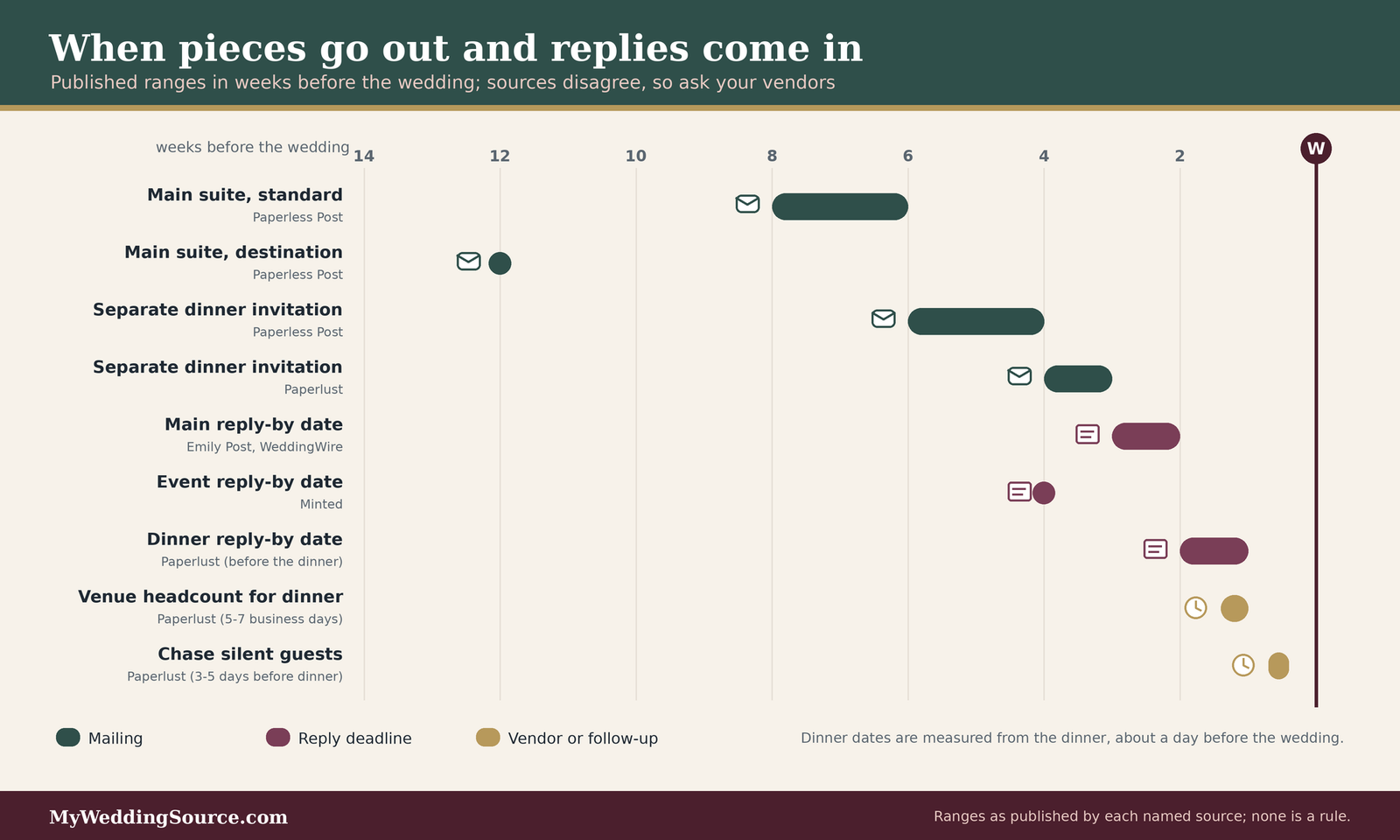
The sources do not agree on one schedule, which is itself useful information. Emily Post says to ask for replies about two to three weeks before the wedding, a figure that WeddingWire and Paperless Post repeat for the main RSVP. Minted says an event RSVP is typically about four weeks before the wedding. Paperlust suggests a reply date one to two weeks before a rehearsal dinner and notes that venues often need a final headcount five to seven business days in advance, especially with fixed per-person catering. Treat these as inputs, not rules, and let the caterer’s actual deadline decide.
Build the earliest date from the vendor backward
Take the date each vendor needs a final count and subtract the time you need to chase late replies. Paperlust suggests following up with non-responders three to five days before the dinner, ideally by a personal text or call. That chase time is your buffer. If your reply-by date leaves no room for it, move the date earlier.
Dietary needs and accessibility
An RSVP is also the moment guests mention what they need. If you do not ask, they will not always say.
Ask about food once, with a clear purpose
Paperlust treats dietary needs as an optional invitation detail and suggests mentioning the menu type if restrictions need advance notice. Emily Post’s guidance on meal choice is that if the reception offers entrée options, the guest writes a name or initials beside their choice, and that a discreet marker on the place card helps servers deliver the right dish. For events with a set menu, ask only for restrictions. Our dietary restrictions guide covers how to handle the answers.
Offer more than one way to reply
Minted points out that response cards help guests, especially older ones, who may not be comfortable with online RSVPs, and The Knot notes that digital invitations can be less accessible for some. Offering both a paper reply and an online or phone reply removes a barrier at little cost. If you use a website, our website accessibility audit lists what to check, and our guide to wedding RSVP wording and RSVP etiquette go deeper on the reply itself.
Timing, mailing order, and the postal rules that can surprise you
Wedding weekend event invitations depend on order as much as wording. If an out-of-town guest receives the details of a rehearsal dinner after buying a flight, the schedule has already cost them something.
When each piece goes out
Published timing advice for wedding weekend event invitations varies, so this section reports ranges and names the source. Use it to choose a window, then confirm with your own vendors and guests.
The main suite and the save-the-date
Zola advises ordering the invitation suite six to eight months before the wedding, with expedited services available for short timelines. Paperless Post says to send standard invitations about six to eight weeks before the wedding, and about twelve weeks for a destination wedding. Paperlust suggests that destination weddings send a weekend save-the-date as early as eight to twelve months ahead. Our save-the-date cards guide explains where a save-the-date fits, and our wedding invitation etiquette guide addresses timing for the main suite.
Separate invitations for smaller events
Paperless Post suggests a separate rehearsal dinner invitation about four to six weeks before the wedding. Paperlust says three to four weeks for standard weddings, after guests have received and answered the main invitation, and six to eight weeks for a destination wedding. The Knot recommends sending a casual rehearsal dinner invite at least a month ahead. A plan that sits inside all of those ranges is a separate invitation about a month before the wedding, earlier for travelers and destination events.
Mailing order and sequencing
The order in which wedding weekend event invitations arrive shapes what guests understand.
Mail travelers first
Paperlust advises mailing international and out-of-town guests first, and notes that international mail can take ten to twenty-one days. If an insert in your wedding weekend event invitations is meant to help someone book travel, it needs to arrive while they can still change plans.
Keep the website in step
Zola says that for last-minute events, you can post on the website first and follow with a mailed invitation. If you do, say on the website that a printed invitation is coming, and keep the details identical. Contradictions between paper and website are the most frequent source of the anxious messages described earlier. Our guide to wedding planning website privacy and security explains why guest-specific events should not sit on a public page.
Postage, size, and weight
The physical size and weight of wedding weekend event invitations affect postage and whether the post office can process it. The only authoritative source for those rules is the United States Postal Service, and its rules change, so check the current edition before you buy envelopes.
What the Domestic Mail Manual says about letter size
We read section 101 of the USPS Domestic Mail Manual, in the archive dated July 12, 2026, on the date this guide was checked. It says a letter must be at least 5 inches long, 3.5 inches high, and 0.007 inch thick, and no more than 11.5 inches long, 6.125 inches high, and 0.25 inch thick. It also says a letter is nonmachinable if its length divided by its height is less than 1.3 or more than 2.5, which means a square envelope, with a ratio of 1.0, falls outside the range. A letter that is rigid, uneven in thickness, or very thin for its size can also be nonmachinable. Our figure below draws those limits to scale.

Weight and the many-card envelope
The same section says a letter-size First-Class Mail piece weighing more than 3.5 ounces pays flat-size prices. A suite with a reply card, an envelope, a details card, an insert, and a map can approach that line, especially on heavy paper. Weigh a complete assembled sample of your wedding weekend event invitations before ordering envelopes. If it is close to the limit, a website replacing one card may be cheaper than the paper. Ask the post office to weigh and measure a finished sample, and ask what they would charge, rather than relying on an online estimate.
What this actually costs
Every extra piece in wedding weekend event invitations adds printing, paper, assembly time, and weight, and a heavier or oddly shaped envelope can change postage. A separate invitation for a limited event usually costs more per guest than an insert, but it can cost less than the confusion of an insert in the wrong envelope. We are not quoting prices, because they vary by printer, paper, and the date. Get a written quote that lists each piece, ask for a finished sample, and have the post office weigh it before you place the order.
Testing your wedding weekend event invitations before anything is printed
A set of wedding weekend event invitations is an information design problem. You cannot see your own blind spots, because you already know the answers. A test with someone who does not is the cheapest protection against a reprint.
The five-minute stranger test
This is a simple method, our suggestion rather than a published standard.
How to run it
Pick someone who is not involved in the planning. Give them one assembled envelope of wedding weekend event invitations for a specific guest circle, with a short description of who that guest is. Ask them to tell you, in their own words, which events the guest is invited to, when each one is, whom they should answer for each, and by what date. Do not explain anything while they read. Write down every hesitation.
What to do with the results
A wrong answer is a design problem, not a reading problem. If the tester thought a brunch was for everyone, the card did not say who it was for. If they could not find the reply date, move it. Run the test once for each guest circle on your routing sheet, because each circle sees a different envelope.
Proofing the details across every piece
Once the design passes the stranger test, check the facts.
Check dates, times, and addresses against one master page
Write every event’s name, date, time, address, host, dress, and reply deadline on one master page and compare each piece against it. The weekend schedule in our wedding weekend event planning guide and the vendor dates in our vendor communication deadlines guide can feed that page.
Check the names, the pile, and the count
Before mailing, compare the pile for each circle against the routing sheet and count the envelopes. Emily Post’s advice is to address by hand and to stack enclosures in the order they will be assembled and inserted. Enlist a friend or two to help, and ask one of them to check the first dozen envelopes against the sheet before the rest are sealed.
Edge cases in wedding weekend event invitations
Not every weekend is a neat set of events. A few patterns need a slightly different design.
A destination or travel-heavy weekend
At a destination wedding, almost everyone is a traveler, so wedding weekend event invitations can be simpler: almost every event applies to almost everyone.
Use an itinerary card for the shared schedule
Zola recommends an itinerary card when every guest is invited to every event, as in destination weddings. Minted recommends accommodation cards where many guests travel. Because the whole group is involved, one card can carry the schedule and the lodging, with the rehearsal dinner still handled separately if it has a limited list. Our guides to destination wedding etiquette and the rehearsal dinner for a destination wedding cover what changes.
Help guests plan around transport
Guests need arrival and departure windows for each event. Link them to your guest transportation planning so the invitation does not promise a start time that the shuttle cannot meet.
Divided families and several hosts
When two families, a divorced pair of parents, or multiple relatives each want to host, wedding weekend event invitations can either calm or inflame the situation.
One event, one host line
Give each event a single host line, even when several people contribute. If two sets of hosts share one event, name both in a consistent order, and ask each to approve the wording. Paperlust notes that hosting is flexible today, so there is no one right arrangement; there is only the arrangement that all of them have accepted.
Separate invitations to keep peace
If two relatives want to host separate gatherings on the same evening, separate invitations with clear start times and guest lists will prevent a guest from being asked to be in two places. Check the guest lists for overlap, and decide what happens for guests who are invited to both.
Changes after wedding weekend event invitations go out
Plans for wedding weekend event invitations change after printing. The question is how to communicate the change without creating a second wave of confusion.
Correct in one place, then tell everyone
Decide which source is the authority, usually the website, and update it first. Then send a brief message to the affected circle, saying what changed and what has not. Do not send a second set of partial corrections by different routes.
Reprint only when the change affects the guest’s decision
A new start time may justify a message. A new color scheme does not. If a change affects whether someone can attend, for example a different city or a different day, a mailed correction is more reliable than a website edit alone. Our wedding vendor timeline guide can help you work out how late a change can be absorbed.
Guests who reply for the wrong event
Even a good set produces some wrong replies. How you respond matters more than how you prevent each one.
The guest who answers for everything
If a guest replies yes to the whole weekend and is only invited to part of it, reply promptly and kindly with the events they are invited to. Paperless Post makes a similar point about replies with a child’s name on an adults-only event: contact the guest quickly. A short, friendly message treats the mistake as a mix-up, not a mistake by the guest.
The guest who does not reply
For non-responders to a rehearsal dinner, Paperlust suggests a personal text or call three to five days before. A personal message is more likely to be answered than a mass reminder, and it keeps a small event feeling personal. Our RSVP data export guide and guest spreadsheet permissions guide cover how to keep your tracking sheet tidy.
Questions to ask printers, hosts, and venues
The right questions turn vague plans for wedding weekend event invitations into dated answers. Ask for the answers in writing, and keep them with your routing sheet and log.
Questions worth asking before you print
- Can you personalize reply cards or an online form so each guest sees only the events they are invited to?
- What is the finished size and weight of an assembled sample, and what will the post office charge for it?
- What is the last date each venue or caterer needs a final headcount?
- Who is named as host on each event, and have they approved the wording in writing?
- Which events are open to everyone, and which are limited, and where is that written?
- Who answers guest questions about each event, and are their contact details on the piece?
Questions for the printer or stationer
These confirm what you will receive and when.
About proofs and changes
Ask how many proofs are included, how long a proof takes, and what a change costs after approval. Paperlust reports that its designer proofs arrive in one to two business days and that production takes about seven to ten business days plus shipping, which gives you a sense of how timelines are described, though your printer’s timeline is the one that matters.
About the pieces
For wedding weekend event invitations, ask whether inserts can be ordered in smaller quantities than the main suite, and whether a matching set can be reordered later if a guest list changes. Several small reorders can cost more than one slightly larger first order, so ask for both quotes.
Questions for hosts and venues
These tie the paper to the plan.
About the host’s expectations
Ask each host which guests they expect, who they want to approve the wording, and how they prefer to receive replies. Ask whether they want RSVP contact details on the piece or would rather route replies through the website.
About the venue’s requirements
Ask the venue for its headcount deadline, its capacity for the room, and any restrictions on children or alcohol that must appear on the piece. Paperlust warns that a group that fits thirty may not fit sixty, so check capacity before adding the out-of-town tier to the dinner list.
FAQ: wedding weekend event invitations
Who gets which invitation
Should the rehearsal dinner be on the main wedding invitation?
Usually not. Paperless Post advises keeping rehearsal dinner details off the main invitation so other guests do not feel left out. Use an insert placed only in invited guests’ envelopes, or a separate invitation. WeddingWire makes the same point: events for only some guests need their own invitation to avoid confusion.
Do out-of-town guests have to be invited to every weekend event?
No. The Knot describes inviting out-of-town guests to the rehearsal dinner as common but not required, and suggests a separate dessert or drinks gathering if the budget is tight. A welcome event is often easier to open to travelers. Whatever you decide, say plainly on each piece who the event is for.
How do I invite a guest to the wedding but not their plus-one to an event?
Address the full suite to the guest and their plus-one, and address only that event’s envelope to the guest alone. Zola gives this advice for plus-ones who are not invited to a specific event. Add a friendly note on the website or in a personal message if you expect questions.
Replies and deadlines
Can one response card cover every event?
For wedding weekend event invitations, it can, if it has a separate line for each event and shows only the events that guest is invited to. Paperlust suggests noting welcome party attendance on the main response card or using a separate method. A generic card listing every event can mislead guests who were not invited to some of them.
When should the reply-by date be?
It depends on the event and the vendor. Several sources suggest asking for the main reply about two to three weeks before the wedding, and one suggests one to two weeks before a rehearsal dinner. Ask each caterer or venue for its headcount deadline, then work backward and leave room to chase late replies.
What if a guest replies for an event they were not invited to?
Reply quickly and kindly, naming the events they are invited to. Paperless Post makes a similar point about a reply that includes a child’s name for an adults-only event: contact the guest promptly. Treat it as a mix-up, not a mistake, and check whether the envelope or the card caused it.
Format, mail, and cost
Can the wedding website replace paper for weekend events?
For events open to everyone, a website can do the job, and Zola suggests it for informal or budget-conscious weddings. For a key event that needs a reply, Paperlust recommends a printed card too. Keep the website and paper identical, and avoid listing limited events on a public page.
Do extra cards change postage?
They can. The USPS Domestic Mail Manual, in the archive dated July 12, 2026, says a First-Class letter-size piece over 3.5 ounces pays flat-size prices, and that letters outside a length-to-height ratio of 1.3 to 2.5 are nonmachinable. Have the post office weigh and measure a finished sample before ordering.
Your next steps
Plan your wedding weekend event invitations on paper first
Fill in the routing sheet and the log
List every event and every guest circle. Mark what each circle receives, then fill in the host and reply-contact log with names, dates, and vendor deadlines. Share both with every host and with the person who will assemble the envelopes. Use our wedding planning checklist to see where invitations fall in the larger schedule.
Decide the format per event
For each event, choose the main suite, an itinerary card, an insert, a separate invitation, or the website. Write down why. If your guest list or budget changes, the reasons will tell you what else to change. Our wedding invitations guide and wedding budget guide help with the broader decisions.
Test, then print
Run the stranger test for each circle
Give one assembled envelope per guest circle to someone outside the planning, and fix every point where they hesitate. Repeat after changes. Then compare every piece against your master page.
Weigh and measure a sample
Take a finished sample to the post office, confirm the postage, and only then order the envelopes. If you add welcome event details, our guides on welcome drinks versus a full welcome dinner and welcome party name tags will help you size the event the invitation promises.
Sources & methodology
How we built this guide
What we relied on
This guide to wedding weekend event invitations combines the Domestic Mail Manual of the United States Postal Service with published etiquette and stationery advice from Emily Post, The Knot, Zola, Minted, WeddingWire, Paperless Post, Paperlust, and The Wed. Where a statement comes from a stationer or a wedding-planning site, we name it, because such sites reflect their own products and customs, and they disagree with one another on timing. The routing sheet, the host and reply-contact log, the stranger test, and the arithmetic about envelope proportions are our own tools, not published standards. Sources were read on November 12, 2026. Wedding customs and postal rules change, so recheck timing and postage before you order.
What we did not do
We did not survey couples, test any mailing, or quote prices. We do not give legal, tax, or financial advice. Who pays for an event, and how a split is documented, is a decision for the people involved, and a professional can advise on anything beyond a friendly agreement. Venue, caterer, and alcohol rules vary by place, so confirm them directly.
Source list
Government source
- United States Postal Service, Domestic Mail Manual, Section 101, Retail Mail: Letters, Cards, Flats, and Parcels (archive dated July 12, 2026): https://pe.usps.com/Archive/NHTML/DMMArchive20260712/101.htm
Etiquette and planning sources
- Emily Post Institute, Wedding Invitations 101: https://emilypost.com/advice/wedding-invitations
- Emily Post Institute, How to word a wedding response card: https://emilypost.com/advice/how-to-word-a-wedding-response-card
- The Knot, Who should be invited to the rehearsal dinner: https://theknot.com/content/who-should-be-invited-to-rehearsal-dinner
- The Knot, Wedding rehearsal dinner invitation wording: https://www.theknot.com/content/wedding-rehearsal-dinner-invitation-wording
- The Wed, Wedding welcome party etiquette: https://thewed.com/magazine/wedding-welcome-party-etiquette
Stationers and retailers
- Zola, Wedding weekend events: what to include in your main invitation vs. enclosure cards: https://www.zola.com/expert-advice/wedding-weekend-events-what-to-include-in-your-main-invitation-vs-enclosure
- Minted, Everything you need to know about wedding enclosure cards: https://www.minted.com/wedding-ideas/detail-cards
- WeddingWire, Which wedding invitation inserts do you need: https://www.weddingwire.com/wedding-ideas/which-wedding-invitation-inserts-do-you-need
- Paperless Post, Wedding invitation etiquette: https://paperlesspost.com/blog/wedding-invitation-etiquette
- Paperlust, Welcome-party invitations: wording and etiquette: https://paperlust.co/blog/?p=17771
- Paperlust, Rehearsal dinner invitations: wording, etiquette, and when to send: https://paperlust.co/blog/rehearsal-dinner-invitations/