

Wedding decor works best when it is designed backward from the room, the lighting, and the people moving through it, then priced as an installed, delivered, and removed package instead of as a photograph.
Quick answer
Start with the room: measure it, read the venue’s rules, and decide what each piece of wedding decor is for before you pick a color. Give the space one focal point, repeat two or three materials, and test the design in the real light. Then ask every vendor for an installed price that includes delivery, setup, teardown, rentals, and a written substitution plan. Survey averages for flowers and decor range widely, so treat them as context, not a target.
Most people begin planning their wedding decor on a screen, with a folder of saved images that show someone else’s room, someone else’s light, and someone else’s budget. That is a fine place to collect feelings. It is a poor place to make decisions. This guide turns that folder into a wedding decor plan you can hand to a florist, a rental company, a planner, or a trusted friend with a ladder, and it keeps the plan tied to things you can check: measurements, written venue rules, vendor scopes, and published survey figures that we label by source and year.
We are not selling a style. The same method works for a barn, a ballroom, a backyard, a courthouse lunch, or a restaurant buyout. If you are still building the larger plan around this one piece, our wedding planning guide and wedding planning checklist show where decor fits among the other decisions.
Start with the room your wedding decor has to fit
A design that does not fit the space will cost money twice: once to buy it and again to fix it on the day. The first job in wedding decor is to learn what the room can hold, where people will look, and what the building will and will not let you do. Do this before you commit to a palette or a vendor, because the answers will rule some ideas out and make others obvious.
Measure the physical constraints before choosing a look
Most disappointment with wedding decor comes from scale, and the fix is measuring. An arch that looked graceful in a photograph disappears under a twenty-foot ceiling, and a dense centerpiece that looked lush on a long farm table blocks the view across a round one. Measuring is unglamorous and takes an afternoon. It saves more money than almost any other step in this guide.
Record dimensions, sightlines, heat, wind, and access
Bring a tape measure, a phone, and a notebook to the venue. Record the ceiling height at the lowest and highest points, the width of the main doorway, the distance from the loading door to the ceremony and reception spaces, and the room’s overall length and width. Photograph the room from where the couple will stand, from the far corner a guest might sit in, and from the doorway where guests first see it.
Then record the conditions a floor plan will not show. Where does the afternoon sun land, and how hot does that wall get? Where does wind funnel across a lawn or a terrace? Which surfaces can take a hook, a clamp, or a weight, and which are historic plaster, glass, or finished wood? Is there a freight elevator or only stairs? Write down what you find in plain words. For example: “south windows, bright and warm until about 4 p.m.; no ceiling hooks; service door is 34 inches wide.” A vendor who can read that note will quote more accurately than one who sees only a photograph.
If you are working with a planner, they may do much of this for you. Even so, walk the room once yourself, because you will make better choices about what to spend on when you know what the space already does well.
Identify venue rules that override inspiration
Venue rules are part of the wedding decor brief, not an obstacle to it. Ask for the venue’s written decor policy, its vendor requirements, and any fire or safety rules before you finalize a concept. The most common limits cover open flames, hanging items from ceilings or beams, nails, tape, and adhesives, confetti and petals, balloons, glitter, rented-equipment access, setup and teardown windows, and which vendors the venue permits or requires.
These rules vary a great deal by place. A private estate may permit candles that a hotel ballroom forbids. A public park or a national park wedding permit may limit what can be left behind or thrown. As one example of how specific they can get, the National Park Service’s wedding permit guidelines for the Mount Rushmore National Memorial terrace say open flames are not allowed, throwing petals or similar items is prohibited, and flowers and equipment must be removed within one hour of the event. That is one site’s policy, not a national rule, but it shows why a written policy from your own venue is worth more than any general advice, including ours.
Ask whether a rule is a house preference the venue can waive or a safety requirement set by a fire marshal. A preference sometimes bends. A fire code does not.
Choose the design function
Once you know what the room can take, decide what each piece of decor is supposed to do. This step is the difference between a room that feels designed and a room that feels decorated. It also keeps the budget honest, because every item either earns its cost or gets cut.
Decide whether the element guides, frames, softens, photographs, or personalizes
We find five jobs cover almost every piece of wedding decor in a typical room. Some elements do more than one.
Guide. Signs, lanterns, aisle markers, and lighting that tell guests where to walk and where to look. A ceremony space that is easy to read needs less decoration. Frame. An arch, a set of columns, a draped wall, or a plant wall that gives the couple a defined place to stand and gives photographers a clean edge to compose against. Soften. Greenery, fabric, candlelight, and low lighting that take the edge off a hard room, such as a gymnasium-style hall with a concrete floor. Photograph. Details that exist mainly to appear in images: a styled sweetheart table, an escort display, a cake backdrop. Personalize. Anything that tells guests something about you, such as framed family photographs, a menu printed with a recipe, or a table named for a place you have traveled.
Write each planned element on a list and tag it with its job. The tags will show you where you are over-investing. Many couples reviewing their wedding decor discover they have five items that frame and none that guide, so guests wander into the room unsure where to sit.
Our wedding photographer shot list is a useful companion here, since it shows which decor details photographers commonly capture. Details you want photographed deserve placement where light and space allow it.

Remove decorative elements with no job
Look at the tagged list and ask of each item: if this disappeared, would a guest notice, would a photograph change, or would the room be harder to use? If the answer to all three is no, it is a candidate for removal. That does not mean every object needs a practical reason. A bud vase on a bathroom shelf can exist for pleasure. It means you should decide on purpose where money and attention go.
A simple test works well. Sort the list into three groups: elements that guests will touch or use, elements they will see from their seats, and elements only visible to someone who walks over and looks closely. Put most of your budget in the first two groups. The third group is where “nice, but not necessary” lives, and it is the easiest place to save.
Check the building’s rules before you buy
Wedding decor purchases are among the easiest to get wrong on rules, because so many pieces are bought or rented before anyone asks whether the venue will allow them. This section covers fire safety, accessibility, and written policies. It is general information, not legal or safety advice. The authority for your event is your venue, your local fire marshal, and your contract.
Fire safety rules for candles, fabrics, and natural materials
Candlelight is one of the most requested elements in wedding decor, and one of the most regulated. The rules come from local fire codes, which are usually adapted from model codes, so what is allowed in one city may not be in the next.
Candles and open flames
Published local guidance gives a sense of what to expect. The Minnesota State Fire Marshal’s guidance says candles and decorative open-flame devices may be used in places of assembly and dining when the fire code official is satisfied that safeguards prevent accidental fires and burns. Its guidance on decorative devices describes fuels with a flash point above 140 degrees Fahrenheit, a flame enclosed in a chimney, and candelabras secured against tipping and kept away from people and drapery. The same guidance says candles are prohibited in aisles and exits.
San Francisco’s fire department publishes a more detailed procedure for candles in public assembly spaces, including device testing and a permit for open flame use. Texas A&M University at Galveston, in its own event policy for campus buildings, prohibits candles for decoration in buildings and tents and recommends battery-powered LED candles instead. These are three different jurisdictions with three different approaches, which is the point: none of them is “the rule.” Ask your venue what applies to you.
If real flame is not allowed or not practical, good flameless candles have improved a lot and photograph well when the glow is warm and steady. Ask the vendor for a sample and look at it in the room at the hour you will use it.
Fabrics, plants, and flame-resistant materials
Fabric swags, paper decorations, and dried or cut natural materials can fall under rules for decorative materials. Fairfax County, Virginia, publishes guidance based on the Virginia Statewide Fire Prevention Code. It says artificial decorations must meet the flame propagation criteria of NFPA 701, with certification from the manufacturer, and that natural vegetation cannot be used in a quantity that creates a fire hazard. The same guidance says decorations may not block exits or the view of them. Texas A&M Galveston’s policy for its campus allows combustible decorations only when they are flame-retardant and certified, limits treated combustibles to a share of wall and ceiling area, and permits fresh-cut flowers in water.
You do not need to memorize these. You need two habits. First, ask rental companies and fabric suppliers whether their draping, runners, and artificial greenery come with flame-resistance documentation, and keep a copy on site on the day. Second, ask the venue whether it has a limit on hanging or draping material and whether its fire marshal reviews events. A florist who works regularly at your venue usually knows.
Accessibility and circulation
Wedding decor changes how people move. A guest who uses a wheelchair, a cane, or a walker, a grandparent who is unsteady in dim light, and a server carrying a full tray all need clear paths. You can design for them without making the room look institutional.
Keep walking routes clear and wide enough
The 2010 ADA Standards for Accessible Design, published by the U.S. Access Board, set a minimum clear width of 36 inches for accessible walking surfaces, allow a narrowing to 32 inches for a length of up to 24 inches, and call for passing spaces on narrow routes. A private wedding is not the same legal situation as a public building, and the venue’s own obligations vary, so we are not offering this as a legal test. We use it as a practical benchmark: if your aisle, your gap between tables, or your path to the cake table is narrower than a standard doorway, rethink it.
When you lay out tables, include chairs pulled out from the table, not just the tables themselves. A path that is wide enough when everyone is seated can close when guests stand up to dance. Ask your venue or rental company for a to-scale floor plan and mark the routes to the restrooms, the bar, and the exits first, then fill in tables around them.
Watch cables, thresholds, and low objects
Lighting and sound equipment bring cables, and cables become trip hazards. Ask your lighting vendor how cables will be routed, covered, or taped. Check changes in floor level at thresholds and on terraces, and plan a ramp or a clear alternative where there is a step. Keep floor-level decor, such as aisle lanterns or low floral installations, out of the walking line. Dim lighting makes small objects hard to see, so test the room at night, with some of the lights you plan to use.
Accessibility also includes sensory comfort. Strong fragrance, flashing light effects, and very loud music can be a problem for some guests. You do not have to remove them, but consider where they sit. A heavily scented flower arrangement belongs on a display table, not on the dinner table for a guest who is sensitive to scent.
Use written policies as part of the design
Verbal assurances disappear. Written policies are what you can point to when something changes.
Turn venue and vendor limits into a one-page brief
The best protection against surprises is a short document that every vendor reads. It does not need to be fancy.
Collect the documents that govern your day
Ask the venue for its decor policy, its vendor guidelines, its floor plan with dimensions, its load-in and teardown schedule, and any fire-code summary it gives to clients. Ask each vendor for its contract, its list of inclusions and exclusions, and its insurance certificate if the venue requires one. Keep them together in one folder, shared with whoever is helping you.
Both the Wisconsin Department of Agriculture, Trade and Consumer Protection and the Ohio Attorney General publish consumer guidance telling couples to get every promise in writing and never sign a blank contract. Their advice applies to wedding decor as much as to any other category.
Write the one-page brief
Summarize what you have learned about your wedding decor in a page: the room’s dimensions, the rules that limit the design, the focal point, the palette, the lighting plan, the schedule for setup and teardown, and who is responsible for each. Send that page, with your inspiration images, to every vendor at the same time. When the florist, the rental company, and the lighting vendor all start from the same facts, their quotes become comparable, which matters for the pricing method later in this guide.
Know who is responsible on the day
A surprising number of wedding decor failures come from an unassigned task. Someone has to place the escort cards, light the candles, move the ceremony flowers to the reception, and pack up the gifts and the guest book. If nobody owns the task, nobody does it.
Assign setup, moving, and cleanup to named people
Name the person responsible for each job. In its guidance on wedding vendors, Wisconsin’s consumer protection department advises couples to confirm who transports flowers from the ceremony to the reception. The same question applies to arch pieces, signs, and aisle decor. If the venue turns over from ceremony to reception while guests have cocktails, decide who moves what and when, and whether that crew is part of the venue, the florist, or the rental company.
Plan for the end of the night
Decide in advance what happens to the decor when the last song ends. Rented items must be ready for pickup, flowers may be taken home or donated, and personal items need to leave with a trusted person. Our wedding timeline guide helps you place these tasks in the larger schedule, and it is worth adding teardown as its own line, because couples often assume it will happen by magic.
Build the composition from scale, color, texture, and repetition
With the room measured and the rules known, you can start composing. In wedding decor, composition means deciding where the eye lands first, what supports it, and how much quiet space surrounds both. The vocabulary below is common design practice, offered as our editorial advice rather than a measured standard, and it is meant to be tested against your own room.
Set one focal point and supporting elements
A room with six equal-sized statements reads as noise. A room with one clear focal point and a few supporting elements reads as calm, even when it is full. In a ceremony space the focal point is almost always the couple’s position at the front. In a reception room it is more often the sweetheart or head table, the dance floor, or a single architectural feature such as a fireplace, a window wall, or a high ceiling.
Use proportion rather than item count
Proportion is the relationship between the size of an object and the size of the space and the people around it. A single large installation can do more for a room than twenty small pieces of wedding decor, and it is usually easier for a vendor to build, move, and strike. The reverse is also true. In a small room, a very large structure feels crowded, and a collection of modest pieces feels generous.
Try this on paper. Sketch the room and mark the focal point. Then sketch the biggest element you are considering at roughly the scale it would occupy. If it fills more than about a third of the visible wall or ceiling plane from where guests will sit, ask whether the room still has room to breathe. That “third” is our rule of thumb, not a standard, and it is a prompt for a conversation with a designer, not a limit. Rooms with strong architecture often want less. Plain rooms can take more.
Repeat rather than multiply. If you choose two or three materials, such as linen, brass, and a particular green foliage, and use them in different places and sizes, the room reads as cohesive. If every table has a different idea, guests see variety but not a design.
Control height and negative space
Height is a tool and a hazard. Tall elements draw the eye upward, which helps in a room with a high ceiling and hurts in one with a low ceiling, where they can feel like a wall of stems. Tall centerpieces on round tables can block conversation across the table, and low ones can disappear in a large ballroom. A common design approach is to mix: a few tall elements that sit above the sightline on a pedestal or a slim stand, with lower arrangements that sit under it, so guests can see each other. Ask your florist to show you their intended heights in inches, measured from the tabletop.
Negative space, meaning the empty area around an object, deserves a line item of its own. Gaps give the eye a place to rest and give guests room for plates, glasses, menus, and elbows. Before you approve a table design, set down the actual tableware, the actual menu card, and the actual glasses for one place setting and look at what remains. A table that looks balanced in a rendering can be crowded once a charger, two glasses, a bread plate, and a place card appear.

Test the design under real lighting and camera conditions
Light changes how wedding decor looks: its color, its mood, and its apparent size. A pale blush that looks soft at noon can look gray under warm evening lights, and a white that looks fresh in daylight can look yellow under dim bulbs. The only way to know is to test.
Check daytime and evening appearance
If your ceremony is outdoors in the afternoon and your reception is indoors at night, you have two different lighting conditions, and the same palette will not look the same in both. Visit the venue at the hours you will actually use it, ideally on a similar day of the year, and bring samples of key materials: a fabric swatch, a linen, a flower or a similar stem, a candle holder, a napkin. Look at them in the room and photograph them.
Ask your florist for a sample stem or a mock-up of a single centerpiece, which many florists will do for a fee, and ask your rental company about sample linens. Compare the samples next to the venue’s own tablecloth, walls, floor, and chairs, because the room’s existing colors will modify yours. A wood-paneled hall with dark carpet makes deep colors recede and light colors glow.
Photograph samples from guest and photographer angles
Take photos of the samples from two positions: seated, at the height of a guest’s eye, and standing, from where a photographer would shoot. Look at the images on a phone and on a larger screen. Check that the focal point reads at both distances, that the tallest element does not cut across a face, and that the color you chose has not shifted into something you do not like.
If you have a photographer, share the plan and ask where they expect to stand during key moments. Photographers can tell you if a backdrop will be too close to a wall, whether a table position will put harsh window light behind your guests, and whether the aisle flowers will be in their way. Treat this as design input for your wedding decor. Our wedding photographer shot list gives you the vocabulary to ask.
Choose a palette and lighting plan that survive the real room
Color and light are two halves of the same decision. A palette is only a plan until light touches it. This section covers how to choose a palette that holds up, then how to layer lighting so the room looks right at each stage of the evening.
Build a palette that works in more than one light
A palette does not need to be complicated. Many cohesive rooms use one dominant color, one supporting color, one neutral, and one accent. The dominant color does most of the work, and the accent appears sparingly, in places you want the eye to stop.
Start from what the room already has
Look at the fixed elements first: the floor, the walls, the ceiling, the wood, the stone, the chairs, the draperies. You cannot change most of them, so choose colors that either agree with them or contrast with them on purpose. A room with warm wood and brass hardware pairs naturally with earthy greens, creams, and rust. A white-walled gallery can take saturated color without fighting anything. A room with strong patterned carpet usually calls for restraint in the tabletop, because the floor is already making a statement.
Because lighting changes with the hour, choose a palette with at least two tones of each color: one lighter and one deeper. In bright daylight the lighter tone carries the look. In low evening light the deeper one holds it. This also gives your florist more room to substitute without leaving the palette, which becomes important in the pricing section.
Check color in the real materials
Printed swatches, screens, and photographs distort color. When you can, compare the actual material: the linen, the napkin, the candle, the ribbon, the acrylic sign, the paper goods. If a vendor offers a physical sample, take it. If they offer only a digital image, ask whether you can borrow or buy a small piece. Color names are not standard across vendors, so “sage” at one rental company may not match “sage” at another. When items from different suppliers will sit side by side, put them next to each other in the venue’s light before you pay.
Layer the lighting
Lighting is the quietest and most powerful element of wedding decor. It decides whether a room feels intimate or institutional, and it is often the part of the plan most affected by what the venue already has.
Understand warm light, cool light, and color rendering
The U.S. Department of Energy explains that color temperature, measured in Kelvin, describes whether a light looks warm or cool, and that the scale runs counterintuitively: lower numbers look warmer and more yellow, and higher numbers look cooler and bluer. Its guidance gives roughly 2,700 to 3,000 K as warm and about 3,600 to 5,500 K as cool, and notes that warm light is generally considered flattering for skin tones and clothing. It also describes the color rendering index, a 1 to 100 scale of how accurately a light shows colors, and says a value of 80 or higher is generally acceptable for most indoor residential uses.
Those figures are written for home lighting, not events, so use them as a vocabulary rather than a specification. In practice, a room with a mix of warm and cool sources can look uneven in photographs. Ask your lighting vendor or venue what color temperature their fixtures produce and whether the fixtures can be matched. If photographs matter, ask about color rendering for any fixture that will light faces or flowers. A light with poor color rendering can make a red rose look brown.
Plan a layer for each part of the evening
Think of lighting in four layers. Ambient light is the general level of the room. Accent light picks out things you want seen, such as a backdrop, a cake, a floral installation, or an architectural detail. Task light helps people do something, such as read a menu, cut a cake, or find the stairs. Atmosphere is the layer of candles, string lights, and lanterns that adds warmth but little brightness.
Many venues offer a dimmer, a lighting package, or approved lighting vendors. Ask when you can see the room with the lights at each setting and what it costs to change them during the evening. A reception often benefits from a lighting change at dinner, at the first dance, and at the start of open dancing. Plan those moments with whoever will operate the lights, so they are not improvised.
Do not forget the practical layer. A room lit entirely by candles and soft sources looks beautiful until someone needs to cut a cake, read a card, or find the exit. Leave working light for the people who work, and make sure exit signs and required safety lighting are not blocked or dimmed by your plan.
Decorate by zone and by job
A wedding day moves through a series of spaces, and each one has different needs. Treat them one at a time. Each zone has a purpose, a different audience, and a different amount of time that guests spend in it, and that should guide where you put money.
Ceremony space and backdrops
The ceremony is the shortest part of the day but the one most photographed, and many couples spend heavily on a backdrop for their wedding decor. Think about what the backdrop does for the rest of your wedding decor. It frames the couple, hides or distracts from whatever is behind them, and gives the space a sense of arrival.
Decide whether you need a backdrop at all
A backdrop earns its cost when what is behind you is distracting or ordinary: a parking lot, a stack of stored chairs, a bland wall, or harsh sun. It earns less when the setting already provides a frame, such as a view, a tree, a garden, or a handsome window. If the setting is strong, a small gesture, such as aisle markers or a simple floral cluster, may be enough.
Backdrops range from a freestanding arch to draped fabric, a plant wall, a framed mirror, a hanging installation, or simply a good position for the couple. The Knot’s wedding flowers page, citing a florist, says a simple arbor floral piece can start at a few hundred dollars and run to several thousand depending on how much of the structure is covered. That is a wide spread, and it shows why you should ask for a scoped quote, not a number.
Structure matters as much as decoration. Ask who supplies the arch, who builds it, how it is anchored on grass or on a floor, and what happens in wind. An unanchored structure outdoors is a safety question, not just a design one, and your vendor should have an answer.
Plan for the ceremony-to-reception transition
If ceremony and reception happen in the same room, a flip crew must reset the space. If they happen in different rooms, ask who moves the flowers. Aisle arrangements, arch florals, and signs often become cocktail-hour decor. Decide in advance which pieces move and which stay, and put that in each vendor’s scope. As noted earlier, Wisconsin’s consumer guidance specifically suggests confirming who transports flowers between spaces.
Reception tables and centerpieces
Tables are where guests spend most of the evening, so they deserve thought. The table is a working surface first: people eat, drink, talk, and pass things. Wedding decor must leave room for all of that.
Choose a table shape and layout that suit the room
Round tables encourage conversation but use more floor space per guest. Long tables look dramatic and create a strong linear feature, but they limit who can talk to whom and can be hard to fit into rooms with columns. Mixed layouts, with a few long tables and a few rounds, can work if the floor plan is carefully drawn. Ask your rental company or venue for a scale drawing before you decide, and check it against the circulation routes described above.
The shape changes what the centerpiece must do. A round table has a clear center. A long table has a continuous line that can hold a runner, a series of small pieces, or a mix. Whatever wedding decor you choose, leave space for the food and drinks the caterer will place.
Match the centerpiece to its job
Centerpieces can be tall, low, spread out, or minimal, and the right choice follows the function. A tall piece adds drama and fills a high room, but only if it stays out of the sightline. A low piece keeps conversation open and photographs well from above. A collection of small pieces, such as bud vases, votives, and a few candles, adds flexibility and cost less to damage or replace, but it can look cluttered if the table is small.
If you plan to keep flowers fresh through dinner and dancing, ask your florist how long the arrangements are designed to hold and whether you should plan for warm rooms, direct sun, or candle heat. Ask about water sources, foam alternatives, and whether containers will be rented or purchased. Ask also whether centerpieces can be given to guests or moved to another location after dinner, since that affects the delivery plan and the teardown timeline.
Entrance, signage, and personal details
The first thing guests see, and the details they read, shape the impression of the whole event.
Make the entrance do some of the guiding
An entrance with a clear sign, a welcome table, and a good source of light tells guests where to go without staff. Keep it uncluttered. Place the guest book, the program basket, the seating chart, and any welcome drinks where they will not block the door. If you use a seating chart, place it where a line can form without blocking circulation.
Choose personal details with restraint
Personal wedding decor details are memorable when there are a few of them. A table of framed family photographs, a printed note about why you chose the venue, a menu with a family recipe, or a playlist request card gives guests something to connect with. Dozens of small personalized items make a room feel busy and cost time and money. Pick two or three and make them excellent.
Formality also guides decisions. A black-tie dinner invites a different kind of detail than a backyard barbecue, and our cocktail attire guide can help you align the dress code you ask of guests with the look of the room you build for them.
Adjust wedding decor for the venue type and the season
The same plan behaves differently in different buildings and on different dates. Two couples with identical palettes and budgets can need very different decisions because one is in a hotel ballroom in January and the other is on a lawn in June. This section is not a list of styles. It is a set of questions that change when the venue or the date changes.
Let the venue type change the question
Venues fall into rough families, and each family has its own usual strengths and its own usual traps. These are generalizations from common practice, so check them against your own venue.
Ballrooms, restaurants, and other finished interiors
A finished interior usually comes with lighting, tables, chairs, and a staff that knows the room. That lowers what you need to bring, and it also tends to raise the number of rules. Hotel and restaurant spaces commonly have policies on candles, hanging items, and outside vendors. The most useful wedding decor in a finished room is often the kind that works with the architecture: lighting that warms the walls, florals that soften hard corners, and linens that agree with the carpet and curtains.
Because the room is already designed, the risk is competing with it. If the ceiling has a strong feature, leave it visible. If the walls are patterned, keep the tabletop quieter. Ask the venue which of its own pieces, such as candle holders, mirrors, or linens, are included, so you do not rent a duplicate.
Barns, gardens, lawns, and tents
An open or semi-finished space gives you more freedom and more to supply. You may need to bring tables, chairs, lighting, power, flooring, restrooms, and shade, and each of those is a cost and a logistics question. The decor in these spaces often leans on the setting, with greenery, wood, and natural light doing much of the work, so a lighter touch can look generous.
The risks are weather, ground conditions, and access. Ask how heavy rental equipment will reach the site, whether lawn or gravel will hold stands and chair legs, and where power comes from. Ask whether a tent changes the plan, because tent walls, poles, and liners affect where wedding decor can sit and what can hang. Tents can fall under local fire and permit rules, so ask the rental company which ones apply to your site.
Let the season and the date change the question
The calendar changes what is available, what is affordable, and how the light looks. It also changes how guests experience the room, since a hot afternoon and a cold evening call for different comfort decisions.
Flowers, supply, and holiday weeks
Flower availability varies with season and with demand. The florist-industry article we cite, written for florists preparing for Mother’s Day, describes wholesalers filling standing orders first during heavy demand and recommends ordering ahead to secure stock. If your date falls on or near a major flower holiday, ask your florist how they plan to source and whether that changes the price or the timing of your order.
Rather than choosing flowers by name, many couples find it easier to choose by color, size, and form, and let the florist propose what is good that week. That approach keeps the wedding decor flexible, and it pairs naturally with the substitution plan described above.
Daylight, temperature, and the schedule of the evening
Look up the sunset time for your date and place, and compare it to your ceremony and your photography plans. A ceremony that ends as the sun is low can give warm light and long shadows, and one that runs into dark may need more lighting for the aisle and the front. If your reception begins at dusk, lighting that looks subtle in daylight may suddenly become your main source.
Temperature matters for flowers, candles, and people. In heat, ask how arrangements will be kept cool before the ceremony and whether wax candles will hold their shape. In cold, consider whether outdoor elements need shelter, and whether guests will want to move indoors sooner than planned. Bring comfort into the wedding decor plan: blankets, fans, shade, or a warm drink station are decor as much as flowers are.
Read the numbers: what surveys say about wedding decor spending
Before you price any wedding decor, it helps to know what published figures do and do not tell you. Cost surveys for wedding decor are scarce and uneven, because the category is defined differently by every publisher. Reading them carefully takes ten minutes and saves you from anchoring on a number that does not match your plan.
Two published sources, two different definitions
We looked for current U.S. figures from sources that disclose their year and method. Two large wedding platforms publish them. Neither number is a quote, and neither is a price you should expect.
What The Knot reports
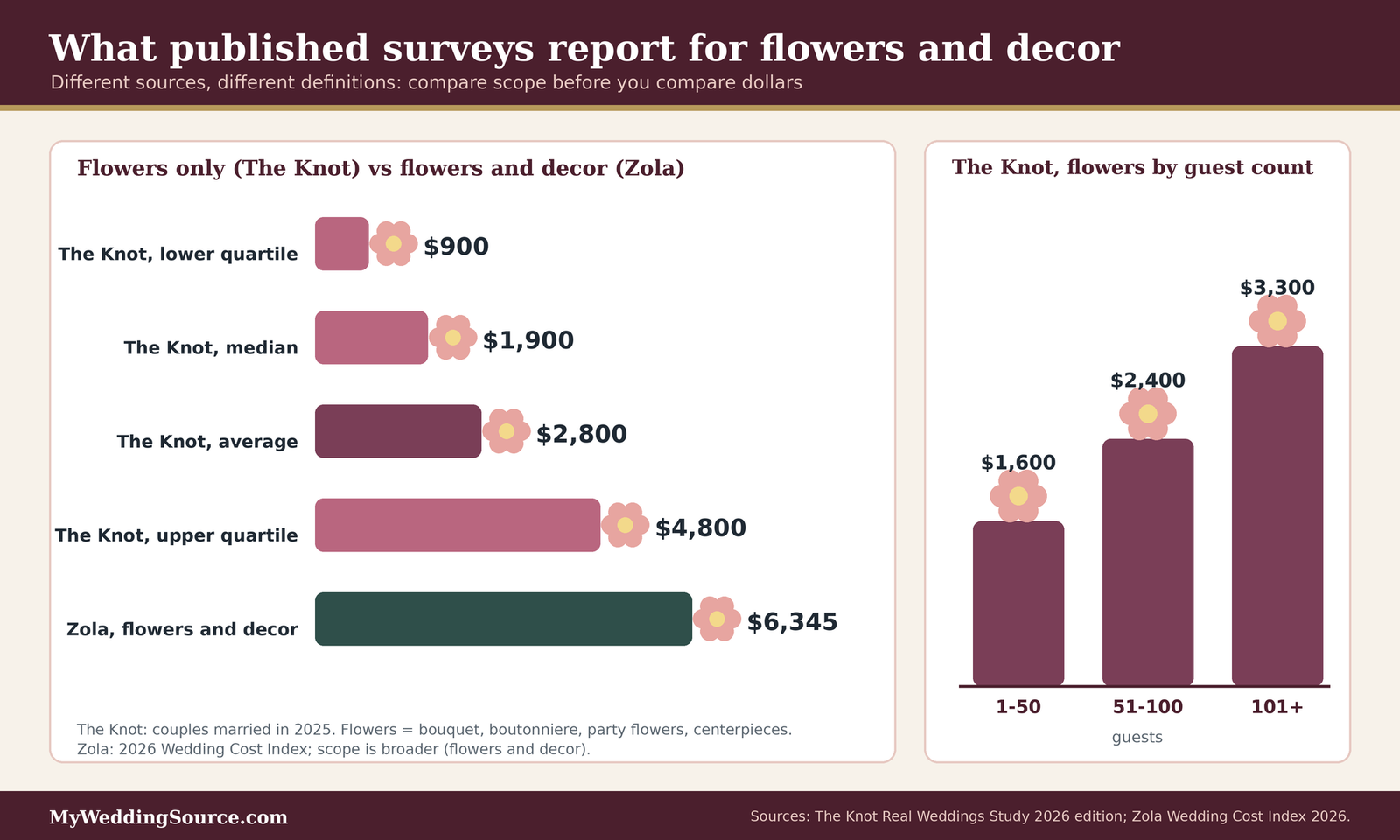
The Knot’s wedding flowers page reports an average of $2,800 for wedding flowers, from its 2026 Real Weddings Study, which surveyed couples who married between January 1 and December 31, 2025. The page lists the sample as 10,474 U.S. couples in its methodology note, while its introduction says “nearly 11,000,” so we treat the sample as roughly ten to eleven thousand. The average covers a bouquet, a boutonniere, flowers for the wedding party, and floral centerpieces.
The same page breaks the figure down. The lower quartile is $900, the median is $1,900, and the upper quartile is $4,800, which tells you the average is pulled up by a smaller group of high spenders. By guest count, couples with 1 to 50 guests reported $1,600, those with 51 to 100 guests $2,400, and those with 101 or more $3,300. By region, the Mid-Atlantic was highest at $3,600 and the West lowest at $2,400. On a separate budget page from the same study, The Knot reports that floral design and decor, which it defines to include both floral and non-floral elements such as lighting, candles, signage, table displays, and non-floral centerpieces, makes up 9% of the total wedding budget.
What Zola reports
Zola’s cost guide for 2026 reports an average total wedding cost of $36,000, which it says is the amount couples pay out of pocket after family contributions. It reports that flowers and decor average $6,345, with a typical range of $5,100 to $7,600, citing its Wedding Cost Index, which draws on platform data including couples’ budgets, spending in its budget tool, and prices reported by vendors on its platform. We could not tell from the page whether the decor figure reflects planned budgets or paid amounts, and the page does not say whether rentals or lighting are included.
How to use figures that disagree
The Knot’s $2,800 and Zola’s $6,345 are not in conflict. They measure different things. The Knot’s flower figure covers bouquets, boutonnieres, party flowers, and centerpieces. Zola’s covers “flowers and decor,” which appears to be a broader category. The Knot’s separate 9% figure covers floral and non-floral decor together, and also appears to be a share of total budget, not a dollar amount.
Compare scope before you compare dollars
If you hold the Zola figures against the 9% share in The Knot’s data, the numbers do not line up neatly. As a rough estimate, $6,345 divided by $36,000 is about 18%, roughly double 9%. We cannot tell whether that gap comes from different samples, different years, different definitions, or different methods, and we would not try to resolve it. The lesson is simple: a headline average is only useful if you know what it contains.
When you read any wedding decor number, including in an online forum or a vendor’s blog, ask five questions. What year? Whose couples? Planned or paid? What is included, flowers only or flowers plus rentals, lighting, and labor? Is it an average, a median, or a range? A figure that cannot answer those questions is a mood, not a benchmark.
Use the data to set a range, not a target
For planning, use the published figures to understand a plausible range, and then build your own estimate from your own scope. For example, if you have 120 guests, The Knot’s guest-count bands put you in the group with 101 or more guests, whose reported flower spending averaged $3,300. That does not mean you should spend $3,300. It means a florist quoting far above or far below that range for a similar scope should be able to explain why. Our wedding budget calculator can help you test how a decor budget fits into the whole.
Price the installed design, not the inspiration image
The picture on a vendor’s website shows finished wedding decor. The quote must cover everything required to get from the studio to your room and back again. That is the difference between the price of an object and the price of an installed design.
Include labor, mechanics, delivery, rentals, teardown, and damage risk
An installed wedding decor design has many cost layers beyond the flowers and fabrics. Some are hidden in the price, and some are billed separately. The goal is to see them all, side by side, before you compare quotes.
What this actually costs
The price you should compare is materials plus rentals plus labor plus delivery plus teardown plus any venue fees, minus anything you will resell or reuse. A low line item with several excluded services is often higher than a higher quote that includes everything. Published averages cover different scopes, so use them for context, and use your own normalized quotes for decisions.
Separate reusable inventory from consumed materials
Some items are bought and used up: fresh flowers, greenery, floral foam alternatives, petals, and food. Some are rented and returned: arches, candelabras, lanterns, linens, chargers, flatware, and furniture. Some are bought and kept: signs, frames, vases you purchase, and personal items. Each group behaves differently in the budget.
Consumed materials carry market risk, because the cost of flowers and greenery depends on season, supply, and demand. Rented items carry damage and replacement risk, and the contract should say who pays for breakage. Wisconsin’s consumer protection department advises couples to confirm who is responsible for broken rentals. Items you buy carry a resale or reuse value, but only if someone takes responsibility for selling or storing them after the event, which many couples do not have energy to do.
Make a short list in three columns: consumed, rented, owned. For every piece of wedding decor, write who supplies it, who sets it up, who removes it, and who is responsible if it is damaged. That list becomes the backbone of a quote comparison.
| Cost layer | What it covers | What to ask | Common way it hides |
|---|---|---|---|
| Materials | Flowers, greenery, fabric, candles, paper goods | What is included, and in what quantity? | A flat package price with no quantities |
| Rentals | Arches, stands, linens, vases, lanterns, chargers | Is it per item or per event, and who pays for damage? | Listed separately, or bundled with the venue |
| Labor | Design time, building, installing, striking | Is setup included, and for how long? | An hourly rate added later |
| Mechanics | Anchors, stands, hanging hardware, lifts, ladders | Who supplies and who is licensed to use them? | Assumed to be “included” |
| Delivery | Transport to ceremony and reception spaces | Is there a fee, and does it cover a second location? | A distance or time surcharge |
| Teardown | Removal, pickup, return of rentals | When, by whom, and is it charged? | A flat fee, or “customer returns” |
| Substitution | What replaces anything unavailable | Who approves it, and does price change? | Silence in the contract |
| Venue fees | Load-in, labor, security, insurance paperwork | Does the venue charge for outside decor vendors? | A line on the venue contract, not the vendor’s |
Flag venue labor or fire-code requirements
Venues often have their own costs for wedding decor. Some charge a fee for outside vendors, require a certificate of insurance, restrict load-in times, or require venue staff to be present for certain tasks. These fees may appear on the venue’s contract rather than the decor vendor’s. The Knot’s budget guidance notes that rentals such as tables, chairs, dishes, and glassware are sometimes included in the venue price and sometimes billed separately, which shows how easy it is to pay twice or to miss a cost altogether.
Fire-code requirements can add costs too. If your venue requires flame-resistance certification for fabrics, or limits live flame, a vendor may need to substitute materials. Ask about this early so the vendor prices the compliant version from the start.
Create a substitution plan before market or weather changes force one
No wedding decor plan survives contact with reality unchanged. A flower is out of season, a color is discontinued, a rented item is damaged, or the weather changes the plan. A substitution plan decides in advance what changes are acceptable.
Define acceptable color, flower, and material substitutions
For each major element, write down the intent in a sentence, then list acceptable alternatives. For example: “Intent: soft, airy, white-and-green ceremony arch. Acceptable: any white or cream flower of similar size, any greenery in the green family. Not acceptable: deep colors, stiff or spiky forms.” That language lets a florist make a good decision at the wholesale market without calling you at 6 a.m.
Flower availability is genuinely variable. The Society of American Florists, in guidance written for florists around Mother’s Day, quotes a wholesaler saying that substitutions happen even with careful planning and that florists should stay in open contact with wholesalers about changes. The same piece says pre-booking stock helps secure availability for peak periods. If your date falls near a major flower holiday, ask your florist how they plan to source, and how much earlier they order.
Rank your priorities. Decide which matters most: the color, the specific flower, the shape, or the budget. When something has to give, the florist should know which to protect.
Require approval rules in the contract
A substitution plan is only useful if it is in the contract. The Wisconsin Department of Agriculture, Trade and Consumer Protection advises that florists specify what replaces unavailable flowers and whether the replacement costs extra. The Ohio Attorney General advises couples to request detailed contracts that cover possible substitutions, refund policies, and how complaints are handled.
At minimum, ask your contract to say four things: the intended design, who may approve substitutions and how quickly they must respond, whether a substitution can change the price, and what happens if you reject a substitution that the vendor cannot avoid. We are not lawyers, and this is general information. If a contract is complex or the amount is large, a local attorney can review it.
Questions to ask every decor vendor
- What exactly is included in this price, and what is not?
- Who delivers, sets up, and removes everything, and at what times?
- Which items are rented, which are consumed, and which do I keep?
- Who pays for damage or loss, and how is it assessed?
- What do you substitute if something is unavailable, who approves it, and does the price change?
- Have you worked at this venue, and do you know its rules for flame, hanging, and load-in?
- What do you need from me, and by what date?
- What is your cancellation and refund policy, and what is the deposit schedule?
Compare quotes with a normalization method
Three quotes can look similar and be very different. A normalization method puts them on the same footing. This is our own approach, not an industry standard, and it uses plain arithmetic you can do on paper.
Turn three quotes into one comparison
The method has four steps. First, write down your scope in a single list. Second, list every cost layer from the checklist above for each vendor. Third, add costs the vendor excluded but you will have to pay. Fourth, divide by tables or guests so you can compare unlike packages.
Build the scope list and fill every line
Start with a scope list: one ceremony backdrop, aisle decor, a head table, twelve guest tables, a welcome table, a cake table, and so on. Ask each vendor to quote the same list, or tell you which parts they would not provide. If a vendor will not itemize, ask for at least a scope summary. A vendor who cannot say what is included may not know either.
Add the excluded costs and divide
Take each quote and add anything excluded that you will need to buy elsewhere or pay separately. Then divide the total by the number of guest tables or by the number of guests. The result is not a price you will necessarily pay, but a way to see whether a quote is high, low, or just differently scoped.
A worked scenario with illustrative numbers
Here is a scenario to show the method. The numbers are invented for illustration and are not market prices. Suppose a couple has 120 guests at 12 tables of 10, and asks three vendors to quote the same scope: a ceremony arch, aisle florals, and one centerpiece per table.
Three quotes, one scope
| Line | Vendor A | Vendor B | Vendor C |
|---|---|---|---|
| Quoted price | $4,800 (all-inclusive) | $3,900 | $2,600 |
| Delivery | included | $300 | $200 |
| Setup | included | $450 | included in labor |
| Teardown | included | $250 | included in labor |
| Vase or candle rentals | included | $144 (12 vases at $12) | $480 (lanterns and candles) |
| Arch rental | included | included | $350 |
| Labor | included | included | $520 |
| Normalized total | $4,800 | $5,044 | $4,150 |
| Per table (12) | $400 | about $420 | about $346 |
| Per guest (120) | $40 | about $42 | about $35 |
Read the result carefully
On the sticker, Vendor B looks cheapest of the first two and Vendor C looks cheapest overall. After normalizing, Vendor B ($5,044) costs more than Vendor A ($4,800), because B excluded delivery, setup, teardown, and vase rental, which total $1,144 on top of $3,900. Vendor C’s total of $4,150 is lowest, but C’s design uses rented lanterns and candles instead of more flowers, so it is a different look, not just a different price. The comparison does not tell you who is best. It tells you where the money goes, which lets you ask a better question: “Is the lantern look something we want, or are we choosing it because the number is smaller?”
Check also what each wedding decor vendor would do about substitutions and damage, since these do not show up in the totals. A quote that is $400 lower and has no substitution clause may cost more if a key flower is unavailable and no one is accountable.
Build a decor timeline with buffer points
Wedding decor decisions have deadlines, and some deadlines are set by other people. A timeline helps you see them. Our wedding timeline guide covers the full plan. This section covers just the wedding decor track, and the months below are our suggestions, which should flex with your date and vendors.
From first decisions to final counts
Lead times vary by vendor, by season, and by the complexity of the design, so ask each vendor for their own deadlines and put them in your calendar.
Early decisions: venue, scale, and rules
Once you have a venue, collect the documents described earlier and walk the space. Decide the overall feel of the wedding decor, the budget range, and the elements that matter most. This is also the time to decide whether you want a planner or a day-of coordinator, since they often manage the decor logistics. Our guide to planning a wedding can help with that larger structure.
Book the vendors for whom availability is limited, such as in-demand florists, lighting designers, and specialty rental companies, at the point your contract and budget allow. Booking early does not mean deciding every detail early.
Middle decisions: palette, samples, and contracts
Several months out, test the palette in the room and look at samples. Finalize the scope with each vendor and read the contract against your checklist. Confirm wedding decor rules and approvals with the venue in writing. Send the one-page brief to all vendors at once.
Final decisions: counts, layout, and approvals
In the last weeks, confirm guest counts, table layout, and schedules. Many vendors need final counts by a set date, and changes after that may cost more or be impossible. Walk through the day with your planner or coordinator. Approve final designs, substitutions, and any mock-ups. Confirm delivery and setup times in writing.
The day itself
On the day, a clear sequence matters more than any single object.
Load-in, setup, and the order of work
Ask the venue and vendors to agree on a schedule. Heavy items and lighting often go first, followed by tables, linens, tableware, flowers, and finishing details. Candles, if permitted, are usually last, and must be lit by a person who knows the venue rules. Assign someone to meet each vendor and sign for deliveries. Keep a printed copy of the floor plan, the one-page brief, and any fire-safety documentation.
Teardown and what happens next
Agree on teardown timing, a pickup list, and where personal items go. Decide who takes the cards, the guest book, and any gifts. Rentals should be ready for return in the condition described in your contract. If you plan to donate or repurpose flowers, line that up beforehand so it does not depend on a tired person at midnight.
Use a design matrix to test common wedding decor choices
By now you have a list of elements, a set of rules, and a rough budget. A matrix lets you test each element against the same criteria so that decisions rest on fit, not on how good it looked in a photograph. The matrix below is our own synthesis. It is a thinking tool, not a ranking, and the entries are general tendencies that your room may overturn.
Read the matrix before you use it
The columns are the six questions that most often change a decor decision: how big the element is relative to the room, whether it blocks or opens sightlines, what it is made of, how lighting affects it, which venue rule is most likely to apply, and what it does to guests’ comfort.
| Element | Scale | Sightline | Material | Lighting | Venue rule to check | Guest impact |
|---|---|---|---|---|---|---|
| Ceremony arch or backdrop | Large; must suit the space behind it | Frames the couple; can hide the view | Wood, metal, fabric, flowers | Backlight and harsh sun flatten it | Anchoring, wind, hanging points | Focus point for every guest |
| Aisle markers and petals | Small, repeated | Low; no effect on views | Flowers, lanterns, petals | Visible in dusk if lit | Petal bans, open flame, slip risk | Guides movement; can be a trip hazard |
| Tall centerpiece | Large vertical | Blocks across the table unless set above eye level | Stems, stands, vases | Gets light from above; can glare | Ceiling height, hanging, flame | Drama, but can limit conversation |
| Low centerpiece | Modest horizontal | Keeps conversation open | Flowers, candles, greenery | Candles add glow, little brightness | Open flame near fabric | Social and photographs well from above |
| Candles and lanterns | Small, repeated | Low to mid | Wax, glass, metal, LED | Warm glow; needs working light too | Open flame limits, holder rules | Mood, with burn and tipping risk |
| Draped fabric or ceiling installation | Large overhead | Above eye line | Fabric, lights, greenery | Can soften or darken a room | Flame resistance, hanging points, exits | Changes how the room feels and sounds |
| Signs and menus | Small | Read at close range | Paper, acrylic, wood, chalk | Needs enough light to read | Adhesive and easel rules | Directly helps guests |
| Dance floor decor | Medium | Often overhead or at edges | Lights, flowers, furniture | Dim, moving, colored light | Cable routing, floor protection | Energy, but accessibility and sensory limits |
Treat each row as a conversation
None of these cells is a rule. A tall centerpiece can work if it is set on a slim stand above the sightline. Candles can be a fine choice when real flame is allowed, and a poor one when it is not. Use the table to prompt questions, and write down your own answers for your own room.
Add your own rows
If you plan something unusual, such as a photo wall, a tent liner, a mobile bar, or a signature scent, add it as a row and answer the six questions. If you cannot answer one, that is the question to take to your venue or vendor.
Make a decision from the matrix
The matrix helps most when it forces a decision between competing priorities.
Rank guest impact above photographs when they conflict
Photographs of wedding decor are lasting, and guests are present. When a design makes guests uncomfortable, it will show in photographs too, in tired faces and early departures. If an arrangement looks lovely but blocks conversation, choose a version that is a little lower or a little narrower. If a lighting plan flatters the room but makes the aisle hard to see, add a few functional lights.
Use the venue rule column to cut early
If a row’s venue rule cell is a firm no, drop the idea early. Do not buy the item and hope. The cheapest decor change is the one you make before the order.
Save money without making the room look thin
Controlling the cost of wedding decor is easier when you know which parts of the design carry the look. Savings that cut the focal point will be visible. Savings that cut the third group of elements, the ones few guests see, will not be.
Do it yourself, borrow, or rent
Many couples want to make some of their wedding decor themselves. That can be rewarding and economical, but it also takes time, space, and a reliable plan for the day.
Choose DIY projects that tolerate imperfection
Good candidates are items that are forgiving, can be made ahead, and do not involve fire, heights, or perishable materials: paper goods, simple signs, framed photographs, a collection of borrowed vases, or a table of personal objects. Make one prototype early and time how long it takes, then multiply by the number you need. A task that takes ten minutes becomes twenty hours at two hundred pieces, which helps you decide whether to do it, delegate it, or buy it.
Be cautious with perishable, structural, or flame-related DIY
Fresh flowers are time-sensitive, and arranging them takes space, cold storage, and skill. Structures such as arches and hanging pieces carry safety risk if not anchored correctly. Open flame has the rule issues covered earlier. For any of these, ask whether a professional can do just that part, such as building the arch while you handle the table details. Many florists will sell flowers by the bucket or offer a “design only” or “setup only” service, and the quote normalization method works for those partial scopes too.
Reuse and repurpose
Some of the best savings come from using the same item twice.
Move ceremony pieces to the reception
Arch flowers can become a cake table feature, aisle arrangements can flank the sweetheart table, and a welcome sign can stand at the bar. The key is a plan: someone must move them, someone must know where they go, and the design must work in both places. Put this in the vendor’s scope and the day-of schedule. Ask whether flowers cut for the ceremony will look fresh enough to appear again at dinner after sun and travel.
Decide what to buy and what to rent
As a rule of thumb, rent items you will use once and that are bulky or hard to store, such as arches, candelabras, and large lanterns. Buy items you want to keep or that carry meaning. For items you will never see again, rental is often simpler. For items you love, buying avoids the fear of damage fees. If you plan to resell, be honest about your energy for photographing, listing, and shipping after the wedding, since many couples intend to sell and never do.
Build a risk register for the day
A wedding decor risk register is a list of things that could go wrong, how likely each seems, how much it would matter, and what you will do about it. Planners and project managers use them, and they are useful for decor because most decor problems are predictable. This one is a starting point.
Weather and outdoor conditions
Outdoor wedding decor is exposed to the elements, and weather is the risk couples most often underestimate.
Plan for wind, heat, and sun
Wind can topple arches, flip tablecloths, blow out candles, and scatter paper. Heat can wilt flowers and soften wax. Strong sun can wash out colors, make guests squint, and create harsh shadows in photographs. Ask vendors how they anchor structures, whether they use weights, and what materials hold up outdoors. Consider shade for the ceremony and keep fresh flowers out of direct sun until the last moment. Choose heavier vases or secure light ones, and avoid tall unsecured pieces on grass.
Choose a rain plan before you need it
The Ohio Attorney General’s consumer guidance suggests asking about backup plans, including the venue’s policies for storms and power outages, and establishing an alternate location for outdoor weddings. Apply that to wedding decor: if the ceremony moves indoors, where does the arch go, who moves it, and does it fit? If a tent is the plan, ask whether it affects decor, such as whether you can hang things from the frame, whether the tent needs a fire-safety review, and whether lighting must change. Decide the weather decision time with your vendors, so they know when to switch. Tents may be subject to local fire and permit rules, and your rental company and venue can tell you what applies.
Vendor and payment risk
Most vendors are reliable. A good wedding decor plan still allows for the occasional problem.
Prepare for a missing item or a late vendor
Keep a list of vendor contact numbers for the day, and give it to someone who is not you. Ask what the vendor does if a team member is ill, a vehicle breaks down, or an item is unavailable. Pack a small kit: scissors, tape that is allowed at the venue, safety pins, extra candles or batteries, a lighter if flame is permitted, and a few spare stems or ribbon. If a vendor is late, a coordinator or trusted friend can begin setting up the elements you control, starting with the focal point.
Protect your payments
For wedding decor payments, both the Ohio Attorney General and the Wisconsin consumer protection department advise paying by credit card where possible, because card payments generally offer dispute options that cash, checks, and often debit do not. Ohio also advises caution when a vendor wants most of the money up front, and Wisconsin advises putting down as little as possible, getting everything in writing, and never signing a blank contract. Keep receipts, emails, and photographs of agreed designs. This is general consumer information, not legal advice. If you have a dispute, contact your state or local consumer protection office.
FAQ: wedding decor questions
Planning and budget
How much should I spend on wedding decor?
There is no single right amount. The Knot’s 2026 study reports that floral design and decor make up about 9% of the total budget, and Zola reports a flowers and decor average of $6,345, but the two define the category differently. Set a range from your scope, compare normalized quotes, and decide which elements carry the look.
When should I book wedding decor vendors?
Book early for vendors with limited availability, like florists and lighting designers, as soon as your venue, date, and budget are settled. Finalize details later. Ask each wedding decor vendor for their own deadlines for counts, designs, and payments, and put them on your calendar so a missed date does not limit your options.
Do I need a planner or designer for wedding decor?
Not always. A planner or designer can save time, know the venues, and coordinate vendors, but a simple wedding can work with a clear brief and a good florist. Consider help if your venue has complicated rules, you are decorating a raw space, or you lack time to manage deliveries and setup.
What is the difference between wedding decor and flowers?
Flowers are one part of wedding decor. The Knot’s flower figure covers a bouquet, boutonniere, wedding party flowers, and floral centerpieces, while its decor category also includes lighting, candles, signage, table displays, and non-floral centerpieces. When comparing prices, check which of these a number includes.
Venue, safety, and logistics
Can I use candles at my venue?
It depends on the venue and the local fire code. Published guidance varies from permitting enclosed, secured devices to prohibiting candles in buildings and tents. Ask your venue for its written policy, and if real flame is not allowed, consider flameless candles and look at a sample in the room before you buy.
How do I make sure my decor is accessible to all guests?
Plan clear walking routes, and consider the 36-inch minimum clear width in the 2010 ADA Standards as a practical benchmark. Include pulled-out chairs when you measure, route cables out of paths, and avoid low objects in the walking line. Test the room in the lighting you plan to use, since dim rooms hide hazards.
What should a wedding decor contract include?
At minimum, it should list the design and quantities, delivery and setup times, teardown and pickup, who is responsible for damage, the substitution rules, the total price with what is and is not included, and the payment and cancellation terms. Consumer protection offices advise getting everything in writing and never signing a blank contract.
What if my favorite flowers are not available?
Ask your florist in advance what they would use instead in your wedding decor. Wisconsin’s consumer protection guidance says florists should specify what replaces unavailable flowers and whether it costs extra. Give your florist a clear intent, such as color, shape, and mood, and a priority order, so they can make a good choice without a late call.
Your next steps
Measure and decide
Walk the room and write the wedding decor brief
Visit your venue with a tape measure, record dimensions, light, access, and rules, and ask for the written decor policy. Then write a one-page brief that every vendor will read. Our wedding planning guide can help you place this step among the others.
Tag every element with a job
List each planned item and tag it as guide, frame, soften, photograph, or personalize. Cut or downgrade any item with no tag. Check the list against your wedding budget calculator so the money follows the jobs that matter.
Price and protect
Normalize at least three quotes
Ask each vendor to quote the same scope. Add any excluded costs, divide by tables or guests, and compare. Use the questions in this guide, and put the substitution plan and teardown responsibility in writing.
Build your timeline and checklist
Add wedding decor deadlines to your wedding planning checklist, including final counts, approvals, delivery, setup, and teardown. A rule of thumb for the whole guide: if you cannot say what a piece of decor is for, who installs it, and who removes it, you are not ready to buy it.
Sources & methodology
How we built this guide
What we relied on
This wedding decor guide combines published survey figures from The Knot and Zola, consumer-protection guidance on wedding vendor contracts from the Wisconsin Department of Agriculture, Trade and Consumer Protection and the Ohio Attorney General, accessibility dimensions from the U.S. Access Board, lighting terms from the U.S. Department of Energy, local fire-code guidance from Minnesota, San Francisco, and Fairfax County, a university event-decor policy, a National Park Service wedding permit page, and a florist-industry article on flower sourcing. Where a statement comes from a company, we say so, because company surveys reflect their own members and methods. The design matrix, the quote-normalization method, the scenario, and the risk register are our own work. The scenario numbers are invented for illustration, and the percentages we calculate are estimates.
What we did not do
We did not test products, visit venues, collect vendor quotes, or conduct our own survey. Design suggestions such as proportion and height are editorial judgment, not measured standards. Fire codes, permits, and contract terms vary by place, and this guide is general information, not legal, safety, or financial advice. Ask your venue, your local fire marshal, and a qualified professional about your own situation.
Source list
Cost and planning data
- The Knot, How much do wedding flowers cost (Real Weddings Study, 2026 edition, couples married in 2025): https://www.theknot.com/content/average-cost-wedding-flowers
- The Knot, Wedding budget breakdown (Real Weddings Study): https://www.theknot.com/content/how-to-save-and-splurge-on-the-wedding
- Zola, Average cost of weddings in 2026: https://www.zola.com/expert-advice/how-much-does-a-wedding-cost
- Society of American Florists, What your wholesaler wants you to know before Mother’s Day: https://safnow.org/2024/03/19/what-your-wholesaler-wants-you-to-know-before-mothers-day/
Government and consumer-protection sources
- Wisconsin Department of Agriculture, Trade and Consumer Protection, Weddings consumer guide: https://datcp.wi.gov/Documents/Wedding219.pdf
- Ohio Attorney General, Consumer Advocate newsletter, Avoid wedding disasters (July 2012): https://ohioattorneygeneral.gov/Media/Newsletters/Consumer-Advocate/July-2012/Avoid-Wedding-Disasters
- U.S. Access Board, 2010 ADA Standards, Chapter 4 accessible routes: https://www.access-board.gov/ada/chapter/ch04/
- U.S. Department of Energy, Lighting principles and terms: https://www.energy.gov/energysaver/lighting-principles-and-terms
- National Park Service, Mount Rushmore special use permit guidelines for weddings: https://www.nps.gov/moru/planyourvisit/special-use-permit-guidelines-for-weddings.htm
Fire-safety and venue-policy examples
- Minnesota Department of Public Safety, State Fire Marshal, Candles and open flames: https://dps.mn.gov/divisions/sfm/fire-code/fire-code-information-topic/candles-and-open-flames
- San Francisco Fire Department, Guidelines for candles in public assembly: https://www.sf-fire.org/guidelines-candles-public-assembly
- Fairfax County Fire Marshal, Guidelines for decorative vegetation: https://www.fairfaxcounty.gov/fire-ems/fire-marshal/guidelines-decorative-vegetation
- Texas A&M University at Galveston, Event decorations: https://www.tamug.edu/environmentalhealthsafety/Event_Safety/EventDecorations.html