

Every season brings a new list of looks, and 2026 wedding decor trends are no different: vintage silver and antique brass, draped fabric, loose and wild-feeling flowers, warm lamps instead of bright overheads. This guide helps you sort what couples are measurably doing from what editors are predicting, price the labor behind each look, and keep only the pieces you will still like when the cycle turns.
Quick answer
Treat 2026 wedding decor trends as three different kinds of evidence. Survey counts tell you what a large group of couples reported (Zola’s First Look Report, for example, reports that 39% of its 2026 couples include vintage or pre-loved pieces). Editor and planner forecasts tell you what professionals expect to photograph well. Social buzz tells you what is circulating, not what is being booked. Adopt a trend when it passes three tests: you can name who will install and remove it, it fits the room’s rules, and you would still like it in a photo from ten years from now. Rent or borrow the most dated pieces and buy only what is quiet.
Most readers arrive at an article about 2026 wedding decor trends with a folder of saved images and a budget that does not match them. This page does not try to predict the future, and it does not tell you what is “in” or “out.” It does three plainer things. It shows where the numbers behind 2026 wedding decor trends come from and what they can and cannot prove. It explains the real work, cost, and risk behind the looks named in the headline: vintage details, drapery, and organic florals. And it gives you a way to decide, element by element, what is worth doing for your own wedding. If you want the underlying room-first method for any style, our wedding decor guide covers measuring the space, lighting, and quote comparison, and we do not repeat it here.
A note on sources before we start. Everything we say about what couples do or what editors forecast comes from published reports by The Knot and Zola, and we say which one each time. Both are wedding platforms with commercial interests, and their surveys describe their own users. Where a figure is our own arithmetic, we label it an estimate, and where an example is invented to show a method, we label it illustrative. This is general planning information, not legal, safety, or financial advice.
How to read 2026 wedding decor trends: measured behavior versus forecast
The phrase “trend” covers at least three different kinds of claims, and mixing them up is how couples end up buying a look that was never as popular as it seemed. With 2026 wedding decor trends, a reported percentage is a count of people who answered a question. A forecast is an informed opinion about what will look fresh. A viral image is neither. Sorting 2026 wedding decor trends into those buckets takes about ten minutes and changes how much weight each one deserves.
What the 2026 surveys actually measured
Two platforms published the most useful recent material, and they measured different things. Reading them side by side shows why a single headline number rarely tells you what to buy.
Zola’s First Look Report
Zola’s First Look Report 2026 describes a survey of more than 11,500 couples getting married in 2026, and Zola calls it its largest survey. The report is about weddings that are happening this year, which makes it a better guide to 2026 wedding decor trends than a forecast made years earlier. Its published decor-related figures are worth listing, with the caveat that we are reporting the company’s numbers as it published them.
On color, Zola reports that sage green is the single most common anchor color, chosen by 30% of couples, and that 53% of weddings include some shade of green in the main palette. It reports that 39% of couples use an all-white decor palette, 19% use blush as a warm neutral, 7% each use terracotta and rust, and 5% use champagne as a soft metallic. On decor and flowers, it reports that 39% incorporate vintage or pre-loved pieces and that 49% use locally sourced or seasonal blooms. It also reports that outdoor garden venues are the most popular venue type for the second year running.
The Knot’s trends reporting
The Knot’s reporting on 2026 wedding decor trends is a different kind of source. Its 2026 trends article on decor, last updated December 2, 2025, contains no survey figures. It is an editorial roundup built from observations and quotes from named wedding planners, and it covers things like layered tablescapes, fruit-based centerpieces, silver and chrome finishes, draped and cascading linens, warm accent lamps, and lived-in, home-like rooms. That is useful as a map of what professionals are designing, and it should be read that way.
The Knot’s separate research report on the future of marriage, released in late November 2025, does include numbers. It reports surveying more than 600 engaged couples in the United States about the economy and vendors, and a separate survey of 228 engaged couples about artificial intelligence. Among its findings, about a third of couples said they are cutting guests or modifying flowers and decor because of rising costs, and 52% said their initial budget was lower than the true cost of a wedding. The report lists over-the-top themed decor among the elements it describes as out for 2026, which fits the quieter direction in Zola’s data. The Knot also published a 2027 trends report in September 2026, which we discuss later because it is a forecast, not a count.
Platform surveys are not the whole population
A large survey feels authoritative, but a number only describes the people who were asked. When you read any statistic about 2026 wedding decor trends, four questions tell you how far to trust it.
Who was asked, and when
For 2026 wedding decor trends, Zola’s survey covers couples who use Zola and are getting married in 2026. The Knot’s research covers people who use The Knot’s platform or panel. Neither is a random sample of every U.S. couple, and couples who plan online with a registry or a vendor marketplace may differ from couples who plan by phone with family and a local caterer. The Zola article we read does not say how couples were recruited, when the survey ran, or what margin of error applies, so we treat its percentages as a useful signal and not as a measurement of all weddings. A count of 39% means 39% of that group, not 39% of American weddings.
What the question allowed
A percentage depends on the wording of the question. “Do you include vintage or pre-loved pieces?” can be answered yes by a couple who borrowed grandmother’s cake knife and by a couple who furnished a lounge with antique sofas. The published figure does not separate the two. Whenever you see a percentage, ask what the least committed version of a yes would look like, because that is probably a large share of the yes answers.
Planned versus paid
Spending figures have the same problem. Some are what couples budgeted and some are what they paid. The Knot’s Real Weddings Study, for example, reports on couples who married in a given year, while Zola’s cost index draws on budgets, platform spending, and vendor-reported prices. If a source does not say which it is, do not compare it to a quote you received last week. We discuss these figures in more detail in the cost section, and our average wedding cost guide covers the wider picture.
Year-over-year percentages need a method
The Knot’s 2027 trends report presents year-over-year increases for trends, such as 280% for antique lace and 133% for silver-toned vintage pieces. The page we read does not explain the base those percentages are calculated from, so a large increase can be a small number growing from almost nothing. Treat these as a sign of rising attention, not as a count of weddings.
Inspiration is direction, not a rule
Even good data cannot tell you what to put on your tables. It can only tell you what is rising in the pool of ideas you are likely to see.
Name the evidence source for every trend you adopt
A simple habit keeps decisions about 2026 wedding decor trends honest. For each look you consider, write one line that says where the evidence came from: a survey percentage, a named planner’s observation, or an image you saw. If the line says “I saw it a lot,” that is fine, but it belongs in a different column from “39% of 11,500 couples reported it.” Our evidence table below does this for the major looks in the 2026 wedding decor trends reporting.
Do not call a look dead from a few posts
Some commentary will declare a style finished long before most couples have used it. A viral post can say that white-on-white weddings are over while Zola’s own data shows 39% of its couples choose an all-white palette. Both statements can be true, because a share of a large group can fall from a higher number and still be large. A look is not unusable because it is no longer new. If you love it, a lower share of couples choosing it is, if anything, a reason it will look less like everyone else’s.

| Signal | Source and sample | What it demands | Our confidence |
|---|---|---|---|
| Sage and other greens, 53% of palettes include green | Zola First Look Report 2026, 11,500+ couples marrying in 2026; method not detailed | Low. A palette change, easy to execute in linens, paper, and flowers | Moderate: large sample, platform users only |
| All-white palette, 39% | Same Zola report | Low | Moderate |
| Vintage or pre-loved pieces, 39% | Same Zola report; “pre-loved” not defined | Medium. Sourcing, transport, return, and breakage rules | Moderate for popularity, low for what counts as vintage |
| Local or seasonal blooms, 49% | Same Zola report | Medium. Depends on date, region, and florist | Moderate |
| Draped linens, sheers, textured drapery | The Knot 2026 trend roundup (December 2025), planner quotes; Zola names heavy drapery as a texture idea | High. Fabric, rigging, labor, fire documentation | Low to moderate: editorial, no counts |
| Silver, antique brass, candelabras | The Knot roundup; Zola mentions antique brass candlesticks | Medium. Rentals, candle rules, tarnish and polish | Low to moderate |
| Warm lamps and home-like rooms | The Knot 2026 roundup and 2027 report | Medium. Power, cords, safe placement, rental count | Low to moderate |
| Cutting or changing flowers and decor to save money | The Knot future-of-marriage report, 600+ engaged couples, about a third | None. A budget behavior | Moderate |
| Antique lace +280%, silver +133%, monofloral +113% | The Knot 2027 trends report (September 2026); base and method not explained | Varies | Low: directional only |
Vintage details, drapery, and organic florals: what the three looks involve
The title of this guide names three of the 2026 wedding decor trends because they appear across the sources we read, in different words and with different amounts of evidence. Each one is easy to admire in a photograph and easy to underestimate in a contract. Here is what each involves in practice.
Vintage and pre-loved details
Both The Knot’s planners and Zola’s survey point to older objects: antique silver serveware, brass candlesticks, mismatched amber and green glassware, rattan furniture, and earlier-decade styles such as 1980s mirrors and bows. Zola’s 39% figure suggests pre-loved pieces are common, though the report does not define the term.
What the sourcing really looks like
In 2026 wedding decor trends, vintage is a sourcing job, not a shopping trip. A set of twelve matching brass candlesticks may not exist, and finding twelve that do not match is the point of the look. That changes the quantity question. Ask whether a vendor can supply the count you need for your table total, whether the pieces are rented or sold, and whether the pieces on the quote are the same ones in the photographs. An honest vendor will tell you that photographs show the best examples and that the final set is a range.
Fragility, cleaning, and who pays for loss
Older glass chips, older silver tarnishes, and older furniture may not meet the weight a rental table does. Ask whether the rental contract has a damage clause and whether the deposit is larger for older pieces. Wisconsin’s consumer protection department advises couples to confirm who is responsible for broken rentals. For vintage, add a second question: is the item replaceable, and if not, how is it valued if it breaks? Read the answer in the contract, not in the conversation.
Drapery and texture
Among 2026 wedding decor trends, draped and cascading linens, billowy sheers, tapestry-like textiles, and heavy drapery appear in the reporting from both platforms. They are among the more dramatic changes to a room, which is exactly why they carry the most operational weight.
Where fabric changes a room
Fabric can soften a hard room, hide a blank wall, frame a ceremony space, or carry a color across a ceiling. It can also compete with a venue’s own architecture. In a room with beautiful beams or a patterned ceiling, covering them with fabric can cost money to hide something you are already paying for. If the room is plain, fabric is often the lowest-risk way to give it shape. Our wedding decor guide explains how to decide where a room needs a focal point.
Rigging, flame rules, and labor
Overhead fabric usually needs a rigging plan, someone qualified to hang it, and a venue that allows it. Fire rules can apply too. Fairfax County, Virginia, publishes guidance based on the Virginia Statewide Fire Prevention Code, which says artificial decorations must meet the flame propagation criteria of NFPA 701, with certification from the manufacturer, and which limits natural vegetation where it creates a fire hazard. Other places differ. Ask the rental company whether its fabric comes with flame-resistance documentation, ask the venue whether its fire marshal reviews events, and keep a copy of the paperwork on site.
Organic and sculptural florals
Among 2026 wedding decor trends in flowers, Zola describes looser, wild-feeling arrangements and sculptural designs in place of dense, round bouquets, with eucalyptus, olive branches, ferns, white ranunculus, anemones, and dried grasses named as examples. It also reports 49% of couples using local or seasonal blooms.
What organic means for a florist
“Organic” is a look, not a certification, and it does not mean a lower price by default. A looser design can use fewer stems per arrangement, but it may also call for more varieties, more greenery, and more hand placement, and we found no published data on which effect wins. Whether the result is cheaper depends on the florist, the season, and the scope. Our seasonal wedding flowers guide explains how in-season stems affect price and availability.
Treat savings claims with care
Zola’s article says sculptural florals can cost up to 80% less than traditional dense arrangements, but the page does not cite a source for that figure, and we could not verify it. We would not use it to set a budget. The Knot’s Real Weddings Study reports an average of $2,800 spent on wedding flowers (bouquet, boutonniere, wedding party flowers, and centerpieces) for couples who married in 2025, with a median of $1,900. The gap between the average and median tells you the middle couple spent less than the average. Ask your florist for a scoped quote and let the number come from your plan.

What 2026 wedding decor trends cost in labor, rentals, and risk
Price is only the first cost of a look in 2026 wedding decor trends. The larger and less visible costs are labor, rentals, and the risk that something goes wrong on the day. That is where a trend that photographs simply can turn out to be the most complicated item in your plan.
What this actually costs
Published averages do not price a specific look. The Knot’s 2026 Real Weddings Study reports $2,800 on average for wedding flowers (couples married in 2025) and about 9% of the total budget for floral design and decor combined, while Zola reports a $6,345 average for “flowers and decor.” These measure different things. To price any trend, ask for a quote that lists materials, labor, delivery, setup, breakdown, rentals, and deposits, then compare it to your own scope.
Connect each look to the venue, the vendor, and the budget
Any of the 2026 wedding decor trends is a bundle of decisions that touch the venue, one or more vendors, and your budget at once. When you evaluate it, follow each thread.
New labor and rental requirements
Take the three biggest 2026 wedding decor trends in turn. Vintage adds sourcing time and often a rental fee per piece. Drapery adds installation labor, and sometimes a lift, a rigging point, or an additional crew. Organic florals can add design time, plus the sourcing of unusual stems and greenery. None of these shows up in the price of the object. Our wedding budget calculator can show how much room your decor line has once the larger categories are set.
The Knot’s research suggests budgets are already tight. About a third of couples in its survey said they are cutting guests or modifying flowers and decor because of costs, and 52% said their initial budget was lower than the true cost. If you are among them, a trend that is cheap to admire and expensive to install is a poor fit.
Hidden trade-offs
A few trade-offs recur across the looks. Candles and warm lamps create atmosphere but also require power, cord management, and, for flame, safety rules. Layered, maximal tablescapes put more objects on the table, which leaves less space for food and glassware. Home-style lounge furniture adds comfort but needs a floor plan and a vendor who can deliver and retrieve it. The Knot’s roundup notes a preference for rooms that feel lived-in, which is lovely, and which also means more items that someone has to place, move, and count.
Test whether the look works beyond the photograph
A wedding where you adopt 2026 wedding decor trends is lived in for six or seven hours by people who eat, dance, and walk to the restroom. The camera sees one angle at one moment. The test below is for everything else.
Comfort, timing, cleanup, and access
Consider the guest first. Can an older relative reach their seat without stepping over a fabric hem or a cord? The 2010 ADA Standards for Accessible Design, published by the U.S. Access Board, set a minimum clear width of 36 inches for accessible walking surfaces. A private wedding is not the same legal situation as a public building, so we offer the figure as a useful planning benchmark and not a legal test. Draped fabric near an aisle, a low lounge, or a cluster of candles near a walkway can all narrow the path.
Then consider timing. A hung installation may need several hours to set up before guests arrive and a defined window to take down. Ask when the venue gives access and when the vendor must be gone. Finally, consider cleanup. Wax, petals, dried grasses, and glitter-like trims create more to sweep, and some venues charge for it. Ask who is responsible for cleanup and whether it is in the quote.
A lower-risk version of the same idea
Almost every one of the 2026 wedding decor trends has a smaller version that keeps most of the effect. Drapery can become a single draped table, a sheer panel behind the sweetheart table, or a fabric runner. Vintage can become a handful of silver or brass pieces at the head table. Organic florals can become one loose arrangement on the welcome table and a few single-stem vases elsewhere. These are editorial suggestions, not tested savings. They let you try the look in a place where it will be seen, with a fraction of the labor.
A worked example: normalizing two quotes for the same look
This example is invented to show a method. The vendors and numbers are not real, and no price here is a benchmark. Suppose a couple wants draped fabric behind the head table and a mix of vintage brass candlesticks on twelve tables.
Put both quotes on the same scope
Vendor A quotes a flat price that says “draping and candlesticks, setup included.” Vendor B quotes a lower price for the same items but lists delivery, installation, breakdown, and a refundable damage deposit as separate lines. The flat price looks higher until you add Vendor B’s lines. To normalize, build one list with the same rows for each quote: materials, count, delivery, setup, breakdown, replacement and damage terms, deposit, and cancellation. Write “not included” where a quote is silent, because silence is a risk.
Read the result before you decide
After normalizing, the gap can shrink, vanish, or reverse. What the normalized list also shows is which vendor has not told you something, such as whether the fabric has flame documentation or whether twelve candlesticks means twelve matching or twelve mixed. Choose the vendor whose answers are complete and whose terms you can accept, not necessarily the lowest number. The same method works for any quote, and our wedding decor guide shows it in a longer form.
Color, light, and tabletop signals in the 2026 reporting
The three looks above are not the only 2026 wedding decor trends in the reporting. Color, lighting, and tabletop styling appear again and again, and they are usually easier to adopt, because they change what you choose and not how much labor you need.
Color moves toward green and warm neutrals
Zola’s report describes a shift in which green overtakes white as the leading color family. The Knot’s 2027 report points toward deeper tones. The two together suggest a direction of travel, though they do not agree on every color.
What Zola reports for 2026
According to Zola, 53% of 2026 weddings include green in the primary palette and 30% anchor on sage. Blush, at 19%, is described as acting like a neutral. Terracotta and rust are 7% each, and champagne is 5%. A palette in these tones is also one of the least risky decisions, because it can be carried in linens, paper, and flowers, all of which are easy to change.
What The Knot forecasts for 2027
The Knot’s 2027 report, published in September 2026, names a group of palettes built on merlot, plum, powder blue, and moss green, with blush and champagne as supporting colors, along with a coastal palette of Mediterranean blues and marigold. Those are forecasts based on the company’s internal behavioral data through June 2026 and a council of five vendors, and the page does not explain the underlying measurements. If you are marrying in 2026, they matter less to you than to a couple planning for next year.
Light and tabletop move toward home
Among 2026 wedding decor trends, both platforms describe rooms that look more like a well-furnished home than a ballroom, with lamps, layered textiles, and objects with a story.
Lamps, candles, and warm accents
The Knot’s roundup names mini table lamps, bistro-style lamps, clusters of candles, and layered lanterns, and its 2027 report names table lamps again under an interior-design theme. The U.S. Department of Energy explains that color temperature is measured in Kelvin and that lower numbers look warmer and more yellow, with roughly 2,700 to 3,000 K described as warm. If you want the glow in these looks, ask any lamp supplier for the bulb’s color temperature, because two “warm” bulbs from different suppliers can look different next to each other.
If the plan includes real flame, check the rules first. Minnesota’s State Fire Marshal guidance says candles and decorative open-flame devices may be used in assembly and dining spaces when the fire code official is satisfied that safeguards are in place. San Francisco publishes a permit process for open flame in public assembly spaces, and Texas A&M University at Galveston prohibits decorative candles in campus buildings and tents, recommending battery-powered LED candles instead. These are three different jurisdictions with three different answers, which is why we say to ask your own venue.
Maximal tables versus gallery restraint
The Knot’s roundup describes two opposite directions at once: layered, maximalist tablescapes with textured menus and sculptural lamps, and a gallery-style sparseness with what one planner describes as minimal clutter and maximal intention. This is a useful reminder that a trend report is a list of options, not a single instruction. Zola’s report, for its part, describes simplified tablescapes that photograph cleanly, and The Knot’s future-of-marriage report names over-the-top themed decor among the elements it calls out for 2026. If you want help with the table itself, our wedding table settings guide goes through place settings and layout.
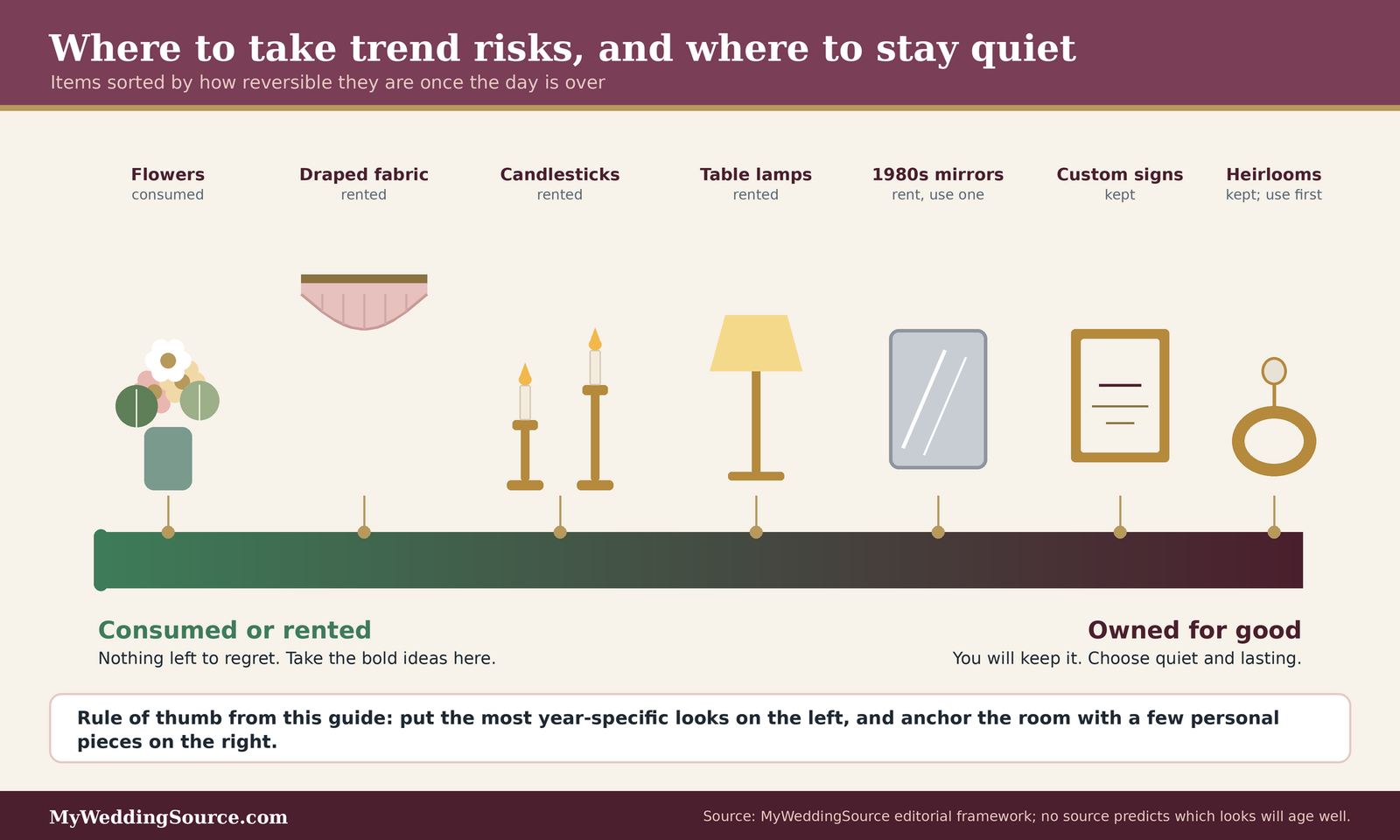
What will still feel right after the trend cycle turns
Everything above describes 2026 wedding decor trends as they stand today. The most useful question about any look is not whether it is popular, but whether you will still be glad to see it in your photographs in ten years. No one can know, and there is no evidence we can cite about which looks will age well. What we can offer is a way to reason about it, and a way to limit the risk.
A personal-value and permanence test
Two questions do most of the work when you weigh 2026 wedding decor trends. The first is about meaning. The second is about quantity.
Does the element tell your story?
A brass candlestick you inherited belongs in your decor for a reason that will not date. A brass candlestick rented because it appears in forecasts has only the forecast behind it. The Knot’s 2027 trends page reports that 60% of couples consider incorporating their ethnicity, religion, or culture important, although the page gives no sample or method for the figure. Whatever the exact number, personal and cultural details give a room a reason to look the way it does, and a reason lasts longer than a style. If an element cannot answer “why is this here?” in one sentence that is about you, use it sparingly.
Avoid stacking trends
A room can carry one or two strong looks. A room that combines 1980s mirrors, Rococo cherubs, draped sheers, silver candelabras, fruit centerpieces, and a monofloral installation will date as a set, because each element sends the same signal that this is a particular year. Choose one look to lead and let the others be quiet. Our wedding reception guide explains how to think about the room as a whole, and our wedding ceremony guide does the same for the first space guests see.
An exit strategy for each element
The practical way to take a risk on 2026 wedding decor trends is to make it reversible. Some looks can be rented, borrowed, or consumed. Others become permanent when you buy them.
Rent, borrow, or choose reversible elements
With 2026 wedding decor trends, anything that is rented, borrowed, or consumed leaves nothing behind to regret. Fabric drapery, candlesticks, lounge furniture, lamps, and flowers can all be rented or consumed. If a look is the most strongly tied to a year, as the 1980s revival or the swan and balletcore motifs described by The Knot may be, this is the place for it. You get the photographs and not the storage unit.
Keep permanent purchases quieter
Among 2026 wedding decor trends, keepsakes, stationery you will frame, a gown, and jewelry are things you will own. Zola mentions simple gold accents on stationery, and The Knot describes place cards that double as keepsakes. For things you will keep, favor materials and shapes that have lasted across decades, and put the most trend-sensitive details on elements you can change. Our wedding photographer shot list can help you decide which details are worth photographing so that they last in the album as well.
| Element | Impact in the room | Reversible | Rental-friendly | Risk of dating | Suggested approach |
|---|---|---|---|---|---|
| Green or neutral palette | Medium | Yes, in linens and paper | Yes | Low to moderate | Safe to commit; vary the shade |
| Loose, seasonal flowers | High | Yes, consumed | Not applicable | Low | Ask the florist what is in season |
| Draped fabric | High | Yes | Yes | Moderate | Rent; try a smaller version first |
| Vintage silver and brass | Medium | Yes if rented | Yes | Moderate | Mix a few pieces; check candle rules |
| Table lamps | Medium | Yes | Yes | Moderate | Confirm power and cord paths |
| 1980s motifs and mirrors | Medium | Yes if rented | Often | High | Rent only; use one |
| Swan and ballet motifs | Low | Yes | Often | High | Keep small |
| Custom signs and framed art | Medium | No, you keep them | No | Moderate | Choose a timeless design |
| Heirlooms and personal items | Medium | Not applicable | Not applicable | Very low | Use first |
A planning timeline for adopting a trend without regret
2026 wedding decor trends move faster than contracts do. A schedule that works backward from your date gives you time to test a look, to learn its rules, and to change your mind before money is committed. The windows below are our own editorial suggestions, not industry standards, and your venue and vendors may need more or less time. Our wedding planning timeline shows where decor sits in the wider plan.
Before you book anything
The earliest stage of adopting 2026 wedding decor trends is cheap and mostly about information. Skipping it is how couples end up paying for a look they have not yet tested.
Collect evidence, not only images
Make a two-column list for 2026 wedding decor trends. In the first column, put the looks you like. In the second, write the evidence behind each one: a survey figure and its source, a planner’s comment, or just “saw it on social media.” Then ask which of your favorites have no evidence beyond images, and whether that bothers you. It is a perfectly good answer if it does not. The point is to know the difference.
Read the venue’s written rules
Ask for the written decor policy before you fall for a look. Rules about open flame, hanging, tape, nails, and outside vendors decide whether your first choice is possible. If a rule is a house preference, ask whether it can be waived. If it comes from a fire code, it generally cannot. Our garden wedding venues guide is useful if your venue is outdoors, because weather and ground conditions add their own limits. Zola’s report says garden venues were the most popular type for the second year running among its couples, so you will not be the only one asking.
While you collect quotes
This is the stage where a look turns into a scope, and where the normalization method pays off.
Ask for the same scope from every vendor
Give each vendor the same written brief: the room, the guest count, the look, and the elements you want. Ask them to list what is included and excluded and what happens if an item is unavailable. If you cannot compare two quotes because they describe different things, the fix is the brief, not the vendor.
Request a sample or a reference
For vintage pieces, ask for a photograph of the actual set you would receive. For fabric, ask for a swatch and the flame documentation. For flowers, ask what a substitute would look like and who approves it. Our seasonal wedding flowers guide helps you judge which stems make sense for your date.
After you decide
Once you commit to any of the 2026 wedding decor trends, the work shifts to confirming details and assigning tasks. Most failures at this stage are failures of ownership: nobody was assigned to do something.
Put every promise in the contract
Wisconsin’s Department of Agriculture, Trade and Consumer Protection and the Ohio Attorney General both advise couples to get every promise in writing and never to sign a blank contract. That includes the exact items, quantities, setup and breakdown times, substitution rules, deposit schedule, and cancellation terms for any decor vendor.
Assign the day-of jobs
Name who sets up, who lights the candles, who moves ceremony pieces to the reception, and who returns the rentals. A look that depends on a late-afternoon change over from ceremony to cocktail hour needs a person and a time. If your plan leans on friends or family, ask them early and be specific about what is expected. If the planning feels like too much, our wedding planning stress guide is a gentle place to start.
Questions to ask before you commit to a trend
Good questions turn 2026 wedding decor trends into a plan. Ask for the answers in writing and keep them with your contract.
Questions to ask before you commit to a trend
- What exactly is included in this look, and what is not?
- Is each piece rented, consumed, or purchased, and who owns it afterward?
- Who installs and removes it, and how long does each take?
- Does the venue allow it, and is any rule a fire-code requirement?
- Does the fabric come with flame-resistance documentation?
- If a piece is unavailable or broken, what is the substitute and who pays?
- Can I see the actual items, not only a styled photograph?
- What is the simpler version of this look, and what would it cost?
Questions for the venue
Start with the room, because it decides which 2026 wedding decor trends are possible.
What the venue must confirm
Ask about flame, hanging points, load-in and teardown times, power outlets, and any limits on outside vendors. Ask whether the venue’s own pieces, such as candle holders, mirrors, or linens, are included so you do not rent a duplicate. Also ask where guests will walk, and whether any element could narrow a path.
Written policy versus spoken answer
If the answer is a rule, ask to see it in writing. A policy that lives only in someone’s memory is likely to change when a different person is on duty.
Questions for the decor vendor
The vendor’s answers tell you whether the quote is a plan or a picture.
Scope, quantity, and substitution
Ask for counts, not adjectives. “Several candlesticks” is not a quantity. Ask what the vendor substitutes if an item is not available, how you approve it, and whether the price changes.
Damage, deposits, and cancellation
Ask what the deposit covers, when it is returned, and how damage is assessed. Ask what happens if the date moves or the plan changes, because trend-driven items sometimes have to be ordered months ahead. If you want to protect against vendor failure, our wedding insurance guide explains what a policy may and may not cover.
FAQ: 2026 wedding decor trends
The trends themselves
What are the main 2026 wedding decor trends?
Across Zola’s survey and The Knot’s planner reporting, the recurring themes are green and warm-neutral palettes, vintage or pre-loved pieces, draped textiles, loose and seasonal flowers, and warm lamp and candle light. Zola’s counts are the only hard numbers; The Knot’s roundup is editorial. Treat each of these 2026 wedding decor trends as an option, not a requirement.
Are vintage details still popular in 2026?
Among 2026 wedding decor trends, vintage stays visible: Zola reports that 39% of the couples in its 2026 survey of more than 11,500 incorporate vintage or pre-loved pieces. The Knot’s December 2025 roundup also describes antique silver, brass, and earlier-decade styles. The figure describes Zola users, and the report does not define what counts as pre-loved, so it shows interest, not a standard.
Is white decor out of style?
Not according to the data we found on 2026 wedding decor trends. Zola reports 39% of its 2026 couples use an all-white decor palette, though it also reports green appearing in 53% of palettes. A shift toward green does not make white unusable. Choose the palette that suits your venue, light, and photographs.
Cost and planning
Do organic or sculptural flowers cost less?
We could not verify that. Zola’s article says sculptural florals can cost up to 80% less than dense arrangements, but does not cite a source. Price depends on florist, season, and scope. Ask for a quote that lists stems, labor, and delivery, and compare it with a traditional design from the same florist.
How much should I budget for flowers and decor?
There is no single correct amount. The Knot’s 2026 Real Weddings Study reports about 9% of total budget for floral design and decor, and an average of $2,800 on flowers, while Zola reports $6,345 for flowers and decor. They define the category differently. Build a range from your own scope and quotes.
How early should I book decor for a trend-heavy look?
Earlier than you might expect for anything custom, rented in quantity, or dependent on a limited vendor. The right time varies by region and season, so ask each vendor for their lead times in writing. Our editorial suggestion is to settle the venue and rules before spending on any look.
Staying power
How do I avoid a look that dates quickly?
Among 2026 wedding decor trends, limit yourself to one or two strong looks, rent or borrow the most trend-specific pieces, and anchor the room with personal items. No source can tell you which styles will age well. A reason tied to your own story tends to last longer than a forecast does.
Should I trust a trend forecast for next year?
Use it as a conversation starter about 2026 wedding decor trends, not a plan. The Knot’s 2027 report is built from internal behavioral data, a five-vendor council, and year-over-year percentages that the page does not explain. It tells you what is gaining attention. It does not tell you what most couples will do.
Your next steps
Sort what you love
Label each favorite with its evidence
Write each of the 2026 wedding decor trends you like next to its source: survey count, planner comment, or image. Keep the ones you love regardless, and drop any you only like because they appeared everywhere. Our wedding planning checklist can hold the final list.
Pick one lead and one supporting look
Choose a single one of the 2026 wedding decor trends to lead the room and one quiet supporting element. If a third idea still calls to you, give it a small place, such as a welcome table, where a miss would cost little.
Make it real
Price the scope, not the photo
Ask two vendors for the same written scope and normalize the quotes with the method above. Our wedding budget calculator can show how the result fits your total plan, and our wedding decor guide goes deeper on the room itself.
Rent first, buy later
Rent or borrow any piece among the 2026 wedding decor trends that depends on a year, and buy only what you will keep. If your day is smaller, the same logic holds, and our wedding planning guide is a good place to widen the view.
Sources & methodology
How we built this guide
What we relied on
This guide draws on trend and survey reporting from Zola (its First Look Report 2026 and a related color article) and The Knot (a 2026 decor trends roundup, a 2027 trends report, a future-of-marriage trends report as summarized by JCK, and its Real Weddings Study cost pages), along with consumer-protection guidance from the Wisconsin Department of Agriculture, Trade and Consumer Protection and the Ohio Attorney General, accessibility dimensions from the U.S. Access Board, lighting terms from the U.S. Department of Energy, and local fire-code guidance from Minnesota, San Francisco, Fairfax County, and Texas A&M University at Galveston. Where a statement comes from a company, we say so, because platform surveys describe their own users and methods. The evidence table, adoption matrix, timeline, and quote-normalization example are our own work. The quote example is invented for illustration, and any percentages we calculate are estimates.
What we did not do
We did not run our own survey, collect vendor quotes, or test any product. Where a source did not disclose its methodology, such as Zola’s recruitment and survey dates or the base for The Knot’s year-over-year figures, we said so and treated the figure as directional. We did not verify Zola’s claim about florals costing up to 80% less. Fire codes, permits, and contracts vary by place, and this guide is general information, not legal, safety, or financial advice. Ask your venue, your local fire marshal, and a qualified professional about your own situation.
Source list
Survey and trend reporting
- Zola, The First Look Report 2026: https://welcome.zola.com/the-first-look-report-2026/
- Zola, Sage green and earthy neutrals: the 2026 wedding color forecast: https://www.zola.com/expert-advice/wedding-color-trends-green-neutrals
- The Knot, Wedding decor trends (2026 edition, updated December 2, 2025): https://theknot.com/content/wedding-decor-trends
- The Knot, 2027 wedding trends report (September 28, 2026): https://www.theknot.com/content/new-wedding-trends
- JCK, The Knot’s 2026 wedding report (summary of The Knot Worldwide Future of Marriage: 2026 Trends to Watch): https://www.jckonline.com/editorial-article/knots-2026-wedding-report/
- The Knot, How much do wedding flowers cost (Real Weddings Study, 2026 edition, couples married in 2025): https://www.theknot.com/content/average-cost-wedding-flowers
- The Knot, Wedding budget breakdown (Real Weddings Study): https://www.theknot.com/content/how-to-save-and-splurge-on-the-wedding
- Zola, Average cost of weddings in 2026: https://www.zola.com/expert-advice/how-much-does-a-wedding-cost
Government, consumer-protection, and safety sources
- Wisconsin Department of Agriculture, Trade and Consumer Protection, Weddings consumer guide: https://datcp.wi.gov/Documents/Wedding219.pdf
- Ohio Attorney General, Consumer Advocate newsletter, Avoid wedding disasters (July 2012): https://ohioattorneygeneral.gov/Media/Newsletters/Consumer-Advocate/July-2012/Avoid-Wedding-Disasters
- U.S. Access Board, 2010 ADA Standards, Chapter 4 accessible routes: https://www.access-board.gov/ada/chapter/ch04/
- U.S. Department of Energy, Lighting principles and terms: https://www.energy.gov/energysaver/lighting-principles-and-terms
- Minnesota Department of Public Safety, State Fire Marshal, Candles and open flames: https://dps.mn.gov/divisions/sfm/fire-code/fire-code-information-topic/candles-and-open-flames
- San Francisco Fire Department, Guidelines for candles in public assembly: https://www.sf-fire.org/guidelines-candles-public-assembly
- Fairfax County Fire Marshal, Guidelines for decorative vegetation: https://www.fairfaxcounty.gov/fire-ems/fire-marshal/guidelines-decorative-vegetation
- Texas A&M University at Galveston, Event decorations: https://www.tamug.edu/environmentalhealthsafety/Event_Safety/EventDecorations.html