

Wedding table settings are the cloth, plates, flatware, glasses, napkins, and paper that every guest touches for several hours, so they deserve decisions based on measurements, the menu, and the venue’s rules rather than on a photo that was styled for a camera.
Quick answer
Start with the table, not the look. Measure the table, count how many guests will sit at it, and plan for roughly 24 to 30 inches of table edge per guest, a figure one U.S. rental company publishes. Then add only the pieces your menu needs to complete the wedding table settings: a cloth sized with the formula drop times two plus diameter, one plate and set of utensils per course, glasses that match what you will actually pour, and cards that tell guests where to sit. Price the whole setting per guest, including the extras and fees, and get the substitution rules in writing.
Most advice about wedding table settings begins with inspiration: color palettes, mixed metals, a charger in a trending finish. That order produces tables that look wonderful in a rendering and feel cramped at 8:00 p.m., when ten people are trying to reach their water glasses around a centerpiece. This guide reverses the order. It starts with the physical table and the people around it, moves through each layer of the setting one at a time, and ends with a per-guest cost method and a contract checklist you can reuse with any rental company or caterer.
Everything in this guide to wedding table settings is general planning information, not a quote, a legal opinion, or a fire-safety approval. Your venue, caterer, rental company, and local fire marshal make the final calls. Where we cite a price or a policy, we name the company that published it, because a single vendor’s price sheet is a data point and not a national average. Where the numbers are our own arithmetic, we say so.
If you are still deciding the overall shape of your day, our wedding planning guide and wedding planning checklist put tabletop decisions in context. This guide to wedding table settings assumes you already know your approximate guest count and that you are ready to work out what goes on the tables.
What your wedding table settings have to fit
Before you choose a single napkin color for your wedding table settings, collect the facts that limit your choices. Tables have a fixed size. Rooms have rules. Guests have bodies, chairs, and elbows. The physical facts decide how elaborate your wedding table settings can be, and they are cheap to gather before you shop and expensive to discover after you have paid a deposit.
Measure the table and the people around it
Every one of the wedding table settings starts from a surface with a perimeter and a middle. The perimeter is shared by the guests, and the middle is shared by everything else: the centerpiece, candles, a menu stand, a bottle of wine, shared bread. Doing the arithmetic early tells you how crowded the surface will be.
Work out the space per guest
Start with the number of seats. Rental and restaurant-supply companies publish rough capacities for round tables. WebstaurantStore lists a 60-inch round as seating 8 and a 72-inch round as seating 10. Party Rental Ltd. lists wider ranges: 8 to 10 at 60 inches and 10 to 12 at 72 inches. The same company advises planning about 24 to 30 inches of space per guest, and says chargers, flowers, candles, and other decor can take up room and may call for a wider table.
Those two vendors disagree at the top of the range, which is useful information in itself: the maximum a table can physically seat is not the number that feels comfortable. Here is our own arithmetic, an estimate based on the circumference of a circle, which is the table’s diameter times about 3.14.
- A 60-inch round has a perimeter of about 188 inches. Eight guests get about 23.6 inches each. Ten guests get about 18.8 inches each.
- A 72-inch round has a perimeter of about 226 inches. Ten guests get about 22.6 inches each. Twelve guests get about 18.8 inches each.
Measured against the 24 to 30 inch guideline, even the “standard” sizes sit at or just under the low end when full. WebstaurantStore separately suggests allowing 18 to 20 inches of elbow room per seated guest, which is the tight limit. If your wedding table settings include chargers, a full complement of glassware, and a centerpiece, treat the lower seat count as the design number and the higher one as the emergency number for a late addition.
The first illustration of wedding table settings shows both table sizes drawn to the same scale, with the per-guest figures from the arithmetic above.

Leave room for what sits in the middle
Whatever is left after the place settings is the zone for the center of the table. To estimate it, assume a place setting occupies about 18 inches of depth from the table edge. That is our own illustrative assumption for a dinner plate or charger with flatware on either side, not a published standard, and glasses may reach slightly further. Subtract it from both sides of the diameter.
- On a 60-inch round, the free middle is roughly 60 minus 36, or about 24 inches across.
- On a 72-inch round, the free middle is roughly 72 minus 36, or about 36 inches across.
That is why a centerpiece that looks modest in a florist’s photo can dominate a 60-inch table. A 24-inch circle has to hold the arrangement, any candles, table numbers, and a menu card if you are using one. If you want a lower, wider arrangement, choose the larger table or a smaller seat count. If you prefer the smaller table, keep the middle simple and let the place settings carry the look of your wedding table settings.
Learn the rules of the room before you shop
Venues and caterers often set rules that override inspiration. Learning them early prevents the most common wedding table settings problem: a design the room will not allow, or one that costs extra because it does not match what the caterer normally does.
Ask the venue and caterer what they allow and supply
Many venues include tables, chairs, and sometimes linens or basic tableware in their fee, which shapes your wedding table settings before you buy anything. Some require you to use their caterer’s rentals. Others let you bring in anything but charge for the staff time to set it. Before you price an outside rental, ask these questions in writing.
- Which tables are provided, in what sizes and shapes, and how many?
- Are linens, napkins, plates, flatware, or glassware included, and in what styles?
- Who sets the tables, who clears them, and is there a fee for outside rentals or for setting a custom design?
- When can the rental company deliver, when must it pick up, and who signs for the order?
- Is there a limit on candles, scattered petals, confetti, or anything that must be cleaned from the floor?
If the caterer supplies the dishware, the choice of plate and glass in your wedding table settings may already be made for you, and the real decisions are linens, napkins, and whatever you add on top. Our wedding budget calculator can help you see where venue-included items change the rest of your numbers.
Check fire, access, and accessibility rules
Two sets of rules matter at the table. The first is fire safety. We read the open-flame pages of two U.S. fire authorities, the Minnesota State Fire Marshal and the Fairfax County Fire Marshal in Virginia. Both describe candle rules in places of assembly that follow model fire codes, and the exact rules depend on where your venue is, so treat them as examples and ask your own fire official. The examples say candles on tables must sit securely on substantial noncombustible bases with their flames protected, that candles are not allowed in aisles, exits, or places where people stand, and that burning candles should be at least 3 inches apart. Fairfax County also says an open-flame event can need a permit and an inspection scheduled well in advance. Neither page addressed tablecloth flame resistance, so ask your venue directly whether linens near candles have any requirement.
The second set of rules is access. The federal ADA Standards say a dining surface should be between 28 and 34 inches above the floor, and the standards also require knee and toe clearance and a clear floor space at accessible seating. In practice, ask the venue which tables meet that standard, and avoid designs that put a pedestal base, a heavy centerpiece stand, or a draped skirt where a wheelchair user would need to pull in. Our broader guide to how to plan a wedding can help you place this conversation early in the process.
Choosing linens for wedding table settings
In wedding table settings, linens are the largest visual surface on a table and the first thing a guest sees. They are also the part of the setting where a small measuring mistake produces a large visible error: a cloth that is too short looks like a mistake, and one that is too long puddles on the floor and catches on chairs.
Size the tablecloth with arithmetic
Tablecloth sizing for wedding table settings is simple once you decide how far you want the cloth to hang.
The drop formula
WebstaurantStore gives a formula that works for round tables: twice the desired drop plus the tabletop diameter equals the cloth size. The same guide describes common drops: about 8 inches as a standard casual drop, 10 to 12 inches at lap level, about 15 inches for banquet tables, and 29 to 30 inches for a floor-length cloth. Urquid Linen likewise describes about 15 inches as a halfway drop for casual or business events and about 30 inches, floor length, for formal events such as weddings and banquets. Emily Post, writing about formal place settings, says a cloth typically hangs about 12 to 18 inches.
Applied to a 60-inch round, that works out as follows. These are our arithmetic from the formula, so check them against your rental company’s catalog.
- 8-inch drop: 76-inch cloth
- 15-inch drop: 90-inch cloth
- Floor length at a 30-inch table height: about 120-inch cloth
For a 72-inch round, a 15-inch drop needs about a 102-inch cloth, and floor length needs about 132 inches. Rental catalogs round to the nearest stocked size, so you may be offered a 120-inch round for a 72-inch table. Curated Events’ sizing guide, for example, pairs a 72-inch round with a 120-inch round cloth. That cloth leaves a 24-inch drop, which is long but not floor length. Ask for the actual drop at your table height, and ask to see a sample on a table the same size as yours.
Round, rectangular, and head tables
Rectangular tables use the same idea on each side: add double the drop to the length and to the width. WebstaurantStore’s example for a 60-by-30-inch table with a floor-length drop is a cloth of about 118 to 120 inches by 88 to 90 inches. Banquet tables, long guest tables, and head tables follow the same formula, but they often need more than one cloth or a custom length, so ask how the seams will be placed and whether they will face the guests.
A head table or sweetheart table has a particular problem: the front is photographed constantly and the back is open to the room. If you want a full floor-length cloth, confirm that the cloth is hemmed and ironed on the visible side, and decide whether you want a table skirt or a swag detail on the front panel. Whatever you choose, make sure there is clear space for legs and chairs on the seating side.
Choose fabric, color, and napkins
After size, the cloth’s color and fabric decide how the table looks under real lighting and how well it hides the inevitable spills.
Color, texture, and what photographs well
White and ivory are the most common choices for wedding table settings, and they are easy to coordinate with flowers, but they show every stain until the rental company cleans them. Darker colors hide a spilled glass of red wine better but can make candlelight look heavier and photographs look moodier. A textured fabric adds interest without adding objects, and it is worth asking to see it in a sample. Linen color names vary from company to company, so “ivory” from one catalog may look different from another’s. Request a swatch or a sample cloth and look at it in the room, at the time of day your reception will take place. Our wedding photographer shot list suggests which table details a photographer will want to capture, which is useful when you decide how much of the cloth will actually be seen.
Napkins: size, material, and the fold
Cloth napkins feel more formal than paper and are usually rented with the cloth. Ask the size, because small cocktail napkins and full dinner napkins are very different. The Meredith Party Rental price sheet from 2024, published through a university purchasing office, lists a napkin at 50 cents each, which is a reminder that the napkin is a minor cost and the fold, if you request one, is a labor cost. A simple fold on the plate or beside the forks takes the least staff time. Elaborate folds can add to setup labor, and they are hard to maintain if guests move around the table before dinner. If you use a napkin ring, treat it as one more piece the rental company has to count in and out.
The place setting, piece by piece
A place setting is the core of any wedding table settings plan, a map: everything a guest needs, arranged so they can use it in the order of the meal without thinking about it. The traditional layout is more flexible than people expect, and you can simplify it for a modern wedding without breaking any rules.
What goes where
Emily Post’s formal place setting guide is a widely cited American reference for wedding table settings. We paraphrase it here and then show where wedding table settings usually depart from it.
Forks, knives, and spoons
According to Emily Post, forks sit to the left of the plate, with the dinner fork nearest the plate and smaller forks for earlier courses to its left, in the order they will be used. A salad fork served after the entrée sits to the right of the dinner fork, next to the plate. Knives sit to the right of the plate with the blades facing the plate, and spoons sit to the right of the knives. The oyster fork is the one fork that sits on the right. Dessert utensils are traditionally brought in with the dessert, with the spoon above the fork. Emily Post’s guide also sets a limit of three of any one utensil on the table at a time, with later courses served with fresh utensils brought in at that time.
For wedding table settings, that limit is a helpful design rule. A three-course dinner can be set with a salad fork, a dinner fork, and a dinner knife, with dessert utensils brought with the dessert. If you plan more courses, plan staff to bring the utensils with each course. Do not set everything at once because it looks fuller in photographs.
Glasses, bread plate, and napkin
Emily Post places glasses above and to the right of the knives and spoons, in the order they will be used, with the water goblet directly above the knives and wine glasses to its right. The guide allows up to five glasses in a very formal setting, and says glasses are cleared after the course they belong to. The bread plate sits above the forks on the left, with a butter knife laid across it. The napkin can go on the plate or charger, to the left of the forks, or under the forks if space is tight.
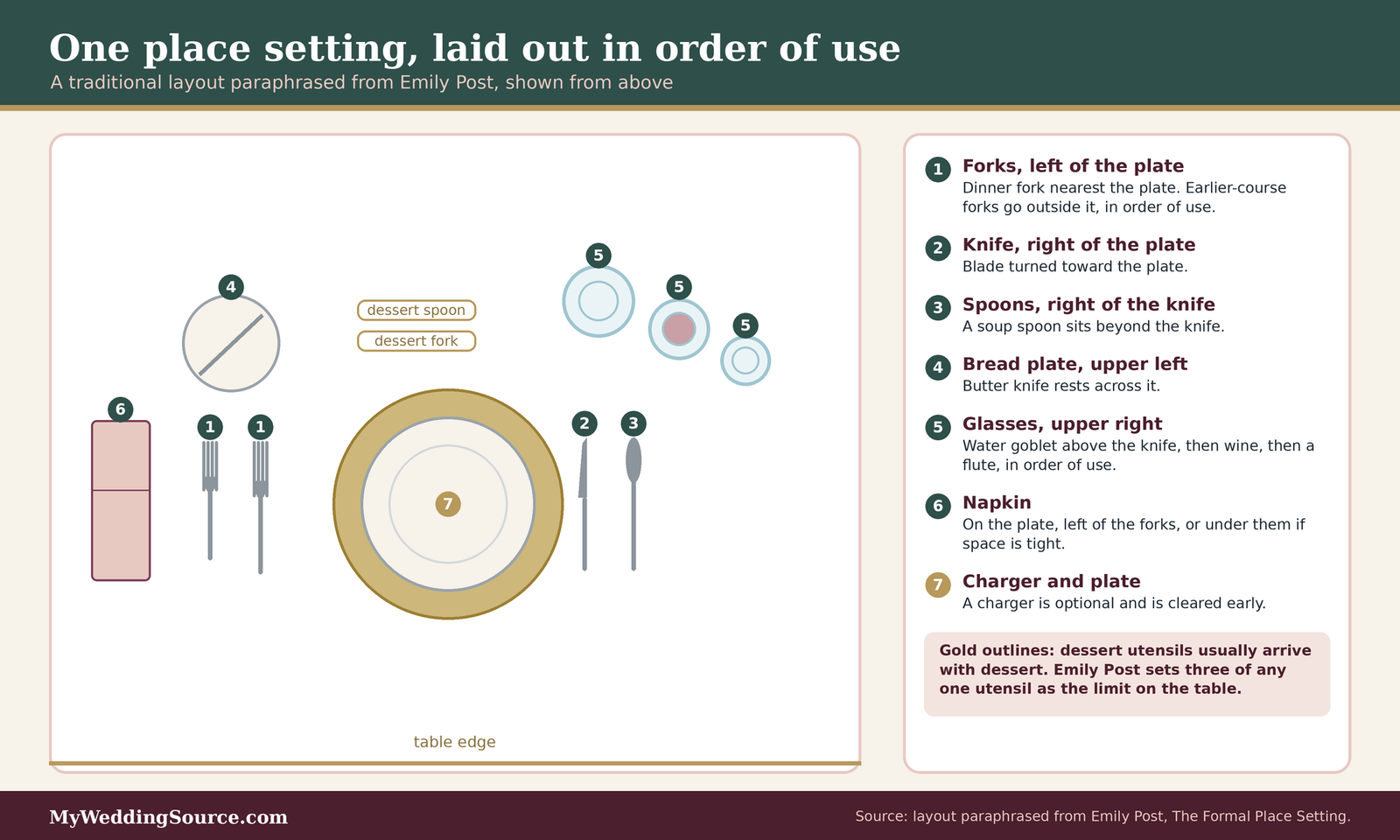
The illustration above shows one common arrangement for wedding table settings, drawn from the Emily Post layout. Real tables vary with the menu, and a caterer may have its own house style, so ask to see their standard setting before you draw up yours.
Chargers, plates, and how much to set
Two decisions decide whether your wedding table settings look generous or cluttered: whether you use a charger, and how many pieces you set before the meal begins.
What a charger does, and when to skip it
A charger is a large decorative plate that sits under the dinner plate and is usually cleared before or with the first course. It frames the setting, adds color, and gives the napkin a place to rest. It also takes up table space and costs money per guest. The Meredith Party Rental sheet lists charger plates at $1.00 each, double the price of its standard dinner plate at 50 cents, so a charger can be the most expensive single piece in a low-cost setting.
Skip chargers if your table is tight, if your caterer will clear them awkwardly, or if the money is better spent on flowers or lighting. Choose them if you want a color or metal accent, if you serve a plated dinner, and if staff have a plan for stacking and clearing them. If you are unsure, ask the rental company for a mock setting with and without the charger and compare the two photographs.
Match the setting to the menu
Your wedding table settings should follow the menu, not the other way around. Ask your caterer for the final menu and the order of courses, then work backwards. A buffet needs a dinner plate, a fork, a knife, a napkin, and a glass. A plated three-course dinner might need a salad plate, a dinner plate, a bread plate, and utensils for two courses at the table. A family-style dinner needs space in the middle for serving platters, which changes how much you can place there. Emily Post’s guidance on spacing also points out that tables should not be overcrowded and that decorations should be low enough that diners can see each other across the table. Sometimes the right answer is to take something away.
Glassware, bar plans, and what actually sits at each seat
Glassware is where wedding table settings and the bar plan collide. The number and type of glasses on the table depends on what you will pour, when, and who clears. Putting five glasses at every seat because a magazine photo had five is a quick way to pay for pieces that nobody touches.
Decide the glass count from the drink plan
For wedding table settings, start with the drinks, not the glasses. List every beverage that will be served at the table during dinner, and ask the caterer or bartender which glass each one needs.
Water, wine, and the toast
Most receptions need a water glass, since guests drink water throughout the evening. If wine is poured at dinner, add a wine glass, and if you will toast with sparkling wine, a flute or a coupe. Emily Post’s guide places the water goblet closest to the knife and lets wine glasses and a champagne flute follow to the right, in the order they will be used. Her upper limit is five glasses, but few weddings need more than three at the table. A cocktail hour often uses a different glass, and bar glassware is usually a separate rental order.
If the toast is the only time sparkling wine is poured, consider having servers hand out flutes just before the toast. The table then holds one fewer glass for most of the meal, the setting looks cleaner, and you rent the same number of flutes with fewer chances for breakage. The trade-off is staff time, so check that servers can pass flutes to every table quickly.
Open bars, cash bars, and glass counts
If you offer an open bar, guests will order drinks that need rocks glasses, highballs, or wine glasses, and the bar will use those glasses throughout the evening, not just at dinner. Ask the caterer or bartender whether bar glassware is included, how many glasses they recommend per guest, and how they handle refills. A glass count is usually larger than the guest count because guests set glasses down and take a fresh one. A rental guide published by Wedding Frontier recommends renting at least ten extra pieces beyond your count. We could not verify its source for that number, so treat it as one company’s rule of thumb and ask your own rental company how many extras it suggests and whether breakage extras are free of charge.
Handle stemware, breakage, and cleanup
The glass that looks the best is also the one most likely to break. Plan for that before you sign the rental order.
Stems, weight, and how staff handle them
Stemware photographs well but breaks easily, especially when staff stack glasses on trays in a crowded service corridor. If your venue has a tight kitchen or a long carry, a stemless glass can reduce breakage and make clearing faster. If you prefer stems, ask whether the rental company ships glasses in racks and whether the caterer’s staff will return them to those racks. A Classic Party Rental, an Indianapolis company, asks customers to return china and glassware in the racks they arrived in, and says dishware and flatware must be scraped and rinsed free of food or a cleaning fee can apply. Whatever your rental company’s policy is, ask who does that work at the end of the night, because it is easy to assume the caterer handles it and then learn that it was your job.
Breakage waivers and replacement charges
Rental companies usually offer a damage waiver, a fee that covers minor breakage from normal use. Two published examples show how much terms differ. Party Rental Ltd. describes a 4% damage waiver on the rental order that covers things such as broken glassware, stained linens, and scratched flatware, but excludes theft, vandalism, improper use, and damage from weather, with replacement cost charged for excluded items. A Classic Party Rental describes a 10% damage waiver that covers minor breakage such as chips and small breaks in china, glassware, or linens, requires that broken items be returned, and charges for lost items unless they come back in a reasonable time. Those are two companies in different markets, not national norms, but they show why you should read the waiver, not just accept it. Ask what counts as “minor,” what is excluded, and what happens to items that guests carry out of the room.
In wedding table settings, paper is the cheapest part of the table and often the part that causes the most arguments, because it carries names. A misspelled name or a missing meal marker is more memorable than the font.
Which cards do you need
The paper side of wedding table settings uses several terms that sound alike. Knowing what each one does keeps you from ordering things you do not need.
Escort cards and place cards
Zola explains the difference this way. An escort card shows a guest’s name and table assignment, but not a specific seat, and is usually displayed near the reception entrance so guests know where to go. A place card sits at the table and marks one particular seat. Zola suggests escort cards alone if guests will choose their own chairs at an assigned table, place cards alone if the seating chart specifies who sits next to whom, and both for a more formal setup. Emily Post’s printed-items guide says place cards are a must at all but the most casual weddings, that assigned seats are usually reserved for the most formal weddings, and that handwritten cards are ideal while a handwriting-style font is acceptable.
For most guest lists, one set of cards is enough in your wedding table settings. If you assign tables but not seats, escort cards are the more useful of the two. If you assign seats, you can use place cards at the table and a simple seating chart sign at the entrance. The most expensive choice is to print both for every guest, and you should do that only if the formality of the wedding calls for it. A formal dress code often goes with a more formal table, and our cocktail attire guide is a useful reference when your invitation wording and your tabletop need to point the same way.
Menu cards: one per table or one per guest
A menu card tells guests what they will eat and drink. Emily Post’s printed-items article mentions descriptions of the food and drink as part of wedding-day paper, but it does not set a rule. Common choices are one card per guest, one card per table, or a single sign at the buffet or bar. A card per guest is the most generous and the most expensive. A card per table cuts printing costs and uses less table space, but it can crowd the center. A menu on a sign at the buffet saves space entirely, and a printed menu is not a requirement. Decide after you have chosen the centerpiece, because the middle of a 60-inch table has little room to spare.
Details that cause trouble
Printing errors and seating errors are the most visible mistakes on the day, and they are almost always avoidable with a plan.
Names, spellings, and meal markers
Zola recommends alphabetizing escort cards and using full first and last names so guests who share a first name are not confused. It also notes that some venues need place settings to carry a meal marker so staff can serve each guest’s choice correctly. If you offer a choice of entrées, ask the caterer which marker the servers prefer, whether it is a small symbol on the card, a color on the card’s edge, or a code on a table list. The simpler the marker, the less likely a server is to misread it in a dim room. Never rely on guests to remember what they ordered months ago.
Verify every spelling on your wedding table settings paper against your RSVPs, not against your memory. Titles, suffixes, and accents are easy to drop in a proof. Ask a second person to read the proof against the guest list, and keep a printed copy of the final seating chart for the planner or coordinator.
Printing, delivery, and the last-minute change
Zola’s guide does not say how far ahead to order cards, so ask your stationer for their production time and their policy for reprints. The practical rule is to freeze your seating as late as you reasonably can, send the list to the printer on the date your stationer gives you, and keep a few blank cards and a pen on hand for the unexpected. Our wedding timeline shows where seating decisions usually fall relative to the final headcount, and the printing date should follow from the date your caterer needs the final number.
Building the look: scale, color, and light
Once the physical table, the linen, the place setting, the glassware, and the paper of your wedding table settings are decided, you can think about the composition. This is the part most people start with, and it is easier when it comes last because the constraints have already narrowed your choices.
Give the table one focal point
A table of wedding table settings photographs and reads best when the eye has somewhere to land. If every element is equal, the table looks busy. If one element leads and the others support it, the table looks designed.
Use proportion, not item count
Choose a lead element: a centerpiece, a bold charger, a patterned napkin, or a lit candle cluster. Then keep the supporting pieces plain. One approach we suggest is to repeat a single color or material across a few elements, such as the napkin, the menu card, and a candle holder, so the table feels coordinated without being matched. That is our own design suggestion and not a measured standard, so judge it by eye. The numbers that do matter are the ones from the arithmetic earlier: the free middle of a 60-inch round is roughly 24 inches across, so a lead element that is 18 inches wide takes up most of it.
Control height and negative space
Emily Post advises keeping decorations low enough that diners across the table can see each other. There are two ways to follow that advice. Keep the arrangement low, or lift it on a thin stem so that guests see under it. Both preserve sightlines. A tall, wide arrangement with a thick base blocks conversation and forces servers to reach over it. Leave visible tablecloth around the pieces, because empty space makes the pieces you did choose look intentional. If you want height, use it at a few tables or the head table, and keep guest tables simple.
Test it in the real conditions
A table that looks balanced in a bright showroom may look flat in a dim reception room, and a candle that glows in the evening may disappear in an afternoon tent.
Check it by daylight and by evening light
If your rental company or caterer will set a sample of your wedding table settings, view it at the time of day your reception will begin and again when the light changes. Check how the cloth color reads, whether glass and metal reflect glare, and whether candle flames, if allowed, are visible at the height of your arrangement. Remember the fire rules from earlier: candles in a place of assembly may be limited to protected flames on noncombustible bases, and your venue may limit open flame further. Decide whether battery candles are acceptable to you before you plan a look that depends on a flame.
Photograph the sample from guest and photographer angles
Take photos of the sample wedding table settings from the seated height of a guest, from the standing height of a photographer, and from the side. You are checking three things: whether a guest can see the person across the table, whether the napkin, plate, and flatware make a clean line, and whether any piece looks out of scale. Show the photos to someone who has not seen the plan and ask what they notice first. If they notice something you do not want them to notice, such as a crooked charger or an overcrowded middle, you have found a problem while it is still cheap to fix.
What wedding table settings cost, and how to price them per guest
Wedding table settings are easy to underestimate in cost because each piece is cheap and the list is long. A fifty-cent glass looks harmless until it is multiplied by three glasses, 120 guests, and a delivery fee. The reliable way to compare quotes for wedding table settings is to convert every option to a cost per guest, then add what the quote leaves out.
Reported averages and what they cannot tell you
National survey data helps you see where spending on wedding table settings sits in the larger budget. It cannot tell you what your table will cost.
What The Knot’s survey shows
The Knot’s 2026 Real Weddings Study covers couples who married in 2025. The Knot says it drew on 10,474 couples who responded to email invitations through its membership, and it reports an average wedding cost of $34,200. It reports shares of the budget and not dollar amounts by item: venue and rentals at 29%, catering, cake, and drinks at 24%, floral design and decor at 9%, and stationery at 1%. Applying those shares to the average gives our own rough estimates of about $9,900 for venue and rentals combined, about $3,100 for floral design and decor, and about $340 for stationery. Because rentals are bundled with the venue, you cannot read a tabletop figure from these numbers, and the shares describe an average across very different weddings. Use them as a reminder that decor and paper are small slices of the whole, and use your own quotes for real pricing. Our wedding budget calculator lets you enter your own figures.
What a single price sheet can and cannot show
We looked for published rental price lists for wedding table settings so that we could show real unit prices. The most complete one we found was the 2024 Meredith Party Rental price sheet, posted by a university purchasing office. It is one company’s list, in one market, and its prices are low compared with what many couples report for upscale rentals, though we did not find a second published list to verify that. We use it only to demonstrate the method. A separate consumer guide from Wedding Frontier gives ranges of $0.40 to $1.10 for dishware pieces, $0.50 to $2.20 for drinkware, and $0.35 to $1.30 for flatware, but the guide says its figures are averages from multiple unnamed companies, and we found small inconsistencies in it, so we treat it as a loose reference and not as evidence.
What this actually costs
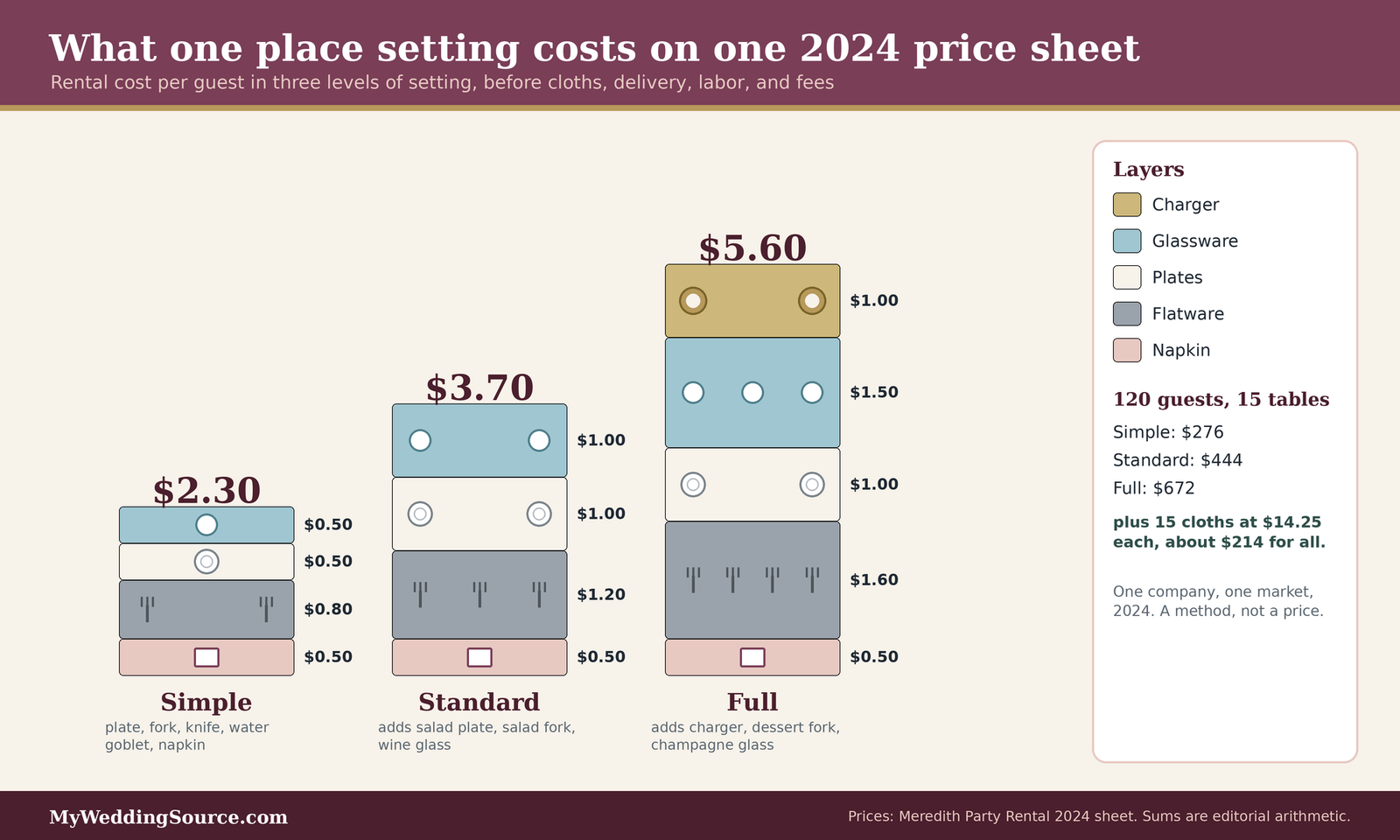
On the one published 2024 price sheet we used, a full setting for one guest comes to about $5.60 before the tablecloth, delivery, labor, and fees, and a simple setting comes to about $2.30. For 120 guests at 15 tables, the whole table rental in our worked example is between about $490 and $890 before fees. Your real number will differ, because it depends on your market, the style you choose, and what delivery, setup, and cleanup add. Treat it as a method for comparing quotes and not as a price you should expect.
A worked example you can copy
The example below is illustrative. We assumed 120 seated guests, 15 round tables of 60 inches seating 8 each, and 120-inch round cloths that reach the floor. Prices come from the 2024 Meredith sheet: a 120-inch round cloth at $14.25, napkins at $0.50, chargers at $1.00, china plates at $0.50, standard flatware at $0.40 per piece, and water goblets, wine glasses, and champagne glasses at $0.50 each. The totals are our arithmetic.
Three levels of setting, compared per guest
Each level adds pieces to the one before it.
- Simple: dinner plate, fork, knife, water goblet, and napkin, for $2.30 per guest.
- Standard: adds a salad plate, a salad fork, and a wine glass, for $3.70 per guest.
- Full: adds a charger, a dessert fork, and a champagne glass, for $5.60 per guest.
The third illustration stacks those pieces so you can see where the money goes. The charger is the largest single block, followed by the glassware.
| Line | Simple | Standard | Full |
|---|---|---|---|
| Place setting, per guest | $2.30 | $3.70 | $5.60 |
| Place settings, 120 guests | $276.00 | $444.00 | $672.00 |
| Cloths, 15 at $14.25 | $213.75 | $213.75 | $213.75 |
| Rental subtotal | $489.75 | $657.75 | $885.75 |
| Subtotal per guest | $4.08 | $5.48 | $7.38 |
| Damage waiver at 4% (one company’s rate) | $19.59 | $26.31 | $35.43 |
| Damage waiver at 10% (another company’s rate) | $48.98 | $65.78 | $88.58 |
What the subtotal leaves out
The subtotal is the cheapest part of the real invoice. It leaves out delivery, setup, teardown, tax, and any extras for breakage. A Classic Party Rental publishes an example of how delivery can vary: about $200 for round-trip delivery in its Indianapolis area, $250 for a timed morning or afternoon window, $500 for a specific time, and a $750 minimum for after-hours or weekend delivery. It also says setup of tables and chairs must be arranged before delivery and carries extra fees. Those are one company’s numbers in one city, but the structure is common: the item prices are only the starting point, and a wedding on a Saturday evening may fall into the most expensive delivery tier. Add a line for every one of those costs before you compare quotes.
The next table compares the common elements of a setting on the design factors that decide whether they belong on your table.
| Element | Scale and space | Sightline | Material and lighting | Venue rule to check | Guest impact |
|---|---|---|---|---|---|
| Tablecloth | Drop of 8 to 30 inches changes the look and the order size | None | Color reads differently by daylight and candlelight | Who steams, who sets | Hides table legs, hides knees if too full |
| Charger | Sits under the plate and adds to the place setting’s footprint | None | Metal catches light and glare | Who clears and when | Takes edge space, can slide |
| Napkin | Little space unless folded tall | Tall folds can block | Fabric weight changes the drape | Setup labor for folds | Easy to reach if on the plate |
| Glassware | Each glass adds to the footprint above the knives | Tall stems can block | Glass reflects flames and light | Bar plan, breakage terms | More glasses means more clearing |
| Flatware | Three of any piece at most, per Emily Post | None | Finish can read gold or silver | Who sets and who counts | Fewer pieces feels calmer |
| Menu card | Small stand or flat card | Stand can block | Paper stock affects glare | Print lead time | Handy when allergies or choices matter |
| Centerpiece and candles | Must fit the free middle | The main one: keep low or lifted | Flame needs protection | Fire marshal, venue | Blocks talk if too tall |
Substitutions, contracts, and fees
Even with a tidy price, your wedding table settings can change between the contract and the wedding. A color goes out of stock, a pattern is discontinued, or a delivery window shifts. A clear substitution plan keeps those changes from turning into surprises.
Decide what is acceptable before something goes missing
For your wedding table settings, make a short list of what you care about most and what you can flex. If the exact shade of a napkin matters, say so. If any ivory would do, say that too. Ask the rental company how it handles an out-of-stock item, whether it will tell you before substituting, and whether a substitution can come at a lower price or a credit. Write down your answers so the person who delivers the order has the same list you do.
What to put in the contract
Ask for an itemized order showing item, style, quantity, size, and price, with the delivery date and window, the pickup date and window, and who is authorized to sign for the order. Ask for the damage waiver terms, the cleaning requirements for returned items, the policy for counting items in and out, and the policy for changes to the guest count. A Classic Party Rental recommends booking about six months ahead for large events and weddings, and says last-minute orders within seven days are handled on a best-effort basis. Treat that as one company’s guidance and ask your rental company how early to book in your market. Contract language varies, and this guide is general education, not legal advice, so have a professional review anything you are unsure about.
A planning timeline for wedding table settings
Wedding table settings have their own order of operations. Doing the steps in a sensible sequence keeps you from ordering linens before you know the table size or printing cards before the final headcount.
Months before: choose and book
The first half of the process is about information and choices.
Gather the facts
Early on, confirm the venue’s table sizes and counts, what the venue or caterer supplies, whether outside rentals are allowed, and what the fire and access rules are. Decide how formal the meal will be, because the number of courses controls how many pieces you need. Our guide to how to plan a wedding and our wedding timeline show how these steps fit into the larger sequence.
Compare and book
Request itemized quotes from at least two sources if your venue allows outside rentals, convert each to a per-guest cost using the method above, and ask to see samples. Book once you have the table size, the cloth drop, the menu, and the glass list written down. Then confirm the details in an order or contract.
Weeks before: confirm and finalize
The second half is about counts and details. Counts change late, and every change touches the table.
Lock the count and the seating
Give the caterer and rental company your final number by their deadline, and send the seating chart to the stationer as soon as it is settled. Ask the rental company how an added guest affects the order, because a table that was full at 8 may not take a ninth chair without crowding. If guests with mobility needs are attending, confirm the location and clearance of their seating.
Walk through on the day
Ask the planner, coordinator, or a trusted friend to check a sample table against your written specification before the guests arrive. Count the glasses at one table, check that napkins are placed as you asked, and confirm that candles are placed and lit only in the ways the venue allows. A ten-minute check of the wedding table settings can catch an order that went wrong.
Questions to ask before you sign
- What is the exact table size and seat count we are planning for, and does the venue agree?
- Which pieces does the venue or caterer already supply, and which must we rent?
- What is the actual drop of this cloth at our table height?
- What is included in the per-piece price, and what are delivery, setup, teardown, tax, and cleaning fees?
- What does the damage waiver cover, and what does it exclude?
- What happens if an item is out of stock, and do we approve substitutions first?
- Who sets, counts, clears, and returns the pieces?
- Are candles or open flame allowed at the tables, and does the fire marshal need to approve?
- Which tables meet accessibility requirements, and where are they?
- When is the final count due, and what does a late change cost?
Planning the setting
How many pieces should each guest have at the table?
For wedding table settings, it depends on the menu. A buffet may need a plate, a fork, a knife, a napkin, and a glass. A plated dinner adds a salad course and perhaps a bread plate. Emily Post limits the table to three of any one utensil, with later-course pieces brought in then, so plan around the menu, not a photograph.
How much table space does each guest need?
Party Rental Ltd. suggests planning for about 24 to 30 inches per guest, and WebstaurantStore describes 18 to 20 inches of elbow room as the tight end. Our arithmetic puts a full 60-inch round at about 23.6 inches per guest with eight seated. Chargers and centerpieces reduce the usable space, so choose a lower seat count if the setting is elaborate.
Do we need chargers at a wedding?
No. A charger is decorative and optional. It frames the setting and holds a napkin, but it takes table space, adds a per-guest cost, and needs a clearing plan. In the 2024 Meredith Party Rental sheet we used, it costs twice as much as a plate. Choose it if the look of your wedding table settings matters to you and the staff can manage it.
Linens and paper
What size tablecloth do we need for a round table?
Double the drop you want and add the table’s diameter. For a 60-inch round, a 15-inch drop needs about a 90-inch cloth, and floor length at a 30-inch table height needs about 120 inches. Rental catalogs round to stocked sizes, so ask what the actual drop will be and ask to see a sample on a table the same size.
Should we use escort cards, place cards, or both?
Zola says escort cards give a guest’s table, and place cards mark one seat. Use escort cards alone if guests choose seats at an assigned table, place cards alone if the chart sets each seat, and both for a formal setup. Emily Post says place cards are a must at all but the most casual weddings.
Cost and safety
How much should we budget for the table settings?
There is no national figure for wedding table settings rentals alone. The Knot’s 2026 study, covering 2025 weddings, reports shares of budget for venue and rentals together, so it cannot isolate tableware. For wedding table settings, get itemized quotes, convert them to a cost per guest, and add delivery, setup, cleanup, tax, and a damage waiver before you compare them.
Can we use candles on the tables?
Often, but your venue and local fire official decide. The Minnesota and Fairfax County fire marshal pages describe table candles needing noncombustible bases and protected flames, with no candles in aisles or exits. Fairfax County adds that burning candles should be at least 3 inches apart. Ask your venue and fire official before you buy anything.
How do we make the table accessible?
Ask the venue which tables meet the federal ADA standard of a surface between 28 and 34 inches high, with knee and toe clearance and floor space. Avoid pedestal bases, heavy stands, or full skirts where a wheelchair user needs to pull in. Place accessible seating where a guest can reach it without moving other furniture.
Your next steps
Start with the facts
Measure and count
For your wedding table settings, write down each table’s size and seat count, the venue’s rules, and what the venue or caterer supplies. Do the per-guest arithmetic for the space and the centerpiece zone. Our wedding planning guide can help you place this step in the larger plan.
Choose the layers in order
For your wedding table settings, decide the cloth, then the place setting, then the glassware, then the paper, then the centerpiece. Use the menu to decide how many pieces each guest needs, and remove any piece that has no job.
Price it and put it in writing
Convert quotes to cost per guest
Use the method in the worked example for each quote. Add delivery, setup, teardown, tax, and the damage waiver. Compare the totals, not the unit prices, and use our wedding budget calculator to see how the result fits your overall plan.
Confirm the details and share them
Put your answers on one page for your wedding table settings: table sizes, cloth drops, piece counts, substitution rules, and delivery windows. Share it with the venue, caterer, rental company, and photographer, and keep a copy in your wedding planning checklist.
Sources & methodology
How we built this guide
What we relied on
This guide combines Emily Post’s published guidance on formal place settings and wedding paper, Zola’s explanation of escort and place cards, The Knot’s 2026 Real Weddings Study summary, the federal ADA Standards for dining surfaces, open-flame pages from two U.S. fire marshals, and published guidance and price sheets from party rental and restaurant-supply companies. Where a statement comes from a company, we say so, because company guidance reflects the seller’s products and habits. The per-guest space figures, centerpiece-zone figures, and worked cost example are our own arithmetic, and they are estimates.
What we did not do
We did not test table settings, visit venues, or request quotes. We did not find a national average for tabletop rentals, so we did not invent one. Fire, access, and contract rules vary by place, and this guide is general education and not legal, fire-safety, or financial advice. Ask your venue, caterer, rental company, and local fire official, and have a professional review any contract.
Source list
Etiquette, survey, and government sources
- Emily Post Institute, The Formal Place Setting: https://emilypost.com/advice/formal-place-setting
- Emily Post Institute, Inside Weddings: Printed Items for Your Wedding: https://emilypost.com/advice/inside-weddings-printed-items-for-your-wedding
- Zola, A Guide to Escort Cards: https://zola.com/expert-advice/a-guide-to-escort-cards
- The Knot, The Wedding Budget Breakdown You Need, Backed by Data (2026 Real Weddings Study): https://www.theknot.com/content/how-to-save-and-splurge-on-the-wedding
- U.S. Access Board, ADA Standards, Chapter 9: Built-In Elements (Section 902, Dining Surfaces and Work Surfaces): https://www.access-board.gov/ada/chapter/ch09/
- Minnesota Department of Public Safety, State Fire Marshal, Candles and Open Flames: https://dps.mn.gov/divisions/sfm/fire-code/fire-code-information-topic/candles-and-open-flames
- Fairfax County Fire Marshal, Open Flame Decorative Devices: https://www.fairfaxcounty.gov/fire-ems/fire-marshal/open-flame-decorative-devices
Rental company, retailer, and consumer sources
- Meredith Party Rental, 2024 price sheet (University of Toledo purchasing): https://www.utoledo.edu/depts/supplychain/purchasing/pdfs/Meredith%20Party%20Rental%20Price%202024.pdf
- A Classic Party Rental, FAQs: https://aclassicpartyrental.com/faqs
- Party Rental Ltd., What happens if I break or misplace something: https://help.partyrentalltd.com/en_US/payment-and-policies/what-happens-if-i-break-or-misplace-something
- Party Rental Ltd., How many people can sit at a table: https://help.partyrentalltd.com/en_US/how-many-people-can-sit-at-a-table
- WebstaurantStore, Table linen buying guide: https://www.webstaurantstore.com/guide/539/table-linen-buying-guide.html
- WebstaurantStore, How many people fit at a banquet table: https://www.webstaurantstore.com/blog/115/how-many-people-can-different-size-tables-seat-comfortably.html
- Urquid Linen, Linen size guide: https://urquidlinen.com/pages/the-table-matrix
- Curated Events, How to measure tablecloth sizes for your event: https://curatedevents.com/blog/how-to-measure-tablecloth-sizes-for-your-event/
- Wedding Frontier, Average cost of renting dishes, glasses, and dinnerware for a wedding: https://weddingfrontier.com/?p=1281