

Micro wedding planning changes the shape of a wedding budget more than it changes the size of it, so the most useful thing you can do before you book anything is learn which costs shrink with every guest you remove, which ones barely move, and which ones quietly grow.
Quick answer
Micro wedding planning starts from a different question than ordinary planning. Instead of asking “what does the average wedding cost,” ask “which of my costs depend on headcount, and which do not.” Catering, bar, rentals, and favors follow guest count. Photography, an officiant, attire, hair and makeup, and most of the venue fee do not. In our illustrative model, cutting a list from 50 guests to 20 (a 60% drop) lowers the total by roughly 35%, not 60%, and the cost per guest goes up. Plan with three scenarios, keep a reserve, and compare vendor quotes on an all-in basis.
Couples who start micro wedding planning are often relieved to be done with the ballroom math, and then surprised by the first quote. A photographer charges the same for 20 people as for 120. A florist still has to build a bouquet. A venue with a food and beverage minimum may charge you for dinners nobody eats. None of that means a small wedding is a bad idea. It means the savings come from different places than most people expect, and that a budget built by multiplying a national average by a smaller guest count will mislead you.
This guide to micro wedding planning is a budget model, not a general overview. If you are still working out the basics of your whole celebration, start with our complete wedding planning guide and come back once you have a rough guest count. Here we focus on one decision: how to build, test, and control a budget when the list is small. You will find a cost-shape matrix, a three-scenario model with every assumption stated, a method for turning vendor quotes into comparable all-in numbers, a reserve and approval system, a timeline, and a risk register.
A note on how to read the numbers. Survey figures from The Knot and Zola are labeled with their year and what they measure. Dollar amounts in our scenario model are editorial arithmetic using stated assumptions, not market prices and not vendor quotes. Your venue, region, and date will produce different results, and the model is designed so you can replace each assumption with a real quote. Nothing here is legal, tax, or financial advice.
What the data says about a small guest list, and what it cannot say
Before building a model, it helps to know what published numbers exist for micro wedding planning and how much weight each one can carry. The short version is that the headline averages describe a much larger event than yours, and almost no published survey isolates the smallest weddings.
Defining micro wedding planning by guest count
There is no legal or industry-standard definition of a micro wedding, so sources draw the line in slightly different places. That matters because a budget for 12 people and a budget for 48 people behave differently.
The common range
The Knot describes a micro wedding as typically 50 or fewer guests, usually immediate family and close friends, and calls a guest count of 50 to 100 a small wedding. Zola also uses 50 or fewer and says the average micro wedding is around 30 guests. Zola separates out a “minimony” of 10 or fewer people, and an elopement of the couple, an officiant, and perhaps a witness or two. This guide uses 20 guests as its central example because it sits comfortably inside every one of those definitions, and it tests 35 and 50 so you can see what happens when a list grows.
Why the label matters less than the headcount
A venue that advertises “micro wedding packages” may define the term as 30 guests, 40, or 50. Ask for the actual guest range and what is included before you compare packages, because a package priced for 50 and used for 18 can be poor value. In micro wedding planning, treat the label as marketing shorthand and the headcount as the number that drives your costs.
What published averages measure
The most widely cited U.S. cost numbers come from two sources, and they are built differently.
The Knot 2026 Real Weddings Study
The Knot’s study surveyed 10,474 U.S. couples who married between January 1 and December 31, 2025, recruited by email through The Knot and WeddingWire membership. It reports an average wedding cost of about $34,000, an average guest count of 117, and an average of $292 per guest. It also reports averages by guest count: $17,100 for weddings of 1 to 50 guests, $27,200 for 51 to 100, and $43,300 for more than 100. Those bracket figures are useful, but notice what they are: averages of whatever those couples chose to spend, which includes a wide mix of venues, regions, and priorities. The Knot’s page gives no separate figures for micro weddings or for weddings under 20 guests.
Zola’s cost index and spend survey
Zola’s 2026 cost guide, last updated in March 2026, combines its Wedding Cost Index (platform data, budget-tool spending, and vendor-reported pricing) with a spend survey of 720 couples surveyed within 180 days of their weddings. It reports an average of $36,000 and a range of $150 to $300 per guest for guest-dependent costs such as food, drinks, and rentals, which it separates from fixed costs like photography and music. For micro wedding planning, note that Zola says backyard micro-weddings are included in its averages, which means they pull the average down slightly rather than being measured on their own.
Both organizations survey their own users, so neither is a random sample of all American couples. Use them as reference points, not predictions, when you start micro wedding planning.
Separate the price drivers before talking about the total for micro wedding planning
The first discipline in micro wedding planning is to stop thinking about a single total. A wedding budget is a stack of lines, and each line responds to guest count in its own way. Sorting lines into four shapes takes about twenty minutes and does more for your budget than any amount of bargain hunting.
Classify fixed, per-person, step, and minimum-bound costs
Every line in a wedding budget behaves in one of four ways as the guest count changes. Naming the shape of each line tells you whether trimming the list will help, hurt, or do nothing.
Cost check
Two lines feel like guest-count lines but often are not: the venue and the photographer. Both are usually priced by the event or by the hour. Ask each vendor whether the quote changes at 20, 35, and 50 guests, and get the answer in writing before you compare totals.
| Cost shape | How it behaves | Typical examples | Controllable or structural |
|---|---|---|---|
| Fixed | Same price at 15 guests or 60 | Photographer, officiant, bridal attire, hair and makeup, marriage license, most stationery design | Structural once you hire the vendor; controllable in who you hire and for how many hours |
| Per-person | Rises and falls with each guest | Catering, bar, favors, rentals per place setting, printed programs | Highly controllable through menu, service style, and bar choice |
| Step | Flat within a range, then jumps | Venue room size, number of tables, staffing ratios, rental delivery tiers, shuttle or van count | Controllable by choosing a guest range that stays inside one step |
| Minimum-bound | A floor you pay even if you use less | Food and beverage minimum, caterer minimum order, planner or florist minimum, photographer package minimum | Structural at a given vendor; controllable by choosing vendors whose minimum fits your list |
The two columns on the right are the practical ones. A “structural” cost is one you cannot reduce by changing the guest list, only by changing the vendor or the plan. A “controllable” cost responds to your choices. Most of the savings in micro wedding planning come from the per-person row, and most of the stubborn spending sits in the fixed and minimum-bound rows.
Show which lines move with guest count
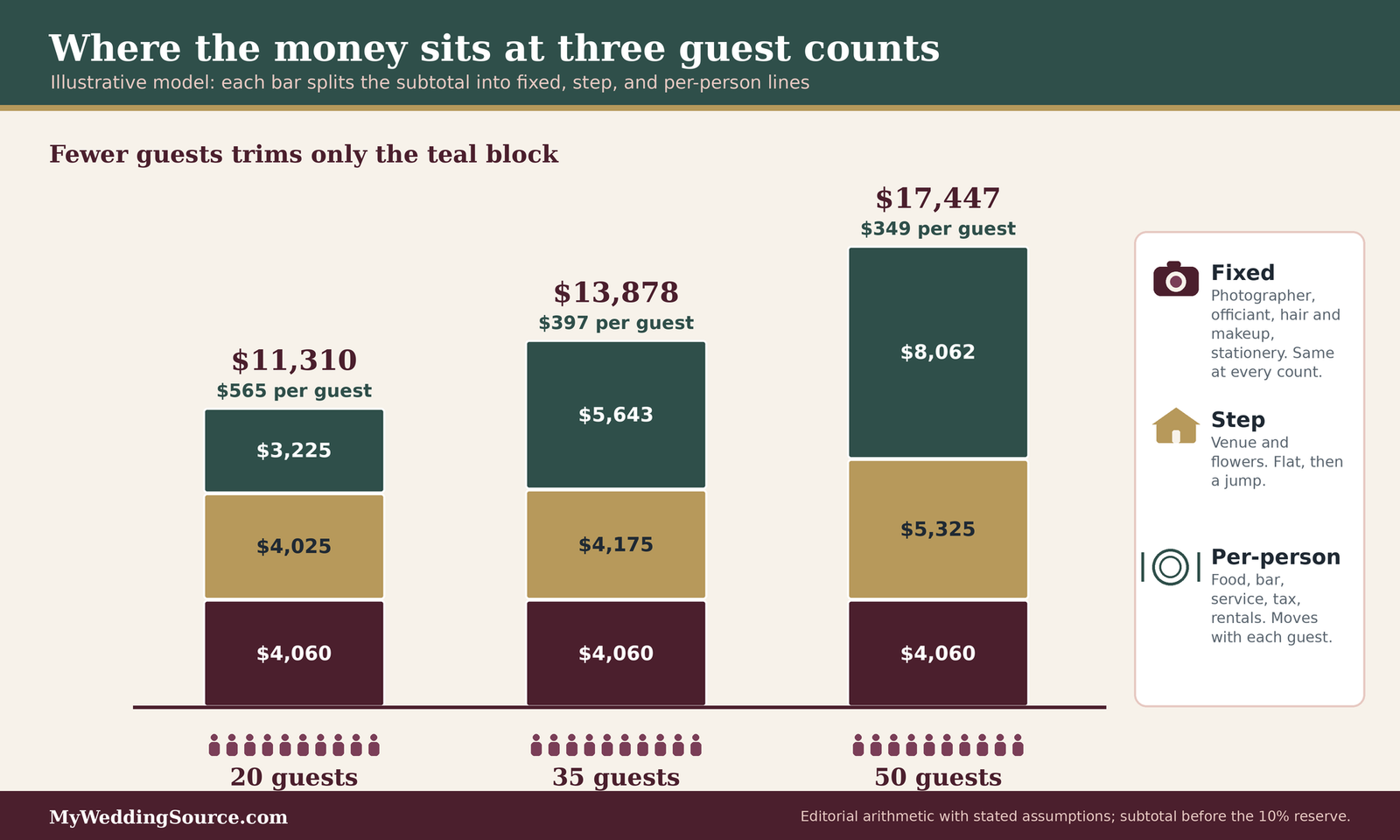
In the model later in this guide, five lines move with headcount: food, drinks, service charge, tax on food and drink, and rentals. At 20 guests they add up to about $3,225. At 50 guests the same lines add up to about $8,060, which is roughly 2.5 times as much for 2.5 times as many people. Those lines are the true beneficiaries of a small guest list.
The lines that do not move are just as telling. In the same model, the photographer, officiant, hair and makeup, and stationery come to $4,060 at every guest count. The venue and flowers move only in steps. At 20 guests, about 71% of our model budget sits in lines that do not scale smoothly with the list. At 50 guests, that share is about 54%. When the share of fixed and step costs is that large, removing guests trims the budget only at the edges.
Expose minimums and thresholds that break simple math
Minimums are where micro wedding planning budgets most often go wrong. One wedding publication that works with venues explains that a food and beverage minimum is a dollar figure you must reach regardless of your guest count, which works as a floor and not a cap. By its example, a $12,000 minimum with $9,500 in selections still costs $12,000, while $14,000 in selections costs $14,000. The same source notes that minimums commonly rise for peak-season Saturdays and that, for guest lists under roughly 120 to 150 in its region, the minimum often becomes the deciding number.
Here is what that looks like at micro scale. Suppose a venue sets a $4,000 food and beverage minimum, and your 20 guests would order $2,200 in food and drinks at the per-person rates in our model. You would pay $4,000 for $2,200 of consumption, a shortfall of $1,800. Your effective food and drink cost per guest becomes $200 instead of $110. If you are weighing venues for micro wedding planning, run this arithmetic for each one before you fall for the room. A restaurant that sets a minimum by the private-dining room, a hotel that sets it by the ballroom, and a caterer that sets it by the order will each behave differently.
Thresholds break math in quieter ways too. A rental company may deliver free above a certain order size. A venue may price a smaller room up to 30 people and a larger room beyond that. Table count changes florist and linen costs. When you are close to a threshold, ask what one additional guest would cost; the answer is sometimes dramatic.
Define what is and is not inside the budget
A budget fails when it quietly leaves things out, and micro wedding planning leaves out more than most because small weddings are often paired with other events.
Keep engagement, honeymoon, and rehearsal costs explicit
The Knot reports several costs that sit outside its average wedding cost: a rehearsal dinner averaging $2,800, an engagement ring averaging $4,600, and a honeymoon averaging $5,500. Those are the averages for the full-sized weddings it surveyed, and your own spending on each may be much lower or zero. The point is that they are separate decisions with separate money. A couple planning a 20-person wedding often folds the rehearsal dinner into the main event, or skips it, which is a legitimate way to save. Decide that on purpose and write the decision down, since clear boundaries make micro wedding planning calmer.
Write a one-line definition at the top of your budget: “This budget covers the ceremony, the meal, and the vendors for one day. It does not cover the ring, the honeymoon, the rehearsal dinner, travel for guests we are helping, or an after-party.” If you plan to subsidize anyone’s travel, give it its own line. Our wedding budget calculator can help you structure those lines, and our guide to honeymoon planning covers that part of the spending separately.
Distinguish quoted price from all-in price
In micro wedding planning, a quote is a price for a defined bundle, not the amount that will leave your account. Between the number on the proposal and the number you pay sit service charges, administrative fees, gratuity, tax, overtime, delivery, and sometimes a surcharge for small events. A legal-information site that summarizes common wedding contract terms lists travel costs, parking, staff meals, per-head surcharges, and a blanket service fee of 20% or more among charges that can raise a total significantly. Overtime for staff beyond agreed hours is another.
Tax rules differ by state and by how a charge is described. As an illustration of how broad they can be, a 2003 advisory opinion from the New York State Department of Taxation and Finance concluded that a separately billed ceremony-room charge was part of taxable catering receipts for the caterer that asked, because the ceremony room was tied to the catered reception. That opinion applies only to the facts it describes and is more than twenty years old, so it is not a statement of today’s rule or of your state’s rule. It is a reason to ask your venue and caterer, in writing, which parts of their invoice are taxable and whether the service charge is taxed. For anything specific to your jurisdiction, check with a tax professional or your state revenue department.
Build scenarios instead of pretending there is one average for micro wedding planning
An average is a description of other people’s weddings. A scenario is a description of yours. Because the guest list for a small wedding is so sensitive to a few names, the most reliable way to plan is to price three versions of the day and let the differences tell you where the risk is.
Model low, base, and high cases with stated assumptions
The model below uses 20, 35, and 50 guests. Twenty is the small case, 50 is the top of the usual micro range, and 35 sits between them. Every number is an assumption you can replace, and we list them so you can check our work.
The assumptions behind the model
These are the inputs, and they are editorial placeholders, not quotes. Where a figure comes from a published survey, we say so.
- Catering: $80 per person, which is The Knot’s reported average catering cost per person for 2025 weddings.
- Bar: $30 per person, our assumption for a beer, wine, and one signature drink service.
- Service charge: 20% on food and bar, our assumption based on the range of charges contracts commonly include.
- Tax: 7% on food, bar, and service charge, an assumption. Your rate and what it applies to will differ.
- Venue: $3,000 for up to 35 guests and $4,000 for 36 to 50, our assumption to show a step.
- Rentals: $20 per guest with a $250 delivery minimum, our assumption.
- Flowers: $800 for personal flowers and ceremony, plus $75 per table with eight guests per table, our assumption.
- Fixed lines: photographer $3,000 and officiant $260 (The Knot’s reported averages), hair and makeup $300 for two people at $150 each (The Knot’s reported per-person average), and $500 for invitations and stationery (close to The Knot’s reported $510 average).
- Reserve: 10% of the subtotal, our recommendation, explained later.
The model leaves out attire, rings, the marriage license, travel, a honeymoon, music, a cake, and a planner, so you can see the structure without distractions. Add your own lines using the same shapes.
| Line | 20 guests | 35 guests | 50 guests | Shape |
|---|---|---|---|---|
| Venue | $3,000 | $3,000 | $4,000 | Step |
| Food at $80 per guest | $1,600 | $2,800 | $4,000 | Per-person |
| Bar at $30 per guest | $600 | $1,050 | $1,500 | Per-person |
| Service charge, 20% of food and bar | $440 | $770 | $1,100 | Per-person |
| Tax, 7% of food, bar, service | $185 | $323 | $462 | Per-person |
| Rentals | $400 | $700 | $1,000 | Per-person with minimum |
| Flowers | $1,025 | $1,175 | $1,325 | Step |
| Photographer, officiant, hair and makeup, stationery | $4,060 | $4,060 | $4,060 | Fixed |
| Subtotal | $11,310 | $13,878 | $17,447 | |
| Reserve, 10% | $1,131 | $1,388 | $1,745 | |
| Total with reserve | $12,441 | $15,266 | $19,192 | |
| Total per guest | $622 | $436 | $384 |
The pattern is clear enough to remember. In micro wedding planning terms, moving from 50 guests to 20 removes 60% of the people and about 35% of the cost in this model. The total per guest rises from about $384 to $622, because the same photographer and the same officiant are now divided among fewer people. For context, The Knot reports $17,100 as the average for weddings of 1 to 50 guests, and Zola reports $150 to $300 per guest for guest-dependent costs alone. Our model lands in the same general neighborhood but is not a prediction, and it deliberately leaves out items such as attire that survey averages include.

Show guest-count sensitivity
The most useful number in the micro wedding planning model is not the total. It is the cost of one more guest. Within a step, each extra guest adds food, bar, service charge, tax, and rentals: ($80 + $30) times 1.284 (the combined effect of a 20% service charge and 7% tax on that amount) plus $20, or about $161. Going from 20 to 24 guests adds about $646 in the model, because the table count stays at three.
Compare that to the average cost per guest. At 20 guests the model says about $565 per guest before the reserve, which is the number a casual calculation would use. But the person you are considering inviting adds only about $161, unless they push you across a step. The fifth, ninth, and 17th guests are all marginal decisions at roughly the same price, which means a list can usually be adjusted a name at a time without drama. The exceptions are the steps: the 25th guest adds a fourth table, and the 36th guest moves the venue to a bigger room.
Use two numbers in your micro wedding planning conversations. The average cost per guest tells you whether the whole event fits the budget. The marginal cost per guest tells you what a particular invitation costs. They are very different numbers at this scale, and mixing them up leads to either overspending or unnecessary guilt.
Show fee and tax multipliers separately
Percentage charges are easy to overlook because they are applied late in a proposal. In the model, a $110 per person food and bar line becomes about $141 once a 20% service charge and 7% tax are added. That 1.284 multiplier is on top of the menu, and it is the reason a quote of $80 per person can mean closer to $103 for food alone in practice.
Keep the multipliers on separate lines in your own micro wedding planning budget, with the rate in a visible cell. If a venue changes the service charge from 20% to 22%, or if tax turns out to apply to the service charge, you can change a single cell and see the total move. If gratuity is already included in the service charge, ask the venue in writing so you do not tip twice. If it is not included, ask what the venue expects, since policies vary. Our guide to wedding catering covers service styles and how caterers typically structure their pricing.
Find the decisions that create the biggest swing
Not all budget decisions are equal in micro wedding planning. A handful of choices account for most of the difference between a modest small wedding and an expensive one, and they are rarely the choices couples spend the most time on.
Rank the top three controllable cost drivers
In our model, with its stated assumptions, the three levers that move the total most are the same ones that tend to matter in real planning.
- Venue type and day of the week. The venue and the food and beverage rules attached to it set the floor for everything else. The Knot notes that a small group opens up unusual spaces, such as a restaurant for about 20 guests or a private rental home for about 35, and that weekday weddings are easier with a small list. Another wedding publication notes a peak-season Saturday can cost nearly double a winter Friday at the same venue in minimums. Choosing the venue and the day is the biggest single lever.
- Service style and bar. Food and drink are the biggest per-person lines. A seated, plated, multi-course dinner with a full open bar costs a different amount than a family-style dinner with beer, wine, and a signature drink. If you want to understand the full-bar trade-offs, our piece on open bar weddings walks through them.
- Photography and video hours. A photographer is a fixed cost, but the number of hours and the package are choices. Spending on one or two hours of ceremony and portraits is a different decision from a ten-hour day. See our wedding photography guide and the photographer shot list for what coverage you actually need.
The Knot’s planner source observes that couples often reinvest the savings from a smaller list into things like a top-shelf bar, a distinctive venue, or a designer dress. That is a valid choice. It does mean that “we saved by inviting fewer people” is a statement about the guest list, not necessarily about the final bill.
Identify false savings that shift cost elsewhere
Some savings move the cost to a different line or a different person. These are the common ones to watch.
- A cheaper venue with no kitchen. The room costs less, but you now rent a full catering kitchen’s worth of equipment, hire servers, and pay delivery or rental minimums. The total can end up higher than an all-inclusive venue.
- Do-it-yourself flowers and decor. Time is the cost, and mistakes show up on the day. Seasonal blooms help, and our guide to seasonal wedding flowers covers what tends to be easier to source, but the real price includes your weekend and a backup plan.
- A friend who photographs. A skilled friend can be wonderful, but there is no contract, no backup equipment, and no one to blame or thank properly if the card fails.
- A very short guest list with a long vendor list. The more vendors you hire, the more fixed lines sit in the budget. A tiny wedding with five specialty vendors can cost more than a bigger wedding with one all-inclusive package.
- A destination for a small group. The wedding bill drops, but guests’ travel costs rise, and some will decline. If you help with travel, that belongs in the budget.
- Skipping the contract for a small business. Informality feels friendly until a date conflict arises.
False savings are not reasons to avoid any of these choices. They are reasons to price the whole picture, including your time, before deciding that something is cheaper.
Where a 20-person guest list saves money, and where it does not
The title question deserves a direct answer, because micro wedding planning rewards knowing where the savings actually are. Based on the structure of the model and on what The Knot and Zola say publicly, a guest list of 20 reliably reduces some costs, may reduce others, and does very little to the rest.
The lines that reliably shrink
In micro wedding planning, per-guest lines respond directly to a smaller list, and a few others follow along less obviously.
Food, drink, and rentals
These are the clear savings. Every guest you do not invite removes about $161 in the model’s assumptions. Zola observes that higher-quality catering, wedding cake, and drinks become more affordable with fewer guests, which is a useful way to look at it: the savings can buy a better menu instead of a lower total.
Stationery, favors, and seating logistics
Printed pieces scale loosely with the list. Fewer invitations, no seating chart for 12 tables, no escort cards for 100 people, and fewer favors reduce cost and workload. Many small weddings send a single invitation to each household, or use a clean digital version. If you do print, our guides to wedding invitations, save-the-date cards, and RSVP wording cover the formats and timing. The Knot suggests save-the-dates about eight months out and invitations about two months out, adjusted for your timeline, though a shorter engagement can compress both.
The lines that stay put
In micro wedding planning, a smaller guest list does not shrink what you pay for skill, time, or a defined service.
Photography, officiant, and attire
A photographer’s price is built around their time and expertise, not your headcount. The Knot reports an average photographer cost of $3,000 and Zola reports $4,400 as its average, and neither figure changes much because the wedding has 20 guests. The officiant and the attire are also fixed. If you want the savings from micro wedding planning to reach these lines, the lever is the number of hours, the package, and the vendor, not the guest count.
Planning help and the vendor team
The Knot notes that micro weddings still usually use a full vendor team for decor, flowers, catering, music, and photography. A planner may charge a flat fee or a percentage of the budget. If a planner’s fee is a percentage, a smaller budget lowers it. If it is flat, it does not. All-inclusive packages that bundle coordination, photography, and floral design are one way to simplify; The Knot’s planner source estimates that kind of package can save roughly 15 hours of vendor research and back-and-forth, though that is one planner’s estimate, not a measured result.
The lines that can quietly grow
Some costs rise when the list shrinks, because the wedding becomes more personal and more designed.
Upgrades and the “we can afford it now” effect
When food, drinks, and rentals cost less, the pressure to upgrade climbs. The Knot’s planner source describes couples spending savings on a top-shelf open bar, a unique venue, entertainment, a designer dress, or a high-end brunch. In micro wedding planning, decide in advance how much of any savings is a deliberate upgrade budget, and keep the rest in the reserve. Without that boundary, a 20-person wedding can easily match the price of a 60-person one.
Per-guest costs for the people who are there
The same fixed costs divided by fewer people produce a higher per-guest number. At 20 guests the model’s $622 per guest (with reserve) is not a sign of waste. It reflects that the photographer and the officiant are present for everyone. If someone asks why your small wedding “costs so much per person,” the answer is arithmetic, not extravagance. Our wedding etiquette guide and our cocktail attire piece may help with the social side of a small event, such as how to word a dress code for a short list.
Turn the budget into a control system for micro wedding planning
In micro wedding planning, a budget document records your intentions. A control system makes sure you keep them. With a small guest list, a handful of decisions can swing the whole total, so it is worth deciding in advance who approves what and when.
Set approval thresholds and a contingency reserve
In micro wedding planning, the reserve exists for the unplanned. The approval rule exists to stop a series of small yeses from becoming a large overspend.
Define who can approve changes
If two people are paying, or if parents or relatives are contributing, write down who can say yes to a change. A workable rule is: either partner can approve a change under a set amount, such as $150, without discussion; any change above it needs both partners; and any change above a larger figure, such as $500, needs a short written note about what it replaces. If someone outside the couple contributes funds, agree early on what they will and will not decide. That is not a legal arrangement, only a way to keep the conversation friendly. The amounts are examples; choose your own.
Create a rule for using the reserve
The 10% reserve in the model is our recommendation, not a standard. Its purpose is to absorb the items every wedding produces: a late guest, a rental that costs more than the estimate, a weather plan, a forgotten line, and a fee that appeared after signing. A good rule has three parts. The reserve covers unplanned or underestimated items, not upgrades. Any use of the reserve is logged with a date and reason. And once the reserve is half spent more than a month before the wedding, you pause new commitments and reforecast. If the wedding arrives with reserve unspent, you have a pleasant choice to make about where it goes. Our wedding planning checklist can help you see which tasks are still open when you reach that point.
Reforecast when inputs change
A budget made in month one will be wrong by month four, and that is normal. What matters is how quickly you catch it.
Update guest count, vendor quotes, and timing together
Guest count, quotes, and dates are connected. A change in one often changes the others. If your list grows from 20 to 28, the model’s table count moves from three to four, the venue may remain the same, and the food and drink total rises. If a quote changes, reforecast the scenario that it affects. If the date moves from a Saturday to a Friday, the venue’s minimum may change. Reforecast monthly and after every signed contract, using the same three scenarios, and keep the old versions so you can see how the numbers moved.
Track committed, paid, and still-estimated money separately
Use three columns for every line. Committed means you have a signed contract or an accepted written proposal. Paid means money has left your account. Estimated means you have not yet received a binding number. A budget that mixes these hides risk. A total that looks comfortable may be 40% estimates. In micro wedding planning, aim to shrink the estimated column steadily, and treat any line that has been estimated for more than two months as a risk. Our wedding budget calculator is one place to keep these columns, though a simple spreadsheet works fine.
A planning timeline and risk register for a small guest list
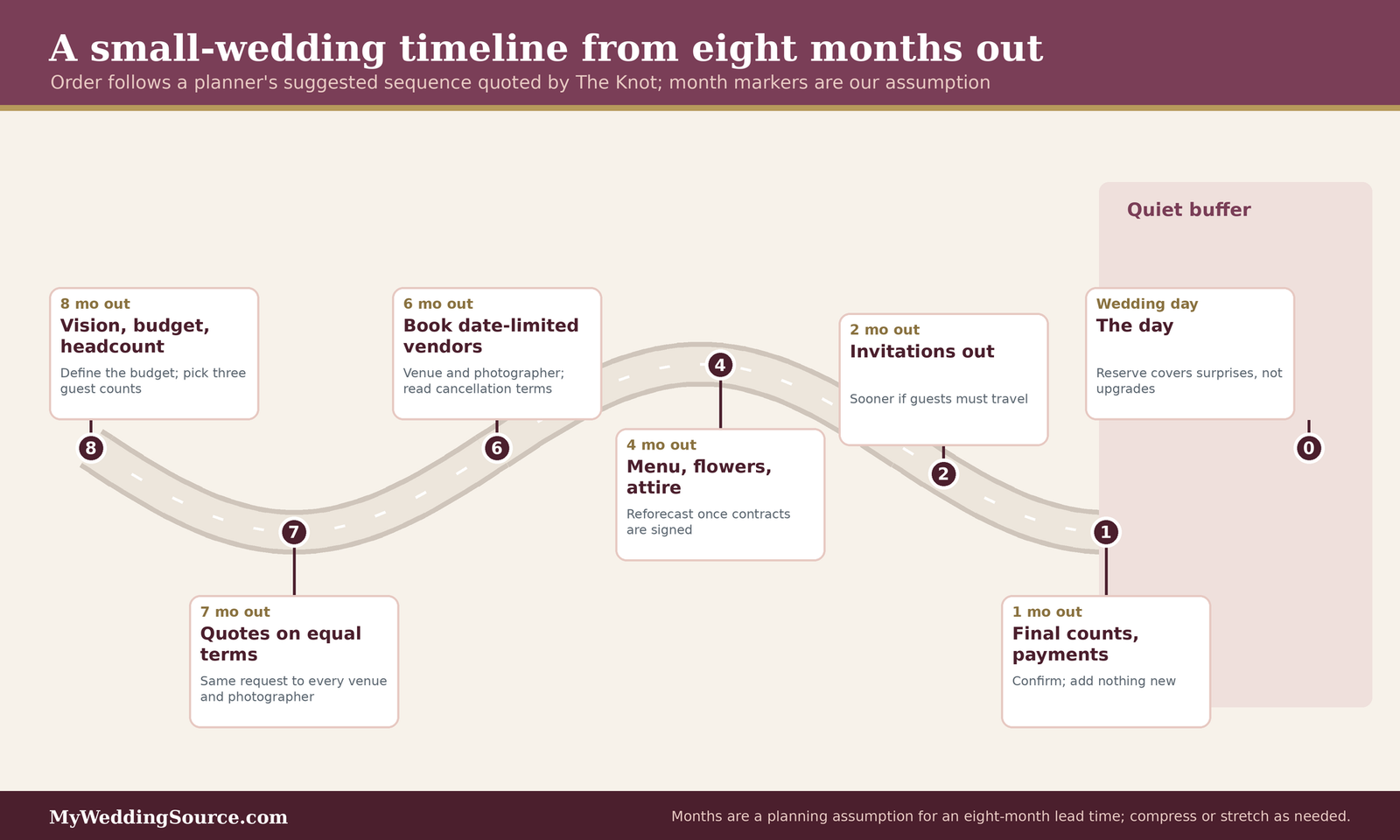
Micro wedding planning can move faster than a traditional timeline, but only if the decisions happen in the right order. The Knot’s planner source says her micro-wedding couples average about six to eight months of lead time, compared with a 15-month average engagement, and suggests this order: vision, budget, guest count, date and venue, website and registry, invitations, then custom upgrades. That sequence is a good skeleton, and the rest of this section turns it into dates and risks.
A working timeline from eight months out
The timeline below assumes about eight months of micro wedding planning. If you have less, compress the early steps and keep the order. If you have more, use the extra time to compare quotes, not to add complexity. Our general wedding planning timeline covers longer engagements.
Months eight to five: decide the shape
Start micro wedding planning with the budget definition and the three scenarios. Agree on the guest range, the likely day of the week, and the top two priorities. Request quotes from three venues and two photographers, using the same guest range in every request. Ask each vendor for the all-in number, with service charge, tax, and any minimum. Book the venue and the photographer first, because both are limited by date. Confirm that you understand the marriage license requirements in your location; our guide to the marriage license explains how the process generally works, and your county or state office is the authority for specifics.
Months four to two: lock the details
Choose food, drinks, flowers, attire, and the ceremony format. Send save-the-dates if guests need to travel, and send invitations about two months before, following The Knot’s rough guidance. Open your registry if you want one; our wedding registry guide covers how registries work. Write or draft your vows if you are writing them, using our wedding vows guide for structure, and plan the ceremony flow with the help of our wedding ceremony guide. Reforecast the budget once every contract is signed.
The last month: confirm, do not add
In the final month, confirm the headcount, give the caterer and venue their final numbers by the contract deadline, finalize the seating, and prepare payments. Do not add new vendors in this window unless something has failed. The goal of micro wedding planning in this window is a quiet month. Your wedding reception plan and the table layout, which our guide to wedding table settings covers, should be settled by then.
A risk register for small weddings
A micro wedding planning risk register is a short table of what could go wrong, how likely it feels, what it would cost, and what you will do. It converts anxiety into decisions.
| Risk | What it looks like | Early warning | Response |
|---|---|---|---|
| Headcount creep | List grows from 20 toward 35 | A venue step or table count changes | Set a cap and a named person who approves additions |
| Food and beverage minimum shortfall | You pay for food no one eats | Quote shows a minimum above your per-person total | Negotiate a lower minimum, a different day, or a different room |
| Vendor cancels | Small business closes or has a conflict | Slow replies, no contract | Written contract with a substitution clause and a named backup |
| Weather | Outdoor ceremony or dinner affected | Forecast within a week | A written indoor plan and the cost of switching |
| Late fee or surcharge | Charges appear on the final invoice | Final invoice differs from the proposal | Ask for the final invoice early and compare line by line |
| Decision fatigue | Long vendor lists drag on | Weeks without a decision | Use a package or reduce the number of vendors |
Rank by cost and by likelihood
Give each risk two scores from one to three, one for how likely it is and one for how expensive it would be. A headcount creep that is likely and costs a few hundred dollars needs a rule. A vendor cancellation that is unlikely but costly needs a contract and a backup. A risk that is both unlikely and cheap can be ignored. This kind of simple scoring is our own method, not an industry standard, and its value is that it makes you decide.
Match each risk to a document
Many responses live in a contract. The Better Business Bureau’s advice, relayed by a public radio consumer handbook, is to get a written contract for every service that covers the services, timeline, guarantees, and cancellation and refund policies. A legal-information article on common contract terms adds that a cancellation fee typically grows as the date approaches, that some contracts require you to cover damages caused by your guests, and that small one-person businesses deserve especially careful review of the cancellation clause. Read these provisions before you sign, and consider having an attorney in your state review anything that worries you. This is general information, not legal advice.
Questions to ask before you sign any contract
Micro wedding planning often involves small vendors, and small vendors have less standard paperwork. These questions help you find the real terms.
Questions to ask
- What is the all-in price at 20, 35, and 50 guests, with every fee and tax included?
- Is there a food and beverage minimum, a room minimum, or a per-person surcharge for small groups?
- Is the service charge taxed, and is gratuity included in it?
- What happens if my guest count drops after I sign? Is there a final-count deadline?
- What are the cancellation and substitution terms, and how do they change over time?
- What is the deposit, is it refundable, and how is the schedule of payments set?
- What counts as overtime, and what does an extra hour cost?
- Who is the backup if you cannot attend?
Questions for the venue and caterer
Venues and caterers set the largest per-person and minimum costs, so ask them first.
Minimums, service charges, and counts
Ask for the minimum in writing, what counts toward it, and whether the minimum differs by day or season. Ask if the service charge covers servers or is a separate fee. Ask whether the final headcount deadline allows a decrease, and by how much. One wedding-industry source suggests asking whether a shortfall can be applied to upgraded bar service, extra stations, or in some cases vendor gratuities. Whether a venue agrees is up to the venue.
Space, timing, and rain plans
Ask how many hours the room is yours, whether setup and cleanup are included, what the rain plan costs, and whether the room has a minimum or maximum capacity. A restaurant that seats 20 comfortably may feel crowded at 28. A rental home may have an occupancy limit, local noise rules, and a rental period that does not include the ceremony. Verify those limits with the owner or the local authority.
Questions for photographers, planners, and other vendors
Fixed-cost vendors have their own policies. Their terms matter most in a small wedding because there is less room to hide a bad one.
Hours, packages, and deliverables
Ask what coverage you get at each package level, what happens if the schedule runs long, how many edited images you will receive, when you will receive them, and what the usage and copyright terms are. For a small wedding, a shorter package may cover everything you need.
Payment, refunds, and disputes
The Better Business Bureau’s advice, as relayed by KRCU Public Radio, is to avoid paying the full cost before the vendor delivers and to pay by credit card for dispute rights. The Federal Trade Commission explains that, under the Fair Credit Billing Act, a card holder can dispute charges for services not delivered as agreed by sending a written notice within 60 days after the first bill with the error. Eligibility and procedure depend on your card agreement and the details, so read your issuer’s terms. We are not giving legal advice, and a dispute is not a substitute for a clear contract.
FAQ: micro wedding planning questions
Size and definitions
How many guests is a micro wedding?
There is no official number. The Knot describes a micro wedding as typically 50 or fewer guests, and Zola uses the same ceiling, with an average around 30. Zola calls a gathering of 10 or fewer a minimony. Ask each venue how it defines the term, since packages vary and the headcount you actually have drives the cost.
Is a micro wedding cheaper than a regular wedding?
Usually the total is lower, but not by the same proportion as the guest list. In our illustrative model, 50 guests to 20 cuts the guest count by 60% and the cost by about 35%. The Knot also notes that fewer guests does not automatically mean lower cost, because date, venue, and priorities matter.
Money
What costs stay the same when the guest list is small?
Photography, an officiant, attire, hair and makeup, and most of the planning help usually do not shrink with guest count. A venue may stay the same within a range and then jump. Ask each vendor whether their price changes at your headcount, because some price by the event and others by the head.
How much should I set aside as a reserve?
We recommend about 10% of the subtotal as a starting point, which is our own planning rule, not an industry standard. Use it for unplanned or underestimated items, not upgrades. If you have several unsigned lines or a vendor with an unclear contract, a larger reserve may be sensible. Adjust to your comfort with uncertainty.
What is a food and beverage minimum, and why does it matter?
It is a dollar amount a venue requires you to spend on food and drink, regardless of your guest count. If your selections fall short, you generally still pay the minimum. With a small list this can exceed what you would order, so compare venues using the minimum and not the per-person price alone.
Planning
How long does micro wedding planning take?
The Knot’s planner source says her micro-wedding couples average about six to eight months of planning, compared with a 15-month average engagement. A shorter timeline works only if you book date-limited vendors, such as the venue and photographer, early. Ceremonies without guests or a venue can move faster.
Do I still need a planner for a small wedding?
Not necessarily. Some couples find a package with coordination included simpler than a separate planner. The Knot’s planner source estimates all-inclusive packages can save about 15 hours of vendor research, but that is one estimate. Decide based on how many vendors you are hiring and how much of the day-of coordination you want to hand off.
Should I still sign contracts with small vendors?
Yes. The Better Business Bureau’s advice is to get a written contract for every service covering the services, timeline, guarantees, and cancellation and refund policies. A contract protects both sides, and a friendly handshake is hard to rely on if the date or scope changes. Ask an attorney in your state if a term worries you.
Your next steps
Build the model
You can finish the core of micro wedding planning in a single evening with a spreadsheet and your first honest guest list.
Write the budget definition and three headcounts
Write one sentence about what the budget includes and excludes. Then choose a low, base, and high guest count. Use the cost shapes from the matrix to label each line as fixed, per-person, step, or minimum-bound, and fill in the model with your own numbers. Replace our assumptions as real quotes arrive.
Set your thresholds and your reserve
Choose the amount either partner can approve alone, the amount that needs both, and the reserve percentage. Add three columns for committed, paid, and estimated money. If you want a starting structure, our wedding budget calculator and the overall plan a wedding guide can help.
Collect comparable quotes
In micro wedding planning, quotes are only useful if they are comparable. Send the same request to every vendor.
Ask for the all-in number at three headcounts
Ask every venue, caterer, and photographer for an all-in price at your low, base, and high headcounts, and ask them to list minimums, service charges, tax, overtime, and cancellation terms. Put the answers side by side and convert each to an all-in price per guest and a marginal price per guest.
Sign only what you understand
Before you sign, read the cancellation, substitution, and overtime clauses, confirm the deposit schedule, and consider paying by credit card. If a contract raises a legal question, speak with an attorney in your state. When the major contracts are signed, reforecast, and then move to the details: flowers, ceremony, attire, and the wedding decor that fits the space.
Sources & methodology
How we built this guide
What we relied on
This guide combines two published U.S. wedding-cost surveys, planning advice from The Knot and Zola about small weddings, consumer-protection guidance on contracts and card disputes, a legal-information summary of common wedding contract terms, a wedding-industry explanation of food and beverage minimums, and one state tax advisory opinion used only as an illustration. Where a statement comes from a company that sells wedding services or planning tools, we say so, because its advice reflects its business. The Knot and Zola survey their own users, so their figures are reference points and not a random sample of all U.S. couples.
What we did not do
We did not collect vendor quotes, survey couples, or test any vendor. The scenario model is editorial arithmetic with stated assumptions, not market pricing, and the 10% reserve, approval thresholds, and risk scoring are our own planning rules, not industry standards. Nothing here is legal, tax, or financial advice. Contract terms, sales-tax treatment, and card dispute rights depend on your state, your vendors, and your card agreement, so verify them before you sign or pay.
Source list
Government and consumer-protection sources
- Federal Trade Commission, Consumer Advice, Using credit cards and disputing charges: https://consumer.ftc.gov/articles/using-credit-cards-disputing-charges
- New York State Department of Taxation and Finance, Advisory Opinion TSB-A-03(20)S (May 8, 2003), as reproduced by a third-party archive: https://ezel.ai/tax-rulings/ny/tsb-a-03-20s-is-whether-a-separately-stated-charge-for-the-rental-of-a-room-in
- KRCU Public Radio, Consumer Handbook: Wedding Vendors (March 11, 2026), relaying Better Business Bureau advice: https://www.krcu.org/2026-03-11/consumer-handbook-wedding-vendors
Wedding-industry surveys and planning guides
- The Knot Worldwide, 2026 Real Weddings Study press release: https://www.theknotww.com/press-releases/the-knot-worldwide-unveils-2026-real-weddings-study
- The Knot, The Average Wedding Cost, According to The Knot Data: https://www.theknot.com/content/average-wedding-cost
- The Knot, What Is a Micro-Wedding?: https://theknot.com/content/what-is-a-microwedding
- Zola, Average Cost of Weddings in 2026: https://www.zola.com/expert-advice/how-much-does-a-wedding-cost
- Zola, Micro Weddings: https://www.zola.com/expert-advice/micro-weddings
Legal-information and venue-practice sources
- FindLaw, Common Wedding Vendor Contract Terms You Should Know: https://www.findlaw.com/legalblogs/law-and-life/common-wedding-vendor-contract-terms-you-should-know/
- Wed Society (South Jersey), The Catering Minimum That Isn’t About Food at All: https://southjersey.wedsociety.com/?p=922