

Fresh vs silk wedding flowers is less a question of which looks better than a question of what you need the flowers to do on one specific day, how much work you are willing to take on, and what you want to be left holding afterward, so it is worth settling those points before you compare a single price.
Quick answer
In fresh vs silk wedding flowers, fresh usually wins on scent, softness, and the way real petals look in close-up photos, while silk and other artificial flowers usually win on timing, heat tolerance, allergies, and the freedom to finish everything weeks ahead. On cost there is no reliable winner: the best-looking artificial options can cost as much as real ones, according to Zola, and a rental order is a separate and often cheaper route. For fresh vs silk wedding flowers, compare itemized quotes that cover the same pieces, the same hours, and the same setup and breakdown, then use the decision rule near the end of this guide.
Everything below is built to be reusable for your own version of the fresh vs silk wedding flowers question. You will find a way to normalize quotes, a worked cost scenario with its assumptions shown, three couple-and-venue examples, and a threshold table that tells you when the answer flips. If you are still choosing a style or a season, our guide to seasonal wedding flowers covers what changes price and availability for fresh stems, and this page picks up where it stops.
Define the decision before declaring a winner for fresh vs silk wedding flowers
Most comparisons of fresh vs silk wedding flowers begin with a list of pros and cons and end with a shrug. A better method starts with the decision itself. Fresh vs silk wedding flowers is really five smaller decisions that happen to share a label: what the flowers look like up close, what they cost in total, how they behave on the day, what happens to them afterward, and who does the work. Treat them separately and the answer to fresh vs silk wedding flowers usually becomes obvious.
List the criteria that genuinely change the choice in the fresh vs silk wedding flowers decision
Some criteria change the answer for almost everyone, and others only matter to a few people. Sorting them early saves you from spending an afternoon on a feature that was never going to decide anything.
Separate deal-breakers from preferences
A deal-breaker is a fact that rules an option out no matter how good it looks otherwise. An allergy that makes fragrant lilies a problem is one. A venue that bans open water or foam is another. A ceremony in a place where nobody can keep stems cool for hours is a third. Preferences are softer: you like scent, you like the idea of keeping a bouquet, you dislike the idea of plastic.
Write both lists before you shop for fresh vs silk wedding flowers, and be strict about what goes on the first one. If an item belongs there, test it against both options. If it rules one out, the decision on fresh vs silk wedding flowers is already made, and the rest of your research only needs to find the better version of the option that remains. If neither list rules anything out, you are free to weigh the preferences against cost.
Weight cost, logistics, experience, and flexibility
Once the deal-breakers are cleared, four weights do most of the work. Cost is the total you pay, including labor, delivery, and anything you must buy or rent separately. Logistics is how many people, hours, and vehicles the flowers need. Experience is how they look, smell, and feel to you and your guests. Flexibility is how late you can change your mind, and how well the plan survives a surprise.
Give each a score from one to five for how much it matters to you, not for how each option performs. A couple who is paying for the wedding with a fixed savings number may rate cost a five and experience a three. A couple with a small guest list and a florist they trust may reverse that. Your weights are the part no article on fresh vs silk wedding flowers can supply, which is why a generic winner is usually wrong for someone.
What this actually costs
For couples married in 2025, The Knot reports an average of about $2,800 on flowers and a middle value of $1,900, with the middle half of couples spending roughly $900 to $4,800. Those figures describe florist-built flowers for a bouquet, boutonniere, wedding party flowers, and centerpieces, so they are a sanity check and not a price list for either option. Silk prices in retail guides for fresh vs silk wedding flowers range from about $20 to $100 for a basic bridal bouquet and above $300 for premium real-touch versions, and rental vendors report average full orders around $450 to $500. These numbers measure different things, so never subtract one from another without matching the scope.
| Criterion | Why it can flip the choice | Fresh tends to fit when | Silk or artificial tends to fit when |
|---|---|---|---|
| Heat and outdoor time | Cut stems need water and shade to hold up | The flowers are in a cooler or shade until needed | Hours of full sun, no cooler, or a long gap before photos |
| Allergies and scent | Pollen and fragrance affect some guests | No one in the party reacts to pollen | A guest or the couple has seasonal or scent sensitivities |
| Lead time | Fresh flowers are made close to the date | You want to decide late and let a florist adapt | You want to finish pieces weeks in advance |
| Close-up photos | Bouquets and boutonnieres are photographed most | Real petals and natural movement matter to you | You have seen a vendor’s photos of that exact product |
| Labor and setup | Someone must build, place, and remove | A florist handles delivery and setup | You or friends will assemble and you have time |
| Keepsake or resale | What remains after the event | You will press, dry, or let go | You want to keep, loan, or sell the pieces |
| Budget certainty | Fresh prices can move before purchase | You can absorb a swing in supply costs | You need a number fixed early |
Compare like with like in the fresh vs silk wedding flowers decision
The most common mistake when comparing fresh vs silk wedding flowers is comparing a florist’s complete service with a retail price for loose artificial stems. They are not the same product. Matching scope before you compare is the single most useful step you can take.
Normalize package contents and time coverage
Start with a single list of pieces: how many bridal and attendant bouquets, how many boutonnieres and corsages, what the ceremony needs, and how many reception tables. Then ask every vendor, including the silk seller, to price exactly that list. For a florist, ask what the quote includes beyond the flowers themselves: delivery, setup, breakdown, and any rental containers. The Knot advises that a florist’s quote should show a price for each item, a line total, a full total, taxes, and any delivery, setup, or breakdown fees.
Time coverage matters just as much in fresh vs silk wedding flowers quotes. A florist quote covers a window in which someone delivers and places the flowers. A silk purchase covers the item and nothing else, so someone on your side builds, transports, places, and removes it. A rental covers a few days with a return deadline. Put the time window in the comparison, because a lower price for fewer hours of service is not a lower price.
Expose features that sound equivalent but are not
Several phrases sound the same across options and mean different things. “Handmade” can describe a florist arranging stems or a factory worker wiring plastic petals. “Real touch” describes a material, not realism in photographs. “Preserved” can mean freeze-dried, glycerin-treated, or dried, each of which looks and ages differently. “Reusable” is true of silk but may not be true of a rental that must be returned or a purchase that fades.
Zola’s guide notes that wax-coated silk can cost up to three times as much as standard silk and that some premium polymer options can yellow in white and ivory shades. Ask each seller what the material is, what it does over time, and what the return or damage policy is. Phrases that stay vague after a direct question deserve a lower score.
Read the cost evidence without mixing apples and oranges
Cost is the criterion people most want settled in fresh vs silk wedding flowers and the one the evidence settles least. The published figures are real, but they describe different things: survey spending, retail price ranges, and vendor-reported rental orders. Putting them on one chart is useful only if the chart says what each one is.
What survey numbers can and cannot tell you about fresh vs silk wedding flowers
Survey averages are the best public picture of what couples actually pay, and they are also the easiest figures to misuse in a comparison of fresh vs silk wedding flowers.
The Knot’s 2025 spending figures
The Knot’s Real Weddings Study reports on 10,474 U.S. couples married during 2025. For flowers covering a bouquet, boutonniere, wedding party flowers, and centerpieces, the average was about $2,800, the middle value about $1,900, and the quartile boundaries about $900 and $4,800. In fresh vs silk wedding flowers budgets, spending rose with guest count, from about $1,600 for up to 50 guests to about $3,300 for 101 or more. The Knot also says florals are roughly 10% of a typical wedding budget as an industry standard, and that price was the top factor for 70% of couples choosing a florist.
Two cautions apply. These are what couples reported, not what a particular florist will quote you. And the survey describes florist-built flowers, so it says nothing about silk. If you want a deeper view of where flower spending goes, our average wedding cost guide puts the number in the context of the whole budget.

Why silk prices do not line up with those numbers
Silk and artificial prices in the fresh vs silk wedding flowers debate come from retail guides and vendor claims, and they are usually per item. Zola lists inexpensive silk bridal bouquets at about $20 to $100, silk bridesmaid bouquets at about $10 to $50, boutonnieres at about $3 to $20, and silk centerpieces at about $20 to $100 each. The Knot’s artificial-flowers article gives similar silk bouquet ranges and puts real-touch polymer above $300 per bouquet.
These ranges leave out labor, assembly, and delivery, which a florist’s price includes. They also leave out your time. On the other side, a vendor that sells artificial flowers has a reason to emphasize savings: one vendor quoted by The Knot claims couples can save over 70%, and we treat that as a claim from the seller, not a finding. The honest summary on fresh vs silk wedding flowers is that silk can cost much less, about the same, or more, depending on the quality tier you choose.
Silk price tiers worth knowing before you shop
Artificial flowers are not one product, and fresh vs silk wedding flowers is not one comparison. Prices and results vary by material, and the material is the first thing to ask about.
Basic silk, foam, and paper
Silk, often made from polyester according to The Knot, is the entry point and is easy to mix with fresh blooms. Zola notes that edges can fray and that stems usually contain heavy steel wire that needs wire cutters. Foam flowers are described as the cheapest artificial option, though they can look unfinished from the side or underneath. Paper can look very realistic or deliberately bold and is friendly to do-it-yourself work, but The Knot says elaborate paper displays can run $20 to $200 or more and cost more if you do not make them yourself.
At this tier of fresh vs silk wedding flowers, the savings are real if you are willing to build the pieces, and the risk is a look that reads as inexpensive in a photograph. Order one sample bouquet before ordering forty.
Real-touch, polymer, and wax-coated options
The premium tier is where the cost advantage in fresh vs silk wedding flowers narrows. The Knot reports real-touch polymer bouquets often exceed $300 each and wax-coated flowers often start around $100. Zola warns that the best-looking varieties can cost as much as, or more than, real flowers, and that fresh-touch polymer can be the most realistic and the most expensive. If you want silk that passes for fresh in a close-up, plan for a price that is closer to a florist’s than a craft store’s.
This tier also changes the resale picture, since a premium set in good condition has more to sell. We could not find reliable published resale prices, so any figure you see for resale is an estimate, including ours later in this guide.
Where each option is stronger, and what it costs to get that advantage for fresh vs silk wedding flowers
Every advantage has a price in money, time, or risk. This section puts the price next to each advantage so that you are choosing between real trade-offs and not between adjectives.
Model the real trade-offs in the fresh vs silk wedding flowers decision
A trade-off model for fresh vs silk wedding flowers does not need software. It needs honesty about the costs that never appear on the first quote.
Include hidden labor, fees, space, and coordination
For fresh vs silk wedding flowers alike, hidden costs matter. For fresh flowers, they are mostly in the quote’s fine print: delivery and setup fees, rental containers or arches, and the cost of breakdown. The Knot notes that supply costs can change between booking and purchase, so ask how your florist handles price movement before the date. For flowers you buy yourself, the hidden cost is conditioning time and a cool, clean space to hold them.
For silk, the hidden costs are shipping, assembly, and space. Zola says shipping can reach about $20 per online order, and may be more. A sponsored article from A Practical Wedding, which we treat as promotional, warns that do-it-yourself flower work takes much longer than expected and suggests doubling or tripling your estimate. For rentals, the fees are different: The Knot lists sample fees, damage fees, shipping below a spending threshold, and setup charges that most vendors do not offer. Add each one to the quote before you compare.
Identify the point where one option stops being cheaper
The cost advantage of silk in fresh vs silk wedding flowers depends on three things you can estimate: the item count, the quality tier, and the labor you supply. As a transparent example, take a wedding with one bridal bouquet, four attendant bouquets, five boutonnieres, ten centerpieces, and two ceremony garlands. Adding the low ends of Zola’s per-item silk ranges gives about $315, and adding the high ends gives about $1,500. That is our own arithmetic and an estimate, and it excludes shipping, tools, and your hours.
Compare that range with The Knot’s reported middle value of $1,900 for florist-built flowers. At the low end, silk is dramatically cheaper. At the high end, it is within a few hundred dollars of the survey middle before you count labor. So the break-even moves toward fresh as you shift to premium materials, and toward silk as you accept basic ones. The point where silk stops being cheaper is the point where your quality requirement rises.
Match the options to different wedding scenarios in the fresh vs silk wedding flowers decision
A rule for fresh vs silk wedding flowers that works for one venue can fail at another. These examples are illustrative, not case studies, and the numbers are placeholders you can replace with your own quotes.
Three couple and venue examples
A backyard wedding with sixty guests in late July. The ceremony is outdoors at 4 p.m. with no indoor cooler. Guests include two with seasonal allergies. Here silk or a mix is appealing: a silk ceremony arrangement and silk centerpieces avoid wilting and wasted hours, while a fresh bridal bouquet gives the couple scent and a real keepsake for photographs. Our guide to garden wedding venues covers other considerations for outdoor spaces.
A ballroom reception with one hundred and fifty guests in February. The venue has a cooler, staff to receive deliveries, and a florist on its preferred list. Fresh makes sense if the florist can supply seasonal stems at a reasonable price, and an all-inclusive venue may lower the total, as The Knot notes. Silk centerpieces would add storage and removal work that the venue might charge for.
A courthouse ceremony and dinner for twelve. The flowers are a bouquet, two boutonnieres, and a few table pieces. Fresh is likely the easiest and probably the cheapest route, since a florist can handle this small order without a rental, a shipment, or assembly. Our guide to micro wedding planning shows how small guest counts change the economics of nearly every vendor.
Why the recommendation changes across scenarios
The three examples flip for different reasons. In the backyard, the fresh vs silk wedding flowers flip comes from heat and allergies, which are conditions of the day. In the ballroom, it comes from infrastructure, since a cooler and delivery staff remove the main problems of fresh flowers. At the courthouse, it comes from scale: below a certain size, the labor and shipping of silk cost more than they save.
That pattern is the useful lesson of fresh vs silk wedding flowers. The answer changes when a condition of the day changes, not when your taste changes. So test your plan against the conditions: heat, hours, storage, staff, allergies, and size.
| Scenario | Fresh vs silk wedding flowers: which tends to win | The threshold that flips it |
|---|---|---|
| Outdoor July afternoon, no cooler | Silk for display pieces, fresh for the bouquet | A cooler or shaded holding area becomes available |
| Winter ballroom with in-house florist | Fresh | The venue charges storage and removal for outside items, or the florist quote exceeds your cap |
| Very small ceremony and dinner | Fresh | You want to keep a set for years and will reuse it |
| Large guest count on a tight budget | Silk or rental for centerpieces | Assembly time exceeds the labor you can actually supply |
| Destination or travel wedding | Silk or dried for carried pieces | A local florist at the destination can quote a firm price |
| Guests with strong allergies | Silk or unscented fresh choices | A medical limit rules out all pollen-bearing stems |
Photography, scent, and the day itself
Flowers spend a few hours in front of a camera and a few more in front of guests, and that is where the two options feel most different. The right question about fresh vs silk wedding flowers is not which is prettier in general, but which behaves better in the conditions you will actually have.
What the camera sees in fresh vs silk wedding flowers
In photographs of fresh vs silk wedding flowers, scent and softness flatten out, while texture, sheen, and color are magnified. That changes the comparison.
Close-up pieces and distance pieces are different jobs
Zola’s guide advises against artificial flowers in the pieces that are photographed closely and most often, such as bouquets and boutonnieres, while noting that some artificial flowers are practically indistinguishable from real ones on film and others look unrealistic in sharp focus. That advice fits a simple principle: the closer the lens, the more the material shows. A centerpiece seen from across a room, an arch seen from the back row, and a garland draped on a railing are distance pieces. A bouquet held at the waist is a close-up piece.
A practical split many couples use is fresh for what is held and photographed closely, and artificial or mixed for what sits at a distance. The Knot notes that mixing the two is common, with fresh bouquets and silk centerpieces as one example. Our wedding photography guide explains how to ask for the kinds of shots that show the flowers well.
Ask for photos of the exact product, not a catalog
Catalog photos in the fresh vs silk wedding flowers market are shot to look their best, often with studio light and careful styling. Ask the seller for photos taken at real weddings, in daylight and in flash, of the same product line you are considering, and ask a photographer you trust to look at them. With fresh flowers, ask your florist for portfolio photos from a similar season and venue, because a peony in May and a substitute in November are not the same bloom.
If you are hiring a photographer, tell them what the flowers are made of before the day. They can adjust angles and distance without comment, and you avoid surprises in the gallery. Our wedding photographer shot list is a good place to add a line for the bouquet and any detail shots.
Heat, wilt, allergies, and outdoor days
Conditions on the day are where fresh vs silk wedding flowers differ most: fresh flowers need the most care and artificial ones need the least.
What fresh flowers need to stay presentable
University extension guidance describes the basics. Stems should go into water with a flower preservative soon after cutting, rest in water for at least an hour to hydrate before arranging, and stay in cool, shaded conditions away from drafts, direct sun, and heat. The same guidance warns that ripening fruit releases ethylene gas, which can shorten flower life, so keep bouquets away from a fruit display. Vase life varies from a day or two for some flowers to two to four weeks for others, so the flowers you choose matter as much as the care you give.
None of this is hard for a florist with a cooler and a van. It becomes a problem when flowers sit in a hot car or in sun between a morning session and an evening ceremony. If your day has a long gap, ask your florist how they would hold the flowers and which stems they trust in heat.
Allergies, scent, and guests who react
Artificial flowers have no natural scent, which The Knot lists as a drawback for some couples and an advantage for guests with scent sensitivities. Fresh flowers can carry pollen and fragrance, and a few common wedding flowers are hazardous to pets and children if eaten, such as lilies, according to the extension guidance. Check pet and toddler access if flowers will go home with guests.
If an allergy is serious, ask the person what triggers them, and have your florist leave out those stems. It is general education, not medical advice, so rely on a clinician for anything specific. A common compromise is unscented, low-pollen stems for tables near the allergic guest and fresh blooms elsewhere.
Storage, rental, ownership, and resale
What happens before and after the wedding is where fresh vs silk wedding flowers differ most, and it is the part most guides skip. The timeline below shows who handles the flowers at each stage.
Storing and moving the flowers
Storage is a logistics question, and fresh vs silk wedding flowers have clearly different answers.

Fresh flowers: cooler, water, and a handoff
With fresh vs silk wedding flowers, the fresh option needs a cool place and water until used, and they are usually handled by a florist who delivers, sets up, and sometimes returns to remove items. If you buy stems yourself, plan for buckets, space in a refrigerator or cool room, and hands to condition and arrange them. The extension guidance notes that stems need a fresh cut and preservative water right away, and that arrangements should be kept out of heat and sun between uses.
After the wedding, fresh flowers go to compost, to guests, or to a keepsake project. The Knot notes that rented flowers cannot be pressed or dried into keepsakes, which is one reason some couples buy fresh bouquets even when they rent the rest.
Silk flowers: pack, protect, and plan the return
In fresh vs silk wedding flowers, silk has no water or cooler requirement, and Zola notes it can be reshaped repeatedly and made well in advance. The Knot suggests buying a month or two before the wedding so you can check colors and clean the pieces. The cost of that convenience is care: edges can fray, white and ivory polymer can yellow, petals can crush in a box, and steel-wire stems can scratch tables and skin.
For rentals, one vendor named by The Knot delivers pre-assembled arrangements about a week before the wedding and expects return shipping within three days afterward. That is a short window, so give a friend a specific job: unpack, place, repack, and ship. Without that job, the savings disappear in late fees or damage charges.
Rent, own, or resell the flowers
After the wedding, the fresh vs silk wedding flowers question changes from “what did it cost” to “what do I do with it.”
How rentals work and what they cost
Rental vendors are a distinct category, and The Knot says they offer only artificial flowers, usually in set designs you cannot customize. It reports typical rentals under $1,000 depending on the number of pieces, average full orders of about $450 to $500 at two vendors, bridal bouquets at $55 to $80, centerpieces at $28 to $138 each, and ceremony arch flowers and garlands under $300. Vendors may charge for samples, for damaged or missing pieces, and for shipping below a spending threshold, and most do not provide setup.
In the fresh vs silk wedding flowers decision, rental is the right fit for a couple who wants artificial flowers for a single use without owning them, who has someone to handle returns, and who accepts a fixed design. It is a poor fit if you want to customize or keep a keepsake. A Practical Wedding’s sponsored article notes that artificial flowers can be pricey and lose their benefits if used only once, which is the reasoning behind renting instead of buying.
What resale and reuse really look like
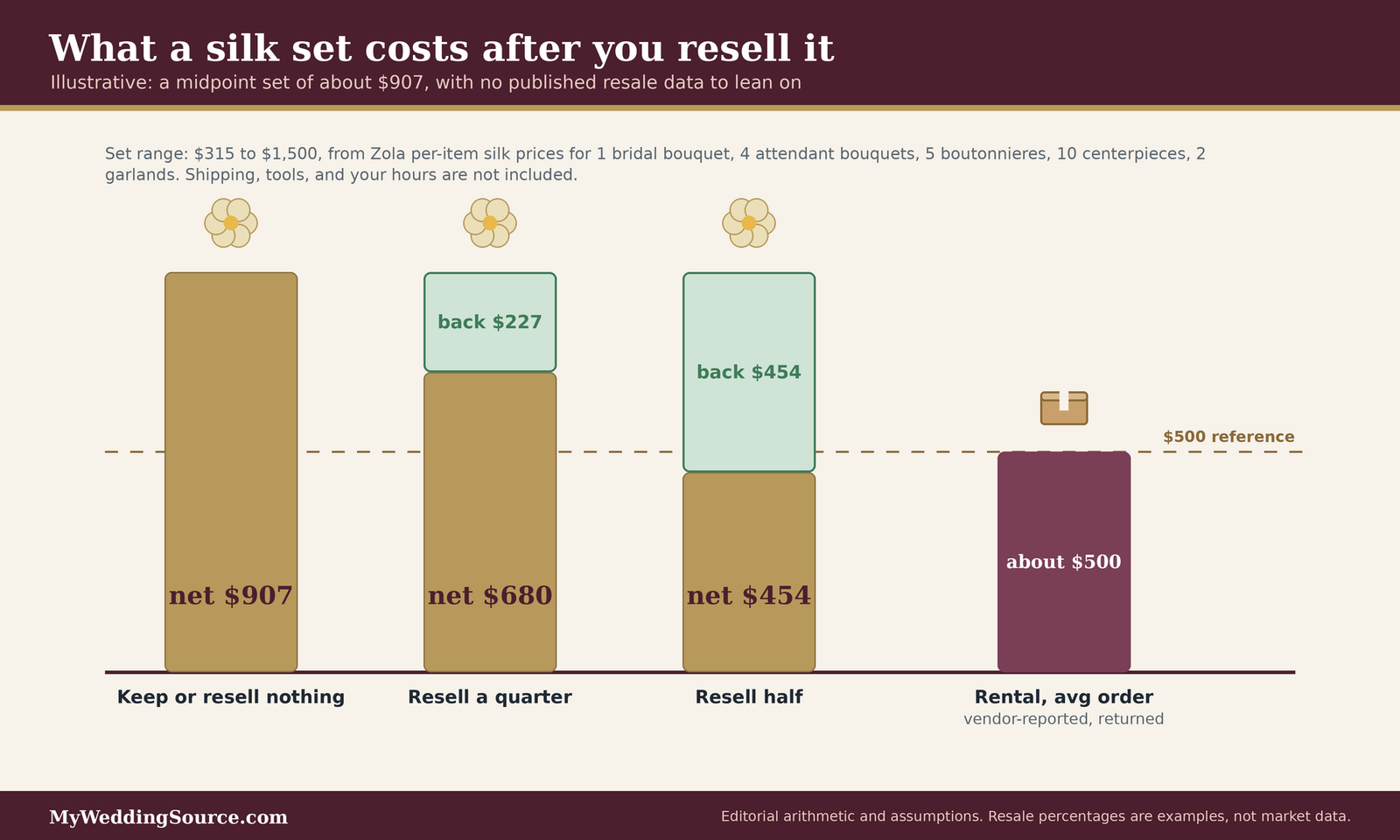
The Knot says artificial flowers can be displayed at home for years, loaned, or sold to another couple. We found no reliable published data on resale prices, so we cannot tell you what a used set will fetch. To show the logic, we use an illustrative example, with assumptions you can change.
Using the midpoint of our earlier estimate, a purchased silk set costs about $907 ($315 to $1,500). If you recover none of that, your net cost is $907. If you recover a quarter, it is about $680, and if you recover half, about $454. Compare that with the roughly $500 a rental vendor reports as an average order. The numbers show that resale only changes the answer if you actually sell, and that a rental often matches the best-case resale result with far less work. Sell only if you will list, photograph, pack, and ship the pieces, which also takes time.
Sustainability without slogans
Sustainability is the most emotional part of fresh vs silk wedding flowers and the least settled by evidence. The honest approach is to separate what is known, what is plausible, and what is marketing.
What the evidence supports about fresh vs silk wedding flowers
We did not find an independent life-cycle study that compares fresh vs silk wedding flowers directly, and several sellers of artificial flowers publish unsourced figures that we chose not to use.
Fresh flowers: a supply chain with real costs
Cut flowers are grown, cooled, shipped, and sold, and each step uses energy and materials. A 2019 life-cycle study by Treeze, commissioned by Fairtrade International and a Swiss retailer, compared cut roses from different origins for the Swiss market and updated earlier work from 2007 and 2009. It looked at production, packaging, and transport, and the page we reviewed does not summarize numeric results, so we do not quote any. The practical lesson is that origin, growing method, and transport all matter, which is why asking your florist where stems come from is more useful than a blanket verdict.
A 2026 paper in Frontiers in Sustainability, based on a 2024 survey of U.S. floriculture businesses with 107 complete responses, found that practices such as recycling, composting, and energy reduction are common but formal sustainability plans and certifications are less so. It does not address artificial flowers or measure footprints. In other words, the industry is working on it, and the evidence about outcomes is thin. If the flowers are imported, the U.S. Department of Agriculture notes that cut flowers must be presented to Customs and Border Protection at the first port of entry and may be refused if pests are found, which matters more to supply than to your bouquet.
Silk flowers: durable plastic with a short life if used once
For fresh vs silk wedding flowers, note that many artificial flowers are made from polyester or other plastics, as The Knot notes for silk. The U.S. Environmental Protection Agency reports that in 2018 the United States generated about 35.7 million tons of plastics in municipal solid waste, recycled about 8.7% of it, and landfilled about 27 million tons. Those are national figures, not figures for flowers, but they are a reminder that disposing of mixed-material products is difficult.
The reasonable inference, which is ours and not a proven result, is that artificial flowers help the environment only to the extent that they are reused many times and do not end up in a landfill after one wedding. A set that is rented repeatedly, kept for years, or passed to another couple spreads its footprint across many uses. A set used once and discarded does not. That is the same point a sponsored A Practical Wedding article made when it noted that artificial flowers are less beneficial if used only once.
Ways to lower the impact whichever option you choose
You do not have to choose a side in fresh vs silk wedding flowers to make a better choice. A few steps matter more than the label.
Skip floral foam and ask what the florist uses
A 2019 study from RMIT University published in Science of the Total Environment found that aquatic animals tested ingested floral foam microplastics, and that chemicals leached from the foam were more toxic to aquatic invertebrates than leachates from other plastic types. The researchers said more work is needed. A related survey by the Sustainable Floristry Network found that about two-thirds of more than 1,200 florists worldwide use foam.
Ask your florist whether they use foam and what they use instead. Many arrangements work with chicken wire, pin holders, or reusable mechanics. For artificial pieces, ask whether the flowers are glued to foam and whether the vendor takes returns for reuse.
Count the number of uses, not just the material
For artificial flowers, the number of uses is the strongest lever you control. Plan the second and third lives before you buy: a bouquet that sits in a frame, centerpieces that go to a family event, a garland that moves to a home. For fresh flowers, plan the afterlife: guests who take centerpieces home, a donation to a care facility if the florist agrees, or compost.
If you will not reuse artificial flowers, rental or a mixed approach is reasonable. If you want the lowest-effort option for a small event, a few fresh stems from a local florist that you compost afterward may be the lightest choice. We cannot rank these with certainty, and we would rather say so than invent a number.
End with a decision rule readers can actually use for fresh vs silk wedding flowers
Now the pieces of the fresh vs silk wedding flowers decision come together. The rule below is a method, not a verdict. It tells you which option wins under which conditions and where the answer changes.
Create a choose-fresh-when and choose-silk-when matrix for fresh vs silk wedding flowers
A matrix for fresh vs silk wedding flowers turns a vague preference into a rule you can check against your own facts.
State the threshold that changes the answer
Choose fresh when most of these are true: the flowers will be photographed closely, you want scent or a keepsake you can press, a florist or venue can hold and place them, your date offers cool conditions or shade, and your quote is within your cap. Choose silk or rental when most of these are true: the day is hot and outdoors with no cooler, someone has a serious allergy, you want to finish early, you have help for assembly and returns, and the quote for fresh is clearly above your cap.
If your answers split evenly, mix them: fresh for the bouquet and boutonnieres, artificial for the arch and centerpieces. The threshold that changes the answer is usually one of three things: heat with no cooler, a hard budget cap, or an allergy. If none applies, choose by the experience you want and the quote you trust.
Call out cases where neither option is ideal
A few cases suit neither side of fresh vs silk wedding flowers well. A very large ceremony in an unheated space in winter may strain fresh stems and make silk look flat. A wedding where you want stems from your own garden depends on weather you cannot control. A couple that wants exact color matching may be disappointed by either natural variation or by faded artificial pieces.
In those cases, consider other formats. The Knot notes that dried flowers are often cheaper than fresh and can be colored to match a palette, and potted plants, greenery, or a mix of materials may handle the problem better than either extreme. Our wedding decor guide shows ways to add visual interest without relying on flowers alone.
Give the next verification step before booking in the fresh vs silk wedding flowers decision
The last step in fresh vs silk wedding flowers is to turn your decision into questions and paper. Do this before you pay a deposit.
List the evidence to request
Ask for evidence that matches each claim about fresh vs silk wedding flowers. If a florist says a stem handles heat, ask for photos from a summer wedding. If a seller says artificial flowers look real, ask for photos from real weddings and a sample you can hold. If a vendor claims savings, ask for the itemized comparison they used, and compare it with your own list of pieces.
Questions worth asking before you book
- Which exact pieces does this price cover, and what is excluded?
- What are the delivery, setup, breakdown, and pickup terms, and who does each?
- For fresh: where do the stems come from, and what is the substitution plan if one is unavailable?
- For fresh: how will the flowers be kept cool, and for how long before use?
- For silk or rental: what is the material, and how does it age, fade, or fray?
- For rental: what is the return deadline, and what are the damage and late fees?
- Can I see photos from real weddings of this exact product or arrangement?
- What happens if the order arrives damaged or the venue changes?
Name the contract or quote line that should settle the question
Most disputes over fresh vs silk wedding flowers come from a missing line. Look for the line that lists items and quantities, the line that names substitutions, the line that covers delivery and setup, and the line that explains cancellation or refund terms. For rentals, find the return date and the damage policy. For purchases, find the return and exchange policy. For fresh flowers, find the deposit and what happens if supply changes.
This is general education, not legal advice. If a contract is large or unusual, ask a qualified professional to read it, and keep copies of every quote and message. If you are worried about losing a deposit to a vendor problem, our wedding insurance guide explains what that kind of policy does and does not cover.
FAQ: fresh vs silk wedding flowers questions
Cost and quality
Are silk flowers always cheaper than fresh flowers?
No. Basic silk can cost much less, but Zola warns that the best-looking artificial flowers can cost as much as real ones. Compare the same pieces, including your assembly time, shipping, and setup, against an itemized florist quote before assuming silk will save money.
Can guests tell silk flowers from fresh ones?
Sometimes, and it depends on the material and the distance. Zola says some artificial flowers are nearly impossible to tell from real ones on film, while others look unconvincing in sharp focus. Distance pieces tend to hide the difference, and close-up pieces show it, so look at real-wedding photos of the exact product.
Is it acceptable to mix fresh and silk flowers?
Yes. The Knot says mixing is common, such as fresh bouquets with silk centerpieces. It lets you spend on what is held and photographed closely and save on what sits at a distance. Ask your photographer and florist to see that the two types look consistent in color and style.
Is renting wedding flowers worth it?
It can be if you want artificial flowers once, can accept a fixed design, and have someone to handle returns. The Knot reports typical rentals under $1,000, with fees for damage, samples, and shipping. Read the return deadline and damage policy first, since those fees can erase the savings.
Logistics and sustainability
How far ahead can I buy silk flowers?
Well ahead, since they do not wilt. The Knot suggests buying a month or two before the wedding so you can check colors and clean them, and Zola notes they can be made in advance. Store them flat or upright in a dry place, and unpack early to reshape crushed petals.
Are artificial flowers more sustainable than fresh ones?
It depends on reuse, and we found no independent study that settles it. Many artificial flowers are plastic, and the EPA reports low national plastics recycling rates. They help most when reused many times. Fresh flowers have supply-chain costs, so ask where stems come from and skip floral foam.
What should I do with silk flowers after the wedding?
Keep, display, loan, or sell them. The Knot says artificial flowers can be displayed at home, loaned, or sold to another couple, but we found no reliable resale prices. If you will not reuse them, consider renting next time or donating them to a local theater or event group.
Do fresh flowers last through a hot outdoor wedding?
Some do, with care. Extension guidance says cut flowers do best in cool, shaded conditions with water and preservative, and vase life ranges from a day or two to several weeks by type. Ask your florist which stems they trust in heat and how they will hold flowers before the ceremony.
Your next steps
Decide with evidence
Write your deal-breakers and weights
List the conditions that rule an option out of your fresh vs silk wedding flowers plan, such as heat, allergies, or venue rules, and score cost, logistics, experience, and flexibility. Our wedding planning checklist is a good place to record the decision and the date you need it by.
Normalize two or three quotes
Ask each vendor to price the same list of pieces, with delivery, setup, and breakdown, and put the results side by side. Use our wedding budget calculator to see how the flower total fits the rest of the budget, and our guide to how to pay for a wedding if the number needs to be funded in stages.
Lock in the details
Get samples and photos
Request a sample of any artificial piece you might hold or wear, and photos from real weddings of the exact product. For fresh flowers, ask for portfolio images from your season and a written substitution plan. Our wedding ceremony guide can help you decide which ceremony pieces matter most.
Put the terms in writing
Confirm the item list, delivery, setup, breakdown, return dates, and fees before you pay. Keep copies of every message, and set a calendar reminder for any return or final-payment deadline.
Sources & methodology
How we built this guide
What we relied on
This guide to fresh vs silk wedding flowers combines The Knot’s 2025 wedding-flower spending study, retail and vendor guides to artificial flowers and rentals, university extension guidance on caring for cut flowers, a published laboratory study on floral foam, a 2019 life-cycle study of cut roses, a 2026 survey of U.S. floriculture sustainability practices, and federal pages on plastics and cut-flower imports. Where a statement comes from a seller or a sponsored post, we say so, because those sources have a reason to favor one option. The silk-set cost range, the net-cost-after-resale example, and the scenarios are our own arithmetic and illustrations, and they are estimates.
What we did not do
We did not test flowers, photograph them, or collect quotes from florists. We found no independent life-cycle study comparing fresh and artificial wedding flowers and no reliable published resale prices, so we make no claim about either. Several sellers of artificial flowers publish unsourced footprint figures, and we did not use them. Nothing here is legal, medical, or financial advice. Check contracts, allergies, and venue rules for your own situation.
Source list
Wedding industry and retail sources
- The Knot, We Did the Math: Here’s the Average Cost of Wedding Flowers (updated May 2026): https://www.theknot.com/content/average-cost-wedding-flowers
- The Knot, Are Artificial Flowers Better Than Fresh Blooms? (updated January 2023): https://theknot.com/content/artificial-wedding-flowers
- The Knot, How to Rent Flowers for Your Wedding (updated September 2024): https://www.theknot.com/content/rent-flowers-wedding
- Zola, Best Artificial Flowers for Wedding: The Complete Guide (updated February 2024): https://www.zola.com/expert-advice/a-guide-to-artificial-wedding-flowers
- A Practical Wedding, Have Your Flowers and Be Eco-Friendly, Too (sponsored post, May 2021): https://apracticalwedding.com/fake-wedding-flower-rental/
Government, university, and research sources
- Washington State University Extension, Making Lasting Bouquets: https://wpcdn.web.wsu.edu/extension/uploads/sites/57/2020/07/Making-Lasting-Bouquets.pdf
- RMIT University, Floral foam adds to microplastic pollution problem: study (December 2019): https://www.rmit.edu.au/news/all-news/2019/dec/floral-foam-microplastic
- Fairtrade International and Treeze, Life cycle assessment of cut roses (2019): https://fairtrade.net/library/life-cycle-assessment-cut-roses
- Solliday, Langston, and Knuth, Sustainable blooms: a look at environmental practices in U.S. floriculture, Frontiers in Sustainability (2026): https://www.frontiersin.org/articles/10.3389/frsus.2026.1691106/full
- U.S. Environmental Protection Agency, Plastics: Material-Specific Data: https://www.epa.gov/facts-and-figures-about-materials-waste-and-recycling/plastics-material-specific-data
- U.S. Department of Agriculture, APHIS, International Traveler: Plants, Plant Parts, Cut Flowers, and Seeds: https://www.aphis.usda.gov/fr/node/2215