
Small wedding planning is not a shrunken version of big wedding planning: when the guest list stays under 50, some costs fall almost in step with headcount, others barely move, and a few new decisions appear that a 120-person wedding never forces on you.
Quick answer
Treat the guest list as your first budget decision and your first legal-and-logistics decision, not your last. Food, drinks, rentals, and seating scale with headcount; photography, music, attire, the officiant, and license fees mostly do not. The Knot reports that weddings with fewer than 50 guests averaged about $15,000 in its study of 2024 weddings, against about $42,000 for weddings with more than 100, but a short list is not automatically cheap, because venue minimums, per-person pricing, and upgrades can push the cost per guest well above a large wedding’s. Lock the list, get quotes normalized to an all-in cost per attending guest, and check your county’s license and witness rules before you fall in love with a date.
This guide to small wedding planning is for couples whose list has settled somewhere under 50, or who are deciding whether it should. It does not walk through every wedding task, because our wedding planning guide and wedding planning checklist already do that. Instead it answers one narrower question: what changes in small wedding planning, which of those changes are real, and how to make each decision with numbers and thresholds you can check yourself.
Some terms first, because the industry does not agree on them, and small wedding planning means different things to different sources. The Knot calls weddings with fewer than 50 guests “intimate” in its own reporting, and in a separate article it defines a micro-wedding as 50 guests or fewer and a small wedding as 50 to 100. Zola describes a micro wedding as typically 50 or fewer, with an average around 30, and treats a “minimony” as 10 or fewer people. We use “under 50” throughout this guide to small wedding planning, and we say so when a source draws the line elsewhere.
Define the decision: what small wedding planning actually changes
Most advice about small wedding planning stops at “it saves money.” That is partly true and mostly unhelpful, because it hides the mechanism. A wedding is a bundle of about a dozen purchases and decisions. A smaller headcount changes how each one behaves, and some of them behave in surprising ways. In small wedding planning, the decision you are really making is not “small or big.” It is “which of these costs and obligations do I want to shrink, which do I want to spend more on instead, and what do I need to settle before anyone can book anything?”
List the inputs that materially change the answer
Five inputs do most of the work in small wedding planning: the number of people, the venue, the budget, the relationships involved, and the calendar. They interact, so the order in which you settle them matters more than it does for a large wedding, where a few extra guests disappear into the total.
Guest count, venue, budget, relationships, and timing
Guest count is the input everything else reads from in small wedding planning. In small wedding planning it is the only input that changes food, drinks, rentals, seating, favors, and, in many venues, the price you pay for the space itself. Zola’s 2026 cost report puts guest-dependent spending (food, beverages, and rentals) at roughly $150 to $300 per guest. The Knot’s survey of couples who married in 2025 found an average of 117 guests, so a list under 50 is less than half of what most couples invite.
Venue is the input people underestimate. A room that suits 40 guests beautifully may be priced as if it needed to be filled. Some venues set a minimum, either a guest count or a dollar amount for food and beverage, and a venue operator we cite later explains that with a guest-count minimum you pay for the required number even if fewer people attend. A short list can therefore meet a floor you cannot see on the listing.
Budget decides what the savings from small wedding planning are for. The Knot’s reporting on micro weddings makes the point that halving the guest count leaves more money per person for catering, the bar, travel, and favors, and also that a micro wedding is not automatically cheaper, since bespoke details and premium vendors can raise the bill. Decide now whether you want the total to fall or the quality per guest to rise. Both are legitimate, but they lead to different vendors.
Relationships set the shape of the list: who is on it for love, who for obligation, and who is only there because a parent expects it. Timing is the last input, and it is more flexible than it looks. Short lists often fit venues that large weddings cannot use, including restaurants, private rooms, and weekday dates, which changes both the available calendar and the price.
Separate hard constraints from social pressure
In small wedding planning, a hard constraint is something a person outside your relationship will enforce: a room’s posted capacity, a venue’s contract, a county’s license rules, a deposit deadline, an elderly relative’s inability to travel. Social pressure is everything that feels like a constraint but can be negotiated, such as “my cousin will be hurt,” “we have always invited the whole church,” or “everyone else seems to have 150.”
The distinction matters because the two need different responses. You cannot negotiate with a fire marshal’s capacity number, but you can have a conversation with a cousin. For small wedding planning, write two lists. The first holds only the constraints someone can enforce in writing. The second holds the pressures, with the person’s name beside each. Then decide, for each name, whether you will hold the line, make an exception, or find another way to include them, such as a livestream of the ceremony, which Zola lists as one option for people you cannot host.
A useful test, also from Zola’s micro-wedding guidance, is to ask whether you can picture your wedding without a given person. If you can, that invitation may be one you can let go. If you cannot, protect the seat. The test is subjective, but it forces the right conversation.
Identify the hidden second-order effects
The first-order effect of a short list is obvious, and small wedding planning is mostly about what comes after it: fewer plates. The second-order effects are the ones that surprise couples in month three, when a vendor quotes something they did not expect or a relative reacts to a list they assumed would be bigger.
What the guest count changes downstream
In small wedding planning, think of the guest count as a dial that is wired to some things loosely and others not at all. Food and drink are wired tightly. Rentals follow, though many rental items are sold per piece, so the arithmetic is simple. Space is wired in steps, because rooms come in sizes. Staffing is wired in steps as well, since one server can only handle so many tables. Photography, officiant services, hair and makeup, music, and the cost of the license barely move at all.
That is why the total in small wedding planning does not fall in proportion to the list. If you cut guests from 120 to 40, the guest-dependent line may drop to a third, but your photographer’s hours and your attire stay roughly where they were. Our estimate, using Zola’s $150-to-$300 range, appears in the second figure below, and it shows why the savings are real but smaller than the headline ratio suggests.
The dial also moves things you did not think were connected. A short list changes who can be a witness without leaving the head table. It changes whether a plus-one policy is even needed. It changes how many chairs, how many place cards, and whether you need a seating chart at all. And it changes how much attention each guest receives from you, which is why many couples choose a short list in the first place.
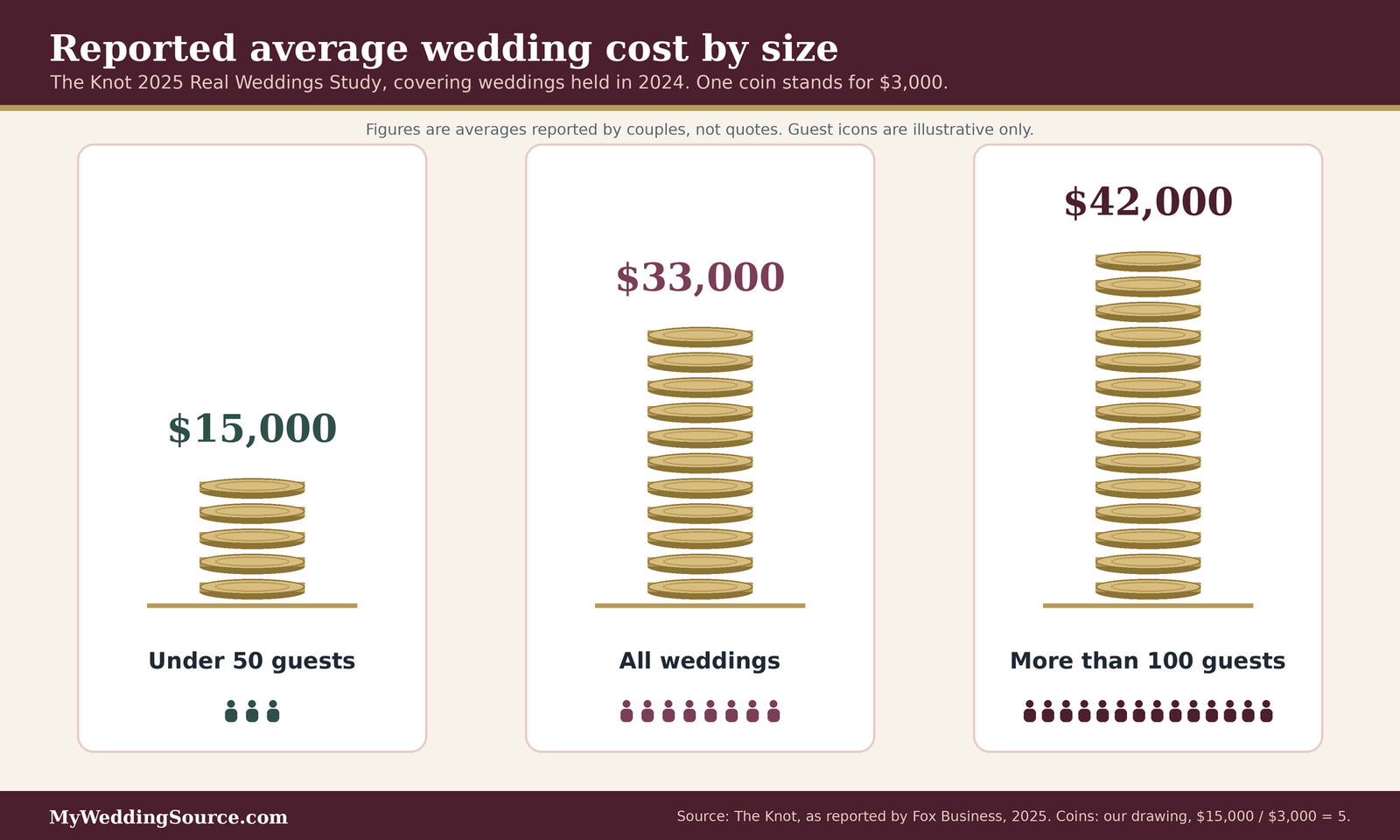
The first figure shows what couples reported. In The Knot’s study of 2024 weddings, as reported by Fox, the overall average was $33,000, weddings with fewer than 50 guests averaged $15,000, and weddings with more than 100 guests averaged $42,000. Those are averages across many couples with very different priorities, so they tell you the direction of the effect and not the price you will pay. Our own division shows that the small-wedding average is about 45% of the overall figure and about 36% of the large-wedding figure. That is editorial arithmetic and should be read as an estimate.
Fairness, workload, and the guest experience
Small wedding planning shifts workload as well as cost. There are fewer RSVPs to chase, fewer dietary notes, and fewer seating puzzles. But there are also fewer people to absorb the unexpected. At a large wedding, a no-show disappears into the crowd. At a wedding of 25, an empty chair is visible, and a single guest with a complicated need, such as limited mobility or a long trip, shapes the day.
Fairness becomes sharper in small wedding planning too. When the list is tight, every decision about who is in or out is visible, so consistency is your protection. Emily Post’s guidance on handling guests is blunt about this: the names on the inner envelope define who is invited, “and family” extends the invitation to everyone in the household, and an exception for one family is unfair to guests who followed the invitation as written. The same logic applies to plus-ones and children, and it is much easier to apply a clear rule at the start than to defend a patchwork afterward.
The guest experience improves in ways that are real and easy to forget to plan for. You can talk to everyone. Toasts can be personal, and a meal can be a single table. But the lack of crowd energy can make a stiff room feel quieter than expected, so Zola’s cons list for micro weddings includes missing the energy of a larger event. If that matters to you, plan a few moments that give the room a shape, such as a seated toast, a shared first course, or music during dinner.
What this actually costs
Three numbers are worth keeping apart. The Knot’s study of 2024 weddings reports about $15,000 on average for weddings with fewer than 50 guests. Zola’s 2026 survey of 720 recently married couples reports an overall average of $36,000, out of pocket after family contributions, and a guest-dependent range of $150 to $300 per guest. And your own quotes are the only figures that bind you. Averages show direction. Quotes show price. Neither one is a budget until you have normalized them to the same assumptions.
Where a short list changes the plan, area by area
With the inputs defined, the next question for small wedding planning is practical: which parts of the plan change, and how? This section moves through the major vendor and legal categories in the order most couples meet them. For each one it separates what genuinely changes in small wedding planning from what stays the same, so you do not spend effort re-deciding things that a short list does not touch. For the full detail on any one category, the dedicated guides linked here go deeper than this page will.
Venue, food, and drinks
Venue and catering are where small wedding planning gains the most and where it can mislead most. They account for the biggest share of guest-dependent spending, and they are also where pricing structures are least transparent.
Minimums and how they behave when the list shrinks
A minimum is a requirement that must be met for an event to take place on a given date and time. Wedgewood Weddings, a venue operator, describes it as usually based on either a guest count or a dollar amount spent on food and beverage, notes that higher-demand dates such as Saturdays carry higher minimums, and gives an example of a 150-guest minimum that applies even if only 130 people attend. That example is general, not a quote, and it is the venue’s own description of its policy, so read it as one operator’s explanation and not as industry law.
What it means for small wedding planning is simple to state and easy to miss. If a venue’s floor is a dollar amount and your list is short, you may pay the floor and eat less than you paid for. If the floor is a guest count and your list is below it, you may be paying for empty seats. In both cases the cost per attending guest rises as the list shrinks, which is the opposite of what the headline ratio suggests.
Ask four questions before you sign: Is the minimum a guest count or a dollar figure? Which charges count toward it, and which do not? What happens if my count or spending falls short? And does the minimum apply before or after service charges and tax? The worked example in the next section shows how much the last question can matter.
In small wedding planning, restaurants and private dining rooms often work differently from event venues, because their pricing is built around a table of a certain size. Zola’s micro-wedding guidance notes that many venues offer micro wedding packages for small wedding planning. We could not find a single authoritative survey of how many do, so treat the claim as a reason to ask and not as a promise. Our wedding reception guide covers how reception formats work, and our wedding catering guide explains what caterers include and exclude.
Rentals, service, and table design
With 30 guests you may not need a venue that provides tables, linens, and glassware, and you may find a space that already has furniture you like. With 45, you may be choosing between long communal tables and several rounds. The choice affects cost, sound, and conversation. A single long table lets everyone hear the same toast. Two or three rounds give people more privacy.
Service ratios matter too. Caterers may assign staff in steps, so a smaller list does not always lower the staffing line in proportion. Ask the caterer to price service as a separate line so you can see what changes at each step. Our wedding table settings guide helps you decide how much to spend on the tablescape, and our wedding decor guide covers how to make a smaller room feel considered without buying for a larger one.
The Knot’s study of 2024 weddings reports an average of $80 per plate for catering. That is an average across all sizes and regions, and it excludes the venue, bar, rentals, and service charges that appear elsewhere on a bill. Do not multiply it by your guest count and call it a catering budget. Use it only as a reference point when a quote looks unusually high or low.
Drinks are a separate decision, and a short list changes it in an interesting way: because the headcount is lower, some couples choose to upgrade the drinks instead of cutting them, which is the same trade-off The Knot describes when it says a smaller count leaves more money per person for the bar. Our open bar wedding guide explains the pricing models, and the question to bring to every bar quote is whether you pay per person, per hour, or by consumption.
Ceremony, license, and witnesses
Small wedding planning changes the ceremony in ways that are easy to overlook until the day, and it changes the legal paperwork in one way that is easy to get wrong: the people in the room are suddenly the witnesses.
What your county clerk decides
Marriage licenses are issued locally under state law, and the rules differ in ways that matter to a short list. Two county examples show how much. In Clark County, Washington, the Auditor’s office says you must wait three days after getting a license before the ceremony, that this waiting period cannot be waived even by court order, and that the license is valid for 60 days. It also says the ceremony needs at least five people in total: the officiant, both partners, and two witnesses, each of whom must be 14 or older and understand what they are witnessing. The county lists a $172 non-refundable application fee, and it says neither applicant may officiate their own wedding.
In San Diego County, California, the Assessor/Recorder/County Clerk says a public license needs at least one witness present at the ceremony, with no more than two signing, and that a confidential license needs none. It lists a license valid for 90 calendar days with no extensions, appointments only, and bookable up to seven weeks ahead. It lists fees of $129 for a public license and $144 for a confidential one, and a county-provided witness at $58.
We chose those two examples to show a spread, not to speak for your state. FindLaw’s general summary says most jurisdictions require two adult witnesses but that requirements vary by state and county, and that California and some other states allow a minor to serve as a witness. This is general information and not legal advice. Check your own county clerk’s page for the license, the waiting period, the witness rules, the fee, and the appointment process before you set a date. Our marriage license guide goes further into the steps.
The timeline figure later in this guide puts these two examples next to The Knot’s lead-time guidance, so you can see how a license window and a mailing schedule fit together. It shows the shape of the constraints, not deadlines for your wedding.
Officiant, vows, and the ceremony itself
In small wedding planning, the ceremony is often the longest uninterrupted attention you will have from your guests, which is a reason to plan it with care. Some couples choose a longer ceremony with personal vows because the room is small enough to hear them. Others keep it short and spend the time at dinner. Both are defensible. Our wedding ceremony guide covers structure, and our wedding vows guide helps you write vows that work in a quiet room.
If someone close to you will officiate, confirm that the person is eligible under your state’s rules, because eligibility differs. The Clark County page, for example, lists judges and licensed or ordained religious officials and says ministers from any state may officiate if the ceremony takes place in Washington. Another state’s list will not match. If a friend will marry you, ask the clerk what that person needs to do before the ceremony.
A short list also lets you decide on a point that would be awkward at 150: whether to make the ceremony an event that guests attend and then leave, or one that is part of a continuous gathering with no break. Without a break, you can reduce the number of moments when guests wait, which helps older relatives and young children.
Invitations, etiquette, and communication
Small wedding planning makes etiquette more visible, not less important. The rules are the same, but the consequences of bending them are easier to see.
Wording, envelopes, and RSVP
The core rule, as Emily Post frames it, is that the names on the invitation define who is invited. If a guest replies for themselves and an uninvited plus-one, Emily Post says you may contact them, explain that your venue size or budget does not allow extra guests, and stand by your list, which it says is not rude. If a family replies with children who were not invited, it advises calling to correct it and not making an exception for one family.
Plan the wording before you print, because small wedding planning leaves less room to correct it later. Our wedding invitations guide covers formats and what each line signals, and our wedding RSVP wording guide gives phrasing that keeps replies clear. For a list this size you can also decide to call or text the first ten people before anything is mailed, which saves you from correcting a misunderstanding afterward.
Timing differs from the norm for large weddings. The Knot’s micro-wedding article suggests save-the-dates about eight months ahead and invitations about two months ahead, which it presents as a suggested order and not a rule. Our save-the-date guide explains when a save-the-date is worth sending, and the answer can be “not at all” if your list is local and you are telling people by phone.
Telling people they are not invited
This is the conversation most couples dread, and it is the most useful one to have early. Zola advises telling people early that the event is smaller than originally planned, and Emily Post advises calling a family you expect to object as soon as you decide, even before invitations go out. The reasoning is the same in both: surprise is what hurts, not the decision itself.
A workable approach to small wedding planning is to decide the rule first (for example, immediate family and the closest friends only, with no plus-ones outside committed relationships and no children), then explain the rule without apologizing for it. The explanation can be short: the list is small, and the rule applies to everyone. Where the rule leaves out someone who matters, consider a different way to include them, such as a dinner afterward, a later celebration, or a livestream. Zola calls a larger celebration held after a micro wedding a “sequel wedding,” and some couples do exactly that. Our wedding etiquette guide covers hosting questions in more depth.
Photography, attire, and the rest
The remaining categories are mostly unaffected by guest count, which is the point: small wedding planning does not shrink them, so it helps to plan for that.
Coverage hours rather than headcount
Photographers generally price by hours and deliverables, not by guests, though that depends on the individual photographer and you should confirm it in the contract. A short list may let you shorten the day, which can reduce coverage hours, but it does not change the cost of editing, the photographer’s travel, or their minimum package. With fewer guests there are also fewer group photos to organize and more time for portraits. Our wedding photography guide explains packages, and our wedding photographer shot list helps you ask for the moments that matter in a small room.
Attire and dress code
A short list lets you set a dress code that large weddings cannot enforce. If you want everyone in cocktail attire, a message to 35 people can make that happen. Our cocktail attire guide describes what the term means, and our black-tie wedding guide covers the formal end. Your own attire does not scale with the list, so a short list is one reason couples put more of their budget into the outfit.
Registry and honeymoon choices tend to shift as well. If fewer guests means fewer gifts, a cash-fund registry or a honeymoon fund may suit you better than a long list of household items. Zola reports that 27% of couples marrying in 2026 are adding cash funds to their registry, up from 16% in 2025, which suggests the practice is common. Our wedding registry guide and honeymoon planning guide walk through both.
Compare viable options against the same criteria for small wedding planning
Once you know what changes, you still have to choose. The honest way to compare options is to put them on the same criteria and say which assumptions drive the result. This section does that in three steps: a matrix of the factors that decide the answer, a method for putting quotes on equal footing, and four contrasting scenarios that show when the best option flips.
Score the options with transparent assumptions
In small wedding planning, most couples compare options by gut feel and a spreadsheet of totals. Totals hide too much. A $7,700 quote and a $7,800 quote can differ by hundreds of dollars per guest once service charges, tax, and minimums are counted. In small wedding planning, the aim is to score on the factors that actually move the answer and to show your assumptions so that someone else could check them.
Use ranges and qualitative thresholds, not false precision
Table 1 lists the factors that most often decide the shape of small wedding planning. It does not assign numerical scores, because any score we invented would be false precision. Each row names the condition that pulls toward a smaller-footprint plan, the condition that pulls toward a standard plan, and the check that tells you which applies.
| Factor | Pulls toward a smaller-footprint plan | Pulls toward a standard plan | How to check |
|---|---|---|---|
| Venue pricing structure | Per-person pricing with no floor, or a floor well below your count | A dollar or guest-count minimum above your list | Ask what the minimum is, what counts toward it, and what happens if you fall short |
| Travel burden | Most guests live within a short drive | Many guests must fly or book hotels | Count households traveling, then ask each whether they can attend before you commit |
| Family expectations | Your families already expect a small day | A relative will treat the list as a verdict on the relationship | Have the conversation before booking, with names written down |
| Spending priority | You want to spend more per guest on food, drinks, or the setting | You want total savings above all else | Decide whether the total or the quality per guest is the target |
| Vendor minimums | Vendors price by the hour or by the item | Vendors have package floors | Request itemized quotes with the minimum stated |
| Accessibility and ages | A single-level space with easy parking suits everyone | Several guests need longer ceremonies or seating changes | List each guest’s needs and compare to the space |
| License logistics | Your county has a short wait and few witness rules | Your county has a long wait or a limited appointment window | Read the clerk’s page and book the earliest slot that fits |
| Flexibility on date | You can choose a weekday or off-peak date | Only one weekend works for everyone | Ask the venue how pricing changes by day |
The table is a conversation starter, not a verdict. If four or five rows point to the left, a lean plan is likely to feel natural. If they split, you are in a middle ground where the quotes will decide.
The next step is to put those quotes on equal footing. For small wedding planning, this is the original method we recommend, and it takes about ten minutes per quote.
Step one: separate fixed from guest-driven. Fixed items do not change if the list changes: the site fee (if there is one), the officiant, the photographer, music, attire, and license fees. Guest-driven items scale with the number of attendees: food, drinks, rentals, and sometimes staffing. Zola’s reporting treats photography and music as fixed and food, beverages, and rentals as guest-dependent.
Step two: add everything the quote leaves out. That means service charges, gratuity, tax, delivery, setup and breakdown, and any minimum shortfall. If the quote does not say whether a charge is included, ask.
Step three: divide by the guests who will actually attend. Not the number you invited, and not the number the venue assumed. If the quote includes a minimum, calculate the cost at your expected count and again at a low-attendance count.
Step four: compare the totals at more than one headcount. One number can mislead. Two or three show where the quotes cross.
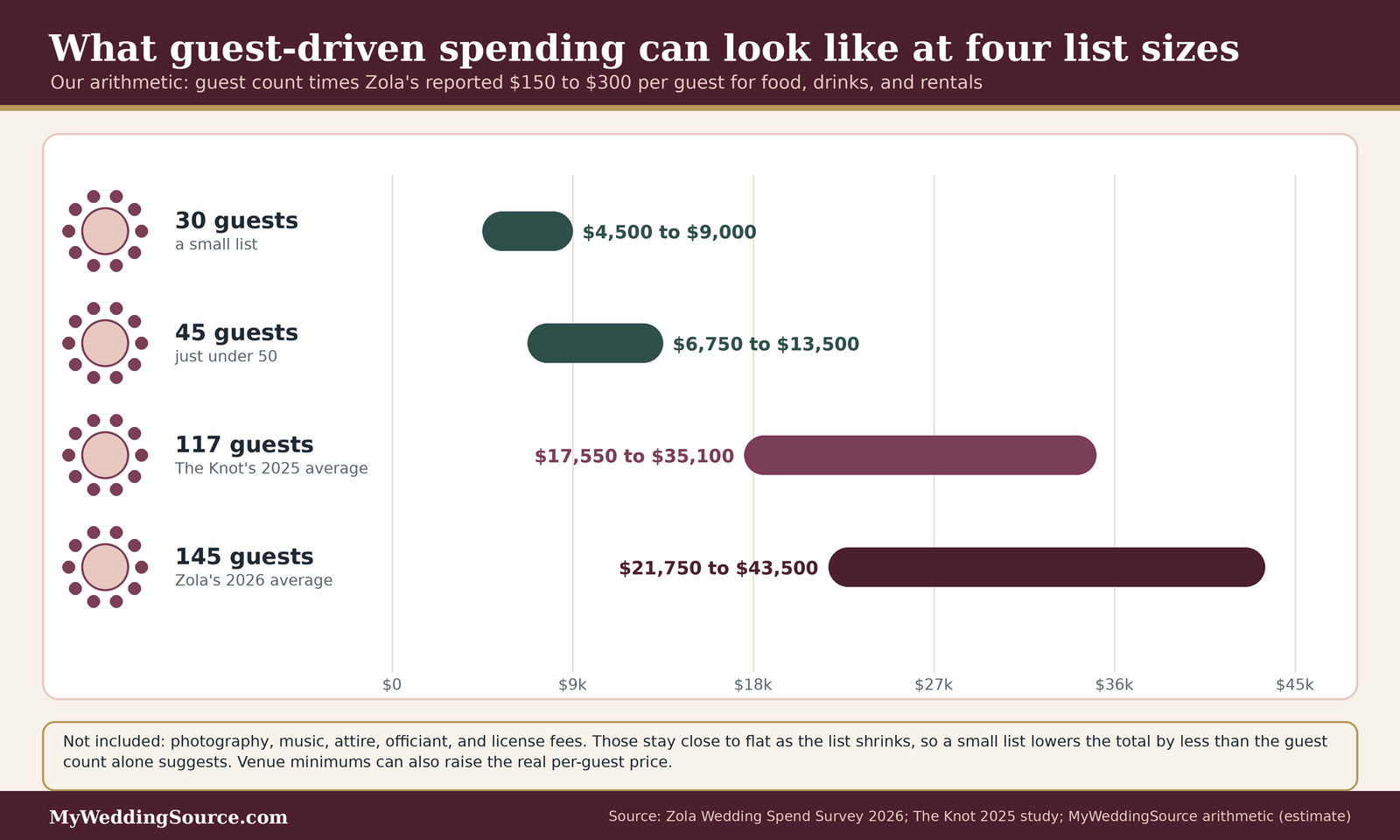
The second figure shows the guest-driven part of that arithmetic. We multiplied four list sizes by Zola’s reported range of $150 to $300 per guest. The result is an estimate that stops at food, drinks, and rentals, so it leaves out everything fixed. Even so, it shows two things. Going from a list of 117 (The Knot’s average) to 45 cuts the guest-driven range from about $17,550 to $35,100 down to about $6,750 to $13,500. And the smallest list does not reduce the total to zero, because the fixed items remain.
Now the worked example. The numbers below are hypothetical and chosen only to show the method. They are not real quotes, and your market will differ.
Suppose Venue A charges a $3,000 site fee and $110 per person for food and drink, adds a 20% service charge on food and drink only, and adds 8% tax on everything. Venue B charges no site fee, has a $6,000 food and beverage minimum, prices food and drink at $85 per person, and adds the same 20% service charge and 8% tax, applied after the minimum. Both are assumptions.
At 40 guests, Venue A comes to $3,000 plus $4,400 for food and drink, plus $880 service, which is $8,280 before tax and $8,942 with tax. That is about $224 per guest. Venue B’s food at 40 guests is $3,400, which is below the minimum, so you pay $6,000, plus $1,200 service, plus tax, for $7,776, or about $194 per guest. Look closer, though: you are paying $150 per guest for food and drink at Venue B ($6,000 divided by 40) even though the menu says $85.
In this small wedding planning example, the two cross near 32 guests. Below that, Venue A is cheaper, because Venue B’s floor is doing the work. Above it, Venue B is cheaper until its per-person cost exceeds the floor at about 71 guests. At 30 guests, Venue A comes to about $7,517 and Venue B to $7,776. At 50, they come to $10,368 and $7,776.
The lesson is not that either venue is better. It is that the “cheaper” venue depends on a headcount threshold, and the threshold is invisible if you only compare menu prices. That is the practical value of normalizing quotes in small wedding planning.
Show where two options tie
Two options tie when the guest-driven and fixed parts offset each other. In the example above, the tie sits at about 32 guests. Ties matter for two reasons. First, if your list is near a tie, a small change in guests, such as one family declining, can flip the result. Second, near a tie the tiebreaker should be something other than price: the light in the room, how easy the drive is, whether the staff seem relaxed about a change of plans.
Ties also arise between categories in small wedding planning. If a florist and a photographer cost about the same for the add-on you want, ask which one you would miss more in ten years. That question is not scientific, but it works better than a spreadsheet when the numbers are equal.
Test the options with contrasting wedding scenarios
Matrices describe patterns, and small wedding planning has plenty of them. Scenarios show the edges. The four below are illustrative. We invented the assumptions to show the logic, they are not data, and they do not describe any real couple.
A small, simple case and a large, complex case
Table 2 sets two simple cases against two complicated ones. In each, the “flip” column names the condition that would change the recommendation.
| Scenario | Assumptions (illustrative) | Recommended approach | What flips it |
|---|---|---|---|
| Simple: a dinner for 14 | Everyone lives within an hour; one private room; a license from a county with a short wait | Book a restaurant’s private room; hire a photographer for a short window; keep the paperwork light | The room’s minimum, divided by 14, exceeds what you want to spend per person |
| Simple: 28 guests, one afternoon | Local list, no children, a venue with per-person pricing | Choose per-person pricing with no floor; spend savings on food and drink | A floor above your count makes a restaurant or a rental house cheaper |
| Complex: 48 guests, half traveling | Ten households flying in; two elderly relatives; three children | Pick a venue with lodging nearby; add a welcome meal; build in slack for delays | Most of the travelers decline early, which makes a local venue simpler |
| Complex: 49 guests, blended families | Four sets of parents; two former-spouse relationships; a strict “family only” rule | Decide the rule first; use consistent invitations; a larger sequel celebration afterward | The rule cannot hold without hurting a relationship you will not trade |
None of the rows is the “right” scenario. Each shows a different path through the same decision. In small wedding planning, the simple cases are mostly governed by venue pricing. The complex ones are governed by people.
The difference is worth taking seriously. A list of 49 is technically small, but 49 people from four families scattered across the country can require more coordination than a list of 90 from one town. Headcount alone does not measure complexity. The Knot’s 2025 data shows average guest counts differing by region, from 140 in the Midwest to 102 in the South and Southeast, and by wedding type, from 123 for hometown weddings to 92 for domestic destination weddings and 69 for international ones. Those averages suggest that where people marry and how far guests travel shape the size of the list at least as much as preference.
Explain why the preferred option changes
Notice what flipped each recommendation. In the simple cases, the flip was a price floor. In the complex cases, the flip was a relationship or a travel constraint. That pattern is the most useful thing to take from the scenarios: price drives the choice when the group is small and close, and people drive it when the group is spread out or complicated.
This helps you decide where to spend your own attention. If your small wedding planning involves a dozen local friends and family, spend your time on quotes. If your list is 45 people on three continents, spend your time on the guest conversations, and let the quotes follow.
The scenarios also show why it is risky to copy another couple’s small wedding planning. A couple with 25 guests who pay $9,000 are not telling you that your 25 guests will cost $9,000. They are telling you what one set of constraints produced. Use their story to generate questions, not answers.
Build a timeline that fits a shorter runway
Small wedding planning often comes with a shorter planning window, and that changes the order of the work. A planner quoted in The Knot’s micro-wedding article, Lauren Miller of Tiny Wedding Co., says the average lead time for her couples is six to eight months, compared with an average engagement of 15 months. She is a vendor describing her own clients, so treat the figure as one professional’s experience and not as a national statistic. It does suggest that many couples doing small wedding planning move faster than the full-size calendar assumes. Our wedding planning timeline gives the full-length version for a larger wedding.
Work backward from the date
With a shorter runway, the useful move is to start from the day and place the fixed points first. Those are the things that cannot be moved: the license window, the venue’s available dates, and the travel time for the people who matter most.
Fix the license window first
A license can expire, and a waiting period can eat days you were counting on. In the two county examples we cited earlier, one license is valid for 60 days after a three-day wait and the other for 90 days from issue. If you book a date that falls outside the window you can actually use, you may need a second appointment. Check the clerk’s page, note the earliest date you can pick up the license and the last date it can be used, and set the ceremony inside that range with a week of slack.
Appointments can be the real bottleneck. San Diego County says it books up to seven weeks ahead and releases a new day each day, which means a couple who waits until the last month may find the preferred day taken. This is one county, but it is a reasonable reminder that the license is a scheduling task with its own calendar, separate from the venue’s.

Place the invitations and save-the-dates
The Knot’s micro-wedding article suggests save-the-dates about eight months before the wedding and invitations about two months before, but it frames this as a typical order for a micro wedding and not as a requirement. If your timeline is shorter than eight months, skip the save-the-date and send a single invitation earlier, perhaps ten to twelve weeks out, with a clear RSVP date. That is our suggestion and not a rule, and you should adjust it if guests need extra time to book travel. For a list this short, a phone call to each household followed by a printed invitation works well.
Add buffers where the decision is hard to reverse
Not every step is equally reversible. A guest list can change until the invitations go out, and then each change gets more awkward. A venue deposit may be non-refundable the moment you pay it. The ceremony location, once publicized, is hard to move. Put your buffers where reversal is expensive.
Lock the list before the first deposit
A risk worth avoiding in small wedding planning is signing a venue contract before the list is final. If you sign for a space that fits 40 and then decide you need to invite 55, you may be in a different room or a different price tier. If you sign for 55 and end up with 35, you may be paying for seats no one fills. In our timeline, we suggest locking the list around seven months out, which is our suggestion and not a statistic. It sits inside the six-to-eight-month lead time a planner described, and it comes before any deposit.
Locking the list in small wedding planning does not mean refusing to adjust. It means agreeing on a range (for example, between 38 and 44) and on the people who are definitely in, and then choosing a venue that is comfortable at both ends. The agreement itself is the product: it tells you what you can promise vendors and family.
Build slack for the last month
In the final month, the work that changes shape is the headcount. Emily Post’s advice on cutoffs is to follow up briefly with guests who have not replied as the deadline approaches, to decide how you will treat late replies, and, if an unexpected guest arrives, to ask the caterer or planner to add a seat and a plate and welcome the person without a lecture. With a list under 50, that means one or two phone calls, a short note to the caterer, and a plan for what happens if two people cancel the week before.
Ask each vendor, before you sign, what their final-count deadline is and what the penalty is for a late change. The answers vary, and they define the real deadline for your list.
Turn the analysis into a rule you can apply for small wedding planning
The sections above give you a way to think. This one gives you a rule, a default for when things are unclear, and the exceptions that override it. The rule is specific to small wedding planning, and it is meant to be used with your own quotes, not copied from ours.
State the threshold or condition that should drive the choice
The central question in small wedding planning is whether the list is small because you chose it or because a constraint forced it. A chosen list is stable. A forced list tends to reopen, usually when a relative objects, so the first test is whether the people who matter agree on the rule.
Give a default when uncertainty remains
If you are unsure, use this default: decide the guest rule first, get three itemized quotes normalized to all-in cost per attending guest, and choose the option that is cheapest at your expected count and not much worse at a count ten percent lower. The ten percent figure is ours, not a standard. It is a way to guard against a floor you cannot see. If a venue is the cheapest at 40 guests but far more expensive at 36, it is less safe than it looks.
For example, imagine you plan for 40 and expect between 36 and 44. Ask each venue for a quote at 36, 40, and 44. If one of them is flat across the range because of a minimum, you know the minimum is binding. If another rises steadily, you know its price follows headcount. Neither is automatically better, but you now know what you are buying.
Also keep a “spend priority” in mind for your small wedding planning. The Knot’s reporting names a premium open bar, a unique venue, and entertainment as places the savings can go. Pick one. A plan that tries to upgrade everything at once can cost far more than you expected.
Name the exception that overrides the default
The default fails when a person, not a price, is the constraint. If a grandparent cannot travel, the venue should be near the grandparent, even if it costs more. If the license rules in your county force a long wait, the date moves, even if the venue is perfect. If a family relationship cannot survive a short list, the list should change, or you should plan a sequel celebration, or you should accept the cost of the strain. We cannot make that call for you, and we do not think there is a universal answer.
A second exception is a venue you love and a floor you can afford. If you can pay a minimum without strain and the place makes you happy, the “inefficiency” of paying for unused seats may be a fair price. The goal is an informed choice, not the lowest number.
Provide the next conversation or data point
Every decision in small wedding planning ends in a conversation or a number you do not have yet. List them now, and assign each to a person and a date.
List who must agree
At a minimum, you and your partner must agree on the rule, the budget target, and which of the two (total cost or quality per guest) you are optimizing. Then decide who else needs a voice. If parents are contributing, Zola’s First Look Report found that 71% of 2026 couples receive some family financial help, and among those, 69% say both families contribute, so money and list size are often discussed together. If someone is paying, their expectations belong in the conversation early, before the list is public.
Next come the people whose attendance shapes the plan: the elderly relative, the guest flying in, the friend who will officiate. Ask them before you book. Their answers may change the venue, the date, or the rule.
List the quote, measurement, or guest information to obtain
From each venue and caterer, get an itemized quote at 36, 40, and 44 guests (or your equivalent), with the minimum, service charge, gratuity, tax, and the final-count deadline written down. From the county clerk, get the license rules, the waiting period, the witness rules, the fee, and the first appointment date. From your guests, get the confirmed list, dietary needs, mobility needs, and travel plans. From your photographer, get hours, deliverables, and the rule on adding time.
Questions to ask before you sign
- Is the minimum a guest count or a dollar amount, and what counts toward it?
- What happens if my headcount falls below it, and when is my final count due?
- Which charges (service, gratuity, tax, setup, delivery) are not in this price?
- What is the room’s posted capacity, and can it hold the ceremony and dinner at once?
- Do you charge less for a weekday or an off-peak date?
- What does the county clerk require for the license, the waiting period, and witnesses?
- If someone cancels in the last month, what changes on the bill?
- Can I see an itemized quote at three different headcounts?
FAQ: small wedding planning questions
Size and definitions
How many guests count as a small wedding?
There is no legal definition, and sources differ. The Knot calls fewer than 50 guests “intimate” in its reporting and defines a micro-wedding as 50 or fewer, with 50 to 100 as small. Zola describes micro weddings as typically 50 or fewer, averaging about 30. Pick the number that matches your list, not a label.
Is a wedding with fewer than 50 guests always cheaper?
No. The Knot reports a lower average for weddings under 50, about $15,000 in its study of 2024 weddings, but it also says a micro-wedding is not automatically cheaper, because premium vendors and bespoke details can raise costs. Minimums can also make the cost per guest higher. Compare quotes at your actual headcount.
Costs and contracts
What is the average guest-driven cost per person?
Zola reports a combined $150 to $300 per guest for food, beverages, and rentals, excluding fixed costs like photography and music. Treat it as a range from survey and vendor data for small wedding planning, not a quote. A venue minimum or a premium menu can put your own figure outside that range, so ask for itemized quotes.
Can a venue charge a minimum if my list is short?
Yes, some do. Wedgewood Weddings, a venue operator, explains that minimums may be a guest count or a dollar amount, and that with a guest-count minimum you pay for the required number even if fewer people attend. Ask what counts toward it and what happens if you fall short before you sign.
Legal and ceremony
How many witnesses do I need for a small wedding?
It depends on your state and county. FindLaw says most jurisdictions require two adult witnesses, but requirements vary. Clark County, Washington, requires two witnesses aged 14 or older, while San Diego County, California, requires at least one for a public license and none for a confidential one. Check your county clerk’s page.
Can we have a small wedding and a bigger party later?
Yes. Zola calls a larger celebration held after a micro wedding, a minimony, or an elopement a “sequel wedding,” and it can happen at any later date. It is one way to include people you could not host at the ceremony. Decide early, so invitations to the first event make the plan clear.
Guests and etiquette
Is it rude to say no plus-ones or no children?
Emily Post says standing by your list is not rude, and that the names on the invitation define who is invited. If someone replies with an uninvited guest or children, it suggests calling to explain your venue size or budget and keeping your decision. Consistency matters because an exception for one family is unfair to the others.
How do I tell someone they are not invited?
Do it early and personally. Zola advises telling people the event is smaller than first planned, and Emily Post advises calling a family you expect to object as soon as you decide, even before invitations go out. Explain the rule briefly without apologizing for it, and consider a livestream or a later celebration for people who matter to you.
Your next steps
Settle the rule
Write the guest rule in one sentence
Put the rule on paper before you talk to anyone: who is in, who is out, and how plus-ones and children are handled. Share it with your partner first, then with the people whose reactions you are worried about. Our wedding etiquette guide can help with the hardest conversations.
Set the budget target
Decide whether you are trying to lower the total or raise the quality per guest, then use our wedding budget calculator to turn that target into a number you can compare with quotes.
Collect the numbers
Get three normalized quotes
Ask each venue and caterer for an itemized quote at three headcounts and divide by attending guests. For the wider plan, use our plan your wedding overview and our wedding planning checklist.
Confirm the license and the witnesses
Read your county clerk’s page, note the waiting period and the validity window, and book the first appointment that fits. Then see our marriage license guide for what to bring.
Sources & methodology
How we built this guide
What we relied on
This guide combines two national wedding-cost and guest-count surveys from The Knot and Zola, planner and venue explanations of how minimums and micro weddings work, Emily Post’s etiquette guidance, a general legal summary of witness requirements, and the license pages of two county governments. Where a statement comes from a vendor, we say so, because vendors describe their own products and clients. Survey figures are reported averages with the methodology described by the publisher. The per-guest ranges, the percentage comparisons, and the venue worked example are our own arithmetic, built on stated assumptions. They are estimates, and the venue example is hypothetical.
What we did not do
We did not collect our own survey data, obtain real vendor quotes, or test any venue. We did not verify every state’s license rules, and we cite two counties only as examples. This is general information and not legal or financial advice. Check your own county clerk, read your contracts, and ask vendors for itemized quotes in writing.
Source list
Government and legal sources
- Clark County, Washington, Auditor, Marriage License: https://clark.wa.gov/auditor/marriage-license
- San Diego County Assessor/Recorder/County Clerk, Marriages: https://www.sdarcc.gov/marriages/
- FindLaw, Marriage license and witness requirements (general summary): https://www.findlaw.com/?p=210913
Surveys, etiquette, and industry sources
- The Knot, Average wedding guest list size (Real Weddings Study, couples married in 2025): https://theknot.com/content/average-wedding-guest-list-size
- The Knot, Study of 2024 weddings as reported by Fox 13, Wedding season is here: How much will one cost in 2025?: https://www.fox13news.com/news/average-wedding-cost-2025-the-knot
- The Knot, What is a micro-wedding? (updated May 2024): https://theknot.com/content/what-is-a-microwedding
- Zola, Average cost of weddings in 2026 (Wedding Spend Survey): https://www.zola.com/expert-advice/how-much-does-a-wedding-cost
- Zola, 2026 wedding trends: First Look Report: https://www.zola.com/expert-advice/the-first-look-report-2026
- Zola, Micro weddings: https://www.zola.com/expert-advice/micro-weddings
- Emily Post Institute, Inside weddings: handling your guests with grace: https://emilypost.com/advice/inside-weddings-handling-your-guests-with-grace
- Wedgewood Weddings, What is a minimum?: https://wedgewoodweddings.com/blog/what-minimum