
Wedding rental damage waivers are a fee you pay the rental company so that ordinary accidents, like a broken glass or a stained napkin, do not turn into itemized charges, but the waiver is not insurance, it rarely covers everything, and the only way to know what yours does is to read the clause and ask a few specific questions.
Quick answer
In the rental terms we read, wedding rental damage waivers were priced at roughly 3.5% to 13% of the rental order, covered accidental, minor damage from ordinary use, and left missing items, neglect, misuse, and weather damage with the customer. Some are optional and some are built in. Whether to buy one comes down to arithmetic you can do in ten minutes: the fee in dollars, compared with the damage you would realistically have to pay for without it. This guide gives you a clause decoder and an exposure worksheet to do exactly that. It is general information, not legal or insurance advice.
What wedding rental damage waivers are and are not
When a rental order is mostly glassware, china, linens, chairs, and tables, something will get chipped, stained, or scuffed. A damage waiver is the rental company’s way of deciding in advance who pays for that. Understanding the idea clearly, before you look at any price, makes the contract language much easier to read.
A fee, not an insurance policy
The most common misunderstanding about wedding rental damage waivers is the word itself. People hear “waiver” and “protection” and assume an insurer stands behind it. In most cases no insurer does.
Who actually carries the risk
A software company that serves the rental industry describes a damage waiver as a flat, non-refundable fee paid at booking, in return for which the rental business absorbs the cost of accidental damage to its own items. The business keeps the fee whether or not anything breaks. The same source points out that with real insurance a licensed insurer takes on the risk and pays claims under a policy, while a waiver is a private agreement between the company and the customer with no insurance company or state insurance regulator involved. In plain terms, you are paying the rental company to be generous about accidents, and the extent of that generosity is whatever its contract says.
Why the wording matters to you
A rental-business blog notes that companies should avoid implying a waiver is insurance, and that the fee works as a benefit to the client. That is a useful clue for couples. If a quote says “damage protection” or “accidental damage waiver,” treat it as a contract term that you can read, not as a policy with a claims department. Anything the clause does not promise, you should assume it does not provide. This is also why vague wedding rental damage waivers lead to arguments after the event: the customer remembers “coverage,” and the company remembers a list of exclusions.
Where a waiver sits among the other layers
A rental order is protected, or not protected, by several layers at once. Wedding rental damage waivers are only one of them, and it is easy to mistake it for the whole stack.
The three layers in plain language
The first layer is the rental agreement itself, which says who is responsible for the equipment and for how long. One company in our sample states that the customer is responsible from the time items are delivered until they are returned. The second layer is the damage waiver, which carves out a category of accidents and forgives them for a fee. The third layer is insurance you carry, such as a special event policy or a homeowners policy, which may or may not touch rented property. We cover that third layer in detail later, and our guide to wedding insurance explains cancellation and liability coverage more broadly.
The gap between layers
The risk for couples lives in the gaps. A waiver may exclude theft, but your insurance may not cover rented equipment either. A liability policy may cover a guest’s injury but not the chairs themselves, as we will see. Your job is not to find a perfect layer. It is to know which events fall through all three, so that you can plan for them directly, for example by adding supervision at the end of the night or by storing rentals indoors.
What this guide covers and how we checked it
We wanted to avoid inventing a universal answer about wedding rental damage waivers, because none exists. Every company writes its own waiver, so we read what several published and compared them.
The examples we used
We read the published damage waiver language and rental terms of four U.S. rental companies, an event-rental software company’s explanation of waivers, a rental-industry blog on handling damage, an insurance-industry explanation of how rented equipment is covered, and consumer-protection and insurance-regulator material on vendor contracts and event insurance. Where a statement comes from a specific company, we say so, because a company describing its own policy is describing its own products and risk appetite. The dollar examples are our own arithmetic on an imaginary order, labeled as estimates.
What “typical” means here
When we write that a waiver “typically” covers something, we mean that it appeared in the terms we read, not that every company does it. Some companies in our sample bundle the fee into every order, some make it optional, one covers only part of the cost, and one reports a different percentage by product line. Treat every pattern in this guide as a prompt for a question to your own rental company, and treat your signed agreement as the final word. If a contract dispute is serious, a licensed attorney in your state is the right person to read it.
How wedding rental damage waivers are priced
The fee is usually shown as a percentage of the order, which hides how large it becomes on a big rental. A little arithmetic turns the percentage into a number you can compare with the risk.
The percentages published by rental companies
Companies publish the rates for wedding rental damage waivers differently, so it helps to line them up. The figures below are the rates each company describes for itself, not an industry standard.
What we found
Among the wedding rental damage waivers we read, one company states its damage waiver fee is 3.5% of the gross rental order. Another says its waiver runs 6.5% to 9%, depending on product line. A third lists an optional fee of 9% of the rental price, and a fourth lists an optional 10% of the rental cost. A rental-software company describes waivers as commonly priced around 8% to 15%, and a rental-industry blog says the fee is often 10% to 13% of the rental total. Those last two are general descriptions from sources that serve rental businesses, not prices you can count on from your own company.
Turning percentages into dollars
To see what that means, imagine a rental order of $4,000 (our assumption, chosen only because it is easy to scale). At 3.5% the fee would be about $140. At 6.5% it would be $260, at 9% about $360, at 10% $400, and at 13% about $520. The range from lowest to highest is nearly four times. That is an estimate from simple multiplication, and your real order, taxes, and rounding will differ.

Optional or built in
Some wedding rental damage waivers appear as a checkbox, and some appear as a line item you cannot remove. The difference changes how you shop for wedding rental damage waivers.
When it is optional
One company says its waiver is optional but recommended, and another lets the customer accept or decline. The template language we read has the customer initial to accept or decline. If you decline, one company says you pay full repair or replacement for any damage, and the software company’s template says a renter who declines is responsible for damage up to the full replacement value. That is an important detail: declining does not leave you at zero risk, it leaves you with the full bill.
When it is part of the price
Another company describes its fee as non-refundable, taxable, and one that cannot be waived or removed. In that case there is no decision to make about whether to buy the waiver. Your decision is whether the company’s total price, including the fee, is competitive with another company’s price. When you compare quotes, compare them after the waiver fee is added, or you may think one company is cheaper when it is simply listing the fee separately. Our wedding rental planning checklist suggests collecting quotes in a way that makes this comparison easy.
What the fee is a percentage of
The base number matters as much as the percentage. A small difference in what the percentage applies to can change the dollar fee.
Gross order, rental price, or only some items
The wording varies: “gross rental order,” “rental price,” “rental cost,” and “rental total” all appeared in the terms we read. One company says its fee does not apply to sale items or services. Ask whether delivery, setup, labor, and sales items are inside the base. If your order includes a lot of delivery and setup labor, the answer can shift the fee noticeably.
Tax, refunds, and timing
One company says its fee is taxable. Several describe it as non-refundable. That means that if you reduce the order later, you may not get the fee back for the part you removed, and you should ask how the fee is recalculated if the guest count or item list changes. If you are still adjusting the order, our guide to counting extra rental chairs for ceremony and reception resets can help you settle quantities before the fee is locked in.
What this actually costs
On an imaginary $4,000 order, the fee ranges from about $140 at 3.5% to about $520 at 13% (our estimate). The figure that matters is not the percentage but the dollar fee compared with the damage you would plausibly pay for without it. We show the break-even arithmetic below. We have not published a typical damage bill, because the sources we read did not publish one, and inventing one would be misleading.
What wedding rental damage waivers typically cover
Read generously, most wedding rental damage waivers are about the small, accidental, ordinary-use problems that happen at almost every event. The details of the wording decide how generous they really are.
Accidental breakage during ordinary use
The clearest, most consistent category in the terms we read is breakage that happens while the items are doing their normal job.
Glassware, china, and the everyday chip
One company lists broken glassware or china, stained linens, dented trays, and scratched flatware as minor damage its waiver covers. Another waiver describes covering minor accidental breakage and normal wear. These match what most couples expect: a champagne flute slips from a guest’s hand, a plate chips during cleanup, a fork gets scratched. If glassware is a big part of your order, our guide to wedding bar glassware rental is a good companion read.
Trays, serving pieces, and small equipment
Dented trays and scratched serving pieces appear in the same lists. The practical point is that the waiver tends to describe categories of minor damage, not a full inventory, so ask whether your specific item types, such as chafing dishes, serving utensils, or glass beverage dispensers, are in the covered category.
Stains and wear on soft goods
Linens deserve their own attention because they are the item most couples worry about, and the answer varies by company and by the type of stain.
Linens and napkins
One company treats stains on linens, chairs, and similar items as minor damage if they can be treated when the items are processed back in, and describes minor treatable stains as covered by its waiver. Another company lists stained linens among covered damage. A third company, however, says its waiver does not cover stains from food or drinks. Those statements come from different companies, which is exactly why you should ask about yours. A phrase like “treatable stain” turns on the company’s judgment after the event.
Wear and the line with normal cleaning
A rental-industry blog explains that expected cleaning is usually built into the base price, while broken parts, stains, and work such as refinishing a table count as damage. Ask where your company draws that line. A table wiped clean of residue is different from a table that needs refinishing, and a waiver that treats both the same way is rare.
Partial coverage structures
Not every waiver forgives everything. Some forgive a portion, and that changes the arithmetic.
Percentage and dollar limits
One company’s optional waiver, priced at 10% of the rental cost, is described as covering 80% of the repair or replacement cost of accidentally damaged items, up to $5,000. That means you would still pay the remaining 20%, and any amount past the limit. A waiver written this way is closer to a cost-sharing arrangement than a full forgiveness, and we show the effect on the break-even point below.
What is not stated
The software company’s template language that we read did not set a deductible or a reporting deadline for damage. That is a reminder that many waivers are short. If yours is silent on a point, such as a deductible, a cap, or how fast you must report, ask for the answer in writing instead of assuming it favors you.
What wedding rental damage waivers typically leave with you
This is the part of the contract that matters most when something goes wrong, and it is the part that is easiest to skim. The exclusions in the terms we read for wedding rental damage waivers were consistent enough to group into four families.
Missing, stolen, and unaccounted-for items
A damage waiver is about damage. Items that disappear are a different problem.
Counts in and counts out
One company says its fee does not cover theft or missing equipment. Another says the customer is responsible for missing items, that items are counted out and back in by order number, and that unrecovered items can be invoiced with recovery costs. The practical implication is that a missing chair, a missing box of flatware, or a missing linen bag can cost you more than a broken glass, and the waiver will not help. Our guide to returning wedding rentals after a Sunday reception walks through the return day.
Unsecured items and unclear custody
One company lists stolen, unsecured items among the major-damage categories that stay with the customer. If the cleanup crew leaves rentals stacked outside overnight, or guests take centerpieces home, the loss may be yours. Decide who has custody at each stage, and write it down.
Neglect, weather, and misuse
The most detailed exclusions are about how the items were treated. They are not about accidents but about decisions.
Items left outdoors
Two companies in our sample exclude damage from leaving items out in bad weather. One lists broken, wet, muddy, sandy, or corroded equipment from being left unprotected outdoors as major damage and says it does not supply tarps. The same company says furniture cannot be placed near the open sides of a tent. These are common sense, but they matter for outdoor weddings, where the plan for storing rentals overnight or during a storm is easy to forget.
Misuse, fire, and wax
Misuse is excluded almost everywhere. One company gives the example of using a chair as a ladder. Another lists burn holes and wax as major damage, along with returning items soiled with bodily fluids or makeup, a full crate or rack of broken china or glassware, excessive tearing, and stickers or adhesive labels on chairs. A third waiver excludes burn or fire damage and damage caused by pets. If your reception includes candles, sparklers, or flameless alternatives, our guide to wedding table settings can help you plan the tabletop around the rules.

Conditions that can undo the waiver
Even covered damage can fall outside the waiver if a condition in the contract is not met.
Return condition and cleaning
The company with the 3.5% fee excludes damage to motors or electrical appliances caused by incorrect voltage or current. Another company requires china, glassware, flatware, and cooking equipment to be scraped clean and not written on, and linens to be returned in provided bags free of food and confetti. The point is that the waiver sits on top of return rules, and breaking the return rules can reclassify ordinary damage as something else.
Reporting and returning broken equipment
One company says that to use its waiver, broken equipment must be returned. Another requires that missing or damaged items be reported with photos before the event begins, and says that if you do not contact the company directly about a problem you may not be eligible for a refund or discount. A third says equipment from tent rentals must be inspected at installation and problems reported immediately. These conditions are easy to meet if you know about them and easy to miss if you do not.
The wedding rental damage waivers decoder, clause by clause
This is the first of two tools in this guide. Every one of the wedding rental damage waivers we read is built from the same few moving parts. If you can name them, you can read any contract in a few minutes and know which questions are worth asking.
The five parts of every waiver
Wedding rental damage waivers vary in length, but nearly every one answers the same five questions, whether or not it does so clearly. When one of the five is missing, that is where disputes start.
Trigger and scope: what kind of damage counts
The trigger is the word or phrase that decides what the waiver forgives. In the terms we read, triggers included “accidental damage,” “minor damage from normal use,” “minor accidental breakage,” and “normal wear and tear.” The scope is the list of examples that follows. Look for whether the examples are a complete list or a sample. A list that begins “such as” is a sample, and the company decides the rest.
Limits and sharing: how much is forgiven
Limits include percentages, dollar caps, and deductibles. One company in our sample covers 80% up to $5,000. Others forgive the whole cost of covered damage. A third kind of limit is a category limit: a full crate of broken china may be excluded even though one broken plate is not. Whenever a waiver mentions “major damage,” ask what the dividing line is, in dollars or in a count of items.
Exclusions: what is never forgiven
Exclusions are the list of things that stay with you. From the terms we read, the recurring ones are theft or missing items, negligence or misuse, intentional damage, damage from weather exposure, burns and wax, pet damage, food and drink stains in one case, and damage from using equipment in an unintended way. The software company advises spelling exclusions clearly because vague language leads to disputes, which is a fair standard to hold your own company to.
Conditions: what you must do for it to apply
Conditions are the actions the waiver depends on, such as returning broken items, reporting damage with photos, cleaning items before return, or keeping rentals sheltered. Missing a condition can reclassify the damage. Check conditions with the same care as exclusions, because they are easier to meet and easier to forget.
Cost and timing: when you pay and what you get back
This part covers the fee, the base it applies to, whether it is taxable, whether it is refundable, and when it must be added. One company’s separate weather waiver, for example, must be added in advance planning and costs more if added later. Ask whether wedding rental damage waivers at your company also have a deadline.
The decoder table
Use the table below as a reading aid. Find a phrase in your contract in the left column, read what it can mean, and use the right column as your question. The meanings are our plain-language reading of how the phrases appeared in the sourced terms, not legal definitions.
How to use the table
Print your rental agreement and a pen. Underline each phrase in the table that appears. Write the company’s answer in the margin, and keep the annotated copy with your receipts. If the answer changes anything, ask for the change in writing, as the Wisconsin Department of Agriculture, Trade and Consumer Protection advises for vendor policies in general.
| Phrase in the contract | What it can mean | Question to ask |
|---|---|---|
| “Accidental damage” | Damage that happens while items are used as intended | What is an example of damage that is not accidental? |
| “Normal wear and tear” | Some small marks are expected, but the company decides what is normal | Can you give examples of wear that is not charged? |
| “Minor damage” | A category limited by size or count | Is there a dollar or item-count line between minor and major? |
| “Such as” followed by a list | A sample of covered items, not a complete list | Are chafing dishes, serving pieces, and glass dispensers included? |
| “Major damage” | Damage that stays with the customer | Does a full rack of broken glassware count as major? |
| “Misuse or negligence” | Use outside the intended purpose, or failure to take reasonable care | Does leaving chairs on the lawn overnight count? |
| “Stains” | May or may not be covered, depending on the type and whether they can be treated | Which stains are covered, and who decides? |
| “Burn, fire, or wax” | Often excluded outright | Are candles on rented tables allowed, and with what holders? |
| “Missing or unaccounted-for items” | Not damage, so not covered | When and how are items counted in and out? |
| “From delivery until return” | You hold responsibility during the entire window | Who is responsible while items are staged but not yet in use? |
| “Must be reported” | A condition for coverage or credit | By when, to whom, and with what proof? |
| “Percent of cost, up to a limit” | You pay the rest | What would I pay on a sample damage amount? |
| “Non-refundable” | The fee stays if the order shrinks | How is the fee recalculated if the item list changes? |
| “Company’s discretion” | The company makes the final call on repair, replacement, or charges | Is there a written schedule of replacement prices? |
What to do with the answers
Sort the answers into three piles: clear and acceptable, clear but not acceptable, and still unclear. The first pile needs nothing more. The second is a reason to negotiate, to shop elsewhere, or to plan around a term you cannot change. The third is your follow-up email, and it should be sent before you pay a deposit, not after the event, so that the answers to your questions about wedding rental damage waivers are in writing.
Reading red flags and green flags
You do not need to be a lawyer to tell clear wedding rental damage waivers from murky ones. Clear ones tend to share a few habits.
Wording that should prompt questions
Be careful with a waiver that never defines “damage,” never lists exclusions, uses the word “insurance” or “coverage” without naming an insurer, or leaves the replacement price to the company’s discretion with no schedule. The rental-industry blog we read says companies must clearly explain what is forgiven and what the client will still pay for, since unclear terms can make clients feel nickel-and-dimed. If your contract does not do that, you can ask the company to, which is a fair request for any company that sells wedding rental damage waivers.
Wording that signals a clear policy
Look for named examples, defined limits, stated conditions, and plain language about what happens if you decline. One company’s contract points to separate sections for weather, damage, and cleaning, and describes dollar limits and time limits for each. You may not love every term, but you can plan around them. That is the point of wedding rental damage waivers: a known, priced rule is better than an argument about what was fair.
Should you buy it? The exposure worksheet
This is the second tool. It turns the decision about wedding rental damage waivers from a feeling into a calculation, so that you decide with numbers instead of with pressure at checkout. It is general planning, not financial advice.
Step one: sort the order by how likely each item is to be damaged
Not every line of an order is equally likely to cause a bill. Sorting first keeps the later arithmetic honest.
Group items by how they are handled
Group items by who touches them and how often. Glassware that is carried, cleared, and washed by a catering team goes through more hands than tables that are set once. Linens near candles and food face stain risk. Chairs face scuffs, and outdoor items face weather. Our guides to lounge furniture rentals and the dance floor rental over grass are useful if either is on your order.
Note who is responsible at each stage
For each group, write down who handles it: your caterer, your venue, a planner, your family, or the rental company’s own delivery crew. If an outside caterer handles the glassware, ask in your caterer contract who pays for breakage, because the waiver may not follow your agreement with the caterer. Our guide to wedding vendor subcontractors can help you ask about handoffs.
Step two: do the break-even arithmetic
The fee is certain. The damage is not. The break-even point is the amount of damage at which the fee would have been worth paying.
A waiver that forgives all covered damage
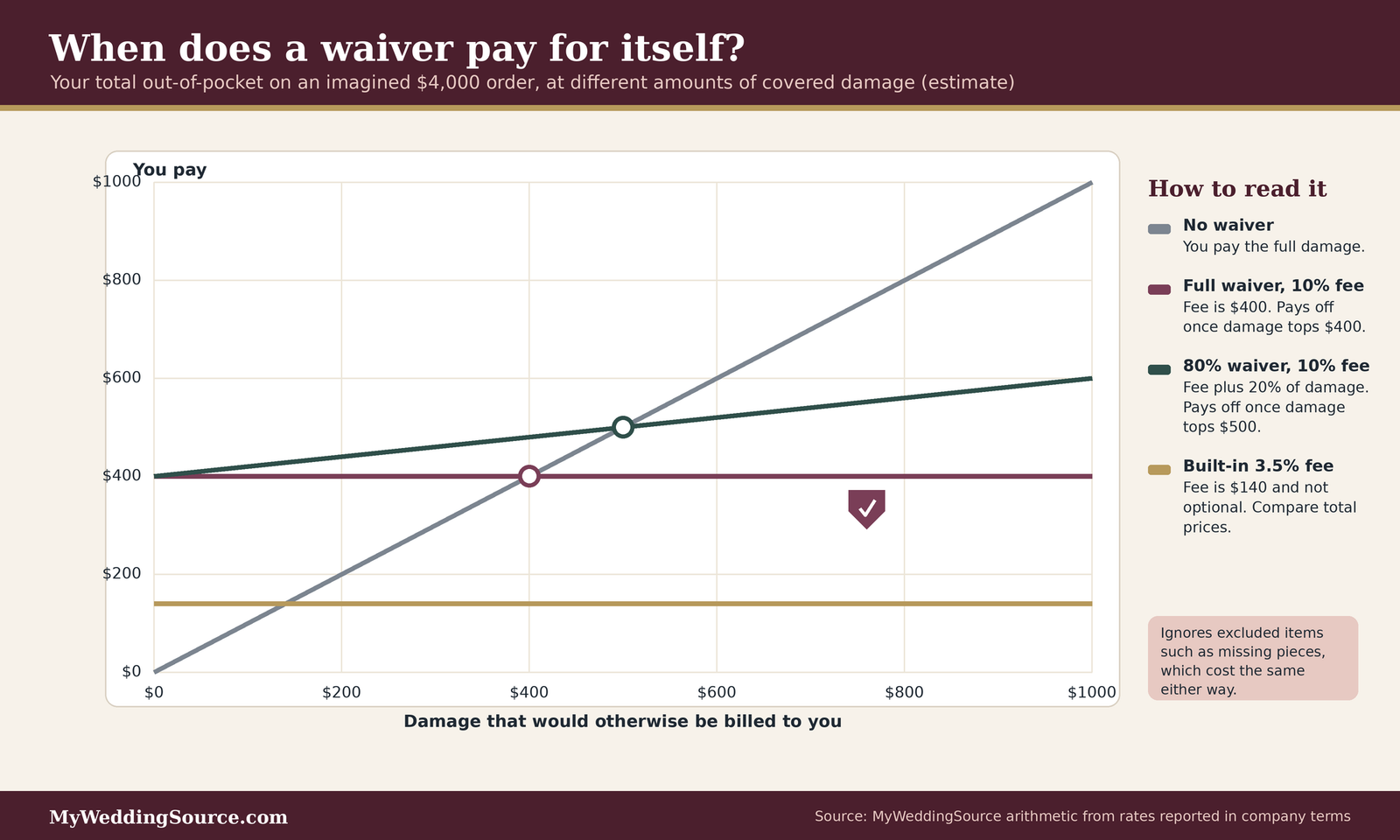
If the waiver forgives all covered damage, the break-even is simply the fee. On an imaginary $4,000 order at 10%, the fee is $400. If you expect covered damage to be less than $400, you would likely pay less by declining, and if it is more, you would pay less by buying. That is our arithmetic, not a prediction, and it ignores any damage that is excluded. A waiver that is mandatory, like the 3.5% fee one company describes, removes the choice, so the useful question becomes whether the total price is competitive.
A waiver that forgives only part of the cost
With the 80% structure one company describes, the fee is $400 plus 20% of any damage, up to the stated limit. Without the waiver you pay the full damage. Setting D as the damage, buying is cheaper when D is greater than 400 plus 0.2 times D, which works out to D greater than $500. That is 12.5% of the order. Our estimate shows a partial waiver needs more damage to pay off than a full one at the same price. The $5,000 limit stated by that company would matter only for very large damage.
Step three: count what the waiver never touches
The most valuable half of the worksheet is the half that wedding rental damage waivers do not change.
Exposures that stay with you either way
List everything the contract excludes that could plausibly happen at your wedding: missing items, outdoor storage, candle wax, burn holes, guests or kids using chairs improperly, a lost linen bag, a late return, a full crate dropped. These risks are the same with or without the waiver, so they are not a reason to buy it. They are a reason to plan, which we cover in the edge-case and documentation sections.
Exposures that may belong to someone else
Some of these risks may be covered by another layer. A special event policy may include an optional add-on for rented equipment or furniture, and a caterer may carry its own coverage. If a plan relies on someone else, confirm it in writing before the event, not after.
Fill in the worksheet
The table below turns the three steps into a page you can complete with your rental quote in hand. Fill in every line, even if the answer is “unknown,” because the unknowns are your question list.
The worksheet
| Item group | Order subtotal | Who handles it | Realistic damage risk (low, medium, high) | Covered by the waiver as written? | Excluded exposures to plan for |
|---|---|---|---|---|---|
| Glassware and china | Full racks, missing pieces | ||||
| Flatware and serving pieces | Missing counts, scratches beyond wear | ||||
| Linens and napkins | Wax, burns, food or drink stains, makeup | ||||
| Chairs and tables | Stickers, outdoor storage, misuse | ||||
| Lounge or specialty furniture | Fabric stains, sun, moisture | ||||
| Tent, flooring, and outdoor items | Wind, rain, mud, unprotected storage | ||||
| Electrical or powered items | Voltage and misuse | ||||
| Totals |
Below the table, write four numbers: the waiver fee in dollars, the break-even damage amount for the waiver as written, the damage amount you consider realistic for your event, and the dollar value of the excluded exposures you will manage another way.
How to read your result
If the realistic damage is well below the break-even, one of these wedding rental damage waivers is likely a cost rather than a benefit for you, though you may still want it for peace of mind, and that is a legitimate reason. If the realistic damage is near or above the break-even, buying looks more sensible. If the excluded exposures are large, the answer on the waiver matters less than your plan for those exposures. Your risk is also more than arithmetic: a weekend with ten dozen glasses in the hands of guests differs from a small seated dinner.
Waivers, insurance, and who else might pay
Wedding rental damage waivers are only one possible payer. Knowing the others helps you avoid paying twice or discovering a gap too late. This section is general information. For advice on your own coverage, ask a licensed insurance agent in your state.
Event liability and rented equipment
Many couples assume an event insurance policy will cover rented items. The sources we read suggest it depends on the policy, and the default may not be what you expect.
What liability coverage is designed for
An insurance-industry explainer says event liability insurance does not cover theft of or damage to equipment the organizer rents from a third party, though it does cover the organizer’s legal responsibility if the use of rented equipment injures a guest or damages the venue. Its example is that damage to the rented chairs themselves is not covered, but damage to the venue floor from dragging them is. The National Association of Insurance Commissioners describes event insurance as typically covering cancellation, liability, personal injury, property damage, and liquor liability.
Optional add-ons for rented items
The same regulator-association resource lists damage to rented equipment or furniture as an optional add-on. An insurer’s consumer page says its property damage coverage applies to rented equipment accidentally damaged during an event, with a sound system a guest knocks over as the example. Another insurer’s wedding page lists reimbursement for property and equipment rentals if a wedding is canceled or postponed, but does not say whether damage to rented items is covered. The lesson is not that one answer is right. It is that policies differ, so ask for the policy wording and ask the agent specifically about rented property. Our overview of wedding insurance gives the broader picture.
Homeowners and renters policies
Some couples assume their existing policy follows them to the wedding and makes wedding rental damage waivers unnecessary. The honest answer is that insurance professionals disagree about it.
What professionals debate
An insurance trade magazine article collects views on whether a homeowners policy’s liability coverage extends to a rented reception site. Several contributors think it likely does for a personal event, citing a definition of an insured location that includes premises occasionally rented for non-business use. Another contributor says one standard form does not cover a rented event space. The article does not give one answer, and it concerns liability, not damage to the rented items themselves.
What to ask your own agent
The regulator-association page suggests confirming that your homeowners or renters policy extends to a scheduled event and checking coverage limits. Ask your agent whether it covers liability at a rented location, whether it covers damage to rented property in your care, and whether a rider is available. Ask them to confirm in writing. If you are hosting at home, the same resource suggests checking that liability and property damage coverage are adequate, especially if alcohol will be served.
Venue-provided furniture and venue rules
Not every rented-looking item comes from a rental company. Tables and chairs that come with the venue follow the venue’s contract.
Items included with the venue
The insurance explainer we read says tables, chairs, and similar items provided with a venue rental are generally covered by the event policy, and that those claims are often approved. That is the insurer’s description, so check the venue’s own terms for who pays for damage to its items. Our list of venue questions is a good base for your tour, and you can add the insurance and damage questions from this guide.
Requirements that touch your rental order
Some venues require a certain level of liability coverage or ask to be named as an additional insured, as the NAIC page notes. If your venue has requirements, confirm whether outside rentals are allowed, who may install them, and what the venue expects regarding damage to floors and walls. For the wider budget picture, see our guide to wedding venue cost.
Edge cases that decide who pays
The standard cases for wedding rental damage waivers are easy. The expensive disputes tend to happen at the edges, where two rules meet or where a plan changes at the last minute.
Tents, wind, and rain
Outdoor setups combine weather, heavy equipment, and the strictest terms.
Weather plans and clear-out rules
One company’s terms say that for tent rentals the customer is solely responsible for managing severe weather and needs backup plans, and that if winds reach 38 mph or higher or lightning occurs, all tents must be cleared immediately. The same terms say the customer is responsible for weather-related damage to landscaping and hardscaping. Another company sells a separate weather waiver that lets customers reschedule or swap items for a fee. A damage waiver is not a weather waiver, and you should not assume one covers the other.
Protecting furniture from the elements
The company that does not supply tarps also says furniture cannot sit near the open sides of a tent. If rain is possible, plan where chairs, linens, and lounge pieces go during setup, during the event, and overnight. If powered equipment is on your order, see our wedding generator rental guide.
Candles, food, and guest behavior
Many damage disputes begin as a decision at the table. They end as an invoice.
Open flames and wax
Wax on equipment and burn holes were classified as major damage in the terms of one company, and another waiver excludes burn or fire damage. If you want candles, ask whether the company allows them on its linens and tables, and which holders it recommends. Flameless candles avoid the problem entirely.
Stickers, writing, and decor attachments
The same company lists stickers or adhesive labels on chairs as major damage and says china and glassware cannot have writing on them. Signs, chair decor, and table numbers are common sources of this problem. If you are choosing signs or tableware, see our guides to wedding table number stands and wedding charger plates.
Multiple vendors and handoffs
The more hands touch the order, the harder it is to say who caused a problem.
When the caterer or planner handles rentals
If a caterer or planner orders or handles the rentals, ask whose contract governs damage, who signs the waiver, and who receives the invoice. A document you never saw may still decide who pays. Our wedding vendor contract guide is the place to start on responsibility clauses, and a legal information site notes that some vendors make clients responsible for damages caused by guests.
Liability releases are a different document
You may be asked to sign a liability release or an indemnification clause along with the rental agreement. One legal information article explains that a release generally means agreeing not to sue for accidents, and that indemnification can make you responsible for defending the vendor if a guest sues. Those documents are about injuries and lawsuits. They are separate from a damage waiver, which is about equipment. If a document confuses you, a licensed attorney can explain it.
Late returns, deposits, and invoices
The event ends, but the contract keeps running.
Late returns and extra days
One company charges extended rental for items returned late, and another describes damage invoices for tent equipment as due within 10 days. If you plan a Sunday return, read the return window carefully, and compare it with our guide on returning wedding rentals after a Sunday reception.
Deposits and how to pay
The Wisconsin consumer protection agency advises keeping upfront payments as low as possible and considering a credit card, which may help if something goes wrong. A rental-industry blog says some companies take a security deposit and refund what remains after damage is assessed, instead of charging a waiver. If your company offers both, compare them using the worksheet.
Documenting condition before, during, and after
Documentation is free, takes minutes, and is the strongest tool you have if a disagreement over wedding rental damage waivers happens. It matters whether or not you buy one of the wedding rental damage waivers on offer.
At delivery
The first hour after delivery is the best moment to establish the baseline.
Count and photograph
Count each item against the order and take dated photographs of any existing stains, chips, or scuffs. One company’s terms ask that missing or damaged items be reported with photos before the event begins, and another says tent equipment must be inspected at installation. Send your photos by email so they have a timestamp.
Confirm the condition standard
A rental-industry blog says staff need to know the condition standard for the collection. Ask the delivery crew to note any item they consider already worn, and ask for a signed or emailed delivery receipt. Keep it with your contract and our wedding vendor timeline.
During the event
You do not need to guard your rentals, but someone should own the plan.
Name one person for rentals
Choose one person, such as a planner, day-of coordinator, or a trusted friend, who knows the return rules, the exclusions, and who to call. A caterer cleanup crew may not know the rental terms unless someone tells them. Our guide on the wedding vendor due diligence checklist helps with this kind of handoff.
Report problems when they happen
If equipment breaks or becomes unsafe, tell the company right away. One company’s terms say that for tents you must stop using unsafe equipment and report the problem within an hour, and another says that if you do not contact the company directly you may not be eligible for a refund or discount. Photograph the problem before anyone cleans it up.
At pickup and after
The final count is where waivers and disputes meet.
Pack and count out
Follow the return rules: scrape and stack dishes, bag linens, protect items from weather, and count items out by order number. Take photographs of the packed items. Ask the crew to sign or email the count.
If you receive a damage invoice
Ask for an itemized list with photographs, the waiver clause the company is relying on, and the replacement price schedule. Compare the list with your delivery photos and counts. If the charge seems wrong, respond in writing, politely and specifically. If the dispute is large, consider consulting a licensed attorney or your state consumer protection office. We cannot advise on a particular dispute.
Questions to ask before you sign
Good questions about wedding rental damage waivers are short and specific, and each one maps to a part of the decoder. Ask for the answers in writing and keep them with your contract.
Questions worth asking about wedding rental damage waivers
- Is the damage waiver optional, and what do I owe if I decline?
- What exactly is the fee a percentage of, and is it taxable or refundable?
- Does the waiver cover all of the cost of covered damage, or a percentage up to a limit?
- What is an example of minor damage, and what is an example of major damage?
- Are stains covered, and which kinds, and who decides whether they are treatable?
- What happens with missing items, and how are items counted in and out?
- Which conditions must I meet, including cleaning, reporting, and returning broken items?
- Who is responsible if a caterer, planner, or venue staff member causes the damage?
About the waiver
These questions pin down what the fee actually buys.
Scope, limits, and deductibles
Ask for the clause in writing, since wedding rental damage waivers differ from company to company. Ask whether it has a dollar limit, a percentage share, or a deductible. Ask for two examples of covered damage and two of excluded damage that match your order. If the company cannot give examples, that tells you something.
Cost and timing
Ask whether the fee changes if the order changes, when it must be added, and whether it appears on the invoice as a separate line. Ask whether the price you were quoted includes it.
About the order and the return
These questions cover everything the waiver does not.
Counts, custody, and return rules
Ask how items are counted at delivery and pickup, how late returns are charged, and what return condition is required. Ask who is responsible while items are staged. Ask whether you may store items indoors overnight.
Replacement prices and disputes
Ask for a replacement price list, the process for disputing an invoice, and the deadline for damage invoices. Ask whether the company will share photographs of any damage it claims.
FAQ: wedding rental damage waivers
Basics
Are wedding rental damage waivers the same as insurance?
No. A waiver is a private agreement in which the rental company agrees to absorb certain accidental damage in exchange for a fee. A software company serving the rental industry notes that no insurer or state insurance regulator is involved. Insurance is a separate product, so ask any waiver seller what, specifically, the fee promises.
Do I have to buy a damage waiver?
It depends on the company. Some describe the waiver as optional, and others as a non-removable fee included in every order. If it is optional and you decline, one company says you pay full repair or replacement cost for any damage. Ask early, because it changes how you compare quotes.
How much do wedding rental damage waivers usually cost?
In the terms we read, fees ranged from 3.5% to about 13% of the rental order, depending on the company. On an imaginary $4,000 order that is roughly $140 to $520, by our arithmetic. Your own company’s rate and base amount decide the real figure, so ask for it in dollars.
Coverage
What does a damage waiver usually cover?
In the terms we read, waivers generally forgave minor, accidental damage from ordinary use, such as broken glassware, chipped china, dented trays, scratched flatware, and treatable linen stains. Details varied by company. Ask for written examples of covered and excluded damage so you are not guessing after the event.
What does a damage waiver usually not cover?
Common exclusions were missing or stolen items, misuse or negligence, burn holes and wax, damage from leaving items outdoors in bad weather, and in one case food or drink stains. Some also exclude electrical damage from wrong voltage. Check your own clause, because lists differ from one company to the next.
Does a damage waiver cover lost or missing rental items?
In the terms we read, generally no. One company says its fee does not cover theft or missing equipment, and another says the customer is responsible for missing items counted out and back in by order number. Plan custody and counting carefully, and ask how unreturned items are priced.
Decisions and disputes
How do I decide whether the waiver is worth the fee?
Convert the fee to dollars, then compare it with the damage you would realistically pay for without it. For a waiver that forgives all covered damage, the break-even is the fee. For a partial waiver, it is higher. Our worksheet in this guide walks through the arithmetic, using estimates rather than predictions.
What if the company bills me for damage after the event?
Ask for an itemized invoice with photographs, the waiver clause relied on, and the replacement price schedule. Compare it with your delivery photos and counts, and reply in writing. If the amount is large or the dispute persists, consider a licensed attorney or your state consumer protection office.
Your next steps
Before you sign
Get the clause and the quote in dollars
Ask your rental company for the clause on wedding rental damage waivers and the fee in dollars on your actual order. Compare quotes after the fee is included, so that one company is not cheaper only because it lists the fee separately. Our wedding rental planning checklist and wedding budget pages can help you keep the numbers in one place.
Complete the decoder and the worksheet
Underline the decoder phrases in your agreement, fill in the exposure worksheet, and write down the break-even amount. If something is unclear, send the questions by email so that the answers are in writing. For a wider review of every vendor agreement, see our wedding vendor due diligence checklist.
Before and after the event
Plan custody and documentation
Choose one person to own the rentals, plan indoor or sheltered storage, and take photographs at delivery. Our wedding vendor timeline can help you place these tasks on the schedule, and our guide on counting extra rental chairs helps you settle quantities.
Check your other layers
Ask a licensed insurance agent whether any existing or event policy covers rented property, and ask your venue what it requires. Keep your delivery photos, signed counts, and the written answers together until the final invoice is settled. See also our guide to wedding insurance.
Sources & methodology
How we built this guide
What we relied on
This guide combines published damage waiver language and rental terms from U.S. rental companies, explanations of waivers from software and blog sources that serve the rental industry, insurance-industry and insurer explanations of how rented property and liability are covered, an insurance-regulator association’s consumer page on event insurance, and a state consumer-protection agency’s wedding-vendor advice. Where a statement comes from a company, we attribute it to that company, because a company describing its own policy reflects its own products. The dollar examples use an imaginary $4,000 order and our own arithmetic, and they are estimates. We checked these pages on November 12, 2026, and terms and prices change, so confirm with your own company. The Knot’s real weddings study page, which we also checked, did not publish rental or decor spending figures on the page we reviewed, so we did not use it for numbers.
What we did not do
We did not review your contract, test any waiver, or compare every company. We did not publish a typical damage bill because the sources did not, and we are not giving legal, insurance, or financial advice. Policies vary by company and state. Ask your rental company, a licensed insurance agent, or an attorney licensed in your state about your own situation.
Source list
Government and insurance-regulator sources
- National Association of Insurance Commissioners, Consumer insight: Event insurance: https://content.naic.org/article/consumer-insight-event-insurance
- Wisconsin Department of Agriculture, Trade and Consumer Protection, Avoiding wedding catastrophes: https://datcp.wi.gov/Pages/Publications/Wedding219.aspx
Rental company terms and policies
- Party Rental Ltd, Do you charge a damage waiver fee: https://help.partyrentalltd.com/do-you-charge-a-damage-waiver-fee
- Party Rental Ltd, What happens if I break or misplace something: https://help.partyrentalltd.com/what-happens-if-i-break-or-misplace-something
- Sky High Party Rentals, Do I need to buy the damage waiver and what does it cover: https://help.skyhighpartyrentals.com/en/article/do-i-need-to-buy-the-damage-waiver-what-does-it-cover-1hqthzd/
- Columbus Parties, Event rental waivers: https://www.columbusparties.com/event-rental-waivers
- PEAK Event Services, Rental terms and policies: https://www.peakeventservices.com/?p=1582
Industry, insurance, and legal-information sources
- Reservety, What is a damage waiver: https://reservety.com/guides/rental-business/what-is-a-damage-waiver.html
- Reservety, Damage waiver template: https://reservety.com/tools/damage-waiver-template.html
- RW Elephant, Dealing with damages in your event rental business: https://rwelephant.com/blog/dealing-with-damages-in-your-event-rental-business
- The Event Helper, How is my rented equipment covered: https://www.theeventhelper.com/blog-posts/how-is-my-rented-equipment-covered
- GEICO, Event insurance coverage and costs: https://www.geico.com/information/aboutinsurance/event/
- Travelers, Wedding insurance: https://travelers.com/event-insurance/wedding
- Insurance Advocate, Does homeowners liability insurance extend to a rented wedding reception site: https://www.iamagazine.com/?p=3950
- Joy, Wedding insurance: what it is: https://withjoy.com/blog/wedding-insurance-what-is-it/
- FindLaw, Common wedding vendor contract terms you should know: https://www.findlaw.com/legalblogs/law-and-life/common-wedding-vendor-contract-terms-you-should-know/
- The Knot, Real weddings study: https://www.theknot.com/content/real-weddings-study