
Most chair shortages at a wedding are not caused by a bad guest list; they happen because one number was asked to do three jobs, so this guide shows how to count extra rental chairs for ceremony and reception resets as separate counts that you can check, adjust, and hand to your rental company in writing.
Quick answer
The short answer to how to count extra rental chairs for ceremony and reception resets is to count seats for each moment of the day on its own: the ceremony, the cocktail hour, and the dinner. Add the people who sit but are not on your guest list, such as musicians, vendors, and the two of you. Then add a buffer. Published rental guides suggest anywhere from about 5 to 10 percent extra, or a flat handful of chairs, and the right size depends on how settled your RSVPs are. Round the ceremony to an even number per side of the aisle. Finally, decide whether the ceremony chairs will be flipped to the reception. If they will, order the larger of the two counts. If you use two separate sets, order the sum. Put the result in a one-page ledger and send it to the rental company and the venue.
How to count extra rental chairs for ceremony and reception resets, in plain terms
A chair count looks like arithmetic, and most of it is. What makes it tricky is that a wedding day is not one event with one headcount. Guests sit in rows for the ceremony, stand or perch during cocktails, sit at tables for dinner, and drift between tables and a dance floor afterward. Each of those moments has its own number, and the rental order has to cover the biggest one without wasting money on the others.
This guide gives you a method and a worksheet for how to count extra rental chairs for ceremony and reception resets. The method is our own synthesis of rental company advice, event-planning guides, and public fire-safety and accessibility references, and every outside claim is attributed where it appears. The arithmetic is labeled as our estimate, because your room, your guests, and your rental company will differ from any example.
Three questions, not one number
People usually search for a single answer, such as “how many chairs do I need,” and then find a rule of thumb that does not match their day. Splitting the question into three smaller ones makes each answer easier to defend.
How many people will sit, and when
The first question is about people, not furniture. Who will be in a chair at 4:00 p.m., and who will be in a chair at 7:00 p.m.? The answers differ because some guests only attend the ceremony, children may sit in different places, and vendors appear at dinner but not in the ceremony rows. An event-rental blog called In The Event makes this point directly: estimate guests separately for each part of the event, because attendance often changes between the ceremony, the cocktail hour, and the reception.
How many chairs the order must be
The second question is about the rental quantity. If you use the same chairs at both events, the order only has to cover whichever moment needs more. If you use different chairs, the order is the total. This is the single biggest lever in the whole count, and it is the part people tend to leave until the last week. We explain it in the reset section below.
How many spares cover the risk
The third question is about risk. Guests are added late, a chair arrives with a loose joint, a caterer needs a few seats at a service station, or a family decides at the last minute to bring a toddler’s car seat to the aisle. Spares are the cushion against all of that, and they are separate from the seats you plan to fill. Keeping them in their own column in your worksheet stops them from quietly becoming part of the “real” count.
Why “reset” changes the math
A reset is any point where the room or the chairs must change shape: moving ceremony rows into dinner tables, turning a dinner room into a dance space, or clearing everything at the end of the night. Each reset has a cost in time and labor, and each can change the count you need.
A flip reuses chairs, so peak demand matters
When the same chairs serve the ceremony and the reception, you are paying for each chair once, but every chair must be in the right place at the right time. The number you need is the peak of the two moments. If the ceremony needs 144 chairs and the dinner needs 148, you need at least 148 chairs on the truck, and the four that are not used for the ceremony wait in a stack.
Separate sets add up instead
When the ceremony takes place in a garden and the reception in a hall, or when you want ceremony chairs in a different style from dinner chairs, the sets do not share. You pay for both, and the delivery, stacking, and return are separate jobs. The cost difference can be large, which is why it deserves a deliberate choice rather than a default.
A reset has its own time window
Moving chairs takes people and minutes, and most of the minutes happen while guests are enjoying cocktails. A rental company’s own planning page describes the option of moving guests to another area during the cocktail hour while the team resets the room. Ask how long your venue or rental crew expects the reset to take, who will do it, and what the plan is if the ceremony runs long. Our guide to the wedding venue load-in restrictions explains why access rules often decide how fast any of this can happen.

Start with a head count you can defend
Everything downstream depends on the guest number, so it deserves the most care. A good head count is not the number on the invitation list. It is the number of people you honestly expect to be present, with a stated margin for error.
From invitations to likely seats
The distance between “invited” and “seated” is large for most weddings, and it shrinks as RSVPs arrive.
Use the yes-rate range, not a single number
The Knot’s editors report that studies vary: some suggest about 83 percent of guests will confirm, while others put the range between 60 and 85 percent. A Knot senior editor describes about 80 percent as a typical yes rate and suggests starting from a 20 percent decline assumption, then adjusting for time of year and travel distance. We use those figures as planning ranges, not promises. For 160 invitees, 80 percent is 128 guests, and the 60 to 85 percent range is 96 to 136. That is our arithmetic, and it shows why a rental order placed months early should lean toward the high end while you wait for answers.
Count invitations by person, not by envelope
Households and plus-ones blur the list. The same Knot article notes that many declines come from invitations addressed to more than one person, where some of the invited people cannot come, such as a friend who no longer brings a partner or parents who decline the seats set aside for their children. When you total your list, count each invited person, then apply the yes-rate to people. Our wedding RSVP etiquette guide covers how to ask clearly so the replies are usable.
Know what a confirmed number means
Once RSVPs are back, the count becomes a confirmed list, but it is still not final. The Knot article advises expecting a small handful of last-minute cancellations from unforeseen circumstances and gives no exact number. We treat that as a reason to keep spares rather than to round down. A confirmed list of 132 is a plan for 132, with a few seats of cushion either side.
People who sit but are not guests
A guest list leaves out several people who sit in chairs and need seats on the count.
Ceremony party and musicians
Officiants often stand, but readers, singers, and musicians may need chairs. A venue planning post from French’s Point suggests adding two or more chairs for people who sit during the ceremony, such as officiants, singers, speakers, or musicians, depending on their answers. Ask each person whether they sit, and if a string trio or a guitarist is involved, ask what kind of chair they need so you can request it from the rental company.
The two of you, vendors, and staff
At the reception, the couple has seats too, usually at a head table or a sweetheart table. Some vendors are fed during the evening and need a seat. Our wedding vendor meals guide explains how to ask for meal counts, and the same list gives you the number of vendor chairs. Ask the caterer and the venue whether their own staff will use any of your rental chairs, and if so, how many.
Reserved, accessible, and special seats
Some seats are reserved for family at the front, for guests who need aisle access, or for people who use mobility devices. These are counted inside the guest total, but they affect the layout and the spare count because they cannot be filled by just anyone. We cover them in the ceremony section below.
The ceremony count
The ceremony is the simplest count to state and the easiest to get wrong, because nearly everyone sits at once and every empty or missing chair is visible. A good ceremony count covers the guests, the people who sit for a reason, and a cushion, and it ends in a number that divides cleanly between the two sides of the aisle.
Rows, sides, and even numbers
Ceremony chairs are usually set in matching rows on both sides of a center aisle, which creates a few small rules that affect the order.
Why an even number per side helps
The French’s Point planning post suggests that after RSVPs return, you add about ten chairs to your confirmed count and round to the nearest even number so both sides of the aisle carry the same number. Its reasoning is practical: guests rarely want to fill every seat in a row, and some families attend in odd numbers. The post also suggests assigning an usher to seat guests in the nearest open seat, which keeps one side from filling while the other sits half empty. We use the even-number idea but make the buffer a percentage of the count, as explained below, because ten chairs means something different at 40 guests than at 200.
Aisle width and row length
For the aisle itself, the U.S. Access Board’s ADA standards for accessible routes set a minimum clear width of 36 inches for walking surfaces, with limited exceptions. That standard governs accessible routes in covered facilities rather than every rented ceremony space, so treat it as a useful floor for planning, not a rule that decides your layout. A wider aisle usually makes more sense for a bride in a full skirt, a wedding party walking in pairs, or a guest using a wheelchair, and your venue may require more. Row length is the other variable. Longer rows fit more guests but make it harder for someone in the middle to get out, so ask how many chairs your venue or fire official allows per row.
Which numbers belong to the fire official
Fire safety limits are set by the authority with jurisdiction over your venue, not by a rental company and not by this guide. The Illinois State Fire Marshal’s occupant-load guide shows how one common method works: it lists a factor of 7 square feet per person for multipurpose rooms with portable chairs in rows, and 15 square feet per person where furniture such as dining tables takes up room. It also says the calculated load is a starting point for egress planning, not an absolute maximum. Maine’s fire marshal page adds that loose chairs are allowed in restaurants and similar spaces and that rooms without fixed seats must post their occupant load near the main exit. Our guide to wedding venue capacity walks through why the posted number is a ceiling and not a comfortable target. Ask your venue for the occupant load of the exact room and the layout it has approved.
Accessible and flexible seats
A ceremony that works for everyone plans a few seats on purpose instead of rearranging at the last minute.
Spaces, not only chairs
A guest who uses a wheelchair needs a space, not a chair, and a companion needs a seat beside it. The Access Board’s guide to clear floor space gives a minimum of 30 by 48 inches for a wheelchair, and its standards for fixed-seating assembly areas call for spaces that are integrated into the seating plan and dispersed, with lines of sight comparable to other guests. A rented-chair ceremony is not the same as fixed theater seating, and we are not offering legal advice about what applies to your venue. The principle still helps: leave a few open spaces within the rows, rather than only at the back, and count the companion chairs next to them. Ask your guests ahead of time what they need.
Aisle seats and easy exits
Some guests need to leave quietly, such as a parent with a restless toddler or someone with a medical condition. Setting aside a handful of aisle seats near the back gives them room to step out without disrupting the ceremony. These chairs are part of your guest count, not extras, but it helps to tag them in your ledger so a day-of helper does not fill them early. Our guide on seating for guests who cannot stand for long periods goes deeper on that need.
Chairs with backs, arms, or extra support
The Knot’s rentals checklist suggests that if you choose benches or pews, you include a few rows of chairs with backs for older guests. The same idea applies to a field of folding chairs: a handful with arms, wider seats, or cushions can matter more than the style. Ask your rental company which models are available, and count these separately so the right guests sit in the right chairs.
The ceremony buffer
A buffer is the number of spares above the seats you plan to fill. It is the part where published advice differs the most, so it helps to see the ranges together.
What published guides suggest
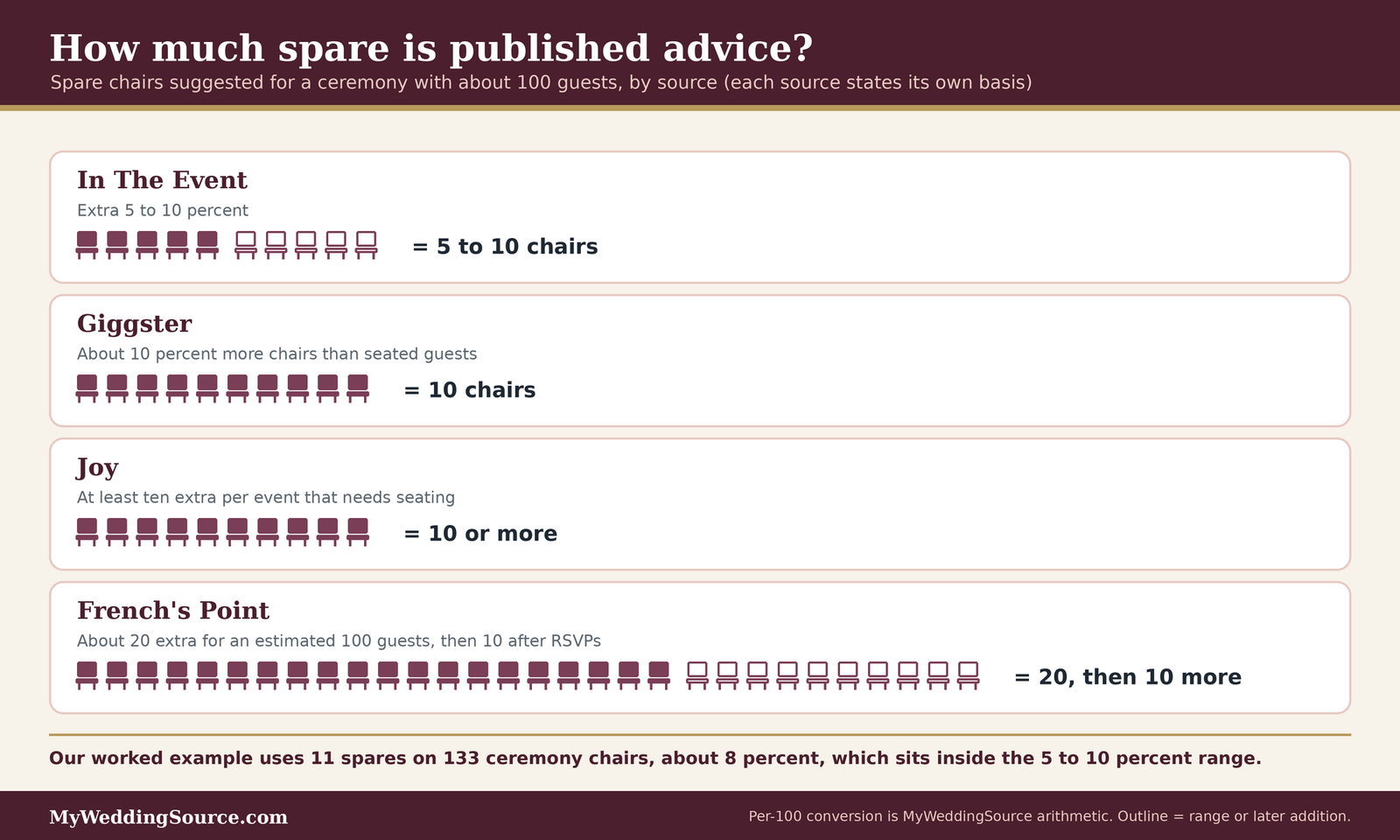
Four sources give different answers. In The Event suggests renting enough ceremony chairs to match the guest list plus an extra 5 to 10 percent so families and couples can sit together. The Joy wedding-planning guide recommends at least ten extra chairs for each event that requires seating. Giggster, a venue-booking marketplace, advises about 10 percent more chairs than seated guests, citing late additions, damaged chairs, and seating at service areas, although that page contains some internal inconsistencies, so we use only its stated rule. French’s Point, a venue, suggests about 20 extra chairs for an estimated 100 guests, then another 10 after RSVPs. Those are different rules for different situations, and they are advice, not standards.
How to pick a buffer for your list
Tie the buffer to how uncertain your count is. Months before the wedding, with RSVPs outstanding, lean toward the upper end of the published ranges, or toward the venue’s 20-per-hundred rule. After RSVPs close and your confirmed list is stable, a smaller buffer is reasonable. In our example later in this guide we use about 8 percent of the ceremony chairs, which sits inside the 5 to 10 percent range. That is a judgment call, not a standard, and you should adjust it for your own risk tolerance and cost.
Where the extras physically go
Spare chairs are only useful if they are close. Ask where the rental crew will stack them, and make sure they are out of sight lines and not blocking an exit. One practical approach is a short stack near a side door, tagged for the day-of lead. Never place spares in the aisle or in a doorway. Our guide to the wedding ceremony covers the layout choices around the rows, and the wedding rehearsal guide explains how a walk-through can reveal an aisle that is too narrow.
The reception count
The reception count is bigger, longer, and harder to see in a single glance, because chairs are scattered among tables. It becomes manageable when you split it into three parts: seats at tables, seats away from tables, and a buffer.
Seats at tables
Dinner seating is the count that most affects cost and floor space, so it should be the most precise.
Tables times seats per table
Start with the number of people who will eat, then divide by the seats per table. Giggster suggests that a 60-inch round seats 8 comfortably and 10 at most, a 72-inch round seats 10 comfortably and 12 at most, and an 8-foot rectangular table seats 8 comfortably and 10 at most. Villanova University’s conference-services sheet gives somewhat different ranges, such as 6 to 8 for a 60-inch round, which shows that sources vary. Use the comfortable number, not the maximum, for your count, and ask your rental company what it considers comfortable for the specific table it will deliver. Our wedding table shapes guide compares the options.
Head table, sweetheart table, and kids’ tables
Special tables change the math. A sweetheart table seats two. A long head table seats the wedding party and may sit on one side only, so a table for 10 may seat just 5 chairs. A kids’ table may use smaller chairs or may mix with family tables. Count each of these on their own line in your ledger, since each may use a different table and a different number of chairs per table.
Round up to full tables, then check the leftover seats
Divide the total by the seats per table and round up. If 138 people need seats and each table seats 8, that is 17.25, so you need 18 tables, or 144 seats, which leaves six empty seats. Those empty seats are not wasted. They are a built-in buffer, and they can be pulled to fix a table that gains a guest late. Count them toward your spares before you add more. Our wedding seating chart guide explains how to place guests so those empty seats are spread out and not clustered at one table.
Cocktail hour, lounge, and late-night seats
Not every guest needs a chair at every moment, but some always do.
Not everyone sits at once
In The Event notes that cocktail hours need less seating than a reception but still need chairs for children, older guests, and anyone with mobility concerns. Giggster suggests about one cocktail table per 10 to 12 guests with 30 to 50 percent of guests seated, and The Knot suggests about one cocktail table per 10 guests. For 132 guests, 30 to 50 percent is about 40 to 66 seats, which is our arithmetic from that range. If those seats come from the ceremony chairs, they are part of the flip, and if they come from lounge furniture, they are a separate rental.
Lounge furniture counts differently
A sofa or loveseat seats several people but never exactly as many as a chair would, so it should not be compared one-to-one. Ask your rental company to state the number of adults each piece seats, then use a conservative figure. Our lounge furniture rentals guide explains how lounge pieces affect space and what to ask the rental company. Lounge seating usually adds comfort without reducing the number of chairs you need for dinner.
Seats at the bar, buffet, cake, and music areas
Service areas collect people who sit for a minute: a bar with a few stools, a buffet line with a bench, a DJ with a chair. Giggster lists extra seating at service areas as one of the reasons for a buffer, and it suggests planning for about 80 to 85 percent seated capacity at a buffet because guests rotate through the line. We treat those as reasons to keep a few spares near the service areas, not as figures to build the whole count from.
The reception buffer
The reception buffer can often be smaller than the ceremony buffer, because by dinner your confirmed list and meal counts are final. But dinner brings its own risks.
Why the buffer can be smaller at dinner
Caterers usually ask for final meal counts ahead of the event, so by the reception the list is more stable than it was when you first ordered chairs. Your caterer will want to know the final number of meals, and your seating chart will have named seats. That means fewer surprises, and a small buffer, around 5 percent in our example, may be enough. If you have many unpredictable additions such as children who may or may not attend, the buffer should be larger.
Damage, loss, and the waiver question
Rental companies treat damage and loss in different ways. A Classic Party Rental, an Indianapolis rental company, says its damage waiver costs 10 percent of the rental equipment total and covers minor wear but not material damage, vandalism, misuse, or lost items, and that a 25 percent prepayment is required to reserve equipment. Those are one company’s terms, not an industry norm. Our guide to wedding rental damage waivers explains how to read the terms for the company you hire. Ask specifically whether a chair that disappears at the end of the night is charged at replacement cost.
Cost note
We do not publish chair prices, because rental rates vary by city, season, and chair style, and a number from one region would mislead in another. Instead, use the quantity from your ledger to ask for a written quote that lists the chair type, the count, the delivery and pickup fees, any set-up, stacking, or reset labor, the damage waiver, and the date the count can still change. One company, A Classic Party Rental, states that setting up tables and chairs is arranged before delivery and carries extra fees, and that chairs must be stacked in one place at teardown or additional charges may apply. Compare quotes line by line, not by the bottom number.
Covers, sashes, and linens for spare chairs
If your chairs need covers or sashes, spares need them too. The Knot’s rentals checklist notes that more basic chairs need covers or sashes, and Joy suggests extra linens in case of stains when tables are reused. A spare chair without a cover is a visible gap. Add the same number of covers and sashes as your spare chairs, and ask the rental company whether covers are counted separately from chairs.
The reset: moving from ceremony to reception
Once you have a ceremony count and a reception count, the reset (the heart of how to count extra rental chairs for ceremony and reception resets) decides how many chairs you actually rent. It is also the part of the day with the tightest timing, so it is worth planning on paper.
Flip or two sets
The first choice is whether the ceremony chairs will become dinner chairs.
Same room, same chairs
A flip works when the ceremony and reception share a space, or when the ceremony space is near enough that moving chairs is quick. It saves rental cost and delivery, and it keeps the style consistent. It requires a crew, a plan for where guests wait, and a reliable sense of timing. A rental company’s planning page describes two options for a shared outdoor space: move guests to another area during cocktail hour while the team resets, or use a layout that allows a flip. That page does not explain how long a flip takes or whether it costs extra, so ask.
Two spaces, two sets
If the ceremony is in a garden, a chapel, or a lawn, and the reception is in a hall, you may use separate sets or you may transport chairs between them. Separate sets avoid moving chairs, but you pay for both sets and for delivery to two locations. Transporting adds labor and a risk that chairs do not arrive before guests are ready to sit. Ask whether the rental company will make that move, whether the venue will, and what each would charge.
Peak demand versus the sum
The math is short. For a flip, the rental quantity is the larger of the ceremony count and the reception count, plus any spares that you want available for both. For two sets, it is the sum. Using our worked example, a flip needs 148 chairs, and two sets need 292, which is a difference of 144 chairs. That is our arithmetic from the example numbers, and your difference will depend on your counts. The takeaway is that the decision about flipping is worth more than any buffer tweak.
The reset timeline
A reset is a short project with a start, an end, and owners. Writing it down turns an uncomfortable guess into a checklist.
What happens during cocktail hour
While guests eat and mingle, a crew clears the ceremony rows, sets tables if they are not already set, places chairs at tables, and removes anything that does not belong in the dinner layout. A sensible order, in our view, is tables first, then chairs, then place settings, then final decor. Ask whether tables, linens, and place settings can be staged ahead in an adjacent room, so only chairs need to move. Our wedding vendor timeline guide shows how to share these steps with every vendor.
Who moves chairs and who pays
Do not assume that rental delivery includes labor. A Classic Party Rental states that tent, dance floor, riser, and pipe-and-drape setup is included in its price, but setting up tables and chairs is arranged before delivery and carries additional fees. Other companies differ. Ask whether the rental company, the venue, the caterer, or your own helpers will do the reset, and make sure that whoever does it is named in a contract or an email you can find later. Our wedding contract change orders guide explains how to document changes.
Ask for a written reset plan
A reset plan can be short. It should say what moves, from where to where, who does it, when it starts, when it must be finished, and what happens if the ceremony runs late. It should also say where the spare chairs will be during each stage. Send it to the venue coordinator, the caterer, the rental company, and the photographer, because the photographer will want to know when the room is ready for portraits. Our guide to wedding vendor communication deadlines covers how to send plans in time for them to be useful.
When a reset goes wrong
Most reset failures are predictable, which means you can set up a plan before they happen.
Chairs that do not match
If the ceremony and reception chairs are different styles, guests notice when they sit. If they are the same style but different finishes, photos reveal it. Confirm before delivery that chairs are from the same set, and ask the rental company what it does if some arrive with scuffs or mismatches. Keep your spares from the same set so that a replacement does not stand out.
Counts that drift during the day
Counts change after the ledger is finalized: a guest is added, a vendor needs a seat, an elderly relative asks for an armchair. Assign one person, a planner, a day-of coordinator, or a trusted relative, to own the ledger on the day. That person should be the only one who authorizes changes, and every change should be written in the ledger with a time. This prevents two helpers from adding the same chair twice or removing the same spare.
Weather and the backup room
Rain, wind, or heat can move the ceremony indoors, and then the room that was going to hold the reception now holds the ceremony. Our wedding photography rain backup and wedding ceremony wind limits guides explain how to plan for that. For chairs, the question is simple: if the ceremony moves inside, which room holds the rows, where do the dinner tables wait, and who flips the room while guests are at cocktails? Write the answer before the day, with a trigger time for the decision.
The chair ledger: a worksheet you can reuse
This is the working tool for how to count extra rental chairs for ceremony and reception resets: a one-page ledger that holds every number in one place, shows how each was built, and can be handed to a rental company as written instructions. It is our own design, not an industry standard.
The ledger layout
The ledger is a table with one row per moment and a few columns that keep the logic visible.
The columns that matter
Use these columns: moment, seated people, special seats (musicians, accessible companions, vendors), spares, total chairs, chair type, where it goes, and who moves it. Keep spares in their own column. Add a final row that says “rental order” with the peak or sum, depending on your reset choice, and a line that records the date the count can change.
| Moment | Seated people | Special seats | Spares | Total chairs | Chair type | Where it goes |
|---|---|---|---|---|---|---|
| Ceremony | Confirmed guests, less wheelchair spaces | Musicians, readers, companion seats | About 5 to 10 percent, your choice | Even number per side | Folding, resin, or other | Rows on the lawn or in the hall |
| Cocktail hour | About 30 to 50 percent of guests, one planning range | Older guests, children, mobility needs | A few near the bar | Taken from ceremony stock or lounge | Same or lounge | Edges, near bar and food |
| Dinner | Guests plus couple plus vendors | Head table, kids’ table | Empty seats at full tables, plus a few extra | Full tables times seats per table | Same set or different | At tables |
| Rental order | Peak (flip) or sum (two sets) | Covers, sashes | Counted once | One number | One type per set | Delivery and pickup times |
How to fill in each line
Fill the confirmed numbers first, then special seats, then calculate spares as a percentage and write the number of chairs, not the percentage. Round the ceremony to an even number per side. For dinner, round the table count up and write down how many empty seats result. Check each total against what your rental company can supply and what the venue allows.
Keep it live and dated
A ledger is only useful if it is current. Put a date at the top, update it when RSVPs change, and keep old versions. Send each updated version to the rental company and ask for a written confirmation. Party Rental Ltd says on its help page that you can adjust guest count and rental quantities up to two business days before delivery, but that is one company’s policy, and you should confirm your own deadline in writing.
A worked example
This is a fictional wedding, used only to show the steps of how to count extra rental chairs for ceremony and reception resets. All numbers are our own arithmetic, and your list, room, and vendors will differ.
Step one: from invitations to guests
Imagine 160 invited people. Using the Knot’s 80 percent as a planning figure gives 128, and the 60 to 85 percent range gives 96 to 136. After RSVPs, 132 people confirm, which is 82.5 percent. Among them, two use wheelchairs and five are children who need their own seats. The ceremony has three musicians who will sit, and four vendors will have dinner.
Step two: ceremony chairs
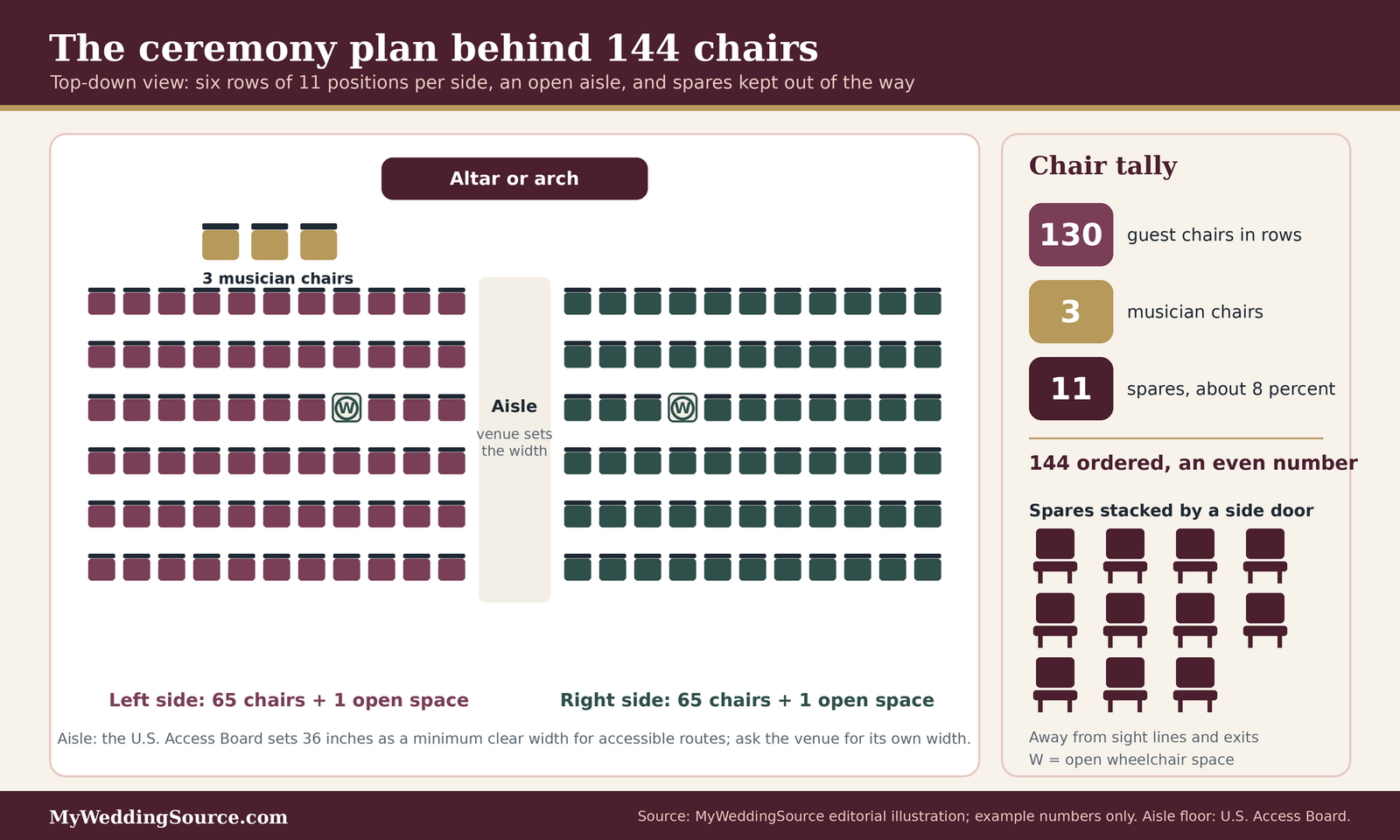
The 132 guests include two people who use wheelchairs and will stay in their own chairs in open spaces within the rows, so the rows need 130 guest chairs. Add 3 chairs for the musicians for 133. A buffer of about 8 percent is 10.64, so we round up to 11 spares, which gives 144. That total is even, and it divides into six rows of 11 positions on each side of the aisle, where each side holds 65 chairs and one open wheelchair space. The 3 musician chairs and the 11 spares sit apart from the rows.
Step three: reception chairs
At dinner, 132 guests plus the two of us plus 4 vendors make 138 seats. With 8 per table, 138 divided by 8 is 17.25, so 18 tables seat 144, which leaves six empty seats. A small buffer of 4 extra chairs for service areas and replacements brings the total to 148.
Step four: the order
If the ceremony chairs are flipped to dinner, the order is the larger count, 148. If the ceremony and dinner use separate sets, the order is 144 plus 148, or 292. Cocktail seating for 30 to 50 percent of 132 guests is about 40 to 66 seats, and in a flip those seats come from the ceremony stock. The table below puts the example into ledger form.
| Moment | Seated people | Special seats | Spares | Total chairs |
|---|---|---|---|---|
| Ceremony | 130 | 3 musicians | 11 | 144 (65 chairs and 1 open space per side, plus musicians and spares) |
| Cocktail hour | About 40 to 66 | Older guests and children | From stock | Drawn from ceremony chairs |
| Dinner | 132 guests + 2 couple + 4 vendors = 138 | Head table | 6 empty seats + 4 extra | 148 |
| Rental order (flip) | Peak of the above | 148 | ||
| Rental order (two sets) | Sum of ceremony and dinner | 292 |
Check your math under pressure
A ledger is only as good as its response to surprises. Test three before you finalize.
If the yes rate is higher than expected
Suppose 90 percent of the 160 invited, or 144 people, come. The ceremony needs 142 guest chairs plus 3 musicians, which is 145, and the example has only 144. That is one chair short, which shows that an 8 percent buffer absorbs about 11 more guests than planned but not 12. At dinner, 144 guests plus 6 others is 150 seats, which needs a 19th table of 8, and the 148 chairs in the example fall short by two. The numbers are our estimate, and the lesson is that the buffer should grow if your RSVP list is still open.
If several guests cancel
If five guests cancel, nothing is wasted if you can still reduce your order before the deadline. If you cannot, the spares simply become more spares. This is why the deadline for count changes belongs in the ledger. Ask the rental company for it before you sign.
If the ceremony moves indoors
If rain moves the ceremony into the reception room, the same chairs may be needed in rows and at tables within a short window, and the reset becomes the reverse of what you planned. Write the second plan and decide who makes the call and at what time. Our outdoor wedding infrastructure checklist covers the supporting rentals that may also change.
Chair finish, covers, and color checks
Chairs are part of the look of the room, and a count that is right can still look wrong if the finish clashes with the linens or the light. This short section borrows a swatch-testing habit from our linen guide and applies it to chairs.
Matching chairs to linens and room
Rental chairs come in finishes that look different in a catalog than in your venue.
Test a chair and a linen together
Ask the rental company whether you can see a chair in person, or at least a photo in a similar room. Place a linen swatch on or next to a chair and look at the pair, not each alone. Our wedding linen swatch testing guide explains a step-by-step approach to comparing fabric colors, and the same habit works for chair finishes, cushions, and sashes. If a chair has a warm wood tone and the linen is cool, the pairing may look off even if each looks good alone.
Check under the actual light
Light changes color. A chair that looks white outdoors may look cream in warm venue lighting, and a gold chair may look orange under certain bulbs. Look at the pair at the time of day of the event, or ask your lighting vendor what bulbs will be used. Our wedding lighting guide explains the options. We do not provide color-temperature figures here because every venue differs, and a test in your own room beats a number from a guide.
Covers, sashes, and spares
Covers and sashes add a layer to the count.
Covers need their own count
If you rent covers or sashes, order the same number as your chairs plus spares, and confirm whether the rental company includes them in the chair price. If you buy covers, order a few extra to cover stains or tears. Plan where they will be stored between the ceremony and the dinner, since a flip with covers adds time. Our wedding charger plates guide covers a related table detail that runs on the same kind of count.
Return counts and condition
At the end of the night, someone has to count the chairs, covers, and sashes back, and stack them as the rental company asks. Our guide to returning wedding rentals after a Sunday reception explains how to plan that handoff, and our wedding rental planning checklist puts the rest of the rental order in one place. If the rental company counts items on pickup, ask for a copy of the count the same day.
Questions to ask the rental company and the venue
Good questions turn a rough count into a booked order. Ask for answers in writing.
Questions to ask before you sign
- What is the last day I can change the chair count, and does the deadline differ for increases and decreases?
- Does the quote include set-up, reset, stacking, and pickup labor, or only delivery?
- How many chairs per row, and what aisle width, does the venue or fire official require for my room?
- What is the posted occupant load for the room, and which layouts have been approved?
- Who moves chairs from the ceremony to the reception, and how long do they expect it to take?
- What happens if a chair is lost, damaged, or left outside overnight, and is a waiver available?
- Can I see the exact chair model, including any cushions, covers, and sashes?
- Where will spare chairs be stored during the ceremony and the dinner?
The rental company
These questions are about quantity, price, and responsibility.
Count changes and cutoffs
Rental companies set their own deadlines. Party Rental Ltd says on its help page that you do not need a final guest count to start and that you can adjust counts and quantities up to two business days before delivery. Another company may say seven days or more. Ask for yours and write it in the ledger.
Set-up, teardown, and stacking
Ask who is responsible for each stage and what charges apply. A Classic Party Rental states that tables and chairs must be torn down and stacked in one location or extra charges may apply, and that dishware has to be scraped and rinsed. Those details are specific to that company, but the type of question applies to any of them.
Damage, loss, and the waiver
Ask what counts as damage, whether a lost chair is billed at replacement cost, and what a waiver covers and does not. Ask for the terms in writing and read them before paying a deposit. This guide does not give legal or financial advice, and rental contracts vary.
The venue and the caterer
These questions are about the room and who works in it.
Occupant load and layout approvals
Ask for the occupant load of the exact room and whether your layout, with rows and then tables, has been reviewed or needs approval. Maine’s fire marshal page says seating diagrams must be submitted to the authority having jurisdiction to increase an occupant load. Your venue may handle this, but ask.
Who resets the room
Some venues reset their own rooms and some do not allow outside crews. Ask which applies, whether there is a fee, and how many people are available. Our wedding venue questions guide lists more questions to ask on a tour.
Vendor and staff seats
Ask whether vendors and staff will use your chairs, and if so, how many. Count them in your ledger. Our wedding reception guide and reception floor plan guide show how seating interacts with the rest of the room.
Edge cases that change the count
Most weddings follow the pattern above, so the advice on how to count extra rental chairs for ceremony and reception resets holds. A few do not, and each has a quirk worth naming.
Small and large guest lists
The method scales, but the buffer should not scale in a straight line.
Very small weddings
For a small guest list, a flat number of spares often works better than a percentage. Ten percent of 20 guests is two chairs, which may not cover a late addition and a damaged chair. The Joy guide’s flat suggestion of at least ten extras per event may be more than a micro-wedding needs, so decide with your rental company how much margin is sensible and whether the minimum order changes the math. Our wedding venue capacity guide also explains how small rooms behave.
Very large weddings
For a large list, a percentage works, but the logistics of a reset grow quickly. Ask how many people the crew needs and whether a staged reset, such as moving half the room at a time, is practical. A larger room also raises the importance of the aisle count, the exit paths, and the posted occupant load, so involve the venue early.
Unusual events
A few event types stretch the method.
Outdoor lawns and temporary structures
Chairs on grass raise questions that a hall does not: how the ground is protected, whether the surface is level, and whether tents and dance floors are included. Our wedding dance floor rental over grass guide covers the ground-level questions. The Knot’s rentals checklist suggests multiplying guests by 15 for the optimal tent area and by 13 for a realistic minimum, so a tent adds a space limit to your chair count. Liberty Party Rental’s rule-of-thumb chart, reproduced by Curated Events, lists 13 to 14 guests in ceremony-style seating for a 10 by 10 foot tent and 10 guests for a sit-down dinner, which works out to roughly 7.1 to 7.7 and 10 square feet per guest by our arithmetic, so the same tent holds fewer dinner chairs than ceremony chairs.
Ceremony in a place of worship or a different venue
If the ceremony is in a house of worship or another venue with its own seating, you may not rent ceremony chairs at all. Ask what is provided, how many it holds, and whether guests who cannot sit in pews need other options. The reception count then becomes the whole rental order.
Multi-event weekends
If you hold a rehearsal dinner, a welcome party, and a reception, each needs its own ledger, and each may use different chairs, tables, or rooms. Our wedding weekend event planning guide explains how to link them, and a single master sheet that lists each event’s date and chair count can prevent double orders.
Frequently asked questions
Counting questions
How many extra chairs should I order for a wedding ceremony?
Published guides differ. One rental blog suggests 5 to 10 percent over your guest list, another recommends at least ten extra chairs per event, and a venue suggests about twenty extra per hundred guests. Choose within that range based on how settled your RSVPs are, and write the spare count separately from your seated count.
Do I count wheelchair users as chairs?
Count a guest who uses a wheelchair as a guest, but plan a space instead of a chair, and add a chair for any companion. The U.S. Access Board gives 30 by 48 inches as the minimum clear floor space for a wheelchair. Ask each guest what they need, and leave spaces within the rows, not only at the back.
Should I round the ceremony count up or down?
Round up, and make it an even number so each side of the aisle has the same count. A venue planning post suggests adding about ten chairs after RSVPs and rounding to an even number. Our method uses a percentage buffer instead, because a fixed ten means different things for a small and large list.
How many people actually say yes?
The Knot cites studies ranging from about 60 to 85 percent, with a senior editor suggesting roughly 80 percent as typical. For 160 invitations, that range gives about 96 to 136 guests. Treat it as a planning range until replies arrive, and expect a few last-minute changes even after they do.
Ordering and the day
Do I order the ceremony chairs plus the reception chairs?
Only if they are separate sets. If the same chairs will move from the ceremony to the reception, order the larger of the two counts, plus any spares. If the ceremony and reception use different chairs or different locations, order the sum. Ask your rental company whether a flip costs extra labor.
Until when can I change my chair count?
It depends on the company. Party Rental Ltd says you can change counts and quantities up to two business days before delivery, and other companies set different deadlines. Ask for the date in writing, record it in your ledger, and plan any RSVP follow-ups before then.
Who resets the room during cocktail hour?
It depends on the venue and the contract. Some venues do it with their own staff, some rental companies charge for it, and some couples hire a crew. A Classic Party Rental says table and chair setup is arranged ahead and carries fees. Name who does it, when, and how long it takes before you sign.
Does a damage waiver cover lost chairs?
Not necessarily. One rental company says its waiver covers minor wear but not material damage, vandalism, misuse, or lost items. Another may differ. Ask what the waiver covers, whether lost chairs are billed at replacement cost, and who counts items at pickup. We do not give legal advice, so read your own contract.
Your next steps
Build your ledger
If you take one habit from this guide on how to count extra rental chairs for ceremony and reception resets, make it a dated ledger.
Start with the three counts
Open a one-page sheet and write the ceremony, cocktail hour, and dinner counts separately. Add the special seats and your spares in their own columns, and date the sheet. Our wedding seating chart guide can help with the dinner layout.
Decide on a flip or two sets
Talk to your venue and rental company about whether the same chairs can serve both events, who will move them, and what it costs. Write the answer into the ledger so the order reflects it.
Lock in the details
Send the ledger in writing
Send the ledger to the rental company and the venue, ask for written confirmation of the count and the change deadline, and keep their reply with your contract. Our wedding rental planning checklist can help with the rest of the order.
Assign a day-of owner
Choose one person to own the ledger on the day, and give them the reset plan, the contact list, and the authority to approve changes. Share the plan with the photographer, the caterer, and the coordinator so everyone knows when the room will be ready.
Sources & methodology
How we built this guide
What we relied on
This guide on how to count extra rental chairs for ceremony and reception resets combines rental-company and event-planning advice on chair counts, The Knot’s reporting on RSVP rates, state and municipal fire-marshal references on occupant loads and seating, and the U.S. Access Board’s accessibility standards. Where a statement comes from a rental company, a venue, or a marketplace, we say so, because each reflects its own products and habits. The worked example, the percentage buffers, and the flip-versus-two-sets arithmetic are our own estimates from the cited ranges. The sources were read on November 12, 2026, and we did not verify whether pages have changed since.
What we did not do
We did not test chairs, measure rooms, or confirm any company’s current terms. The primary reference listed in our planning file, The Knot’s Real Weddings Study page, gave no usable guest-count figures on the page we could read, so we did not use it for numbers. Fire, building, and accessibility rules depend on your location and venue, and nothing here is legal, safety, or financial advice. Ask your venue, rental company, and local fire official for the rules that apply to you.
Source list
Government, fire-safety, and accessibility sources
- U.S. Access Board, ADA Accessibility Standards, Chapter 4: Accessible routes: https://www.access-board.gov/ada/chapter/ch04/
- U.S. Access Board, Guide to the ADA Standards, Chapter 3: Clear floor or ground space and turning space: https://www.access-board.gov/ada/guides/chapter-3-clear-floor-or-ground-space-and-turning-space
- 2010 ADA Standards, section 221 Assembly areas, wheelchair spaces (text mirror): https://www.corada.com/documents/2010ADAStandards/221-2
- Illinois Office of the State Fire Marshal, Calculating occupant loads for assembly occupancies (March 2022): https://sfm.illinois.gov/content/dam/soi/en/web/sfm/sfmdocuments/documents/calculating-occupant-loads-for-assembly-occupancies-march-2022.pdf
- Maine Department of Public Safety, Fire Marshal’s Office, Seating arrangements: https://www.maine.gov/dps/fmo/inspections-plans-review/seating
Rental companies, venues, and planning guides
- The Knot, What percentage of wedding guests RSVP yes: https://theknot.com/content/how-many-people-rsvp-no
- The Knot, Wedding rentals and lighting checklist: https://www.theknot.com/content/wedding-rentals-and-lighting-checklist
- French’s Point, How many chairs do I order for my wedding ceremony: https://www.fpmaine.com/news/chairs-wedding-ceremony/
- In The Event, Tips for optimal wedding chair rentals, part 1: https://intheevent.com/tips-for-optimal-wedding-chair-rentals-part-1/
- Joy, Wedding rentals 101: https://withjoy.com/blog/wedding-rentals-101/
- A Classic Party Rental, Wedding rentals breakdown: https://aclassicpartyrental.com/the-breakdown-wedding-rentals/
- Party Rental Ltd, Questions to ask before you start your event rental order: https://help.partyrentalltd.com/questions-to-ask-before-you-start-your-event-rental-order
- Giggster, Tables and chairs calculator guide: https://giggster.com/guide/portions/tables-chairs/
- Villanova University Conference Services, Seating formulas: https://www1.villanova.edu:443/content/dam/villanova/conferenceservices/documents/SeatingFormulas.pdf
- Curated Events (Liberty Party Rental rule-of-thumb chart), Tent size square footage: https://curatedevents.com/nashville/wp-content/uploads/2021/04/Resources-Guides-Tent-Size-Square-Footage.pdf