
A wedding registry works best when it is built from the way you actually live, priced so that every guest can find something, and checked for fees, return windows, and delivery details before the first invitation goes out, rather than assembled in one excited afternoon with a barcode scanner.
Quick answer
Start with a household inventory, not a store. Plan on roughly two registry items per invited guest (The Knot’s rule of thumb), spread across low, middle, and high prices, with a few shared-gift items for expensive things. Register at a small number of places (advice ranges from three at most to three to five, depending on who you ask) plus, if you want one, a single cash or experience fund with a plain purpose. Read the fee screen on any cash fund, because processing fees are set by the platform and can change. Put the link on your wedding website, keep it off the invitation, and write down every gift as it arrives. Save the details that cost money later (return windows, completion discounts, shipping dates) in one note, because they differ by retailer.
What a wedding registry is for, and what it is not
Most couples encounter the wedding registry as a to-do item with a deadline attached: someone says “you should register,” a store hands over a scanner gun or a link, and the list begins to fill. That is a fine way to start a list. It is not a very good way to decide what belongs on it. This guide treats the wedding registry as a small piece of household planning with a public-facing side, so that the same list serves your kitchen, your budget, and the people who want to celebrate you.
The job a registry does for you and for your guests
A wedding registry is a shared list of things you would be glad to receive, held somewhere your guests can reach it. Its first job is to save guests from guessing. Its second job is to save you from receiving a third toaster. Everything else, from the cash fund to the completion discount, is an add-on to those two jobs.
It answers “what would they actually use?”
Guests who ask where you are registered are usually asking a practical question: what can I buy that you will use and not have to return? A good wedding registry answers that question across several price levels and several tastes. It also quietly protects the relationship, because a guest who picks something from your list does not have to wonder whether it will land well.
It is a convenience, not an invoice
Etiquette writers are consistent on one point: the giver chooses the gift. The Emily Post Institute notes that a guest may buy something that is not on your list, and that an invitation carries an unspoken expectation of a gift without ever mentioning one. For you, that means the list is an offer of suggestions. It is not a price schedule, and it is not a way to measure how much someone cares. Couples who hold that view tend to write a calmer list, and they tend to respond more gracefully when a gift arrives that was never on it.
What the survey data says, and what it does not
Several wedding companies publish wedding registry and gift numbers, and the figures are useful context as long as you notice who collected them. The Knot, which operates a wedding registry platform, reports that 82% of couples set up a wedding registry as part of planning, and it publishes a guest study on what attendees spend. Those numbers come from the seller of the product, so treat them as a snapshot of the market, not a rule.
The numbers worth knowing
The Knot’s Guest Study surveyed 1,000 U.S. adults aged 18 to 54 in October 2024, and respondents had attended at least one in-person wedding that year. According to The Knot, the average wedding gift was $150. Close friends, family, and wedding party members typically spent $160, casual friends $140, and a guest’s date or plus-one $120. Six percent of guests reported giving no gift, and 25% contributed to a group gift. Separately, The Knot’s Real Weddings Study covers couples married in 2025 and recruited respondents from The Knot and WeddingWire members, so it describes people who use those sites, not every couple in the country.

Why averages should not set your list’s prices
An average of $150 sounds like a target, but it hides a wide spread. A guest who spends $60 and a guest who spends $300 produce a mean of $180, and neither of them gave that amount. If you price your whole list near the average, you will leave out the guest who wants a modest item and the one who wants a statement gift. The better use of the number is as a check at the end: once your list is built, ask whether a person with a $50 limit and a person with a $300 limit could each find three things they would be happy to buy.
Three decisions to make before you open an account
Registry platforms ask you to begin with a store, but the decisions that shape a good list come earlier. You can settle them in one conversation with your partner, ideally before either of you has browsed a catalog.
Who is likely to shop from it
Think about the actual guests. A list that serves coworkers who shop online on a lunch break is different from one that serves grandparents who prefer to walk into a store. Emily Post advises including at least one wedding registry at a physical store for guests who are not comfortable shopping online, and adding a small traditional list even if your taste runs toward camping gear or gardening, since older guests often favor classic options. If your guest list is mostly one generation, say so aloud to each other, because it changes the mix.
Things, experiences, or cash
Decide how much of the list should be physical goods, how much should be experiences such as a trip or a dinner out, and whether you want to accept cash. There is no correct split. The Knot notes that cash funds are most useful when you and your partner have already agreed on common goals, such as a house purchase, a trip, or repairs. A fund without a goal tends to feel vague to the person giving, and a list of only objects can feel limiting to a guest who would rather contribute toward something larger.
Start with your household, not a store catalog
The most common regret about registries is not that couples chose the wrong brand. It is that they registered for things they did not need and skipped things they did. Walking through your home before you open an app takes about an hour and pays for itself the first time you decide against a duplicate.
Take an inventory before you browse
Browsing a catalog invites you to want things. An inventory invites you to notice what you already have, what is worn out, and what is missing. Do the inventory together, and do it before looking at any store, because once you have seen a beautiful set of dishes it is hard to remember that you own a perfectly good set.
Walk the rooms with a notebook
Go room by room, including the closets, the bathroom, the garage, and the balcony. For each item that sees weekly use, write down whether it is in good shape, nearly done, or missing. A kitchen walk might reveal that your skillets are fine but your knives are dull and you have no baking sheets that fit your oven. A bedroom walk might reveal that you own one set of sheets that fits the bed you are keeping. This is plain arithmetic about your own life, and the list it produces is more specific than any store’s suggested checklist.
Sort what you find into keep, replace, and add
Keep means it works and you like it. Replace means it works poorly or will soon need replacing, and you would be happier with a better version. Add means it fills a gap, such as a slow cooker you do not own or the folding chairs you would need to host eight people. Registry items live in the second and third groups. If you are combining two households, a fourth group appears, which is duplicates. Decide together which version stays, and sell, donate, or store the other, because duplicates are the item category that registries are most likely to make worse.
Translate your life into categories
Once you know what is missing, group the items by how you live. A list organized around your habits reads as personal and tends to attract more thoughtful gifts than a list that copies a store’s default categories.
If you already live together
Couples who already share a home often have the basics covered, and a list full of starter pans would feel false. In that case the list can lean toward upgrades, the items you have been postponing, or things that support a new plan, such as hosting dinners, renovating a room, or traveling. Say so on your wedding website in a sentence, because guests assume that couples need a starter kit unless told otherwise.
If you are combining households or moving
Couples who are moving into a new place, or merging two existing homes into one, often have a different problem: they have plenty of items but few that match, fit the new space, or suit the way the two of you cook. Measure the new kitchen’s storage and counter space before you register for large appliances. An item that is a good idea but has nowhere to go becomes a return, and returns are where registries cost real time.
If your wedding changes how you entertain
A wedding can also be a pivot point. You might hold more holiday meals, host family who travel in, or start a hobby together. Register for the things that support that change, not the idea of it. A set of eight wine glasses is a sensible choice for a couple who will host eight; it is a less sensible choice for a couple who drinks little and has a small table.
Needs, wants, and someday items
A useful list includes all three, but you should know which is which. This keeps you from treating a splurge as a necessity and from burying something essential among decorative extras.
The replace-in-five-years test
For each potential item, ask whether you will still use it in five years and whether you would replace it yourself if it broke. Items that pass both questions earn a place. This test favors durable basics, such as cookware and bedding, over novelty items, and it makes the high-priced items easier to justify because they spread their cost across years of use.
Give someday items a single section
Some things are pure wants: the espresso machine you will use twice a week, the framed print you have wanted for years. These belong on a wedding registry, and guests often enjoy giving them, because a gift that fulfills a known wish feels personal. Keep them visible but few, and place a handful at the top of the price range so that a group of guests can share the cost.
Categories that earn a place on the list
Store registries come with default categories, usually kitchen, tabletop, bedding, bath, and home. The Knot’s registry store, for example, is organized into Kitchen, Tabletop, Home, Bed & Bath, Lifestyle, and Gift Cards & Experiences. Those headings are a handy starting point, but they are not a plan. The notes below are our own editorial reasoning about how to decide within each category, and they are not product recommendations or test results.
Everyday categories
These are the places where a wedding registry most often saves you money, because you would buy the items yourself eventually.
Kitchen and cooking
The kitchen is where inventory pays off most. Look for the item you reach for weekly and wish were better: a pan that warps, a knife that slips, a pot that is too small for the way you cook. Match capacity to the people you feed. A couple who cooks for two and hosts four times a year needs a different set than a couple who hosts every month. Avoid registering for a complete boxed set if you already own half of it, since sets often include pieces you would not choose individually.
Bedding, bath, and linens
Linens are a good wedding registry category because sizes are knowable and replacement is predictable. Write down the exact bed size, the number of beds, and how many sets you want so guests do not have to guess. Think about how often you do laundry before you ask for several sets, and choose colors that work with each other so a mismatched gift is less likely to clash.
Hosting and tabletop
If you entertain, tabletop items are where taste shows. Count how many people you actually seat and how often. Eight place settings are enough for many households. Twelve are enough only if you host twelve. Choose a pattern you will still like in a decade, or choose a simple set that mixes with what you already own.
Categories that need more thought
Some categories carry more risk of regret. They are worth including only if you have a concrete reason.
Large appliances and furniture
Large items have a high cost of a wrong choice. They may need delivery, installation, or return shipping, and they depend on your living situation. If you rent and may move, a heavy item is a risk. If you are buying a home soon, you may prefer to wait until you know the layout. A group-gift item can work well here, as long as the delivery plan is clear.
Decor and art
Decor is personal, which is why guests often hesitate to buy it without guidance. If you want decor, list items that match your style and your space. Keep the quantity small, since a wedding registry full of decorative pieces gives guests fewer practical choices.
Gift cards and experiences
Gift cards and experience vouchers can be useful, but they carry their own rules. Amazon’s completion discount terms, for example, exclude gift cards and some fund contributions from the $500 qualifying total. Before you list vouchers, read the expiration and refund terms and be sure that the date you will use them is realistic.
Categories that grow with you
A wedding registry can also include items for what is coming, not only what is here.
Things for a changing household
If you expect a move, a new hobby, a pet, or a child in the next few years, you might register for items that grow with you. Be careful: guests are often more comfortable with items you will use now. Add later items in a small section and update the list as plans become concrete.
Tools and maintenance gear
Practical items such as a toolkit, a good vacuum, a step stool, or storage solutions rarely feel glamorous, but couples who register for them often use them more than they use a decorative item. They are also usually modest in price, which makes them good candidates for the lower tiers of your price ladder.
Special situations that change the list
A wedding registry is easy to explain in a standard case and harder when your situation is different. The advice below is general, based on the etiquette sources already cited and our own reasoning, and you can adapt it.
Smaller weddings and later-in-life weddings
Couples who marry later, remarry, or have a very small guest list often own much of what a wedding registry offers.
Lean toward upgrades, experiences, or causes
When you already own a full household, you may prefer a short list, a fund for a shared goal, or a donation option. Emily Post says donation registries are fine for non-controversial causes, such as a local food bank, and not for political ones. Say plainly on your website what you would prefer, and keep it brief. Guests tend to respond well to clear, warm directions.
Keep it optional and easy
A short list with a few options is easier for guests than a full catalog, and it lowers the pressure for everyone. If you want no gifts at all, you can say so on your website, though some guests may give anyway, as an invitation carries an unspoken expectation of a gift and some guests will follow that tradition. Have a plan for receiving and thanking these gifts.
Guests who live far away
Distance changes how guests shop and how gifts reach you.
Make shipping simple for them
Guests who cannot attend still often send gifts. Registry platforms that ship to your address spare them from carrying anything and keep the cost predictable. A cash fund can also work well for distant relatives, because it avoids shipping entirely. Include one or two ways to give that do not depend on location.
Be mindful of different shopping habits
Some guests will prefer a retailer they know, and some will be uncomfortable with an unfamiliar platform. Emily Post’s advice to include one wedding registry at a physical store helps here. For guests who use payment apps, a clear link on your website is safer than passing handles through messages, for the reasons the FTC gives.
Wedding parties, family, and mixed budgets
Not every guest is in the same position, and a good list expects that.
Different relationships, different amounts
The Knot’s guest study reported different typical spending by relationship: $160 for close friends, family, and wedding party members, $140 for casual friends, and $120 for a plus-one. Those are survey figures, not expectations. A guest who is a student, between jobs, or supporting a family may spend much less, and that is fine. Your list should make modest gifts feel welcome.
A guest who offers to help in another way
Sometimes a guest offers time or skill, such as a meal, a repair, or help with a move, in place of a purchase. Accept warmly and write it in your gift log so you remember to thank them. It will not appear on any wedding registry, and it can be worth more than an item.
How many items, and at what prices
This is where most of the arithmetic lives. A list that is too short forces guests to pick from leftovers, and a list that is too long can look greedy and become tedious to maintain. Neither problem is hard to avoid once you have a rough method.
Sizing the list
There are two simple ways to size a wedding registry, and comparing them gives you a sensible range. One starts from the number of invited guests and the other starts from the number of households.
The two-items-per-guest rule
The Knot suggests starting at about double your guest count, on the reasoning that not every item will be bought and that guests need options as items disappear. With 120 invited guests, that gives about 240 items. The rule is generous because many guests are in couples or families who will give one gift between them, so it overstates what you will receive while giving everyone plenty of choice.
A household-based check
A second method counts households instead of people. Suppose your 120 guests come from about 75 households (an assumption for illustration, since couples, families, and singles mix differently). If you want each household to see three to four items it would be happy to buy, you land at roughly 225 to 300 items, similar to the first method. If you want two items per household, you land near 150. Treat anything between about 150 and 250 as a reasonable range for a list of this size, and adjust toward the low end if you have a small, close-knit guest list who will ask you directly what you want.
When to go smaller or larger
A short list suits couples who have most of what they need and a guest list that will ask. A long list suits couples starting from scratch, with many guests who will shop alone and not coordinate. Lists can also grow. Because you can add items as others sell out, it is easier to begin at the lower end and expand than to prune a bloated list that guests have already seen.
A price ladder instead of a price average
The point of varied prices is that every guest should find a comfortable option without having to look for one. A price ladder is a simple way to plan that, because it fixes the distribution before you begin choosing items.
One example of a ladder
The Knot suggests including gifts from different budgets, with some in the $50 to $200 range and some higher. Here is a worked illustration, which is our own editorial arithmetic and not a survey result. Take a 150-item list and split it into four tiers: 45 items under $50, 60 items from $50 to $150, 30 items from $150 to $300, and 15 items above $300. Using rough midpoints of $35, $100, $225, and $450, the whole list is worth about $21,000 if every item sold. That is far more than guests are likely to spend.
Checking the ladder against plausible gifts
If 75 households each gave the Knot’s reported $150 average, and 6% of guests gave nothing, the total would be somewhere near $10,500 (our estimate, assuming one gift per household). So a list worth about $21,000 would be about half bought. That is the intended outcome, not a problem: the rest stays available for later purchases, completion discounts, and guests who give after the wedding. If your list’s total value is five or six times what you can plausibly expect, it is probably padded with high-priced items nobody will buy. If it is only equal to what you expect, it has no slack for guests to choose from.
Put thoughtful items at the bottom, too
Low-priced items are easy to dismiss as filler, but they matter. A guest with a $30 budget wants a good gift as much as a guest with a $300 one, and the lower tiers are where guests buy several small items at once. Include things that you will use every day, such as good dish towels, a bread knife, or a set of mixing bowls, and avoid filling the bottom of the list with trinkets.
Showers and smaller sub-lists
A shower, if you have one, changes what people buy. Emily Post notes that shower gifts usually cost less than wedding gifts, and it suggests a separate shower registry with lower-priced items, especially if the shower has a theme.
Build a shower list with a different center of gravity
A shower list works best with small, specific items: kitchen tools, linens, bar accessories, or the contents of a themed basket. Keep the items modest and make sure you do not move the best wedding items onto it, because the same guest may be invited to both events.
Keep the two lists from competing
Name the lists plainly so that a guest knows which is which, and agree with the shower host about who shares the link. If the lists use different stores, say so in the invitation message, so no one has to compare. If you do not host a shower, you can skip this entirely, and a single list with a good spread of prices will do.
Choosing where to open your wedding registry
Where you register shapes shipping, returns, fees, and how easily guests can find your list. The choice is less about a favorite brand than about which trade-offs you can live with.
One list or several
Etiquette advice differs on how many places to use, and that difference is worth knowing because it is real.
Authorities disagree on how many
The Emily Post Institute advises limiting yourself to three registries, on the grounds that variety helps guests but a very long list reads as self-indulgent. The Knot suggests three to five, with three or four for larger guest lists of 150 or more, two or three for fewer than 100, and more than five pushing the limits. A reasonable reading is that the number matters less than the ease of finding it. Three clear places on one website page are easier for guests than five that require explanation.
Where a universal list helps
Universal registries let you gather items from several stores, plus cash funds and experiences, onto one page. The Knot suggests using only one universal registry that consolidates your store registries. Zola describes a single registry that holds gifts from more than 800 brands, local shops, and any online store through a browser extension. A universal list is often easier for guests, since they open one link. The trade-off is that the platform now sits between you and the store, so returns, delivery, and who gets the money for a purchase depend on that platform’s rules.
Keep one list that can be shopped in person
Emily Post advises including at least one wedding registry at a physical store. This is less about the store and more about the guest who wants to hold the item, or who would rather pay in person. If one of your three lists belongs to a retailer with local branches, it solves that without making the other lists less useful.
An option matrix
The table below compares the main registry types by use case and not by popularity. It reflects the sources cited in this guide and our own reasoning about trade-offs. It is a starting point for your own questions, because every retailer’s terms change.
| Option | Best fit | Trade-offs | What to confirm | Where it tends to go wrong |
|---|---|---|---|---|
| One store registry | Couples who want a single, familiar retailer and local pickup | Narrow range; guests who dislike the store have no alternative | Return window, completion discount, shipping address options | Items go out of stock and are not replaced |
| Several store registries | Couples who want variety across price and style | More lists to maintain; more rules to remember | Each store’s discount and return rules | Duplicates across lists; discounts that expire at different times |
| Universal registry | Guests who want one link; couples mixing stores, cash, and experiences | The platform controls the guest experience and policies | Fees, payout timing, who handles returns for outside items | Gifts bought “direct” from another store may not be returnable through the platform |
| Cash or honeymoon fund | Couples with a clear goal and a guest list that welcomes cash | Processing fees; some guests prefer a physical gift | Who pays the fee, payout time, how money can be moved | A vague fund purpose; a surprise fee at checkout |
| Experience registry | Couples who want a trip, class, or night out as a gift | Less familiar to older guests; vouchers may expire | Expiration, transferability, refund policy | Vouchers tied to dates that change |
| Group gift for a big item | Expensive items that no single guest would buy | Needs a platform that supports shared gifts | How partial contributions are handled | An item that is never fully funded |
| Charitable donation option | Couples who want to honor a cause | Not every guest wants to give this way | Whether the charity receives the money directly | Funds that route through a platform before reaching the charity |
How to read the table
Do not look for one winner. Look at the “what to confirm” column and ask which three questions you would have to answer for your top two options. Then answer them from the platform’s own terms, which you can usually find in the help center, instead of from a marketing page.
Who each option suits and who should skip it
A single store works well for a couple who shops there already and whose guests are local. A universal registry suits couples who want a single link and who will accept the platform’s rules. A cash fund suits couples with a goal, and it suits guests who live far away or would rather not ship. Skip a cash fund if your family or community would find the request awkward, and skip a universal list if you would rather deal directly with a single retailer’s returns. None of these is a moral choice; they are logistics.
What product pages leave out
Registry pages are built to make sharing easy. They rarely lead with the details that matter after the wedding, which are shipping, returns, and what happens to money and credits.
Shipping and who controls the date
Gifts may arrive before the wedding, after it, or in pieces. Where a platform lets you choose when to ship, as Zola describes, you can hold everything until you have a stable address. When a guest buys directly from an outside store, you may have no control over timing. Zola’s help center notes that for such gifts, the item ships straight from that store, and the couple cannot control when it arrives.
Returns and exchanges
Return windows differ widely. According to Joy’s 2026 comparison, Amazon allows 180 days, Target one year after the event for most new, unopened items, and several others 90 days. That comes from a wedding registry company that competes with the retailers it describes, so confirm the current terms with the retailer. For items bought directly from an outside store on Zola, the help center says they cannot be returned, exchanged, or cashed out through Zola.
Store credit versus cash
Some platforms let you convert cash into store credit, and some add a bonus. Zola, for example, describes a 5% bonus when cash is converted to Zola store credit. That is useful if you plan to buy from that store anyway, and it is a reason to be careful if you would rather keep the money flexible. Decide your intention before you move any funds.
Cash, honeymoon, and experience funds
Money gifts have always been acceptable, and the wedding registry is now the place many couples ask for them. The question is how to do it clearly, kindly, and without losing a slice of every gift to fees you did not notice.
Wording a fund so guests understand it
A fund works when a guest can tell, in one line, what the money is for. Emily Post says a honeymoon registry is acceptable as one of your registries and that it helps to explain what each contribution pays for. It also notes that money has always been an acceptable gift and that couples may now say it is welcome, ideally by word of mouth, using softer terms such as “contribution” or “help.”
Give each fund a plain purpose
“Honeymoon fund” is clear enough. “Our first year” or “Savings” is less so. If your goal is a down payment, a renovation, or a car repair, say so in a sentence. The Knot lists purposes couples use, including post-wedding travel, home renovations, date nights, a house purchase, and pet adoption fees. A named goal gives guests something to picture, and it keeps the request from reading as a bare ask for money.
Break a big goal into parts people can buy
Instead of one open-ended total, you can name the pieces. A trip might include a dinner at your destination, a day tour, or a night’s stay. Emily Post notes that it helps to explain what each contribution covers. Keep the pieces honest, because the money you receive may not be tied to those specific items. If you are not going to use it for exactly that dinner, describe the fund as a contribution toward the trip.
Say it where people will see it
Put the fund on your wedding website next to your other wedding registry links. Avoid printing it on the invitation, which Emily Post advises against. If you want to mention that cash is welcome, a close relative or member of the wedding party can say so when asked.
What fees really do to a gift
Cash funds are where fees show up, and platforms describe them in different ways. Because rates and terms change, read the current fee screen on the platform you choose, and treat the figures below as a snapshot from the sources we checked.
What this actually costs
On Zola’s help-center page for honeymoon funds, there is a 2.5% transaction fee, which the guest can pay at checkout or the couple can absorb. At that rate, a $150 gift nets the couple $146.25 if they absorb the fee, or costs the guest $153.75 if the guest covers it (our arithmetic). Honeyfund’s own page says it charges couples and guests no platform fee, funds out through its prepaid card or gift cards without fees, and charges a small third-party fee to send cash to PayPal, Venmo, or a bank account. Those are the platforms’ own descriptions. Check the screen your guests will actually see.
Fee models you are likely to meet
Platforms tend to use one of a few structures. A percentage fee applies to each contribution. A cash-out fee applies when the couple moves the money to a bank. An optional tip supports the platform, which Honeyfund describes as an optional contribution guests can add and couples can turn off. Some platforms make a profit in other ways, such as partner commissions or interest on money they hold. None of those is hidden, and none is inherently unfair, but each changes the number that reaches you.
The same platform can describe fees differently
When we read Zola’s pages, its main registry page describes cash funds as free to the couple and claims that rival platforms take 2 to 3% per gift. Its help-center page on honeymoon funds describes a 2.5% transaction fee that the couple or the guest can pay, and another help page says Venmo contributions carry no fee while card contributions do. These may reflect different products or different times, so we do not claim one is wrong. The practical lesson is to open the fund as a guest would and read the checkout screen before you share the link.
A worked example, with the arithmetic shown
Suppose 40 guests contribute an average of $100 each to a honeymoon fund, for $4,000 in total (an assumption for illustration). At a 2.5% card fee, the fee comes to $100. If the couple absorbs it, they receive $3,900. If guests cover it, each pays $102.50 and the couple receives $4,000. Now suppose half of those guests use a no-fee method such as Venmo, where the platform offers it. The fee drops to about $50. The numbers are small per guest, but they add up to a dinner out, and the choice of who pays is yours to make on most platforms.

Getting the money, and paying attention to its path
Money from a fund does not necessarily arrive in your account automatically. Zola describes funds that you choose to move, with a first transfer taking up to 10 business days and later transfers taking 2 to 4 business days. Honeyfund describes payouts from instant to 5 days, depending on the method.
Know your payout options before the wedding
Ask three questions: how do I move the money, how long does it take, and what does it cost? Then test the process with a small amount if you can. A honeymoon booked for a date near the wedding is hard to pay for if the payout takes two weeks and you did not plan for it.
Keep a plan for unspent money
Decide in advance what you will do if guests contribute more than the stated goal, or if your plans change. Zola’s help pages describe a hidden-target option, in which a guest who tries to exceed a hidden target is asked to give less. Many couples would rather accept the extra and describe the fund as a contribution to the larger goal. Either approach is fine, as long as the description guests see is accurate.
Safety, taxes, and the legal edges
This section is general education and not legal, tax, or financial advice. Rules differ by state and by situation, and a tax professional can answer questions about your return.
Payment safety for guests and couples
Money apps and wedding registry platforms are convenient, and scammers know it. A few habits reduce the risk for you and for anyone who sends you a gift.
Confirm who you are paying
The Federal Trade Commission advises people to confirm who will receive money before sending it through payment apps such as Venmo, Zelle, and Cash App, and warns that scammers may pose as friends or relatives. If a message that looks like it is from a guest or relative asks for money or a change of payment details, verify it using a phone number you already know.
Use links you created
Put your wedding registry and fund links on your wedding website, and share them from there. Avoid pasting payment handles into group chats where they might be copied or altered. If a guest tells you they sent money by mistake, answer promptly and ask them to contact their app or bank, because the FTC page we read does not describe how to recover a mistaken transfer, and each app has its own process.
Check statements after the wedding
The FTC also advises checking bank statements regularly and reporting unauthorized transactions to the app company and the bank. A wedding week brings many unfamiliar charges and deposits, so reconcile your fund payouts against your records within the first few weeks.
Taxes on gifts, in plain terms
Couples and guests often ask whether a cash gift is taxable. The short answer from the IRS is reassuring, with caveats.
Gifts you receive
The IRS’s Publication 525 says that property you receive as a gift is not included in your income, though income that the property later produces, such as interest, is taxable. We read the 2025 edition. Cash gifts to a couple are generally gifts in this sense, but if your situation includes anything unusual, such as a very large transfer, ask a tax professional.
Large gifts from relatives
Gift tax rules apply to the person giving, not the person receiving. The IRS says the annual exclusion is $19,000 per recipient for 2025 and 2026, and that the donor is generally responsible for any gift tax. Spouses who give together can combine their exclusions, up to $38,000 per recipient in those years. A parent contributing toward your wedding or home usually does not need to worry about this, but if a relative plans a very large gift, they should speak with a tax professional about filing requirements.
What we did not cover
We did not research state rules, business or employer gifts, or how a gift might affect benefits such as financial aid or Medicaid. If any of those apply, get advice that is specific to your situation.
Group gifts, off-registry gifts, and heirlooms
No wedding registry captures everything people give. Some of the most meaningful gifts will not be on your list, and handling them well matters as much as the list itself.
Pooling money for large items
Expensive items such as a mattress or a major appliance are easier to give when several guests share the cost. The Knot reports that 25% of guests in its 2024 guest study contributed to a group gift, which suggests it is a normal practice.
Which items suit shared gifts
Pick items with a clear price and a clear use, such as a mattress, a good vacuum, or a dining table. Avoid putting very expensive but decorative items on the list, because few guests will want to pool money for them.
Check how the platform handles partial gifts
Platforms vary in how they handle a partly funded item. Some convert partial contributions into cash or credit. Zola’s help center, for example, describes group gifting as available for the cash option on gifts from other stores, and unavailable for the buy-direct option. Before you add a big-ticket item, ask what happens if only half of it is funded.
When a guest goes off the list
Guests choose gifts for many reasons: they could not find anything in their range, they made something, or they simply did not look.
Receive it warmly
The giver chooses, as Emily Post puts it. Thank them for what they chose, not for what they might have chosen. If you will not use the gift, you can quietly exchange or donate it later, and you do not need to explain.
Exchanges without a registry receipt
A gift that was not bought through your wedding registry may not be returnable through a wedding registry. Ask for a gift receipt from the giver only if it comes up naturally, and do not ask guests to track one for you. If you cannot return it, donating or passing it to someone who will use it is a reasonable choice.
Heirlooms and in-kind gifts
Some gifts carry history, such as family china, a quilt, or jewelry. These are not purchases, and they do not fit the wedding registry model.
Accepting family items kindly
Say thank you, and say what you plan to do with it. If you cannot use an item the way the giver imagines, you can still honor it by displaying it, storing it carefully, or using it on special occasions.
Protecting valuable gifts
If an heirloom or a piece of jewelry has meaningful value, ask your insurer whether it needs separate coverage, and read our guide on engagement ring insurance and the costs people overlook for the questions that apply to any high-value item.
Telling guests, and getting the timing right
A wedding registry that nobody can find does not help anyone. Sharing it gracefully, and sequencing the work around your wedding date, takes more thought than it seems to.
Sharing the list without making it awkward
Etiquette sources agree on the broad shape here and differ on one detail, which is worth looking at closely.
Use the website as the hub
The Knot calls the wedding website the central hub for details and recommends putting the wedding registry link there. Emily Post similarly advises sharing wedding registry details by word of mouth and through the website, and making sure close family and the wedding party know where you are registered. That also means your parents, siblings, and attendants can answer when someone asks.
Keep it off the invitation
Both sources advise against printing wedding registry information on the formal invitation. They differ on a small point: The Knot says you can include a separate insert with your website link in the same envelope, while Emily Post advises leaving registry details off the invitation and its enclosures, and says preprinted store inserts are acceptable for showers but not weddings. If you want to follow the more traditional path, put the link on the website and let the invitation point to the website for details. If your guests are mostly not online, ask a relative to answer questions.
Leave it off social media
Emily Post advises against sharing the wedding registry on social media, even when the wedding registry site suggests it. The reasoning is that a public post reaches people who were not invited. If a friend asks where you are registered, answer them directly.
A timeline you can follow
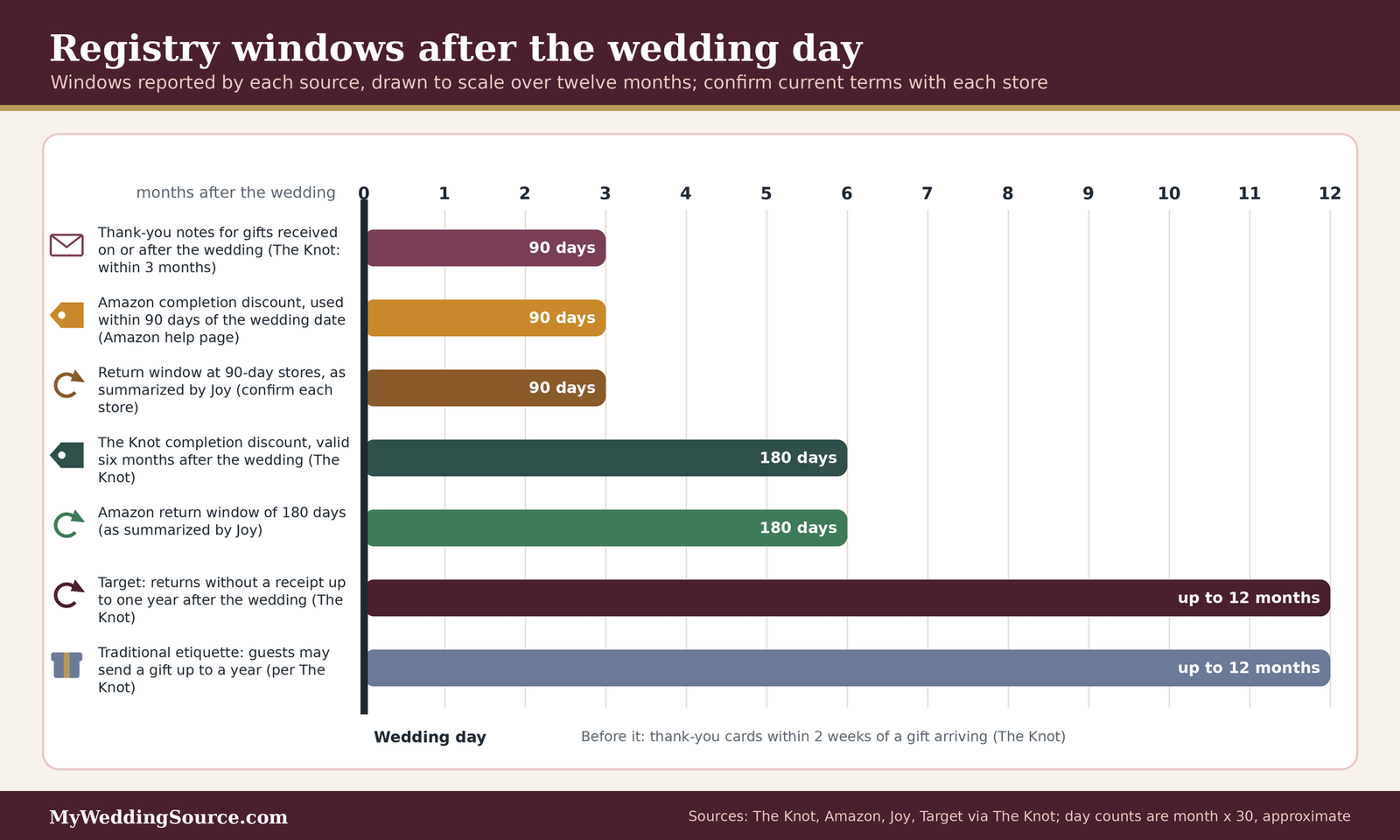
A wedding registry has no single deadline, but the order of operations matters, because some perks depend on dates. The infographic below shows common windows described by the sources in this guide, drawn to scale. Because terms change, treat it as an orientation map and confirm each one.
Months before the wedding
The Knot suggests setting up your wedding registry shortly after getting engaged, and notes that you do not need a complete list at the start. That fits with how engagements work: guests often ask about gifts early, and engagement parties or showers may prompt purchases months before the wedding. Begin with the essentials and a spread of prices, then add items as you learn more. Our wedding planning timeline shows where the registry fits among bigger bookings.
As gifts arrive
The Knot advises letting guests know as soon as a gift arrives, even if it is months before or after the wedding. In practice, that means opening boxes, logging each gift, and sending a short note. A gift that arrives before the wedding is simpler to thank for than a pile that arrives at once afterward.
After the wedding
Some perks arrive only after the wedding. The Knot’s article on completion discounts says the discount is valid for six months after the wedding, and advises waiting a few weeks so that more gifts can arrive before you buy leftover items. It also notes that, per traditional etiquette, guests have up to a year to send a gift. Add the expiration dates to your calendar so you do not miss them.
Delivery details that cause trouble
Delivery is the least glamorous part of a wedding registry and the one most likely to produce a missing package, a damaged box, or a gift left on a porch.
Choose where gifts ship
Many couples ship gifts to one trusted address, such as a parent’s house, until they have a settled home. Others hold items at the retailer until a set date, where the platform allows it. Think about who will be there to receive boxes, and whether anything large or fragile needs a signature. If you are moving soon, consider the timing before you add large items.
Keep the unboxing record
Open each box soon after it arrives, check for damage, and photograph anything broken before you contact the retailer. A short note in your gift log (who gave it, what it was, when it arrived, and its condition) helps if you need to report a problem, and it makes the thank-you note easier. For notes with photos, our wedding photographer shot list is a good place to ask whether a few portraits can be used for cards.
Plan for the honeymoon gap
If you travel right after the wedding, gifts and cards will pile up. Ask a family member to open boxes and log them, or ask the platform to hold shipments. Emily Post suggests that if thank-you notes fall behind, you should aim to finish within a month of returning from your honeymoon, so build that into your travel plans.
Verify before you click: product and policy checks
Registries make it easy to add an item with one tap. A few minutes of checking before you add it can save you from a recall, a short warranty, or a return that is not allowed.
Check the product itself
A wedding registry gift should survive normal use for years. Many problems are visible only if you look for them.
Search for recalls
The U.S. Consumer Product Safety Commission publishes recalls and safety warnings on its site, where you can filter by product category and sign up for email alerts. Before you add a small appliance or anything with a heating element, search the item’s name and brand. Searching takes a minute and avoids giving someone an item you must later stop using.
Read the warranty before it matters
The FTC says a written warranty must be available to read before you buy, in store or online, and advises checking how long coverage lasts, what is covered, and how claims work. Keep the warranty and receipt. For wedding registry gifts, that means asking the giver, or saving the wedding registry order confirmation, so that you have the paperwork if something fails after the wedding.
Look at energy and capacity specifications
For appliances, the ENERGY STAR label, run by the Environmental Protection Agency, identifies energy-efficient products. For capacity, compare the specification with your actual life: a large mixer bowl is helpful if you bake for crowds and a burden if your cabinets are small. Marketing words such as “professional” or “premium” mean little unless the page gives numbers you can compare.
Check the policies
Rules for returns, discounts, and exchanges can be buried in help pages. Before you commit, read them as a skeptical customer.
Return and exchange windows
Windows vary. A table in Joy’s 2026 returns guide reports 180 days at Amazon, a year at Target, and 90 days at several others, and notes that Joy’s own policy counts from the event date or purchase date, whichever is later. Because that comes from a competitor, treat it as a prompt to check each retailer’s page. The Knot’s article on Target says wedding registry gifts can be returned or exchanged without a receipt for up to one year after the wedding.
Completion discounts and their conditions
A completion discount is a one-time offer on items still on your wedding registry after the wedding, and its conditions matter. Amazon’s help page says registrants who reach at least $500 in qualifying wedding registry purchases receive a one-time 20% discount on select items sold and shipped by Amazon, usable on one order of up to $1,500, for a maximum saving of $300, within 90 days of the wedding date. Gift cards and some group-gift or fund contributions do not count toward the $500. The Knot’s article reports 15% at Target and Crate & Barrel, 20% at The Knot’s own store, and conditions such as adding at least one gift 45 days before you plan to redeem it.
Do the arithmetic before you plan around a discount
A completion discount is a bonus, not a strategy. With Amazon’s cap, for example, the most you can save is $300, and you reach that only by spending $1,500 on one order (our arithmetic from Amazon’s stated terms). At 15%, a $1,000 order saves $150. If a discount tempts you to keep items on the list that you do not need, you are paying for the discount with clutter.
A verification checklist
The table below turns the above into questions you can answer in about ten minutes per wedding registry. Keep the answers in one note.
| Check | Where to find it | What a good answer looks like | If the answer is unclear |
|---|---|---|---|
| Return window and starting date | Retailer or platform help page | A number of days, plus the date it starts counting | Screenshot the page and note the date you read it |
| Completion discount rule | Help page or terms | Percent, cap, deadline, and eligibility in writing | Ask support by email and save the reply |
| Cash fund fee and who pays | Guest checkout screen | A stated percentage and a choice of who pays | Test a small contribution as a guest |
| Payout timing | Fund help page | A range of days for each method | Plan a buffer before travel |
| Shipping address and hold options | Registry settings | You can change the address or delay shipment | Use a trusted address until you settle |
| Recall status of each item | CPSC recall search | No active recall for the model | Choose a different model |
| Warranty terms | Manufacturer page | Length, coverage, and how to claim | Skip items with no readable warranty |
| Outside-store gifts | Platform help | Clear rules for returns and exchanges | Prefer the option that lets you exchange |
How to use the checklist
Pick the two registries you are most likely to use and fill in each row. Then compare. If a wedding registry has an unclear answer in three or more rows, it may not be the right place for expensive items.
Save proof
Keep screenshots of the policy pages with the date. Policies change, and a screenshot is the simplest evidence of what applied when you registered. This is a habit that costs nothing and helps if a store later disputes a return.
Questions worth asking before you commit to a registry
- What is the return and exchange window, and when does it start counting?
- Is there a completion discount, and what are its percentage, cap, deadline, and conditions?
- If a guest pays by card for a cash fund, what is the fee and who pays it?
- How long does a payout take, and how much does each payout method cost?
- Can I change the shipping address or hold shipments until a date I choose?
- What happens to gifts bought directly from an outside store: can they be returned or exchanged?
- What happens to partially funded group gifts?
- Can guests see or hide the fund total, and can I hide it?
Plan for the fit and the fallback
A wedding registry is a plan, and plans need a fallback.
Test the list against your real life
Before you share the link, read it as a guest, and then as yourself six months from now. Which items would you use weekly? Which would you be glad to receive? If you cannot imagine using an item, remove it.
Decide what happens if the preferred option fails
If your first-choice platform changes fees, closes, or loses an item, have a second place ready. Keep your list in a plain note so that you can move it. If you rely on a single retailer’s discount, have a plan for what you would buy elsewhere.
Gifts in, thank-yous out
Gifts create a small administrative job. Done in a steady trickle, it takes minutes a week. Left until after the honeymoon, it can feel like a second wedding project.
Keeping a gift log
A gift log is the backbone of the thank-you process, and it also supports returns, insurance questions, and wedding registry cleanup.
What to record
Record the giver’s name, what they gave, the date it arrived, how it arrived (wedding registry, outside store, hand-delivered, cash, check), and a note on any damage or duplicates. Add a column for whether you have sent a thank-you. Record cash and checks the same way, with the amount, so you can reconcile them against your bank records.
Who keeps it
Agree on who opens boxes and who updates the log. If you share the work, set a weekly ten-minute check-in. A log kept by one person who is away is a log that stalls.
Thank-you notes, and where advice differs
Sources agree that notes should be prompt and specific, and they differ on how long you can take.
Timing
The Knot advises thanking guests as soon as a gift arrives, sending cards within two weeks for gifts that arrive before the wedding, and within three months for gifts received on or after the wedding day. Emily Post says the idea of a one-year window is a myth, advises ideally sending notes within a day or so of receiving a gift, and says that if you fall behind you should aim to finish within a month of returning from your honeymoon. A sensible reading is that three months is an outer limit, and sooner is kinder.
What to say about cash and unusual gifts
Name the gift or the amount in a way that feels natural. For cash, many people write about what the money will do, such as “we are putting it toward our trip” or “it will help with the new kitchen.” For an off-wedding registry gift, mention something specific about it. Write by hand if you can, and keep it to a few sentences.
Guests who sent a gift but did not attend
The Emily Post Institute says an invitation carries an unspoken expectation of a gift, even from guests who cannot attend. Whatever the guest decides, a note of thanks is appropriate for any gift that arrives.
Returns, exchanges, and the leftover list
After the wedding, the wedding registry shifts from a shopping list to a tool for filling gaps.
Exchange duplicates carefully
If you received two of the same item, exchange one for something you need, and check the retailer’s rule first. Joy’s returns article says its platform does not notify the giver when a gift is returned, which is one platform’s practice, not a universal rule. Keep your approach consistent: never discuss an exchange with the giver unless they ask.
Use the leftover list on purpose
Wait a few weeks after the wedding, as The Knot suggests, so late gifts can arrive. Then look at what remains, compare it to your needs, and buy only what you will use, using the discount rules you saved. If you reach the end of the window with items you do not want, let the discount lapse.
Three worked scenarios
The following examples are illustrations that we constructed for this guide. The numbers are assumptions and arithmetic, not survey data, and your own situation will differ. They are meant to show how the decisions interact.
A couple who already share a home
Maya and Daniel (illustrative names) have lived together for three years. They own cookware, a couch, and a table, and they do not want to start over.
What they register for
They register for about 100 items for 70 invited guests, a little under two per guest, because they expect guests to ask and they already own most basics. The list leans toward upgrades: a better knife set, linens in the size of their actual bed, and a few things for hosting. Because they do not need much, they add a modest home-repair fund with a one-line description.
What they check
They check return windows, a cash fund fee screen, and shipping to a relative’s address while they travel. They keep only two registries, and they hold large items for later. The result is a short list that guests find easy, a fund that guests understand, and a clear plan for what to do with leftovers.
A couple moving in together after the wedding
Priya and Sam (illustrative) are combining two apartments and moving into a larger rental. They have scattered, mismatched items and little storage.
What they register for
They register for about 220 items for 120 invited guests, closer to the two-per-guest rule, because they need a wide range. They measure the new kitchen before choosing large appliances, avoid items with no storage, and set aside a short section for items they will replace in the next year.
What they check
They compare three registries using the verification table, choose one universal list and one store with local branches, and ship gifts to Priya’s parents’ address until the move. They write down every return window in one note. When two guests send the same set of towels, they exchange one with the retailer’s rules in mind, and the giver never hears about it.
A couple with a modest budget and a large family
Elena and James (illustrative) are planning a larger wedding on a tight budget and expect many guests with modest means.
What they register for
They build a ladder with more low-priced items than average, such as kitchen tools, linens, and small appliances, and a few big-ticket items for group gifts. They add a fund with a stated purpose and decide in advance to absorb the card fee, because they know some guests will use a card.
What they check
They do the fee arithmetic: if 60 guests give an average of $75 by card, the total is $4,500 and a 2.5% fee costs $112.50 (our arithmetic, assuming the 2.5% figure applies). They decide that is acceptable. They also review their wedding budget with our wedding budget calculator, so that they do not count on gifts to pay for wedding costs, since gift amounts are unpredictable and often arrive after bills are due.
Risk register: what tends to go wrong, and the fix
Most wedding registry problems fall into a handful of categories. Naming them in advance makes them easier to avoid.
The common failure points
Each of these is a plain risk with a plain fix, and none requires special expertise.
Money and fees
A surprise fee, a slow payout, or a confusing checkout screen can cause friction. The fix is to test the checkout as a guest, read the fee terms, and plan for payout time before you need the money.
Returns and discounts
Missed return windows and lapsed discounts are the most common avoidable costs. The fix is a single note that lists each store, the window, the date it starts, and the expiration, with a calendar reminder a few weeks before the deadline.
Duplicates and gaps
Duplicates come from several lists with overlapping items. Gaps come from lists that were never updated. The fix is to review the lists monthly, remove items that have been bought elsewhere, and add items as others sell out.
A compact risk table
| Risk | Likely effect | Early warning | Fix |
|---|---|---|---|
| Fee larger than expected | Smaller payout | Fee shown only at checkout | Test as a guest; choose who pays |
| Payout delay | Cash not available when needed | Long stated transfer time | Request payout early; keep a buffer |
| Return window missed | Stuck with an unwanted item | Window shorter than expected | Calendar the date on arrival |
| Discount expires | Lost savings | No date recorded | Record dates; set reminders |
| Gift lost or damaged | Replacement hassle | Shipping to an unattended address | Ship to a reliable address; photograph damage |
| Outside-store gift cannot be returned | Duplicate or unwanted item | Item bought “direct” | Prefer options that allow exchanges |
| Thank-you backlog | Strained feelings | Boxes unopened | Log gifts weekly; write a few notes each week |
| Scam message | Loss of money | Request to change payment details | Confirm by a number you know |
How to use the table
Run through it once before the wedding and once a month afterward. If any row applies, handle it before moving on. It takes five minutes and covers most of what goes wrong.
What the table does not cover
It does not cover disputes with a retailer, product defects outside the warranty, or tax questions. For those, use the retailer’s support, the manufacturer’s warranty, and a tax professional, in that order.
Frequently asked questions
Planning the list
When should we create our wedding registry?
The Knot suggests creating it shortly after you get engaged and adding to it throughout your engagement, since you do not need a complete list on day one. Starting early helps guests who ask about gifts for engagement parties or showers, and it leaves time to test the platform and read the policies before the wedding.
How many items should a wedding registry have?
A common starting point, suggested by The Knot, is about two items per invited guest. Many couples land lower because guests come as couples and families. A range between roughly one and a half and two items per guest works for most lists, and you can add items as others sell out.
Money and cash funds
Is it rude to ask for cash on a registry?
Etiquette sources say cash has always been an acceptable gift. Emily Post says couples may now say money is welcome, ideally by word of mouth, using softer words such as “contribution.” Pair a cash fund with a traditional registry for guests who prefer a physical gift, and give the fund a clear purpose.
Do cash funds charge fees?
Often, yes, and the details vary. Zola’s help center describes a 2.5% transaction fee on card contributions that either the guest or the couple can pay, while Honeyfund says it charges no platform fee. Fees change, so open the fund as a guest and read the checkout screen before you share it.
Guests and gifts
Do guests have to buy from the registry?
No. Emily Post notes that the giver chooses the gift, and a guest may buy something not on your list. Treat the wedding registry as a set of suggestions, thank the guest for what they chose, and quietly exchange or pass along anything you cannot use.
How long do guests have to send a gift?
The Knot’s article on completion discounts says that, per traditional etiquette, guests have up to a year to send a gift. Not every guest follows that rule, and many send gifts before or at the wedding. Keep your wedding registry open and your address current for a while after the wedding.
Policies and paperwork
What is a completion discount?
It is a one-time discount on items still on your wedding registry after the wedding. The terms vary by retailer. Amazon’s help page describes 20% off select items on one order of up to $1,500 with a $300 maximum saving, after at least $500 in qualifying purchases. Read each store’s terms, because conditions and deadlines differ.
How soon should we send thank-you notes?
The Knot suggests within two weeks for gifts that arrive before the wedding and within three months for gifts received on or after the wedding day. Emily Post says sooner is better, ideally within a day or so, and to finish within a month of returning from your honeymoon if you fall behind.
Your next steps
Plan the list
Take the household inventory
Spend an hour walking through your home with a notebook, and sort what you find into keep, replace, and add. This gives you the real needs that the wedding registry should serve.
Set a size and a price ladder
Pick a target number of items from the two-items-per-guest rule and the household check, then divide them into four price tiers. Check that a guest with a modest limit and a guest with a large one can both find three things they would like.
Set it up carefully
Choose places and read the terms
Pick a small number of registries, include one that guests can shop in person, and fill in the verification table for each. For the wider picture, use our wedding planning checklist, the wedding planning guide, and our overview of how to plan a wedding.
Share it and keep records
Put the link on your wedding website and not on the invitation, start a gift log on day one, and put every return window and discount deadline in your calendar. Revisit the list monthly through the wedding.
Sources & methodology
How we built this guide
What we relied on
This guide combines published etiquette guidance from the Emily Post Institute and The Knot, registry and cash-fund terms published by Zola, Honeyfund, Amazon, and Joy, federal consumer and tax guidance from the FTC, the IRS, and the Consumer Product Safety Commission, and the EPA’s ENERGY STAR program. Where a statement comes from a registry company or retailer, we say so, because those companies describe their own products and compete with one another. The scenarios, the price ladder, the list-value comparison, and the fee examples are our own arithmetic from the figures cited and from stated assumptions, and they are estimates.
What we did not do
We did not open registry accounts, test checkout screens, or verify any company’s current terms directly with its support team. Fees, return windows, and discount rules change often, and some pages we read disagreed with each other, so confirm each term on the retailer’s own page before you rely on it. This is general information, not legal, tax, or financial advice. The Knot’s wedding-gift survey covers adults aged 18 to 54 who attended an in-person wedding in 2024, and its Real Weddings Study covers members of The Knot and WeddingWire, so neither describes every U.S. couple. Our web search quota ran out partway through research, which limited how many additional retailer policies we could check, and we chose not to cite anything we had not read.
Source list
Etiquette and survey sources
- Emily Post Institute, Wedding registry etiquette: https://emilypost.com/advice/wedding-registry-etiquette
- Emily Post Institute, Inside Weddings: Registry rules: https://emilypost.com/advice/inside-weddings-registry-rules
- The Knot, Wedding registry etiquette: https://www.theknot.com/content/wedding-registry-etiquette
- The Knot, How many places should you register for your wedding: https://www.theknot.com/content/how-many-registries-should-you-have
- The Knot, Average wedding guest cost and how to budget for it: https://www.theknot.com/content/wedding-guest-cost
- The Knot, Registry completion discounts: https://www.theknot.com/content/registry-completion-discount
- The Knot, Real Weddings Study: https://www.theknot.com/content/wedding-data-insights/real-weddings-study
Government and regulatory sources
- Federal Trade Commission, Using payment apps safely: https://consumer.ftc.gov/node/298410
- Federal Trade Commission, Warranties: https://consumer.ftc.gov/articles/warranties
- Internal Revenue Service, Frequently asked questions on gift taxes: https://www.irs.gov/businesses/small-businesses-self-employed/frequently-asked-questions-on-gift-taxes
- Internal Revenue Service, Publication 525, Taxable and Nontaxable Income: https://www.irs.gov/publications/p525
- U.S. Consumer Product Safety Commission, Recalls: https://www.cpsc.gov/Recalls
- ENERGY STAR (U.S. Environmental Protection Agency), About: https://www.energystar.gov/about
Registry platforms and retailers (their own descriptions)
- Zola, Wedding registry: https://www.zola.com/wedding-registry
- Zola, How cash and honeymoon funds work: https://www.zola.com/wedding-registry/how-cash-gifts-work
- Zola, Gifts added from other stores: https://www.zola.com/faq/115002835872-is-there-a-fee-for-gifts-added-from-other-stores-
- Honeyfund, Wedding registry fees: https://www.honeyfund.com/wedding-registry-fees
- Amazon, Wedding registry completion discount: https://digprjsurvey.amazon.com/csad/help/node/GVPHTHKGZG2SQMYE
- The Knot, Target registry: https://www.theknot.com/registry/target-registry
- Joy, Wedding registry returns guide for 2026: https://withjoy.com/blog/stress-free-wedding-registry-returns-a-brides-essential-guide-for-2026/