
An open bar wedding is easy to say yes to and hard to price, because the final bill depends on how the bar is sold, how long it stays open, who pours, and what guests actually drink, so the useful work is to separate those four things before you compare a single quote.
Quick answer
An open bar wedding means the hosts pay so guests do not. It can be bought as a per-person package, as a consumption tab (you pay for what is poured or opened), or as a hybrid with a cap. Published per-guest ranges are wide: The Knot’s bar-types guide cites about $45 to $90 per guest for a full open bar and $20 to $35 for a limited bar, while Zola cites $15 to $90 per person. Because no single average fits every venue, compare quotes by cost per guest per hour and cost per drink served, add service charge and tax separately, and keep a reserve of about 10% (our rule of thumb, not an industry standard) until the final headcount is locked.
Most couples meet the open bar wedding question in the middle of a bigger budget conversation. A venue manager says “we can do a package or you can pay on consumption,” a caterer mentions a four-hour minimum, a friend says the bar should never run dry, and a spreadsheet cell labeled “alcohol” suddenly looks very small. This guide is for that moment, and it is written for anyone planning an open bar wedding or still deciding whether to. It does not tell you whether to serve alcohol, and it does not promise a number. It gives you a way to turn vague quotes into comparable ones, a worked model you can copy, and a control system that keeps the bar from quietly becoming the largest surprise on the final invoice.
Here is how we built it. We read the bar guidance published by The Knot, Zola, a liquor retailer, a caterer, and a cost-data site, along with federal public-health definitions and government reporting on alcohol liability. Where those sources disagree, we say so. Where we do the arithmetic ourselves, we label it an estimate, and where a figure is a vendor’s own claim we attribute it. This is general planning information, not legal, insurance, or financial advice, and rules about alcohol service vary by state, county, and venue. If you are weighing a decision that has legal or insurance consequences, confirm the specifics with your venue, your caterer, your insurer, or a local attorney.
If you are still working out the wider plan, our wedding planning guide and wedding planning checklist cover where beverage decisions sit among the rest, and our wedding budget calculator is a good place to hold the number once you have one.
What an open bar wedding actually means
The phrase sounds precise, but it covers several very different arrangements. Two couples can both say they are having an open bar wedding and mean a four-hour beer-and-wine service in a rented hall or a six-hour top-shelf bar with a late-night shot station. Pinning down the definition first prevents most of the confusion that shows up later in quotes.
Open bar, limited bar, cash bar, and tickets
The cleanest way to define the choices is by who pays at the moment of service and by how much choice guests have. The Knot’s guide to bar types describes the main options, and Zola’s budgeting guide uses a similar vocabulary, so we have combined their descriptions with our own notes on what each one changes for you.
Full open bar, beer and wine, and signature-plus
In a full open bar, the hosts pay and guests can order from the whole menu, which typically means spirits, wine, beer, mixers, garnishes, and often non-alcoholic options. The Knot’s guide says this is the most common choice and puts typical spending at about $45 to $90 per guest, depending on brands and hours. A limited bar is narrower: wine and beer, sometimes one liquor, and sometimes a short list of signature cocktails. The Knot places that at roughly $20 to $35 per guest and notes that service is often cut to one to three hours. A middle path many caterers describe is beer and wine plus one or two signature drinks, which keeps labor and bottle counts down while still feeling generous. Danielle Lee of My House Events, quoted by The Knot, puts the gap between beer-and-wine and a bar with liquor at about $10 to $15 per person.
Cash bar, drink tickets, and dry receptions
A cash bar shifts the cost to guests. Zola points out that you still pay for the bar setup and the bartenders, and The Knot warns that a cash bar needs proper licensing for the people selling drinks, which is a detail your venue or caterer should confirm. Drink tickets split the difference: each guest gets a set number, which caps your cost, but The Knot notes that guests may go without once tickets run out or have to pay extra. A dry reception removes alcohol entirely, sometimes with mocktails that look like cocktails, and The Knot lists it as a respectful choice for religious, cultural, or sober-guest reasons. None of these is inherently better. They are different answers to the question of how much of the evening’s hospitality you want to pay for directly.
What the surveys say and what they do not say
Surveys of couples are useful because they show what real people chose and paid, but they answer a narrower question than “what will my bar cost?” Reading them well means knowing exactly what they measured.
What The Knot and Zola report
The Knot’s bar-types guide, which does not state its survey year on the page, reports that 57% of couples had an open bar, 21% a limited bar, 8% a dry wedding, and 6% a cash bar. A later Knot article on open bar cost, published in September 2024, cites a higher figure of 62% having an open bar in The Knot’s 2023 Real Weddings Study. The two numbers are from different studies, so the difference is not necessarily a trend. On what an open bar wedding costs, Zola’s budgeting guide reports a national average open bar cost of $5,541 in its Zola Wedding Cost Index, about 11% of a typical wedding budget, and says most couples land between $4,400 and $6,600. It does not state the survey year for that index on the page, and it was last updated in February 2026. A third-party summary of The Knot’s 2025 Real Weddings Study, from a stationery company’s blog, reports a national average alcohol spend of $2,800, but that is across all wedding types including dry and cash-bar weddings, so it is not an open bar figure. We could not verify it on The Knot’s own page.
Why one average misleads
An average for an open bar wedding mixes weddings that had no alcohol, weddings with a beer-and-wine table, and weddings with a six-hour premium bar, and it mixes cities with very different labor and liquor costs. Zola illustrates the point with a single scenario: for 150 guests at the same package and duration, it reports roughly $4,375 in Milwaukee and roughly $14,031 in New York City. As a plausibility check, our own arithmetic puts Zola’s $5,541 average across The Knot’s reported average of 116 guests at about $48 per guest. That falls inside the published per-guest ranges, but it mixes two different surveys, so treat it as a sanity check and not a benchmark. The practical lesson is to use national figures to decide whether an open bar wedding quote is wildly out of line and to use your own venue’s documents to decide what you will pay.
Separate the price drivers before you look at a total for an open bar wedding
What this actually costs
Published open bar wedding figures describe different things, so keep them apart. The Knot’s bar guide cites about $45 to $90 per guest for a full open bar. Zola cites an average open bar cost of $5,541 and a per-person range of $15 to $90. Zola also reports that service charges and gratuity often add 18% to 22% on top, and our own scenario model later in this guide (editorial arithmetic, not quotes) shows a $50-per-guest quote becoming about $63.50 per guest all-in before any reserve. Always label a figure as a survey average, a vendor quote, or your own estimate.
Every quote for an open bar wedding hides a mixture of cost types, and the type matters more than the amount. A cost that scales with every guest behaves differently from one that jumps when you add a bartender, and both behave differently from a minimum that you owe even if the night goes quietly. Sorting the lines first lets you predict what will happen to the total when your headcount, your hours, or your menu changes.
Sort every line as fixed, per-person, step, or minimum-bound
We use four labels. A fixed cost does not change with headcount, such as a one-time setup fee. A per-person cost scales directly, such as a package rate. A step cost changes in jumps, such as adding a bartender when the guest count crosses a ratio. A minimum-bound cost has a floor, such as a venue’s required bar spend. The table below applies those labels to the lines you are likely to see. It is our own framework, built from the fee types that The Knot, Zola, and the cost-data site Fash describe, and the right-hand column is our judgment about which lines you can realistically change.
| Cost line | Shape | What moves it | Controllable or structural |
|---|---|---|---|
| Package rate per guest | Per-person | Guest count, brand tier, hours | Controllable (tier, hours) |
| Bartender labor | Step | Guests per bartender, event length, setup and breakdown time | Mostly structural, partly controllable (menu complexity) |
| Bar setup and breakdown | Fixed | Venue rules, number of bars | Structural |
| Venue bar minimum | Minimum-bound | Date, season, venue policy | Structural, negotiable at booking |
| Service charge and gratuity | Percentage multiplier | Contract wording | Structural, but read it |
| Sales tax | Percentage multiplier | State and local rules | Structural |
| Corkage (if you bring alcohol) | Per-bottle | Bottles opened | Controllable |
| Champagne or sparkling toast | Per-person add-on | Guests, pour size | Controllable |
| Extra service hours | Per-hour | Hours beyond the base package | Controllable |
| Glassware, ice, mixers, garnish | Per-person or fixed | Package scope | Check the contract |
| Keg or cylinder deposits | Fixed, refundable | Equipment | Structural |
| Liquor liability coverage | Fixed | Insurer and venue requirements | Structural |
Lines that move with guest count
Package rates, toasts, and sometimes glassware scale per guest, so a drop from 130 to 110 guests changes the open bar wedding total in proportion. The important detail is which headcount the vendor bills. Some packages bill every invited guest, some bill every guest who attends, and some bill only guests over 21 or only guests who drink. The difference between billing total guests and billing drinkers can be thousands of dollars on a large wedding, so ask which count is used and when it locks.
Minimums and thresholds that break simple math
Zola notes that some venues set minimum bar spends, especially in peak season, and that you pay the minimum even if consumption is lower. A minimum turns a consumption quote into a floor. A cost-data site, Fash, reports that holiday dates can add 30% to 50% to bartender pay and that overtime may run 1.5 to 2.5 times the regular rate, though that is member-reported and undated, so confirm your own contract. Staffing thresholds create jumps too: if your caterer uses one bartender per 75 guests, 76 guests means two bartenders, and the second one costs you nearly as much as the first. Simple per-guest multiplication cannot see any of that.
Decide what is inside the bar budget
An open bar wedding budget gets blurry when one line has to carry a rehearsal dinner, a welcome reception, and an after-party. Decide on paper what the number covers so that a later overage is a decision and not a discovery.
Rehearsal dinner, welcome drinks, and after-party
Alcohol often appears at more than one event. If you are hosting a rehearsal dinner or a welcome reception, those drinks use the same pool of money unless you set up a separate line. An after-party at a bar is usually a separate purchase, often a tab or a bar minimum, and it is easy to forget in the main spreadsheet. Give each event its own row in the budget, with its own guest count and its own drinking window, and add them up at the end.
Quoted price versus all-in price
A quote is a starting point, not a bill. Zola reports that gratuity and service charges often add 18% to 22% to the bar bill, and Zola’s guidance is that if gratuity is already in the contract, additional tipping is not necessary. The per-guest ranges in The Knot’s and Zola’s guides do not say whether those percentages are inside them. Add taxes on top, and ask whether tax applies to the service charge, because practices differ by state and by the way the charge is written. Our worked scenarios later in this guide show what a 20% service charge and a 7% sales tax do to a quote, using those two numbers as labeled assumptions that you should replace with the figures from your contract.
Package, consumption, or a hybrid: comparing quotes for an open bar wedding
Venues and caterers tend to offer an open bar wedding in one of two billing shapes, and sometimes in a blend. Zola describes per-person packages as the most common approach, with predictable totals and usually setup, breakdown, and basic supplies included. It describes consumption billing as paying only for what guests drink, with less predictable costs. A caterer’s blog, Curated Events, says much the same: a flat per-head rate stays fixed regardless of consumption, while a consumption bill arrives at the end based on drinks served or bottles opened, and it calls consumption billing the more expensive of the two but better when many guests do not drink. The point of this section is to give you a rule for choosing a billing shape for your open bar wedding instead of a preference.
Per-person packages
A package for an open bar wedding is a bet that your guests will drink about as much as the vendor assumed when they set the price. If they drink less, you overpay. If they drink more, the vendor absorbs the difference. That is the entire trade, and it is why packages feel safer even when they are not cheaper.
What a package usually includes
Zola reports that packages commonly cover four to five hours of service, with extra time billed as overtime, and that they usually include setup, breakdown, and basic supplies. Tiers are usually described as well or house, call or premium, and top-shelf. Zola says premium adds roughly $5 to $10 per person and top-shelf $10 to $15 over the house tier. Fash reports a lower overall price range, with top-shelf adding $5 to $10 per guest, and notes that glassware can add $2 to $5 per person when it is not included. Those add-on numbers are not directly comparable across sources, which is why we recommend asking every vendor to list inclusions in writing before you compare prices.
When a package wins and when it overcharges
A package tends to win when the crowd is a typical drinking crowd, when the bar runs long, and when you value a known total more than a possible saving. It tends to overcharge when many guests do not drink, when the reception is short, or when the package bills every invited guest even though you expect a quiet bar. If your guest list includes many children, many guests who avoid alcohol, or a morning or early-afternoon event, ask whether the vendor offers a drinker-only count, a reduced rate for non-drinkers, or a consumption option. The Knot’s calculator notes that drinks per guest per hour run higher for events under three hours, so a short party is not automatically a light-drinking party.
Consumption billing and the break-even rule
For an open bar wedding, consumption billing sounds like fairness, since you pay for what is poured. In practice the exposure is on the high side, because a lively crowd, a long dinner delay, or a toast with refills can raise the bill, and the vendor has no reason to cap the night unless you ask.
A break-even worked example
Here is a transparent way to compare the two for an open bar wedding. The formula is: break-even drinks per drinking guest equals the package total divided by (number of drinkers times price per drink). Suppose a package quote is $45 per guest for 120 guests, or $5,400. Suppose 100 of those guests drink, and a consumption quote prices a typical drink at $9. Those numbers are our illustrative assumptions, not vendor data, and the per-guest rate sits at the low end of The Knot’s $45 to $90 range for a full open bar. Break-even is $5,400 divided by (100 times $9), which is 6.0 drinks per drinking guest. If your guests average fewer than 6, consumption billing costs less. If they average more, the package costs less. For reference, Zola and Spec’s, a liquor retailer, both describe about two drinks in the first hour and one per hour after, which over a five-hour bar is six drinks per drinking guest, exactly the break-even in this example. The Knot’s calculator cites a bartender’s rule of thumb of about five drinks over an evening, which would favor consumption by roughly $900. That is a rule of thumb from one bartender, not a survey, so treat it as a plausible lower bound.

The picture above uses the same assumptions. The point is not that consumption is better. It is that the right answer depends on a number you can estimate, so estimate it before you sign, and revisit the choice if your guest count or your hours change.
Caps, minimums, and tab controls
If you choose consumption billing, three controls turn an open-ended bill into a manageable one. First, ask for a maximum spend, at which the bar converts to a limited menu, a cash bar, or an owner approval before it continues. Fash suggests setting a maximum spend to cap costs. Second, ask how consumption is counted: by drinks poured, by bottles opened, or by bottles opened less unopened returned. Third, ask whether the minimum is a floor. Zola notes that a venue’s minimum means you pay it even if guests drink less, so a consumption quote with a high minimum is really a package in disguise. Ask who may order off the tab and when the tab closes. Without answers, a consumption bar is a variable cost with no governor.
Normalize every quote to the same yardstick
Quotes arrive with different hours, different inclusions, and different headcounts. Before you compare them, convert them into two numbers you can line up in a spreadsheet.
Cost per guest per hour
Take the quoted total, add every fee that is not already inside it, and divide by billed guests and by service hours. A $6,000 quote for 120 guests over five hours is $10 per guest per hour. A $5,400 quote for the same guests over four hours is $11.25 per guest per hour, which is more expensive per hour even though the total is lower. Hours are often the quiet variable in an open bar wedding package, and Zola reports that packages usually cover four to five hours, so check whether the clock starts at cocktail hour or after dinner.
Cost per drink served
For consumption quotes, divide the total by drinks. For packages, divide the total by an estimate of drinks served, using the six-drinks-per-drinker model above as a middle case and four to eight as the range. A package that costs $5,400 for 100 drinkers is $9 per drink at six drinks each, $13.50 at four, and $6.75 at eight. Cost per drink exposes the real difference between a house-tier package and a premium one. If you would not pay that much for one drink in a restaurant, your quote assumes that guests drink heavily, which is worth knowing before you sign.
How much liquor, wine, and beer an open bar wedding needs
Quantity planning is where an open bar wedding budget becomes concrete. Two decisions drive it: how many drinks your guests will consume, and how those drinks split among spirits, wine, and beer. Neither has one correct answer, but each can be estimated transparently.
Drinks per guest, and what counts as a drink
Start with the unit, because an open bar wedding budget is built from drinks. Planning guides count in “drinks,” but a drink is only meaningful if everyone agrees on its size.
The standard drink and your pour size
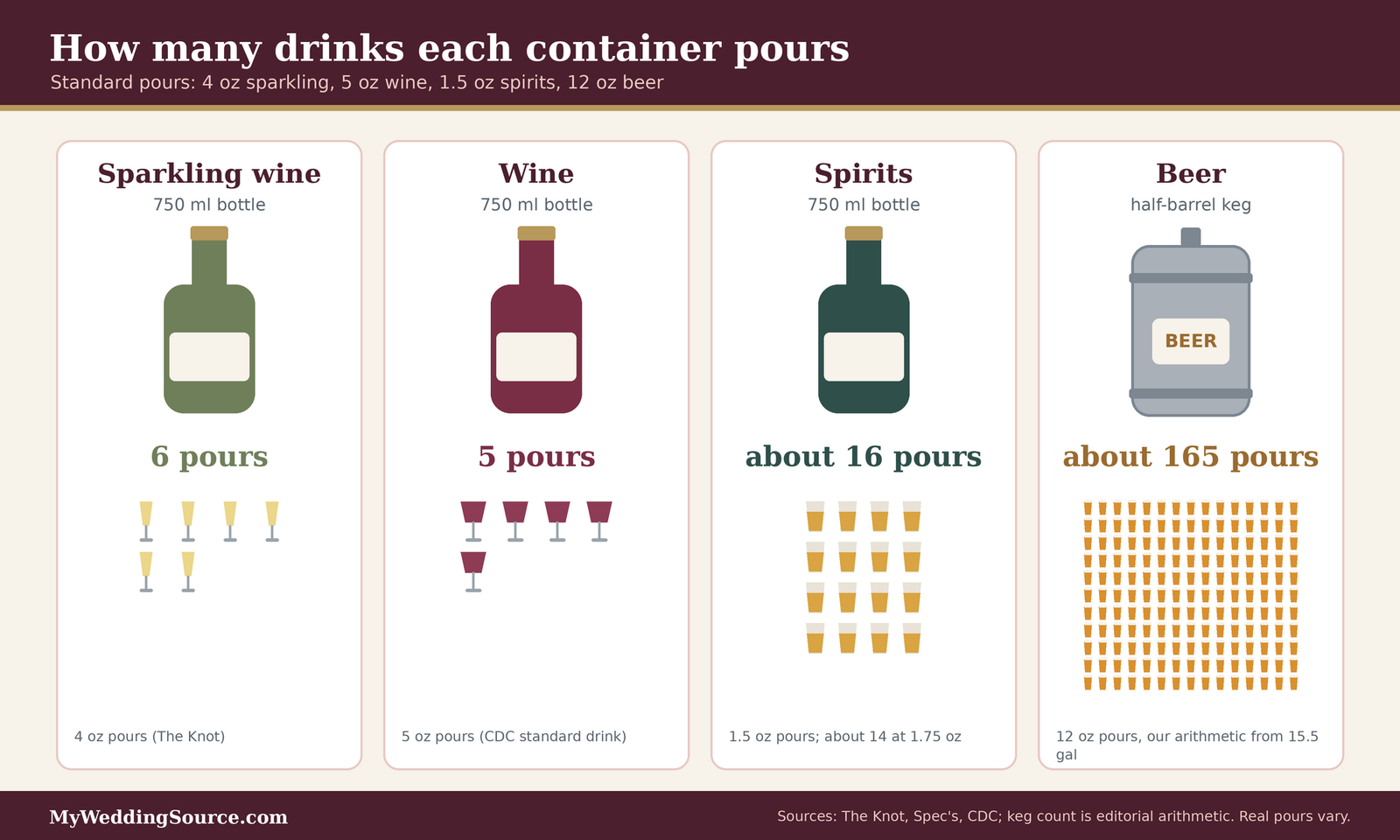
The Centers for Disease Control and Prevention defines a U.S. standard drink as containing 14 grams of pure alcohol, which is 12 ounces of 5% beer, 5 ounces of 12% wine, or 1.5 ounces of 40% distilled spirits. Bar pours often differ. The Knot’s calculator assumes 1.75-ounce liquor pours and 4-ounce champagne pours, while Spec’s assumes 1.5 ounces of liquor. A 750 ml bottle holds about 25.4 ounces, so by our arithmetic that yields about 16 to 17 pours at 1.5 ounces and about 14 at 1.75 ounces. That is why published tables list 14 drinks per bottle in one place and 16 in another. Neither is wrong. They assume different pours, and a bartender who free-pours generously will produce fewer drinks per bottle than either.
The first-hour surge and the long tail
Zola and Spec’s both describe about two drinks per guest in the first hour and one per hour after. The Bash, a wedding planning site, suggests two to three drinks per person during cocktail hour and one per hour for the rest of the reception. The Knot’s calculator cites a bartender’s rule of about one drink per hour, or five over an evening, and adds that events shorter than three hours usually run higher per hour. These are rules of thumb from vendors and planning sites, not measurements, but they agree in shape: the first hour is heaviest, and consumption flattens after dinner.
Turning drinks into bottles
Once you have a drink total, bottle counts follow from yields. The illustration above shows how many standard pours different containers deliver, using the yields published by The Knot and Spec’s together with our own arithmetic for the keg.
Splitting spirits, wine, and beer
The split matters more than most people expect when you stock an open bar wedding yourself. The Knot’s calculator calls a 50% liquor, 25% beer, 25% wine mix the recommended mix, though it does not cite a source for it. Zola’s buying guide suggests 50% wine, 30% liquor, and 20% beer. Run both through the same 120-guest, five-hour wedding in which 100 guests drink and each has six drinks, so 600 drinks. This is our estimate, using 16 pours per liquor bottle, 5 per wine bottle, and about 165 twelve-ounce pours per half-barrel keg, which is 15.5 gallons.
With the 50/25/25 split, 300 spirit drinks need about 19 bottles, 150 wine drinks need 30 bottles, and 150 beer drinks fit in one half-barrel keg. With the 50/30/20 wine-heavy split, 180 spirit drinks need about 12 bottles, 300 wine drinks need 60 bottles, and 120 beer drinks still fit in one keg. At the example prices in Spec’s own sample, $25 per liquor bottle, $15 per wine bottle, and $200 per half-barrel keg, the first split costs about $1,125 and the second about $1,400. Wine-heavy is not automatically the cheaper plan. Those prices are the retailer’s illustration, not a quote, and your local prices will differ, but the method shows how the split alone moves a purchase by hundreds of dollars.
Spare bottles, returns, and mixers
Buying exactly the arithmetic is a mistake, because a guest mix cannot be predicted to the bottle. Pad your plan, and ask where unopened product can go. The Bash advises asking large liquor stores about return policies, which often matter more than the exact padding. Mixers add up as well: Spec’s suggests about 1 liter of mixer per three guests, with three or four options, which means roughly 40 liters for 120 guests, or about $80 at its $2-per-liter example. Add ice, garnishes, and glassware to that line unless the caterer includes them. If you are hiring a company to supply everything, this entire subsection becomes their problem, and you are paying them to carry it.
Liquor tiers and what guests notice
Tier choices are the most visible lever on the per-guest rate of an open bar wedding. They are also the one most often decided by pride.
Well, call, premium, and top-shelf
Well or house liquor is the vendor’s default brand. Call brands are named brands guests recognize when they order. Premium and top-shelf tiers move up from there. Zola reports the add-on cost per person, and The Knot’s guide reports that a full-service bar covers well, call, premium, and ultra-premium tiers and is the most expensive and most varied option. The tier you pick sets the base for every cocktail made, so a small difference per drink becomes a large difference over hundreds of drinks.
Where a tier upgrade is worth it
A useful test is to ask which drinks your guests will actually order. If most orders are beer, wine, and vodka sodas, a premium tier changes little they can taste. If your guests order spirit-forward cocktails or neat pours, the tier is visible. A middle path is to keep house spirits for mixed drinks and upgrade one or two categories, such as tequila or whiskey, that matter to your crowd. The Knot’s calculator also suggests mid-priced brands over bottom-shelf or top-shelf for cost reasons. If you want signature cocktails, The Knot’s guide says to limit them, with a bartender it quotes recommending two or three and no more than five, because every extra recipe adds ingredients, prep, and lines.
Staffing the bar so the line stays short
Labor is the cost most couples forget to model in an open bar wedding, because in a package it disappears into the rate. It is still there, and it still follows rules. Even when you never see a bartender line on the invoice, staffing decides how long guests wait, how fast the bar can run, and how much the vendor has to charge.
Bartenders per guest
Published ratios disagree a little, which is useful. The disagreement tells you that the right number depends on the menu and the room, not on a formula.
Ratios from published guides
The Bash reports that 75 guests per bartender is a general rule of thumb and suggests three bartenders for 200 guests to be safe. Zola’s budgeting guide reports about one bartender per 50 to 75 guests and about one bar station per 75 to 100 guests. Fash reports one bartender per 50 guests for a full or liquor bar and one per 75 for beer and wine only. For an open bar wedding, our reading is that a menu with cocktails, a short cocktail hour, or a single bar location points to the tighter ratio, while beer and wine, a long cocktail hour, or two stations points to the looser one.

Bar stations, bar backs, and who restocks
A bartender who leaves the bar to carry ice or open cases is a bartender who is not serving. Spec’s, the liquor retailer, mentions bar backs as additional help for larger events, and prices them at $25 to $35 per hour in its guide, though it gives no ratio. Whether you need one depends on how much the bar will be restocked, how far the storage area is, and whether your vendor handles ice and glassware. A second station often shortens lines more than a second bartender behind the same station, because guests do not queue behind a single point. Ask your vendor to sketch where the bars will be, and where guests will wait while the bar is busy.
Who is allowed to pour
This is the part of the plan where you stop guessing and read documents. Alcohol service at an open bar wedding is regulated at the state and local level in the United States, and venues add their own rules on top.
Licensing and venue rules
Many venues and caterers hold the alcohol license for the event, so they control who may serve. The Bash notes that many venues and caterers restrict who can serve alcohol on site, often for insurance reasons, and that some allow you to buy your own alcohol while others do not. The Knot says that self-service bars suit small weddings but that many public venues require a certified, insured bartender on site, and that sellers of drinks need proper licensing. If a friend with bartending experience offers to pour, ask the venue in writing before you accept. The answer is often no, and the reasons are usually about liability.
Liquor liability and why vendors ask about it
Liability for alcohol service varies by state. A federal report to Congress on underage drinking reports that, as of January 1, 2021, 45 of 51 jurisdictions (50 states and the District of Columbia) imposed dram shop liability through statute, common law, or both, which means a business that serves someone may be sued if that person then injures a third party; the details differ, and the report focuses on service to people under 21. Nolo, a legal publisher, explains that some states also have social host liability, which can apply to a person who hosts a party, and that most such laws are aimed at underage drinking, though a few states can reach hosts even when the guest was of legal age. WedSafe, an insurance provider, describes host liquor liability coverage as protecting against claims from people hurt by an intoxicated guest who was served alcohol at an event you hosted, and notes that if a venue requires liability insurance and alcohol will be served, the venue will likely require liquor liability coverage. The Bash suggests hiring a bartender or company that carries liquor liability insurance, and Zola says professional bartenders should carry it. We are not lawyers, and none of this is legal advice. The practical step is to ask your venue and your caterer what coverage they hold, what they require from you, and what a one-day policy would cost.
Build scenarios instead of one average
A single number for an open bar wedding is a guess dressed as a plan. A short set of scenarios for an open bar wedding, each with its assumptions written down, is more honest and more useful, because it shows how the total reacts when something changes. The model below is our own and is built so that you can replace our assumptions with the numbers in your own contract.
Model low, base, and high cases
We built three cases that differ in guest count, hours, and tier, so the table shows both a guest-count effect and a scope effect. The per-guest rates come from the published ranges quoted earlier: roughly the middle of The Knot’s limited-bar range for the low case, the low end of The Knot’s full-open-bar range for the base case, and a rate between the middle and upper end of that range for the high case. The service charge of 20% sits within Zola’s reported 18% to 22%. The 7% tax is a placeholder, because tax rules and rates differ across the country. The 10% reserve is our rule of thumb. We add the service charge and tax as simple percentages of the quote, which is an approximation, since a contract may compound them or exempt one of them.
| Case | Guests | Hours | Scope | Package rate | Quote | Service charge (20%) | Tax (7%) | All-in | Reserve (10% of all-in) | Plan to hold | Bartenders (1 per 75 to 1 per 50) |
|---|---|---|---|---|---|---|---|---|---|---|---|
| Low | 75 | 4 | Beer, wine, two signature drinks | $30 | $2,250 | $450 | $158 | $2,858 | $286 | $3,143 | 1 to 2 |
| Base | 120 | 5 | Full bar, house spirits | $50 | $6,000 | $1,200 | $420 | $7,620 | $762 | $8,382 | 2 to 3 |
| High | 150 | 5 | Full bar, premium tier | $75 | $11,250 | $2,250 | $788 | $14,288 | $1,429 | $15,716 | 2 to 3 |
How guest count changes the result
In the base case, every guest changes the quote by $50 and the all-in total by $63.50, which is the 27% that service charge and tax add on top of the rate. Dropping from 120 to 100 guests lowers the all-in bill by about $1,270, and rising to 140 raises it by about the same. The bartender count does not move in line with that: 100 guests are still two to three bartenders under the ratios above, so if your package unbundles labor, a headcount change near a ratio boundary can add a whole bartender. This is where cost per guest per hour, calculated earlier, helps, because it shows when a rate is really a labor charge in disguise.
How fee and tax multipliers stack
In every open bar wedding case above, the quote is only about 79% of the all-in bill, because $1 of quote becomes about $1.27 once service charge and tax are added, and then about $1.40 after the 10% reserve. That reserve is the line that couples skip most often. Put the three multipliers in separate cells so that you can change each one. If the contract says that the service charge already covers gratuity, remove the tip line from your plan. If the venue taxes the service charge, raise the tax cell. If your state treats parts of the bill differently, your vendor can tell you in a sentence, and a sentence in writing is worth more than a guess.
Find the decisions that create the biggest swing
Not every line in an open bar wedding budget deserves your attention. A handful of choices account for most of the movement between a low and a high bar.
The three controllable drivers, ranked
From the scenario model, the controllable drivers rank in this order. First, scope and tier: moving from the base case’s house tier to the high case’s premium tier adds $25 per guest to the rate in our model, and The Knot’s own range spans $45 to $90, so tier and menu are the widest lever. Second, hours: Zola reports that packages usually cover four to five hours and that extra time costs overtime, and a stationery company’s blog, Paperlust, gives an unsourced estimate of $5 to $15 per person per hour beyond five hours, so every added hour is a visible line. Third, headcount billed: whether the vendor counts all guests or only drinkers. If you cannot change guest count, you may be able to change the count you are billed on.
False savings that move cost elsewhere
Some savings on an open bar wedding are real, and some are transfers. A cash bar moves the cost to your guests, and Zola notes you still pay for setup and bartenders. Bringing your own alcohol removes the package markup but adds corkage fees where venues charge them. Zola reports corkage fees without giving an amount, and Fash’s sample figures put it at $2 to $12 per bottle of wine, and the BYO route adds glassware, ice, mixers, delivery, cleanup, and your own liability. As a rough illustration using the Spec’s example prices from earlier, the bottles, keg, and mixers for the 120-guest model cost about $1,200 to $1,500 before bartenders, whose event fees Fash reports at $240 to $400 each. That can look much cheaper than a $5,400 package, but it leaves out what a package carries for you, and it only works at all if your venue permits it. A third false saving is the shorter bar with a long reception, which tends to produce a crowd at the door of the cash bar at 9 p.m. A fourth is dropping the toast: Zola puts a sparkling toast at $2 to $5 per person, and The Knot’s calculator notes that a toast is optional because guests often stick with their own drink, so a toast is a real choice but a small one.
Turn the bar budget into a control system
A budget for an open bar wedding is a statement of intent. A control system is what keeps the intent alive when a vendor sends a revised quote at 4 p.m. on a Friday. For a bar, a few simple rules are enough.
Set approval thresholds and a reserve
Write the rules before there is pressure to bend them, because money decisions are easier when nobody is in the middle of a conversation with a vendor.
Who can approve a change, and up to what amount
Pick one person to approve open bar wedding changes, and set a dollar threshold under which they can act alone and above which both partners, or whoever is paying, must agree. A tab that is open on the wedding night needs the same rule. If there is a tab, name the person who may order from it, and the amount at which the bartender should check with that person. If a planner or venue coordinator is managing the day, give them the rule in writing, so the answer is the same at 10 p.m. as it was at 10 a.m.
A rule for using the reserve
We suggest holding a reserve of about 10% of the all-in bar total, and using it for changes that improve the experience you already chose, such as an added hour or an extra bartender, and not for upgrades you rejected earlier. Spending the reserve should be a recorded decision with a date and a reason. If the reserve is untouched at the final headcount, it becomes an unallocated amount you can move deliberately, and not an invisible cushion that quietly gets spent on small things.
Reforecast when inputs change
The most common error when budgeting an open bar wedding is updating one number and forgetting that others are linked to it. The bar total depends on headcount, hours, tier, staffing, and fees at once.
Update guest count, quotes, and timing together
Each time the RSVP count changes, recalculate the bar rather than adjusting the headline total. A change in guest count may change the number of bartenders, the minimum, and the package tier available. A change in the schedule, such as a later ceremony, may change the hours billed. A change in a vendor’s quote may change the percentage you plan for. Re-run the scenario table with the new inputs in one sitting, and note the date at the top of the sheet so no one works from an old version. Our wedding planning timeline can help you decide when each of those inputs is likely to change.
Track committed, paid, and still-estimated money
For an open bar wedding, keep three columns. Committed is what a signed contract obliges you to pay. Paid is what has left your account. Estimated is everything else, including the reserve. An open bar wedding that is mostly estimated is one where the number can still move, and that is when you have the most room to adjust scope. A bar that is mostly committed is where the contract language matters most. Review the three columns after every vendor payment date and whenever the headcount is updated, and compare the sum with the number you set in our wedding budget calculator.
Pacing the night without paying for avoidable trouble
An open bar wedding that is well priced can still be badly paced. Pacing is a cost issue as well as a hospitality one, because a bar that runs hot early either costs more or runs short, and either outcome tends to be paid for in a rush.
Setting the rhythm of the evening
At an open bar wedding, the shape of the evening decides when guests drink, and therefore when you pay.
Cocktail hour, dinner, and the late stretch
The sources we reviewed agree that drinking is heaviest in the first hour. A cocktail hour that runs long with no food will push consumption up and shorten how long the bar can run on a fixed budget. Food timing is the simplest control: passed appetizers early, dinner on schedule, and late-night snacks later in the evening. If your photographer’s coverage ends at a fixed time, our wedding photographer shot list helps you plan toasts and key moments while guests are still together, since the bar and the photo timeline run on the same clock.
Last call and the end of service
Ask the vendor how last call works, who announces it, and whether the bar closes before the music ends. Ask whether the package, the venue, or its license sets an end time for service. Putting last call in the timeline avoids an awkward conversation, and it lets you decide whether to close the bar and keep water, coffee, and food available instead. If your invitation signals a dressier evening, our cocktail attire guide explains what that wording tends to tell guests about the pace of the night.
Looking after every guest
A host’s responsibilities do not end at the bar. The bar is one part of the hospitality, and the other parts are worth budgeting too.
Non-drinkers, designated drivers, and kids
At an open bar wedding, offer something good for guests who are not drinking: a mocktail, a sparkling option, good coffee and tea, and water that is easy to find. The Knot’s calculator recommends mocktails as a substitute for some liquor or as a dedicated station, and The Knot’s guide describes them as part of a dry celebration. This is also a place where a drinker-only billing count can save money, since non-alcoholic drinks may cost the vendor less than cocktails. Ask whether your vendor includes soft drinks in the package or bills them separately.
Rides home and a plan for the late hours
Think about how guests will leave your open bar wedding. If your venue is far from lodging or public transit, a shuttle, a ride-share plan, or a hotel block makes the evening easier on everyone, and it belongs in the planning timeline, not on the night. Whether you can or should do more than that is a legal and personal decision that depends on your state and your venue. Your insurer, your caterer, and your venue will each tell you what they expect of a host, and their answers are a better guide than a general article.
Questions to ask before you sign for an open bar wedding
Contracts for an open bar wedding are written by the people who run the bar, so the useful questions are the ones that surface what the contract assumes. Ask for answers in writing and attach them to the agreement.
Questions to ask before you sign
- Is the price per person, by consumption, or a hybrid with a maximum? What happens when the maximum is reached?
- Which guest count is billed, and on what date does it lock?
- How many hours are included, and when does the clock start and stop?
- What is the venue’s bar minimum, and does it apply if consumption is lower?
- Are service charge, gratuity, and tax inside the quote, and does tax apply to the service charge?
- How many bartenders and bar stations are planned for my headcount, and what does each additional one cost?
- What is included: ice, mixers, garnishes, glassware, soft drinks, and cleanup?
- What liquor liability coverage do you carry, and what do you require from me?
- May I bring my own alcohol, and if so, what are the corkage fee and the rules for who pours?
- What is the policy on unopened product, and who owns it after the event?
About the price
These questions decide whether two quotes can be compared at all.
Scope and inclusions
Ask the vendor to list, line by line, what the rate covers. A list that includes bartenders, setup, breakdown, ice, mixers, garnishes, glassware, and non-alcoholic drinks is a different product from a bare per-person rate, even when the numbers look alike. Compare the lists before you compare the totals.
Fees, minimums, and tax
Ask for the service charge, gratuity, tax, and any minimum as separate lines, and ask which are negotiable. Request a sample final invoice from a recent event, with the client’s details removed, so you can see how the pieces appear at the end.
About the service
These questions decide how the evening will actually run.
Staffing and layout
Ask how many bartenders and stations the vendor plans for your headcount, why that number, and what the plan is if the line grows. A vendor who can explain their ratio, in terms of your menu and your room, is more likely to have thought about your event.
Rules, insurance, and last call
Ask who is allowed to serve, what insurance the vendor and venue carry, what happens with guests who should not be served, and how last call is handled. These are not questions about trust. They are the ordinary steps a careful host takes, and a good vendor will answer them without hesitation.
FAQ: open bar wedding questions
Choosing the bar
Is an open bar wedding expected?
No rule requires it. The Knot’s bar-types guide describes an open bar as the most common choice, but it also lists limited bars, cash bars, drink tickets, and dry receptions as ordinary options. Choose the format that fits your budget and your guests, and communicate it clearly so no one is surprised at the bar.
Is a package or a consumption bar cheaper for an open bar wedding?
It depends on how much your guests drink and who bills what. Divide the package total by your expected drinkers times the price per drink to find the break-even number of drinks. If you expect fewer, consumption is cheaper. If you expect more, the package wins. Ask about caps and minimums either way.
Is beer and wine only acceptable?
Yes, many couples choose it. The Knot reports that a limited bar is a common budget-friendly option, and its quoted caterer puts the cost of adding liquor at about $10 to $15 per person. Adding one or two signature drinks can make a beer-and-wine bar feel more generous without the full cost of a spirits bar.
Quantities and staffing
How many drinks should I plan per guest?
Published rules of thumb vary. Zola and Spec’s describe about two drinks in the first hour and one per hour after, while The Knot’s calculator cites about one per hour. For a five-hour bar that spans roughly five to six drinks per drinking guest. Treat that as a starting estimate and adjust for your crowd.
How many bartenders do I need?
Guides range from about one bartender per 50 guests to one per 75. Fash suggests one per 50 for a full bar and one per 75 for beer and wine, while The Bash suggests about 75. Cocktails, a short cocktail hour, and a single station point toward more staff. Ask your vendor to explain their plan.
Cost and risk
How much will fees add to the quoted price?
Zola reports that gratuity and service charges often add 18% to 22% to the bar bill, and tax may be added on top. In our model, a 20% service charge and a 7% tax placeholder turn a $50 quote into about $63.50. Ask for each percentage in writing, and replace our placeholders with yours.
Can we bring our own alcohol to an open bar wedding?
Only if your venue and caterer allow it. The Bash notes that some venues permit outside alcohol and others do not, and that many restrict who may serve. Corkage fees and the cost of bartenders, ice, glassware, and insurance can reduce the savings. Ask first, and ask in writing.
Do we need liquor liability insurance?
It depends on your venue, your vendors, and your state. WedSafe, an insurance provider, says a venue that requires liability insurance will likely require liquor liability coverage when alcohol is served. Ask your venue what it requires, ask your bartender what they carry, and consult an insurance professional about your situation.
Your next steps
Get the numbers on one page
Normalize your quotes
Put every open bar wedding quote into the same sheet: billed guests, hours, tier, staffing, inclusions, service charge, tax, and minimum. Then calculate cost per guest per hour and the break-even number of drinks. If two quotes cannot be filled out the same way, ask the vendor for the missing line.
Set the plan and the reserve
Enter the base case in our wedding budget calculator, hold about 10% as a reserve, and write down who can approve changes. Revisit the sheet each time the guest count moves.
Place the bar in the larger plan
Check the calendar
Bar decisions touch your venue contract, your caterer’s deadlines, and your final headcount. Our wedding planning timeline shows where those dates tend to fall, and our guide to planning a wedding places the bar among the other early decisions.
Confirm the rules in writing
Before you pay a deposit, ask the venue and the caterer the questions above, keep the answers with the contract, and add any open items to your wedding planning checklist.
Sources & methodology
How we built this guide
What we relied on
This guide combines the bar and cost guidance published by The Knot and Zola, a liquor retailer’s planning guide, a wedding-planning site’s advice on hiring bartenders, member-reported cost data from a cost aggregator, an insurer’s description of host liquor liability, a legal publisher’s explanation of social host liability, a federal report to Congress on dram shop liability, and the Centers for Disease Control and Prevention’s definition of a standard drink. Where a figure comes from a vendor, a retailer, or a planning site, we say so, because those sources describe their own market and often omit survey years or methods. The scenario model, break-even example, bottle counts, and per-guest-per-hour figures are our own arithmetic. They use stated assumptions and example prices, and they are estimates, not quotes.
What we did not do
We did not collect vendor quotes, survey couples, or test any bar service. We could not verify The Knot’s 2025 alcohol average on The Knot’s own page, so we label it as a third-party summary. Several sources do not state the year of their figures, and some contain internal inconsistencies, which we noted where relevant. This guide is not legal, insurance, tax, or financial advice. Alcohol rules, liability, and tax treatment differ by state and venue, so confirm the details for your location with your venue, your caterer, your insurer, or a qualified professional.
Source list
Government, public-health, and legal sources
- Centers for Disease Control and Prevention, About standard drink sizes: https://cdc.gov/alcohol/standard-drink-sizes/index.html
- Interagency Coordinating Committee on the Prevention of Underage Drinking, Report to Congress 2022, Dram shop liability profile: https://www.stopalcoholabuse.gov/media/ReportToCongress/2022/profile_summaries/dram_shop_liability.pdf
- Nolo, Social host liability laws and lawsuits over alcohol-related accidents: https://www.nolo.com/legal-encyclopedia/social-host-liability-laws-and-lawsuits-over-alcohol-related-accidents.html
Wedding industry surveys and planning guides
- The Knot, 8 wedding bars to consider: https://www.theknot.com/content/types-wedding-bar
- The Knot, Open bar wedding cost: https://www.theknot.com/content/open-bar-wedding-cost
- The Knot, Wedding alcohol calculator and shopping list: https://theknot.com/content/how-to-stock-the-bar-at-your-wedding
- The Knot, 2025 Real Weddings Study press release (Business Wire, February 27, 2025): https://www.businesswire.com/news/home/20250227544757/en
- Zola, How much should you budget for an open bar at your wedding: https://zola.com/expert-advice/how-much-should-you-budget-for-an-open-bar-at-your-wedding
- Zola, How to buy alcohol for your reception: https://www.zola.com/expert-advice/how-to-buy-alcohol-for-your-reception
- The Bash, How to hire a wedding bartender: https://www.thebash.com/articles/how-to-hire-a-bartender-for-your-wedding
Retailer, insurer, caterer, and cost-data sources
- Spec’s, How to plan an open bar for a wedding: https://static.specsonline.com/blog/open-bar-wedding-planning
- WedSafe, Liquor liability insurance for weddings: https://www.wedsafe.com/Pages/liquor-liability-insurance.aspx
- Fash, How much does an open bar cost at a wedding: https://fash.com/costs/open-bar-wedding-cost
- Curated Events, How much does an open bar at a wedding cost: https://curatedevents.com/blog/how-much-does-an-open-bar-at-a-wedding-cost/
- Paperlust, How much does a wedding bar cost: https://paperlust.co/blog/how-much-does-a-wedding-bar-cost/